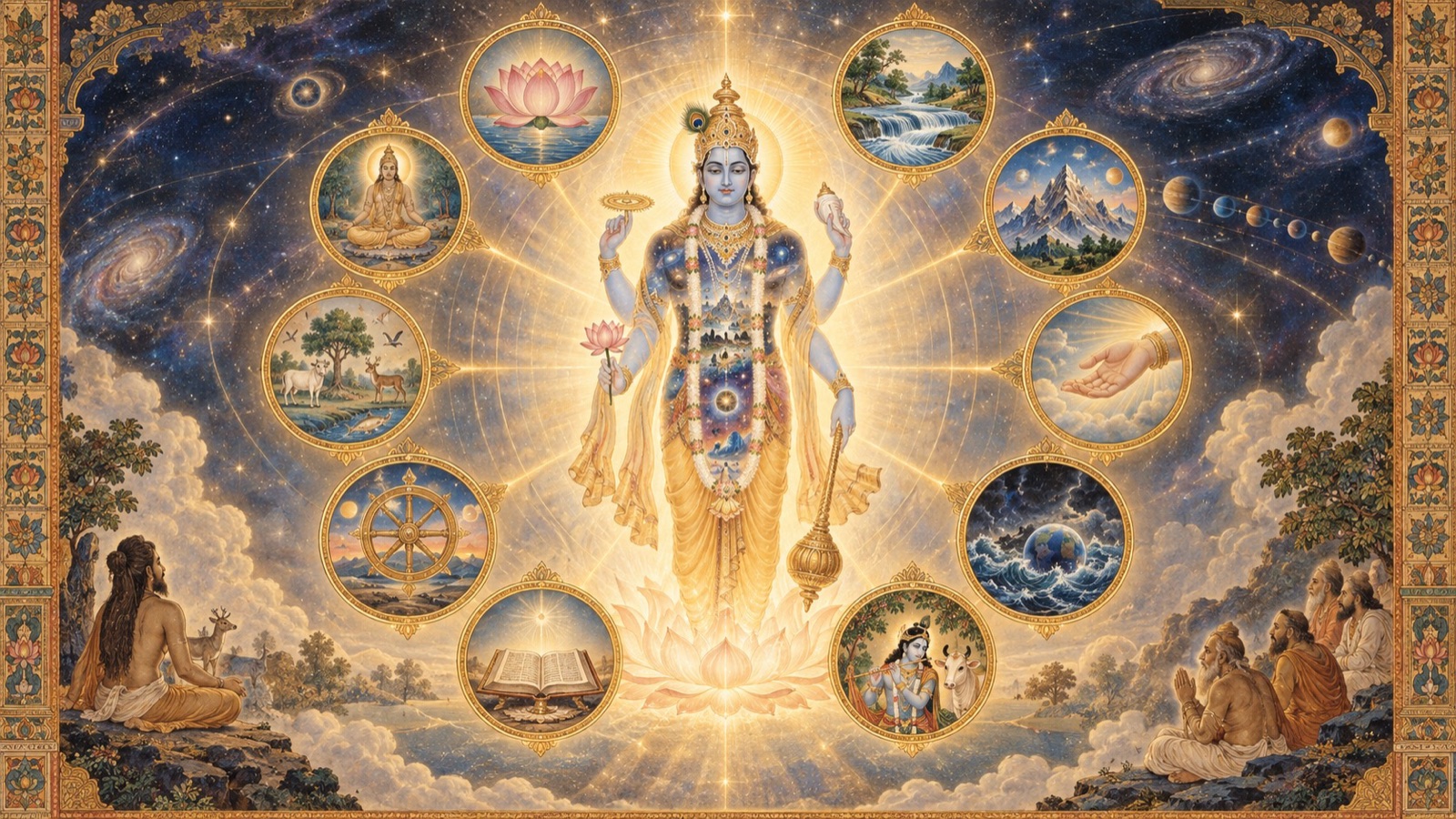
Sukadeva Gosvami names the ten characteristic topics of the Bhagavata and then unveils them in miniature, describing how the one Cosmic Being — seeking a foothold in the primordial waters — brought forth every sense, limb, and world, closing the Second Canto and opening the way to Vidura and the sage Maitreya.
Om Namo Bhagavate Vasudevaya.
Om Namo Bhagavate Vasudevaya.
Om Namo Bhagavate Vasudevaya.
Welcome to Srimad Bhagavatam Wisdom, a devotional journey through the sacred histories and teachings of the Srimad Bhagavat Mahapurana. We arrive now at the tenth and final chapter of the Second Canto — a chapter that functions almost like a table of contents spoken aloud by the scripture itself. Sukadeva Gosvami, continuing his discourse to King Parikshit, pauses the unfolding story to name the ten essential topics that the entire Bhagavata Purana will explore in the eleven cantos still to come. Having named them, he does something remarkable: rather than leave the tenth and highest topic, Asraya — the ultimate shelter of all existence — as an abstraction, he spends the rest of the chapter showing precisely how that one Supreme Being, alone in the primordial waters at the dawn of creation, brought forth the very senses, limbs, and elements that make a universe possible. It is a chapter of extraordinary density, moving from a bare list of ten Sanskrit terms to a full account of how eyes, ears, hands, and feet came to exist at all — and it closes, fittingly, the entire Second Canto, handing the narrative baton to Saunaka’s question about the pilgrim Vidura, which will carry us into the beginning of the Third.
Chapter Information
- Scripture: Śrīmad Bhāgavata Mahāpurāṇa
- Canto: 2 (Book Two)
- Chapter: 10 (Discourse X) — the final chapter of Canto 2
- Chapter title: The ten characteristic features of the Bhagavata (Gita Press chapter heading); “The Disposition of the limbs of the Cosmic Being” (Gita Press closing colophon)
- Principal speaker: Sri Sukadeva Gosvami, addressing King Parikshit; the outer frame remains Suta Gosvami narrating to the sage Saunaka and the assembly at Naimisharanya
- Principal listener: King Parikshit (within the narrated dialogue); the sage Saunaka and the sages of Naimisharanya (hearing it from Suta)
- Main setting: The riverside teaching of Sukadeva to Parikshit, framed within the forest hermitage of Naimisharanya
- Central subject: The ten characteristic topics of the Bhagavata Purana (Sarga, Visarga, Sthana, Posana, Utis, Manvantaras, Isanukathas, Nirodha, Mukti, and Asraya), followed by a detailed account of how the primeval Cosmic Being manifested the universe’s elements, senses, and presiding deities — and, in closing, Saunaka’s question that turns the narrative toward Vidura and the sage Maitreya
- Principal verse range: Canto 2, Chapter 10, verses 1–51
- Primary edition: Gita Press Śrīmad Bhāgavata Mahāpurāṇa
The Ten Topics Named
Sukadeva opens with a list that reads almost like a syllabus for the whole scripture: Sarga, Visarga, Sthana, Posana, the Utis, the Manvantaras, Isanukathas, Nirodha, Mukti, and Asraya — ten topics, he says, that the Bhagavata Purana will discuss in full. He immediately adds a teaching about how to understand this list: the wise say that the first nine of these topics are treated in this Purana only so that the tenth and final one, Asraya — the all-supporting Supreme Spirit — may be clearly conceived. Every account of creation, every genealogy of kings, every story of a Manu’s reign, is ultimately in service of helping the listener grasp the one Reality that supports all of it. This is deduced, Sukadeva notes, sometimes from the plain words of the text and sometimes from what those words imply — a small but important instruction in how to read scripture itself, alerting Parikshit (and us) not to mistake the vehicle for the destination.
श्रीशुक उवाच अत्र सर्गो विसर्गश्च स्थानं पोषणमूतय: । मन्वन्तरेशानुकथा निरोधो मुक्तिराश्रय: ॥ १ ॥
śrī-śuka uvāca atra sargo visargaś ca sthānaṁ poṣaṇam ūtayaḥ manvantareśānukathā nirodho muktir āśrayaḥ
Meaning: Sukadeva said: Here in this Bhagavata Purana, ten topics will be discussed — creation, subcreation, the sustaining of worlds, the Lord’s grace, the impulses that bind action, the passing ages of the Manus, the sacred accounts of the Lord and His devotees, the soul’s withdrawal, liberation, and the ultimate shelter. (SB 2.10.1)
Defining Each Topic: From Sarga to Asraya
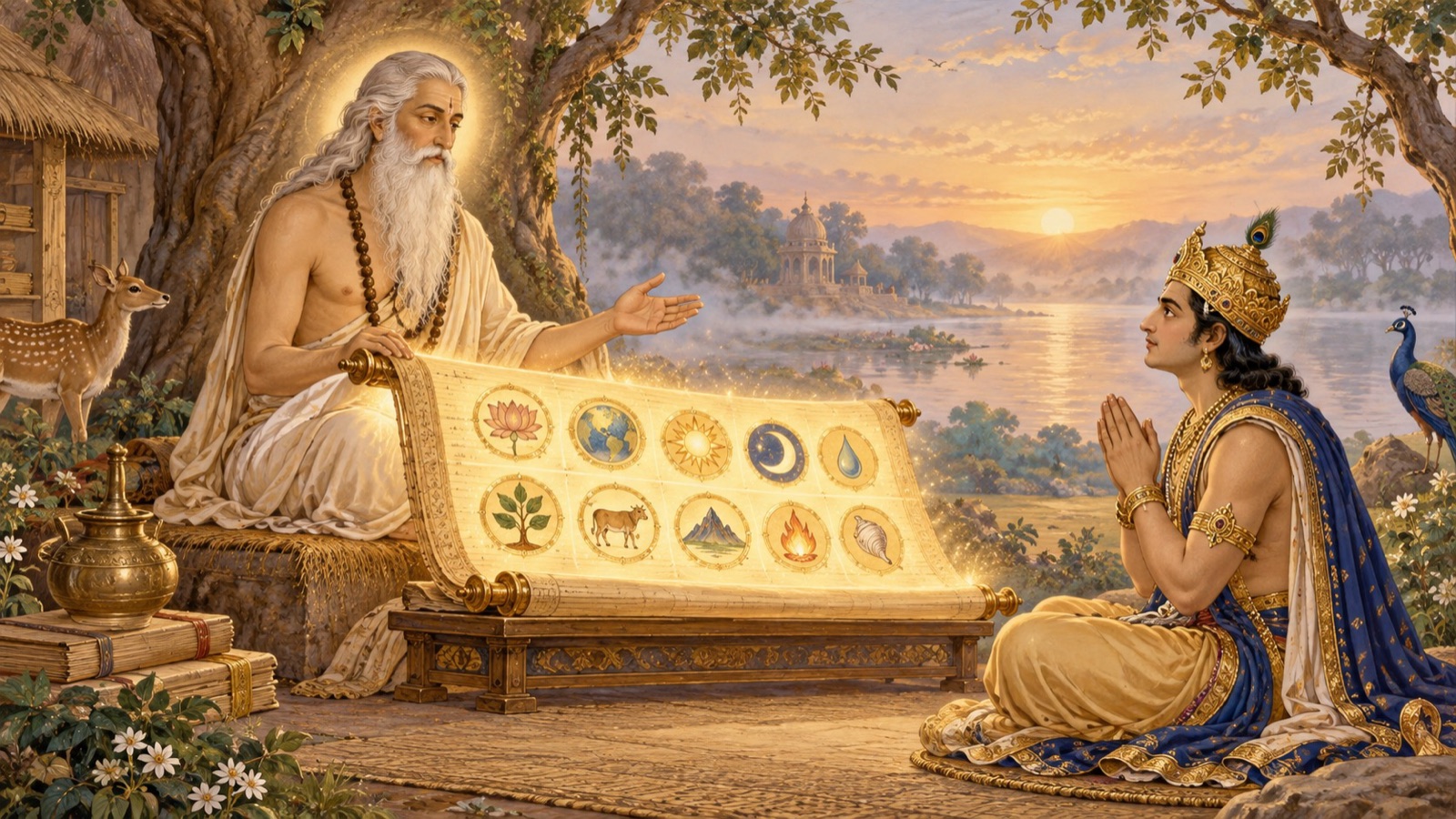
Having named the list, Sukadeva now defines each term with the precision of a teacher who wants no ambiguity left. Sarga is the creation — in reverse order — of the gross and subtle elements, the senses, the organs of action, the mind, the ego, and the Mahat-tattva, all arising from a disturbance in the equilibrium of the three Gunas by the Lord’s will; Visarga is the subsequent creation of animate and inanimate beings by Brahma himself. Sthiti is the Lord’s sustaining triumph, by which living beings keep within their bounds; Posana is His grace toward His devotees. The virtuous conduct of the saintly Manus who preside over each age is called by the name Manvantara, while the latent desires that bind creatures through interested action are called Utis. The life-accounts of the Lord’s manifestations and of His devotees, together with related stories, are Isanukathas. Nirodha is the withdrawal of the individual soul into the Lord as He retires into Yoganidra, and Mukti is the liberation that follows when the soul lets go of its assumed identity and realizes its true nature. And Asraya, finally, is that from which creation, preservation, and dissolution are known to proceed — spoken of in scripture as the Supreme Brahma, the Supreme Spirit, the Paramatma. Sukadeva closes this section with a subtle logical proof: the perceiving soul, the senses, and the deities who preside over those senses cannot be known apart from one another, and so whoever knows and supports all three is the true Asraya — a support that needs no further support beyond itself.
The Cosmic Being Seeks a Foothold
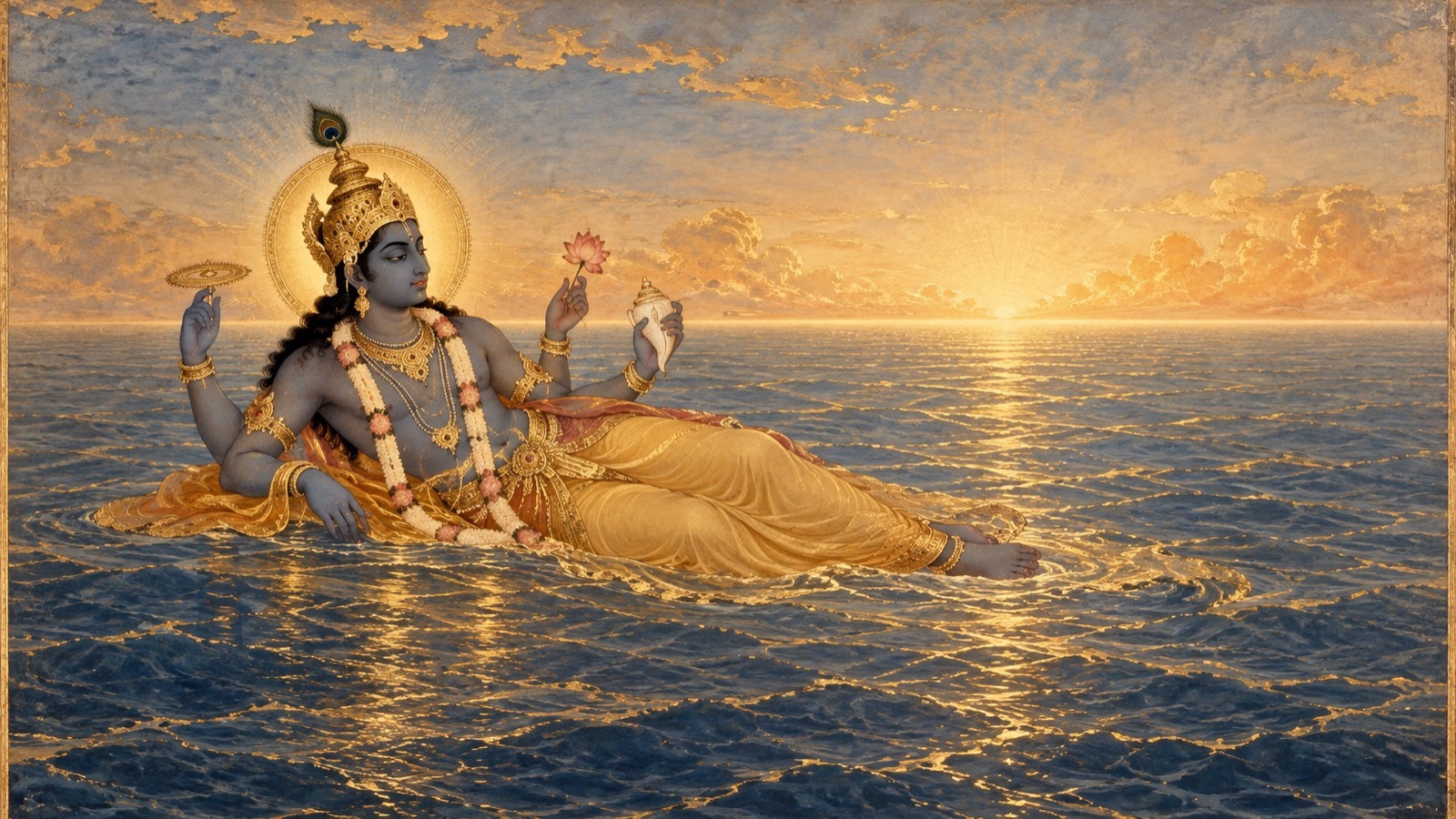
With the definitions complete, Sukadeva turns to illustrate the tenth topic directly, and the chapter shifts from philosophy into vivid narrative. When the Cosmic Being emerged from the egg-shaped universe and stood apart from it, He looked for a foothold, and in His purity of intention, He created the holy waters. Because these waters proceeded from Him — who is also called Nara — they came to be known as “Nara” themselves; and because the Lord dwelt upon these self-created waters for a thousand celestial years, He became known as Narayana, “He who resides in the Nara.” Sukadeva adds a striking note here: the gross elements of the universe, Karma, Time itself, and the very mutability of Matter and the individual souls exist only by His grace, and would cease the instant He grew indifferent to them. This is not a distant, uninvolved creator but a Being whose continued attention is the only thing holding creation together.
द्रव्यं कर्म च कालश्च स्वभावो जीव एव च । यदनुग्रहत: सन्ति न सन्ति यदुपेक्षया ॥ १२ ॥
dravyaṁ karma ca kālaś ca svabhāvo jīva eva ca yad-anugrahataḥ santi na santi yad-upekṣayā
Meaning: Matter, action, time, the tendencies of nature, and the very souls meant to make use of them all exist only because He extends His grace toward them — and would cease to exist the instant He grew indifferent to them. (SB 2.10.12)
Awakening: Prana, the Senses, and the Elements of a Body
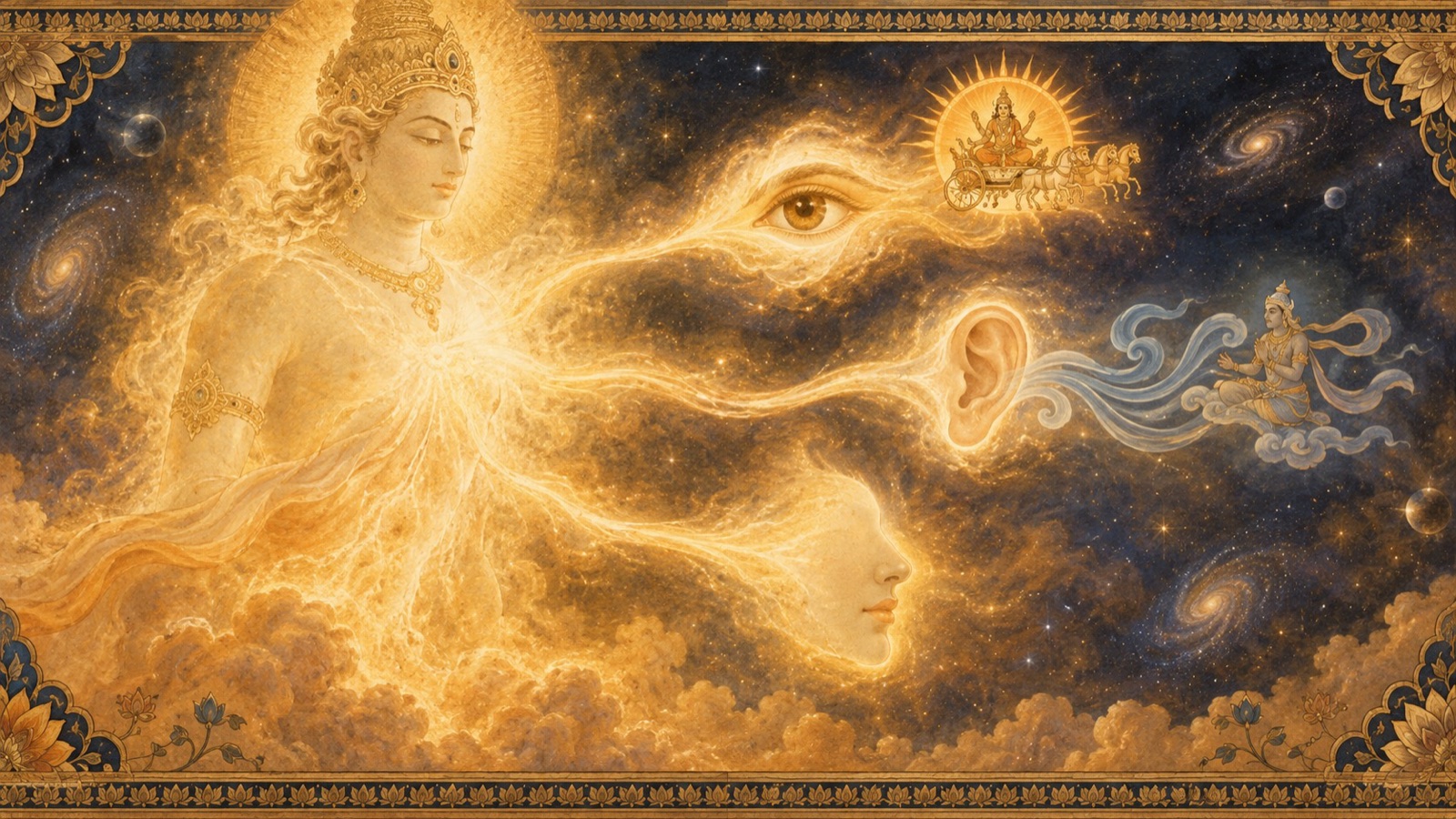
Sukadeva then describes how, awakening from His Yoganidra, the Lord — until then utterly alone — sought to multiply Himself, and by His own Maya split His effulgent seed-body into three: the Adhidaiva, the divine aspect; the Adhyatma, the individual self; and the Adhibhuta, the elemental world. What follows is one of the most remarkable passages in the entire Bhagavatam: a limb-by-limb, sense-by-sense account of how a body — any body, and by extension the body of the universe itself — comes into being. From the space within the Cosmic Being’s form arose the strength of the senses, of will, and of the body, and from these sprang Prana, the vital air that all the senses follow the way a king’s attendants follow him. Moved by Prana, the Being felt hunger and thirst, and a mouth appeared; from the mouth came the palate and the sense of taste; wishing to speak, the god of fire and the organ of speech emerged from that same mouth. A pair of nostrils appeared with the wish to smell, along with the wind-god who presides over that sense; a pair of eyes appeared in the surrounding darkness, together with the sun-god, when He wished to see. When the Vedas sought to awaken Him with their hymns, a pair of ears appeared, along with the deities of the four quarters. Wishing to feel warmth and coolness, softness and hardness, the skin appeared, and upon it the hair and the wind-god who governs touch.
Hands, Feet, and the Organs of Action
The account continues with the organs of action. Wishing to perform deeds, a pair of hands grew out of the Cosmic Being, along with the faculty of grasping and the god Indra, who presides over it; wishing to move freely, a pair of feet appeared, together with Lord Vishnu, their presiding deity, and the faculty of locomotion by which beings gather what is needed for sacrifice. Craving offspring and the joys of a pious household life, the organ of generation appeared, along with the god Prajapati; feeling the need to release waste, the organ of evacuation appeared, along with the god Mitra. Wishing to pass from one body to the next, the navel appeared, and within it the vital air called Apana together with the god of death — for it is the very dissociation of Prana from Apana that constitutes death itself. Finally, wishing to eat and drink, the cavity of the abdomen, the intestines, and the network of veins and arteries appeared, with the seas and rivers as their presiding deities, giving rise to satisfaction and nourishment; and wishing to contemplate His own Maya, the heart appeared, and within it the mind, the moon as its presiding deity, and the twin functions of volition and desire.
Sukadeva then draws the physical description together: from earth, water, and fire came the seven constituents of the body — the two layers of skin, flesh, blood, fat, marrow, and bone — while from ether, water, and air came the vital air itself. The senses are directed outward to their objects, which are themselves born of the Ego; the mind is the seat of every morbid feeling, while the intellect alone reveals the true nature of things. This entire gross form, Sukadeva says, is wrapped in eight sheaths — earth, water, fire, air, ether, the Ego, the Mahat-tattva, and Prakrti — and beyond even this lies the Lord’s most subtle form: unmanifest, unqualified, without beginning, middle, or end, entirely outside the reach of mind and speech.
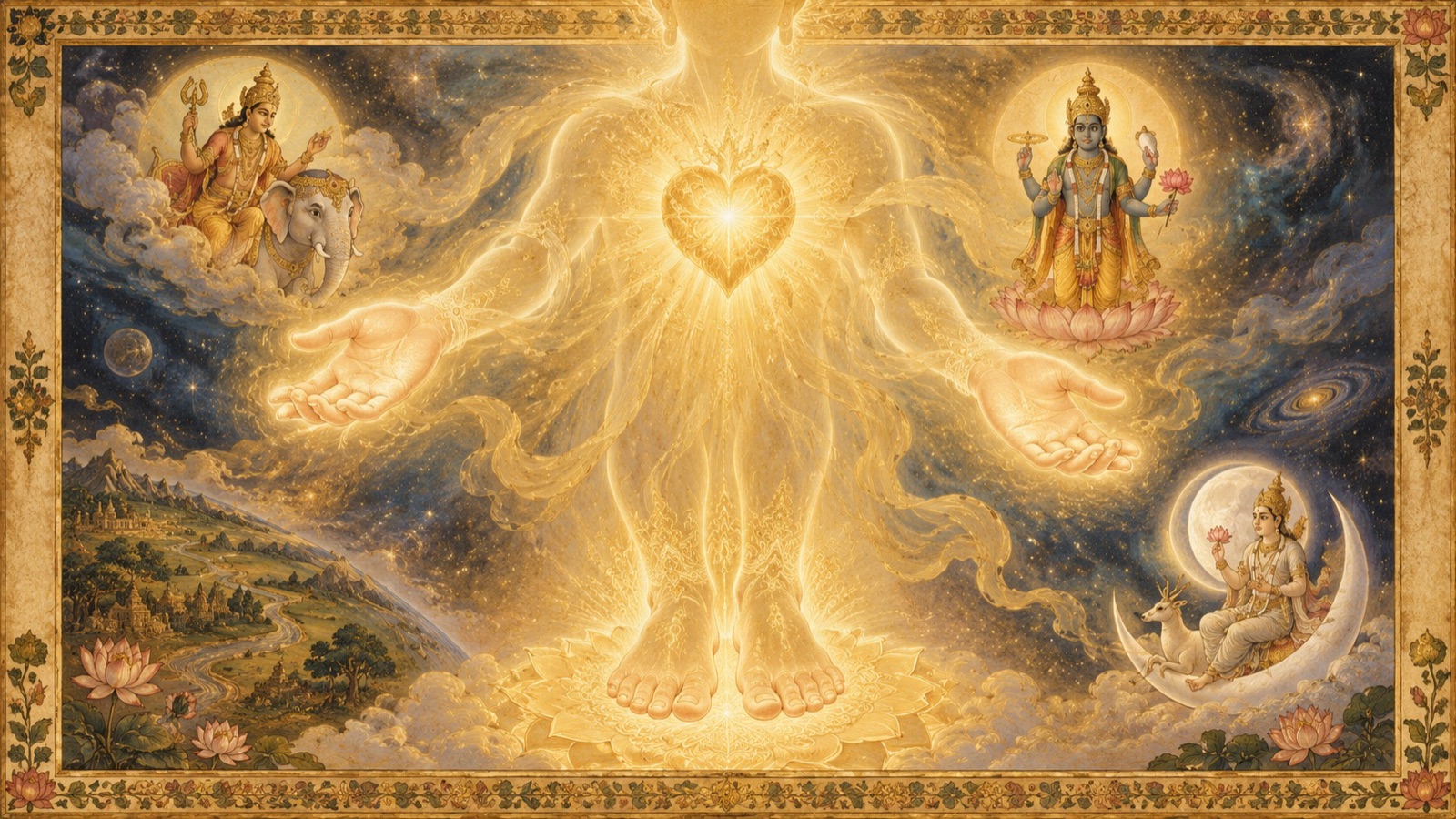
Maya, the Roll-Call of Creation, and the Lord Beyond Description
Sukadeva is careful to add a crucial qualification: both the subtle and gross forms he has just described are themselves productions of the Lord’s Maya, and for this reason the wise do not take either one as an object of worship in place of the Lord Himself.
अमुनी भगवद्रूपे मया ते ह्यनुवर्णिते । उभे अपि न गृह्णन्ति मायासृष्टे विपश्चित: ॥ ३५ ॥
amunī bhagavad-rūpe mayā te hy anuvarṇite ubhe api na gṛhṇanti māyā-sṛṣṭe vipaścitaḥ
Meaning: These two forms of the Lord just described to you — the gross cosmic body and the subtle unmanifest form alike — are both productions of His Maya; those who truly know Him accept neither one as the final truth. (SB 2.10.35)
The Supreme is, in truth, entirely actionless; it is only through His Maya that He appears to act, assuming the form of Brahma to reveal Himself as both word and the meaning a word carries, evolving countless names, forms, and activities. What follows is a sweeping roll-call — Prajapatis, Manus, gods, sages, the various classes of ancestral spirits, Siddhas, Charanas, Gandharvas, Vidyadharas, Asuras, Kinnaras, Apsaras, serpents and Nagas, Rakshasas and a dozen other classes of spirit-beings, birds, beasts, reptiles, trees and mountains — every name and form in the universe, Sukadeva tells Parikshit, belongs to Him. Every other creature, born from egg or womb, from sweat or from the soil, living in water, on land, or in the air, is the good, bad, or mixed fruit of past action, and the predominance of Sattva, Rajas, or Tamas determines birth among gods, humans, or the denizens of hell and the animal kingdoms — each destiny further divided according to how the Gunas eclipse one another.
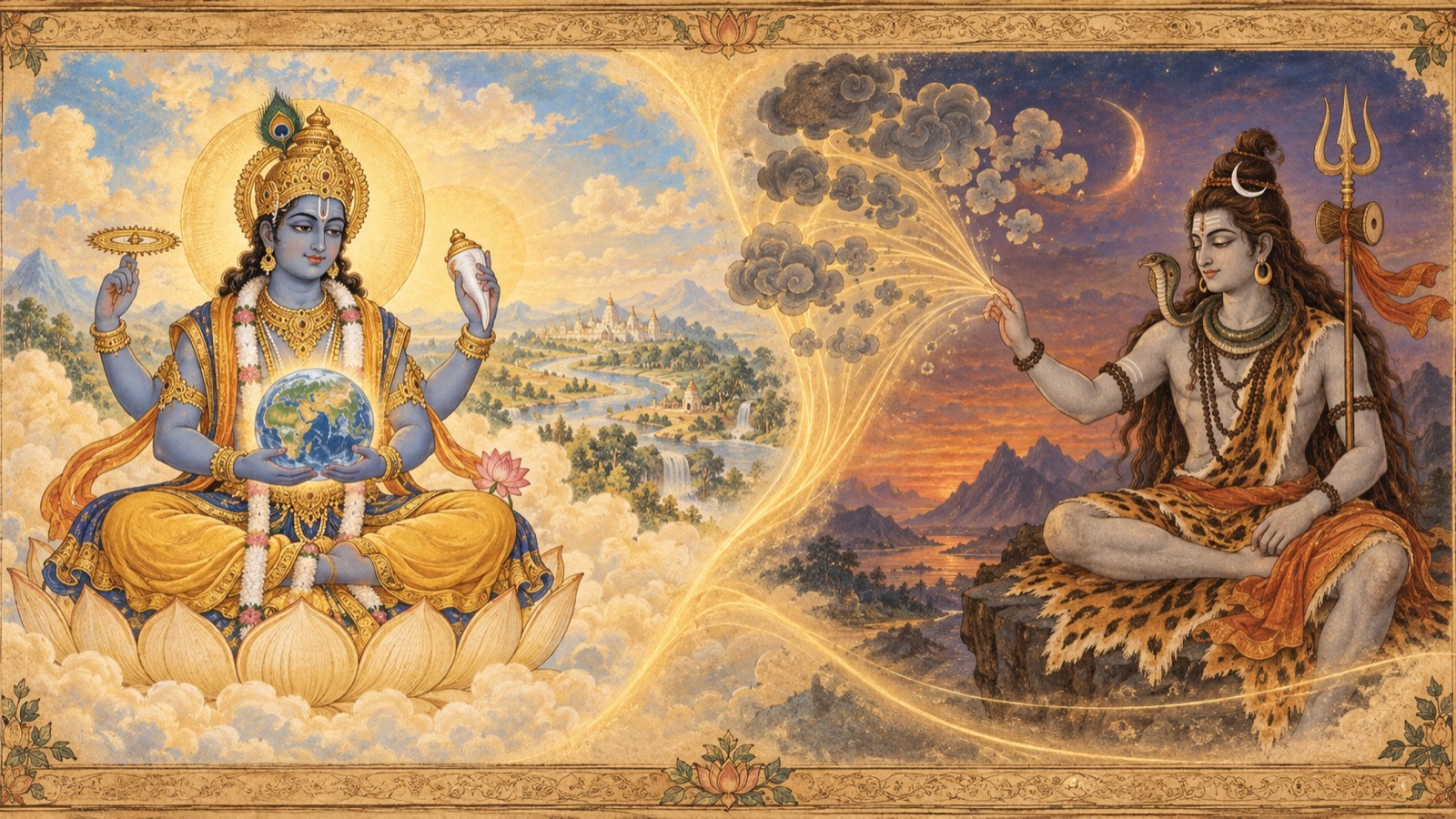
Having assumed the form of Vishnu for the world’s protection, the Lord preserves and sustains the universe by appearing again and again as animals, men, and gods; and when the time comes, He appears as Rudra out of the fire of universal dissolution and disperses the very universe He created, as effortlessly as a blast of wind scatters a bank of clouds.
तत: कालाग्निरुद्रात्मा यत्सृष्टमिदमात्मन: । संनियच्छति तत् काले घनानीकमिवानिल: ॥ ४३ ॥
tataḥ kālāgni-rudrātmā yat sṛṣṭam idam ātmanaḥ sanniyacchati tat kāle ghanānīkam ivānilaḥ
Meaning: Then, in the form of Rudra who is the very fire of time, He gathers back into Himself, at the appointed hour, all that He had created — as easily as the wind scatters a mass of clouds. (SB 2.10.43)
Yet Sukadeva insists this three-part description — creator, preserver, destroyer — must not be mistaken for the whole truth: the Lord is beyond even this. The Supreme has no real doership in the universe’s activities; the scriptures ascribe such doership to Him only so as to ultimately deny it, since it has been superimposed upon Him by Maya alone. Sukadeva closes this long teaching by telling Parikshit he has now described the great Kalpa connected with Brahma’s own appearance as well as the smaller Kalpas that follow, and promises to explain the measures of time in full detail later, in the Third Canto — but for the moment, he says, let him turn to the story of the Padma Kalpa.
Saunaka’s Question and the Turn Toward Vidura
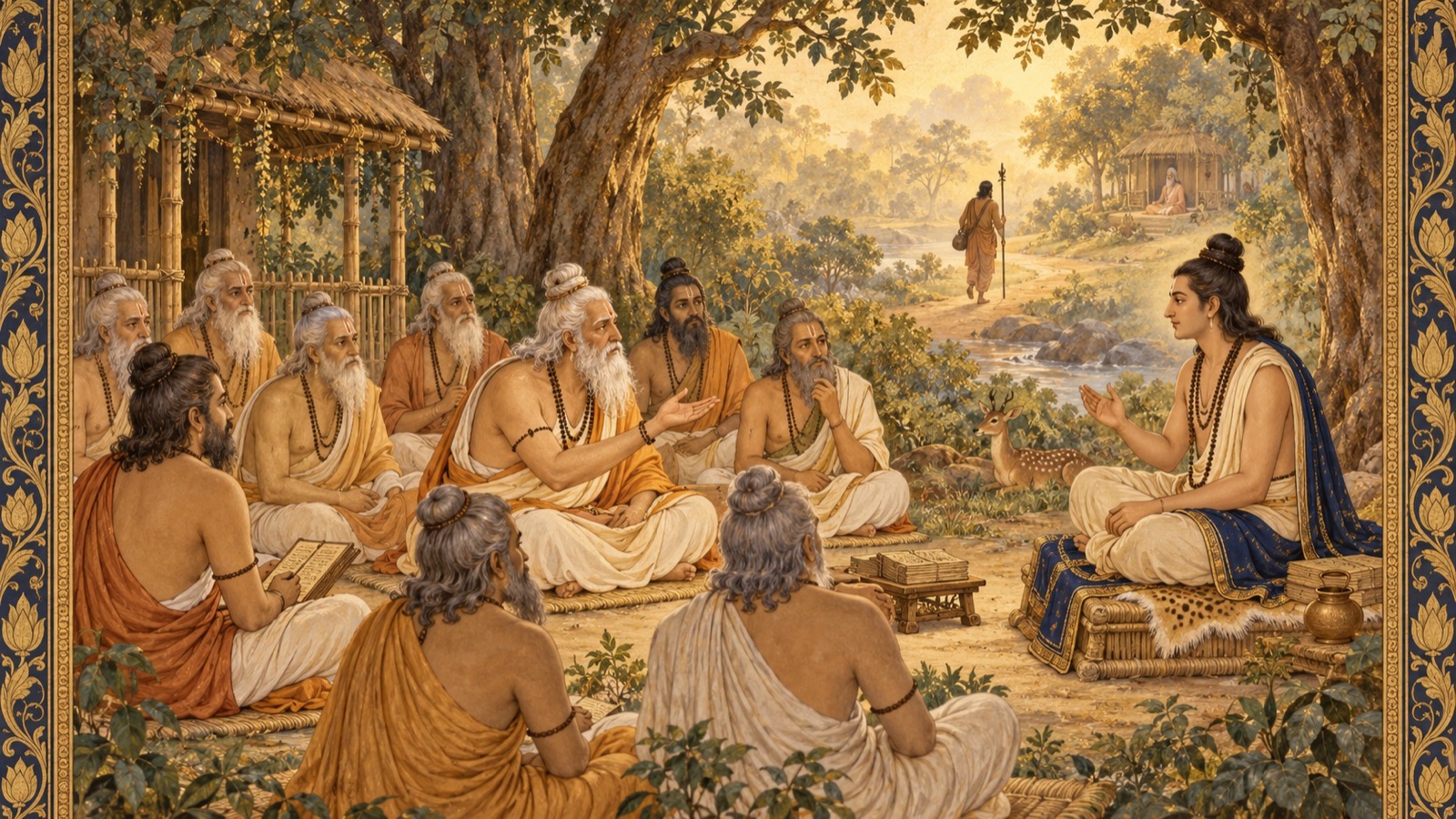
It is at this point that the frame of the narrative shifts, and we are reminded that all of this has been Suta Gosvami’s telling to the sage Saunaka and the assembly at Naimisharanya. Saunaka speaks up: earlier, he says, Suta had told them how Vidura — foremost among the Lord’s devotees — left behind his own kith and kin, so difficult to part with, and travelled on foot to every sacred place on the earth’s surface. Where, Saunaka now asks, did Vidura come to speak with the sage Maitreya, son of Kusaru, on spiritual matters, and what truth did that venerable sage teach him in answer to his questions? Tell us the whole story, Saunaka urges — the circumstances of Vidura’s departure from his kinsmen, and what eventually led him home again. Suta’s brief reply closes the chapter: King Parikshit, he says, asked this very same question, and he will now relate to the sages the discourse that the great sage Sukadeva gave in response.
Principal Teachings of This Chapter
1. Scripture has a structure, and it serves a purpose. The nine topics of creation, sustenance, and cosmic history are not ends in themselves; they exist to bring the listener to a clear conception of Asraya, the one Reality that supports everything (verses 1-2).
2. Existence itself is on loan from His attention. Every material ingredient, every action, time itself, and the very souls who make use of them all continue to exist only because the Lord extends His grace toward them — and would vanish the instant He grew indifferent (verse 12).
3. Every faculty we possess arose from a wish, met by grace. Sight, hearing, taste, touch, speech, and movement did not simply appear — each was called forth by a desire of the Cosmic Being and answered instantly, each with its own presiding deity, a pattern that quietly honors the sacredness of the human body itself (verses 15-30).
4. Neither the gross nor the subtle form of the Lord is the whole truth. Both are productions of His Maya; the wise look past even the most magnificent cosmic form to the actionless Reality beyond both form and formlessness (verses 33-36).
5. Creation, preservation, and destruction are one Lord’s play, not three different powers. As Vishnu He sustains, as Rudra He dissolves — yet He remains beyond even this threefold description, untouched by any true doership (verses 42-45).
6. The grandest cosmic teaching still ends in a simple human story. After defining the very structure of existence, the chapter closes not with more philosophy but with a son’s question about a devotee’s journey — reminding us that the loftiest truths of scripture are always in service of real, personal stories of devotion (verses 48-51).
A Devotional Reflection
There is something almost tender in the way this chapter moves. It begins at the highest possible altitude — ten abstract categories meant to organize an entire scripture — and then, rather than stay there, it descends all the way down into the body: into a mouth, a pair of eyes, a beating heart, a hand reaching out to grasp something. It is as though Sukadeva wants Parikshit, and us, to understand that the loftiest philosophy and the most ordinary act of seeing a sunrise or reaching for a loved one’s hand are not, in the end, two different subjects. The same wish that first stirred in the Cosmic Being seeking a foothold in the waters is echoed, faintly but truly, in every desire we feel today. And just as strikingly, after all this cosmic architecture, the chapter does not end with a flourish of doctrine — it ends with Saunaka’s simple, human curiosity about a devotee named Vidura, who walked away from his whole world in search of truth. Perhaps that is the chapter’s quiet lesson: that the grandest account of creation and the smallest, most personal story of a single devotee’s pilgrimage belong to the very same scripture, because they belong to the very same Lord.
A Daily Devotional Practice
Today, take a slow moment with just one of your own senses — perhaps sight, or hearing, or the simple sensation of touch. As you look, listen, or feel, recall that this very faculty is described in this chapter as having arisen from a wish within the primeval Cosmic Being, answered instantly by grace, and governed still by a presiding deity who is Himself a form of the one Lord. Let the ordinary act of seeing or hearing become, for a few breaths, an act of remembrance rather than habit — a reminder that the body itself is a small universe, and its Asraya is the same one who supports the whole of creation. Close by repeating slowly, a few times: “Om Namo Bhagavate Vasudevaya.”
Conclusion
The tenth chapter of the Second Canto brings a fitting close to this canto’s grand meditation on the nature of God and the cosmos. Having begun this canto with a vision of the universal form and Brahma’s own roll-call of the Lord’s sportful descents, the Bhagavata now hands us the very framework — the ten characteristic topics — by which the entire scripture organizes its teaching, and then makes that framework vivid by showing, limb by limb and sense by sense, how the one Supreme Being became the foundation of an entire universe. With this chapter, the Second Canto of the Srimad Bhagavatam comes to its conclusion. Saunaka’s question about Vidura’s pilgrimage and his meeting with the sage Maitreya closes this canto’s teaching and opens the door to the Third Canto, which will carry us into the story of Vidura and Maitreya and the deeper unfolding of creation that follows. May this pause between cantos be, for each of us, an invitation to sit for a moment with everything we have heard — from Varaha lifting the earth to the ten topics that hold the whole scripture together — before we walk on, as Vidura once did, toward the next teacher waiting to receive us.
May the divine wisdom of Srimad Bhagavatam awaken pure devotion within our hearts.
Om Namo Bhagavate Vasudevaya.
Jay Shree Madhav.
References and Attribution
- Primary edition: Gita Press, Śrīmad Bhāgavata Mahāpurāṇa (English, complete), Book Two, Discourse 10, pages 127–133.
- Series: Srimad Bhagavatam Wisdom · Biswa Sanatan Dharma Seva Trust.
- Presented following the spiritual guidance and recommendation of Pandit Dr. Shri Kashinath Mishra.
This is an original, faithful retelling in the writer’s own words, with brief quoted verses shown in Devanāgarī and transliteration and their meanings given as summaries. It is not a reproduction of any single publisher’s continuous translation or commentary. No affiliation with or endorsement by any publisher is implied.
Jay Shree Madhav