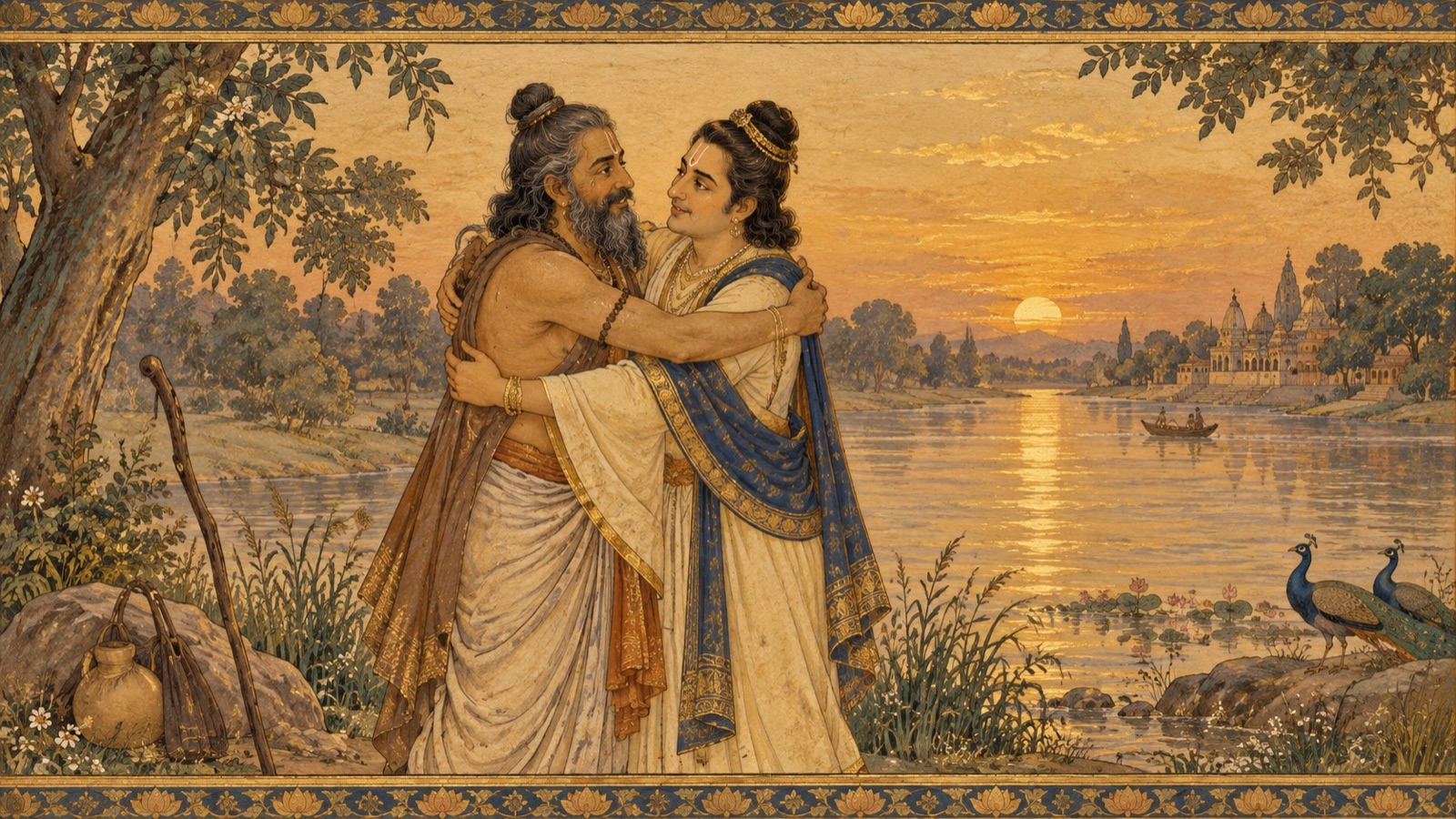
On the bank of the Yamuna, two devotees who have not met in years fall into each other’s arms — and the whole of Canto Three opens with the tender, anxious question of one who loves: “Tell me, are they well?”
Om Namo Bhagavate Vasudevaya.
Om Namo Bhagavate Vasudevaya.
Om Namo Bhagavate Vasudevaya.
Welcome to Srimad Bhagavatam Wisdom, a devotional journey through the sacred histories and teachings of the Srimad Bhagavat Mahapurana. With this chapter we cross a threshold: Canto Two has closed, and Canto Three begins. At the very end of the last Canto, Brahma promised Narada a fuller account of time and its divisions “later on, in Book Three.” True to that promise, Sukadeva now opens Book Three by reminding King Parikshit that this deeper teaching was once given by the sage Maitreya to a particular listener — the noble Vidura, exiled from his own family’s palace. Before that teaching can be told, however, Sukadeva must tell its frame: how Vidura, a peace-loving counsellor insulted and banished from Hastinapura, undertook years of solitary pilgrimage, and how, in a moment of pure devotional warmth, he was reunited on the bank of the Yamuna with Uddhava, another beloved servant of the Lord. This first chapter of Canto Three is that reunion — the setting up of the two friends’ conversation, and above all, the long, loving list of questions with which Vidura asks after everyone he holds dear.
Chapter Information
- Scripture: Śrīmad Bhāgavata Mahāpurāṇa
- Canto: 3 (Book Three)
- Chapter: 1 (Discourse 1)
- Chapter title: Meeting of Uddhava and Vidura
- Principal speakers: Sukadeva Gosvami (narrating the story to King Parikshit); King Parikshit (asking two brief questions); and Vidura (whose long address to Uddhava fills most of the chapter) — the whole related by Suta Gosvami to the sage Saunaka and the assembly at Naimisharanya
- Principal listener: King Parikshit (within Sukadeva’s narration); Uddhava (within Vidura’s speech); and the sage Saunaka with the assembly at Naimisharanya (hearing it all from Suta)
- Main setting: The bank of the river Yamuna, at the close of Vidura’s long pilgrimage across the holy places of Bharatavarsa; relayed within the riverside teaching of Sukadeva to Parikshit and the forest hermitage of Naimisharanya
- Central subject: The backstory of Vidura’s exile from Hastinapura for the sake of righteous counsel, his years of solitary pilgrimage, and his joyful reunion with Uddhava — through whom he anxiously enquires after the welfare of the entire Yadu and Pandava households
- Principal verse range: Canto 3, Chapter 1, verses 1–45
- Primary edition: Gita Press Śrīmad Bhāgavata Mahāpurāṇa
A Question Carried Over From Canto Two
Sukadeva begins Book Three by picking up a thread he had left dangling. This very question — the nature of time and its measures, which Brahma had promised Narada he would explain “later, in Book Three” — was, Sukadeva says, once asked long ago by Vidura of the great sage Maitreya, after Vidura had left his own prosperous household for the forest. In the same breath, Sukadeva reminds Parikshit of something that had already been told in this dynasty’s history: how Lord Sri Krishna, visiting Hastinapura as the Pandavas’ own ambassador, chose to stay not in Duryodhana’s royal palace but in the modest home of Vidura — entering it, the Bhagavatam says, “as if it were His own house.”
श्रीशुक उवाच एवमेतत्पुरा पृष्टो मैत्रेयो भगवान् किल । क्षत्त्रा वनं प्रविष्टेन त्यक्त्वा स्वगृहमृद्धिमत् ॥ १ ॥
śrī-śuka uvāca evam etat purā pṛṣṭo maitreyo bhagavān kila kṣattrā vanaṁ praviṣṭena tyaktvā sva-gṛham ṛddhimat
Meaning: Sri Suka said: It was this very question that Vidura asked the worshipful sage Maitreya in the past, when he had retired to the forest, quitting his prosperous home. (Canto 3, Chapter 1, verse 1)
King Parikshit, hearing this, cannot contain his curiosity. Where, he asks, and when did Vidura actually meet Maitreya? And what exactly was the question Vidura put to him — for surely, he reasons, it could not have been trivial, since a sage of Maitreya’s stature troubled himself to answer it in full. Suta tells the sages of Naimisharanya that Sukadeva, delighted at the earnestness of the king’s question, simply says, “Listen!” — and begins the story from its true beginning.
The Fall of a House Divided
To explain how Vidura came to leave home at all, Sukadeva must retell, in a few compressed and painful verses, the whole tragedy of the Kuru family. He reminds Parikshit how the blind king Dhritarashtra, having lost his moral judgment along with his eyesight, indulged his wicked sons in every injustice — lodging his brother’s orphaned children, the young Pandavas, in a house of lac built to burn them alive. He recalls the day Duhshasana dragged Queen Draupadi by the hair into open court, and Dhritarashtra did nothing to stop it. He recalls the rigged game of dice that sent righteous Yudhishthira into thirteen years of exile, and how, when that exile ended and the Pandavas rightfully asked for their share of the kingdom back, Duryodhana — blinded by his own infatuation with power — simply refused. Even when Lord Krishna Himself came as a peace envoy and spoke words “full of nectar” to Bhishma and the elders, Duryodhana would not listen; his store of merit, the Bhagavatam says starkly, had already run out.
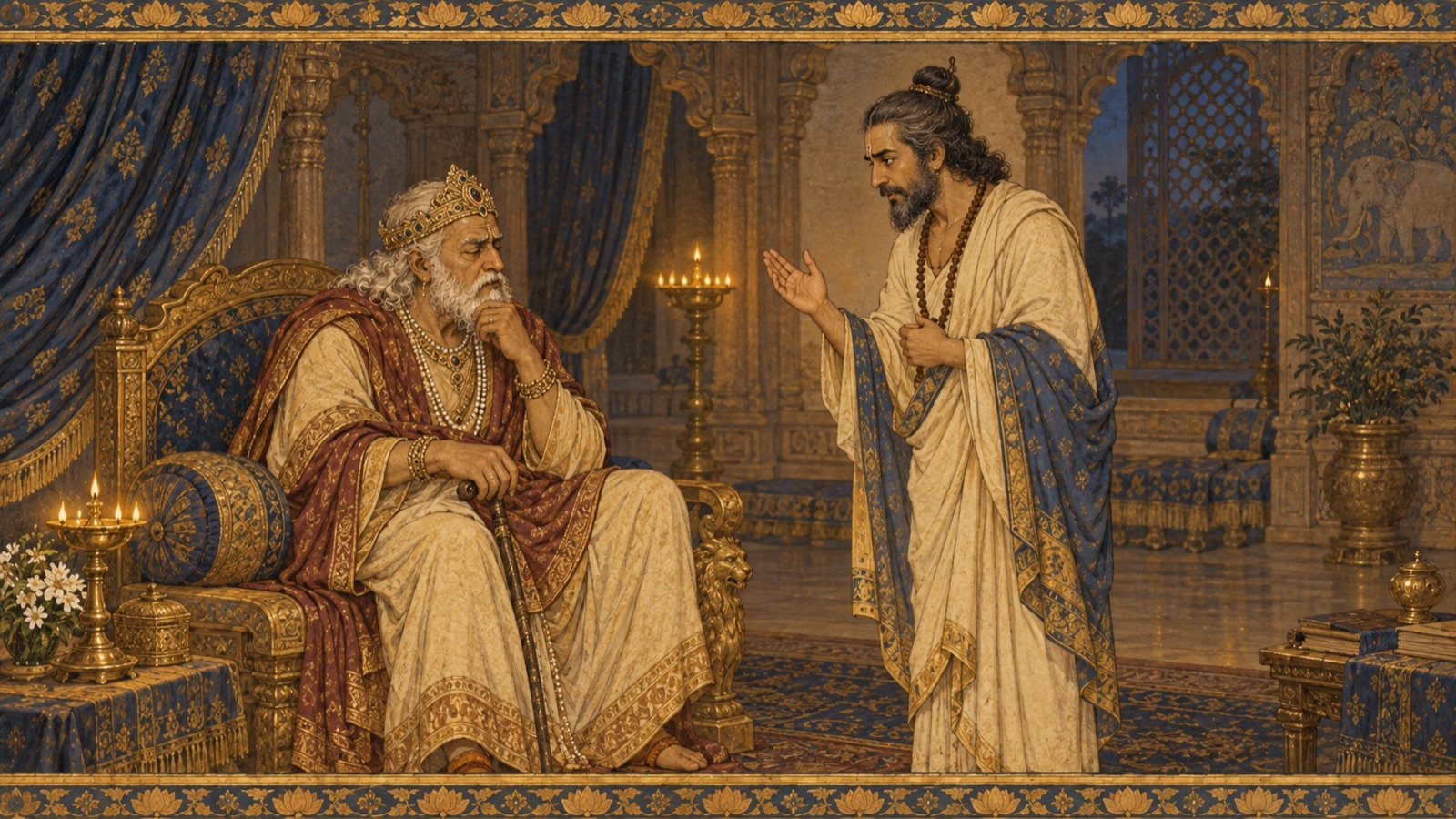
It was in this atmosphere that Dhritarashtra, troubled at heart, once called his younger brother Vidura into a private chamber and asked for his honest counsel — advice still remembered, centuries later, as Vidura-niti, the Counsel of Vidura.
Vidura’s Counsel and Duryodhana’s Fury
Vidura’s actual words to Dhritarashtra are given directly. Return Yudhishthira’s share, he says — Yudhishthira, who regards no one as an enemy and has patiently borne wrongs that are hard to bear, and who is followed by the fearsome Bhima, hissing like a serpent in his restrained fury. More than that, Vidura reminds his brother, the cause of the Pandavas has been taken up by Lord Sri Krishna Himself — worshipped by the Yadava chiefs, ruling from His own capital of Dwaraka, with every Brahmana and every god on His side. Then Vidura says the sentence that will cost him his home: it is evil incarnate, he tells Dhritarashtra, that has entered this house in the person of Duryodhana — an enemy of the Supreme Person nursed as a son — and it is for this very reason that Dhritarashtra himself has lost his splendour. For the good of the whole family, Vidura urges, abandon this “unlucky fellow” now.
स एष दोष: पुरुषद्विडास्ते गृहान् प्रविष्टो यमपत्यमत्या । पुष्णासि कृष्णाद्विमुखो गतश्री-स्त्यजाश्वशैवं कुलकौशलाय ॥ १३ ॥
sa eṣa doṣaḥ puruṣa-dviḍ āste gṛhān praviṣṭo yam apatya-matyā puṣṇāsi kṛṣṇād vimukho gata-śrīs tyajāśv aśaivaṁ kula-kauśalāya
Meaning: This very fault — an enemy of the Supreme Person, received into the house as a son — you are nurturing, having turned away from Krishna and lost your fortune; abandon this inauspicious one at once, for the well-being of the family. (Canto 3, Chapter 1, verse 13)
The room erupts. Though Vidura’s own temperament was gentle enough to be envied even by saints, his words cut Duryodhana, Karna, Duhshasana and Shakuni to fury. Duryodhana turns on him with contempt — calling him “this crooked son of a maid-servant,” accusing him of working secretly for the enemy while living on his master’s crumbs, and ordering that he be banished from the capital at once, his life spared only out of a last shred of restraint. Vidura, though the insult pierces him like an arrow, does something remarkable: recognizing in it all the working of the Lord’s own Maya, he does not lose his composure. He simply sets down his bow at the palace gate and walks away.
The Pilgrim’s Vow
What follows is one of the most quietly moving passages in the Bhagavatam — not a lament, but a description of a life transformed by loss into pilgrimage. Vidura, born into the Kuru line through great merit, leaves Hastinapura and sets out, entirely alone, to visit every holy place on the earth sacred to the Lord — places where, the Bhagavatam says, the Lord “resides in a thousand and one forms.” He walks on foot through cities, sacred groves, mountains, forest bowers, rivers and clear lakes, seeking out every shrine that bears the Lord’s image. He lives as a recluse, unrecognized even by his own people, eating only fallen fruit, bathing in every sacred water without exception, sleeping on bare ground, foregoing even ordinary grooming — observing, in short, every vow that would please Sri Hari.
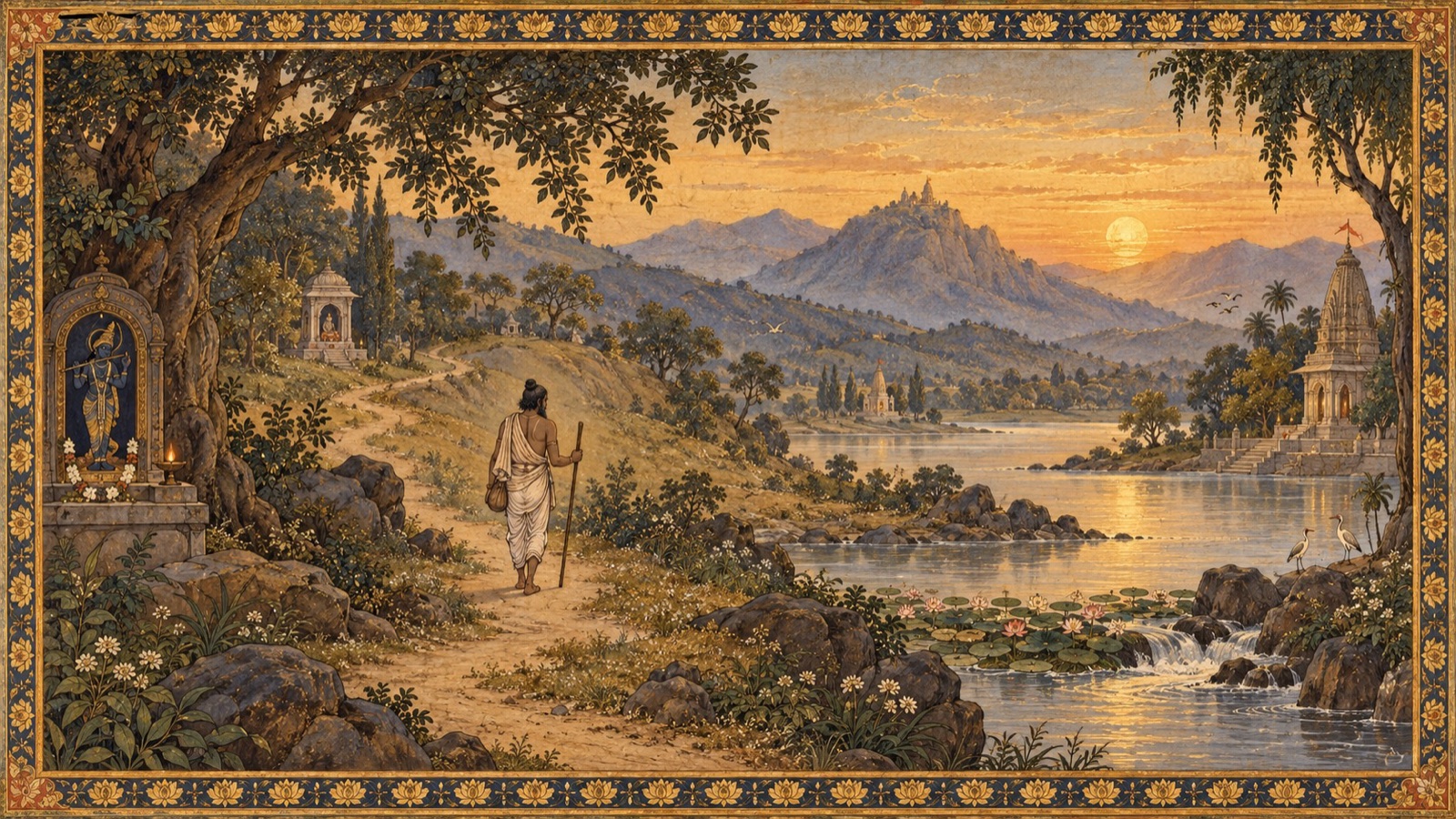
While Vidura wanders in this way through the land of Bharatavarsa, the great events of the epic have already run their course elsewhere. By the time he reaches Prabhasa, near Dwaraka, he learns that Yudhishthira, aided by Krishna, has become the undisputed sovereign of the whole earth — but he also learns, in the same breath, that his own kinsmen the Kauravas have annihilated one another, “like a thicket of bamboos consumed by fire produced by the friction of one bamboo against another.” Grieving over this devastation, Vidura turns quietly toward the bank of the river Saraswati, which flows there toward the west.
Eleven Sacred Fords to the Bank of the Yamuna
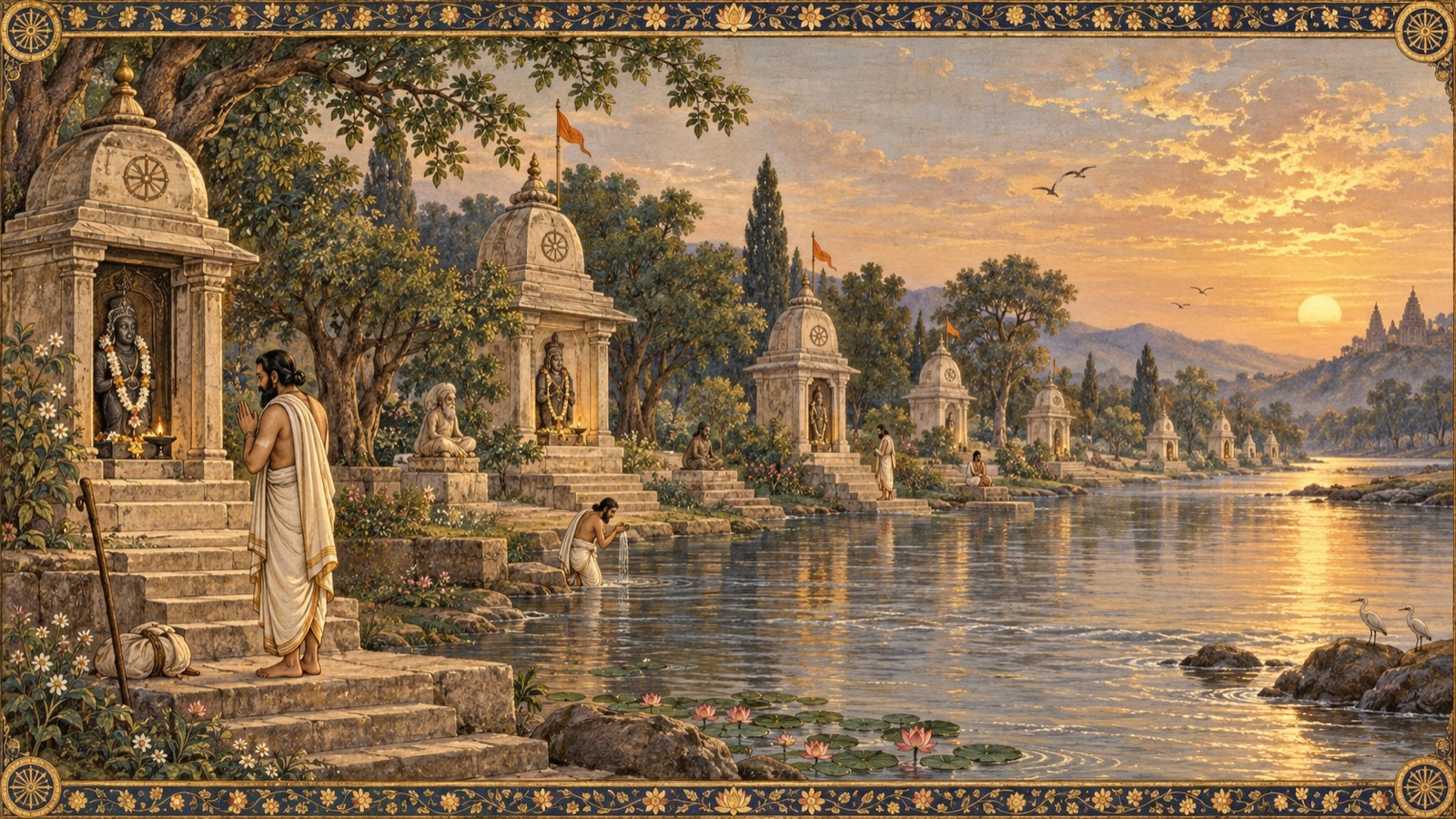
Along the Saraswati, Vidura visits, one after another, eleven places sanctified by the memory of great souls — the sages Trita, Ushana (father of Shukracharya) and Asita; Swayambhuva Manu; King Prithu; the gods of fire and wind; King Sudasa; the cows; Guha (Lord Kartikeya); and Shraddhadeva, the Manu of this age — along with many other shrines founded by sages and gods, their domes marked with the emblem of the Sudarshana discus, each sight a reminder of Lord Krishna Himself. From there his path takes him through the prosperous lands of Saurashtra, and the kingdoms of Sauvira, Matsya, and Kuru-Jangala, until at last he arrives at the bank of the river Yamuna — and there, unexpectedly, he comes upon Uddhava, another great and beloved devotee of the Lord.
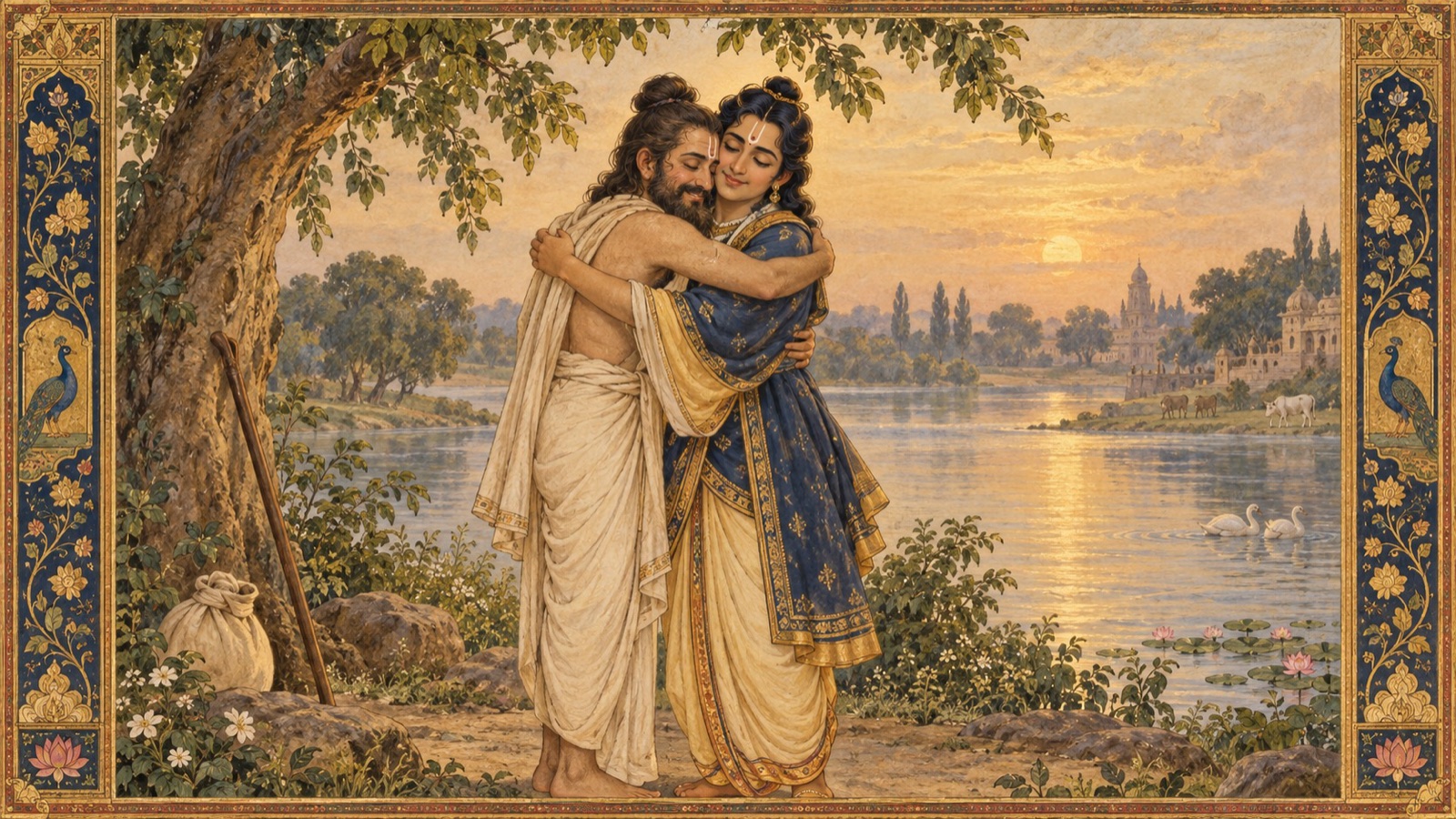
The two embrace with deep affection — Uddhava, once a pupil of Brihaspati, the very teacher of the gods, now settled into a perfect serenity of mind. Vidura, overjoyed, at once begins to ask him about the welfare of their beloved relations, the Yadavas, whom the Lord Himself protects.
Asking After Every Beloved Name
What follows is not doctrine but devotion in its most intimate form — a long, tender roll call of names. Vidura asks first after Balarama and Krishna themselves, the “two Primal Persons” who appeared on earth in answer to Brahma’s prayer, wondering if they fare well in the house of Surasena. He asks after Vasudeva, Krishna’s father and his own brother-in-law, ever generous to his sisters. He asks after Pradyumna, the Yadava commander; after Ugrasena, restored to his throne though he had given up all hope; after Samba, the equal of his divine father; after Satyaki, who learned archery from Arjuna himself; after the wise and sinless Akrura, so overcome with love that he once rolled in the dust marked by Krishna’s own footprints; after Devaki, mother of the Lord; after the divine Aniruddha; and after Hridika, Charudeshna, Gada, and others of the household — each question folding in, almost in passing, a small loving detail of who this person is and what they mean to the Lord.
Only after asking so fully after the Yadu house does Vidura turn to his own family, the Pandavas. Does Yudhishthira still uphold righteousness with Arjuna and Krishna as his two arms? Has Bhima’s long-smouldering fury against the Kauravas finally found peace? Is Arjuna, who once pleased Lord Shiva Himself in the guise of a hunter, now at rest with his enemies? Are the twins Nakula and Sahadeva, protected like eyelashes over the eyes, rejoicing in their recovered kingdom? And what of Pritha — his sister-in-law Kunti — surviving now only for her children’s sake, though widowed of noble Pandu long ago? Finally, with evident pain, Vidura asks after his own brother Dhritarashtra, who wronged his nephews and banished his own well-wisher, and who, Vidura fears, is “paving his way for hell.”
Not the Least Surprised: Vidura’s Closing Reflection
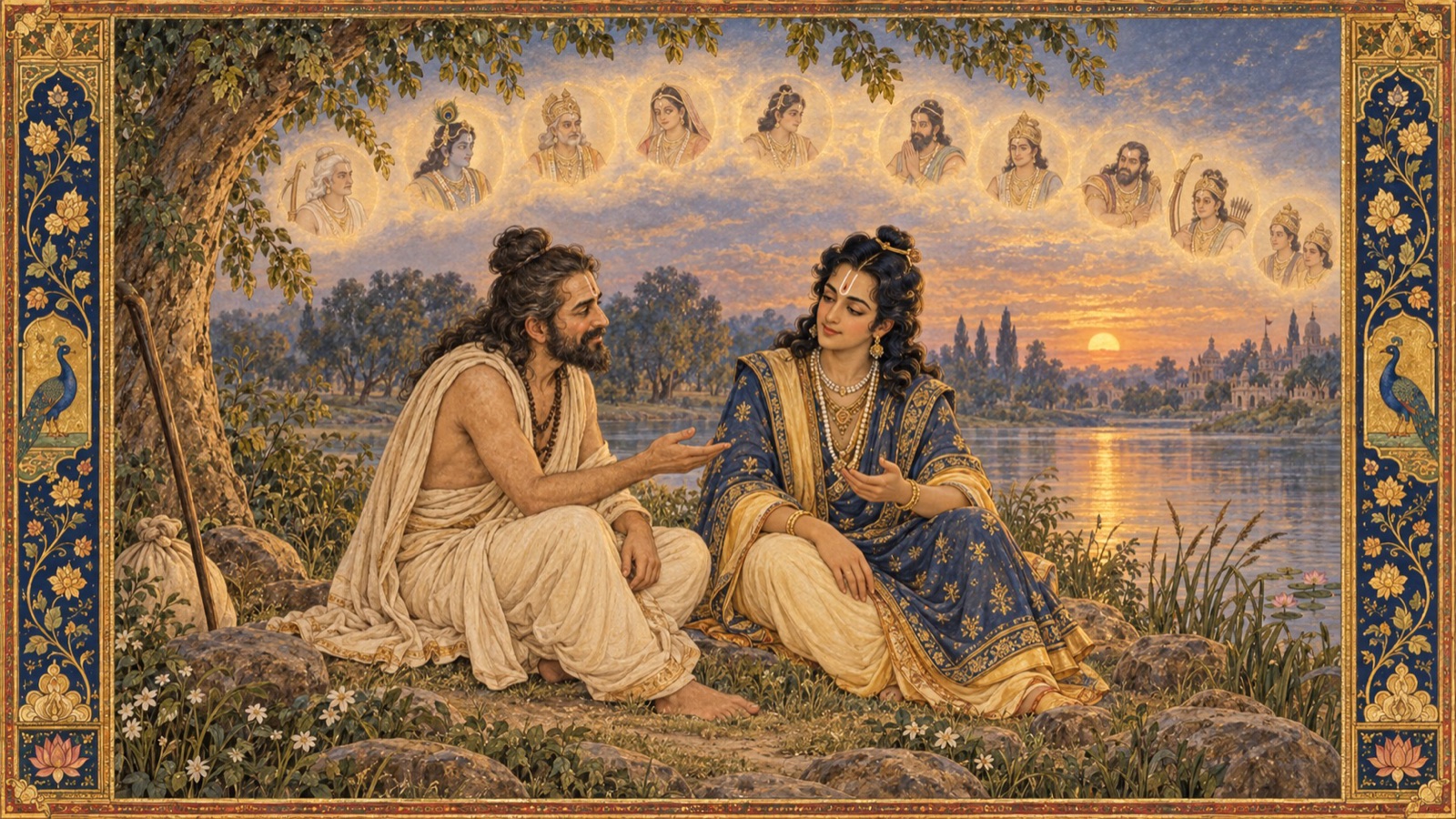
Then, remarkably, Vidura’s tone shifts from grief to a settled peace. He is not, he says, surprised or sorrowful over his brother’s treatment of him — for it is Sri Hari Himself, the Supreme Ruler, who “bewilders the intellect of men” while playing the part of an ordinary mortal among them (verse 42). Vidura says he has learned simply to move through the world unnoticed, observing the Lord’s glory wherever His grace reveals it. Even the Lord’s apparent tolerance of the Kauravas’ wrongdoing, Vidura explains, was purposeful — rather than striking down the Kauravas the moment they sinned, the Lord waited, so that in one and the same reckoning He could also remove the many other proud kings who were burdening the earth with their arrogance of wealth, learning and following (verse 43).
Vidura then names the principle that stands behind this patience. Unlike an ordinary being’s birth, which is forced upon him by his own past deeds, the Lord’s appearance in a body answers to nothing outside Himself: He takes it on for one purpose only, to uproot those who have strayed from the right path, and He acts only so that His ways may be understood by ordinary people, though in truth He is never bound as a doer the way we are. No one who genuinely stands beyond the three Gunas, Vidura reasons, would otherwise have any cause to accept a body or take up any scheme of action at all — such a being simply has nothing left to gain from doing so.
अजस्य जन्मोत्पथनाशनाय कर्माण्यकर्तुर्ग्रहणाय पुंसाम् । नन्वन्यथा कोऽर्हति देहयोगं परो गुणानामुत कर्मतन्त्रम् ॥ ४४ ॥
ajasya janmotpatha-nāśanāya karmāṇy akartur grahaṇāya puṁsām nanv anyathā ko ‘rhati deha-yogaṁ paro guṇānām uta karma-tantram
Meaning: The unborn Lord assumes His appearance only to destroy those who have wandered from the right path, and He undertakes His deeds only so that people may come to recognise Him, even though He Himself is never truly the doer of anything; for otherwise, why would one who stands entirely above the three Gunas ever accept a body or take up a course of action at all? (Canto 3, Chapter 1, verse 44)
With this understanding settled in his heart, Vidura makes his final, simple request to his friend.
तस्य प्रपन्नाखिललोकपाना-मवस्थितानामनुशासने स्वे । अर्थाय जातस्य यदुष्वजस्य वार्तां सखे कीर्तय तीर्थकीर्ते: ॥ ४५ ॥
tasya prapannākhila-lokapānām avasthitānām anuśāsane sve arthāya jātasya yaduṣv ajasya vārtāṁ sakhe kīrtaya tīrtha-kīrteḥ
Meaning: Tell me, O friend, the news of that unborn Lord of sacred renown, who was born in the race of Yadu for the sake of all the guardians of the spheres who have taken shelter in Him and who remain established under His rule. (Canto 3, Chapter 1, verse 45)
With this heartfelt appeal the first discourse of Book Three closes, setting the stage for Uddhava’s long and loving reply in the chapters that follow.
Principal Teachings of This Chapter
1. Righteous counsel may cost everything, and still be worth giving. Vidura speaks the truth to his brother knowing it will not be welcomed; when it costs him his home, he does not regret having spoken (verses 11-16).
2. Insult met without agitation is itself a spiritual attainment. Vidura recognizes the Lord’s Maya even in his own humiliation, and departs in peace rather than in anger — a quiet but total renunciation of the desire to defend himself (verse 16).
3. Loss can be transformed into pilgrimage. Rather than nursing his banishment, Vidura turns it into years of devotional wandering, visiting every place sanctified by the Lord’s presence (verses 17-24).
4. Love for the Lord’s devotees is itself devotion. Vidura’s long, detailed enquiry after every member of the Yadu and Pandava households — asked with evident joy rather than mere duty — shows that asking after a devotee’s welfare is itself an act of bhakti (verses 26-41).
5. Even a devotee’s grief has its resting place in surrender. Vidura is not bitter about his exile; he understands it as part of the Lord’s inconceivable working, which uses ordinary human events to protect the surrendered and to draw all beings toward Himself (verses 42-45).
A Devotional Reflection
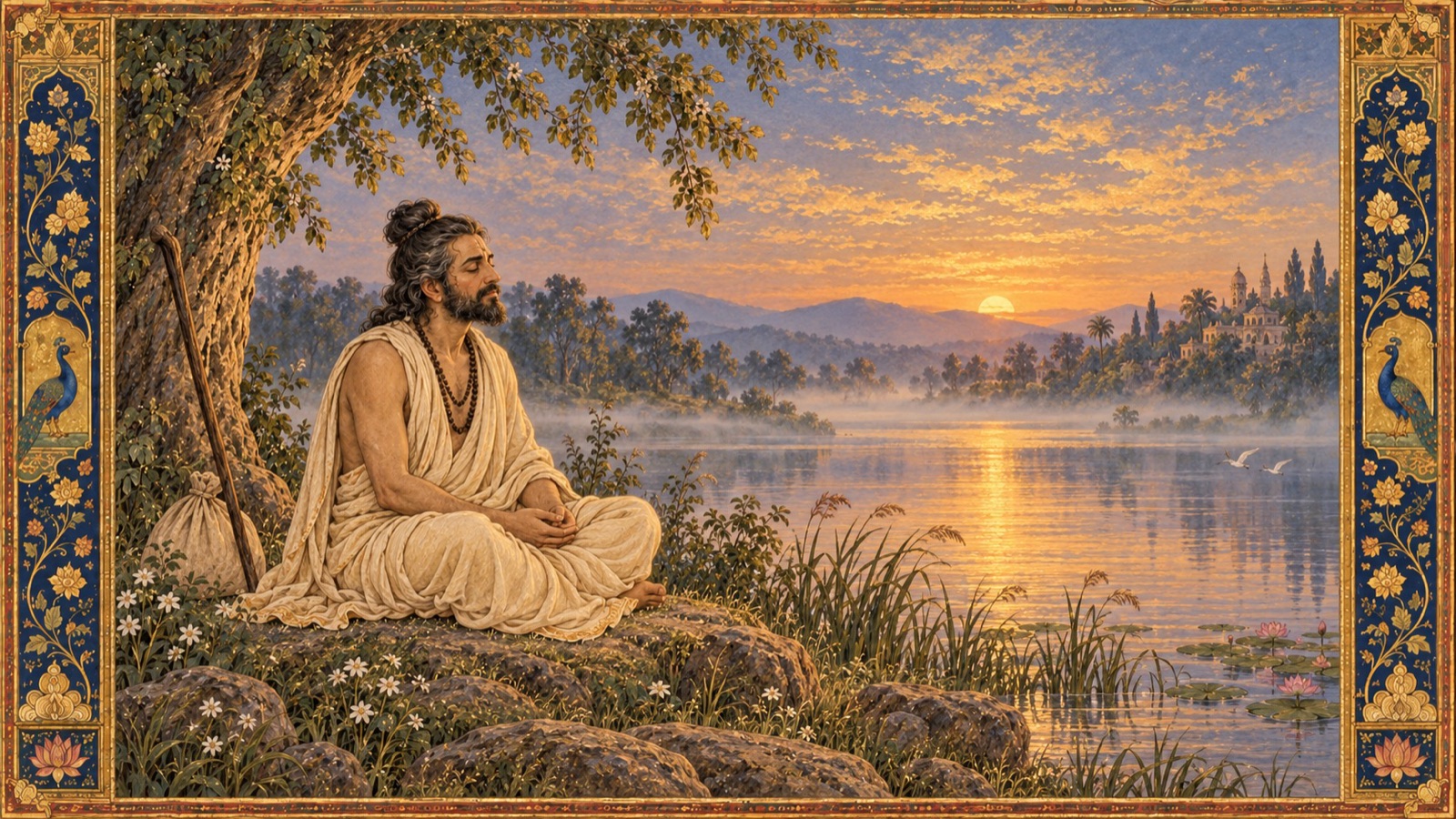
It would be easy to read this chapter simply as backstory — the necessary bridge between one book and the next. But sit with it a moment longer, and something quietly profound emerges. Vidura has just spent years walking alone across the earth, stripped of home, family, and standing, for the crime of telling the truth. And when he finally meets a friend after all that time, he does not begin by describing his own suffering. He asks about everyone else. Balarama and Krishna first, then Vasudeva, then a dozen more names, each one held with visible tenderness, before he even mentions his own brother’s cruelty — and when he does mention it, it is with sorrow for Dhritarashtra’s fate, not anger at his own. This is what mature devotion looks like: a heart so full of love for the Lord and His devotees that it has almost no room left for self-pity. Vidura’s pilgrimage did not just take him to holy rivers and shrines; it emptied him of resentment and filled him instead with this capacity to ask, with real joy, “Are they well?”
A Daily Devotional Practice
Today, think of one person in your own life whom you have not asked about in a long while — a friend, a relative, someone you have lost touch with through distance, misunderstanding, or simply the business of days. Following Vidura’s example, take a quiet moment to genuinely wonder how they are, and if possible, reach out to ask. Before you do, sit for a moment in stillness and repeat: “Om Namo Bhagavate Vasudevaya.” Let that remembrance soften whatever old hurt may stand between you and the asking, just as it softened Vidura’s own long years of exile into a pilgrim’s peace.
Conclusion
The first chapter of the Third Canto is, on its surface, the story of a family torn apart and a devotee’s long, lonely wandering. But its true center is the moment loss dissolves into love: an insulted, banished man, having walked the length of a continent in devotion, finally sits down beside a friend — and instead of unburdening his own grief, spends the rest of the chapter asking, one beloved name at a time, whether everyone else is well. Behind this warmth lies Sukadeva’s larger purpose: to carry Parikshit — and us — from the vast impersonal cosmology of Canto Two into the intimate, personal, story-shaped devotion that will define Canto Three. Vidura’s very last words, asking for news of the Lord “descended in the race of Yadu for the good of all who have taken shelter in Him,” are the doorway through which the rest of this Canto will walk.
May the divine wisdom of Srimad Bhagavatam awaken pure devotion within our hearts.
Om Namo Bhagavate Vasudevaya.
Jay Shree Madhav.
References and Attribution
- Primary edition: Gita Press, Śrīmad Bhāgavata Mahāpurāṇa (English, complete), Book Three, Discourse 1, pages 133–139.
- Series: Srimad Bhagavatam Wisdom · Biswa Sanatan Dharma Seva Trust.
- Presented following the spiritual guidance and recommendation of Pandit Dr. Shri Kashinath Mishra.
This is an original, faithful retelling in the writer’s own words, with brief quoted verses shown in Devanāgarī and transliteration and their meanings given as summaries. It is not a reproduction of any single publisher’s continuous translation or commentary. No affiliation with or endorsement by any publisher is implied.
Jay Shree Madhav