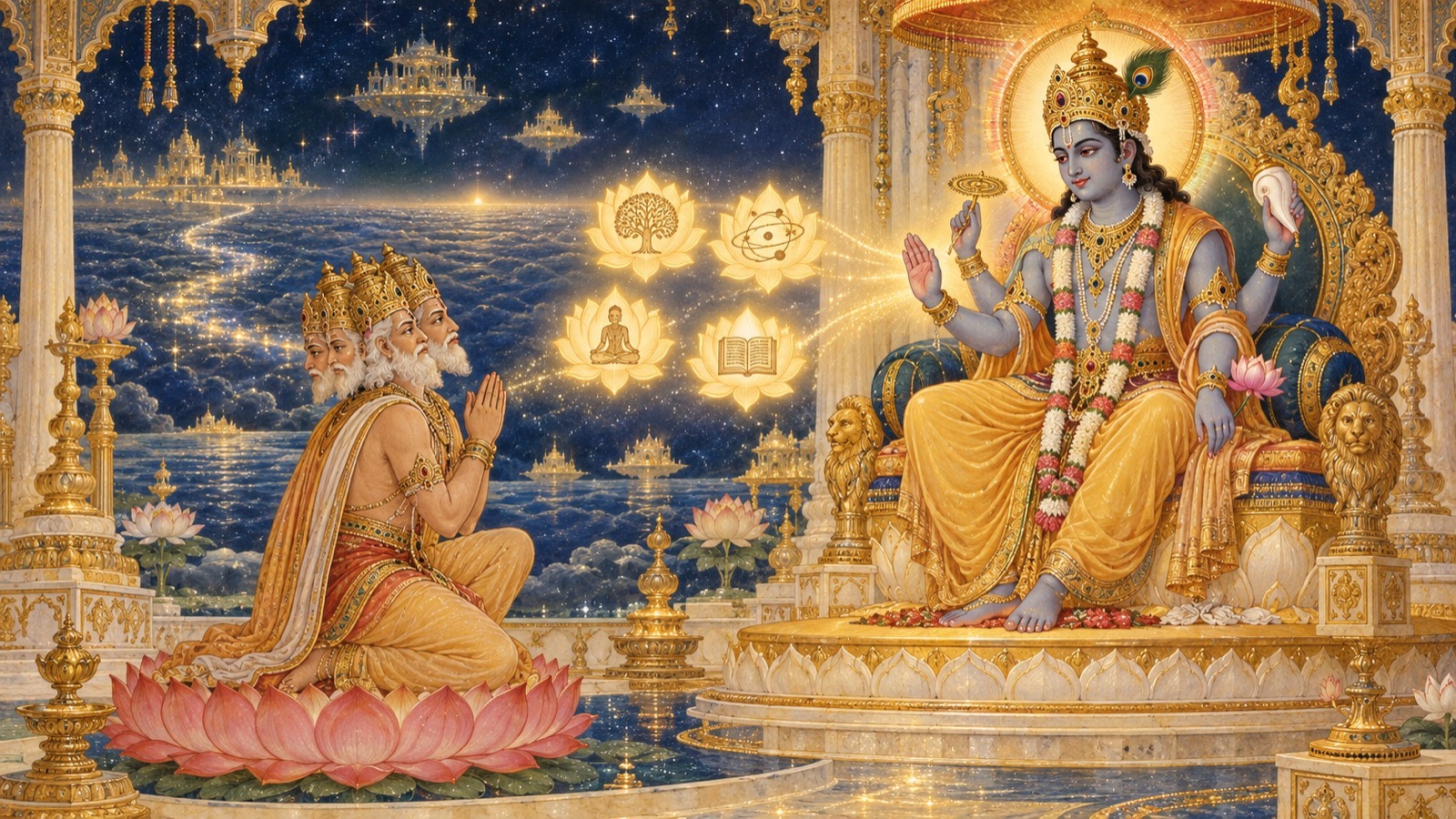
In the stillness of the causal waters, the Lord reveals His own transcendent Abode to Brahma and speaks to him the four essential verses of the Bhagavata — the seed from which this entire scripture grows.
Om Namo Bhagavate Vasudevaya.
Om Namo Bhagavate Vasudevaya.
Om Namo Bhagavate Vasudevaya.
Welcome to Srimad Bhagavatam Wisdom, a devotional journey through the sacred histories and teachings of the Srimad Bhagavat Mahapurana. The eighth chapter closed with King Parikshit posing his questions to Sukadeva Gosvami — how did the Lord create, sustain, and act through the ages, and what is the true nature of His many forms? Rather than answering directly, Sukadeva now reaches back to the oldest teaching he knows: the day the Supreme Lord Himself appeared before Brahma, the very architect of creation, and gave him — in only four verses — the essential truth of the entire Bhagavata. This ninth chapter carries perhaps the most theologically pivotal passage in the whole Purana: the Chatuh-shloki Bhagavatam, the “four-verse Bhagavatam,” so concentrated and so complete that tradition holds the remaining eighteen thousand verses of this scripture to be nothing but its unfolding. Here Brahma’s own penance, his vision of the Lord’s transcendent Abode, and his heartfelt prayer set the stage for those four verses — and the chapter closes by tracing how this same teaching passed, hand to hand, from the Lord to Brahma, from Brahma to Narada, and from Narada to Vyasa, the very sage who set it down as the scripture now being read.
Chapter Information
- Scripture: Śrīmad Bhāgavata Mahāpurāṇa
- Canto: 2 (Book Two)
- Chapter: 9 (Discourse 9)
- Chapter title: Brahma beholds the Lord’s own transcendent Abode and receives from Him, in just four couplets, the very substance of the Bhagavata
- Principal speaker: Sukadeva Gosvami, narrating to King Parikshit an older recollection — Brahma’s own account, given to his son Narada, of the day the Supreme Lord appeared to him and spoke; within that recollection, the Lord Himself is the speaker of the four verses
- Principal listener: King Parikshit (hearing it from Sukadeva); within the nested account, the sage Narada (hearing it from his father Brahma) and Brahma himself (hearing it from the Lord)
- Main setting: The causal ocean at the dawn of creation, where Brahma performs his penance and beholds the Lord’s transcendent Abode; relayed within the riverside teaching of Sukadeva to Parikshit and the forest hermitage of Naimisharanya
- Central subject: Brahma’s penance in response to a mysterious command heard in the waters, his vision of the Lord’s own supreme Abode and of the Lord Himself, and the four essential verses (Chatuh-shloki Bhagavatam) the Lord speaks to him — the seed-teaching of the entire scripture
- Principal verse range: Canto 2, Chapter 9, verses 1–45
- Primary edition: Gita Press Śrīmad Bhāgavata Mahāpurāṇa
Sukadeva’s Preface: Only Maya Connects the Soul to This World
Before returning to Brahma’s story, Sukadeva Gosvami offers Parikshit a brief but important clarification about the nature of the self. The soul, he says, is pure consciousness — and such a soul, in truth, has no real connection to the objects and events of this world at all, any more than a sleeping man has a real connection to what he sees in a dream. It is only through the Lord’s Maya, His deluding creative potency, that such a connection even appears to exist.
श्रीशुक उवाच आत्ममायामृते राजन् परस्यानुभवात्मन: । न घटेतार्थसम्बन्ध: स्वप्नद्रष्टुरिवाञ्जसा ॥ १ ॥
śrī-śuka uvāca ātma-māyām ṛte rājan parasyānubhavātmanaḥ na ghaṭetārtha-sambandhaḥ svapna-draṣṭur ivāñjasā
Meaning: Sri Suka said: O king, except through the Lord’s own Maya, the soul — which is pure consciousness itself — can have no real connection with the objects of this world, exactly as a dreamer has no real connection with what he sees in a dream. (Canto 2, Chapter 9, verse 1)
It is this same Maya, Sukadeva continues, that makes the embodied self appear to take on countless forms; delighting in sensory objects, it develops the notions of “I” and “mine.” But when that same self awakens to its own glory — a glory beyond both Time and Maya — it drops these two notions entirely and rises above the three Gunas. With this framing in place, Sukadeva announces that he will now expound the very truth the Lord once taught Brahma, when He revealed to him His own divine form as a mark of approval for Brahma’s true penance.
Brahma’s Penance and the Word From the Waters
Sukadeva then takes Parikshit back to the very beginning. Brahma, seated in his own lotus abode, wished to begin the work of creation, but try as he might, he could not obtain the vision needed to proceed. While he sat absorbed in this difficulty, he heard, from somewhere in the causal waters around him, a mysterious two-syllable word — spoken twice — the word for penance itself.
स चिन्तयन् द्वयक्षरमेकदाम्भ- स्युपाशृणोद् द्विर्गदितं वचो विभु: । स्पर्शेषु यत्षोडशमेकविंशं निष्किञ्चनानां नृप यद् धनं विदु: ॥ ६ ॥
sa cintayan dvy-akṣaram ekadāmbhasy upāśṛṇod dvir-gaditaṁ vaco vibhuḥ sparśeṣu yat ṣoḍaśam ekaviṁśaṁ niṣkiñcanānāṁ nṛpa yad dhanaṁ viduḥ
Meaning: While Brahma sat thinking, he once heard, in the causal waters, a two-syllable word uttered twice — the word known as the sole wealth of those who have renounced everything. (Canto 2, Chapter 9, verse 6)
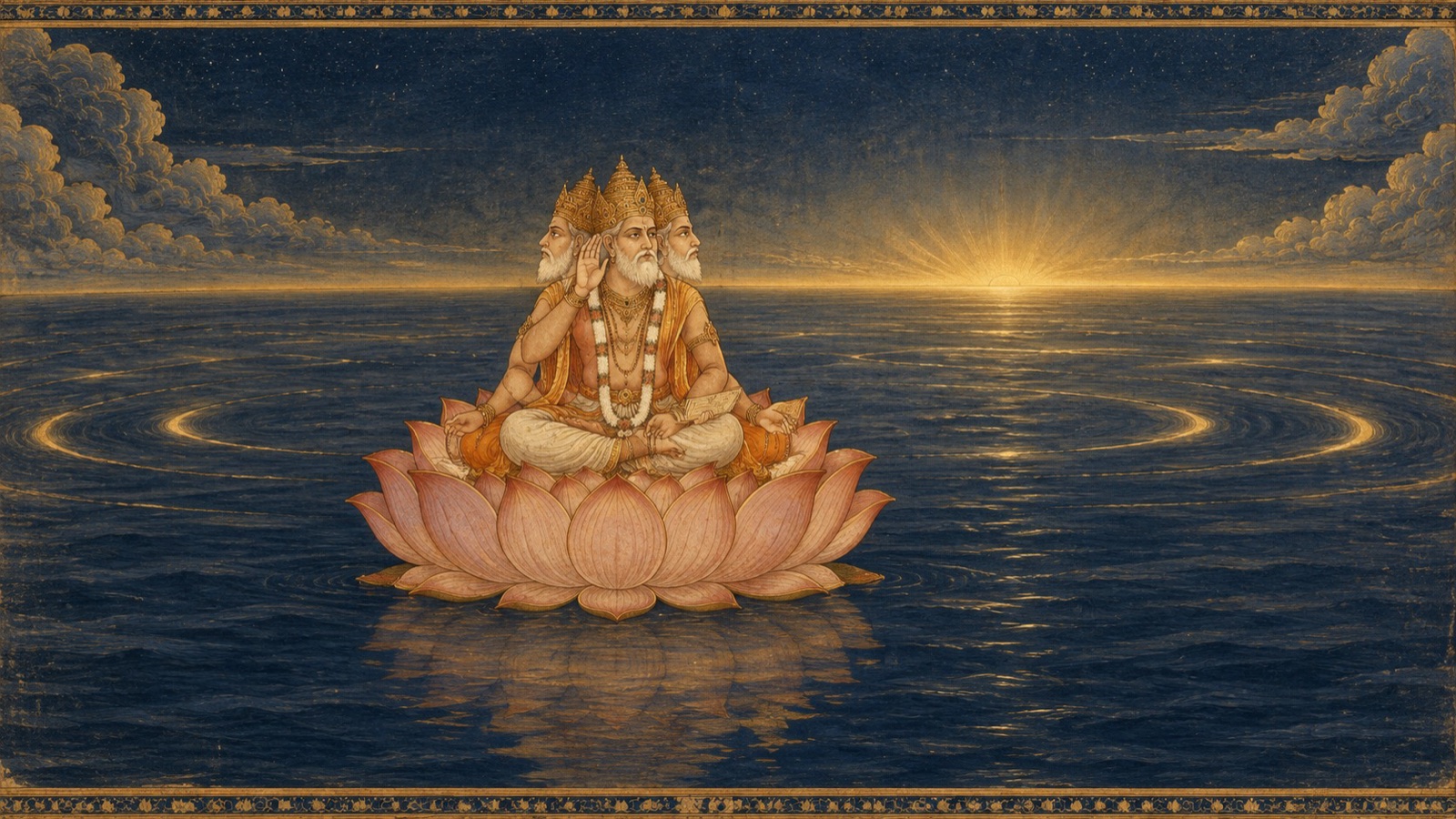
Brahma looked in every direction for the speaker but found no one at all. Taking the word as sound advice rather than an idle sound, he resumed his seat and set his heart on penance, “as if enjoined by the Lord.” That foremost of ascetics then controlled his breath, his mind, his senses, and his organs of action, and, with perfect composure, sustained this penance for a full thousand celestial years — a span that “illumined all the worlds,” revealing to him a vision of the entire universe he was about to create.
The Vision of the Lord’s Transcendent Abode
Pleased by this austerity, the Lord rewarded Brahma with something far beyond a mere plan for creation: a direct vision of His own supreme Abode, a realm higher than which none exists, untouched by affliction, bewilderment, or fear, and praised on every side by the enlightened souls who have beheld it.
तस्मै स्वलोकं भगवान् सभाजित: सन्दर्शयामास परं न यत्परम् । व्यपेतसंक्लेशविमोहसाध्वसं स्वदृष्टवद्भिर्पुरुषैरभिष्टुतम् ॥ ९ ॥
tasmai svalokaṁ bhagavān sabhājitaḥ sandarśayām āsa paraṁ na yat param vyapeta-saṅkleśa-vimoha-sādhvasaṁ sva-dṛṣṭavadbhir puruṣair abhiṣṭutam
Meaning: Pleased with him, the Lord revealed to Brahma His own supreme Abode, higher than which there is no other realm, free from all affliction, bewilderment, and fear, and praised by the enlightened souls who have themselves beheld it. (Canto 2, Chapter 9, verse 9)
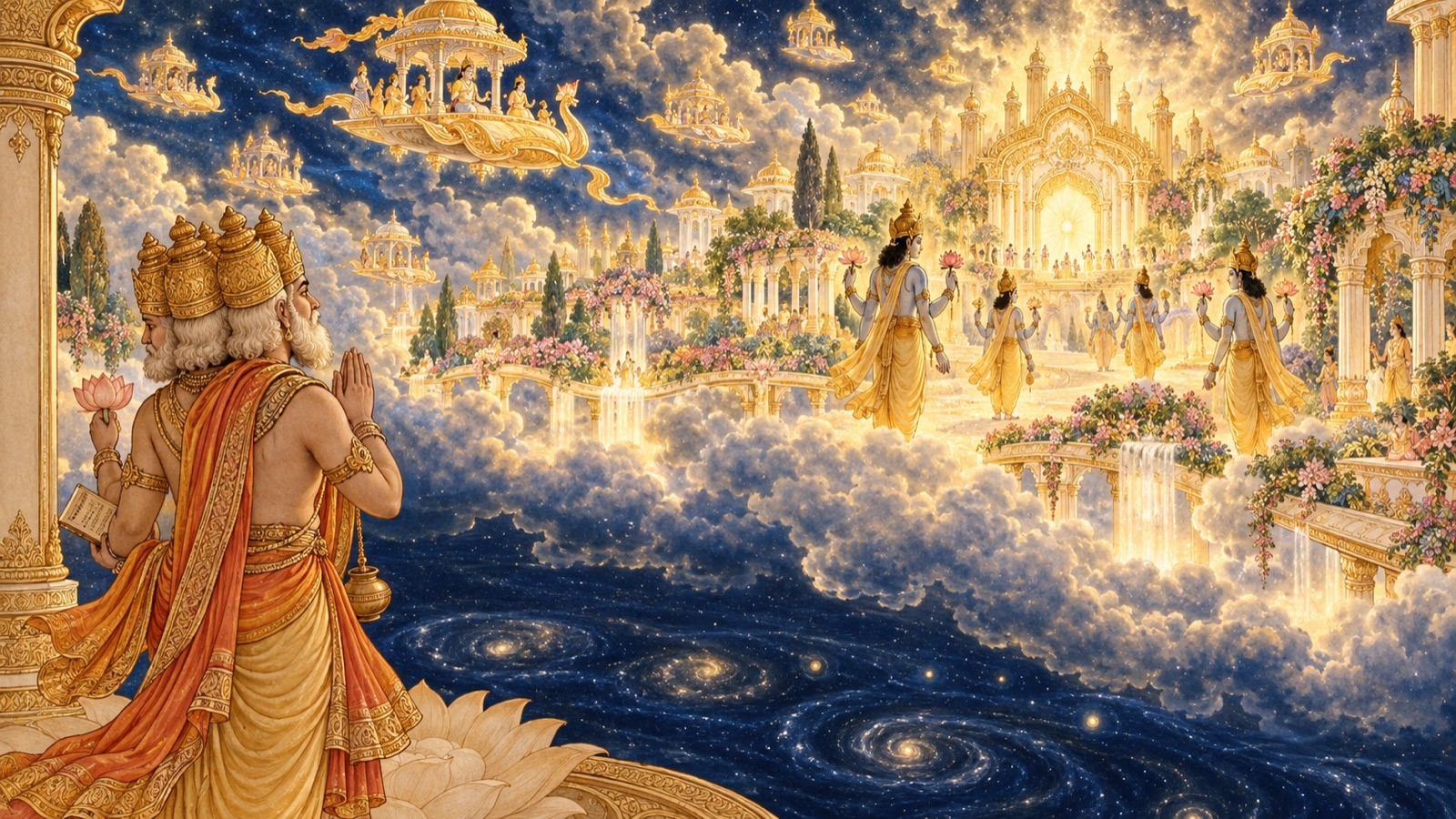
In that realm, Sukadeva explains, neither Rajas nor Tamas prevails, nor even Sattva mixed with either; the all-destroying force of Time is powerless there, and so is Maya itself — how, then, could attachment or greed ever find their way in? The attendants who reside there, adored by gods and demons alike, are four-armed, richly adorned, transparent in complexion, and radiantly beautiful. Aerial cars glitter across that realm like a monsoon sky lit by lightning, and Sri, the goddess of fortune, sits there on a swing, singing the exploits of her beloved Lord even as the bees of that eternal spring sing her own praises in turn.
Brahma Beholds the Lord Himself
At the heart of this vision, Brahma finally beholds the Lord Himself — the Protector of His devotees, the Lord of Sri, the enjoyer of every sacrifice, waited upon by His own foremost attendants, Sunanda, Nanda, Prabala, and Arhana.
ददर्श तत्राखिलसात्वतां पतिं श्रिय: पतिं यज्ञपतिं जगत्पतिम् । सुनन्दनन्दप्रबलार्हणादिभि: स्वपार्षदाग्रै: परिसेवितं विभुम् ॥ १४ ॥
dadarśa tatrākhila-sātvatāṁ patiṁ śriyaḥ patiṁ yajña-patiṁ jagat-patim sunanda-nanda-prabalārhaṇādibhiḥ sva-pārṣadāgraiḥ parisevitaṁ vibhum
Meaning: Brahma beheld there the Lord of all His devotees, the Lord of Sri, the enjoyer of sacrifices and Ruler of the universe, being attended by His own foremost servants Sunanda, Nanda, Prabala, Arhana, and others. (Canto 2, Chapter 9, verse 14)
The Lord’s gaze itself bears nectar, and His countenance carries a gracious smile; His eyes are reddish, His head crowned, His ears adorned, His body ever clad in yellow, His four arms unmistakable, and His chest marked with a golden streak — the sign of Goddess Lakshmi’s presence. Enthroned amid His twenty-five potencies and His six eternal, divine attributes, He revels eternally in His own blissful nature. At the sight of Him, Brahma’s heart floods with rapture; the hair on his body stands on end, tears of love fill his eyes, and the Creator of the universe bows at those lotus feet attained only by the path of the Paramahamsas — the wholly renounced. The Lord, delighted in turn to see Brahma standing before Him in love and humility, ready to receive His command, takes Brahma by the hand and speaks to him with a gentle, illumined smile.
The Lord Speaks: Penance Is My Own Heart
The Lord’s first words to Brahma are words of recognition and invitation. Brahma’s long penance, undertaken with the Vedas already stored in his heart, has thoroughly pleased the Lord — for hypocritical Yogis, He notes, can hardly please Him at all. Brahma is invited to ask for any boon he desires, since every effort a soul makes for its own good comes to fruition in the Lord’s sight. The very vision Brahma has just received, the Lord adds, is itself the highest fruit that ingenuity can attain — the direct perception of His own Abode, granted only because of the humble, submissive spirit in which Brahma carried out that penance at the Lord’s own bidding (verse 21).
The Lord then reveals something remarkable: He Himself had commanded Brahma to undertake this penance, speaking that mysterious two-syllable word in the lonely waters precisely because Brahma did not yet know how to proceed with creation. And penance, the Lord says, is nothing less than His own heart — the very means by which He Himself creates the universe, maintains it, and, in time, draws it back into Himself.
सृजामि तपसैवेदं ग्रसामि तपसा पुन:। बिभर्मि तपसा विश्वं वीर्यं मे दुश्चरं तप: ॥ २३ ॥
sṛjāmi tapasaivedaṁ grasāmi tapasā punaḥ bibharmi tapasā viśvaṁ vīryaṁ me duścaraṁ tapaḥ
Meaning: It is by penance alone that I create this universe, and by penance again that I absorb it; by penance I sustain it as well — My very strength lies in penance, which is difficult to practise. (Canto 2, Chapter 9, verse 23)
Brahma’s Prayer: The Spider and Its Web
Given leave to ask anything, Brahma’s request is strikingly humble. Since the Lord already knows, as the witness seated in every heart, exactly what Brahma intends to do, Brahma asks only for one thing: insight into how the Lord, through His own Maya, projects this universe from Himself, sustains it, and then withdraws it again — all without ceasing to be Himself.
यथात्ममायायोगेन नानाशक्त्युपबृंहितम् । विलुम्पन् विसृजन् गृह्णन् बिभ्रदात्मानमात्मना ॥ २७ ॥
yathātma-māyā-yogena nānā-śakty-upabṛṁhitam vilumpan visṛjan gṛhṇan bibhrad ātmānam ātmanā
Meaning: [Brahma prayed:] Even as a spider spins its web out of itself, plays within it, and then draws it back into its own mouth, so You, O Madhava, through Your own Maya endowed with manifold powers, project, sustain, and withdraw this universe entirely by Yourself. Grant me the insight to understand how You do this. (Canto 2, Chapter 9, verses 26-27)
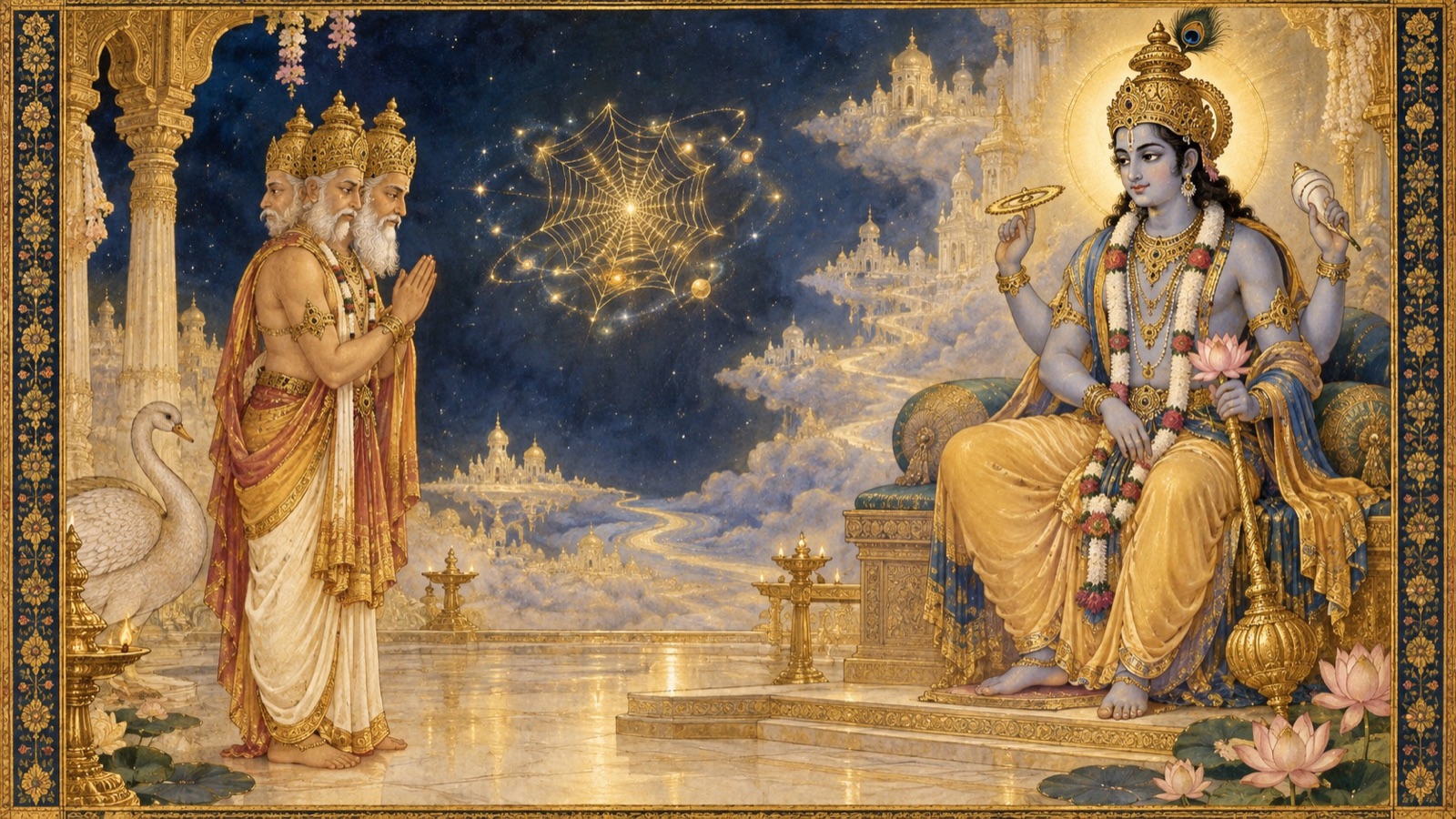
Brahma asks, further, for the strength to carry out the Lord’s instructions tirelessly and without attachment, and for protection from the pride of imagining himself somehow the Supreme’s equal, simply because the Lord has shown him such personal favour — clasping his hand, calling him friend. He asks only to remain, with an unconfounded mind, a humble servant classifying the countless Jivas according to their own natures and past deeds as creation unfolds.
The Four Verses: Chatuh-shloki Bhagavatam
What follows is the theological heart not only of this chapter but, by long tradition, of the entire Srimad Bhagavatam. The Lord offers to impart to Brahma the most confidential knowledge of Himself — how great He is, what His essential nature is, in how many forms He manifests, and what His true doings are. He then speaks four verses so complete that the eighteen thousand verses of the Bhagavata that follow are traditionally understood as nothing but their elaboration. This blog approaches these four verses with the greatest care, offering the plain sense of the Gita Press primary source rather than any borrowed interpretation.
The first verse establishes the Lord’s sole and total existence prior to creation, and His continuity through and beyond it.
अहमेवासमेवाग्रे नान्यद् यत् सदसत् परम् । पश्चादहं यदेतच्च योऽवशिष्येत सोऽस्म्यहम् ॥ ३२ ॥
aham evāsam evāgre nānyad yat sad-asat param paścād ahaṁ yad etac ca yo ‘vaśiṣyeta so ‘smy aham
Meaning: [The first of the four couplets.] I alone existed before this creation, and nothing else — gross or subtle, or their cause — existed besides Me. I exist afterward, in the form of this manifest universe, and I alone shall remain when it is withdrawn. (Canto 2, Chapter 9, verse 32)
The second verse defines Maya itself — that which seems to appear, yet has no reality independent of the Lord.
ऋतेऽर्थं यत् प्रतीयेत न प्रतीयेत चात्मनि । तद्विद्यादात्मनो मायां यथाभासो यथा तम: ॥ ३३ ॥
ṛte ‘rthaṁ yat pratīyeta na pratīyeta cātmani tad vidyād ātmano māyāṁ yathābhāso yathā tamaḥ
Meaning: [The second couplet.] That which appears to have a reality of its own, apart from the Self, but which has no true existence when the Self alone is considered — that should be known as the Self’s own Maya, comparable to an illusory second light or to darkness. (Canto 2, Chapter 9, verse 33)
The third verse offers the celebrated analogy of the gross elements to explain how the Lord is at once present and beyond the beings He pervades.
यथा महान्ति भूतानि भूतेषूच्चावचेष्वनु । प्रविष्टान्यप्रविष्टानि तथा तेषु न तेष्वहम् ॥ ३४ ॥
yathā mahānti bhūtāni bhūteṣūccāvaceṣv anu praviṣṭāny apraviṣṭāni tathā teṣu na teṣv aham
Meaning: [The third couplet.] Just as the great gross elements are said to have entered, and also not to have entered, the many beings — great and small — made up of them, so I too am, and am not, within those very beings. (Canto 2, Chapter 9, verse 34)
The fourth verse gives Brahma — and every seeker after him — the actual method of enquiry into this one Reality.
एतावदेव जिज्ञास्यं तत्त्वजिज्ञासुनात्मन: । अन्वयव्यतिरेकाभ्यां यत् स्यात् सर्वत्र सर्वदा ॥ ३५ ॥
etāvad eva jijñāsyaṁ tattva-jijñāsunātmanaḥ anvaya-vyatirekābhyāṁ yat syāt sarvatra sarvadā
Meaning: [The fourth and final couplet.] This alone is what the seeker of the truth of the Self should enquire into and ascertain: that Reality which exists everywhere and always, whether approached through the method of affirmation or through the method of negation. (Canto 2, Chapter 9, verse 35)
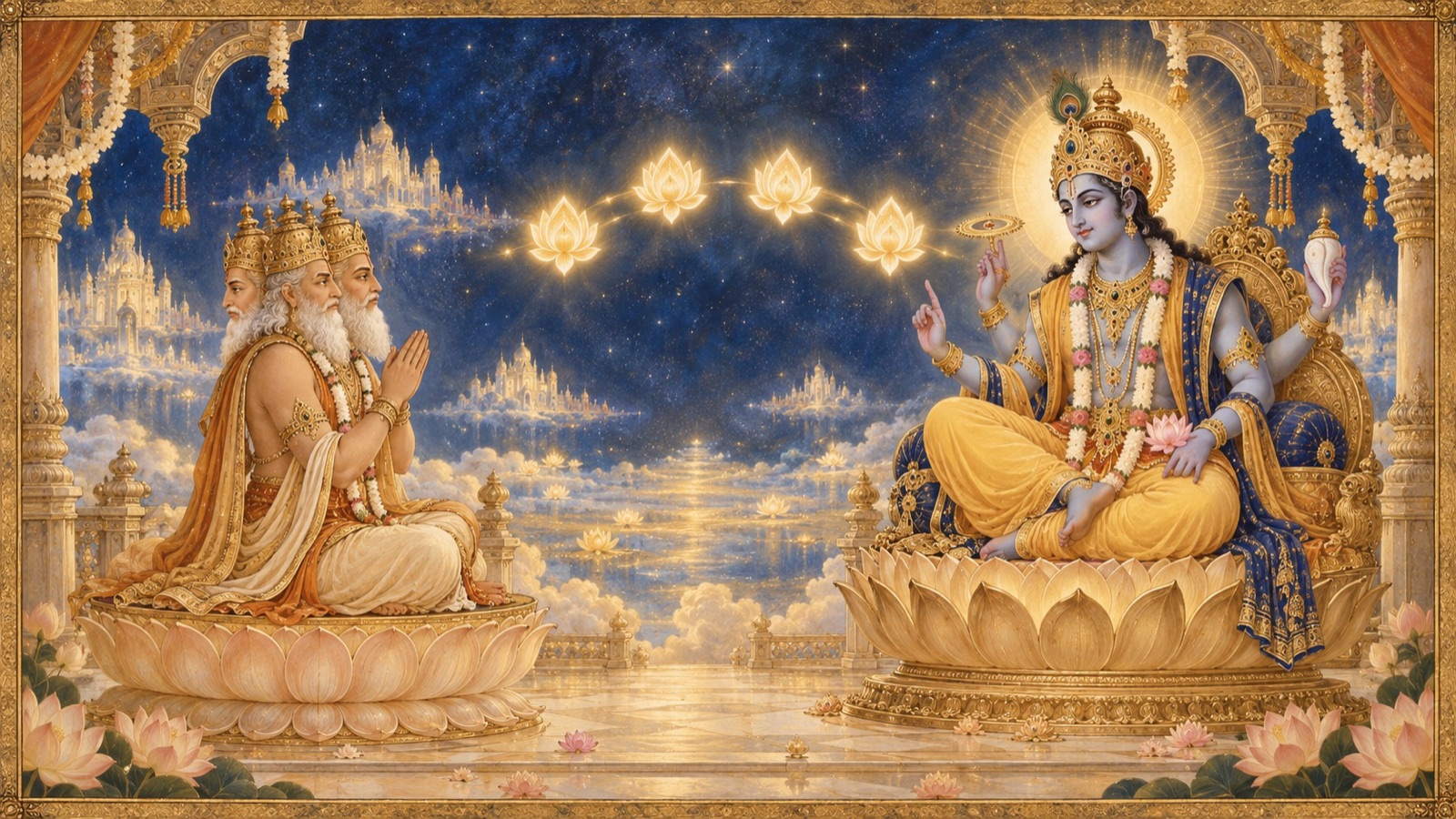
Having spoken these four verses, the Lord adds one further instruction — not itself counted among the four, but the key to living by them: Brahma is to establish himself fully in this teaching through penance and steady concentration, so that he will never again be confounded by pride or delusion across the endless cycles of creation still to come.
एतन्मतं समातिष्ठ परमेण समाधिना । भवान् कल्पविकल्पेषु न विमुह्यति कर्हिचित् ॥ ३६ ॥
etan mataṁ samātiṣṭha parameṇa samādhinā bhavān kalpa-vikalpeṣu na vimuhyati karhicit
Meaning: Establish yourself firmly in this teaching of Mine through supreme concentration; doing so, you shall never again be bewildered across the different Kalpas of creation. (Canto 2, Chapter 9, verse 36)
The Lord Withdraws, and the Teaching Descends to Vyasa
Having instructed Brahma, the unborn Lord Sri Hari withdrew that visible form while Brahma stood gazing in wonder. Brahma, representing all beings, bowed with joined palms to the Lord who had now concealed Himself, and resumed the work of creation just as he had done in the cycles before. Eager for the good of all created beings, he took up the disciplines of Yama and Niyama — the very foundations of Yoga — in pursuit of that same end the Lord had shown him.
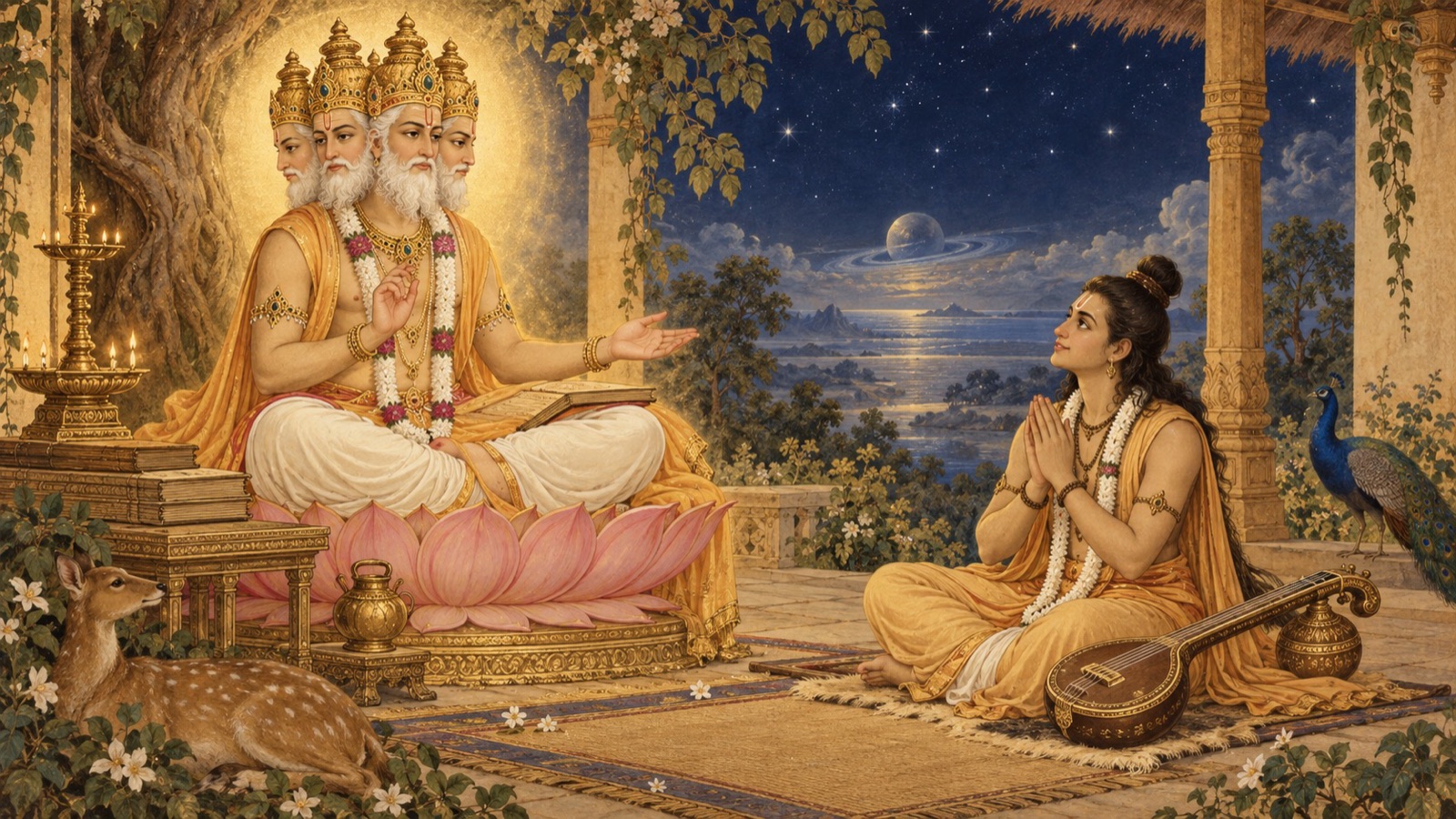
It was during this period that Narada, the sage most dear among Brahma’s sons and an eminent devotee of the Lord, eager to learn the wonder of Bhagavan Vishnu’s Maya, served his father with such devotion, humility, and self-control that Brahma was fully satisfied. Finding his father pleased, Narada asked him the very same questions that Parikshit has now asked Sukadeva. And Brahma, delighted by his son’s question, repeated to Narada this same Bhagavata-Purana of ten distinctive features — the very teaching the Lord had once given him.
नारद: प्राह मुनये सरस्वत्यास्तटे नृप । ध्यायते ब्रह्म परमं व्यासायामिततेजसे ॥ ४४ ॥
nāradaḥ prāha munaye sarasvatyās taṭe nṛpa dhyāyate brahma paramaṁ vyāsāyāmita-tejase
Meaning: Narada, in turn, O King, imparted this same teaching to the sage Vyasa, of boundless glory, as Vyasa sat meditating on the Supreme Brahman on the bank of the river Saraswati. (Canto 2, Chapter 9, verse 44)
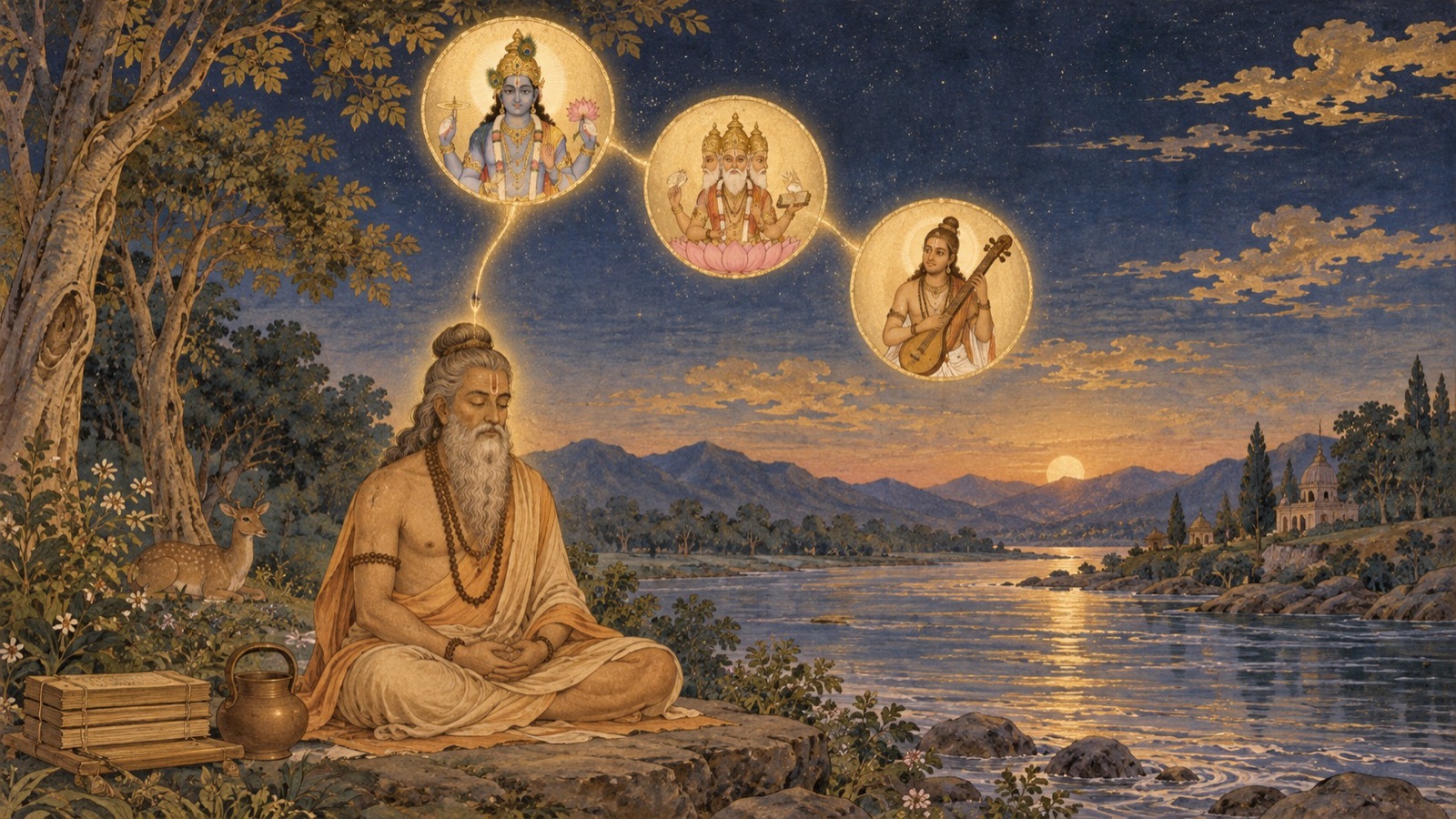
With that, Sukadeva closes the circle: this very scripture, received through that unbroken chain, is what he will now expound to Parikshit in answer to his questions — how the universe emanated from the Cosmic Being, and everything else Parikshit wishes to know.
Principal Teachings of This Chapter
1. Genuine knowledge of God is received, not invented. Brahma does not devise his own path to creation; he hears an unseen command, undertakes penance on faith alone, and is rewarded only afterward with vision. The chapter models a chain of transmission — Lord to Brahma, Brahma to Narada, Narada to Vyasa — in which no link claims originality (verses 5-9, 39-45).
2. Penance is not self-effort separate from God — it is His own heart. The Lord declares that penance is what He Himself uses to create, sustain, and withdraw the universe; austerity is not a technique for approaching a distant God but a participation in what God already is (verses 19-23).
3. The proper prayer asks for understanding, not power. Offered any boon, Brahma asks only to understand how the Lord’s Maya works, and to remain free from doership and pride while serving as an instrument of creation (verses 24-29).
4. The entire Bhagavata is contained in four verses. The Chatuh-shloki establishes the Lord’s sole existence before and after creation, defines Maya as apparent but not ultimately real, resolves the paradox of divine immanence and transcendence through the elements-in-beings analogy, and gives the one enquiry — into that single Reality present everywhere and always — that every seeker must undertake (verses 32-35).
5. Vision of God is a gift that must be lived, not merely received. The Lord’s final instruction to Brahma is not further information but a call to concentration and steadfastness, so that the teaching received in a moment of grace endures across every future cycle of creation (verse 36).
A Devotional Reflection
There is a quiet honesty in the way this chapter is built. Brahma — the very architect who will soon fashion the fourteen worlds — does not begin his work from his own wisdom. He waits in confusion until an unseen voice speaks two syllables, and he trusts that voice enough to spend a thousand celestial years in penance before he sees anything at all. Only then does the Lord appear, and only then does He speak the four verses that make sense of everything: that He alone was, is, and will remain; that whatever seems to stand apart from Him is Maya; that He is somehow both within and beyond every created thing; and that this single Reality, sought steadily, is the only enquiry worth making. It is easy to read the Chatuh-shloki as abstract philosophy. It is harder — and truer to how this chapter presents it — to read it as something spoken to a listener who had already waited, already surrendered, and already asked for nothing but insight. The verses answer a question shaped by devotion before they answer a question shaped by curiosity. Perhaps that is why the chapter does not let the teaching stop with Brahma: it insists on tracing it onward to Narada and to Vyasa, as if to say that a truth received in silence and humility is a truth meant to be carried forward, hand to hand, rather than kept.
A Daily Devotional Practice
Today, before turning to any of your own plans or efforts, sit quietly for a few moments and recall Brahma’s long wait beside the causal waters — how he heard only two syllables, and how those two syllables were enough. Ask yourself what “tapa” might mean in your own life today: not necessarily austerity in the ascetic sense, but a willingness to hold steady in uncertainty rather than rushing to fill it with your own answers. Then let your mind rest, even briefly, on the first of the Lord’s four verses — I alone existed before this creation, and I alone shall remain — as a reminder that whatever unfolds today is held within something that does not come and go. Close by softly repeating the mantra that has carried this whole series from its first page: “Om Namo Bhagavate Vasudevaya.”
Conclusion
The ninth chapter of the Second Canto is, in many ways, the theological keystone of the entire Bhagavatam. Where earlier chapters described the Cosmic Being’s limbs and the unfolding of the elements, this chapter reaches behind all of that to the moment the Lord Himself first spoke to Brahma — teaching him, in four spare verses, everything that the eighteen thousand verses to follow will spend an entire scripture unfolding. Brahma’s penance, his vision of the transcendent Abode, his humble prayer for insight rather than power, and finally his reception of the Chatuh-shloki together form a single arc: from confusion, through surrender, to a teaching so complete that it becomes the seed of an entire tradition. And the chapter does not end with Brahma alone — it follows the teaching onward, to Narada beside his father, and to Vyasa beside the Saraswati, showing that this knowledge was never meant to terminate with one recipient, however exalted. It was always meant to travel — and it is travelling still, in every retelling of this scripture, including this one.
May the divine wisdom of Srimad Bhagavatam awaken pure devotion within our hearts.
Om Namo Bhagavate Vasudevaya.
Jay Shree Madhav.
References and Attribution
- Primary edition: Gita Press, Śrīmad Bhāgavata Mahāpurāṇa (English, complete), Book Two, Discourse 9, pages 122–127.
- Series: Srimad Bhagavatam Wisdom · Biswa Sanatan Dharma Seva Trust.
- Presented following the spiritual guidance and recommendation of Pandit Dr. Shri Kashinath Mishra.
This is an original, faithful retelling in the writer’s own words, with brief quoted verses shown in Devanāgarī and transliteration and their meanings given as summaries. It is not a reproduction of any single publisher’s continuous translation or commentary. No affiliation with or endorsement by any publisher is implied.
Jay Shree Madhav