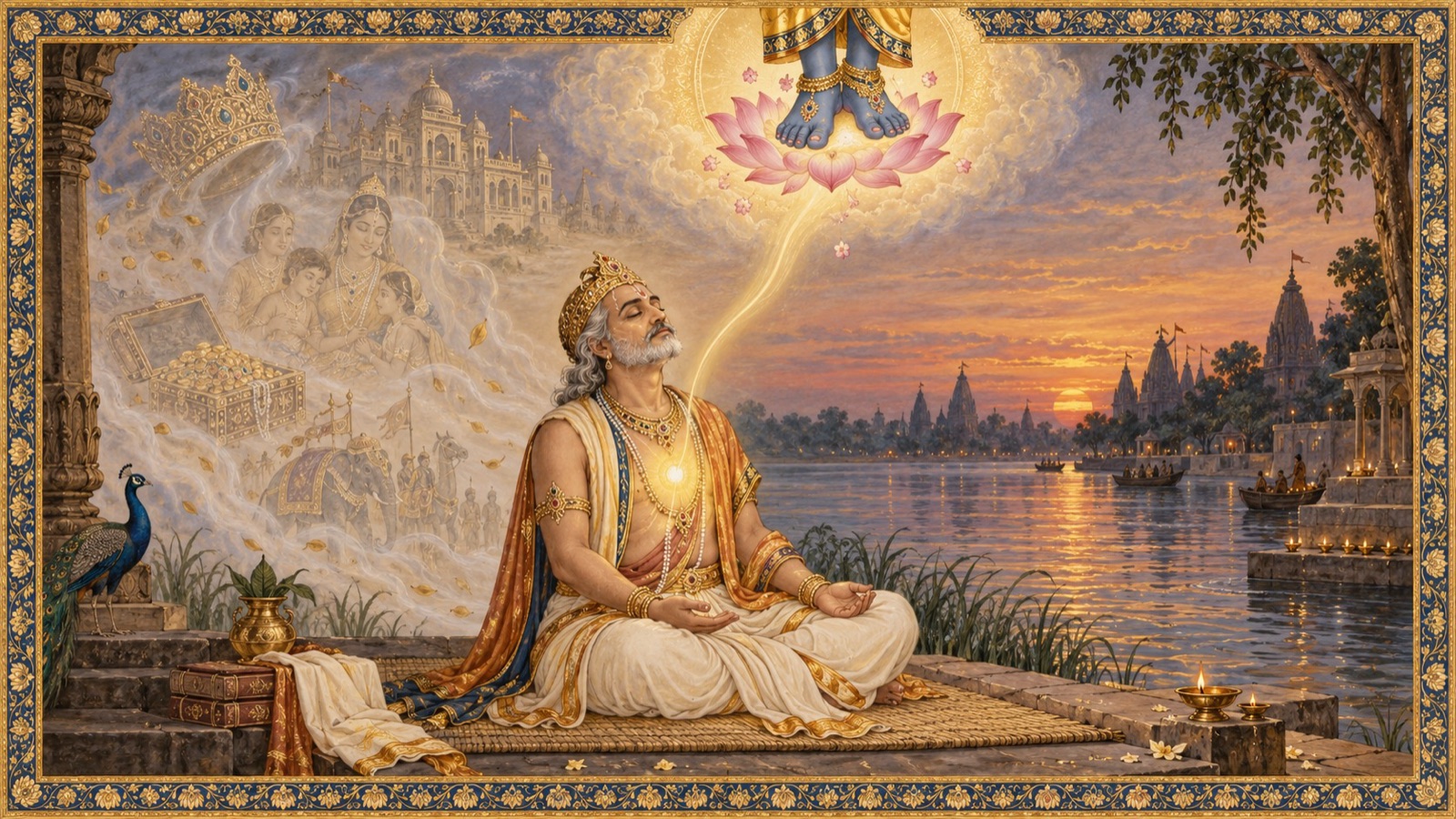
His mind fixed at last on Sri Krishna’s feet, King Parikshit lets every attachment — kingdom, kin, and body alike — fall quietly away, as the chapter’s outer narrators prepare to ask what he asked next.
Om Namo Bhagavate Vasudevaya.
Om Namo Bhagavate Vasudevaya.
Om Namo Bhagavate Vasudevaya.
Welcome to Srimad Bhagavatam Wisdom, a devotional journey through the sacred histories and teachings of the Srimad Bhagavat Mahapurana. The third chapter closed with a request left hanging in the air: Saunaka, at the forest hermitage of Naimisharanya, had just asked Suta Gosvami to reveal what King Parikshit asked Sukadeva Goswami next. This fourth chapter answers that request — but not before pausing, briefly and movingly, on what Sukadeva’s teaching had already done to the dying king’s heart. Suta describes how Parikshit, having heard Sukadeva’s words, let go of every attachment that had bound him — to his body, his family, his kingdom — and fixed his mind wholly on Sri Krishna. Only then does the king ask his question: how does the Lord create, sustain, and dissolve this vast universe? And Sukadeva’s answer, when it finally begins, opens not with an explanation of cosmology at all, but with one of the most beautiful and comprehensive prayers of praise found anywhere in the Bhagavatam — a hymn of obeisance to the Supreme Person that this chapter’s entire scope is given over to.
Chapter Information
- Scripture: Śrīmad Bhāgavata Mahāpurāṇa
- Canto: 2 (Book Two)
- Chapter: 4 (Discourse 4)
- Chapter title (Gita Press): how Parikshit puts his question about the universe’s making to Sukadeva, and Sukadeva opens his reply
- Principal speaker: Suta Gosvami, narrating throughout to the sage Saunaka and the assembly at Naimisharanya; within his narration, King Parikshit speaks (verses 5–10) and Sri Suka (Sukadeva Gosvami) speaks (verses 12–25)
- Principal listener: The sage Saunaka and the assembled sages at Naimisharanya (outer frame); within the narrated story, Sukadeva Gosvami listens to Parikshit’s question, and Parikshit listens to Sukadeva’s opening prayer
- Main setting: The forest hermitage of Naimisharanya, where Suta is narrating; and, within that narration, the bank of the Ganga, where the dying Parikshit once sat before Sukadeva Goswami
- Central subject: Parikshit’s complete inner renunciation on hearing Sukadeva’s teaching; his question about how the Lord creates, maintains, and destroys the universe through His own Maya; and Sukadeva’s opening response — an extended invocatory prayer of obeisance to the Supreme Person as the source of all three cosmic functions
- Principal verse range: Canto 2, Chapter 4, verses 1–25
- Primary edition: Gita Press Śrīmad Bhāgavata Mahāpurāṇa
The King Whose Heart Had Already Let Go
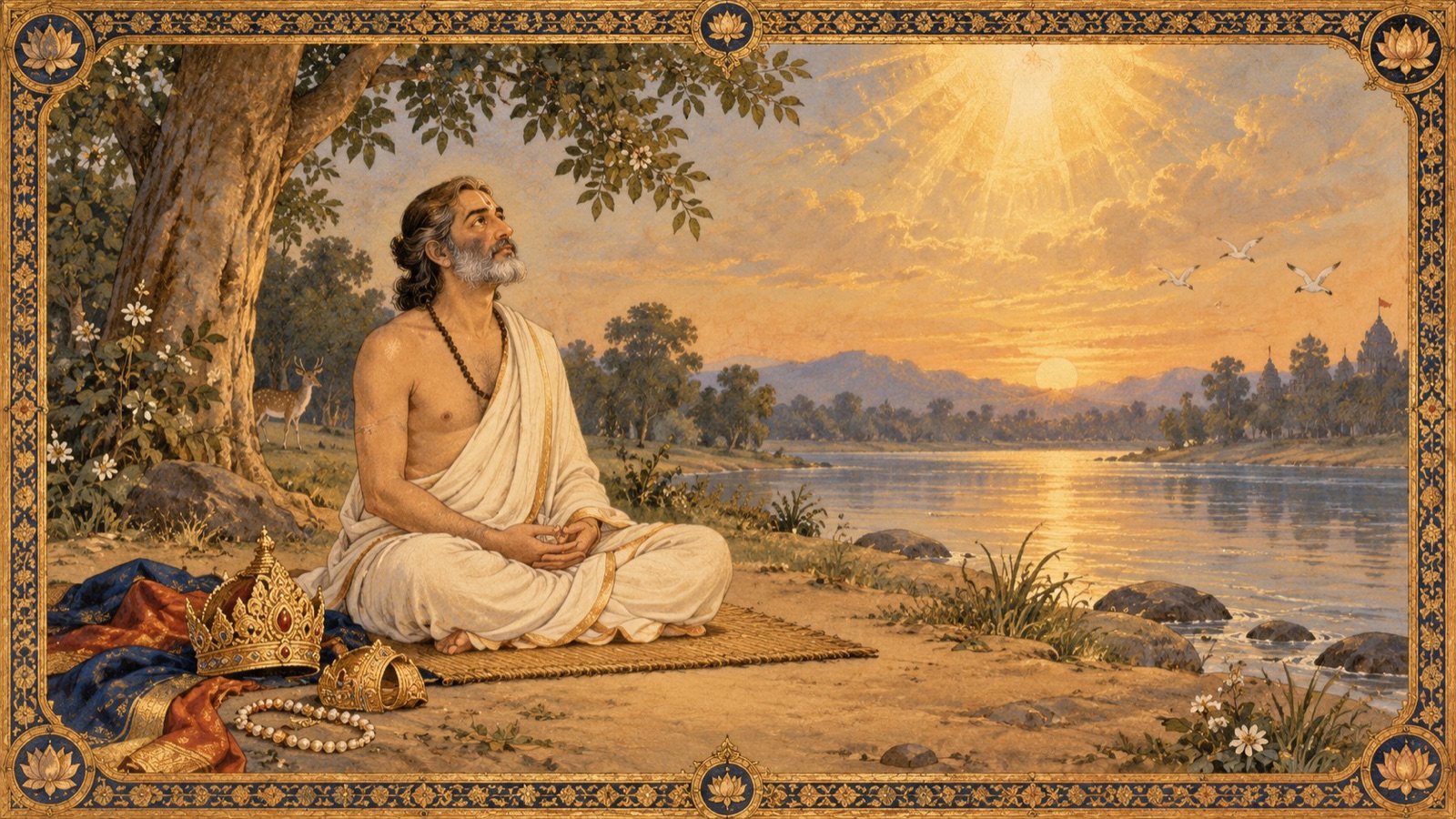
The chapter opens quietly, almost as an aside, but it carries real weight. Suta tells the sages of Naimisharanya that on hearing Sukadeva’s words — the entirety of what has come before, across three full chapters — King Parikshit’s mind became exclusively devoted to Sri Krishna’s feet. In a moment, Suta says, the king shook off the deep-rooted attachment he had held all his life: attachment to his own body, to his wife, to his sons, to his home, to his animals, to his wealth, to his kinsmen, and even to his kingdom, which until then had known no trouble at all. This is worth pausing over. Parikshit was not a renunciant by profession; he was a reigning emperor, a descendant of the Pandavas, a man whose kingdom was peaceful and prosperous. Yet in the span of a teaching, that entire structure of identity and possession simply came loose.
Knowing that his death was near, the high-minded king renounced his engagement with the first three goals of human life — Dharma, Artha, and Kama, the pursuits of duty, wealth, and desire that structure most human striving. He established his complete identity with Lord Vasudeva. And it is in this state — no longer a man defending his kingdom or securing his lineage, but a soul turned wholly toward the Lord, deeply reverent simply to hear more of Krishna’s glory — that Parikshit asked Sukadeva the very question Saunaka is now asking Suta. The narrative frame folds neatly here: the question about to be quoted is not a new one invented for this chapter, but the same question the king once posed on the bank of the Ganga, now being relayed a second time, in the second telling of the whole Bhagavatam.
The King’s Question: How Is the Universe Made?
What Parikshit actually asks is laid out across six verses, and it is a remarkably precise, almost scientific set of questions for a man on the edge of death. He begins with an acknowledgment: Sukadeva’s words are dispelling the gloom of his ignorance, and he trusts the sage completely, for Sukadeva is all-knowing and free of sin. Then come the questions themselves. First: how does the Lord, through His own Maya — His deluding, creative potency — bring this universe into being at all, a mystery so deep that even the great gods, Brahma among them, find it hard to fathom? Second: how does that same all-pervading Lord protect and sustain what He has created, and how, in time, does He destroy it again? Third, and most striking: possessed of innumerable powers, which of these does the Supreme Person actually take up when, at play with His own Self, He fashions Himself into so many playthings — that is, so many universes — and then dissolves them once more? Even for the wise, Parikshit admits, the doings of Sri Hari are difficult to comprehend.
There is a fourth question tucked into this sequence that is easy to miss but philosophically rich: how does the Lord, who is one without a second, take up all three Gunas of Prakriti — the three qualities or modes of material nature — simultaneously in order to carry out creation and its related functions; or, alternatively, how does He manifest Himself in a succession of distinct forms, such as Brahma, to accomplish the same ends? Is it one act performed all at once, or a series of transformations performed one after another? Having laid all of this before Sukadeva, the king closes with a simple, respectful request: since you are learned in the Vedas and have realized the Supreme Spirit yourself, please answer this.
Sukadeva Fixes His Mind and Begins
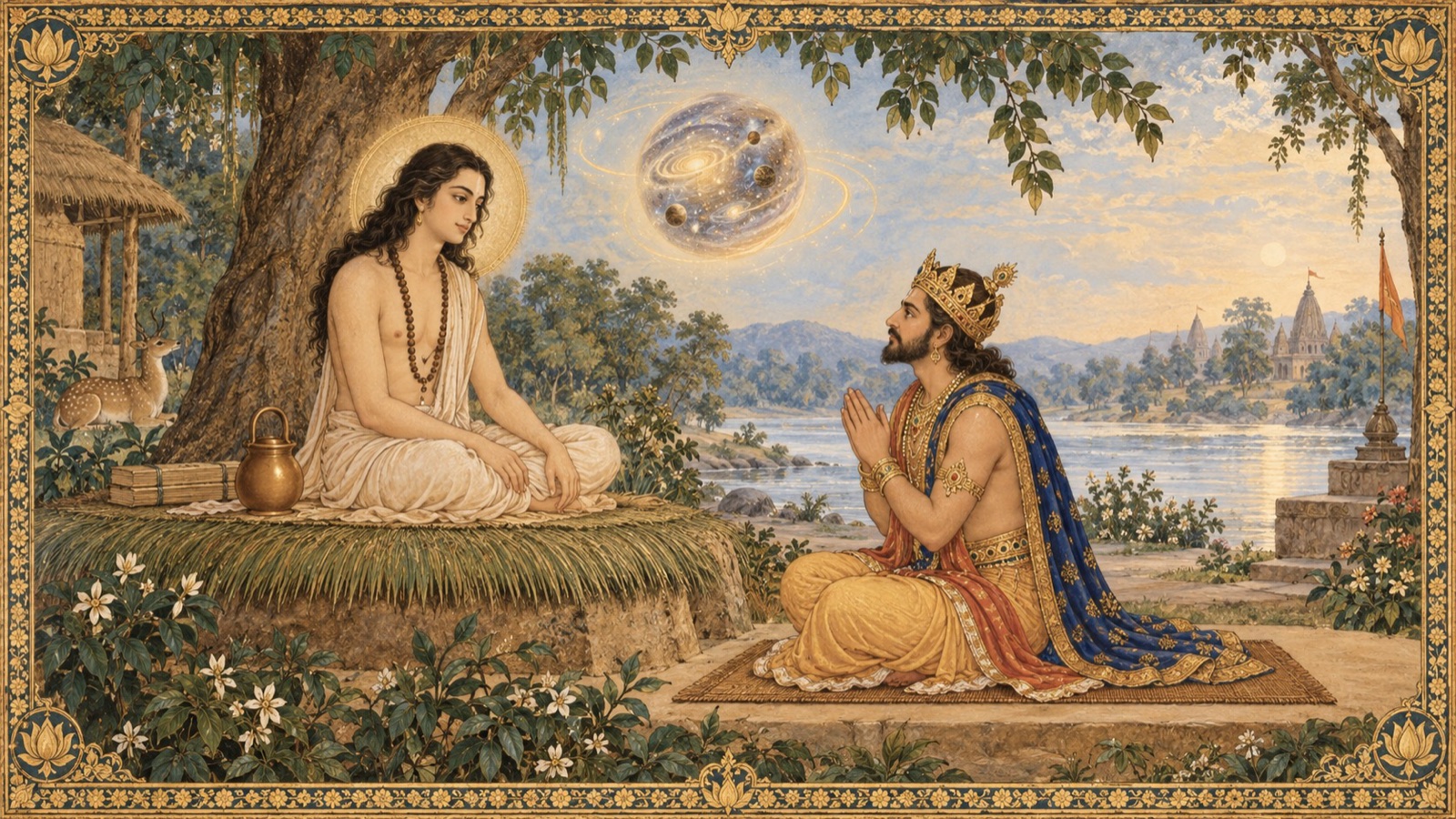
A single verse — verse eleven — marks the hinge of the whole chapter. Suta tells the assembly that, thus entreated by the king to discourse on the excellences of Sri Hari, Sukadeva fixed his thought on Lord Krishna, the Inspirer of all the senses, and began his reply. It is a small, almost procedural line, yet it matters for what it shows about how such teaching is meant to be given: not from memorized doctrine recited on demand, but from a mind first gathered and settled on the Lord Himself. Only after that inward turning does Sukadeva speak — and what he says first is not, in fact, an answer to any of Parikshit’s specific questions about Maya, Gunas, or the mechanics of creation. It is a prayer.
An Invocation Before an Explanation
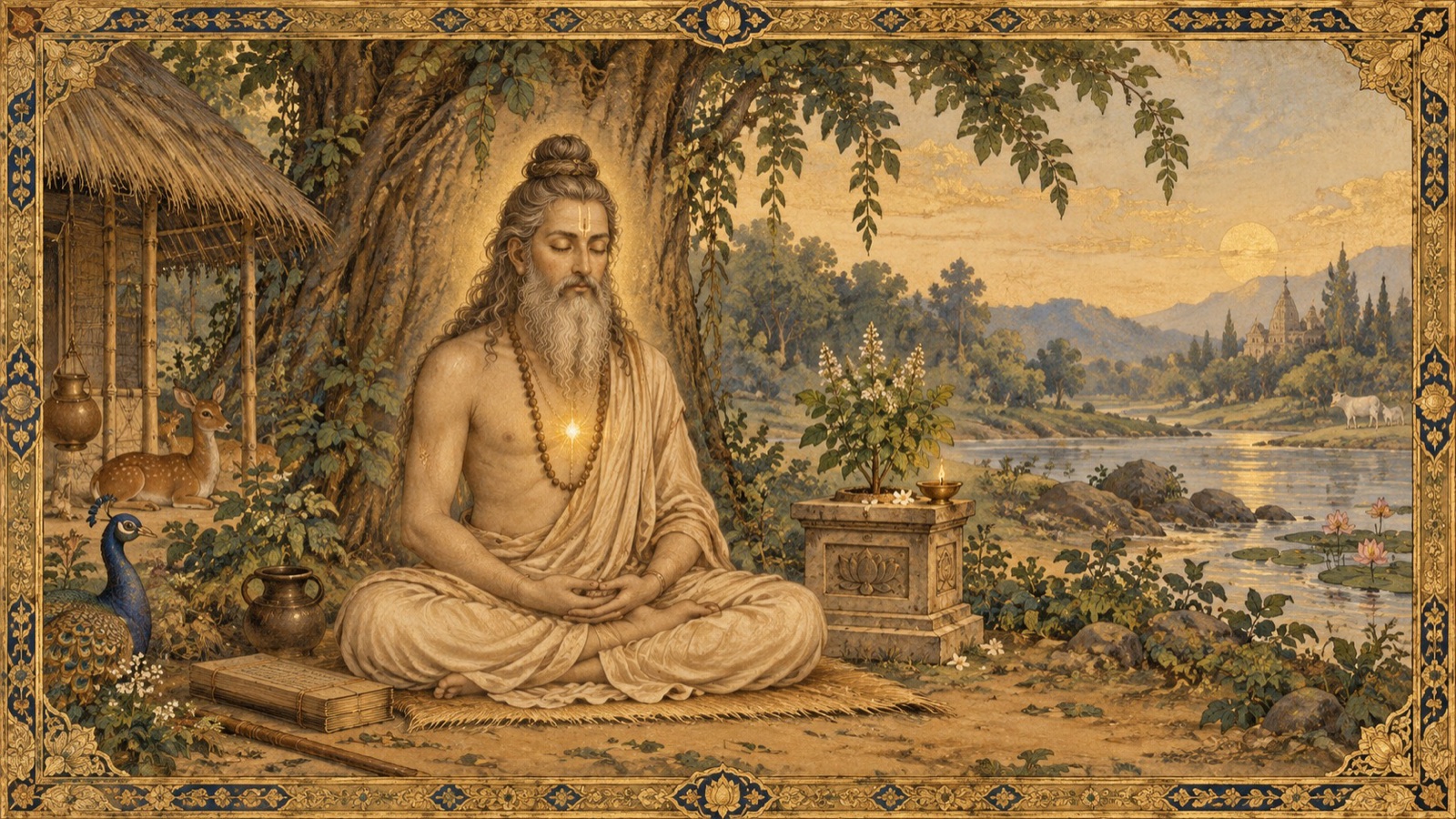
Sukadeva’s opening words to Parikshit form an extended hymn of obeisance — thirteen verses long, running from verse twelve to verse twenty-four — before the actual account of creation is even attempted (that account belongs to the following chapters). This is itself a teaching: before explaining the universe, one bows to its source. Sukadeva opens by naming the Lord’s threefold creative office and His hidden, ungraspable nature — praise offered before a single word of cosmology has been spoken.
श्री शुक उवाच नमः परस्मै पुरुषाय भूयसे सदुद्भवस्थाननिरोधलीलया । गृहीतशक्तित्रितयाय देहिना- मन्तर्भवायानुपलक्ष्यवर्त्मने ॥ १२ ॥
śrī-śuka uvāca namaḥ parasmai puruṣāya bhūyase sad-udbhava-sthāna-nirodha-līlayā gṛhīta-śakti-tritayāya dehinām antarbhavāyānupalakṣya-vartmane
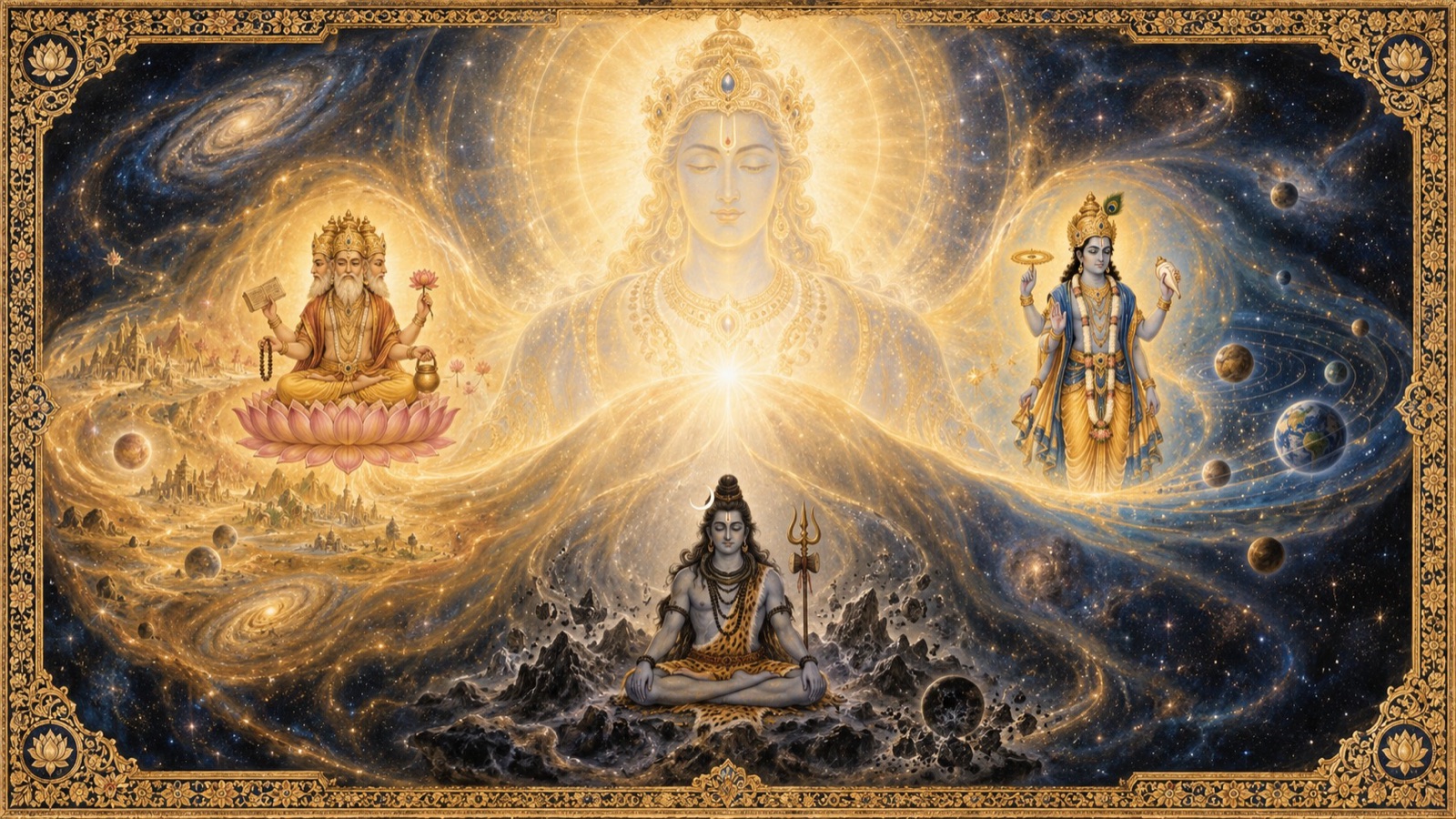
Meaning: Sri Suka said: Obeisance to that Supreme Person of infinite glory, who, in order to carry on His sportful activity of creating, preserving, and destroying the universe, has assumed the three Saktis (as Vishnu, Brahma, and Shiva) in the shape of Sattva, Rajas, and Tamas; who is the Inner Controller of all beings; and whose true nature and ways cannot be apprehended through the intellect. (Canto 2, Chapter 4, verse 12)
From there the prayer widens, verse by verse, into a vision of the Lord that leaves almost no aspect of life untouched. He is the one who uproots the sorrows of the virtuous and yet also puts a stop to the endless material growth of the wicked, granting even them, in time, liberation — and He does this without partiality, since all beings, virtuous or otherwise, are simply His own manifestations. He is celebrated as one whom devotees can reach but the devotionless cannot, delighting eternally in His own essence known as Brahman. Merely singing His praises, thinking of Him, seeing His form, greeting Him, or hearing His glory — the prayer says — cleanses a person of impurities at once, and taking refuge at His feet allows even the mind’s attachment to this world and the next to fall away effortlessly.
The Lord Who Purifies Every Kind of Person
One stretch of the prayer stands out for how far it reaches. Ascetics, philanthropists, men of high repute, those who have mastered their mind and senses, scholars of the Vedic mantras, and the righteous — none of these, the prayer insists, attain true blessedness without surrendering to the Lord’s feet. And then, in a single striking verse, Sukadeva names groups often regarded in the social imagination of the time as outside the pale of orthodox practice, and declares that even they, and anyone else of sinful conduct, are purified simply by taking refuge in those who themselves depend on the Lord.
किरातहूणान्ध्रपुलिन्दपुल्कशा आभीरशुम्भा यवना: खसादय: । येऽन्ये च पापा यदपाश्रयाश्रया: शुध्यन्ति तस्मै प्रभविष्णवे नम: ॥ १८ ॥
kirāta-hūṇāndhra-pulinda-pulkaśā ābhīra-śumbhā yavanāḥ khasādayaḥ ye ‘nye ca pāpā yad-apāśrayāśrayāḥ śudhyanti tasmai prabhaviṣṇave namaḥ
Meaning: The Kiratas, Hunas, Andhras, Pulindas, Pulkasas, Abhiras, Kankas, Yavanas, the Khasa peoples, and anyone else given to sinful ways — all of them are purified once they take refuge in those who themselves take refuge in Him. Obeisance to that all-powerful Lord. (Canto 2, Chapter 4, verse 18)
The Bhagavatam’s vision of divine grace, voiced here in Sukadeva’s very first words of his reply to Parikshit, refuses to draw a boundary around who may approach.
The Vedas Born, and the Chain of Teaching
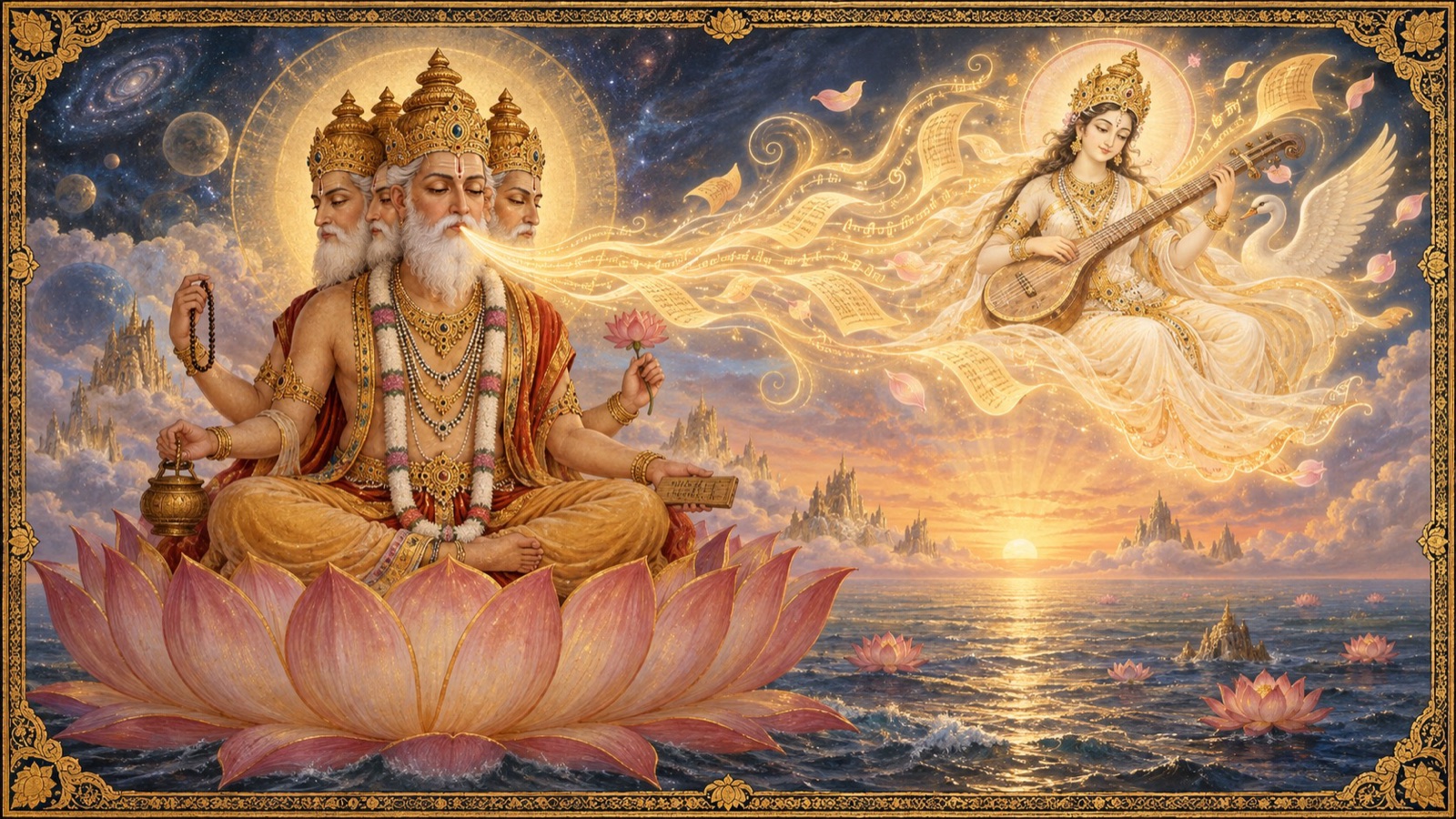
The prayer’s final verses turn toward something almost tender. Sukadeva praises the Lord as the very Self realized by the wise, the Veda itself to those devoted to ritual, Dharma personified to the righteous, and austere penance to ascetics — a reality that even Brahma and Shiva regard with wonder. He is hailed as the Lord of Sri, of sacrifice, of all created beings, of intellect, and of the earth; the protector of the Andhaka, Vrishni, and Satvata clans; the one the wise realize through deep meditation as Mukunda, the Bestower of Liberation. Then comes an especially lovely image: at the very dawn of creation, the Lord inspired Brahma’s heart to recall the memory of the previous cosmic cycle, and in response the goddess Saraswati appeared from Brahma’s own mouth — the Vedas themselves, complete with all their auxiliary limbs of phonetics and grammar. Sukadeva prays that this same Lord, the foremost source of all wisdom, be gracious to him as he prepares to speak.
The prayer closes with two final touches. First, a description of how the Lord, having formed human bodies from the five gross elements, dwells within them as the Purusha, the individual soul enjoying the sixteen objects of experience through sixteen instruments — the senses, the organs of action, the vital airs, and the mind. And then, remarkably, Sukadeva salutes the omniscient Lord Vedavyasa himself — his own father, and, the Bhagavatam says, no other than Lord Vasudeva — from whose lotus-like lips devotees drink the nectar of wisdom. In the very last verse of the chapter, Sukadeva reveals where this teaching he is about to give actually comes from: it is the same teaching that self-born Brahma, once questioned by the sage Narada, delivered — a teaching Brahma himself had received directly from Sri Hari. A hidden chain of transmission is disclosed in this single line, stretching from the Lord, through Brahma, through Narada, and finally reaching Sukadeva’s own lips as he sits before the dying king.
The Chapter’s Final Word — and What Comes Next
The chapter ends exactly where it must: with the colophon marking the close of “the fourth discourse in Book Two of the great and glorious Bhagavata-Purana, otherwise known as the Paramahamsa-Samhita.” No cosmology has yet been described. What has happened, instead, is preparation — Parikshit’s heart has been shown fully surrendered, his question has been asked in precise and searching terms, and Sukadeva has bowed before the very Being whose works he is about to describe. The actual unfolding of creation — how the universe comes forth from the Lord and what its structure is — belongs to Discourse Five, “A description of the cosmos,” which opens, fittingly, with another act of questioning: the sage Narada asking Brahma the same kind of question Parikshit has just asked Sukadeva.
Principal Teachings of This Chapter
1. Teaching that is truly heard changes the hearer completely. On hearing Sukadeva’s words, Parikshit did not merely acquire information — he let go, in a moment, of every attachment to body, family, wealth, and kingdom, turning his mind wholly toward Sri Krishna (verses 1–4).
2. A dying king’s final concern was cosmology, not comfort. Rather than seeking consolation for himself, Parikshit asked how the Lord creates, sustains, and dissolves the universe through His own Maya — a question of understanding, not of personal fear (verses 5–10).
3. Right teaching begins with a gathered, devoted mind. Before Sukadeva answers even one of the king’s questions, he first fixes his thought on Sri Krishna — a model for how sacred knowledge is meant to be given (verse 11).
4. Before explaining creation, one bows to its source. Sukadeva’s entire opening response is an invocatory prayer of obeisance, not a cosmological lecture — worship precedes explanation (verses 12–24).
5. The Lord’s grace draws no boundary of merit or birth. Ascetics, scholars, and the righteous attain blessedness only through surrender to the Lord’s feet — and so, the prayer insists, do peoples regarded as outside orthodox practice, purified through those who take refuge in Him (verses 17–18).
6. All wisdom, including the Vedas themselves, originates in the Lord. Saraswati’s appearance from Brahma’s mouth at the dawn of creation, and the chain of teaching from Hari to Brahma to Narada to Sukadeva, shows that even sacred knowledge is itself a gift flowing from the one Source (verses 22–25).
A Devotional Reflection
There is something quietly instructive in the order of events this chapter follows. A king who has just been told the deepest secrets of meditation and liberation does not respond by asking for more secrets to master — he responds by loosening his grip on everything he has ever called his own. And a sage who is about to explain the single most vast subject imaginable — the origin, maintenance, and dissolution of the universe — does not begin with a diagram or a doctrine. He begins by bowing. Two very different figures, a dying emperor and a realized sage, arrive at the same posture: attention gathered, hands folded, heart turned toward the Lord before either speaks or acts further. Perhaps this is the chapter’s real teaching, quietly built into its structure rather than stated outright — that whatever we are about to receive, whether it is the answer to a lifetime’s question or the last moments of a life well lived, is best approached the way Parikshit and Sukadeva approach it here: not by seizing tightly, but by letting the heart turn, first, toward its true refuge.
A Daily Devotional Practice
Today, before you take up whatever task or question is in front of you, pause for a few quiet moments and simply offer your attention to the Lord, the way Sukadeva does before he speaks. Chant or softly repeat “Om Namo Bhagavate Vasudevaya” a few times, without hurry. Then notice, gently, whether there is anything you are gripping too tightly — a worry, a plan, an outcome you are trying to control. You need not let it go by force. Simply notice it, the way Parikshit’s attachments are described as falling away almost on their own, once his mind had truly turned toward Krishna. Let that noticing, however small, be today’s offering.
Conclusion
The fourth chapter of the Second Canto is a chapter of thresholds. It stands between the intimate, personal teaching on death and liberation that filled the first three chapters, and the vast cosmological teaching about to begin in earnest with Discourse Five. It shows a king’s heart completing its turn toward the Lord, records the precise question that will occupy much of the rest of this Canto, and lets Sukadeva demonstrate — before he explains anything at all — what it looks like to approach the universe’s mystery with reverence rather than mere curiosity. Nothing about how the universe actually came to be has yet been told; what has been given instead is the right posture from which to hear it. The chapter closes with Sukadeva still speaking, still bowing, the promised explanation of creation waiting just beyond its final verse.
May the divine wisdom of Srimad Bhagavatam awaken pure devotion within our hearts.
Om Namo Bhagavate Vasudevaya.
Jay Shree Madhav.
References and Attribution
- Primary edition: Gita Press, Śrīmad Bhāgavata Mahāpurāṇa (English, complete), Book Two, Discourse 4, pages 98–101.
- Series: Srimad Bhagavatam Wisdom · Biswa Sanatan Dharma Seva Trust.
- Presented following the spiritual guidance and recommendation of Pandit Dr. Shri Kashinath Mishra.
This is an original, faithful retelling in the writer’s own words, with brief quoted verses shown in Devanāgarī and transliteration and their meanings given as summaries. It is not a reproduction of any single publisher’s continuous translation or commentary. No affiliation with or endorsement by any publisher is implied.
Jay Shree Madhav