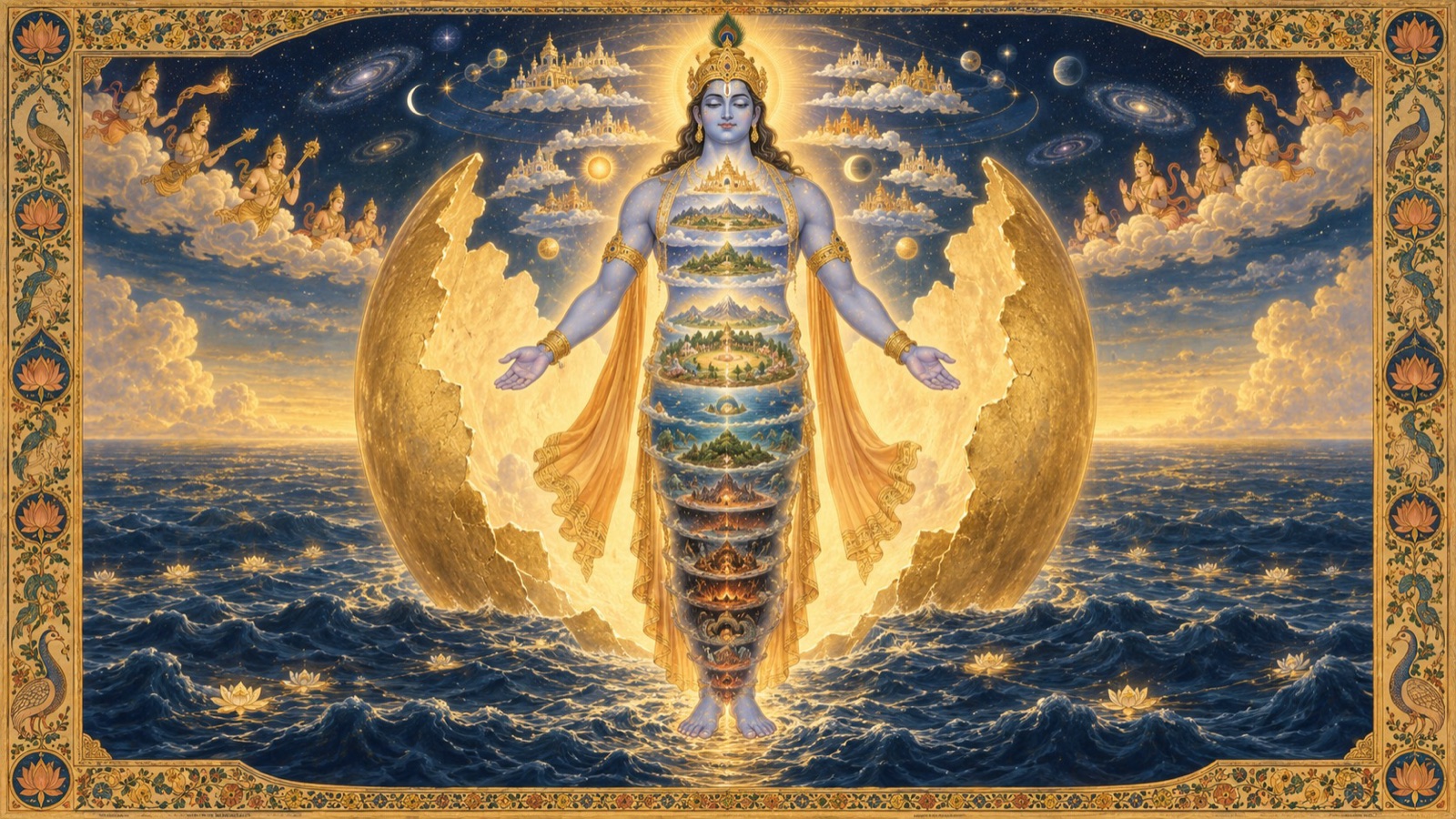
From a single golden egg floating on the causal waters, the Cosmic Being emerges — and within His vast, luminous form the wise behold all the worlds of the universe, upper and lower alike.
Om Namo Bhagavate Vasudevaya.
Om Namo Bhagavate Vasudevaya.
Om Namo Bhagavate Vasudevaya.
Welcome to Srimad Bhagavatam Wisdom, a devotional journey through the sacred histories and teachings of the Srimad Bhagavat Mahapurana. The previous chapter ended by revealing a hidden chain of teaching: the knowledge Sukadeva Goswami was about to give King Parikshit had once been taught by Brahma to the sage Narada, and by Sri Hari to Brahma before that. This fifth chapter opens that inner door. Here Sukadeva repeats, for the dying king, the ancient dialogue in which Narada asked his father Brahma to explain the truth of the universe — and Brahma answered with one of the most remarkable confessions in all of scripture, followed by a sweeping description of how the cosmos unfolds, step by step, from the Supreme Lord. We will follow that unfolding in its exact order: from the stirring of the three Gunas, through cosmic intelligence and ego, the subtle and gross elements, the senses and their presiding gods, and finally the Cosmic Egg from which the Virat Purusha — the universal form containing all the worlds — bursts into being.
Chapter Information
- Scripture: Śrīmad Bhāgavata Mahāpurāṇa
- Canto: 2 (Book Two)
- Chapter: 5 (Discourse 5)
- Chapter title: A description of the cosmos
- Principal speaker: Brahma, the self-born, answering the sage Narada — a dialogue that Sukadeva Gosvami relates to King Parikshit, and that Suta Gosvami in turn narrates to the sages of Naimisharanya
- Principal listener: The sage Narada, Brahma’s son (within the narrated dialogue); King Parikshit (hearing it from Sukadeva); and the sage Saunaka with the assembly at Naimisharanya (hearing it from Suta)
- Main setting: The primordial dawn of creation, at the seat of Brahma upon the cosmic lotus; relayed within the riverside teaching of Sukadeva to Parikshit and the forest hermitage of Naimisharanya
- Central subject: Brahma’s disclosure that he is not the true source of creation — Narayana (Vasudeva) alone is — followed by a sequential description of cosmic emanation and of the fourteen worlds located within the body of the Cosmic Being
- Principal verse range: Canto 2, Chapter 5, verses 1–42
- Primary edition: Gita Press Śrīmad Bhāgavata Mahāpurāṇa
Narada’s Question to His Father
The chapter opens with the sage Narada approaching Brahma, the creator, with folded hands and a searching mind. His opening words are an act of reverence.
नारद उवाच देवदेव नमस्तेऽस्तु भूतभावन पूर्वज । तद् विजानीहि यज्ज्ञानमात्मतत्त्वनिदर्शनम् ॥ १ ॥
nārada uvāca deva-deva namas te ‘stu bhūta-bhāvana pūrvaja tad vijānīhi yaj jñānam ātma-tattva-nidarśanam
Meaning: Narada said: O god of gods, creator of all beings, forefather of all — my obeisance to you. Kindly instruct me in that wisdom which makes one realize the truth of the Spirit. (Canto 2, Chapter 5, verse 1)
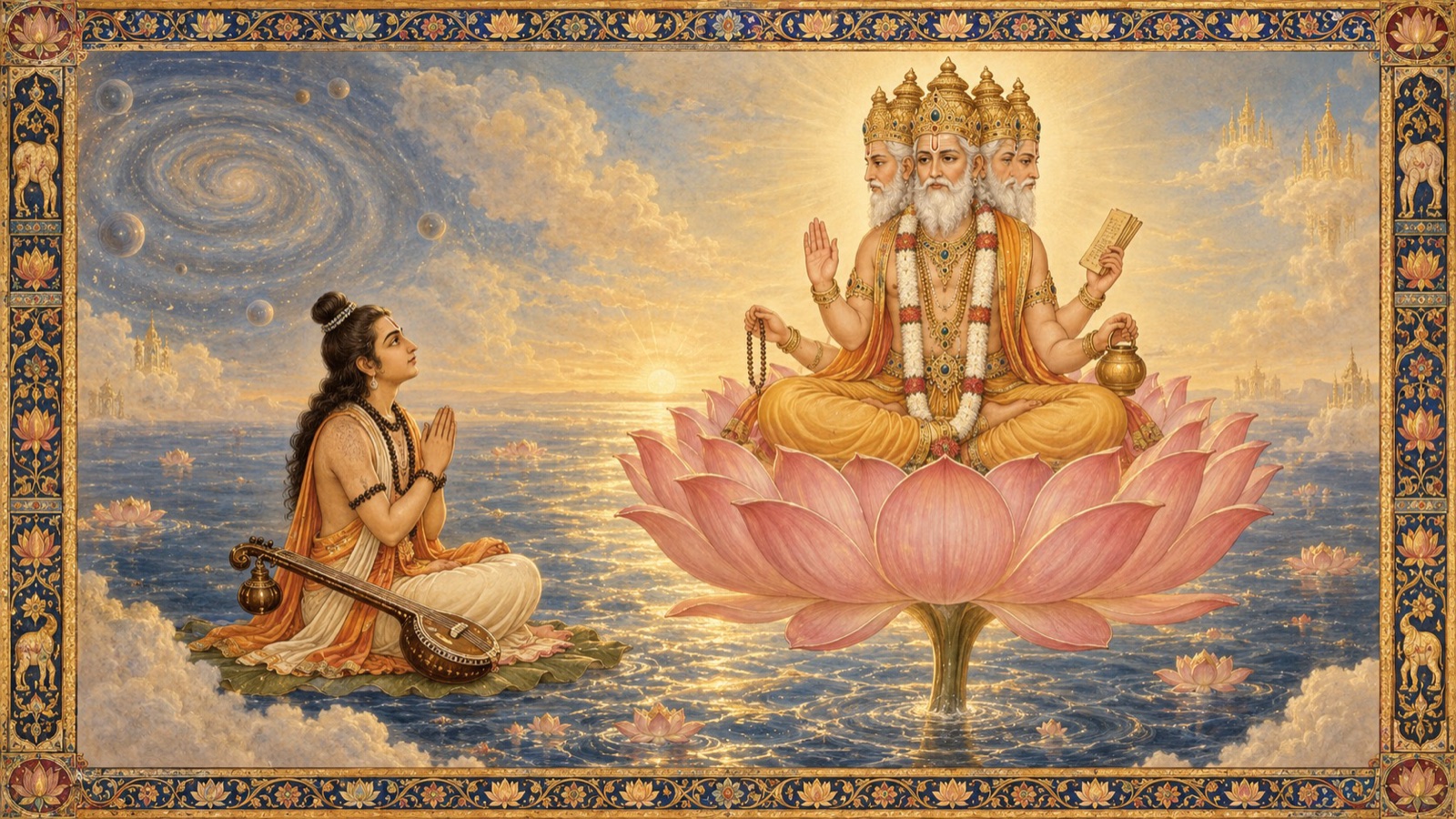
Then come his questions, laid out with great precision. What, in essence, is the truth about this universe — what are its characteristics, on what is it supported, by whom was it created, where does it ultimately rest, by what power is it ruled, and what is it essentially? Narada tells his father that all of this must surely lie within Brahma’s knowledge, for Brahma is lord of all that has been, all that is, and all that is yet to come; the whole universe rests in his awareness like a fruit held on the palm of one’s hand. Yet Narada presses further, and this is where his inquiry becomes profound. He asks what the source of Brahma’s own knowledge is, by whom Brahma himself is supported, and what Brahma’s essential nature is. Like a spider spinning its web out of its own body and playing within it, Narada observes, Brahma seems to bring forth all beings out of himself and yet remain unchanged. He admits that he knows of nothing — animate or inanimate, high, low, or in between — whose source is anything other than Brahma. And yet one thing troubles him: the fact that even Brahma, the supreme ruler, once practised intense austere penance. Why would the creator himself need to meditate and perform tapasya, unless there were someone higher still? This single, humble doubt is the hinge of the entire chapter.
“Until You Know Him, My Greatness Seems My Own”
Brahma’s reply is extraordinary — not a defense of his own status, but a joyful surrender of it. He first praises the question itself: it is laudable, he tells his compassionate son, because it has given him the opportunity to reveal the glory of the Lord. What Narada has said of him is not untrue, Brahma admits — but only in a limited sense. Until one comes to know Him who is greater than Brahma, all this apparent greatness seems to belong to Brahma himself. The creator then offers a luminous simile: just as the sun, fire, the moon, the planets, and the stars seem to illumine the universe, though in truth it is already illumined by the self-effulgent Lord, so Brahma only seems to manifest the universe, which in reality stands manifested by that same Lord. He bows to Lord Vasudeva and meditates on Him. It is only Maya, the Lord’s deluding potency — so difficult to conquer — that makes people call Brahma the “father of the universe.” The same Maya, he adds, makes deluded souls proclaim the body to be their very self and all its belongings to be “mine,” though this Maya is so shy that it cannot even stand before the Lord’s direct glance. Brahma then carries this confession to its furthest point, in the verse that stands as the doctrinal heart of his entire reply.
द्रव्यं कर्म च कालश्च स्वभावो जीव एव च । वासुदेवात्परो ब्रह्मन्न च चान्योऽर्थोऽस्ति तत्त्वत: ॥ १४ ॥
dravyaṁ karma ca kālaś ca svabhāvo jīva eva ca vāsudevāt paro brahman na cānyo ‘rtho ‘sti tattvataḥ
Meaning: The ingredients of creation, their interaction, eternal time, and the innate disposition of the individual soul — none of these, Brahma tells Narada, has any reality apart from Lord Vasudeva. (Canto 2, Chapter 5, verse 14)
Here the creator of the universe points past himself entirely, to the one Cause behind all causes.
Narayana, the One Reality
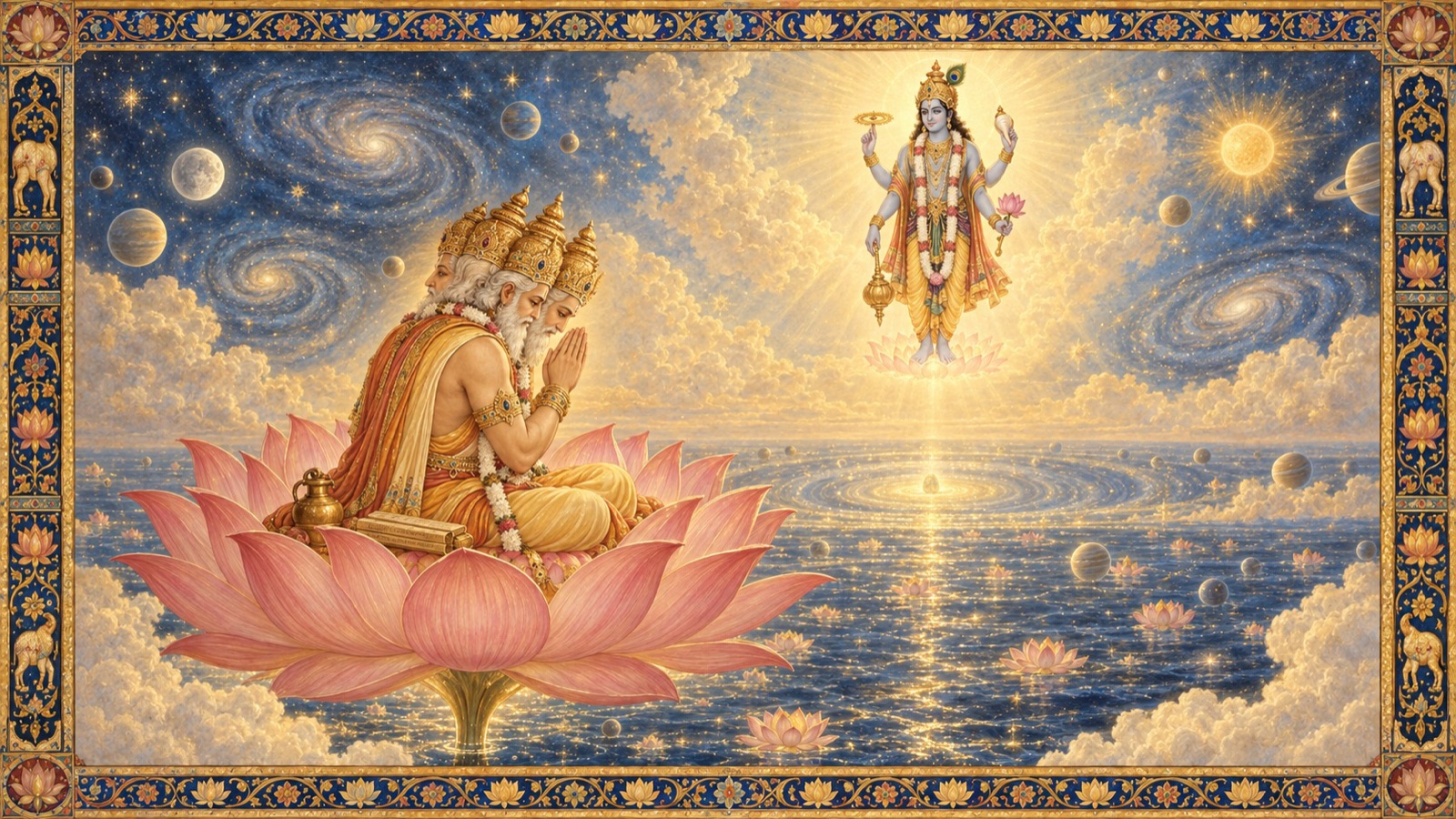
Having turned Narada’s gaze toward the true source, Brahma now exalts Narayana as the single reality underlying everything. Narayana is the goal of the Vedas; the gods have sprung from His limbs; sacrifices are performed to please Him, and the very worlds attained through sacrifice are but limbs of His Cosmic Body. In one of the chapter’s most quoted verses, Brahma gathers every spiritual discipline into one current flowing toward the Lord.
नारायणपरो योगो नारायणपरं तप: । नारायणपरं ज्ञानं नारायणपरा गति: ॥ १६ ॥
nārāyaṇa-paro yogo nārāyaṇa-paraṁ tapaḥ nārāyaṇa-paraṁ jñānaṁ nārāyaṇa-parā gatiḥ
Meaning: Narayana is the ultimate object of all yoga; all austere penance is intended to propitiate Narayana; all wisdom is directed toward Narayana; and all paths lead to Narayana. (Canto 2, Chapter 5, verse 16)
The Lord, Brahma continues, is at once the Seer and the Ruler; though immutable, He is all-embracing. It is He who created Brahma, and it is only when encouraged by His glance that Brahma evolves this creation. The Lord Himself is infinite and beyond the three Gunas — the modes of material nature — but it is His Maya that takes up those three qualities for the work of the cosmos.
सत्त्वं रजस्तम इति निर्गुणस्य गुणास्त्रय: । स्थितिसर्गनिरोधेषु गृहीता मायया विभो: ॥ १८ ॥
sattvaṁ rajas tama iti nirguṇasya guṇās trayaḥ sthiti-sarga-nirodheṣu gṛhītā māyayā vibhoḥ
Meaning: Sattva, Rajas, and Tamas are the three Gunas of the Lord, who is Himself beyond all Gunas; these three are assumed by His Maya for the purpose of preservation, creation, and destruction. (Canto 2, Chapter 5, verse 18)
Through the agency of the elements, the senses, and the gods presiding over the senses, these three Gunas bind the individual soul — who is ever free in essence yet now convinced that he is the body, the senses, and the mind, all in one. The selfsame Lord, transcending all sense-perception, veils Himself beyond recognition within these three sheaths of matter, and remains the Ruler of all beings and of Brahma himself.
The Gunas Stirred: Mahat and the Three-fold Ego
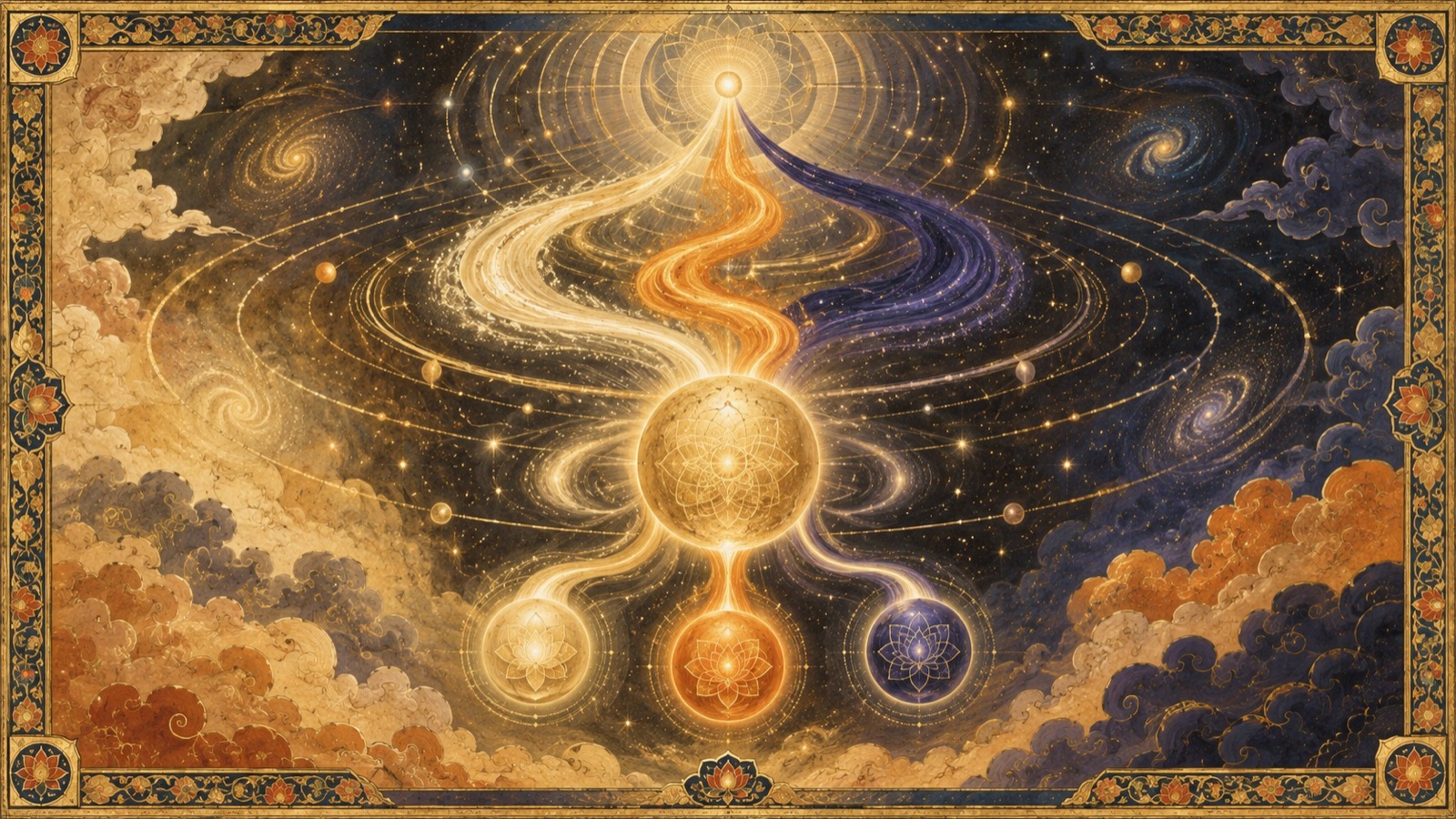
Now Brahma begins the actual account of how creation proceeds, and he follows a strict order of emanation. Intent upon becoming many at the dawn of creation, the Lord pressed into service Time, Karma (the destiny of the individual souls), and Swabhava (their innate disposition) — all of which had already existed in a latent, unmanifest form within His being. Time disturbed the equilibrium of the three Gunas; Swabhava began to transform them; and from Karma was evolved Mahat, the principle of cosmic intelligence — all of this functioning through the power of the Lord alone. From Mahat, dominated by Rajas and Sattva as it underwent transformation, there emanated a further evolute dominated by Tamas and composed of three factors: substance, intelligence, and activity. This was Ahankara, the cosmic ego or principle of “I”-ness.
सोऽहङ्कार इति प्रोक्तो विकुर्वन् समभूत्त्रिधा । वैकारिकस्तैजसश्च तामसश्चेति यद्भिदा । द्रव्यशक्ति: क्रियाशक्तिर्ज्ञानशक्तिरिति प्रभो ॥ २४ ॥
so ‘haṅkāra iti prokto vikurvan samabhūt tridhā vaikārikas taijasaś ca tāmasaś ceti yad-bhidā dravya-śaktiḥ kriyā-śaktir jñāna-śaktir iti prabho
Meaning: This was called Ahankara (ego), which became threefold as it underwent transformation — Vaikarika (in the mode of Sattva), Taijasa (in the mode of Rajas), and Tamasa — possessed respectively of the power of knowledge, the power of action, and the power of substance. (Canto 2, Chapter 5, verse 24)
The Five Elements Unfold, One From Another
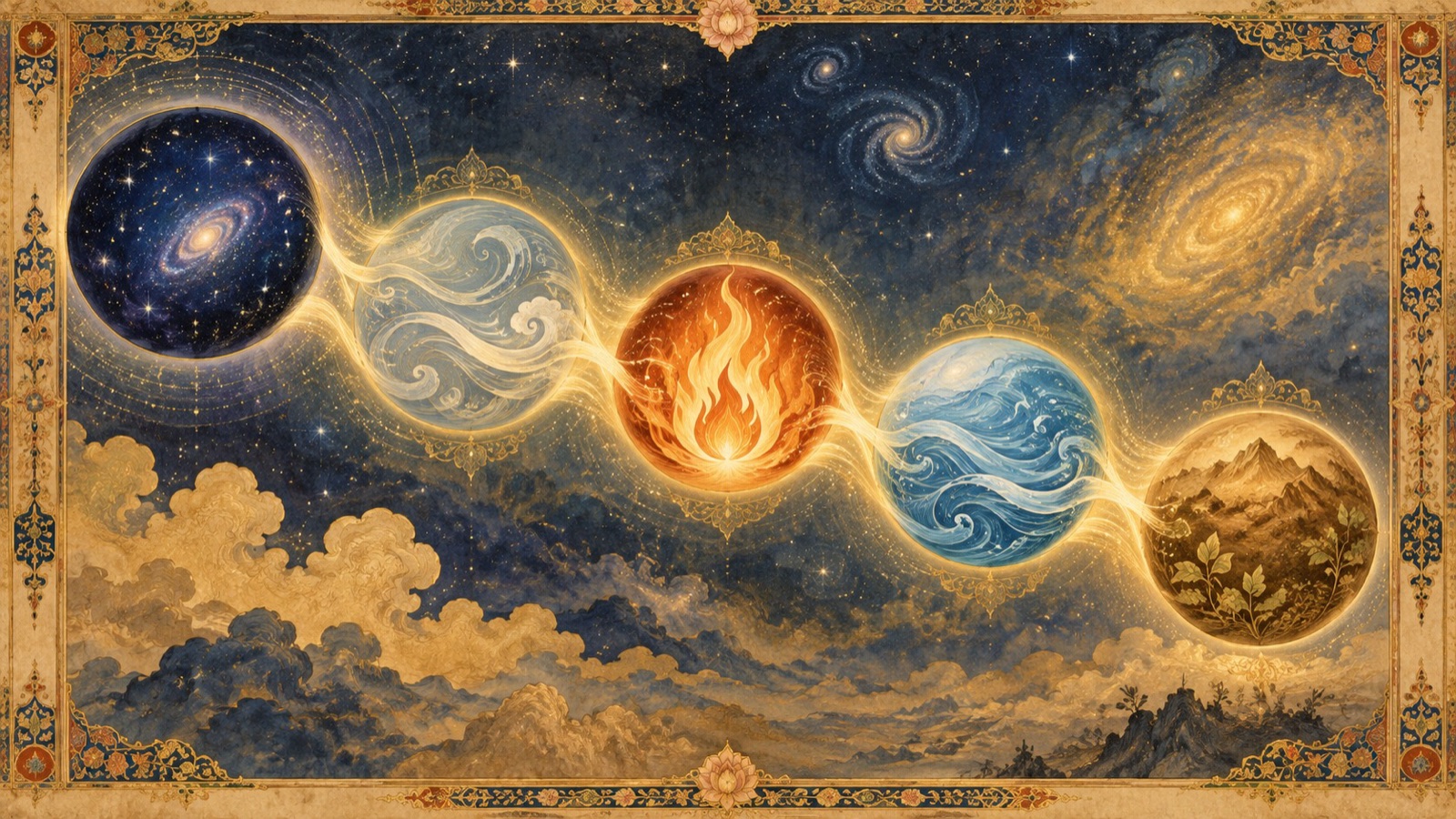
From the Tamasa variety of ego arose the subtle origin of the five gross elements, and from it, as it transformed, came the first element: ether (space). Its subtle quality and distinctive mark is sound.
तामसादपि भूतादेर्विकुर्वाणादभून्नभ: । तस्य मात्रा गुण: शब्दो लिङ्गं यद् द्रष्टृदृश्ययो: ॥ २५ ॥
tāmasād api bhūtāder vikurvāṇād abhūn nabhaḥ tasya mātrā guṇaḥ śabdo liṅgaṁ yad draṣṭṛ-dṛśyayoḥ
Meaning: From the Tamasa ego, the source of the gross elements, as it underwent transformation, evolved ether; sound is its subtle quality and distinctive characteristic — and it is sound that furnishes the clue connecting the seer and the seen. (Canto 2, Chapter 5, verse 25)
The sequence then proceeds with beautiful logic, each new element inheriting the qualities of all that came before it. From ether arose air, whose distinctive quality is touch, while it also carries sound; vitality, energy, zeal, and strength are, Brahma says, only other names for air. From air arose fire, marked by the quality of colour or form, carrying touch and sound as well. From fire arose water, marked by taste, carrying colour, touch, and sound. And from water arose earth, the densest element, marked by smell and carrying within it all the qualities of its predecessors — taste, colour, touch, and sound. Thus the single quality of sound, present in ether, is progressively joined by touch, colour, taste, and smell, until earth contains all five. This is the scripture’s own account of how the perceptible world thickens into being, layer upon layer.
The Senses, the Mind, and Their Presiding Gods
Creation is not only made of elements; it is also made of the faculties by which beings perceive and act. From the Sattvika ego sprang up the cosmic Mind, along with the deity presiding over it, the moon-god, and the ten deities who severally preside over the five senses of perception and the five organs of action — among them the guardians of the directions, the wind-god, the sun-god, Varuna, the Aswin twins, the god of fire, Indra, Upendra (Lord Vishnu as the younger brother of Indra), Mitra, and Prajapati. From the Rajasika ego, as it transformed, were evolved the ten Indriyas themselves: the five senses of perception — hearing, touch, sight, taste, and smell — and the five organs of action — the organ of speech, the hands, the feet, and the organs of generation and excretion. The intellect, the faculty of cognition, and Prana, the faculty of vital action, also arise from this Rajasika ego. In this way the instruments of experience take their places alongside the elements they will come to know.
The Cosmic Egg and the Birth of the Cosmic Being
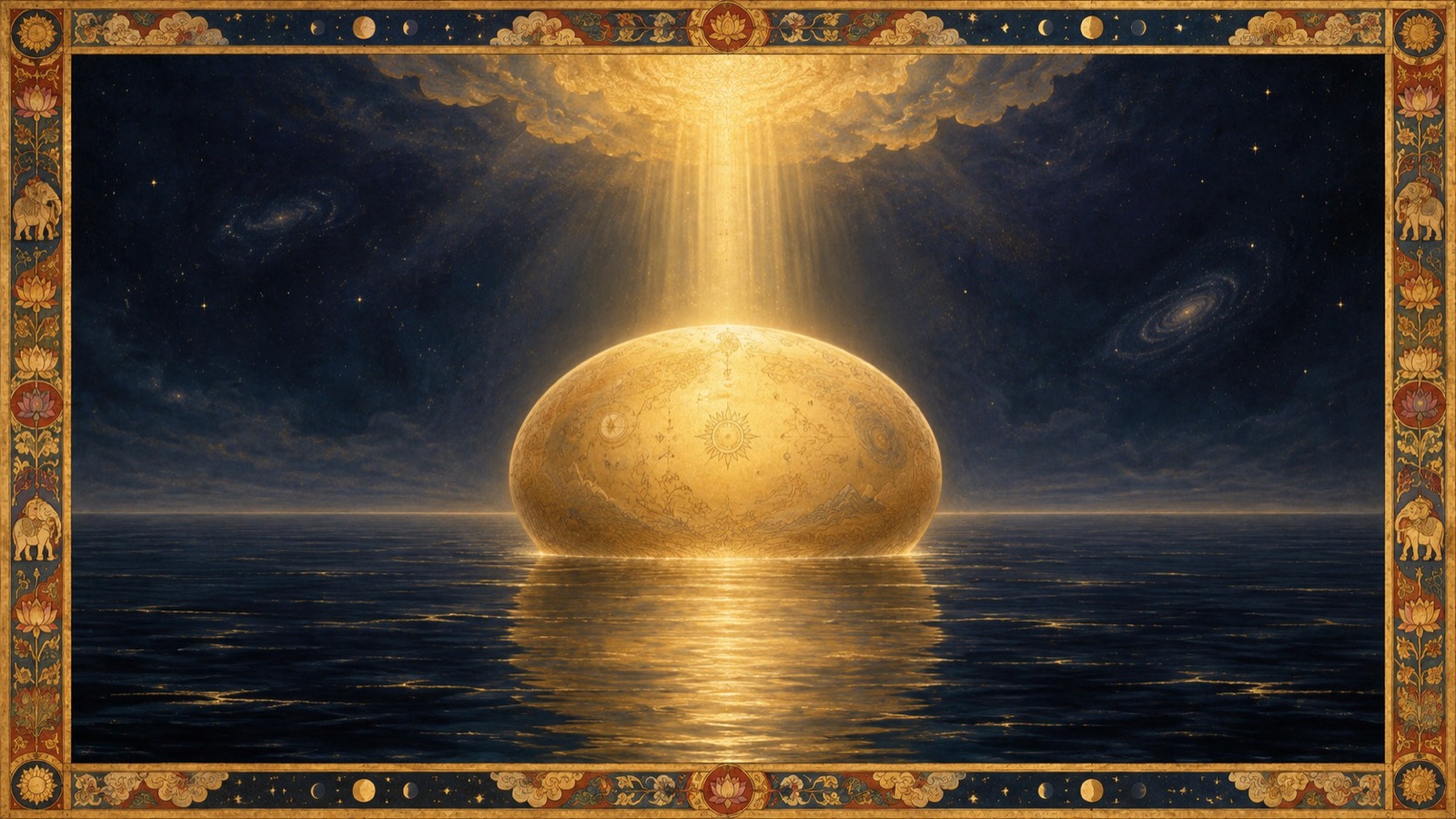
Here the account reaches its great turning point. So long as these categories — the gross elements, the senses, the mind, and the three Gunas — remained separate and dissociated, Brahma explains, they could not erect a “house” in the form of a body; they could build nothing. Then, urged by the power of God, they combined with one another, assuming among themselves the relationship of cause and effect, and together produced both the cosmic body and the individual body. The macrocosm took the form of a vast egg, which lay upon the causal waters in a lifeless condition for a thousand years. At the end of that period, with the help of Time, destiny, and the innate disposition of the souls, the Lord — the life-giver of all — infused life into that egg. And then came the moment the whole chapter has been moving toward.
स एव पुरुषस्तस्मादण्डं निर्भिद्य निर्गत: । सहस्रोर्वङ्घ्रिबाह्वक्ष: सहस्राननशीर्षवान् ॥ ३५ ॥
sa eva puruṣas tasmād aṇḍaṁ nirbhidya nirgataḥ sahasrorv-aṅghri-bāhv-akṣaḥ sahasrānana-śīrṣavān
Meaning: Bursting open that Cosmic Egg, the same Supreme Person — the Cosmic Being — issued forth, with thousands of thighs, feet, arms, and eyes, and thousands of faces and heads. (Canto 2, Chapter 5, verse 35)
The Fourteen Worlds Within the Cosmic Body
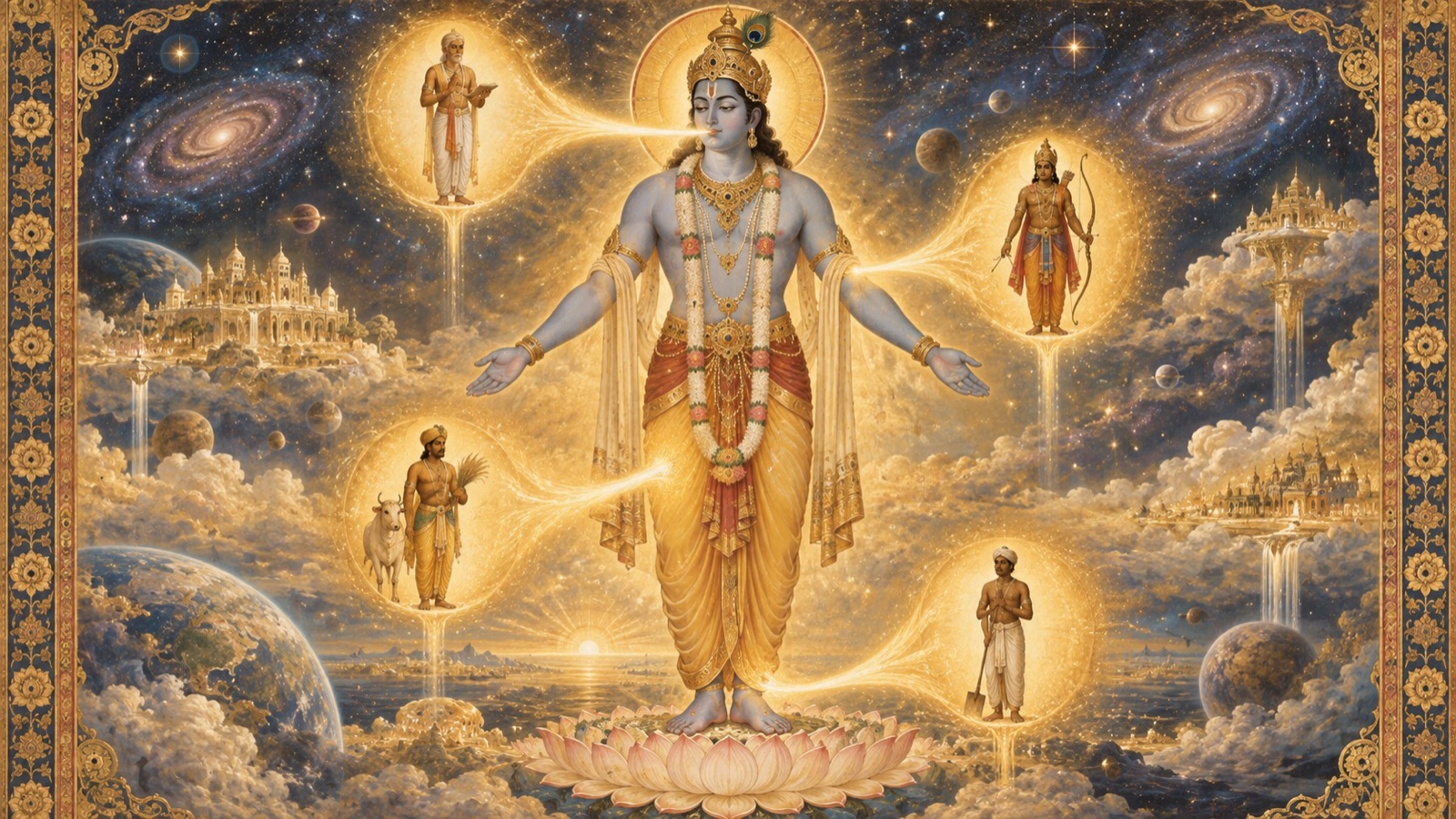
With the Cosmic Being now manifest, Brahma describes how the entire universe of worlds is located within His limbs — the seven lower spheres below His waist and the seven higher spheres above. He begins with the social order itself, echoing the ancient hymn of the Cosmic Person.
पुरुषस्य मुखं ब्रह्म क्षत्रमेतस्य बाहव: । ऊर्वोर्वैश्यो भगवत: पद्भ्यां शूद्रो व्यजायत ॥ ३७ ॥
puruṣasya mukhaṁ brahma kṣatram etasya bāhavaḥ ūrvor vaiśyo bhagavataḥ padbhyāṁ śūdro vyajāyata
Meaning: The Brahmana represents the mouth of this Cosmic Being, the Kshatriya His arms; the Vaishya emanated from the Lord’s thighs, and the Sudra from His feet. (Canto 2, Chapter 5, verse 37)
Brahma then maps the worlds themselves onto the body of the Cosmic Being. The subterranean spheres and the earth rest in His lower limbs; Bhuvarloka, the region between earth and heaven, in His navel; Swarloka, Indra’s paradise, in His heart; Maharloka in His breast; Janaloka in His neck; Tapoloka in His bosom; and Satyaloka, the comparatively eternal abode of Brahma, in His heads. Below, the seven nether worlds are located in turn — Atala in His waist, Vitala in His thighs, the holy Sutala (abode of Prahlada and Bali, and of the Lord Himself as the divine Dwarf) in His knees, Talatala in His shanks, Mahatala in His ankles, Rasatala in the fore part of His feet, and Patala in His soles. In this way the Supreme Person is revealed as the living aggregate of all fourteen worlds. Finally, Brahma offers a simpler, alternative arrangement of the three principal worlds.
भूर्लोक: कल्पित: पद्भ्यां भुवर्लोकोऽस्य नाभित: । स्वर्लोक: कल्पितो मूर्ध्ना इति वा लोककल्पना ॥ ४२ ॥
bhūrlokaḥ kalpitaḥ padbhyāṁ bhuvarloko ‘sya nābhitaḥ svarlokaḥ kalpito mūrdhnā iti vā loka-kalpanā
Meaning: According to another arrangement, the earthly sphere is located in His feet, Bhuvarloka in His navel, and Swarloka in His head — this is how the three worlds are conceived in that scheme. (Canto 2, Chapter 5, verse 42)
With this, the fifth discourse closes. What began as a son’s simple question — why does even the creator meditate? — has opened into a complete vision of the cosmos as the very body of God, from the first stirring of the Gunas to the last of the fourteen worlds.
Principal Teachings of This Chapter
1. Even the creator points beyond himself. Brahma, who could have accepted Narada’s praise, instead confesses that his apparent greatness truly belongs to the Lord; until we know the source behind the source, we mistake the reflection for the light (verses 9-14).
2. There is only one substance: the Lord. Brahma declares that nothing — not the elements, karma, time, nature, or the individual soul — has any existence independent of Lord Vasudeva (verse 14).
3. Every path leads to Narayana. Yoga, penance, wisdom, and all spiritual roads are gathered into a single destination; the variety of disciplines hides a single goal (verse 16).
4. Creation unfolds in a sacred order. From the Lord’s Maya and the three Gunas proceed Mahat, ego, the subtle and gross elements, the senses, and the mind — a structured descent, never a random accident (verses 18-31).
5. The universe is the body of God. The worlds are not scattered through empty space but located within the living form of the Cosmic Being, so that to contemplate the cosmos is to contemplate the Lord Himself (verses 35-42).
A Devotional Reflection
It is easy to read a chapter like this as a kind of ancient cosmology and leave it there — a map of elements and worlds. But its heart is not a diagram; it is an act of humility. The most powerful created being in existence, the one whom all of us might be tempted to call “God” if we met him, uses his answer to a beloved disciple’s question to do one thing: to step aside and point. I only seem to create, Brahma says; the light you see as mine is borrowed. There is something freeing in this for us, too. So much of our striving comes from the quiet conviction that the “I” at the center of our experience is the real doer, the real owner, the real source. Brahma, of all beings, gently dismantles that conviction — not by denying the self, but by revealing its true ground. If even the father of the universe rests wholly in Vasudeva, then perhaps our own small burdens of authorship and control can rest there too. The vast cosmic body described here is not meant to overwhelm us; it is meant to show us that we already live inside the Lord, held within a form where every world has its place.
A Daily Devotional Practice
Today, take one quiet minute to look at the ordinary world around you — the space of the room, the air you breathe, the warmth of light, the taste of water, the solid ground beneath you. These are the very five elements this chapter describes, unfolding one from another out of the Lord. As you notice each one, softly offer the thought that it, too, rests in Him. Then, following Brahma’s example, gently set down any sense that you must be the sole author of your day, and repeat a few times, without hurry: “Om Namo Bhagavate Vasudevaya.” Let the act of noticing the elements become, for a moment, an act of remembering their source.
Conclusion
The fifth chapter of the Second Canto answers a question the whole Bhagavatam keeps returning to: how does the one Lord become this vast many? Brahma’s reply is both a teaching and a confession. Before describing a single element or world, he empties himself of the honour Narada offered, placing the entire weight of creation upon Narayana, the cause of all causes. Only then does he trace, in careful sequence, the great descent — Maya stirring the Gunas, Mahat and ego arising, the five elements thickening into form, the senses and their gods taking their places, the Cosmic Egg waiting a thousand years upon the causal waters, and at last the Cosmic Being bursting forth to contain all fourteen worlds within His limbs. What we are left with is not merely a picture of the universe, but a way of seeing it: as the living body of God, in which even the creator is a reverent servant, and within which we, too, are lovingly held.
May the divine wisdom of Srimad Bhagavatam awaken pure devotion within our hearts.
Om Namo Bhagavate Vasudevaya.
Jay Shree Madhav.
References and Attribution
- Primary edition: Gita Press, Śrīmad Bhāgavata Mahāpurāṇa (English, complete), Book Two, Discourse 5, pages 101–103.
- Series: Srimad Bhagavatam Wisdom · Biswa Sanatan Dharma Seva Trust.
- Presented following the spiritual guidance and recommendation of Pandit Dr. Shri Kashinath Mishra.
This is an original, faithful retelling in the writer’s own words, with brief quoted verses shown in Devanāgarī and transliteration and their meanings given as summaries. It is not a reproduction of any single publisher’s continuous translation or commentary. No affiliation with or endorsement by any publisher is implied.
Jay Shree Madhav