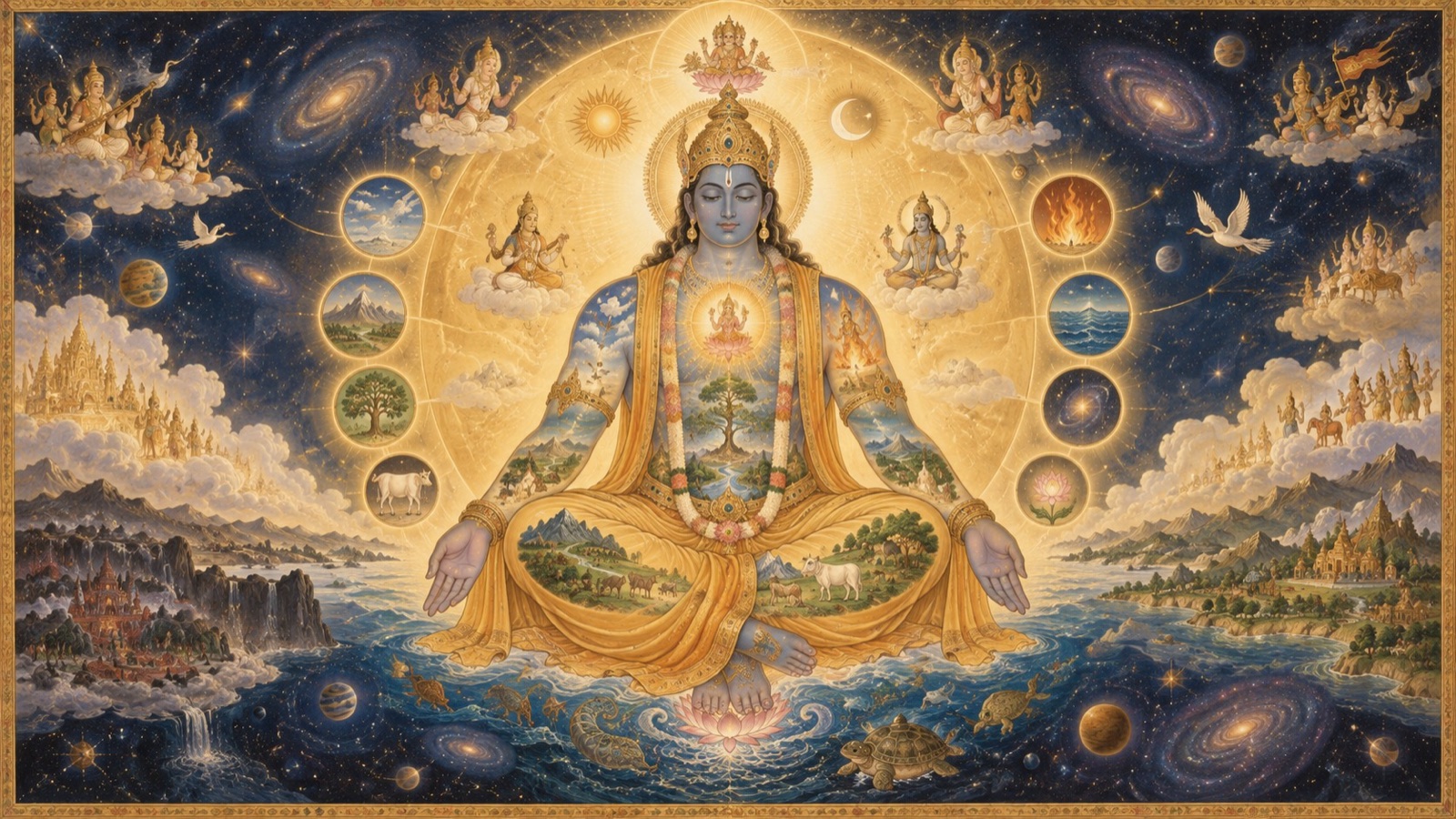
Every world, every deity, every element of creation is shown resting within the vast, luminous body of the Cosmic Being — the living form in which Brahma discovers the whole universe already assembled.
Om Namo Bhagavate Vasudevaya.
Om Namo Bhagavate Vasudevaya.
Om Namo Bhagavate Vasudevaya.
Welcome to Srimad Bhagavatam Wisdom, a devotional journey through the sacred histories and teachings of the Srimad Bhagavat Mahapurana. The previous chapter left Brahma mid-confession — having told his son Narada that he himself is not the ultimate source of creation, and having traced how the cosmos unfolds from the Lord through the Gunas, Mahat, the elements, and the senses, right up to the bursting of the Cosmic Egg and the emergence of the Virat Purusha containing all fourteen worlds. Brahma does not pause for a new question here; he simply continues, without a break, into this sixth chapter. Now he turns from where the worlds are located within the Cosmic Being to what every single limb, sense, and faculty of that vast form actually produces — mouth, tongue, eyes, ears, skin, arms, feet, and more, each one the birthplace of a cosmic principle, a deity, or an element of nature. The chapter builds to a moving personal testimony: Brahma himself, “Veda personified” and lord of the Prajapatis, admits that despite every austerity and every mastery of Yoga, he could never fully know the Lord to whom he owes his own existence. It closes with Brahma announcing what comes next — the sportive descents (lila-avataras) of the Supreme Person, the subject of the following chapter.
Chapter Information
- Scripture: Śrīmad Bhāgavata Mahāpurāṇa
- Canto: 2 (Book Two)
- Chapter: 6 (Discourse 6)
- Chapter title: Glories of the Cosmic Being
- Principal speaker: Brahma, continuing his reply to Narada without interruption from Discourse V — a dialogue that Sukadeva Gosvami relates to King Parikshit, and that Suta Gosvami in turn narrates to the sages of Naimisharanya
- Principal listener: The sage Narada, Brahma’s son (within the narrated dialogue); King Parikshit (hearing it from Sukadeva); and the sage Saunaka with the assembly at Naimisharanya (hearing it from Suta)
- Main setting: The primordial dawn of creation, at the seat of Brahma; relayed within the riverside teaching of Sukadeva to Parikshit and the forest hermitage of Naimisharanya
- Central subject: A detailed account of how every limb and faculty of the Cosmic Being (Virat Purusha) gives rise to a corresponding deity, element, or cosmic principle, followed by Brahma’s own confession that even he cannot fathom the Lord’s true nature
- Principal verse range: Canto 2, Chapter 6, verses 1–45
- Primary edition: Gita Press Śrīmad Bhāgavata Mahāpurāṇa
The Body That Becomes the Whole Creation
Brahma resumes exactly where he left off, describing the Cosmic Being limb by limb as the literal source of the universe. The mouth is the birthplace of speech and of Agni, the god of fire; the seven essential ingredients of the body become the seven Vedic metres; the tongue is the source of every kind of food and of Varuna, the deity of taste. The nostrils give rise to the five vital airs and to the Ashwin twins, the celestial physicians; the eyes to colour, to light, and to the sun; the ears to the cardinal directions and to sacred places; the sense of hearing to ether and to sound itself.
ब्रह्मोवाच वाचां वह्नेर्मुखं क्षेत्रं छन्दसां सप्त धातव: । हव्यकव्यामृतान्नानां जिह्वा सर्वरसस्य च ॥ १ ॥
brahmovāca vācāṁ vahner mukhaṁ kṣetraṁ chandasāṁ sapta dhātavaḥ havya-kavyāmṛtānnānāṁ jihvā sarva-rasasya ca
Meaning: Brahma continued: speech and the fire-god arise from the mouth of the Cosmic Being; the seven essential ingredients of His body give rise to the seven Vedic metres; and from His tongue come every variety of food along with the very faculty of taste. (Canto 2, Chapter 6, verse 1)
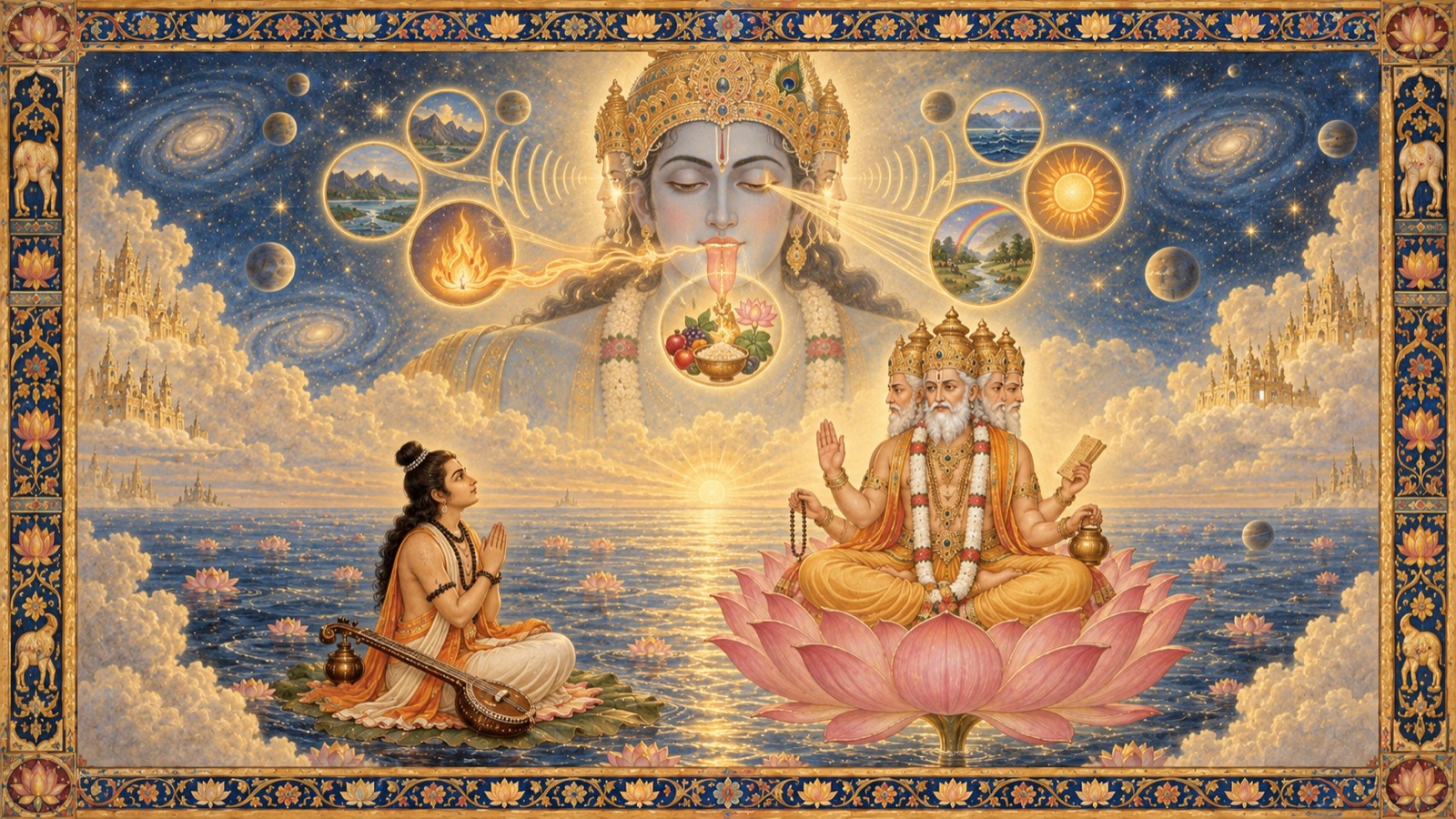
Brahma continues methodically: the skin gives rise to touch and to sacrifice; body hair to plants and trees; the hair of the head to clouds, the beard and moustache to lightning, and the nails to rock and iron. The arms are the birthplace of the guardian deities of the directions, who protect the universe. And then comes a verse of particular sweetness — the stride and the feet of the Lord.
विक्रमो भूर्भुव: स्वश्च क्षेमस्य शरणस्य च । सर्वकामवरस्यापि हरेश्चरण आस्पदम् ॥ ६ ॥
vikramo bhūr bhuvaḥ svaś ca kṣemasya śaraṇasya ca sarva-kāma-varasyāpi hareś caraṇa āspadam
Meaning: The stride of the Cosmic Being is the support of the three worlds — earth, sky, and heaven — while Sri Hari’s feet are the abode of security, of shelter, and of every object one might desire. (Canto 2, Chapter 6, verse 6)
The account moves on through the body: the organs of generation and excretion give rise, respectively, to the god of rain and Prajapati, and to Yama and Mitra; the back becomes the seat of defeat and of Tamas; the veins become rivers, the bones become mountains, the abdomen becomes the unmanifest ground of all things and the oceans, and the heart becomes the birthplace of the mind. Finally, Brahma reaches the subtlest faculty of all — the Citta, the inner faculty of reason and reflection.
धर्मस्य मम तुभ्यं च कुमाराणां भवस्य च । विज्ञानस्य च सत्त्वस्य परस्यात्मा परायणम् ॥ ११ ॥
dharmasya mama tubhyaṁ ca kumārāṇāṁ bhavasya ca vijñānasya ca sattvasya parasyātmā parāyaṇam
Meaning: The Supreme Self is the excellent abode of Dharma, of myself (Brahma), of you (Narada), of the four Kumaras, and of Siva, as well as of understanding and of the very faculty of reason. (Canto 2, Chapter 6, verse 11)
All Beings Are Only a Fraction of Him
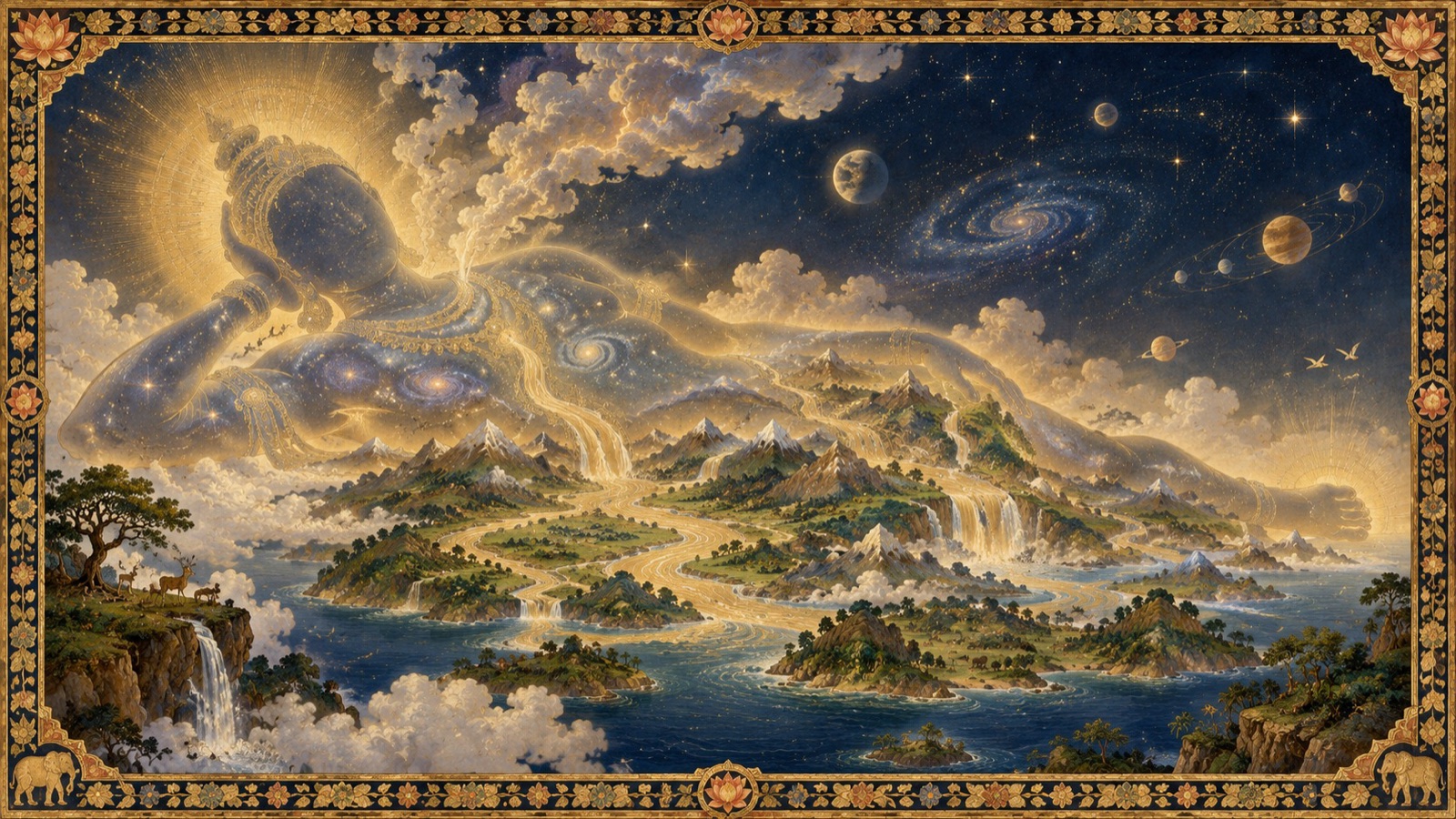
Having completed this inventory of limbs and faculties, Brahma widens the lens to every category of being in existence: gods, demons, and men; Nagas, birds, deer, and reptiles; Gandharvas and celestial nymphs; Yakshas, Rakshasas, and ghosts; serpents and beasts; the manes; Siddhas, Vidyadharas, and Charanas; every tree and living creature of water, land, and air; the planets, the lunar mansions, the comets and stars, the lightning and the thunder-clouds. All of this, Brahma declares, past, present, and future, is no other than the Supreme Person — and even so, all of it together covers only a span of His being. It is here that Brahma offers the sun as an image for how the Lord can be both inside and outside everything at once.
स्वधिष्ण्यं प्रतपन् प्राणो बहिश्च प्रतपत्यसौ । एवं विराजं प्रतपंस्तपत्यन्तर्बहि: पुमान् ॥ १६ ॥
sva-dhiṣṇyaṁ pratapan prāṇo bahiś ca pratapaty asau evaṁ virājaṁ pratapaṁs tapaty antar bahiḥ pumān
Meaning: Even as the vital air heats its own seat and radiates outward as well, so does the Supreme Person, illumining the Cosmic Being, shine both within and without the universe. (Canto 2, Chapter 6, verse 16)
The Lord, Brahma continues, transcends death and the fruit of all action; He alone is the lord of the fearless, immortal state of liberation, and for that reason His glory cannot be fathomed. All the worlds are only a fraction of Him, and it is in the three highest heavens — Janaloka, Tapoloka, and Satyaloka, standing above Maharloka — that immortality and fearlessness are truly established. The three Ashramas of celibate discipline, forest retirement, and renunciation form, Brahma says, three of the Lord’s feet standing outside the three worlds, while the fourth — the householder’s stage — remains within them. And of the two paths described in scripture, the Path of Action (called Avidya, since it leads to further birth) and the Path of Meditation upon God (called Vidya, since it leads to true knowledge), the embodied soul may follow either, but the Supreme Purusha is the one foundation beneath both. As the sun warms and illumines all things while remaining distinct from them, so the Lord — though the source of the cosmic egg, the five gross elements, the ten senses, and the three Gunas — remains entirely beyond the universe and beyond His own Cosmic Body.
Brahma’s Own Testimony: Born From the Lotus, Taught by the Body of God
At this point Brahma turns personal, offering Narada an account of his own origin and his first act of worship. When Brahma sprang up from the lotus growing in the navel of the great-souled Cosmic Being, he found that he needed no materials for sacrifice beyond the limbs of the Supreme Person Himself.
यदास्य नाभ्यान्नलिनादहमासं महात्मन: । नाविदं यज्ञसम्भारान् पुरुषावयवानृते ॥ २२ ॥
yadāsya nābhyān nalinād aham āsaṁ mahātmanaḥ nāvidaṁ yajña-sambhārān puruṣāvayavān ṛte
Meaning: When I sprang up from the lotus in the navel of this great-souled Cosmic Being, I found no materials for sacrifice apart from the limbs of the Supreme Person Himself. (Canto 2, Chapter 6, verse 22)
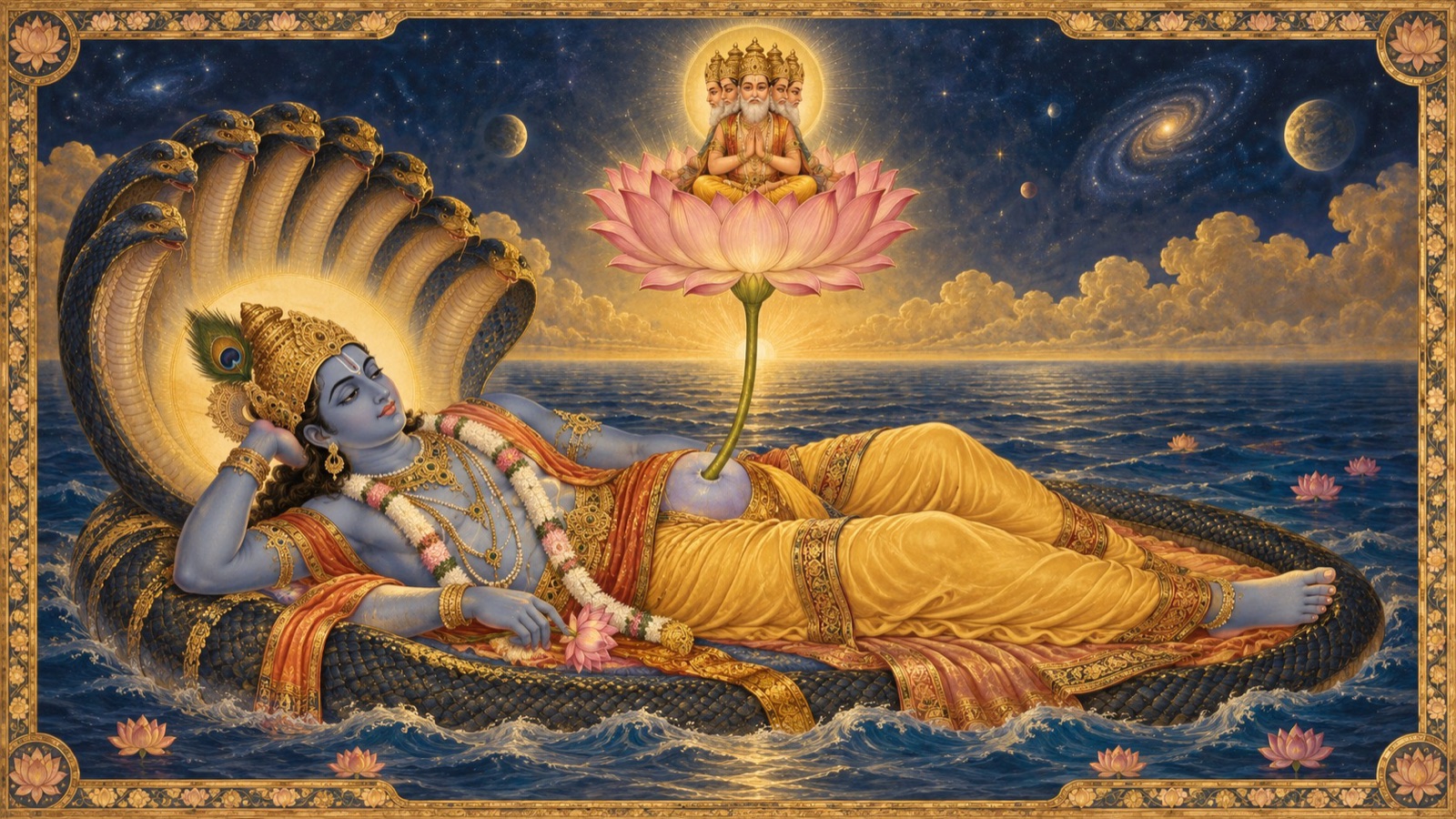
From those limbs, Brahma explains, he gathered every requisite of sacrifice — the animals, the sacrificial posts, the Kusa grass, the sacred ground and the auspicious season, the vessels and cereals, the clarified butter, the Soma, the gold and the earths and the water, the three Vedas, the four officiating priests, the names of the sacrifices and their Mantras, the fees and vows, and the closing rites of dedication to the Lord — and with these very materials, gathered from the Cosmic Being’s own body, he worshipped that same Supreme Person, Lord Vishnu. Afterward, Brahma’s nine sons, the great Prajapatis led by Marichi, worshipped the Lord in both His manifest and unmanifest aspects; and in due course the Manus, the sages, the manes, the gods, the demons, and all humanity took up sacrifice as their own form of worship. Creation itself, in other words, began as an act of devotion performed with the Lord’s own substance, offered back to Him.
The Confession: Even Brahma Cannot Know Him
Having described his own beginnings, Brahma returns to the theme that opened the previous chapter — his complete dependence on Narayana — but now with even greater intimacy and humility.
नारायणे भगवति तदिदं विश्वमाहितम् । गृहीतमायोरुगुण: सर्गादावगुण: स्वत: ॥ ३० ॥
nārāyaṇe bhagavati tad idaṁ viśvam āhitam gṛhīta-māyoru-guṇaḥ sargādāv aguṇaḥ svataḥ
Meaning: This entire universe rests upon Lord Narayana, who, though intrinsically without attributes, assumes great attributes through His Maya at the dawn of creation. (Canto 2, Chapter 6, verse 30)
Brahma creates the universe only as commissioned by that Lord; Siva, under the same Lord’s control, dissolves it; and the Lord Himself, as the Purusha, preserves it — the three Gunas of Sattva, Rajas, and Tamas are simply His own powers, taken up for these three tasks. There is nothing in all creation, Brahma insists, whether cause or effect, that is other than Him. And then, in one of the chapter’s most affecting passages, Brahma turns to his own limitations. His words are never false and his senses never led astray, he says, only because he has always contemplated Sri Hari with a longing heart. Yet despite being Veda personified, despite a lifetime of austere penance, despite being lord of the Prajapatis and thoroughly accomplished in Yoga — he confesses that he has failed to realize the very Being to whom he owes his existence. He bows instead to those blessed feet that end the cycle of birth and death, admitting that even the sky does not know its own limits, and the Lord Himself does not measure the extent of His own Maya — so how could Brahma, or Siva, or any god possibly know Him fully? Our minds, Brahma says, remain so confounded that we do not even fully grasp the reality of this universe, His own creation; we can only speculate about it, each according to his own understanding.
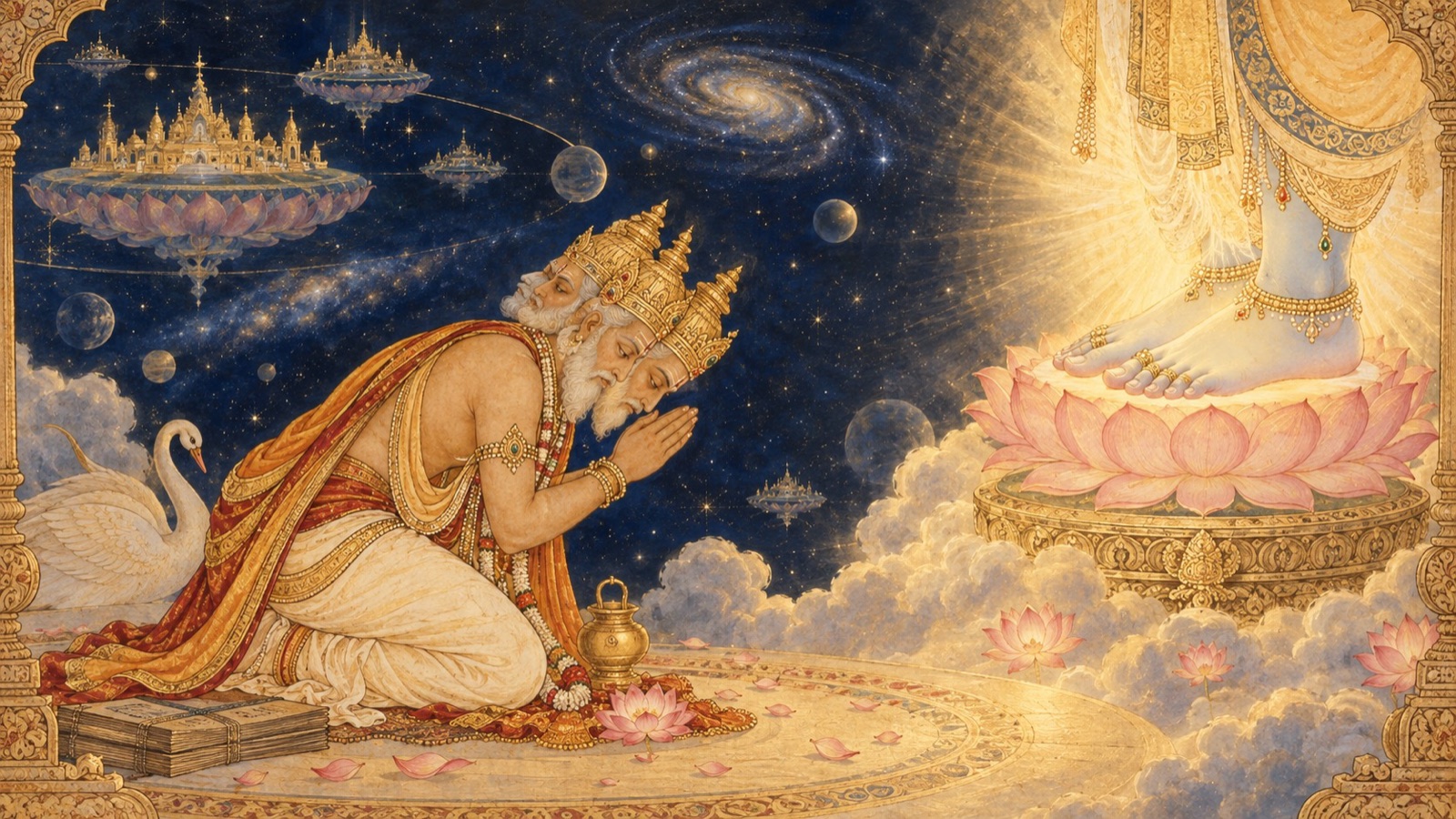
Hail to the Lord Who Cannot Be Fully Known
Out of this confession rises one of the chapter’s most quoted verses — a hymn of praise offered precisely because the Lord exceeds every attempt to grasp Him.
यस्यावतारकर्माणि गायन्ति ह्यस्मदादय: । न यं विदन्ति तत्त्वेन तस्मै भगवते नम: ॥ ३७ ॥
yasyāvatāra-karmāṇi gāyanti hy asmad-ādayaḥ na yaṁ vidanti tattvena tasmai bhagavate namaḥ
Meaning: Hail to that Lord whose descents and exploits we constantly sing, though none of us truly knows Him in reality. (Canto 2, Chapter 6, verse 37)
That unborn Primal Person, Brahma continues, creates, sustains, and dissolves Himself, within Himself, by Himself, cycle after cycle. He is pure, absolute consciousness, the inner Self of all beings, ever true and complete, without beginning or end, without attributes, eternal, and one without a second. Those given to deep contemplation realize Him only when body, senses, and mind have been perfectly stilled; but He disappears from view the moment He is approached through the clever, sophistical reasoning of the wicked. And then Brahma names Him as the first manifestation of the Supreme — the Purusha, the Cosmic Being — from whom Time, Swabhava, Prakriti as cause and effect, mind, the five gross elements, the ego, the three Gunas, the senses, and the Cosmic Body itself all proceed as further manifestations of the one all-pervading Lord.
आद्योऽवतार: पुरुष: परस्य काल: स्वभाव: सदसन्मनश्च । द्रव्यं विकारो गुण इन्द्रियाणि विराट् स्वराट् स्थास्नु चरिष्णु भूम्न: ॥ ४१ ॥
ādyo ‘vatāraḥ puruṣaḥ parasya kālaḥ svabhāvaḥ sad-asan-manaś ca dravyaṁ vikāro guṇa indriyāṇi virāṭ svarāṭ sthāsnu cariṣṇu bhūmnaḥ
Meaning: The first manifestation of the Supreme is the Purusha, the Cosmic Being; besides Him, Time, Swabhava, cause and effect, mind, the gross elements, the ego, the Gunas, the senses, and the Cosmic Body are all manifestations of that all-pervading Lord. (Canto 2, Chapter 6, verse 41)
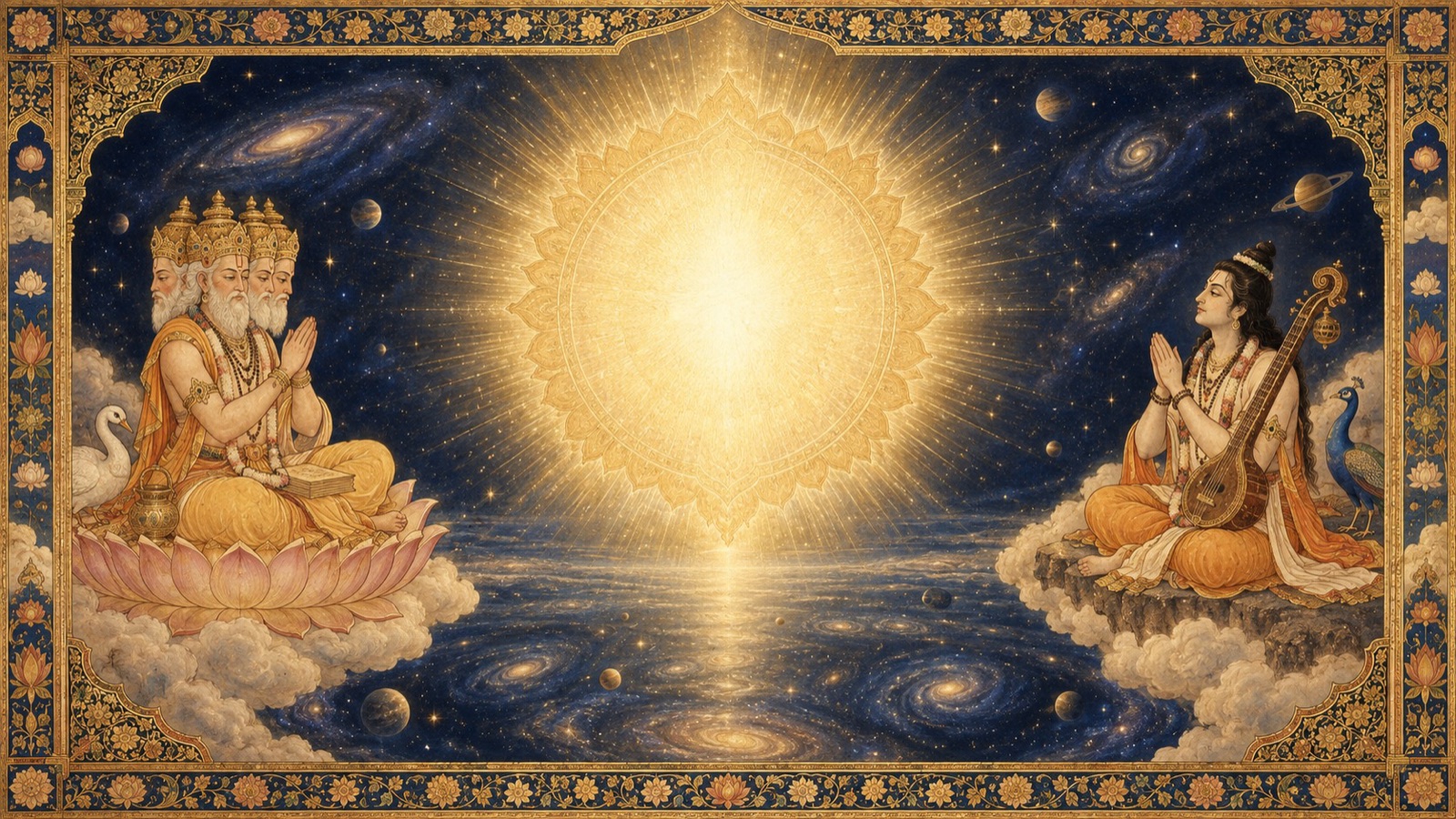
A Fragment of His Glory, and a Promise of What Is to Come
The chapter’s closing verses widen once more to every being of power or splendour in creation — Brahma himself, Siva, Vishnu, the great progenitors like Daksha, the guardians of heaven led by Indra, Garuda and the guardians of the sky, the rulers of the nether regions led by Sesha, the lords of the Gandharvas, Vidyadharas, and Charanas, the leaders of the Yakshas, Rakshasas, serpents, and Nagas, the foremost sages and the manes, the lords of the Daityas, Siddhas, and Danavas, the rulers of the Pretas, Pisachas, and Bhutas, and every creature of water, land, and air that carries supernatural power, glory, strength, forbearance, splendour, good fortune, or intellectual brilliance. All of this, Brahma tells Narada, whether embodied or formless, may appear to be the very truth and form of the Lord — but it is, in fact, only a fragment of His transcendental potency. With that, Brahma turns toward what comes next: he will now recount, in due order, the Lord’s principal sportive descents, His lila-avataras — pastimes that, once heard, wash away every impurity accumulated by the ear, and that Brahma invites Narada to drink in like nectar, to his heart’s full content. With this promise, the sixth discourse closes, and the seventh opens directly into the roll-call of divine incarnations.
Principal Teachings of This Chapter
1. The universe is not merely located within God — it is made of Him. Every organ and faculty of the Cosmic Being is the literal birthplace of an element, a deity, or a cosmic principle; creation is not something God assembled from outside but something that continuously issues from His own form (verses 1-11).
2. Every being, however vast, is only a fraction of the Lord. From gods and demons to planets and stars, Brahma insists that the totality of creation covers only “a span” of the Supreme Person (verses 12-15).
3. God is both immanent and transcendent. Like the sun that shines within its own orb and beyond it, the Lord illumines the universe from within while remaining entirely beyond it (verses 16-21).
4. Devotion is woven into creation from its very first moment. Brahma’s own first act, upon springing from the lotus, was to gather sacrificial materials from the Lord’s limbs and worship Him with His own gifts (verses 22-29).
5. Even the greatest being in creation cannot fully know God. Brahma — Veda personified, master of Yoga, lord of the Prajapatis — openly confesses that he cannot fathom the Lord’s true nature, and bows instead in surrender (verses 30-41).
A Devotional Reflection
There is something quietly radical about a chapter in which the most exalted created being in the universe spends forty-five verses describing his own limitations. Brahma could easily have used this discourse to expand on his own glory — he has, after all, just shown that entire worlds and deities issue from his very limbs, in the form of the Cosmic Being he inhabits. Instead, he turns the whole description into an offering: this is not my body, this is the Lord’s; these are not my powers, they are fragments of His. Perhaps the deepest teaching of “Glories of the Cosmic Being” is that true glory recognizes its own borrowed nature. We, too, are made of gifts we did not create — the breath in our lungs, the strength in our limbs, the thoughts that arise in our minds — each one, this chapter suggests, tracing back to the same single source. To read this chapter devotionally is not to memorize a cosmic anatomy lesson, but to let Brahma’s humility become our own: to notice how much of what we call “ours” is, on close inspection, simply on loan from the One who lends form to everything, including the lender himself.
A Daily Devotional Practice
Today, bring to mind one part of your own body or one of your senses — your hands, your eyes, your breath, your voice — and pause to consider it not as something you own, but as something you have received. Recall Brahma’s confession that even his own perfectly disciplined mind and unfailing speech were possible only because he kept Sri Hari in his heart. Following his example, offer a silent thought of gratitude for that one faculty, and let it lead you gently into the mantra that has carried this whole series from its first page: “Om Namo Bhagavate Vasudevaya.” Let today’s small act of noticing become, in its own quiet way, an offering back to the source from which even Brahma’s greatness flows.
Conclusion
The sixth chapter of the Second Canto completes what the fifth began. Where Discourse V traced the unfolding of the cosmos from the Lord — the Gunas, Mahat, the elements, the Cosmic Egg — Discourse VI turns to the anatomy of the Cosmic Being already manifest, showing that every limb, sense, and faculty of that vast form is itself the birthplace of some feature of the world we live in. And where Discourse V ended in a description, Discourse VI ends in a confession: Brahma, the very creator of the universe, admits that his austerities, his Vedic mastery, and his accomplished Yoga could not deliver him to a full knowledge of the Lord — only surrender could. What remains after such an admission is not despair but praise — homage to a Lord whose incarnations and pastimes are forever celebrated in song, even though His true nature eludes the very ones singing of Him. Having offered that hail, Brahma turns toward the stories that will fill the next chapter — the sportive descents of the Lord into this world — inviting Narada, and every reader after him, to drink those stories in like nectar.
May the divine wisdom of Srimad Bhagavatam awaken pure devotion within our hearts.
Om Namo Bhagavate Vasudevaya.
Jay Shree Madhav.
References and Attribution
- Primary edition: Gita Press, Śrīmad Bhāgavata Mahāpurāṇa (English, complete), Book Two, Discourse 6, pages 103–110.
- Series: Srimad Bhagavatam Wisdom · Biswa Sanatan Dharma Seva Trust.
- Presented following the spiritual guidance and recommendation of Pandit Dr. Shri Kashinath Mishra.
This is an original, faithful retelling in the writer’s own words, with brief quoted verses shown in Devanāgarī and transliteration and their meanings given as summaries. It is not a reproduction of any single publisher’s continuous translation or commentary. No affiliation with or endorsement by any publisher is implied.
Jay Shree Madhav