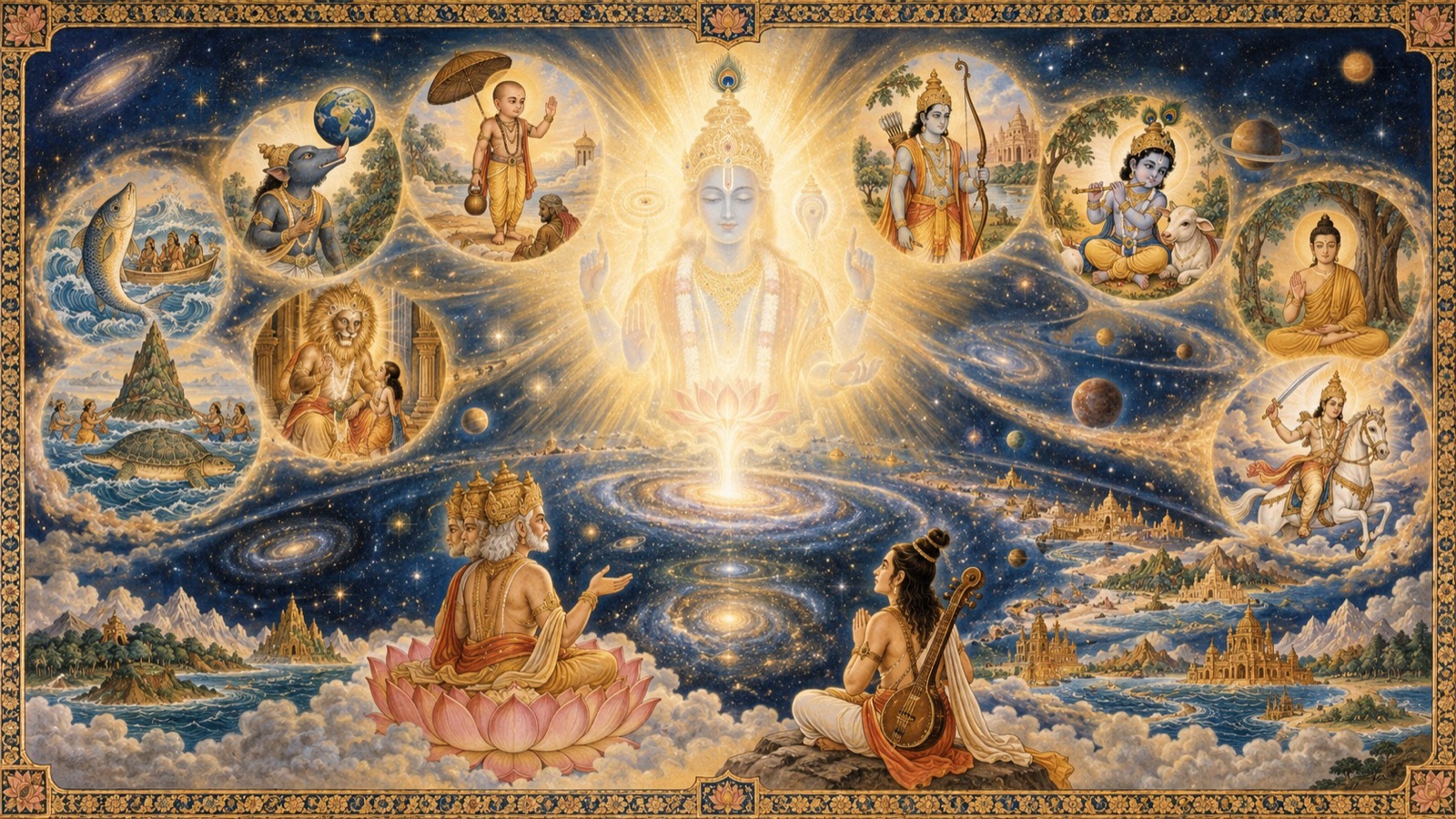
From the Boar who lifted the drowning earth to the Lord who will one day appear as Kalki, Brahma tells Narada of the countless sportful descents by which the one Supreme Person crosses the ages and rescues His creation.
Om Namo Bhagavate Vasudevaya.
Om Namo Bhagavate Vasudevaya.
Om Namo Bhagavate Vasudevaya.
Welcome to Srimad Bhagavatam Wisdom, a devotional journey through the sacred histories and teachings of the Srimad Bhagavat Mahapurana. Brahma has just finished describing, in the previous discourse, the glory of the Cosmic Being and the beauty of the path of devotion — a description so nectarean that Narada, at its close, begged his father for more: to hear, in the same breath, of the Lord’s own sportful descents into this world. This seventh chapter is Brahma’s generous answer. Here the creator becomes a storyteller, moving swiftly and joyfully through descent after descent of the one Supreme Person — Varaha, Kapila, Dattatreya, the four Kumaras, Dhruva, Prthu, Matsya, Kurma, Narasimha, Vamana, Rama, Krishna and Balarama, Vyasa, Buddha, and finally Kalki, who is yet to come. It is one of the most beloved chapters of the entire Bhagavatam, because within a single conversation between father and son, the whole sweep of the Lord’s activity across the ages is gathered into view.
Chapter Information
- Scripture: Śrīmad Bhāgavata Mahāpurāṇa
- Canto: 2 (Book Two)
- Chapter: 7 (Discourse VII)
- Chapter title: The stories of the Lord’s sportful descents
- Principal speaker: Brahma, continuing his answer to the sage Narada — a dialogue that Sukadeva Gosvami relates to King Parikshit, and that Suta Gosvami in turn narrates to the sages of Naimisharanya
- Principal listener: The sage Narada, Brahma’s son (within the narrated dialogue); King Parikshit (hearing it from Sukadeva); and the sage Saunaka with the assembly at Naimisharanya (hearing it from Suta)
- Main setting: The primordial dawn of creation, at the seat of Brahma; relayed within the riverside teaching of Sukadeva to Parikshit and the forest hermitage of Naimisharanya
- Central subject: Brahma’s roll-call of the Lord’s principal sportful descents (avataras), opening with the Boar who lifted the drowning earth and closing with the future Punisher of Kali, together with a concluding meditation on the Lord’s unfathomable nature and His charge to Narada to expand the Bhagavata
- Principal verse range: Canto 2, Chapter 7, verses 1–53
- Primary edition: Gita Press Śrīmad Bhāgavata Mahāpurāṇa
The Earliest Descents: Varaha, Kapila, Datta, the Kumaras, Nara-Narayana
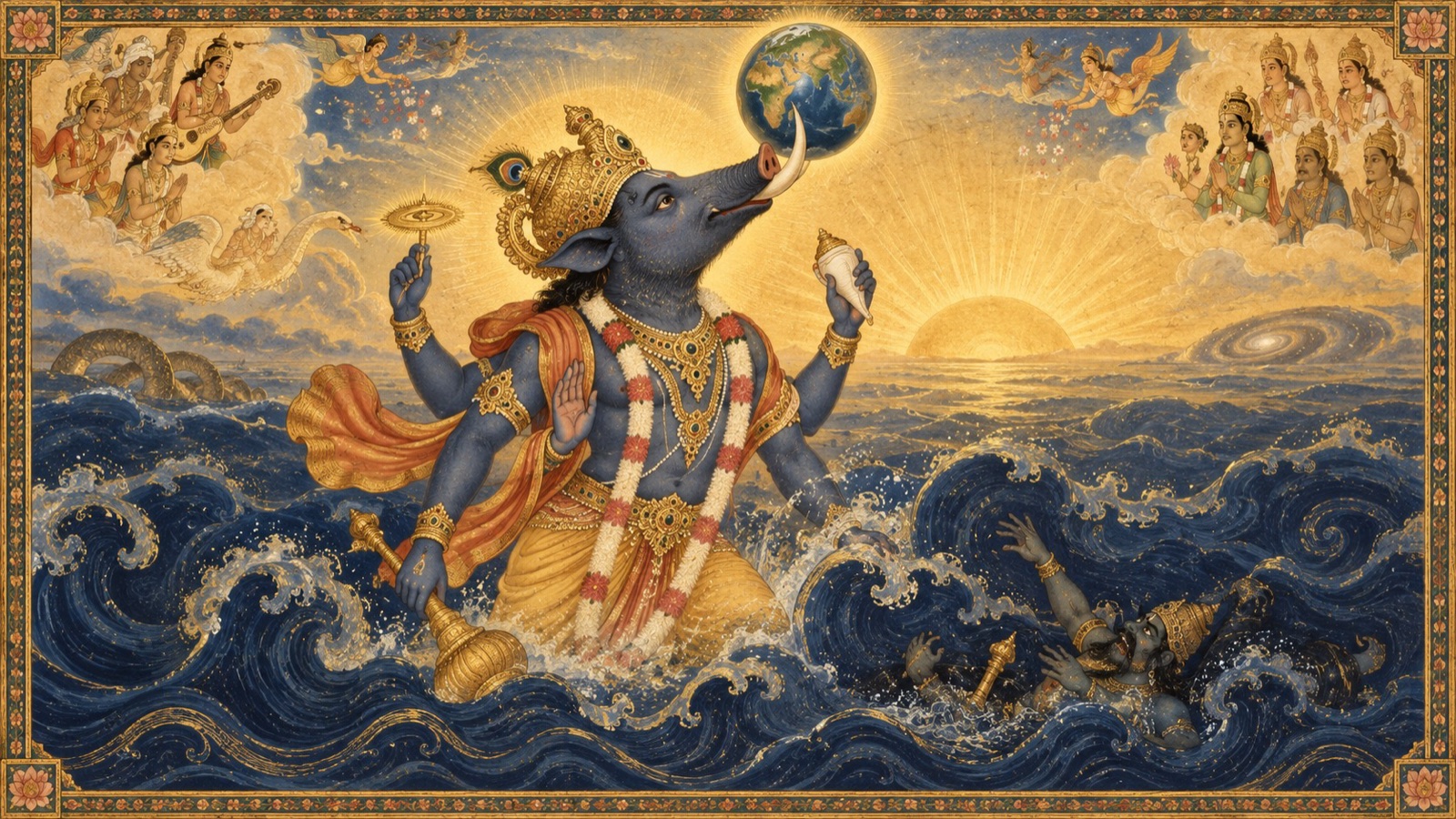
Brahma opens with the descent that, in the order of this universe’s history, comes first. When the earth lay drowned within the vast cosmic ocean, the unlimited Lord assumed the form of a Boar, lifted her upon His tusk, and pierced the first demon, Hiranyaksha, who rose to oppose Him. Brahma then moves quickly through several further descents. As Suyajna, born through Svayambhuva Manu’s lineage, the Lord ruled as Indra of that age and relieved the three worlds of great distress, earning the name “Hari.” As Kapila, born to the sage Kardama and his wife Devahuti, the Lord taught His own mother the path of self-realization, by which she was liberated in that very life. To the sage Atri, who prayed for a son, the Lord promised Himself, saying, “I have given Myself as a son to you” — and so was born as Dattatreya, “the Given One,” by whose grace kings such as Yadu and Sahasrabahu attained both enjoyment and liberation. And in response to Brahma’s own austerities at the dawn of creation, the Lord appeared as the four Kumaras — Sanaka, Sanandana, Sanatana, and Sanatkumara — who restored the truth of the Spirit that had been lost at the close of the previous cycle. Finally in this opening cluster, Brahma tells of the Lord’s birth as the twin sages Nara and Narayana, born to Murti, whose penance was so complete that when Cupid’s own celestial nymphs came to break it, they instead beheld countless nymphs as beautiful as themselves emanating from the sages’ own Yogic power — a vow no anger, nor even the mildest trace of lust, could ever approach.
Dhruva, Prthu, and Rishabhadeva
Brahma turns next to descents in which the Lord acts less through His own body than through the granting of extraordinary boons and through His inspired devotees. Wounded by his stepmother’s sharp words in front of his own father, the child Dhruva went alone into the forest to practise austerity; pleased with his devotion, the Lord granted him the eternal abode of the polar star, which the celestial sages still circle in reverence to this day. When King Vena strayed so far from righteousness that the Brahmanas’ curse burned away his virtue and fortune and sent him toward hell, the Lord had mercy and appeared as Vena’s own son, Prthu — churned into being from the dead king’s body — who rescued his father from that fate and, taking the earth as a cow, milked her of all her produce for the benefit of the world. And born to King Nabhi and Queen Sudevi, the Lord appeared as Rishabhadeva, who renounced every attachment so completely, and settled so deeply into pure spiritual absorption, that He appeared to the world as little more than an idiot — the very state that great seers honour as the summit of the Paramahamsa, one who is ever absorbed in the Self.
Hayagriva, Matsya, and Kurma
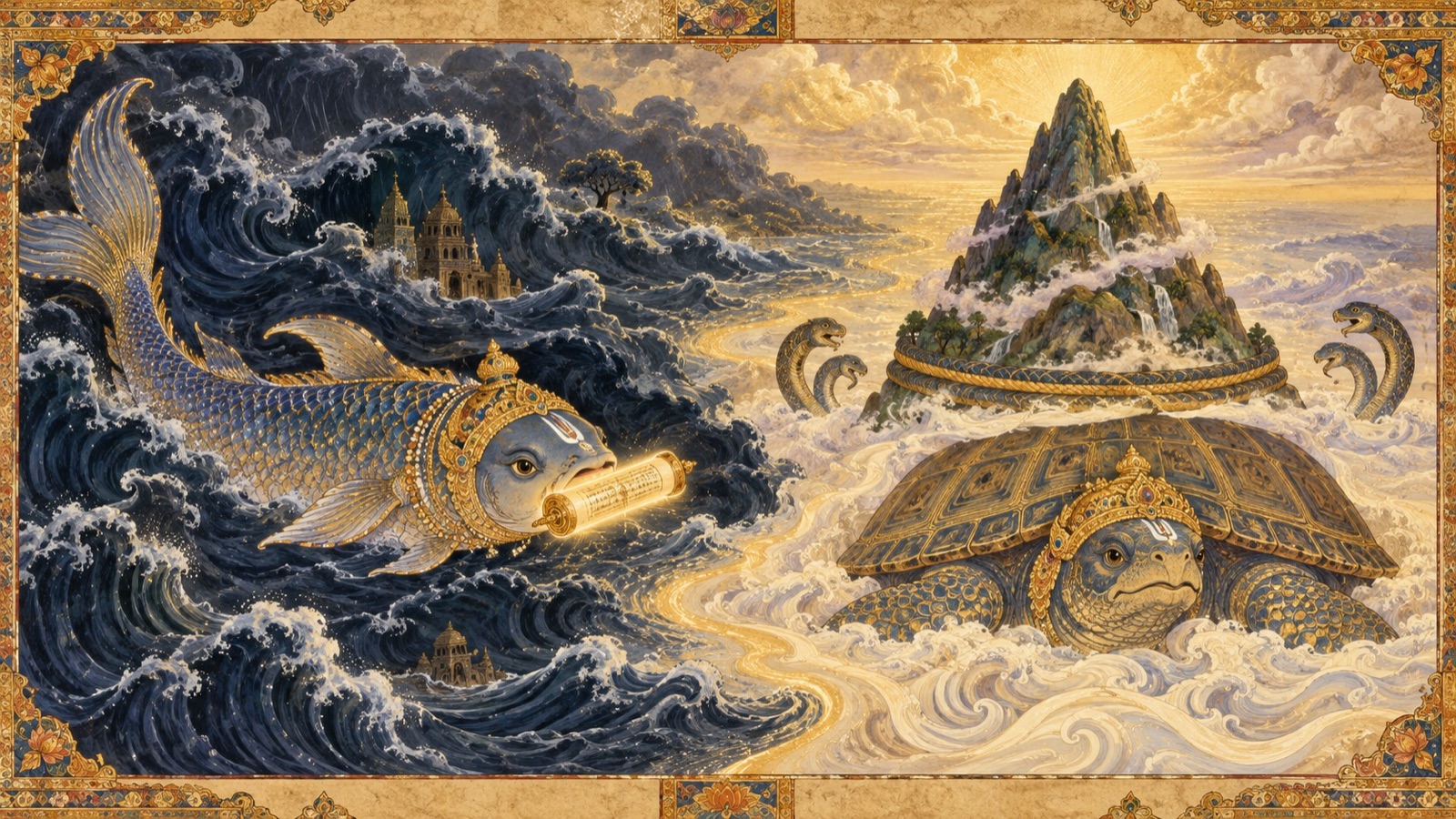
The next descents concern the preservation of sacred knowledge itself. At a sacrifice performed by Brahma, the Lord personally appeared as Hayagriva, golden of complexion, the very embodiment of the Vedas and of sacrifice, from whose nostrils, as He breathed, the sacred hymns themselves issued forth. At the end of an earlier age, when the king Satyavrata was destined to become the next Manu, he beheld the Lord in the form of the divine Fish, Matsya, who carried the Vedas — which had slipped from Brahma’s own mouth in fear — safely across the dreadful flood that consumed the universe, sporting there until the next creation began. And when the gods and demons together churned the Ocean of Milk with Mount Mandara in search of nectar, the Lord took the form of the divine Tortoise, Kurma, bearing the whole mountain upon His back — the friction of the churning, Brahma notes with tenderness, relieved an itch on His shell and even brought Him a moment’s nap.
Narasimha and the Rescue of Gajendra
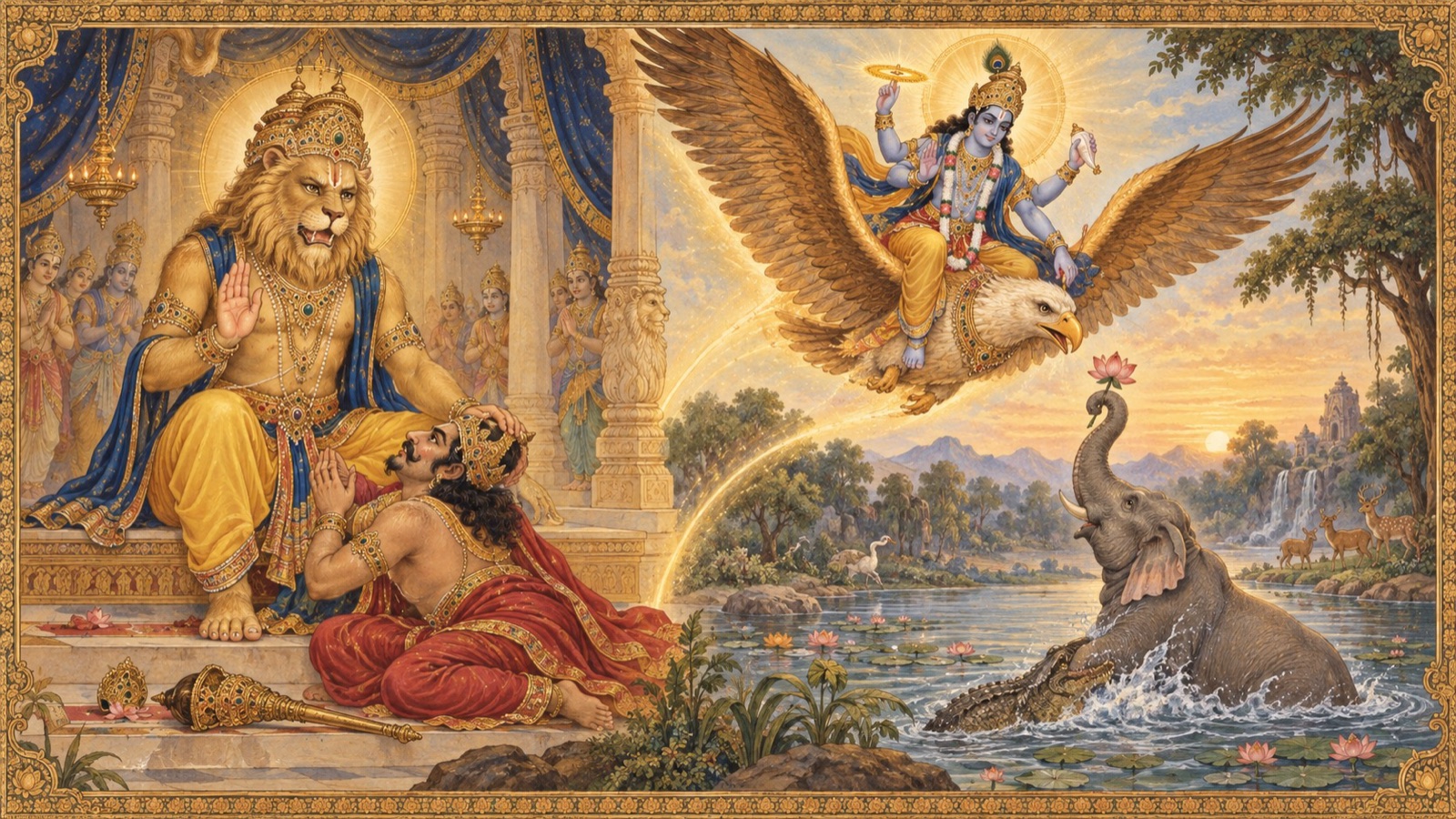
Two of the chapter’s most vivid scenes follow. To dispel the great terror of the gods, the Lord assumed the form of Narasimha, the Man-Lion, His face made most fearsome by restless eyebrows and moving jaws; when the demon king Hiranyakashipu attacked Him with a mace, the Lord seized him, threw him across His own thighs, and tore open his belly with His claws. Then Brahma tells of an elephant, leader of his herd, seized by the leg in a lake by a mighty alligator. In his distress the elephant lifted a lotus in his trunk and cried out to the Primal Person, the Protector of all the worlds, whose names alone are auspicious to hear. Hearing that cry, the infinite Lord Hari appeared at once, mounted upon Garuda and armed with His discus, severed the alligator’s head, and drew the grateful elephant to safety by his own trunk.
Vamana and the Gift of Three Worlds
Though the youngest of Aditi’s twelve sons, the Lord as Vamana, the Dwarf, surpassed them all in virtue: the moment King Bali promised Him land measuring three paces, He covered all three worlds with His strides. Brahma pauses here to draw out the deeper teaching — the Lord chose to ask, rather than simply take, showing that even the all-powerful will not seize what has not been offered. Bali, though warned and even cursed by his own preceptor Sukracharya for keeping his word, did not waver; he placed his own head at the Lord’s feet as the third step, valuing that surrender above the very kingdom of heaven he had once conquered by his strength.
Hamsa, Manu, and Dhanvantari
Brahma then turns briefly and personally to Narada: it was the Lord, appearing as the divine Swan, Hamsa, who — deeply pleased by Narada’s own devotion — taught him the Yoga of Devotion and the wisdom that reveals the Spirit’s truth, a teaching graspable only by souls who have taken refuge in Vasudeva. In every Manvantara, Brahma continues, the Lord appears as the Manu, protecting that race of humanity and wielding unobstructed authority over all directions, His glory reaching to the highest heaven, Satyaloka, and His rule inflicting just punishment on wicked kings. And descending as Dhanvantari, glory itself, the Lord cures the diseases of suffering men at the mere utterance of His name, earns His own share in the sacrificial offerings among the immortals, and taught to the world the science of Ayurveda.
Parashurama and the Coming of Rama
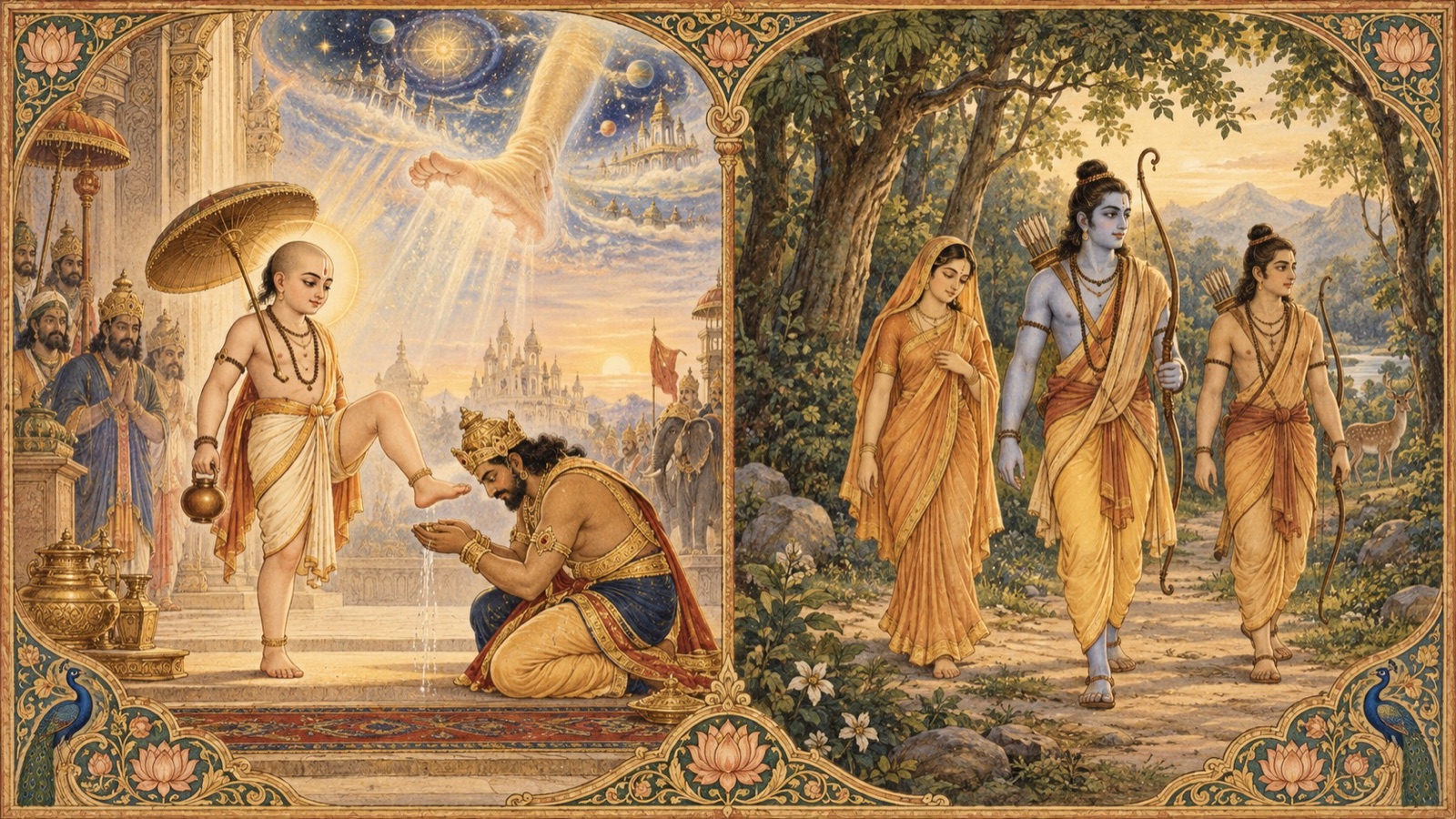
When the Kshatriya race turns against the very Brahmanas it should protect and hurries toward the torments of hell, the Supreme Spirit appears as Parashurama, of tremendous prowess, and cuts down that fallen race thrice-seven times with His sharp-edged axe. From this stern justice Brahma turns to a gentler descent still to come: ever gracious to the gods, the Lord will take birth in the line of Ikshvaku as Sri Rama, accompanied by His part-manifestations Bharata, Lakshmana, and Shatrughna, and will go into exile at His father Dasaratha’s command, with Sita and Lakshmana at His side — an exile in which the ten-headed Ravana will make himself the Lord’s enemy and come to ruin. When Rama reaches the shore of the ocean, His eyes red with a wrath born of separation from Sita, the very alligators and serpents of the deep will tremble at His gaze, and Ocean himself, limbs shaking with fear, will grant Him passage. Ravana, who once made even Indra’s elephant Airavata’s tusks shatter against his own chest in pride, will laugh in triumph — until the moment he dares to carry off Sita and stride between the two armies at Lanka, at which the mere twang of Rama’s bow will end both his laughter and his life.
The Sportful Childhood and Deeds of Balarama and Krishna
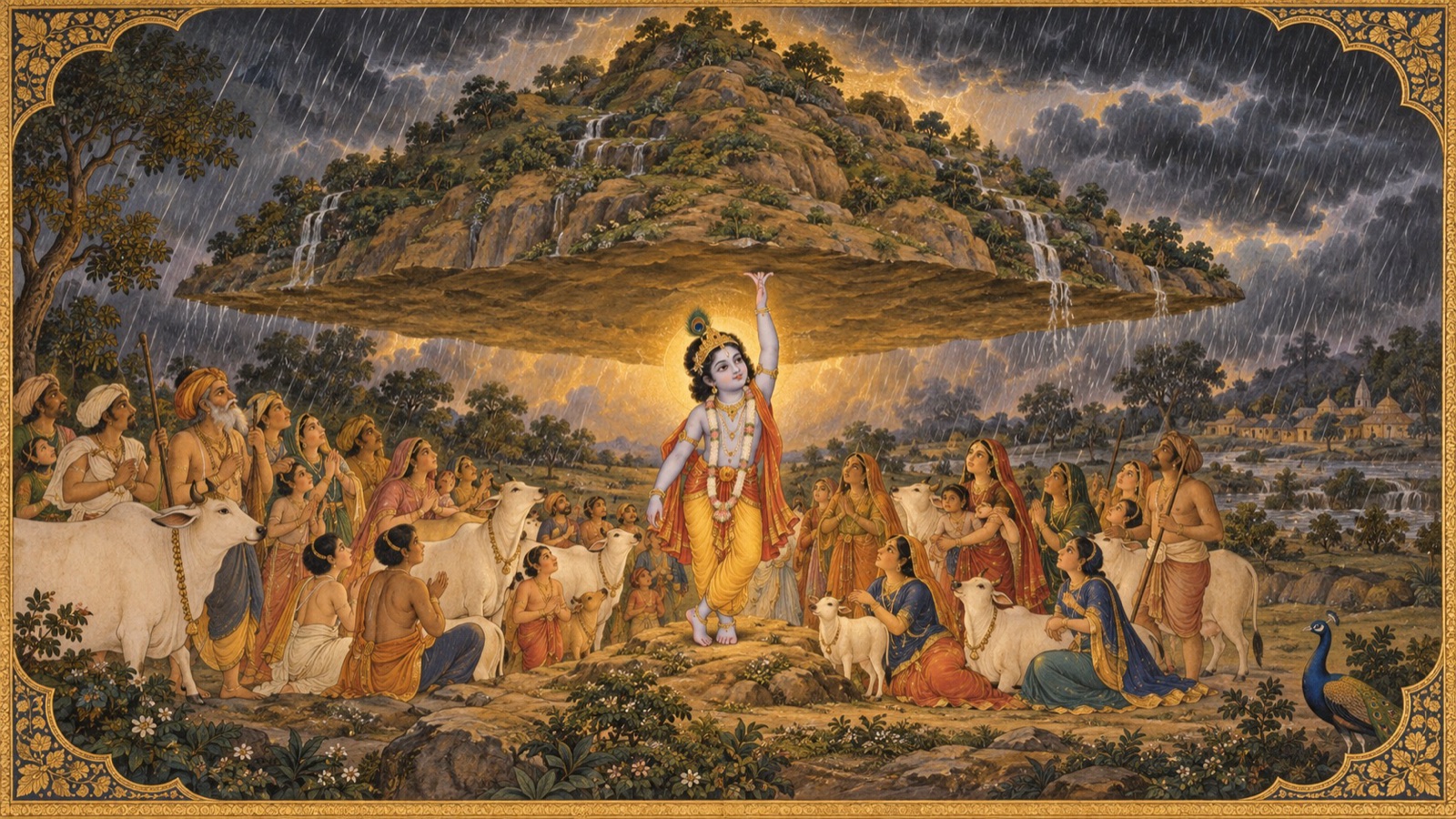
Brahma now gives his longest and most loving account: the descent of the Lord, together with Balarama, to relieve the earth of the burden of demon-born kings — two forms Brahma calls “a grey and a dark hair” of the one Godhead, though in truth the whole, undivided Lord. As an infant not yet ten days old, He sucks the very life from the demoness Putana; at three months He overturns a cart with a kick of His foot; crawling on hands and knees, He fells two towering Arjuna trees between which He passes. In Vraja, He restores to life the cowherds and cattle who perish from the poisoned waters of the Yamuna, then enters that river Himself to subdue and banish the many-hooded serpent Kaliya, purifying its waters. The same night, as a wildfire threatens the sleeping cowherd folk, He and Balarama need only tell them to close their eyes to save them all from a fate that seems certain. Every cord Mother Yashoda ties Him with proves too short, and when, catching Him yawning, she glimpses the fourteen worlds within His small mouth, her dismay turns at once into a dawning sense of His divinity. He frees His father Nanda from a python and from the noose of Varuna, rescues cowherd boys trapped in caves by the demon Vyoma, and at the last carries the people of Gokula — who toil all day and sleep like the dead each night from sheer exertion — to His own eternal Abode, Vaikuntha. When the cowherds, at the Lord’s own urging, cease their yearly offering to Indra, and Indra floods Vraja in fury, the seven-year-old Lord simply lifts Mount Govardhana as if it were a mushroom and holds it aloft for seven days to shelter His people. And on a moonlit night in the groves of Vrindavana, His flute calls the young cowherdesses to the Rasa dance; when Kubera’s own attendant Shankhachuda dares to abduct them, the Lord severs his head without a pause.
Brahma then names, almost in a single breath, the long roll of demons and rival warriors who meet their end at the hands of Krishna, Balarama, and their allies — Pralamba, Dhenuka, Baka, Keshi, Arishta, the wrestler Chanura, the war-elephant Kuvalayapida, Kamsa, Kalayavana, Narakasura, the false Krishna named Paundraka, and later Shalva, Dvivida, Balvala, Dantavakra, the seven bulls of Nagnajit, Shambara, Vidhuratha, Rukmi, and the warring kings of the Kambojas, Matsyas, Kurus, Kekayas, and Srinjayas — all slain by Hari Himself or under the names Balarama, Arjuna, and Bhima, and thereby granted entry into His own divine Abode.
Vyasa, Buddha, and Kalki: Guarding the Ages to Come
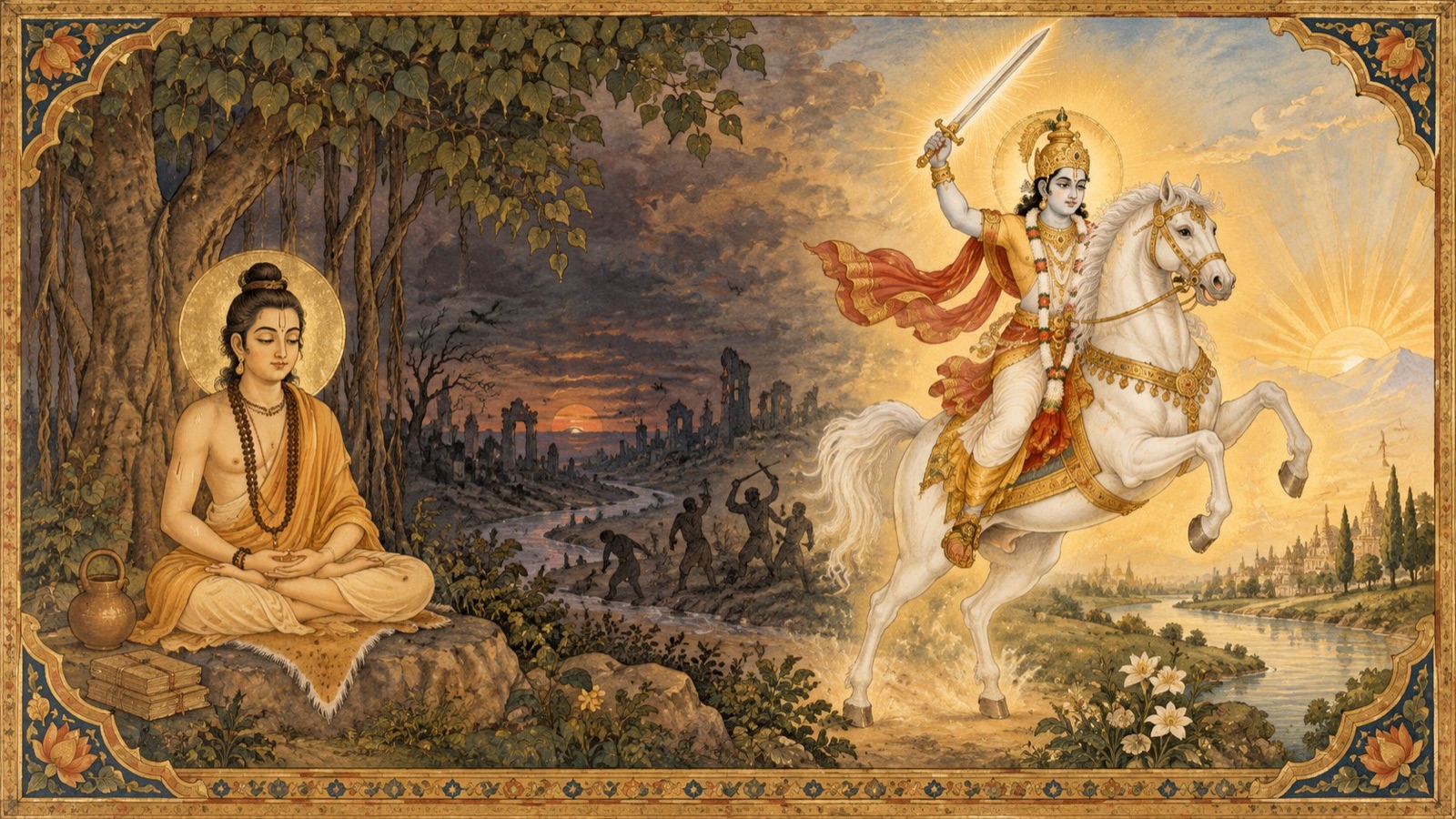
As the ages advance and human intellect and lifespan shrink, Brahma says, the Lord will appear through the womb of Satyavati as Vedavyasa, dividing the single tree of Vedic knowledge into many branches so that it may still be grasped by minds no longer capable of holding it whole. When atheists — learned in the Vedas yet turned against their purpose — build invisible aerial citadels through the sorcery of the demon-architect Maya and threaten the world, the Lord will take a deluding, alluring form as Buddha, teaching heresies that bewilder those who have already abandoned truth for its own sake. And at the very close of Kali-yuga, when no one speaks of Hari even in the homes of the pious, when the twice-born themselves turn heretic, when the lowest of men rule as kings, and when the ancient offerings of “Swaha,” “Swadha,” and “Vashat” are heard no more, the Lord will appear as Kalki, the Punisher of Kali, to set the ages right once again.
The Lord None Can Fully Fathom
Having completed his roll-call, Brahma steps back to a larger truth. All of creation, maintenance, and dissolution — Brahma himself with the Prajapatis at the beginning, Vishnu with the empowered gods and kings in the middle, and Shiva with the wrathful forces at the end — are but manifestations of a single, supreme energy. Who, Brahma asks, can fully describe even the prowess of Vishnu, whose single stride as Trivikrama carried Him effortlessly beyond the highest heaven, Satyaloka, to a point beyond the three Gunas themselves? Not Brahma, nor any sage born before Narada, nor even the thousand-mouthed Sesha — the Lord’s own first expansion, who has spent eternity praising Him — has reached the limit of that knowledge. Only a soul specially favoured through unalloyed surrender, Brahma says, can cross the otherwise insurmountable ocean of illusion; those still attached to the body, which in the end feeds only dogs and jackals, cannot.
येषां स एष भगवान् दययेदनन्त: सर्वात्मनाश्रितपदो यदि निर्व्यलीकम् । ते दुस्तरामतितरन्ति च देवमायां नैषां ममाहमिति धी: श्वशृगालभक्ष्ये ॥ ४२ ॥
yeṣāṁ sa eṣa bhagavān dayayed anantaḥ sarvātmanāśrita-pado yadi nirvyalīkam te dustarām atitaranti ca deva-māyāṁ naiṣāṁ mamāham iti dhīḥ śva-śṛgāla-bhakṣye
Meaning: The boundless Lord grants His mercy only to the soul who has taken shelter of His feet with an undivided heart, and it is that soul alone who crosses the otherwise uncrossable ocean of Maya — no longer clinging to “I” and “mine” over a body that, in the end, becomes food for dogs and jackals. (SB 2.7.42)
Brahma then names a long line of exalted souls who do know the Lord’s Maya-potency and have crossed it through devotion: Shiva himself; the great devotee Prahlada; Svayambhuva Manu and his queen Shatarupa; their children Priyavrata, Uttanapada, Akuti, Devahuti, and Prasuti; and a great roster of sages and kings — Prachinabarhi, Rbhu, Anga, Dhruva, Ikshvaku, Aila, Mucukunda, Janaka, Gadhi, Raghu, Ambarisha, Sagara, Gaya, Nahusha, Mandhata, Alarka, Shatadhanva, Anu, Rantideva, Bhishma, Bali, Amurttaraya, Dilipa, Saubhari, Utanka, Shibi, Devala, Pippalada, and Sarasvata, together with Uddhava, Parashara, Bhurishena, Vibhishana, Hanuman, Shukadeva, Arjuna, Arshtishena, Vidura, and Srutadeva. And Brahma is careful to add that this knowledge is not reserved for the great alone: women, labourers, forest peoples, those born to a sinful life, and even birds and beasts who follow in the footsteps of the Lord’s devotees can likewise realize His Maya and cross beyond it.
ते वै विदन्त्यतितरन्ति च देवमायां स्त्रीशूद्रहूणशबरा अपि पापजीवा: । यद्यद्भुतक्रमपरायणशीलशिक्षा- स्तिर्यग्जना अपि किमु श्रुतधारणा ये ॥ ४६ ॥
te vai vidanty atitaranti ca deva-māyāṁ strī-śūdra-hūṇa-śabarā api pāpa-jīvāḥ yady adbhuta-krama-parāyaṇa-śīla-śikṣās tiryag-janā api kim u śruta-dhāraṇā ye
Meaning: Even those the world counts as lowly — women, labourers, tribal outcastes, souls burdened by a sinful past, even birds and beasts — come to know and cross this Maya the moment they take up the character and conduct of the Lord’s own wondrous devotees; how much more surely, then, does it open to one who has truly heard and held His teaching in the heart. (SB 2.7.46)
The Nature of the Supreme and Brahma’s Charge to Narada
Brahma closes his teaching with a description of the Supreme Spirit’s own essential nature: ever serene, fearless, pure consciousness, untouched by Maya, beyond both the real and the unreal, beyond the reach of words and beyond the fruit of any ritual action — so complete that Maya herself, ashamed, flees from His presence. This is the Brahman the wise realize, of the nature of eternal bliss; those who fix their mind upon Him need no further discipline to dissolve the sense of difference, just as Indra, being himself the lord of rain, has no need of a spade to dig a well. It is this same Lord who grants the fruit of every action, inspiring each doer according to their own nature; and even as a body dissolves when its elements disperse, the unborn Spirit within remains untouched, exactly as the ether pervading a jar is not broken when the jar itself shatters. Having said all this, Brahma turns to Narada with the gentlest of instructions: “I have told you, dear child, in brief, of the Lord who creates the universe by thought alone; nothing that exists as cause or effect is other than Hari, though He stands apart from all of it. This is the Bhagavata that the Lord Himself once taught to me in summary — now you must expand it, that men everywhere may come to devotion for Hari, the Universal Spirit and Sustainer of all.”
इदं भागवतं नाम यन्मे भगवतोदितम् । संग्रहोऽयं विभूतीनां त्वमेतद् विपुलीकुरु ॥ ५१ ॥
idaṁ bhāgavataṁ nāma yan me bhagavatoditam saṅgraho ‘yaṁ vibhūtīnāṁ tvam etad vipulī kuru
Meaning: This very teaching, Brahma tells Narada, is called the Bhagavata — what the Lord Himself once gave me is only a seed-summary of His infinite glories; now you must unfold it and make it vast. (SB 2.7.51)
And know this, Brahma adds: the mind of one who describes this Maya of the Lord, or who approves of another’s describing it, or who reverently hears it described each day, is never again deluded by that very Maya.
माया वर्णयतोऽमुष्य ईश्वरस्यानुमोदत: । शृण्वत: श्रद्धया नित्यं मायया आत्मा न मुह्यति ॥ ५३ ॥
māyāṁ varṇayato ‘muṣya īśvarasyānumodataḥ śṛṇvataḥ śraddhayā nityaṁ māyayātmā na muhyati
Meaning: Whoever describes this Maya of the Lord, delights in another’s describing it, or simply listens to it with faith day after day — that soul is never again bewildered by it. (SB 2.7.53)
Principal Teachings of This Chapter
1. The one Lord takes countless forms across the ages. From Varaha at the dawn of creation to Kalki at the end of Kali-yuga, every descent serves a purpose — protecting the innocent, restoring dharma, teaching wisdom, or simply sporting with His devotees (verses 1-38).
2. Devotion, not power, moves the Lord. Vamana asks rather than takes; Bali’s surrender outweighs his kingdom; Gajendra’s single cry of distress brings the infinite Lord instantly to his side (verses 15-18).
3. No one — not even Brahma or Sesha — fully knows the Lord. His prowess as Trivikrama alone is beyond measure; only unalloyed surrender, not intellectual effort, crosses the ocean of His Maya (verses 40-42).
4. This knowledge is for everyone. From Shiva and Prahlada to women, labourers, forest peoples, and even animals who follow the devotees’ example, the Lord’s Maya can be known and crossed by any surrendered soul (verse 46).
5. Hearing of the Lord’s Maya itself protects the mind. Brahma’s final teaching to Narada is not a philosophy to be merely understood, but a practice: to speak of, approve of, or reverently hear of the Lord daily is itself the remedy for delusion (verse 53).
A Devotional Reflection
There is something wonderfully unhurried about the way Brahma tells these stories. He does not linger to build suspense or moralize at length; he simply names descent after descent, sketching each in a few vivid strokes — the itch on the Tortoise’s back, the cord too short for baby Krishna, Bali’s head bowed at the Lord’s feet — and moves on, as though the sheer abundance of the Lord’s sportfulness is itself the teaching. And in a real sense it is. We often imagine that faith requires us to master a single, tidy account of who God is and what He wants. This chapter offers something different: a Lord who is at once the fierce Man-Lion and the sleepy Tortoise, the towering Trivikrama and the milk-thief bound with a rope too short, the chastiser Kalki still to come and the patient teacher Vyasa dividing the Vedas for our sake. None of these forms exhausts Him; and yet each one is completely Him. Perhaps this is Brahma’s real gift to Narada — and to us. We do not need to resolve the Lord into a single manageable idea before we can love Him. We only need to keep listening to the stories, one after another, the way a child asks a parent to tell it again, and let that steady repetition itself become the path that carries us across illusion.
A Daily Devotional Practice
Today, choose just one of the descents named in this chapter — perhaps Gajendra’s cry answered instantly, or the child Krishna’s mouth revealing the fourteen worlds, or Bali’s quiet surrender of everything he owned. Sit with that single image for a few minutes, picturing it as vividly as you can, and notice what it stirs in you: comfort, wonder, humility, or longing. Then, in the spirit of Brahma’s closing instruction to Narada, speak of it aloud to someone, or simply narrate it silently to yourself once more with full attention — for the chapter itself promises that a mind which reverently describes or hears of the Lord’s Maya each day is never again deluded by it. Close by repeating slowly, a few times: “Om Namo Bhagavate Vasudevaya.”
Conclusion
The seventh chapter of the Second Canto is, on its surface, a list — a rapid procession of the Lord’s incarnations across the ages of the universe. But listened to with devotion, it becomes something far richer: a portrait of a God who is endlessly resourceful in His love, willing to become a Boar, a Dwarf, an infant thief of butter, a chastising warrior, or a future king of punishment, whatever the hour requires. Brahma, who might have claimed some share of this glory as its narrator, instead ends by handing the whole teaching back to Narada, and through him, to us — insisting that the surest way to remain untouched by illusion is simply to keep telling, and keep hearing, these very stories with love. From Varaha lifting the earth to Kalki who is yet to come, the message of this chapter is the same one Brahma has been offering from the start: that behind every form and every age, there is only ever the one Supreme Person, sporting endlessly for the sake of those who love Him.
May the divine wisdom of Srimad Bhagavatam awaken pure devotion within our hearts.
Om Namo Bhagavate Vasudevaya.
Jay Shree Madhav.
References and Attribution
- Primary edition: Gita Press, Śrīmad Bhāgavata Mahāpurāṇa (English, complete), Book Two, Discourse 7, pages 110–118.
- Series: Srimad Bhagavatam Wisdom · Biswa Sanatan Dharma Seva Trust.
- Presented following the spiritual guidance and recommendation of Pandit Dr. Shri Kashinath Mishra.
This is an original, faithful retelling in the writer’s own words, with brief quoted verses shown in Devanāgarī and transliteration and their meanings given as summaries. It is not a reproduction of any single publisher’s continuous translation or commentary. No affiliation with or endorsement by any publisher is implied.
Jay Shree Madhav