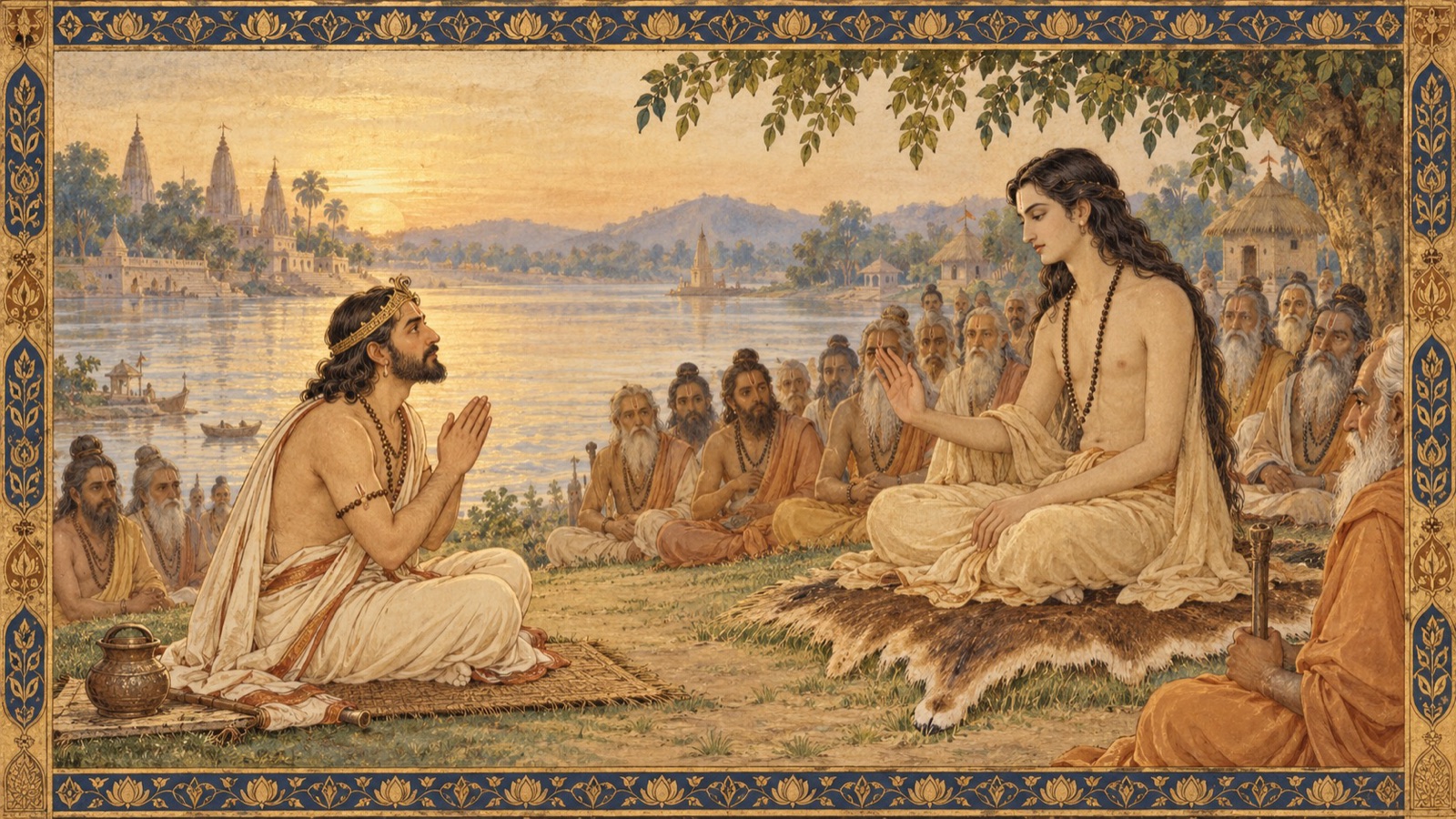
On the bank of the Ganga, with seven days left to live, King Parikshit lays before the sage Suka the whole of his heart’s curiosity — one question flowing into the next, like a river seeking the sea.
Om Namo Bhagavate Vasudevaya.
Om Namo Bhagavate Vasudevaya.
Om Namo Bhagavate Vasudevaya.
Welcome to Srimad Bhagavatam Wisdom, a devotional journey through the sacred histories and teachings of the Srimad Bhagavat Mahapurana. The previous chapters carried us through Sukadeva Gosvami’s account of how the ancient sage Narada once questioned his father Brahma, and how Brahma answered by tracing the universe’s descent from the three Gunas to the towering form of the Cosmic Being holding all fourteen worlds within His limbs. Having heard this much, King Parikshit — sitting on the bank of the Ganga, with only seven days of life remaining to him under a Brahmana’s curse — can wait no longer. This eighth chapter belongs entirely to him. It is his moment to ask, without restraint, everything he has ever wished to know: about time and its vast Kalpas, about the earth and the worlds beyond it, about the Vedas and the Yugas, about Yoga and its goal, about bondage and freedom, and above all, about how to fix a dying mind upon the Lord. What we receive here is not an answer but a question — magnificent, sweeping, and utterly sincere — which will occupy the sage Suka for the rest of this great scripture.
Chapter Information
- Scripture: Śrīmad Bhāgavata Mahāpurāṇa
- Canto: 2 (Book Two)
- Chapter: 8 (Discourse 8)
- Chapter title: King Pariksit asks various questions of the sage Suka
- Principal speaker: King Parikshit (posing his questions to Sukadeva Gosvami); Suta Gosvami closes the chapter, narrating to the sages of Naimisharanya
- Principal listener: Sukadeva Gosvami (within the narrated scene); the sage Saunaka and the assembly at Naimisharanya (hearing it from Suta)
- Main setting: The bank of the river Ganga, where King Parikshit sits fasting, awaiting death, in the company of Sukadeva Gosvami and a great assembly of sages
- Central subject: Parikshit’s extensive series of questions to Suka — covering the Bhagavata’s origin, the nature of the soul and the Cosmic Being, time and the Kalpas, cosmology, the Yugas and the Lord’s incarnations, the duties of men, the Tattvas and Yoga, the Vedas and scriptures, the cycle of creation, and the mystery of bondage, liberation, and the Lord’s own Maya
- Principal verse range: Canto 2, Chapter 8, verses 1–29
- Primary edition: Gita Press Śrīmad Bhāgavata Mahāpurāṇa
A King’s Question About the Bhagavata Itself
The chapter opens not with cosmology but with curiosity about the very teaching Parikshit has just been told exists. He has heard that Narada once declared the glories of the Lord who transcends the three Gunas, at Brahma’s urging — but before whom did Narada speak, and how? Parikshit puts the question directly to Suka, calling him foremost among the knowers of Truth, for the stories of Sri Hari are, he says, a source of blessing to the whole world.
राजोवाच ब्रह्मणा चोदितो ब्रह्मन् गुणाख्यानेऽगुणस्य च । यस्मै यस्मै यथा प्राह नारदो देवदर्शन: ॥ १ ॥
rājovāca brahmaṇā codito brahman guṇākhyāne ‘guṇasya ca yasmai yasmai yathā prāha nārado deva-darśanaḥ
Meaning: The king said: O learned Brahmana, when Brahma urged Narada — whose vision reaches the gods themselves — to declare the glories of the Lord who is beyond the three Gunas, before whom, and in what manner, did he speak of them? (Canto 2, Chapter 8, verse 1)
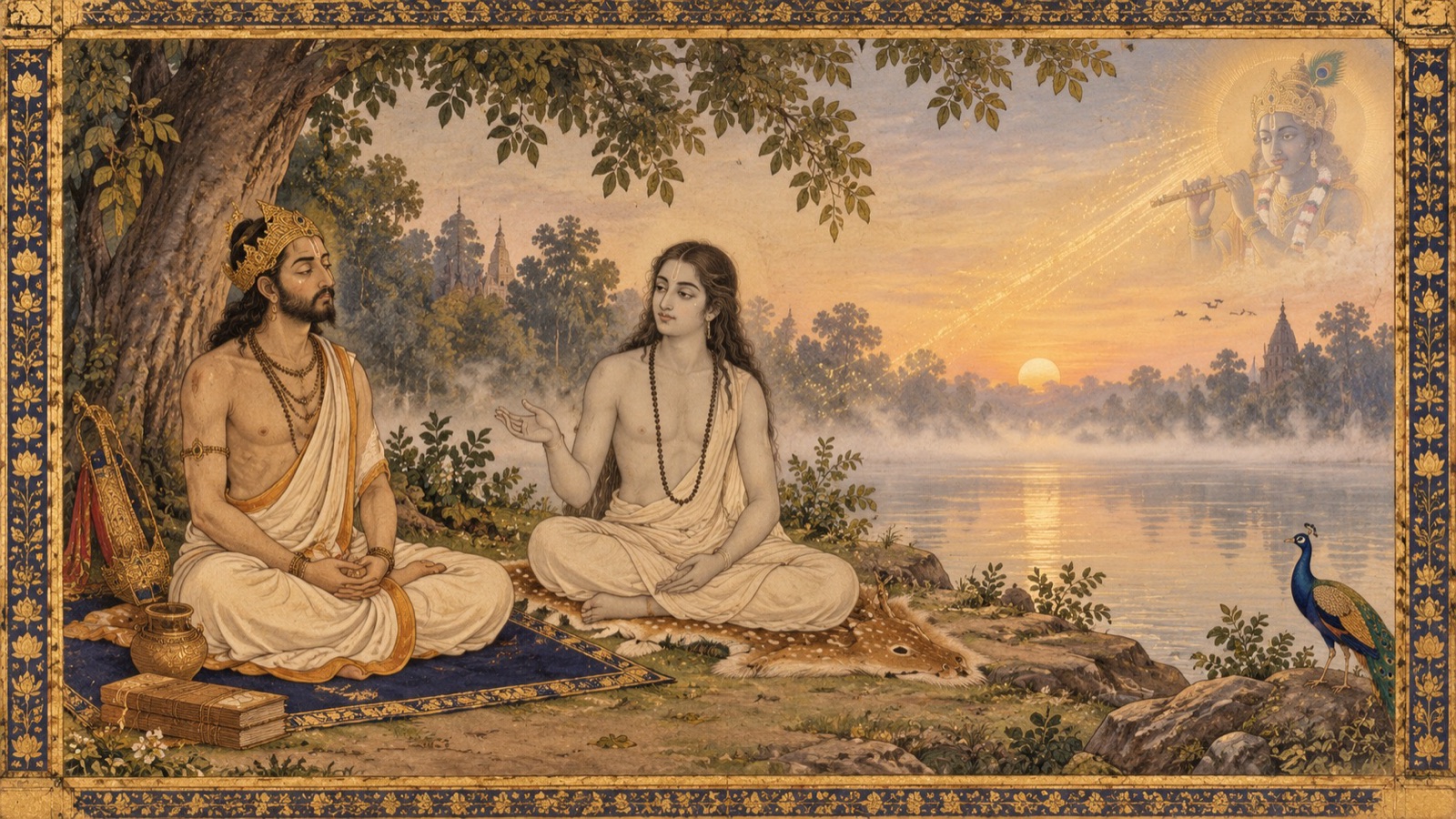
But the king’s deeper concern soon reveals itself. He is not merely curious about scripture; he is preparing to die. How, he asks, is a soul to fix its mind — free of every attachment — upon Sri Krishna, the Soul of the universe, in the final hours before casting off the body? Suka’s answer to this, though it will unfold over many chapters still to come, is anticipated here in Parikshit’s own words.
शृण्वत: श्रद्धया नित्यं गृणतश्च स्वचेष्टितम् । कालेन नातिदीर्घेण भगवान् विशते हृदि ॥ ४ ॥
śṛṇvataḥ śraddhayā nityaṁ gṛṇataś ca sva-ceṣṭitam kālena nātidīrgheṇa bhagavān viśate hṛdi
Meaning: One who daily hears the Lord’s doings with faith, and who himself narrates them, soon finds Bhagavan coming to dwell within the heart — the process takes no great length of time at all. (Canto 2, Chapter 8, verse 4)
Entering, Parikshit says, through the ear as through an open door, the Lord rids that heart of every impurity — as autumn clears the muddied waters of a pond. A heart so purified never again abandons the shelter of His feet, the king says, just as a weary traveller returning home after a long journey never wishes to leave his own roof again.
The Soul, the Body, and the Cosmic Being
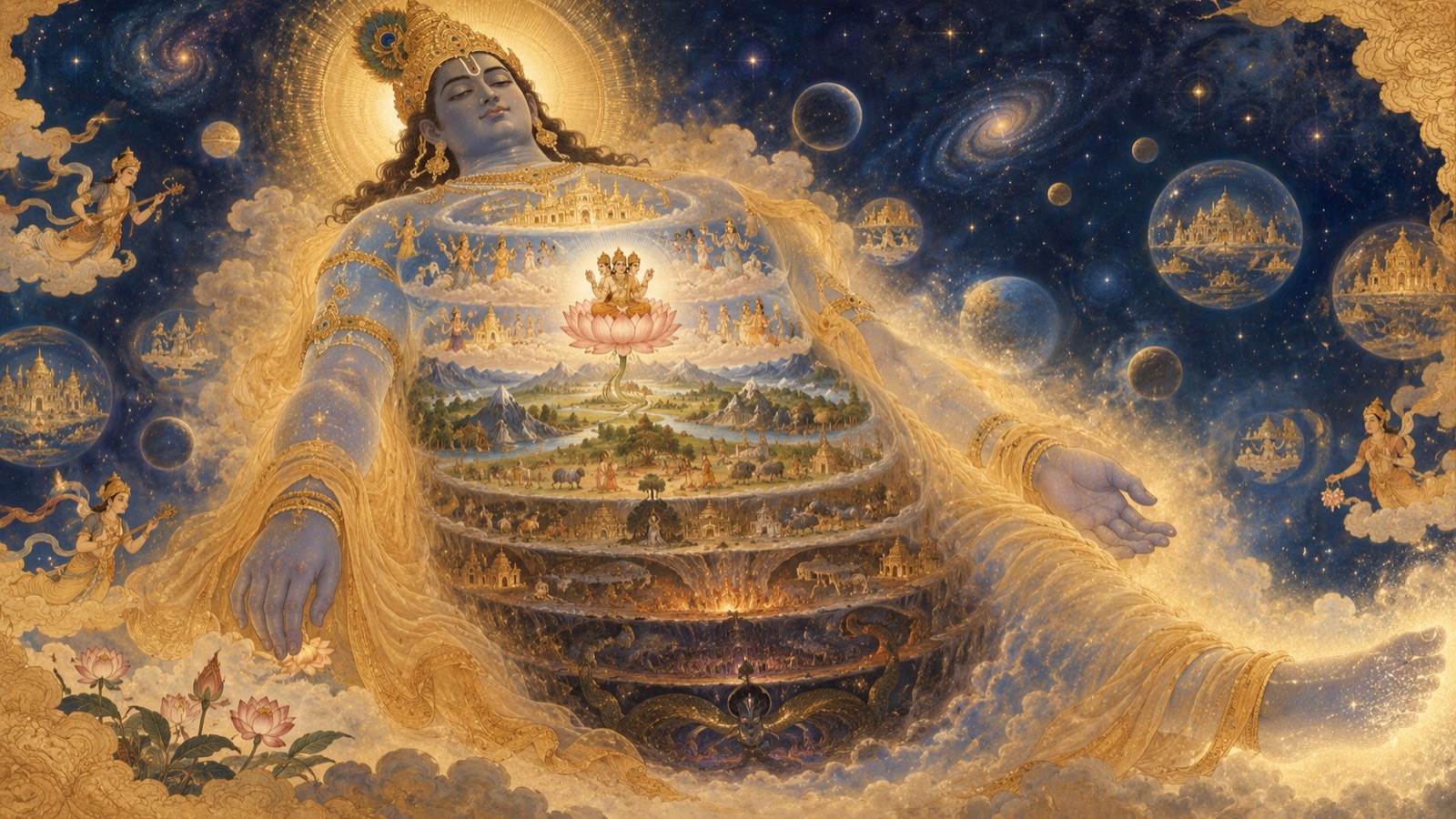
From this deathbed urgency, Parikshit’s mind turns outward to a puzzle that has evidently been troubling him since the earlier chapters: how can the soul, which has no true connection with matter, come to identify itself so completely with a body made of matter? Is this by chance, he asks, or does it happen for a reason rooted in Karma? He does not wait for an answer before moving to a still greater puzzle — the very form of the Cosmic Being described earlier by Brahma. From the Lord’s own navel-lotus, Parikshit recalls, sprang the lotus containing the arrangement of all the worlds; and the Lord Himself has been described with the same limbs, in the same proportion, as an ordinary man — only vast beyond all measure.
अज: सृजति भूतानि भूतात्मा यदनुग्रहात् । ददृशे येन तद्रूपं नाभिपद्मसमुद्भव: ॥ ९ ॥
ajaḥ sṛjati bhūtāni bhūtātmā yad-anugrahāt dadṛśe yena tad-rūpaṁ nābhi-padma-samudbhavaḥ
Meaning: It is by His grace alone that Brahma — the unborn one, sprung from the navel-lotus, himself the aggregate soul of all beings — creates all beings, and it is by that same grace that he was able to behold the Lord’s form. (Canto 2, Chapter 8, verse 9)
Then comes one of the chapter’s most striking questions, and in a sense its true hinge: after withdrawing the veil of His own Maya, where does that Supreme Person — the Ruler of Maya, the indweller of every heart, the source of the universe’s creation, maintenance, and dissolution — actually rest? It is a question that looks past every visible form of God to ask what remains when even the divine display is set aside. Parikshit adds that he has already heard how the various worlds, with their guardian deities, are conceived as located within the limbs of that Supreme Person — but he wants to be sure he has understood rightly, part by part.
Time, Karma, and the Shape of the Cosmos
Having touched the mystery of the soul and the Cosmic Being, Parikshit’s questions now widen into a sweeping survey of the universe he inhabits. He wants to know the length of a Mahakalpa and the smaller Kalpas contained within it, and the very measure of “past,” “future,” and “present” by which the lifespans of all created beings are reckoned. He wants to understand how the subtle and gross movements of time can even be perceived, however small or immense, in terms of the different actions performed by embodied souls. And he asks about the accumulation of Karma itself — how it is taken over, by whom, and how it drives the transformations of the Gunas and of the beings who bear them.
यावान् कल्पोविकल्पो वा यथा कालोऽनुमीयते । भूतभव्यभवच्छब्द आयुर्मानं च यत् सत: ॥ १२ ॥
yāvān kalpo vikalpo vā yathā kālo ‘numīyate bhūta-bhavya-bhavac-chabda āyur-mānaṁ ca yat sataḥ
Meaning: What is the measure of a Kalpa and its subsidiary divisions? And by what reckoning is time understood through the words “past,” “future,” and “present,” and the span of life of every created being determined? (Canto 2, Chapter 8, verse 12)
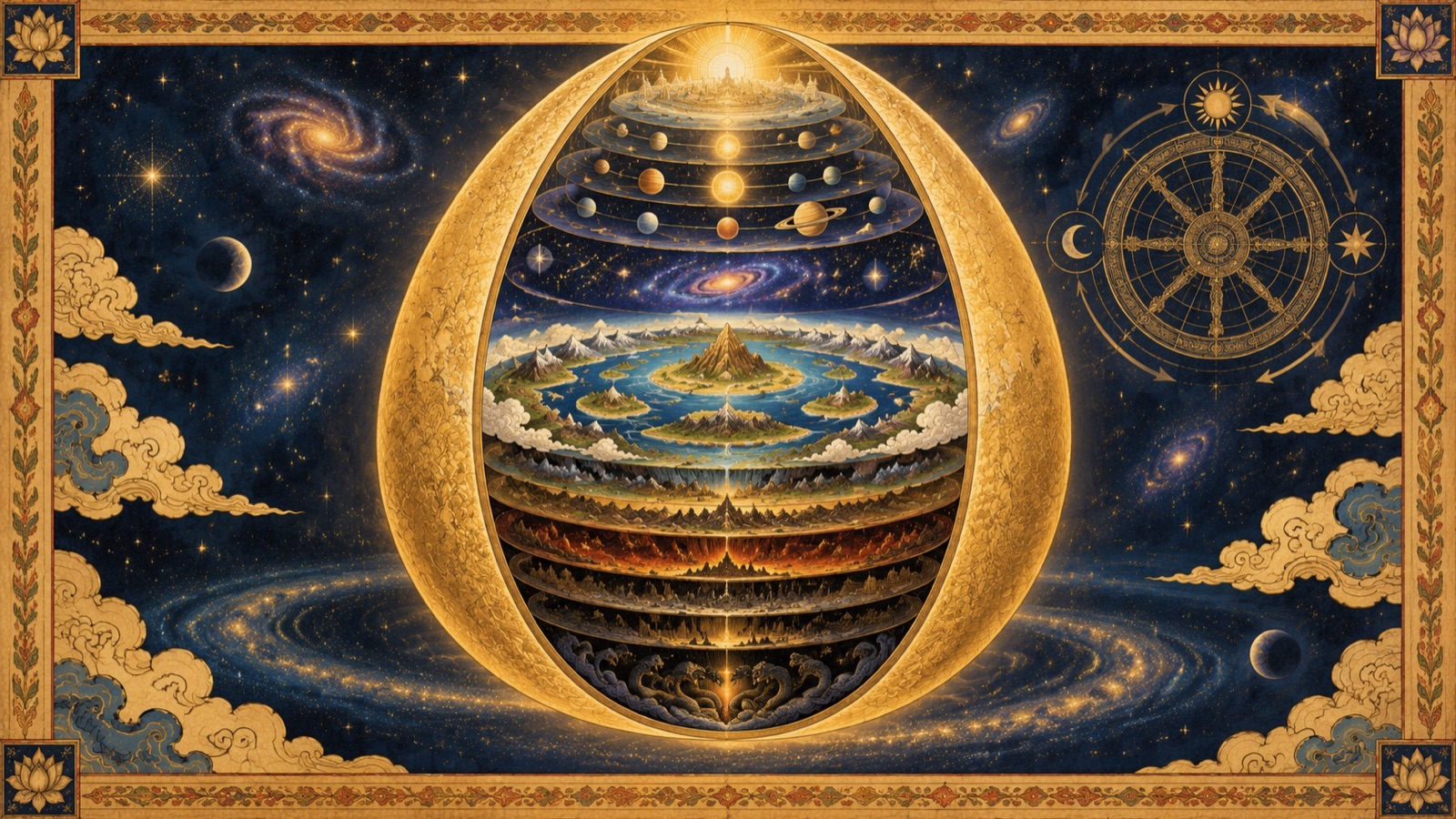
From time, Parikshit turns to space: how do the earth and Patala, the nethermost region, come into being, along with the four quarters of the heavens, the sky, the planets, the stars, the mountains, rivers, seas, and islands, together with all the beings who dwell in them? And what is the measurement of the Cosmic Egg itself, reckoned by its outer and inner divisions — along with the deeds of the great souls who live within it, and the fixed order governing the Varnas and the Ashramas, the grades of society and the stages of life?
The Ages, the Incarnations, and the Duties of Men
Parikshit’s curiosity now turns to history and to human life. He asks for the duration of the various Yugas — the great ages of the world — and the code of duties prescribed for each; and he asks, with evident longing, to hear the stories of Sri Hari’s most wondrous descents into this world, age after age. This is, in effect, a request for everything that the Bhagavatam’s later Cantos will go on to deliver in full: the incarnations of the Lord, one after another, through the turning ages.
Alongside this, the king wants to understand the shape of human duty itself — what is common to all men, and what is peculiar to particular classes; the special duties of saintly kings, and the duties proper to those living in adverse or difficult circumstances.
नृणां साधारणो धर्म: सविशेषश्च यादृश: । श्रेणीनां राजर्षीणां च धर्म: कृच्छ्रेषु जीवताम् ॥ १८ ॥
nṛṇāṁ sādhāraṇo dharmaḥ saviśeṣaś ca yādṛśaḥ śreṇīnāṁ rājarṣīṇāṁ ca dharmaḥ kṛcchreṣu jīvatām
Meaning: What is the general duty common to all men, and what is the specific duty proper to particular classes; what is the duty of saintly kings; and what is the duty of those living under distressed conditions? (Canto 2, Chapter 8, verse 18)
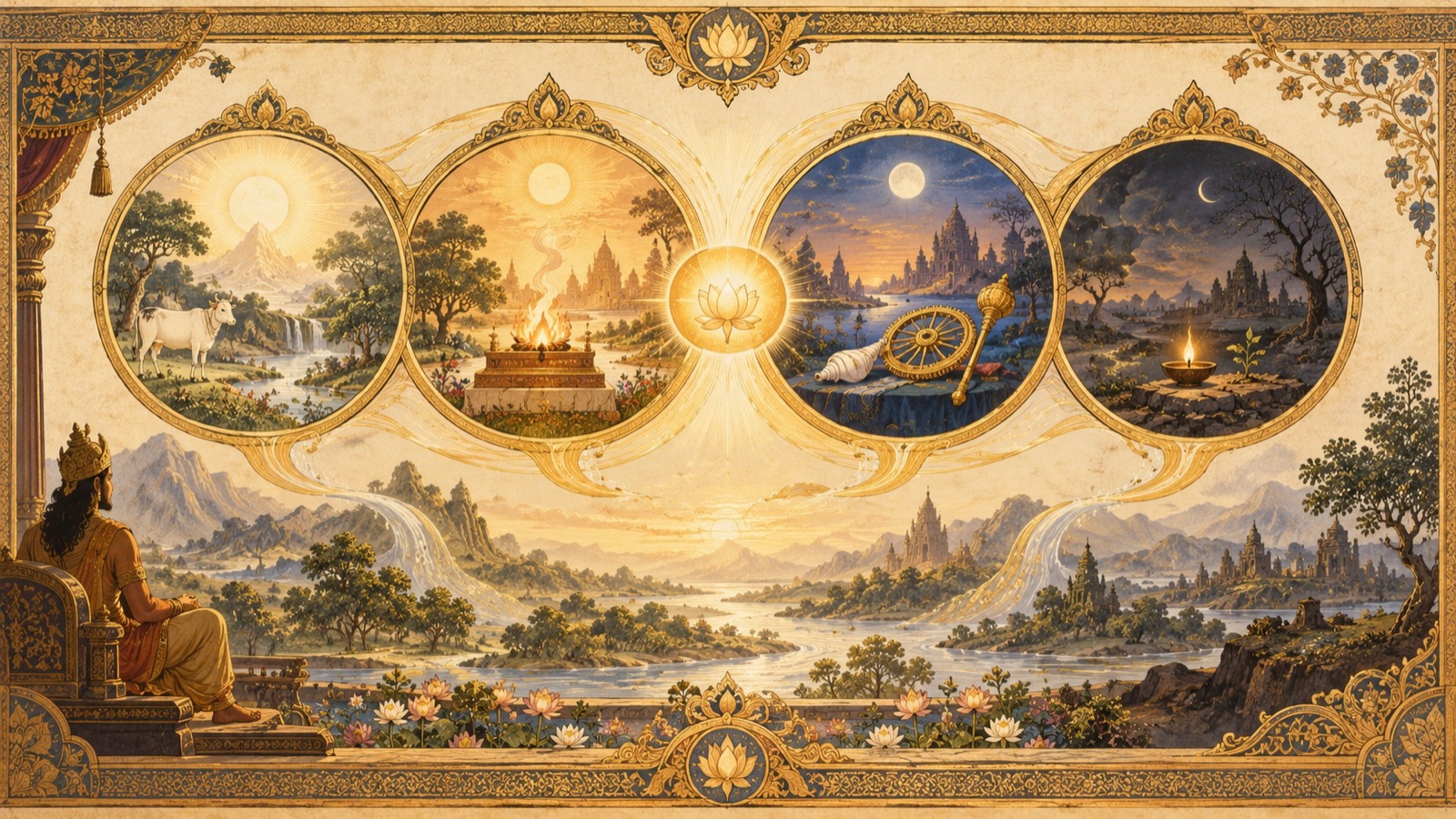
The Tattvas, Yoga, and the Great Scriptures
Next the king’s questions turn inward, toward the disciplines by which a soul seeks the Lord directly. He asks for an account of the Tattvas — the ultimate categories of existence — with their distinguishing marks and causal relationships, and for an explanation of the proper modes of worship of the Supreme Person and of other deities. He specifically names the Ashtanga Yoga taught by the sage Patanjali, the eight-limbed path, and asks what powers a great master of Yoga acquires, what the final goal of that practice is, and how a Yogi’s subtle body comes to be dissolved at the end of the path.
His questions then widen once more to take in the whole architecture of sacred knowledge: the distinctive character of the Vedas and their subsidiary branches such as Ayurveda, the science of medicine; the Dharma-shastras, the books of law; and the Itihasas and Puranas, the great epics and histories. He asks how the creation, preservation, and dissolution of all beings take place, and how one is to perform Vedic rites and the works recommended by the Smriti texts — digging wells and tanks, building temples and gardens, giving food in charity — as well as acts done from some more personal desire. And he asks for the unobjectionable way to pursue the three legitimate aims of life: Dharma, Artha, and Kama.
सम्प्लव: सर्वभूतानां विक्रम: प्रतिसंक्रम: । इष्टापूर्तस्य काम्यानां त्रिवर्गस्य च यो विधि: ॥ २१ ॥
samplavaḥ sarva-bhūtānāṁ vikramaḥ pratisaṅkramaḥ iṣṭā-pūrtasya kāmyānāṁ tri-vargasya ca yo vidhiḥ
Meaning: How do all beings come into being, endure, and pass away; what is the proper way to perform the Vedic rites and the works of merit recommended by the Smriti texts; and what is the right, unobjectionable way to pursue Dharma, Artha, and Kama, the three legitimate aims of life? (Canto 2, Chapter 8, verse 21)
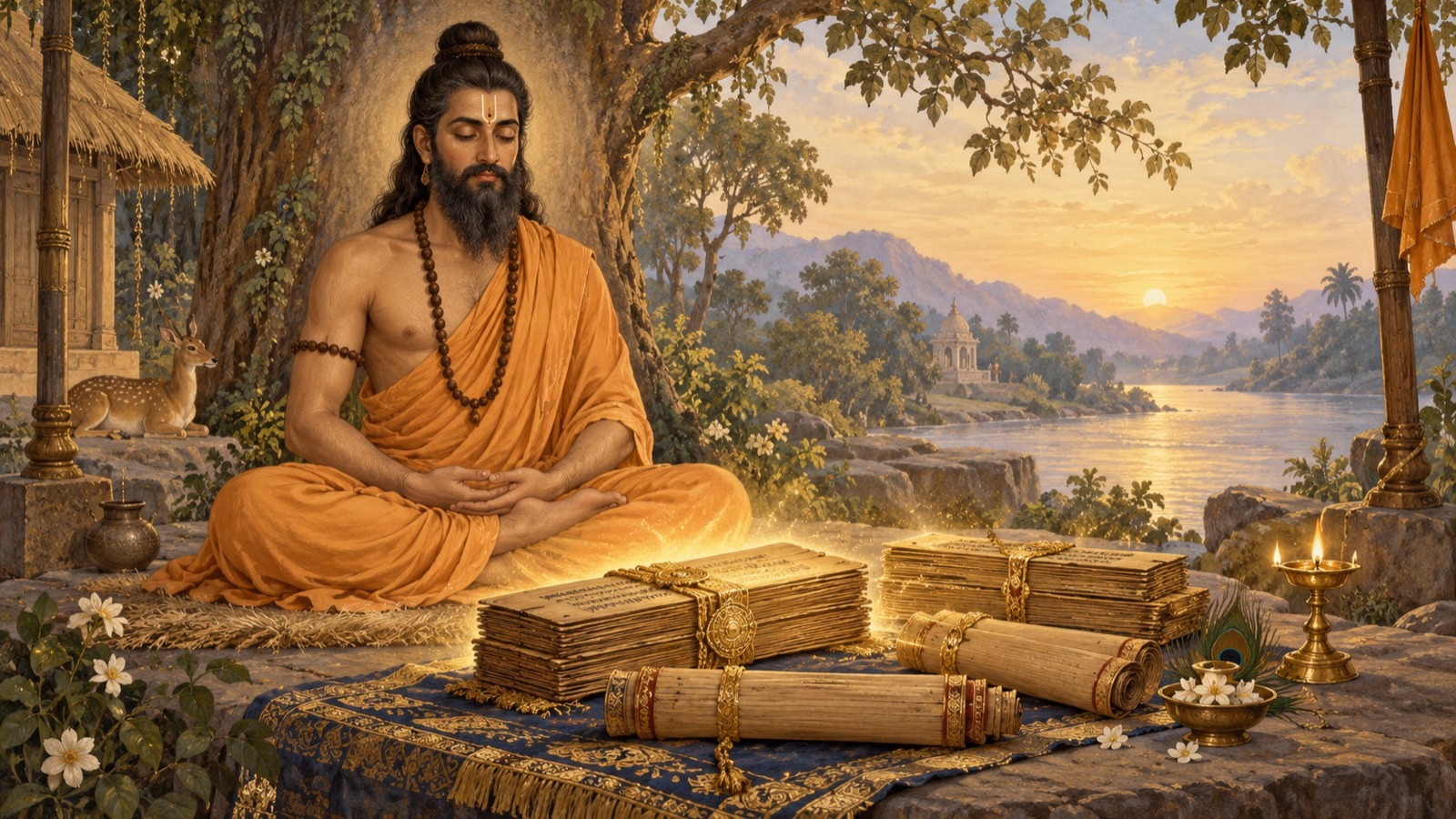
Bondage, Liberation, and the Lord’s Own Maya
The king’s final set of questions reaches for the deepest mystery of all. How, he asks, are souls whose individuality has merged back into Prakriti at a Mahapralaya — the great dissolution that ends a life of Brahma — invested with a body once again when creation resumes? How does a heretical doctrine even come to arise in the world? And what, in truth, is meant by the bondage of a soul, by its emancipation, and by its realizing its own true nature?
यो वानुशायिनां सर्ग: पाषण्डस्य च सम्भव: । आत्मनो बन्धमोक्षौ च व्यवस्थानं स्वरूपत: ॥ २२ ॥
yo vānuśāyināṁ sargaḥ pāṣaṇḍasya ca sambhavaḥ ātmano bandha-mokṣau ca vyavasthānaṁ sva-rūpataḥ
Meaning: How does the creation of souls merged in dissolution take place, and how does heresy arise? What is the bondage of the soul, and what is its liberation, and what is its being established in its own true nature? (Canto 2, Chapter 8, verse 22)
And finally, the question that gathers every earlier one into a single knot: how does the Lord, who is absolutely independent and all-pervading, sport with His own Maya — and how, having cast that Maya aside, does He remain standing apart, unconcerned, as a mere witness of His own creation?
यथात्मतन्त्रो भगवान् विक्रीडत्यात्ममायया । विसृज्य वा यथा मायामुदास्ते साक्षिवद् विभु: ॥ २३ ॥
yathātma-tantro bhagavān vikrīḍaty ātma-māyayā visṛjya vā yathā māyām udāste sākṣivad vibhuḥ
Meaning: Being entirely His own master, the all-pervading Lord sports as He pleases with His own Maya; and equally, having set that same Maya aside, He stands apart from it altogether, an unconcerned witness. (Canto 2, Chapter 8, verse 23)
Having laid out this entire questionnaire, Parikshit asks Suka to answer it all, one thing after another, exactly as asked, since he has come to him as a soul who has taken refuge at his feet, and since Suka is as much an authority on these matters as Brahma himself — unlike others who merely follow, without inquiry, what their forefathers did before them.
The king then offers a quiet, moving reassurance: his life, he says, is in no danger of ending on account of the young Brahmana’s curse, so long as he continues abstaining from food while drinking instead the nectar of the infallible Lord’s stories, welling up as if from an ocean of words at Suka’s own mouth.
न मेऽसव: परायन्ति ब्रह्मन्ननशनादमी । पिबतोऽच्युतपीयूषम् तद्वाक्याब्धिविनि:सृतम् ॥ २६ ॥
na me ‘savaḥ parāyanti brahmann anaśanād amī pibato ‘cyuta-pīyūṣam tad vākya-abdhi-viniḥsṛtam
Meaning: O learned Brahmana, this life-breath of mine will not depart merely from fasting, so long as I go on drinking the nectar of the infallible Lord’s stories flowing forth from the ocean of your words. (Canto 2, Chapter 8, verse 26)
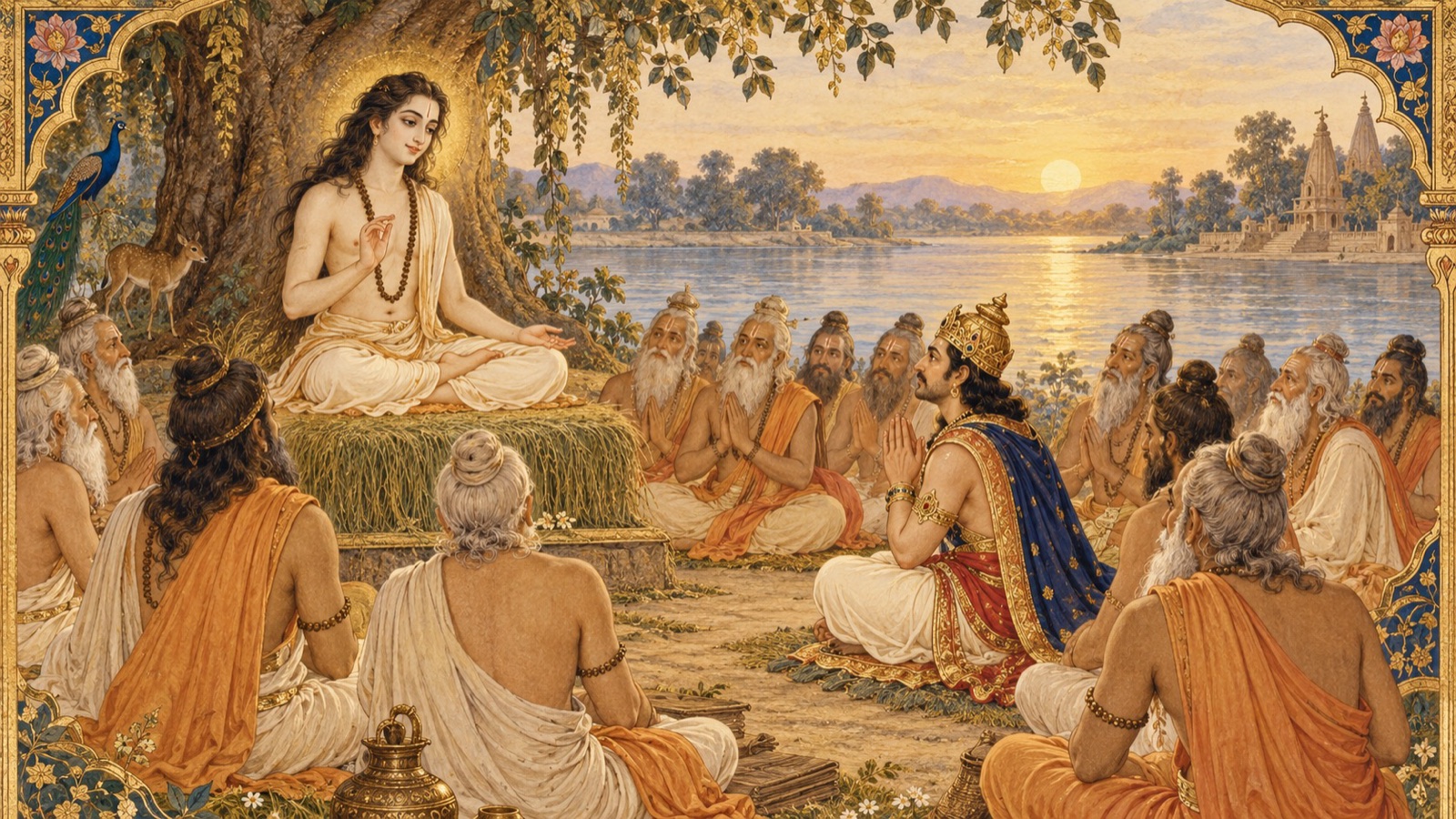
Suka’s Quiet Consent
The chapter closes not with an answer but with the promise of one. Suta relates to the sages of Naimisharanya how Suka, invited in this way by Parikshit — who had once, as an unborn child, been rescued in his mother’s womb by Lord Vishnu Himself — was highly pleased, and began to expound the same Bhagavata-Purana that the Lord had taught to Brahma at the very start of the Brahma-kalpa, a teaching held in the same esteem as the Vedas themselves. He set out to answer, one after another and in due order, every question that Parikshit, foremost among the descendants of Pandu, had asked. With this quiet turning point, the chapter ends, and the great unfolding of the Bhagavatam’s remaining teaching is set in motion.
Principal Teachings of This Chapter
1. A dying king’s curiosity becomes our inheritance. Every question Parikshit asks here — about time, cosmos, Yoga, scripture, and liberation — becomes a promise of what the rest of the Bhagavatam will patiently unfold (verses 1-24).
2. Hearing and chanting purify the heart. The Lord enters, through the ear, the heart of one who daily hears and narrates His stories, clearing it of impurity as autumn clears muddied water (verses 4-6).
3. The Cosmic Being is proportioned like a man, yet immeasurable. The Lord’s form contains all fourteen worlds within limbs described in ordinary human terms — a mystery Parikshit specifically asks to have opened further (verses 8-11).
4. Every branch of sacred knowledge belongs to one whole. Time, cosmology, Yugas, incarnations, duty, the Tattvas, Yoga, and the Vedas and Puranas are not separate subjects to Parikshit — they are facets of a single, urgent question about how to know the Lord (verses 12-21).
5. The nectar of His stories sustains life itself. Parikshit’s closing words reveal what the entire chapter has really been about: not information, but the sustaining sweetness of hearing about Krishna, which he trusts more than food to keep him alive until his questions are answered (verse 26).
A Devotional Reflection
There is something deeply human about this chapter, more human perhaps than any cosmological description that has come before it. A king, days from death, does not ask one careful question and wait patiently for its answer — he pours out everything: doubts about the soul and the body, curiosity about time and space, longing to hear of the Lord’s incarnations, an almost scholarly interest in Yoga and scripture, and beneath it all, a plain confession that food no longer sustains him the way sacred words do. We may never sit, as Parikshit did, on the bank of a river counting our last seven days. But each of us carries some version of his hunger — the sense that the ordinary answers we have accepted about time, duty, and the self are not quite enough, and that somewhere there is a fuller truth waiting to be asked for directly. Parikshit’s example is not really about the content of his twenty-some questions; it is about the courage and urgency with which he asks them, refusing to let politeness or fear of seeming ignorant stand between himself and the sage who can answer him. Perhaps the truest devotion begins exactly there — in permitting ourselves, at last, to ask.
A Daily Devotional Practice
Today, set aside a few quiet minutes and, like Parikshit, allow yourself to ask rather than assume. Bring to mind one question about your own life or your own understanding of the Divine that you have long left unspoken — not to answer it immediately, but simply to name it honestly before the Lord. Then, remembering how Parikshit found that the stories of Krishna sustained him even better than food, spend a few minutes reading or recalling one story of the Lord’s grace, letting it settle in your heart the way the king describes autumn settling the muddied waters of a pond. Close by repeating quietly, a few times: “Om Namo Bhagavate Vasudevaya.”
Conclusion
The eighth chapter of the Second Canto is, in the truest sense, a chapter of pure inquiry. Nothing here is resolved; everything here is opened. King Parikshit, sensing the nearness of death and having only just glimpsed the vastness of Brahma’s own account of creation, refuses to die with his questions unasked. He wants to know how the Bhagavata came to be spoken, how a soul should meet its final hour, why the self forgets its own nature, how the Cosmic Being holds all worlds within His limbs, how time and Karma actually work, what the ages and the incarnations mean, what duty asks of every kind of person, what Yoga promises and where it leads, what the great scriptures hold, and finally, how bondage and freedom and the Lord’s own playful Maya fit together. In answer, Suka does not lecture — he simply consents, quietly and joyfully, to speak the very Bhagavata that the Lord once taught to Brahma. The whole of the remaining scripture, in a sense, is Suka keeping this one promise. And in this chapter’s closing image — a dying king finding life not in food but in the nectar of the Lord’s stories — we are given, before a single question is even answered, the deepest teaching of them all.
May the divine wisdom of Srimad Bhagavatam awaken pure devotion within our hearts.
Om Namo Bhagavate Vasudevaya.
Jay Shree Madhav.
References and Attribution
- Primary edition: Gita Press, Śrīmad Bhāgavata Mahāpurāṇa (English, complete), Book Two, Discourse 8, pages 119–122.
- Series: Srimad Bhagavatam Wisdom · Biswa Sanatan Dharma Seva Trust.
- Presented following the spiritual guidance and recommendation of Pandit Dr. Shri Kashinath Mishra.
This is an original, faithful retelling in the writer’s own words, with brief quoted verses shown in Devanāgarī and transliteration and their meanings given as summaries. It is not a reproduction of any single publisher’s continuous translation or commentary. No affiliation with or endorsement by any publisher is implied.
Jay Shree Madhav