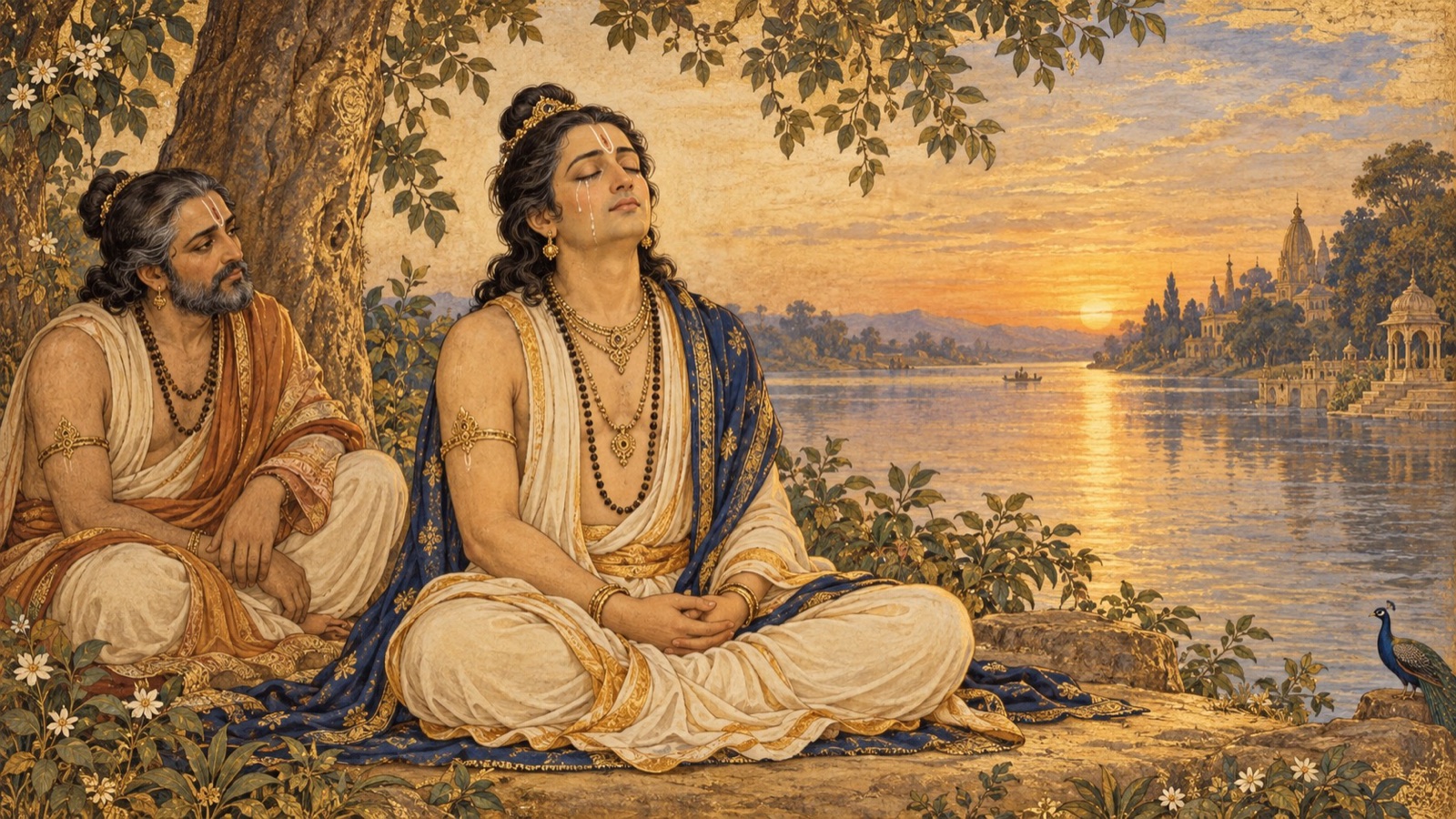
Asked a simple question about his beloved Lord, the great devotee Uddhava cannot answer at all — his hair stands on end, tears break from his closed eyes, and for nearly an hour he is lost, silent, in the ocean of remembrance.
Om Namo Bhagavate Vasudevaya.
Om Namo Bhagavate Vasudevaya.
Om Namo Bhagavate Vasudevaya.
Welcome to Srimad Bhagavatam Wisdom, a devotional journey through the sacred histories and teachings of the Srimad Bhagavat Mahapurana. In the previous chapter, the exiled Vidura, reunited with Uddhava on the bank of the Yamuna, closed his long, loving roll-call of questions with one final request: tell me the news of that unborn Lord, born in the race of Yadu for the sake of all who take shelter in Him. This second chapter of Canto Three is Uddhava’s reply — but it does not begin as a reply at all. It begins with silence. The mere mention of Krishna’s name sends Uddhava into an hour-long trance of ecstatic remembrance, and only when he slowly returns to ordinary awareness does he speak — first in a long, wondering lament on the paradox of a world that lived beside God and did not know Him, and only afterward in the brief, tender summary of Krishna’s childhood pastimes that gives this chapter its Gita Press title.
Chapter Information
- Scripture: Śrīmad Bhāgavata Mahāpurāṇa
- Canto: 3 (Book Three)
- Chapter: 2 (Discourse 2)
- Chapter title: Uddhava recounts the childish sports of the Lord
- Principal speakers: Sukadeva Gosvami (briefly framing the scene, verses 1–6); and Uddhava (whose address to Vidura fills the entire remainder of the chapter, verses 7–34) — the whole related by Suta Gosvami to the sage Saunaka and the assembly at Naimisharanya
- Principal listener: Vidura, receiving Uddhava’s reply on the bank of the Yamuna; and the sage Saunaka with the assembly at Naimisharanya (hearing it all from Suta)
- Main setting: The bank of the river Yamuna, continuing directly from the reunion described in Chapter 1
- Central subject: Uddhava’s overwhelming, speechless love for Krishna; his wondering lament on the paradox of the Lord’s humility, mercy, and hiddenness; and his condensed account of Krishna’s birth and childhood pastimes at Vraja
- Principal verse range: Canto 3, Chapter 2, verses 1–34
- Primary edition: Gita Press Śrīmad Bhāgavata Mahāpurāṇa
A Question That Cannot Be Answered in Words
Sukadeva tells Parikshit what happened the instant Vidura’s question landed. Uddhava — that great devotee who, even in his boyhood games, would grow so absorbed in worshipping the Lord that he forgot to answer his own mother’s call to breakfast — was, at the mere mention of Krishna’s name, put in mind of his Lord so completely that he could not utter a word. Grown grey now in a lifetime of service, his thought forever fixed on those lotus feet, he simply could not answer.
श्री शुक उवाच इति भागवत: पृष्ट: क्षत्त्रा वार्तां प्रियाश्रयाम् । प्रतिवक्तुं न चोत्सेह औत्कण्ठ्यात्स्मारितेश्वर: ॥ १ ॥
śrī-śuka uvāca iti bhāgavataḥ pṛṣṭaḥ kṣattrā vārtāṁ priyāśrayām prativaktuṁ na cotseha autkaṇṭhyāt smāriteśvaraḥ
Meaning: Sri Suka said: Thus asked by Vidura for news dear to his heart, that great devotee Uddhava, his Lord brought to mind, was too overwhelmed to reply. (Canto 3, Chapter 2, verse 1)
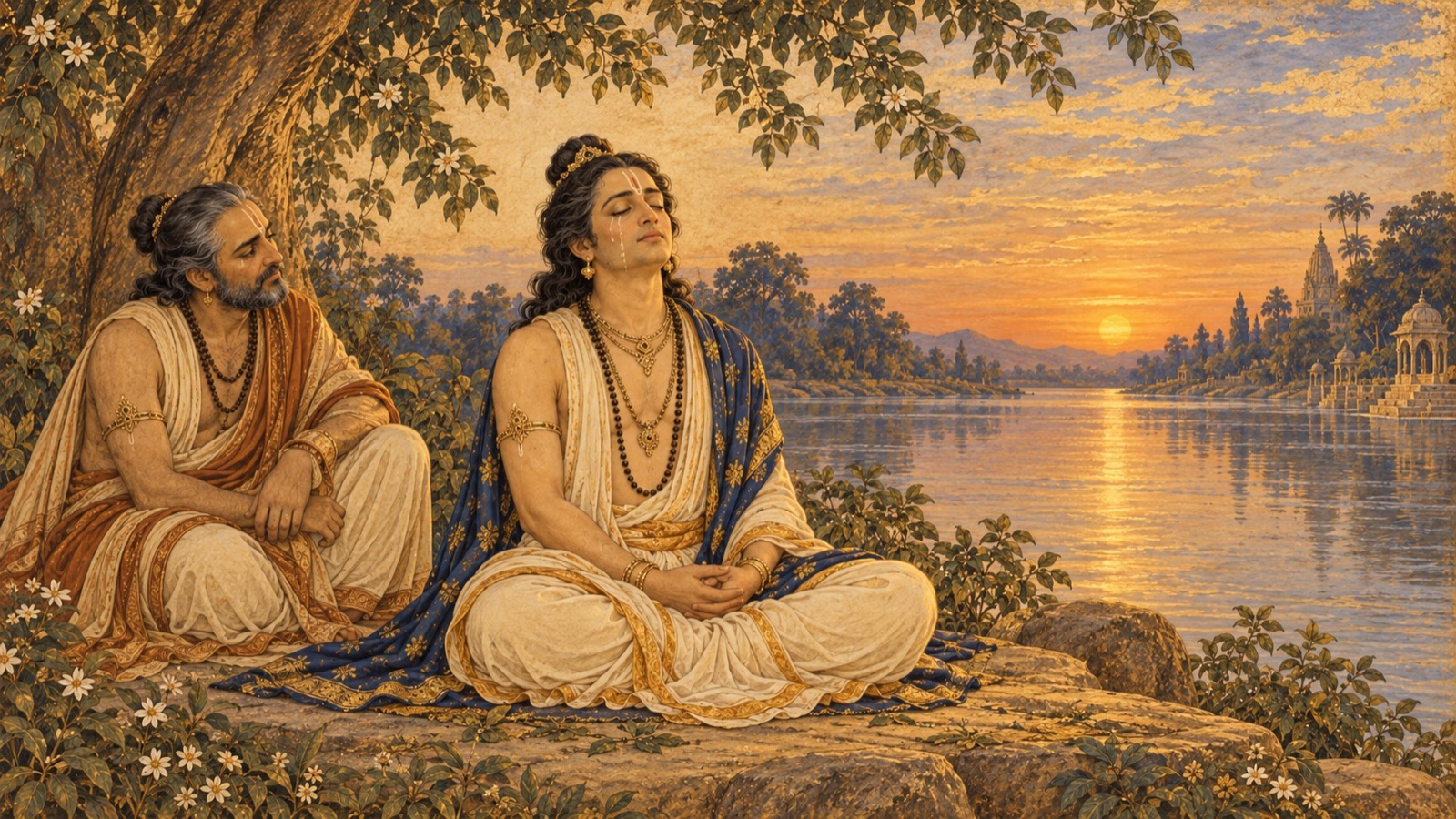
For nearly an hour Uddhava remains exactly like this — immersed completely in the nectar flowing from Krishna’s lotus feet, transported by the sheer intensity of his own devotion, mute. His hair stands erect over his whole body; tears break through his closed eyes. Vidura, watching this flood of affection overtake his friend, understands at once that Uddhava has realized the very goal of life itself — that this silence is not absence of an answer but the fullest answer there could be. Only slowly does Uddhava return from that divine realm to ordinary body-consciousness. Wiping his eyes, he finally begins to speak, and his very first words carry the tone not of narration but of wonder — the wonder of a man still half-drowned in what he has just remembered.
The Sun Has Set: A Devotee’s Lament
Uddhava does not begin with Krishna’s birth or a tidy chronology. He begins instead with grief and paradox — the strange blindness of a world that had God Himself walking among them and somehow failed to see. “The sun in the shape of Sri Krishna having set,” he says, “our homes of blighted splendour have been devoured by the python of Time. What shall I say, then, about our welfare?” It is a startling opening for a chapter meant to recount “childish sports” — but it tells us everything about who is speaking. This is not a historian’s account. It is a devotee’s heart still raw with love and loss.
He turns first to a hard truth about his own people. Unfortunate, he says, is this world, and more so the Yadus themselves — for though they lived with Sri Hari day after day, ate with Him, played with Him, they could not recognize Him, no more than a fish beneath the water can recognize the moon reflected on its surface. The Satvatas were clever enough to read another’s mind through the smallest gesture; and yet, sharing His very household, they took the Abode of all beings to be merely the foremost among themselves — a great kinsman, not the Lord of all. And yet, Uddhava adds, this blindness afflicts only those whose hearts are elsewhere. A man who has given his heart entirely to Sri Hari cannot be misled by the scornful words of the Lord’s own bewildered kinsmen, nor by the hatred of open enemies like Sisupala — his understanding stands beyond the reach of either.
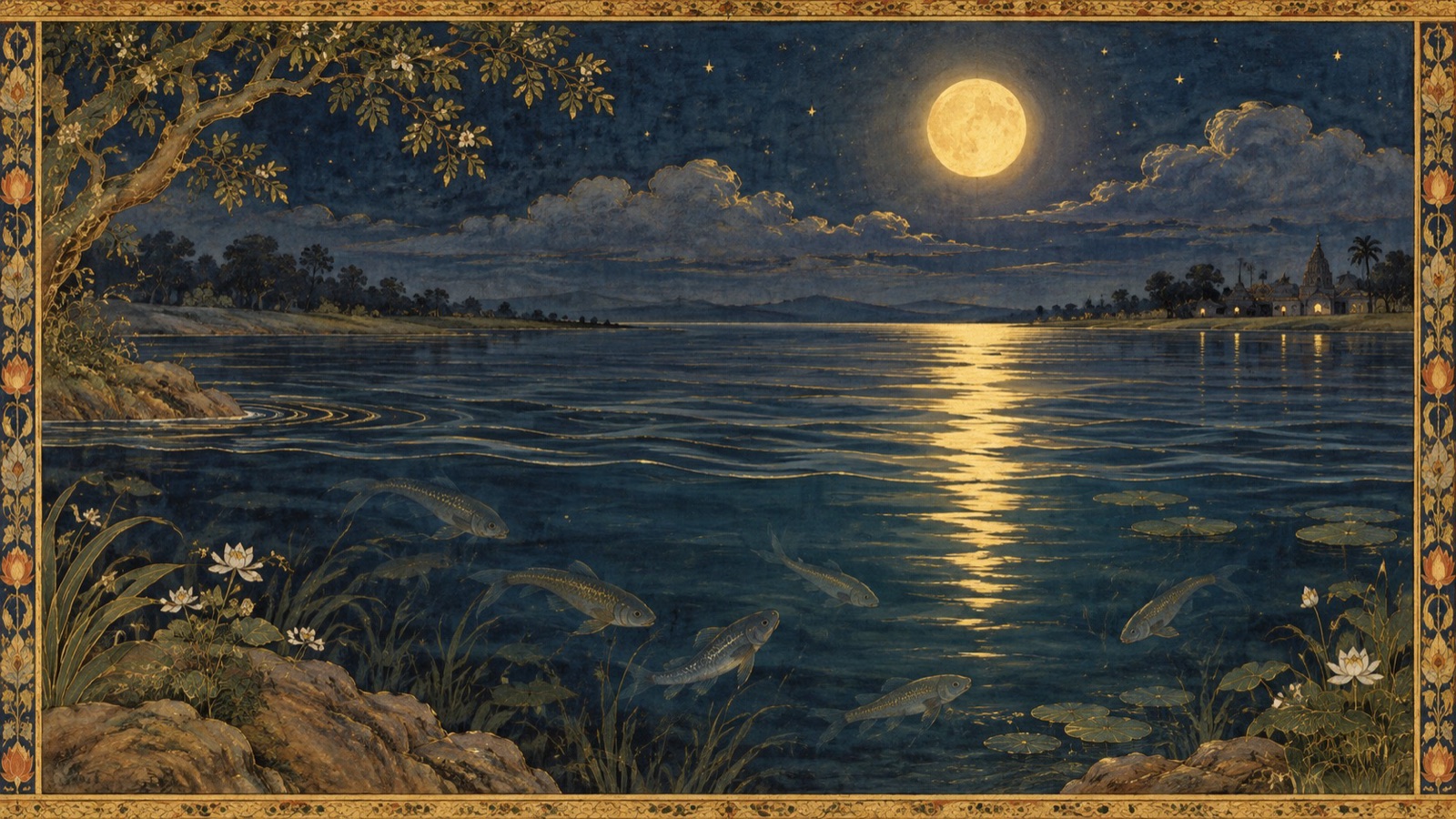
He marvels, too, at the Lord’s own strange discretion: having once shown His divine form to men who had undertaken no penance to earn the sight of it, He has now withdrawn that form from view, leaving their eyes unsated — as though robbing them of the very sight they never valued enough while it was theirs. And that form itself, Uddhava says, was a wonder even to itself — a beauty of such abounding grace, so perfectly suited to human-seeming pastimes through the power of His own Yogamaya, that even the ornaments it wore seemed to gain their charm from it, rather than lend it any.
The Form Seen at the Rajasuya
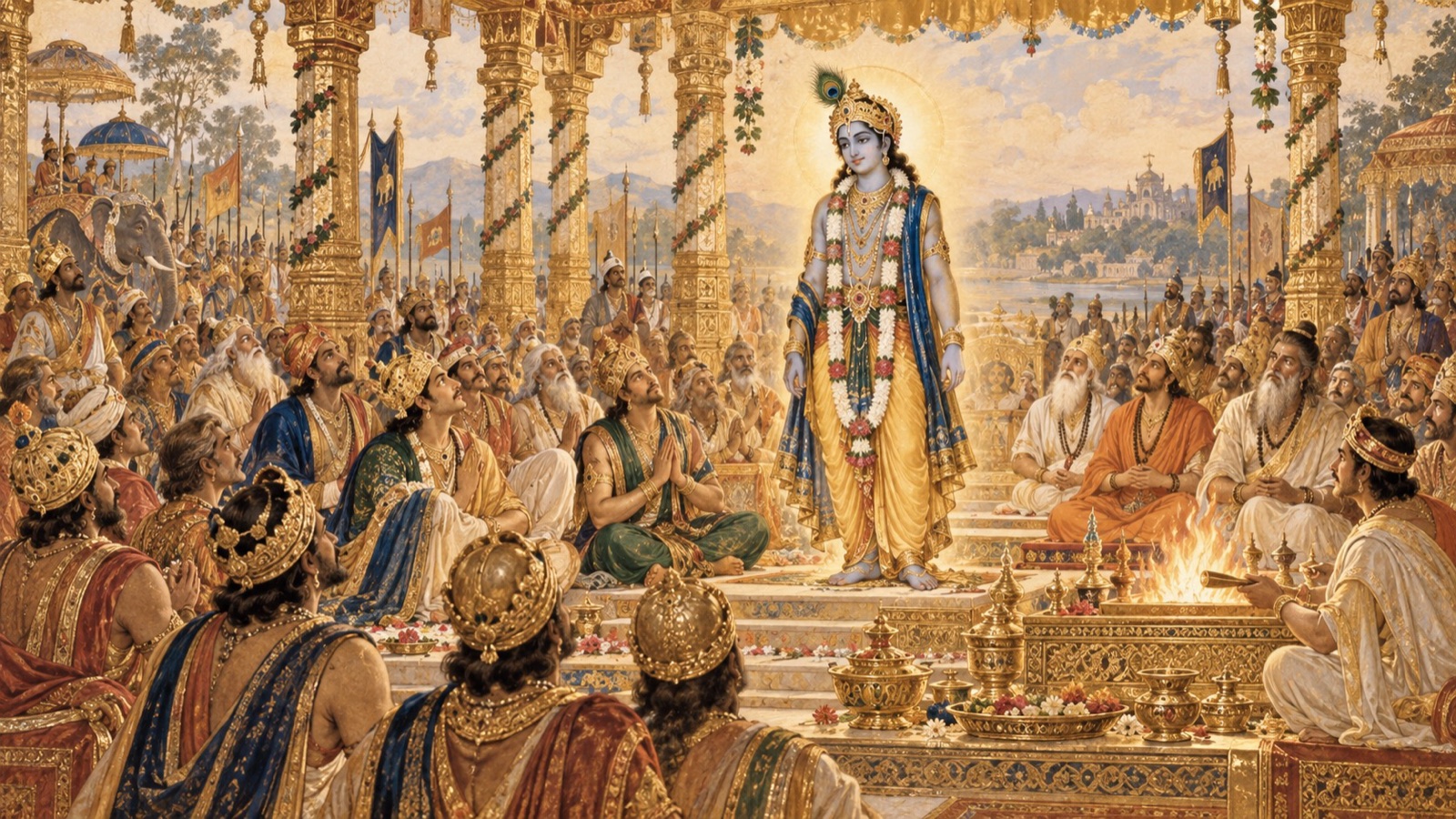
Uddhava recalls one moment in particular: that same form, beheld by the assembled kings and sages at King Yudhishthira’s Rajasuya sacrifice, was so complete a delight to every eye that the onlookers from all three worlds concluded Brahma must have exhausted the whole of his creative skill in fashioning it — as if creation itself had been building toward this one form all along.
यद्धर्मसूनोर्बत राजसूये निरीक्ष्य दृक्स्वस्त्ययनं त्रिलोक: । कार्त्स्न्येन चाद्येह गतं विधातु- रर्वाक्सृतौ कौशलमित्यमन्यत ॥ १३ ॥
yad dharma-sūnor bata rājasūye nirīkṣya dṛk-svastyayanaṁ tri-lokaḥ kārtsnyena cādyeha gataṁ vidhātur arvāk-sṛtau kauśalam ity amanyata
Meaning: Beholding at the Rajasuya sacrifice of Dharma’s son that auspicious form, the delight of every eye, the people of the three worlds believed that the Creator’s entire skill in fashioning this world had been used up in producing it. (Canto 3, Chapter 2, verse 13)
He recalls, too, the gopis of Vraja — how, honored merely by His love-laden smiles and sportive glances, they would follow Him with their eyes and their whole mind as He set off into the woods, standing motionless as statues, their household chores left half-finished in their hands. And then Uddhava turns to a paradox that plainly still troubles his own understanding, devotee though he is: how could the unborn Lord, whose true nature nothing can touch, take on the appearance of being born in Vasudeva’s house and grow up in Vraja as though hiding from an enemy — and how could the possessor of infinite, unlimited prowess seem to flee the very city of Mathura, as if genuinely afraid of the invader Kalayavana? “This puzzles me,” Uddhava confesses plainly, “as something irreconcilable with His divinity” — and in that admission we sense the honesty of a mature devotee, one who does not pretend to have solved every mystery of the Lord he loves, only to love Him through the mystery.
His mind fills with agony, he says, remembering something else: the sight of Krishna and Balarama bowing at Their own parents’ feet and saying, “Dear father and mother, being in such dread of Kamsa, we failed to render you any service — please forgive us.” That the Lord of all should bow to His own parents and beg forgiveness for a debt only fear had prevented Him from repaying — this small, human gesture moves Uddhava more than any display of power could.
Mercy Even to an Enemy, Liberation Even Through Hatred
The lament turns, in its final movement, toward mercy — and toward one of the Bhagavatam’s most startling teachings. Uddhava recalls how even Sisupala, the king of Chedi who hated Krishna his whole life, attained a oneness with the Lord that ascetics labor for lifetimes through the disciplines of Yoga to achieve. He recalls, too, the warriors slain at Kurukshetra by Arjuna’s arrows, who died drinking in with their very eyes the beauty of Krishna’s face, and who thereby reached His own supreme abode. Even the Lord’s own majesty humbles Uddhava when he sets it beside what he remembers next: this same Krishna, ruler of all three worlds and all three modes of nature, whom the eternal guardians of creation worship by touching their crowned heads to His feet, would nonetheless stand quietly before King Ugrasena on the royal throne and offer his own account of things, saying only, “My lord, let this be known to you.” That the Lord of everything should present himself before an earthly king with such plain humility, Uddhava confesses, wounds his heart even now — a tenderness he finds no less wondrous than any display of power (verses 21-22). And then Uddhava names the demoness Putana — sent to nurse the infant Krishna at a breast smeared with deadly poison, meaning only to kill Him — and marvels that even she received, in return, the destiny proper to a true foster-mother. “Is there anyone so merciful,” Uddhava asks, “whom we should resort to for protection, other than Him?”
He even extends this wonder to the demons who fought the Lord outright in battle, their minds fixed on Him — however malevolently — as they watched Garuda swoop upon them with Vishnu, discus in hand, mounted on his back. Fixing the mind on the Supreme, Uddhava suggests, carries its own power to liberate, whether that fixation comes wrapped in devotion or in hatred, because it is the mind’s contact with the Lord, and not the emotion accompanying it, that finally matters. This closes the great arc of Uddhava’s wondering lament (verses 7–24) — grief at a world’s blindness, wonder at a Lord who conceals His own splendour, and finally awe at a mercy so vast it redeems even His enemies.
Born in a Prison, Raised in Secret
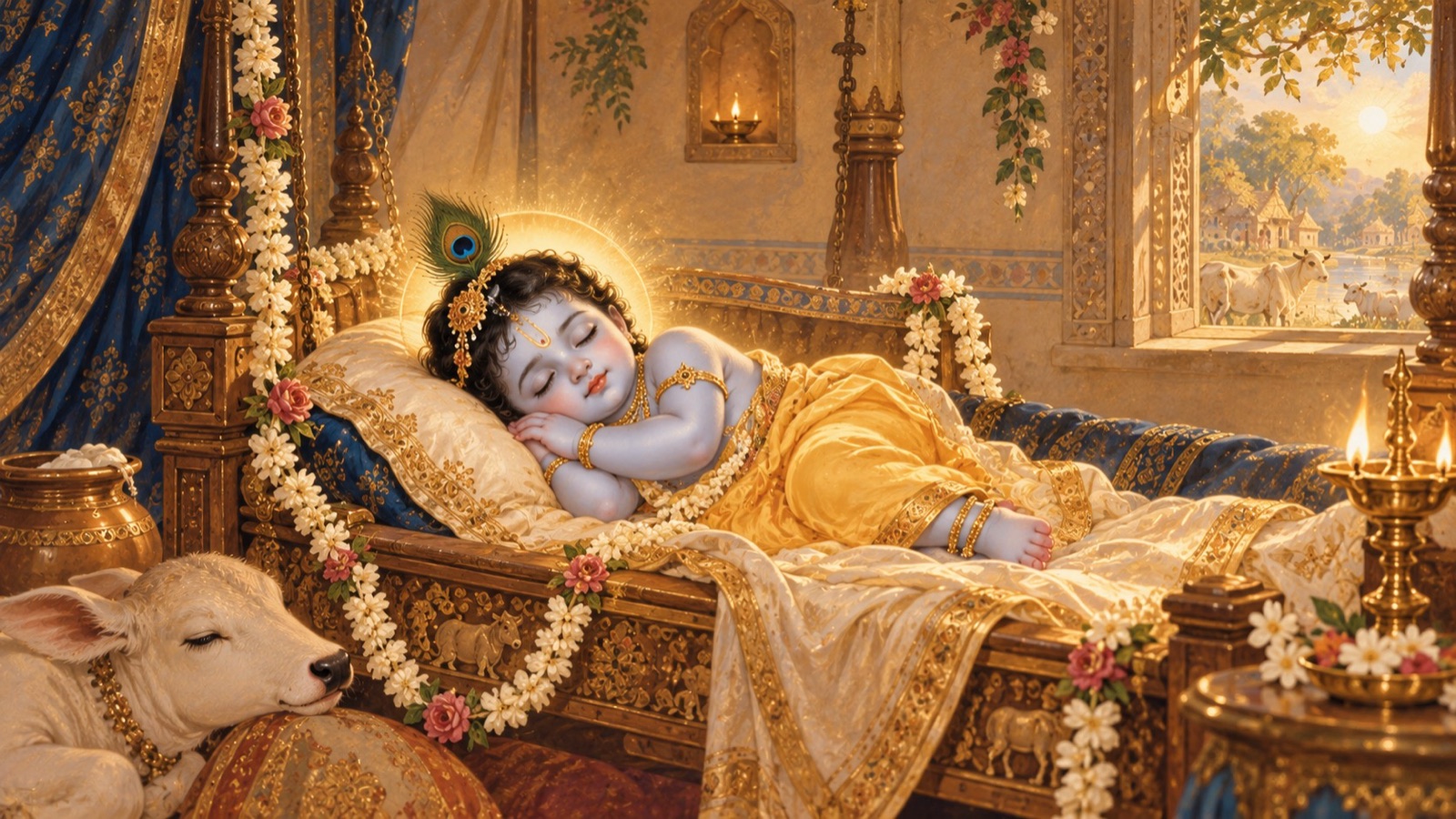
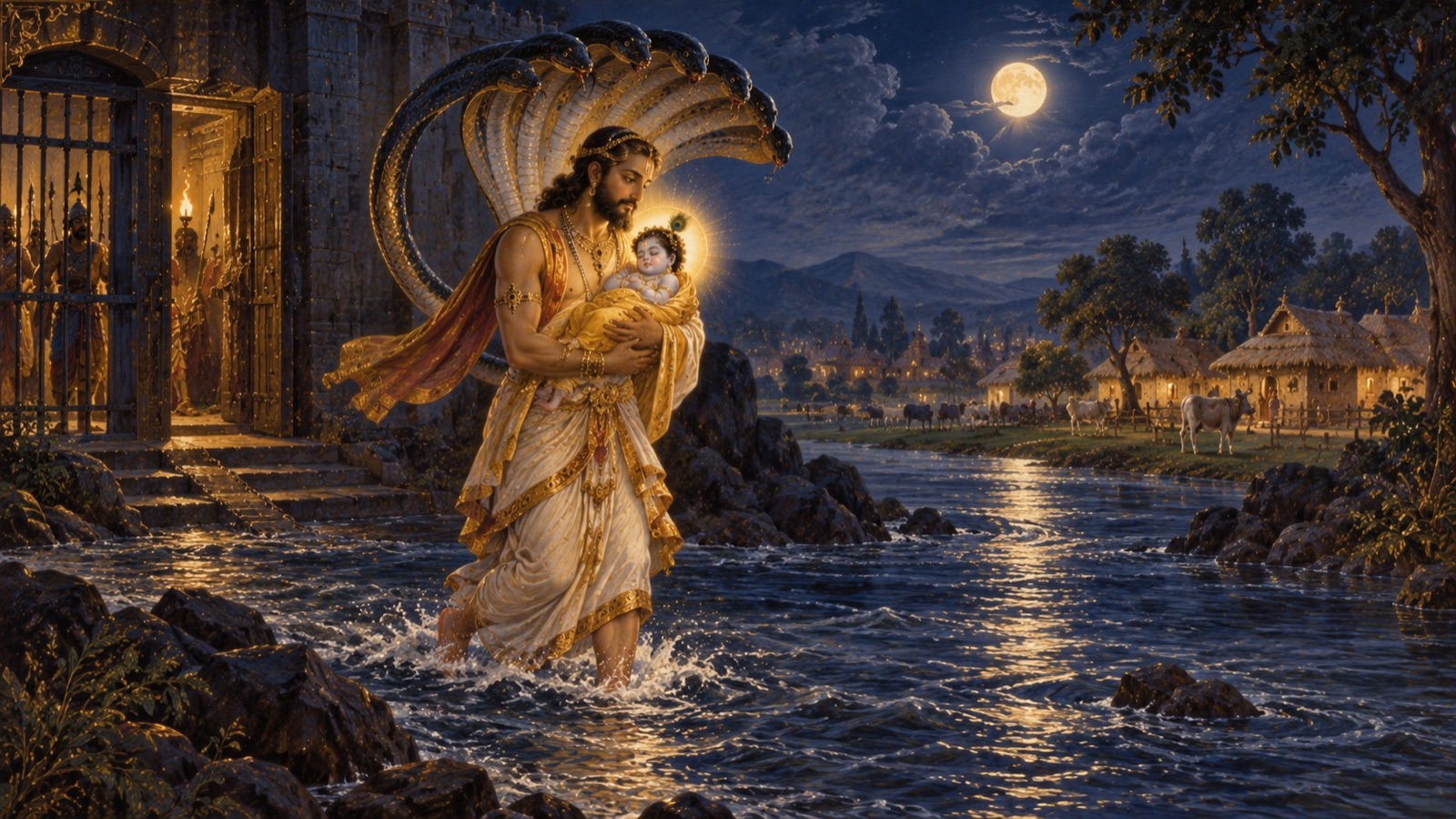
Having poured out his wonder and his grief, Uddhava now turns to the sweet remembrance that gives this discourse its name — the Lord’s own birth and childhood sports. To relieve the earth’s burden, in answer to Brahma’s own prayer, the Lord was born of Vasudeva and Devaki in the prison house of King Kamsa. Terrified for the newborn’s safety, Vasudeva carried Him away that very night to Nanda’s Vraja, where Krishna — together with His elder brother Balarama — lived for eleven years, His true glory carefully concealed from the world outside.
What follows is a swift, tender sketch — not the full unfolding that the Tenth Canto will later give in loving detail, but a devotee’s condensed, affectionate overview. In the grove on the Yamuna’s bank, thick with warbling birds, the Lord sported among the cowherd boys, tending calves. He showed the ordinary, endearing gestures of any child — weeping one moment, laughing the next, gazing about with the innocent wonder of a lion cub — gestures that delighted every inhabitant of Vraja who witnessed them. As He grew a little older, He took up the grazing of the splendid white bulls and cows, filling the air with the music of His flute for the cowherd boys who followed Him everywhere. And all the while, in what Uddhava describes as mere sport, He dispatched every demon Kamsa sent against Him — beings skilled in Maya, capable of any disguise — as effortlessly as a child breaks its own toys.
Kaliya, Govardhana, and the Rasa
Uddhava closes his account with four pastimes, given almost as a list, each one a marvel in itself. He tamed and expelled the serpent Kaliya from the Yamuna, restoring life to the cows and cowherds who had fallen dead from its poisoned waters, and making the river fit to drink from again. He persuaded Nanda to redirect the wealth of Vraja away from Indra’s sacrifice and toward a sacrifice honoring the cows themselves — conducted with the help of the finest Brahmanas — thereby humbling, gently, the pride of the king of heaven.
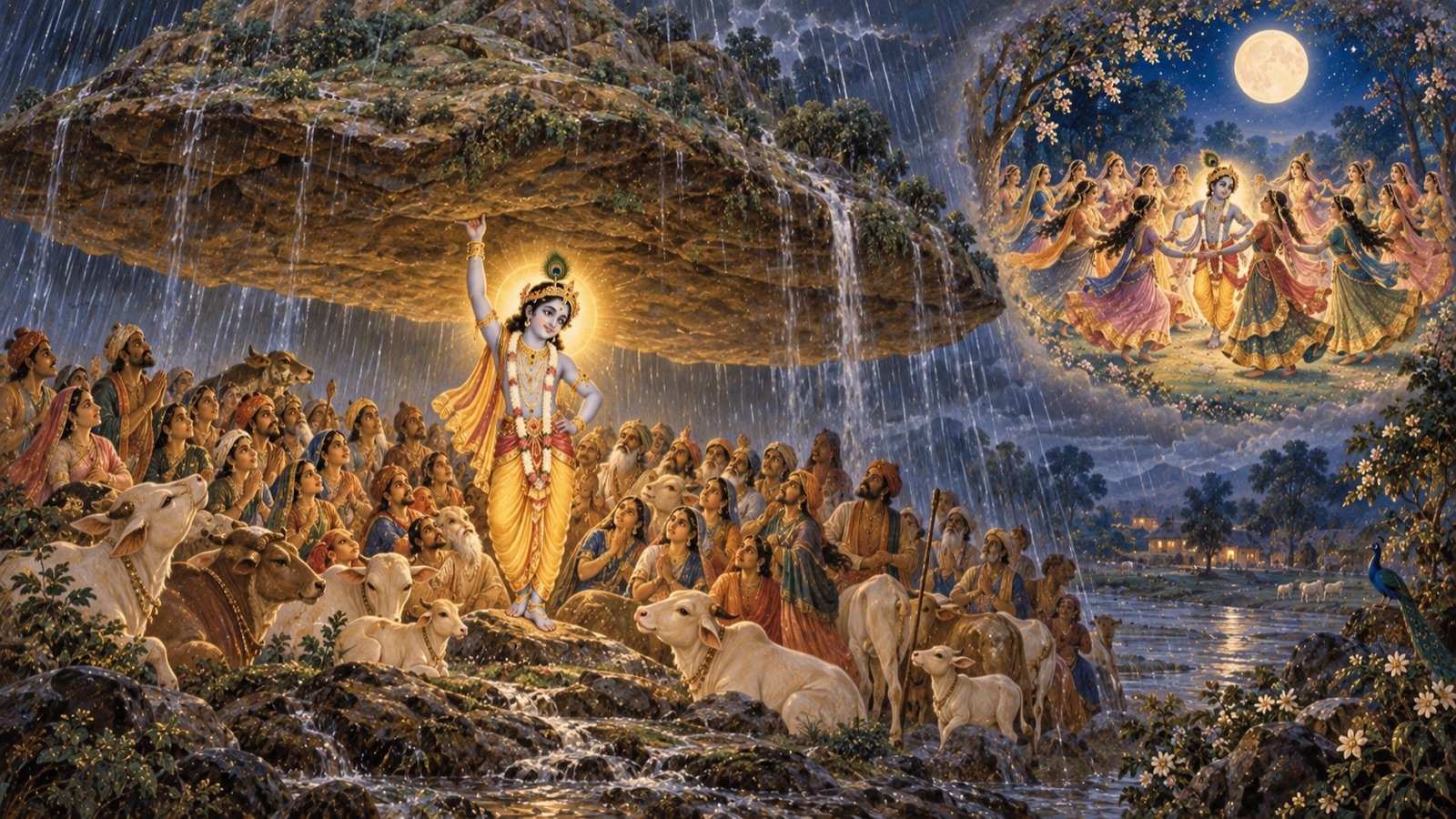
When Indra, enraged at this interruption to his own worship, unleashed torrential rains upon the land, the Lord — Uddhava addresses Vidura directly here, calling him “Blessed Vidura!” — lifted the entire hill of Govardhana as easily as a child lifts a toy umbrella, sheltering the terrified people of Vraja beneath it until the danger passed. And finally, in the briefest and most lyrical of these closing verses, Uddhava recalls the autumn evenings, bright with moonlight, when the Lord — “the ornament of the circle of women” — sang in melodious strains and revelled among a company of young women, gracing them simply with His presence.
शरच्छशिकरैर्मृष्टं मानयन् रजनीमुखम् । गायन् कलपदं रेमे स्त्रीणां मण्डलमण्डन: ॥ ३४ ॥
śarac-chaśi-karair mṛṣṭaṁ mānayan rajanī-mukham gāyan kala-padaṁ reme strīṇāṁ maṇḍala-maṇḍanaḥ
Meaning: Honoring the evenings, made lovely by the rays of the autumn moon, He sang in sweet melodious tones and revelled, the very ornament of the circle of women. (Canto 3, Chapter 2, verse 34)
With this single luminous image — song, moonlight, and the joy of divine company — the second discourse closes, its colophon marking the end of Uddhava’s first great outpouring to Vidura.
Principal Teachings of This Chapter
1. The deepest devotion sometimes has no words at all. Uddhava’s hour of speechless, tear-filled trance is itself the fullest possible answer to Vidura’s question — a reminder that remembrance of the Lord can overflow the capacity of language entirely (verses 1-6).
2. Nearness to God is no guarantee of recognizing Him. The Yadus lived beside Krishna every day and yet, like fish beneath the water failing to know the moon, could not see who He truly was — proximity without devotion still leaves the heart blind (verses 7-10).
3. The Lord’s mercy extends even to those who hate Him. Sisupala’s lifelong enmity, the demons slain in battle, and even Putana’s murderous intent were each, in their own strange way, transformed by contact with the Supreme into a path to liberation (verses 19, 23-24).
4. Even the Lord bows to His parents. Krishna and Balarama’s simple apology to Vasudeva and Devaki — asking forgiveness for the service fear had prevented them from rendering — shows that true greatness is never too proud for humility, just as His quiet submission before King Ugrasena despite being ruler of all three worlds shows the same (verses 17, 21-22).
5. Divine pastimes can be both playful and protective at once. Whether taming Kaliya, lifting Govardhana, or dancing beneath the autumn moon, the Lord’s activities in Vraja combine effortless sport with real, tangible care for those who depend on Him (verses 27-34).
A Devotional Reflection
There is something quietly instructive in the very shape of this chapter. Vidura asks a plain question — tell me the news of the Lord — and receives, first, not information but silence: an hour of a devotee simply overcome by love. Only afterward comes speech, and even then, the speech is not the tidy chronology we might expect but a wondering, almost disordered outpouring of grief, paradox, and awe, circling the subject again and again before finally settling into the calm narrative of Krishna’s birth and childhood. This, perhaps, is what real remembrance of the divine actually looks like — not a report delivered on demand, but something that must first overwhelm the heart before it can be put into any order at all. Uddhava does not manage his emotion for the sake of a clean narrative; the emotion comes first, and the narrative follows only once it has had its say. Devotion, this chapter suggests, is allowed to be messy, overwhelming, even wordless — and that this, too, is a complete and worthy form of remembering God.
A Daily Devotional Practice
Today, before you speak of the Lord to anyone — in prayer, in conversation, in teaching a child a verse — pause for just a few unhurried breaths and let yourself simply feel whatever arises when you bring Krishna to mind, without rushing to organize it into words. Following Uddhava’s example, allow even a moment of silence, or of tears, or of simple stillness, to be itself a form of devotion, rather than a delay before the “real” prayer begins. Then, when you are ready, softly repeat: “Om Namo Bhagavate Vasudevaya.” Let that remembrance be complete in itself, exactly as Uddhava’s silent hour was complete before a single word of his reply had been spoken.
Conclusion
The second chapter of the Third Canto answers Vidura’s question in the only way a devotee of Uddhava’s depth truly could — not with a clean report but with an hour of silence, a wondering lament on the strange blindness of a world that lived beside God, an awed meditation on mercy so complete it redeems even hatred, and only then, briefly and tenderly, the childhood story itself: a birth in a prison cell, a secret childhood among cowherds, a serpent tamed, a mountain lifted, and an autumn night of song beneath the moon. Behind this unusual shape lies something Sukadeva wants Parikshit — and us — to feel rather than merely learn: that true remembrance of the Lord is never simply information passed from one person to another. It is something that first overtakes the one remembering, and only afterward becomes speech. Uddhava’s tears, not his eventual words, are the real heart of this chapter.
May the divine wisdom of Srimad Bhagavatam awaken pure devotion within our hearts.
Om Namo Bhagavate Vasudevaya.
Jay Shree Madhav.
References and Attribution
- Primary edition: Gita Press, Śrīmad Bhāgavata Mahāpurāṇa (English, complete), Book Three, Discourse 2, pages 139–141.
- Series: Srimad Bhagavatam Wisdom · Biswa Sanatan Dharma Seva Trust.
- Presented following the spiritual guidance and recommendation of Pandit Dr. Shri Kashinath Mishra.
This is an original, faithful retelling in the writer’s own words, with brief quoted verses shown in Devanāgarī and transliteration and their meanings given as summaries. It is not a reproduction of any single publisher’s continuous translation or commentary. No affiliation with or endorsement by any publisher is implied.
Jay Shree Madhav