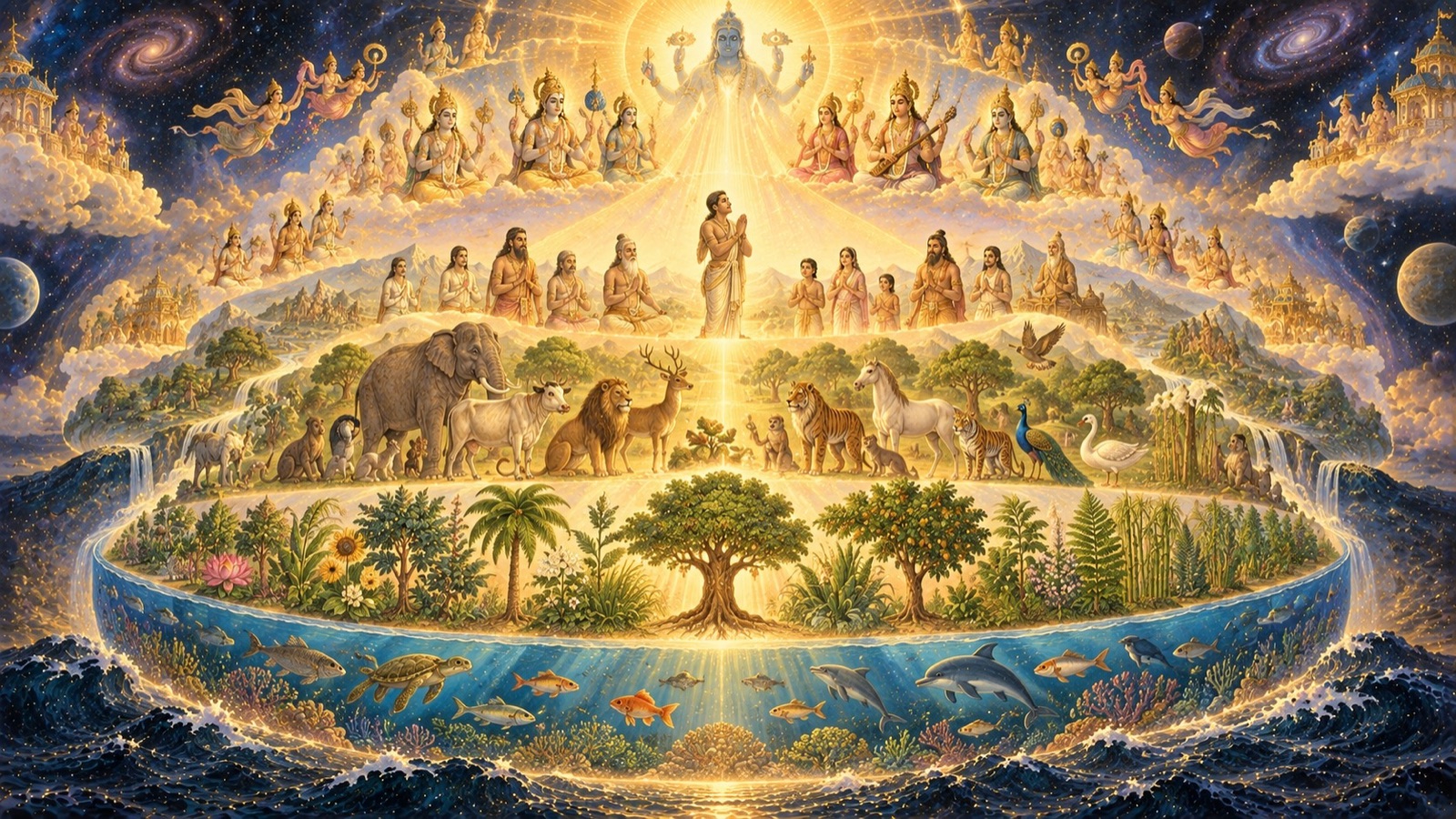
Vidura, still hungry for understanding, asks the sage Maitreya a simple question with an answer vaster than he could have imagined: how many kinds of living beings did Brahma bring forth? What follows is nothing less than a map of the entire created order — nine streams of creation flowing from God and Brahma together, a tenth completing the count, unfolding from the subtlest seed of matter to the plants that cannot walk, the animals that cannot reason for themselves, the humans restless with desire, and the shining hosts of heaven.
Om Namo Bhagavate Vasudevaya.
Om Namo Bhagavate Vasudevaya.
Om Namo Bhagavate Vasudevaya.
Welcome to Srimad Bhagavatam Wisdom, a devotional journey through the sacred histories and teachings of the Srimad Bhagavat Mahapurana. Discourse IX closed with the Lord Himself, having appeared to Brahma at the tip of the lotus stem, instructing the newly awakened Creator on the means of evolving the universe — and then withdrawing from view, leaving Brahma alone with the task. Discourse X takes up the story precisely there. Vidura, eager as ever to have every thread of Maitreya’s narration drawn out in full, asks the most natural of questions: now that the Lord has vanished, what did Brahma actually do, and how many kinds of living beings did he bring into being? Maitreya’s answer is one of the great structural passages of the Bhagavatam — an entire taxonomy of creation, sorted into ten distinct streams, four of them named directly by God and six unfolding through Brahma, cataloguing everything from the plants rooted silently in the earth to the shining courts of heaven.
Chapter Information
- Scripture: Śrīmad Bhāgavata Mahāpurāṇa
- Canto: 3 (Book Three)
- Chapter: 10 (Discourse 10)
- Chapter title: Description of the tenfold creation
- Principal speaker: The sage Maitreya, addressing Vidura — the whole related by Sukadeva Gosvami to King Parikshit, and by Suta Gosvami to the sage Saunaka and the assembly at Naimisharanya
- Principal listener: Vidura
- Main setting: Maitreya’s hermitage, continuing his discourse to Vidura on the origin of the universe, immediately after Brahma receives the Lord’s instruction in Discourse IX
- Central subject: Brahma’s long penance and his discovery of the lotus and the three worlds; the Lord’s potency of Time; and the tenfold creation — the nine streams proceeding from Prakrti and Vikrti together with the tenth, culminating in the eightfold creation of the heavenly beings
- Principal verse range: Canto 3, Chapter 10, verses 1–29
- Primary edition: Gita Press Śrīmad Bhāgavata Mahāpurāṇa
Vidura’s Question and Brahma’s Long Penance
Maitreya’s narration in this chapter opens, unusually, with Vidura himself framing the question that will shape everything that follows. When the Lord had withdrawn from Brahma’s sight, Vidura asks, how many species of life did Brahma — the grandfather of all creation — evolve, whether from his own body or from his mind? He asks Maitreya, whom he addresses as foremost among those of vast knowledge, to resolve every doubt he has been carrying, one point at a time.
विदुर उवाच । अन्तर्हिते भगवति ब्रह्मा लोकपितामहः । प्रजाः ससर्ज कतिधा दैहिकीर्मानसीर्विभुः ॥ १ ॥
vidura uvāca antarhite bhagavati brahmā loka-pitāmahaḥ prajāḥ sasarja katidhā daihikīr mānasīr vibhuḥ
Meaning: Vidura said: When the Lord had disappeared from view, how many species of life did Brahma, the grandfather of the whole creation, evolve either from his body or from his mind? (Canto 3, Chapter 10, verse 1)
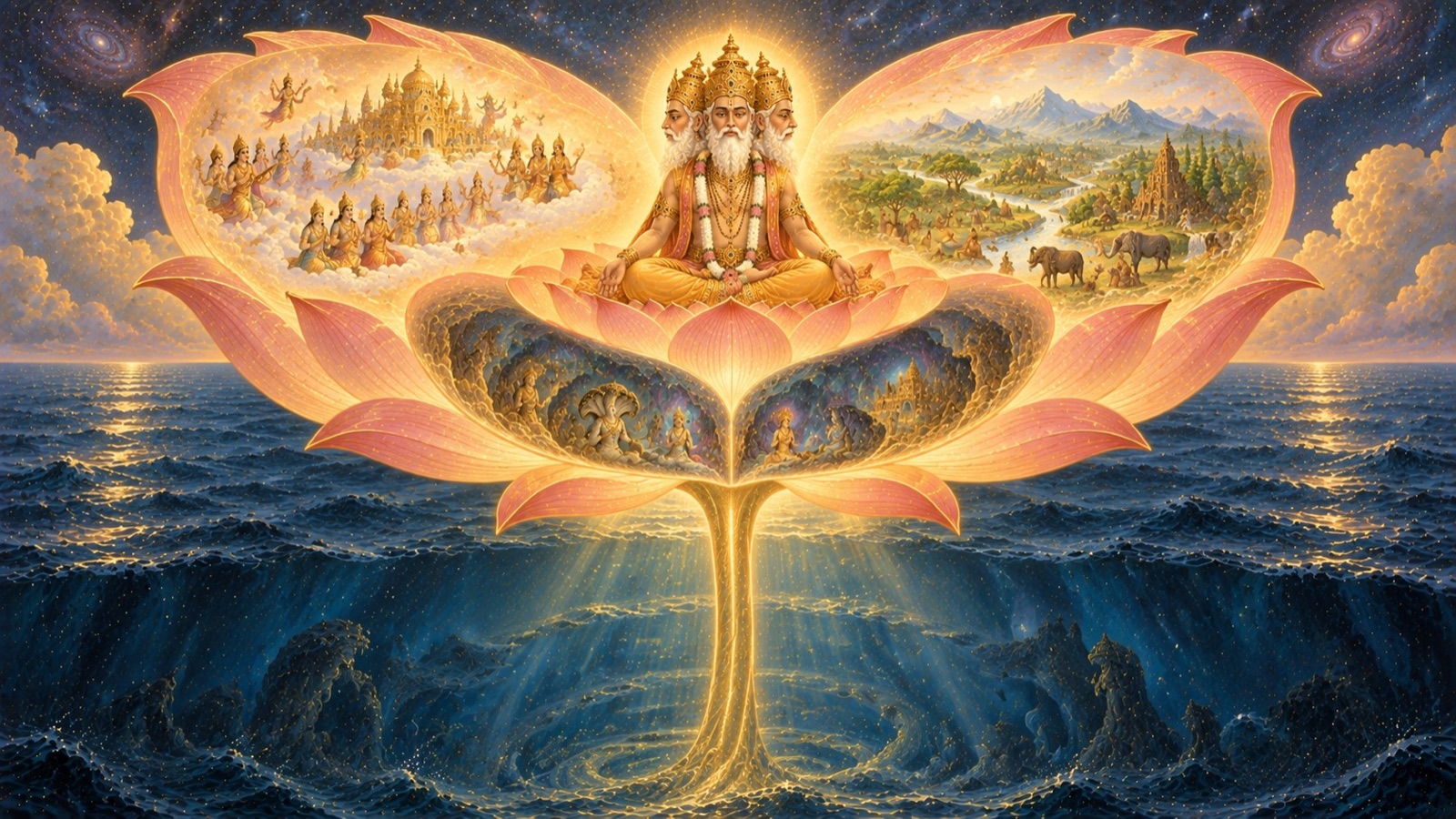
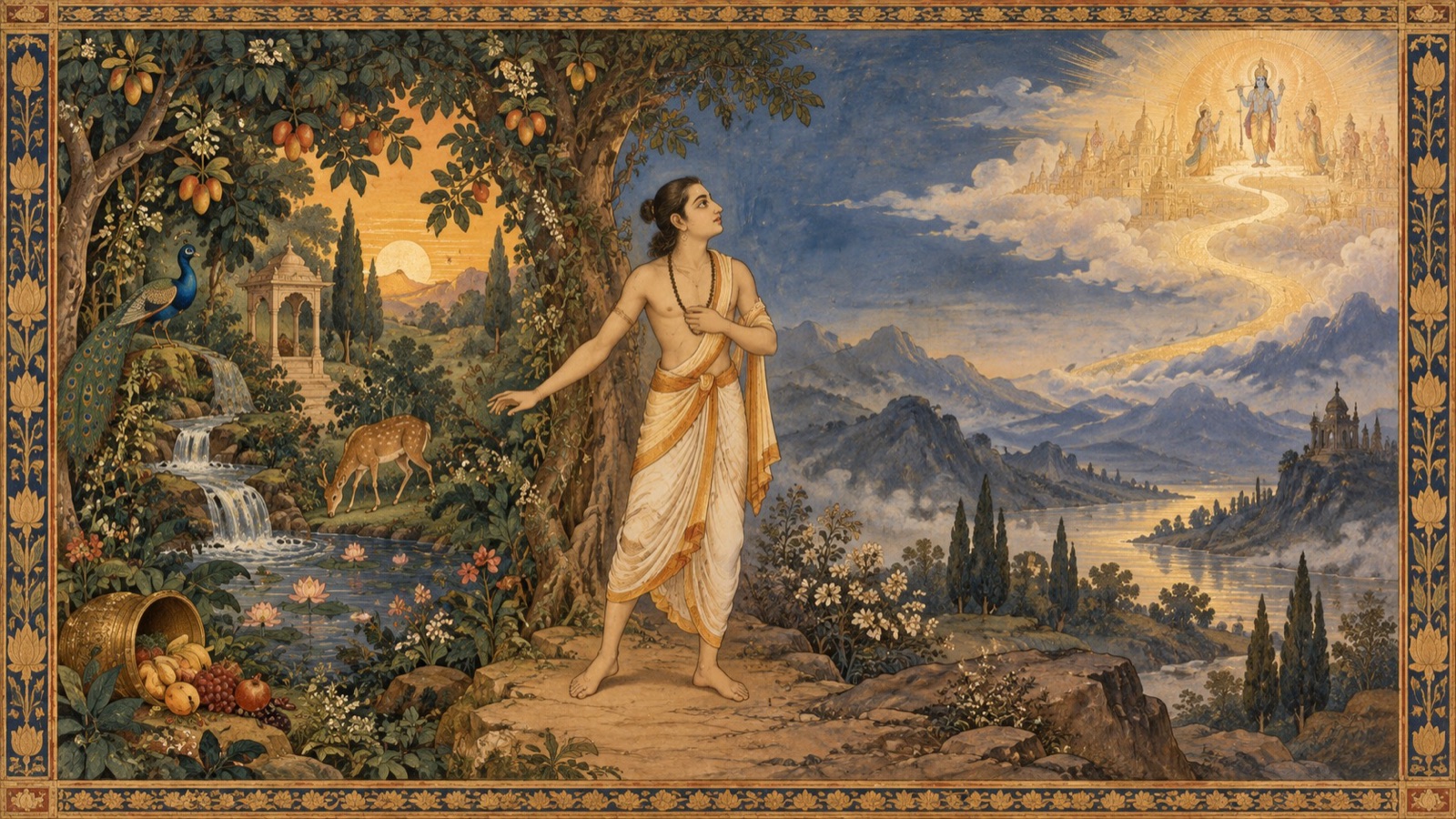
Suta, narrating this exchange to the sages at Naimisharanya, notes with evident warmth that Maitreya, thus questioned by Vidura, felt highly pleased — the question, in other words, was exactly the kind of question a true seeker should ask, and Maitreya answers it not with a short summary but with a complete and careful account. Brahma, he begins, first practised austere penance for a full hundred celestial years, his mind fixed unwaveringly on Sri Narayana, precisely as the Lord had instructed him. Only after this immense discipline did Brahma look about himself and see, for the first time with fully awakened perception, the very lotus on which he was seated — and the primeval waters surrounding it, still being tossed by the fierce residual winds of the universal dissolution that had only just ended.
His penance had not simply passed the time; it had matured his knowledge of creation and sharpened his creative power. Now capable of extraordinary feats, Brahma drank up that wind along with the water surrounding him — stilling the chaos so that he could see clearly. Looking again at the lotus, which he now perceived rising all the way to the heavens, he resolved that through this very lotus he would restore to visibility the worlds that had vanished at the close of the preceding Kalpa. Acting on the Lord’s own instruction, he entered the corolla of that vast lotus and divided it into three parts — Bhuh, Bhuvah and Swah, the three worlds — though the lotus itself, Maitreya notes almost in passing, was so immense it could have been divided into fourteen parts or more. These three worlds, he explains, are specifically the realm in which embodied souls experience the fruits of their own past actions; Brahma’s own abode, the Satyaloka, together with the three worlds directly beneath it — Maharloka, Janaloka and Tapoloka — are reserved instead as the reward of virtue performed without any selfish motive at all.
The Lord’s Potency of Time and the Tenfold Creation
Having heard this much, Vidura presses further, asking Maitreya to explain in detail the potency that the sage has referred to as Time — the very power by which Sri Hari of marvellous deeds appears as the manifold universe. Maitreya’s answer opens one of the Bhagavatam’s clearest statements on the metaphysics of creation. Time itself, he says, is undifferentiated, without beginning or end; it is only in the form of the transformation of worldly phenomena that Time becomes visible at all. Making Time His own instrument, the Supreme Person sportfully manifests Himself as the universe. This universe, dissolved during the period of cosmic destruction by the Maya of Lord Vishnu, had existed as nothing other than Brahma himself in dormant form; God, then, evolved it once more as a distinct entity, working entirely through the instrumentality of that same undifferentiated Time.
There is a deeper point folded into this teaching that a devotee does well to sit with, since it is the very reason Maitreya insists on Time at all rather than simply describing the universe as it appears. He is not saying that the manifested world is a second reality running alongside God, separate and independent; he is saying that it is God Himself, made to appear as something apart from Himself, and Time is precisely the means by which that appearance of separation is produced. Nothing that unfolds afterward — not Brahma’s penance, not the six streams from Prakrti, not the plants and animals and gods still to be named — ever steps outside that one truth. This is why the whole of creation can be called, without exaggeration, a pastime: it is the Lord dividing Himself from Himself only in seeming, through the instrument of Time, so that the drama of manifestation can proceed (verse 12).
As the universe exists today, Maitreya continues, so it existed before, and so it will continue to exist hereafter — its structure is not arbitrary or one-time, but a recurring pattern. That structure, he explains, is ninefold in its creation, with a tenth stream completing the count: nine born jointly of Prakrti (God, the material cause) and Vikrti (Brahma, the instrumental agent), the tenth being creation understood simply as their joint activity as a whole. Its dissolution, correspondingly, is threefold — through Time, through the elements, and through the Gunas, the three modes of Prakrti.
सर्गो नवविधस्तस्य प्राकृतो वैकृतस्तु यः । कालद्रव्यगुणैरस्य त्रिविधः प्रतिसंक्रमः ॥
sargo nava-vidhas tasya prākṛto vaikṛtas tu yaḥ kāla-dravya-guṇair asya tri-vidhaḥ pratisaṅkramaḥ
Meaning: The creation of this universe is ninefold — proceeding both from Prakrti (the primary material cause) and from Vikrti (its transformations) — and its dissolution, through Time, the elements and the Gunas, is threefold. (Canto 3, Chapter 10; this formula immediately follows the continuity statement that the Gita Press edition numbers together as verse 13)
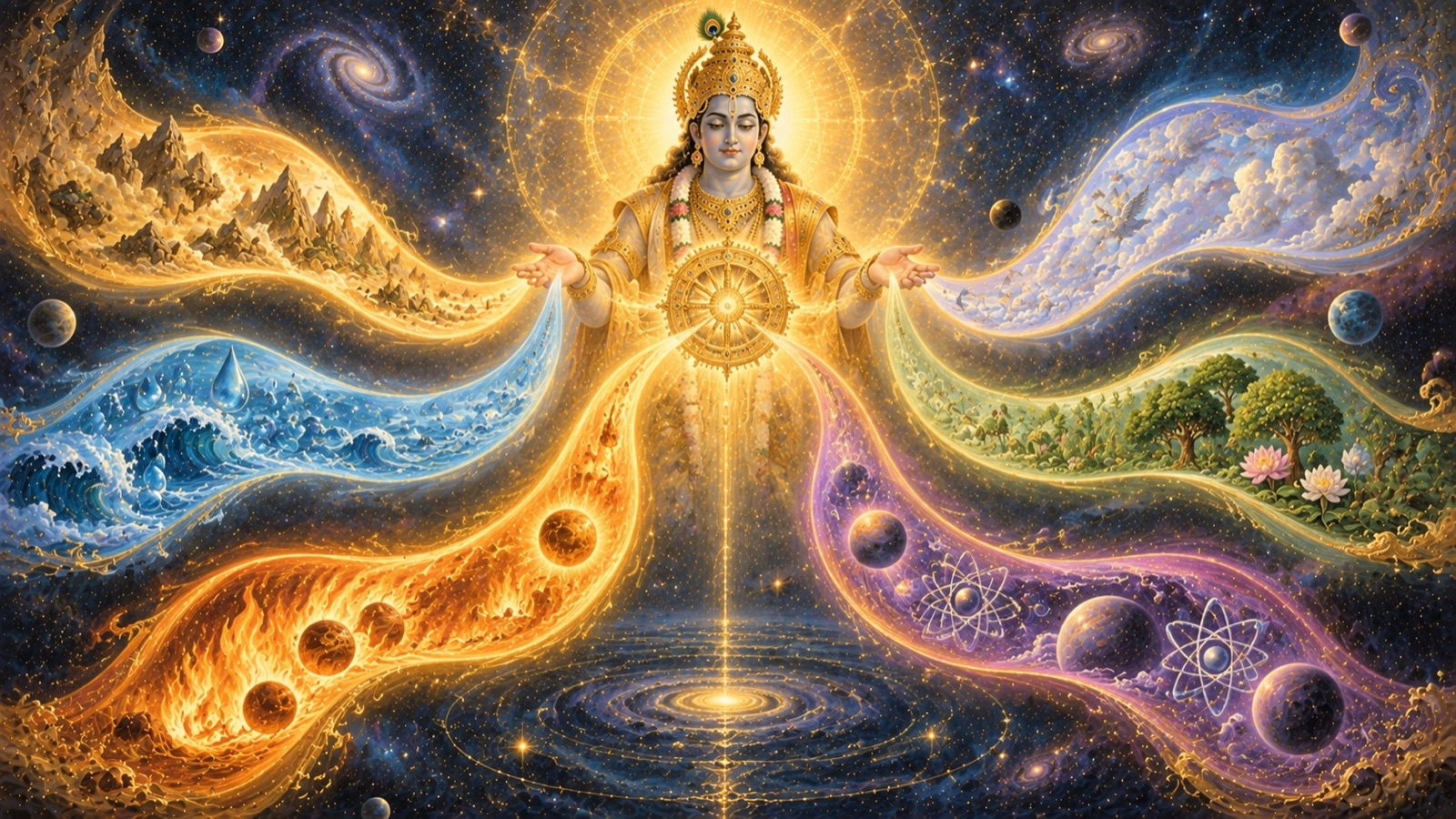
Maitreya then names the six varieties of creation that proceed directly from Prakrti, i.e., from God as the ultimate cause, before Brahma is even involved as an instrument. The first is the creation of the Mahat-tattva, cosmic intelligence itself, which arises only when the equilibrium of the three Gunas is disturbed by the will of God. The second is the evolution of the ego (Ahaṁ), from which in turn proceed the five gross elements, the five senses of perception and the five organs of action. The third is the evolution of the subtle elements (the Tanmatras), which themselves evolve into the gross elements. The fourth is the evolution of the Indriyas — the senses of perception and the organs of action considered as a distinct category of creation in their own right. The fifth is the evolution of the deities who preside over those Indriyas, born of the Sattvika ego, together with the mind, likewise a product of the Sattvika ego. And the sixth is the evolution of Tamas itself, the principle of nescience that clouds the reason and distracts the mind of every Jiva. These six, Maitreya says, constitute the creation proceeding from Prakrti — from God as the Cause of causes (verses 14-16). What remains are the streams that proceed from Vikrti, from Brahma, who himself sprang from the Lord.
The Three Creations Proceeding from Brahma: Plants, Animals and Humans
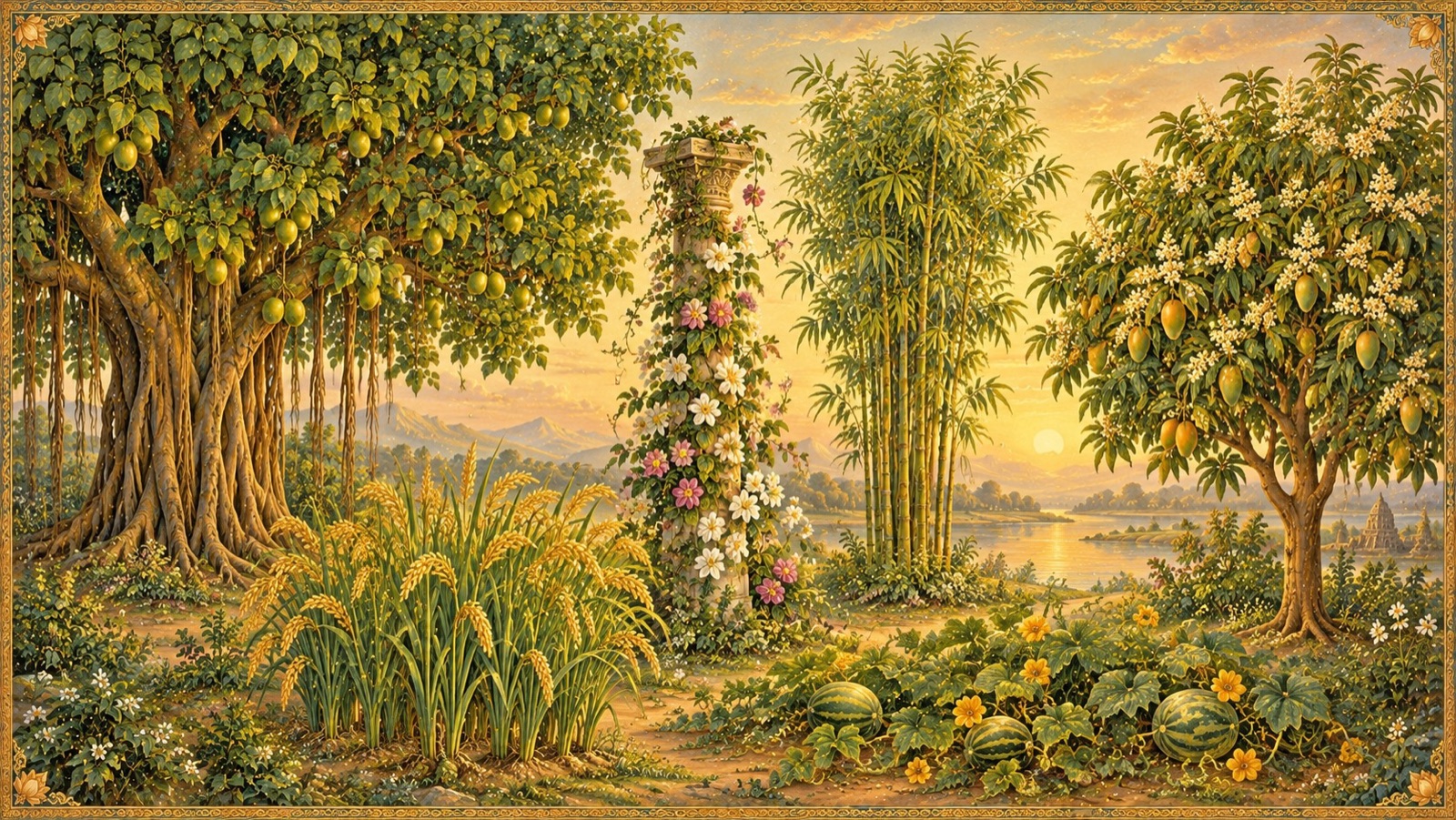
Maitreya is careful to note that even the creation that proceeds from Brahma is, in truth, still a pastime of the Lord — for Brahma himself, in taking up the quality of Rajas in order to carry out the work of creation, remains an instrument of the very Lord whose thought alone rids one of every sorrow. Of the three principal categories of creation that proceed from Brahma, the seventh in the overall sequence is the creation of immobile beings — plants and trees — itself subdivided into six varieties: trees that bear fruit without first flowering, such as the banyan and the peepul; annual plants and herbs, such as the cereals, that die once their fruit has ripened; creepers that climb upon the support of other trees or walls; plants with a hard bark, such as the bamboo; creepers too stiff to climb and so trailing along the ground instead, such as the melon and the watermelon; and finally trees that do flower before bearing fruit. All of these, Maitreya notes, draw their nourishment upward from below, through their roots; nearly devoid of outward sensibility, they possess only an inward sense of touch, and each variety carries some particular quality of its own.
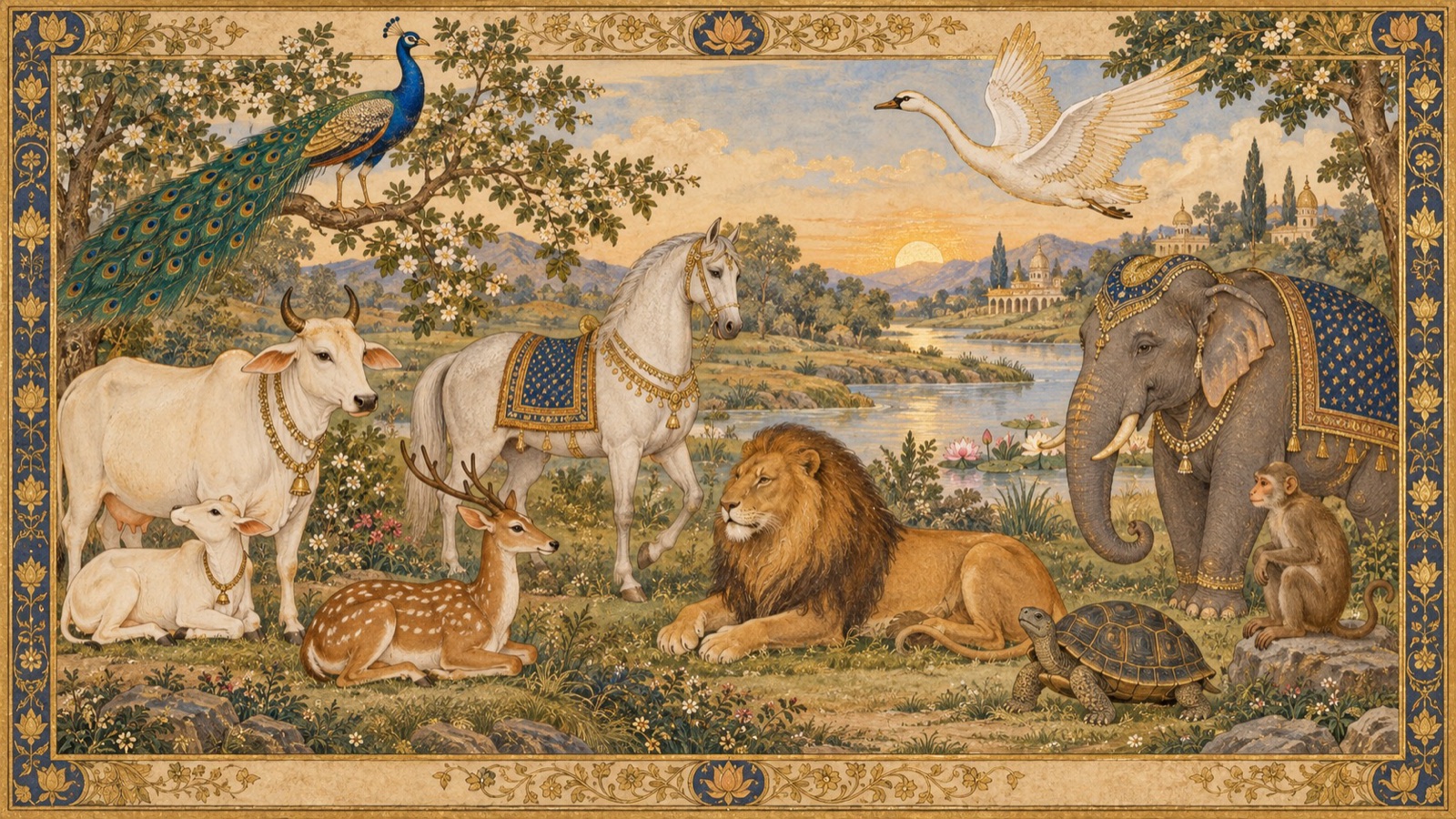
The eighth stream is the creation of animals — beings, as Maitreya defines them, whose current of nourishment runs horizontally through their bodies. He counts as many as twenty-eight distinct varieties among them, noting that they share certain common traits: they have no sense of time as such, they are governed by instinct rather than reason, they perceive what is useful to them chiefly through the sense of smell, and they are incapable of taking any long view of their circumstances. Maitreya then names them with the meticulous care of a naturalist. Among the cloven-hoofed beasts he places cattle, the goat, the buffalo, the black antelope, the swine, the Gavaya, the Ruru deer, the sheep and the camel. Among the whole-hoofed beasts he places the donkey, the horse, the mule, the Gaura antelope, the eight-legged Sarabha and the yak. Among beasts with five claws he names the dog, the jackal, the wolf, the tiger, the cat, the hare, the hedgehog, the lion, the monkey, the elephant, the tortoise, the iguana and the alligator. And among the birds of the air he names the heron, the vulture, the quail, the hawk, the Bhasa, the Bhalluka, the peacock, the swan, the crane, the Cakravaka, the crow and the owl.
The ninth stream, distinct from all the rest, is the creation of the human species — a single kind, Maitreya says, whose current of nourishment tends downward. Human beings, he explains, carry an abundance of Rajas within them; they are active by temperament and take their delight in the pleasures of the senses, pleasures which, though sought eagerly, are rooted in sorrow all the same. Maitreya closes this portion of his account by noting that these three streams — the immobile creation, the beasts and birds, and the human species — together with the creation of the gods still to come, all proceed from Brahma. The deities presiding over the Indriyas, born of the Sattvika ego, he reminds Vidura, have already been covered earlier under the creation proceeding directly from God; while the creation of the great sage-sons of Brahma, Sanaka and his brothers, is classed as belonging to both categories at once — proceeding from Brahma in one sense, yet, because they were created before even Rudra and the Prajapatis, also counted among the creations of God Himself.
The Eightfold Creation of Heavenly Beings
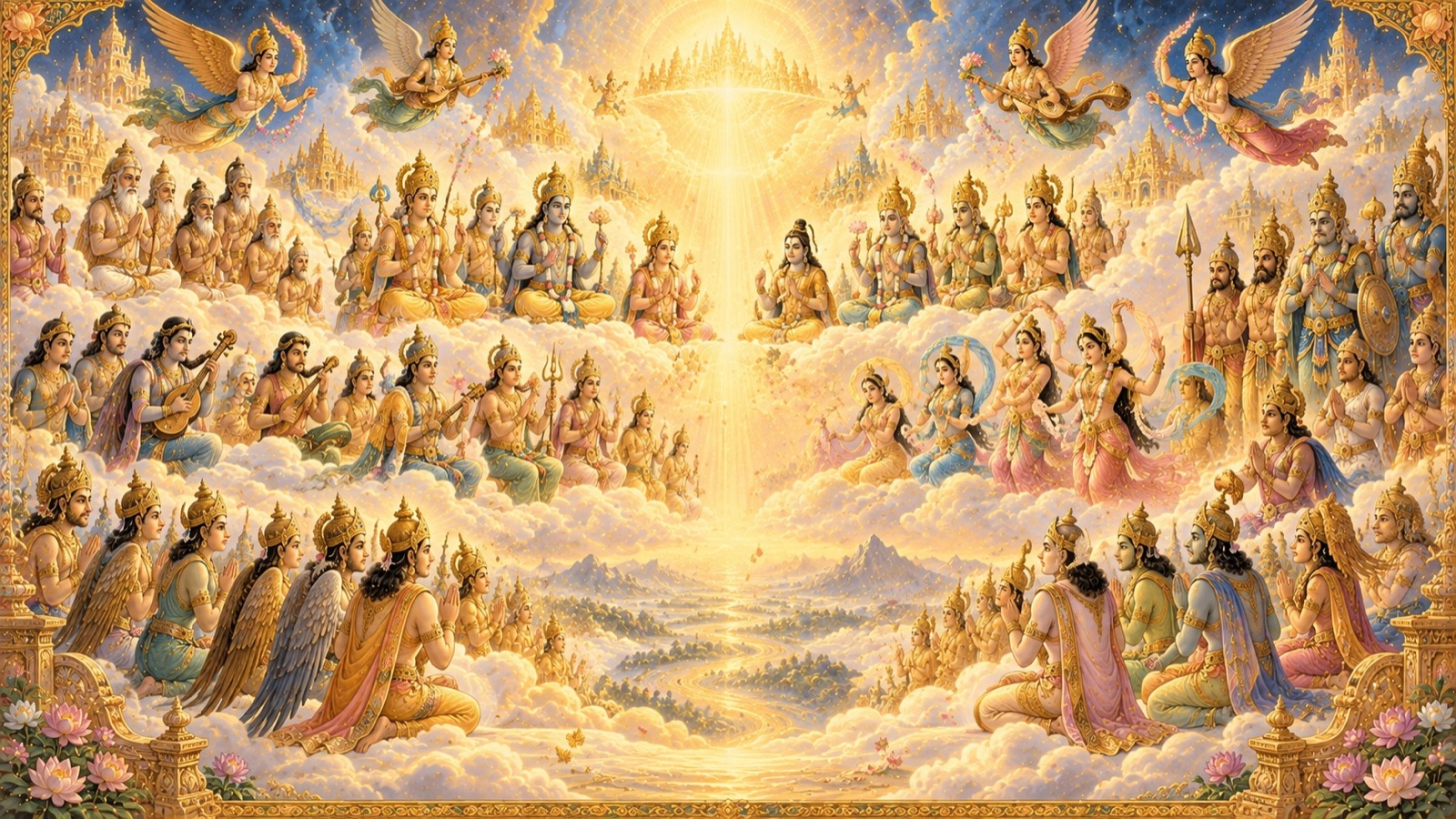
Maitreya reserves the tenth and final stream — the creation of the heavenly beings — for the chapter’s climactic summary. This creation, he says, is itself eightfold: the gods; the manes, the ancestral spirits; the demons; the Gandharvas, the celestial musicians, together with the Apsaras, the celestial dancers; the Yakshas and the Rakshasas; the Siddhas, beings endowed with supernatural powers, together with the Caranas, the celestial bards, and the Vidyadharas; the Bhutas, Pretas and Pisachas — the ghosts, spirits and fiends; and finally the Kinnaras, the Kimpurushas and the Aswamukhas. With this, Maitreya tells Vidura plainly, he has now related the ten creations evolved by the Lord — some directly, in His own person, and some through the instrumentality of Brahma, the Creator of the universe.
देवसर्गश्चाष्टविधो विबुधाः पितरोऽसुराः । गन्धर्वाप्सरसः सिद्धा यक्षरक्षांसि चारणाः ॥ भूतप्रेतपिशाचाश्च विद्याध्राः किन्नरादयः । दशैते विदुराख्याता सर्गास्ते विश्वसृक्कृताः ॥
deva-sargaś cāṣṭa-vidho vibudhāḥ pitaro ‘surāḥ gandharvāpsarasaḥ siddhā yakṣa-rakṣāṁsi cāraṇāḥ bhūta-preta-piśācāś ca vidyādhrāḥ kinnarādayaḥ daśaite vidurākhyātā sargās te viśva-sṛk-kṛtāḥ
Meaning: The creation of heavenly beings is eightfold — the gods, the manes, the demons, the Gandharvas and Apsaras, the Yakshas and Rakshasas, the Siddhas, Caranas and Vidyadharas, the Bhutas, Pretas and Pisachas, and the Kinnaras and their kind. These, O Vidura, are the ten creations brought about by the Creator of the universe. (Canto 3, Chapter 10, verses 27-28)
Having completed this full accounting, Maitreya turns immediately to what lies ahead in his narration: after this, he tells Vidura, he will speak next of the ruling dynasties and of the successive periods presided over by the Manus. He closes the chapter by returning, once more, to the truth beneath the entire taxonomy he has just delivered — that Brahma, united with the quality of Rajas as the self-born Creator, is none other than Sri Hari Himself, of unfailing resolve, projecting Himself as the universe, by Himself, at the beginning of every single Kalpa.
अतः परं प्रवक्ष्यामि वंशान्मन्वन्तराणि च । एवं रजःप्लुतः स्रष्टा कल्पादिष्वात्मभूर्हरिः । सृजत्यमोघसङ्कल्प आत्मैवात्मानमात्मना ॥
ataḥ paraṁ pravakṣyāmi vaṁśān manvantarāṇi ca evaṁ rajaḥ-plutaḥ sraṣṭā kalpādiṣv ātma-bhūr hariḥ sṛjaty amogha-saṅkalpa ātmaivātmānam ātmanā
Meaning: After this I shall tell you of the ruling dynasties and of the Manvantaras. Thus does Brahma, the self-born, immersed in Rajas, who is none other than Sri Hari of unfailing resolve, project Himself, by Himself, through Himself, at the beginning of every Kalpa. (Canto 3, Chapter 10, verse 29)
With this hymn-like summary — the ten creations named, tallied and returned at last to their single divine source — the tenth discourse of Book Three closes. Discourse XI will carry Maitreya’s narration forward into an entirely different register: no longer the census of created beings, but the measurement of Time itself, from the Paramanu, the smallest indivisible particle, up through the Manvantaras and the full life-span of Brahma.
Principal Teachings of This Chapter
1. Even the grandest classification of creation still ends in a single divine source. Ten distinct streams, nine of them proceeding from Prakrti and Vikrti together and one completing the tally, all still resolve into the truth that self-born Brahma, at the moment of creating, is none other than Sri Hari Himself (verse 29).
2. Discipline precedes vision. Brahma does not perceive the lotus, the waters, or the way forward until a hundred celestial years of penance, fixed wholly on the Lord, have matured both his knowledge and his creative capacity — a reminder that spiritual sight is earned through sustained practice, not granted on demand (verses 4-6).
3. Time is the Lord’s own instrument, not a force outside Him. Undifferentiated, beginningless and endless in itself, Time becomes visible only as the transformation of worldly phenomena — and it is by making Time His instrument that the Supreme Person manifests the universe at all, teaching that even the most impersonal-seeming cosmic forces are personally wielded by God (verses 11-12).
4. Every category of being, from plants to gods, is accounted for and none is accidental. The Bhagavatam’s vision of creation leaves no gap between the silent tree and the shining Gandharva — each is a distinct, named, purposeful stream of the same creative act, teaching a completeness of vision that refuses to treat any part of creation as beneath notice (verses 18-28).
5. Human life, for all its restlessness, is still named and placed within the divine order. The human species is described plainly — an abundance of Rajas, activity by temperament, delight rooted in sorrow — not to condemn it, but to locate it honestly within the ninefold creation, the necessary first step toward transcending exactly those tendencies (verse 25).
A Devotional Reflection
There is a quiet lesson embedded in the very shape of Maitreya’s answer to Vidura’s question. Vidura asks something that sounds almost administrative — how many kinds of beings did Brahma make? — and Maitreya could, in principle, have answered with a number and moved on. Instead he builds an entire architecture: penance before vision, Time as instrument before creation proper, six streams from Prakrti before three more from Vikrti, plants before animals before humans, and finally the gods themselves, each stream named with the patience of someone who believes that nothing in creation is too humble to be counted. A tree that bears fruit without flowering receives the same careful attention as a Gandharva or a god. This is itself a teaching: reverence for the Lord’s creation is not selective. If a scripture will pause to name the six varieties of a banyan tree’s kin before it ever reaches the human species, then surely no part of the created order — and no living being encountered in daily life — is unworthy of the same unhurried attention and respect.
A Daily Devotional Practice
Today, let your eye rest for a moment on something ordinarily overlooked — a potted plant, an insect on a windowsill, a stray animal glimpsed on the street. Recall, in the spirit of this chapter, that each belongs to one of the very streams of creation Maitreya has just described in careful, deliberate detail: not an accident, but a named part of the Lord’s own ninefold-plus-one design. Let that small act of noticing become an offering rather than a passing glance. Before you return to your day, pause and repeat quietly: “Om Namo Bhagavate Vasudevaya.” Let that remembrance widen your regard even for the smallest and most easily forgotten forms of life, seeing in each one thread of the same vast tapestry Brahma was taught to weave.
Conclusion
The tenth discourse of Book Three answers Vidura’s simple question with the fullest possible generosity: not a count, but a complete map of creation. It unfolds from the century of unbroken austerity that finally opened Brahma’s eyes to the vast lotus and its three worlds, through the Lord’s own potency of Time — Time as the very means by which the one God appears to stand apart from His own creation — through the six streams that proceed directly from Prakrti, and onward through the three streams — plants, animals, humans — and the climactic eighth variety of heavenly beings that together proceed from Brahma. Ten creations in all, named and tallied, and every one of them, Maitreya insists at the very close, still nothing other than Sri Hari Himself, projecting His own form by Himself at the dawn of every Kalpa. Vidura’s question about numbers becomes, in Maitreya’s hands, a lesson in seeing the whole of existence — from the rooted tree to the shining god — as a single continuous act of divine self-expression, preparing the ground for Discourse XI’s turn to the measurement of Time itself.
May the divine wisdom of Srimad Bhagavatam awaken pure devotion within our hearts.
Om Namo Bhagavate Vasudevaya.
Jay Shree Madhav.
References and Attribution
- Primary edition: Gita Press, Śrīmad Bhāgavata Mahāpurāṇa (English, complete), Book Three, Discourse 10, pages 175–177.
- Series: Srimad Bhagavatam Wisdom · Biswa Sanatan Dharma Seva Trust.
- Presented following the spiritual guidance and recommendation of Pandit Dr. Shri Kashinath Mishra.
This is an original, faithful retelling in the writer’s own words, with brief quoted verses shown in Devanāgarī and transliteration and their meanings given as summaries. It is not a reproduction of any single publisher’s continuous translation or commentary. No affiliation with or endorsement by any publisher is implied.
Jay Shree Madhav