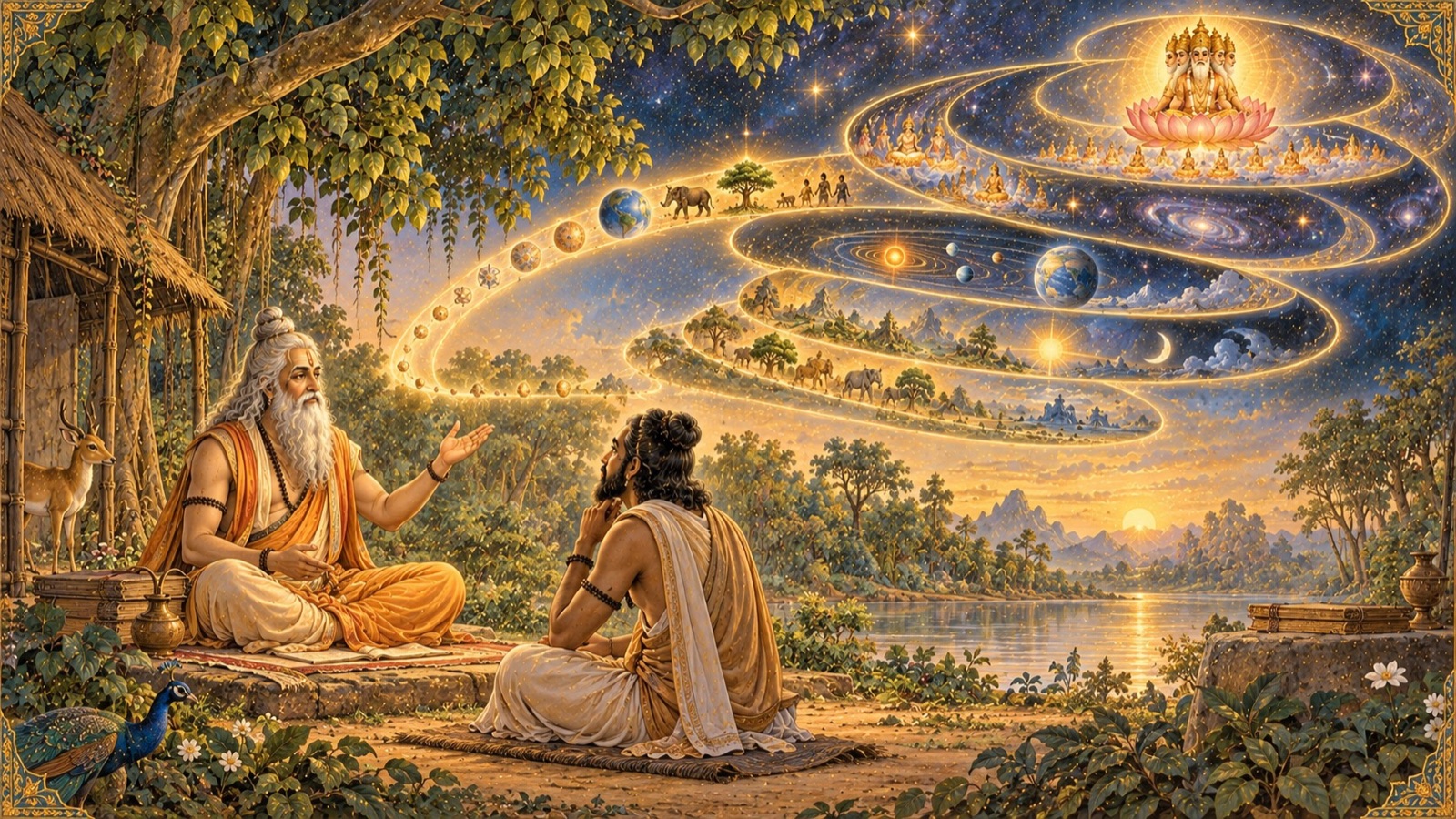
What is the smallest possible unit of time? What is the largest? In this chapter, Maitreya answers both questions at once — building, unit by patient unit, from a single indivisible atom to the full hundred-year lifespan of Brahma himself, and showing Vidura that the vast architecture of cosmic time is, in the end, no more than a single blink of the eye of the Lord who stands beyond it.
Om Namo Bhagavate Vasudevaya.
Om Namo Bhagavate Vasudevaya.
Om Namo Bhagavate Vasudevaya.
Welcome to Srimad Bhagavatam Wisdom, a devotional journey through the sacred histories and teachings of the Srimad Bhagavat Mahapurana. Chapter Ten closed with Maitreya’s description of the primary creation — the sequential unfolding of the elements, the senses, and the cosmic egg from the will of the Supreme, culminating in a universe fit to be entered by the Lord as the Purusha. Vidura, still hungry to understand the shape of the creation he has just heard described, now asks the question that will carry the rest of Canto Three’s cosmology forward: if all of this exists in time, then what, precisely, is time? In this eleventh discourse, Maitreya answers with a rigor that is almost startling in a work of devotion — laying out, unit by unit, the entire scale of time itself, from a particle too small to be divided further to a life-span so vast that it is reckoned in the billions of human years, and closing with the calm reminder that all of this measureless immensity is, to the Lord who holds it, no more than the twinkling of an eye.
Chapter Information
- Scripture: Śrīmad Bhāgavata Mahāpurāṇa
- Canto: 3 (Book Three)
- Chapter: 11 (Discourse 11)
- Chapter title: Divisions of Time such as Manvantara and so on
- Principal speakers: Maitreya, with a brief interjecting question from Vidura — the whole related by Sukadeva Gosvami to King Parikshit, and by Suta Gosvami to the sage Saunaka and the assembly at Naimisharanya
- Principal listener: King Parikshit (within the narrative frame); Vidura (within the dialogue itself)
- Main setting: The hermitage where Vidura sits at the feet of the sage Maitreya, continuing the long dialogue on creation and cosmology
- Central subject: The complete technical scale of cosmic time — from the indivisible Paramanu through the human calendar, the four Yugas, a day and night of Brahma, the fourteen Manvantaras, the periodic dissolution (Pralaya) of the three worlds, the two Parardhas of Brahma’s life, and the true, changeless nature of the Lord who stands beyond all of Time’s measure
- Principal verse range: Canto 3, Chapter 11, verses 1–41 (Gita Press numbering; see Verification notes)
- Primary edition: Gita Press Śrīmad Bhāgavata Mahāpurāṇa
From the Unsplittable Atom to the Measure of a Year
Maitreya opens this chapter not with a story but with a definition, and the precision of it sets the tone for everything that follows. The Paramanu, he explains, is the minutest particle of material substance — a particle that cannot be divided further, has not yet combined with other particles, and so exists eternally in that primal, causal state. It is only the illusory combination of many such Paramanus, Maitreya says, that creates in the minds of ordinary men the notion of a single “unit” of matter at all. And just as the smallest imaginable particle of matter implies the existence of a Paramanu, the entire undifferentiated mass of material substance, taken as a whole before it returns to its source in Prakrti, gives us the very largest measure — and time itself, Maitreya says, can be measured the same way, stretching between these two poles precisely because time, as a potency of the Lord, is itself all-pervading and unmanifest, circumscribing every finite object as it travels, in the form of the sun, across every dimension both large and small.
मैत्रेय उवाच । चरम: सद्विशेषाणामनेकोऽसंयुत: सदा । परमाणु: स विज्ञेयो नृणामैक्यभ्रमो यत: ॥ १ ॥
maitreya uvāca / caramaḥ sad-viśeṣāṇām aneko ‘saṁyutaḥ sadā paramāṇuḥ sa vijñeyo nṛṇām aikya-bhramo yataḥ
Meaning: Maitreya continued: The minutest particle of material substance, which cannot be further divided and has not yet combined with other such particles, eternally existing in that state, should be known as the Paramanu; it is the combination of many such Paramanus that creates in the minds of men the illusory notion of a single unit. (Canto 3, Chapter 11, verse 1)
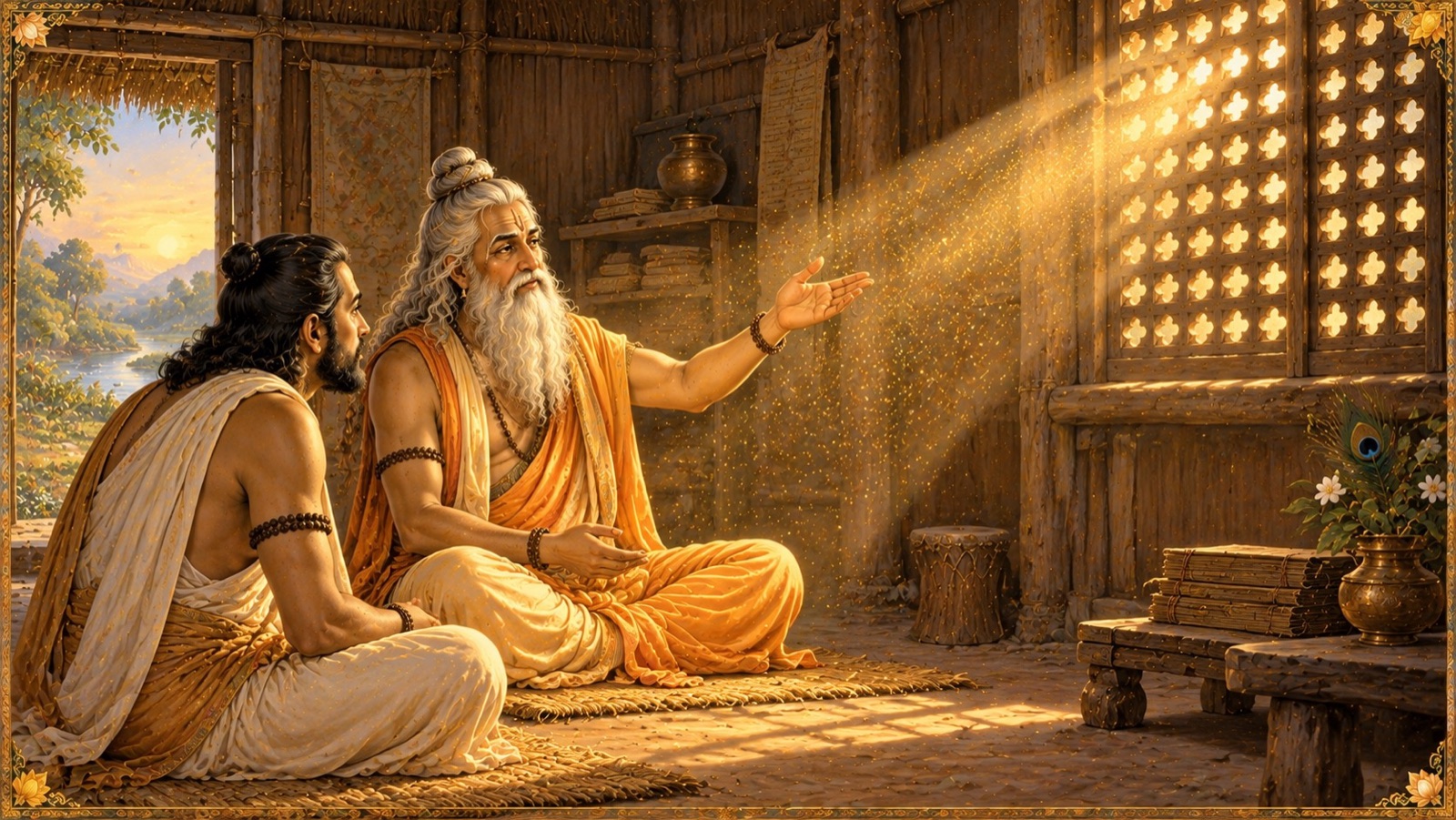
From this single definition, Maitreya builds the entire edifice of time with the patience of a careful teacher who intends to leave no gap unfilled. Two Paramanus, he explains, make one Anu; three Anus make a Trasarenu — the tiny mote of dust one sees floating and dancing in a shaft of sunlight that enters a darkened room through the holes of a window-lattice. From there the scale simply keeps climbing: three Trasarenus in motion give a Truti; a hundred Trutis make a Vedha; three Vedhas make a Lava; three Lavas make a Nimesa, the time of a single blink of the eye; three Nimesas make one Kshana, or moment; five Kshanas make a Kashtha; and fifteen Kashthas make a Laghu.
स काल: परमाणुर्वै यो भुङ्क्ते परमाणुताम् । सतोऽविशेषभुग्यस्तु स काल: परमो महान् ॥ ४ ॥
sa kālaḥ paramāṇur vai yo bhuṅkte paramāṇutām sato ‘viśeṣa-bhug yas tu sa kālaḥ paramo mahān
Meaning: That measure of time which, in the form of the sun, flits across the smallest particle of matter is called a Paramanu; while that which extends over the whole life-span of the universe is the greatest, longest measure of time. (Canto 3, Chapter 11, verse 4)
A Table of Time: From a Blink of the Eye to a Human Century
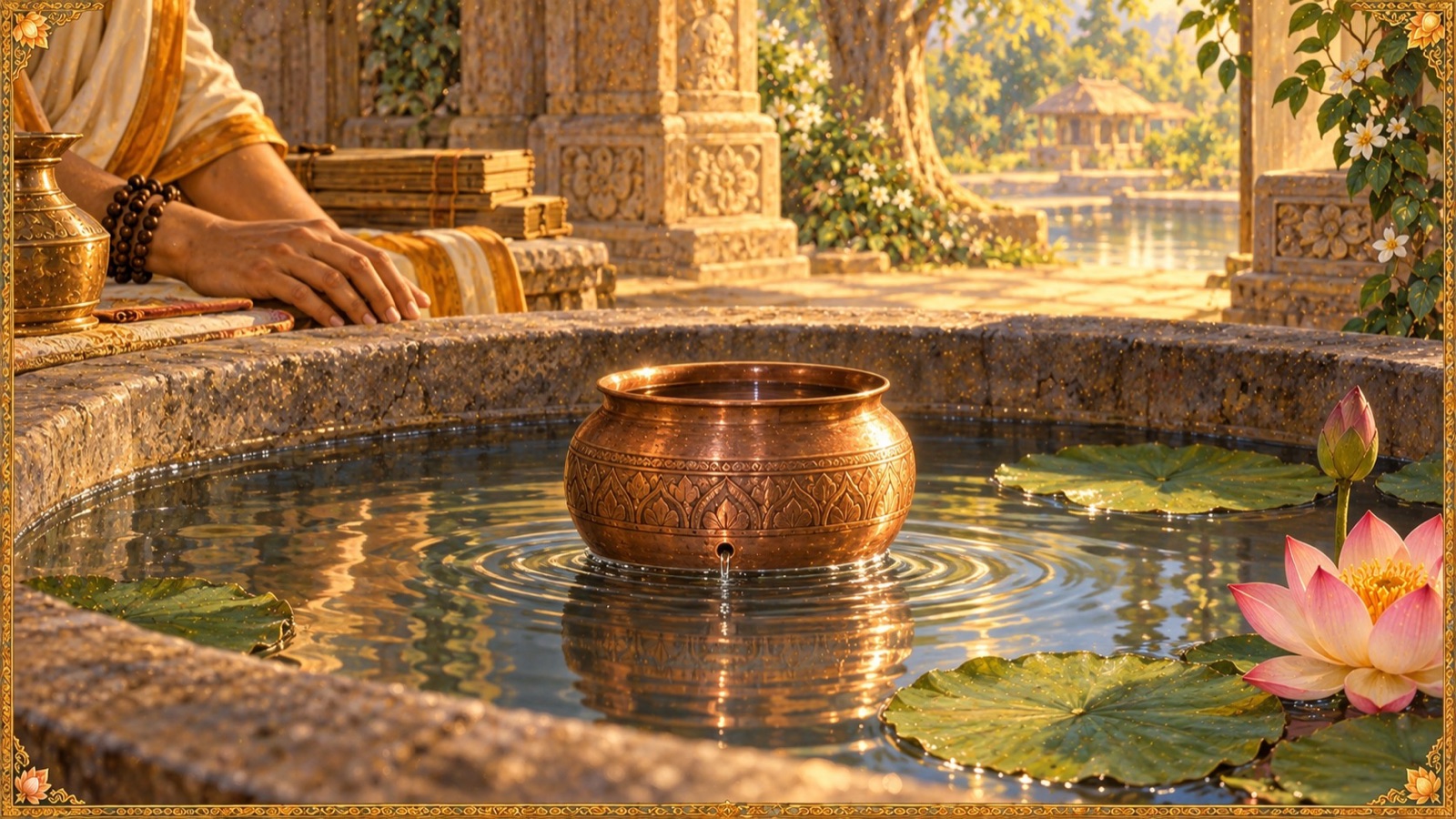
The scale continues to climb, and here Maitreya’s teaching becomes almost mathematical in its exactness, moving from the fraction of a second to the full span of a human life. Fifteen Laghus taken together are called a Nadika; two Nadikas make one Muhurta; and six or seven Nadikas, depending on whether the day or night is longer or shorter, make one Prahara — a quarter of a day or night for ordinary human beings. Maitreya even describes the actual instrument by which a Nadika was measured in ancient times: a small copper pot of a precise weight and capacity, bored at its base with a gold needle of an exact size, set afloat on water — the time it takes for that pot to fill with water and sink is one Nadika.
लघूनि वै समाम्नाता दश पञ्च च नाडिका । ते द्वे मुहूर्त: प्रहर: षड्याम: सप्त नृणाम् ॥ ८ ॥
laghūni vai samāmnātā daśa pañca ca nāḍikā te dve muhūrtaḥ praharaḥ ṣaḍ yāmaḥ sapta vā nṛṇām
Meaning: Fifteen Laghus are declared to constitute one Nadika; two Nadikas make one Muhurta, while six or seven Nadikas make a Prahara, one quarter of a day or night of human beings. (Canto 3, Chapter 11, verse 8)
From here Maitreya moves swiftly through the familiar human calendar — four Praharas to a day, fifteen days and nights to a fortnight (one bright, one dark), two fortnights to a month, two months to a season, six months to an Ayana, and two Ayanas — southerly and northerly by turns — to one full year, which is also reckoned as a single day and night of the gods in heaven, just as one human month is a single day and night of the Pitrs, the manes. A hundred such years, Maitreya says, is declared to be the full span of human life. To keep this long, cascading sequence readable, the units Maitreya names in this chapter may be gathered into a single table:
| Unit | Equals | Approximate scale |
|---|---|---|
| Paramanu | The indivisible ultimate particle of time and matter | Immeasurably small |
| Anu | 2 Paramanus | — |
| Trasarenu | 3 Anus | A mote of dust in sunlight |
| Truti | 3 Trasarenus in motion | — |
| Vedha | 100 Trutis | — |
| Lava | 3 Vedhas | — |
| Nimesa | 3 Lavas | The blink of an eye |
| Kshana | 3 Nimesas | A moment |
| Kashtha | 5 Kshanas | — |
| Laghu | 15 Kashthas | — |
| Nadika (Danda) | 15 Laghus | ~24 minutes |
| Muhurta | 2 Nadikas | ~48 minutes |
| Prahara | 6-7 Nadikas | One quarter of a day/night |
| Day and night (human) | 4 Praharas each | 24 hours |
| Fortnight | 15 days/nights | Bright or dark half of a month |
| Month | 2 fortnights | One day-night of the Pitrs |
| Season (Rtu) | 2 months | — |
| Ayana | 6 months | Sun’s southerly or northerly course |
| Year | 2 Ayanas | One day-night of the gods; 100 years = a full human life |
| Yuga-cycle (Chatur-yuga) | Krita + Treta + Dwapara + Kali | 12,000 celestial years (43,20,000 human years) |
| Day of Brahma | 1,000 Chatur-yugas | Followed by an equal night |
| Manvantara | ~71 Chatur-yugas | One reign of a Manu, within a day of Brahma |
| Parardha | Half of Brahma’s 100-year life | The first Parardha has already ended |
| Full life of Brahma | 2 Parardhas | Figuratively, one blink of the Lord’s eye |
The sun itself, Maitreya adds, is the living embodiment of this entire scale: the ever-vigilant sun-god, a manifestation of the Lord and identical with the Time-Spirit, travels through the midst of the planets, lunar mansions, and stars, tracing out this whole range from the Paramanu to the year as it goes. The year itself carries five names — Samvatsara, Parivatsara, Idavatsara, Anuvatsara and Vatsara — according to whether it is measured by the sun, Jupiter, or the moon, and Maitreya closes this first movement of the chapter by urging that offerings be made to the sun-god, who through his power called Time governs the seed’s capacity to germinate, courses through the heavens as one of the five gross elements to loosen men’s attachment to sensory pleasure by shortening their days, and yields, for those who desire it, the many fruits of sacrifice.
Vidura’s Question: What of Those Who Live Beyond the Three Worlds?
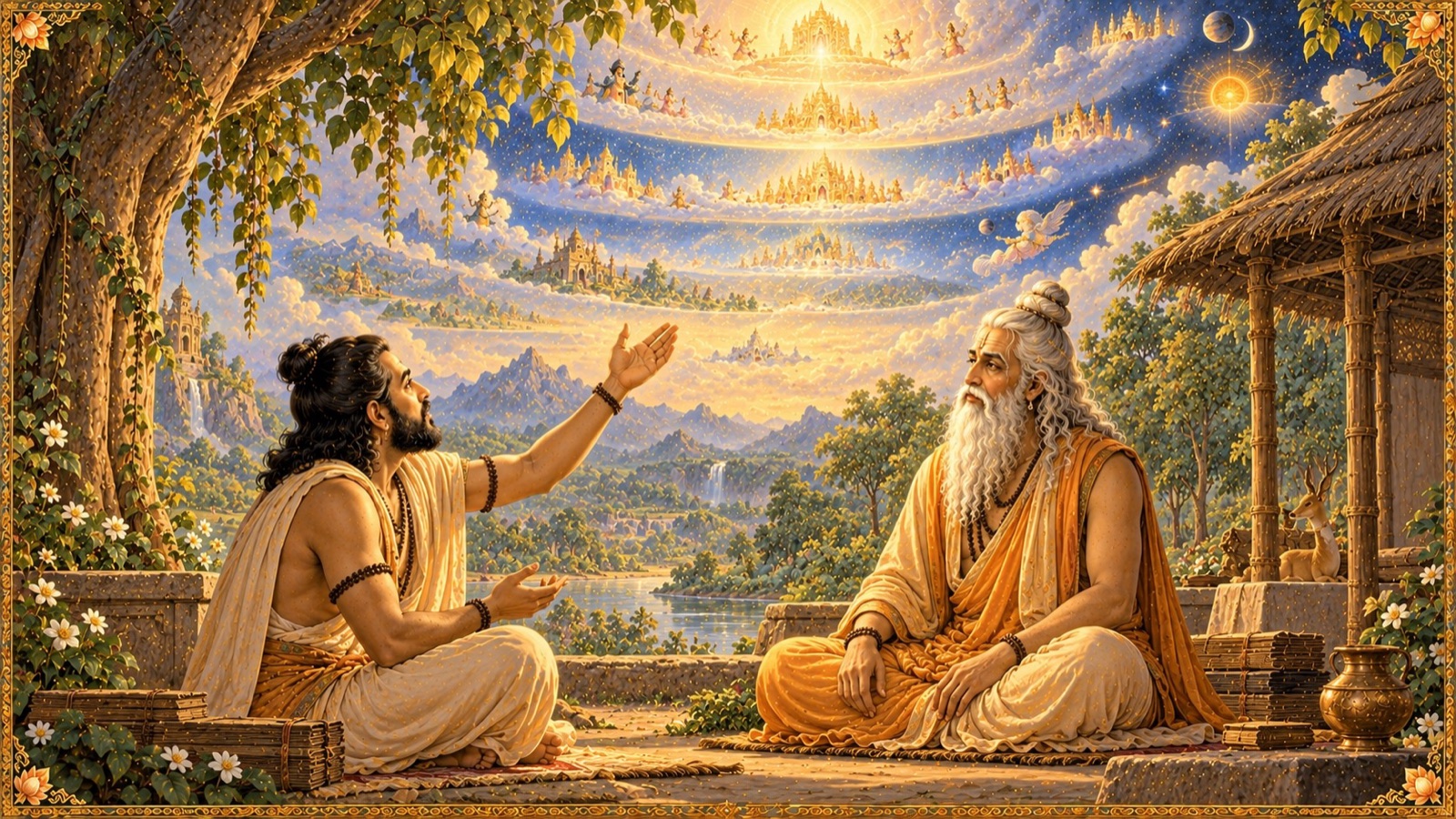
Having heard the full scale of ordinary time — the lifespans of the manes, the gods, and human beings — Vidura interrupts with a natural question, one that pushes the inquiry further outward. He has understood, he says, the hundred-year span that governs beings within the three worlds; but what of the higher, more enlightened beings — Brahma himself, and sages like Sanaka and Bhrgu — who dwell beyond Indra’s paradise, outside the reach of the three worlds altogether? Vidura’s confidence in his teacher is total: surely, he says, one who has perfected the eye of Yoga can see the entire course of the all-powerful Time exactly as it is. (Canto 3, Chapter 11, verses 16-17.)
It is worth pausing on the shape of this small exchange. Vidura does not ask this question idly. Having just been given the entire architecture of ordinary time — down to the very instrument by which a Nadika is measured — he senses, correctly, that something vaster still remains: a scale of time appropriate not to men and gods within the three worlds, but to the very architects of creation itself. Maitreya’s answer to this question is the second and larger movement of the chapter — an answer that will carry Vidura, and the reader, all the way from the four Yugas to the full life-span of Brahma.
The Four Yugas and the Fading of Dharma
Maitreya’s answer begins with the four Yugas — Krita (or Satya), Treta, Dwapara and Kali — which, together with their Sandhya and Sandhyamsa (the transitional periods that open and close each Yuga), total twelve thousand celestial years, or 43,20,000 human years. Each Yuga is progressively shorter than the one before it: Krita spans four thousand celestial years (plus eight hundred more of Sandhya and Sandhyamsa combined), Treta three thousand, Dwapara two thousand, and Kali one thousand — each with its own proportionate transitional periods.
मैत्रेय उवाच । कृतं त्रेता द्वापरं च कलिश्चेति चतुर्युगम् । दिव्यैर्द्वादशभिर्वर्षै: सावधानं निरूपितम् ॥ १८ ॥
maitreya uvāca / kṛtaṁ tretā dvāparaṁ ca kaliś ceti catur-yugam divyair dvādaśabhir varṣaiḥ sāvadhānaṁ nirūpitam
Meaning: Maitreya replied: The four Yugas — Krita, Treta, Dwapara and Kali — together with their transitional periods, have been declared as consisting of twelve thousand celestial years. (Canto 3, Chapter 11, verse 18)
What matters most in this description, though, is not simply the arithmetic but what Maitreya says happens to Dharma, to righteousness itself, as the Yugas turn. In the Krita Yuga, he explains, virtue exists complete in all four of its limbs — austere penance, purity both internal and external, compassion, and truthfulness. In each Yuga that follows, as unrighteousness advances, virtue loses one of these four limbs in turn: penance first, in Treta; then purity as well, in Dwapara; until in Kali, truthfulness alone remains as the last thread of Dharma still widely practiced among men. It is a sober, unsentimental picture of decline — offered not as a cause for despair, but as a simple description of how time itself, in its largest cosmic sweep, shapes the moral condition of an age.
A Day and Night of Brahma, and the Reign of the Manus
Having placed the Yugas on the scale, Maitreya now takes the single largest step in the chapter. One thousand complete cycles of the four Yugas, he says, beyond the three worlds and up to the abode of Brahma, constitute a single day of Brahma; and an equal length constitutes his night, during which Brahma withdraws the three worlds into himself and sleeps.
त्रिलोक्या युगसाहस्रं बहिराब्रह्मणो दिनम् । तावत्येव निशा तात यन्निमीलति विश्वसृक् ॥ २२ ॥
tri-lokyā yuga-sāhasraṁ bahir ābrahmaṇo dinam tāvaty eva niśā tāta yan nimīlati viśva-sṛk
Meaning: One thousand revolutions of the four Yugas, beyond the three worlds up to the abode of Brahma, constitute a single day; and the night is of equal length, dear one, during which the creator of the universe closes his eyes in sleep. (Canto 3, Chapter 11, verse 22)
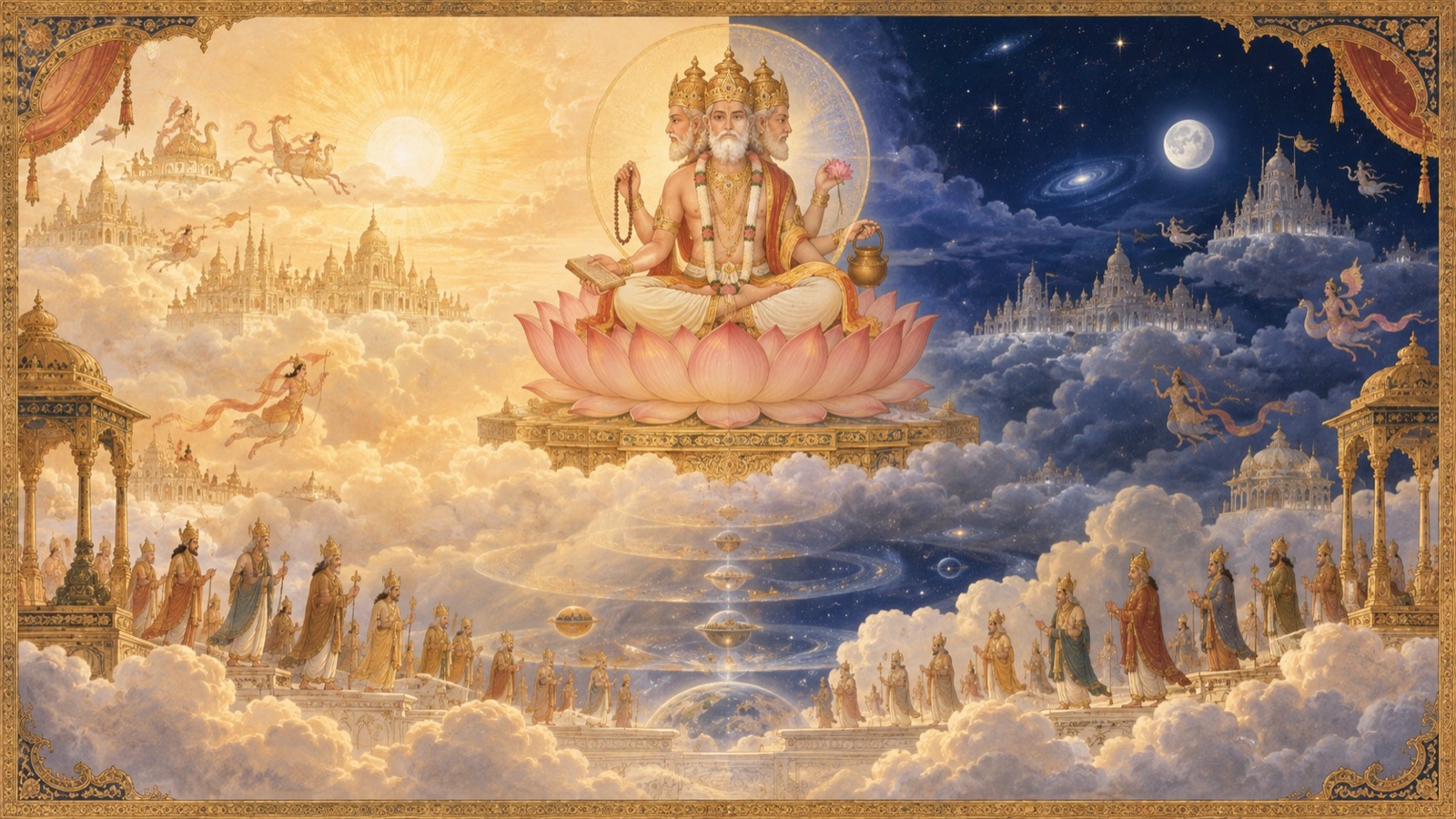
At the close of Brahma’s night, creation begins again exactly as before, and continues through the reign of fourteen successive Manus across his waking day — each Manu governing for a period a little more than seventy-one cycles of the four Yugas, a single such reign being called a Manvantara. Within each Manvantara, Maitreya notes, a distinct Manu and his own descendants appear, along with a distinct group of seven Rishis, a distinct company of gods, and a distinct Indra with his attendants — all of these, apart from the Manu’s own descendants, born together as a single company at the Manvantara’s start.
मन्वन्तरेषु मनवस्तद्वंश्या ऋषय: सुरा: । भवन्ति चैव युगपत्सुरेशाश्चानु ये च तान् ॥ २५ ॥
manvantareṣu manavas tad-vaṁśyā ṛṣayaḥ surāḥ bhavanti caiva yugapat sureśāś cānu ye ca tān
Meaning: In each Manvantara, the Manu and his lineage, the seven Rishis, and the gods all appear together at the same time, along with Indra, the lord of the gods, and those who follow him. (Canto 3, Chapter 11, verse 25)
This, Maitreya says, is the day-to-day creation of Brahma — a creation confined to the three worlds, in which sub-human creatures, human beings, the manes, and the gods are all born according to their own accumulated Karma. Throughout each Manvantara the Lord assumes the quality of Sattva, harmony, and protects the universe, manifesting His own strength through the Manus and the other guardians of the age. But at the close of Brahma’s day, a measure of Tamoguna, the principle of inertia, touches even Brahma himself; his activity winds down, and everything is drawn back into him by the force of Time, until his night, too, has run its course.
The Great Dissolution and the Lord Asleep on the Causal Waters
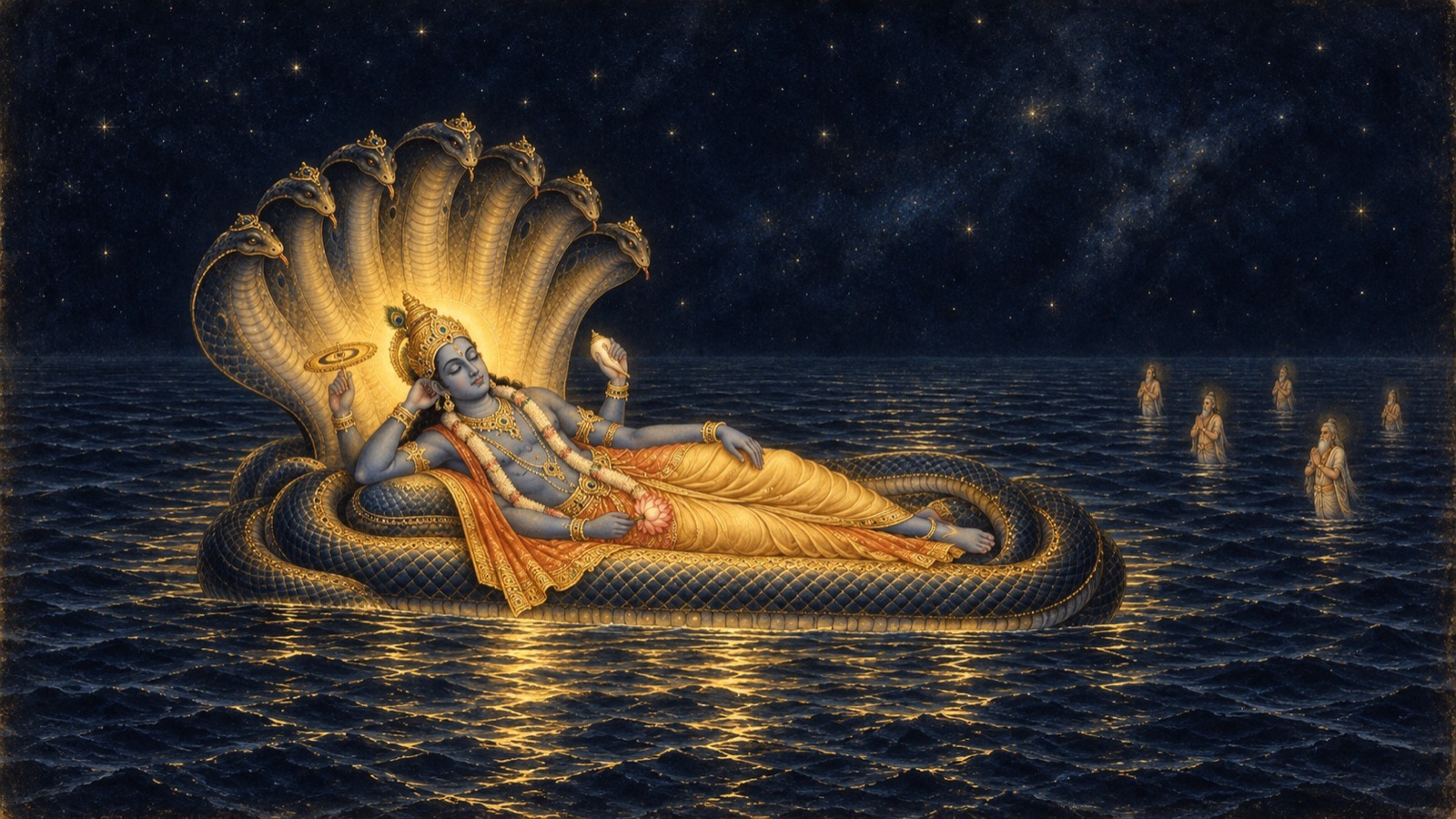
Maitreya now turns to describe, with the same careful exactness, what happens when a still greater night falls — the night not merely of Brahma’s daily sleep, but of universal dissolution, Pralaya, when the moon and sun themselves disappear and the three worlds, Bhuh, Bhuvah, and Swah, are drawn entirely back into Brahma’s body. He describes the mechanism of this dissolution in vivid terms: the three worlds are consumed by a great fire that issues from the mouth of Lord Sankarshana, and the sages headed by Bhrgu, dwelling in the Maharloka just above Indra’s paradise, feel the oppressive heat of that conflagration and ascend further still, to the Janaloka beyond it. At the same time, all seven oceans overflow their bounds, their waters swollen and driven by ferocious winds, until in a very short time the three worlds lie entirely submerged.
And in the midst of that vast expanse of water, Maitreya says, Sri Hari Himself reclines upon the couch of Lord Ananta, His eyes closed in the sleep of divine meditation, while the sages of the Janaloka sing His praises on every side.
अन्त: स तस्मिन् सलिल आस्तेऽनन्तासनो हरि: । योगनिद्रानिमीलाक्ष: स्तूयमानो जनालयै: ॥ ३२ ॥
antaḥ sa tasmin salila āste ‘nantāsano hariḥ yoga-nidrā-nimīlākṣaḥ stūyamāno janālayaiḥ
Meaning: There within that boundless water Sri Hari Himself reclines upon Ananta, His eyes closed in yogic slumber, while the sages who dwell in Janaloka sing His glories all around Him. (Canto 3, Chapter 11, verse 31 in the Gita Press numbering; see Verification notes.)
This image — the Lord resting, at peace, upon the very waters that have swallowed the three worlds — is one of the most enduring in the entire Bhagavatam, and Maitreya offers it here not as a moment of crisis but as a moment of stillness: the universe unmade, and the Maker unmoved. With the steady alternation of these days and nights, Maitreya notes, even the full hundred years of Brahma’s life — the longest span of life in all creation — are, in due course, spent.
Two Parardhas: Brahma, Padma, and Varaha
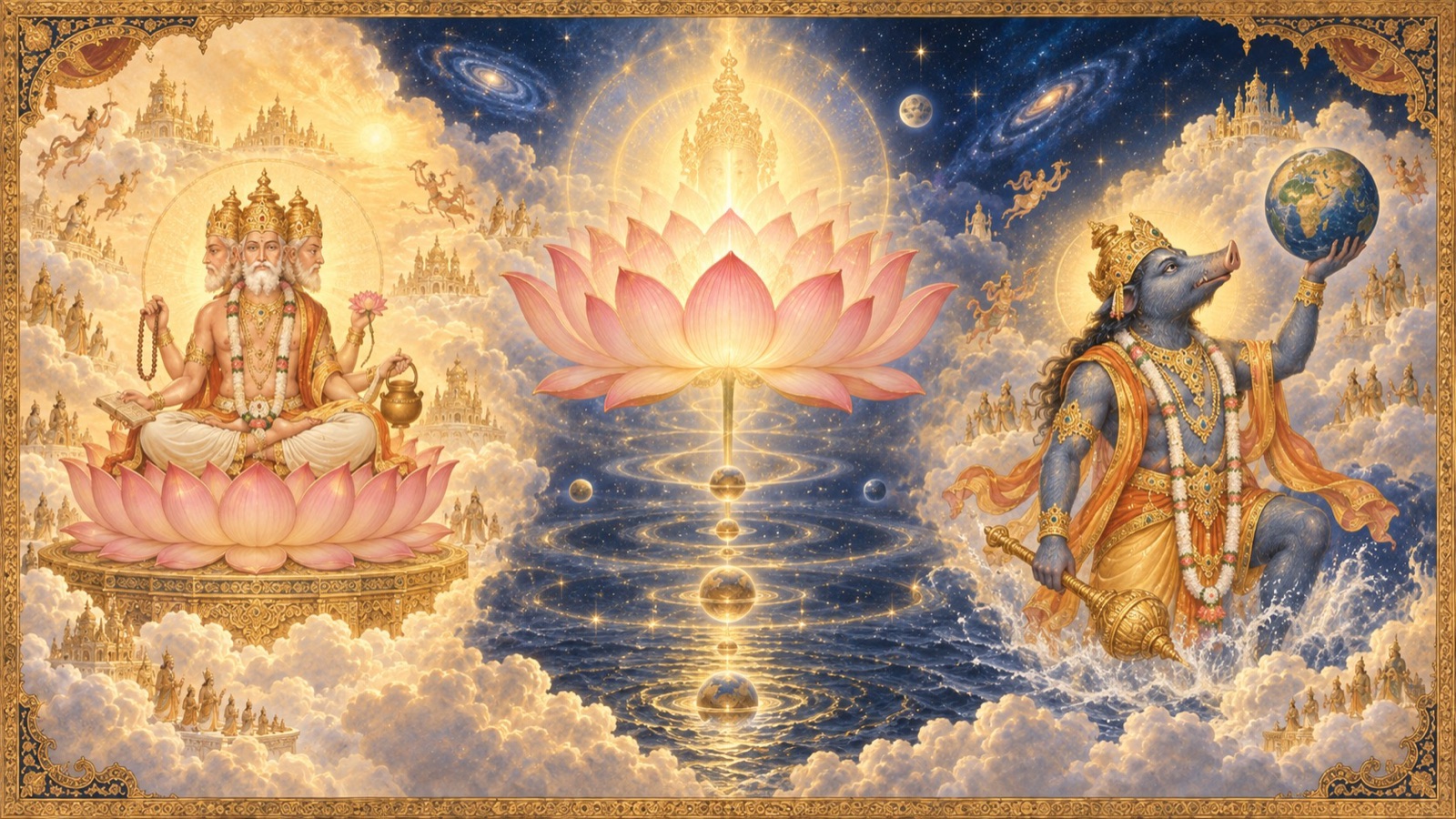
From the scale of a single day and night of Brahma, Maitreya now moves to the full span of Brahma’s own life. One half of that hundred-year life, he explains, is called a Parardha; the first Parardha has already elapsed, and the second is the one now running, beginning with the current Kalpa.
यदर्धमायुषस्तस्य परार्धमभिधीयते । पूर्व: परार्धोऽपक्रान्तो ह्यपरोऽद्य प्रवर्तते ॥ (Canto 3, Chapter 11, verse 33)
yad ardham āyuṣas tasya parārdham abhidhīyate pūrvaḥ parārdho ‘pakrānto hy aparo ‘dya pravartate
Meaning: One half of Brahma’s full life-span is called a Parardha; the first Parardha has already passed, and the second one is now current. (Canto 3, Chapter 11, verse 33)
The first Parardha, Maitreya says, opened with a momentous Kalpa known as the Brahma Kalpa, in which Brahma himself appeared and was recognized by the wise as the Veda personified; and that same Parardha closed with the Padma Kalpa, in which the great lotus containing all the worlds sprang from the pool of Sri Hari’s own navel. The present age, Maitreya tells Vidura, is the opening Kalpa of the second Parardha — the Varaha-Kalpa, so named because Sri Hari assumed the form of the divine Boar within it. And this entire span of two Parardhas, spanning uncountable Manvantaras and Kalpas, Maitreya says, is spoken of, from the vantage of the immutable, immortal, beginningless Lord who is the very Soul of the universe, as no more than the twinkling of a single eye.
कालोऽयं परमाण्वादिर्द्विपरार्धान्त ईश्वर: । नैवेशितुं प्रभुर्भूम्न ईश्वरो धाममानिनाम् ॥ ३९ ॥
kālo ‘yaṁ paramāṇv-ādir dvi-parārdhānta īśvaraḥ naiveśituṁ prabhur bhūmna īśvaro dhāma-māninām
Meaning: This all-powerful Time, ranging from the Paramanu to the length of two Parardhas, has no power over the all-embracing Lord; it holds sway only over those who identify themselves with the body. (Canto 3, Chapter 11, verse 38 in the Gita Press numbering; see Verification notes.)
This is, in a sense, the philosophical center of the entire chapter, arriving only after all the painstaking measurement that came before it. Maitreya has spent nearly forty verses building, with total precision, the largest imaginable scale of time — atoms to Parardhas, moments to Manvantaras — only to conclude that this entire towering structure has no purchase whatsoever on the Lord Himself. Time’s dominion, vast as it is, extends only over those who have identified themselves with a body; the Lord who is beyond the body is, by the same token, beyond Time’s reach altogether.
The Universe as a Single Grain, and the Cause of All Causes
The chapter’s final movement pulls the lens back to its widest possible aperture. This egg-shaped universe, Maitreya explains, built of the eight causal principles and the sixteen evolutes, has a breadth of five million Yojanas, and is wrapped, on the outside, by seven successive sheaths — earth, water, fire, air, ether, the Ego, and the Mahat-tattva — each sheath ten times larger than the one it encloses. And that cause of all causes, Maitreya says, in which this entire universe, sheaths and all, appears as small as a single Paramanu, and which contains within itself countless other universes just like it, is called the indestructible Brahma — the very transcendent reality of the most ancient Person, Lord Vishnu, the Supreme Spirit in embodied form.
विकारै: सहितो युक्तैर्विशेषादिभिरावृत: । आण्डकोशो बहिरयं पञ्चाशत्कोटिविस्तृत: ॥ … तदाहुरक्षरं ब्रह्म सर्वकारणकारणम् । विष्णोर्धाम परं साक्षात्पुरुषस्य महात्मन: ॥
vikāraiḥ sahito yuktair viśeṣādibhir āvṛtaḥ / āṇḍakośo bahir ayaṁ pañcāśat-koṭi-vistṛtaḥ … tad āhur akṣaraṁ brahma sarva-kāraṇa-kāraṇam / viṣṇor dhāma paraṁ sākṣāt puruṣasya mahātmanaḥ
Meaning: This egg-shaped universe, together with its evolutes, wrapped by successive sheaths, has an immense breadth outside — and that cause of all causes, in which this whole universe appears as a mere Paramanu, is called the indestructible Brahma, the very transcendent abode of Lord Vishnu, the Supreme Person Himself. (Canto 3, Chapter 11, verses 39-41 in the Gita Press numbering; see Verification notes.)
With this single, breathtaking image — an entire universe reduced to the size of an atom against the true scale of the Absolute — Maitreya closes his teaching on the divisions of time, and the eleventh discourse of Book Three comes to an end. Chapter Twelve, “The multiplication of creation,” begins immediately after, taking up the story of how Brahma proceeds to actually populate the universe whose scale has just been measured.
Principal Teachings of This Chapter
1. Time itself has a precise, knowable structure, from the smallest imaginable instant to the largest imaginable age. Maitreya’s chapter-long unbroken chain — Paramanu to Anu to Trasarenu to Truti, and onward through Nadikas, Yugas, Manvantaras, and Parardhas — treats the measurement of time not as poetry but as exact, teachable knowledge (verses 1-15).
2. Dharma itself is time-bound, and its four limbs recede one by one across the Yugas. From the complete fourfold virtue of the Krita Yuga to the single thread of truthfulness that survives in Kali, the chapter presents moral decline not as accident but as part of the same lawful structure that governs the length of a day (verses 18-21).
3. Creation, protection, and dissolution repeat endlessly at every scale. A single day and night of ordinary human beings; a single day and night of Brahma, filled with fourteen Manvantaras; the periodic Pralaya that submerges the three worlds — the same essential rhythm of waking and sleeping recurs at every order of magnitude in this chapter (verses 22-32).
4. Even in dissolution, the Lord is at rest, not at risk. The image of Sri Hari reclining peacefully on the causal waters while the three worlds lie submerged teaches that the Lord’s tranquility is untouched by even the most total cosmic destruction (verse 31).
5. The entire scale of Time, however vast, has no power over the Lord Himself. After building the most exhaustive possible measure of cosmic time, Maitreya’s real teaching is that this measure applies only to those identified with a body — the Lord beyond the body stands, by the same logic, entirely beyond Time (verses 38-41).
A Devotional Reflection
There is a quiet humility built into the very structure of this chapter that is easy to miss amid its numbers. Maitreya does not begin with grand philosophy; he begins with the smallest, most modest unit imaginable — a particle of matter too small to be divided further — and only then, patiently, unit by unit, climbs all the way to the life-span of Brahma himself. The lesson embedded in that method is worth sitting with: the vastest truths in this tradition are not reached by leaping over the small ones, but by building through them, faithfully, one careful step at a time. It would have been possible for Maitreya to simply announce the length of Brahma’s life and be done with it. Instead, he walks Vidura through every intermediate unit, as if to say that the immensity of cosmic time only becomes trustworthy, only becomes truly graspable, once its smallest building block has first been properly understood. And when the climb is finally complete — when Brahma’s own hundred years, built from Parardhas, built from Kalpas, built from Manvantaras, built from Yugas, built at last from Paramanus — Maitreya’s conclusion is not one of awe at the vastness of Time, but of a deeper awe still: that the Lord who set this entire scale in motion is not, Himself, contained by any part of it.
A Daily Devotional Practice
Today, take a single ordinary unit of your own time — an hour, or even a single unhurried breath — and hold it, briefly, the way Maitreya holds a Nimesa or a Kshana: as something exact, worth naming, worth respecting, rather than something to rush past unnoticed. Notice how a small, carefully attended moment can, in its own way, contain as much reality as an entire day poorly spent. Then let your mind travel outward, as Vidura’s did, from that single small moment toward the vastest scale you can imagine — a Kalpa, an age, the whole life of the universe — and let both scales, the small and the vast, come to rest in the same place: the Lord who set time itself in motion, and yet remains untouched by it. Before returning to your day, pause and repeat quietly: “Om Namo Bhagavate Vasudevaya.” Let that remembrance be the fixed point around which time itself, from its smallest to its largest measure, is finally understood to turn.
Conclusion
The eleventh discourse of Book Three is, on its surface, the most technical chapter of Canto Three so far — a careful, almost mathematical unfolding of the scale of cosmic time, from the indivisible Paramanu to the vast twin Parardhas of Brahma’s own life. Yet beneath its numbers lies a teaching as devotional as anything else in the Bhagavatam. Maitreya does not measure time for its own sake; he measures it so that its true limit can finally be seen — the point at which even the grandest possible scale of cosmic duration simply stops, having no purchase at all on the Lord who exists beyond body, beyond identification, beyond the very categories that make time meaningful in the first place. Vidura asked, quite reasonably, for the lifespan of beings greater than gods and men. Maitreya answered that question fully and exactly — and then, in the same breath, showed him something greater still: that behind every unit of time, however small or however vast, stands a Person whom no unit can measure at all.
May the divine wisdom of Srimad Bhagavatam awaken pure devotion within our hearts.
Om Namo Bhagavate Vasudevaya.
Jay Shree Madhav.
References and Attribution
- Primary edition: Gita Press, Śrīmad Bhāgavata Mahāpurāṇa (English, complete), Book Three, Discourse 11.
- Series: Srimad Bhagavatam Wisdom · Biswa Sanatan Dharma Seva Trust.
- Presented following the spiritual guidance and recommendation of Pandit Dr. Shri Kashinath Mishra.
This is an original, faithful retelling in the writer’s own words, with brief quoted verses shown in Devanāgarī and transliteration and their meanings given as summaries. It is not a reproduction of any single publisher’s continuous translation or commentary. No affiliation with or endorsement by any publisher is implied.
Jay Shree Madhav