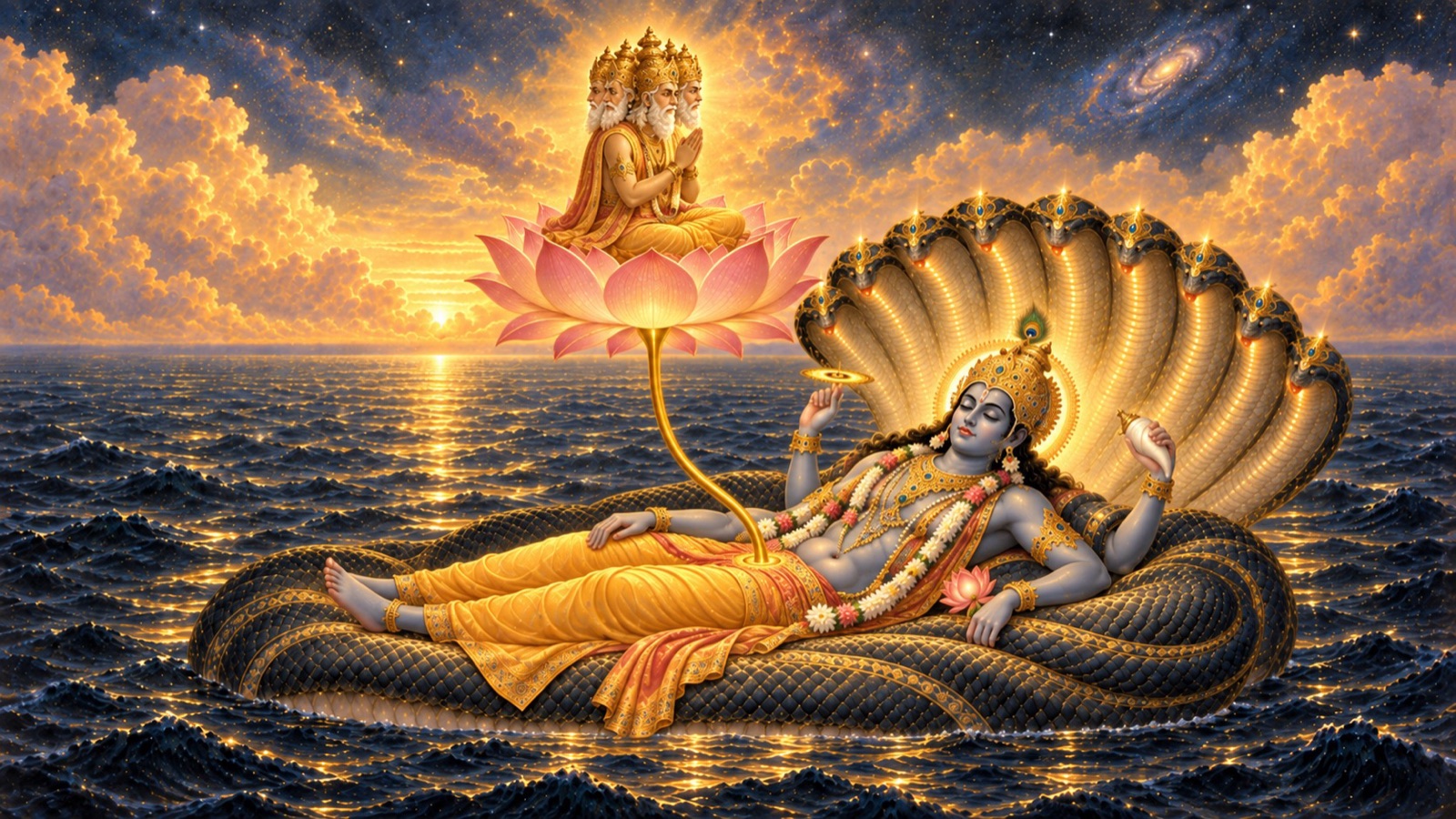
Newly born on a lotus rising from the navel of the sleeping Lord, Brahma looks upon his own Father for the first time — and, unable to begin the work of creation on his own, pours out the most personal and searching hymn of praise in the entire Srimad Bhagavatam.
Om Namo Bhagavate Vasudevaya.
Om Namo Bhagavate Vasudevaya.
Om Namo Bhagavate Vasudevaya.
Welcome to Srimad Bhagavatam Wisdom, a devotional journey through the sacred histories and teachings of the Srimad Bhagavat Mahapurana. The ninth discourse of Book Three arrives at one of the most intimate moments in the whole of Maitreya’s narration to Vidura. Across the previous chapters, the cosmic egg has formed, the Lord has entered it as Garbhodakasayi Vishnu, and from the lotus sprung from His navel, Brahma — dominated by the quality of Rajas and eager to begin the work of creation — has opened his eyes only to find nothing around him but water, wind, sky and the lotus on which he sits. Uncertain, unable to see any material with which to build a universe, he fixes his mind upon the very Lord from whose navel he has emerged. What follows in this chapter is Brahma’s answer to his own bewilderment: not a plan, not a technique, but a prayer — one of the Bhagavatam’s longest and most theologically rich hymns, in which the newly-born creator confesses that he has, after unimaginable ages, only now truly come to know the Lord, and asks for nothing less than the vision and the grace to do the very work for which he was born. The Lord’s reply that closes the chapter is equally tender: reassurance, instruction, and finally, a quiet withdrawal — the Divine Form receding from Brahma’s sight so that the work of creation, entrusted now to Brahma’s own hands, may begin.
Chapter Information
- Scripture: Śrīmad Bhāgavata Mahāpurāṇa
- Canto: 3 (Book Three)
- Chapter: 9 (Discourse 9)
- Chapter title: Brahma extols the Lord
- Principal speakers: Brahma (in prayer) and the Lord (in reply) — the whole scene narrated by the sage Maitreya to Vidura, within the outer frame of Sri Suka’s narration to King Parikshit
- Principal listener within the chapter’s frame: Vidura, receiving Maitreya’s account
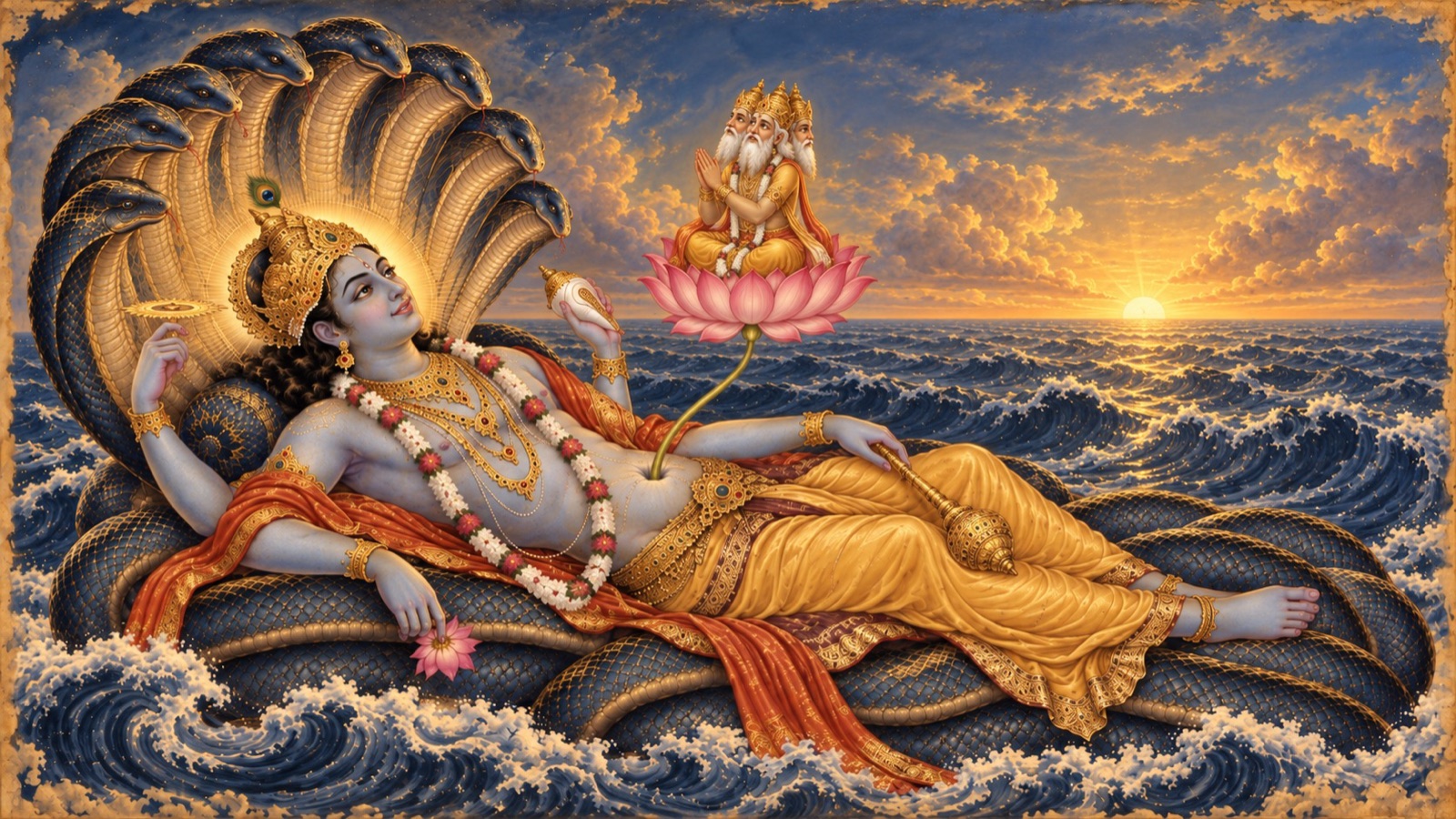
- Main setting: The causal ocean of universal dissolution, where the Lord as Garbhodakasayi Vishnu reclines on the serpent-couch of Sesa, and Brahma sits upon the lotus that has sprung from the Lord’s navel
- Central subject: Brahma’s extended hymn of praise (stuti) to the Lord upon first beholding Him, followed by the Lord’s compassionate reply — reassuring Brahma, instructing him in the path of devotion and Self-knowledge, and commissioning him to undertake the work of creation before withdrawing His own personal form from view
- Principal verse range: Canto 3, Chapter 9, verses 1–44 (Gita Press numbering)
- Primary edition: Gita Press Śrīmad Bhāgavata Mahāpurāṇa
Brahma’s Confession: Knowing the Lord Only After Ages Beyond Counting
The chapter opens with Brahma already in the posture of prayer, having spent the previous chapter searching in vain for any material out of which to fashion the universe and finding, at last, only the Lord Himself worth turning to. His very first words are a confession of long ignorance, remarkable for a being who is himself the highest of created intelligences: it is only now, after an unimaginably long time, that he has truly come to know the Lord. It is shameful, he says, that embodied souls remain blind to who the Lord really is — for there is, in truth, nothing else that exists; and even what appears to exist independently is not ultimately real, since it is the Lord alone who, when the equilibrium of Maya’s three Gunas is disturbed, appears in the form of the many.
ब्रह्मोवाच । ज्ञातोऽसि मेऽद्य सुचिरान्ननु देहभाजां न ज्ञायते भगवतो गतिरित्यवद्यम् । नान्यत्त्वदस्ति भगवन्नपि तन्न शुद्धं मायागुणव्यतिकराद्यदुरुर्विभासि ॥ १ ॥
brahmovāca jñāto ‘si me ‘dya sucirān nanu deha-bhājāṁ na jñāyate bhagavato gatir ity avadyam nānyat tvad asti bhagavann api tan na śuddhaṁ māyā-guṇa-vyatikarād yad urur vibhāsi
Meaning: Brahma said: It is after a very long time that I have come to know You today. It is truly shameful that embodied beings should fail to realize the true nature of the Lord. There is nothing at all other than You; and even that which appears to exist independently is not ultimately real — for it is You alone who, through the interplay of the Gunas of Your Maya, appear here as the manifold universe. (Canto 3, Chapter 9, verse 1)
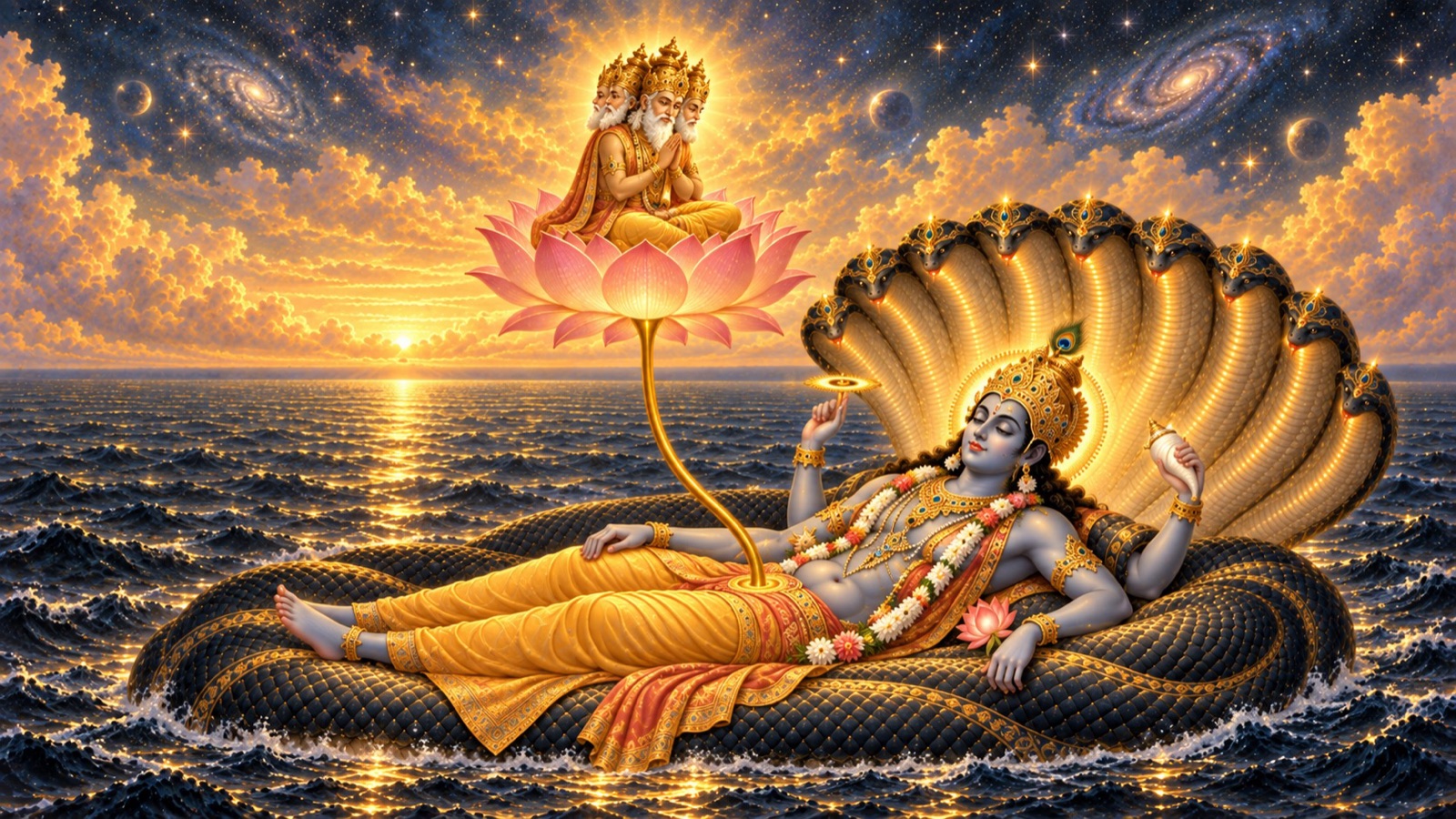
Brahma continues in this vein for several verses, describing the very form he now beholds — the form that is the seed of hundreds of Avataras yet to come — as something the Lord has assumed, for the very first time, purely to show His grace to the worshipper. He is careful to clarify that he does not regard this personal, visible form as somehow lesser than or separate from the Lord’s own undifferentiated, blissful essence; rather, he takes refuge precisely in this form, which — even while creating the universe — remains transcendent to it, and which is the very source of the five elements and the ten Indriyas, the senses of perception and organs of action. It is, Brahma says, entirely for his own good that the Lord has revealed Himself in this way; he makes obeisance again and again to the One who is disregarded only by those addicted to sensory pleasure, who thereby earn for themselves a place in hell.
The Devotee’s Heart: Fear, Attachment, and the Refuge of the Lord’s Feet
Having established the nature of the form before him, Brahma turns to a meditation on the devotee’s condition more broadly — one of the most psychologically penetrating passages in this hymn. The Lord, he says, never departs from the lotus-heart of His devotees, who draw in through their ears the fragrance of His glory carried on the breeze of the Vedas, their hearts bound fast to His feet by the cords of supreme devotion. By contrast, an ordinary man remains subject to fear, grief, covetousness, disgrace and insatiable greed arising from wealth, home and kindred — haunted by a false sense of “mine-ness” that is itself the root of all sorrow — for only so long as he has not yet taken refuge at those same feet, which alone grant freedom from all fear.
Brahma does not spare those who turn away from this path. Those who neglect the practices connected with the Lord — hearing and chanting His praises, which alone destroy all evil — have, he says, been robbed of their good sense by an unpropitious fate; withdrawing their senses from such practice, they remain absorbed in sinful pursuits, their minds gripped by craving for the most trivial pleasures, and correspondingly wretched. And then comes a verse of striking, almost paternal compassion: Brahma confesses that it pains his own soul to foresee these very creatures — not yet created, existing still only as possibilities within the Lord’s own being — repeatedly tormented by hunger and thirst, by the body’s three humours, by the extremes of weather, by mutual conflict, and by the unbearable fires of passion and anger. A footnote preserved in the primary edition explains this striking image: although no living being yet existed before Brahma at that moment, since creation itself had not yet begun, he was able to perceive their subtle bodies within the person of the Lord, and thus, in effect, to foresee their future lives as though he were witnessing them directly.
So long as a man regards himself as separate from the Lord — a separation created entirely by the Lord’s own Maya, working through the senses and their objects — the cycle of birth and death, Brahma observes, will never come to an end for him; and though this cycle has, in truth, no ultimate reality, it remains nonetheless a perennial source of suffering, since through it a man continues to reap the fruit of his own actions. Even those born into families of sages, Brahma adds, are not exempt: if their minds remain absorbed in mundane pursuits by day and their sleep, though constantly disturbed by restless ambition, offers no true rest by night, they too must pass again and again through birth and death, their efforts endlessly frustrated by Providence.
Devotion Alone Reveals the Path
Turning from warning to instruction, Brahma declares that the path to the Lord can be discovered only through hearing His praises — and that the Lord truly dwells within the lotus-heart of devotees whose hearts have been purified through the practice of Devotion. In a verse of great tenderness, Brahma observes that the Lord, in order to oblige His devotees, assumes precisely the form in which each devotee thinks of Him. The Lord, Brahma says, is the one truly disinterested friend of all beings, the very inner Self seated within every heart; and it is not lavish offerings or self-interested worship, however abundant, that pleases Him so much as compassion shown toward all beings — a virtue, Brahma notes pointedly, that the wicked can never acquire.
This leads Brahma to state what might be called the hymn’s central practical teaching: the highest reward of any human action is to win the Lord’s pleasure, whether that action takes the form of sacrificial rites, charitable giving, austere penance, or the observance of sacred vows — for any religious act dedicated to the Lord brings inexhaustible merit, one that never perishes. The illusion of a fragmented, diverse world, Brahma says, stands eternally swallowed up by the very effulgence of the Lord’s Being, which is itself the abode of all wisdom; and even those who, at the moment of death, utter the Lord’s names — signifying His descents, virtues and exploits — even unconsciously, are instantly freed from the accumulated sins of many lifetimes and attain oneness with the Brahman that shines beyond the veil of Maya.
The Lord as the Tree of the Universe, and as Time Itself
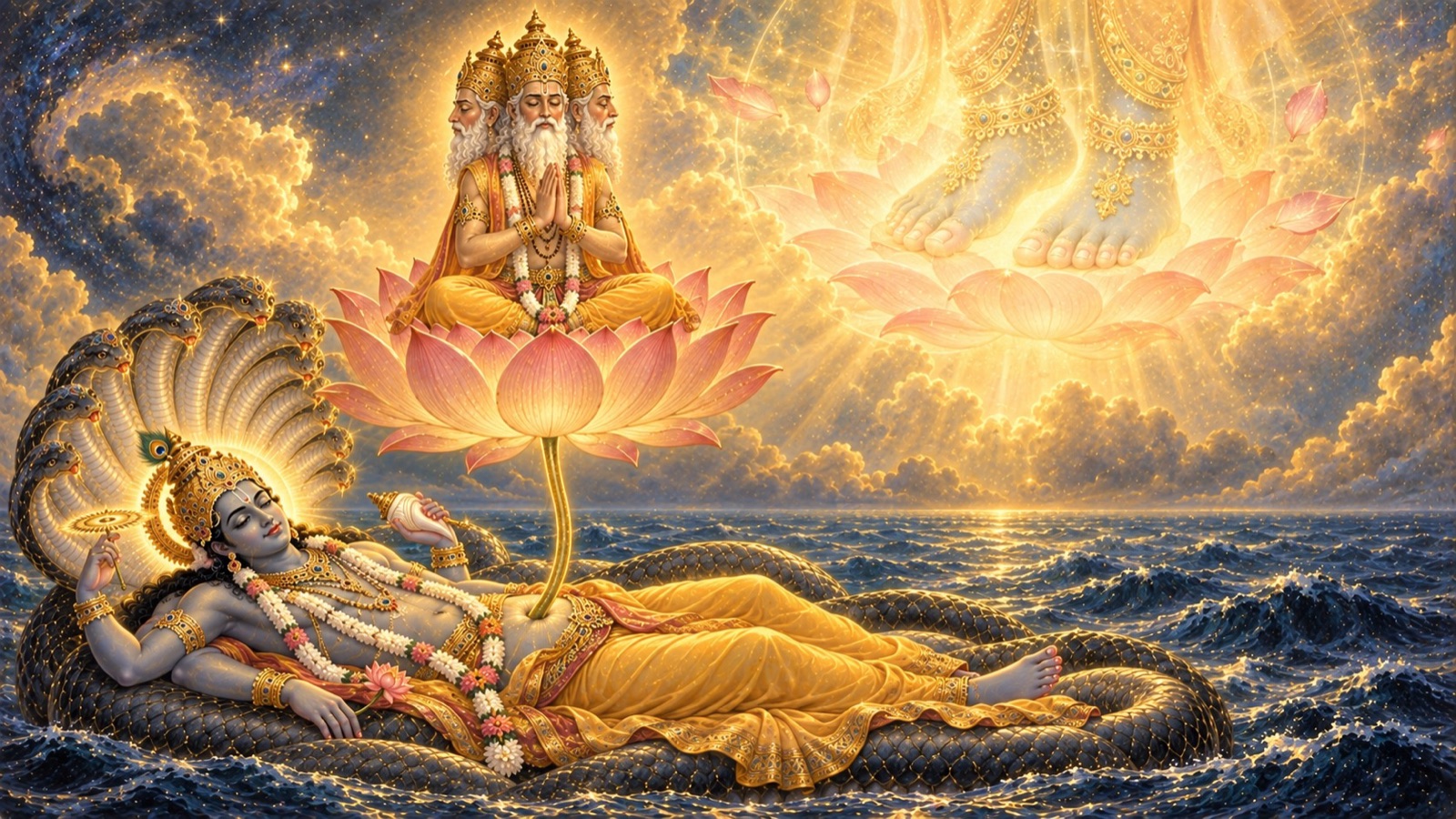
Brahma next offers one of the Bhagavatam’s most memorable images of cosmic structure: obeisance, he says, to the Lord who manifests Himself, at the time of creation, as the very tree of this universe. This tree evolves from Prakrti, which itself is rooted in the Lord; it splits first into the three Gunas — Sattva, Rajas and Tamas — and appears initially as three great trunks: Brahma himself, Lord Vishnu, and Lord Shiva who dwells on Mount Kailasa, each severally responsible for creation, preservation and dissolution, before the tree grows outward into countless boughs and branches — the various lords of created beings, the Manus, and so on.
From this image of cosmic structure, Brahma turns to a meditation on Time. The Lord’s worship, he says, has been declared by the Lord Himself as the duty that yields true happiness; yet neglecting this duty, most men remain engaged in forbidden acts, and Time — most powerful and ever vigilant — cuts short their hope of survival in a single moment. Time itself, Brahma concludes, is nothing other than a form the Lord assumes; his obeisance, therefore, is owed to the Lord under this name as well. Even Brahma himself, presiding as he does over Satyaloka — the highest heaven, enduring for two entire Parardhas, the full span of his own cosmic life, and honoured by all other spheres — confesses that he too fears Time, and that it was precisely to attain freedom from Time’s ravages that he once practised long years of austere penance. His obeisance goes, therefore, to the Lord who presides over all sacrifices.
The Lord’s Forms, and the Lord’s Yogic Sleep
Brahma then turns to the mystery of divine incarnation itself. Though wholly satisfied by His own blissful nature and utterly free of craving for sensory delight, the Lord — simply to uphold the very standards of morality and virtue that He Himself established — voluntarily assumes forms across every species of life: among birds, beasts, human beings and gods alike. Brahma’s salutation goes to this Purushottama, the Supreme Person, in all of these forms.
It is at this point in the hymn that Brahma turns to describe the very scene before his own eyes — the Lord’s yogic sleep upon the causal waters, the scene that frames this entire chapter.
योऽविद्ययानुपहतोऽपि दशार्धवृत्त्या निद्रामुवाह जठरीकृतलोकयात्रः । अन्तर्जलेऽहिकशिपुस्पर्शानुकूलां भीमोर्मिमालिनि जनस्य सुखं विवृण्वन् ॥ २० ॥
yo ‘vidyayānupahato ‘pi daśārdha-vṛttyā nidrām uvāha jaṭharī-kṛta-loka-yātraḥ antar-jale ‘hi-kaśipu-sparśānukūlāṁ bhīmormi-mālini janasya sukhaṁ vivṛṇvan
Meaning: Though wholly untouched by the fivefold Avidya (nescience) that binds ordinary beings, You have enjoyed sleep amid the waters tossed by fearsome waves — a sleep made pleasant by the soft touch of the serpent-bed of Lord Sesa — having gathered all the worlds to rest within Your own belly, thereby revealing to created beings the very relief that sleep itself can bring, even amid the danger and turbulence surrounding them. (Canto 3, Chapter 9, verse 20)
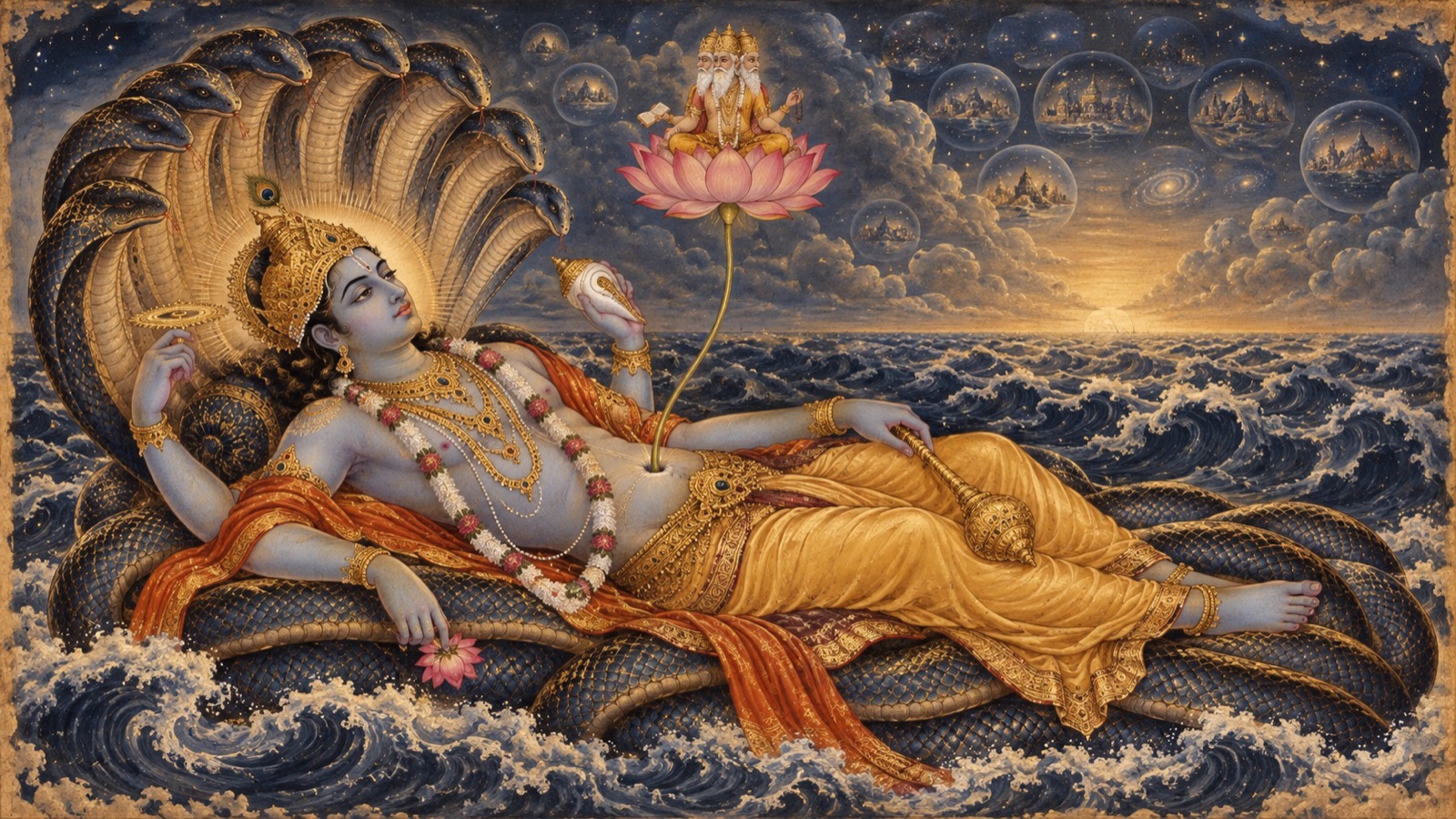
Brahma goes on to describe his own origin directly: it is from the very lotus sprung from the Lord’s navel that he himself has emerged, and it is by the Lord’s grace alone that he has now been given the opportunity to serve the three worlds by creating them. The Lord, Brahma observes, has kept the entire universe safely deposited within His own belly for the whole span of a Kalpa — and now, His lotus eyes have just begun to open, signaling that His sleep, itself a form of profound meditation, is drawing to its close.
Brahma’s Prayer for Creative Vision
With the scene thus set, Brahma makes his actual petition. The Lord, he says, is the sole well-wisher and friend of all beings, animate and inanimate alike — indeed, their very inner Self, the lover of every suppliant. Brahma therefore asks that his own vision and understanding be endowed with the same wisdom and supernatural power by which the Lord delights the entire universe, so that he, Brahma, may be able to create this universe precisely as it existed in the Kalpa that has now passed. Since the Lord grants the wishes of all who take refuge in Him, Brahma asks further that his mind be filled, as he undertakes this work of creation — itself nothing but an exhibition of the Lord’s own creative power — with the memory of every exploit the Lord performs in the course of His descents, together with His eternal consort, the goddess Rama, manifesting countless divine virtues; in this way, Brahma prays, he might remain untouched by the impurities of egotism that so easily attach themselves to the work of creation.
Brahma identifies himself, in this closing portion of his hymn, as the very deity presiding over the Mahat-tattva — the Lord’s own power of cosmic understanding — sprung from the pool of the Lord’s navel even as the Lord Himself slept upon these waters; he prays, therefore, that as he sets out to bring this wondrous creation to light, his utterance of the sacred Vedic words will not fail him. And in the hymn’s final, most personal verse, Brahma makes his ultimate appeal: that the most ancient Person, possessed of infinite grace, would be pleased to open His lotus eyes with a smile of overflowing love, and, rising from His serpent-bed to begin the work of creating the universe, dispel Brahma’s own despondency through the sweetness of His speech.
सोऽसावदभ्रकरुणो भगवान् विवृद्ध- प्रेमस्मितेन नयनाम्बुरुहं विजृम्भन् । उत्थाय विश्वविजयाय च नो विषादं माध्व्या गिरापनयतात्पुरुषः पुराणः ॥ २५ ॥
so ‘sāv adabhra-karuṇo bhagavān vivṛddha- prema-smitena nayanāmburuhaṁ vijṛmbhan utthāya viśva-vijayāya ca no viṣādaṁ mādhvyā girāpanayatāt puruṣaḥ purāṇaḥ
Meaning: May that same Lord of boundless compassion, the most ancient Person, open the lotus of His eyes with a smile of overflowing love, and, rising to accomplish the conquest — that is, the creation — of the universe, dispel our despondency through the sweetness of His speech. (Canto 3, Chapter 9, verse 25)
Brahma Falls Silent, and the Lord Responds
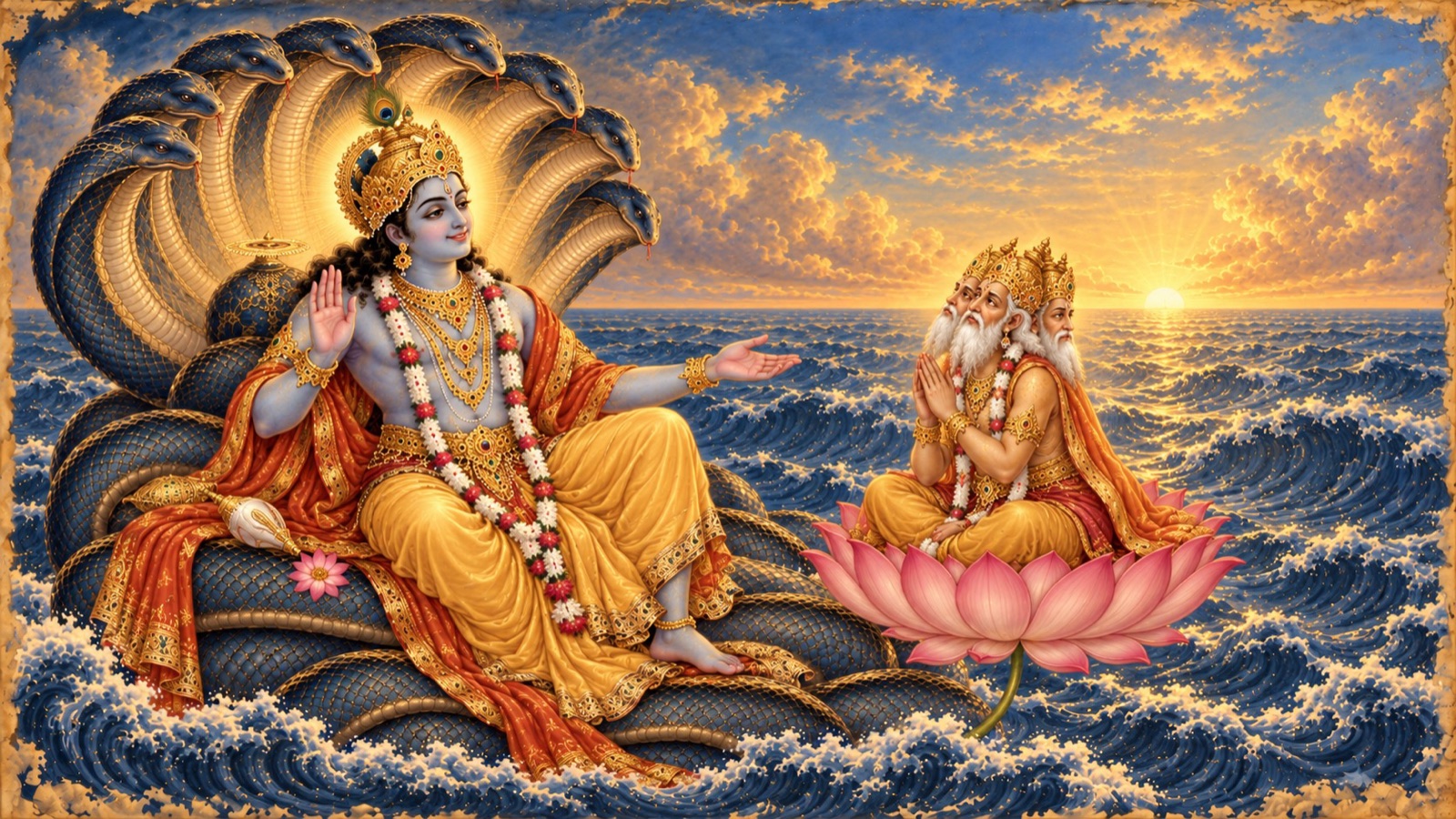
Maitreya then narrates a quiet but touching moment: having thus beheld his own Father through austere penance, worship and meditation, Brahma extolled Him as fully as his mind and speech allowed — and then simply stood silent, as though exhausted by the effort. Lord Vishnu, perceiving Brahma’s despondency amid the surging waters of universal dissolution, and aware that Brahma remained uncertain of the relative position of the worlds he was meant to create, now addresses him directly, as though lifting him out of his own faint-heartedness.
मा वेदगर्भ गास्तन्द्रीं सर्ग उद्यममावह । तन्मयापादितं ह्यग्रे यन्मां प्रार्थयते भवान् ॥ २९ ॥
śrī-bhagavān uvāca mā veda-garbha gās tandrīṁ sarga udyamam āvaha tan mayāpāditaṁ hy agre yan māṁ prārthayate bhavān
Meaning: The Personality of Godhead said: O Brahma, repository of the Vedas, do not fall prey to lassitude — exert yourself for the work of creation. Whatever you ask of Me, I have already arranged for you from the very outset. (Canto 3, Chapter 9, verse 29)
The Lord’s Teaching: Devotion, Self-Knowledge, and the Charge to Create
What follows is a compact but profound teaching, spoken by the Lord Himself to console and instruct His newly-born son. Brahma is told to practise penance and worship once more through Mantras sacred to the Lord, and in doing so, he will find the worlds themselves revealed within his own heart. With devotion and a concentrated mind, Brahma will come to see the Lord pervading both himself and the entire universe, and will behold all worlds and all Jivas — every embodied soul — resting within the Lord. The very moment a man perceives the Lord present in all beings, the Lord explains, as fire is present, latent, in every piece of wood, he is freed from all delusion; and when he realizes himself as distinct from the five gross elements, the senses, the Gunas and the inner mind — identical, instead, with the Lord as his own true Self — he attains liberation.
The Lord reassures Brahma that even as he sets about evolving countless creatures according to the accumulated stock of their past Karma, his mind will not be thrown into confusion, precisely because he carries the Lord’s own grace in abundance; the destructive force of Rajoguna, the principle of restless activity, will not bind Brahma, the very first of seers, since his mind will remain fixed on the Lord even while he is occupied with the vast labour of creation. Today, the Lord says, Brahma has truly come to know Him — a knowledge that most living beings find exceedingly difficult to attain — precisely because Brahma understands the Lord as free from the five elements, the senses, the Gunas and the mind itself.
There is a deeper doctrine folded into this reassurance. Rajoguna — the very quality of restless activity that will drive the whole work of creation — is elsewhere named among the chief causes of bondage; action performed in this mode ordinarily entangles the doer ever more deeply in its results. Here the Lord states plainly that Rajoguna will not bind Brahma, not because Brahma will somehow avoid activity, but because his mind remains fixed on the Lord even while immersed in it. The point is unmistakable: it is not action itself, nor its mode, that binds a soul, but the object to which the mind clings while acting. Creation performed with the Lord as its center is worship; the same labour performed for one’s own sake is bondage (verses 34-35).
The Lord then recalls, with evident warmth, the very episode that first taught Brahma this truth: when Brahma, doubting the Lord’s existence, searched along the stalk of the lotus down into the water for its root, it was the Lord who revealed His own being within Brahma’s own self. Whatever hymn of praise Brahma has now offered, interwoven with the glory of the Lord’s own stories, and whatever faith Brahma has developed through austere penance — all of this, the Lord says plainly, is itself due to His own grace. May success attend Brahma; the Lord declares Himself pleased, since Brahma, in his very eagerness to create the worlds, has described the Lord as free of the Gunas even while the Lord appears, to ordinary sight, to be endowed with them. Indeed, the Lord promises that He, the Bestower of all desired blessings, will be swiftly and immensely pleased with any devotee, in any age, who worships Him while repeating this very hymn of praise.
The knowers of Truth, the Lord continues, hold that His own pleasure alone — not works of public utility such as the digging of tanks and wells, not austere penance, sacrificial rites, charitable gifts, the practice of Yoga, or abstract meditation pursued for their own sake — constitutes the highest good that men can attain. The Lord identifies Himself, in one of the chapter’s most direct statements of intimacy, as the Ordainer, the very Self of the self of all beings, dearer even than the dearest of the dear; therefore, He says, a man should fix his love on Him alone, for the body and every other thing that seems dear is dear only for His sake. With this teaching complete, the Lord gives Brahma his charge: now, He says, evolve the three worlds and all the beings who lie hidden within Me, just as they existed in the Kalpa that has passed, by means of your own personality — a personality that has itself emanated from Me, and which is nothing other than an embodiment of all the Vedas.
The Lord Withdraws His Form
The chapter closes with a single, quiet verse of narration from Maitreya. The Lord, whose navel bears the distinguishing mark of the lotus that sprang from it, and who is the Ruler of both Matter and Spirit alike, having thus disclosed to Brahma — the Creator of the universe — the very means by which creation is to unfold, withdrew from Brahma’s sight His own personal form: the form known by the name of Narayana.
तस्मा एवं जगत्स्रष्ट्रे प्रधानपुरुषेश्वरः । व्यजयेदं स्वेन रूपेण कञ्जनाभस्तिरोदधे ॥ ४४ ॥
maitreya uvāca tasmā evaṁ jagat-sraṣṭre pradhāna-puruṣeśvaraḥ vyajyedaṁ svena rūpeṇa kañja-nābhas tirodadhe
Meaning: Maitreya continued: The Lord, whose navel bears the lotus, and who is the controller of both the material principle and the individual spirit, having thus revealed to the world’s creator (Brahma) the means of accomplishing the creation, withdrew His own personal form from view. (Canto 3, Chapter 9, verse 44)
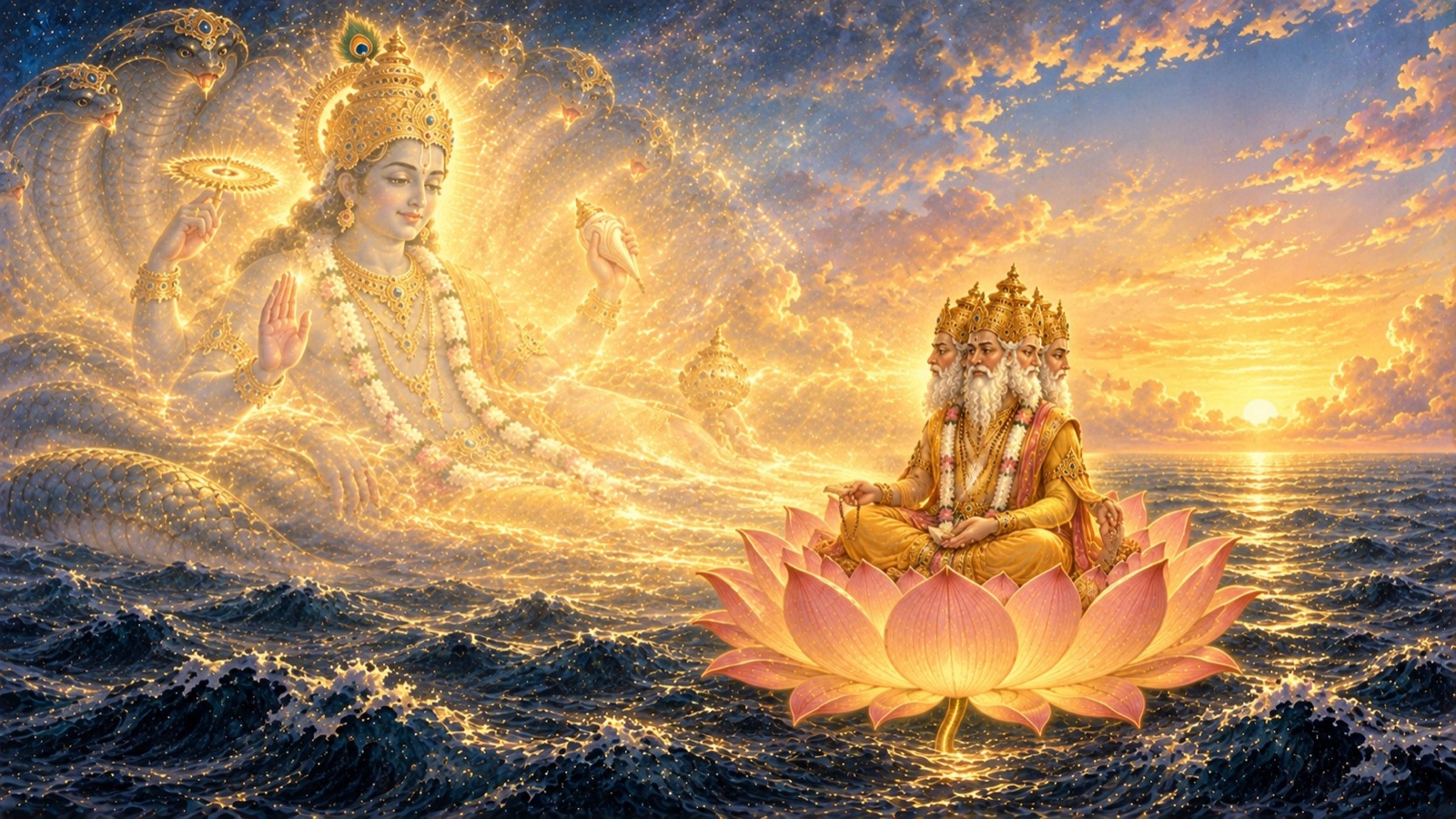
The chapter thus ends on a note quite different from its opening: what began as Brahma’s bewildered confession of not-knowing closes with the Lord’s own personal form receding from view, having left behind not confusion but a settled, grace-filled confidence — Brahma now ready, at last, to undertake the work of creation described in the discourse that follows.
Thus ends the ninth discourse in Book Three of the great and glorious Bhagavata-Purana, otherwise known as the Paramahamsa-Samhita.
Principal Teachings of This Chapter
1. True knowledge of the Lord comes only after long searching, even for Brahma. The creator of the universe himself admits that only now, after ages beyond his own reckoning, has he truly come to know his Father — a reminder that intimacy with the Divine is a matter of grace and grown recognition, not automatic entitlement, however exalted one’s position (verse 1).
2. Compassion, not lavish offering, is what pleases the Lord. Brahma states plainly that the Lord is not pleased so much by abundant worship offered with self-interested motives as He is by compassion shown toward all beings — a virtue, Brahma notes, that the wicked can never acquire (verse 12).
3. The Lord assumes the form each devotee holds in the heart. “In order to oblige Your devotees You assume that very form in which they think of You” — one of the Bhagavatam’s clearest statements on the intimate, personal responsiveness of divine grace to sincere devotion (verse 11).
4. Even the deity presiding over Time fears Time — because Time, too, is the Lord. Brahma, ruler of the highest heaven for two entire Parardhas, confesses his own fear of Time, then resolves the paradox by recognizing Time itself as nothing other than a form the Lord assumes (verses 17-18).
5. Liberation is the recognition of the Self as distinct from matter and identical with the Lord. The Lord’s own teaching to Brahma is direct: realizing oneself as devoid of the elements, the senses, the Gunas and the mind, and identical instead with the Lord as one’s true Self, is itself liberation (verse 33).
6. Creation is entrusted, never simply seized. Brahma does not presume to create on his own initiative or ability; he waits, prays, and receives both reassurance and instruction before the Lord charges him, explicitly, with the work — and only then withdraws His own visible form, leaving Brahma to act with confidence rather than autonomy (verses 29-44).
A Devotional Reflection
There is something deeply reassuring in the shape of this chapter for anyone who has ever stood, like Brahma, at the beginning of a task too large to grasp. Brahma is not an ordinary being — he is the very architect of the universe, the first-born of all creation — and yet his response to the moment of his own commissioning is not confidence but confession, not a plan but a prayer. He tells the truth about his own long ignorance before he asks for anything. He describes, in the same breath, both the majesty of the form before him and his own need for that form’s compassion. And when the answer comes, it comes not as a technical solution but as reassurance, spoken directly, person to person: do not despair; what you have asked has already been arranged; My grace is already yours in abundance. Only after this reassurance does the Lord withdraw, trusting Brahma now to act. Perhaps this is itself the chapter’s quiet lesson — that readiness for any great work begins not in self-sufficiency but in this same posture of honest confession and patient waiting upon grace.
A Daily Devotional Practice
Today, before beginning whatever task feels, in its own small way, as vast and uncertain as creation itself must have felt to Brahma, pause and offer an honest confession of your own not-knowing — not as a confession of failure, but as the very posture from which real help becomes possible. Ask, in whatever words are natural to you, for the vision and the steadiness that only grace can supply, trusting that whatever you have sincerely asked for has, in some sense, already been arranged. Before you begin your work, pause and repeat quietly: “Om Namo Bhagavate Vasudevaya.” Let that remembrance be your own small hymn of praise — an echo, however humble, of the prayer with which the universe’s own first architect began his work.
Conclusion
The ninth discourse of Book Three is, in many ways, the emotional and theological heart of the Bhagavatam’s creation-narrative: not a description of mechanisms, as the previous chapters have offered, but an encounter — Brahma, newly born, face to face for the first time with the very source of his own being, pouring out forty-four verses of praise that move from cosmic philosophy to the most personal confession of fear and gratitude, and receiving in turn not a rebuke for his hesitation but a Father’s reassurance. The Lord’s reply distills, in a few unforgettable verses, some of the Bhagavatam’s central teachings on devotion, Self-knowledge and liberation, before withdrawing His personal form and leaving Brahma — now instructed, comforted and charged — to take up the work of creation that the chapters ahead will describe in full. It is a chapter that asks every reader, whatever the scale of the task before them, to notice the same sequence: honest confession, sincere prayer, and the quiet confidence that follows when grace has spoken.
May the divine wisdom of Srimad Bhagavatam awaken pure devotion within our hearts.
Om Namo Bhagavate Vasudevaya.
Jay Shree Madhav.
References and Attribution
- Primary edition: Gita Press, Śrīmad Bhāgavata Mahāpurāṇa (English, complete), Book Three, Discourse 9, internal pages 169–174.
- Series: Srimad Bhagavatam Wisdom · Biswa Sanatan Dharma Seva Trust.
- Presented following the spiritual guidance and recommendation of Pandit Dr. Shri Kashinath Mishra.
This is an original, faithful retelling in the writer’s own words, with brief quoted verses shown in Devanagari and transliteration and their meanings given as summaries. It is not a reproduction of any single publisher’s continuous translation or commentary. No affiliation with or endorsement by any publisher is implied.
Jay Shree Madhav