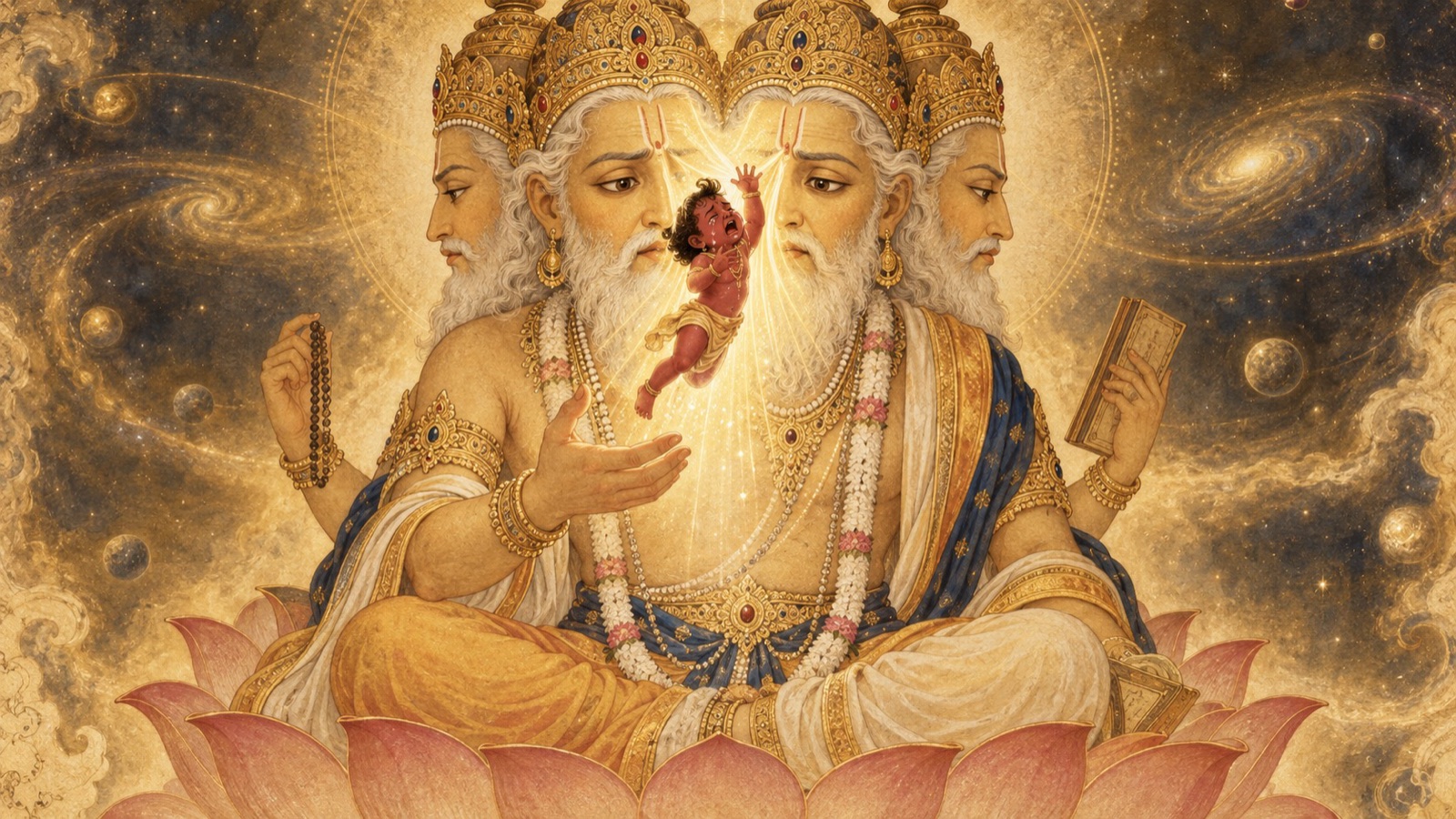
Between the brows of the frustrated Creator, a boy of dark-red hue bursts suddenly into being, crying out for a name and a place in the world he has just entered — the first anger of Brahma given form, and the first tears of the god who will be called Rudra.
Om Namo Bhagavate Vasudevaya.
Om Namo Bhagavate Vasudevaya.
Om Namo Bhagavate Vasudevaya.
Welcome to Srimad Bhagavatam Wisdom, a devotional journey through the sacred histories and teachings of the Srimad Bhagavat Mahapurana. Having praised the Supreme Spirit under the name of Time in the previous chapter, Maitreya now turns to the work Vidura has been waiting to hear about since this discourse began: how Brahma, the self-born repository of the Vedas, actually set creation in motion. It is not a tidy or triumphant story. Brahma’s first attempt produces nothing but ignorance. His most brilliant sons refuse to help him. His own suppressed anger erupts from his brow as a howling child who will become Rudra. Ten more sons spring from ten different parts of his body, and still creation will not multiply — until, in a passage the tradition treats with great delicacy, Brahma’s own desire nearly undoes him, and he is rebuked by his own children before he can begin again in a second body. Chapter 12 is where the Bhagavatam shows us creation not as a single divine command but as a long, difficult, deeply personal labor — one that finally succeeds only through Svayambhuva Manu and his queen Satarupa.
Chapter Information
- Scripture: Śrīmad Bhāgavata Mahāpurāṇa
- Canto: 3 (Book Three)
- Chapter: 12 (Discourse 12)
- Chapter title: The Multiplication of Creation
- Principal speaker: Maitreya, continuing his discourse to Vidura (the whole related, in the outermost frame, by Suta Gosvami to the sage Saunaka and the assembly at Naimisharanya)
- Principal listener: Vidura, who also speaks once within the chapter (verse 36) to ask Maitreya for further detail
- Main setting: The bank of the river Ganga, where Maitreya and Vidura remain seated, as in the chapters before; within the narration, the whole of the newly-created universe as Brahma labors to populate it
- Central subject: Brahma’s unintended creation of the five kinds of ignorance; the four Kumaras and their refusal to procreate; the birth of Rudra from Brahma’s anger; Rudra’s fearsome offspring and his retirement to penance; the ten sons born from Brahma’s body who further creation; Brahma’s shame over his daughter Vak and the casting-off of his body as fog; the Vedas, sciences and sacred order issuing from Brahma’s four mouths; and the birth, through Svayambhuva Manu and Satarupa, of the five children whose own descendants would fill the universe
- Principal verse range: Canto 3, Chapter 12, verses 1–56 (with verses 49–52 rendered as a single continuous passage in the Gita Press English translation)
- Primary edition: Gita Press Śrīmad Bhāgavata Mahāpurāṇa
Turning from Time to the Work of Creation
Maitreya opens this chapter by closing the last one. He tells Vidura, in effect: I have now finished describing to you the glory of the Supreme Spirit under the name of Time; now hear how Brahma, the repository of the Vedas, proceeded with the actual work of creation.
मैत्रेय उवाच इति ते वर्णित: क्षत्त: कालाख्य: परमात्मन: । महिमा वेदगर्भोऽथ यथास्राक्षीन्निबोध मे ॥ १ ॥
maitreya uvāca iti te varṇitaḥ kṣattaḥ kālākhyaḥ paramātmanaḥ mahimā veda-garbho ‘tha yathāsrākṣīn nibodha me
Meaning: Maitreya told Vidura that his account of the Supreme Being’s majesty in His all-devouring time-form now stood complete, and that he would next explain how Brahma, keeper of the Vedas, took up the actual work of creating. (Canto 3, Chapter 12, verse 1)
It is a small, businesslike verse, but it marks an important shift in the discourse. Everything before this point — the vision of the Lord as the all-devouring form of Time, the meditations on His majesty — has been preparation. Now Maitreya takes up the actual mechanics of how a universe gets built, and the story he tells is far stranger and more human than a simple account of divine fiat.
Brahma’s First, Unwanted Creation
Before Brahma manages to create anything he intends, he creates something he does not: the five kinds of ignorance. Tamas, the ignorance of one’s own true self; Moha, the false identification of the self with the body; Mahamoha, the endless craving for sense-enjoyment; Tamisra, anger; and Andhatamisra, the delusion of regarding death as one’s own final end — these are the very first “creation” that issues from Brahma, and he takes no pleasure in what he has made. Displeased with himself at this most wicked beginning, Brahma turns to meditation on the Lord, purifies his mind, and only then evolves a different kind of creation altogether: the four sages Sanaka, Sanandana, Sanatana and Sanatkumara — lifelong celibates, “Urdhvareta” in the tradition’s own term, who have mastered their senses so completely that even the ordinary current of life is said to flow upward rather than down.
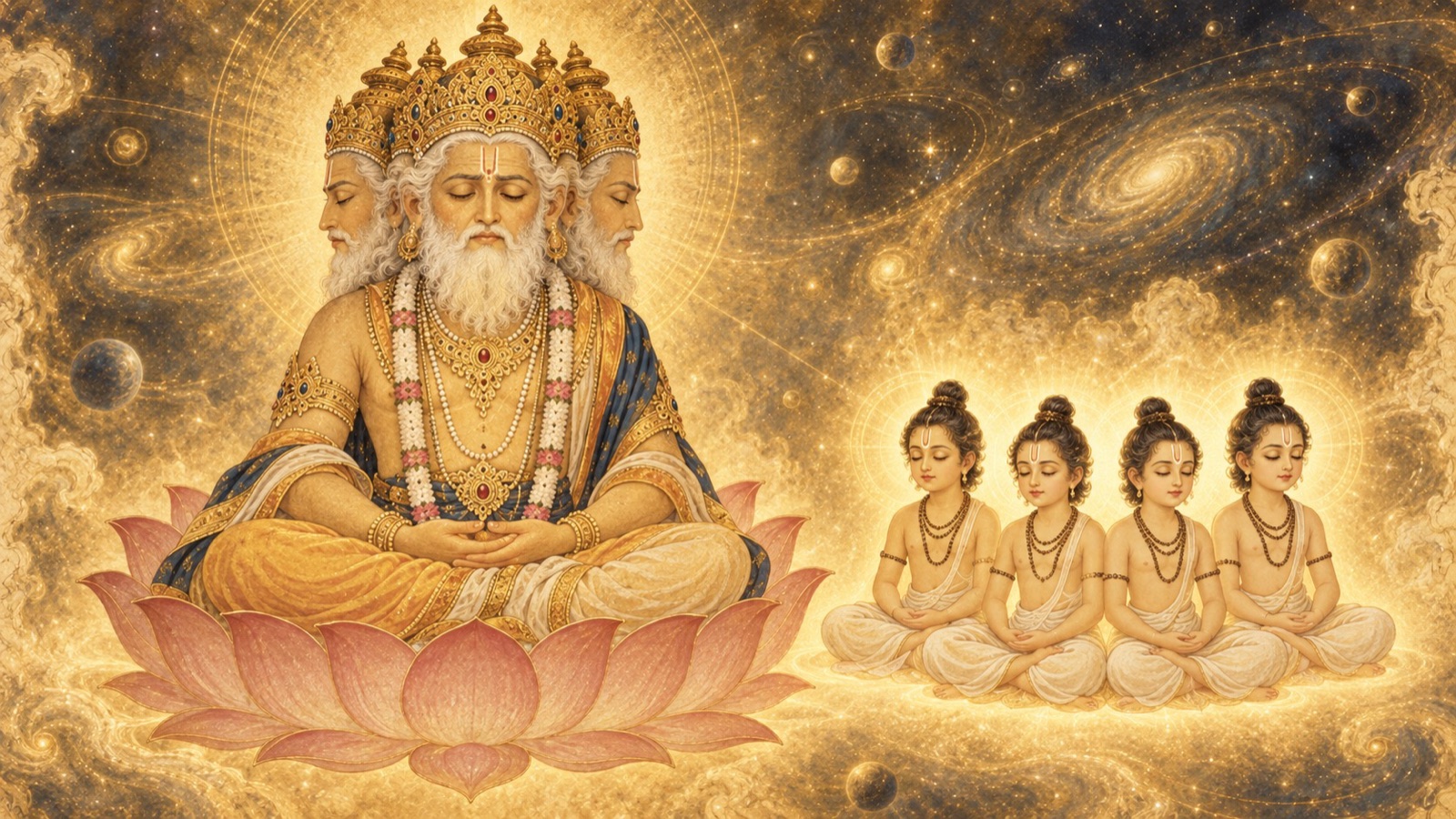
Brahma asks these four remarkable sons to do the one thing any father wants of his children: to marry, to have children of their own, to continue the family. They refuse. Their hearts, the Bhagavatam tells us, are set on Lord Vasudeva as the highest goal, and they have already taken the path of renunciation as their road to liberation. It is not defiance so much as a different calling entirely — but for Brahma, standing at the very beginning of creation with almost nothing yet made, it is a serious setback. His own first successful sons, the very embodiment of purity and wisdom, want no part in the work he needs done.
The Birth of Rudra from Brahma’s Anger
Disregarded by the sons he had hoped would help him, Brahma tries to master the anger rising in him. He fails. Despite every effort to restrain it by force of reason, that suppressed fury bursts forth from between his brows — and what emerges is not an abstraction but a living being: a boy of dark-red hue, crying.
स वै रुरोद देवानां पूर्वजो भगवान् भव: । नामानि कुरु मे धात: स्थानानि च जगद्गुरो ॥ ८ ॥
sa vai ruroda devānāṁ pūrvajo bhagavān bhavaḥ nāmāni kuru me dhātaḥ sthānāni ca jagad-guro
Meaning: That boy — none other than the worshipful Lord Bhava, eldest-born among the gods — cried out, “Give me names, O Creator, and also assign me abodes, O father of the world.” (Canto 3, Chapter 12, verse 8)
This is Rudra, and the scene is remarkable for how tender and almost domestic it is. A newly-born god, frightened and crying like any child, simply asks his father for an identity — a name, a place to belong. Brahma answers gently, in kind tones, telling the boy not to cry, that he will provide for him at once.
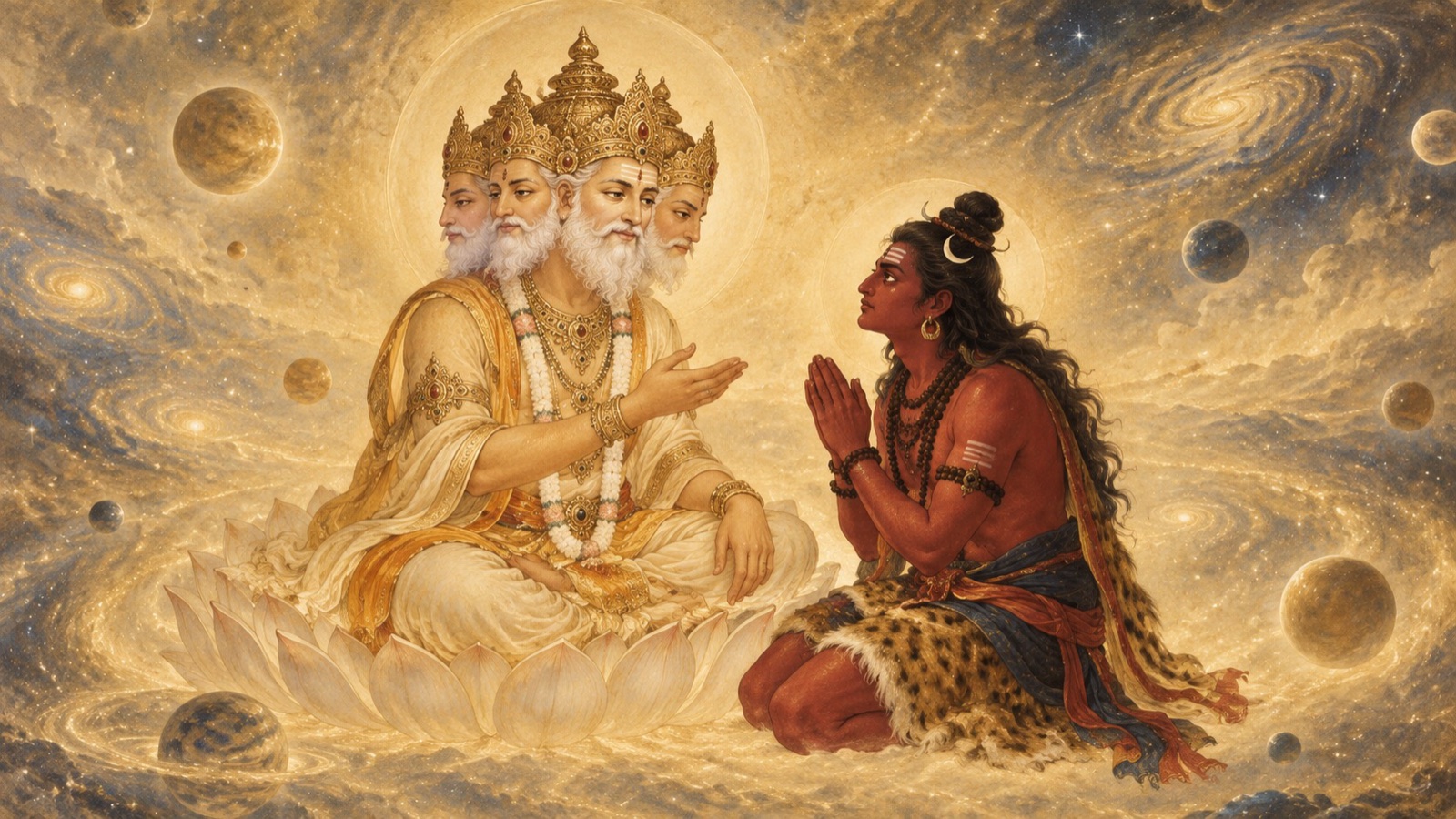
Because the boy wept as a frightened child, Brahma tells him, people will forever call him by the name Rudra — “one who weeps.”
यदरोदी: सुरश्रेष्ठ सोद्वेग इव बालक: । ततस्त्वामभिधास्यन्ति नाम्ना रुद्र इति प्रजा: ॥ १० ॥
yad arodīḥ sura-śreṣṭha sodvega iva bālakaḥ tatas tvām abhidhāsyanti nāmnā rudra iti prajāḥ
Meaning: Because you cried out in fear like a startled child, O chief of the gods, from now on people will call you by the name Rudra. (Canto 3, Chapter 12, verse 10)
Brahma does not stop at one name. He assigns Rudra a whole series of further names — Manyu, Manu, Mahinasa, Mahan, Siva, Rtadhwaja, Ugrareta, Bhava, Kala, Vamadeva, Dhrtavrata — each tied to a specific abode: the heart, the senses, the vital air, ether, air, fire, water, earth, the sun, the moon, and austere penance itself. And he gives Rudra eleven wives, the Rudranis — Dhi, Vrtti, Usana, Uma, Niyut, Sarpi, Ila, Ambika, Iravati, Sudha and Diksa — instructing him to accept these names, abodes and consorts, and to beget through them, since he too is now a Prajapati, a lord of created beings entrusted with the work of procreation.
The Fearsome Hosts of Rudra
Rudra obeys, and the result terrifies his own father. The progeny Rudra begets resemble him closely in strength, appearance and temperament — and they multiply into vast, numberless hosts of Rudras, burning with fearful eyes, threatening to devour the still-fragile creation on every side, including Brahma himself.
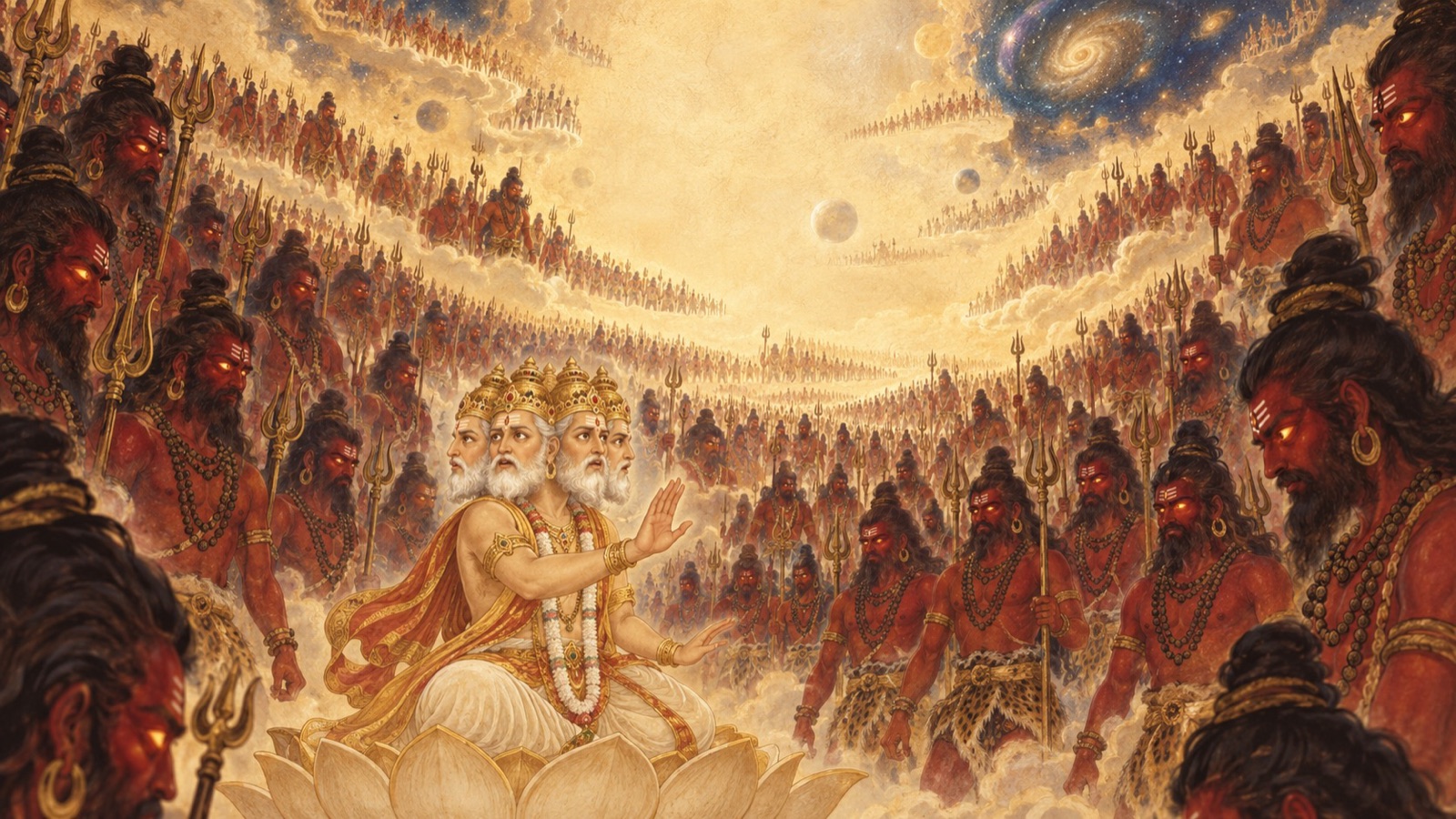
Alarmed, Brahma pleads with Rudra to beget no more such offspring. Instead, he asks him to practise austere penance — the one discipline, Brahma says, through which every living being finds true good and this universe can again be set in order as it was before the last dissolution.
तपसैव परं ज्योतिर्भगवन्तमधोक्षजम् । सर्वभूतगुहावासमञ्जसा विन्दते पुमान् ॥ १९ ॥
tapasaiva paraṁ jyotir bhagavantam adhokṣajam sarva-bhūta-guhāvāsam añjasā vindate pumān
Meaning: By penance alone, and by no other means, a soul comes directly to that supreme effulgence — the Personality of Godhead who lies hidden in the heart-cave of every creature, beyond the grasp of the material senses. (Canto 3, Chapter 12, verse 19)
Rudra’s answer is immediate and simple: “All right.” He circles his father in a gesture of respect and withdraws to the forest to take up austerities. It is a striking moment — the god who will become one of the great deities of the tradition begins his path not with grand cosmic authority but with an act of quiet obedience and self-restraint, choosing tapas over further, unchecked procreation.
Ten Sons, and Creation Continues Through Brahma’s Own Body
With Rudra’s line contained, Brahma tries again. Equipped anew with the Lord’s own creative energy, he brings forth ten more sons dedicated to multiplying creation properly: Marici, Atri, Angira, Pulastya, Pulaha, Kratu, Bhrgu, Vasistha and Daksa — with Narada named as the tenth.
मरीचिरत्र्याङ्गिरसौ पुलस्त्य: पुलह: क्रतु: । भृगुर्वसिष्ठो दक्षश्च दशमस्तत्र नारद: ॥ २२ ॥
marīcir atry-aṅgirasau pulastyaḥ pulahaḥ kratuḥ bhṛgur vasiṣṭho dakṣaś ca daśamas tatra nāradaḥ
Meaning: Marici, Atri and Angira, Pulastya, Pulaha and Kratu, Bhrgu and Vasistha and Daksa — and Narada as the tenth among them. (Canto 3, Chapter 12, verse 22)
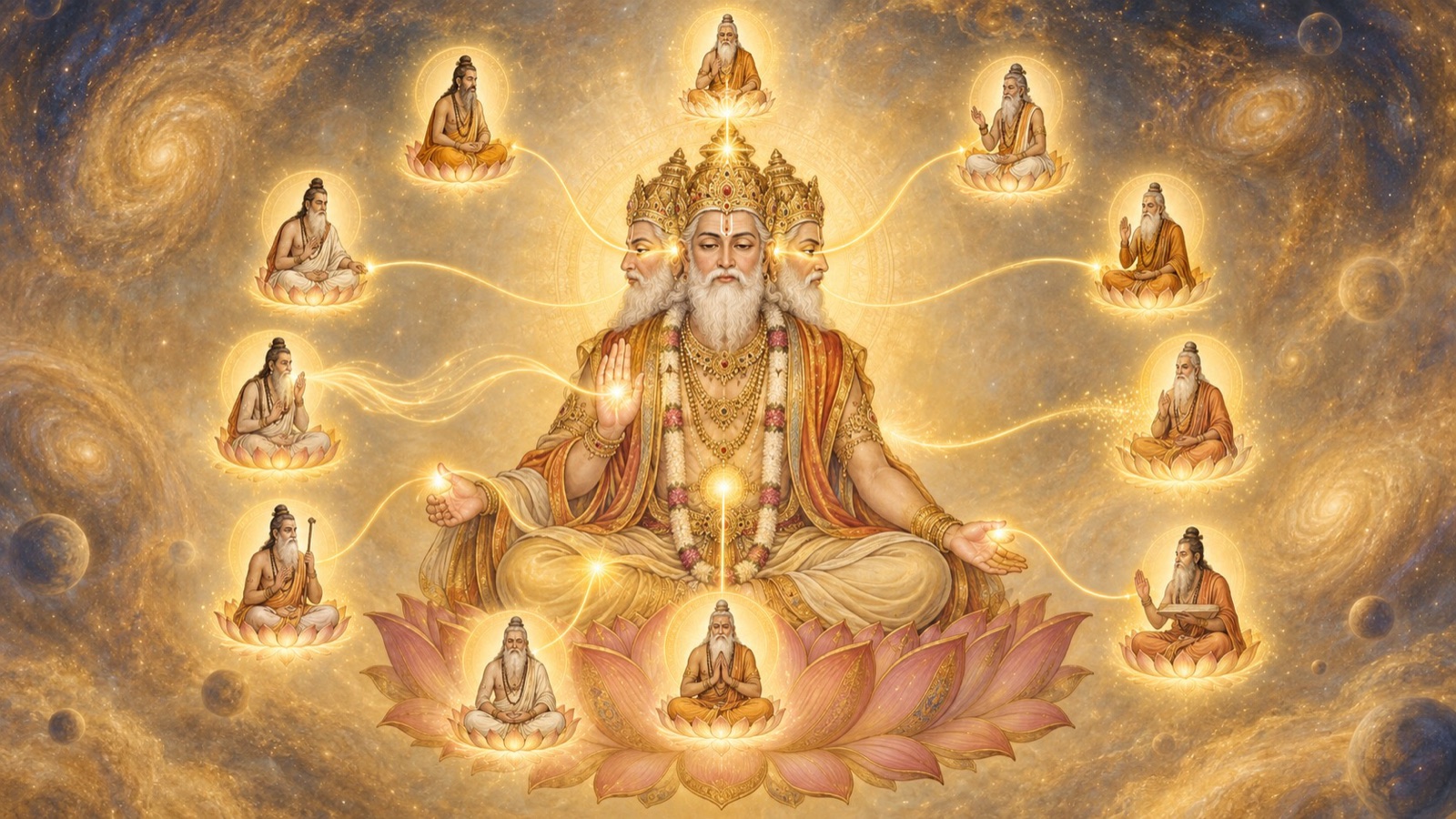
What is remarkable about these ten sons is where they come from. Each is said to have emerged from a distinct part of Brahma’s own body: Narada from his lap, Daksa from his thumb, Vasistha from his breath, Bhrgu from his skin, Kratu from his hand, Pulaha from his navel, Pulastya from his ears, Angira from his mouth, Atri from his eyes, and Marici from his mind. The pattern continues beyond these ten: Dharma, the god of virtue — from whom Lord Narayana Himself would descend in the twin forms of Nara and Narayana — appeared from Brahma’s right breast; Adharma, from whom sprang the terrifying god of death, appeared from his back; Kama (desire) came from his heart; Anger from his brows; Greed from his lower lip; Vak, the goddess of speech, from his mouth; the oceans from his generative organ; and Nirrti, the spirit presiding over sin, from his anus. Even the sage Kardama, the future husband of Devahuti and father of Lord Kapila, is said to have emerged from Brahma’s shadow. The whole of creation, Maitreya tells Vidura, was evolved either from the mind or from the body of Brahma.
Brahma’s Shame, and the Body Cast Off as Fog
The chapter now turns to one of its most difficult passages, one the tradition itself treats carefully rather than glossing over. Eager to push creation further along, Brahma becomes infatuated with his own daughter Vak, who is described as most handsome and captivating — though she herself has no such desire toward him. His sons, Marici and the other sages, see what has taken hold of their father and speak to him directly, out of filial love rather than condemnation: it is strange, they say, that one who has mastered his own self should be unable to control his passion toward his own daughter; such a thing has never been done by any Brahma before him, nor will it be done by any Brahma who comes after; it is not praiseworthy even in one so powerful, for it is by following the conduct of the wise that the world itself finds the path to happiness. They close their appeal with an offering of obeisance to the Lord, whose own light of wisdom first manifested this universe, praying that He protect the cause of righteousness.
तस्मै नमो भगवते य इदं स्वेन रोचिषा । आत्मस्थं व्यञ्जयामास स धर्मं पातुमर्हति ॥ ३२ ॥
tasmai namo bhagavate ya idaṁ svena rociṣā ātma-sthaṁ vyañjayām āsa sa dharmaṁ pātum arhati
Meaning: Let all obeisance go to that Supreme Personality who, resting within Himself, has revealed this entire universe by His own radiance alone — may He kindly protect righteousness. (Canto 3, Chapter 12, verse 32)
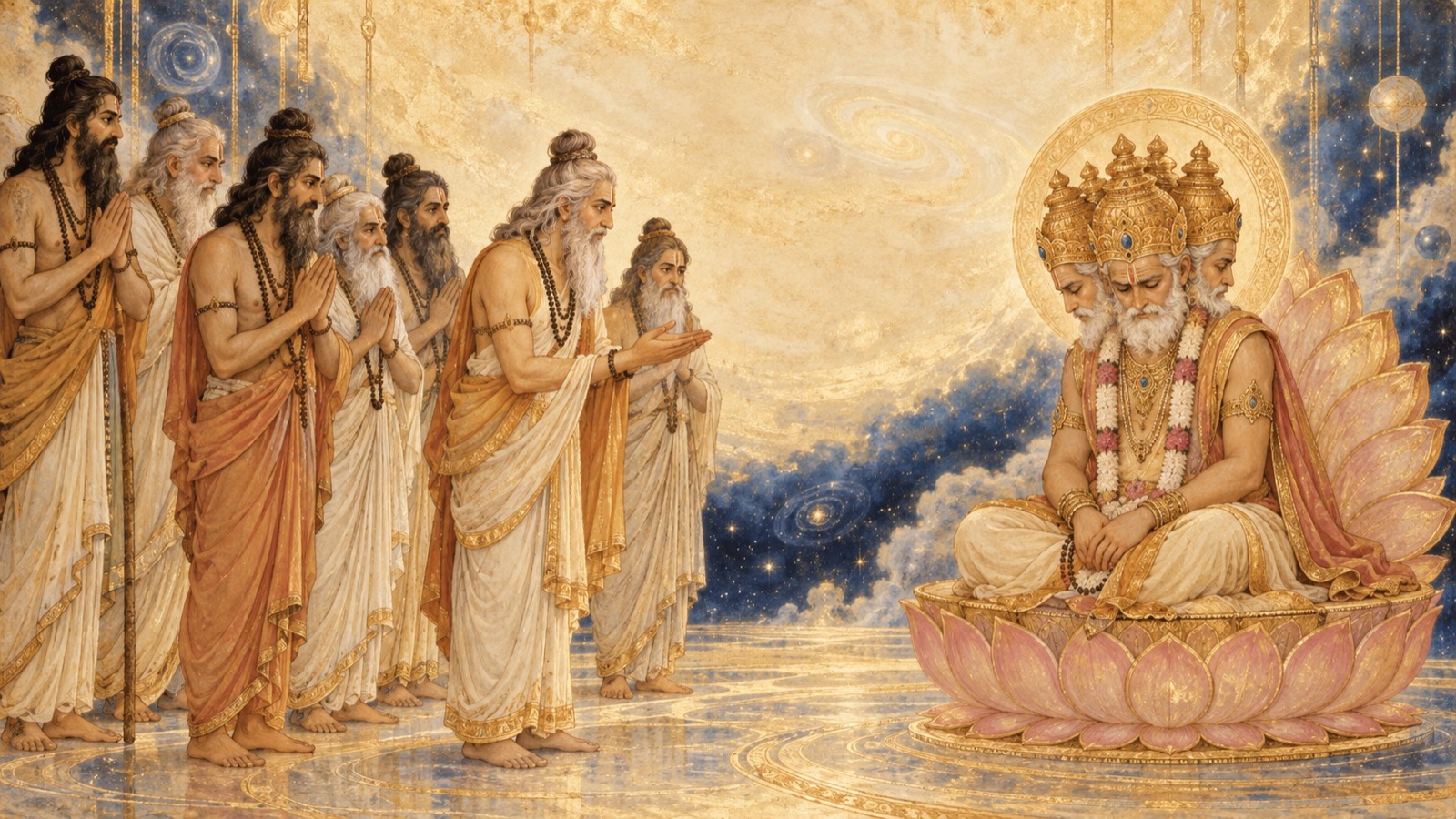
Brahma’s response is immediate and total. Ashamed to see his own sons — the very lords of created beings he himself had made — pleading with him to his face, he casts off that body at once. The four quarters of space pick it up, and it continues to exist in the world as fog, also known as darkness. It is worth pausing on how the Bhagavatam handles this episode: rather than excusing Brahma or dwelling on blame, the text moves swiftly to consequence and correction — shame, the casting-off of the compromised body, and a fresh start. A note appended to the traditional commentary on this passage explains that it is meant less as a literal biography of the cosmic Creator than as a pointed warning: that even a mind as disciplined as Brahma’s can be overwhelmed by desire under the wrong conditions, and that scripture elsewhere counsels that one should never remain entirely alone even with one’s own mother, sister, or daughter — for the senses are powerful enough to mislead even a learned man.
There is a further point worth drawing out here, easy to miss if this episode is read only as scandal. Notice what Marici and his brothers actually ask for: not Brahma’s punishment, but the Lord’s protection of dharma, trusting the very Personality of Godhead seated within Brahma to set him right (verse 32). And the restoration comes at once — the instant Brahma turns from self-justification to shame, the compromised body is gone, and within moments the Vedas themselves pour forth from him in full (verses 33-34). The point a devotee is meant to carry away is not that Brahma fell like an ordinary man, but that a soul surrendered to the Lord is measured less by the one temptation that arose and passed than by how swiftly it lets go rather than clings. That readiness to release rather than defend, not flawlessness, is what the Lord’s mercy answers.
The Vedas and the Sacred Order Issue from Brahma’s Mouths
Once that body is set aside, Brahma turns his attention once more to how creation might proceed as a coherent, organic whole. This time the results are extraordinary. From his four mouths — facing east, south, west and north — issue the four Vedas: the Rgveda, the Yajurveda, the Samaveda and the Atharvaveda, together with the corresponding duties of the four classes of priests who officiate at a sacrifice. From the same four mouths come the sciences of medicine (Ayurveda), archery (Dhanurveda), music (Gandharvaveda) and architecture (Sthapatyaveda), and the great body of history and legend known as Itihasa and Purana — recognized as a fifth Veda in its own right. Pairs of sacrificial rites, the four pillars of virtue (purity through knowledge, charity, austerity and truthfulness), the four stages of life (Brahmacharya, Grhastha, Vanaprastha and Sannyasa) and the specific duties, vows and modes of livelihood proper to each stage, all issue in careful order from Brahma’s mouths.
Vidura, listening to all this, asks Maitreya a direct question: tell me, in detail, what did Brahma produce from which mouth or from which other organ? Maitreya takes up the question point by point, beginning with the branches of knowledge:
आन्वीक्षिकी त्रयी वार्ता दण्डनीतिस्तथैव च । एवं व्याहृतयश्वासन् प्रणवो ह्यस्य दहृत: ॥ ४४ ॥
ānvīkṣikī trayī vārtā daṇḍa-nītis tathaiva ca evaṁ vyāhṛtayaś cāsan praṇavo hy asya dahrataḥ
Meaning: The four branches of knowledge — Anviksiki (the knowledge of the Spirit), Trayi (ritual knowledge), Varta (the knowledge of agriculture and commerce), and Dandaniti (political science) — as well as the sacred Vyahrtis, issued from Brahma’s mouths in this order, while Pranava, the syllable Om, flowed from the very cavity of his heart. (Canto 3, Chapter 12, verse 44)
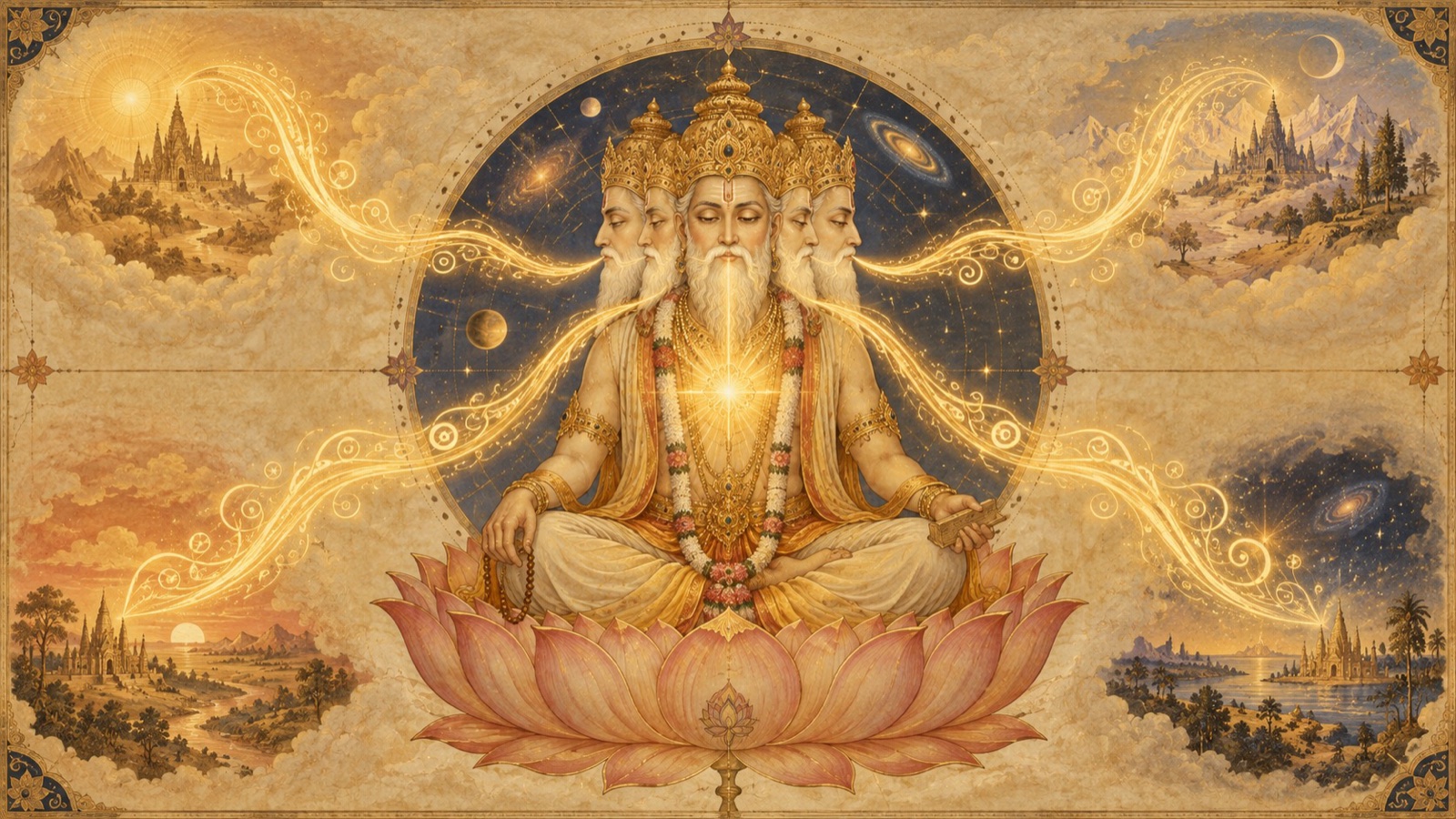
Maitreya’s answer continues into still finer detail: the Vedic metres themselves are said to have emerged from Brahma’s very body — Usnik from his body hair, Gayatri from his skin, Tristubh from his flesh, Anustubh from his sinews, Jagati from his bones, Pankti from his marrow, and Brhati from his breath. His consciousness became the hard consonants; his body itself, the vowels; his organs of sense, the sibilant sounds; his physical strength, the semi-vowels; and the seven notes of the musical scale proceeded from his own re-creative energy. Brahma, we are told, is Sabdabrahma — the Veda, or sacred sound, personified — manifest outwardly as Vaikhari, articulate speech, and unmanifest inwardly as Pranava, the syllable Om; and beyond even Brahma shines the Supreme Lord Himself, who pervades all things and holds every potency as the almighty source of them all.
A Second Body, and the Birth of Manu and Satarupa
Having set aside his compromised first body, Brahma assumes a new one and turns his heart to creation once again. But even now, with sages as powerful as Marici and the others already at work, creation still does not multiply as it should. Brahma finds himself wondering, within his own heart, how it is that despite his constant effort, his progeny are not increasing — as though some adverse fate stands in his way. While he waits for a more favorable moment, something remarkable happens: Brahma’s own body divides into two. From this division, we are told, comes the very word “Kaya” — the Sanskrit term for a human body — since it originally belonged to Brahma himself. The two resulting forms are male and female.
The male form becomes Svayambhuva Manu, the first sovereign of the entire earth; the female becomes his queen, Satarupa. Through their union, at last, creation truly begins to multiply in the way Brahma had been waiting for. Svayambhuva Manu and Satarupa beget five children: two sons, Priyavrata and Uttanapada, and three daughters, Akuti, Devahuti and Prasuti.
स चापि शतरूपायां पञ्चापत्यान्यजीजनत् । प्रियव्रतोत्तानपादौ तिस्र: कन्याश्च भारत । आकूतिर्देवहूतिश्च प्रसूतिरिति सत्तम ॥ ५६ ॥
sa cāpi śatarūpāyāṁ pañcāpatyāny ajījanat priyavratottānapādau tisraḥ kanyāś ca bhārata ākūtir devahūtiś ca prasūtir iti sattama
Meaning: Through Satarupa, Svayambhuva Manu begot five children: the sons Priyavrata and Uttanapada, and the three daughters — O best of the Bharatas — named Akuti, Devahuti and Prasuti. (Canto 3, Chapter 12, verse 56)
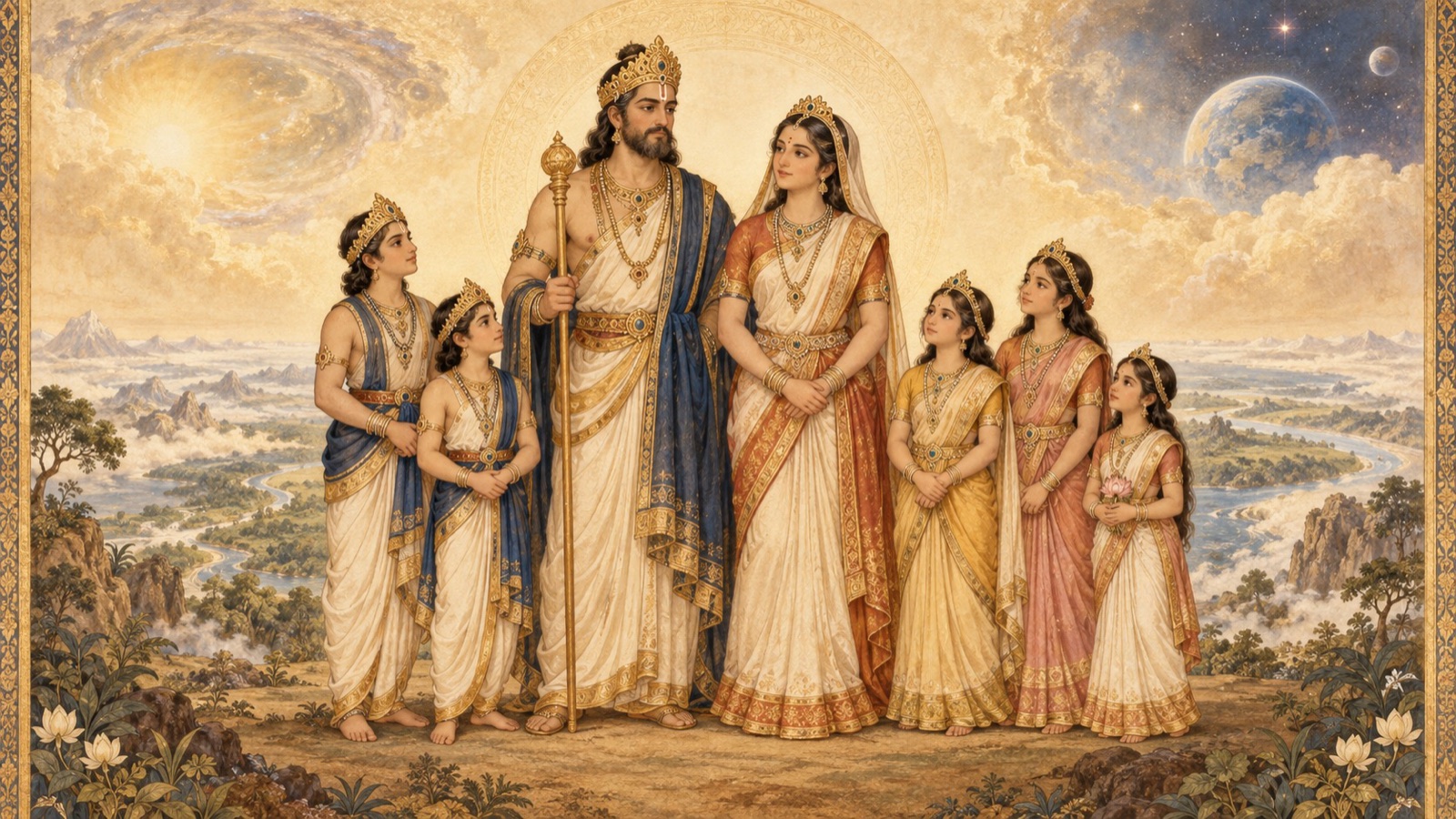
Manu gives his eldest daughter, Akuti, to the Prajapati Ruci; his middle daughter, Devahuti, to the great sage Kardama (who, we recall, had earlier emerged from Brahma’s own shadow, and who would become the father of Lord Kapila); and his youngest, Prasuti, to Daksa, one of the ten sons Brahma had brought forth earlier in this same chapter. Maitreya closes with a simple but weighty statement: the progeny of these three daughters alone would go on to fill the entire universe. After chapters of failed attempts, refused requests, uncontrolled anger and a shameful lapse that had to be set right, creation finally finds its footing — not through any single dramatic act, but through the quiet, ordinary multiplication of a family.
Principal Teachings of This Chapter
1. Even divine effort can misfire before it succeeds. Brahma’s very first act of creation produces the five kinds of ignorance, not the world he intended — a reminder that even the highest capacity for creation does not guarantee an immediate, flawless result (verse 2).
2. Some are called to renounce, not to multiply. The four Kumaras’ refusal to procreate is not disobedience but the honoring of a different, higher calling; not every gift is meant to serve every purpose asked of it (verse 5).
3. Suppressed anger does not vanish — it takes on a life of its own. Rudra is born precisely because Brahma tries and fails to master his own fury; what is denied expression by force of will still finds a way into the world (verses 6-8).
4. True strength can still choose obedience and restraint. Rudra, capable of producing hosts fierce enough to alarm his own father, simply says “All right” and withdraws to practise penance the moment he is asked — power submitting willingly to a higher purpose (verse 20).
5. No one, however disciplined, is beyond the reach of temptation. Brahma’s lapse concerning his own daughter is presented candidly, not to condemn the Creator but to warn that the senses can overpower even a master of self-control under the wrong conditions (verses 28-30).
6. Correction, honestly faced, opens the way to a fresh beginning. Rather than defending himself, Brahma casts off the compromised body in shame and begins again — showing that setting a fault aside honestly, rather than carrying it forward, is itself part of the path (verse 33).
7. Creation ultimately multiplies through partnership, not through solitary effort. After every other attempt, it is the union of Svayambhuva Manu and Satarupa — man and woman together — through which creation finally begins its steady, lasting increase (verses 53-56).
A Devotional Reflection
There is an unusual honesty in this chapter that is easy to miss on a first reading. We are used to thinking of creation stories as triumphant — a divine word spoken, and worlds appear fully formed. This chapter gives us something far more recognizable: a Creator who produces something unwanted before he produces something good; whose most gifted children decline to help him; whose own suppressed emotion breaks free and becomes a being he then has to name, house and guide; and who, even after everything, stumbles seriously enough to need his own sons’ correction before he can begin again. And yet none of this diminishes Brahma. If anything, it makes the eventual flowering of creation — through Rudra’s obedient penance, through the ten sons scattered like seeds from his own body, through Manu and Satarupa’s quiet, faithful partnership — feel more hard-won and more real. The lesson offered here is not that the path to any true creation is smooth, but that it can survive missteps, corrections, and even shame, provided each is met honestly rather than concealed.
A Daily Devotional Practice
Today, bring to mind one thing in your own life — a habit, a relationship, a piece of work — where your first attempt did not go the way you hoped, or where anger or desire pulled you somewhere you did not intend to go. Rather than dwelling in self-reproach, follow Brahma’s example in this chapter: acknowledge what happened honestly, set it aside without excuse, and turn toward a fresh, purified beginning. Before you do, sit quietly for a few minutes and repeat softly: “Om Namo Bhagavate Vasudevaya.” Let that remembrance remind you that even the Creator of the universe needed more than one attempt — and that honest correction, not perfection, is what carries any true work forward.
Conclusion
The twelfth discourse of the Third Canto takes us through the whole difficult, human labor by which Brahma actually built a working creation: an unwanted first harvest of ignorance; four brilliant sons who chose renunciation over procreation; the sudden, tearful birth of Rudra from suppressed anger, and his fearsome offspring sent off in favor of penance; ten more sons springing from ten different parts of Brahma’s own body; a painful lapse involving his daughter Vak, met with his sons’ honest rebuke and his own immediate shame; the entire sacred order of Vedas, sciences, duties and even musical notes pouring forth from his mouths and body; and finally, through a second body divided into Svayambhuva Manu and Satarupa, the birth of the five children whose own descendants would go on to fill the universe. It is a chapter that shows creation not as a single perfect act but as a long, corrected, ultimately fruitful process — one that finally succeeds not through anger, not through desire, but through obedience, honesty, and partnership.
May the divine wisdom of Srimad Bhagavatam awaken pure devotion within our hearts.
Om Namo Bhagavate Vasudevaya.
Jay Shree Madhav.
References and Attribution
- Primary edition: Gita Press, Śrīmad Bhāgavata Mahāpurāṇa (English, complete), Book Three, Discourse 12, pages 183–188.
- Series: Srimad Bhagavatam Wisdom · Biswa Sanatan Dharma Seva Trust.
- Presented following the spiritual guidance and recommendation of Pandit Dr. Shri Kashinath Mishra.
This is an original, faithful retelling in the writer’s own words, with brief quoted verses shown in Devanāgarī and transliteration and their meanings given as summaries. It is not a reproduction of any single publisher’s continuous translation or commentary. No affiliation with or endorsement by any publisher is implied.
Jay Shree Madhav