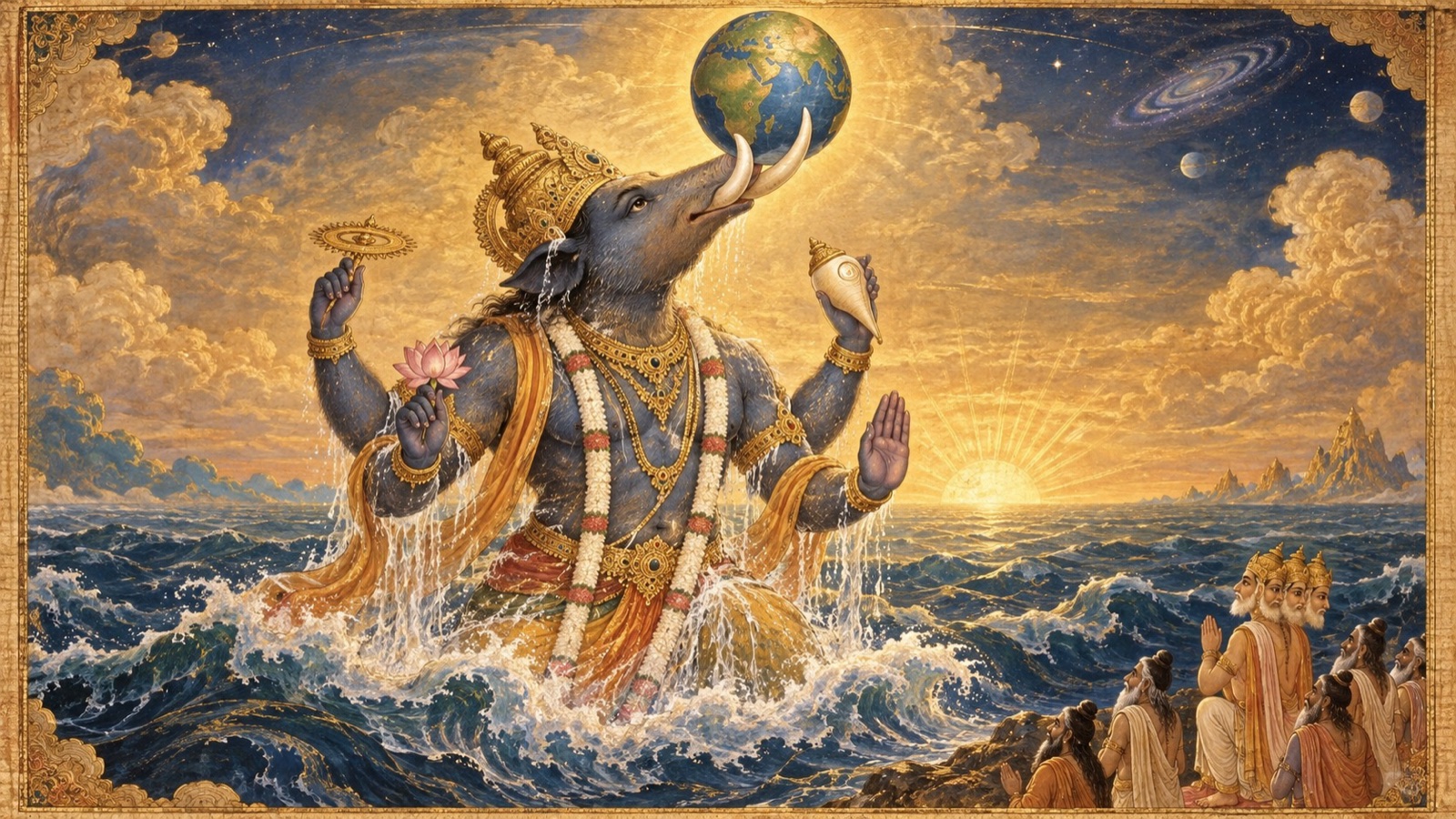
When the newly-created earth sinks into the cosmic ocean and Brahma finds himself powerless to save her, the Lord answers not with argument but with action — emerging as a tiny boar from Brahma’s own nostril, growing in an instant to the size of a mountain, and plunging into the fathomless waters to lift the world itself upon His tusks.
Om Namo Bhagavate Vasudevaya.
Om Namo Bhagavate Vasudevaya.
Om Namo Bhagavate Vasudevaya.
Welcome to Srimad Bhagavatam Wisdom, a devotional journey through the sacred histories and teachings of the Srimad Bhagavat Mahapurana. The thirteenth discourse of Book Three turns from the philosophy of creation to one of its most beloved and dramatic stories. Vidura, still hungry for the stories of Sri Krsna after everything Maitreya has already told him, asks a simple question: what did Swayambhuva Manu, the first sovereign of the earth, do once Brahma had given him a queen and a kingdom to rule? The answer leads, by a natural and unhurried path, from a father’s blessing to a son, to a terrifying discovery — that the very earth Manu has been asked to govern lies submerged beneath the cosmic waters — and from there to one of the Bhagavatam’s most vivid and cherished episodes: the Lord’s descent as Varaha, the Divine Boar, who emerges the size of a thumb from Brahma’s nostril, grows in an instant to the size of a mountain, dives into the fathomless ocean of dissolution, and lifts the drowned earth to safety upon the points of His gleaming white tusks — pausing along the way to dispatch, almost playfully, the demon Hiranyaksa who dares to obstruct Him.
Chapter Information
- Scripture: Śrīmad Bhāgavata Mahāpurāṇa
- Canto: 3 (Book Three)
- Chapter: 13 (Discourse 13)
- Chapter title: The Lord’s Descent as the Divine Boar
- Principal speakers: Vidura (questioner), Sri Suka (outer narrator to King Parikshit), Maitreya (inner narrator to Vidura), Swayambhuva Manu, Brahma, and the sages of Janaloka, Tapoloka and Satyaloka (who offer the chapter’s central hymn of praise)
- Principal listener within the chapter’s frame: Vidura, receiving Maitreya’s account
- Main setting: The court of Brahma at the dawn of creation, and then the vast, wave-tossed ocean of universal dissolution into which the earth has sunk
- Central subject: Swayambhuva Manu’s commissioning to rule the earth; the discovery that the earth lies submerged in the cosmic waters; the emergence and growth of the Lord’s boar-form from Brahma’s nostril; the Boar’s dive into the ocean, the recovery of the earth upon His tusks, the slaying of the demon Hiranyaksa, and the sages’ elaborate hymn identifying the Boar’s very body with the whole apparatus of Vedic sacrifice
- Principal verse range: Canto 3, Chapter 13, verses 1–50 (Gita Press numbering)
- Primary edition: Gita Press Śrīmad Bhāgavata Mahāpurāṇa
Vidura’s Renewed Enquiry
The chapter opens quietly, almost as a bridge between one great teaching and the story that follows. Having just heard Maitreya’s account of Brahma’s difficulties in the work of creation and the eventual appearance of Swayambhuva Manu and his queen Satarupa, Vidura — described here as a soul who once had the honour of bearing the feet of Sri Krsna Himself upon his lap — cannot rest content. He asks Maitreya, with evident reverence, what became of Manu once he had secured a spouse after his own heart: what did this first sovereign of the globe do next, he who had taken refuge in Lord Vishnu? Vidura frames his question with a teaching of his own: that the highest reward of all the learning men acquire through long and painful effort is simply this — to hear the praises of those who have enshrined the Lord’s lotus-feet within their hearts. Moved by this evident devotion, and with his hair standing on end at the very thought of narrating the Lord’s stories once again, Maitreya begins.
Brahma’s Blessing and Manu’s Charge
Maitreya’s answer begins not with drama but with the quiet dignity of a father instructing a son. Swayambhuva Manu, together with Satarupa, approaches Brahma with joined palms and asks a question every dutiful child might ask a parent: you are our one father, our progenitor and sustainer — how may we serve you? Brahma’s reply is warm and immediate. He blesses the couple, delighted that Manu has surrendered himself without guile, and lays out Manu’s duty in a few clear strokes: rule the earth with righteousness, worship the Supreme Person through sacrifice, beget worthy offspring, and above all govern the people well — for it is precisely through faithful care of his subjects that Lord Hari will be pleased with him. Brahma adds a warning as well, and states it not as a passing remark but as a governing principle.
येषां न तुष्टो भगवान् यज्ञलिङ्गो जनार्दन: । तेषां श्रमो ह्यपार्थाय यदात्मा नादृत: स्वयम् ॥ १३ ॥
yeṣāṁ na tuṣṭo bhagavān yajña-liṅgo janārdanaḥ teṣāṁ śramo hy apārthāya yad ātmā nādṛtaḥ svayam
Meaning: Whoever fails to satisfy Lord Janardana, who reveals Himself in the very form of sacrifice, labours in vain, however vast that labour may seem — for in neglecting Him, without realizing it, one neglects nothing less than one’s own true Self. (Canto 3, Chapter 13, verse 13)
This is not a minor caution appended to Manu’s charge; it states the very principle the rest of the chapter goes on to dramatize. Manu’s kingship, like every undertaking Brahma is about to describe, carries no value measured on its own terms — only in whether it pleases the Lord who is its hidden purpose. The same truth underlies the sages’ own hymn later in this chapter: when they map the entire architecture of sacrifice onto the Boar’s body feature by feature, they are not merely praising a rescuing incarnation but confirming, in the most literal way imaginable, that Janardana Himself is what all sacrifice was ever actually for.
Manu accepts this charge without hesitation, asking only that Brahma assign him and his progeny a proper abode. It is here that the chapter’s central crisis surfaces, delivered almost as a single, startling line: the earth — the very abode of all living beings — lies submerged in the vast expanse of water, and something must be done to recover her.
The Tiny Boar That Grew Like a Mountain
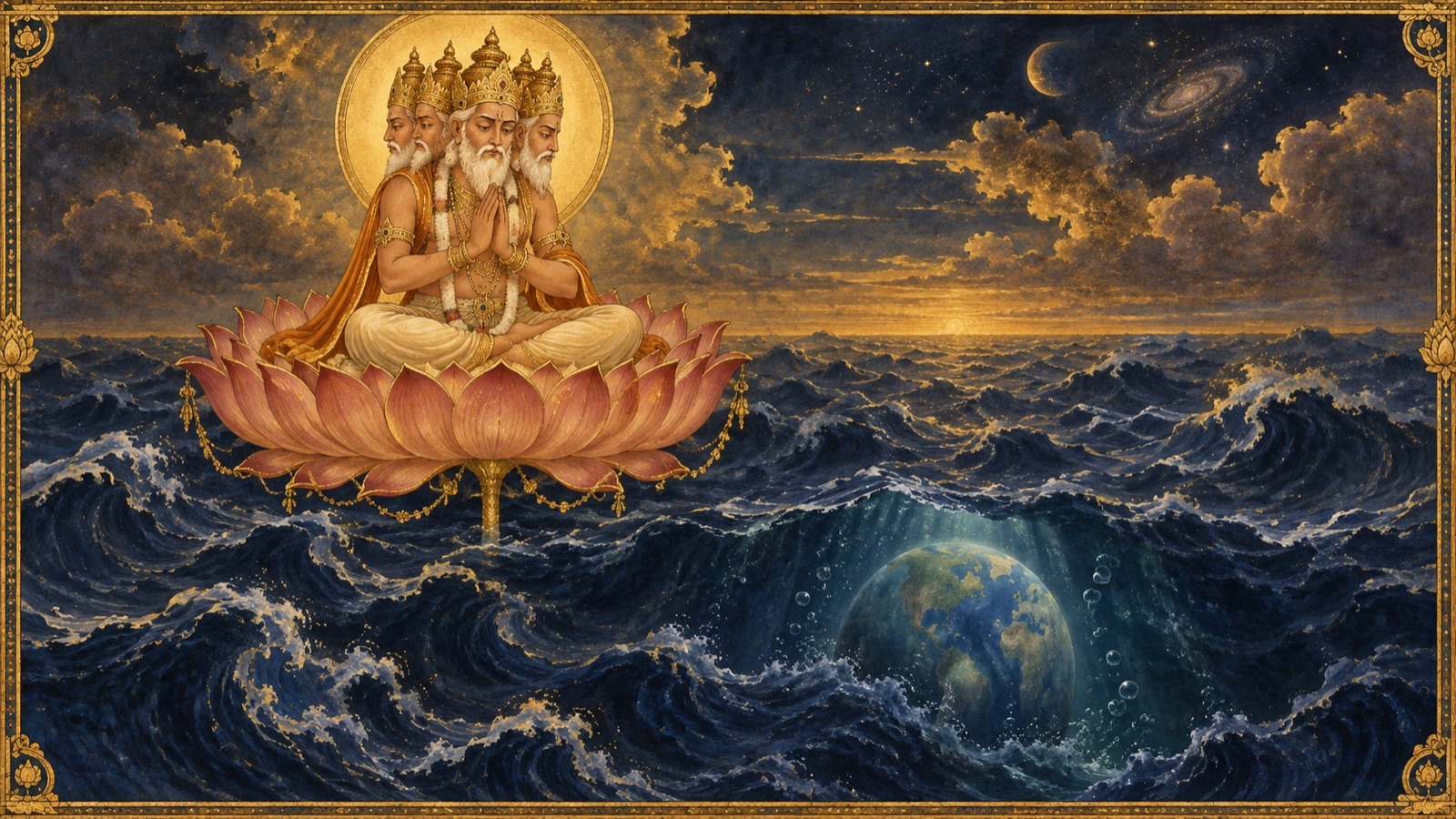
Brahma’s response to this crisis is itself instructive. He does not attempt to solve the problem by his own power or ingenuity. Instead, remembering that it was from the Lord’s own heart that his own thought first sprang, he turns his mind toward the Lord and silently prays that some means of rescue be devised. It is precisely at this moment of surrendered contemplation — not before, and not through any exertion of Brahma’s own — that the miracle occurs. Suddenly, without warning, a tiny boar, no bigger than the top joint of a thumb, emerges from one of Brahma’s own nostrils.
इत्यभिध्यायतो नासा-विवरात्सहसानघ । वराहतोको निरगादङ्गुष्ठपरिमाणकः ॥ १८ ॥
ity abhidhyāyato nāsā-vivarāt sahasānagha varāha-toko niragād aṅguṣṭha-parimāṇakaḥ
Meaning: As Brahma was thus reflecting, O sinless Vidura, a tiny boar — no larger than the tip of a thumb — suddenly emerged from the opening of his nostril. (Canto 3, Chapter 13, verse 18)
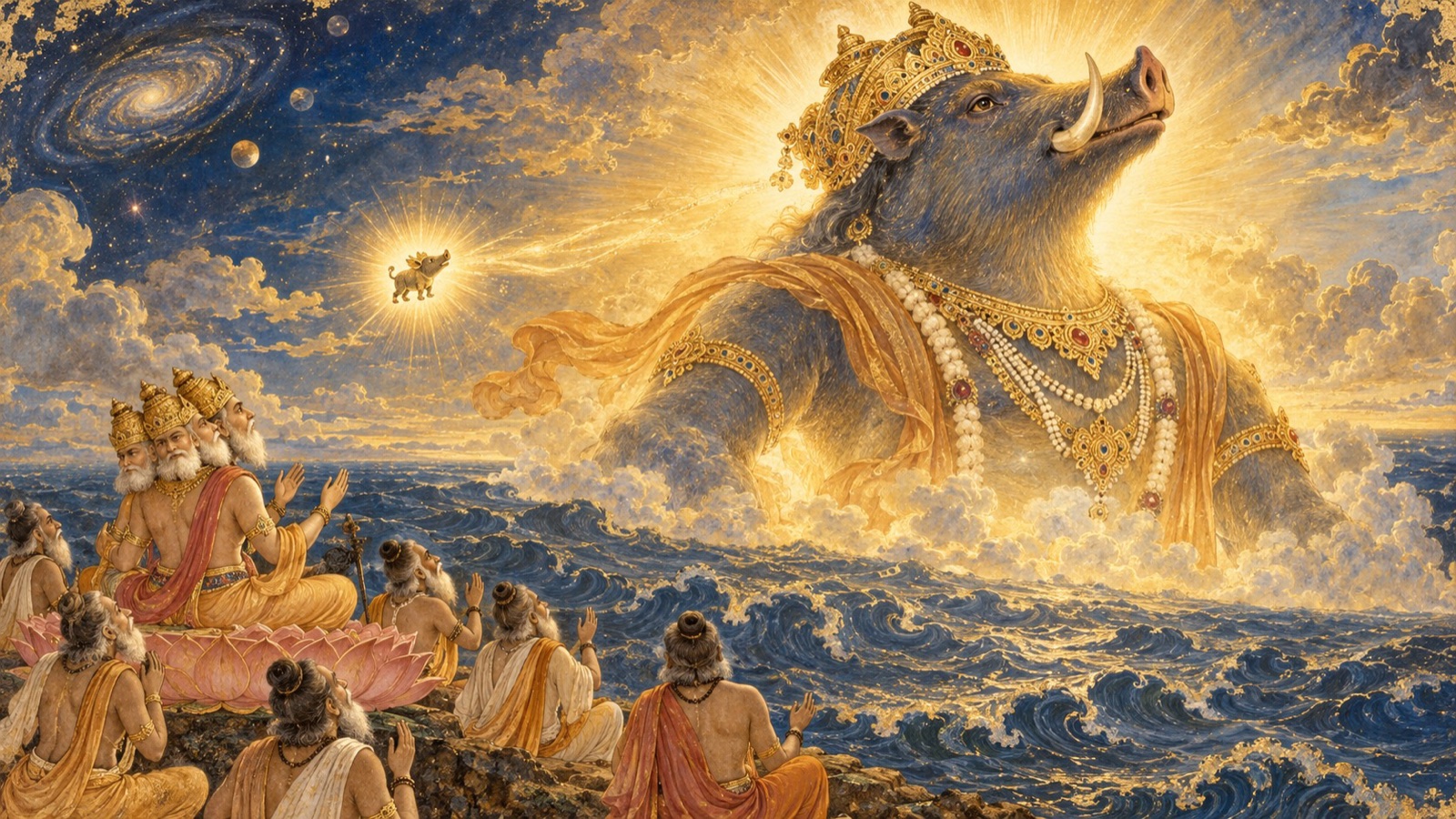
What happens next is one of the Bhagavatam’s most arresting images of scale. While Brahma simply stands and watches, this thumb-sized creature grows, in the space of moments, first to the size of an elephant and then to the size of a great mountain — a transformation Maitreya himself calls “really most wonderful.” Brahma, Marici and the other great Brahmanas, together with Sanaka and his three brothers and Swayambhuva Manu, gather around this astonishing sight and speculate aloud: who can this strange creature be, wearing the guise of a boar, that has emerged from Brahma’s own nostril? Might this, they wonder, be Lord Vishnu Himself, come to test or instruct them? While they are still turning the question over in their minds, the mountain-sized boar-form — for it is indeed none other than the Lord presiding over all sacrifices — answers them Himself, with a roar so tremendous that it makes the very quarters of the sky resound, delighting Brahma and the assembled sages and dispelling their perplexity at a stroke. Recognizing this roar as an invitation, the sages of Janaloka, Tapoloka and Satyaloka begin at once to extol the Lord through the sacred mantras of the three Vedas — praise which the Lord, whose own form the Vedas glorify, receives as Veda itself. With a second mighty roar, and sporting as playfully as a lordly elephant, He enters the cosmic waters in search of the drowned earth, undertaking this rescue, the Bhagavatam notes, in the interest of the gods.
The Dive Into the Cosmic Ocean
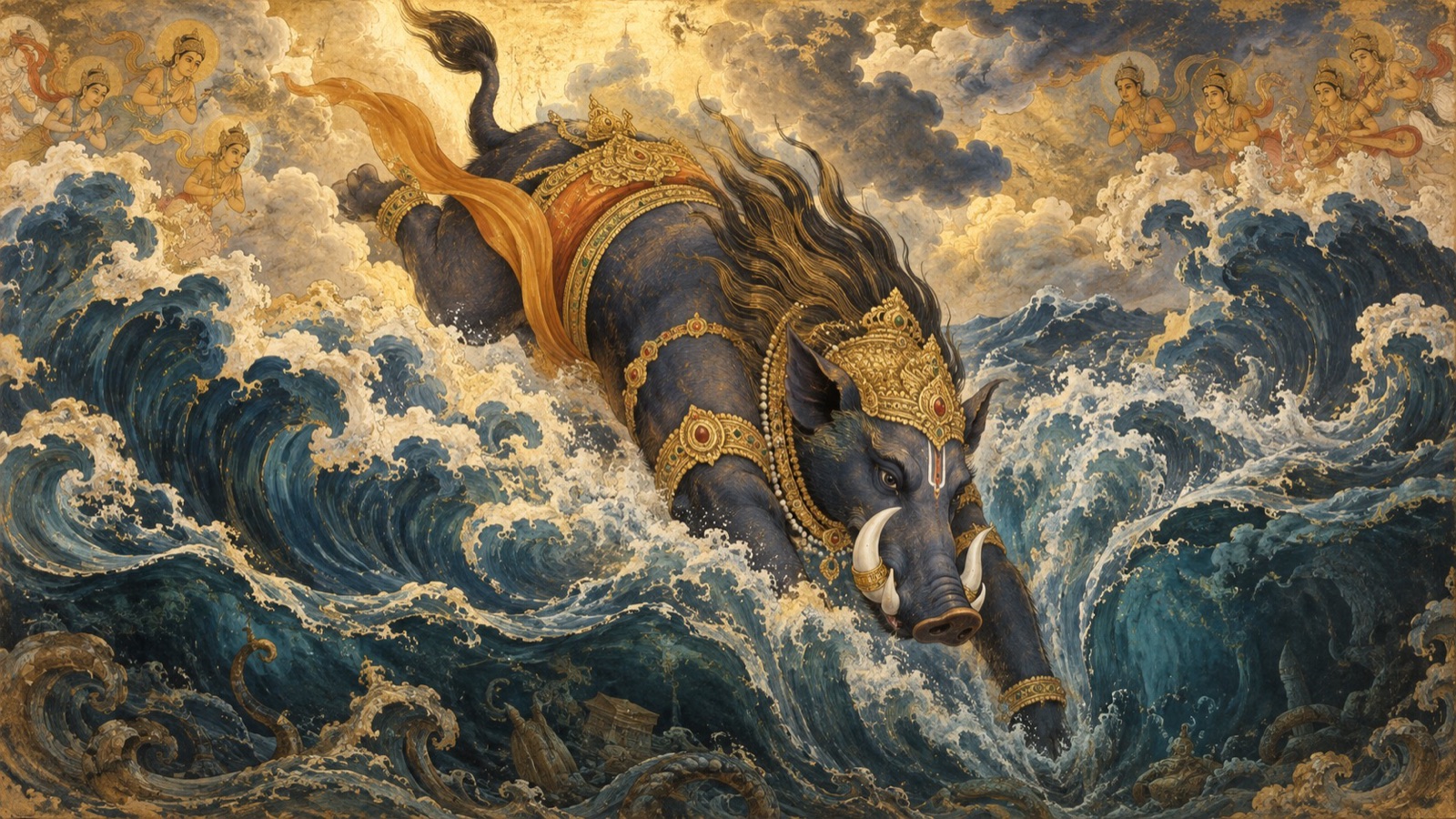
Having entered the waters, the divine Boar is described in language of tremendous physical power and beauty at once. Possessed of a frame as hard as steel and a thick coat of stiff bristles, He springs into the air, His tail erect and His mane shaking, tearing the very clouds with His hoofs — and shining most splendidly, His white tusks casting a lustre wherever His glance falls. Though disguised as a boar, He is, the text reminds us, none other than Lord Narayana Himself, embodying in His own person the whole of sacrifice; even so, as He goes about smelling for the earth with His snout, His fearsome tusks notwithstanding, He turns a gentle and gracious look upon the Brahmanas who continue to praise Him, before diving beneath the surface.
The ocean itself becomes almost a character in this telling. Torn open by the headlong plunge of a body as immense as a mountain of adamant, it thunders aloud, tossing up its high waves like so many desperate arms, crying out — as the text vividly puts it — “Protect me, O Lord of sacrifices!” Undeterred, the Lord cleaves through the waters with hoofs sharp as arrows, presses on to the far end of that fathomless ocean, and there, in its very depths, discovers the terrestrial globe — the earth He Himself had drawn into His own body at the close of the previous Kalpa, now waiting to be drawn back out again into the light.
Lifting the Earth, and the Fall of Hiranyaksa
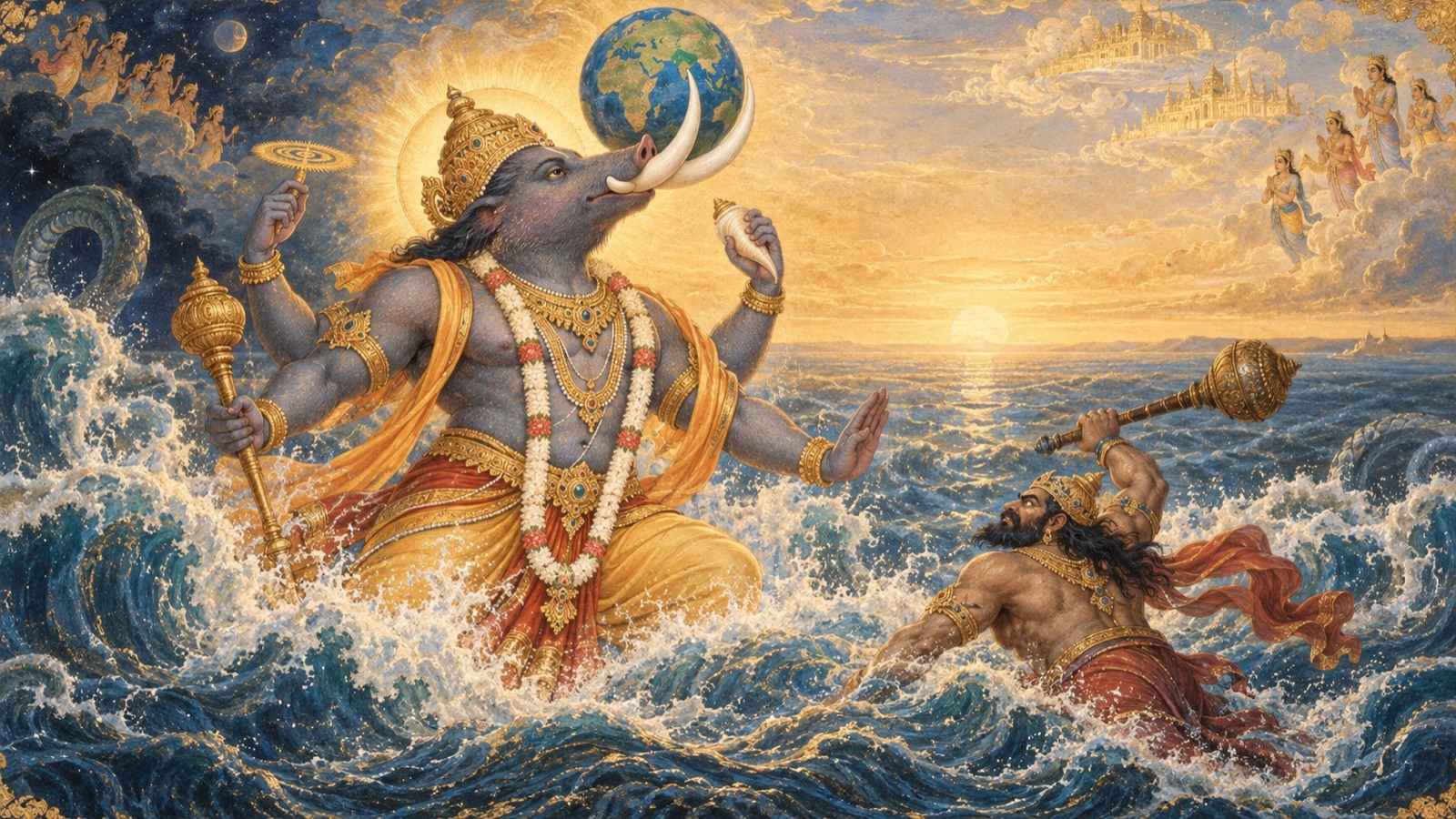
The chapter’s most celebrated action now unfolds in a single sweeping passage. The Lord rises from the depths, the earth lifted safely upon the points of His tusks, shining with unmatched splendour. But even as He is still in those waters, a demon of formidable strength — Hiranyaksa by name — assails Him with a club, attempting to bar His way. The Lord’s response is immediate and, notably, almost effortless: His fury blazes forth like His own discus, the Sudarsana, and He disposes of the demon as easily and as playfully as a lion kills an elephant, His temples and snout left stained with the demon’s blood, giving Him, the Bhagavatam says, the appearance of a lordly elephant that has just churned up a mound of red ochre earth.
स्वदंष्ट्रयोद्धृत्य महीं निमग्नां स उत्थितः संरुरुचे रसायाः । तत्रापि दैत्यं गदयापतन्तं सुनाभसन्दीपिततीव्रमन्युः ॥ ३१ ॥ जघान रुन्धानमसह्यविक्रमं स लीलयेभं मृगराडिवाम्भसि । तद्रक्तपङ्काङ्कितगण्डतुण्डो यथा गजेन्द्रो जगतीं विभिन्दन् ॥ ३२ ॥
sva-daṁṣṭrayoddhṛtya mahīṁ nimagnāṁ sa utthitaḥ saṁruruce rasāyāḥ tatrāpi daityaṁ gadayāpatantaṁ sunābha-sandīpita-tīvra-manyuḥ jaghāna rundhānam asahya-vikramaṁ sa līlayebhaṁ mṛgarāḍ ivāmbhasi tad-rakta-paṅkāṅkita-gaṇḍa-tuṇḍo yathā gajendro jagatīṁ vibhindan
Meaning: Having lifted the sunken earth upon His tusks, the Lord rose and shone with resplendent beauty amid those waters. There, a demon of irresistible prowess assailed Him with his club to obstruct His way; His fury blazing forth like His own discus, the Lord playfully slew that demon — as a lion kills an elephant without exertion — His temples and snout stained with the demon’s blood, appearing thereby like a lordly elephant that has just turned up a mound of red earth. (Canto 3, Chapter 13, verses 31-32)
Even as the Lord — dark of hue like a Tamala tree — lifts the earth upon the ends of His white tusks, much as an elephant might carry a lotus, Brahma and the assembled sages at last recognize Him fully for who He is. Joining their palms, they wait upon Him with hymns of praise closely resembling the Vedic mantras themselves — a hymn that occupies the greater part of the remainder of this chapter.
The Sages’ Hymn: The Boar as the Very Body of Sacrifice
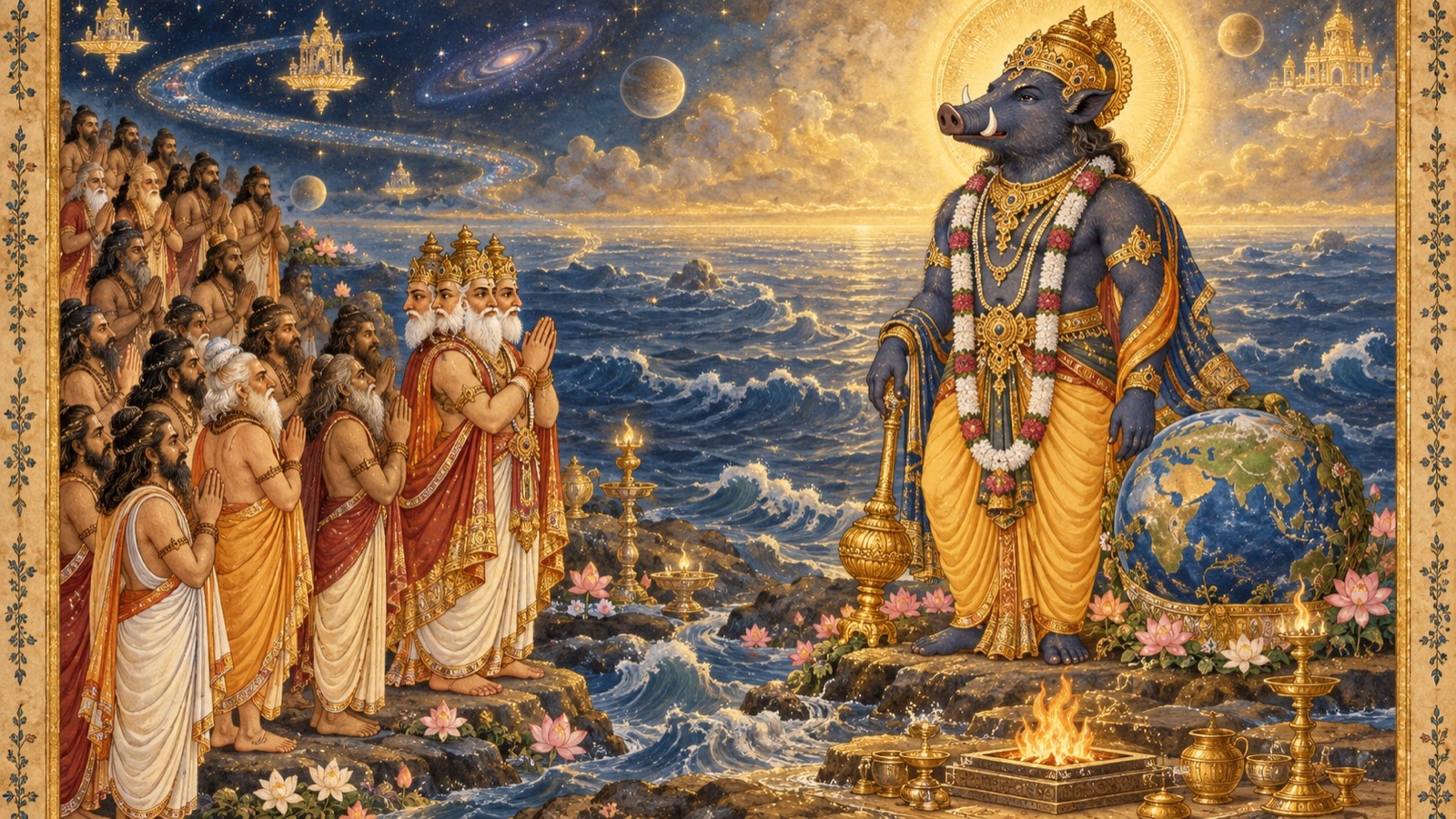
What follows is one of the Bhagavatam’s most distinctive hymns — not a hymn of abstract philosophy, as Brahma’s own prayer in the previous chapters had been, but an extraordinarily detailed identification of the Boar’s physical body, feature by feature, with the entire apparatus of Vedic sacrifice. The sages open with a cry of victory: “Victory, victory to You, O invincible Lord, the Promoter of sacrifices!” — bowing to Him even as He shakes His own divine body, itself composed of the three Vedas, to free it of moisture, and marvelling that the various sacrifices lie hidden, they say, in the very pores of His bristles.
ऋषय ऊचुः । जितं जितं तेऽजित यज्ञभावन त्रयीं तनुं स्वां परिधुन्वते नमः । यद्रोमगर्तेषु निलिल्युरद्धय- स्तस्मै नमः कारणसूकराय ते ॥ ३४ ॥
ṛṣaya ūcuḥ jitaṁ jitaṁ te ‘jita yajña-bhāvana trayīṁ tanuṁ svāṁ paridhunvate namaḥ yad-roma-garteṣu nililyur addhayas tasmai namaḥ kāraṇa-sūkarāya te
Meaning: The sages said: Victory, victory to You, O unconquerable Lord, the very source and sustainer of sacrifice! Obeisance to You as You shake Your own body, which is composed of the three Vedas; in the pores of whose bristles the very waters themselves have found a hiding place. Obeisance to You, the primeval Boar, the very cause of this rescue. (Canto 3, Chapter 13, verse 34)
The hymn then proceeds, verse after verse, to map the entire architecture of sacrificial worship onto the Boar’s own form. The Vedas themselves, the sages say, find a place in His skin; the sacred Kusa grass in His bristles; clarified butter in His eyes; the four kinds of fruitive rites in His four legs. The various sacrificial ladles and vessels — the Sruk, the Sruva, the Ida, the Camasas, the Prasitra, the Grahas — are found respectively in His tongue, His nostrils, His belly, His ears, His mouth and His throat, while His very act of chewing constitutes the Agnihotra, the daily fire-oblation. His repeated descents into the world are themselves identified with the preparatory sacrificial rites; His neck with the Upasads; His tusks with the opening and closing rites of a sacrifice; His tongue with the Pravargya ceremony; His head with the sacred household fires; His vital airs with the very laying of bricks for a sacrificial altar. Even His generative fluid is identified with the Soma, His sitting posture with the thrice-daily rites, the seven constituents of His body with the seven great classes of sacrifice, and the very joints of His limbs with the long sacrificial Satras. In this single, sweeping identification, the sages declare, the Lord combines in His own person the whole of Yajna and Kratu, sacrifices with and without the offering of Soma alike — and, they add, He is Himself the wisdom gained through dispassion, devotion and self-control, the very teacher who imparts all knowledge.
Having exhausted, as it were, every technical correspondence between the Boar’s body and the sacrifice it embodies, the sages turn to simpler, more visual praise: the earth borne upon His tusks shines, they say, like a lotus plant held upon the tusks of a lordly elephant rising from the water; and the whole boar-form, bearing the globe, appears as charming as a great mountain crowned with a mass of clouds. They pray that the Lord will place the earth — the mother of all animate and inanimate creation, and in a mystical sense His own spouse — firmly upon the waters so that she may become habitable for all beings, since He alone is her Father as well as theirs; and having placed her thus, they will offer worship to both the Lord and the earth together, in whom He has deposited His own sustaining power, just as a sacrificer invokes fire within the sacred Arani wood.
संस्थापयैनां जगतां सतस्थुषां लोकाय पत्नीमसि मातरं पिता । विधेम चास्यै नमसा सह त्वया यस्यां स्वतेजोऽग्निमिवारणावधाः ॥ ४२ ॥
saṁsthāpayaināṁ jagatāṁ sa-tasthuṣāṁ lokāya patnīm asi mātaraṁ pitā vidhema cāsyai namasā saha tvayā yasyāṁ sva-tejo ‘gnim ivāraṇāv adhāḥ
Meaning: Kindly establish this earth firmly, O Lord, for the benefit of all moving and unmoving beings, for she is Your spouse and their mother, even as You are their Father. We shall offer worship, with reverence, to her together with You — You in whom she rests, as fire rests latent within the sacred Arani wood, having deposited within her Your own sustaining power. (Canto 3, Chapter 13, verse 42)
The hymn closes on a note of wonder and surrender: who else but the Lord, they ask, could have ventured to lift up the earth from the very lowest depths of the water — though for Him, the very abode of all wonders, who has fashioned this entire marvellous universe through His own Maya, this is no miracle at all. Even the drops of holy water flying from His mane as He shakes His Veda-formed body, they say, have splashed and purified the inhabitants of Janaloka, Tapoloka and Satyaloka who stand witnessing this scene. And in their final plea, the sages confess that anyone who seeks to know the Lord’s endless exploits in their totality has surely lost his wits — asking only that He bring happiness to a universe that stands deluded through its contact with the objects of the senses, a delusion wrought by His own Yogamaya.
The Earth Restored, and the Lord Withdraws
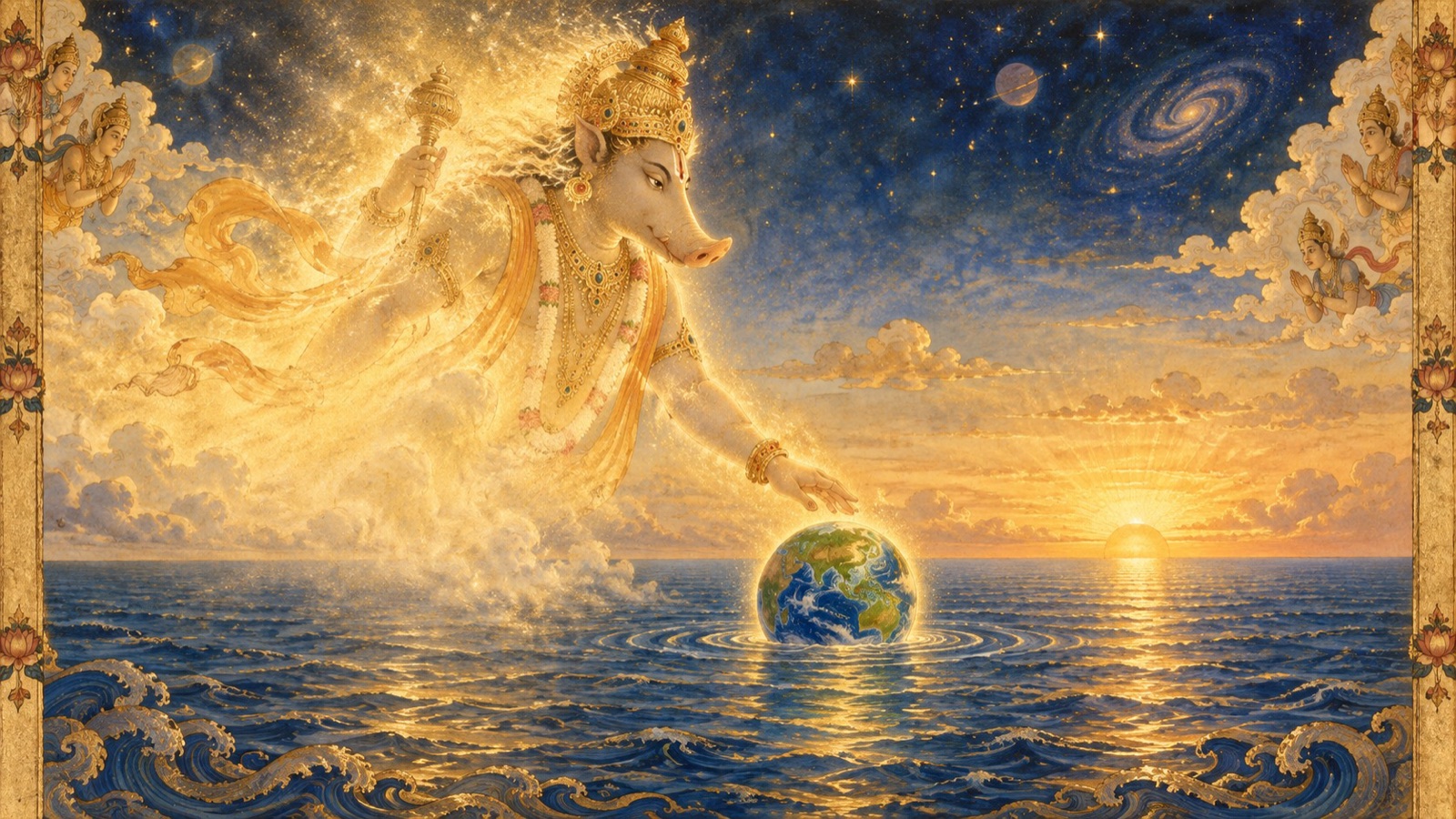
The chapter closes as quietly and as swiftly as its central miracle began. While the sages continue to extol Him in verses that closely resemble the Vedic hymns themselves, the Protector of the universe, still in His boar-form, gently places the earth upon the surface of the water — the same water that had, moments before, borne the weight of His own hoofs. Having thus set down, with evident sport and ease, the very globe He had lifted from the ocean’s depths, the almighty Lord Sri Hari, the Protector of all beings, simply vanishes from sight.
Maitreya closes the chapter, as is customary throughout the Bhagavatam, with a statement of the fruit of hearing this story: Lord Janardana is quickly and deeply pleased with anyone who listens to or narrates with devotion this blissful and charming account of Sri Hari, an account whose very remembrance rids the hearer of sorrow and sin, and whose every sportful activity is worth recounting again and again. What, after all, is difficult to obtain, Maitreya asks, once the Lord who can grant every desire is truly pleased? Small blessings, he suggests, are hardly worth seeking, since the Supreme Lord, seated in the heart of all beings, freely confers His own highest state upon those who fix their minds exclusively on Him. And in the chapter’s final verse, Maitreya poses a question that lingers well beyond the story itself: having once tasted, through the cup of one’s own ears, the nectar of the Lord’s stories — a nectar distilled from among all the world’s ancient legends, and one that alone brings the cycle of birth and death to its end — who, unless he were something other than human, could ever feel he had had enough?
को नाम लोके पुरुषार्थसारवि- त्पुराकथानां भगवत्कथासुधाम् । आपीय कर्णाञ्जलिभिर्भवापहा- महो विरज्येत विना नरेतरम् ॥ ५० ॥
ko nāma loke puruṣārtha-sāravit purā-kathānāṁ bhagavat-kathā-sudhām āpīya karṇāñjalibhir bhavāpahām aho virajyeta vinā naretaram
Meaning: Who indeed, in this world, that truly knows the essence of life’s worthwhile pursuits, could ever grow indifferent to the nectar of the Lord’s stories — the very cream skimmed from among all ancient legends, capable of ending the round of birth and death — once he has drunk it in through the cupped vessel of his own ears, unless he were something other than a human being? (Canto 3, Chapter 13, verse 50)
Thus ends the thirteenth discourse in Book Three, narrating among other things the descent of the Divine Boar, of the great and glorious Bhagavata-Purana, otherwise known as the Paramahamsa-Samhita.
Principal Teachings of This Chapter
1. Rescue begins with surrender, not self-effort. Brahma does not devise a scheme of his own to save the drowning earth; he simply turns his mind toward the Lord, from whose heart his own thought first sprang — and it is at that exact moment of surrendered contemplation that the boar-form emerges (verses 16-18).
2. Divine power reveals itself gradually, then suddenly. The Lord’s boar-form begins no larger than the tip of a thumb and grows, within moments, to the size of a mountain — a vivid image of how grace can appear humble at first sight before its true magnitude becomes apparent (verses 18-19).
3. The Lord’s play (Lila) contains no real exertion. Hiranyaksa’s assault, formidable as it is described to be, is dispatched by the Lord “playfully,” as a lion kills an elephant without effort — a reminder that no obstacle to divine purpose ever truly threatens it (verse 32).
4. Sacrifice, rightly understood, is not separate from the Lord — it is His own body. The sages’ hymn does not merely praise the Boar for rescuing the earth; it identifies every element of Vedic sacrifice, down to the smallest ritual vessel, with a specific part of His physical form, teaching that all true religious ritual is itself an act of worship directed at Him (verses 35-39).
5. The earth herself is sacred — mother, spouse, and dependent all at once. The sages’ prayer asks the Lord to establish the earth firmly “for the benefit of all moving and unmoving beings,” addressing her as mother of creation and describing her relationship to the Lord in the most intimate terms, a striking affirmation of the earth’s own sanctity within the Bhagavatam’s worldview (verse 42).
6. Hearing the Lord’s stories with devotion is itself the highest attainment. The chapter closes, as so many in the Bhagavatam do, not with a moral drawn from the action but with praise of the very act of hearing and narrating it — asking who, having tasted this nectar, could ever feel he had heard enough (verses 48-50).
7. Duty has no value except in pleasing the Lord. Brahma tells Manu directly that whoever fails to satisfy Janardana, who reveals Himself in the form of sacrifice, “labours in vain” and neglects his own true Self — the same principle the sages’ hymn later confirms in the most literal way, by identifying the whole of sacrifice with the Boar’s own body (verse 13).
A Devotional Reflection
There is something quietly consoling in the shape of this chapter, particularly for anyone who has ever felt that a problem before them is simply too large to solve by their own strength. Brahma, the very architect of the universe, discovers that the world he has been charged to govern lies drowned beneath an ocean he cannot part by his own power — and his response is neither panic nor a frantic search for a technique, but a quiet turning of the mind toward the source from which his own thought first arose. What answers him is not a plan delivered in words but an act: a form both humble and, within moments, immense, that dives without hesitation into the very waters that seemed insurmountable. There is a lesson here about the shape divine help so often takes — small at first, easy to overlook, and only afterward revealed in its true scale; and about the ease, even the playfulness, with which what seems to us a mountain of an obstacle is met and set aside once grace has truly entered the scene. The sages’ long hymn, meanwhile, offers a complementary teaching: that the sacred is not confined to temple rites and Vedic formulas alone, but can be found, if one looks with devotion, hidden in the very pores of the world around us — every part of creation, rightly seen, is already an instrument of worship.
A Daily Devotional Practice
Today, when a difficulty before you feels as vast and unmanageable as an ocean, pause before attempting to solve it entirely by your own strength. Turn your mind, even briefly, toward the source from which your own capacity to think and act first arose, and ask sincerely for the help that only grace can supply — trusting that the answer, when it comes, may begin small and unnoticed before revealing its true scale. As you do, remember that no obstacle, however formidable it appears, stands beyond the reach of that grace. Before you begin your work, pause and repeat quietly: “Om Namo Bhagavate Vasudevaya.” Let that remembrance be your own small offering, an echo of the sages’ hymn that found the sacred hidden in even the smallest details of the world before them.
Conclusion
The thirteenth discourse of Book Three is, in many ways, the Bhagavatam’s own answer to the question every reader eventually asks after the philosophical density of the chapters that come before it: what does divine grace actually look like in motion? Here, the answer arrives as story rather than doctrine — a father’s blessing to his son, a queen’s earth found missing, a thumb-sized boar growing to the size of a mountain, a demon dispatched without real effort, and a hymn that finds the whole of sacred ritual hidden within the Boar’s own body. The chapter asks nothing more complicated of its reader than to notice, in Brahma’s quiet turning toward the Lord and in the sages’ overflowing praise, the same posture that every sincere seeker eventually adopts: recognizing one’s own limits honestly, and trusting that what seems impossibly large is, for the Lord who once lifted the drowned earth upon His tusks, no true miracle at all.
May the divine wisdom of Srimad Bhagavatam awaken pure devotion within our hearts.
Om Namo Bhagavate Vasudevaya.
Jay Shree Madhav.
References and Attribution
- Primary edition: Gita Press, Śrīmad Bhāgavata Mahāpurāṇa (English, complete), Book Three, Discourse 13, internal pages 190–194.
- Series: Srimad Bhagavatam Wisdom · Biswa Sanatan Dharma Seva Trust.
- Presented following the spiritual guidance and recommendation of Pandit Dr. Shri Kashinath Mishra.
This is an original, faithful retelling in the writer’s own words, with brief quoted verses shown in Devanagari and transliteration and their meanings given as summaries. It is not a reproduction of any single publisher’s continuous translation or commentary. No affiliation with or endorsement by any publisher is implied.
Jay Shree Madhav