
A story told by Brahma to the gods themselves, and passed down through Maitreya to Vidura: how the demoness Diti, overcome by desire at the most inauspicious of hours, pressed her husband, the sage Kasyapa, into a union he knew to be ill-timed — and how, from that single forbidden hour, sprang two sons whose enmity toward the Lord would echo through the ages, wrapped even so in a father’s blessing that one grandson among them would become a great and shining devotee.
Om Namo Bhagavate Vasudevaya.
Om Namo Bhagavate Vasudevaya.
Om Namo Bhagavate Vasudevaya.
Welcome to Srimad Bhagavatam Wisdom, a devotional journey through the sacred histories and teachings of the Srimad Bhagavat Mahapurana. Discourse XIII closed with the great sages of the Janaloka, Tapoloka and Satyaloka pouring out their Vedic hymns of praise as the Lord, in His form of the divine Boar, gently set the rescued earth back down upon the waters and withdrew from sight — the whole assembly left in awe of a story that, Suta says, only a less-than-human heart could ever feel sated by. Discourse XIV opens exactly there, with Vidura’s hunger for the story still unsatisfied. He turns to Maitreya once more, this time to ask a question that seems almost incidental — how, precisely, did the boar-formed Lord come to cross paths with the demon Hiranyaksa? — and receives in reply not a battle report but something far more searching: the story of how Hiranyaksa, and his brother Hiranyakasipu, came to be born in the first place. It is a story Maitreya himself heard from Brahma, who heard it directly from the gods, and it turns on a single evening’s transgression — a wife’s insistence, a husband’s reluctant yielding, and the sober counsel of a father who saw, even as he spoke his warning, the shadow of two terrible lives already falling across the world.
Chapter Information
- Scripture: Śrīmad Bhāgavata Mahāpurāṇa
- Canto: 3 (Book Three)
- Chapter: 14 (Discourse 14)
- Chapter title: Diti’s conception
- Principal speaker: The sage Maitreya, addressing Vidura — narrating an account he himself heard from Brahma — the whole related by Sukadeva Gosvami to King Parikshit, and by Suta Gosvami to the sage Saunaka and the assembly at Naimisharanya
- Principal listener: Vidura
- Main setting: Maitreya’s hermitage, continuing his discourse to Vidura immediately after the conclusion of the Varaha (Boar) episode in Discourse XIII; within Maitreya’s narration, the setting shifts to the hermitage of the sage Kasyapa at dusk
- Central subject: Vidura’s renewed question about Hiranyaksa; Diti’s desire-driven plea to her husband Kasyapa at a forbidden hour; Kasyapa’s counsel on the sanctity of marriage and the danger of the hour; his eventual yielding, followed by his curse-like prophecy of two wicked sons and his simultaneous blessing that a devotee grandson would arise from among their offspring
- Principal verse range: Canto 3, Chapter 14, verses 1–50
- Primary edition: Gita Press Śrīmad Bhāgavata Mahāpurāṇa
Vidura’s Renewed Question and Maitreya’s Praise
Suta tells the sages at Naimisharanya that Vidura, who had taken a vow of hearing the Lord’s praises, simply could not feel satisfied, however much of the story he had already heard from Maitreya’s own mouth. With his palms joined in reverence, he asks once more — this time about the specific circumstances of the Lord’s encounter, in His boar form, with Hiranyaksa, the earliest of the sons of Diti to take the path of the Daityas. As He was sporting with the earth balanced on the ends of His tusks, Vidura asks, how did that encounter with the demon king come about at all?
श्रीशुक उवाच । निशम्य कौषारविणोपवर्णितां कथां कारणसूकरात्मनः ।
śrī-śuka uvāca niśamya kauṣāraviṇopavarṇitāṁ kathāṁ kāraṇa-sūkarātmanaḥ
Meaning: Sri Suka said: Having heard the story narrated by the son of Kusaru (Maitreya) about the Lord’s assuming the form of the primeval Boar, [Vidura, still not satisfied, questioned the sage again]. (Canto 3, Chapter 14, verse 1)
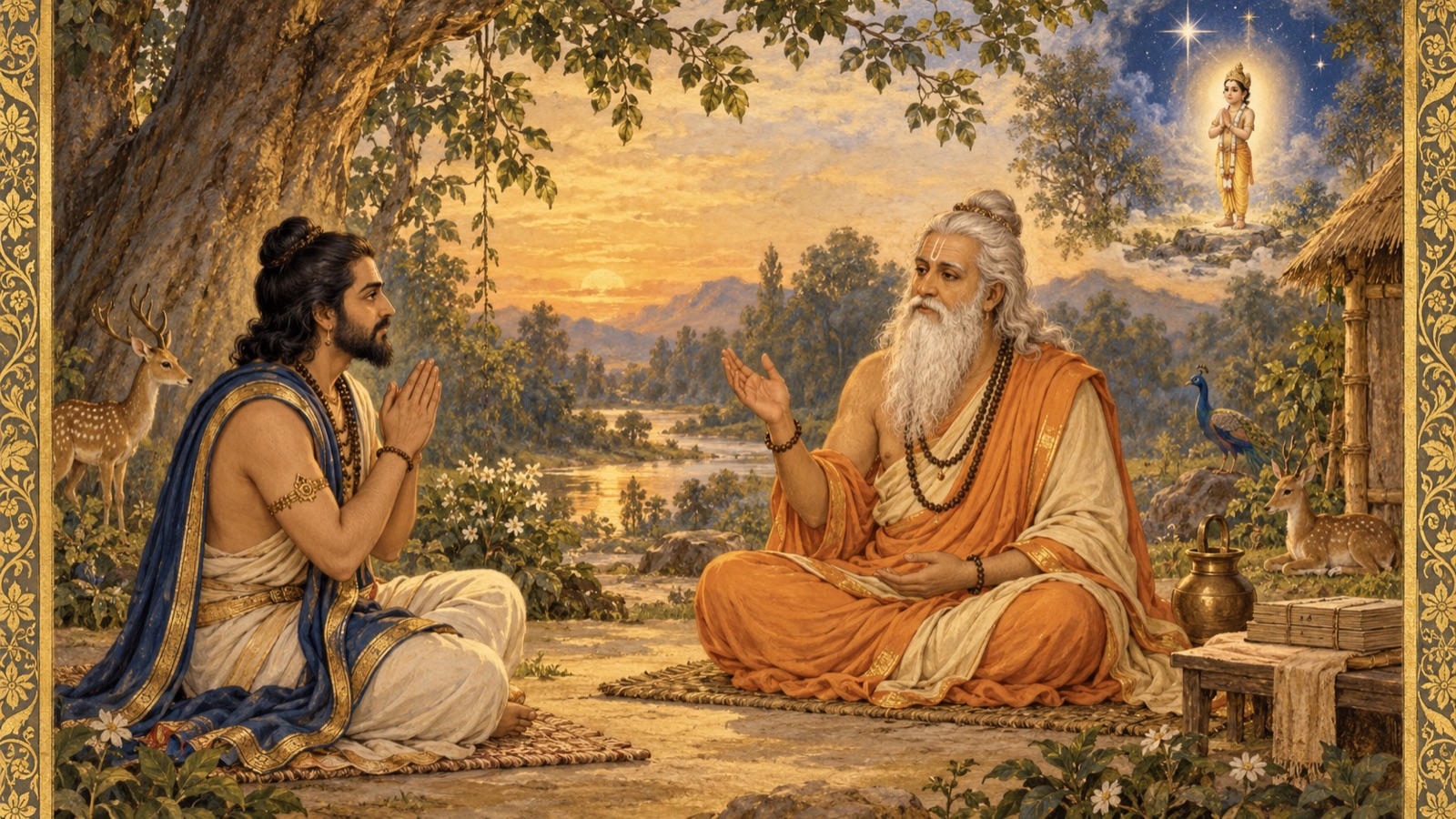
Maitreya is visibly pleased by the question. He tells Vidura that he has asked well, for any enquiry that touches the story of the Lord’s descent is itself a rope-cutter, severing the noose of birth and death that binds every mortal being. As proof, he reminds Vidura of young Dhruva — a mere child who, through the story of Sri Hari narrated to him by the sage Narada, found the strength to set his foot, quite literally, on the head of Death itself, and ascend bodily to the Lord’s own abode. It is in this spirit, Maitreya says, that he will now relate an anecdote he himself once heard — an account first told by Brahma, the god of gods, in answer to a question the gods themselves had put to him. And so the story proper begins: Diti, a daughter of Daksa, eager as any wife for a son, sought out her husband Kasyapa, the son of Marici, while it was only dusk — stung, Maitreya says plainly, by the darts of desire. Kasyapa, for his part, had just finished offering oblations of rice boiled in milk into the sacred fire, and sat absorbed in meditation, aware that the sun was on the point of setting.
Diti’s Plea at the Forbidden Hour
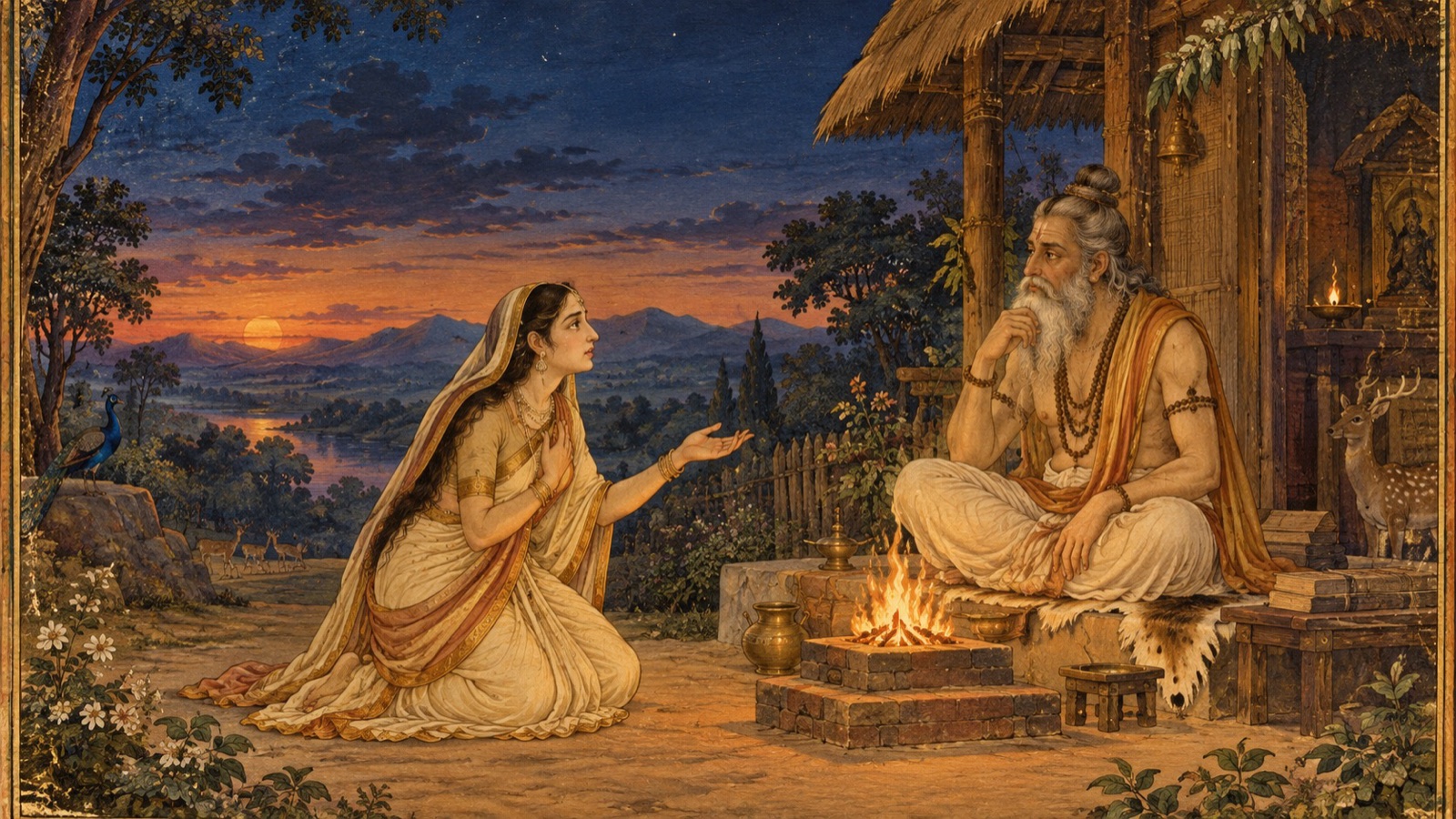
Diti’s appeal to her husband is unguarded and urgent. She compares the god of love’s assault upon her to a wild elephant trampling a banana tree — a helpless woman, she says, tormented on her husband’s own account, unable to bear the sight of her co-wives already blessed with children while she alone waits. She reminds Kasyapa, too, of an old family history: their father Daksa, fond as he was of his daughters, had once asked each of them, before their marriages, whom they wished to choose; sensing their unspoken preference, he gave thirteen of his daughters, Diti among them, to Kasyapa himself, precisely because they were suited to his nature. A husband, she says, is reborn through the son a devoted wife bears him — so let her plea, born of genuine affliction, not go unanswered by one so capable of granting it.
दितिरुवाच । एष मां त्वत्कृते विद्वन् काम आत्तशरासनः । दुनोति दीनां विक्रम्य रम्भामिव मतङ्गजः ॥
ditir uvāca eṣa māṁ tvat-kṛte vidvan kāma ātta-śarāsanaḥ dunoti dīnāṁ vikramya rambhām iva mataṅgajaḥ
Meaning: Diti said: O learned one, this god of love, bow drawn, forcibly torments me, poor woman that I am, on your account, just as a wild elephant would trample a banana tree. (Canto 3, Chapter 14, verse 9)
Maitreya makes plain that Diti is not calculating here; she is, in the text’s own words, a woman whose reason has already been clouded by the intensity of her longing. Kasyapa sees this clearly. He does not scold her, nor does he refuse her outright — he answers her, instead, with the calm, considered tone of a husband who understands both the legitimacy of her desire and the danger of the moment in which she has chosen to express it.
Kasyapa’s Counsel on Marriage and the Sanctity of Time
What follows is one of the more tender and philosophically rich passages in the entire episode, and it is worth pausing over, because it complicates any reading of this chapter as a simple morality tale. Kasyapa’s first instinct is not refusal but grace: he tells Diti plainly that he will grant her wish, for what husband would deny the desire of a wife through whom he achieves all three aims of human life — worldly prosperity, sense-fulfilment and religious merit? He goes further, offering a whole theology of marriage: just as a vessel carries a traveller across the ocean, married life carries a householder across the ocean of worldly sorrow, bearing with it, in a sense, the other three Asramas — the student, the forest-dweller, and the renunciate — all of whom, in practice, depend upon the householder’s support. A wife, the scriptures say, is the other half of a man’s body; by placing the burden of the household upon her, a man is freed to move through the world without constant anxiety. And just as the commander of a fortress subdues invaders with an ease that others, exposed in the open field, cannot match, so too does the householder — sheltered within married life — conquer the senses with a facility that those in the other Asramas struggle to attain. Kasyapa even confesses, with striking humility, that he could never fully repay Diti’s devotion in a single lifetime, nor even across many lives to come.
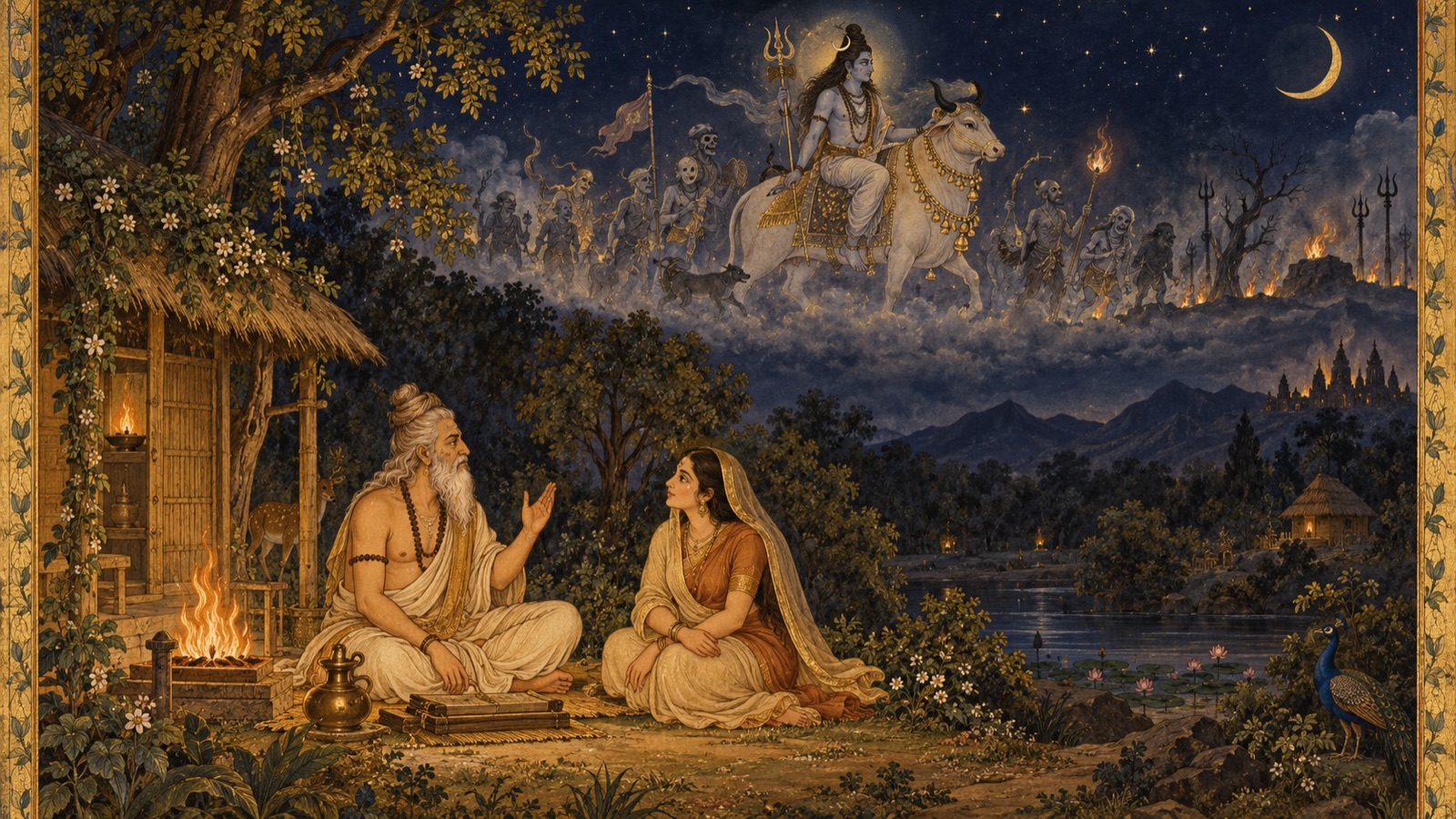
And yet — this is the turn on which the whole chapter hinges — Kasyapa asks her to wait. Not out of coldness, but because of exactly what kind of hour this is. He describes it precisely: an hour favourable to fearsome beings, at which the ghosts and spirits who form the retinue of Lord Rudra are abroad, and at which Rudra himself, seated upon His bull, moves through the world surrounded by His ghostly entourage — His matted hair disordered by the dust of the cremation grounds, His body pale with ash, His three eyes watching all things. Kasyapa’s description of Siva here is neither dismissive nor fearful in an ordinary sense; it carries, instead, a note of awed humility. He observes that Siva regards no one as intimate or estranged, none as more or less worthy — that His seeming poverty and strangeness of conduct is not a flaw but a teaching, meant to show the world how to grow indifferent to bodily vanity, even as those who prize their own adornment mock what they cannot understand. Even Brahma, Kasyapa says, respects the bounds Siva sets; He alone is the true cause of this universe, His illusory power merely His handmaiden, however inscrutable His outward conduct might appear.
Diti Persists, and Kasyapa Yields
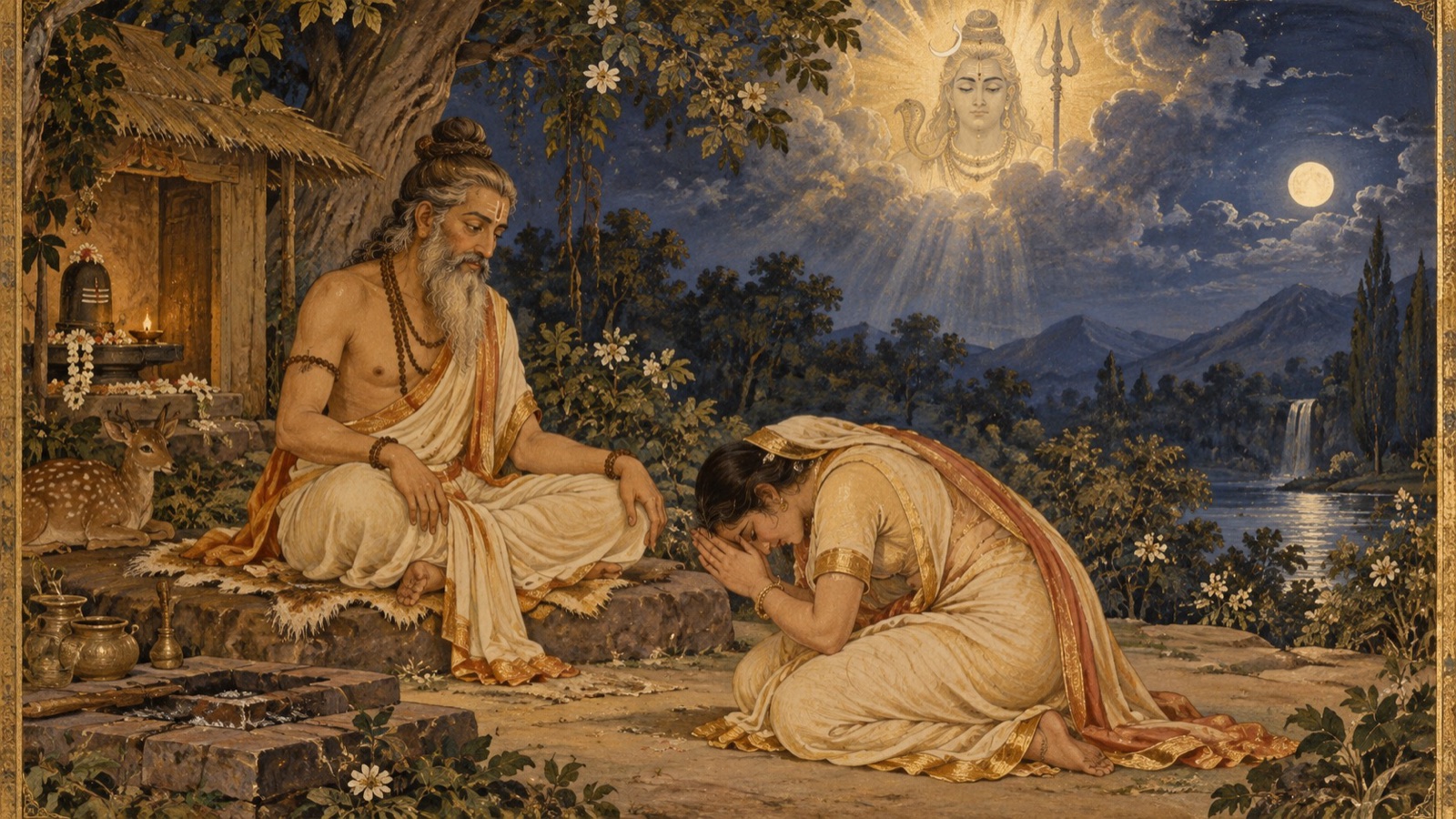
Diti, however, is beyond persuasion. Maitreya describes her, without flattery, as a woman whose mind has been entirely overtaken by love — she seizes the holy Brahmana by his very garment, setting aside, like an ordinary woman rather than the daughter of Daksa she is, all sense of modesty. Kasyapa, seeing this unusual insistence on a course he knows to be forbidden, bows before what he takes to be the working of Providence, and withdraws with her into seclusion. It is worth noting how the text frames what happens next: not as an act taken lightly, but as one immediately followed by disciplined atonement. Kasyapa bathes, controls his breath and speech, and begins to mutter the sacred syllable Om, his mind fixed on the eternal, self-effulgent Brahman it signifies. Diti, for her part, feels the full weight of shame at what has occurred; she approaches her husband again, this time with her face lowered, and speaks to him in genuine fear.
Her fear is focused and specific: she is afraid that Lord Rudra, whom she has offended by the very timing of the union, will destroy the seed now placed in her womb. She offers him her obeisance in the most reverent terms — the irresistible, all-blissful Lord who both drives away His devotees’ anguish and, when necessary, wields the rod of correction; the anger of universal dissolution personified, yet perfectly non-violent by nature. She appeals, too, to a bond of kinship: since Sati, Siva’s own spouse, was Diti’s real sister — both being daughters of Daksa — she asks that her brother-in-law, compassionate as he is by nature, show mercy even to a woman who has offended him, much as a hunter’s mercy might still be sought by the humblest creature.
Kasyapa’s Curse — and the Blessing Hidden Within It
Kasyapa, having completed his own evening devotions, sees his wife trembling and pleading on behalf of the very offspring she has just conceived — pleading, that is, for both this world’s welfare and the next’s. What he tells her next is delivered without evasion. Because her mind was impure at the moment of conception, because the hour itself was inauspicious, because she overrode his own express caution, and because she disregarded the gods altogether, a pair of sons will be born to her — sons whose very nature will be wicked and unworthy, sons who will make all three worlds, and their guardian gods, cry out again and again in distress. When, in time, they set about killing the helpless and the innocent, violating the honour of women, and provoking exalted souls to anger, the Lord Himself — Ruler of the universe, the Delighter of every world — will descend in wrath and strike them down, Maitreya says, exactly as Indra once struck down the mountains with his thunderbolt.
कश्यप उवाच । अप्रायत्यादात्मनस्ते दोषान्मौहूर्तिकादुत । मन्निदेशातिचारेण देवानां चातिहेलनात् ॥ भविष्यतस्तवाभद्रावभद्रे जाठराधमौ । लोकान् सपालांस्त्रींश्चण्डि मुहुराक्रन्दयिष्यतः ॥
kaśyapa uvāca aprāyatyād ātmanas te doṣān mauhūrtikād uta man-nideśāticāreṇa devānāṁ cātihelanāt bhaviṣyatas tavābhadrāv abhadre jāṭharādhamau lokān sa-pālāṁs trīṁś caṇḍi muhur ākrandayiṣyataḥ
Meaning: Kasyapa said: Because of the impurity of your mind, the fault of the hour, your transgression of my instruction, and your disregard of the gods, O wrathful one, two inauspicious and lowly sons will be born from your womb, who will make the three worlds together with their protectors weep again and again. (Canto 3, Chapter 14, verses 37-38)
Diti’s reaction to this news is itself remarkable, and reveals a mother’s conscience already at work even before her sons are born. She says she would rather her sons die directly at the hands of the Lord Himself — whose mighty arm bears the discus Sudarsana — than perish beneath the curse of an angered Brahmana; even the denizens of hell, she notes, refuse favour to one who dies consumed by a Brahmana’s wrath, or to one who has terrorised living beings, whatever species he is consigned to thereafter. It is a small but telling moment: Diti, already regretting the manner of her sons’ conception, at least wishes for them a death with some measure of dignity — met by the Lord Himself, rather than withered by a sage’s anger.
Kasyapa’s answer to this is where the chapter turns from warning to consolation. Seeing her genuine sorrow, her remorse, and the swift return of her right judgment — seeing, too, her deep reverence for Lord Vishnu, for Lord Siva, and indeed for Kasyapa himself — he tells her that one of the four sons born to her elder son will prove worthy of honour even among the holiest of men; people will sing his fame in the same breath as the Lord’s own glory.
कश्यप उवाच । कृतशोकानुतापेन सद्यः प्रत्यवमर्शनात् । भगवत्युरुमानाच्च भवे मय्यपि चादरात् ॥ पुत्रस्यैव च पुत्राणां भवितैकः सतां मतः । गास्यन्ति यद्यशः शुद्धं भगवद्यशसा समम् ॥
kaśyapa uvāca kṛta-śokānutāpena sadyaḥ pratyavamarśanāt bhagavaty uru-mānāc ca bhave mayy api cādarāt putrasyaiva ca putrāṇāṁ bhavitaikaḥ satāṁ mataḥ gāsyanti yad-yaśaḥ śuddhaṁ bhagavad-yaśasā samam
Meaning: Kasyapa said: Because your grief has turned to sincere penitence and honest self-examination, and because of your deep regard for the Supreme Lord, for Lord Siva, and for me — one born among the sons of your own son will be embraced by the saints as their own, and his pure renown will one day be sung in the very same breath as the Lord’s own glory. (Canto 3, Chapter 14, verses 43-44)
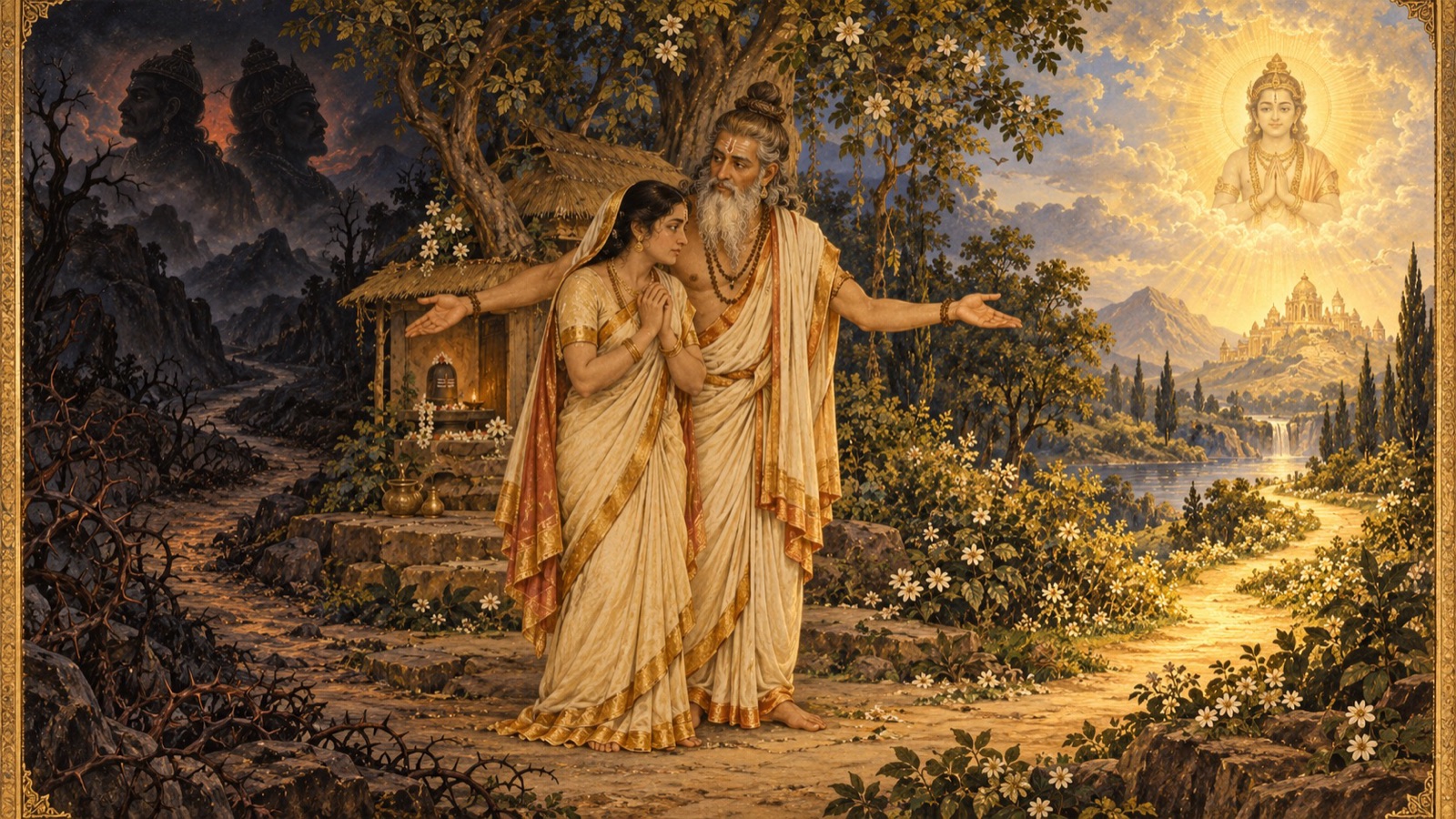
Though this chapter never speaks the child’s name outright, the wider Bhagavatam identifies him plainly: he is Prahlada, destined to be born to Hiranyakasipu, the elder of Diti’s two sons, and remembered ever after as one of the tradition’s most cherished exemplars of unwavering devotion. Just as gold of inferior quality is purified by fire, Kasyapa says, pious souls will cleanse their own hearts by emulating this grandson’s freedom from animosity and his noble character. This grandson will be a great devotee: magnanimous, high-souled, the noblest among the noble, installing Lord Vishnu in a heart purified by intense devotion, and shedding every false identification with the body. He will have no attachment to sensory pleasure, will be steadfast in virtue, will delight in the prosperity of others as readily as he grieves at their suffering, and — regarding no one as his enemy — will relieve the world’s sorrows just as the moon relieves the heat of summer. He will behold the lotus-eyed Lord, both in meditation and directly, in a form ever attentive to the wishes of His own devotees.
It is worth pausing on why Kasyapa’s warning and Kasyapa’s blessing arrive in the very same breath, addressed to the very same womb. The two wicked sons and the devotee grandson are not separate outcomes weighed against each other; they are one continuous act of providence working itself out across a single troubled lineage. Diti’s ill-timed desire brings real consequence — Kasyapa does not take back a single word of what he has foretold — but that consequence does not place her family beyond the Lord’s reach. If anything, it becomes the very channel through which His most beloved devotee will one day enter the world. This is the deeper teaching folded inside the visible one about timing and dharma: divine grace is not rationed out only to blameless households, and a heart that turns to genuine repentance, as Diti’s does here, can become the doorway through which even a self-made misfortune delivers a future saint into the world (verses 43-49).
Diti’s Acceptance
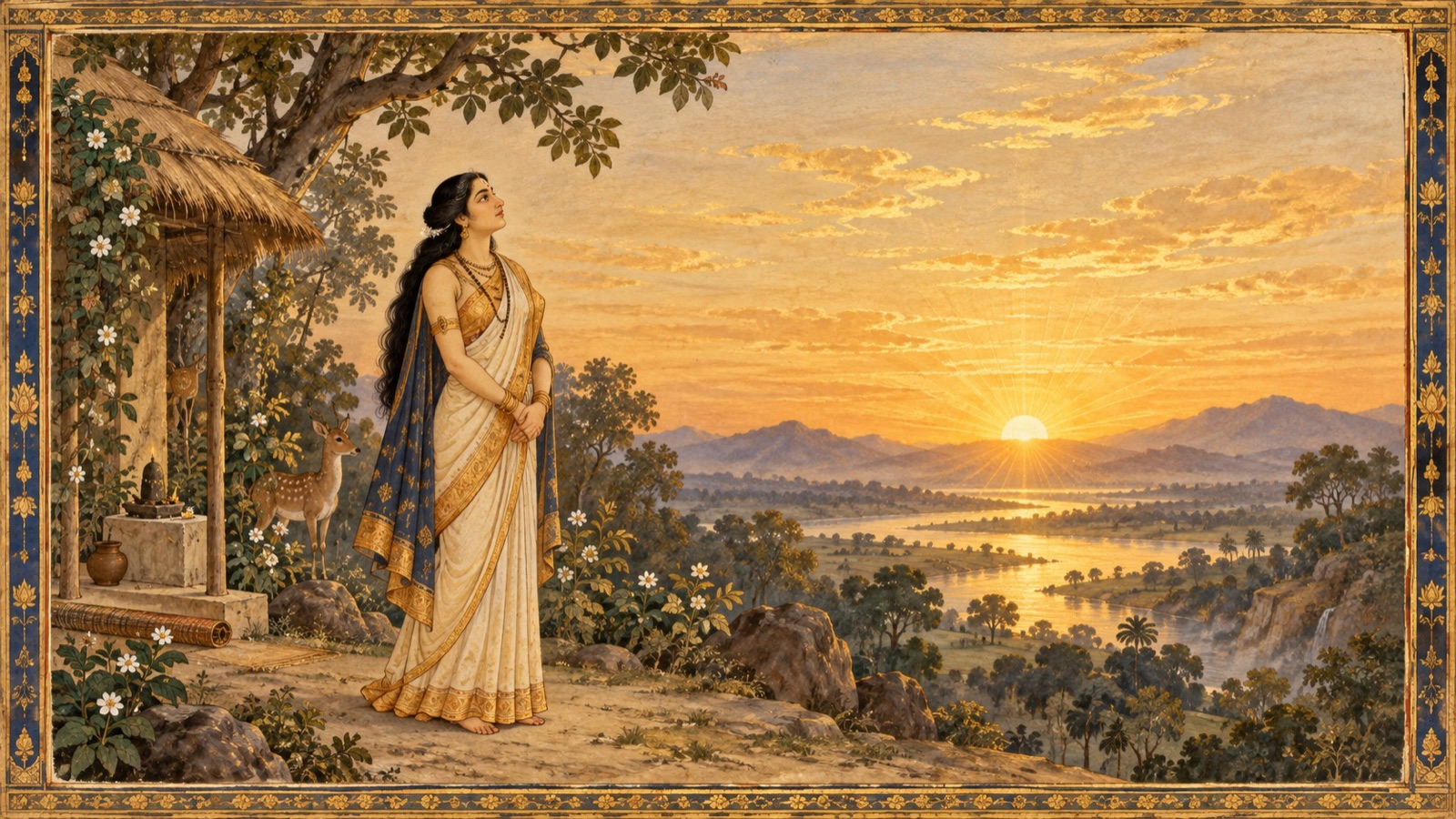
The chapter closes on a note that is neither wholly tragic nor wholly triumphant, but something more complex than either — a mother’s peace found in an unexpected place. Diti, hearing that her grandson will be a great devotee of the Lord, feels genuine delight; and in that same moment, Maitreya tells us, she comes to accept — with a mind grown magnanimous rather than merely resigned — that her own sons are destined to meet their deaths at the hands of Sri Krishna Himself. It is, in its way, the same wish she voiced earlier granted in full: a death delivered by the Lord’s own hand rather than by a Brahmana’s curse, wrapped now inside the further consolation that even from this troubled lineage, devotion to God will still find its way into the world.
मैत्रेय उवाच । श्रुत्वा भागवतं पौत्रममोदत दितिर्भृशम् । पुत्रयोश्च वधं कृष्णाद्विदित्वासीन्महामना ॥
maitreya uvāca śrutvā bhāgavataṁ pautram amodata ditir bhṛśam putrayoś ca vadhaṁ kṛṣṇād viditvāsīn mahā-manāḥ
Meaning: Maitreya said: Hearing that her grandson would be a devotee of the Lord, Diti became greatly delighted; and knowing that her two sons would be slain by Krishna, she nonetheless became magnanimous of mind. (Canto 3, Chapter 14, verse 50)
With this, the fourteenth discourse of Book Three closes — its colophon confirming that it has narrated, among other things, the dialogue between Diti and Kasyapa. Discourse XV will carry Maitreya’s narration forward to an altogether different scene: Sanaka and his three brothers pronouncing a curse against the gatekeepers Jaya and Vijaya, the episode that ultimately explains why these same two sons of Diti — soon to be born as Hiranyaksa and Hiranyakasipu — came to be born as demons at all.
Principal Teachings of This Chapter
1. Even a legitimate desire has a right and a wrong time. Kasyapa never denies that Diti’s wish for a son is proper, nor that marriage itself is a sanctified path across the ocean of worldly sorrow — his caution is entirely about timing, reminding us that dharma is rarely a question of what is desired but of when and how it is pursued (verses 16-22).
2. Consequences follow from the conditions of an action, not merely its outward form. Kasyapa names four distinct causes for what is to come — impurity of mind, an inauspicious hour, disregard of his own counsel, and disrespect toward the gods — a reminder that the Bhagavatam treats cause and effect with a precision that resists easy moralising (verses 37-38).
3. Repentance can reshape a story already set in motion. Diti’s sons are still born as she was told they would be, yet her sincere remorse is enough to draw from Kasyapa an entirely unlooked-for blessing — that a devotee grandson would arise from the very lineage she feared she had ruined (verses 43-49).
4. Devotion is never confined to a single family’s virtue. That greatness can emerge even from the descendants of Hiranyakasipu is itself a teaching central to this whole cycle of the Bhagavatam — the assurance that no lineage, however troubled at its root, is beyond the reach of grace (verses 46-49).
5. A mother’s love can find peace even in foreknowledge of loss. Diti’s magnanimity at the chapter’s close — accepting that her sons will die at the Lord’s own hand, and finding comfort rather than despair in it — models a devotional acceptance of what cannot be changed, once it is understood to serve a higher purpose (verse 50).
A Devotional Reflection
There is something quietly instructive in the fact that this chapter, so often summarised merely as “the birth of Hiranyaksa and Hiranyakasipu,” spends far more of its verses on a husband’s patient counsel and a wife’s fear and repentance than on the demons themselves. Kasyapa does not appear here as a stern moral authority handing down judgment from a distance; he is, throughout, a devoted husband trying to honour his wife’s desire while remaining faithful to a discipline he understands better than she does in the moment. And Diti is not reduced to a cautionary figure either — her longing is treated with real sympathy, her fear afterward with real tenderness, and her sons’ coming darkness is met, in the end, not with despair but with a grandmother’s undimmed hope for a grandson she will likely never live to meet. The scripture seems to be teaching, gently and without lecturing, that even the gravest consequences unfold within a fabric of continuing love and continuing grace — that no single hour, however inauspicious, closes the door on devotion finding its way back into a family’s story.
A Daily Devotional Practice
Today, consider a decision in your own life where the question is not whether something is right, but when it is right — a word that would be kind spoken tomorrow but wounding spoken now, a request that is reasonable but poorly timed, a desire that is not wrong in itself but asks to be held a little longer before it is acted upon. Let Kasyapa’s patient, respectful counsel to Diti be a model: honour the desire without dismissing it, but do not mistake urgency for readiness. And if you find, as Diti did, that impatience has already led you somewhere you now regret, let her example guide you there too — sincere remorse, rather than despair, is what draws grace back into a difficult situation. Before returning to your day, pause and repeat quietly: “Om Namo Bhagavate Vasudevaya.” Let that remembrance steady your sense of timing in whatever you undertake, trusting that the Lord’s own grace can still bring good out of an imperfect beginning.
Conclusion
The fourteenth discourse of Book Three answers Vidura’s simple question about Hiranyaksa with a story of far greater depth than a mere birth record. It opens with Maitreya’s praise for any enquiry into the Lord’s own deeds, moves through Diti’s desire-driven plea and Kasyapa’s grave counsel on marriage, timing and the true nature of Lord Siva, and arrives at a conception undertaken against a husband’s own better judgment, at the very hour when the world’s fiercer powers are abroad. What follows is neither simple retribution nor simple mercy, but both together: a curse naming two sons destined for great wickedness and an unlooked-for blessing naming a grandson destined for great devotion — and a mother’s heart, by the chapter’s final verse, finding room enough to hold both truths at once. Vidura’s question about a demon’s death becomes, in Maitreya’s hands, a meditation on how even an ill-timed beginning cannot finally close off the possibility of grace, preparing the ground for Discourse XV’s account of the curse that first set Jaya and Vijaya on the path to becoming these very brothers.
May the divine wisdom of Srimad Bhagavatam awaken pure devotion within our hearts.
Om Namo Bhagavate Vasudevaya.
Jay Shree Madhav.
References and Attribution
- Primary edition: Gita Press, Śrīmad Bhāgavata Mahāpurāṇa (English, complete), Book Three, Discourse 14, pages 194–199.
- Series: Srimad Bhagavatam Wisdom · Biswa Sanatan Dharma Seva Trust.
- Presented following the spiritual guidance and recommendation of Pandit Dr. Shri Kashinath Mishra.
This is an original, faithful retelling in the writer’s own words, with brief quoted verses shown in Devanāgarī and transliteration and their meanings given as summaries. It is not a reproduction of any single publisher’s continuous translation or commentary. No affiliation with or endorsement by any publisher is implied.
Jay Shree Madhav