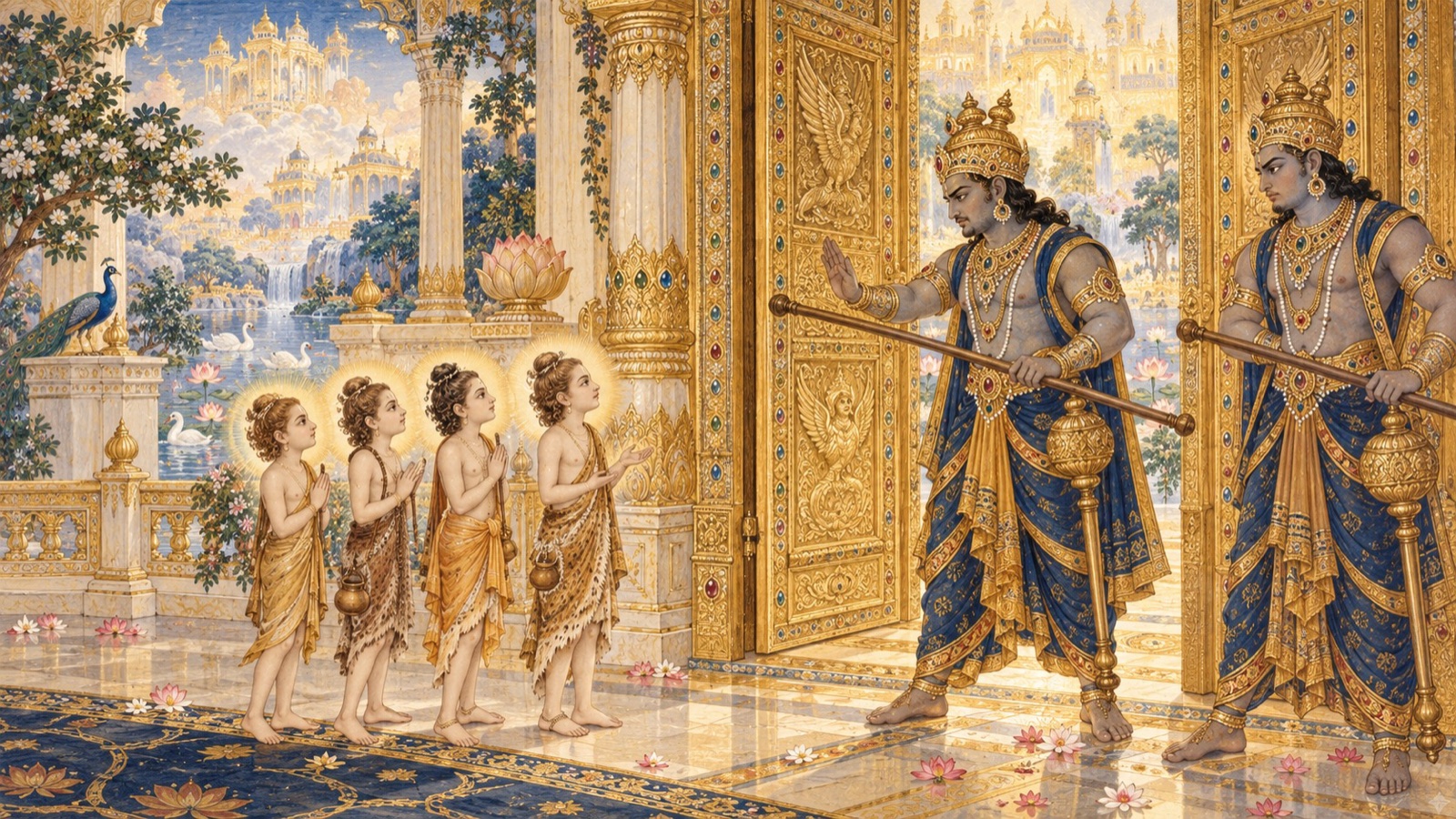
How does the perfect world fall out of balance? In this chapter, four naked child-sages walk unhindered through six gates of paradise — and are stopped at the seventh by two proud doorkeepers. What follows is not a battle but a curse, spoken in a single breath of anger and undone, just as quickly, by the Lord’s own arrival at the gate.
Om Namo Bhagavate Vasudevaya.
Om Namo Bhagavate Vasudevaya.
Om Namo Bhagavate Vasudevaya.
Welcome to Srimad Bhagavatam Wisdom, a devotional journey through the sacred histories and teachings of the Srimad Bhagavat Mahapurana. Chapter Fourteen closed with Diti, having conceived twin sons through Kasyapa in a moment of inauspicious passion, retaining the seed within her womb for a hundred years out of fear of what her demigod-hating sons might become. That single detail — a hundred years of waiting, of gathering darkness — is where this fifteenth discourse begins. But before Maitreya can tell Vidura what becomes of Diti’s sons, he must first go backward in the story, to explain why the gods were so afraid of what Diti carried, and that explanation carries us somewhere altogether unexpected: through the gates of Vaikuntha itself, to a single fateful morning when the doorkeepers Jaya and Vijaya refused entry to four small, effulgent, wandering sages, and were cursed for it. This is the story, Brahma tells the anxious gods, that explains the darkness gathering in Diti’s womb — for the two proud doorkeepers of paradise are about to be born, twice over, as her sons.
Chapter Information
- Scripture: Śrīmad Bhāgavata Mahāpurāṇa
- Canto: 3 (Book Three)
- Chapter: 15 (Discourse 15)
- Chapter title: Sanaka and his three brothers pronounce a curse against the doorkeepers Jaya and Vijaya
- Principal speakers: Maitreya (narrating throughout), quoting in turn the gods, Brahma, the four Kumara sages, and the Kumaras’ own prayer to the Lord — the whole related by Sukadeva Gosvami to King Parikshit, and by Suta Gosvami to the sage Saunaka and the assembly at Naimisharanya
- Principal listener: King Parikshit (within the narrative frame); Vidura (within the dialogue itself)
- Main setting: The hermitage where Vidura sits at the feet of the sage Maitreya; within Maitreya’s own narration, the setting shifts to the gods’ assembly before Brahma, and then to Vaikuntha itself — specifically its seventh gate
- Central subject: Brahma’s explanation, to the alarmed gods, of an old story: how the sages Sanaka, Sanandana, Sanatana and Sanatkumara (traditionally called the four Kumaras) once traveled to Vaikuntha and were refused entry at its seventh gate by the doorkeepers Jaya and Vijaya; how the sages, in a moment of righteous anger, cursed the two to fall from Vaikuntha into the material world; how Jaya and Vijaya accepted the curse in humility; and how the Lord Himself came at once to the gate, His presence transforming the sages’ anger into ecstatic devotion
- Principal verse range: Canto 3, Chapter 15, verses 1–50 (the traditional numbering runs unbroken across all fifty verses of this chapter; see Verification notes)
- Primary edition: Gita Press Śrīmad Bhāgavata Mahāpurāṇa
Darkness in the Womb, and a Prayer to Brahma
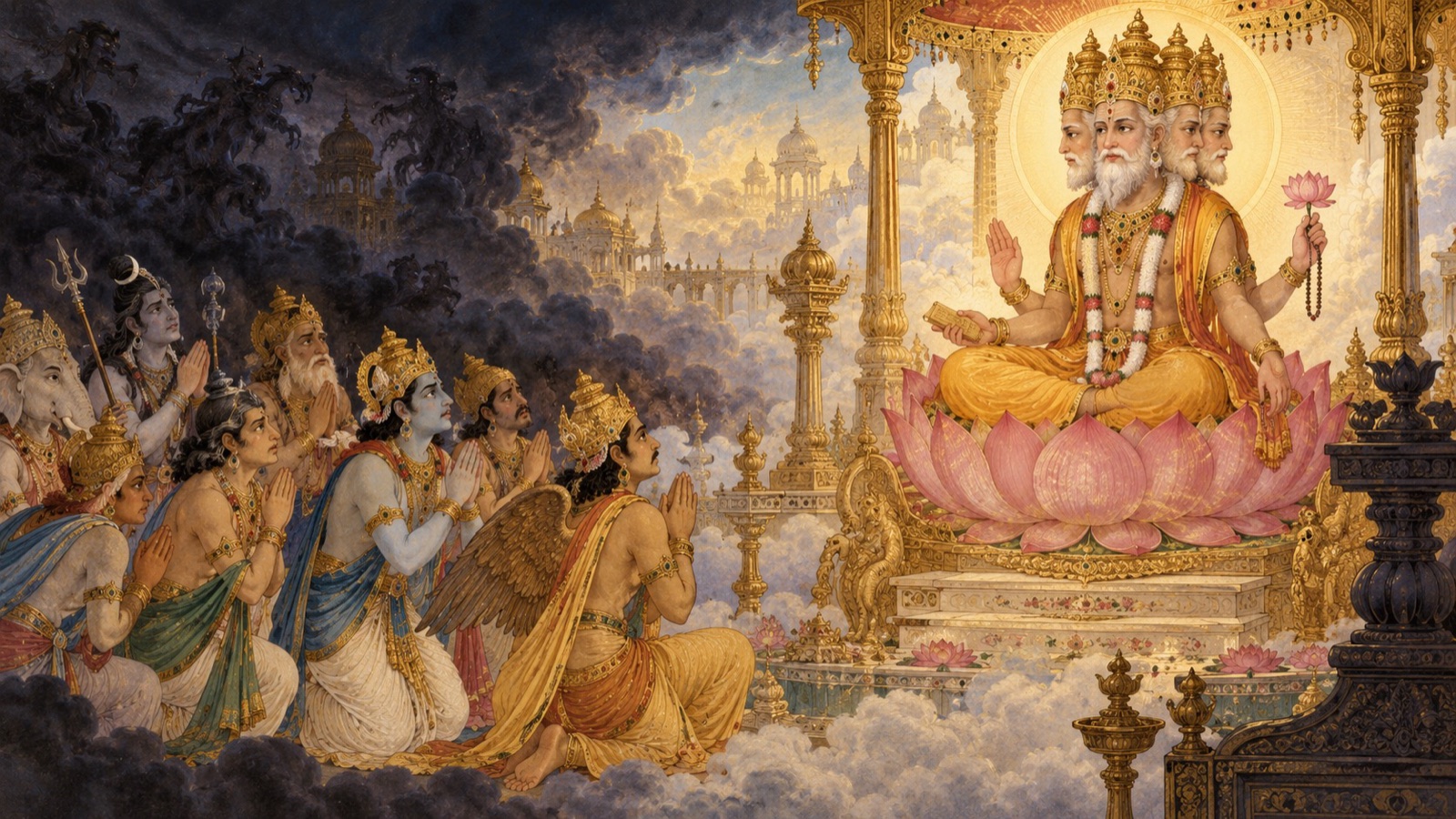
The chapter opens not in Vaikuntha but back with Diti, whom we left at the close of Chapter Fourteen carrying, for fear of what it might become, the powerful seed of Kasyapa. Maitreya tells Vidura that Diti held that seed within her for a full hundred years — and that its concealed brilliance was still strong enough to dim the light of every luminary in the universe. The guardians of the different spheres felt their own splendour fade and, alarmed, went to Brahma, the creator, to ask what this spreading darkness could mean.
मैत्रेय उवाच । प्रजापत्यं तु तत्तेज: परतेजोहनं दिति: । दधार वर्षाणि शतं शङ्कमाना सुरार्दनात् ॥ १ ॥
maitreya uvāca / prājāpatyaṁ tu tat tejaḥ para-tejo-hanaṁ ditiḥ dadhāra varṣāṇi śataṁ śaṅkamānā surārdanāt
Meaning: Maitreya continued: Fearing trouble for the gods, Diti held within her womb, for a hundred years, the powerful seed of Kasyapa — a seed capable of overwhelming the strength of any enemy. (Canto 3, Chapter 15, verse 1)
The gods’ prayer that follows is a small masterpiece of humility mixed with confusion. They address Brahma with every mark of supreme reverence — “You, whose knowledge is unaffected by time,” “You in whom the whole universe, cause and effect together, is woven” — language that would properly belong only to the Supreme Lord Himself. It is a touching, almost comic moment: the gods, terrified by the darkness pressing in on them, instinctively reach for the highest language of devotion they know, even though they are addressing Brahma rather than Krishna or Vishnu directly. Maitreya notes that Brahma himself found this rather amusing — he “laughed at their rank ignorance in praying to him as if he were the Supreme Deity” — before answering them anyway, kindly, in words that delighted the anxious assembly.
Brahma’s Answer: A Story About Vaikuntha
Brahma’s reply is not a direct explanation of Diti’s pregnancy at all — not yet. Instead, he tells the gods an old story, and it is this story that occupies the rest of the chapter. Long ago, he says, his own mind-born sons — Sanaka and his three brothers, the eldest of all his progeny, sages who wander the worlds by the power of yoga, entirely free from attachment to anything they see — once travelled, in the course of their wanderings, to Vaikuntha itself, the transcendent abode of Lord Vishnu.
ते एकदा भगवतो वैकुण्ठस्यामलात्मन: । ययुर्वैकुण्ठनिलयं सर्वलोकनमस्कृतम् ॥ १३ ॥
ta ekadā bhagavato vaikuṇṭhasyāmalātmanaḥ yayur vaikuṇṭha-nilayaṁ sarva-loka-namaskṛtam
Meaning: Once, they went to the abode called Vaikuntha, belonging to Lord Vishnu of pure, undefiled being — a realm which is bowed to and adored by all other worlds. (Canto 3, Chapter 15, verse 13)
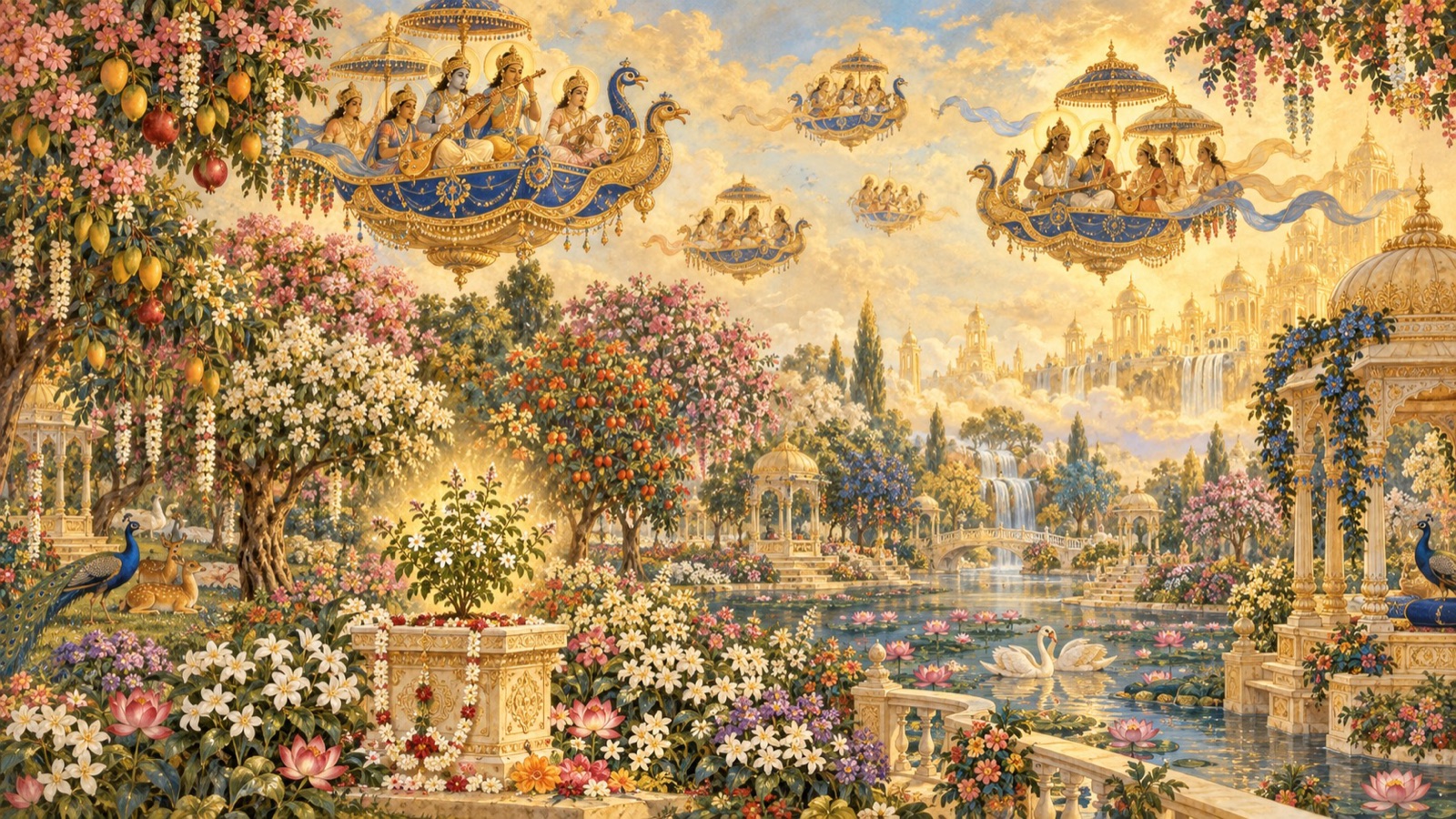
What follows this simple statement of arrival is one of the longest and most loving descriptions of Vaikuntha found anywhere in the early chapters of the Bhagavatam — some thirteen full verses (14 through 26) given over entirely to the wonder of that realm, before the actual incident at the gate is even mentioned. It is worth lingering on this description, because Brahma’s telling makes clear that Vaikuntha is not simply a more comfortable version of heaven; it is a realm built, in every particular, out of pure, undivided devotion.
Every soul who lives there, Brahma says, bears a form like the Lord’s own, and reaches that realm only by disinterested service to Sri Hari — never by mere ritual, austerity, or the pursuit of personal liberation for its own sake. There is an orchard called Naihsreyasa, beatitude made visible as trees and fruit and flowers blooming in every season at once. Gandharvas ride through the sky in aerial cars, singing the Lord’s stories with such absorption that even the fragrance of the most intoxicating spring-blossoms, drifting to them on the breeze, cannot pull their attention away — indeed, they scold the breeze itself for the interruption. When the humming of bees rises to a certain pitch, it sounds like the Lord’s own story being told, and every other bird — the cuckoo, the swan, the peacock, the Cakravaka — falls silent to listen. Even the flowers of that realm, the Bhagavatam says, recognise a kind of hierarchy among themselves: the Mandara, the lotus, the Parijata, all fragrant and all glorious, nonetheless acknowledge that Tulasi, the humble basil plant so beloved of the Lord, performed a greater penance in a former life than any of them, and so wears the greatest honour of decorating His own body.
Two further verses (21-22) describe Goddess Sri, the Lord’s own consort, moving through the palace grounds with anklets that make a soft tinkling sound, a lotus flower held as a plaything in her hand, glimpsed reflected in walls of crystal inlaid with gold — a reflection so vivid that she seems, playfully, to be dusting a house that could never truly hold any dust at all. Nearby, in her own pleasure-garden, she worships the Lord with Tulasi leaves, and catches sight of her own reflected face in a coral-staired pond, thinking herself fortunate simply to have once been kissed by His feet.
This entire, extended vision of Vaikuntha’s beauty is not decoration. It exists in the text to make one thing unmistakably clear before the incident at the gate occurs: this is a realm from which anger, suspicion and duality have, by nature, no place — which is precisely what makes what happens next so striking.
Six Gates Passed Freely, and a Seventh That Is Not
Having taken in the wonder of that realm — Brahma tells the gods — the four Kumaras felt supreme delight, having reached by the power of their yoga the very abode that is the sole object of reverence for every other world. And they began to walk toward the Lord’s own residence.
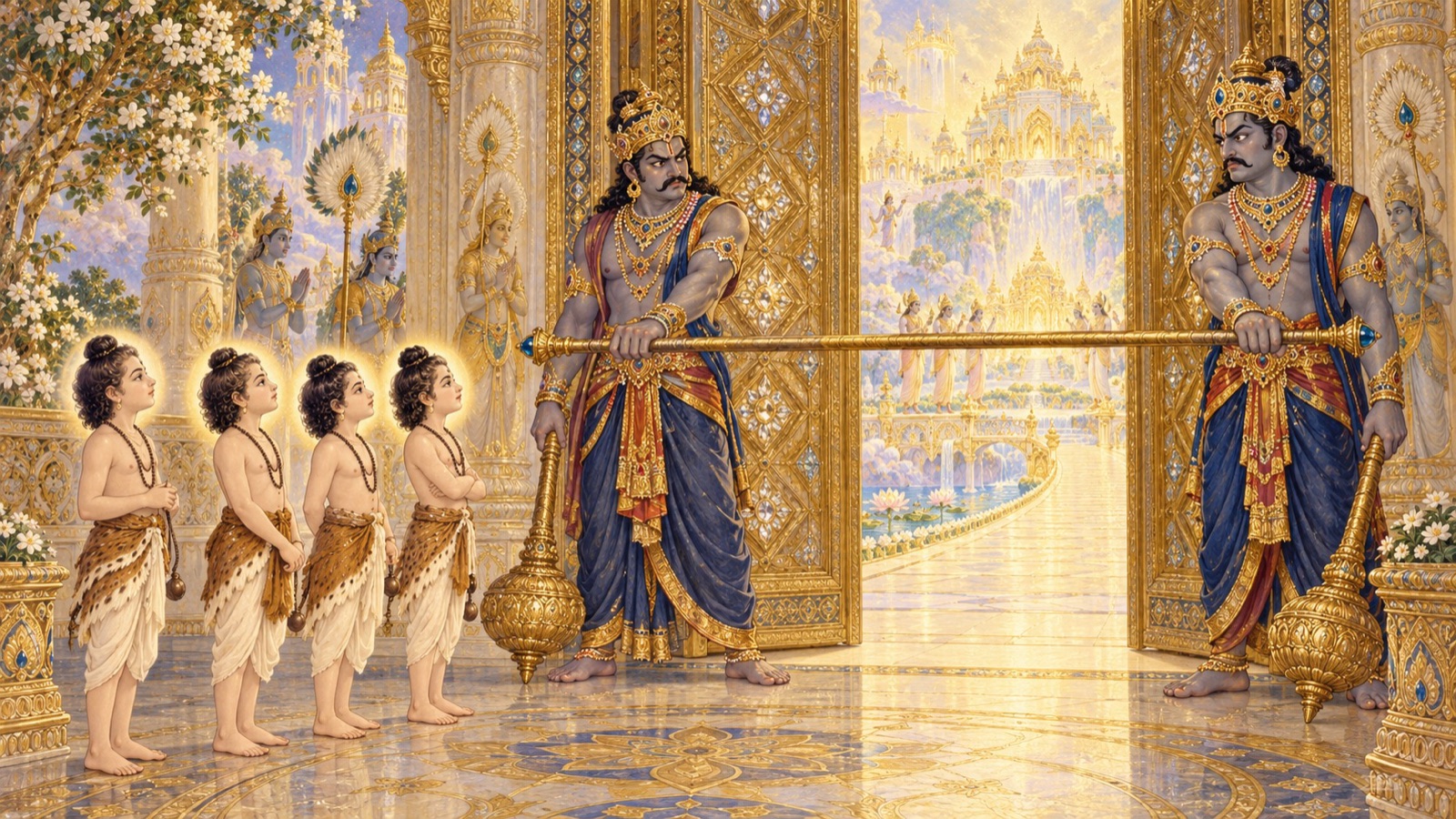
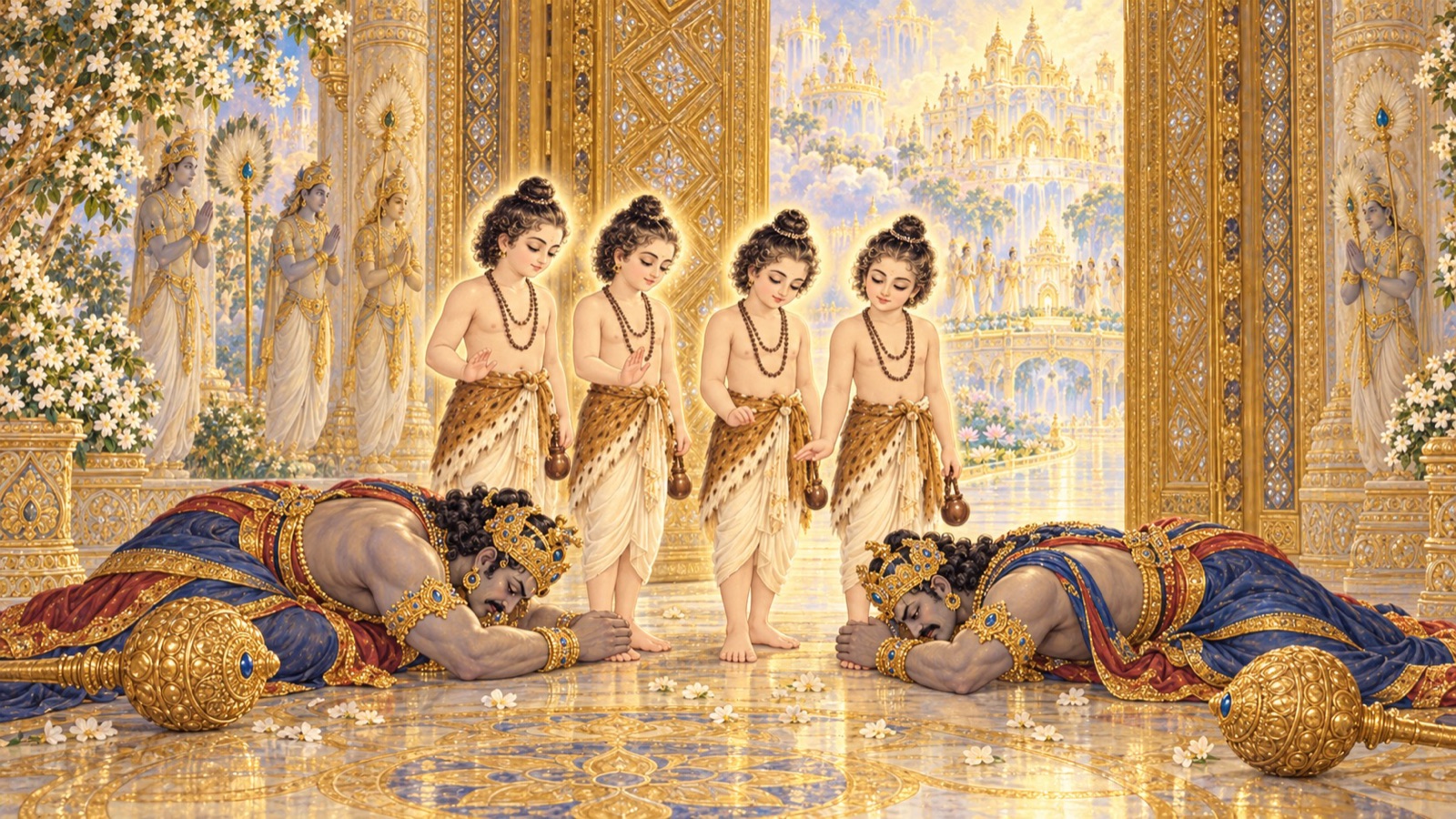
Six gates, richly furnished with doors of gold and diamond, they passed through freely, without the smallest attachment to what they saw and without pausing to ask permission of anyone — for these are sages who move everywhere without obstruction, regarding every being they encounter, doorkeeper or god, as no different from their own Self. At the seventh gate, however, they encountered something new: two shining beings of the same age, armed with maces, adorned with the most valuable armlets, earrings, and diadems — doorkeepers of a kind the six earlier gates apparently had not required.
तस्मिन्नतीत्य मुनय: षडसज्जमाना: कक्षा: समानवयसावथ सप्तमायाम् । देवावचक्षत गृहीतगदौ परार्ध्य- केयूरकुण्डलकिरीटविटङ्कवेषौ ॥ २७ ॥
tasminn atītya munayaḥ ṣaḍ asajjamānāḥ kakṣāḥ samāna-vayasāv atha saptamāyām devāv acakṣata gṛhīta-gadau parārdhya- keyūra-kuṇḍala-kirīṭa-viṭaṅka-veṣau
Meaning: Having passed through six gates of the Lord’s residence without any attachment, the sages saw, at the seventh, two shining beings of the same age, holding maces and adorned with the most precious armlets, earrings, and crowns. (Canto 3, Chapter 15, verse 27)
The two doorkeepers — though the Bhagavatam does not yet name them, tradition and the following chapter (Discourse XVI) identify them as Jaya and Vijaya — wore, alongside their splendid ornaments, an unmistakably agitated countenance: arched eyebrows, distended nostrils, reddish eyes, as though some anxiety already sat uneasily on them even before the sages arrived. The four boy-sages, for their part, looked like five-year-old children, clothed in nothing but the open air, though they were in truth the very eldest of Brahma’s creation and had long since realised the deepest truth of the Self. True to their custom, they simply began walking through the seventh gate exactly as they had walked through the previous six — without pausing to seek anyone’s leave.
This time, though, the doorkeepers stopped them. Jaya and Vijaya — whose very disposition, the Bhagavatam notes pointedly, was “quite unpalatable to the Lord” — barred the sages’ way with their staff, showing open contempt for beings whose glory, in truth, they did not deserve to treat with anything but reverence. The other divinities of Vaikuntha looked on as this happened; and even they, the Bhagavatam says, though eminently fit to enter the Lord’s presence themselves, felt their own eyes redden slightly with anger at seeing their approach to their most beloved Friend thwarted in this way.
The Curse: “Go You Hence to Those Spheres”
What the four sages say next is worth reading closely, because it is not simple rage — it is a diagnosis. They ask the doorkeepers, in effect, how it is possible that two beings living in a realm built entirely on the qualities of the Lord Himself — a realm of perfect equanimity, where nothing and no one is regarded as truly separate from anything else — could have developed a nature so discordant, so suspicious, so quick to see enemies where none exist. If you see impostors and threats here, the sages say, the fault lies in your own eyes, not in this place: “You happen to be the only impostors in this realm.”
मुनय ऊचु: को वामिहैत्य भगवत्परिचर्ययोच्चै- स्तद्धर्मिणां निवसतां विषम: स्वभाव: । तस्मिन् प्रशान्तपुरुषे गतविग्रहे वां को वात्मवत्कुहकयो: परिशङ्कनीय: ॥ ३२ ॥
muni ūcuḥ / ko vām ihaitya bhagavat-paricaryayoccais tad-dharmiṇāṁ nivasatāṁ viṣamaḥ svabhāvaḥ tasmin praśānta-puruṣe gata-vigrahe vāṁ ko vātmavat kuhakayoḥ pariśaṅkanīyaḥ
Meaning: The sages said: Living here in the highest service of the Lord, and expected to share His very qualities, how have you two developed such a discordant nature? The Lord Himself is entirely at peace with everyone — who, then, is there here for you to suspect, except in your own image, you two impostors? (Canto 3, Chapter 15, verse 32)
They press the point further: the true residents of Vaikuntha, they say, do not even perceive themselves as separate from the Lord who holds the whole universe within His own body — the way space enclosed in a jar is never, in truth, different from the boundless space around it. What then, the sages ask, has happened to these two, invested as they are with divine bodies, that has filled them with a fear rooted in the perception of division? And so, they declare, a fitting punishment must be considered — not out of vengeance, but so that ultimate good may come to these two “dull-witted servants of the Supreme Being.” Since the two doorkeepers perceive duality even here, in Vaikuntha itself, they must go to the one place where duality is the very air one breathes:
तद्वाममुष्य परमस्य विकुण्ठभर्तु: कर्तुं प्रकृष्टमिह धीमहि मन्दधीभ्याम् । लोकानितो व्रजतमन्तरभावदृष्टया पापीयसस्त्रय इमे रिपवोऽस्य यत्र ॥ ३४ ॥
tad vām amuṣya paramasya vikuṇṭha-bhartuḥ kartuṁ prakṛṣṭam iha dhīmahi manda-dhībhyām lokān ito vrajatam antara-bhāva-dṛṣṭyā pāpīyasas traya ime ripavo ‘sya yatra
Meaning: Therefore, for the good of you two dull-minded servants of the Supreme Lord of Vaikuntha, we shall determine a fitting course. Since you perceive division even here, go hence to those worlds where the three sinful enemies — lust, anger, and greed — hold sway. (Canto 3, Chapter 15, verse 34)
It is a curse spoken almost clinically — not in a raised voice, but in the calm, diagnostic tone of a physician naming a disease and prescribing its cure. Nowhere in these verses do the sages act out of personal injury; their anger, the text has already told us, arose only from a thwarted longing to reach their beloved Lord, and what they pronounce is framed, even in the moment of anger, as ultimately for Jaya and Vijaya’s own good.
Two Doorkeepers Fall at the Sages’ Feet
The response of Jaya and Vijaya to hearing this is immediate and, in its way, deeply moving. The moment they understand that what has fallen upon them is a curse from Brahmanas — a force, the Bhagavatam says, that cannot be countered “even by multitudes of missiles” — the two attendants of Sri Hari, who fear the wrath of Brahmanas even more than they fear anything else, prostrate themselves at once on the ground, clasping the sages’ feet in complete humility.
Their own words in response contain no protest, no bargaining, no plea for the curse to be lifted. “You have meted out to us a punishment which is but meet for an offender,” they say; “let it, therefore, take effect, so that it may purge us in toto of the sin of showing disrespect to the Lord.” Their only request — and it is telling that this, and only this, is what they ask for — is that whatever infatuation awaits them in their coming births in the material world should not be allowed to erase from their minds the memory of the Lord.
This single request contains, in miniature, one of the chapter’s deepest teachings. Jaya and Vijaya do not ask to be spared suffering, loss of status, or exile from paradise. They ask only to keep what matters most: remembrance. It is a request the Lord will, in the following chapter, grant in His own particular way.
The Lord Arrives at His Own Gate
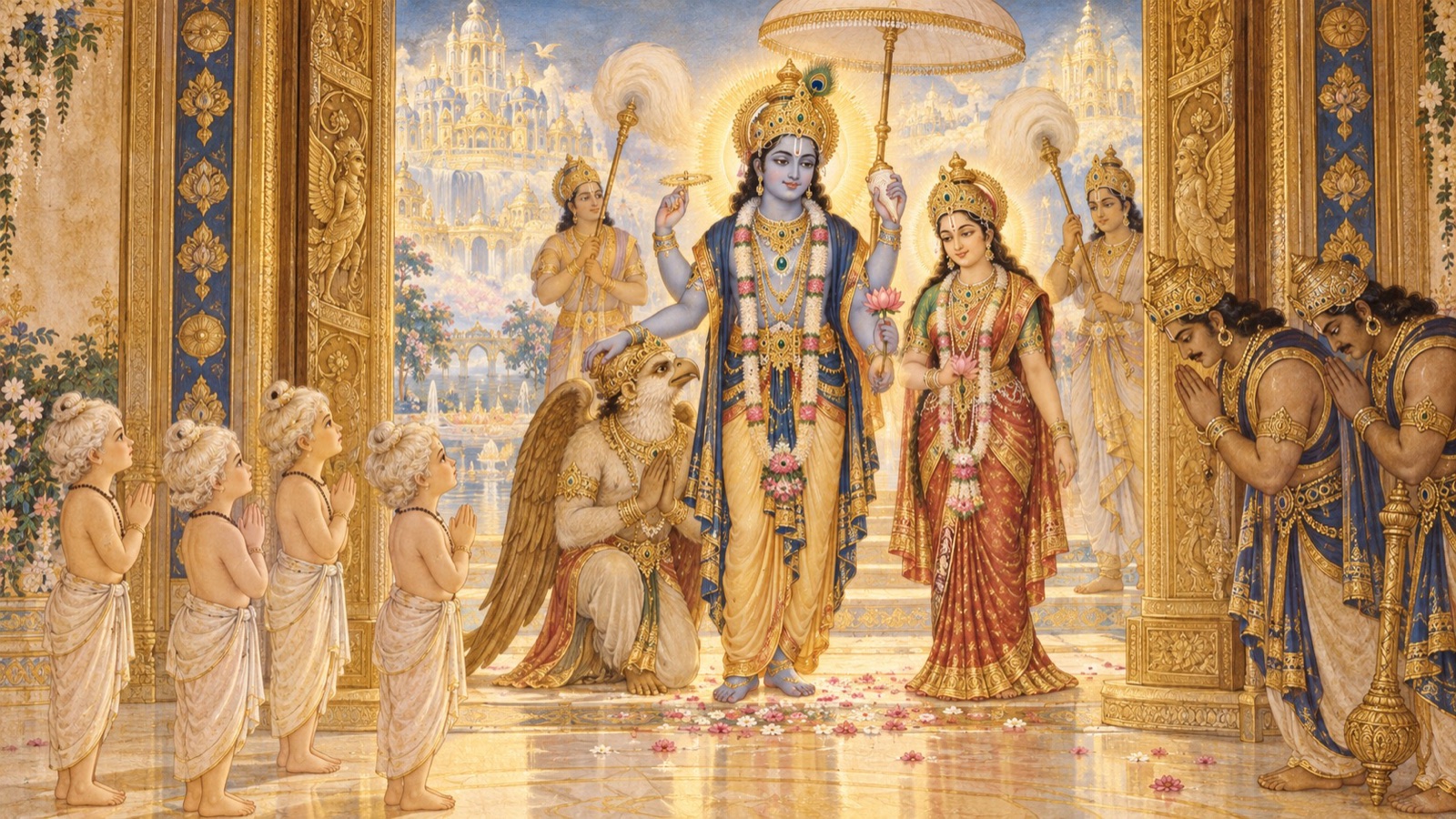
What happens next answers, more powerfully than any explanation could, the question the sages themselves had just posed: how could anything be genuinely wrong in a realm so entirely suffused with the Lord’s presence? The very moment the offence occurs, the Lord Himself — described here as Padmanabha, He from whose navel the lotus of creation grows, the delight of the righteous — becomes aware of the insult His own servants have offered to such exalted saints, and sets out at once for the gate on His own two feet, the very feet sought after by recluses and great sages, accompanied by Sri, His eternal Spouse.
एवं तदैव भगवानरविन्दनाभ: स्वानां विबुध्य सदतिक्रममार्यहृद्य: । तस्मिन् ययौ परमहंसमहामुनीना- मन्वेषणीयचरणौ चलयन् सहश्री: ॥ ३७ ॥
evaṁ tadaiva bhagavān aravinda-nābhaḥ svānāṁ vibudhya sad-atikramam ārya-hṛdyaḥ tasmin yayau paramahaṁsa-mahā-munīnām anveṣaṇīya-caraṇau calayan saha-śrīḥ
Meaning: That very moment, the Lord, whose navel bears the lotus and who delights the righteous, learned of the offence His own servants had committed against the saints, and went at once to that place — on those very feet sought by the greatest of recluses and sages — accompanied by Sri. (Canto 3, Chapter 15, verse 37)
What follows is an extended, loving description of the Lord’s appearance as He arrives — a white umbrella like the moon overhead, strings of pearls at its edge catching the breeze from swan-white chowries like drops of falling nectar, Goddess Lakshmi resting against His broad dark chest like a streak of gold, a garland of forest flowers alive with the hum of bees, one hand resting on Garuda’s shoulder and the other turning a lotus, a crown studded with gems, the Kaustubha jewel at His throat. The sages, whose entire practice of meditation had this very form as its object, now saw it directly before their eyes, and looked on with unsated gaze, joyously bowing their heads.
It is worth noting what does not happen in this scene: there is no rebuke of the sages for their anger, no judgment pronounced upon the incident at all. The Lord’s response to a curse spoken in His own gateway is simply to appear — His very presence dissolving whatever tension the moment had carried, transforming the sages’ remaining agitation into pure, absorbed devotion. Even the breeze that reaches them, carrying the fragrance of Tulasi mixed with the dust of His lotus feet, is enough to send a visible thrill through their bodies, though these are sages already established in oneness with the Absolute and, by every ordinary measure, entirely beyond such sensory excitation.
That single detail carries more weight than it first appears. The four Kumaras had spent ages absorbed in the pursuit of the featureless, all-pervading Brahman, seeking the Self beyond every form. Yet the instant that tulasi-scented breeze reaches them, something changes in them, body and mind together, even though their whole training had taught them to regard the Absolute as formless (verse 43). Their long-held pursuit of oneness with the Supreme quietly gives way to a longing they had never before entertained: simply to remain, forever, His servants at His feet.
This, the text goes on to explain, is in fact the very form that real yoga was always meant to lead to — not a void or an abstraction, but the Lord’s own personal body, exactly as He now stood before the four sages.
पुंसां गतिं मृगयतामिह योगमार्गै- र्ध्यानास्पदं बहु मतं नयनाभिरामम् । पौंस्नं वपुर्दर्शयानमनन्यसिद्धै- रौत्पत्तिकै: समगृणन् युतमष्टभोगै: ॥ ४५ ॥
puṁsāṁ gatiṁ mṛgayatām iha yoga-mārgair dhyānāspadaṁ bahu-mataṁ nayanābhirāmam pauṁsnaṁ vapur darśayānam ananya-siddhair autpattikaiḥ samagṛṇan yutam aṣṭa-bhogaiḥ
Meaning: This very form is what the followers of the yoga path seek and meditate upon; it is no imagination but a directly perceived truth, confirmed by great yogis themselves — a form fully endowed with all eight mystic perfections, which others attain only in part, if at all. (Canto 3, Chapter 15, verse 45)
This is the theological turn on which the whole chapter quietly hinges. Brahma had already taught, and the yoga tradition of his age had long assumed, that the highest goal of the sincere seeker was liberation into the light of the formless Absolute — the very goal these four sages had themselves pursued since the beginning of their existence. Yet the moment they behold the Lord’s actual form, that old aspiration falls away unforced, replaced by love for a Person. Real yoga, this chapter insists, does not end in formlessness; it ends here, at this gateway, before a form fully endowed with beauty and power, whom even the most sincere seeker of the void must eventually meet face to face. Devotion, not dissolution, is revealed as the true summit of the very yoga these sages had practiced their whole existence (verses 43, 45).
The Kumaras’ Prayer
The chapter closes with the four Kumaras offering a prayer of wonder before the Lord they have just been granted the rare privilege of seeing directly. It is a prayer built entirely around the theme of vision and remembrance — the very theme that Jaya and Vijaya, moments earlier, had begged to keep hold of even in their coming fall.
कुमारा ऊचु: योऽन्तर्हितो हृदि गतोऽपि दुरात्मनां त्वं सोऽद्यैव नो नयनमूलमनन्त राद्ध: । यर्ह्येव कर्णविवरेण गुहां गतो न: पित्रानुवर्णितरहा भवदुद्भवेन ॥ ४६ ॥
yo ‘ntarhito hṛdi gato ‘pi durātmanāṁ tvaṁ so ‘dyaiva no nayana-mūlam ananta rāddhaḥ yarhy eva karṇa-vivareṇa guhāṁ gato naḥ pitrānuvarṇita-rahā bhavad-udbhavena
Meaning: The Kumaras said: O infinite Lord, You who remain hidden even from those in whose hearts You dwell, have today become present directly before our own eyes — You who had, until now, entered our hearts only through the sound of our father’s words describing Your secret nature. (Canto 3, Chapter 15, verse 46)
They go further still. This very form, they declare, full of unmixed goodness and untouched by passion or ignorance, is the last word on the Absolute Truth itself — beyond the impersonal Brahman they had once sought, and beyond the localised Paramatma known to yogis in meditation, stands Bhagavan, the Person, knowable only through unflinching devotion (verse 47). And those who have truly understood this, the Kumaras say, no longer hanker even for liberation — the very state their years of impersonalist searching had trained them to want above every other thing. They would rather simply hear and retell the Lord’s own activities, letting every other blessing, however exalted, go unclaimed (verse 48).
The prayer that follows this opening declares, in verse after verse, that the Kumaras seek nothing beyond this vision and its memory — not liberation, not the position of Indra, not any of the boons the Lord might offer. “Let us by all means be born in the infernal regions as a result of our sins,” they say, using language almost identical to what Jaya and Vijaya themselves had just spoken, “only if our mind takes constant delight in Your lotus-like feet” (verse 49). It is a striking echo: the doorkeepers who are about to fall, and the sages who caused their fall, are shown in the space of a few verses to want, at bottom, the very same thing — not comfort, not status, but unbroken remembrance of the Lord.
प्रादुश्चकर्थ यदिदं पुरुहूत रूपं तेनेश निर्वृतिमवापुरलं दृशो न: । तस्मा इदं भगवते नम इद्विधेम योऽनात्मनां दुरुदयो भगवान् प्रतीत: ॥ ५० ॥
prāduścakartha yad idaṁ puruhūta rūpaṁ teneśa nirvṛtim avāpur alaṁ dṛśo naḥ tasmā idaṁ bhagavate nama id vidhema yo ‘nātmanāṁ durudayo bhagavān pratītaḥ
Meaning: O Lord, invoked by many names, our eyes have found complete fulfilment in this form which You have graciously manifested before us; we therefore offer our obeisance to You, the almighty one, who are so difficult for those bound to the false self to perceive. (Canto 3, Chapter 15, verse 50)
With this closing offering of obeisance, the fifteenth discourse ends. Discourse Sixteen, which follows immediately, will return to the doorkeepers themselves and narrate the actual mechanics of their fall — the choice the Lord offers them, and the destiny that awaits Jaya and Vijaya as they descend from paradise into the material creation, there to be born, across three successive pairs of lifetimes, as the great enemies and, in the end, the great devotees of the Lord’s own incarnations.
Principal Teachings of This Chapter
1. A curse pronounced in anger can still be an act of grace. The four Kumaras curse Jaya and Vijaya not out of malice but as a diagnosis and a remedy — their explicit aim, stated within the verses themselves, is the doorkeepers’ own ultimate good, not their ruin (verses 32-34).
2. Duality perceived even in paradise reveals a flaw in the perceiver, not the place. Vaikuntha itself, as Brahma’s long description makes clear, is built entirely on the qualities of the Lord; the sages’ rebuke to Jaya and Vijaya is precisely that suspicion and separateness have no true basis there — the fault lies in the seeing, not the seen (verses 26-33).
3. Right response to just correction is complete humility, not resistance. Jaya and Vijaya do not argue, bargain, or resist their punishment; they accept it immediately as deserved, asking only to retain what matters most — remembrance of the Lord (verses 35-36).
4. The Lord responds to an offence against His devotees by appearing, not by punishing. Rather than rebuking anyone further, the Lord’s own reaction to the incident is simply to manifest Himself at once at the gate — His presence itself resolving what anger and offence could not (verse 37).
5. The devotee’s only true prayer is for unbroken remembrance, whatever the circumstance. Both the falling doorkeepers and the cursing sages, in their own words within this very chapter, ask for the same thing above every other blessing: that the memory and vision of the Lord never be lost, even amid suffering or a fall from grace (verses 36, 48-49).
6. A glimpse of the Lord’s personal form wins over even a lifelong seeker of the formless. The four Kumaras, whose entire practice had been meditation on featureless Brahman, are changed the instant the fragrance of the Lord’s feet reaches them, and go on to declare that liberation itself loses its appeal once He has actually been seen (verses 43, 45, 47-48).
A Devotional Reflection
There is a paradox at the very heart of this chapter that rewards sitting with quietly. Vaikuntha, as Brahma describes it at such loving length, is a realm entirely without division — a realm in which even the flowers understand their place relative to Tulasi, in which every resident shares the very qualities of the Lord Himself. And yet it is precisely in that realm, at its own seventh gate, that this story’s only real conflict occurs. The lesson embedded here is not that perfection is an illusion, but that even a single moment’s forgetfulness — a flicker of pride, a flash of suspicion — carries consequences wherever it arises, however exalted the setting. Jaya and Vijaya were not strangers to Vaikuntha; they were its own trusted guardians, adorned with its own ornaments, standing at its own innermost gate. Their fall began not with some outside temptation but with an inward failure of vision at the very moment four small, unclothed sages walked toward them looking, perhaps, like nobody in particular. The chapter’s quiet warning is that seeing rightly — recognising divinity in whatever form it approaches us, however unassuming — is a discipline that must be kept even in paradise, and its opposite, however small, is capable of unseating even a doorkeeper of God.
A Daily Devotional Practice
Today, before you speak sharply to someone who seems, in the moment, to be in your way — a stranger, a family member, someone whose purpose or worth is not immediately visible to you — pause, as the sages eventually did with Jaya and Vijaya, and ask honestly whether what you are seeing is truly a threat, or only your own agitation reflected back at you. Consider that the person before you, like the four Kumaras at the gate, may carry a dignity your first glance failed to recognise. And when you find that you have, in some small way, blocked or dismissed something you should have welcomed, take Jaya and Vijaya’s own response as your model: do not argue or excuse, but humbly accept the correction, and ask only that whatever consequence follows, your remembrance of the Divine be preserved through it. Close this reflection by repeating quietly: “Om Namo Bhagavate Vasudevaya.” Let that remembrance be the gate through which no pride is ever allowed to bar your own way.
Conclusion
The fifteenth discourse of Book Three is, on the surface, a story about a single lapse at a single gate — two doorkeepers, four wandering sages, one hasty curse. But its true scope reaches from the furthest edge of transcendence to the very origin of the material world’s most feared demons, for it is Jaya and Vijaya’s fall from this gate that will set in motion, across the coming chapters, the births of Hiranyakasipu and Hiranyaksa. Brahma tells this story to the anxious gods not as a digression but as the answer to their fear: the darkness gathering in Diti’s womb is nothing other than these two proud but devoted servants, already fallen once from paradise, now approaching their second and final birth in the material world. And yet the chapter refuses to let this be read simply as a tragedy. At every turn — in the sages’ insistence that the curse serves the doorkeepers’ good, in Jaya and Vijaya’s calm acceptance and their single request for remembrance, in the Lord’s immediate, non-judgmental appearance at His own gate — the text insists that even a fall from the highest paradise remains, for a true devotee, held within the embrace of divine grace.
May the divine wisdom of Srimad Bhagavatam awaken pure devotion within our hearts.
Om Namo Bhagavate Vasudevaya.
Jay Shree Madhav.
References and Attribution
- Primary edition: Gita Press, Śrīmad Bhāgavata Mahāpurāṇa (English, complete), Book Three, Discourse 15.
- Series: Srimad Bhagavatam Wisdom · Biswa Sanatan Dharma Seva Trust.
- Presented following the spiritual guidance and recommendation of Pandit Dr. Shri Kashinath Mishra.
This is an original, faithful retelling in the writer’s own words, with brief quoted verses shown in Devanāgarī and transliteration and their meanings given as summaries. It is not a reproduction of any single publisher’s continuous translation or commentary. No affiliation with or endorsement by any publisher is implied.
Jay Shree Madhav