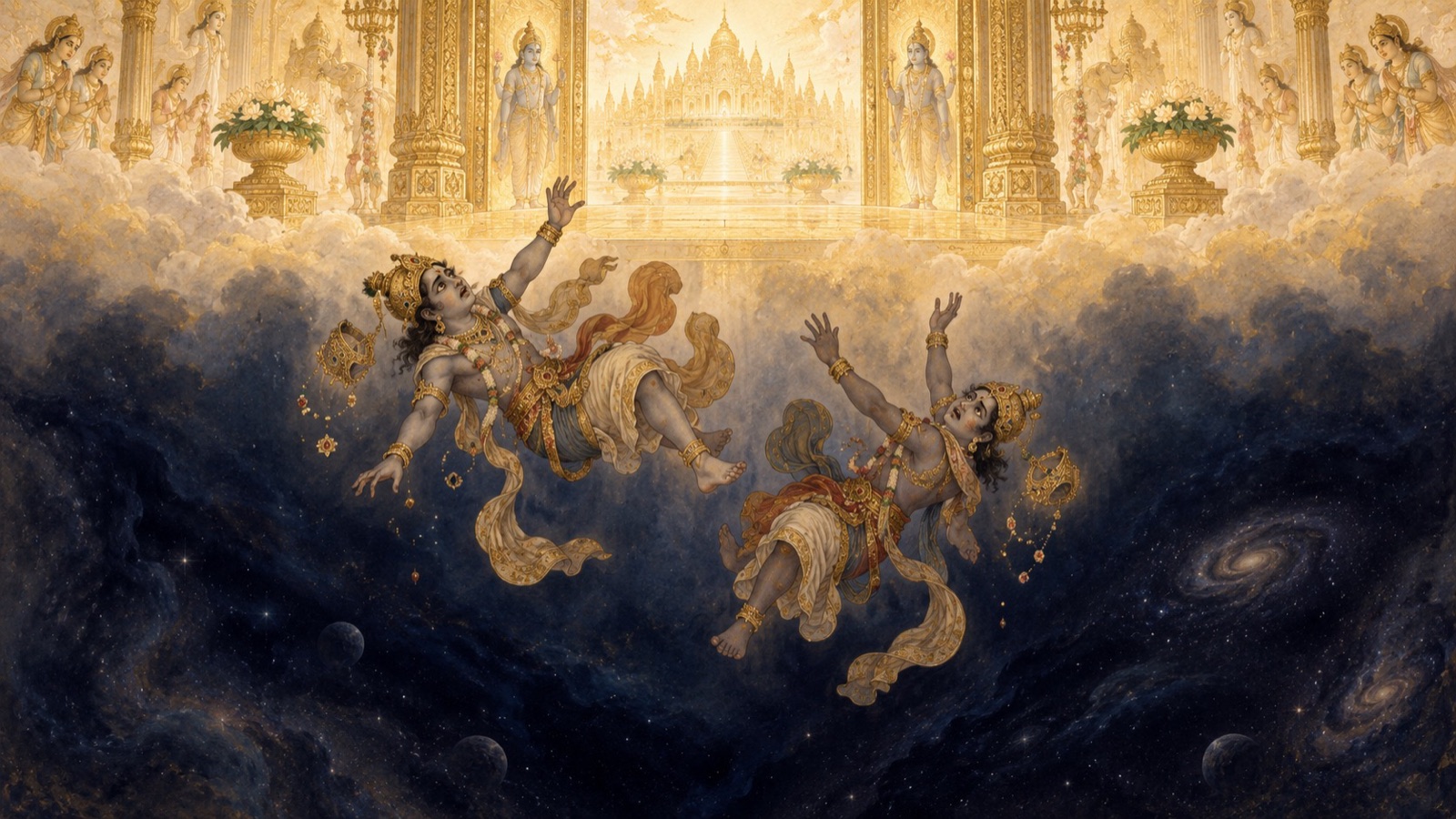
Two radiant gatekeepers of the Lord’s own abode lose their splendour in an instant and begin to fall from the gates of Vaikuntha — not cast out in wrath, but released, by the Lord’s own consent, into a curse He Himself had already ordained.
Om Namo Bhagavate Vasudevaya.
Om Namo Bhagavate Vasudevaya.
Om Namo Bhagavate Vasudevaya.
Welcome to Srimad Bhagavatam Wisdom, a devotional journey through the sacred histories and teachings of the Srimad Bhagavat Mahapurana. In the chapter before this one, the four sage-boys Sanaka, Sanandana, Sanatana and Sanatkumara arrived at the gate of Vaikuntha seeking audience with the Lord, only to be turned back by two proud doorkeepers, Jaya and Vijaya — and, in a moment of righteous anger, cursed them to fall from the eternal abode into mortal birth. Chapter 16 opens exactly where that left off: the Lord Himself has heard everything, and now He speaks. What follows is neither a rebuke of the sages nor a rescue of His servants, but something far more startling — the Supreme Person Himself insisting that an offence against a Brahmana is an offence against Him; the sages, astonished, insisting in turn that He is the Deity of the Brahmanas and of every god besides; and, in the end, a curse that both sides agree should stand, because it was never really an accident to begin with. Brahma, narrating all this to his own sons, closes the chapter still turning the mystery over in his mind: some things, he says, are simply not for us to resolve by our own deliberation.
Chapter Information
- Scripture: Śrīmad Bhāgavata Mahāpurāṇa
- Canto: 3 (Book Three)
- Chapter: 16 (Discourse 16)
- Chapter title: The fall of Jaya and Vijaya from Vaikuntha
- Principal speaker: Brahma, continuing his narration to his sons (the whole related, in the outermost frame, by Suta Gosvami to the sage Saunaka and the assembly at Naimisharanya); within Brahma’s account, the Lord of Vaikuntha and the four Kumara-sages also speak at length
- Principal listeners: Brahma’s sons (Narada and the other rishis present, continuing from Chapters 14–15); within the narrated episode, the sages Sanaka and his brothers, and the Lord’s two doorkeepers Jaya and Vijaya
- Main setting: Vaikuntha, the Lord’s own eternal abode, immediately after the sages’ curse against Jaya and Vijaya recounted in Chapter 15
- Central subject: The Lord’s own judgment on the curse against His doorkeepers; His ruling that any wrong done to a Brahmana wounds Him personally; the sages’ astonished reply affirming that He is the Deity of all, Brahmanas included; the Lord’s revelation that the curse was His own ordinance from the start; His final parting words to Jaya and Vijaya, recalling an earlier curse by Lakshmi; and the doorkeepers’ actual fall from Vaikuntha into the womb of Diti
- Principal verse range: Canto 3, Chapter 16, verses 1–37
- Primary edition: Gita Press Śrīmad Bhāgavata Mahāpurāṇa
Brahma Resumes: The Lord Speaks
Brahma had left the four sage-boys standing at the threshold of Vaikuntha, their curse against Jaya and Vijaya just pronounced. Now he tells his sons what happened next: the Lord, far from being troubled or angered, received the sages’ words with evident joy.
ब्रह्मोवाच इति तद् गृणतां तेषां मुनीनां योगधर्मिणाम् । प्रतिनन्द्य जगादेदं विकुण्ठनिलयो विभु: ॥ १ ॥
brahmovāca iti tad gṛṇatāṁ teṣāṁ munīnāṁ yoga-dharmiṇām pratinandya jagādedaṁ vikuṇṭha-nilayo vibhuḥ
Meaning: Brahma continued: The Lord who has His abode in Vaikuntha joyfully received the foregoing words of those sages — who had taken a vow of devotion to Sri Hari and extolled Him in the aforesaid manner — and spoke the following words in reply. (Canto 3, Chapter 16, verse 1)
It is worth pausing on that single word, “joyfully.” The all-powerful Lord of Vaikuntha has just watched His own gatekeepers cursed by four visiting sages, and His first recorded response is not concern for His servants or displeasure at the sages’ presumption — it is delight. Whatever is about to unfold, the text signals from its very first line, is not a crisis being managed. It is something the Lord already welcomes.
“An Offence Against You Is an Offence Against Me”
What the Lord says next is the theological heart of the chapter, and it arrives without hesitation or qualification. He does not ask the sages to reconsider, does not defend His servants’ conduct, and does not treat the matter as beneath His attention. Instead, He owns it completely.
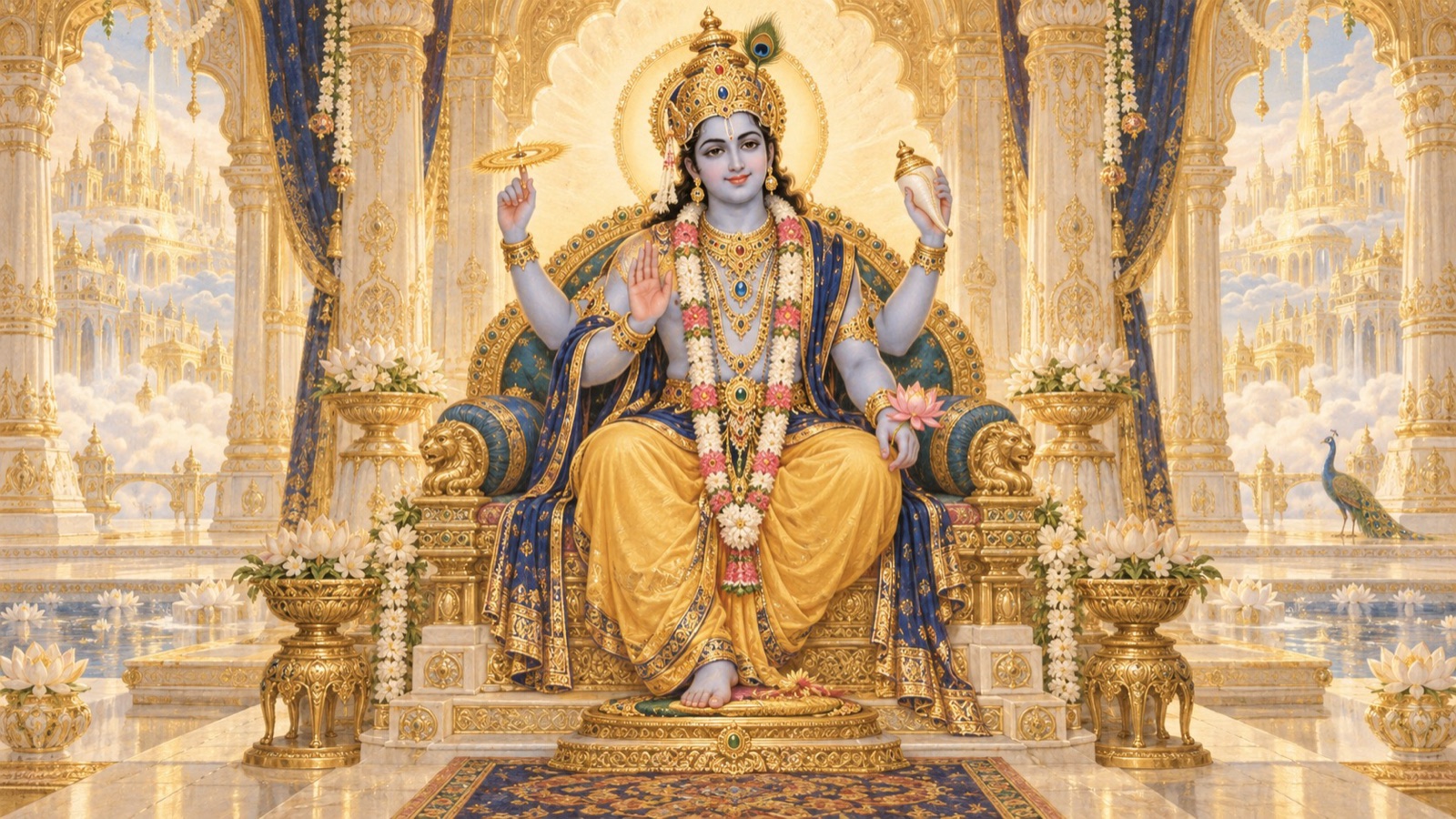
The Lord said: These attendants of Mine, Jaya and Vijaya by name, have committed a great offence against you, ignoring Me at the same time. The punishment that has been meted out to them by you, who are so devoted to Me, is approved of by Me, O good sages, inasmuch as the offence against you constitutes an affront to Me. The Brahmana is My highest deity, and the disrespect that has been shown to you by My own people I take as an offence committed by Myself; hence I crave your forgiveness for the same on this occasion. (verses 2–4)
तद्व: प्रसादयाम्यद्य ब्रह्म दैवं परं हि मे । तद्धीत्यात्मकृतं मन्ये यत्स्वपुम्भिरसत्कृता: ॥ ४ ॥
tad vaḥ prasādayāmy adya brahma daivaṁ paraṁ hi me tad dhīty ātma-kṛtaṁ manye yat sva-pumbhir asat-kṛtāḥ
Meaning: I ask your forgiveness this day, for to Me the Brahmana is the highest object of reverence; whatever slight has come to you at the hands of those who serve Me, I count as an offence of My own making. (Canto 3, Chapter 16, verse 4)
He then offers an image that has stayed with readers of this chapter for centuries: on a servant doing wrong, the world blames the master, and the disrepute tarnishes the master’s fair name even as white leprosy disfigures the skin. It is not a small comparison. Leprosy in the tradition’s own imagery is not just an illness but a visible, undeniable mark — and the Lord is telling the sages that His servants’ insult to them has left exactly that kind of mark on Him, however invisible it might otherwise seem, because He accepts full responsibility for what those under His authority do.
Why the Dust of a Brahmana’s Feet Outweighs His Own Glory
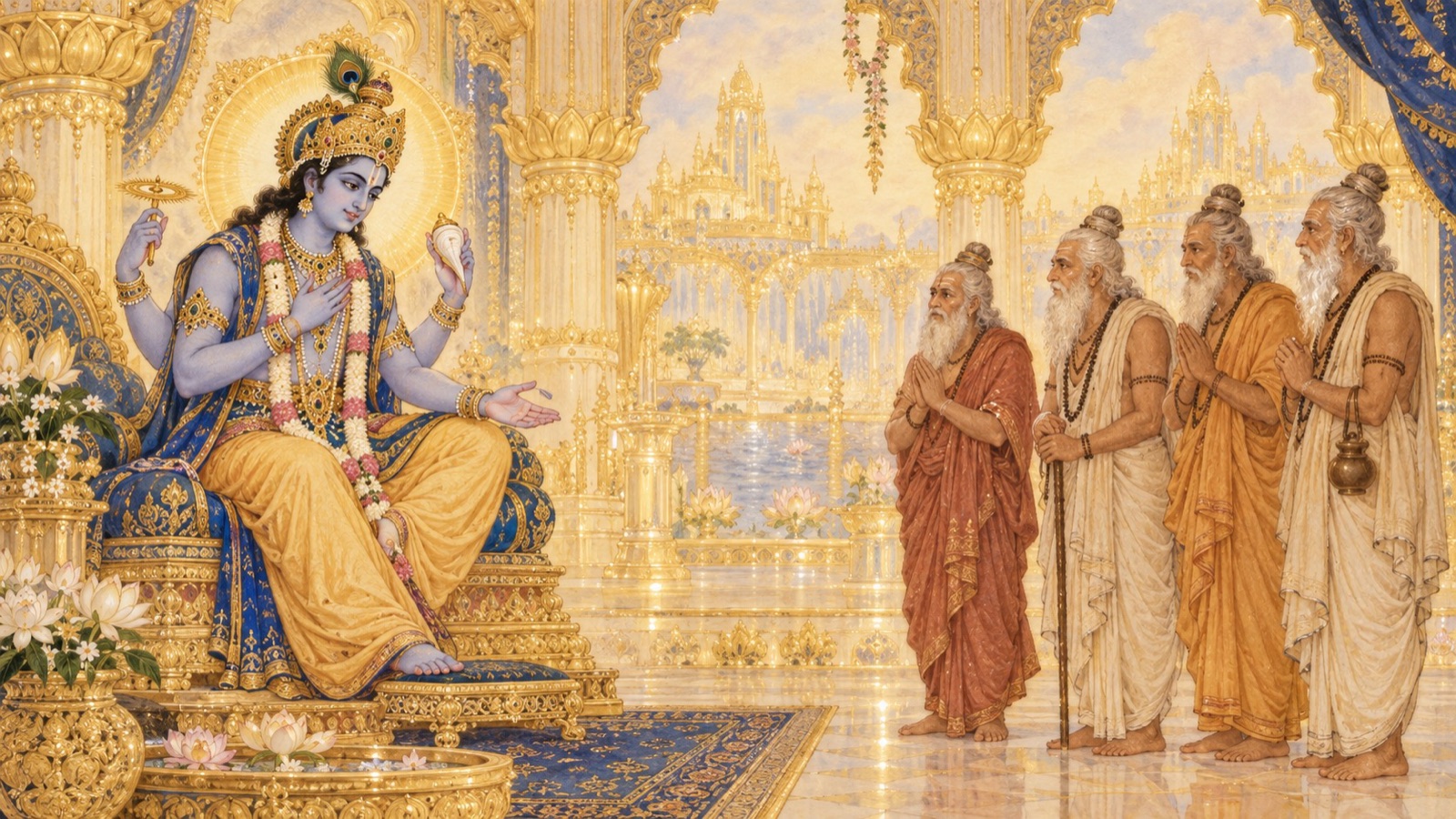
The speech that follows is extraordinary for how far the Lord is willing to go in elevating the Brahmanas above even His own reputation. He tells the sages that the whole world, down to the lowest outcaste, is purified instantly by hearing of His unsullied glory — yet it is from the Brahmanas that He has derived this very glory in the first place. And then comes a vow with real teeth to it: irresistible as He is, He says, He will not hesitate to cut off His own arm if its conduct is found hostile to a Brahmana.
यस्यामृतामलयश:श्रवणावगाह: सद्य: पुनाति जगदाश्वपचाद्विकुण्ठ: । सोऽहं भवद्भय उपलब्धसुतीर्थकीर्ति- श्छिन्द्यां स्वबाहुमपि व: प्रतिकूलवृत्तिम् ॥ ६ ॥
yasyāmṛtāmala-yaśaḥ-śravaṇāvagāhaḥ sadyaḥ punāti jagad āśvapacād vikuṇṭhaḥ so ‘haṁ bhavadbhya upalabdha-sutīrtha-kīrtiś chindyāṁ sva-bāhum api vaḥ pratikūla-vṛttim
Meaning: Even one born to the lowest of tasks is purified at once merely by bathing his ears in the hearing of My unsullied glory; and it is through you, the Brahmanas, that I have won this very repute — so I would not hesitate to sever My own arm should it ever turn hostile toward you. (Canto 3, Chapter 16, verse 6)
He does not stop there. Because of His service to the Brahmanas, He says, the dust of His own lotus-feet has become so sacred that it wipes out sin instantly, and it is this very disposition that keeps Lakshmi, the goddess of fortune, forever by His side — even though He Himself has no attachment to Her, while gods as great as Brahma undergo austerities merely to catch Her passing glance. He goes further still: He does not relish the sacrificial oblations offered through the sacred fire — one of His own mouths — with the same pleasure as He tastes the simple, ghee-laden food eaten by a Brahmana who has surrendered the fruits of his actions to Him and is content with whatever comes his way.
तन्मे स्वभर्तुरवसायमलक्षमाणौ युष्मद्वयतिक्रमगतिं प्रतिपद्य सद्य: । भूयो ममान्तिकमितां तदनुग्रहो मे यत्कल्पतामचिरतो भृतयोर्विवास: ॥ १२ ॥
tan me sva-bhartur avasāyam alakṣamāṇau yuṣmad-vyatikrama-gatiṁ pratipadya sadyaḥ bhūyo mamāntikam itāṁ tad anugraho me yat kalpatām acirato bhṛtayor vivāsaḥ
Meaning: These servants of Mine trespassed against you without knowing the mind of their Master. I shall deem it a favour done to Me if you so ordain that, reaping the fruit of their transgression, they may return to My presence soon — that the term of their exile from My abode may expire before long. (Canto 3, Chapter 16, verse 12)
Even the Lord’s power of Yogamaya, He tells them, is infinite and unobstructed, and the water that has washed His own feet — the holy Ganga — sanctifies all three worlds, carried as it is even upon the head of Lord Siva. Yet He Himself bears the dust of a Brahmana’s feet upon His crown; who, then, would refuse to bear with them? The Brahmanas, the cows, and every defenceless creature, He says plainly, are His own bodies — and the fierce, vulture-like messengers of Yama tear with their bills at anyone whose judgment has been so impaired by sin that they see these beings as separate from Him. Those who honor a Brahmana as His own self, even when that Brahmana speaks harshly, and who pacify him the way a son soothes an angry father — those are the ones who capture His heart. It is with this whole weight of conviction behind Him that He makes His request: not a command, but a plea, that the sages ordain a swift end to His servants’ exile, calling it a favour done to Himself.
The Sages Listen, Astonished
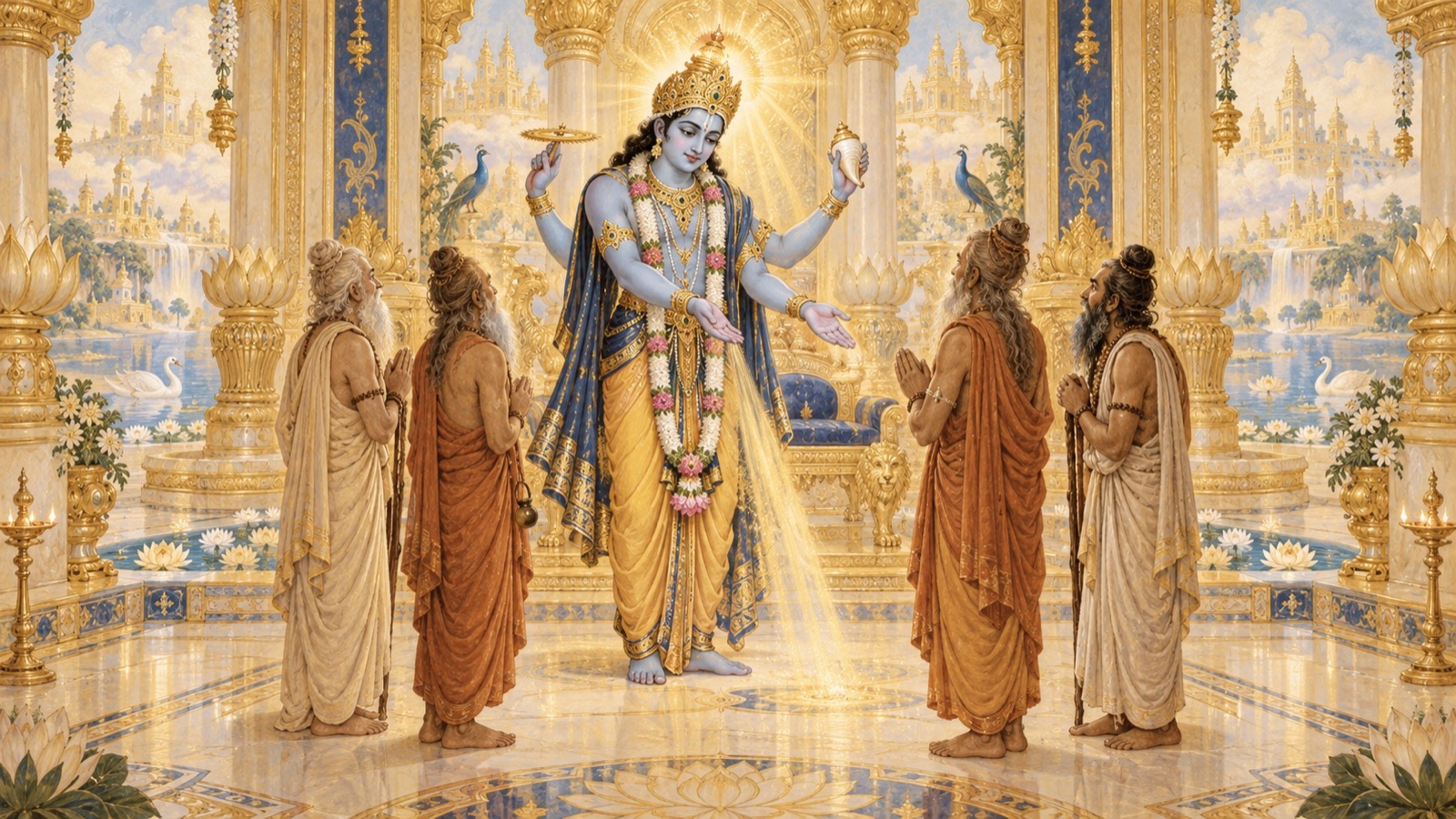
Brahma tells his sons that the four sages, though their anger had only just cooled, were far from satisfied merely to have heard this speech — they wanted to understand it.
Brahma continued: Even though the sages had been bitten by the serpent of anger, their soul was not sated with hearing the Lord’s lovely and illuminating speech, which was like a series of Mantras. Though brief, the Lord’s excellent speech was difficult to comprehend because of its momentous import and was most profound in significance. The sages heard it with wide open, attentive ears and pondered it as well; yet they could not understand what He intended doing. The Brahmanas were all the same extremely delighted to behold Him and experienced a thrill all over their body. (verses 13–15)
There is something quietly instructive in this detail. Even sages of the highest realization — the very Kumaras who had renounced the world from birth — find themselves unable to fully grasp the Lord’s intention on first hearing it. Understanding what the Lord is doing, the text suggests, is not simply a matter of attentiveness or purity of heart; it can remain genuinely mysterious even to those closest to Him, and delight and bewilderment can coexist in the same moment.
“You Are the Deity of All, Not of the Brahmanas Alone”
The sages’ reply is the second great speech of the chapter, and it performs an almost startling reversal. Where the Lord has just spent eleven verses subordinating Himself to the Brahmanas, the sages spend the next ten verses gently but firmly correcting Him — insisting that His humility, however sincere, does not change what He actually is.
The sages said: O self-effulgent Lord, we are unable to know what You contemplate doing; for, even though the Ruler of all, You speak of a favour done to You by us! A friend and well-wisher of the Brahmanas as You are, it is but natural for You to believe that the Brahmana is Your supreme deity. The fact, however, is that the Lord Yourself is the Self and the Deity of not only the Brahmanas but even of the gods of gods — Brahma, Siva and others. (verses 16–17)
ब्रह्मण्यस्य परं दैवं ब्राह्मणा: किल ते प्रभो । विप्राणां देवदेवानां भगवानात्मदैवतम् ॥ १७ ॥
brahmaṇyasya paraṁ daivaṁ brāhmaṇāḥ kila te prabho viprāṇāṁ deva-devānāṁ bhagavān ātma-daivatam
Meaning: O Protector of the Brahmanas, it is true that You call the Brahmana Your supreme deity — but in fact You Yourself are the very Self and worshipable Lord even of the Brahmanas, who are themselves gods among the gods. (Canto 3, Chapter 16, verse 17)
They continue, building their case verse by verse: the Eternal Religion, Sanatana Dharma, has proceeded from Him and is protected, age after age, by His own manifestations; by His grace alone the Yogis on the path of renunciation cross the ocean of birth and death; even Lakshmi, whose feet’s dust others wear on their heads as the mark of wealth and fortune, waits upon Him at the appointed hours, hoping only for a place near His own lotus feet.
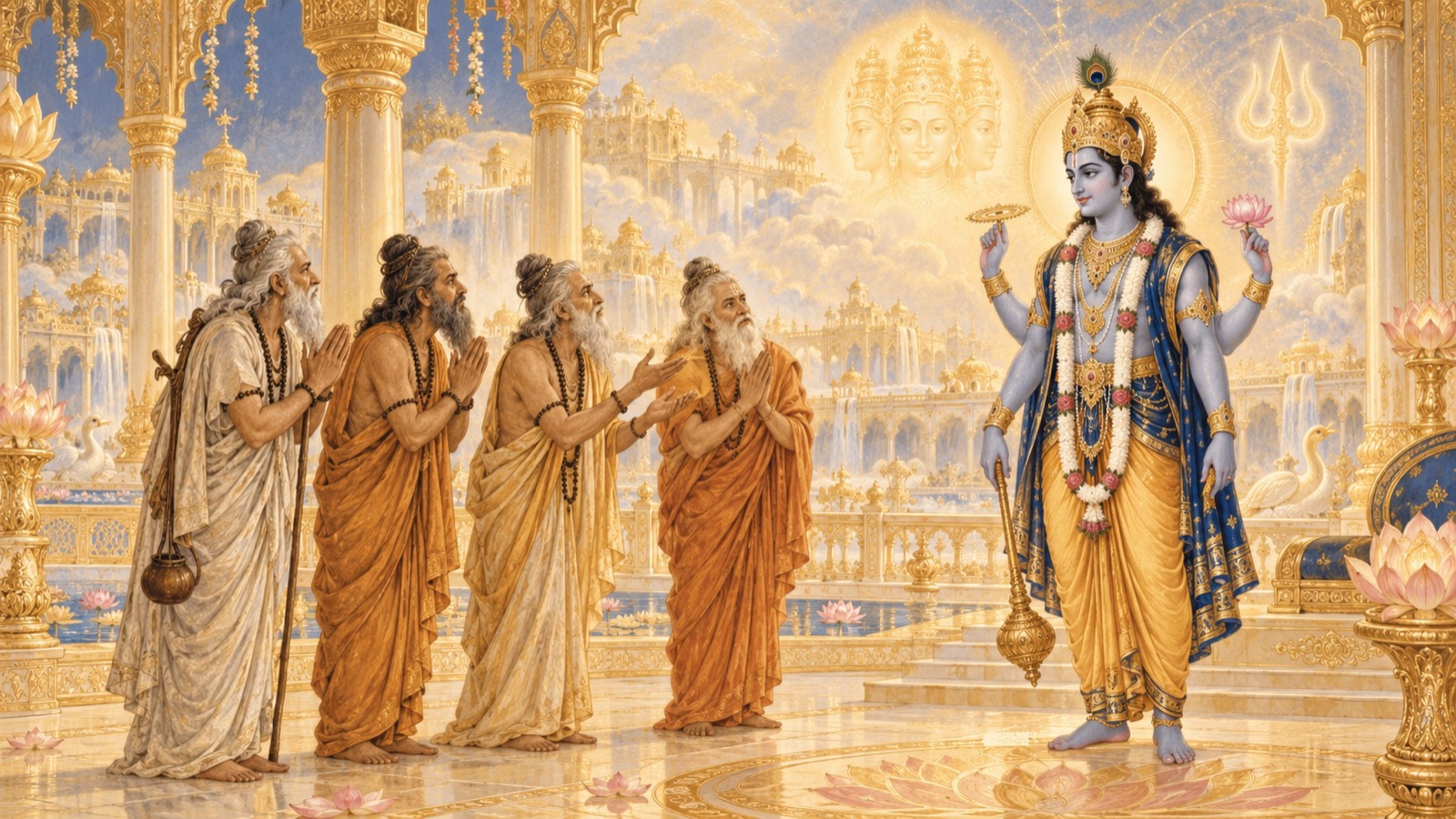
Then comes one of the chapter’s more striking images: the sages tell the Lord that He is Dharma personified, manifest through the three ages of Satya, Treta and Dwapara, protecting the universe with three sustaining feet — purity, penance and compassion — while even in the fourth age, Kali, notorious for its want of virtue, a trace of truthfulness still survives in an attenuated form. And they warn Him plainly: if He, who is Dharma itself, were ever to cease honoring the Brahmana race with worship and gentle words, the very path of the Vedas that He Himself laid down would vanish from the world overnight — because the people would simply follow whatever conduct the Supreme Person Himself is seen to practise.
The Lord’s humility, the sages insist, cannot diminish His glory — it is, they say, “a mere sport on Your part,” since He remains the suzerain lord of all three worlds regardless of how low He stoops before the Brahmanas.
The sages close their reply with something remarkable: rather than simply accepting the Lord’s plea on behalf of Jaya and Vijaya, they offer to accept whatever consequence He wishes for themselves too — since it was they, after all, who pronounced a curse against His innocent servants. Nay, we accord our hearty approval to any other punishment that You may choose to inflict on them, O universal Lord, they say, or to any additional provision You may wish to make for them; or You may mete out to us any punishment that may be suitable for us. (verse 25)
“The Curse Was Ordained by Myself”
It is only now, after both speeches have been fully exchanged, that the Lord reveals the truth that reframes everything that has come before.
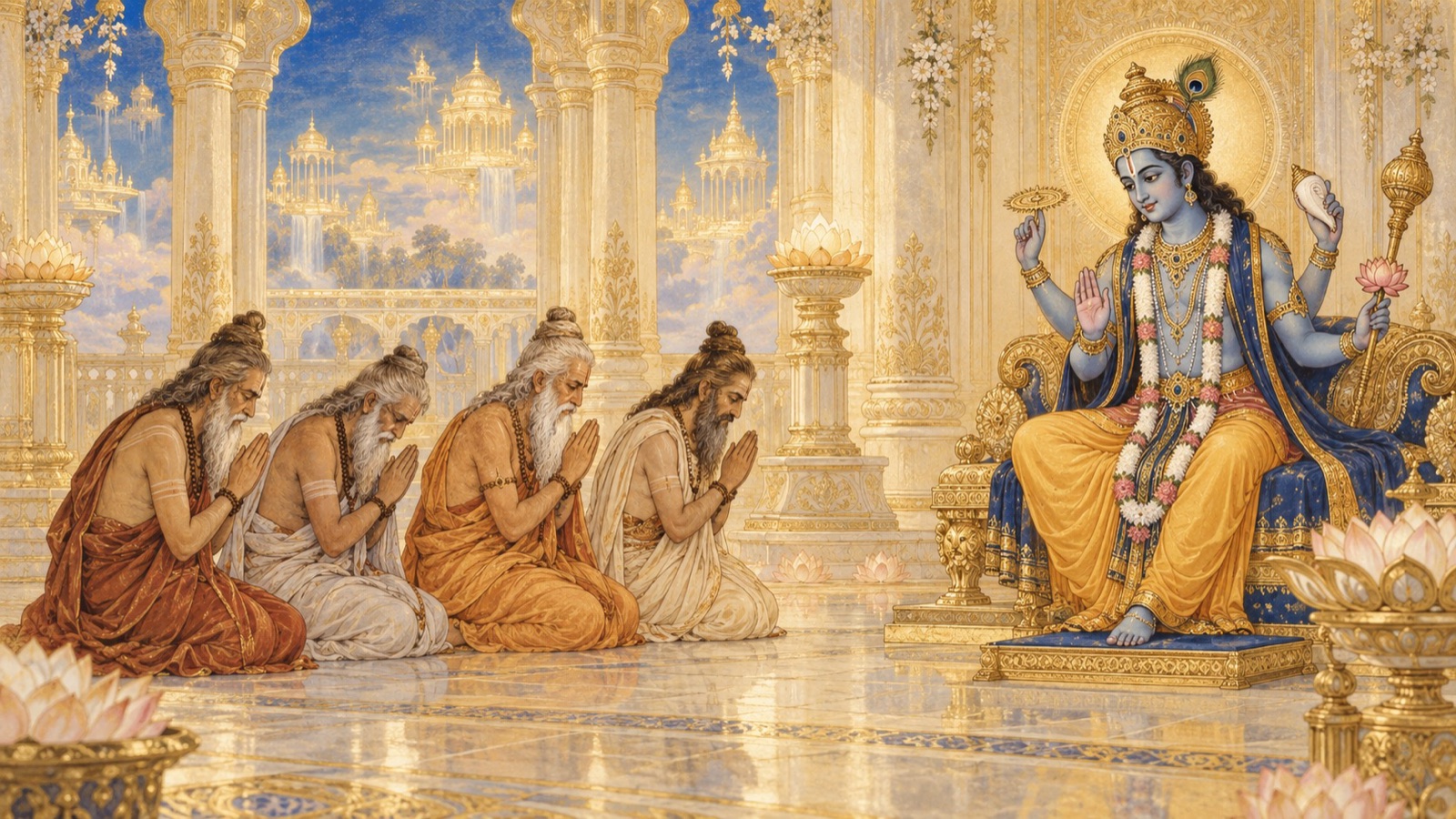
श्रीभगवानुवाच एतौ सुरेतरगतिं प्रतिपद्य सद्य: संरम्भसम्भृतसमाध्यनुबद्धयोगौ । भूय: सकाशमुपयास्यत आशु यो व: शापो मयैव निमितस्तदवेत विप्रा: ॥ २६ ॥
śrī-bhagavān uvāca etau suretara-gatiṁ pratipadya sadyaḥ saṁrambha-sambhṛta-samādhy-anubaddha-yogau bhūyaḥ sakāśam upayāsyata āśu yo vaḥ śāpo mayaiva nimitas tad aveta viprāḥ
Meaning: The Lord replied: Know that the imprecation uttered by you was ordained by Myself, O holy Brahmanas! Therefore, being born before long into the demoniac species, and firmly united in thought with Me through concentration of mind intensified by anger, they will return to My presence shortly afterwards. (Canto 3, Chapter 16, verse 26)
Everything that had appeared, moment to moment, as a spontaneous sequence — the doorkeepers’ pride, the sages’ anger, the curse itself — is revealed here as something that had already been set in motion by the Lord’s own will, before any of it visibly occurred. This is not a case of the Lord tidying up an accident after the fact. The curse was the plan from the very start, and the sages, without knowing it, had simply been His instruments in pronouncing it. The Lord even tells them how the exile will end: born as demons, Jaya and Vijaya will remain so intensely fixed on Him — even through the very anger and hatred that possesses a mind at war with Him — that this fixation itself will function as a kind of concentrated remembrance, and it is this that will bring them back to His presence before long.
Why arrange such a thing at all? The chapter’s own answer comes only later, when Brahma reveals whose children the fallen doorkeepers are about to become (verses 35–36) — but the design is already visible here. In Vaikuntha there is no one for the Lord to contend with; every being there is wholly absorbed in loving Him, and a fighting spirit has no object. Yet that fighting spirit is as much a part of Him as His mercy, so He sends two of His own dearest servants into the material world to stand, for a time, as His opponents — not cast off in disgrace, but sent out on assignment, so that He may meet them again as their slayer and, through that very death at His own hands, as their liberator. Read this way, the Brahmanas’ curse is not an obstacle the Lord’s plan must survive; it is the very mechanism that carries the plan out (verses 26, 35–36).
Having heard this, Brahma tells his sons, the sages went round the Lord in reverence, prostrated themselves, and took their leave — extremely delighted, still applauding the divine splendour they had beheld. (verses 27–28)
The Lord’s Parting Words to His Doorkeepers
With the sages gone, the Lord turns at last to the two who have been standing at the center of this entire episode without speaking a single word themselves — Jaya and Vijaya.
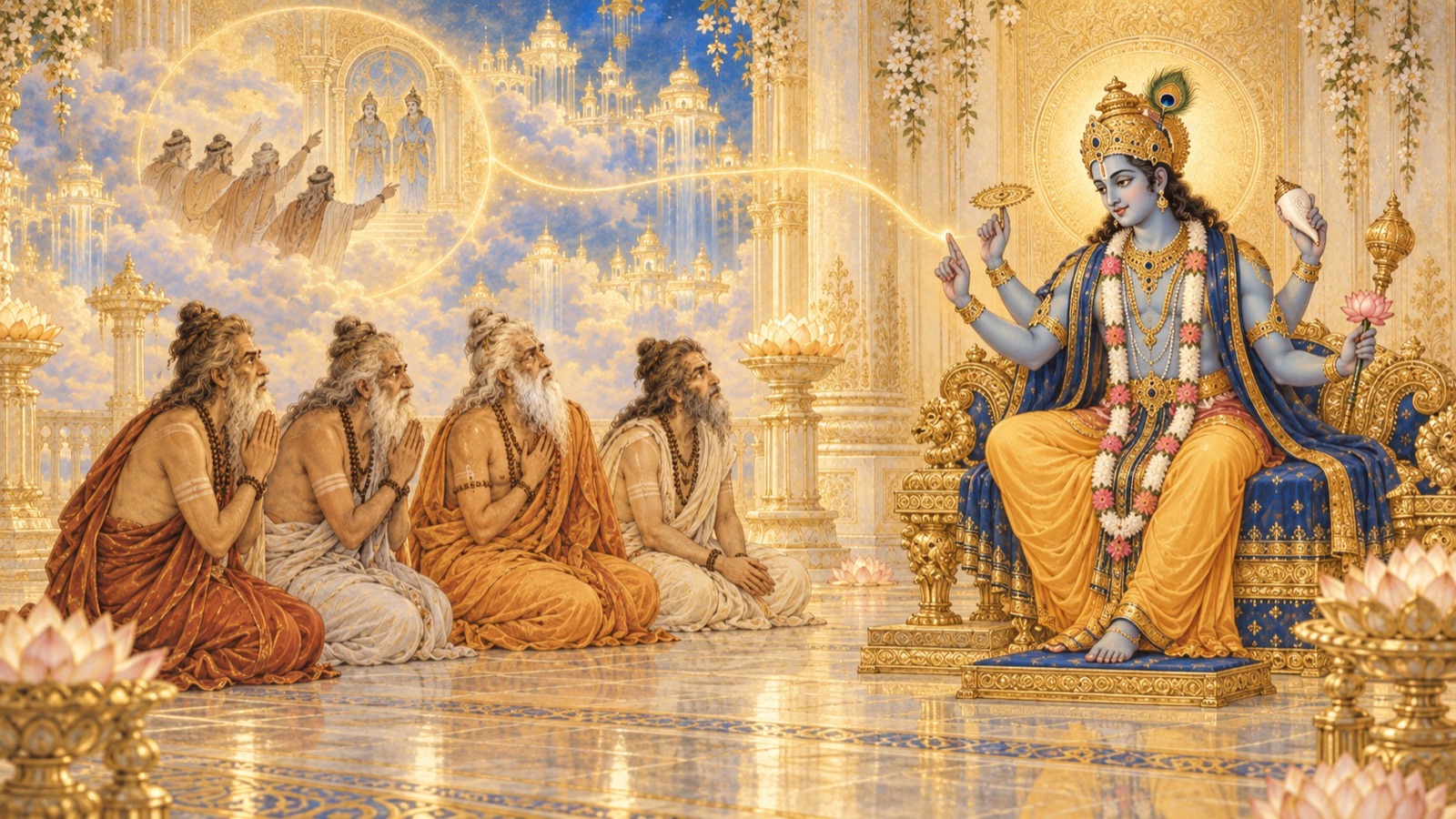
The Lord then said to His attendants, “Depart from this place, but fear not; may all be well with you. Though capable of nullifying the Brahmanas’ curse, I would not do so; on the contrary, it has My approval.” (verse 29)
भगवाननुगावाह यातं मा भैष्टमस्तु शम् । ब्रह्मतेज: समर्थोऽपि हन्तुं नेच्छे मतं तु मे ॥ २९ ॥
bhagavān anugāv āha yātaṁ mā bhaiṣṭam astu śam brahma-tejaḥ samartho ‘pi hantuṁ necche mataṁ tu me
Meaning: The Lord told His two attendants: “Go, do not be afraid, may all be well with you. Though fully capable of nullifying the power of the Brahmanas’ curse, I have no wish to do so — this is My own will.” (Canto 3, Chapter 16, verse 29)
He then discloses something that recasts the whole episode in yet another light: this was not, in fact, the first time. It had already been pronounced once before by Rama — Lakshmi herself — who had grown angry with Jaya and Vijaya on an earlier occasion, when they had stopped Her from entering while the Lord lay absorbed in Yoganidra, His own deep, mystic trance. (verse 30) The sages’ curse, in other words, is not an isolated accident but the second half of a debt already incurred. The Lord assures them once more that, absolved of their offence against the Brahmanas through the very intensity of their thought toward Him — even anger-driven thought — they will return to His presence before long. (verse 31) Having spoken these final instructions to His gatekeepers, the Lord withdraws into His own Abode, resplendent with rows of palaces and a majesty beyond compare. (verse 32)
The Fall
What follows is rendered with a kind of restrained, almost tender gravity — not triumph, not horror, but simple, cosmic fact.
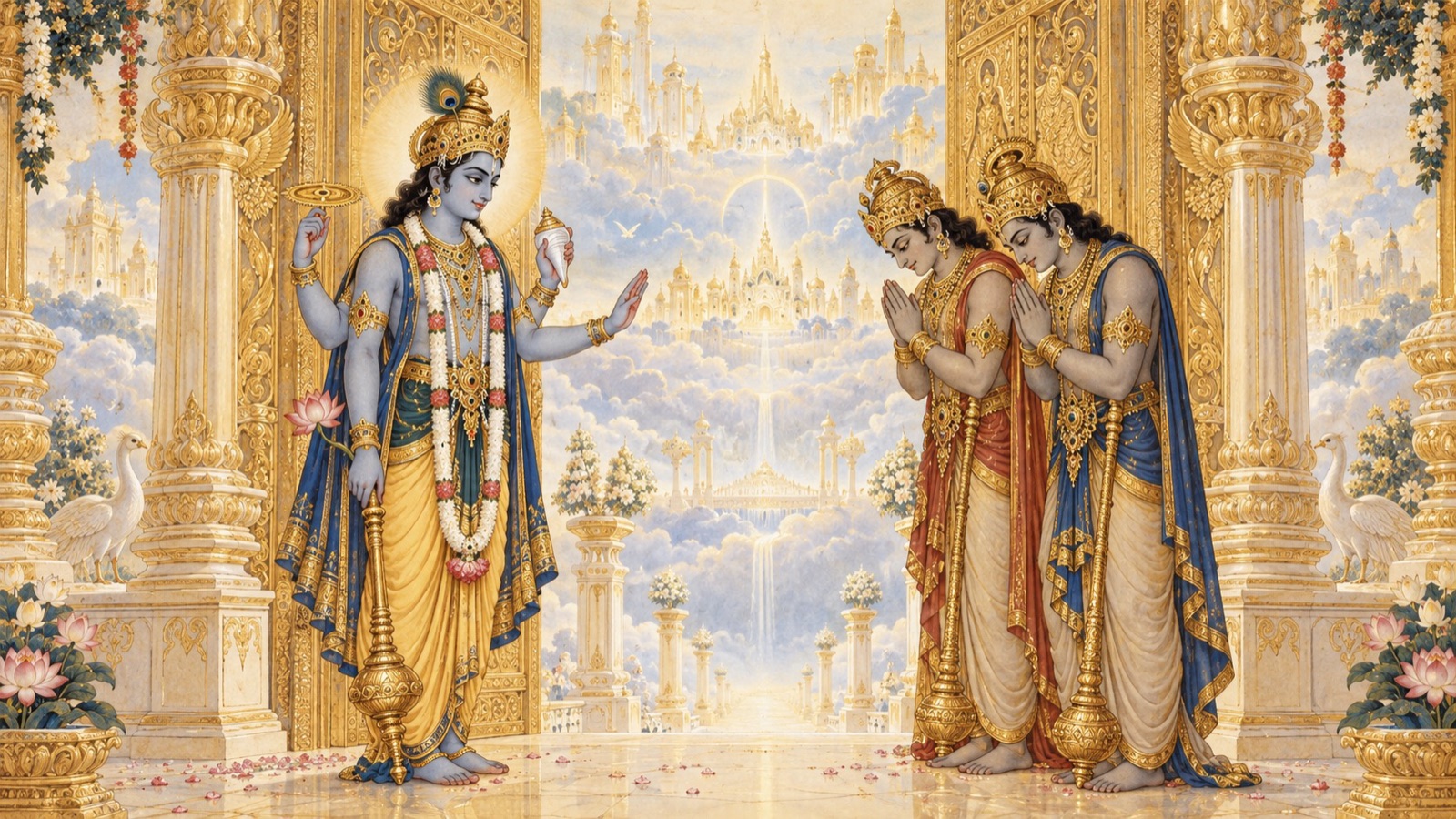
As a result of the Brahmanas’ curse, which was not easy to escape, the two attendants of the Lord, the foremost of the gods among the inhabitants of Vaikuntha, lost their splendour, and their pride too was gone, even as they were about to fall from the realm of Sri Hari. (verse 33) When they actually began to fall from the realm of Lord Visnu, a loud outcry was raised by the occupants of the principal aerial cars. (verse 34)
तौ तु गीर्वाणऋषभौ दुस्तराद्धरिलोकत: । हतश्रियौ ब्रह्मशापादभूतां विगतस्मयौ ॥ ३३ ॥
tau tu gīrvāṇa-ṛṣabhau dustarād dhari-lokataḥ hata-śriyau brahma-śāpād abhūtāṁ vigata-smayau
Meaning: As a result of the Brahmana’s curse, which was hard to overcome, those two best among the gods lost their splendour and their pride as they fell from the realm of Hari. (Canto 3, Chapter 16, verse 33)
The witnesses in the aerial cars — the very citizens of the heavens who would ordinarily watch such a fall with satisfaction or alarm — cry out instead, as though something genuinely grievous is taking place: two of the greatest among the immortals, servants who had stood at the Lord’s own gate, are leaving the world of light. Brahma then tells his sons exactly where that fall has led:
It is those two principal attendants of Sri Hari that have now entered the powerful seed of Kasyapa deposited in the womb of Diti. It is by the glory of these twin Asuras that your glory has been eclipsed; and there is no remedy for this, because it is the Lord Himself who is keen to bring it about at this juncture. (verses 35–36)
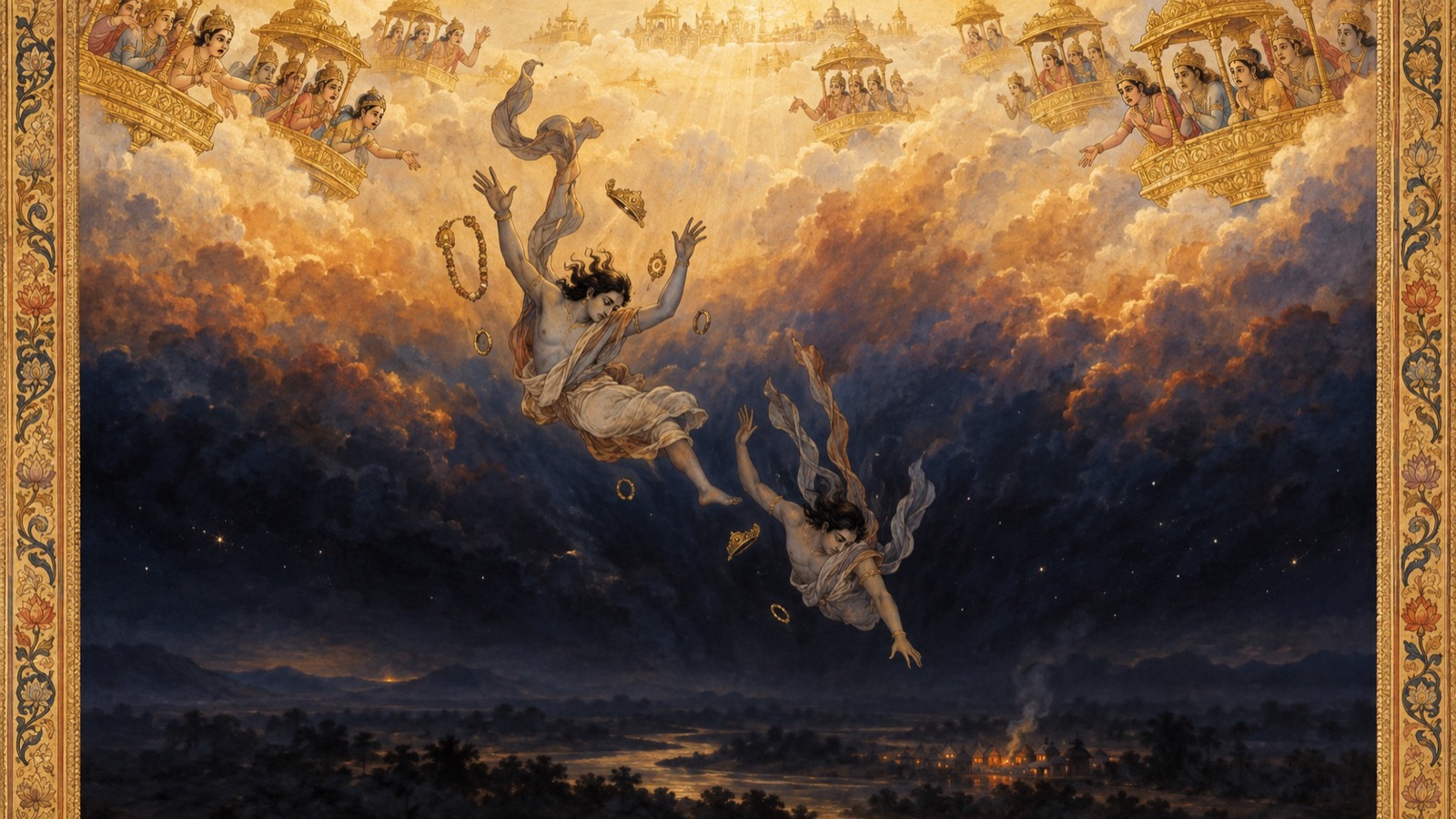
This is the moment the whole two-chapter episode has been building toward, and the Bhagavatam does not soften it: the two doorkeepers who once guarded the very threshold of Vaikuntha are, as this chapter ends, on their way to being born as the sons of Diti — the demons whose towering strength and enmity toward the gods will drive much of the Bhagavatam’s unfolding drama for cantos to come. Brahma names them only indirectly here, as “these twin Asuras,” but the tradition understands them clearly as Hiranyakashipu and Hiranyaksha, whose births even Brahma himself acknowledges as a development so significant that it has eclipsed the glory of the gods, his own sons among them.
Brahma’s Closing Reflection
Brahma does not end the episode with an explanation. He ends it, instead, with something closer to surrender.
The Lord, who is the controller of the three Gunas, nay, who is responsible for the creation, preservation and dissolution of the universe, and whose Yogamaya cannot be easily understood even by Masters of Yoga — that most ancient Person alone will come to our rescue. What purpose can be served in this behalf by our deliberation on the subject? (verse 37)
विश्वस्य य: स्थितिलयोद्भवहेतुराद्यो योगेश्वरैरपि दुरत्यययोगमाय: । क्षेमं विधास्यति स नो भगवांस्त्र्यधीशस्तत्रास्मदीयविमृशेन कियानिहार्थ: ॥ ३७ ॥
viśvasya yaḥ sthiti-layodbhava-hetur ādyo yogeśvarair api duratyaya-yogamāyaḥ kṣemaṁ vidhāsyati sa no bhagavāṁs tryadhīśas tatrāsmadīya-vimṛśena kiyān ihārthaḥ
Meaning: He who is the cause of the maintenance, dissolution and creation of the universe, whose Yogamaya even the masters of yoga find hard to fathom — that same primeval Lord, the master of the three worlds, alone will secure our welfare in this matter. What, then, is the use of our own deliberation upon it? (Canto 3, Chapter 16, verse 37)
Brahma, the very being who set the whole of creation in motion in earlier chapters of this Canto, here confesses openly to his own sons that he does not fully understand why the Lord has chosen to let two of His own eternal servants fall so far, or what deeper purpose it serves — only that the Lord’s own Yogamaya governs it, and that no amount of reasoning on Brahma’s part will improve upon it. It is a strikingly humble note on which to end a chapter that began with the Lord’s own extraordinary humility toward the Brahmanas, and it leaves the story, quite deliberately, unresolved — an open door into the cantos still to come.
Principal Teachings of This Chapter
1. The Lord takes personal responsibility for those under His authority. Rather than distancing Himself from His servants’ fault, the Lord declares their offence His own and asks the sages’ forgiveness on His own account, comparing a servant’s wrongdoing that reflects on the master to a single spot of white leprosy that discolors the whole skin — true authority, the chapter suggests, does not disown its dependents (verses 2-5).
2. Devotion to the Lord is inseparable from honoring the Brahmana. The Lord’s declaration that a Brahmana’s dust is more sacred to Him than sacrificial oblations offered through His own mouth of fire reframes reverence for the wise and the pure not as a separate virtue but as reverence for the Lord Himself — the same logic by which He says even the lowest-born is purified merely by hearing of His glory, and by which He vows to sever His own arm should it ever act against a Brahmana (verses 6-11).
3. Even the most exalted may not fully grasp the Lord’s intention on first hearing it. The four sages — supreme renunciates from birth — hear the Lord’s speech with rapt attention and still cannot discern what He means to do; understanding His will is a matter of grace, not merely of purity or attentiveness (verses 13-15).
4. True humility does not alter the truth of who one is. The Lord’s self-subordination to the Brahmanas does not make Him any less the Self and Deity of all beings, as the sages themselves insist when they declare Him the worshipable Lord even of the gods among gods, Brahma and Siva included; a great being’s humility is itself described here as “a mere sport,” never a diminishment (verses 16-24).
5. Owning a fault honestly, and offering to bear its consequence, is itself a mark of greatness. The sages, having pronounced the curse in anger, do not defend themselves but instead invite whatever punishment the Lord sees fit for them as well — accountability offered freely, not extracted (verse 25).
6. What looks like an accident may already be part of a larger design. The Lord’s revelation that the curse was ordained by Himself all along transforms the entire episode from a story of anger and consequence into a story of purpose fulfilling itself through willing instruments who did not know they were instruments (verse 26).
7. Not every fall is a punishment without end, and not every mystery is meant to be solved by us. Jaya and Vijaya’s fall carries within it the seed of their own swift return, and Brahma’s closing admission — that only the Lord’s own Yogamaya can secure the outcome, not his deliberation — models a devotion that can rest even inside genuine not-knowing (verses 33-37).
A Devotional Reflection
There is a particular kind of comfort available in this chapter that is easy to miss beneath its drama. We tend to imagine divine justice as something dispensed from a great height, untouched by the messiness of the situation it addresses — the Lord as judge, the sages as petitioners, the doorkeepers as the punished. What this chapter shows instead is a Lord who steps directly into the mess, claims responsibility for it as His own, and only afterward reveals that He had already arranged its resolution before it began. Jaya and Vijaya do not vanish from the story in disgrace; they fall carrying a promise of return that the Lord Himself guarantees twice, once to the sages and once to their own faces. Even Brahma, watching the entire episode unfold with his own eyes, admits he cannot fully account for it — and finds, in that very inability, not despair but rest. There is real devotional freedom in that: the recognition that not every difficult turn in one’s own life needs to be solved by our understanding of it before it can be trusted.
A Daily Devotional Practice
Today, bring to mind a situation in your life that felt, at the time, like a pure accident or a simple consequence of someone’s fault — your own or another’s — with no larger meaning behind it. Sit with the possibility, as Brahma does at the close of this chapter, that some threads of your life may already be held by a purpose beyond your present understanding, and that your task is not always to solve the mystery but sometimes simply to trust the One who set it in motion. Before you move on with your day, sit quietly for a few minutes and repeat softly: “Om Namo Bhagavate Vasudevaya.” Let that remembrance carry you the way the Lord promises it will carry Jaya and Vijaya — steadily back toward Him, even through the most difficult passage.
Conclusion
The sixteenth discourse of the Third Canto completes the episode begun in the chapter before it, and does so by overturning every expectation of how such a story should end. The Lord does not defend His doorkeepers, and does not merely accept their punishment — He claims their offence as His own, honors the sages who cursed them as His very Deity, and then reveals that the curse itself had been His own design from the start. The sages, in turn, refuse to accept His self-abasement at face value, insisting on His true, universal Lordship even as they humbly offer to bear any consequence themselves. And Jaya and Vijaya, once the proud guardians of Vaikuntha’s threshold, fall at last toward the womb of Diti amid the grief of the watching heavens — carrying with them, even into their demon births, the seed of an inevitable return. Brahma closes not with certainty but with surrender, a reminder that some turns in the Lord’s design are not meant to be unravelled by deliberation, only trusted.
May the divine wisdom of Srimad Bhagavatam awaken pure devotion within our hearts.
Om Namo Bhagavate Vasudevaya.
Jay Shree Madhav.
References and Attribution
- Primary edition: Gita Press, Śrīmad Bhāgavata Mahāpurāṇa (English, complete), Book Three, Discourse 16, pages 207–211.
- Series: Srimad Bhagavatam Wisdom · Biswa Sanatan Dharma Seva Trust.
- Presented following the spiritual guidance and recommendation of Pandit Dr. Shri Kashinath Mishra.
This is an original, faithful retelling in the writer’s own words, with brief quoted verses shown in Devanāgarī and transliteration and their meanings given as summaries. It is not a reproduction of any single publisher’s continuous translation or commentary. No affiliation with or endorsement by any publisher is implied.
Jay Shree Madhav