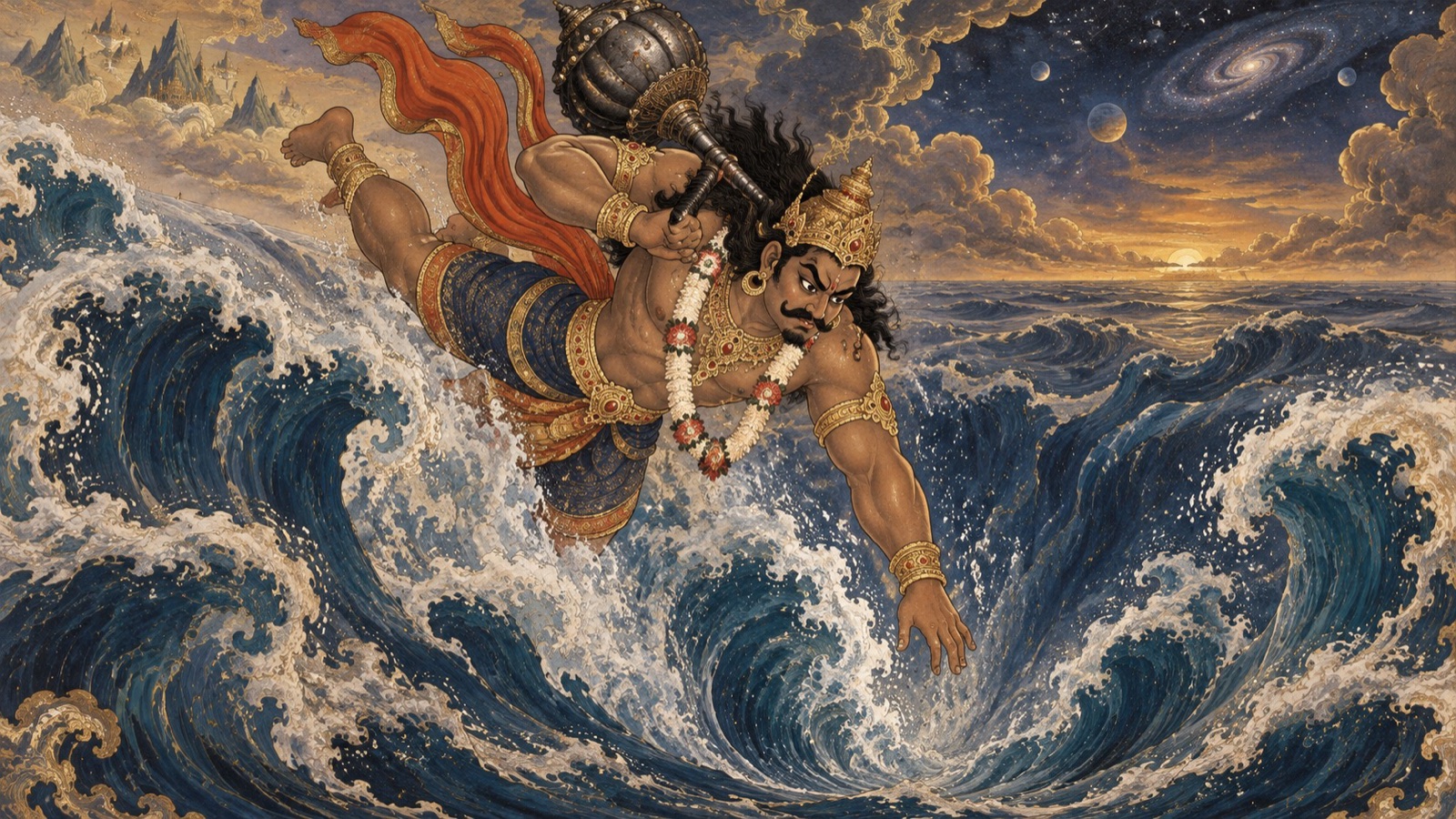
The two attendants of Vaikuntha, cast down by a Brahmana’s curse, have now entered the womb of Diti. As the world shudders under a night of terrible portents, two demon-brothers are born who will grow, within moments, to the size of mountains — and one of them, mace in hand, will go looking for a fight with no less than the ocean itself.
Om Namo Bhagavate Vasudevaya.
Om Namo Bhagavate Vasudevaya.
Om Namo Bhagavate Vasudevaya.
Welcome to Srimad Bhagavatam Wisdom, a devotional journey through the sacred histories and teachings of the Srimad Bhagavat Mahapurana. The seventeenth discourse of Book Three opens a new and darker chapter of the Bhagavatam’s great drama. In the discourse just concluded, Vidura learned the secret behind an inexplicable darkness that had once fallen over the three worlds: Jaya and Vijaya, the Lord’s own gatekeepers in Vaikuntha, cursed by four sages they had once turned away at the door, were falling from the spiritual sky to be born as demons — and it is the Lord Himself, Brahma revealed, who desires this fall, for reasons that will only become clear in time. Now Maitreya resumes the story precisely where it must: with the birth itself. Diti, after a full hundred years of pregnancy and no small anxiety about the harm her sons might bring upon the gods, gives birth to twin sons amid a night of portents so calamitous that people everywhere believe the universe itself is ending. These are Hiranyakasipu and Hiranyaksa — and this chapter follows them only as far as their earliest exploits: their instant growth to gigantic size, Hiranyakasipu’s swift conquest of the three worlds through a boon from Brahma, and Hiranyaksa’s restless search for a worthy opponent, which carries him first through a heaven emptied by his own terror and then down into the very depths of the cosmic ocean, to the gates of Varuna’s own city.
Chapter Information
- Scripture: Śrīmad Bhāgavata Mahāpurāṇa
- Canto: 3 (Book Three)
- Chapter: 17 (Discourse 17)
- Chapter title: Birth of Hiranyakasipu and Hiranyaksa and the latter’s conquest of the four quarters
- Principal speakers: Sri Suka (outer narrator to King Parikshit, understood throughout), Maitreya (inner narrator to Vidura), Varuna (Praceta)
- Principal listener within the chapter’s frame: Vidura, receiving Maitreya’s account
- Main setting: The hermitage of Kasyapa and Diti at the moment of the twins’ birth; the three worlds under Hiranyakasipu’s swift sway; heaven emptied by Hiranyaksa’s arrival; the depths of the cosmic ocean and Varuna’s capital, Vibhavari
- Central subject: The birth of Diti’s twin sons amid terrible cosmic portents; their instantaneous growth to mountainous size; Kasyapa’s naming of Hiranyakasipu and Hiranyaksa; Hiranyakasipu’s conquest of the three worlds through Brahma’s boon; Hiranyaksa’s search for a battle, the flight of the terrified gods, his sporting dive into the ocean, and his mocking challenge to Varuna, who redirects him toward Lord Vishnu as his true and final opponent
- Principal verse range: Canto 3, Chapter 17, verses 1–31 (Gita Press numbering)
- Primary edition: Gita Press Śrīmad Bhāgavata Mahāpurāṇa
A Night the World Mistook for Its Last
Maitreya’s account resumes with a note of relief: the gods, having heard from Brahma the true cause of the darkness that had fallen over the three worlds, were freed of their fear and returned to heaven. But the relief is short-lived, for the story now turns to the very cause that darkness had foreshadowed. Diti, we are told, had been deeply apprehensive from the moment her husband Kasyapa first predicted what her pregnancy would bring — a foreboding, evidently, that these children would trouble the gods. After carrying them for a full hundred years, she at last brought forth twin sons in that same hermitage.
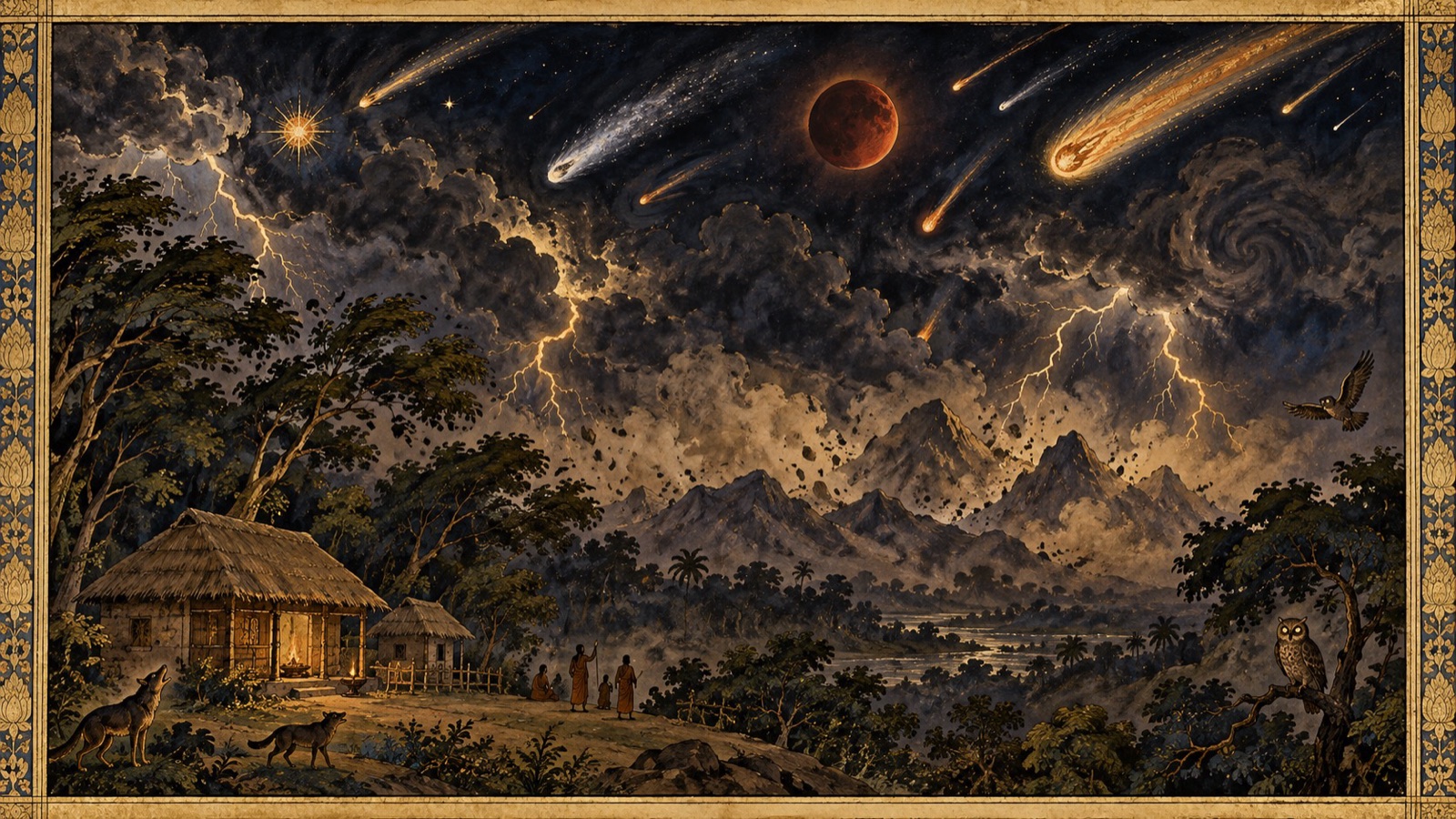
Their birth is marked by a catalogue of omens so extensive and so vivid that it occupies nearly half the chapter, and it is worth lingering over, because the Bhagavatam rarely spends this much attention on atmosphere alone. Portions of the globe shook along with the mountains; every quarter of the sky seemed to catch fire; meteors and thunderbolts fell; comets of ill omen appeared. Harsh, hissing winds tore up giant trees, carrying storm as their army and clouds of dust as their battle-standards. Clouds screened the sun and moon and stars, and though lightning sometimes flashed within them — as though laughing at the world below — darkness reigned everywhere, so total that nothing could be seen at all. The ocean itself wailed with its high waves as if stricken with grief, its own creatures thrown into commotion, while rivers and lakes grew turbulent and their lotuses withered where they stood. Misty haloes repeatedly ringed the sun and moon in solar and lunar eclipse; thunder cracked from a cloudless sky, and sounds like rattling chariot-wheels rolled out from the caves of the mountains.
The omens grow stranger, and closer to home, as the description continues. In the villages, she-jackals howled portentously, vomiting fire from their mouths, joined by the cries of jackals and owls. Dogs raised their necks and cried out in tones that shifted between song and lament. Donkeys, driven wild, ran in herds striking the earth with their hooves and braying without cease, so that birds fled shrieking from their nests in fright, and cattle in the byres and the forest alike voided themselves in terror. Cows gave blood instead of milk; clouds rained pus; the very images of the gods were seen to weep; and trees crashed to the ground though no wind had touched them. Ill-omened planets such as Mars and Saturn shone with unnatural brightness, outshining the benefic planets and lunar mansions, and seemed to move retrograde, clashing against one another in the sky. Seeing all this, everyone except the four Kumaras — Sanaka and his brothers, who alone knew the secret of Jaya and Vijaya’s fall and their coming birth as Diti’s sons — was seized with terror, certain that the dissolution of the universe itself was at hand.
Two Mountains of Flesh, and Their Names
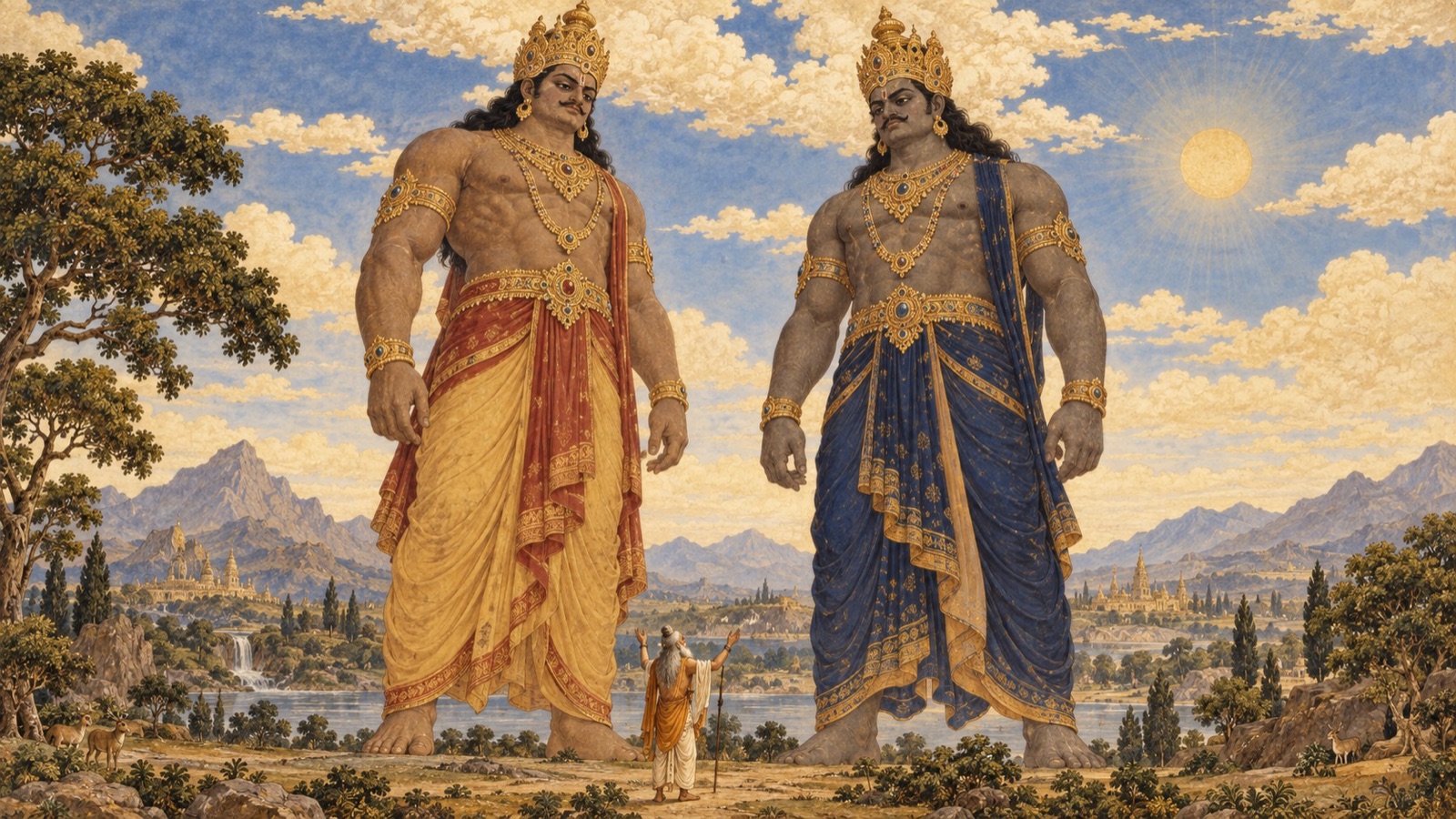
What follows is one of the Bhagavatam’s most striking images of instant, monstrous scale. The two newborn Daityas, sons of Diti, at once reveal the prowess that had once been theirs as Vaikuntha’s own gatekeepers, and their steel-like frames grow, without pause, to the size of two towering mountains. Their golden crowns brush the very sky; their bodies alone are wide enough to screen entire quarters of the heavens from view; every footfall shakes the earth beneath them; their arms, adorned with brilliant bracelets, hang beside waists cinched in magnificent girdles so vast that their mere silhouette eclipses the sun.
It falls to their father, Kasyapa, lord of created beings, to name them — and the naming carries a small but pointed mystery that Gita Press preserves in a footnote from the ancient commentator Sridhara Swami. Of the twin brothers, the one who had entered his mother’s womb first — descending, so to speak, from Kasyapa’s own body before the other — becomes known to the world as Hiranyakasipu, “he whose seat is of gold.” The other, whom Diti actually brought forth into the world first, is named Hiranyaksa, “the golden-eyed one.” Sridhara Swami explains the apparent puzzle by citing an old embryological teaching: twins are conceived in successive drops of seed entering the womb, yet born in the reverse of that order — the child conceived first is born last, and the child conceived last is born first. It is a small, almost technical aside, but it is characteristic of how carefully the Bhagavatam’s traditional commentators have always attended even to its briefest verses.
Hiranyakasipu’s Swift Conquest
The chapter allots only a single verse to Hiranyakasipu’s own early career, but it is enough to establish, in outline, the terror he will represent for the rest of this Canto and beyond: having received a boon from Brahma that leaves him fearing death at no one’s hands, he grows puffed up with pride and brings all three spheres of existence — earth, heaven, and the subterranean region — under his sway by the sheer strength of his own arms, subjugating even their guardian deities in the process. The Bhagavatam will return to Hiranyakasipu’s story at far greater length in a later Canto; here, this single verse is enough to set him, fully armed with invincibility, in place as a looming presence behind the chapter’s real subject.
There is a deeper design half-hidden inside that single verse, and it is worth pausing on before the story moves ahead. Hiranyakasipu’s boon does not grant true immortality — no benediction, however exalted its giver, can lift any embodied being above the laws of birth, old age, disease and death — it grants only fearlessness of death at the hands of anyone within the three worlds (verse 19), and the same qualified invincibility will shortly be conferred on Hiranyaksa as well (verse 22). This is not a loophole the demons cleverly discovered; it is the Lord’s own arrangement. By sealing off every ordinary path to their defeat, providence ensures in advance that no demigod, sage, or weapon of this world will ever be permitted to end what these two begin — that only the Supreme Person Himself, appearing in a form of His own choosing, can bring their reign to its close. Varuna will make this arrangement explicit before the chapter ends (verse 31): the Lord assumes His forms precisely to exterminate the wicked and to show grace to the virtuous, two purposes fulfilled by a single, carefully prepared act.
Hiranyaksa Goes Looking for a Fight
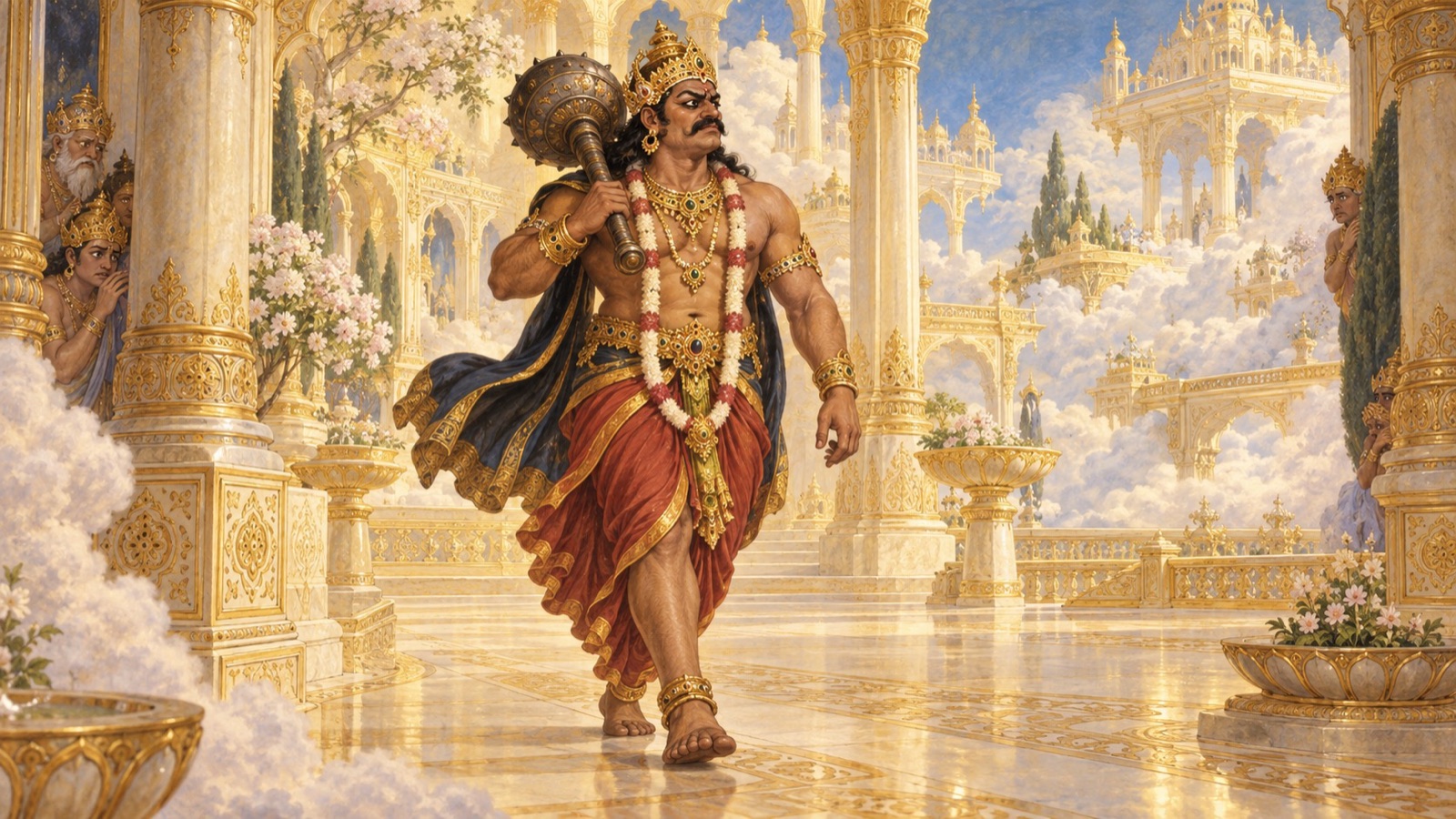
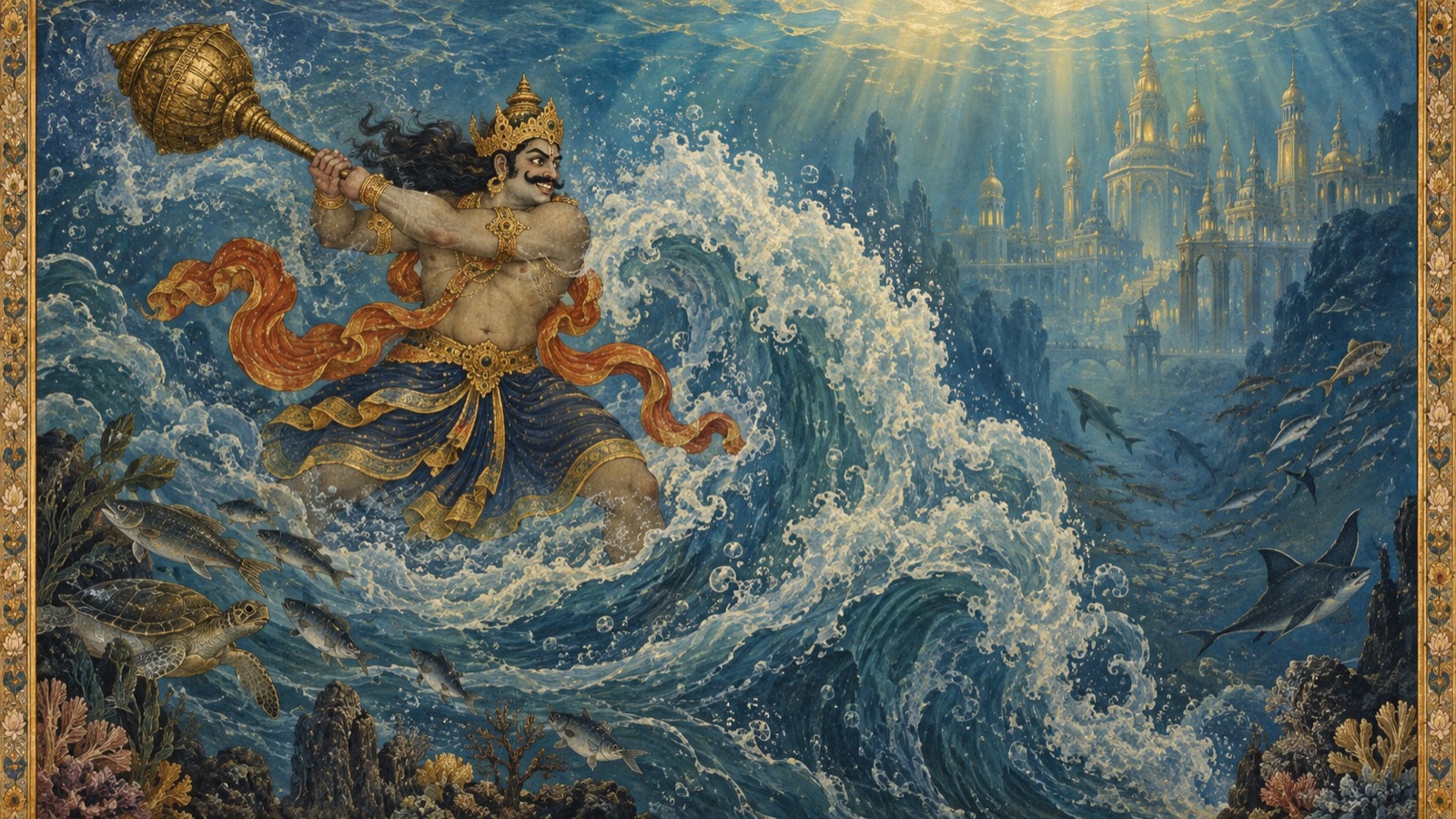
That real subject is Hiranyaksa, and the chapter now follows him with evident relish for the sheer physical bravado of the character. His beloved younger brother — for it is Hiranyaksa who is described here as forever trying to please Hiranyakasipu, and who is, we are told, passionately fond of war — sets out for heaven itself, mace in hand, seeking nothing more or less than an adversary worthy of combat. His temper, the Bhagavatam says, is difficult to resist; golden anklets tinkle at his feet as he walks, a garland hangs at his chest, and his huge mace rests, almost casually, upon one shoulder. Puffed up by his own strength of mind and body and by the boon that leaves him fearless of death from any quarter, and utterly unchecked by any authority, his very appearance is enough to empty heaven of the gods. Indra and the rest, we are told, hide themselves at the mere sight of him — as snakes hide from Garuda — leaving Hiranyaksa to roar aloud in frustration at finding no one, not even the gods who had once been intoxicated with their own power, willing to face him.
Denied a battle in heaven, Hiranyaksa turns his restless energy elsewhere, and it is here that the chapter takes its most memorable turn. Like an elephant in rut looking merely for sport, he plunges into the deep and terribly roaring ocean — not out of any strategic purpose, the Bhagavatam is careful to note, but simply for amusement. The aquatic hosts of Varuna scatter in fear at his very splendour the instant he enters the water, without his needing to strike a single blow. For very many years he roams those depths, smiting the towering, wind-driven waves again and again with his iron mace, until at last he arrives at Vibhavari, the capital city of Varuna himself, lord of the waters and guardian of Patala, the subterranean realm of the demons.
The Mockery of Varuna, and a Prophecy of Death
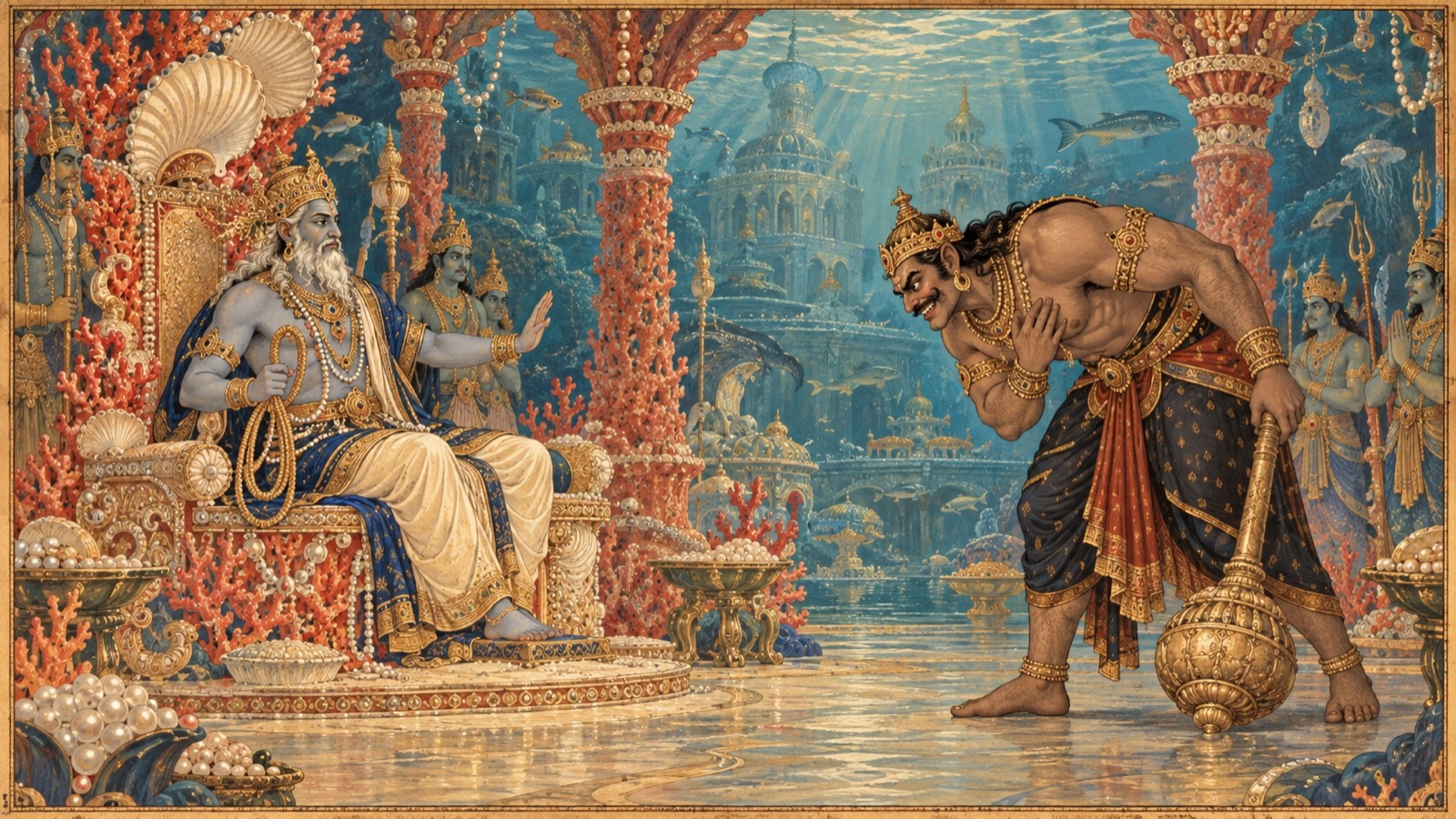
What Hiranyaksa does next reveals the full, reckless arrogance of his character. Reaching Varuna, he does not challenge him as an equal but falls at his feet in an exaggerated, mocking gesture — the posture of a low, base man rather than a genuine act of respect — and, smiling, demands: “Give me battle, O supreme lord!” He follows this with what sounds, on the surface, like flattery but functions as pure taunt: reminding Varuna that he is the guardian of an entire sphere, a ruler of wide fame who has crushed the pride of many an arrogant warrior, and who once, having conquered every sage and Danava in the world, performed a Rajasuya sacrifice — surely, the implication runs, such a mighty lord could not possibly refuse a simple request for combat.
Varuna, thus wantonly mocked by an enemy whose vanity knows no limit, does feel his anger rise — the Bhagavatam does not pretend its heroic figures are made of stone — but he governs that anger through the strength of his own reason rather than acting on it. His reply is a masterclass in redirecting a dangerous confrontation without either fighting or fleeing from it. He tells Hiranyaksa plainly that he himself has grown too old for warfare and has set such pursuits aside. But he does not merely decline; he offers something far more consequential in its place. “I do not see anyone else than the most ancient Person,” he says, “who will give satisfaction in battle to you, who are so skilled in the ways of war.” He directs the demon, in other words, toward Lord Vishnu Himself — the one opponent, Varuna says, whom even heroes of Hiranyaksa’s stature speak of with praise.
पश्यामि नान्यं पुरुषात्पुरातनाद् य: संयुगे त्वां रणमार्गकोविदम् । आराधयिष्यत्यसुरर्षभेहि तं मनस्विनो यं गृणते भवादृशा: ॥ ३० ॥
paśyāmi nānyaṁ puruṣāt purātanād yaḥ saṁyuge tvāṁ raṇa-mārga-kovidam ārādhayiṣyaty asurarṣabhehi taṁ manasvino yaṁ gṛṇate bhavādṛśāḥ
Meaning: “I see no one but the most ancient Person, O chief of the Asuras, who could give due satisfaction in battle to one so skilled in the ways of war as you — go to Him, the very One whom even resolute heroes of your own stature speak of with praise.” (Canto 3, Chapter 17, verse 30)
Varuna’s final words to Hiranyaksa carry, beneath their courteous surface, a plain and startling prophecy. Upon reaching that ancient Hero, he says, Hiranyaksa’s pride will vanish at once, and he will lie down upon the field of battle — in what the text pointedly calls “eternal sleep” — surrounded by dogs. It is precisely in order to exterminate the ill-behaved, Varuna explains, and to extend His grace to the virtuous, that the Lord assumes His various forms from age to age.
तं वीरमारादभिपद्य विस्मय: शयिष्यसे वीरशये श्वभिर्वृत: । यस्त्वद्विधानामसतां प्रशान्तये रूपाणि धत्ते सदनुग्रहेच्छया ॥ ३१ ॥
taṁ vīram ārād abhipadya vismayaḥ śayiṣyase vīra-śaye śvabhir vṛtaḥ yas tvad-vidhānām asatāṁ praśāntaye rūpāṇi dhatte sad-anugrahecchayā
Meaning: “Approaching that Hero close at hand, your pride will vanish, and you will lie down upon the hero’s bed, surrounded by dogs — for it is to bring peace by removing the ill-behaved, such as yourself, and to show grace to the virtuous, that He assumes His various forms.” (Canto 3, Chapter 17, verse 31)
The chapter ends precisely there, on the threshold of the confrontation it has been building toward — Hiranyaksa now pointed, by the very lord he had come to mock, toward the encounter that the previous chapter of this series (Canto 3, Chapter 13) has already shown us the outcome of: the Lord’s descent as Varaha, the Divine Boar, and the demon’s death upon His tusks in the cosmic waters.
Principal Teachings of This Chapter
1. Cosmic disturbance often announces a coming trial before that trial is even visible. The elaborate catalogue of omens that marks the twins’ birth — earthquakes, weeping deities, blood in place of milk, planets moving against their natural courses — teaches that the universe itself registers the arrival of adversity long before its human and celestial inhabitants can name the cause; only the four Kumaras, already aware of Jaya and Vijaya’s fall, remained undisturbed amid the general terror (verses 3-14).
2. Power without restraint quickly becomes a danger to everyone, including its possessor. Hiranyakasipu’s boon-granted fearlessness and Hiranyaksa’s boon-granted invincibility both lead, almost immediately, to conquest and violence — a reminder that strength divorced from humility rarely stays contained to its original purpose (verses 19, 22).
3. Fear, even among the gods, is not itself a failure — but neither is it the end of the story. The gods hide from Hiranyaksa exactly as snakes hide from Garuda; the Bhagavatam does not shame them for this, but neither does it leave them without recourse, since a greater reckoning is already being arranged elsewhere (verse 22).
4. True strength includes the wisdom to decline an unworthy fight. Varuna, mocked and provoked, feels genuine anger yet governs it through reason rather than pride, declining personal combat without ever appearing weak — a portrait of restraint as its own form of power (verse 29).
5. Every adversary, however invincible he appears, is ultimately answerable to the Lord alone. Varuna’s redirection of Hiranyaksa is not an evasion but a statement of cosmic order: it is the “most ancient Person” alone who can meet and finally end the demon’s pride (verse 30).
6. Divine forms arise specifically to restore balance, not merely to display power. Varuna’s closing words make explicit what the whole Varaha episode later confirms: the Lord assumes His various forms precisely to exterminate the ill-behaved and to extend grace to the virtuous — the two purposes are inseparable (verse 31).
A Devotional Reflection
There is something quietly bracing about the way this chapter refuses to let its most fearsome character go unanswered for even a moment. Hiranyaksa strides through heaven and empties it by his presence alone; he descends into an ocean vast enough to have swallowed the earth itself in an earlier chapter and treats it as a mere playground; he mocks the very lord of that ocean to his face. And yet, at the height of this display, it is not a mightier warrior who meets him but an old and weary god who has simply set aside the desire to prove himself — and it is precisely that god’s restraint, not any show of force, that sets in motion the demon’s actual undoing. Varuna does not need to defeat Hiranyaksa; he need only point, truthfully, toward the One who will. There is a lesson here that reaches well beyond this one episode: that recognizing the proper scale of a battle — knowing which fights are truly yours to fight, and which belong to a power greater than your own — is itself a form of victory, quieter than combat but no less complete.
A Daily Devotional Practice
Today, when you find yourself provoked, mocked, or pressed toward a confrontation that flatters your pride more than it serves any real purpose, pause and ask honestly whether this is truly a battle meant for your own hands. Like Varuna, allow yourself to feel whatever anger genuinely rises in you — there is no virtue in pretending it away — but govern it with reason rather than acting from it, and trust that the deeper order of things does not require you to answer every challenge personally. Before you decide how to respond, pause and repeat quietly: “Om Namo Bhagavate Vasudevaya.” Let that remembrance remind you, as it reminded Varuna, that the final reckoning of every arrogance always belongs, in the end, to the Lord alone.
Conclusion
The seventeenth discourse of Book Three is a chapter of thresholds: the threshold between the falling of Jaya and Vijaya, told in the previous discourse, and their full manifestation as the demon-brothers who will shape much of this Canto’s remaining drama; the threshold between a night of cosmic portent and the two towering figures those portents foretold; and, most immediately, the threshold on which Hiranyaksa now stands, pointed by Varuna’s own words toward the encounter this series has already narrated in Canto 3, Chapter 13. Nothing in this chapter is resolved — Hiranyakasipu’s conquest continues unchecked, and Hiranyaksa has not yet met the Boar who awaits him — and perhaps that is the chapter’s real teaching: that the Bhagavatam is patient even with its villains, allowing their pride to build to its fullest extent before the moment of reckoning finally arrives, in its own time, at the hands of the Lord.
May the divine wisdom of Srimad Bhagavatam awaken pure devotion within our hearts.
Om Namo Bhagavate Vasudevaya.
Jay Shree Madhav.
References and Attribution
- Primary edition: Gita Press, Śrīmad Bhāgavata Mahāpurāṇa (English, complete), Book Three, Discourse 17, internal pages 211–214.
- Series: Srimad Bhagavatam Wisdom · Biswa Sanatan Dharma Seva Trust.
- Presented following the spiritual guidance and recommendation of Pandit Dr. Shri Kashinath Mishra.
This is an original, faithful retelling in the writer’s own words, with brief quoted verses shown in Devanagari and transliteration and their meanings given as summaries. It is not a reproduction of any single publisher’s continuous translation or commentary. No affiliation with or endorsement by any publisher is implied.
Jay Shree Madhav