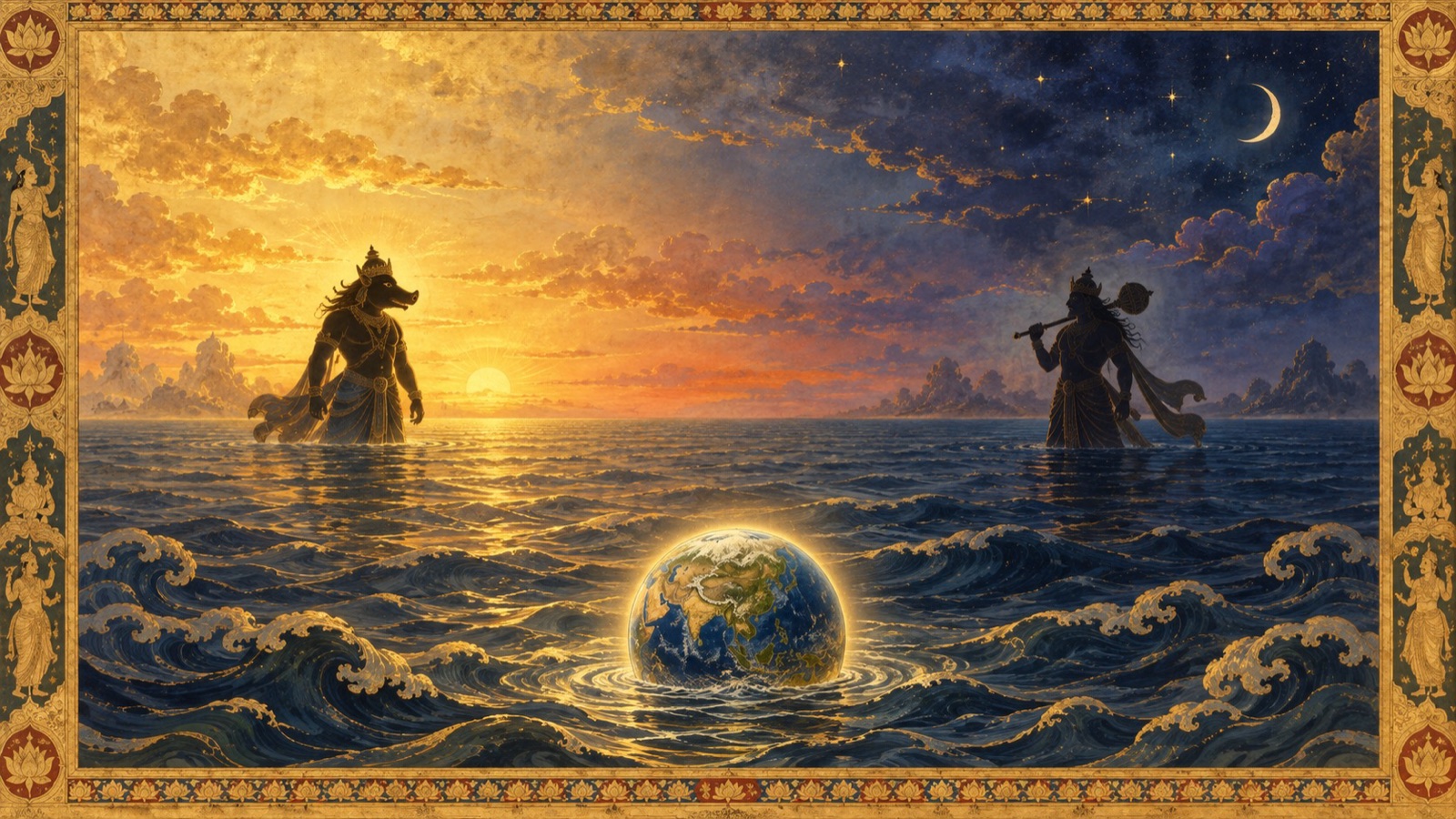
Maitreya continues his narration to Vidura: how the demon Hiranyaksa, scornful of Varuna’s counsel and guided by Narada to the depths of the ocean, found there the divine Boar bearing the rescued earth upon His tusks — and how taunt met taunt, mace met mace, until Brahma himself arrived, anxious that the Lord end the duel before the dreaded hour of twilight fell upon the world.
Om Namo Bhagavate Vasudevaya.
Om Namo Bhagavate Vasudevaya.
Om Namo Bhagavate Vasudevaya.
Welcome to Srimad Bhagavatam Wisdom, a devotional journey through the sacred histories and teachings of the Srimad Bhagavat Mahapurana. Discourse XVII closed on the ocean floor, in the court of Varuna, lord of the waters — Hiranyaksa, having tracked the divine Boar’s scent across the seven seas, arrived there mace in hand and mockingly demanded battle. Varuna, too old now for such contests, declined with a grace that was itself a kind of instruction: he told the demon that only one adversary in all creation was fit to answer his challenge — the most ancient Person, Lord Vishnu Himself — and that seeking Him out would bring the proud Daitya, at long last, to the end of his pride, laid low on the field of battle. Discourse XVIII opens exactly there, with Maitreya telling Vidura what Hiranyaksa did with that counsel: he ignored it entirely, at least as guidance toward humility, though he took its substance eagerly enough. Learning from the sage Narada exactly where the Lord could be found, he hurried toward the one confrontation Varuna had tried, in his own way, to spare him.
Chapter Information
- Scripture: Śrīmad Bhāgavata Mahāpurāṇa
- Canto: 3 (Book Three)
- Chapter: 18 (Discourse 18)
- Chapter title: Encounter of the Divine Boar with Hiranyaksa
- Principal speaker: The sage Maitreya, continuing his ongoing narration to Vidura — the whole related by Sukadeva Gosvami to King Parikshit, and by Suta Gosvami to the sage Saunaka and the assembly at Naimisharanya
- Principal listener: Vidura
- Main setting: The depths of the cosmic ocean, where the divine Boar (Varaha) holds the rescued earth upon His tusks; the confrontation and opening exchange of blows between the Lord and the demon Hiranyaksa, witnessed by Brahma and a great retinue of sages
- Central subject: Hiranyaksa’s pursuit of the Lord into the ocean; his scornful taunts and challenge; the Lord’s own calm, mocking reply; the first exchange of mace-blows between the two; Brahma’s arrival and his urgent appeal that the Lord slay the demon before the approaching, world-endangering hour of twilight
- Principal verse range: Canto 3, Chapter 18, verses 1–28
- Primary edition: Gita Press Śrīmad Bhāgavata Mahāpurāṇa
Hiranyaksa Finds the Boar in the Depths of the Ocean
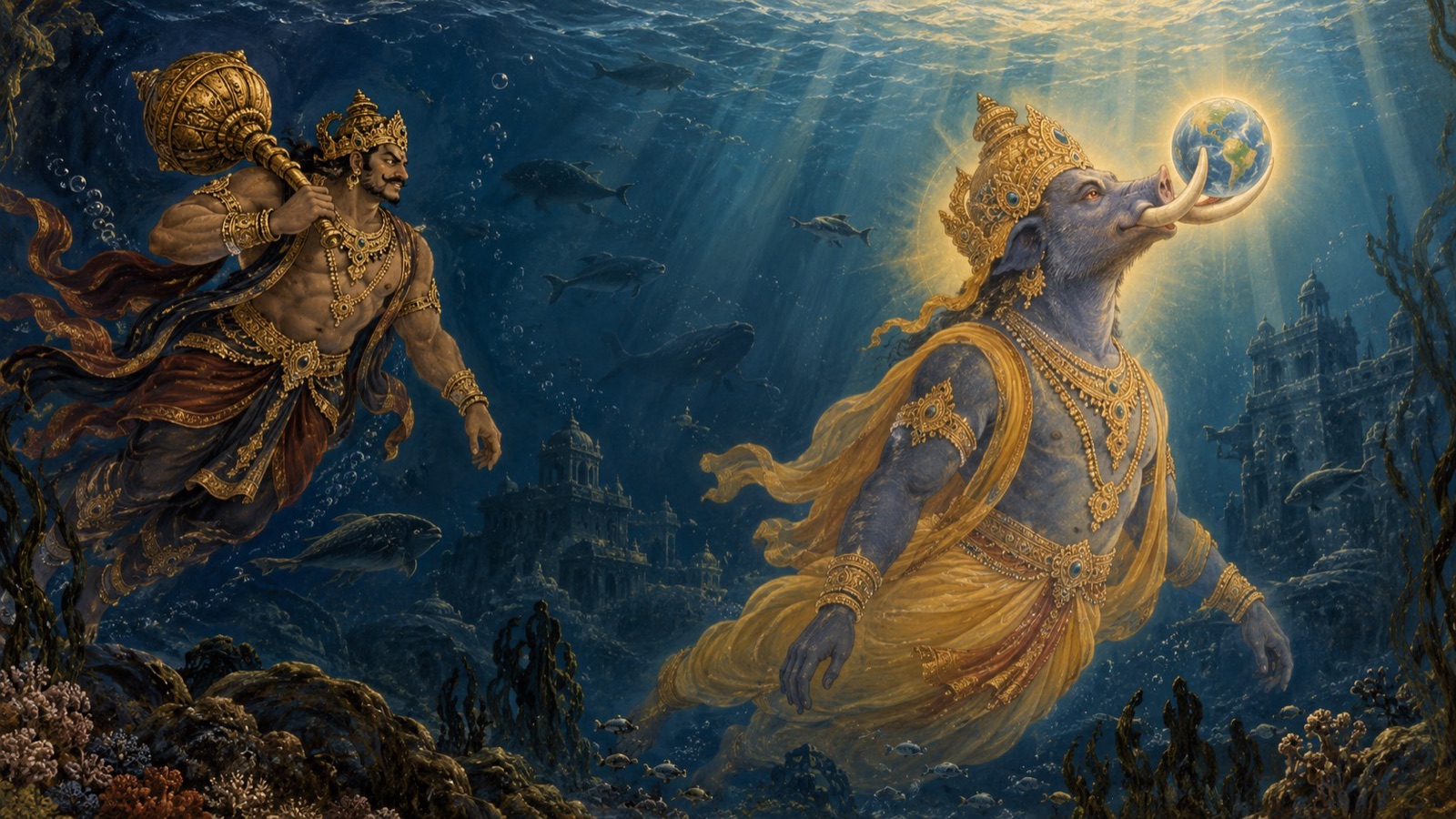
Maitreya does not linger on Hiranyaksa’s dismissal of Varuna’s counsel; he moves at once to what the demon did instead. Proud and vainglorious, paying the older god’s words little heed, Hiranyaksa turned to Narada, learned from him exactly where Sri Hari could be found, and hurried into the depths of the ocean with an urgency the Bhagavatam is careful to note — this was not idle curiosity but a Daitya closing in for a kill he assumed was already his. What he found there was the all-victorious divine Boar, the rescued earth still balanced upon the ends of His tusks, His reddish eyes seeming almost to strip the demon of his own splendour merely by their gaze. Hiranyaksa’s first reaction is not fear but derision — he laughs outright, calling the Lord nothing more than an amphibious beast, unworthy, in his estimate, of the contest he has crossed an ocean to demand.
मैत्रेय उवाच । तदेवमाकर्ण्य जलेशभाषितं महामनास्तद्विगणय्य दुर्मदः । हरेर्विदित्वा गतिमङ्ग नारदाद्रसातलं निर्विविशे त्वरान्वितः ॥ १ ॥
maitreya uvāca tad evam ākarṇya jaleśa-bhāṣitaṁ mahā-manās tad vigaṇayya durmadaḥ harer viditvā gatim aṅga nāradād rasātalaṁ nirviviśe tvarānvitaḥ
Meaning: Maitreya said: Hearing these words of Varuna, the lord of the waters, the vainglorious demon paid them little heed; and having learnt from Narada the whereabouts of Sri Hari, he hurriedly entered the depths of Rasatala (the ocean). (Canto 3, Chapter 18, verse 1)
The Demon’s Challenge and His Taunting Words
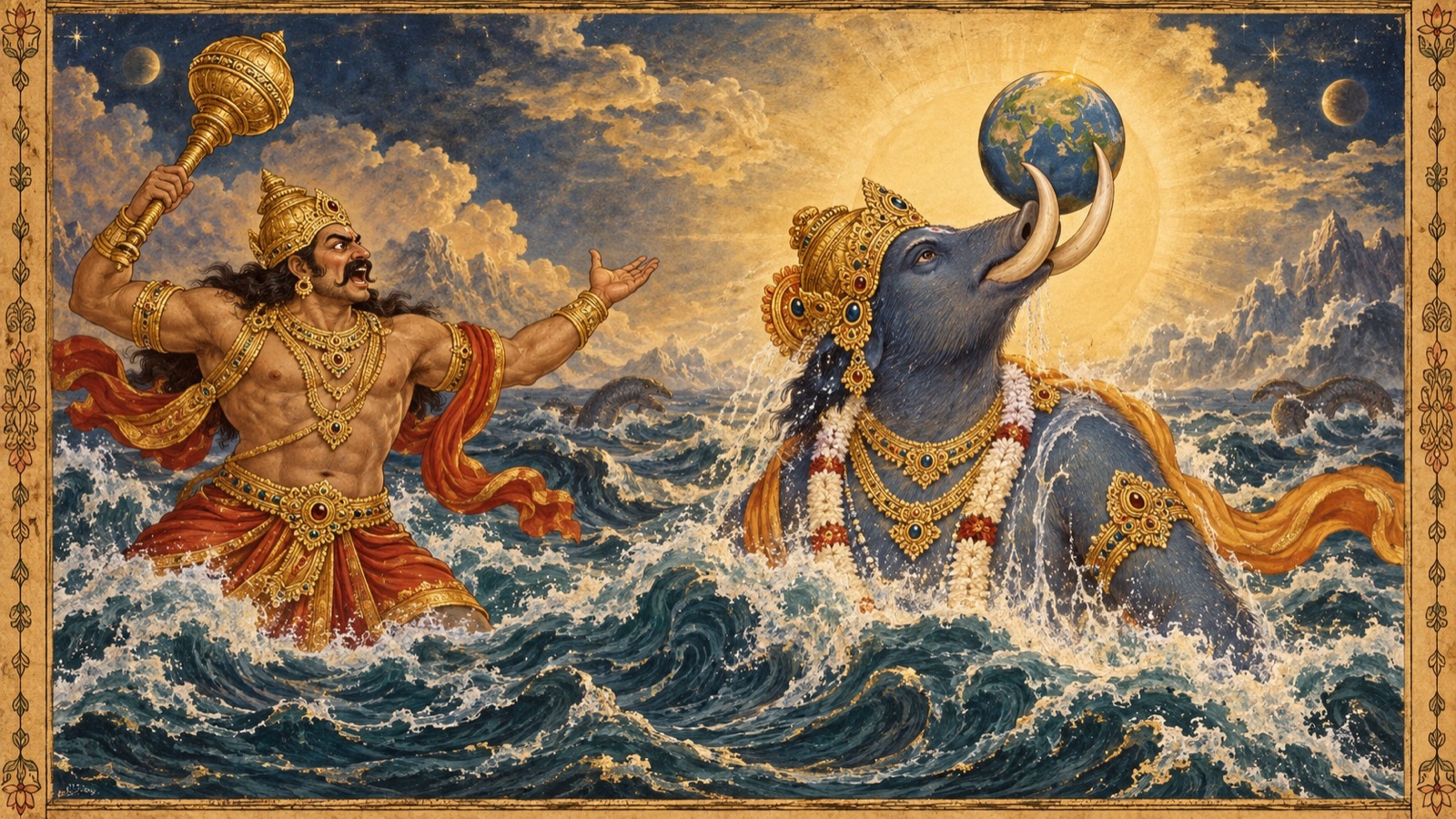
What follows is a torrent of scorn, and Maitreya reports it at length rather than summarising it, as if the sheer volume of the demon’s boasting were itself part of the lesson. Hiranyaksa orders the Lord to abandon the earth at once, calling Him a fool and a “vile god disguised as a boar,” insisting the Maker of the universe has entrusted the earth to the dwellers of Rasatala and that no one — least of all this animal-formed intruder — will be permitted to carry her off unscathed before his eyes. He goes further, accusing the Lord of cowardice dressed up as strategy: that the gods have reared Him for the express purpose of exterminating the Asuras through trickery, that His only real strength is Yogamaya, the power of deception, and that killing Him now would finally wipe away the tears of his own kinsmen. His final threat is almost gleeful in its violence — when the Lord’s skull is smashed by his mace, he says, the sages and gods who depend on Him will wither like trees stripped of their roots.
There is a deeper reason, easy to miss beneath the noise of threats and mace-blows, for why the Lord engages an adversary He could vanquish with a glance. When Hiranyaksa boasts that killing the Lord will finally wipe away his kinsmen’s tears, the very word placed in the demon’s mouth for that “killing” carries, in the Sanskrit, a second and more telling sense: to liberate. What looks, from the demon’s side, like a fight to the death is, from the Lord’s side, the quiet occasion of grace — for death delivered by the Lord’s own hand does not end in destruction but in release from the very bondage of birth and death that keeps ordinary souls circling. Hiranyaksa fights to end the Lord’s life; the Lord, absorbing every insult without haste, is in truth already preparing to end the demon’s bondage instead. Even enmity, when its object is the Supreme Person, becomes for the enemy a doorway rather than a dead end (verse 4).
Through all of this the Lord does not answer in kind, not yet. Maitreya’s language is striking here: the demon’s abusive words are described as piercing the Lord like the sharp ends of arrows, and He is said to bear the pain — not because He is actually wounded by mere insult, but because His attention remains fixed on something else entirely: the earth, still resting on His tusks, visibly affrighted by the demon’s rage. Only once He has safely emerged from the water, moving with the calm deliberation of an elephant shielding its mate from a lurking alligator, does the confrontation properly begin. Hiranyaksa, golden-haired and fearsome-tusked himself, gives chase as the Lord rises from the depths, roaring like thunder and taunting Him further for what he takes to be a retreat — though the text lets us see plainly that this is composure, not flight.
The Earth Set Down, and the Lord’s Own Reply
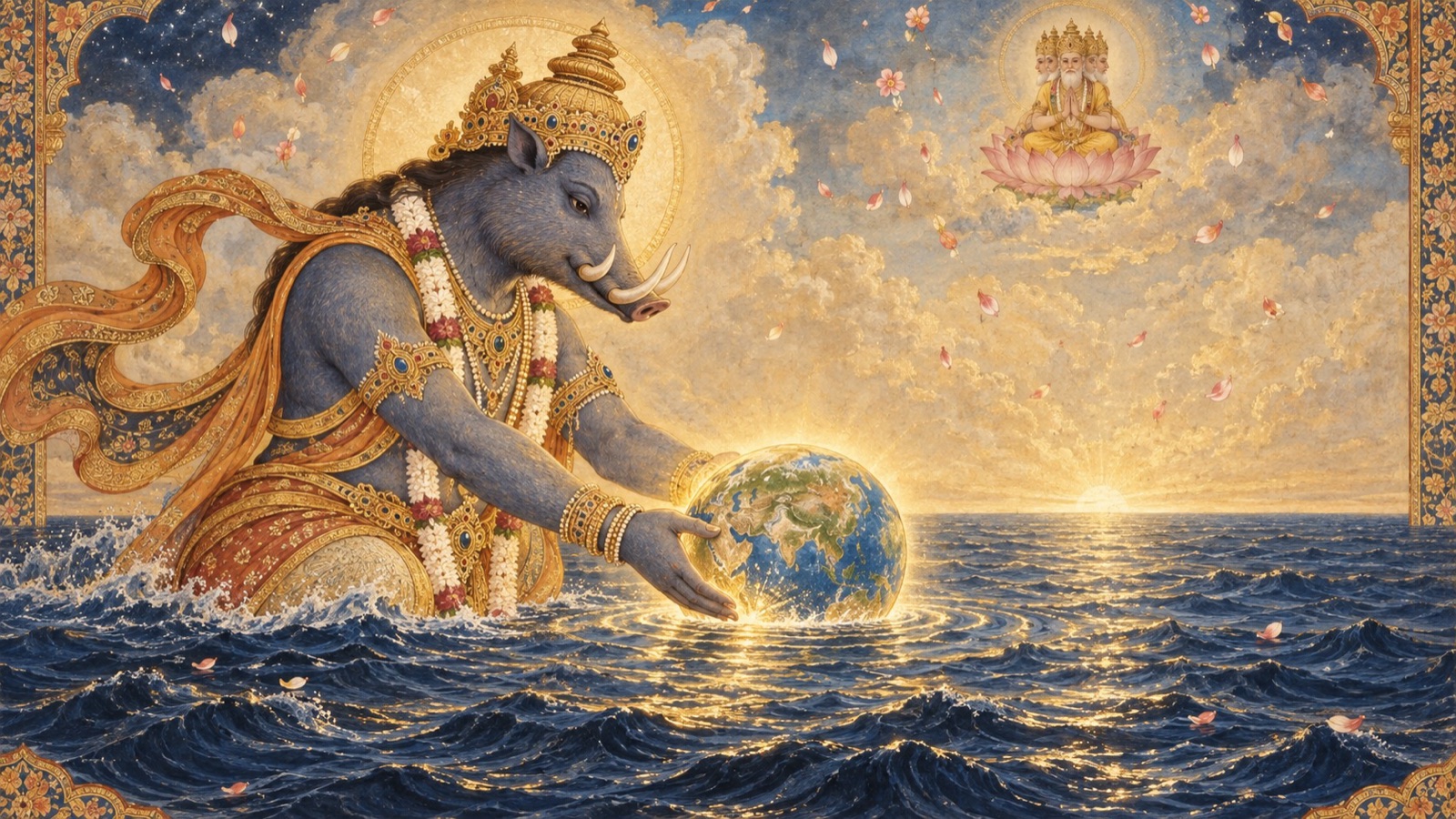
The turning point of the chapter’s opening movement comes quietly, almost as an aside amid all the demon’s noise. The Lord places the earth gently upon the surface of the water within His own sight, transferring to her a portion of His own energy so that she might support herself there — a small, tender act performed even as an enraged demon closes in, and performed, the Bhagavatam notes, while Brahma extols Him from a distance and the gods rain down flowers in silent tribute. Only once the earth is safe does the Lord turn His full attention to Hiranyaksa. What comes next is not fury but something closer to amused, terrible calm — Maitreya says the Lord “displayed a terrible rage” even as He spoke “laughing” to the demon now closing in on Him, armed with his mace and dressed in his strange golden armour, having spent the whole encounter thus far cutting the Lord to the quick with words alone.
परानुषक्तं तपनीयोपकल्पं महागदं काञ्चनचित्रदंशम् । मर्माण्यभीक्ष्णं प्रतुदन्तं दुरुक्तैः प्रचण्डमन्युः प्रहसंस्तं बभाषे ॥ ९ ॥
parānuṣaktaṁ tapanīyopakalpaṁ mahā-gadaṁ kāñcana-citra-daṁśam marmāṇy abhīkṣṇaṁ pratudantaṁ duruktaiḥ pracaṇḍa-manyuḥ prahasaṁs taṁ babhāṣe
Meaning: [Maitreya narrates that] the Lord, His heart pierced again and again by the demon’s abusive words, and now facing him close at hand, armed with his mighty mace and adorned with gold ornaments and strange golden armour, spoke to him, laughing, though displaying terrible rage. (Canto 3, Chapter 18, verse 9)
The Lord’s own reply, when it comes, matches the demon taunt for taunt, but with an edge of self-deprecating irony that only deepens the sense that He is entirely in control of the moment. He calls Himself and His kind mere wild brutes of the forest, hunting village dogs like Hiranyaksa; He notes, pointedly, that heroes bound already by the cords of Death — as every mortal and demon ultimately is — pay no attention to such braggadocio. He admits, with evident sarcasm, to having “stolen the charge” of Rasatala’s dwellers and to standing there now scared by the demon’s mace, casting shame to the winds — and yet, He says, willy-nilly, a stand must be made, for having provoked so powerful an adversary, there is nowhere left to retreat. His closing words are almost a formal challenge: let the “leader of leaders of foot soldiers” take prompt steps against Him, for no one deserves a seat among the honourable who fails to make good on a plighted word.
श्रीभगवानुवाच । सत्यं वयं भो वनगोचरा मृगा युष्मद्विधान्मृगये ग्रामसिंहान् । न मृत्युपाशैः प्रतिमुक्तस्य वीरा विकत्थनं तव गृह्णन्त्यभद्र ॥ १० ॥
śrī-bhagavān uvāca satyaṁ vayaṁ bho vana-gocarā mṛgā yuṣmad-vidhān mṛgaye grāma-siṁhān na mṛtyu-pāśaiḥ pratimuktasya vīrā vikatthanaṁ tava gṛhṇanty abhadra
Meaning: The Personality of Godhead said: It is true, we are but wild animals, wandering here in search of dogs like you who prowl the village. Heroes bound already by the noose of death take no heed of your idle bragging, O wretched one. (Canto 3, Chapter 18, verse 10)
The Duel Begins
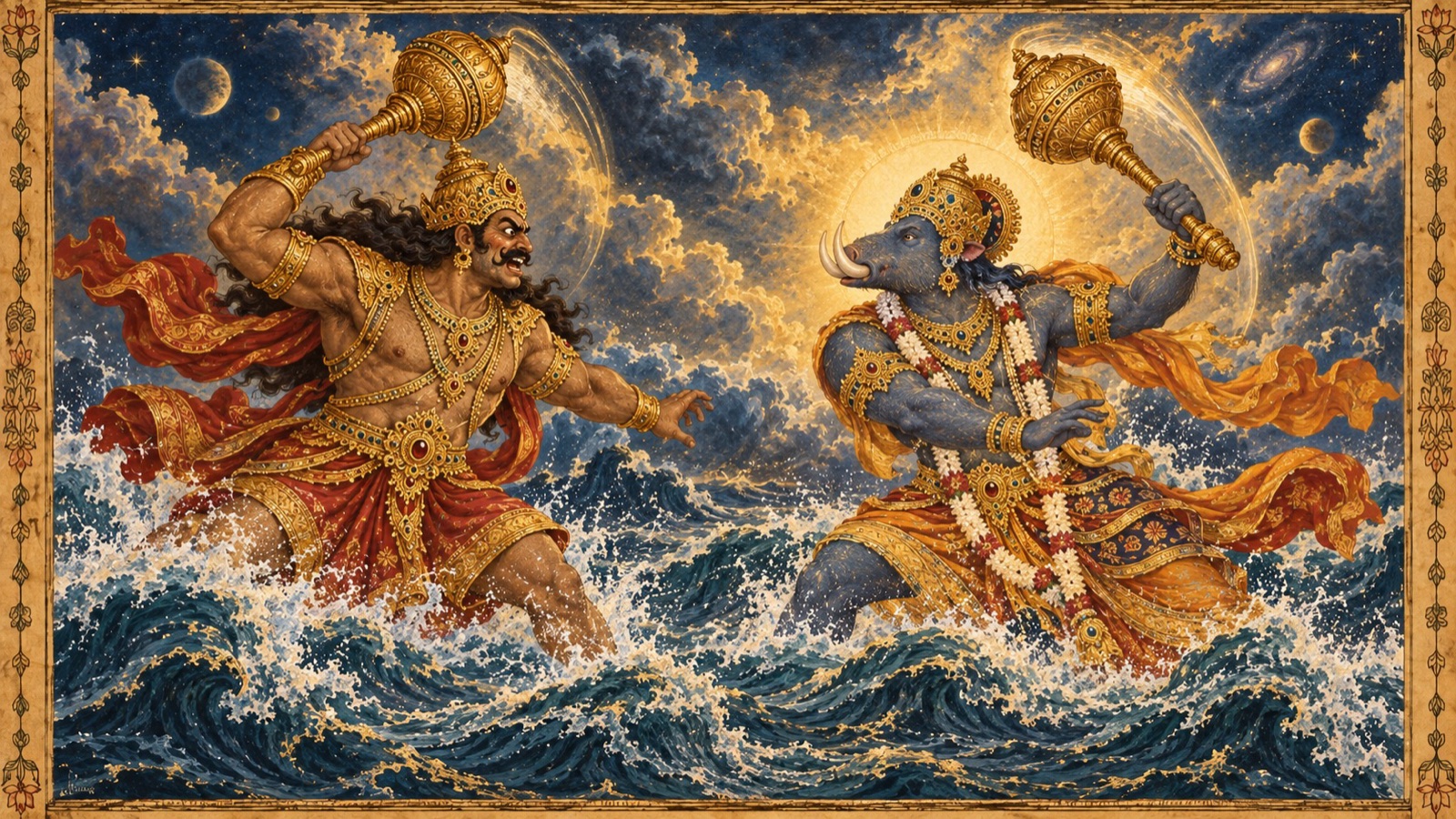
Provoked past all patience by being mocked and ridiculed in turn, Hiranyaksa’s fury boils over completely — Maitreya compares him to a serpent being carelessly played with, hissing with indignation, every sense shaken by wrath. He springs upon the Lord and lands the first blow with his mace, aimed straight at the divine breast. The Lord, unhurried, simply steps aside, evading the strike with the same effortless economy of motion Maitreya likens to a perfected Yogi eluding death itself — a comparison that quietly reminds the listener what is truly at stake in this encounter, and for whom. From here the duel proper begins in earnest: the Lord rushes to meet the demon, who takes up his mace again and brandishes it repeatedly, biting his lips in rage; the Lord’s own mace finds the demon’s right eyebrow, but Hiranyaksa, skilled in this kind of combat, intercepts the blow with his own weapon. Maitreya’s narration settles here into the rhythm of genuine battle — Haryaksa, as he calls the demon by one of his epithets, and Sri Hari trade blow for blow, each seeking victory, until both combatants carry visible wounds and the smell of blood on their own bodies only feeds their mounting rage. Maitreya’s simile for what the whole scene resembles is deliberately earthy and unglamorous: two bulls locked in combat over a single cow, each manoeuvring for advantage with everything he has.
It is worth pausing on how restrained this description actually is, set against what it could have been. The verses give us motion, sound, and consequence — blows landed and returned, injuries sustained, rage escalating — without lingering on gore or spectacle for its own sake. The emphasis throughout remains on the contest of wills as much as the contest of arms: a proud demon convinced of his own invincibility meeting, for the first time, something that will not simply be overawed by his strength or his boasting.
Brahma Arrives, Anxious for the World
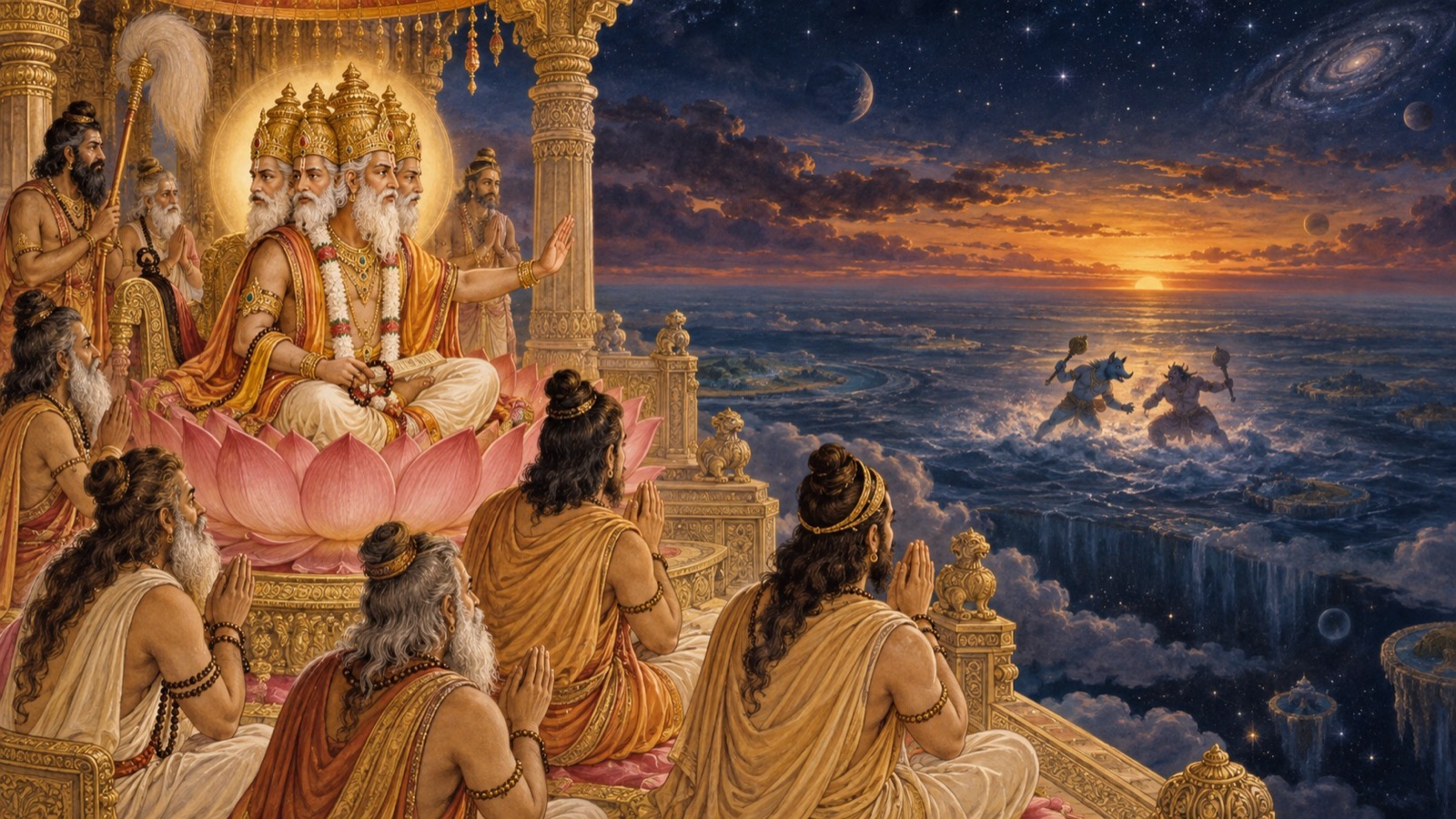
At this point the scene widens. Brahma himself, the creator of the universe, arrives at the scene surrounded by a great retinue of sages headed by Marici, drawn there specifically to witness the combat between Hiranyaksa, son of Diti, and the Supreme Spirit who has assumed the form of a boar through His own Maya — a form, Maitreya reminds us, that represents on His own person the various sacrifices (Yajnas) of the Vedic tradition. What Brahma sees troubles him: Hiranyaksa is fighting with full manliness, entirely devoid of fear, returning every blow the Lord deals him and displaying what can only be called irresistible prowess. It is this sight — not doubt in the Lord’s ultimate victory, but concern for how long the contest might now be permitted to run — that prompts Brahma to address Lord Narayana directly.
दैत्यस्य यज्ञावयवस्य मायागृहीतवाराहतनोर्महात्मनः । कौरव्य मह्यां द्विषतोर्विमर्दनं दिदृक्षुरागादृषिभिर्वृतः स्वराट् ॥ २० ॥
daityasya yajñāvayavasya māyā-gṛhīta-vārāha-tanor mahātmanaḥ kauravya mahyāṁ dviṣator vimardanaṁ didṛkṣur āgād ṛṣibhir vṛtaḥ svarāṭ
Meaning: O Vidura, descendant of Kuru, Brahma, the self-sufficient lord, surrounded by sages, arrived there eager to witness the fierce combat, for the sake of the earth, between the demon and the great soul who had assumed the form of a boar, representing the sacrifices, through His own divine potency. (Canto 3, Chapter 18, verse 20)
Brahma’s speech, which closes the chapter, is less a command than an urgent, almost anxious appeal — the creator of the universe speaking to its Sustainer not as an equal issuing instructions but as a devoted well-wisher of all worlds, pleading for their protection. He reminds the Lord that this demon, having secured a boon from Brahma himself, has become nothing but a constant menace: trespassing against, terrifying, and injuring the very gods, Brahmanas, cows, and innocent beings who have taken shelter at the Lord’s own feet, and — having found no rival anywhere capable of matching him — wandering the spheres like a thorn in search of new flesh to wound. Brahma’s counsel is not to prolong the contest even for the sake of sport: play not with him, he says, as a careless child might play with an already-enraged serpent. Slay this sinful demon, he urges, presiding as You do over Your own Maya, before the demon grows still more formidable with the approach of an hour that favours him — the dreaded, world-endangering hour of twilight now fast approaching. He adds a note of practical urgency that is almost touchingly human for so cosmic a figure: the auspicious period called Abhijit, so favourable for securing victory, began at midday and has very nearly passed; on behalf of all who call themselves the Lord’s friends, Brahma asks that this formidable foe be dealt with quickly. His final words frame the whole encounter, retrospectively, as a kind of grace already extended: this demon has, by good fortune for the three worlds, come entirely of his own accord to the very death that was always ordained for him. Let the Lord now exhibit His prowess, slay him in fair combat, and establish the worlds once more in peace.
ब्रह्मोवाच । एष ते देव देवानामङ्घ्रिमूलमुपेयुषाम् । विप्राणां सौरभेयीणां भूतानामप्यनागसाम् ॥ २२ ॥ आगस्कृद्भयकृद्दुष्कृदस्मद्राद्धवरोऽसुरः । अन्वेषन्नप्रतिरथो लोकानटति कण्टकः ॥ २३ ॥
brahmovāca eṣa te deva devānām aṅghri-mūlam upeyuṣām viprāṇāṁ saurabheyīṇāṁ bhūtānām apy anāgasām āgas-kṛd bhaya-kṛd duṣkṛd asmad-rāddha-varo ‘suraḥ anveṣann apratiratho lokān aṭati kaṇṭakaḥ
Meaning: Brahma said: O Lord, this demon, having obtained his boon from me, has become a thorn — offending, terrifying, and doing harm to the gods who have taken shelter at Your feet, the Brahmanas, the cows, and other blameless beings, and, finding no rival anywhere, wanders about the worlds still seeking one. (Canto 3, Chapter 18, verses 22-23)
दिष्ट्या त्वां विहितं मृत्युमयमासादितः स्वयम् । विक्रम्यैनं मृधे हत्वा लोकानाधेहि शर्मणि ॥ २८ ॥
diṣṭyā tvāṁ vihitaṁ mṛtyum ayam āsāditaḥ svayam vikramyainaṁ mṛdhe hatvā lokān ādhehi śarmaṇi
Meaning: By good fortune, this demon has come of his own accord to You, who are his ordained death. Exhibiting Your prowess, slay him in this duel, and establish the worlds in peace. (Canto 3, Chapter 18, verse 28)
With Brahma’s appeal, the eighteenth discourse comes to a close — its own colophon describing it as forming part of the larger story of Hiranyaksa’s death, though the death itself has not yet come. The demon still stands. The duel is still under way. What Discourse XVIII gives us is the confrontation in full: the chase, the taunts on both sides, the earth set safely down, the first exchange of blows, and finally the anxious, hopeful watching of Brahma and his company of sages, their eyes fixed on a battle whose outcome they already trust but whose timing, with twilight bearing down, they cannot help but wish hastened.
Principal Teachings of This Chapter
1. Composure under provocation is itself a form of strength. The Lord absorbs a relentless torrent of insult and mockery from Hiranyaksa without losing His poise, attending first to the earth’s safety before ever answering the demon in kind. The Bhagavatam does not pretend the words left Him unmoved — it says plainly that they pierced Him like arrows — yet even genuine hurt does not divert Him from His actual priority, a model of self-mastery that has nothing to do with pretending not to feel provocation at all (verses 3-9).
2. Even the Lord’s play carries purpose. What Brahma witnesses as combat is, from the Lord’s own side, never in doubt; yet He engages fully, blow for blow, showing that divine sport (lila) does not mean carelessness. His own reply to the demon (verse 10) makes the point explicit: one already beyond the reach of death has nothing to prove against a boaster still bound by it, so the duel that follows is fought from unhurried certainty rather than anxiety — every action, even in seeming jest, serves the protection of the worlds (verses 10-19).
3. Unchecked power divorced from humility becomes a danger to all. Hiranyaksa’s boon-given strength, unaccompanied by any corresponding restraint, makes him a menace not through malice alone but through the sheer absence of any check upon him — a caution about power granted without corresponding character (verses 3-5, 22-24).
4. Even the creator of the universe petitions the Lord as protector. Brahma’s urgent appeal — coming from the very being who granted Hiranyaksa his dangerous boon in the first place — shows that responsibility for a danger set loose in the world does not end at its origin; it extends to actively seeking its remedy. Brahma does not ask for punishment out of anger but for swift action out of mercy toward the innocent this demon has terrorised, a distinction he is careful to make even while pressing his case (verses 20-28).
5. Timing matters even in the unfolding of cosmic justice. Brahma’s anxiety about the approaching hour of twilight and the waning of the auspicious Abhijit period reminds us that dharma operates within time, not outside it — even divine intervention is spoken of here as something to be sought at the right moment, not merely at the ultimately certain one (verses 25-27).
A Devotional Reflection
There is a quiet dignity in how this chapter handles what could easily have become simple spectacle. Hiranyaksa is given real menace and real voice — his taunts are not caricatured but delivered with the full, chilling confidence of someone who has never once been opposed. And the Lord’s answer to that menace is not overwhelming force applied instantly, but a sequence of small, deliberate priorities: protect the earth first, absorb the insult without losing composure, meet violence with matched but controlled violence only once retreat is no longer possible, and even then, address the aggressor with a wit that never abandons its underlying calm. Brahma’s late arrival, anxious and pleading, adds a further layer of humility to the whole episode — the architect of the universe himself admitting, in effect, that the danger loose in his creation is one he cannot resolve without appealing to the very Lord whose form as a boar he had, moments before, merely come to admire. It is a chapter about power in several registers at once: power abused, power restrained, power finally about to be exercised in full — and about how even the mightiest figures in the cosmic order find themselves, in the end, waiting on grace.
A Daily Devotional Practice
Today, notice a moment when someone’s words are sharper than the situation requires — a taunt, a provocation, an insult meant to draw you off balance. Before answering, ask what the Lord attended to first in this chapter: not His own dignity, but the safety of what had been entrusted to Him. Let that be your own first concern too — protect what matters before defending your pride. And if you find that restraint has already been tested past its limit, remember that even the Lord’s eventual response came wrapped in composure rather than blind rage. Before returning to your day, pause and repeat quietly: “Om Namo Bhagavate Vasudevaya.” Let that remembrance steady you the next time provocation arrives uninvited, trusting that calm strength, rightly timed, accomplishes what anger alone cannot.
Conclusion
The eighteenth discourse of Book Three carries Vidura’s story of Hiranyaksa into its central confrontation — not yet its resolution. Maitreya shows us a demon at the height of his boon-given power, scornful of every counsel that might have restrained him, chasing the Lord across an ocean only to find, in the divine Boar, an opponent who answers taunt with wit, provocation with patience, and violence, when it finally comes, with equal and measured force. The chapter closes not with a death but with a plea — Brahma himself, surrounded by sages, urging the Lord to bring this fierce and rising duel to its appointed end before twilight’s dangerous hour arrives. It is a chapter suspended, deliberately, at its point of highest tension, preparing the ground for Discourse XIX’s account of how that appointed end, “Death of Hiranyaksa,” finally comes to pass.
May the divine wisdom of Srimad Bhagavatam awaken pure devotion within our hearts.
Om Namo Bhagavate Vasudevaya.
Jay Shree Madhav.
References and Attribution
- Primary edition: Gita Press, Śrīmad Bhāgavata Mahāpurāṇa (English, complete), Book Three, Discourse 18, pages 215–217/218.
- Series: Srimad Bhagavatam Wisdom · Biswa Sanatan Dharma Seva Trust.
- Presented following the spiritual guidance and recommendation of Pandit Dr. Shri Kashinath Mishra.
This is an original, faithful retelling in the writer’s own words, with brief quoted verses shown in Devanāgarī and transliteration and their meanings given as summaries. It is not a reproduction of any single publisher’s continuous translation or commentary. No affiliation with or endorsement by any publisher is implied.
Jay Shree Madhav