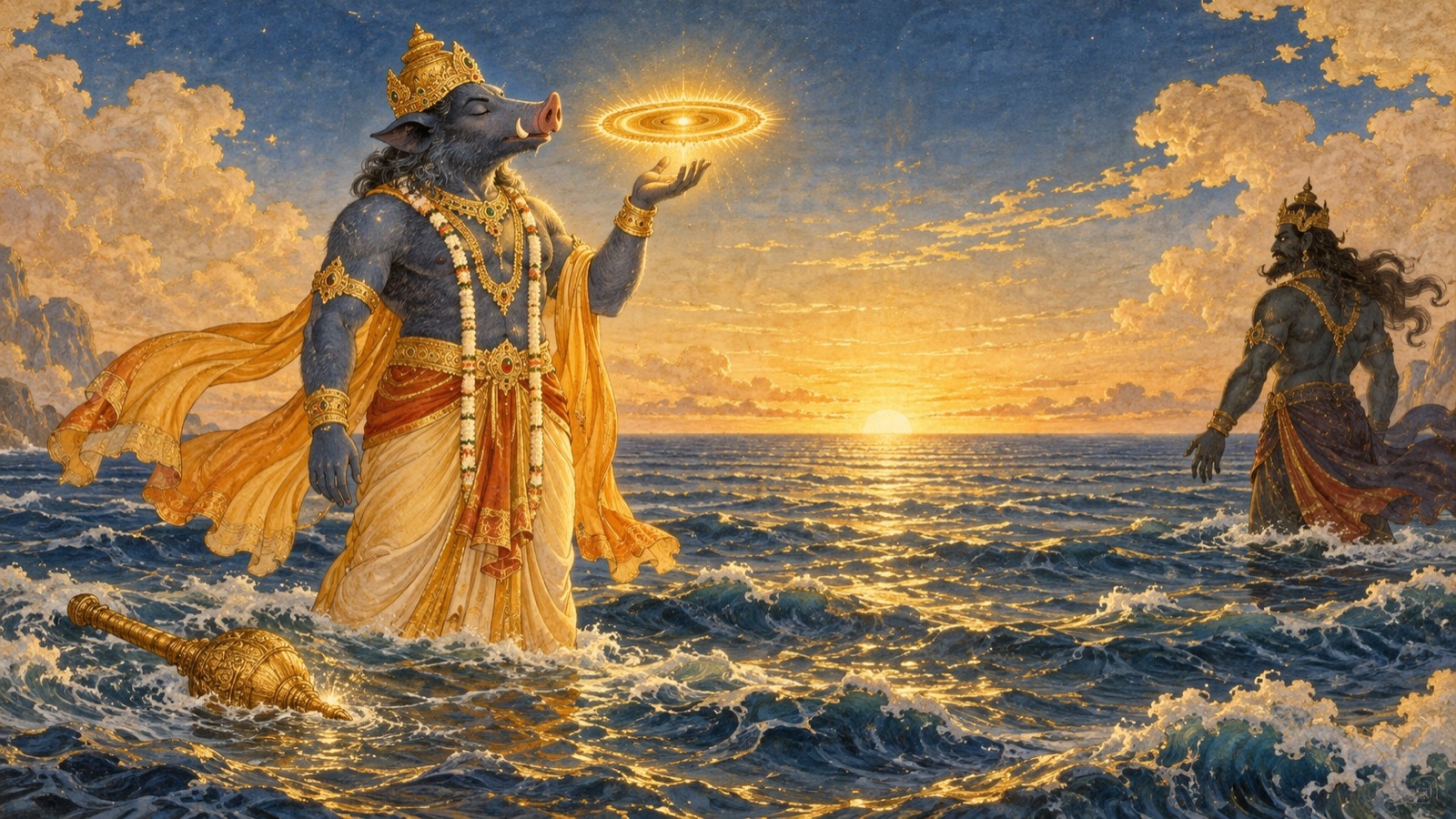
His mace struck from His own hand and cast miraculously aside, the divine Boar honors His unarmed enemy’s sense of fair play — and then, laughing, calls to mind the whirling discus that will end, at last, this long and terrible contest.
Om Namo Bhagavate Vasudevaya.
Om Namo Bhagavate Vasudevaya.
Om Namo Bhagavate Vasudevaya.
Welcome to Srimad Bhagavatam Wisdom, a devotional journey through the sacred histories and teachings of the Srimad Bhagavat Mahapurana. The chapter before this one left the divine Boar and the demon Hiranyaksa locked in a duel of maces at the edge of the cosmic ocean, their blows drawing blood, the twilight hour drawing near, and Brahma himself pleading with the Lord to end the contest before the demon grew stronger still. Chapter 19 carries that combat to its close — but not in the way a reader braced for a straightforward battle might expect. What follows is a contest decided as much by conduct as by weapons: a demon who will not strike an unarmed foe, a Lord who honors that restraint before unleashing His own greater power, a storm of illusion met with light rather than fury, and a death so serene that the very gods who witness it can only marvel at what it means to be released from the world by the Supreme Person’s own hand. Maitreya, still speaking to Vidura, brings the tale to its long-awaited resolution; and then, in a final turn, the frame widens once more as Suta Gosvami tells the sages of Naimisharanya exactly what is gained by anyone who simply listens to it.
Chapter Information
- Scripture: Śrīmad Bhāgavata Mahāpurāṇa
- Canto: 3 (Book Three)
- Chapter: 19 (Discourse 19)
- Chapter title: Death of Hiranyaksa
- Principal speaker: Maitreya, continuing his narration to Vidura (verses 1–29, 31–32); a direct-speech insert of the gods’ own hymn (verse 30); and Suta Gosvami, once more addressing the assembly of Saunaka and the sages of Naimisharanya (verses 33–38)
- Principal listeners: Vidura, within Maitreya’s account; Saunaka and the assembled sages of Naimisharanya, in the outermost frame
- Main setting: The surface of the cosmic waters, where the divine Boar and Hiranyaksa continue and conclude the combat begun in Chapter 18
- Central subject: The climax of the Varaha–Hiranyaksa duel — the demon’s fair play in battle, the Lord’s invocation of the Sudarsana discus, the demon’s storm of maya and its dispersal, his final death at the Lord’s touch, the gods’ hymn of gratitude, and the spiritual merit of hearing this narrative
- Principal verse range: Canto 3, Chapter 19, verses 1–38
- Primary edition: Gita Press Śrīmad Bhāgavata Mahāpurāṇa
A Glance Laden with Love
Discourse XVIII had ended with Brahma, surrounded by sages, begging the Lord to finish the duel before the dangerous twilight hour arrived in full. Chapter 19 opens with the Lord’s response to that plea — and it is not urgency, but affection.
Maitreya continued: Hearing the words of Brahma, which were free from guile and sweet as nectar, the Lord heartily laughed and accepted his prayer with a glance laden with love. (verse 1)
Even at the height of a cosmic battle, fought for the fate of the earth itself, the text pauses to note the quality of the Lord’s attention: not grim resolve, not martial calculation, but laughter and love directed toward His own well-wishing devotee. It is a reminder, before the violence resumes, of what actually governs the scene beneath its surface drama.
The Mace That Fell, and the Demon Who Would Not Strike
What happens next is one of the chapter’s most striking passages, precisely because it inverts the reader’s expectations of who behaves honorably in a fight between a god and a demon.
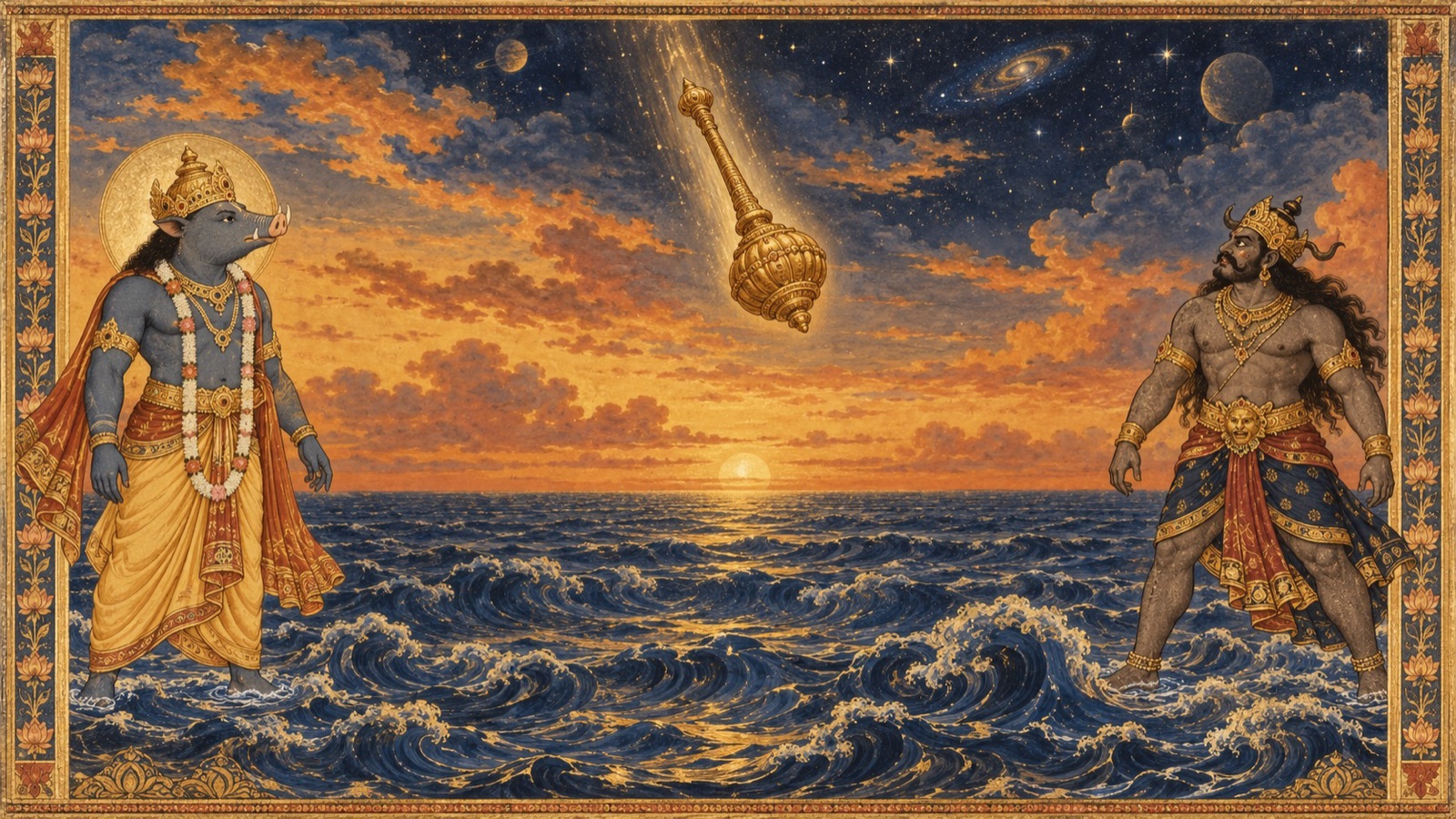
Thereupon the divine Boar sprang and aimed His mace at the chin of His enemy, who was stalking fearlessly before Him. Struck by the demon with his own mace, however, it slipped from the Lord’s hand and looked splendid as it fell down whirling — something miraculous, as it were. Even though he had an excellent opportunity to strike, the demon refused to hit his unarmed foe, respecting the law of a single combat, and this very restraint kindled the fury of the Universal Lord. (verses 2–4)
It is worth sitting with the strangeness of this moment: Hiranyaksa, the destroyer of worlds, the demon who has spent two chapters boasting and taunting, is shown here observing a code of honorable combat more scrupulously than the situation might lead us to expect — and it is precisely this act of restraint, not any blow, that “kindles the fury of the Universal Lord.” The text does not explain this fury as anger at being disarmed. Read alongside what follows, it reads instead as the Lord’s recognition that this demon, whatever his crimes, still carries within him a trace of dignity worth acknowledging — and that the moment has now come to end the contest properly, with full power, rather than let it continue as an even match.
As the mace fell and a cry of alarm rose from the watching gods and sages, the almighty Lord acknowledged the demon’s love of fair play and invoked His discus Sudarsana. (verse 5) As the discus began to revolve in the Lord’s hand, unnamed voices from the aerial cars overhead — witnesses with no true knowledge of the Lord’s own reality — called out, “May victory attend You. Pray, despatch him; play no more with him!” (verse 6)
Honoring His enemy’s fair play rather than pressing His advantage, the Lord lets the fallen mace lie and instead calls to mind His discus Sudarsana, beginning the combat’s final and decisive phase (verses 4-6).
Playing with the Mace, Catching It Like Garuda
Even with the discus now summoned, the Lord does not use it at once. What follows instead is an almost playful demonstration of effortless mastery, verse after verse, before the real ending arrives.
Seeing the Lord armed with a discus, the demon’s senses were overpowered with indignation; hissing like a serpent, he bit his lips in resentment, sprang into the air, and aimed his mace at the Lord, crying, “You are slain!” The Lord, who represented all the sacrifices in His own form, playfully knocked it down with His left foot, even as it came upon Him with the force of a tempest. (verses 7–9) “Take up your weapon and try again,” the Lord said, “eager as you are to conquer Me.” Challenged in these words, the demon hurled his mace once more and roared aloud. When the Lord saw it flying toward Him, He stood firm and caught it, with the same ease as Garuda, the king of birds, would seize a serpent. (verses 10–11) The great demon felt humiliated, his valour frustrated, and was reluctant even to take back the very mace Sri Hari now offered him. (verse 12)
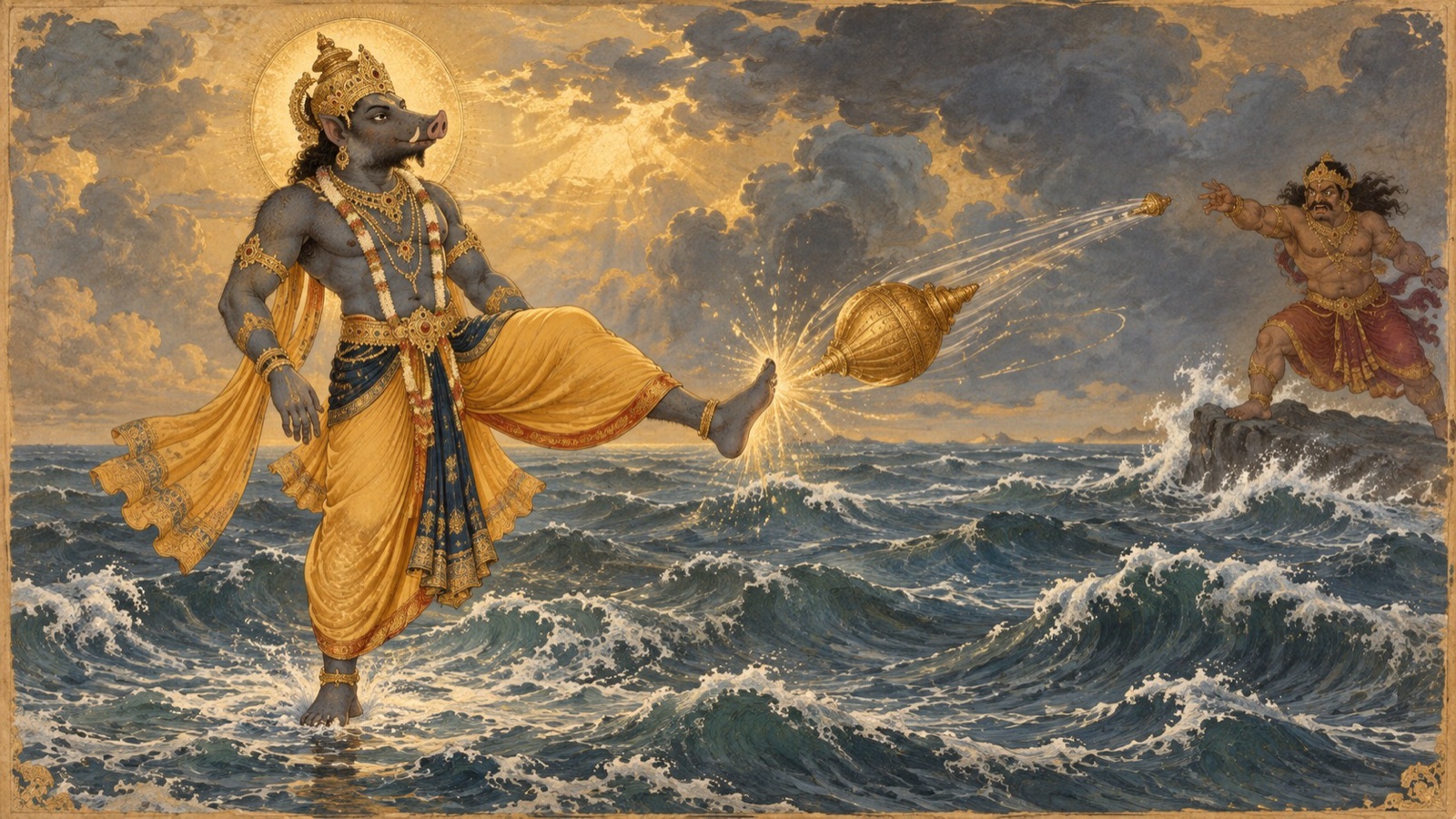
There is something quietly devastating in this sequence for the demon’s pride specifically: the Lord is not straining to survive Hiranyaksa’s assault; He is toying with it, catching a weapon thrown with world-shaking force the way one might casually pluck a thrown stone from the air, and then handing it back. Every escalation the demon attempts is met not with equal force but with an ease that reveals, more clearly than any lecture could, the actual gulf between them.
The Trident, Shattered in Mid-Air
Humiliated but undeterred, the demon reaches for a still more fearsome weapon.
He now took up a trident, rapacious as a flaming fire, to hurl against the Lord, who was Yajna personified — even as one would use malevolent spells against a holy Brahmana. Hurled with all his strength, the glowing trident shone brighter still as it flew through the sky. Sri Hari, however, tore it to pieces with His sharp-rimmed discus, even as Indra once cut down a wing of Garuda. (verses 13–14) Enraged at seeing his trident destroyed, the demon advanced and struck the Lord’s broad, Srivatsa-marked chest with his hard fist, then vanished from sight. Hit in this way, the Lord — appearing as the First Boar — did not feel the least quaking in any part of His body, any more than an elephant would when struck with a wreath of flowers. (verses 15–16)
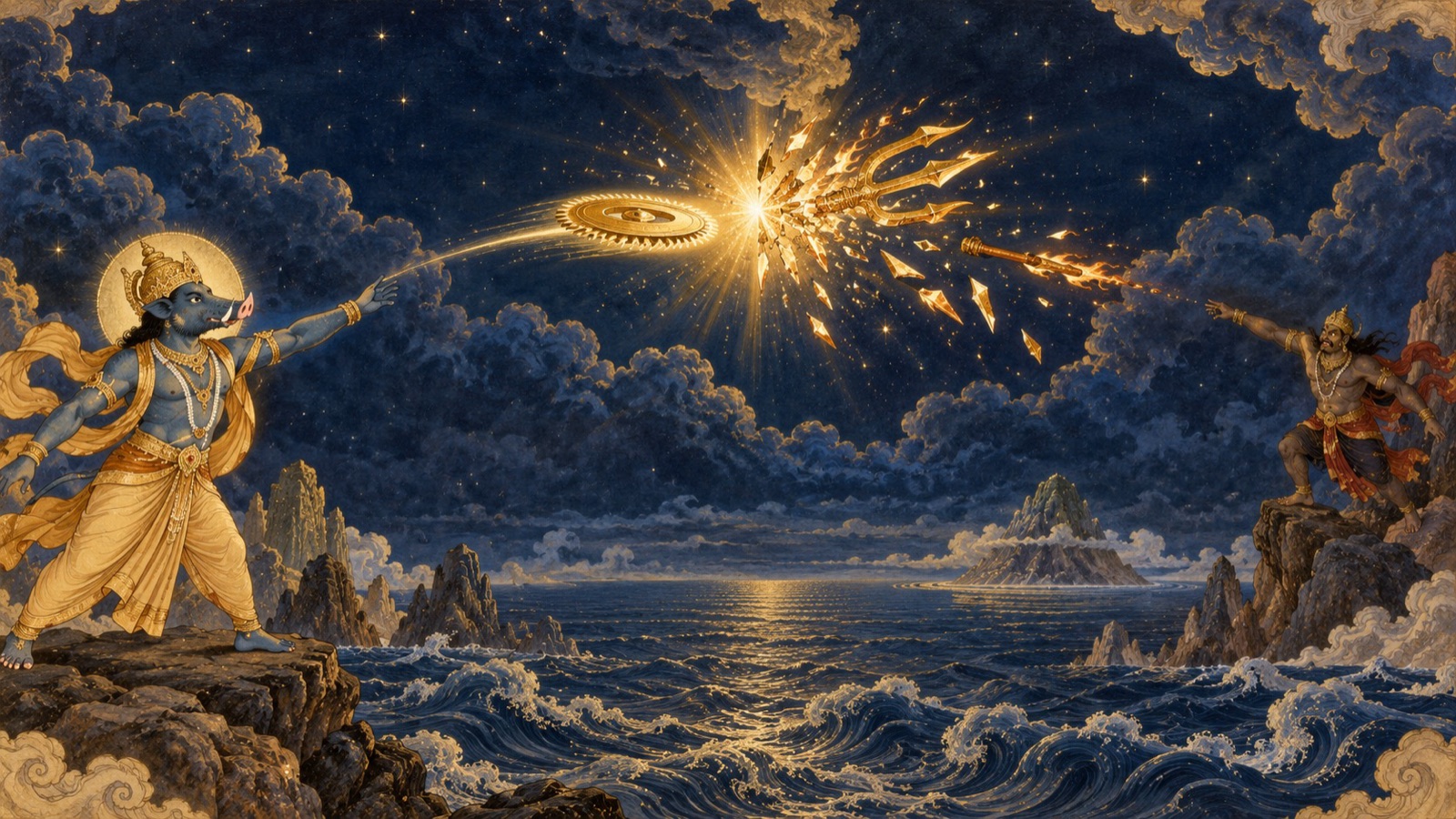
The chapter includes, at this point, a footnote explaining the Garuda comparison: once, to free his mother Vinata from her stepmother Kadru’s bondage, Garuda had snatched away the gods’ nectar, and Indra hurled his thunderbolt at him in response; Garuda, unwilling to let Indra’s weapon prove ineffective, voluntarily dropped one of his own wings to be shattered by it. It is a story about honoring even an opponent’s power rather than defeating it outright — a theme that echoes, in its own way, the demon’s earlier refusal to strike an unarmed foe.
A Storm of Illusion
Having failed with weapon after weapon, the demon turns at last to magic — and the Bhagavatam describes what follows with genuine cosmic dread.
He now employed many a conjuring trick against Sri Hari, the Lord of Yogamaya, at the sight of which the people were filled with alarm and thought the dissolution of the universe was near. Fierce winds began to blow, spreading darkness with dust, and stones came in volleys from every quarter as if thrown from slings. The luminaries of heaven vanished behind masses of clouds accompanied by lightning and thunder, which rained down pus, hair, blood, faeces, urine and bones. Mountains discharging weapons of every kind appeared, along with naked demonesses armed with tridents, their hair hanging loose; and the most cruel and savage slogans rang out from hosts of Yaksas and Rakshasas, marching on foot or riding horses, elephants and chariots. (verses 17–21)
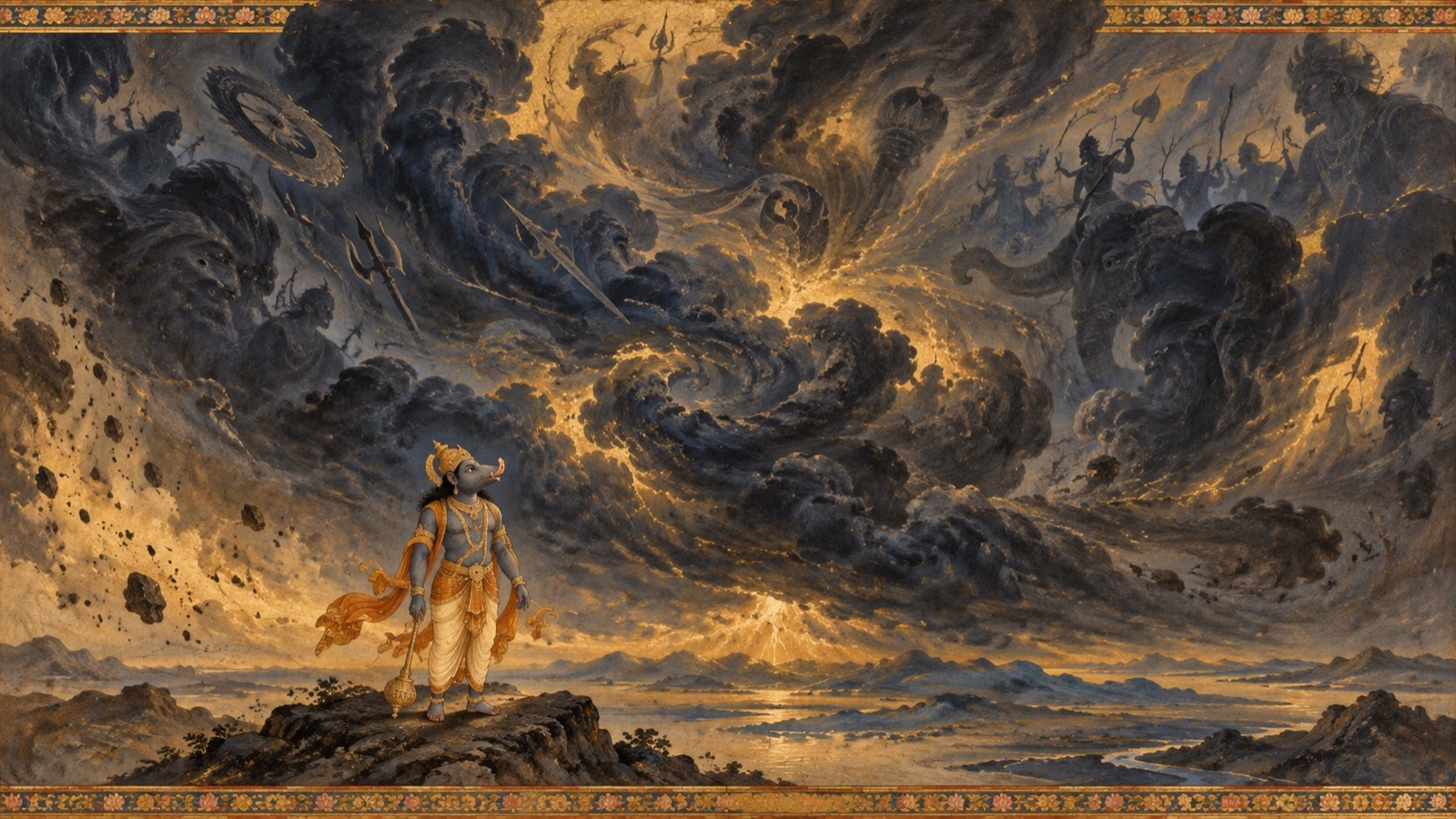
It is a passage that earns the restraint used in illustrating it: the description is vivid and frightening in the text precisely because it is meant to be a genuine cosmic threat, yet the chapter does not linger on it as spectacle for its own sake. It exists to be answered, and the answer comes immediately.
Light Against the Darkness
Against this entire storm of manufactured horror, the Lord’s response is a single, decisive act.
The Lord, who represented all the sacrifices in His person, now discharged His beloved discus Sudarsana, capable of dispersing every Maya the demon had displayed. (verse 22) That very moment, far away, a shudder ran unexpectedly through the heart of Diti, the demon’s mother, as she recalled the words her husband Kasyapa had once spoken to her; and blood flowed from her breasts. (verse 23)
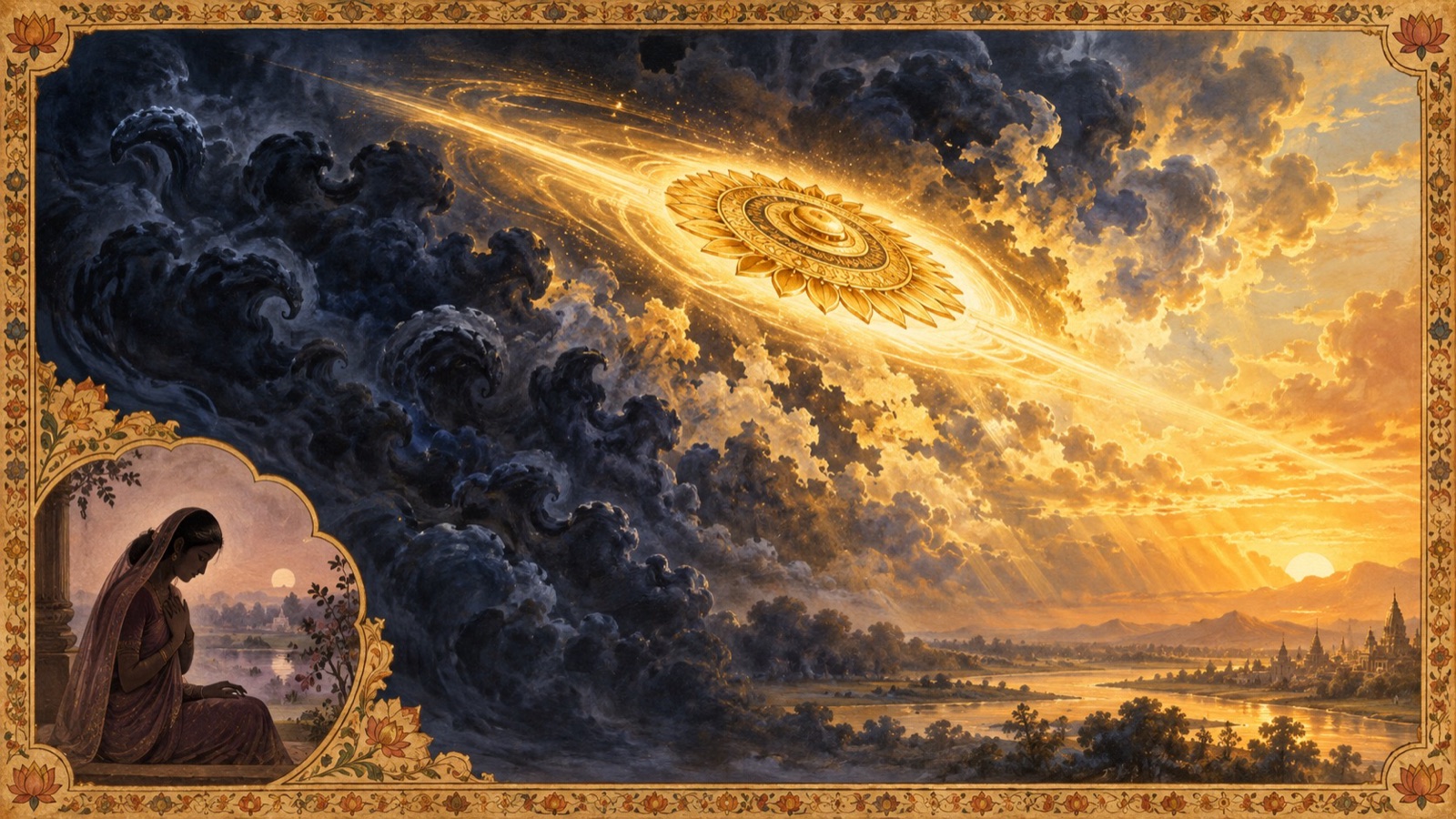
The juxtaposition here is deliberate and quietly devastating: at the very instant the demon’s power is broken, his mother — who has no way of knowing what is happening — feels its consequence in her own body, a grief that arrives before the news ever could. It is one of the chapter’s gentlest and saddest touches, a reminder that even a demon’s death ripples outward into ordinary, aching, maternal love.
The Final Blow
With his illusions dispelled, the demon makes one last, desperate physical attempt.
Seeing his magic forces dispelled, he went into the Lord’s presence once more and, full of rage, tried to encompass Him within his arms to crush Him — only to find, to his great amazement and chagrin, that the Lord stood outside the circle of his own embrace. As he began striking the Lord with fists harder than adamant, Lord Adhoksaja slapped him in the root of his ear, even as Indra once struck the demon Vrtra. Though struck almost indifferently by the all-conquering Lord, the demon’s body began to wheel, his eyeballs bulged from their sockets, and he fell down dead like a gigantic tree uprooted by the wind, his arms, legs and hair scattered. (verses 24–26)
There is no dwelling here on gore or spectacle; the text moves, in the space of three verses, from a demon’s final desperate grasp to his fall — described through the dignified, almost gentle image of an uprooted tree rather than through violence lingered upon for its own sake. What the chapter chooses to dwell on instead is what comes next.
There is a deeper reason the narrative lingers so long over this duel rather than ending it in a single stroke. It has already shown that the Lord felt no more than a flower’s touch when Hiranyaksa struck His chest (verse 16) — He was never in danger, and never needed this fight to protect Himself. What the extended combat provided instead was contact: verse after verse of direct exchange between the demon and the Lord’s own body, culminating in the single slap that ends his life (verse 26) and the countenance he gazes upon as he falls (verses 27–28). For a soul who had once been Jaya, the Lord’s own gatekeeper, this was not chastisement for its own sake but the very method of his release — the fight itself was the embrace, however fierce, by which a fallen devotee was drawn back toward home.
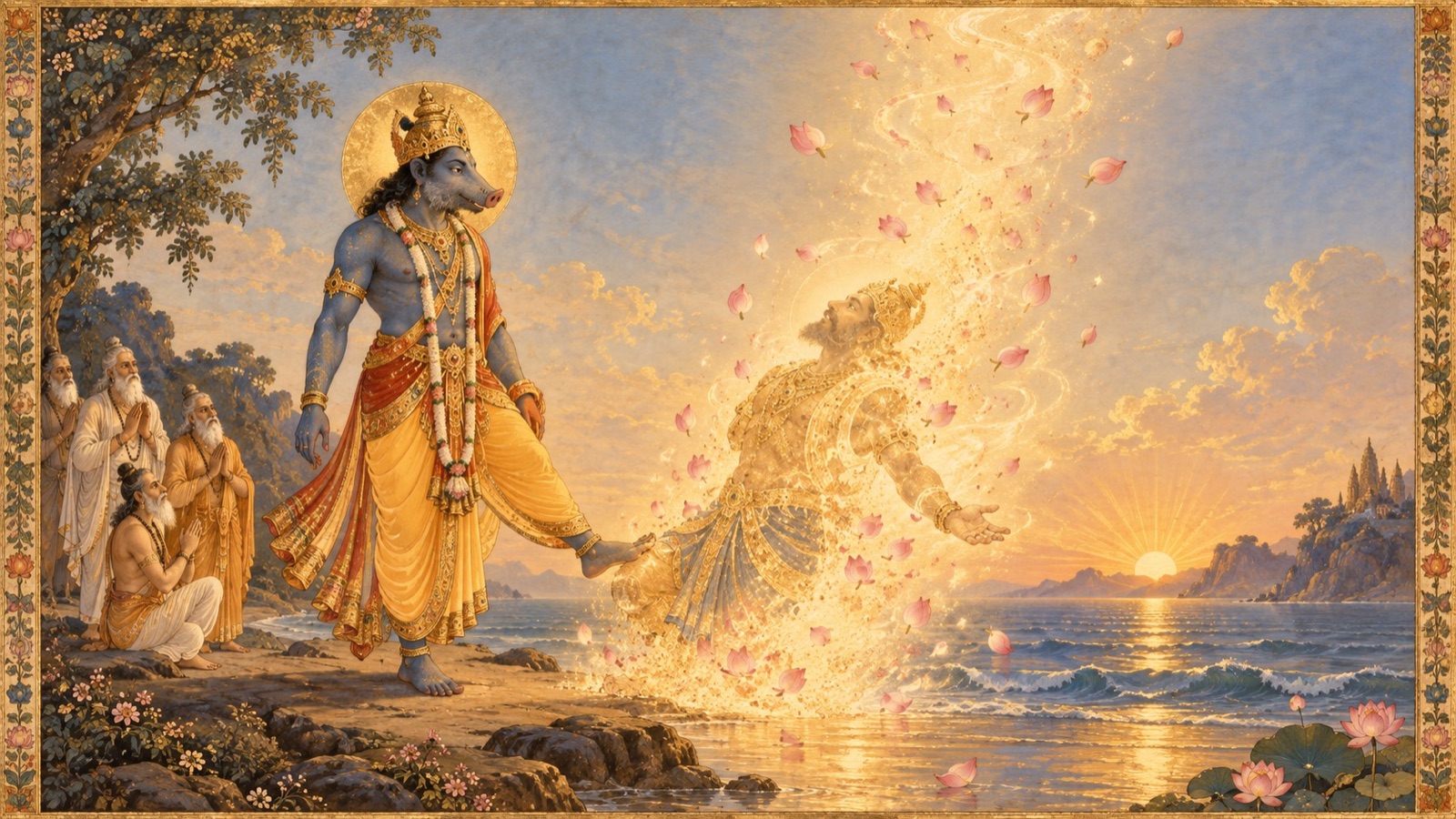
“Who Could Meet Such a Blessed Death!”
What the arriving sages say when they see the fallen demon reframes everything that has come before.
Brahma and the others, now arrived on the spot, saw the demon lying on the ground, biting his lips, the glow on his face yet unfaded, and admiringly said: “Oh, who could meet such a blessed death! Struck by a fore-foot of the Lord — whom Yogis meditate upon in seclusion through Yoga, seeking freedom from their own unreal limitation — and gazing on His countenance, this crest-jewel of Diti’s sons has shuffled off his mortal coil!” (verses 27–28)
This is the theological heart of the chapter’s ending: not triumph over an enemy, but wonder at a liberation. The very sages who came to witness a demon’s destruction speak instead of his good fortune — struck by the Lord’s own foot, gazing directly upon His face at the last instant of life, granted in death an intimacy with the Divine that even Yogis pursue through a lifetime of seclusion and meditation. Brahma then reveals what has been true all along: these are no ordinary demons, but the Lord’s own attendants — Jaya and Vijaya, cursed once to be born as Hiranyakashipu and Hiranyaksa — who, after some further births, will return at last to their true, divine Abode. (verse 29)
Hail to the Source of All Sacrifices
The gods, witnessing this, do not simply celebrate a victory; they offer worship.
देवा ऊचु: नमो नमस्तेऽखिलयज्ञतन्तवे स्थितौ गृहीतामलसत्त्वमूर्तये । दिष्ट्या हतोऽयं जगतामरुन्तुद- स्त्वत्पादभक्त्या वयमीश निर्वृता: ॥ ३० ॥
devā ūcuḥ namo namas te ‘khila-yajña-tantave sthitau gṛhītāmala-sattva-mūrtaye diṣṭyā hato ‘yaṁ jagatām aruntudas tvat-pāda-bhaktyā vayam īśa nirvṛtāḥ
Meaning: The gods addressed the Lord: Hail, hail to You, the source of all sacrifices, who have assumed a form of pure Sattva for the maintenance of this world. Fortunately for us, this demon, who was a torment to the worlds, has been slain by You, and we too, O Lord, are now at ease through devotion to Your feet. (Canto 3, Chapter 19, verse 30)
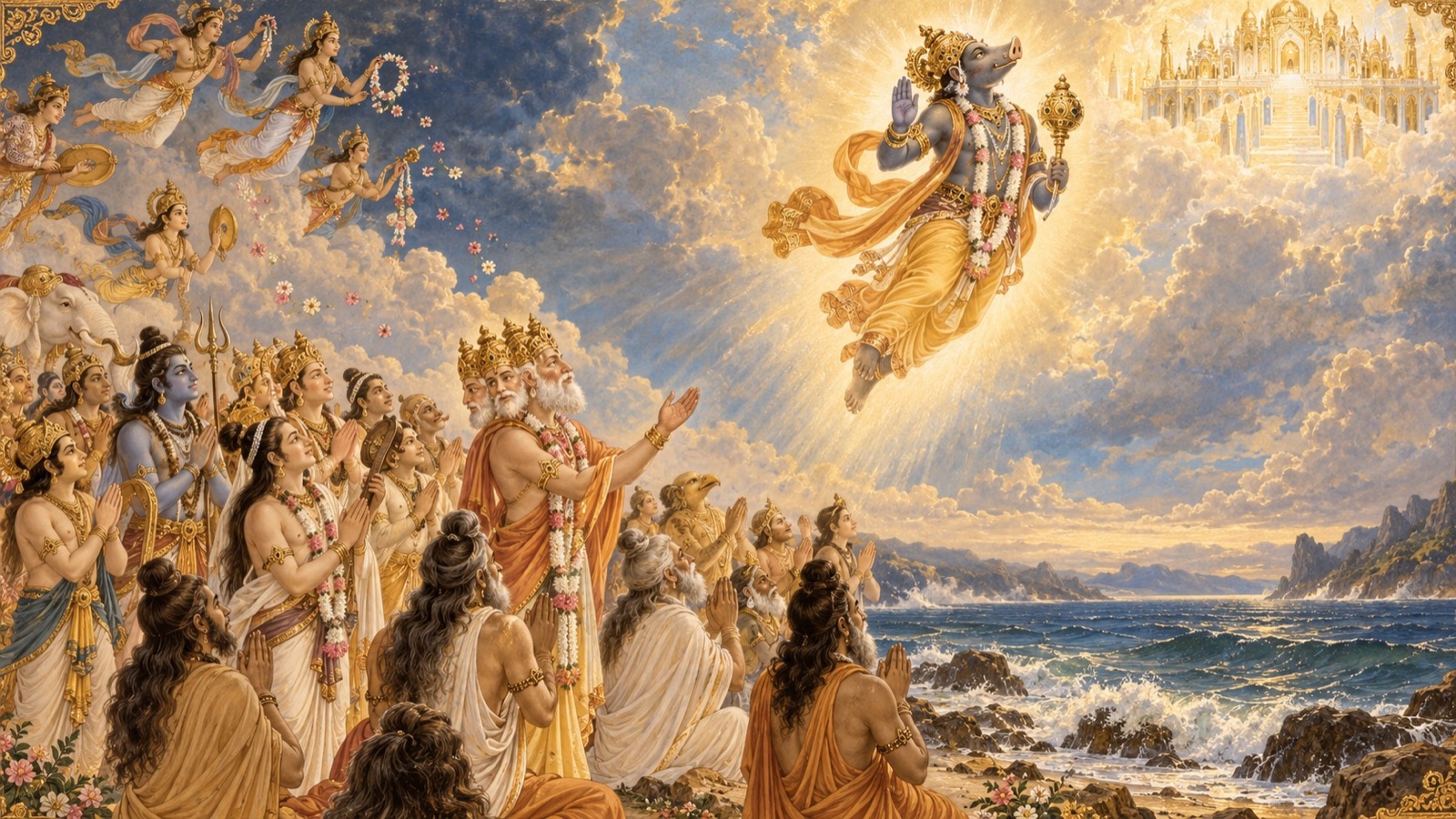
Having thus killed Hiranyaksa of irresistible prowess, Sri Hari, who had appeared in the form of the First Boar, retired to His own divine realm, the abode of uninterrupted joy, while Brahma and others extolled Him. (verse 31) Maitreya then closes his own telling: “I have narrated to you, as I was told by my preceptor, O good friend, the exploits of Sri Hari, and how that Hiranyaksa of mighty valour was knocked down by Him like a plaything in that great encounter.” (verse 32)
Suta’s Closing Words: The Fruit of Hearing This Story
Here the chapter takes its final, deliberate turn, stepping back from Maitreya and Vidura entirely to let Suta Gosvami speak once more to the sages of Naimisharanya about what this story is actually for.
Hearing the narrative as Maitreya told it, Vidura, a great devotee of the Lord, derived supreme delight. One rejoices to hear even the life-account of virtuous souls of sacred renown; there is no limit, then, to the joy of hearing the story of the Lord who bears the mark of Srivatsa. (verses 33–34) Suta recalls, too, how this same Lord once quickly delivered the lordly elephant who, seized by an alligator, fixed his mind on the Lord’s lotus-feet amid the cries of his terrified companions — a reference forward to the Bhagavatam’s own later, celebrated account of Gajendra’s rescue, offered here only as an example of how completely the Lord protects one who surrenders to Him. (verse 35)
एतन्महापुण्यमलं पवित्रं धन्यं यशस्यं पदमायुराशिषाम् । प्राणेन्द्रियाणां युधि शौर्यवर्धनं नारायणोऽन्ते गतिरङ्ग शृण्वताम् ॥ ३८ ॥
etan mahā-puṇyam alaṁ pavitraṁ dhanyaṁ yaśasyaṁ padam āyur-āśiṣām prāṇendriyāṇāṁ yudhi śaurya-vardhanaṁ nārāyaṇo ‘nte gatir aṅga śṛṇvatām
Meaning: This most sacred narrative confers extraordinary merit, purity, wealth, fame, longevity and every object of desire; on the field of battle it strengthens the vital organs and organs of action; and those who listen to it at the last moment of life find their asylum in Lord Narayana, O dear friend. (Canto 3, Chapter 19, verse 38)
What grateful soul, Suta asks, would not devote himself to such a Master — one so easily pleased by the guileless who resort to Him for protection alone, however difficult the unrighteous may find it to win His favour? One who listens to, sings, or even applauds this most wonderful pastime — the destruction of Hiranyaksa at the hands of the Lord who assumed a boar’s form to rescue the earth — is speedily and completely absolved even from the sin of killing a Brahmana. (verses 36–37) The chapter’s very last promise is its gentlest: that this narrative, carried in the heart even to one’s final hour, becomes itself a doorway into the presence of Narayana.
Principal Teachings of This Chapter
1. Even in conflict, dignity can be recognized across every boundary. The demon’s refusal to strike an unarmed foe, and the Lord’s evident regard for that restraint, shows that honorable conduct is honored by the text itself, regardless of who displays it (verses 3-5).
2. True mastery does not need to strain. The Lord’s playful handling of the demon’s mace — catching it “with the same ease as Garuda would seize a serpent” — illustrates a power so complete that it never needs to appear desperate or effortful (verses 9-12).
3. Illusion, however vast, is dispersed by a single act of clarity. The demon’s entire storm of maya — darkness, foul rain, phantom armies — collapses the instant the Sudarsana discus is discharged; no illusion, however elaborate, can withstand true clarity for long (verses 17-22).
4. A difficult death can be a doorway, not merely an ending. The sages’ astonished response to Hiranyaksa’s death — “who could meet such a blessed death!” — reframes his fall entirely: struck by the Lord’s own foot and gazing on His face, he departs in a state Yogis spend lifetimes seeking (verses 27-28).
5. Nothing is ever truly outside the Lord’s design. Brahma’s revelation that Hiranyaksa was, underneath, the Lord’s own eternal attendant returning home through a fixed path recasts the whole terrifying episode as part of a larger, compassionate plan (verse 29).
6. Gratitude, not triumph, is the proper response to deliverance. The gods do not gloat over a fallen enemy; they turn immediately to worship, recognizing their own peace as a gift of devotion to the Lord’s feet, not a victory of their own making (verse 30).
7. Simply hearing this story is itself a spiritual practice. Suta’s closing verses promise merit, purity, courage and, at life’s last moment, asylum in Narayana to anyone who listens with faith — the telling of the story is presented as inseparable from its own blessing (verses 33-38).
A Devotional Reflection
There is a particular grace in how this chapter chooses to end its violence. A demon who has terrorized the three worlds is not simply destroyed and forgotten; his death is witnessed by sages who call it blessed, explained by Brahma as a homecoming disguised as a downfall, and answered by gods who respond not with celebration of their enemy’s ruin but with hymns of gratitude to the One who set them free. Even Diti, the mother of this same demon, is granted a moment of the story’s tenderness — her unexplained grief a quiet reminder that no death, however necessary, passes without a ripple of sorrow somewhere in the world. And then, in its final turn, the chapter steps entirely outside the battle to make its real claim: that the true gift of this story is not the outcome of the fight at all, but the story itself, carried in the heart of anyone willing to listen.
A Daily Devotional Practice
Today, bring to mind a conflict or difficulty in your life — past or present — where you responded, or wish you had responded, with a moment of restraint or honor even toward someone who did not deserve it from you. Consider, as this chapter shows, that such restraint is never wasted; it is recognized, even when unseen, by something larger than the immediate contest. Then bring to mind, too, that even the fiercest storms of confusion in your own life — moments that feel as overwhelming as Hiranyaksa’s maya — dissolve the instant real clarity is invited in. Before you move on with your day, sit quietly for a few minutes and repeat softly: “Om Namo Bhagavate Vasudevaya.” Let it be, as it was for the demon in his final moment, a fixing of the mind on the one Presence that turns even an ending into a homecoming.
Conclusion
The nineteenth discourse of the Third Canto brings the Varaha–Hiranyaksa combat to its long-building close, and does so with a restraint that matches its subject. The demon’s fair play is honored before it is answered with greater power; his storm of illusion is met not with equal fury but with a single act of clarity; and his death, far from being lingered upon, is transfigured by the very sages who witness it into a blessed release — a homecoming for one of the Lord’s own eternal attendants, disguised for a time as an enemy of the worlds. The gods respond not with triumph but with worship, and the chapter’s final movement steps back from the battlefield altogether to make its deepest claim: that this story, simply heard with faith, carries within it merit, purity, and — at life’s last moment — a doorway into the presence of Narayana Himself.
May the divine wisdom of Srimad Bhagavatam awaken pure devotion within our hearts.
Om Namo Bhagavate Vasudevaya.
Jay Shree Madhav.
References and Attribution
- Primary edition: Gita Press, Śrīmad Bhāgavata Mahāpurāṇa (English, complete), Book Three, Discourse 19, pages 218–222.
- Series: Srimad Bhagavatam Wisdom · Biswa Sanatan Dharma Seva Trust.
- Presented following the spiritual guidance and recommendation of Pandit Dr. Shri Kashinath Mishra.
This is an original, faithful retelling in the writer’s own words, with brief quoted verses shown in Devanāgarī and transliteration and their meanings given as summaries. It is not a reproduction of any single publisher’s continuous translation or commentary. No affiliation with or endorsement by any publisher is implied.
Jay Shree Madhav