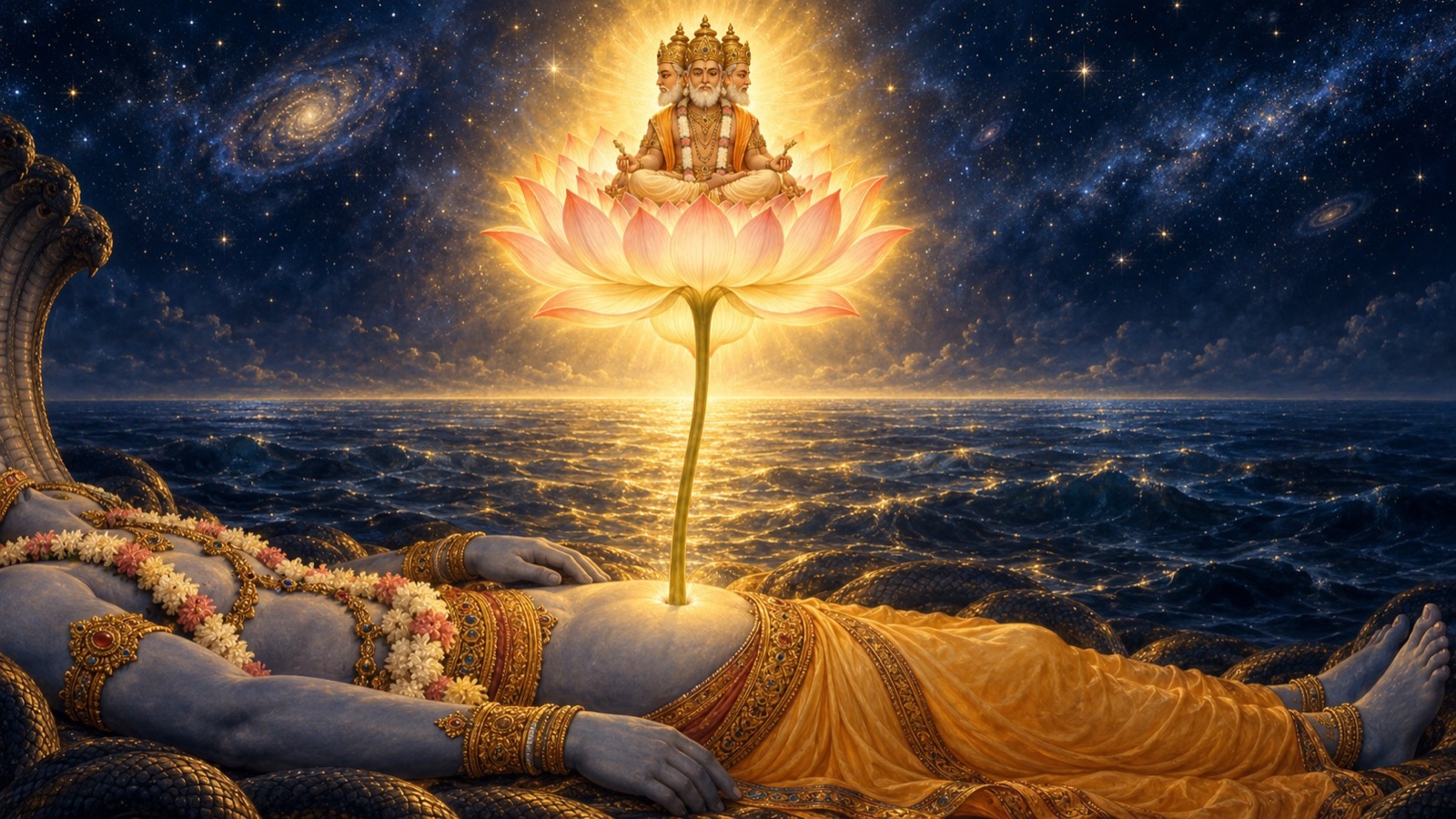
From the navel of the Lord, resting upon the waters of the causal ocean, springs a lotus of a thousand suns — and from that very lotus, self-born, emanates Brahma, the creator who will people the universe with every order of living being.
Om Namo Bhagavate Vasudevaya.
Om Namo Bhagavate Vasudevaya.
Om Namo Bhagavate Vasudevaya.
Welcome to Srimad Bhagavatam Wisdom, a devotional journey through the sacred histories and teachings of the Srimad Bhagavat Mahapurana. Having narrated in the previous chapter the death of the demon Hiranyaksha at the hands of the Lord’s boar incarnation, the sage Maitreya now turns, at Vidura’s request, to a question of a very different order: not how the Lord destroys evil, but how the whole living creation — gods, demons, sages, ancestors, celestial musicians, serpents, and finally the human race itself — first came into being. What unfolds is one of the most vivid and unusual chapters in the Third Canto: Brahma, the self-born creator, does not simply will each species into existence out of nothing. He evolves them, one after another, out of his own body and his own passing states of mind — his ignorance, his hunger, his shame, his sloth, his fear, his self-admiration, his exhaustion — and each discarded form is claimed and inhabited by the very beings it gives rise to. It is a strange and often startling account, worlds away from a tidy list of creation, and it ends on a note of quiet completion: with the birth of the Manus who would carry forward the human race, and the Rishis to whom Brahma gives, quite literally, a portion of himself.
Chapter Information
- Scripture: Śrīmad Bhāgavata Mahāpurāṇa
- Canto: 3 (Book Three)
- Chapter: 20 (Discourse 20)
- Chapter title: The various species of living beings created by Brahma
- Principal speaker: Maitreya, replying to Vidura’s question (the whole related, in the outermost frame, by Suta Gosvami to the sage Saunaka and the assembly at Naimisharanya)
- Principal listeners: Vidura, at the hermitage of Kusavarta (Haridwara); in the outer frame, Saunaka and the sages at Naimisharanya
- Main setting: The frame narration takes place at Kusavarta on the bank of the Ganga, where Vidura has come to meet Maitreya after leaving his brother Dhritarashtra’s court; the events described took place at the very dawn of creation, on the waters of the causal ocean and in the newly formed universe
- Central subject: Vidura’s question to Maitreya about how Brahma, acting on Svayambhuva Manu’s behalf, evolved the many species of living beings; Maitreya’s account of the formation of the cosmic egg and Brahma’s emanation from the Lord’s navel-lotus; and Brahma’s successive creation — from his own shifting bodies and states of mind — of Nescience, the Yaksas and Raksasas, the gods, the demons, the “evening twilight” and the Asuras’ infatuation with her, the Gandharvas and Apsaras, the Bhutas and Pisacas, the Sadhyas and Pitrs, the Siddhas and Vidyadharas, the Kimpurusas and Kinnaras, serpents and Nagas, the Manus, and finally the Rishis
- Principal verse range: Canto 3, Chapter 20, verses 1–53
- Primary edition: Gita Press Śrīmad Bhāgavata Mahāpurāṇa
Saunaka’s Question and the Return to Vidura’s Journey
The chapter opens not with Maitreya or Vidura at all, but with Saunaka, the sage presiding over the assembly at Naimisharanya, turning to Suta Gosvami with a question that reaches all the way back to the frame of the entire Canto.
Saunaka said: “Having secured a foothold in the shape of the earth, O son of Suta, what means did Svayambhuva Manu adopt for evolving the other creatures that were yet to see the light?” (verse 1)
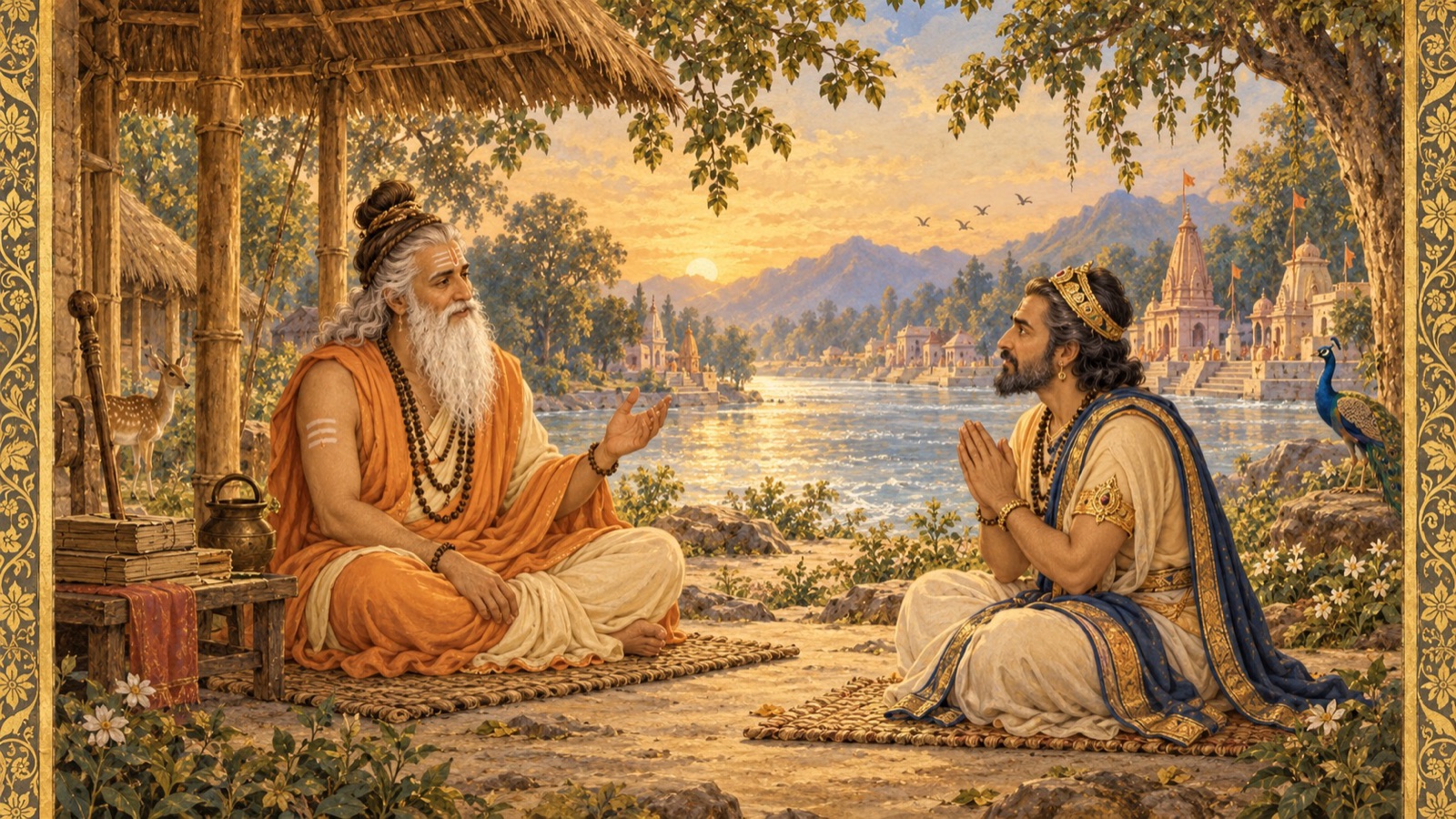
It is a small but telling detail of how the Bhagavatam is constructed — a many-layered conversation nested inside conversations, in which the outermost listeners periodically resurface to ask exactly the question the reader themselves might be holding. Saunaka goes on to remind the assembly, and us, of who Vidura was and why his testimony matters so much: a great devotee of the Lord and a devoted friend of Sri Krishna, so committed to that friendship that he abandoned his own elder brother Dhritarashtra and Dhritarashtra’s sons because of their offences against the Lord and His beloved Pandavas (verse 2). Born from the sage Dwaipayana Vedavyasa himself and in no way inferior to him in glory, Vidura had, after cleansing himself further at sacred places, sought out the sage Maitreya — the foremost among the knowers of Truth — at Kusavarta, on the banks of the Ganga at Haridwara (verses 3–4). Saunaka asks Suta to relate what passed between them, certain that their conversation must have carried sacred stories of the Lord’s lotus-feet, as purifying as the waters of the Ganga that themselves flow from those same feet (verse 5). “What man who has his aesthetic sense developed,” he asks, “would feel sated with drinking in the nectar-like stories of Sri Hari’s pastimes?” (verse 6)
Suta, questioned thus, fixes his mind on the Lord and simply says, “Listen!” (verse 7) He reminds the assembly that Vidura, having just heard the story of the Lord’s boar incarnation lifting the earth from the ocean and slaying Hiranyaksha, was delighted, and turned to Maitreya with a fresh question of his own (verse 8).
Vidura’s Question: How Did Brahma Create the Living Beings?
Vidura’s question, when it comes, is precise and almost technical in its curiosity — he wants to understand the mechanics of creation itself.
Vidura said: “Knowing as you do things unperceived by us, tell me, O holy sage, what Brahma, the lord of Prajapatis, did for the purpose of creating living beings after evolving the Prajapatis, the lords of created beings. How did the sage Marichi and the other Brahmanas, as well as Svayambhuva Manu, evolve the creation in obedience to Brahma’s command? Did they evolve it in conjunction with their wives, or remaining independent in their action, or did they all jointly produce it?” (verses 9–11)
The question sets up the whole of what follows: not a philosophical discourse on the nature of creation in the abstract, but a direct, almost narrative account of what Brahma actually did, step by step, being by being.
The Cosmic Egg and the Lord’s Entry Into It
Maitreya’s reply begins at the very root of things, before Brahma himself yet existed.
Maitreya replied: When the equilibrium of the three Gunas constituting Prakriti was disturbed through the working of Prarabdha — the destiny of the Jivas, difficult as it is to comprehend — the Mahat-tattva, the principle of cosmic intelligence, was evolved through the Supreme Spirit’s presiding over Prakriti and Time, and through mere proximity to the Lord. From the Mahat-tattva, in which the element of Rajas predominates, was evolved the Ego, itself of three kinds; and the Ego in its turn evolved the five gross elements and their accompanying groups of five principles. (verses 12–13)
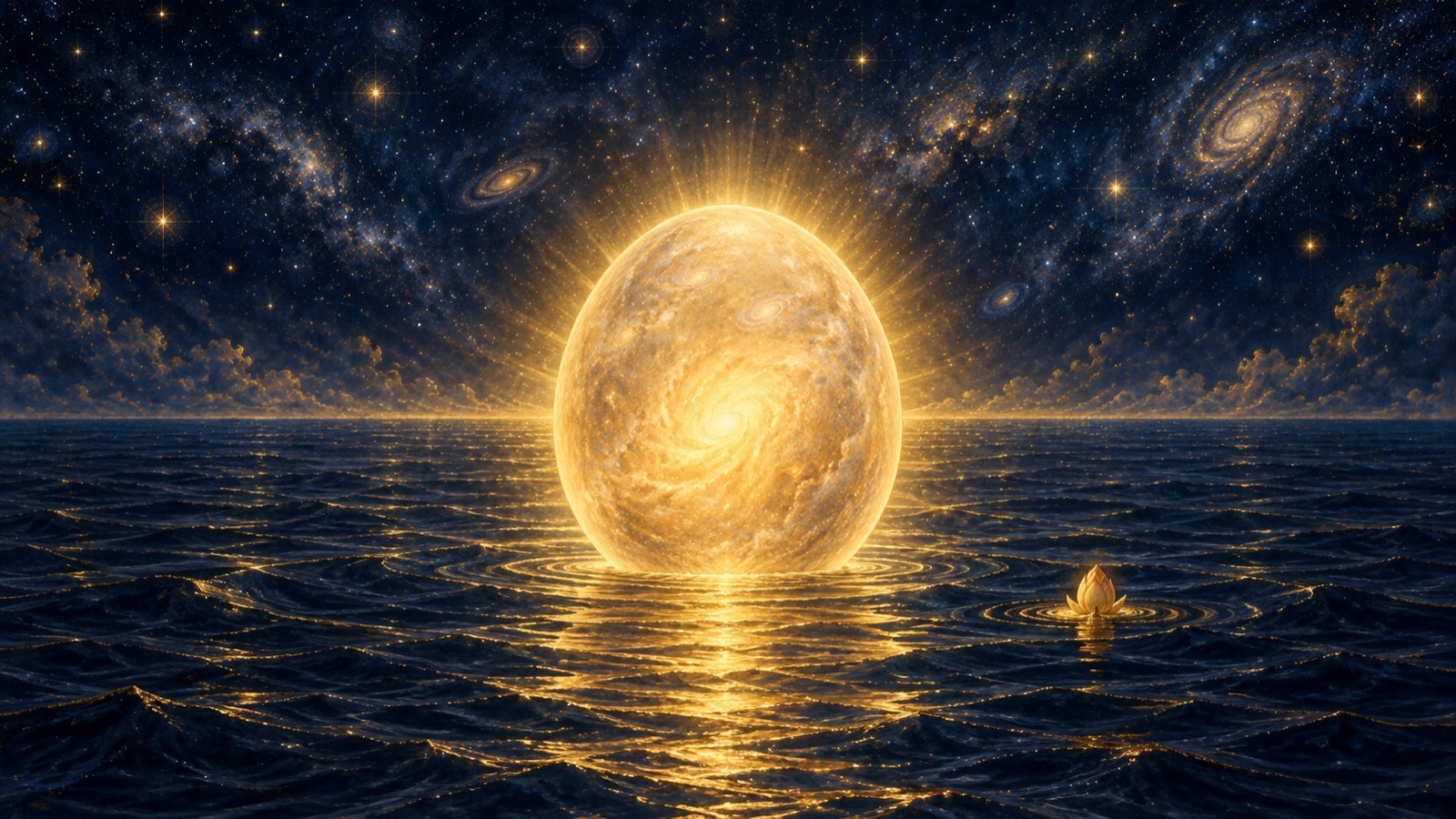
Individually, none of these principles could produce the material universe. It was only when they combined, with the help of the Lord’s own divine energy, that they were able to evolve a single shining egg (verse 14). For over a thousand years that egg lay lifeless upon the waters of the causal ocean — until the Lord Himself entered it, as its presiding Deity (verse 15).
तस्य नाभेरभूत्पद्मं सहस्रार्कोरुदीधिति । सर्वजीवनिकायौको यत्र स्वयमभूत्स्वराट् ॥ १६ ॥
tasya nābher abhūt padmaṁ sahasrārkoru-dīdhiti sarva-jīvanikāyauko yatra svayam abhūt svarāṭ
Meaning: From the navel of the Lord — as He presided over the egg — sprang a lotus possessing the dazzling splendour of a thousand suns and intended to be the abode of all living beings; Brahma himself, the self-manifest one, emanated from that very lotus. (Canto 3, Chapter 20, verse 16)
This single verse contains one of the most enduring images in the entire Bhagavata Purana: the Lord, reclining upon the causal waters, gives rise from His own navel to the lotus that becomes both the seat and the source of Brahma, the being who will now carry the work of creation forward. Everything that follows in this chapter — every god, demon, sage, and creature — traces its lineage back to this single moment.
Nescience, and the Birth of the Yaksas and Raksasas
Once the Lord has entered his heart as the Inner Controller, Brahma begins creating the hierarchy of the worlds according to the plan of the preceding Kalpas (verse 17).
There is a deeper point folded into this single verse that a Vaishnava reading of the chapter draws out directly. Brahma’s capacity to create is not, in the end, something he possesses in his own right — it becomes available to him only once the Lord, reclining as the presiding Deity of the cosmic waters, enters his heart and awakens his intelligence (verse 17). The same truth resurfaces later in this very chapter in a more dramatic key: when Brahma is cornered by his own children and cannot save himself by any resourcefulness of his own, it is not his creative power but the Lord’s simple word — “cast off this impure body” — that actually resolves the danger (verses 25–28). Read together, the two moments make the same point from opposite directions: the one who creates the universe and the one who is powerless before it are shown to be the same person, because the real doer, seated within, has only ever lent Brahma the intelligence and the occasion to act. Even the architect of the cosmos, in other words, is himself a dependent instrument of the Lord he serves.
But his very first act of creation is not a being of light — it is his own shadow, his own ignorance, from which he evolves the five varieties of Avidya: Tamisra, Andhatamisra, Tamas, Moha, and Mahamoha (verse 18).
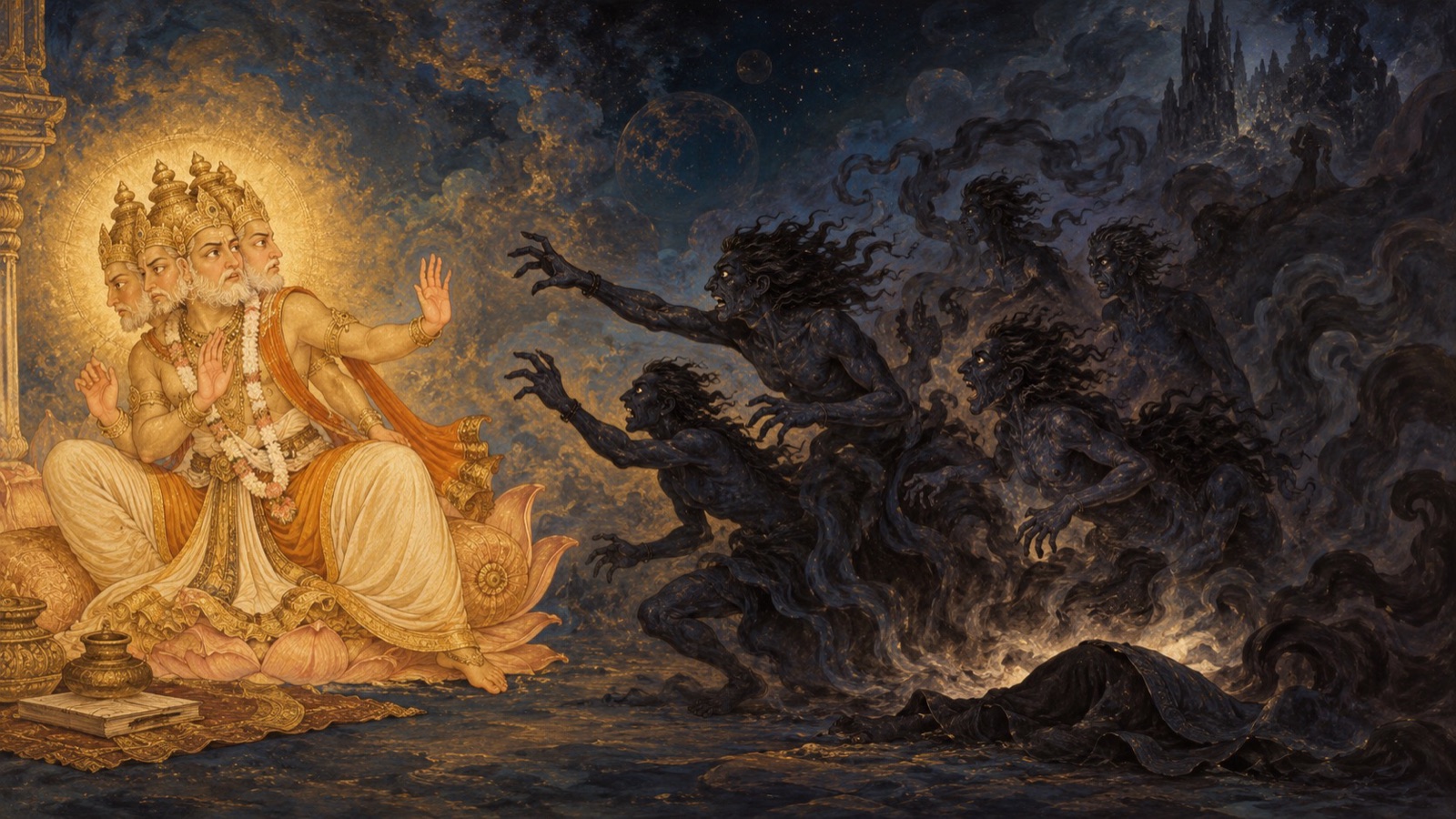
Brahma, disliking this dark, shadow-body he had made, threw it off — and the Yaksas and Raksasas, who had sprung from it, took possession of that discarded form, which continues in the world as night, and as the source of hunger and thirst (verse 19). Almost immediately, overpowered by that very hunger and thirst, they turned on their own creator, crying out to devour him from every side: “Spare him not — eat him up!” (verse 20). Brahma, frightened by this sudden turn, pleaded with them: “Pray, eat me not; but spare me. For you have all been born as sons to me, O Yakshas and Rakshasas!” (verse 21)
It is a startling scene precisely because of how unguarded it is — the creator of the universe, terrified of his own newest children, begging for mercy from beings who, moments before, did not exist at all. The chapter offers, almost in passing, the origin of the two names themselves: those who cried “eat him up” (jakṣata) became known as Yakshas, and those who cried “spare him” (rakṣata) became the Rakshasas.
The Gods, and the Demons Born from Weariness
From that unsettling beginning, Brahma moves to gentler creations. Shining with his own glory, he brought forth, before all others, the divinities in whom the quality of Sattva, or goodness, predominated; and when he dropped the effulgent form from which they had come — the form that now became daytime itself — the gods took joyful possession of it (verse 22).
But the very next creation turns dark again. From his hinder parts, Brahma evolved the demons, beings excessively fond of women, and being intensely lustful, they came up to him for copulation (verse 23). Brahma, at first, simply laughed at their foolishness — but when the shameless Asuras pressed close upon him, his laughter turned to indignation, and then to fear, and he fled from them in great haste (verse 24).
Brahma’s Flight to the Lord, and the Casting Off of the Impure Body
Fleeing his own creation, Brahma approached Sri Hari — the Bestower of boons, who dispels the agony of those who run to Him for succour, and who reveals Himself in whatever form answers His devotee’s need (verse 25).
“Protect me, O Supreme Spirit!” Brahma cried. “I created these beings as directed by You, but these sinful creatures are out to copulate with me, my Lord. You are the only one capable of ending the affliction of distressed people, as also the one inflicting agony on those who never resort to Your feet.” (verses 26–27)
पाहि मां परमात्मंस्ते प्रेषणेनासृजं प्रजा: । ता इमा यभितुं पापा उपाक्रामन्ति मां प्रभो ॥ २६ ॥
pāhi māṁ paramātmaṁs te preṣaṇenāsṛjaṁ prajāḥ tā imā yabhituṁ pāpā upākrāmanti māṁ prabho
Meaning: “Protect me, O Supreme Spirit! I created these beings at Your bidding, but these sinful creatures are approaching to violate me, my Lord.” (Canto 3, Chapter 20, verse 26)
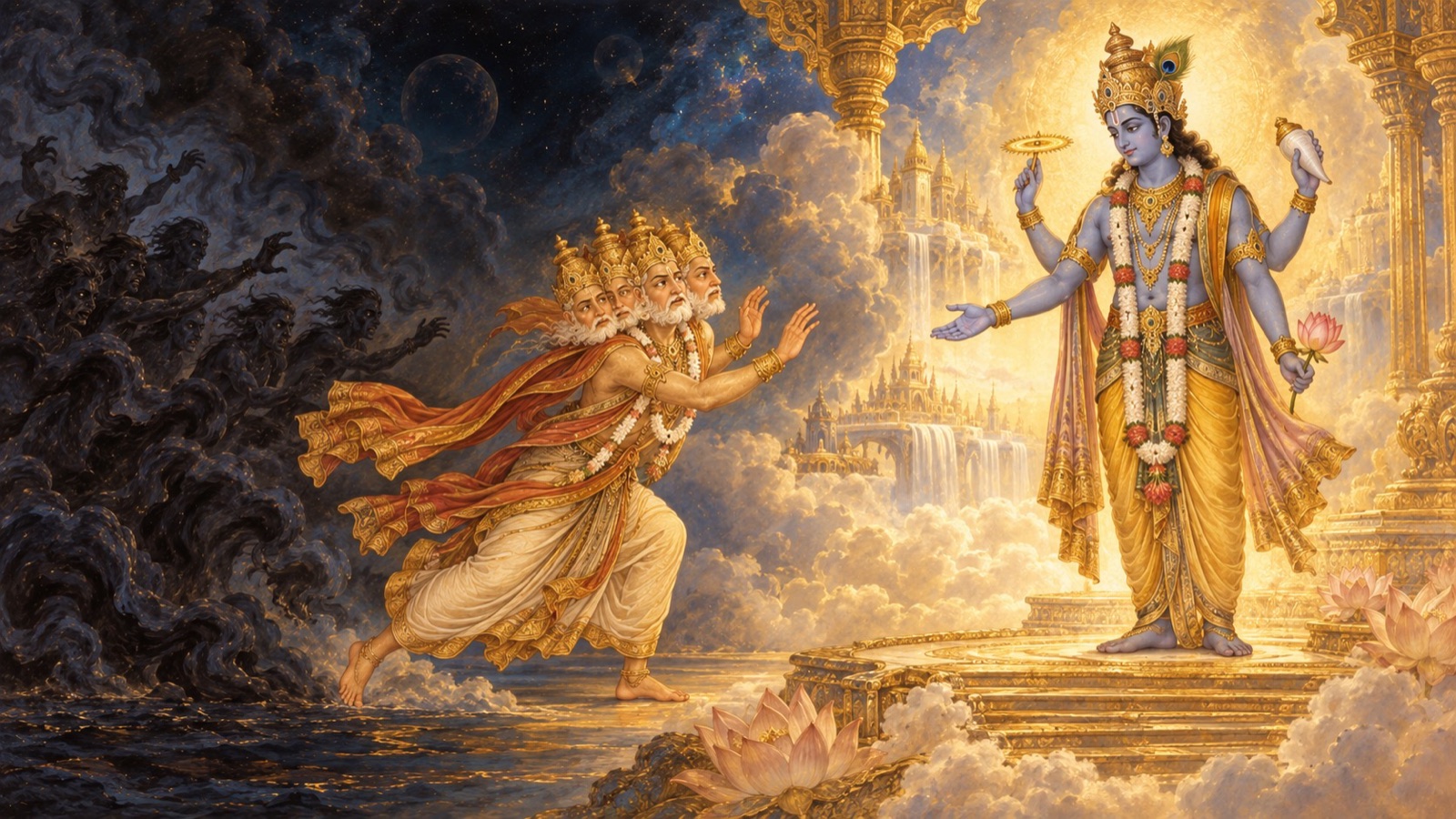
The Lord, who sees clearly into the minds of others, perceives Brahma’s distress and gives him simple counsel: “Cast off this impure body of yours” — impure, the text explains, because it had produced the libidinous Asuras and excited their passion. Brahma does exactly as told (verse 28).
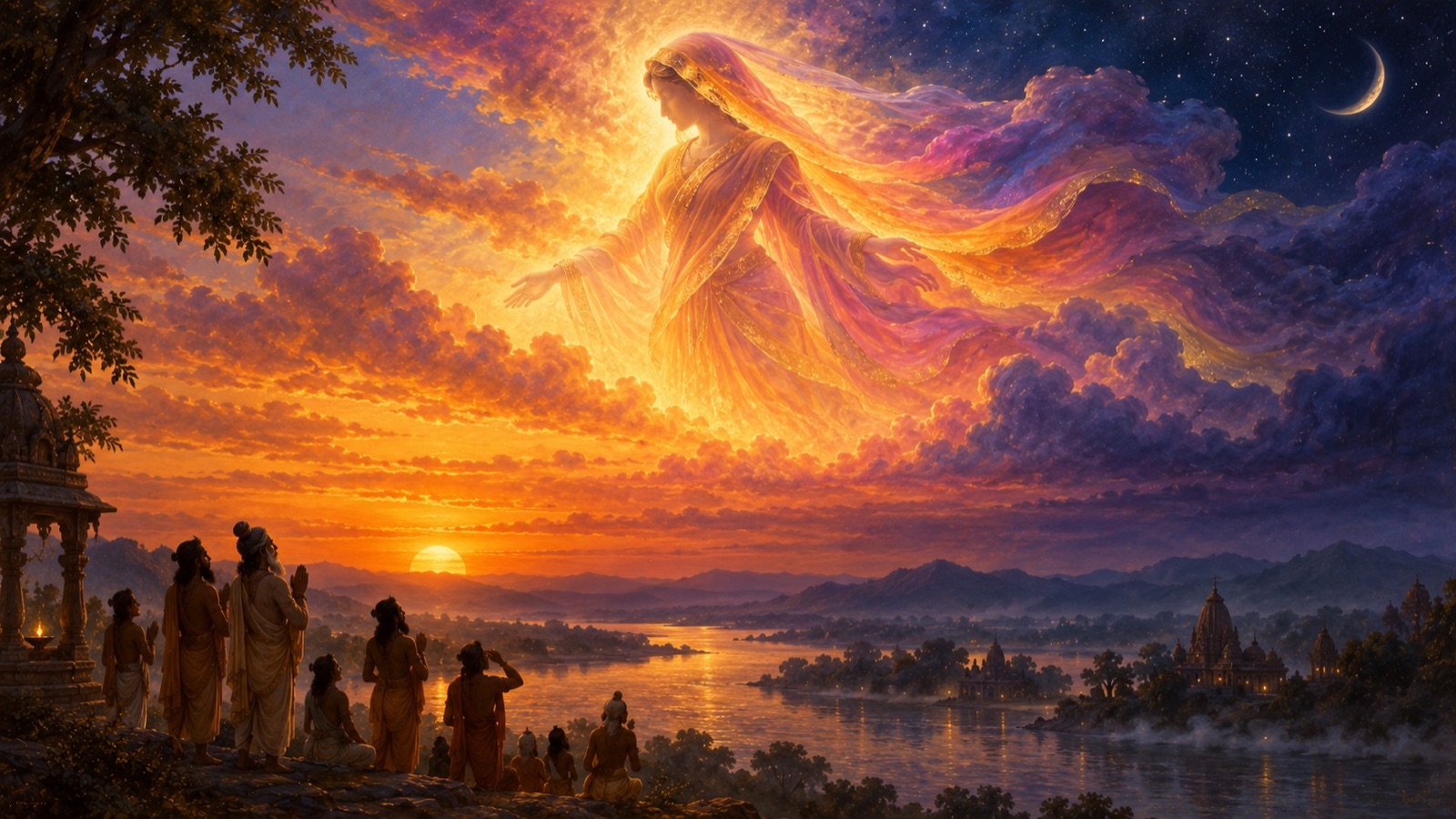
What happens to that discarded body is one of the most striking passages in the chapter. It takes the form of the evening twilight, the meeting-point of day and night, a time that has always been associated with the kindling of passion — and the Asuras, dominated as they are by the quality of Rajas, mistake this twilight for a beautiful young woman: adorned, graceful, and inviting (verses 29–32). Overcome, the Asuras approach her with foolish, flattering questions — who is she, whose daughter, why has she come, and would she braid her hair for them — and in their confusion, they seize hold of the evening twilight itself, believing they have caught hold of a woman (verses 33–37).
The episode is best understood, and is presented by the tradition itself, not as a literal narrative about desire fulfilled but as a vivid personification: the natural world — twilight, day, night, sleep, dreams — is shown here as arising, quite literally, from Brahma’s own passing states of being, each claimed by the very order of creature suited to it. It illustrates, in the boldest possible terms, how thoroughly the created world is said to be an extension of the creator’s own nature, its most mysterious hours no less than its most luminous ones.
Gandharvas, Apsaras, Bhutas, Pisacas, and the Ancestors
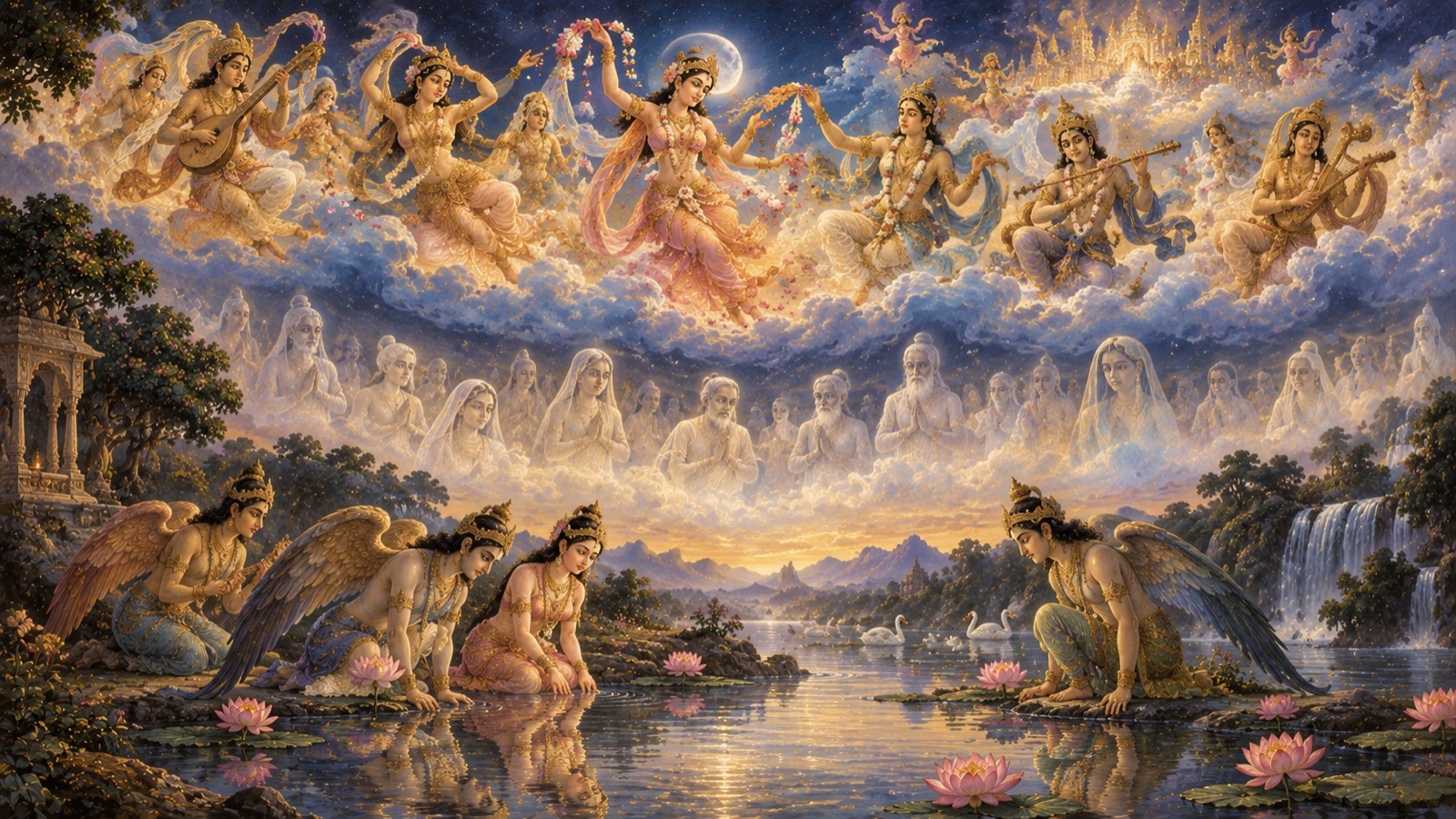
With the darker creations behind him, Brahma turns to more luminous ones. With a laugh full of deep significance, he evolved, by his own loveliness, the hosts of the Gandharvas — the celestial musicians — and the Apsaras, the dancing girls of heaven; and when he set aside that shining, moonlit form, Vishvavasu and the other Gandharvas gladly took possession of it (verses 38–39).
Next, out of his own sloth, Brahma evolved the Bhutas, or ghosts, and the Pisacas, or fiends — closing his eyes, the Bhagavatam notes, when he saw them standing naked with their hair dishevelled. That discarded body, in the form of a yawn, became sleep itself, the very state that causes living beings to eject saliva from the mouth; and it is these same Bhutas and Pisacas, the chapter explains, who are said to attack those left impure by that state — an attack known, in this telling, as insanity (verses 40–41).
Then, recognizing himself as full of vigour and energy, Brahma evolved from his invisible form the Sadhyas and the Pitrs — the ancestors — and it is through the medium of that same invisible body that those versed in ritual continue to offer oblations to the Sadhyas and the Pitrs during Sraddha and similar rites (verses 42–43). By his own faculty of remaining hidden from view, he evolved the Siddhas and the Vidyadharas, giving them the marvellous form called Antardhana (verse 44). And one day, beholding his own reflection in water and admiring it, he evolved the Kimpurusas and the Kinnaras out of that very reflection — beings who, to this day, are said to sing Brahma’s praises together with their spouses at the break of every dawn (verses 45–46).
Finally, one day, Brahma lay stretched out at full length, weighed down by concern that his work of creation had not proceeded as it should, and in that sullen mood he shed yet another body. The hair that dropped from it became serpents; and as the body itself crawled along, with its hands and feet contracted, ferocious serpents and Nagas sprang from it, their necks dilated in the form of a hood (verses 47–48).
The Manus and the Rishis: Creation Reaches Its Fullness
It is only after this long, strange, deeply personal sequence of creations that Brahma arrives at what the chapter frames as the true completion of his work.
One day, Brahma felt as though the object of his life had at last been accomplished, and at that time — last of all — he evolved the Manus, who promote the welfare of the world, out of his own mind (verse 49). To them he gave his own human form; and those beings created earlier — the gods, the Gandharvas, and the rest — on seeing the Manus, applauded Brahma warmly: “Oh, creator of the universe! We are glad that what you have produced is well done. Since all ritual acts have now been placed on a sound footing in this human form, we shall all share the sacrificial oblations along with it.” (verses 50–51)
There is something quietly moving in this moment of applause. After the fear, the flight, the shame, and the many strange births that came before it, it is the human form — evolved from Brahma’s own mind, at the very point when he sensed his purpose fulfilled — that draws genuine celebration from the beings already created. It is presented here not as an afterthought in the order of creation but as its culmination, the form through which the whole apparatus of ritual, sacrifice, and worship first becomes properly established in the world.
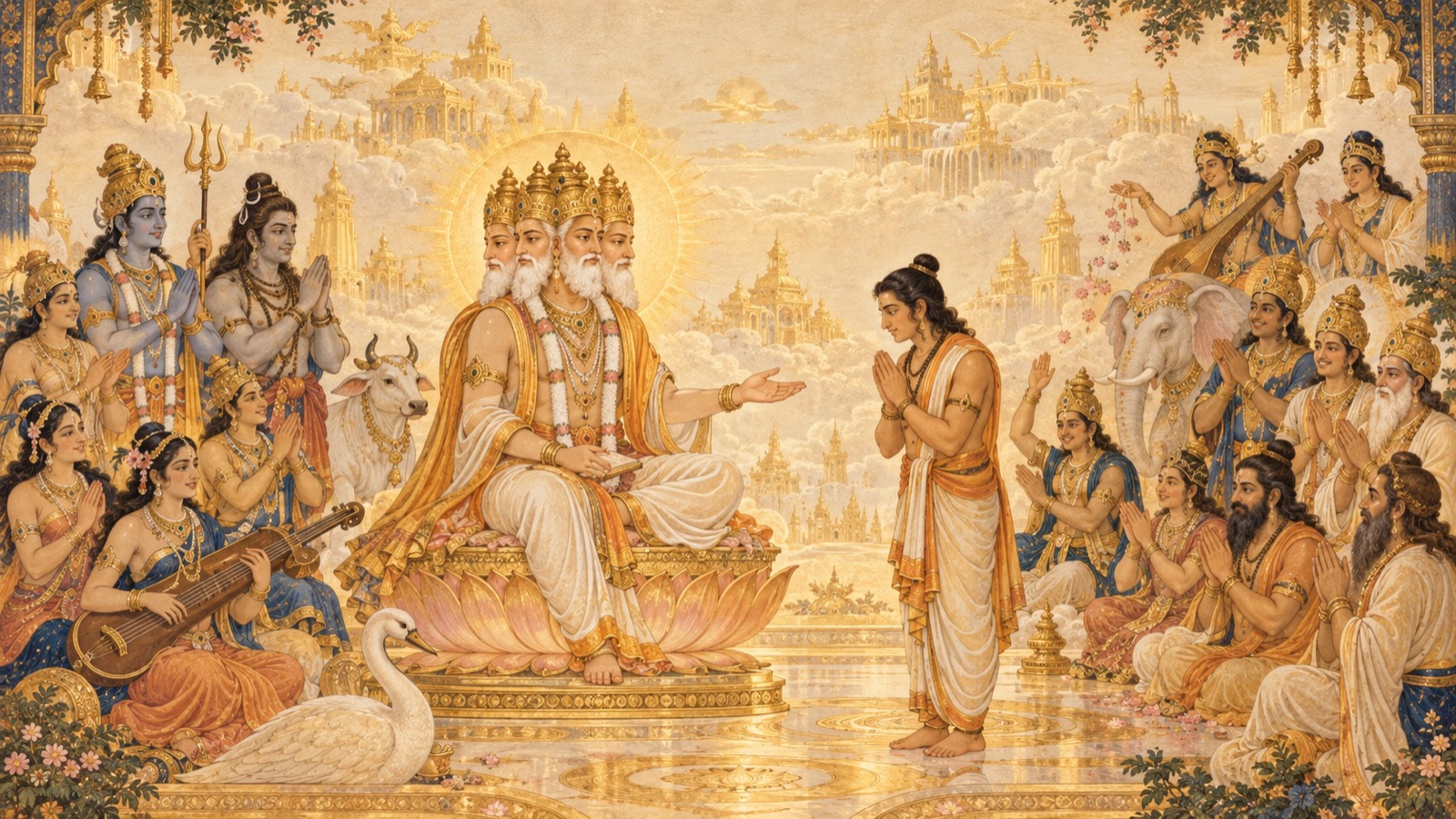
The chapter’s final act belongs to the sages. Having equipped himself with austere penance, adoration, Yoga, and deep meditation, and having mastered his own senses, Brahma — the first seer — evolved the Rishis, his own beloved sons (verse 52). And to each one of them, the unborn creator gave a part of his own very body, a portion marked by deep meditation, concentration of mind, supernatural power, austerity, adoration, and dispassion (verse 53).
तेभ्यश्चैकैकश: स्वस्य देहस्यांशमदादज: । यत्तत्समाधियोगर्द्धितपोविद्याविरक्तिमत् ॥ ५३ ॥
tebhyaś caikaikaśaḥ svasya dehasyāṁśam adād ajaḥ yat tat samādhi-yogarddhi- tapo-vidyā-viraktimat
Meaning: To each of them, the unborn creator gave a portion of his own body — that very portion marked by deep meditation, mystic power, austerity, knowledge, and dispassion. (Canto 3, Chapter 20, verse 53)
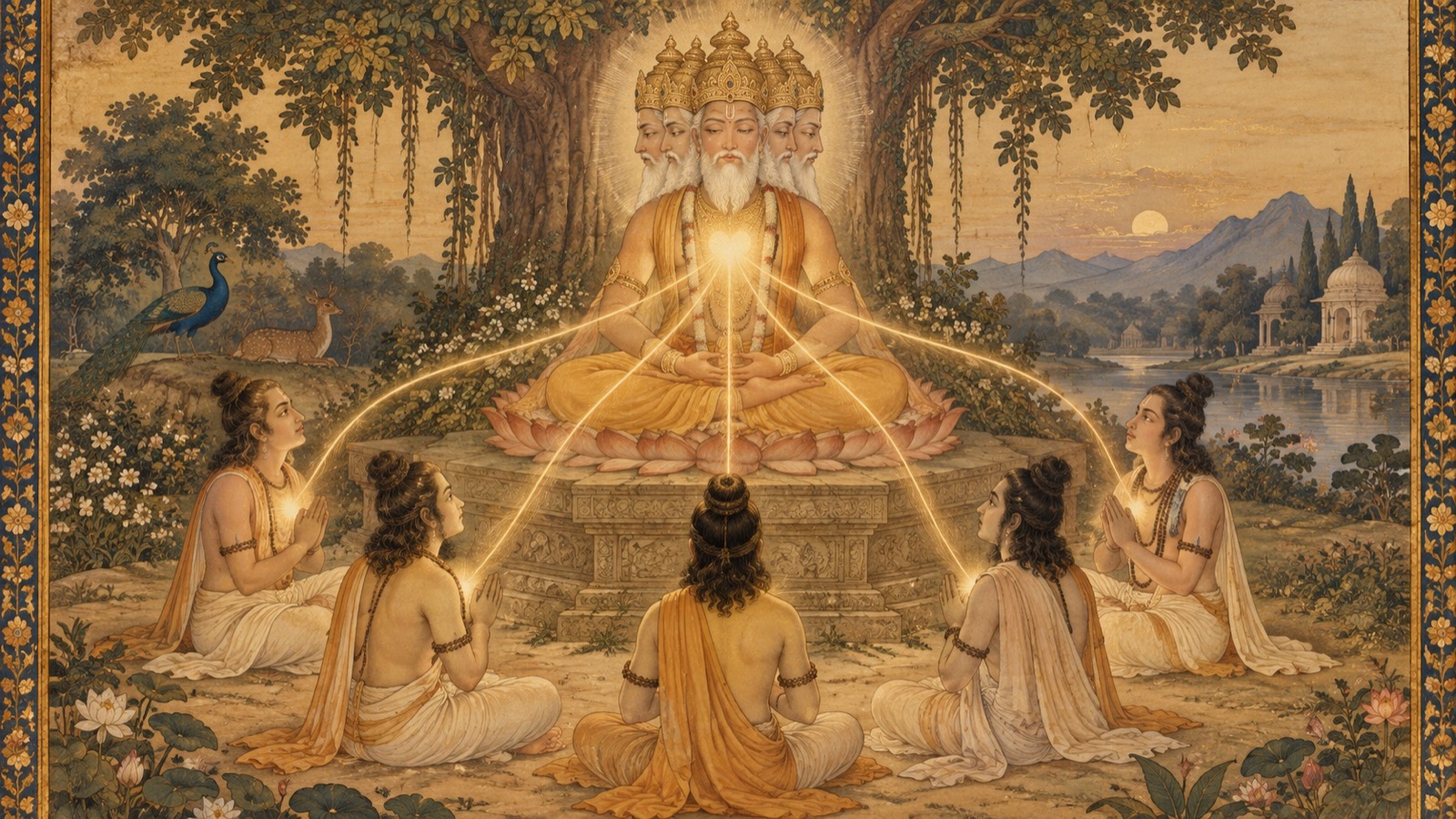
With this act, the chapter closes. There is no grand colophon of drama here, no cliffhanger of the kind that ended the two preceding chapters — only the quiet, deliberate completion of a vast project, verse by verse, being by being, until the whole hierarchy of creation, from the darkest of demons to the wisest of sages, has found its place in the world.
Principal Teachings of This Chapter
1. Creation, in this account, is intimate rather than mechanical. Brahma does not summon each species from nothing by an act of detached will; every order of being arises from something genuinely his own — his shadow, his hunger, his shame, his loveliness, his sloth, his reflection, his mind — suggesting that the created world carries, quite literally, the imprint of its creator’s own nature (verses 17-53).
2. Even the creator is not exempt from fear and vulnerability. Brahma is shown fleeing his own children twice in this chapter — once from the Yakshas and Rakshasas who wish to devour him, and once from the lustful demons — a reminder that power over creation does not place one beyond the reach of its consequences (verses 20-21, 23-24).
3. Genuine refuge is found only in surrender to the Lord. When Brahma cannot resolve his own predicament, his response is not to fight or to reason his way out but to run directly to Sri Hari and ask for protection — and it is the Lord’s simple counsel, not any power of Brahma’s own, that resolves the crisis (verses 25-28).
4. What is cast aside does not vanish — it becomes something else, and belongs to someone. Every discarded body in this chapter is claimed and inhabited by the beings born from it: night by the Yakshas and Rakshasas, daytime by the gods, twilight by the deluded Asuras, sleep by the Bhutas and Pisacas. Nothing in this account of creation is wasted; everything continues in another form.
5. The human form is presented as creation’s fulfillment, not merely one species among many. It is only with the birth of the Manus, evolved from Brahma’s own mind at the moment he senses his purpose accomplished, that the wider community of already-created beings offers its applause — signaling the special place given to the human form as the vehicle through which sacrifice and worship become properly established (verses 49-51).
6. Wisdom and dispassion are described as a literal inheritance, not merely a teaching. The Rishis do not simply learn meditation, austerity, and detachment from Brahma — they are given, the Bhagavatam says, an actual portion of his own body characterized by exactly those qualities, suggesting that the capacity for such realization is, in a real sense, something we already carry within us (verse 53).
A Devotional Reflection
There is something quietly consoling in the sheer honesty of this chapter. Brahma, the very architect of the universe, is shown here not as an untouchable, all-controlling figure but as someone who stumbles, who is frightened by what he has made, who flees, who pleads for help, and who only finds his footing again by turning, without embarrassment, to the Lord. If the creator of all things needed that kind of refuge at the very dawn of the universe, there is a certain freedom in recognizing that our own moments of fear or confusion do not disqualify us from a similar turning. And there is a deeper comfort still in the chapter’s closing image: that the very qualities of meditation, austerity, and detachment which the Rishis embody were not achievements they built from nothing, but a portion of the creator’s own being, given to them outright. Whatever stillness or wisdom we ourselves manage to cultivate may, in that same spirit, be understood less as something invented and more as something remembered — a portion of a larger inheritance, waiting to be lived out.
A Daily Devotional Practice
Today, take a few quiet moments to consider one part of yourself that you have been tempted to see only as a flaw — a fear, a weariness, an old shame — and ask, gently, whether it might also be the raw material of something you have not yet allowed it to become. Brahma’s own shadow gave rise to the night; his own sloth gave rise to sleep; nothing in him was simply discarded without purpose. Sit quietly for a few minutes, breathe slowly, and repeat softly: “Om Namo Bhagavate Vasudevaya.” Offer to the Lord whichever part of yourself feels most in need of transformation, and trust, as Brahma himself was made to learn in this very chapter, that true refuge and true renewal are found only by turning toward Him.
Conclusion
The twentieth discourse of the Third Canto answers Vidura’s question about the origin of the many species of living beings with an account unlike any conventional creation narrative — not a single grand design unfolding smoothly from a divine plan, but a long, often startling sequence of Brahma’s own bodies and states of mind, each cast off and each claimed in turn by the very order of being fitted to it. From the terrifying Yakshas and Rakshasas born of his shadow, to the gods born of his glory, to the demons born of his weariness, to the Gandharvas, Apsaras, Bhutas, Pisacas, ancestors, Siddhas, Vidyadharas, Kimpurusas, Kinnaras, serpents and Nagas that follow, the chapter builds steadily toward its true culmination: the Manus, born last of all from Brahma’s own mind in the very hour his long labor felt complete, and the Rishis, to whom Brahma gives, quite literally, a living portion of himself. Vidura set out simply to understand how creation had unfolded; what Maitreya gives him instead is a portrait of a creator who is himself deeply and personally implicated in everything he brings into being — and who, when overwhelmed by his own creation, finds his own refuge exactly where every being in this chapter is ultimately shown to belong: at the feet of the Lord.
May the divine wisdom of Srimad Bhagavatam awaken pure devotion within our hearts.
Om Namo Bhagavate Vasudevaya.
Jay Shree Madhav.
References and Attribution
- Primary edition: Gita Press, Śrīmad Bhāgavata Mahāpurāṇa (English, complete), Book Three, Discourse 20, pages 222–227.
- Series: Srimad Bhagavatam Wisdom · Biswa Sanatan Dharma Seva Trust.
- Presented following the spiritual guidance and recommendation of Pandit Dr. Shri Kashinath Mishra.
This is an original, faithful retelling in the writer’s own words, with brief quoted verses shown in Devanāgarī and transliteration and their meanings given as summaries. It is not a reproduction of any single publisher’s continuous translation or commentary. No affiliation with or endorsement by any publisher is implied.
Jay Shree Madhav