In a single sweeping breath, Uddhava carries Vidura across an entire lifetime of the Lord’s glory — from a tyrant’s fall in Mathura to a battlefield of eighteen armies, from a stolen celestial tree to sixteen thousand rescued brides — and closes, quietly, on the seed of a curse that will one day end it all.
Om Namo Bhagavate Vasudevaya.
Om Namo Bhagavate Vasudevaya.
Om Namo Bhagavate Vasudevaya.
Welcome to Srimad Bhagavatam Wisdom, a devotional journey through the sacred histories and teachings of the Srimad Bhagavat Mahapurana. Uddhava’s narration to Vidura, begun in the previous chapter with the Lord’s Vrindavan childhood, now quickens its pace. In this third discourse of Book Three, Uddhava races through the middle decades of the Lord’s earthly life — decades that other parts of the Bhagavatam will later unfold verse by verse, chapter by chapter, in the Tenth Canto’s full glory. Here they are compressed into twenty-eight verses: Kamsa’s death, a guru’s blessing repaid with a resurrected son, marriages won by strength and by the Lord’s grace, a jealous god’s fury over a stolen tree, an entire city of imprisoned princesses set free and married in a single hour, the thunder of the Mahabharata war, a kingdom’s peaceful restoration, and finally — almost in passing, like a shadow crossing a sunlit court — the first hint of a curse that will one day bring the whole Yadu dynasty to its close. This is a chapter built for momentum, not lingering; and yet, read slowly, its compressed lines open into some of the most remarkable episodes in the entire scripture.
Chapter Information
- Scripture: Śrīmad Bhāgavata Mahāpurāṇa
- Canto: 3 (Book Three)
- Chapter: 3 (Discourse 3)
- Chapter title: A brief survey of the Lord’s other exploits
- Principal speaker: Uddhava, continuing his address to Vidura — the whole related by Sukadeva Gosvami to King Parikshit, and by Suta Gosvami to the sage Saunaka and the assembly at Naimisharanya
- Principal listener: Vidura
- Main setting: The bank of the river Yamuna, within Uddhava’s ongoing reply to Vidura’s questions about the welfare of the Yadu and Pandava households
- Central subject: A rapid survey of the Lord Sri Krishna’s exploits from His return to Mathura through the Mahabharata war and His years at Dvaraka, closing with the sages’ curse at Prabhasa that foreshadows the Yadus’ end
- Principal verse range: Canto 3, Chapter 3, verses 1–28
- Primary edition: Gita Press Śrīmad Bhāgavata Mahāpurāṇa
The Fall of Kamsa and the Debt Repaid to a Guru
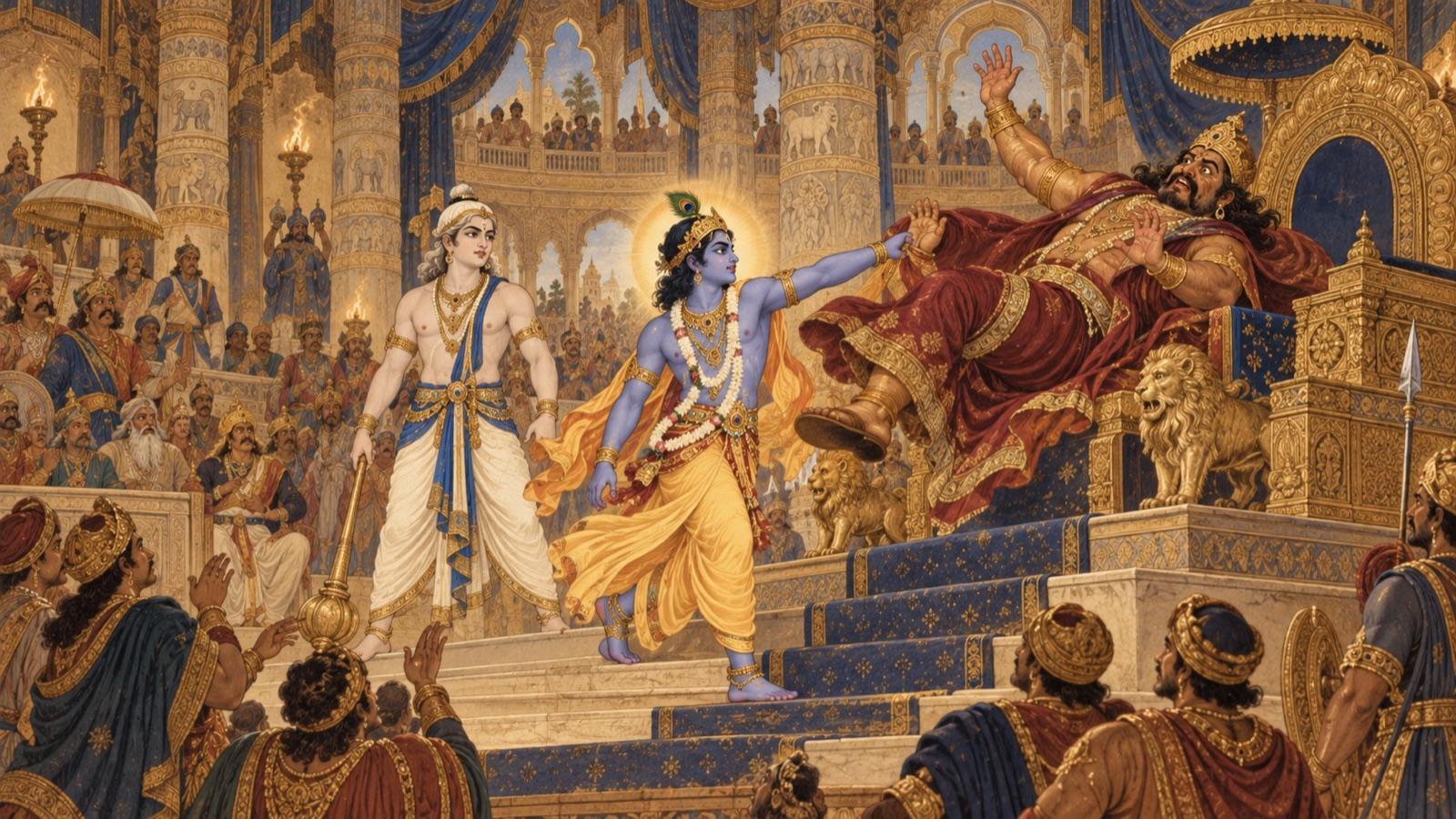
Uddhava picks up the thread exactly where the previous chapter left it: the Lord and Baladeva have just left Vrindavan behind. Now, to bring joy to Vasudeva and Devaki — the parents who had never once been allowed to raise Him — the Lord returns to Mathura, confronts Kamsa, the leader of His enemies, on his own high seat, throws him down, and kills him, dragging the tyrant’s lifeless body along the ground before the eyes of the city he had terrorized for years.
तत: स आगत्य पुरं स्वपित्रो-श्चिकीर्षया शं बलदेवसंयुत: । निपात्य तुङ्गाद्रिपुयूथनाथं हतं व्यकर्षद् व्यसुमोजसोर्व्याम् ॥ १ ॥
tataḥ sa āgatya puraṁ sva-pitros cikīrṣayā śaṁ baladeva-saṁyutaḥ nipātya tuṅgād ripu-yūtha-nātham hataṁ vyakarṣad vyasum ojasorvyām
Meaning: Thereafter, in order to give happiness to His own parents, the Lord returned to the city, accompanied by Baladeva, and knocking down the leader of His enemies from his high seat and killing him, dragged his lifeless body along the ground. (Canto 3, Chapter 3, verse 1)
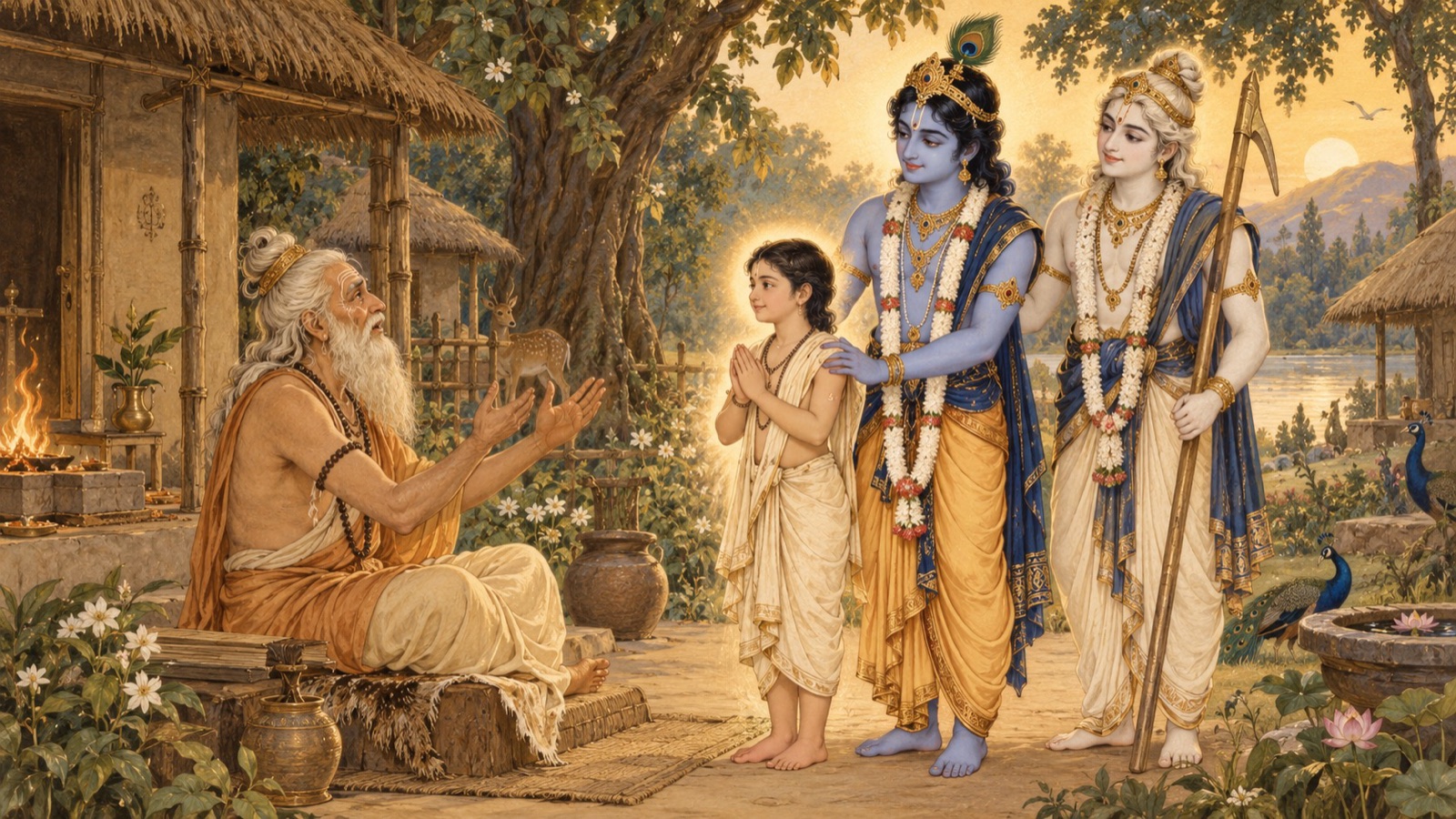
Uddhava moves immediately from this act of justice to an act of devoted discipleship. Sent to the sage Sandipani for a formal education, the Lord and Baladeva learn the Vedas together with every subsidiary science — grammar, astronomy, phonetics, prosody, etymology, and the ritual science of Kalpa — hearing each subject recited only once. When it comes time to offer the guru his fee, Sandipani’s own request is the return of his dead son, lost years earlier. The Lord travels to Yama’s abode itself, retrieves the boy after overcoming the demon Panchajana along the way, and restores him to his father — turning the guru-dakshina, the disciple’s traditional gift, into an act of resurrection.
Marriages Won by Grace and by Strength
Two marriages follow in quick succession, each showing a different face of the Lord’s power. Princess Rukmini of Vidarbha, sought by rival kings including Sisupala and Jarasandha, had already given her heart to Krishna; when her suitors gather to claim her by force, the Lord simply carries her away by mutual consent, as Garuda once carried off a jar of nectar he had rightfully won — for Uddhava is careful to note that Rukmini was already, in truth, the Lord’s own share, a portion of Goddess Lakshmi Herself.
The second marriage asks for a different kind of victory. Princess Satya, daughter of King Nagnajit, can only be won by a suitor able to subdue seven untamed bulls at once. The Lord tames all seven in a single effort, and when the other assembled princes — their pride wounded but not extinguished — take up arms against Him afterward, He turns aside their weapons without so much as a scratch.
The Stolen Tree and a Jealous God’s Pursuit
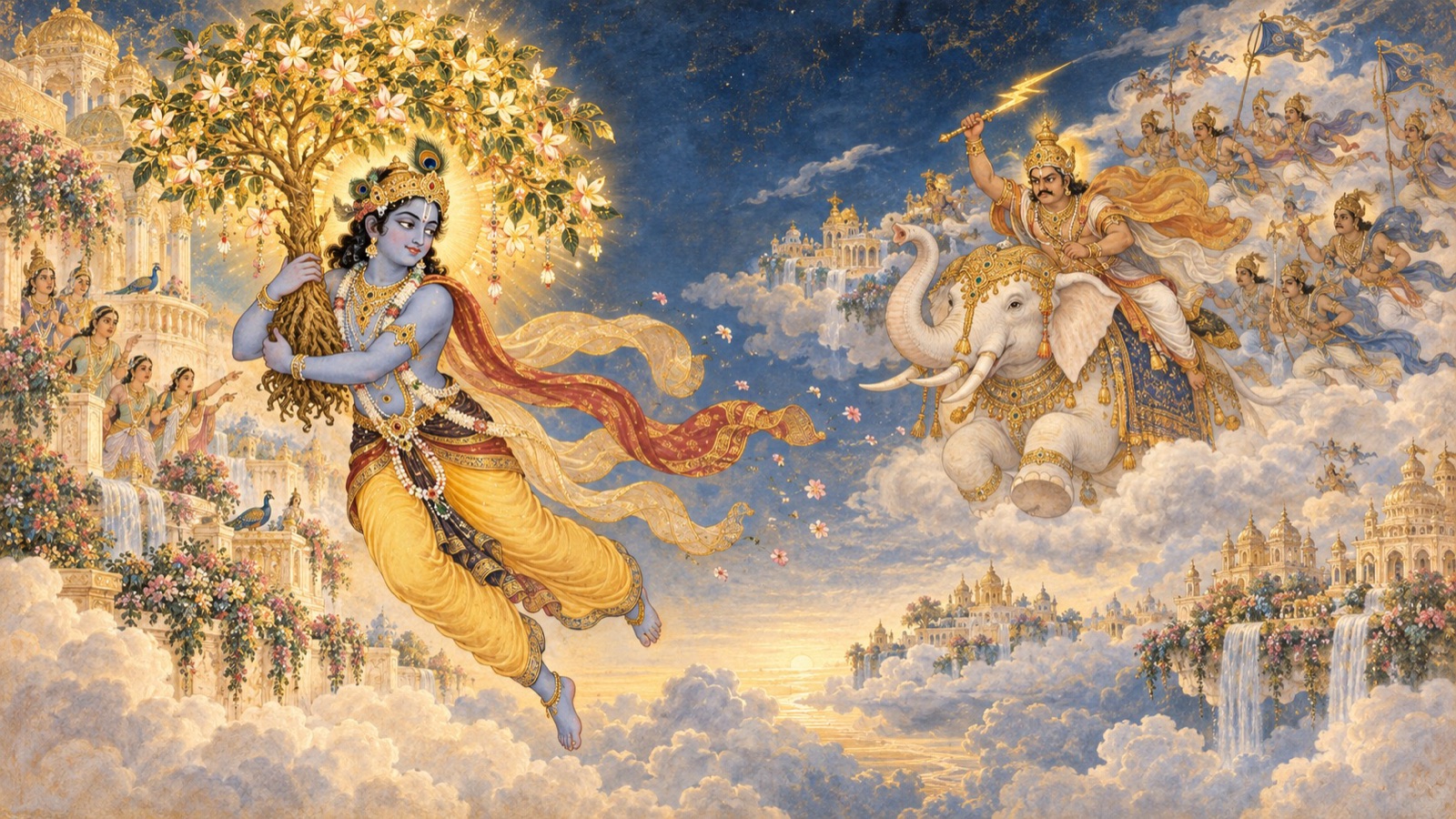
Uddhava’s next verse is almost playful in its irony: to please His beloved consort Satyabhama, the Lord — described here, remarkably, as behaving “like a hen-pecked husband” — carries off the celestial Parijata tree from Indra’s own paradise. Indra, thunderbolt in hand and blind with fury, pursues Him with the forty-nine wind-gods as his bodyguard. Uddhava’s aside is pointed: even a god as mighty as Indra, he says, is ultimately a toy in the hands of his own wives — a small, human observation folded into a cosmic episode.
Naraka Slain and Sixteen Thousand Princesses Freed
The chapter’s most striking episode follows. The demon Naraka, son of goddess Earth herself, has grown so vast that his very body seems to swallow the sky. When the Lord’s discus Sudarshana ends his life, Earth comes before the Lord not in anger but in supplication, asking mercy for her grandson Bhagadatta, to whom the Lord grants the portion of the kingdom left unconquered.
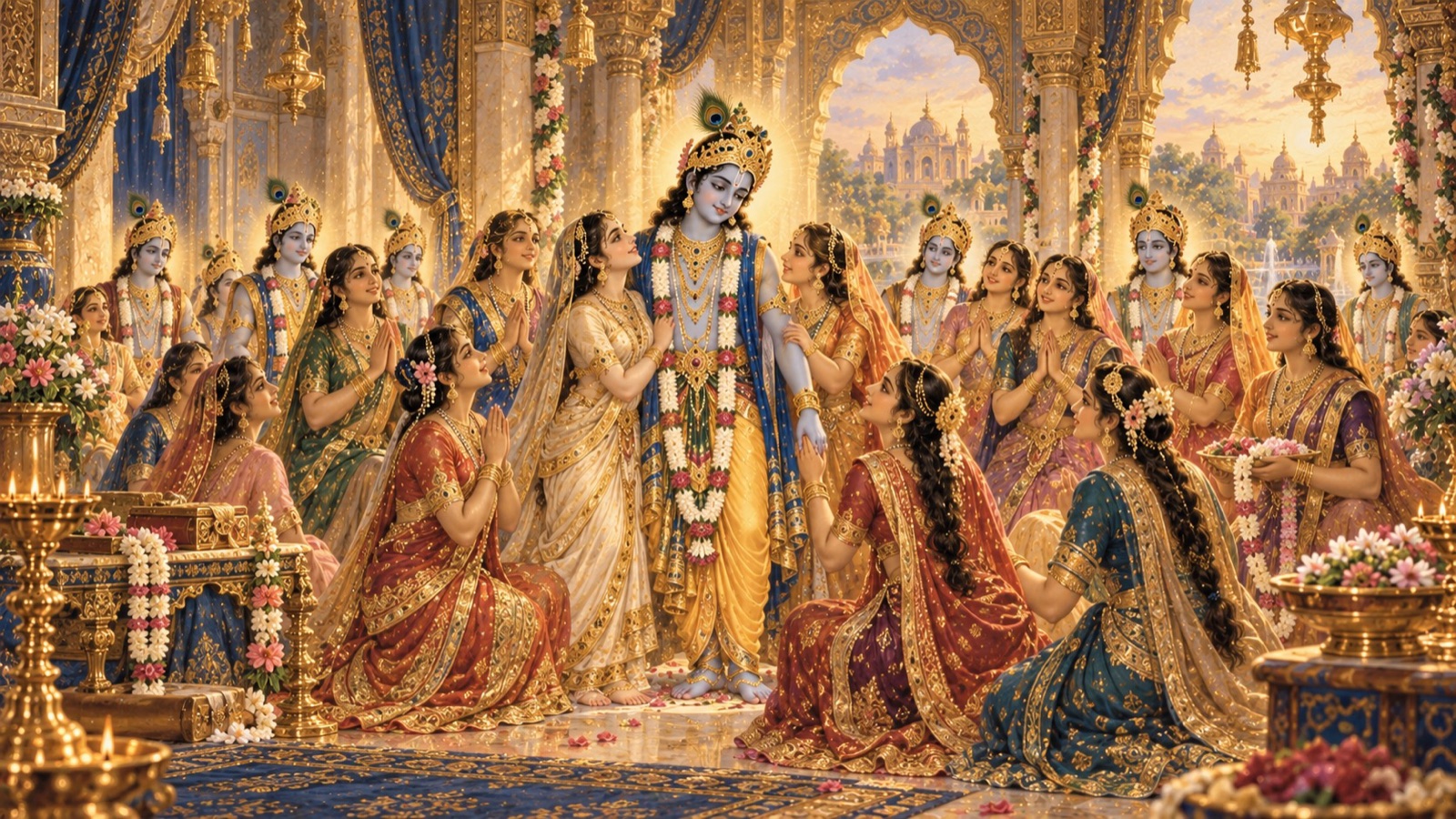
Inside Naraka’s palace the Lord discovers something else: sixteen thousand princesses, kidnapped and held captive by the slain demon. The moment they see Him — Sri Hari, the Befriender of the afflicted — they spring to their feet and, through glances alone, betraying joy, bashfulness, and love all at once, accept Him as their husband. What happens next is one of the Bhagavatam’s most quietly astonishing statements of the Lord’s unlimited nature: by His divine potency, Yogamaya, He assumes an equal number of forms — one identical Lord multiplied sixteen thousand times over — and marries all of them with full ceremony, at one and the same hour, each in a separate palace.
आसां मुहूर्त एकस्मिन्नानागारेषु योषिताम् । सविधं जगृहे पाणीननुरूप: स्वमायया ॥ ८ ॥
āsāṁ muhūrta ekasmin nānāgāreṣu yoṣitām sa-vidhaṁ jagṛhe pāṇīn anurūpaḥ sva-māyayā
Meaning: In that same single hour, in separate mansions, the Lord — matching Himself to each bride through His own Yogamaya — took the hand of every one of those women in proper ceremony. (Canto 3, Chapter 3, verse 8)
To extend the sphere of His play still further, Uddhava adds, He fathers ten sons through each of them, every son bearing His own likeness.
Enemies Repelled, and the Turning of the Great War
Uddhava’s survey now widens to the defense of the Yadu capitals themselves. When Kalayavana, Jarasandha, Shalva, and other kings besiege Mathura with their combined armies, the Lord orchestrates their destruction through His own people — Mucukunda, Bhima, and others — lending them His divine power rather than always acting directly. A parallel list of demons — Shambara, Bana, Mura, Balvala, Dvivida the monkey-chief, and the warrior Dantavaktra among others — meet their end either at His own hand or at the hands of Balarama, Pradyumna, and the rest of His extended family, each blow ultimately traceable back to Him.
Then, in a single verse, Uddhava turns to the largest catastrophe of the age: the Mahabharata war itself, in which the Lord brings about the destruction of the very kings who had allied themselves with the sons of Dhritarashtra and Pandu — the massed armies whose marching, Uddhava says, made “the entire globe rock.” Even as Duryodhana lies fallen on the battlefield, his thighs broken by Bhima’s mace, ruined by the counsel of Karna, Duhshasana, and Shakuni, the Lord takes no pleasure in the sight.
स कर्णदुःशासनसौबलानां कुमन्त्रपाकेन हतश्रियायुषम् । सुयोधनं सानुचरं शयानं भग्नोरुमूर्व्यां न ननन्द पश्यन् ॥ १३ ॥
sa karṇa-duḥśāsana-saubalānāṁ kumantra-pākena hata-śriyāyuṣam suyodhanaṁ sānucaraṁ śayānaṁ bhagnorum ūrvyāṁ na nananda paśyan
Meaning: Seeing Suyodhana (Duryodhana) — who, ruined by the wicked counsel of Karna, Duhshasana and Shakuni, had lost his fortune as well as his life — lying prostrate with his followers on the battlefield, his thighs broken, the Lord did not rejoice. (Canto 3, Chapter 3, verse 13)
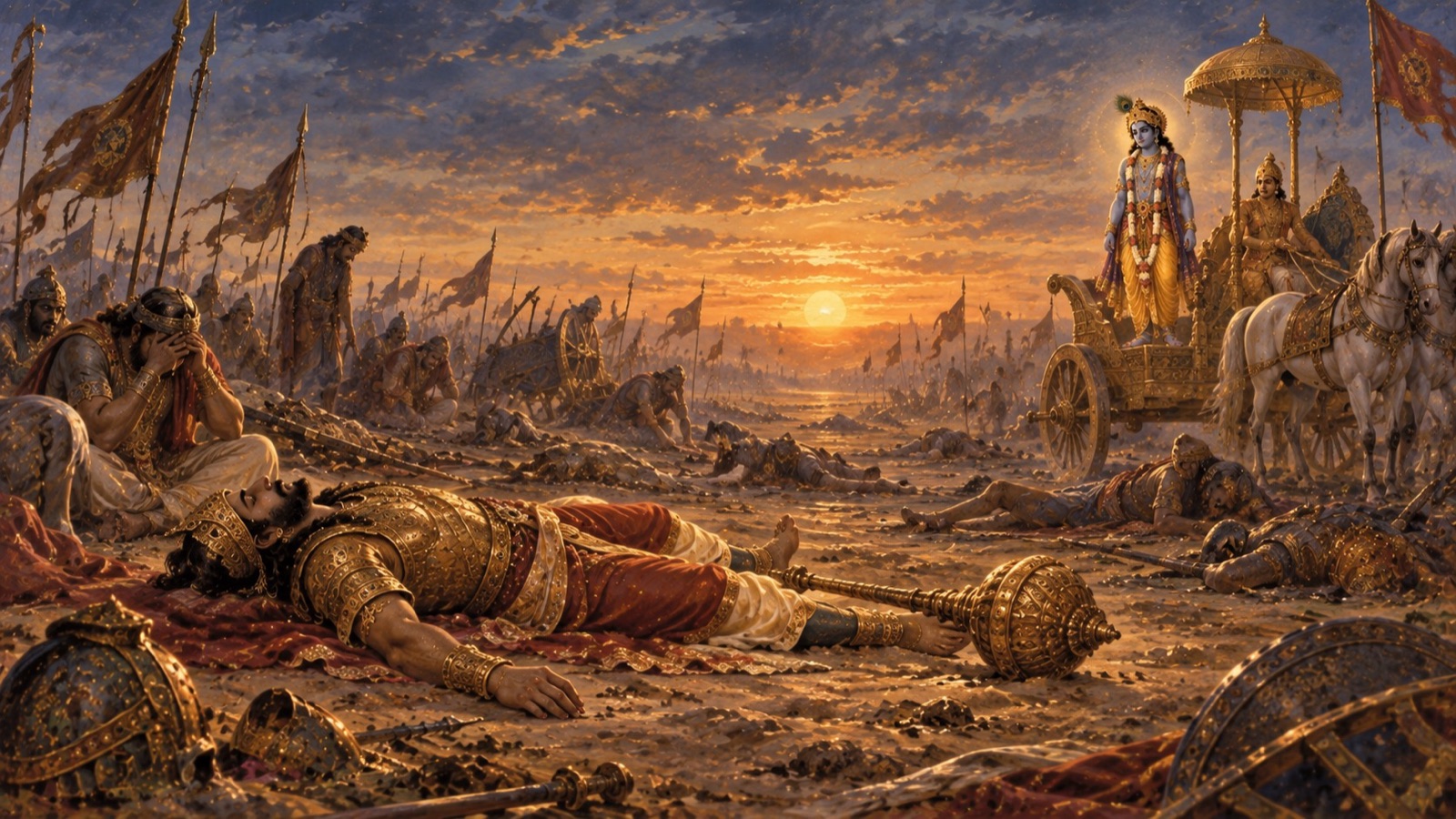
Uddhava then does something unusual for this fast-moving survey: he pauses to give the Lord’s own private reflection, almost as an aside spoken to Himself. Even though the earth has been relieved of an immense burden — eighteen full Akshauhinis of soldiers destroyed at the hands of Drona and Bhishma alone — that destruction, the Lord considers, is still negligible compared to the might of His own kinsmen, the Yadus, who continue to flourish under the protection of His own expansions, Pradyumna and others. And then comes the line that quietly plants the seed for everything Book Three of the Bhagavatam will eventually lead toward: the Yadus, the Lord reflects, will one day destroy themselves — drunk with wine, quarreling among themselves, their eyes red with intoxication — and that alone will be the true means of ending them, timed to occur exactly when He is ready to depart for His own eternal Abode.
मिथो यदैषां भविता विवादो मध्वामदातान्रविलोचनानाम् । नैषां वधोपाय इयानतोऽन्यो मय्युद्यतेऽन्तर्दधते स्वयं स्म ॥ १५ ॥
mitho yadaiṣāṁ bhavitā vivādo madhv-āmadātāmra-vilocanānām naiṣāṁ vadhopāya iyān ato ‘nyo mayy udyate ‘ntar-dadhate svayaṁ sma
Meaning: “When they quarrel among themselves, drunk with wine, their eyes red with intoxication, that alone will be the means of their destruction — no other. Indeed, they will vanish of themselves the moment I make ready to depart.” (Canto 3, Chapter 3, verse 15)
A footnote preserved in the primary edition records the war’s scale in traditional terms: one Akshauhini comprises 21,870 elephants, an equal number of chariots, 65,610 horses, and 1,09,350 foot-soldiers — meaning the Mahabharata war as a whole, at eighteen Akshauhinis, involved the destruction of 3,93,660 elephants, the same number of chariots, 11,80,980 horses, and 19,68,300 foot-soldiers.
A Kingdom Restored, a Lineage Preserved
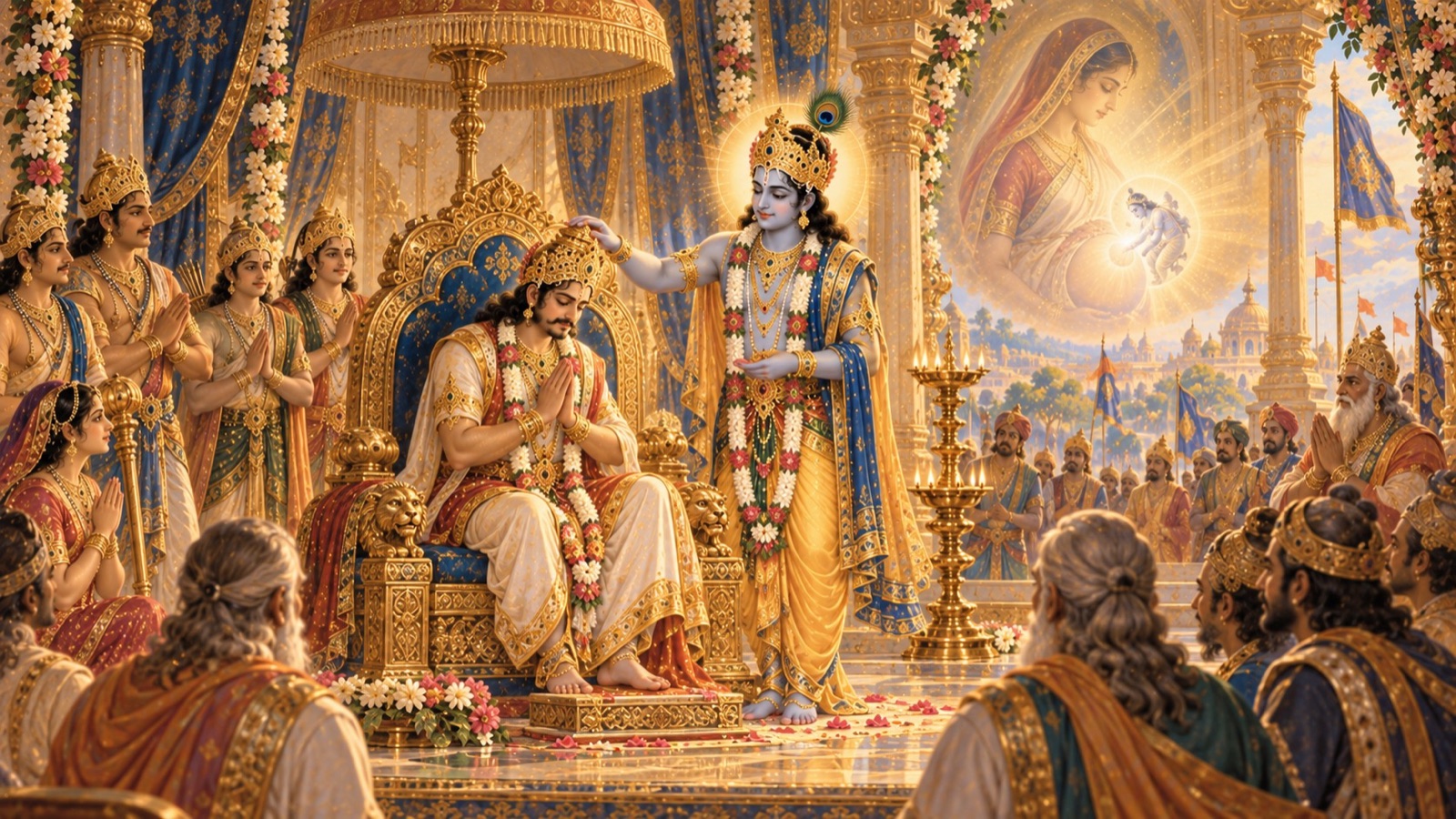
With the war’s reckoning complete, Uddhava’s tone shifts from grief to restoration. The Lord secures Yudhishthira, the son of Dharma, firmly on his ancestral throne, bringing joy to His own family by showing them, through His own conduct, the path of righteousness. And in the same breath, Uddhava recalls a mercy that Vidura — and every listener of the Bhagavatam since — holds especially dear: the child growing in Uttara’s womb, planted there by Abhimanyu before his own death in the war, torn at by the Brahmastra loosed by Ashwatthama in a final act of vengeance, is nevertheless preserved by the Lord. This child is Parikshit himself — the very king to whom, in the frame of this whole narration, Sukadeva Gosvami is speaking.
Yudhishthira, at the Lord’s own urging, performs no fewer than three Ashwamedha, or horse-sacrifices, and reigns happily, devoted to Krishna and protected by his brothers. The Lord Himself, meanwhile, the Soul of the universe, settles into the life of Dvaraka — enjoying its pleasures while keeping strictly to the path laid out in the Vedas and Smritis, remaining, in the spirit of Sankhya philosophy, ever the untouched witness even while matter interacts with matter around Him.
Life at Dvaraka, and the First Shadow of Its End
Uddhava lingers, briefly, on the sweetness of those Dvaraka years — the Lord delighting this world and the next, and the Yadus above all, through His smiles, His glances, His nectar-sweet words, His flawless conduct, and a person that was itself the abode of all charm. By night He moved among His consorts, granting each the joy of His company and a touch of tender, momentary affection. Yet even amid all this, Uddhava notes something quietly significant: as the years passed in this way, the Lord Himself grew to feel a distaste for the ordinary duties of household life bound up with sense-pleasure (verse 22). From that single observation Uddhava draws out a teaching meant for every listener, not only for the Lord’s own household: since the rise and fall of sense-enjoyment is never in a person’s own hands but is granted or withdrawn by a power beyond them, a soul genuinely intent on pleasing Krishna, the Lord of all Yoga, through devotion has no real reason to fix its heart on pleasures it was never free to keep in the first place (verse 23).
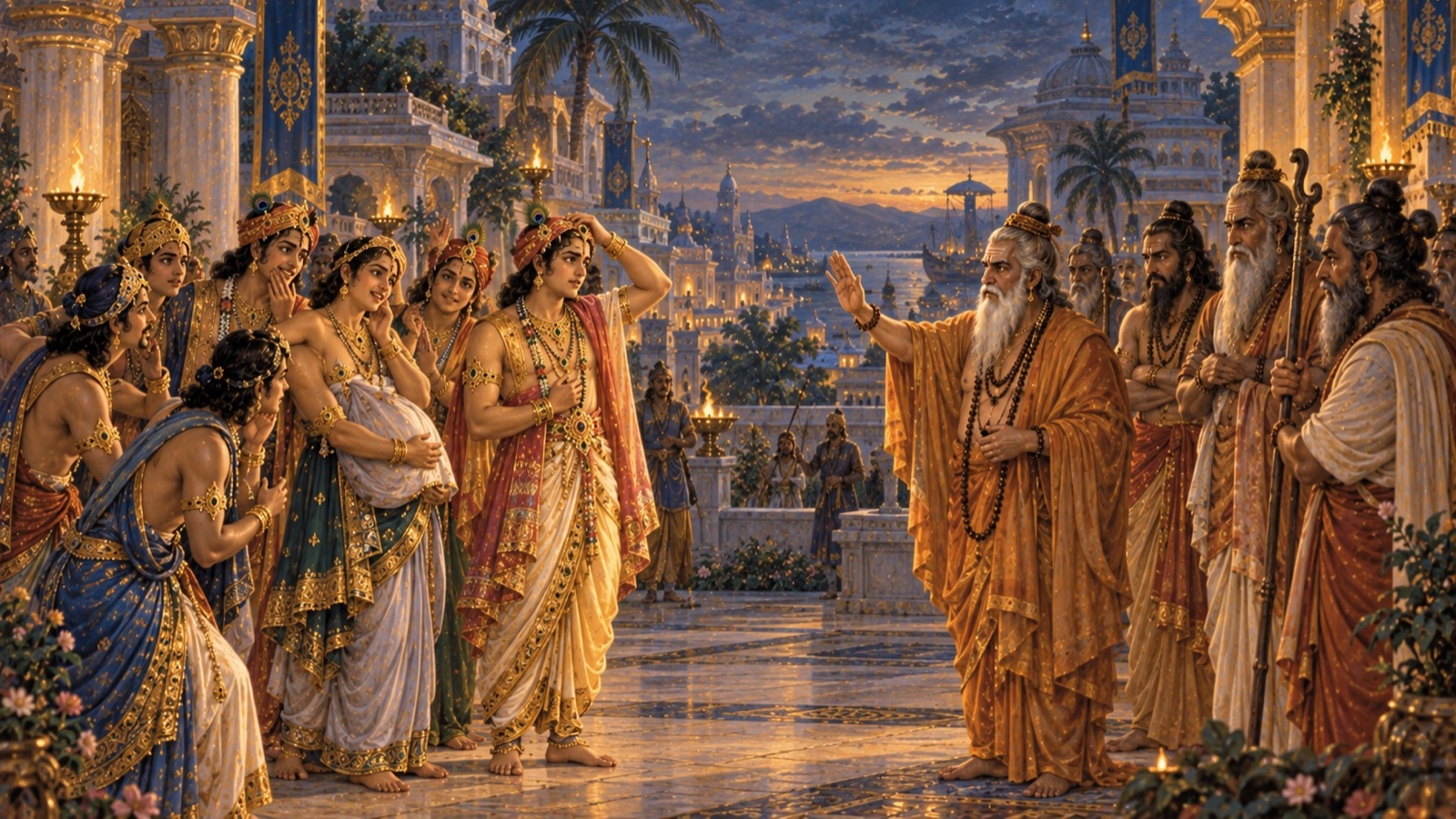
It is against this backdrop that the chapter’s final, ominous note arrives. One day, the young men of the Yadu and Bhoja clans, playing carelessly in the streets of Dvaraka, offend a group of visiting sages — sages who, seeing clearly the Lord’s own hidden intention to bring about the Yadus’ end, pronounce a curse upon them rather than forgiving the offense. Months later, seemingly untouched by any premonition, the Vrishnis, Bhojas, Andhakas, and the rest of the Yadu clans drive out in festive spirits to Prabhasa, a sacred spot by the sea — drawn there, Uddhava says pointedly, by the will of Sri Krishna Himself.
Devotion Amid Every Circumstance
The chapter’s final verses, however, refuse to end on foreboding alone. At Prabhasa the Yadus bathe, offer water to the manes, the gods, and the sages, and — in an act that Uddhava clearly wants remembered — give away cows of the finest quality to the Brahmanas, along with gold, silver, beds, garments, deerskins, blankets, palanquins, chariots, elephants, unmarried girls given in marriage, land for their sustenance, and food of every delicious variety, all of it offered in a spirit of dedication to the Lord. These valiant men, Uddhava says, who lived their whole lives for the sake of cows and Brahmanas, bow before them with their heads touching the ground — a final image of devotion and generosity held in the same breath as the curse that will soon undo them all.
अन्नं चोरुरसं तेभ्यो दत्त्वा भगवदर्पणम् । गोविप्रार्थासवः शूराः प्रणेमुर्भुवि मूर्धभिः ॥ २८ ॥
annaṁ ca uru-rasaṁ tebhyo dattvā bhagavad-arpaṇam go-viprārthāsavaḥ śūrāḥ praṇemur bhuvi mūrdhabhiḥ
Meaning: Having given them foods of rich and varied taste, first offered to the Lord, those valiant men, who lived for the sake of cows and Brahmanas, bowed before them with their heads touching the ground. (Canto 3, Chapter 3, verse 28)
With this act of humble devotion — offered even as the sages’ curse quietly ripens in the background — the third discourse of Book Three closes, its survey of the Lord’s exploits complete for now, and the narrative poised for Uddhava to be sent, at the Lord’s own direction, to Vidura’s teacher Maitreya, whose meeting with Vidura forms the subject of the next chapter.
Principal Teachings of This Chapter
1. Justice against a tyrant and tenderness toward a guru can flow from the same hand. The Lord who drags Kamsa’s lifeless body through the streets is, within the very next verse, the ideal disciple who repays his teacher’s kindness a hundredfold, even traveling to Yama’s own abode to do so (verses 1-2).
2. Divine love can multiply without dividing. The Lord’s marriage to sixteen thousand princesses in a single hour, through an equal number of simultaneously assumed forms, teaches that the Lord’s presence and attention are never diminished by being shared — a principle devotees are invited to trust in their own relationship with Him (verses 7-9).
3. Even necessary destruction brings the Lord no private joy. Seeing Duryodhana fallen and ruined on the battlefield, the Lord does not rejoice — a reminder that righteous consequence, however deserved, is never occasion for gloating (verse 13).
4. The Lord’s plans unfold on His own timing, hidden within ordinary events. The Yadus’ eventual self-destruction is foretold by the Lord Himself in this very chapter, long before the careless quarrel of some young men and an insulted sage’s curse make it visible to anyone else (verses 14-15, 24).
5. Devotion holds steady even in the shadow of coming loss. The Yadus’ generous, humble worship of the Brahmanas at Prabhasa — offered in the very hour that seals their fate — shows that a life dedicated to the Lord’s service does not need to know the future to remain faithful within it (verses 26-28).
A Devotional Reflection
It would be easy to read this chapter as simply a fast catalogue of miracles — Kamsa killed, a tree stolen, princesses rescued, a war concluded — each event ticked off before Uddhava rushes to the next. But look again at where Uddhava chooses to slow down. He does not linger over the drama of Kurukshetra’s carnage; he lingers, instead, over the Lord’s private reflection that even the destruction of eighteen Akshauhinis is “negligible” compared to what still lies ahead for His own family. That single verse quietly reframes everything that has come before it: all of these exploits — however vast, however astonishing — are staged within a scale of time and consequence that only the Lord Himself can truly see. The Yadus, drunk and quarreling on a beach at Prabhasa, will not know, in that final hour, that their end was foretold in a private thought years earlier, spoken over the body of a fallen enemy. This is the quiet, sobering wisdom threaded through an otherwise triumphant chapter: the Lord’s play unfolds on a timescale invisible to those living inside it, and the truest devotion — like the Yadus’ own act of bowing before the Brahmanas even as their fate ripens unseen around them — is simply to keep offering what is in front of you, without needing to see the whole of the Lord’s design.
A Daily Devotional Practice
Today, notice one moment in your own life where you cannot see the full picture — a decision still pending, a relationship still unfolding, a difficulty whose purpose is not yet clear. Rather than straining to predict its outcome, follow the example closing this chapter: continue simply to act with generosity and devotion in the present moment, trusting that the Lord’s timing holds a wisdom your own vantage point cannot yet perceive. Before you return to your day, pause and repeat quietly: “Om Namo Bhagavate Vasudevaya.” Let that remembrance settle the mind’s need to know everything in advance, and offer instead the same steady faithfulness the Yadus showed at Prabhasa, in the very hour before everything changed.
Conclusion
The third discourse of Book Three moves at the pace of a rushing river — Kamsa’s fall, a resurrected son, two marriages, a stolen tree, sixteen thousand rescued brides, a world-shaking war, a kingdom restored, a lineage preserved, years of splendor at Dvaraka — and yet, folded quietly inside all this triumph, Uddhava leaves Vidura (and every listener since) with the one thought that outlasts the rest: the Lord who accomplishes all of this also already knows, and has already accepted, exactly how and when it will end. Behind the momentum of this chapter’s many exploits lies Sukadeva’s deeper purpose within Uddhava’s narration: to show Vidura, gently and without alarm, that grief for what is coming to the Yadu house has, in truth, already been transformed into acceptance by the Lord’s own hand — and that even the shadow of an ending can be met, as it is met at Prabhasa, with generosity, humility, and an offering freely given.
May the divine wisdom of Srimad Bhagavatam awaken pure devotion within our hearts.
Om Namo Bhagavate Vasudevaya.
Jay Shree Madhav.
References and Attribution
- Primary edition: Gita Press, Śrīmad Bhāgavata Mahāpurāṇa (English, complete), Book Three, Discourse 3, pages 143–146.
- Series: Srimad Bhagavatam Wisdom · Biswa Sanatan Dharma Seva Trust.
- Presented following the spiritual guidance and recommendation of Pandit Dr. Shri Kashinath Mishra.
This is an original, faithful retelling in the writer’s own words, with brief quoted verses shown in Devanāgarī and transliteration and their meanings given as summaries. It is not a reproduction of any single publisher’s continuous translation or commentary. No affiliation with or endorsement by any publisher is implied.
Jay Shree Madhav