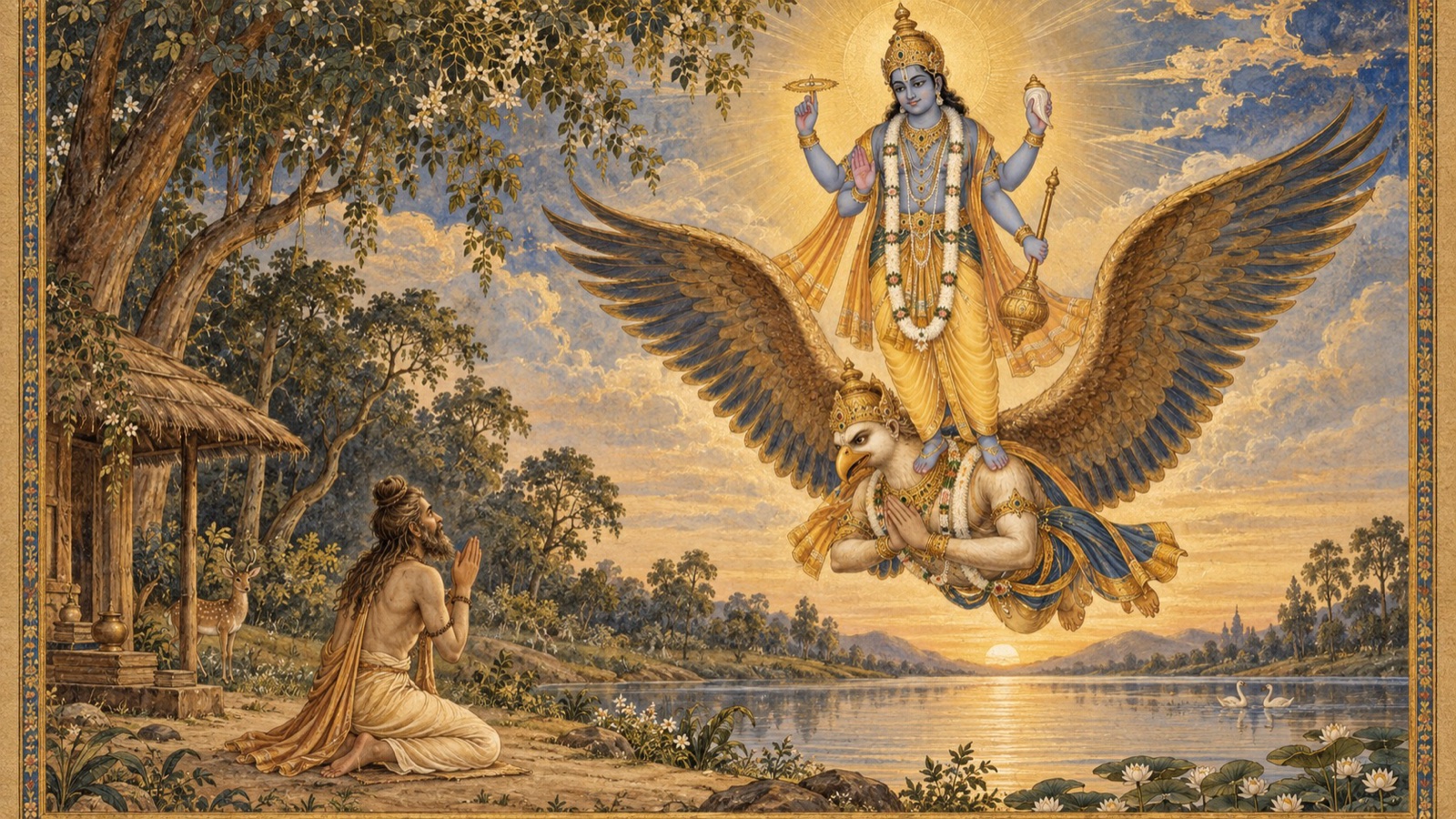
For ten thousand years the sage Kardama has stood on the bank of the Sarasvati, his whole life narrowed to a single act of worship. Now, at the dawn of a new age, the ocean of his waiting finally yields its shore: the Lord Himself descends on Garuda’s shoulders to answer a penance no one else was watching.
Om Namo Bhagavate Vasudevaya.
Om Namo Bhagavate Vasudevaya.
Om Namo Bhagavate Vasudevaya.
Welcome to Srimad Bhagavatam Wisdom, a devotional journey through the sacred histories and teachings of the Srimad Bhagavat Mahapurana. The twenty-first discourse of Book Three turns away, for a while, from the terror of Hiranyakasipu and Hiranyaksa and toward a gentler, quieter kind of greatness. Vidura, having heard the fearsome birth-story of Diti’s demon-sons, now asks Maitreya about a different lineage altogether: the line of Emperor Svayambhuva Manu, and in particular the fate of his daughter Devahuti, given in marriage to the sage Kardama. What follows is one of the Bhagavatam’s most tender accounts of devotion rewarded — ten thousand years of silent penance on the bank of the Sarasvati, the Lord’s own appearance in a form of overwhelming splendour, a prayer offered with a heart that admits its own imperfection, and a boon that will shape the rest of this Canto: a bride, nine daughters, and, in time, the philosophical teaching that will flow from Devahuti to her own son, the great sage Kapila. The chapter ends on the threshold of that promise’s fulfilment, as Manu himself arrives with his daughter at Kardama’s hermitage, and the sage — recalling all he has been told — turns to greet the king with words of such reverence that Manu is left, for the moment, simply asked why he has come.
Chapter Information
- Scripture: Śrīmad Bhāgavata Mahāpurāṇa
- Canto: 3 (Book Three)
- Chapter: 21 (Discourse 21)
- Chapter title: The sage Kardama practises austere penance and the Lord confers a boon on him
- Principal speakers: Sri Suka (outer narrator to King Parikshit, understood throughout), Maitreya (inner narrator to Vidura), the sage Kardama (in prayer to the Lord, and later in address to Manu), the Lord (in reply to Kardama)
- Principal listener within the chapter’s frame: Vidura, receiving Maitreya’s account
- Main setting: The hermitage on the bank of the Sarasvati, beside the sacred lake Bindusarovara
- Central subject: Vidura’s question about the daughters of Svayambhuva Manu; Kardama’s ten-thousand-year penance and the Lord’s appearance before him; Kardama’s prayer of surrender; the Lord’s boon promising Devahuti as his bride, nine daughters, and final liberation; the Lord’s departure to Vaikuntha; the arrival of Manu, Satarupa, and Devahuti at the hermitage on the very day foretold; and Kardama’s opening words of praise to Manu
- Principal verse range: Canto 3, Chapter 21, verses 1–56 (Gita Press numbering)
- Primary edition: Gita Press Śrīmad Bhāgavata Mahāpurāṇa
Vidura’s Question: The Daughters of Svayambhuva Manu
The chapter opens not with narration but with a question, and it is worth noticing how precisely Vidura frames it. He has already learned, in earlier discourses, of Svayambhuva Manu’s two sons, Priyavrata and Uttanapada, who ruled the earth’s seven divisions with piety. Now he wants to know of a different branch of that same illustrious family: the emperor’s daughters. Maitreya has apparently already mentioned, in passing, that Devahuti — Manu’s daughter — became the wife of the sage Kardama, one of the lords of created beings (Prajapatis) entrusted by Brahma with the work of populating the universe. Vidura asks how many children this great Yogi, Devahuti’s husband, begot through her, a princess herself accomplished in the eightfold discipline of Yoga. And in the same breath he asks after her two sisters as well — Akuti, given to the sage Ruci, and Prasuti, given to Daksa, Brahma’s own son — wanting to know how they, too, fared in bringing forth progeny. It is a simple genealogical question on its surface, but it opens the door to one of the Bhagavatam’s most beloved love stories between a soul and its Lord.
Ten Thousand Years on the Bank of the Sarasvati
Maitreya’s answer begins with an instruction and an obedience. Brahma had commanded Kardama, in words the text renders simply as “Beget children!” — the charge given to every Prajapati at the dawn of creation. But Kardama’s response to that charge is anything but perfunctory. Rather than seeking a wife by his own initiative, he turns first to worship, practising penance on the bank of the river Sarasvati for a period the Bhagavatam states plainly: ten thousand years. Throughout that immense stretch of time, his devotion is directed not at any personal ambition but at Sri Hari Himself — the Lord who is here named, tellingly, as “the Bestower of blessings on those who flee to Him for protection.” Kardama worships through various modes accompanied by deep and unbroken meditation, asking for nothing, simply offering himself.
The Lord’s response comes precisely at the moment such devotion deserves it: at the very beginning of Satyayuga, the first and most virtuous of the four ages, the lotus-eyed Lord — pleased by Kardama’s austerities — shows Himself. The text is careful to specify the nature of this appearing: a form consisting of the Lord’s own divine essence, ordinarily knowable only through the divine Word, the Vedas themselves. This is not an incarnation for the world’s sake in the manner of Varaha rescuing the earth or the future Boar-avatar’s cosmic rescue; it is an intimate, personal appearing, granted to a single soul whose entire life had narrowed itself to a single act of longing.
The Lord’s Form: A Vision Beyond the Reach of Yogis
What Kardama beholds is described with the loving specificity the Bhagavatam reserves for its most cherished visions. The Lord stands in His purely divine form, effulgent like the sun, garlanded with white lotuses and water-lilies, clad in spotless yellow silk. His lotus face is fringed by sleek, dark, curling locks; a crown and earrings adorn Him. In three of His four hands He holds His characteristic emblems — conch, the discus Sudarsana, and mace — while in the fourth He holds, almost playfully, a white lily. His smiling look alone is enough to captivate the heart of anyone who beholds it. Most strikingly, He is shown standing in the air with His lotus-feet set upon the shoulders of Garuda, a golden streak — the mark of Goddess Lakshmi — visible on His breast, and the famous Kaustubha gem hanging at His neck.
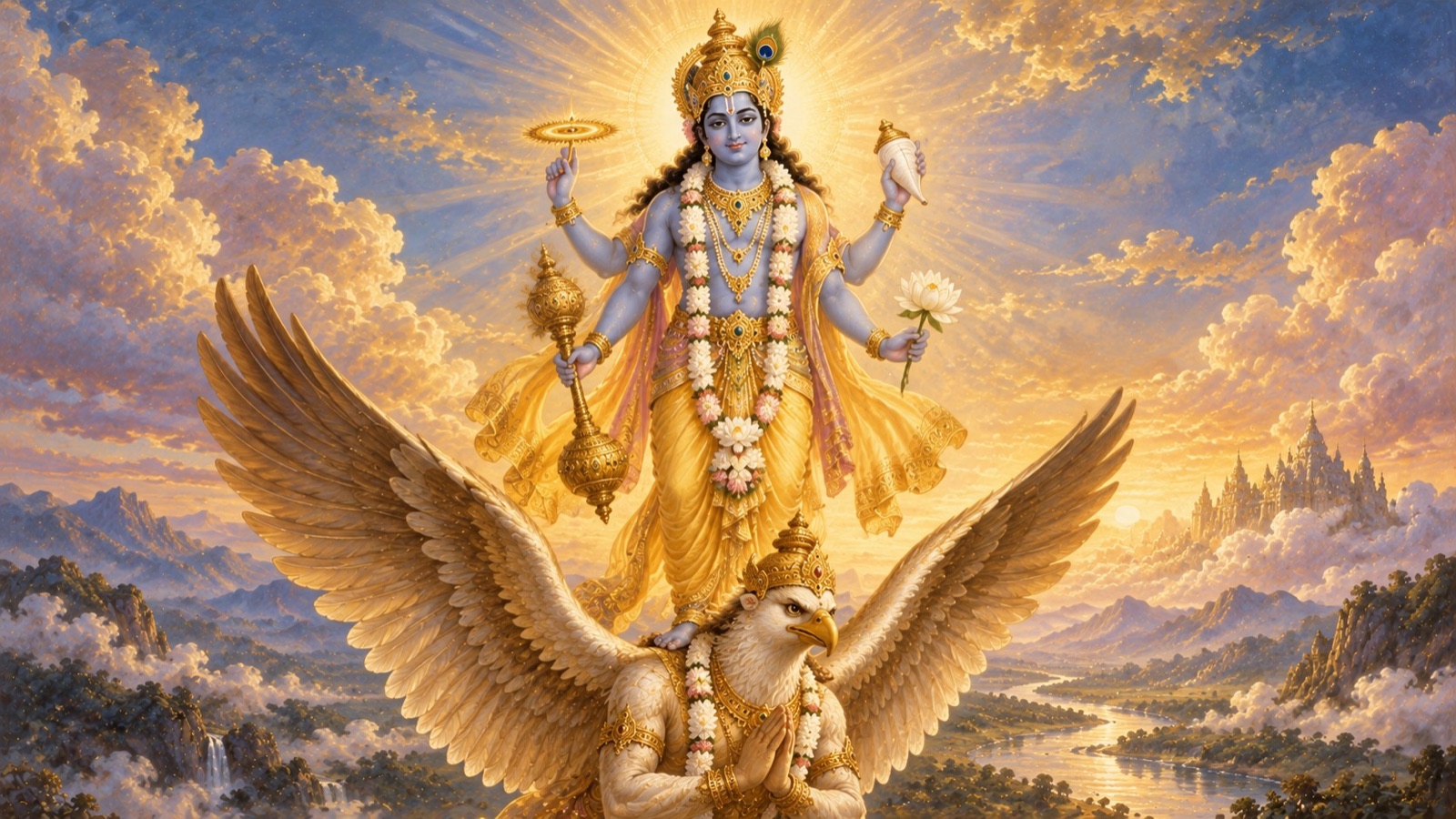
Having realized, in this single vision, the ambition his entire life had been bent toward, Kardama falls prostrate, his head touching the ground, and then rises to extol the Lord — his mind, the Bhagavatam notes, naturally full of love, his palms joined in prayer. What follows is not a request delivered plainly but a nine-verse hymn, one of the most quietly moving prayers in this portion of the Bhagavatam.
Kardama’s Prayer: A Heart That Admits Its Own Imperfection
Kardama’s prayer begins, characteristically, not with a petition but with gratitude and wonder: the fruit of his eyes, he says, has been fully attained today, for he has beheld a sight coveted even by Yogis who have passed through birth after birth of deep meditation to earn it. He calls the Lord’s lotus-feet a vessel to cross the ocean of mundane existence — and then, in a moment of remarkable candour, he observes that even those deprived of their senses by the Lord’s own Maya worship those same feet merely for trivial, momentary pleasures, the kind available even in hell, and that the Lord in His generosity grants even these lesser prayers.
ये मायया ते हतमेधसस्त्वत्- पादारविन्दं भवसिन्धुपोतम् । उपासते कामलवाय तेषां रासीश कामान्निरयेऽपि ये स्यु: ॥ १४ ॥
ye māyayā te hata-medhasas tvat-pādāravindaṁ bhava-sindhu-potam upāsate kāma-lavāya teṣāṁ rāsīśa kāmān niraye ‘pi ye syuḥ
Meaning: “O Lord, those whose very intelligence has been undone by Your Maya worship Your lotus-feet — the vessel to cross this ocean of birth and death — only for the smallest fragment of sense-pleasure, the kind that even the denizens of hell can obtain; yet You, O Lord, are so generous that You grant even that.” (Canto 3, Chapter 21, verse 14)
Then comes the confession that gives this hymn its particular warmth. “You are a wish-yielding tree,” Kardama says, “while my heart is impure, tainted by carnality.” He does not disguise his desire: he wishes to marry a woman of a disposition like his own, one who might prove, in his married life, a veritable cow of plenty — granting all three legitimate objects of human pursuit. And so, aware of his own imperfection, he too has sought shelter at the Lord’s feet, the source of every blessing. It is a striking moment of scriptural honesty: a soul on the very threshold of receiving the Lord’s direct blessing, admitting plainly that his motive is not yet purely spiritual — and trusting, nonetheless, that the Lord’s grace does not wait for perfect motives to begin its work.
The hymn then widens into cosmic vision. Kardama describes how this world, smitten by desire, is bound like a beast to the cord of the Lord’s own word, the Veda; and how devotees, in contrast, seek shelter beneath the Lord’s feet as beneath an umbrella, sustaining themselves instead on the intoxicating nectar of praises exchanged among themselves. He then offers what may be the chapter’s most memorable image: the wheel of Time itself, with three naves representing the year’s three great divisions, thirteen spokes for the months (including the extra month intercalated every third year), three hundred and sixty joints for the days, six rims for the six seasons, and countless carved leaves standing for the passing moments. This wheel, turning with tremendous velocity, cuts short the lifespan of the entire creation — and yet, Kardama says, it cannot touch the lifespan of the Lord’s own devotees.
Kardama closes his prayer with a meditation on the Lord’s Yogamaya — the wonderful creative energy that is, paradoxically, no other than the Lord Himself — by which He brings forth, sustains, and finally reabsorbs the universe, exactly as a spider spins its web, tends it, and then draws it back into itself. And he ends with an acknowledgment that even though the Lord Himself takes no pleasure in granting mere sense-enjoyment to His devotees, He allows it to come to them for their ultimate good, when He has shown Himself before them in a form garlanded with fresh Tulasi leaves — a form that appears finite only through the veil of Maya. “I repeatedly bow,” Kardama says, “to You, whose lotus-feet are worthy of reverence to all.”
The Lord’s Reply: A Boon Already Prepared
Maitreya notes a small but telling detail before recording the Lord’s answer: sincerely extolled in this way, Lord Vishnu — shining on Garuda’s shoulders, His navel marked by a lotus — replies in accents sweet as nectar, His eyebrows gracefully moving, regarding the sage with a smile full of affection. It is a moment of tenderness before the words themselves arrive.
“Having come to know what was in your mind,” the Lord tells Kardama, “I have already arranged that for which you have worshipped Me well.” He assures the sage that worship offered by those who have fixed their minds solely on Him — particularly by souls like Kardama, who have surrendered everything unto Him — is never fruitless.
न वै जातु मृषैव स्यात्प्रजाध्यक्ष मदर्हणम् । भवद्विधेष्वतितरां मयि संगृभितात्मनाम् ॥ २४ ॥
na vai jātu mṛṣaiva syāt prajādhyakṣa mad-arhaṇam bhavad-vidheṣv atitarāṁ mayi saṅgṛbhitātmanām
Meaning: “O guardian of created beings, worship offered to Me is never in vain — least of all for souls like you, who have wholly fixed their heart and mind upon Me.” (Canto 3, Chapter 21, verse 24)
Then the Lord speaks with startling specificity: Emperor Svayambhuva Manu, celebrated for his righteous rule from his seat in Brahmavarta, will come to see Kardama, together with his queen Satarupa, the very day after tomorrow — and will give his daughter, a girl of marriageable age, noble character, and commendable virtue, in marriage to Kardama, whom the Lord declares worthy of her in every way.
स चेह विप्र राजर्षिर्महिष्या शतरूपया । आयास्यति दिदृक्षुस्त्वां परश्वो धर्मकोविद: ॥ २६ ॥
sa ceha vipra rājarṣir mahiṣyā śatarūpayā āyāsyati didṛkṣus tvāṁ paraśvo dharma-kovidaḥ
Meaning: “That royal sage, versed in the secret of dharma, will come here, O Brahmana, together with his queen Satarupa, the day after tomorrow, desiring to see you.” (Canto 3, Chapter 21, verse 26)
She will, moreover, be exactly the kind of match Kardama has long set his heart upon, and she will serve him to his heart’s content.
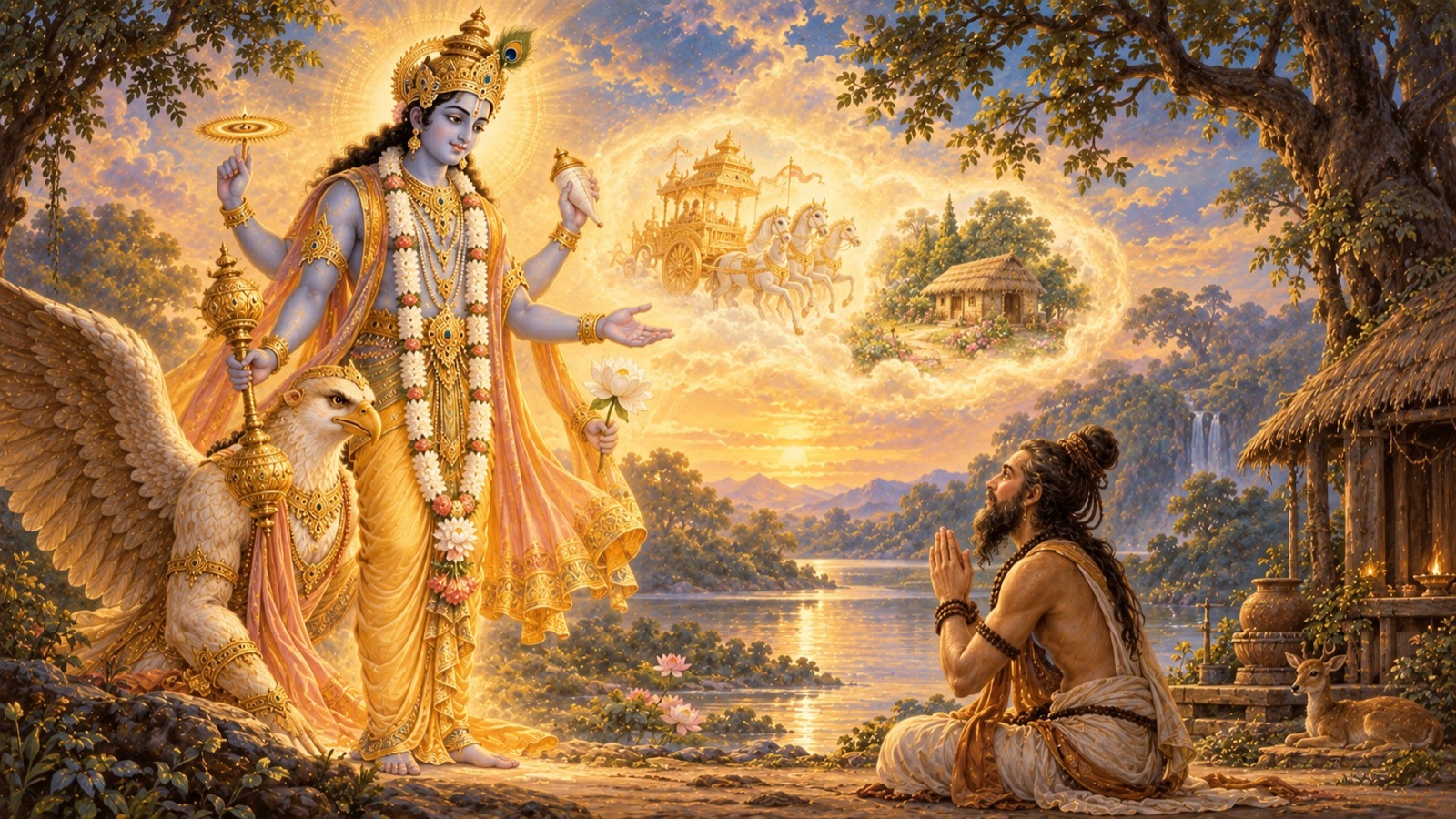
The boon then extends beyond marriage into a whole unfolding future. Devahuti will bear nine daughters from the seed sown in her by Kardama, and through those daughters, in turn, great sages such as Marici will duly beget children of their own — a lineage that will populate significant portions of the created world. And Kardama himself, having properly carried out the Lord’s command and resigned to Him the fruit of all his acts, will finally attain to the Lord — showing compassion to all living beings in his married life, attaining Self-Realization, and, in his eventual renunciation, perceiving his own self and the universe as identified in the Lord, and the Lord as identified in himself.
या त आत्मभृतं वीर्यं नवधा प्रसविष्यति । वीर्ये त्वदीये ऋषय आधास्यन्त्यञ्जसात्मन: ॥ २९ ॥
yā ta ātma-bhṛtaṁ vīryaṁ navadhā prasaviṣyati vīrye tvadīye ṛṣaya ādhāsyanty añjasātmanaḥ
Meaning: “She will bring forth nine daughters from the seed sown by you; and through your own seed present in them, sages will in turn duly beget their own children.” (Canto 3, Chapter 21, verse 29)
Here lies the chapter’s deepest instruction, easy to pass over amid the excitement of the coming marriage. The Lord does not simply grant the household Kardama has asked for and leave its spiritual meaning unaddressed; in the very same breath He hands Kardama the exact discipline by which that household life will itself become the road back to Him.
त्वं च सम्यगनुष्ठाय निदेशं म उशत्तम: । मयि तीर्थीकृताशेषक्रियार्थो मां प्रपत्स्यसे ॥ ३० ॥ कृत्वा दयां च जीवेषु दत्त्वा चाभयमात्मवान् । मय्यात्मानं सह जगद् द्रक्ष्यस्यात्मनि चापि माम् ॥ ३१ ॥
tvaṁ ca samyag anuṣṭhāya nideśaṁ ma uśattamaḥ mayi tīrthī-kṛtāśeṣa-kriyārtho māṁ prapatsyase kṛtvā dayāṁ ca jīveṣu dattvā cābhayam ātmavān mayy ātmānaṁ saha jagad drakṣyasy ātmani cāpi mām
Meaning: “By faithfully carrying out this instruction of Mine, O best of sages, and offering unto Me the fruit of every action you perform, you will at last reach Me. Extending compassion to all living beings, and assuring them of freedom from fear, with a steadied mind you will see your own self, together with the whole universe, resting in Me, and Me resting within your own self.” (Canto 3, Chapter 21, verses 30-31)
This is the theological heart of the boon: marriage and fatherhood are not a concession the Lord makes to Kardama’s still-imperfect desire, to be corrected later by some separate path of renunciation. Offering the results of every act back to the Lord, and extending real compassion rather than indifference to the beings he will one day father and guide, are together the very technology of his liberation. A grihastha life entered this way is not a detour from devotion — it is devotion’s own working ground, and it is by this same instruction that Kardama will, in time, truly see nothing as separate from the Lord.
And then the boon reaches toward something greater still — a promise whose fulfilment will occupy much of the rest of this Canto. “Manifesting a part of My own divine Being through your wife Devahuti,” the Lord tells Kardama, “along with your nine daughters, O great sage, I shall instruct her in the system of philosophy known as Sankhya” — the science of the ultimate categories of existence, Prakrti, Purusha, Iswara, and the rest. This is the first mention, oblique but unmistakable, of what devotees of this series will recognize as the coming incarnation of Lord Kapila, born of Kardama and Devahuti, who will teach precisely this Sankhya philosophy to His own mother in gratitude for her devoted service — a story this series will reach in the chapters ahead.
The Lord Departs for Vaikuntha
Having spoken these words, the Lord — who reveals Himself, Maitreya notes, only when the senses are turned inward in devotion — departs from the hermitage on the strand of Bindusarovara, the lake encircled by the Sarasvati. Kardama stands watching as the Lord leaves by the path that leads to Vaikuntha, a path extolled by all the great Siddhas, listening as He goes to the hymns forming the basis of the Samaveda, sung by the very wings of Garuda, lord of the feathered kingdom. It is a departure without ceremony or grandeur — only the quiet music of the Vedas accompanying the Lord’s ascent, and a sage left standing on the riverbank with a promise to hold onto.
Bindusarovara: A Lake Formed from the Lord’s Own Tears
Even after the Lord’s departure, Kardama remains at his hermitage, patiently awaiting the day that had been foretold. Meanwhile, on the far side of this unfolding promise, Svayambhuva Manu mounts his gold-plated chariot with Queen Satarupa at his side, takes his daughter Devahuti along with him, and journeys across the whole earth until, on the very day the Lord had named, he arrives at Kardama’s hermitage — the sage having, by then, just completed his long vow of austerity.
Before describing this meeting, Maitreya pauses to tell Vidura the origin and beauty of the lake itself. Bindusarovara — literally, the “lake of drops” — takes its name from an extraordinary source: drops of tears that fell from the Lord’s own eyes, overwhelmed by extreme compassion for the sage who had sought His protection through such long penance. Its water, ever replenished by the Sarasvati, is not merely wholesome but sweet as nectar, and it is resorted to by hosts of eminent sages. The description that follows is one of the loveliest passages of pure natural beauty in this portion of the Bhagavatam: the lake ringed by fruit and flower trees of every season, alive with the notes of overjoyed birds and the humming of intoxicated bees, its surrounding forest home to proudly dancing peacocks and cuckoos calling to one another. Kadamba, Campaka, Asoka, Karanja, Bakula, Asana, Kunda, Mandara, Kutaja, and young mango trees hem its banks, and its waters echo with the calls of Karandavas, Plavas, swans, ospreys, water-fowl, cranes, Cakravakas, and Cakoras — while its surrounding forest shelters deer, boars, porcupines, Gayals, elephants, baboons, lions, monkeys, mongooses, and musk-deer.
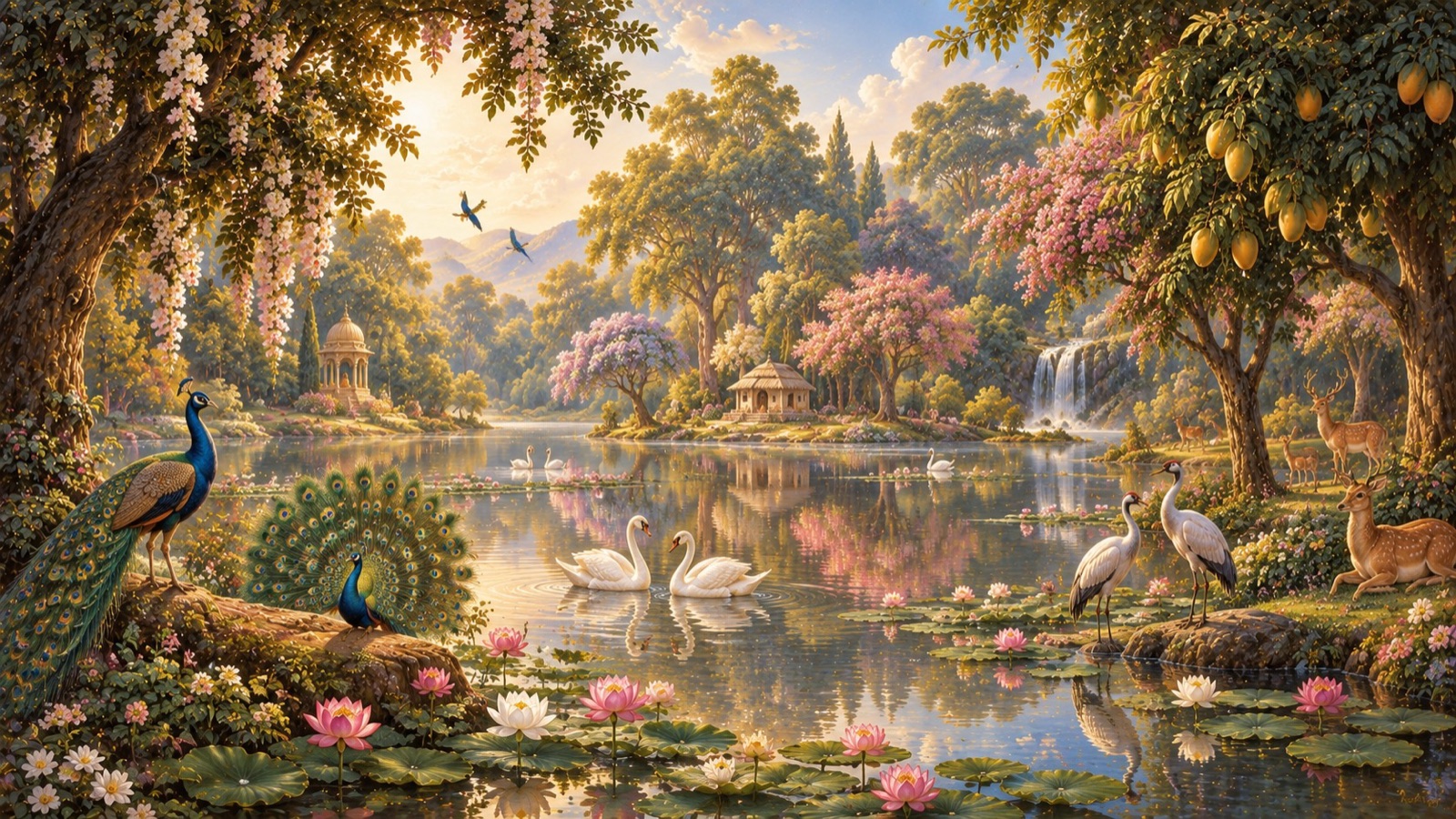
It is a passage worth lingering over precisely because of what it reveals: this is a landscape shaped, quite literally, by divine feeling. The Lord’s compassion did not remain an abstract sentiment; it left behind a lake that would nourish sages and creatures alike for generations, a physical trace of grace in the created world.
Manu Arrives, and Kardama Rises to Greet Him
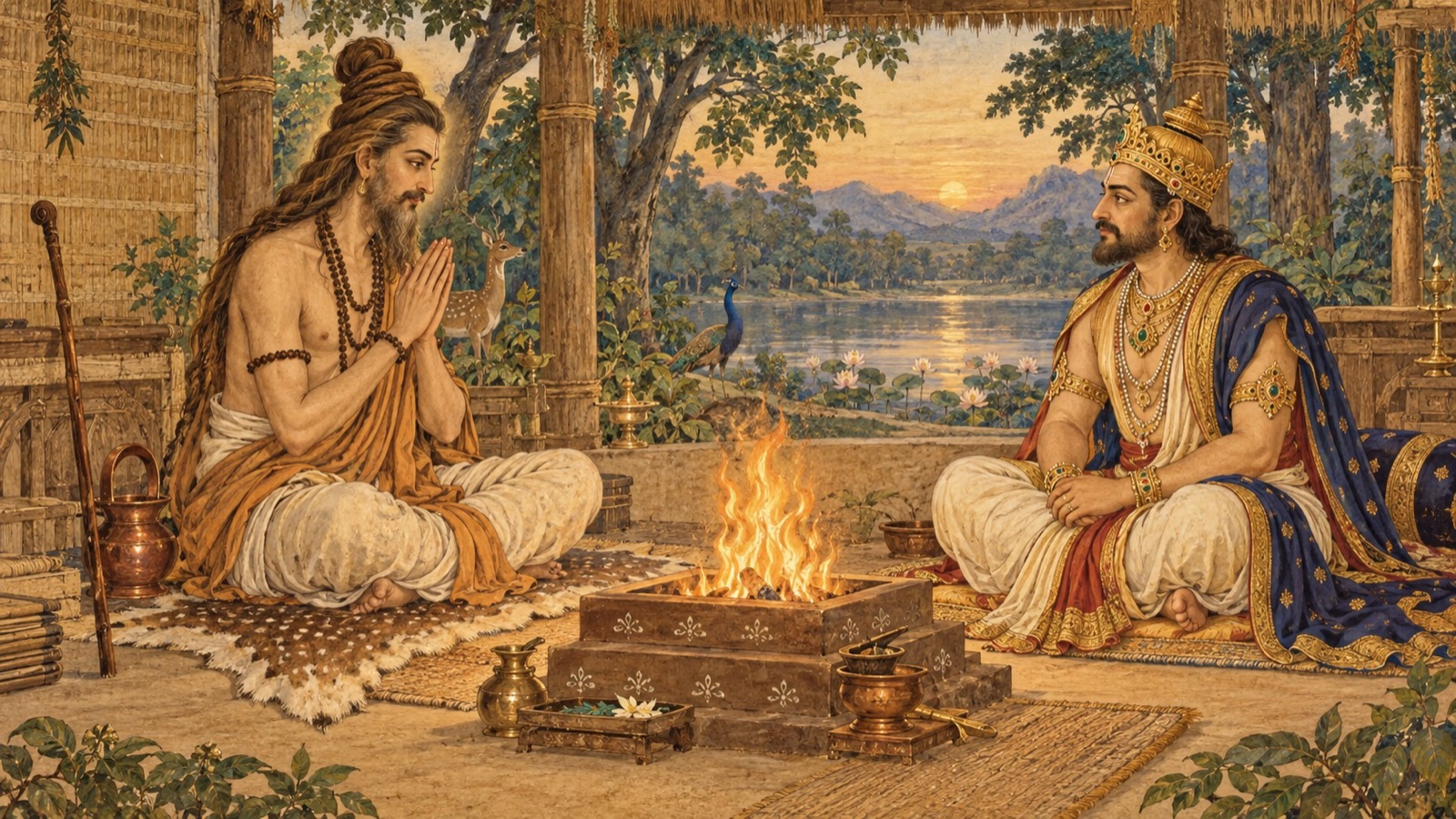
Entering this most sacred spot with his daughter, the first monarch approaches the sage and finds him seated, having just finished pouring oblations into the sacred fire. Kardama’s appearance is itself a small marvel: though he has practised austere penance for so long, his body is not much emaciated, for two graces have sustained him — the Lord’s own affectionate glance cast upon him, and the nectar he has drunk with his ears from the Lord’s moon-like words. He is described as tall, with eyes large as lotus petals, his hair matted, clad in rags, looking untidy — like an unpolished gem, the Bhagavatam says, whose true worth lies hidden beneath a rough exterior.
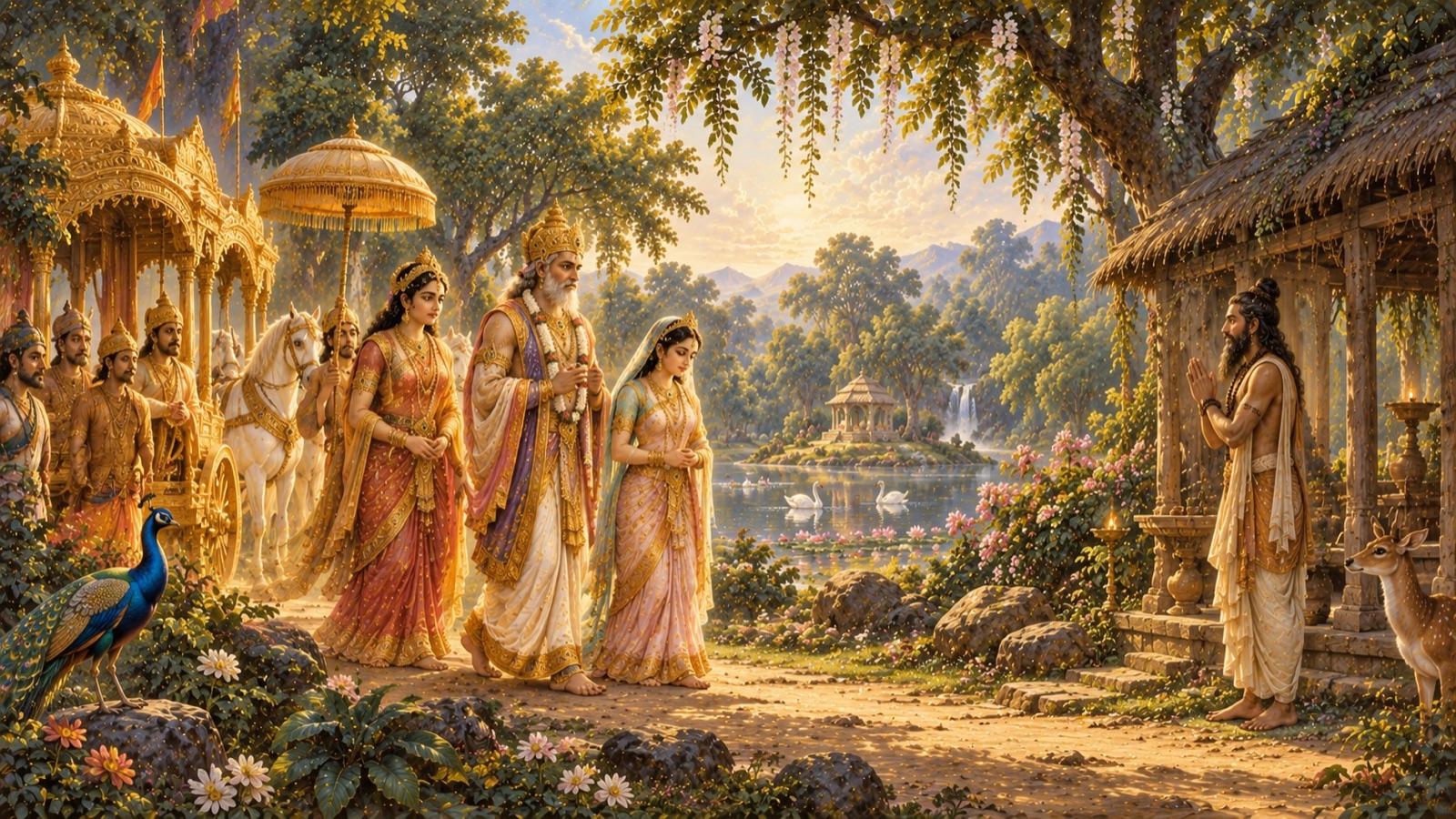
Seeing the monarch arrive, Kardama bows before him, greets him with benedictions, and receives him with every due honour. Only once the king has seated himself, calm and collected, does the sage — recalling all that the Lord had told him — begin to speak, delighting Manu with the softness of his accents.
Kardama’s Praise: “You Are No Other Than Lord Vishnu”
What Kardama says to Manu is itself a small theology of kingship. He tells Manu that his tour of the earth is surely undertaken to protect the virtuous and destroy the wicked, for the king embodies nothing less than the very protecting energy of Sri Hari. It is the king, Kardama says, who assumes the functions of the sun-god, the moon-god, the god of fire, Indra, the wind-god, Yama, Dharma, and Varuna, as circumstance requires — and so he hails Manu as no other than Lord Vishnu Himself. Were the king not to go about the world in his bejewelled, ever-victorious chariot, twanging his fierce bow, striking terror into the hearts of the wicked, and shaking the earth with the tread of his army, Kardama warns, the moral order governing the Varnas and Ashramas — an order established by the Lord Himself — would collapse that very moment under the weight of impious men. Unrighteousness would flourish through the grasping and the unruly, and the world, abandoned by its rightful protector, would fall into ruin.
Only after this extended tribute does Kardama finally ask the question the whole chapter has been quietly building toward. “Nevertheless,” he says, “I ask you, O valiant king, the purpose for which you have come here; with a glad heart we shall meet your wishes.”
अथापि पृच्छे त्वां वीर यदर्थं त्वमिहागत: । तद्वयं निर्व्यलीकेन प्रतिपद्यामहे हृदा ॥ ५६ ॥
athāpi pṛcche tvāṁ vīra yad-arthaṁ tvam ihāgataḥ tad vayaṁ nirvyalīkena pratipadyāmahe hṛdā
Meaning: “Yet I ask you, O hero, the purpose for which you have come here; whatever it may be, we shall meet it wholeheartedly, without deceit.” (Canto 3, Chapter 21, verse 56)
And there, on that gracious, unfinished question — Kardama already knowing, in truth, exactly why Manu has come — the chapter closes.
Principal Teachings of This Chapter
1. Sincere, sustained devotion is never wasted, however long it takes to bear fruit. Ten thousand years of penance on the Sarasvati’s bank finally meets the Lord’s own appearing — a reminder that spiritual patience is itself a form of faith (verses 6-8).
2. Grace does not wait for a perfectly pure motive to begin its work. Kardama openly admits his heart is not yet free of desire, and asks for a wife rather than for liberation alone — yet the Lord answers this imperfect prayer with unhesitating generosity, using it as the very doorway through which greater blessings, and eventually Lord Kapila Himself, will enter the world (verses 14-15, 32).
3. The Lord’s time is exact, even when the request itself is not. The Lord tells Kardama precisely which day Manu will arrive — a small but striking testimony that divine providence operates with real, practical precision, not vague or distant promise (verse 26).
4. Compassion leaves a lasting mark on the created world. The lake Bindusarovara, formed from the Lord’s own tears of compassion for a devotee, continues for generations to nourish sages, birds, and beasts alike — grace given once does not simply vanish but becomes part of the world’s own fabric (verses 38-39).
5. True kingship is service, not privilege. Kardama’s praise of Manu locates the king’s greatness entirely in his function as protector of dharma and destroyer of the wicked — the king is honoured not for his crown but for the burden he carries on behalf of everyone else (verses 50-55).
6. Even a soul at the very threshold of receiving the Lord’s boon remains courteous, patient, and unassuming. Kardama, who already knows through the Lord’s own promise exactly why Manu has come, still asks the question with humility rather than presumption, and offers to meet the king’s wishes with a glad and honest heart (verse 56).
A Devotional Reflection
There is a particular sweetness to this chapter that sets it apart from the thunderous drama of the discourses just before it. Nothing here is fought or conquered; nothing is destroyed. Instead, an ordinary human longing — for a wife, for a settled life, for the ordinary blessings that make a household possible — becomes, through ten thousand years of unwavering devotion, the occasion for the Lord’s own appearing, and eventually for the birth of one of the great teachers of the entire tradition. Kardama does not pretend to be beyond desire; he says plainly that his heart is impure, that he wants what most people want. And it is precisely this honesty, offered at the Lord’s feet rather than hidden from Him, that the Lord answers so tenderly. There is something here for every devotee who has ever felt that their own prayers were too small, too personal, too tangled up with ordinary human wanting to be worthy of divine attention. The Bhagavatam’s answer, gently given through this chapter, is that no sincerely offered prayer is too small — that the Lord meets us exactly where our hearts actually are, and from that meeting, in His own time, greater things than we asked for can unfold.
A Daily Devotional Practice
Today, bring to mind one desire you have been reluctant to name in prayer — not because it is wrong, but because it feels too ordinary, too personal, too tied to worldly happiness to seem worthy of spiritual attention. Like Kardama, offer it honestly rather than disguising it as something more elevated than it is. There is no need to pretend your heart is purer than it is; there is only the need to bring that heart, exactly as it stands, to the Lord’s feet. Before you turn to your day’s tasks, pause and repeat quietly: “Om Namo Bhagavate Vasudevaya.” Let that remembrance remind you, as it reminded Kardama across ten thousand years of waiting, that patience offered in devotion is never overlooked, and that the Lord’s response to an honest heart is always, in its own time, more generous than the prayer itself.
Conclusion
The twenty-first discourse of Book Three is a chapter of quiet fulfilment — the long-delayed answer to a penance begun in obedience and sustained by love, and the first visible step toward a lineage that will shape the remainder of this Canto. It closes, fittingly, not with a resolution but with an invitation: Manu seated before Kardama, the sage’s tribute freshly spoken, and a question — “the purpose for which you have come” — whose answer both men, and every reader who has followed the Lord’s own promise this far, already knows. The marriage itself, and the extraordinary destiny it sets in motion, await the discourse that follows.
May the divine wisdom of Srimad Bhagavatam awaken pure devotion within our hearts.
Om Namo Bhagavate Vasudevaya.
Jay Shree Madhav.
References and Attribution
- Primary edition: Gita Press, Śrīmad Bhāgavata Mahāpurāṇa (English, complete), Book Three, Discourse 21, internal pages 228–233.
- Series: Srimad Bhagavatam Wisdom · Biswa Sanatan Dharma Seva Trust.
- Presented following the spiritual guidance and recommendation of Pandit Dr. Shri Kashinath Mishra.
This is an original, faithful retelling in the writer’s own words, with brief quoted verses shown in Devanagari and transliteration and their meanings given as summaries. It is not a reproduction of any single publisher’s continuous translation or commentary. No affiliation with or endorsement by any publisher is implied.
Jay Shree Madhav