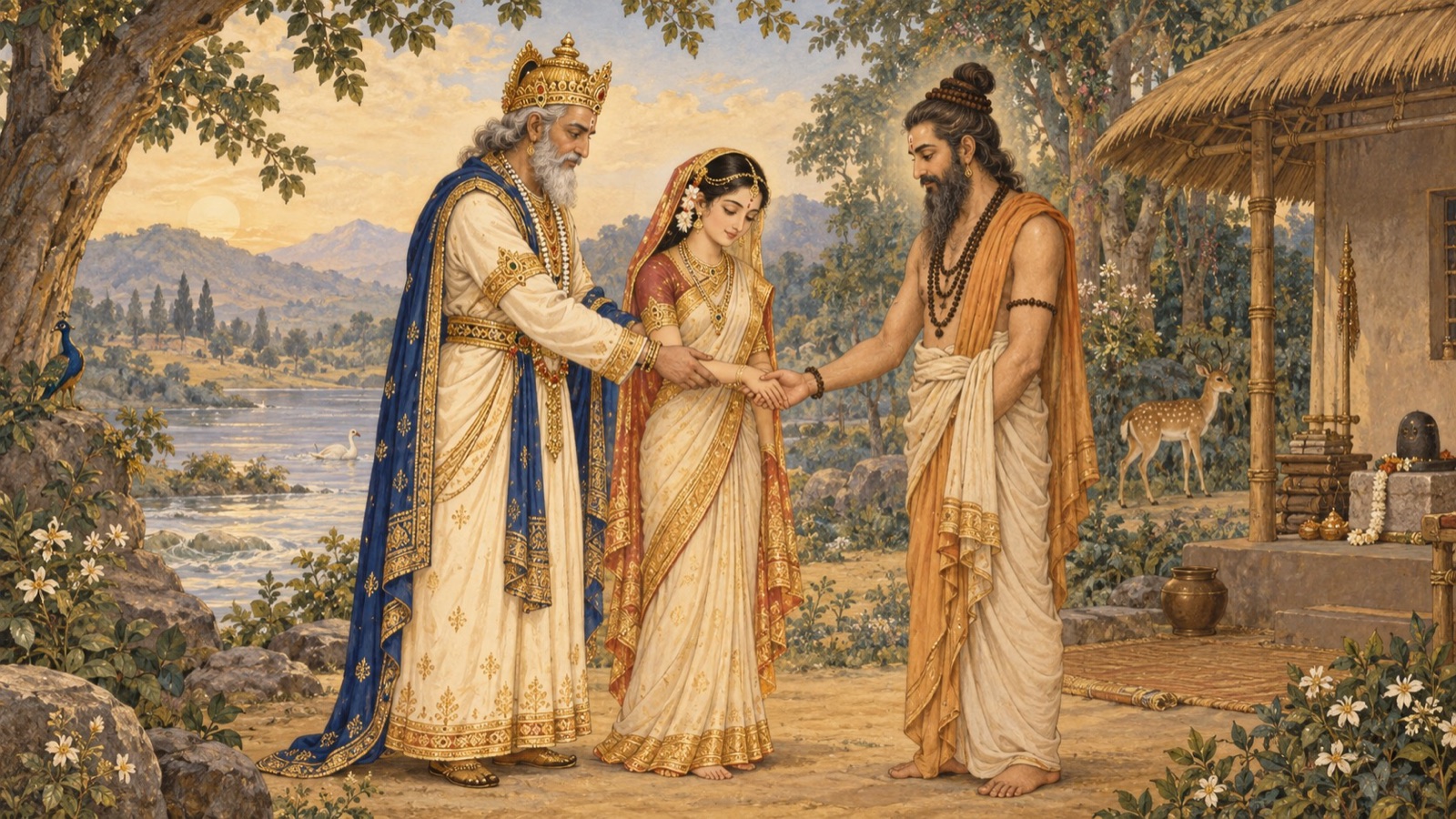
A sage who has spent years in austere solitude on the banks of the Sarasvati is about to become a householder. A king who rules the whole earth is about to become, for one tender moment, simply a father. Between them stands a daughter who has already given her heart away before either man has said a word.
Om Namo Bhagavate Vasudevaya.
Om Namo Bhagavate Vasudevaya.
Om Namo Bhagavate Vasudevaya.
Welcome to Srimad Bhagavatam Wisdom, a devotional journey through the sacred histories and teachings of the Srimad Bhagavat Mahapurana. The twenty-second discourse of Book Three completes a scene this series has been building toward across several chapters: the meeting of two very different kinds of greatness. In the discourse just concluded, Emperor Swayambhuva Manu had journeyed to the hermitage of the sage Kardama Muni and, in a long and generous outpouring, praised the sage’s virtues so extravagantly that Kardama himself, deeply moved, replied in kind — extolling Manu’s own kingship and finally asking, with evident warmth, what purpose had brought so great a monarch to his quiet forest dwelling. Now Maitreya resumes the story exactly there, with Manu forced to answer a question he finds almost as embarrassing to receive as his own praise had been for Kardama to hear a moment before. What follows is one of the most tender and consequential scenes in the entire Third Canto: a father’s offer of his daughter in marriage, a sage’s thoughtful and conditional acceptance, a wedding conducted with the full warmth of two royal houses, and a homeward journey that quietly carries within it the seed of one of the Bhagavatam’s most important theological threads — for the union about to be sealed here is the very one from which Lord Kapila, the great teacher of Sankhya philosophy, will in time take birth.
Chapter Information
- Scripture: Śrīmad Bhāgavata Mahāpurāṇa
- Canto: 3 (Book Three)
- Chapter: 22 (Discourse 22)
- Chapter title: The sage Kardama accepts the hand of Devahuti
- Principal speakers: Sri Suka (outer narrator to King Parikshit, understood throughout), Maitreya (inner narrator to Vidura), Swayambhuva Manu, the sage Kardama
- Principal listener within the chapter’s frame: Vidura, receiving Maitreya’s account
- Main setting: The forest hermitage of the sage Kardama on the banks of the river Sarasvati; the road home to Manu’s capital, Barhismati
- Central subject: Manu’s humble reply to Kardama’s praise; his formal offer of his daughter Devahuti in marriage to the sage; Kardama’s gracious and conditional acceptance; the wedding itself and the giving-away of the bride; the royal couple’s journey home, including the legend of how the city of Barhismati received its name; and a closing summary of Manu’s long and God-centered life
- Principal verse range: Canto 3, Chapter 22, verses 1–39 (Gita Press numbering)
- Primary edition: Gita Press Śrīmad Bhāgavata Mahāpurāṇa
A Father’s Humility Before a Sage’s Praise
The chapter opens on a note of quiet awkwardness. Manu, having just been showered with the sage’s praise for his kingship and character, feels — the Bhagavatam says — abashed, as though caught out by an honor he had not sought and did not feel he fully deserved. Rather than deflecting the compliment with mere modesty, though, Manu answers with something far more substantial: a brief but weighty statement of cosmic theology explaining exactly why a Brahmana and a Kshatriya owe each other the regard they do. The Cosmic Being, Manu explains, who is the Vedas personified, brought forth the Brahmanas — rich in penance, learning, and inward discipline — from His own mouth, for the sake of preserving His own self in the form of scriptural knowledge. That same thousand-footed Being brought forth the Kshatriyas from His thousand arms, for the protection of the Brahmanas in turn. The Brahmana race, Manu says, is thus the Lord’s own heart; the Kshatriya race, His outer limbs. Each order exists to guard the other, and both exist, ultimately, to guard the one Lord who is simultaneously the cause and the effect of it all, and who remains unchanged through every transformation.
अतो ह्यन्योन्यमात्मानं ब्रह्म क्षत्रं च रक्षत: । रक्षति स्माव्ययो देव: स य: सदसदात्मक: ॥ ४ ॥
ato hy anyonyam ātmānaṁ brahma kṣatraṁ ca rakṣataḥ rakṣati smāvyayo devaḥ sa yaḥ sad-asad-ātmakaḥ
Meaning: “For this very reason the Brahmana order and the Kshatriya order protect one another, and in protecting one another they protect their own selves as well — for it is the one imperishable Lord, Himself both cause and effect, who accomplishes that protection by working through the two of them together.” (Canto 3, Chapter 22, verse 4)
There is a deeper point folded into this verse that a Vaishnava reader should not pass over too quickly. The Lord does not personally step down to guard either order; the verse itself calls Him avyaya, imperishable and unmoved, even while naming Him as both cause and effect of everything that exists. His protection reaches the world only through the interplay of the very orders He has Himself brought forth — brahminical wisdom safeguarding the kingdom’s dharma, royal strength safeguarding the brahminical order, neither functioning without the other. This is the same reasoning behind the Bhagavatam’s insistence elsewhere that the Lord is nirvikara, without personal exertion of His own: His energies act and cooperate on His behalf, while He remains the unchanging witness behind their motion. To see one’s own place in the world — whatever it is — as one thread in that same living cooperation is itself a form of worship (verses 3-4).
Having laid out this framework, Manu turns to something more personal: his own gratitude at having been able to sit in Kardama’s presence at all. Such a sage, he says, cannot easily be perceived by anyone who has not first subdued his own mind — and Manu counts himself fortunate not merely to have seen him, but to have touched, with his own head, the sacred dust of the sage’s feet. He has been instructed, he says, and a great favor has been done him; he has listened, with an eager and open heart, to Kardama’s charming and illuminating words. It is a striking moment of role-reversal worth pausing over: a few verses earlier it was the sage extolling the king; now it is the emperor of the earth, ruler of every kingdom beneath him, speaking of a forest ascetic’s darshan as the greatest fortune of his life.
A King Offers His Daughter
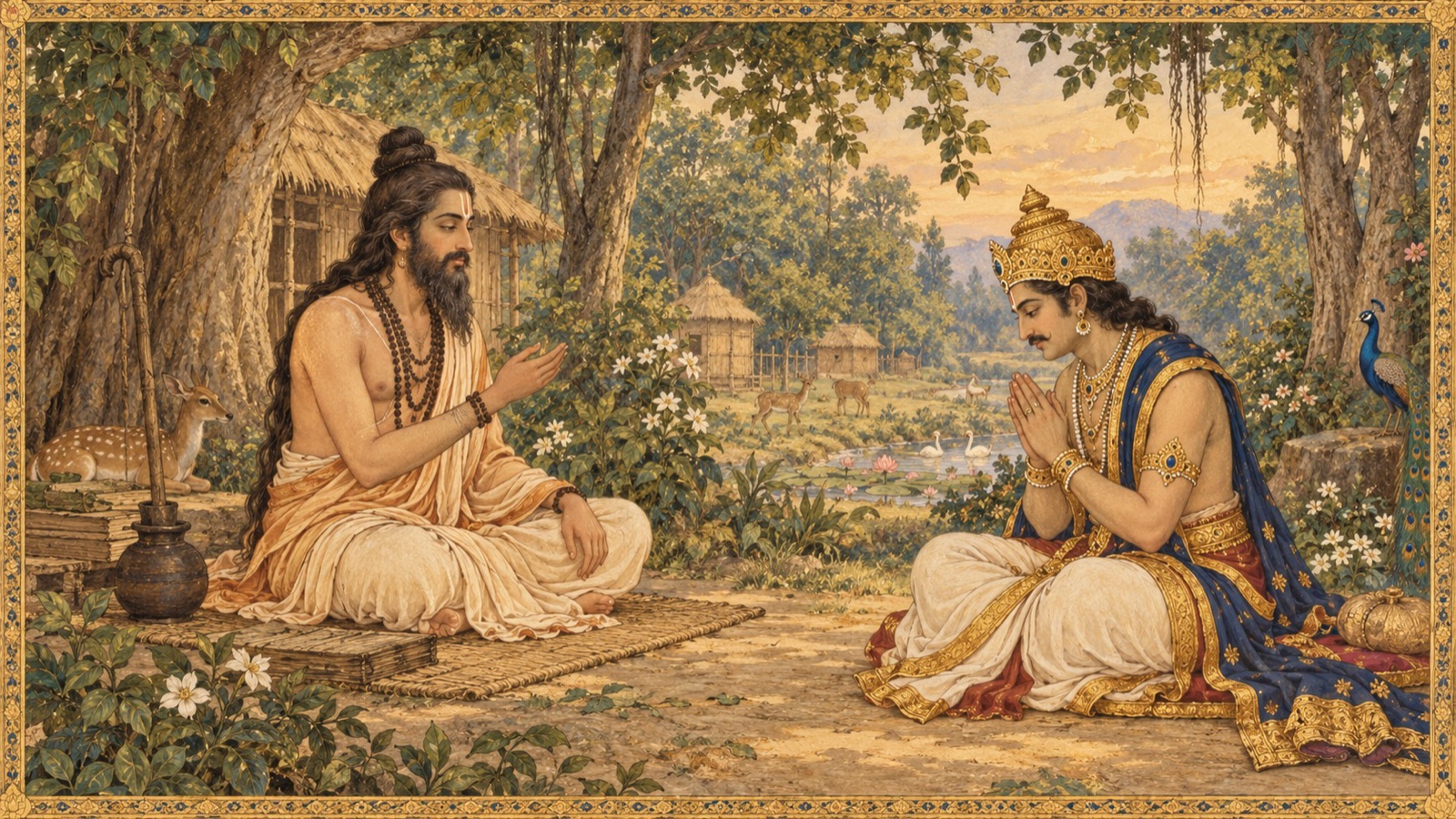
Only after this preamble does Manu finally reveal the actual purpose of his visit, and it is here that the chapter’s real business begins. He asks Kardama’s gracious attention for a request troubled by nothing less than a father’s deepest affection: his daughter Devahuti, sister to the princes Priyavrata and Uttanapada, has reached an age where she is searching for a match worthy of her in years, character, and virtue. And — Manu explains, with what reads as a father’s quiet wonder at his daughter’s own agency in the matter — the moment she heard from the sage Narada an account of Kardama’s noble character, his learning, his youthful comeliness, and his other virtues, she fixed her heart on him, and on him alone. This detail matters: Devahuti’s affection is not arranged for her from nothing: it is her own response to what she has already heard, and Manu is here simply carrying that decision forward into a formal offer.
Manu presses his case with an argument that carries real moral weight in the Bhagavatam’s world. He tells Kardama plainly to accept her, since he offers her with full reverence and since she is, in every respect, fit to be his helpmate in household life. It is not commendable, Manu says — not even for one who is entirely free of worldly attachment, and still less for anyone who retains some taste for the pleasures of the senses — to spurn a desirable object that has come to him unbidden. Worse, he who refuses what is freely given and instead goes begging for it from a miserly source loses his good name altogether, and his pride is humbled by the very disrespect of others. Manu closes his appeal on a note that is almost gently teasing: he has heard, he says, that Kardama himself has expressed a wish to marry, and since the sage has taken no vow of perpetual celibacy, there can surely be no real obstacle to accepting the hand that is now being so earnestly offered.
The Sage’s Conditions, and a Captivated Heart
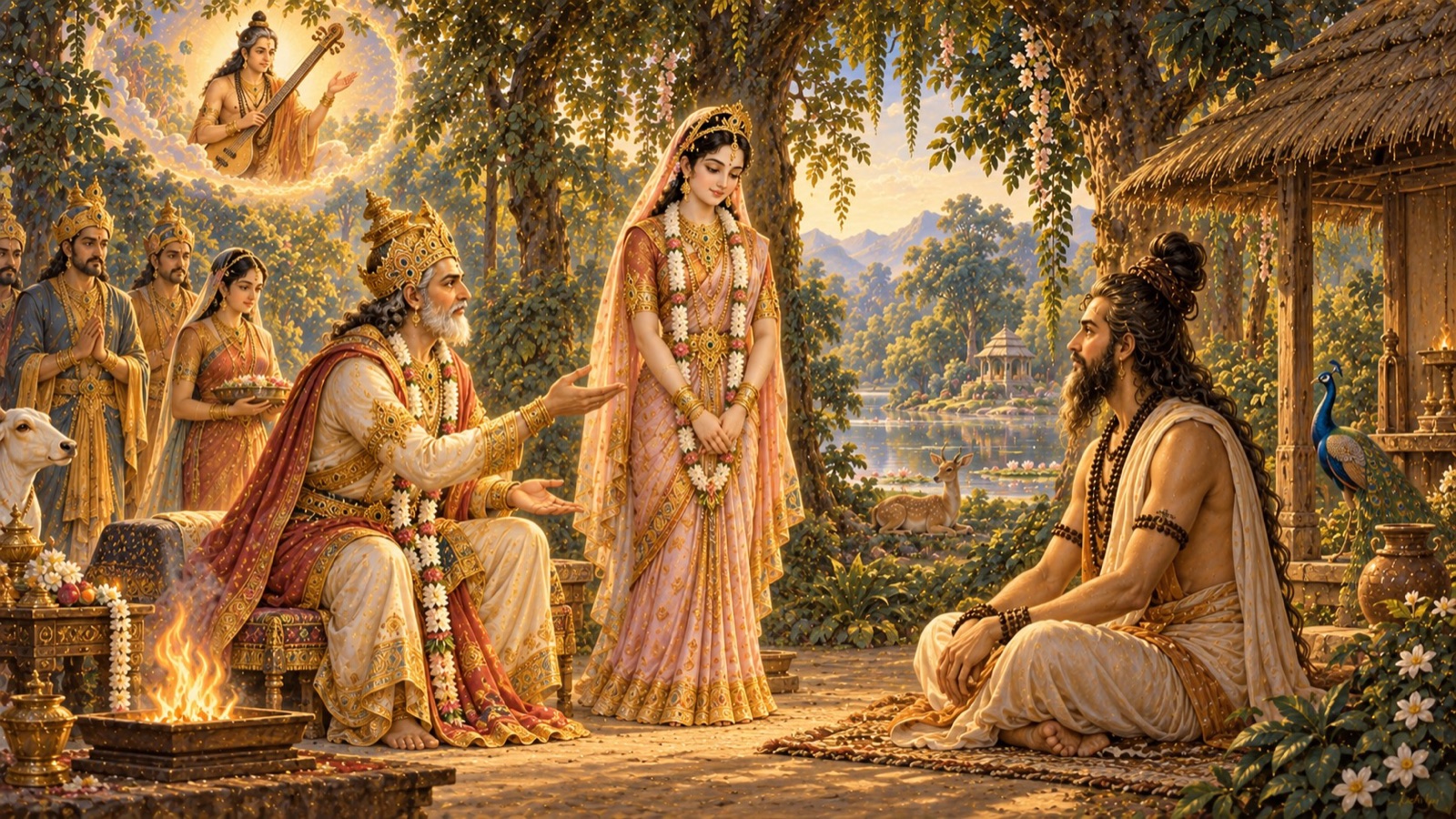
Kardama’s reply is gracious, direct, and — in keeping with the character the Bhagavatam has already shown him to be — carefully considered rather than merely swept along by circumstance. Yes, he says plainly, he does indeed wish to marry, and since Devahuti has not yet been promised to anyone else, their union by the Brahma method of marriage — recognized by the scriptures as the most excellent of all such forms — will be entirely fitting. He then turns to praise Devahuti herself in terms that place her firmly among the great women of the tradition: so radiant, he says, that her own natural splendor outshines even the ornaments she wears; so captivating that, on one earlier occasion while at play atop her royal mansion, a celestial musician named Vishvavasu, glimpsing her, was so overcome with infatuation that he fell from his very aerial chariot. What wise man, Kardama asks, would not welcome such a woman — the beloved daughter of Manu himself, sister of Uttanapada, one who cannot even be perceived by those who have not first adored the feet of the Lord, and who has, moreover, come seeking his hand of her own accord?
But Kardama does not accept unconditionally, and his condition is the theological heart of this entire episode. He will take Devahuti as his wife, he says, only for so long as it takes her to bear, through him, a portion of his own spiritual potency — after which he intends to turn almost entirely toward the practices of renunciation, the non-violent disciplines that mark the life of a true Samnyasi, disciplines that have been taught to him directly by the Lord Himself.
अतो भजिष्ये समयेन साध्वीं यावत्तेजो बिभृयादात्मनो मे । अतो धर्मान् पारमहंस्यमुख्यान् शुक्लप्रोक्तान् बहु मन्येऽविहिंस्रान् ॥ १९ ॥
ato bhajiṣye samayena sādhvīṁ yāvat tejo bibhṛyād ātmano me ato dharmān pāramahaṁsya-mukhyān śukla-proktān bahu manye ‘vihiṁsrān
Meaning: “I shall remain joined to this virtuous woman on this one understanding — that she is to carry, through me, a portion of my own inner potency; beyond that, I hold in high regard only those foremost, non-violent duties of the paramahamsa which the radiant Lord Himself has proclaimed.” (Canto 3, Chapter 22, verse 19)
His highest authority in this matter, he says plainly, is none other than the immortal Lord Sri Hari, ruler of even the lords of creation, from whom the entire wondrous universe has emanated, in whom it now rests, and into whom it will one day dissolve again. This “portion of his own spiritual potency” Kardama speaks of here is a direct anticipation of Lord Kapila — the great teacher-incarnation whose birth to Kardama and Devahuti will form the climax of this section of the Third Canto. The marriage being arranged in this chapter is not, in other words, an ordinary household matter; it is the arranged meeting-point of a divine descent still several chapters away.
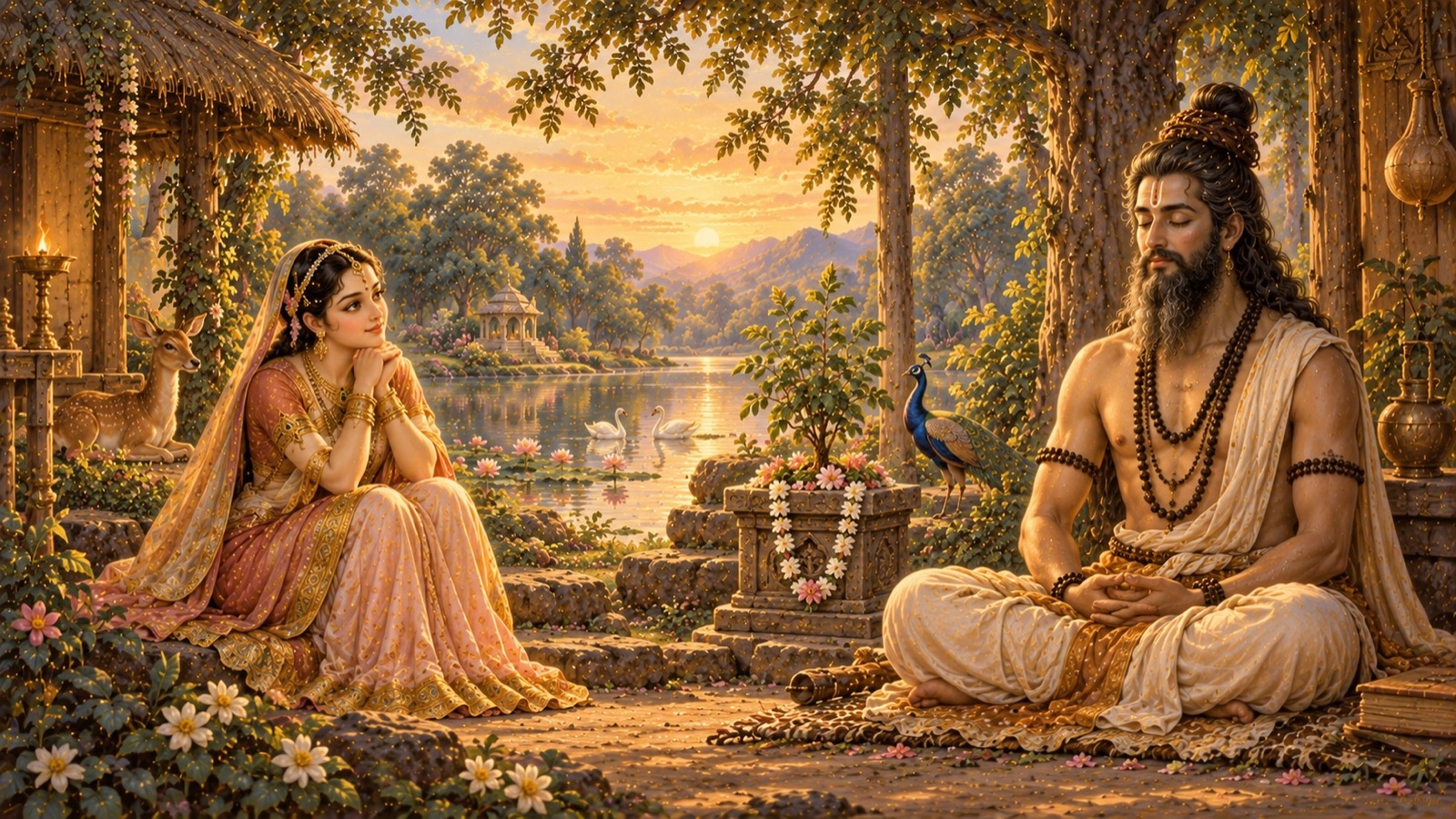
Having said this much, Kardama falls silent — his mind, Maitreya says, clinging entirely to the Lord whose navel bears the lotus. And it is in this very silence, this inward absorption, that the chapter’s most gently human moment occurs: his countenance, graced by a quiet smile, captivates the heart of Devahuti, who has evidently been present and listening throughout this entire exchange.
मैत्रेय उवाच स उग्रधन्वन्नियदेवाबभाषे आसीच्च तूष्णीमरविन्दनाभम् । धियोपगृह्णन् स्मितशोभितेन मुखेन चेतो लुलुभे देवहूत्या: ॥ २१ ॥
maitreya uvāca sa ugra-dhanvann iyad evābabhāṣe āsīc ca tūṣṇīm aravinda-nābham dhiyopagṛhṇan smita-śobhitena mukhena ceto lulubhe devahūtyāḥ
Meaning: “Sri Maitreya said: To the mighty-bowed Vidura, the sage spoke only this much and then fell silent, his thought held fast upon the lotus-naveled Lord; and it was that very silence, lit by a gentle smile upon his face, that stole away the heart of Devahuti.” (Canto 3, Chapter 22, verse 21)
There is something quietly remarkable in how the Bhagavatam handles this: the sage’s most attractive quality, in the very moment his bride’s heart turns fully toward him, is not any display of eloquence or virtue but simply his recollected, God-absorbed stillness.
A Wedding Blessed by Both Houses
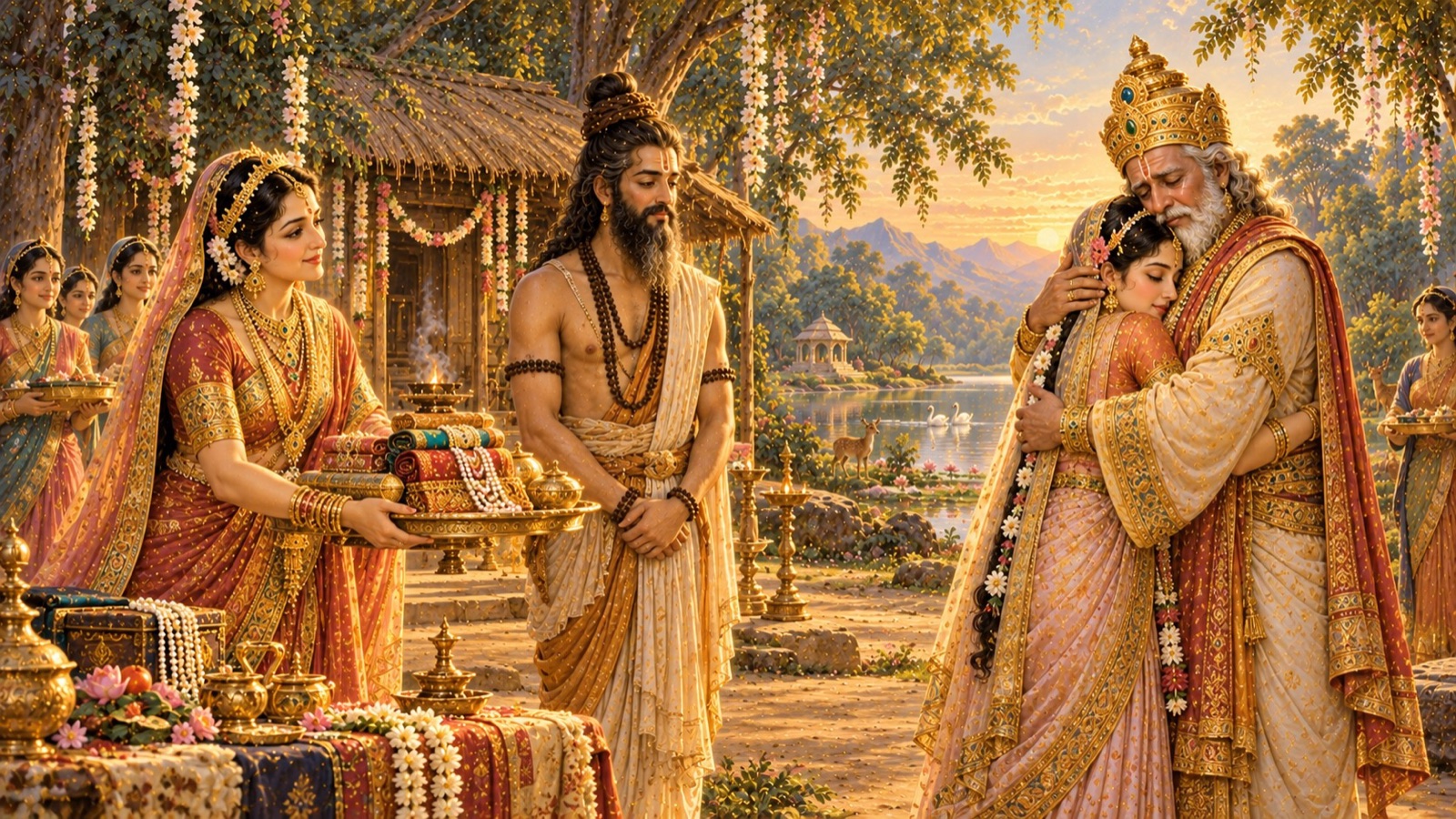
With both parties’ hearts now unmistakably aligned, Manu wastes no further time. Perceiving clearly the decision already settled in the minds of both his queen and his daughter, the emperor most gladly gives Devahuti away to the sage — a match, Maitreya notes, in which the two are well suited to one another in virtue. Empress Satarupa, for her part, showers the bride and bridegroom with valuable wedding gifts befitting the occasion: jewellery, fine garments, and other articles suited to setting up a household. It is a moment of full, unreserved celebration on both sides, royal generosity meeting ascetic dignity without either seeming out of place beside the other.
And yet the chapter does not let the moment pass without also showing us its cost. Relieved as he is to have settled his daughter with so worthy a match, Manu cannot help but be overcome, in the same breath, by the ordinary grief of any father giving away a beloved child. He embraces Devahuti within his arms, his heart agitated with an affection he can no longer contain, and — unable to bear the thought of separation from her — weeps again and again, his tears falling on his daughter’s face, crying out, “My daughter, my darling!” It is a small but deeply human detail, and one the Bhagavatam clearly does not consider beneath its dignity to record: even amid the fulfillment of a destiny that will one day bring the Lord Himself into the world as Devahuti’s son, a father’s ordinary sorrow at losing his daughter to marriage is given its full and unembarrassed due.
Homeward to Barhismati
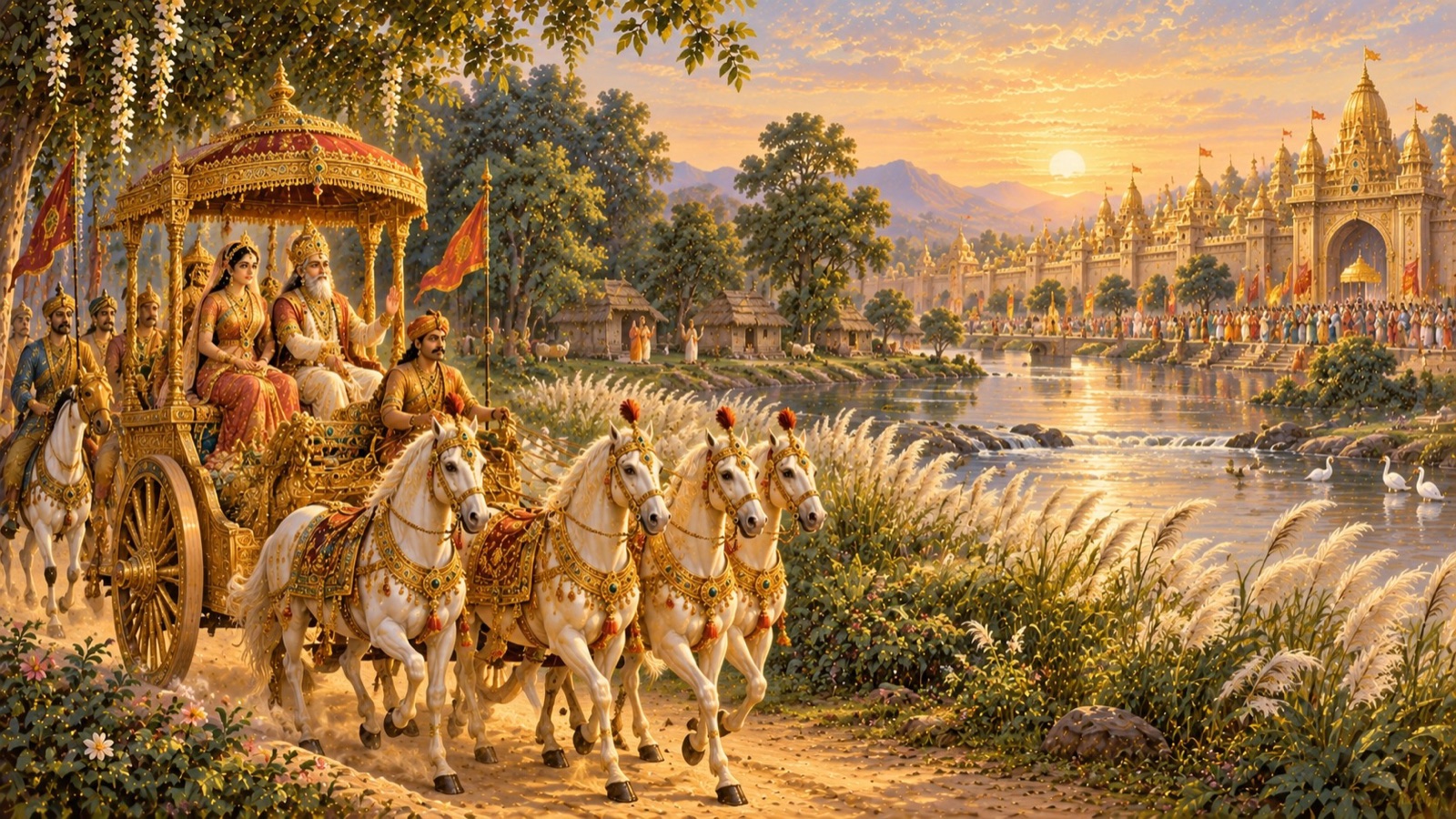
With the wedding concluded, Manu takes his leave of the great sage and, together with his queen, mounts his chariot for the journey home, his retinue following behind. Their route carries them along both banks of the river Sarasvati, a river the text calls especially agreeable to sages, and the emperor’s party passes the beautiful hermitages of tranquil-minded seers along the way — a fitting closing image for a journey that began, after all, at one such hermitage. Word of the emperor’s approach travels ahead of him, and his subjects, overjoyed, come out from the city of Brahmavarta to greet their returning lord with songs, praise-hymns, and instrumental music.
Their destination is Barhismati, Manu’s own capital, described here as rich in every kind of wealth — and the Bhagavatam pauses at this point to explain, with evident relish for the etymological legend, precisely how the city came by that name. Long before, when Lord Vishnu had manifested as the divine Boar and, in the course of His great work, shook His own body, hairs fell from Him to the earth. Those very hairs, the Bhagavatam tells us, turned into blades of the evergreen Kusa grass — also called Barhis — and Kasa grass, the reed-like plant used even today for mats and roofing. It was by means of these sacred grasses that the sages of old were able to drive away the demons who interfered with their sacrifices, and it was with these grasses that they worshipped Lord Vishnu through those very sacrifices. It was here, precisely, that Manu himself had once spread a seat of Kusa and Kasa grass and propitiated the Lord of sacrifices — the same Lord from whom Manu had secured his own footing over the entire terrestrial globe. The city, in other words, is named for the very grass through which Manu’s own royal authority was first sanctified, and that sanctification, the chapter reminds us in passing, traces back to a hair of the divine Boar.
A Life Undisturbed by the World
The chapter’s final movement steps back from the immediate scene of the wedding to offer a summary — almost a eulogy in miniature — of Manu’s entire remaining life. Arriving at his palace in Barhismati, Manu enters a home the Bhagavatam says drove away all three types of agony: that which arises from one’s own body and mind, that which comes from divine or natural causes beyond anyone’s control, and that which is inflicted by other living beings. There, surrounded by wife and children, he enjoyed the pleasures proper to household life — never in a way that interfered with the deeper pursuits of dharma, artha, and moksha — while celestial musicians, we are told, sang his praises each morning together with their wives. And yet, the Bhagavatam is careful to specify, Manu’s own heart inclined not toward this praise but toward the stories of Sri Hari alone, to which he listened with genuine, loving attention.
What follows is one of the chapter’s quietest but most striking observations: although Swayambhuva Manu was, by his own nature and position, a past master in the very art of creating objects of sense-enjoyment — he was, after all, the progenitor and first king of the human race — none of it could drag him down from his exalted, contemplative mood, so wholly was he devoted to the Lord. His long life, spanning the entirety of a full Manvantara — seventy-one complete rounds of the four ages, Satya, Treta, Dvapara, and Kali — passed not in vain but in continuous engagement with Lord Vasudeva: meditating on His form, chanting His names and glories, worshipping His images, and simply listening to, contemplating, composing, and narrating His stories. Having in this way transcended the three Gunas that ordinarily determine a soul’s destiny, Manu lived out this entire vast span of time in a manner the Bhagavatam clearly holds up as exemplary. Maitreya closes the chapter with a rhetorical question addressed directly to Vidura: how, indeed, can bodily or mental trouble, or any affliction arising from divine, human, or other agency, ever truly touch one who has taken refuge in Sri Hari?
शारीरा मानसा दिव्या वैयासे ये च मानुषा: । भौतिकाश्च कथं क्लेशा बाधन्ते हरिसंश्रयम् ॥ ३७ ॥
śārīrā mānasā divyā vaiyāse ye ca mānuṣāḥ bhautikāś ca kathaṁ kleśā bādhante hari-saṁśrayam
Meaning: No distress — whether it springs from one’s own body, from unseen and celestial powers, or from other men and creatures — can ever lay a hand upon the soul who has taken shelter of Lord Hari. (Canto 3, Chapter 22, verse 37)
Having thus completed the wonderful story of Swayambhuva Manu — first king, friend to all living beings, teacher of dharma to sages who once questioned him — Maitreya turns, in his closing words, to what comes next: the glory of Manu’s own daughter, Devahuti, whose fuller story this series will now take up.
Principal Teachings of This Chapter
1. Genuine virtue answers praise with substance, not false modesty. Rather than merely deflecting Kardama’s praise, Manu responds with a considered theological account of why Brahmana and Kshatriya owe each other mutual protection — teaching that humility, rightly practiced, deepens a conversation rather than closing it (verses 2-4).
2. A gift freely offered should not be refused out of false detachment. Manu’s argument to Kardama — that spurning an unsought gift dishonors both giver and receiver, and that begging elsewhere for what is already offered destroys one’s good name — carries a broader lesson about receiving grace, human or divine, with humility rather than false pride (verses 12-13).
3. A vow, even a joyful one, is strongest when it is conditional on higher purpose. Kardama does not accept marriage as an end in itself; he frames it explicitly as a temporary stage serving a higher spiritual aim, with renunciation and the Lord’s own authority as his ultimate compass (verses 19-20).
4. Spiritual stillness is its own form of attractiveness. It is not eloquence but Kardama’s silent absorption in the Lord that captivates Devahuti’s heart — a reminder that God-consciousness, rightly held, radiates outward without any need for display (verse 21).
5. Ordinary human love and spiritual purpose are not enemies. Manu’s unguarded tears at giving away his daughter, set directly beside the cosmic significance of the marriage he has just arranged, show that the Bhagavatam has no interest in denying or suppressing natural affection even in its most exalted narratives (verses 24-25).
6. A life fully engaged in the world can remain fully devoted to God. Manu’s example — a king, householder, and father who nonetheless passes an entire Manvantara absorbed in the stories and worship of Sri Hari — offers a model of devotion that does not require withdrawal from worldly duty, only right priority within it (verses 33-37).
A Devotional Reflection
There is a particular grace in the way this chapter refuses to separate the sacred from the domestic. A cosmic event is quietly set in motion here — the marriage that will, in time, bring Lord Kapila into the world — and yet the chapter spends as much of its attention on a father’s tears, a mother’s wedding gifts, and a young woman’s heart being won by a smile as it does on theology or destiny. Nothing here feels smaller for being human. Manu’s grief at his daughter’s departure does not compete with the chapter’s larger purpose; it simply sits alongside it, honored in its own right. And Kardama, for his part, shows that even a vow taken toward the highest possible end — the birth of a divine teacher — need not be cold or merely transactional; he speaks of Devahuti’s beauty and worth with genuine warmth before ever mentioning his condition. Perhaps this is the chapter’s quiet lesson: that the sacred and the tender are not two different registers competing for our attention, but one and the same current, moving at once through a father’s embrace, a sage’s silence, and the slow turning of a much larger divine plan.
A Daily Devotional Practice
Today, when you find yourself giving something dear to you away — your time, your effort, a loved one’s independence, or simply a plan you had held tightly — notice whether you can offer it, as Manu does, without either false detachment or resentful reluctance. Let yourself feel whatever grief or attachment is genuinely present, exactly as Manu wept even while rejoicing in his daughter’s good marriage; there is no need to perform a serenity you do not feel. But let that offering, whatever it is, be made in the same spirit Kardama shows in accepting it: gratefully, thoughtfully, and always in service of something greater than the moment itself. Before you make your offering, pause and repeat quietly: “Om Namo Bhagavate Vasudevaya.” Let that remembrance steady you, as it steadied Kardama in his silence, so that whatever you release may be released toward the Lord rather than merely let go.
Conclusion
The twenty-second discourse of Book Three is, on its surface, a wedding chapter — full of formal speeches, generous gifts, tearful farewells, and a joyful homecoming. But beneath that surface, it is doing something far larger: it is quietly assembling the very household from which the Bhagavatam’s great Sankhya teacher, Lord Kapila, will in time take birth, and it is doing so through characters the Bhagavatam clearly wants us to admire in their own right — a sage whose condition for marriage is itself an act of devotion, a princess whose heart chooses wisely and without coercion, and a king whose theology of duty is matched, in the very same breath, by his unguarded love for his daughter. Nothing in this chapter feels rushed, and nothing in it feels merely functional. The Bhagavatam takes its time here, as it so often does, trusting that the smallest human details — a smile, a tear, a wedding gift — are exactly where the divine plan chooses to become visible.
May the divine wisdom of Srimad Bhagavatam awaken pure devotion within our hearts.
Om Namo Bhagavate Vasudevaya.
Jay Shree Madhav.
References and Attribution
- Primary edition: Gita Press, Śrīmad Bhāgavata Mahāpurāṇa (English, complete), Book Three, Discourse 22, internal pages 234–237.
- Series: Srimad Bhagavatam Wisdom · Biswa Sanatan Dharma Seva Trust.
- Presented following the spiritual guidance and recommendation of Pandit Dr. Shri Kashinath Mishra.
This is an original, faithful retelling in the writer’s own words, with source verses summarized rather than quoted at length. It is not a reproduction of any single publisher’s continuous translation or commentary. No affiliation with or endorsement by any publisher is implied.
Jay Shree Madhav