
Maitreya continues his narration to Vidura: how the sage Kardama, moved by years of Devahuti’s silent, devoted service, granted her long-deferred wish — conjuring by his yogic power a wondrous aerial mansion, sending her to a sacred lake where she was transformed and adorned as if newly born, and carrying her through the pleasure-gardens of heaven for what felt, to the devoted couple, no longer than a single hour.
Om Namo Bhagavate Vasudevaya.
Om Namo Bhagavate Vasudevaya.
Om Namo Bhagavate Vasudevaya.
Welcome to Srimad Bhagavatam Wisdom, a devotional journey through the sacred histories and teachings of the Srimad Bhagavat Mahapurana. Discourse XXII closed with Maitreya completing his long account of Swayambhuva Manu — the first king, ever absorbed in the stories of Sri Hari, untouched by the very pleasures he himself had the power to create, whose entire Manvantara passed in devotion rather than distraction. Having finished that story, Maitreya turned to Vidura with a simple invitation: “Now hear of the glory of his daughter.” That daughter is Devahuti, wife of the great sage Kardama, and Discourse XXIII opens exactly there, with the years of quiet, faithful service she gave her husband after her parents had returned to their own kingdom, and with what that long devotion at last drew forth from the sage who received it.
Chapter Information
- Scripture: Śrīmad Bhāgavata Mahāpurāṇa
- Canto: 3 (Book Three)
- Chapter: 23 (Discourse 23)
- Chapter title: Amorous pastimes of Kardama and Devahuti
- Principal speaker: The sage Maitreya, continuing his ongoing narration to Vidura — the whole related by Sukadeva Gosvami to King Parikshit, and by Suta Gosvami to the sage Saunaka and the assembly at Naimisharanya
- Principal listener: Vidura
- Main setting: The hermitage of Kardama on the bank of the river Sarasvati; a wondrous aerial mansion created by Kardama’s yogic power; a sacred lake within it; the heavenly pleasure-gardens and the slopes of Mount Meru, through which the couple travel
- Central subject: Devahuti’s years of unwavering, devoted service to her husband; Kardama’s gratitude and his conferral upon her of a rare vision and boon; the creation of a magnificent aerial mansion at her unspoken wish; her purifying bath in a sacred lake and her miraculous transformation; the couple’s long, joyful life together in that celestial dwelling; the birth of their nine daughters; and, as Kardama prepares to leave for the forest as agreed at their marriage, Devahuti’s sorrowful appeal that he first grant her the promised son
- Principal verse range: Canto 3, Chapter 23, verses 1–57
- Primary edition: Gita Press Śrīmad Bhāgavata Mahāpurāṇa
Devahuti’s Years of Devoted Service
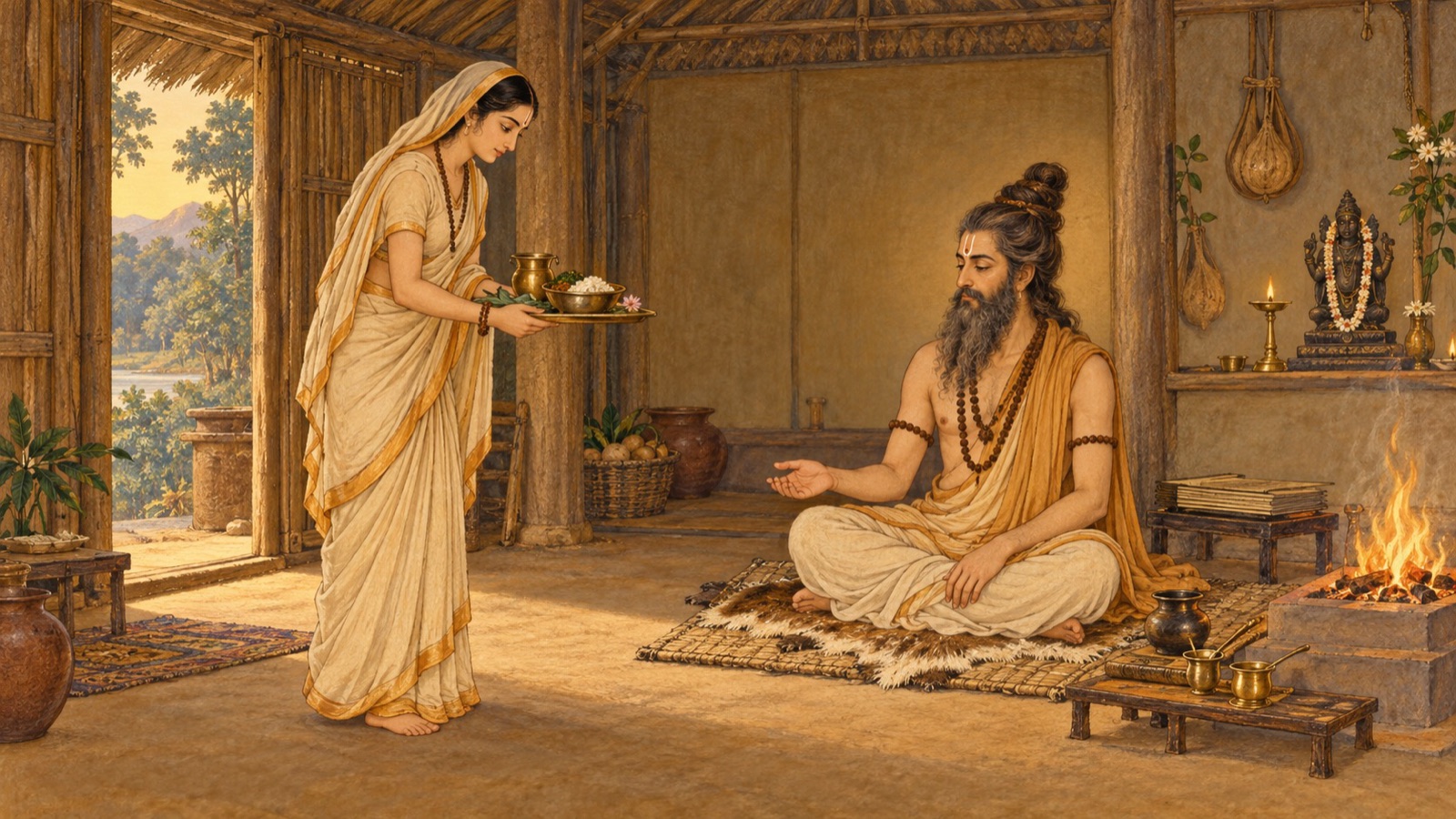
Maitreya begins not with Kardama but with Devahuti herself, and the emphasis is deliberate. Once her parents — Swayambhuva Manu and his queen Satarupa — had departed for their own capital after the wedding, the newly married princess settled into a life of unbroken attentiveness to her husband. Maitreya reaches for the highest comparison available to him: Devahuti served Kardama daily, with the same loving care that Goddess Parvati (Bhavani) shows her own consort, Lord Siva (Bhava). It is a comparison that immediately elevates what might otherwise read as ordinary marital duty into something closer to worship — a wife who could read her husband’s mind and needs before he voiced them, and who met those needs not from obligation but from genuine delight.
मैत्रेय उवाच । पितृभ्यां प्रस्थिते साध्वी पतिमिङ्गितकोविदा । नित्यं पर्यचरत्प्रीत्या भवानीव भवं प्रभुम् ॥ १ ॥
maitreya uvāca pitṛbhyāṁ prasthite sādhvī patim iṅgita-kovidā nityaṁ paryacarat prītyā bhavānīva bhavaṁ prabhum
Meaning: Maitreya said: When her parents had departed, the virtuous Devahuti, ever skilled at reading her lord’s mind, daily attended upon him with the same loving delight that Bhavani (Parvati) shows in serving her own consort Bhava (Lord Siva). (Canto 3, Chapter 23, verse 1)
What follows this opening verse is a fuller portrait of the character behind that devotion. Maitreya tells Vidura that Devahuti forswore lust, deceit, malice, covetousness, vanity, and every forbidden act; that she remained ever vigilant and active in her husband’s service; and that she won his pleasure through fidelity, purity of mind and body, reverence, control of the senses, genuine service, love, and affable speech — a description that reads almost like a catalogue of the qualities that make devoted partnership possible in the first place. She regarded her husband as greater even than Providence itself, fully devoted, expecting from him blessings beyond the ordinary. And her devotion cost her something real: years of such service, offered with such intensity, left her visibly weakened and emaciated by her own religious observances. It was this — not a request, not a complaint, but the simple, visible evidence of what her devotion had already cost her — that moved Kardama to compassion and prompted him, at last, to speak to her in accents faltering with love.
Kardama’s Gratitude and the Boon of Vision
Kardama’s response to what he sees in his wife is, first of all, an acknowledgment. He tells her plainly that he is pleased — that her faithful service and supreme devotion have earned his genuine gratitude, and that she has ungrudgingly spent her own body, dear as the body is to every living being, entirely in his service. It is worth noting how the sage frames this: not as something owed to him by virtue of marriage, but as a gift freely and repeatedly given, one he now intends to repay.
कर्दम उवाच । तुष्टोऽहमद्य तव मानवि मानदायाः शुश्रूषया परमया परया च भक्त्या । यो देहिनामयमतीव सुहृत्स देहो नावेक्षितः समुचितः क्षपितुं मदर्थे ॥ ६ ॥
kardama uvāca tuṣṭo ‘ham adya tava mānavi mānadāyāḥ śuśrūṣayā paramayā parayā ca bhaktyā yo dehinām ayam atīva suhṛt sa deho nāvekṣitaḥ samucitaḥ kṣapituṁ mad-arthe
Meaning: Kardama said: O daughter of Manu, you who grant honour to others, I am pleased today with your most excellent service and supreme devotion — for you have not hesitated to wear out, for my sake, this very body that is the dearest friend of every embodied soul. (Canto 3, Chapter 23, verse 6)
The gift Kardama then offers is striking in its nature: not immediately the son she has long hoped for, but supernatural vision — the capacity to see for herself the unearthly blessings he has secured through his own austere penance, deep meditation, worship, and unwavering devotion to duty. These are blessings, he tells her, entirely free from fear and grief, and blessings to which her own faithful service has now earned her a rightful share. He adds a further, almost philosophical aside: what are the pleasures of heaven itself worth, he asks, when even the aspirations of the celestial worlds can be frustrated by the mere contraction of a brow on the part of the all-powerful Lord? Devahuti, he tells her, has already attained her true object through her fidelity; she may now enjoy pleasures earned through devotion to duty, pleasures that ordinary human beings, caught up in false notions of royal dignity, can scarcely obtain even with difficulty.
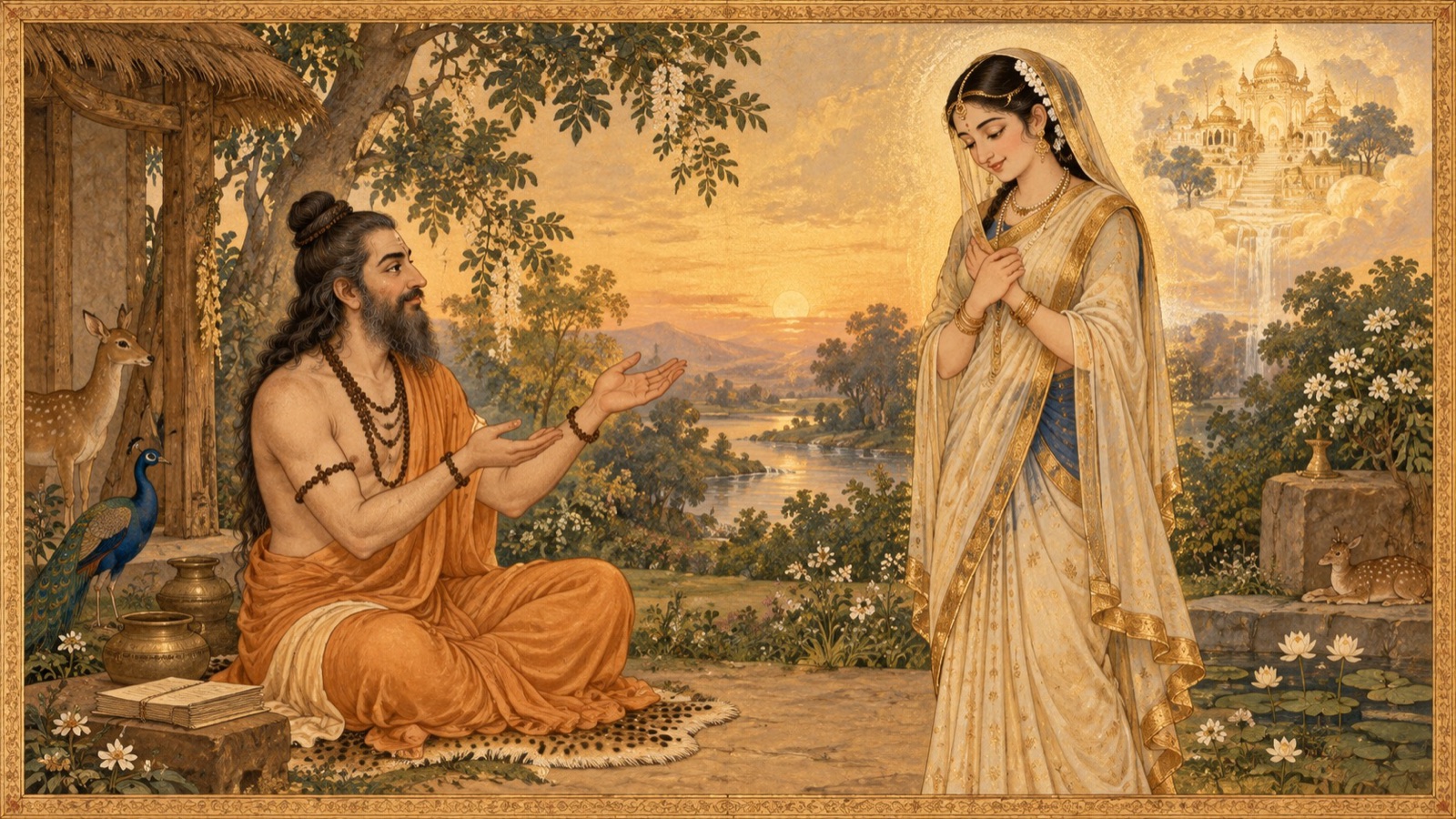
Hearing this, Devahuti’s relief is immediate and visible — she understands, perhaps for the first time with full clarity, that her husband is a complete master of yogic power and every form of worship. Maitreya notes the change in her expression: her face brightens with a smile and bashful glances, and when she speaks, her voice is choked with a mixture of modesty and love.
Devahuti’s Request
What Devahuti asks for, once she finds her voice, is not vague or ornamental — it is the fulfilment of a promise made at the time of her marriage, made in the presence of her own father: that Kardama would grant her the contact of his body, if only once, so that she might bear a child through so venerable a husband. She calls this what it is in the tradition she was raised in — a rare boon for any virtuous wife — and asks her husband, practically and without embarrassment, what preparations the scriptures on such matters call for, and where a suitable dwelling for the purpose might be found. Her request is framed throughout not as indulgence but as the fulfilment of dharma: the securing of progeny through a husband she reveres as greater than Providence itself.
The Aerial Mansion Is Created
Kardama’s answer to his wife’s request is not a house built by hand but a marvel summoned by yogic power. Maitreya tells Vidura, almost matter-of-factly, that the sage simply exercised his wonderful spiritual attainment and at once produced an aerial mansion capable of travelling wherever it was desired.
मैत्रेय उवाच । प्रियायाः प्रियमन्विच्छन् कर्दमो योगमास्थितः । विमानं कामगं क्षत्तस्तर्ह्येवाविरचीकरत् ॥ १२ ॥
maitreya uvāca priyāyāḥ priyam anvicchan kardamo yogam āsthitaḥ vimānaṁ kāma-gaṁ kṣattas tarhy evāviracīkarat
Meaning: Maitreya said: O Vidura, wishing to please his beloved, Kardama resorted to his yogic power and instantly created an aerial mansion capable of travelling wherever one desired. (Canto 3, Chapter 23, verse 12)
What Maitreya describes next is less a residence than a vision of paradise rendered in architecture: a structure adorned with every kind of jewel, pillars of precious stone, and a wealth that multiplied with use rather than diminishing; furnished with articles of supernatural convenience, comfortable in every season, decorated with flags and buntings of every colour; embellished with garlands of flowers so fragrant they drew the humming of bees, and hung with tapestries of the finest linen and silk. Its many storeys held cushions, beds, fans, and seats arranged with evident care; its walls carried fine engravings and works of art; its floors were paved with emerald and coral. Diamond doors stood in coral thresholds; sapphire domes wore crowns of gold; rubies set into the diamond walls made the whole structure seem to gaze back at its beholder with living eyes; golden festoons and wonderful canopies completed the effect. Even the birdsong was uncanny — swans and pigeons carved or conjured into the architecture were mistaken for living companions by the actual birds that flew up to greet them. The mansion held pleasure-grounds, resting chambers, and both inner and outer courtyards, arranged with such attentive comfort that it is said to have astonished even Kardama himself, its own creator.

Devahuti Is Sent to the Sacred Lake
For all its splendour, the mansion alone does not fully satisfy what Kardama perceives in his wife’s heart — reading the minds of all beings as he can, he notices that even so magnificent a house has not delighted her as much as he had hoped. So he directs her, gently, toward something else first: a nearby lake, consecrated, he tells her, by the very tears Lord Vishnu Himself once shed into its waters, and capable of granting any desire to those who bathe there.
कर्दम उवाच । निमज्ज्यास्मिन् हृदे भीरु विमानमिदमारुह । इदं शुक्लकृतं तीर्थमाशिषां यापकं नृणाम् ॥ २३ ॥
kardama uvāca nimajjyāsmin hrade bhīru vimānam idam āruha idaṁ śukla-kṛtaṁ tīrtham āśiṣāṁ yāpakaṁ nṛṇām
Meaning: Kardama said: O timid one, bathe in this sacred lake and then ascend this aerial mansion; for this lake, consecrated by Lord Vishnu Himself, is capable of fulfilling the desires of all who resort to it. (Canto 3, Chapter 23, verse 23)

Devahuti’s Bath and Her Celestial Transformation
What happens next is presented by Maitreya as a wonder rather than a mere bath. Devahuti, still bearing the outward marks of her long years of austere service — soiled garments, matted hair, a body dulled by dust and hardship — bows to her husband’s word and enters the lake, whose waters are identified with the sacred Sarasvati herself. Beneath the surface she discovers an entire hidden world: a house filled with a thousand maidens in the full bloom of youth, radiant and fragrant as lotuses, who rise at once on seeing her and offer themselves, with joined palms, as her attendants.
What these attendants do for Devahuti is described in the text as an act of purification and restoration rather than ornamentation for its own sake — the removal, at last, of every trace of the hardship her devotion had cost her. She is bathed, anointed, and clothed anew; given jewels, nourishing food, and refreshing drink; and when she finally looks into a mirror, she sees a woman entirely transfigured — cleansed of every mark of austerity, adorned, and radiant. Her original beauty, the Bhagavatam says, is restored to her in full: her countenance shines, her ornaments gleam, and she stands, in Maitreya’s careful telling, no longer as the weary ascetic’s wife but as someone renewed. The moment she thinks of her husband, she and her thousand attendants find themselves instantly transported to wherever he is — a small, quiet demonstration that the wonder she has just witnessed is entirely of a piece with the yogic power that shaped it.

Ascending the Mansion and Life in the Heavenly Gardens
Kardama, seeing his wife transformed and no longer the weary figure she had been, is filled with tender affection and helps her ascend the aerial mansion, now attended by her thousand celestial companions. Maitreya is careful here to note something important about the sage himself: even amid this splendour, even surrounded by attentive Vidyadhara maidens and a devoted, radiant wife, Kardama does not lose his inner mastery — his glory as a self-controlled yogi remains wholly intact. The comparison Maitreya reaches for is celestial rather than earthly: Kardama in that mansion, with Devahuti at his side, resembles the moon shining alongside its consort star Rohini amid the other lunar mansions of the heavens, an image of harmony rather than mere indulgence.
Extolled by hosts of Siddhas and served by their attendant maidens, the couple travel through the pleasure-grounds of Mount Meru itself — the mountain that serves as the playground of the guardians of all eight directions — where cool, fragrant breezes carry the sound of the sacred Ganga’s descent from heaven. They pass, in turn, through the celebrated heavenly gardens of Vaisrambhaka, Surasana, Nandana, Puspabhadra, and Caitrarathya, and over the tranquil waters of Manasarovara. Coursing through the skies in a mansion that could fly at will, Kardama is said to surpass even the gods themselves in his freedom of movement, since the gods, Maitreya notes, remain bound to their own particular spheres. Maitreya closes this movement of the chapter with a reflection rather than a further description: what, he asks Vidura, is truly difficult of attainment for those self-possessed souls who have taken refuge at the feet of the Lord — feet from which sacred rivers like the Ganga themselves flow, and which put an end to every sorrow of worldly life?

Return, the Nine Forms, and the Birth of Nine Daughters
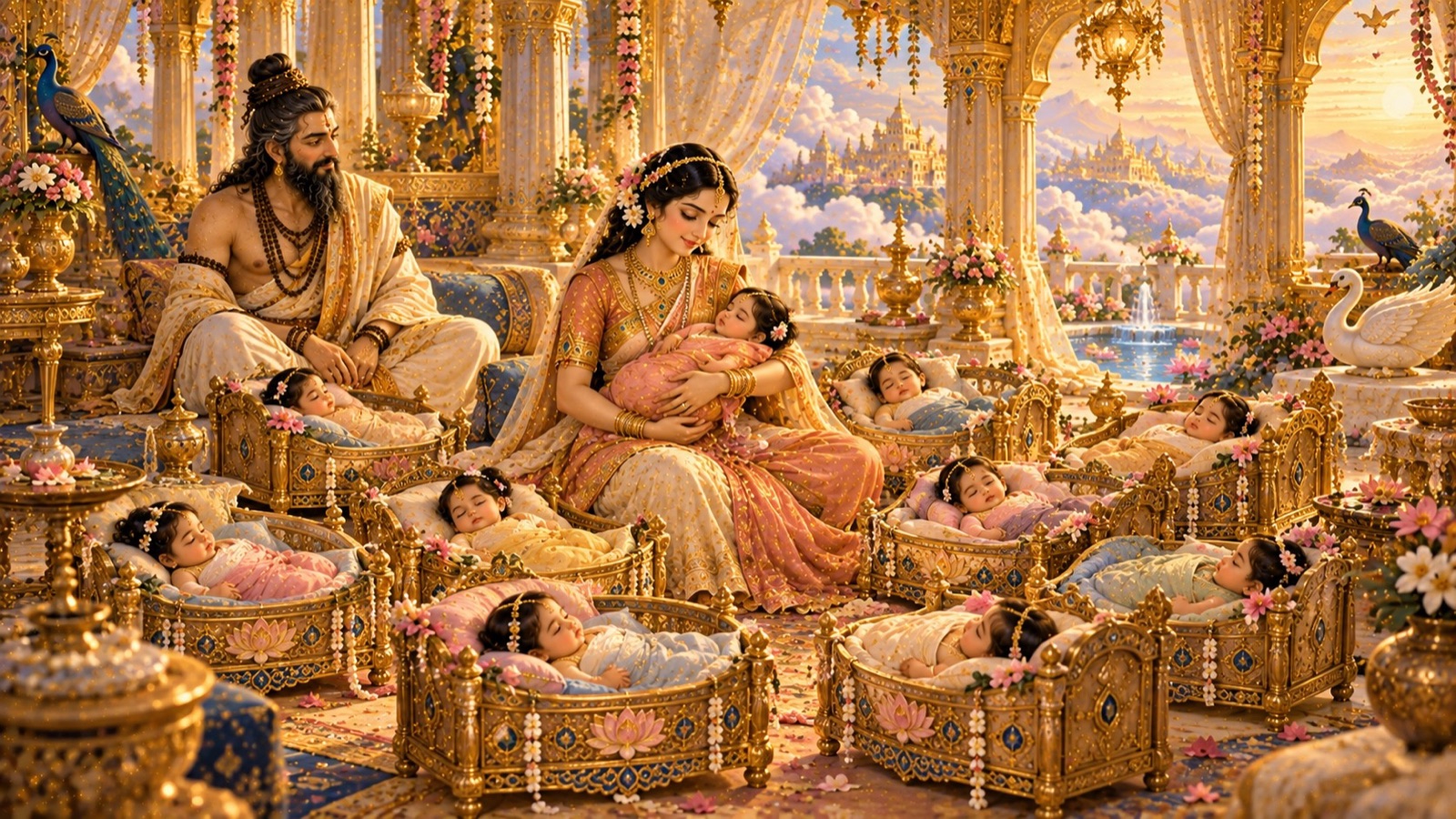
Eventually, having shown his wife the wonders of the wider world, Kardama brings the aerial mansion back to his own hermitage. It is here that Maitreya narrates the culmination of the couple’s long companionship: wishing to fulfil Devahuti’s own deep longing for union with him, the sage divided his single self into nine forms, so that years of shared life together passed, for the couple, with the swiftness of a single hour. A hundred autumns are said to have gone by as though they were but a brief moment, so complete was their absorption in one another through the sage’s yogic power.
मैत्रेय उवाच । विभज्य नवधात्मानं मानवीं सुरतोत्सुकाम् । रामां निरमयन् रेमे वर्षपूगान्मुहूर्तवत् ॥ ४४ ॥
maitreya uvāca vibhajya navadhātmānaṁ mānavīṁ suratotsukām rāmāṁ niramayan reme varṣa-pūgān muhūrtavat
Meaning: Maitreya said: Dividing himself into nine forms in order to fulfil the deep longing of his wife, the daughter of Manu, for union, the sage delighted her, and many years passed together for the couple as though they were but a single hour. (Canto 3, Chapter 23, verse 44)
What follows this remarkable act of yogic devotion is its natural fruit: regarding Devahuti with the tenderness one reserves for one’s own self, and having divided his form into nine, Kardama’s union with her bore fruit in the same day — nine daughters, each one lovely in every limb and fragrant as a red lotus, born together. The chapter treats this less as a spectacle than as the natural culmination of a marriage built, from its very beginning, on mutual devotion, patient service, and the exercise of sacred power in the service of love rather than mere pleasure.
Devahuti’s Sorrowful Appeal
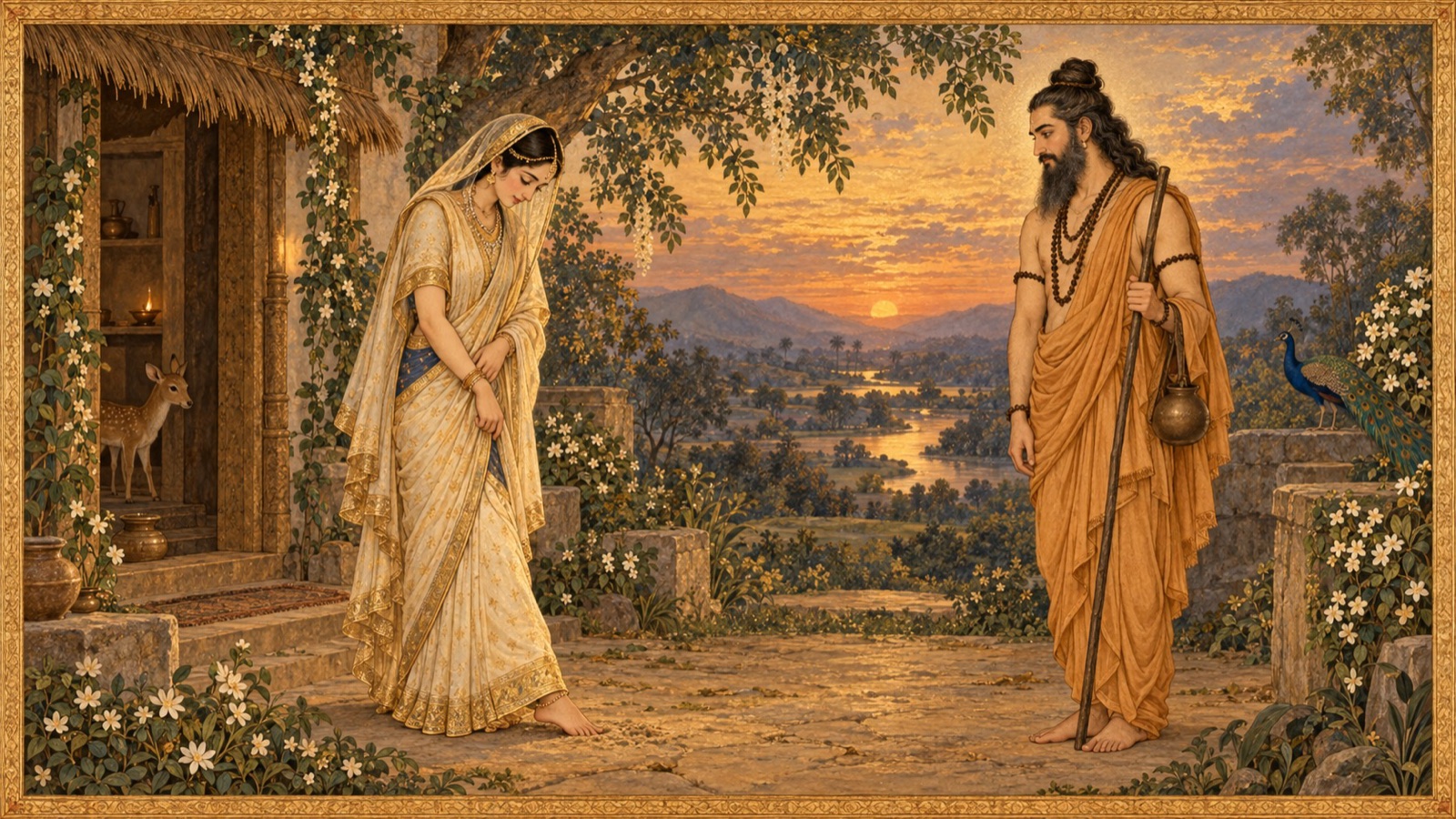
The chapter’s final movement turns, quite suddenly, from celebration to a quiet, aching grief. Kardama, true to the understanding reached at the time of their marriage, now prepares to leave the household life and depart for the forest as a renunciate. Devahuti, who still longs for one thing above all — a son, promised but not yet given — finds herself unable to hide her sorrow. Maitreya’s description of her in this moment is tender and precise: she scratches at the ground with a foot whose nails gleam like gems, her head bowed low, and though she wears a smile on her face, she speaks in slow, careful words shaped by a heart visibly agitated and aching, suppressing tears even as she forms them.
Her words to Kardama acknowledge everything he has already given her — every promise he made has been kept — even as she asks for one thing more: not indulgence, but protection from fear, since she has taken shelter in him completely. Her daughters, she notes with the practical concern of a mother, will each need a suitable match found for them; and she herself, once he departs, will need someone to comfort her in the sorrow of his absence. She reflects, with unflinching honesty, on the time she has already spent enjoying the objects of the senses while forgetting the Supreme Spirit, admitting that her love for Kardama, however genuine, arose without her fully knowing his transcendent glory — and yet she asks that this same love, imperfect as its origin may have been, still be the very thing that frees her from all fear.
देवह्यूतिरुवाच । सङ्गो यः संसृतेर्हेतुरसत्सु विहितोऽधिया । स एव साधुषु कृतो निःसङ्गत्वाय कल्पते ॥ ५५ ॥
devahūtir uvāca saṅgo yaḥ saṁsṛter hetur asatsu vihito ‘dhiyā sa eva sādhuṣu kṛto niḥsaṅgatvāya kalpate
Meaning: Devahuti continued: The same bond of attachment that, fixed unknowingly upon the ungodly, chains the soul to the wheel of birth and death becomes, when that very attachment is placed instead upon the saintly, the means by which one is freed from all attachment. (Canto 3, Chapter 23, verse 55)
It is a striking claim for her to make of her own marriage: whatever first drew her to Kardama, that same bond, she now sees, has already been doing the quiet work of freeing her. In the next breath she turns from what such association gives to what its absence costs.
नेह यत्कर्म धर्माय न विरागाय कल्पते । न तीर्थपदसेवायै जीवन्नपि मृतो हि सः ॥ ५६ ॥
neha yat karma dharmāya na virāgāya kalpate na tīrtha-pada-sevāyai jīvann api mṛto hi saḥ
Meaning: Any work that does not carry one toward righteousness, any renunciation that does not carry one toward genuine detachment, and any pursuit that does not carry one toward service at the feet of the Lord — a life spent in nothing more than such activity, she says, is death wearing the appearance of breath. (Canto 3, Chapter 23, verse 56)
There is a deeper current running beneath these two verses that this chapter has been quietly building toward all along. Devahuti did not come to Kardama in search of liberation; by her own account moments earlier, she came seeking a husband, a household, and children. Yet the very point she now makes is that association entered into for such ordinary reasons still ripens, of its own accord, into freedom, the instant the one associated with is himself surrendered to the Lord. The nine daughters already born of this marriage are Devahuti’s family in the fullest sense; but the son she is about to ask for will, in time, become Lord Kapila himself — her own liberator and teacher. Her attachment to Kardama, sought for one reason, was already carrying her, unseen, toward another (verses 53–56).
And she closes with an admission of her own that carries the whole weight of the chapter’s final turn: she has, she says, surely been deceived by the Lord’s own Maya, in that she failed to seek liberation from worldly bondage even after securing, in her own husband, the very bestower of final beatitude.
देवह्यूतिरुवाच । साहं भगवतो नूनं वञ्चिता मायया दृढम् । यत्त्वां विमुक्तिदं प्राप्य न मुमुक्षेय बन्धनात् ॥ ५७ ॥
devahūtir uvāca sāhaṁ bhagavato nūnaṁ vañcitā māyayā dṛḍham yat tvāṁ vimuktidaṁ prāpya na mumukṣeya bandhanāt
Meaning: Devahuti said: Surely I have been deeply deceived by the Lord’s Maya, in that, having attained you — the very bestower of liberation — I did not seek release from the bondage of worldly life. (Canto 3, Chapter 23, verse 57)
With this appeal, the twenty-third discourse comes to its close — its own colophon describing it, notably, as forming part of the narrative of Lord Kapila, the divine incarnation whose birth this whole sequence of events is quietly building toward. Devahuti’s sorrow here is not despair; it is the honest ache of someone who has glimpsed, through her own husband’s power and grace, just how much more remains possible — and who now, at the threshold of his departure, asks for the one gift that will let that possibility be fulfilled.
Principal Teachings of This Chapter
1. Devotion offered without demand is eventually, and abundantly, answered. Devahuti’s years of silent, uncomplaining service — costly enough to visibly weaken her — are what move Kardama to grant her far more than she asked for; the chapter suggests that sincere devotion carries its own quiet power to draw forth grace (verses 1-9).
2. Spiritual mastery and worldly splendour need not corrupt one another. Even amid a mansion of unimaginable wealth and the company of celestial attendants, Kardama’s yogic self-mastery remains wholly unshaken — a reminder that renunciation is a quality of the heart, not merely a circumstance of one’s surroundings (verses 12-21, 36-42).
3. Sacred power, rightly used, serves love rather than replacing it. Kardama’s yogic feats throughout this chapter — the mansion, the transformation of Devahuti, the multiplication of his own form — are never displayed for their own sake; each is directed entirely toward his wife’s genuine happiness and the fulfilment of a sacred promise (verses 22-23, 43-44).
4. Even a blessed and abundant life leaves room for deeper longing. Devahuti’s joy in the aerial mansion, her transformation, and the birth of her nine daughters do not exhaust her heart’s true desire; her sorrow at the chapter’s end shows that worldly fulfilment, however real, is not the same as the fulfilment the soul ultimately seeks (verses 49-56).
5. Love, rightly directed, becomes the very means of liberation. Devahuti’s closing reflection — that love given to the unworthy binds while the same love given to the truly holy frees, and that a life never carried toward the Lord’s feet is death wearing the appearance of breath — offers, in three unflinching verses, some of this chapter’s most enduring spiritual insight, and quietly prepares the ground for Lord Kapila’s own teachings on devotion still to come (verses 55–57).
A Devotional Reflection
There is something quietly instructive in how this chapter moves — from years of unseen, unglamorous service, to a marvel conjured seemingly out of nowhere, to a transformation that restores what hardship had worn away, to a companionship so complete that time itself seems to lose its grip, and finally to a grief that arrives not despite all this abundance but alongside it. Devahuti is never simply a passive recipient of her husband’s power; she is shown throughout as someone whose own inner life — her patience, her candour, her eventual longing for something beyond even a celestial mansion — shapes the story as much as Kardama’s yogic gifts do. And Kardama himself, for all his power, is never depicted as diminished by tenderness; his mastery and his affection for his wife are shown, deliberately, as fully compatible. The chapter’s final note — Devahuti’s honest admission that she was, in a sense, too content with what she had been given — is less a criticism of her than an invitation to every reader: even the richest blessings this world can offer, sacred and hard-won as they may be, are meant to point us toward something further still.
A Daily Devotional Practice
Today, consider one relationship in your own life sustained by quiet, unglamorous service — care given without expectation of immediate return. Notice, as this chapter shows, that such devotion is rarely wasted, even when its fruits are slow to appear. And consider, too, Devahuti’s closing honesty: ask yourself whether some blessing you have already received, however real and hard-won, has quietly become an end in itself rather than a doorway toward something greater. Before returning to the demands of your day, pause and repeat quietly: “Om Namo Bhagavate Vasudevaya.” Let that remembrance turn your heart, gently, from contentment with what you have toward the deeper freedom that every true blessing is ultimately meant to lead you.
Conclusion
The twenty-third discourse of Book Three carries Vidura’s story from the glory of Swayambhuva Manu into the tender, richly detailed life of his daughter Devahuti and her husband, the sage Kardama. Maitreya shows us devotion answered by grace: years of unseen service met, at last, with a boon beyond ordinary imagining — a celestial mansion, a purifying and transformative bath, a shared life so complete that a hundred years passed as a single hour, and nine daughters born of a union shaped as much by yogic power as by love. Yet the chapter does not end in simple triumph; it ends with Devahuti’s own honest sorrow, her recognition that even this abundance has not yet given her the one thing dharma still asks of her, and her plea for the courage and protection to meet whatever comes next. It is a chapter suspended, deliberately, between fulfilment and further longing — preparing the ground for Discourse XXIV, in which Kardama’s final promise to his wife opens the way for the birth of Lord Kapila Himself.
May the divine wisdom of Srimad Bhagavatam awaken pure devotion within our hearts.
Om Namo Bhagavate Vasudevaya.
Jay Shree Madhav.
References and Attribution
- Primary edition: Gita Press, Śrīmad Bhāgavata Mahāpurāṇa (English, complete), Book Three, Discourse 23, pages 237–243.
- Series: Srimad Bhagavatam Wisdom · Biswa Sanatan Dharma Seva Trust.
- Presented following the spiritual guidance and recommendation of Pandit Dr. Shri Kashinath Mishra.
This is an original, faithful retelling in the writer’s own words, with brief quoted verses shown in Devanāgarī and transliteration and their meanings given as summaries. It is not a reproduction of any single publisher’s continuous translation or commentary. No affiliation with or endorsement by any publisher is implied.
Jay Shree Madhav