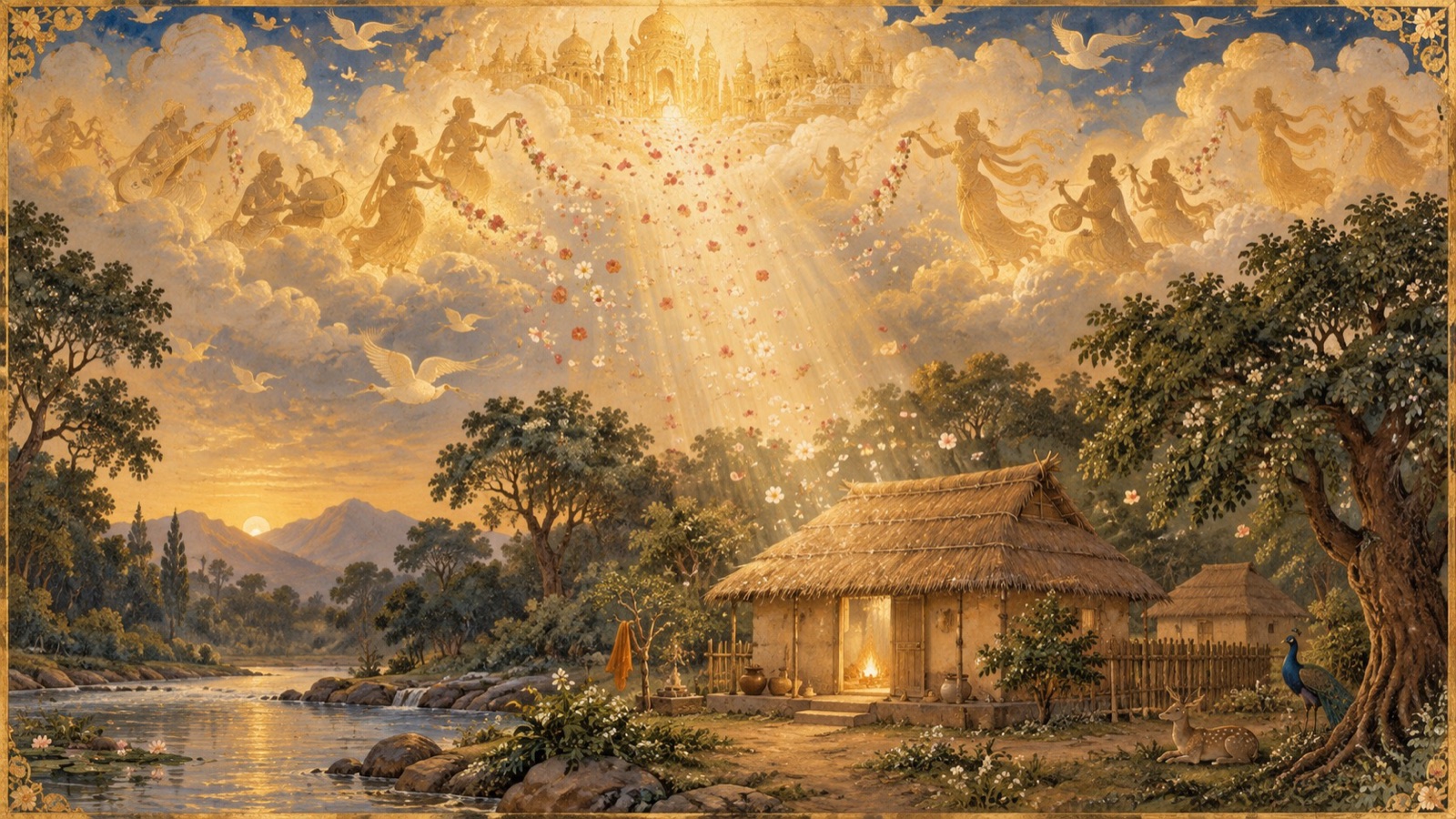
Even as fire is born from friction in dry wood, the Supreme Lord manifests first through the sage Kardama and then through the womb of Devahuti — while the sky above the hermitage fills with falling flowers, thunder like drums, and the songs of Gandharvas.
Om Namo Bhagavate Vasudevaya.
Om Namo Bhagavate Vasudevaya.
Om Namo Bhagavate Vasudevaya.
Welcome to Srimad Bhagavatam Wisdom, a devotional journey through the sacred histories and teachings of the Srimad Bhagavat Mahapurana. The chapter before this one left Devahuti — nine daughters born, her youth spent, her husband Kardama’s ascetic power fully displayed in the aerial palace he built for her pleasure — speaking to him at last in words “full of dispassion,” reminding him gently of the promise Lord Vishnu Himself had made before their marriage: that the Lord would take birth as their son. Chapter 24 answers that reminder. It is the chapter in which a long-awaited promise is finally kept — quietly, without spectacle for its own sake, and yet marked by every sign of cosmic rejoicing that scripture reserves for the Lord’s own descent. Kardama reassures his wife; the Lord manifests through both parents as fire arises from kindling; Brahma himself travels to the hermitage to confirm what has happened and to see to the marriage of Kardama’s nine daughters; and finally, in the chapter’s most moving passage, the father recognizes his own newborn son as the Supreme Person, offers Him a hymn of surrender, and takes his leave to become a wandering renunciate — leaving Kapila, the Lord now embodied as a human child, to remain behind and instruct His mother in the very knowledge He has come to teach the world.
Chapter Information
- Scripture: Śrīmad Bhāgavata Mahāpurāṇa
- Canto: 3 (Book Three)
- Chapter: 24 (Discourse 24)
- Chapter title: Descent of Lord Kapila
- Principal speaker: Maitreya, narrating throughout to Vidura; within his narration, four passages of direct speech are quoted in full — Kardama’s reply to Devahuti (verses 2–4), Brahma’s address to Kardama and Devahuti (verses 12–19), Kardama’s own hymn to his newborn son (verses 26–34), and the Lord’s reply to His father (verses 35–40)
- Principal listener: Vidura
- Main setting: The hermitage of the sage Kardama on the bank of the river Sarasvati
- Central subject: The Lord’s descent as Kapila through Kardama and Devahuti; Brahma’s visit and his instructions concerning the marriage of Kardama’s nine daughters; Kardama’s recognition of his son as the Supreme Lord and his hymn of surrender; the Lord’s explanation of why He has taken birth; and Kardama’s departure into a life of renunciation and final union with the Supreme
- Principal verse range: Canto 3, Chapter 24, verses 1–47
- Primary edition: Gita Press Śrīmad Bhāgavata Mahāpurāṇa
“Worry Not About Yourself”
The chapter opens exactly where the household drama of the previous discourse left off — not with the Lord’s arrival, but with a husband’s tenderness toward a wife who has spent her youth waiting.
Maitreya resumed: When Devahuti, the daughter of Swayambhuva Manu, spoke such words, full of dispassion, the merciful sage Kardama recalled the words of Lord Vishnu and replied. (verse 1)
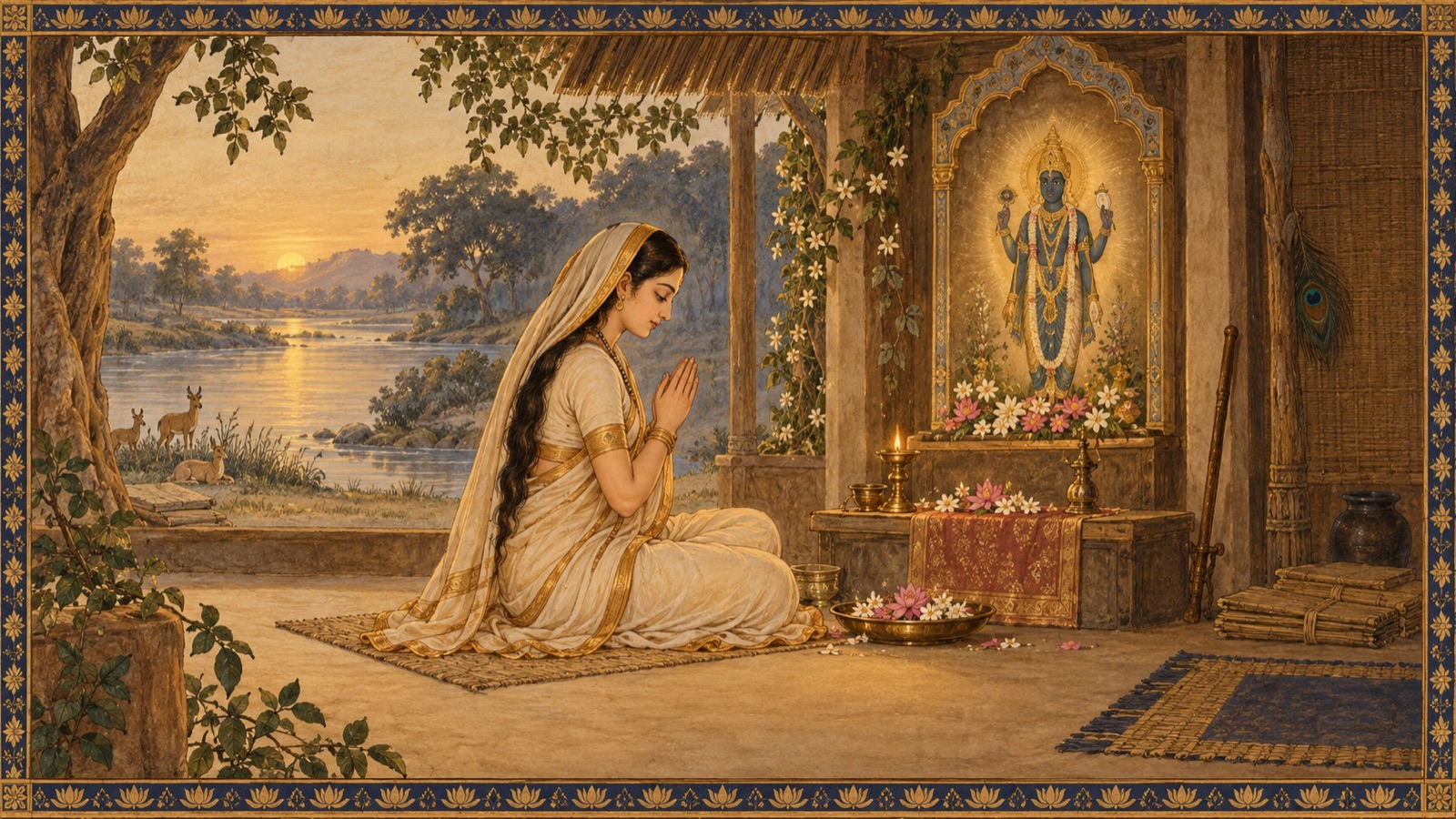
What Kardama says next is worth pausing over, because it is not a philosophical discourse but a simple, direct comfort: “Worry not about yourself, O princess of irreproachable conduct. The immortal Lord will enter your womb at no distant date.” (verse 2) He then instructs her, gently, in what remains for her to do — to worship the Lord with reverence, through control of the senses, religious observance, austerity, and charity — for it is through such propitiation, he promises, that Vishnu will be born as her son, cutting the very knot of ignorance in her heart by instructing her in spiritual knowledge. (verses 3–4) There is something quietly instructive in the order of events here: the promise comes first, and only afterward is the practice given — grace precedes effort, even as effort is still asked for.
Fire Born of Kindling: The Lord’s Descent
Reposing full faith in Kardama’s message, Devahuti took up the worship of the immutable Supreme Person, the Preceptor of the world. (verse 5) And then, after what the text calls “a pretty long time,” the actual descent takes place — described in a single, simple image that has echoed through devotional literature ever since.
After a pretty long time Lord Vishnu, the Slayer of the demon Madhu, manifested Himself first through the generative fluid of Kardama and then through Devahuti, even as fire appears through firewood. (verse 6)
तस्यां बहुतिथे काले भगवान्मधुसूदन: । कार्दमं वीर्यमापन्नो जज्ञेऽग्निरिव दारुणि ॥ ६ ॥
tasyāṁ bahu-tithe kāle bhagavān madhusūdanaḥ kārdamaṁ vīryam āpanno jajñe ‘gnir iva dāruṇi
Meaning: After many years had passed, Lord Madhusudana — having first entered Kardama’s own being — appeared through Devahuti exactly as fire arises from within wood: a birth that was neither ordinary nor accidental, but the Lord’s own chosen way of keeping His word. (Canto 3, Chapter 24, verse 6)
It is a deliberately unspectacular image for an event the rest of the verse-sequence treats as anything but ordinary. At the moment of His descent, the Bhagavatam tells us, gods in the form of raining clouds sounded thunder like musical instruments in the sky; the Gandharvas, the celestial musicians, sang His praises; the Apsaras, the celestial nymphs, danced for joy; heavenly flowers rained down from the gods flying above; and every direction, every body of water, and the minds of all people became clear. (verses 7–8) The whole created order, in other words, responds to this birth the way it always responds to the Lord’s descent — not because a king has been born, but because the source of all being has, for a time, chosen to be found within it.
Thunder like drums, songs from the Gandharvas, dancing Apsaras, and a rain of heavenly flowers mark the quiet moment of the Lord’s descent through Kardama and Devahuti, “even as fire appears through firewood” (verses 6–8).
Brahma Comes to the Hermitage
News of this kind does not stay confined to one household long, and the next verses turn to the arrival of an especially significant guest.
Brahma, the self-born, went along with Marici and the other great sages to Kardama’s celebrated hermitage on the bank of the river Sarasvati. (verse 9) Brahma, who is naturally possessed of true wisdom, already knew that the Lord — who is no other than the supreme Brahma — had descended through pure Sattva in order to impart the knowledge of the Sankhya system of philosophy. (verse 10) Welcoming the Lord’s intention with a guileless mind, the creator spoke to Kardama and Devahuti with all his senses filled with delight. (verse 11)
It is a small but telling detail that Brahma “already knew” why the Lord had come before anyone told him. The descent of Kapila is not, in this telling, a surprise even to the highest of created beings — it is the fulfilment of something Brahma himself had long understood was coming, and his arrival at the hermitage is less an investigation than a joyful confirmation.
Brahma’s Instructions: Nine Daughters, One Divine Son
What Brahma says next carries the weight of a father figure addressing both a son he is proud of and a daughter-in-law whose long patience is about to be rewarded — and it moves, within a few verses, from ordinary household counsel to the direct revelation of who the newborn child truly is.
Brahma said: “You have truly worshipped me, dear son, in that you reverently carried out my behest, O respecter of elders.” (verse 12) This, he continues, is the very service a son owes his father — to bow to his command with due deference. (verse 13) Turning to practical matters, Brahma tells Kardama that his slender-waisted daughters will multiply this creation manifold through their descendants, and instructs him to give them, this very day, to the foremost of the sages, with due regard for each girl’s own temperament and liking — thereby spreading his fame across the world. (verses 14–15)
Then Brahma’s tone shifts, and the chapter’s central revelation is delivered directly and without further preamble:
I know that the most ancient Person, the bestower of all boons on living beings, has descended through His own wonderful creative energy in the person of Kapila, O Kardama. (verse 16)
Turning to Devahuti, Brahma continues: with golden hair, lotus-like eyes, and lotus feet whose very soles bear the mark of a lotus, it is Lord Vishnu Himself, the Slayer of the demon Kaitabha, who has been born of her — born to tear up the roots of karma, the latent desires that bind the soul, through the knowledge of the scriptures and direct realization; and having cut the knot of ignorance and misapprehension, He will roam the earth. (verses 17–18) He will be the Lord of the perfected beings, held in the highest esteem by the teachers of Sankhya philosophy, known throughout the world by the name Kapila, and He will spread Devahuti’s own fame through the ages to come. (verse 19)
Nine Sages, Nine Brides
Having reassured the couple and completed his purpose, Brahma does not linger.
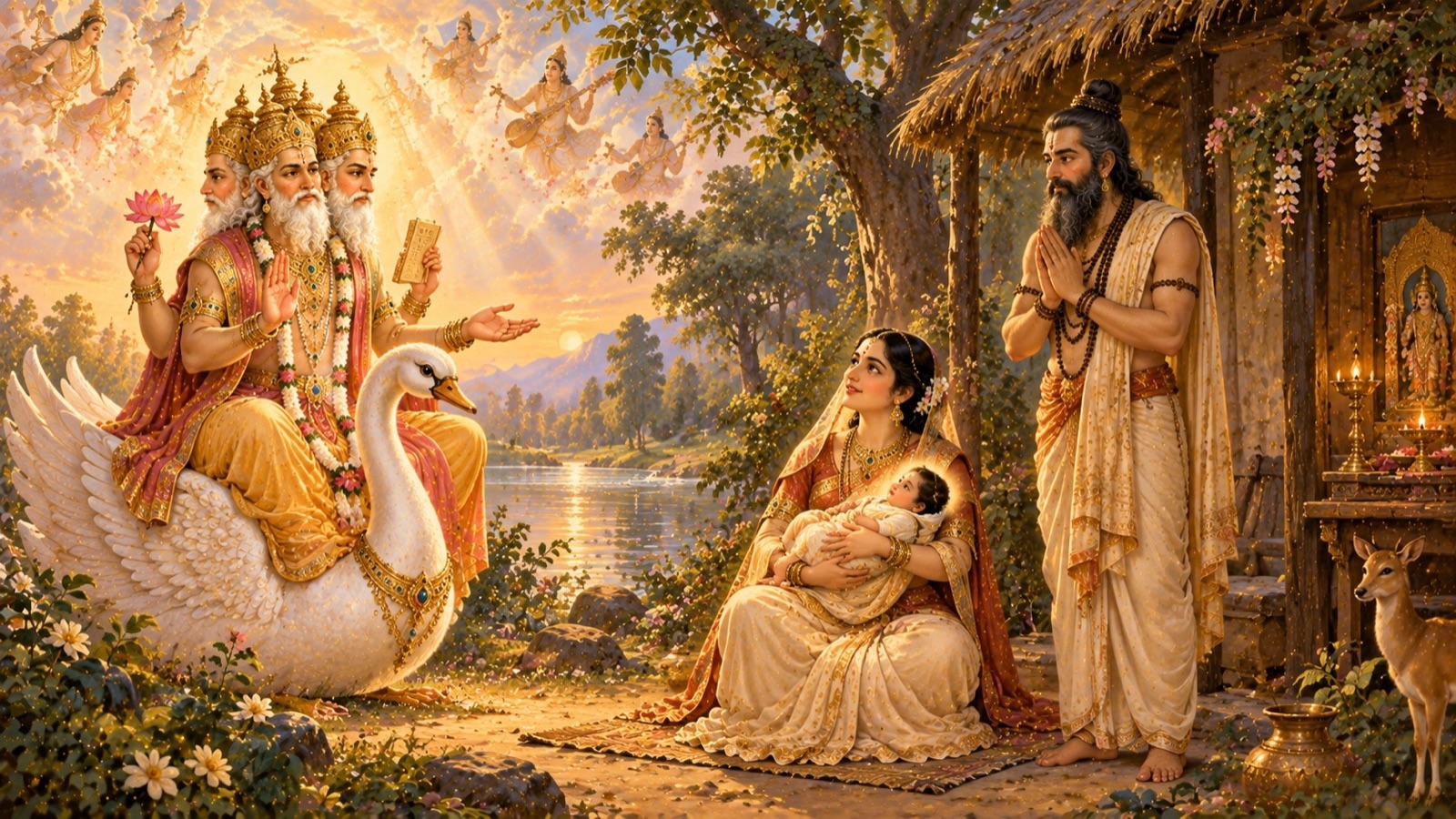
Having thus reassured the couple, Brahma, the creator of the universe, rode his swan and returned to Satyaloka, accompanied by the four Kumaras — Sanaka and his three brothers — and by Narada, all of them lifelong celibates, leaving Marici and the other sages behind so that they might receive the hands of Kardama’s nine daughters in marriage. (verse 20)
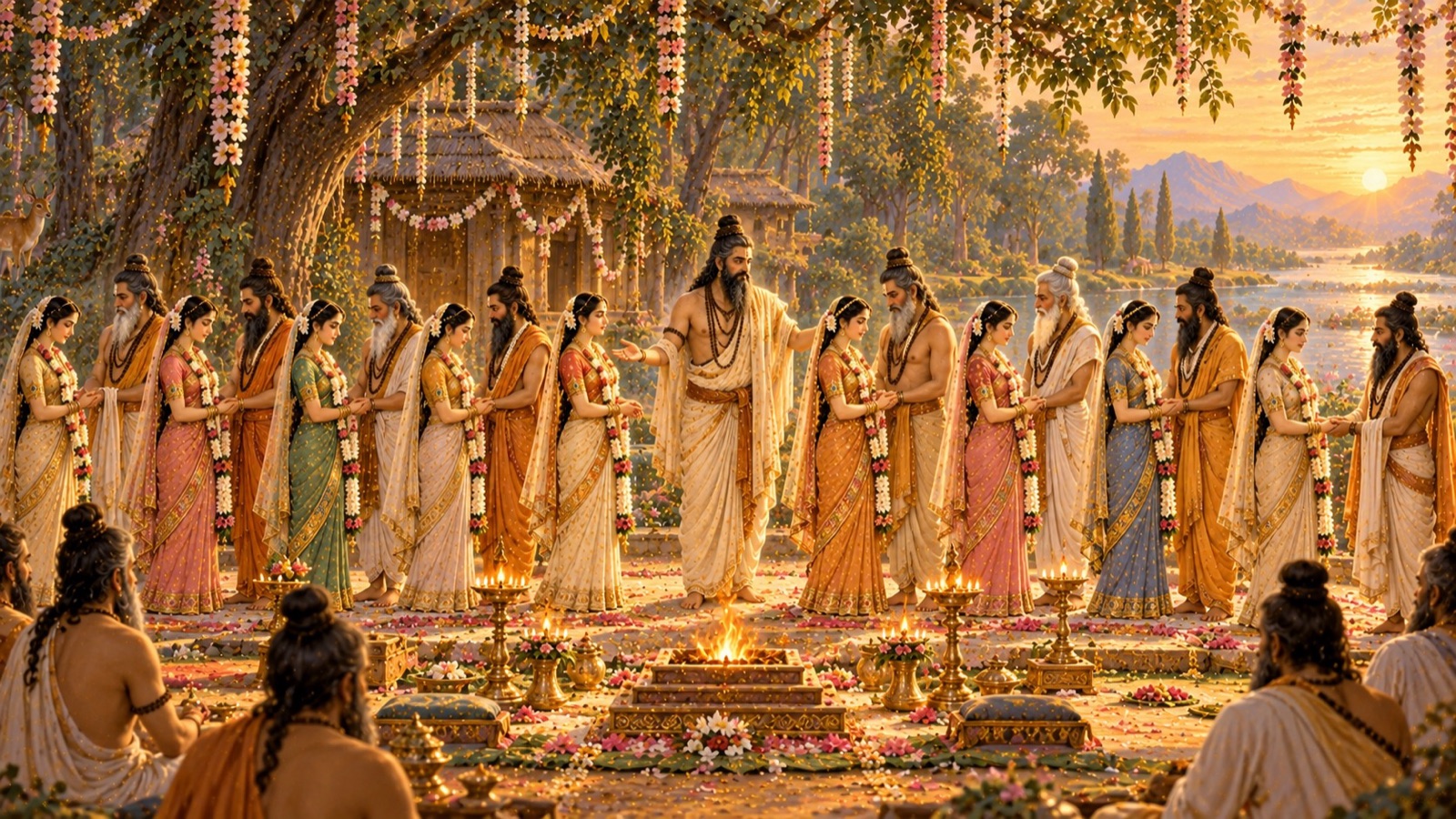
What follows is one of the most quietly significant genealogical passages in the entire Bhagavatam, because these nine marriages are the seeds from which nearly every great sage-lineage of the tradition will spring. After Brahma’s departure, Kardama immediately gave his daughters in marriage to the lords of created beings, exactly as the creator had directed and in accordance with scriptural injunction. (verse 21) He gave Kala to Marici, and Anasuya to Atri; Shraddha he gave to Angira, and Havirbhu to Pulastya. (verse 22) He gave Gati, well suited to Pulaha, to that sage, and the virtuous Kriya to Kratu; Khyati he gave to Bhrigu, and Arundhati to Vasistha. (verse 23) And to the sage Atharva he gave Shanti, through whom sacrifice is successfully accomplished. Once they were duly married, Kardama honored these foremost sages and their new wives with every kind attention. (verse 24) So married, the sages then took their leave of Kardama and departed, full of joy, each to his own hermitage. (verse 25)
“Who Would Meet Such a Master”: Kardama’s Hymn
With the household’s other great obligation now discharged, the chapter turns to its emotional center: a father who realizes, fully and at last, exactly who his son is.
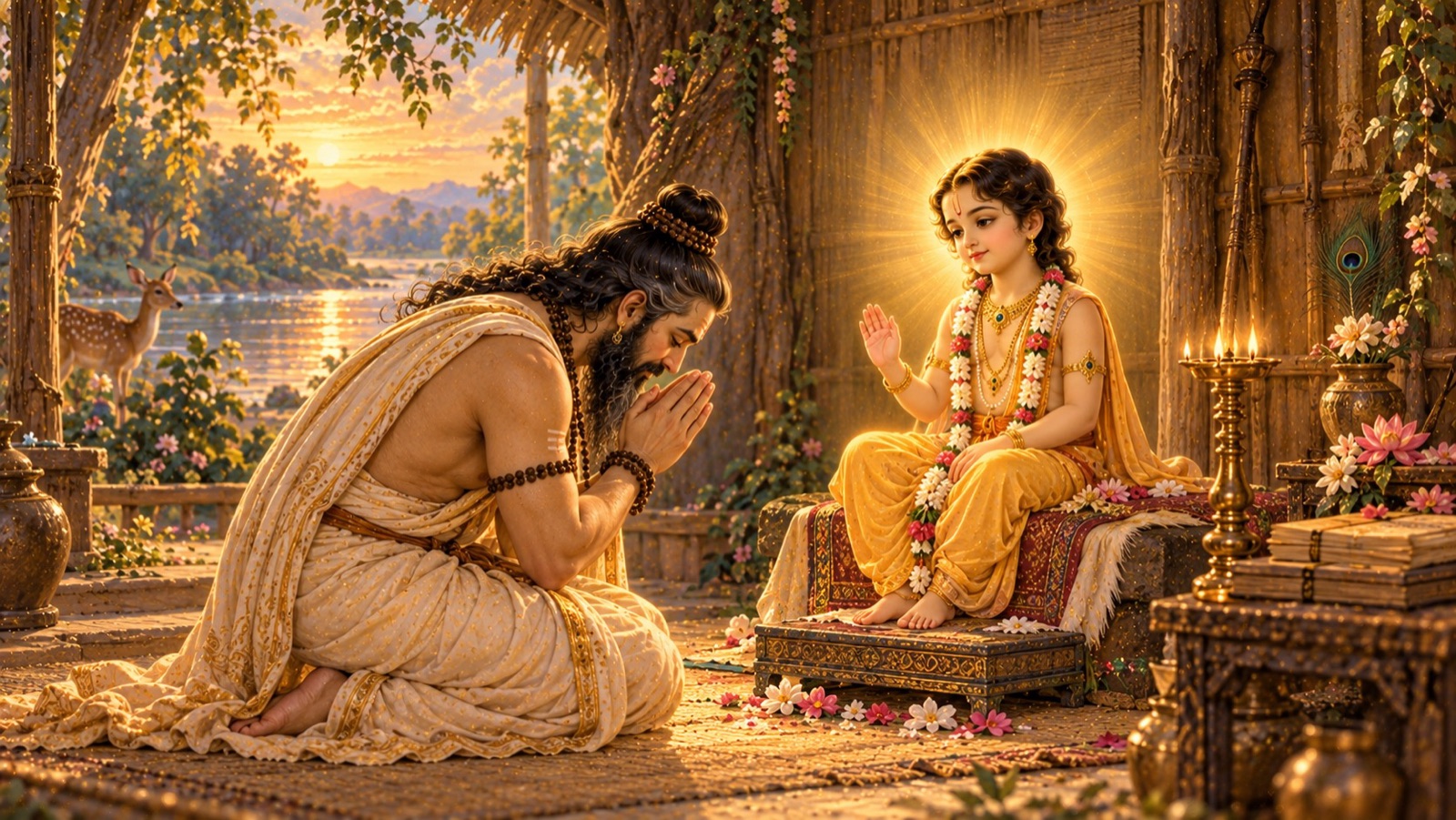
Having come to know that it was Lord Vishnu Himself — possessed in their entirety of the divine attributes of power, affluence, piety, renown, wisdom, and dispassion — who had been born to him, the sage approached his son when He was alone and, bowing before Him, spoke. (verse 26)
Kardama’s hymn that follows is a remarkable mixture of wonder, humility, and grief held gently in check.
Kardama said: “Alas! On those who are burning in this hell of transmigration through their own evil deeds, the gods shower their grace only after a very long time. Yet the Lord, whose truth striving souls seek to realize in solitude through devotion matured over many lifetimes, and who exists to promote the cause of His devotees, has this time appeared in the house of ordinary, sense-bound men like us — undisturbed by the seeming indignity of such a birth. (verses 27–29) Intent only on raising the dignity of Your devotees, You have been born into my house to redeem Your own promise and to found the Sankhya system that leads to true knowledge. (verse 30) O Lord, Your transcendent forms alone are truly worthy of You; and yet the human likeness that delights Your own devotees is equally dear to You, though You are without any material form at all. (verse 31) I take refuge in You, whose very footstool sages eager to know the Truth are ever fit to salute, and who are complete in power, energy, wisdom, dispassion, fame, and affluence. (verse 32) I take refuge in Kapila, the Supreme Lord, who commands every potency, who appears as Primordial Matter, as the Spirit, as the Mahat-tattva of cosmic intelligence, as Time itself, as the threefold ego and the many spheres with their guardians — and who, by His own energy of Consciousness, draws all these phenomena back into Himself, the all-witnessing Seer. (verse 33) Acquitted now of the debt I owed my own father, Brahma, who commanded me to marry and beget children, and having gained through You everything I could desire, I take my leave of You, Lord of all created beings. Walking the path of the recluse, I would roam wherever I please, free from sorrow, holding You always in my heart.” (verse 34)
आ स्माभिपृच्छेऽद्य पतिं प्रजानां त्वयावतीर्णर्ण उताप्तकाम: । परिव्रजत्पदवीमास्थितोऽहं चरिष्ये त्वां हृदि युञ्जन् विशोक: ॥ ३४ ॥
ā smābhipṛcche ‘dya patiṁ prajānāṁ tvayāvatīrṇarṇa utāpta-kāmaḥ parivrajat-padavīm āsthito ‘haṁ cariṣye tvāṁ hṛdi yuñjan viśokaḥ
Meaning: Acquitted of my debt through You, and having gained all my desires, I now take leave of You, the Lord of all created beings; walking the path of the recluse, I will roam freely, holding You in my heart and free from sorrow. (Canto 3, Chapter 24, verse 34)
There is a theological point worth naming plainly here, one this hymn states more directly than most chapters of the Bhagavatam do. Kardama observes that mature yogis, after many lifetimes of solitary practice, still struggle merely to glimpse the Lord’s feet in seclusion (verses 27–28) — yet that very same Lord has now walked, unbidden, into an ordinary householder’s home simply because a husband and wife worshipped Him with faith (verse 29). The point is not that austerity is worthless, but that loving devotion succeeds where solitary striving alone cannot: the Lord answers His devotee’s sincerity far more readily than any technique of yoga or renunciation pursued for its own sake. This is also why the knowledge Kapila has come to teach is never dry metaphysics: Kardama himself says that the Lord’s birth in his house was meant precisely to found the Sankhya system that leads to true knowledge (verse 30) — a philosophy of categories that exists, finally, to deepen surrender, not to replace it.
“Whatever I Say Is an Authority”: The Lord’s Reply
Kapila’s answer to His own father is brief, but it explains, in the plainest possible terms, why this entire chapter — and much of what has come before it — has happened at all.
The Lord replied: “Whatever I say is an authority to the world, in matters secular as well as sacred. It is only to redeem what I once promised you that I have been born as your son, O sage. (verse 35) My present birth in this world is meant solely to expound the true nature of the categories of existence — knowledge that helps those seeking release from the subtle body to realize the Self. (verse 36) This mysterious path of Self-Knowledge has lain obscured through long ages; know that I have assumed this very personality in order to revive it. (verse 37) Go now, with My blessing, wherever you wish, and conquering death — which is exceedingly difficult to conquer — through actions dedicated to Me, adore Me with a view to attaining immortality. (verse 38) Beholding Me, the supreme self-effulgent Spirit dwelling in the hearts of all beings, within your own heart through your intellect, you will be freed from all sorrow and attain the fearless state of final beatitude. (verse 39) And to My mother as well I shall impart that same spiritual knowledge which frees one from the bondage of all action, and by which she too will overcome the fear of transmigration and attain supreme joy.” (verse 40)
It is worth noticing what the Lord does not say here. He does not ask Kardama to remain as a householder to raise Him, nor does He treat His father’s request for renunciation as anything but entirely appropriate. Kardama’s debts — to his own father, to his wife, to the world — are simply, matter-of-factly, declared paid. What remains is left open for each of them to walk in their own way: Kardama into the forest, Devahuti into the very knowledge her son has come to teach.
Kardama’s Departure, and a Life Made Whole
The chapter’s closing movement follows Kardama alone, and it is written with a stillness that matches its subject.
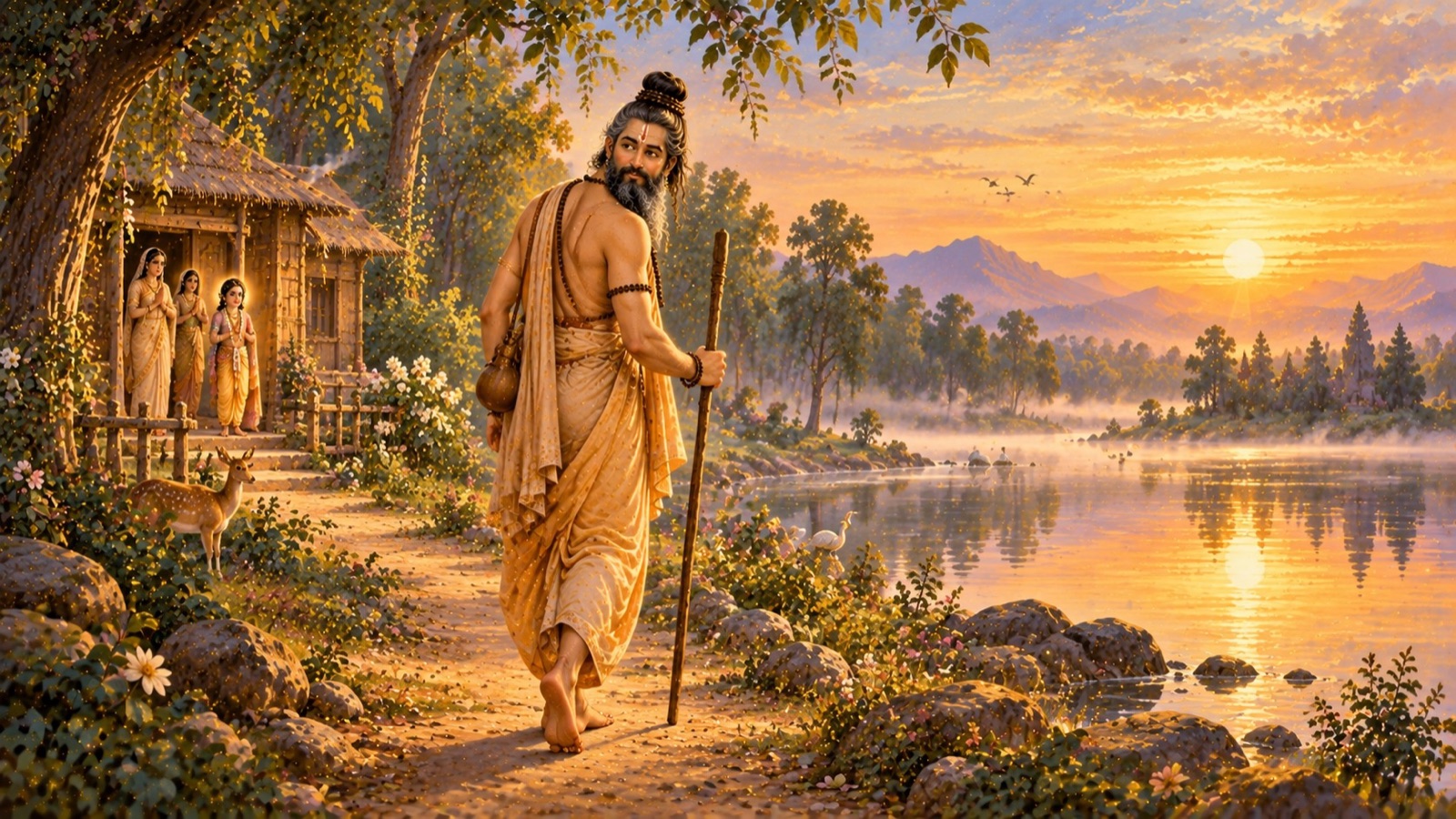
Thus addressed by the celebrated Kapila, Kardama, a lord of created beings, circled his son in reverence and withdrew at once to the forest, full of joy. (verse 41) Observing the hermit’s vow of non-violence, and depending exclusively on Sri Hari, he renounced the sacrificial fire and any permanent dwelling, and roamed the earth free of attachment. (verse 42) He fixed his mind on the Infinite Brahman — beyond both cause and effect, itself devoid of the three modes of material nature yet the very source that brings them to light, and realized only through exclusive devotion. (verse 43) Free from egotism and the sense of possessiveness, indifferent to the pairs of opposites — heat and cold, pleasure and pain, joy and sorrow — and viewing all things with the same eye, Kardama perceived his own self present everywhere; his mind, turned entirely inward, had become an ocean without waves. (verse 44) His mind fixed through supreme devotion on the all-knowing Lord Vasudeva, the inner Self of every embodied being, he became free from the very bondage of ignorance. (verse 45) He perceived the Lord, his own true Self, present within all living beings, and he perceived all living beings within the Lord, that same Self. (verse 46) In this way Kardama — desireless, free of malice, even-minded toward all, and established in devotion to the Lord — attained union with Him. (verse 47)
इच्छाद्वेषविहीनेन सर्वत्र समचेतसा । भगवद्भक्तियुक्तेन प्राप्ता भागवती गति: ॥ ४७ ॥
icchā-dveṣa-vihīnena sarvatra sama-cetasā bhagavad-bhakti-yuktena prāptā bhāgavatī gatiḥ
Meaning: Free from desire and hatred, even-minded toward all, and endowed with devotion to the Supreme Lord, Kardama attained the goal reserved for the Lord’s own devotees. (Canto 3, Chapter 24, verse 47)
With that single closing verse, the “Story of Lord Kapila” arc that began several chapters earlier reaches its first true resolution — not with Kapila’s teaching, which is still to come, but with the quiet perfection of the ordinary devotee who made room for that teaching to enter the world at all.
Principal Teachings of This Chapter
1. A promise fulfilled needs no fanfare of its own to be recognized as momentous. The Lord’s descent through Kardama and Devahuti is described in the plainest domestic terms — fire arising from kindling wood — even as the whole of creation responds with music, dance, and falling flowers; grandeur and simplicity are not opposites here (verses 6–8).
2. Grace is often given before the effort that seems to earn it. Kardama tells Devahuti not to worry before he tells her what to do — the promise of the Lord’s birth precedes, and makes possible, her subsequent worship (verses 2–5).
3. Even Brahma’s role is to confirm and celebrate, not to control. Brahma arrives at the hermitage already knowing why the Lord has descended; his visit is one of joyful welcome and practical guidance, not investigation or authority asserted over the Supreme (verses 9–11).
4. Ordinary duties and extraordinary revelation can occupy the very same breath. In a single conversation, Brahma moves from arranging nine marriages to declaring, without transition, that the newborn child is the Supreme Person Himself — the sacred does not wait for the mundane to be tidied away first (verses 12–19).
5. Genuine humility recognizes divinity even in one’s own child. Kardama’s hymn is remarkable precisely because it is a father bowing to his own son — his wonder at the Lord’s willingness to appear “in the house of ordinary, sense-bound men like us” reframes the entire episode as an act of extraordinary condescension and love (verses 26–34).
6. A life’s debts, rightly discharged, leave a person genuinely free. The Lord tells Kardama plainly that his obligations — to his father, to his household — are paid; nothing further binds him, and he is free to walk whatever path devotion now calls him toward (verse 35, verse 38).
7. Renunciation’s true sign is not absence but stillness. Kardama’s closing state is described not chiefly by what he has given up — fire, home, possessions — but by what he has become: even-minded, free of egotism, “an ocean without waves,” perceiving the Lord in all beings and all beings in the Lord (verses 44–47).
A Devotional Reflection
There is a tenderness in this chapter that is easy to miss beneath its genealogical detail and its philosophical vocabulary. At its center is a household — an ordinary, if unusually devoted, husband and wife — who have waited years for a promise to be kept, who discharge every remaining worldly duty with evident care even in the very moment of that promise’s fulfilment, and who then, without protest or delay, let each other go: the father into the forest, to seek in solitude the very Self he has just recognized in his own son’s face; the mother, left behind, to receive directly from that same son the teaching that will occupy the chapters still to come. Nothing here is rushed, and nothing here is withheld. The chapter’s real subject may not be the descent of Kapila at all, but the freedom that follows naturally once a soul has recognized, without any remaining doubt, exactly Whom it has been serving all along.
A Daily Devotional Practice
Today, bring to mind some long-held hope or promise in your own life — something you have waited for, perhaps for years, the way Devahuti waited. Notice, as this chapter shows, that the waiting itself was never wasted; it was itself a form of preparation. Then consider, too, Kardama’s example: a life’s debts, honestly discharged, can be set down completely, without lingering guilt or unfinished business, freeing the heart for whatever comes next. Before you move on with your day, sit quietly for a few minutes and repeat softly: “Om Namo Bhagavate Vasudevaya.” Let it be, as it was for Kardama in his final years of wandering, a way of holding the Lord continually in the heart — even, and especially, amid the ordinary duties of family, work, and daily life that this chapter shows can themselves become the very ground of devotion.
Conclusion
The twenty-fourth discourse of the Third Canto brings the long household narrative of Kardama and Devahuti to its turning point: the promise made before their marriage is finally kept, not with distant grandeur but through the intimate, quietly miraculous image of fire arising from kindling wood, while the heavens themselves mark the moment with music and falling flowers. Brahma arrives to confirm what has happened and to see the family’s remaining worldly duties — the marriage of nine daughters to nine great sages — carried to completion. And then, in the chapter’s true heart, a father bows before the child he now knows to be the Supreme Person Himself, offers Him a hymn of wonder and surrender, and departs, his debts fully discharged, into a wandering life of renunciation that ends not in loss but in union — an ocean, at last, without waves. Left behind is Kapila Himself, the Lord embodied as a human child, already turned toward the task that will occupy the chapters ahead: teaching His own mother, and through her the whole world, the path that leads beyond sorrow.
May the divine wisdom of Srimad Bhagavatam awaken pure devotion within our hearts.
Om Namo Bhagavate Vasudevaya.
Jay Shree Madhav.
References and Attribution
- Primary edition: Gita Press, Śrīmad Bhāgavata Mahāpurāṇa (English, complete), Book Three, Discourse 24, pages 243–246.
- Series: Srimad Bhagavatam Wisdom · Biswa Sanatan Dharma Seva Trust.
- Presented following the spiritual guidance and recommendation of Pandit Dr. Shri Kashinath Mishra.
This is an original, faithful retelling in the writer’s own words, with brief quoted verses shown in Devanāgarī and transliteration and their meanings given as summaries. It is not a reproduction of any single publisher’s continuous translation or commentary. No affiliation with or endorsement by any publisher is implied.
Jay Shree Madhav