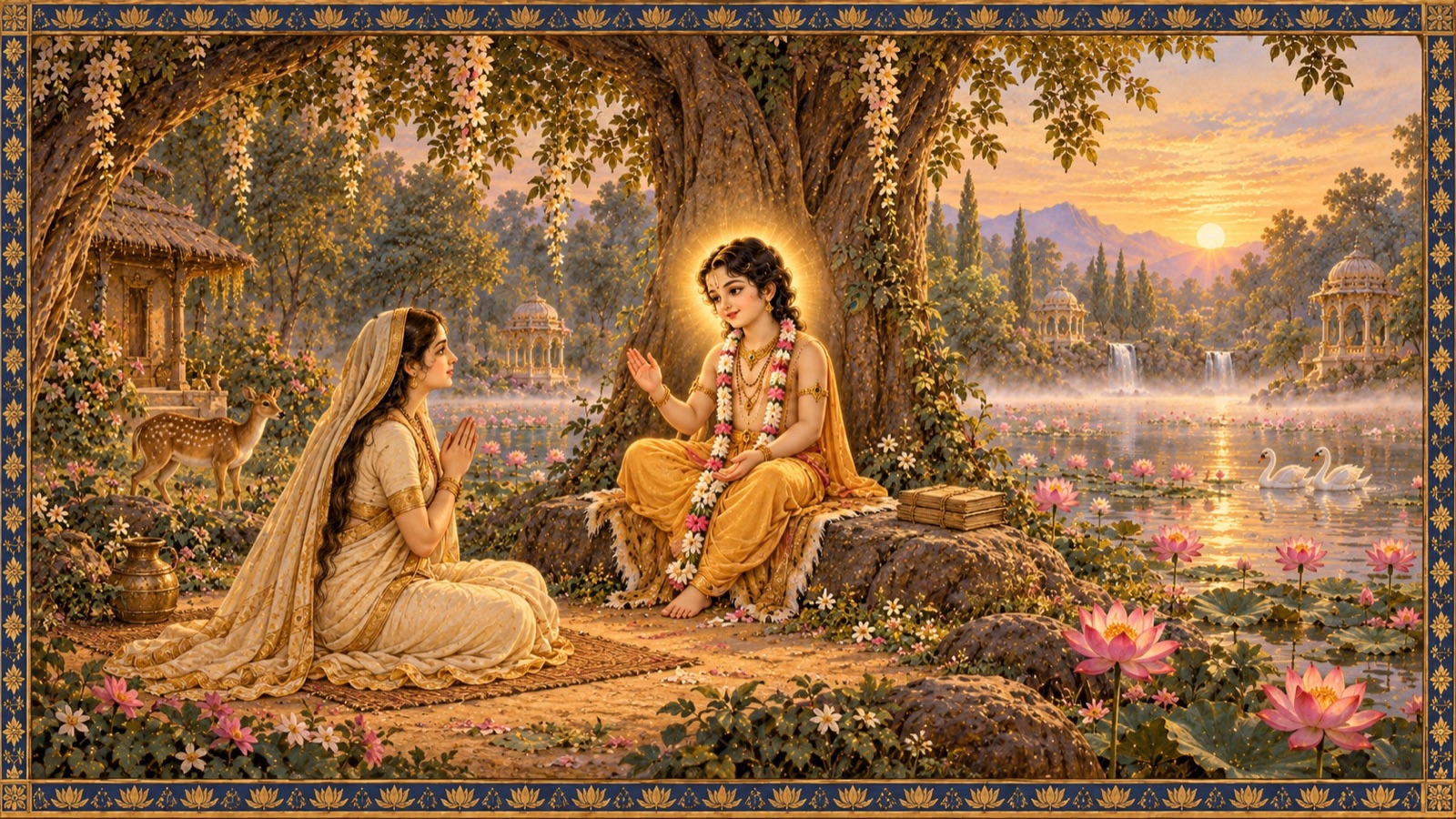
Alone with His mother on the strand of Bindusarovara, the Lord Kapila — the birthless Narayana, born of His own free will through Kardama and Devahuti — begins, with a gentle smile, the discourse the world would come to know as the Kapila-Gita.
Om Namo Bhagavate Vasudevaya.
Om Namo Bhagavate Vasudevaya.
Om Namo Bhagavate Vasudevaya.
Welcome to Srimad Bhagavatam Wisdom, a devotional journey through the sacred histories and teachings of the Srimad Bhagavat Mahapurana. The previous chapter closed with a household made whole: Kardama, having recognized his own newborn son as the Supreme Lord, offered a hymn of surrender and withdrew into the forest as a wandering renunciate, his debts to father and family fully discharged. Left behind at the hermitage on the strand of Bindusarovara was Devahuti — and her son, who is no other than Kapila, the birthless Lord Himself, born through her only to teach the world the path beyond sorrow. Chapter 25 is where that teaching finally begins. It opens, in fact, one narrative layer further back than the household story itself — with the sage Saunaka, at the great sacrificial assembly in the forest of Naimisaranya, asking Suta to tell him everything about Kapila’s glory, because no amount of hearing about the Lord has ever been enough. Suta then hands the story to Maitreya, who resumes his narration to Vidura: Kapila, sitting at leisure with His mother, is met with a confession of spiritual exhaustion and a heartfelt plea for guidance. What follows — beginning here and continuing through the chapters ahead — is the celebrated “Kapila-Gita,” the Lord’s own systematic discourse on the nature of the soul, the practice of Yoga, and above all the incomparable glory of Bhakti, devotion, which this chapter declares to be dearer to the Lord, and more direct a path to Him, than liberation itself.
Chapter Information
- Scripture: Śrīmad Bhāgavata Mahāpurāṇa
- Canto: 3 (Book Three)
- Chapter: 25 (Discourse 25)
- Chapter title: Lord Kapila expatiates on the glory of Devotion in response to the query of mother Devahuti
- Principal speakers: Suta, narrating to Saunaka and the sages of Naimisaranya (verses 1–4); within that frame, Maitreya continues his narration to Vidura (verses 5 onward). Direct speech is quoted in full from Saunaka to Suta (verses 1–3), Devahuti to Kapila (verses 7–11 and 28–30), and Kapila to Devahuti (verses 13–27 and 32–44)
- Principal listeners: Saunaka (outer frame); Vidura (inner frame); Devahuti (within Kapila’s own discourse)
- Main setting: The hermitage on the bank of Bindusarovara, where Kapila remains with His mother after Kardama’s departure into the forest
- Central subject: Devahuti’s confession of spiritual weariness and her plea to be shown the path beyond ignorance; Kapila’s opening reply on Yoga as contemplation of the Supreme Spirit; His description of the qualities of saints and the transforming power of their company; Devahuti’s request to know the true nature of Devotion; and the Lord’s own definition of motiveless Bhakti as superior even to liberation, together with His description of the devotees who possess it
- Principal verse range: Canto 3, Chapter 25, verses 1–44
- Primary edition: Gita Press Śrīmad Bhāgavata Mahāpurāṇa
Saunaka’s Unsated Hearing
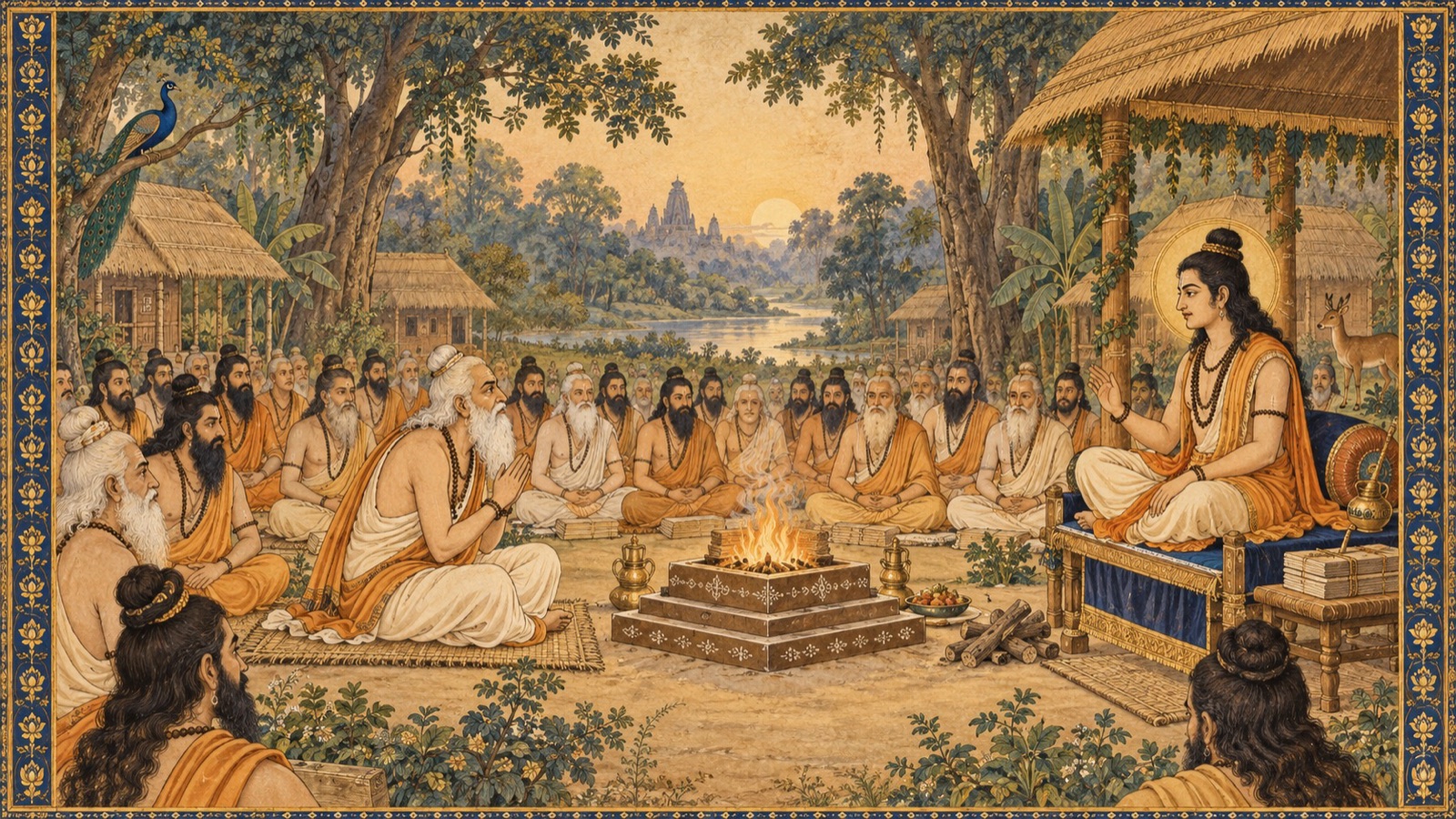
The chapter opens not at the hermitage at all, but at the great sacrificial gathering in the Naimisaranya forest, where Suta has been narrating the entire Bhagavatam to the assembled sages. It is a reminder, easy to overlook amid the household narrative of the previous chapters, that everything we have been reading is itself being told and retold, layer within layer, because the story of the Lord never exhausts the appetite of those who love to hear it.
Saunaka said: “Kapila, who expounded the true nature of the fundamental principles, was no other than the birthless Lord (Narayana), descended of his own free will and through His own Maya (wonderful creative energy) in order to teach humanity the truth of the Self. (verse 1) Although I have often heard the stories of the Lord, my senses are not sated with hearing the glory of Lord Kapila, the best of all men and the foremost of all Yogis. (verse 2) Having assumed by His own Maya a personality conforming to the will of His devotees, whatever the Lord does is all worth singing. Therefore, kindly narrate all those doings to me, full of reverence as I am.” (verse 3)
Suta said: Urged in this way to expound the true nature of the fundamental principles, the worshipful Maitreya, a friend of the sage Dwaipayana (Vedavyasa), addressed Vidura as follows according to the spirit of his enquiry. (verse 4)
There is something quietly moving in Saunaka’s admission that his senses are “not sated” even after hearing the Bhagavatam’s stories many times over. It sets the tone for everything that follows: this chapter is not new information to be consumed once and filed away, but a teaching meant to be returned to, the way one returns to a beloved’s presence, again and again, without ever feeling it has been exhausted.
Kapila Remains, to Please His Mother
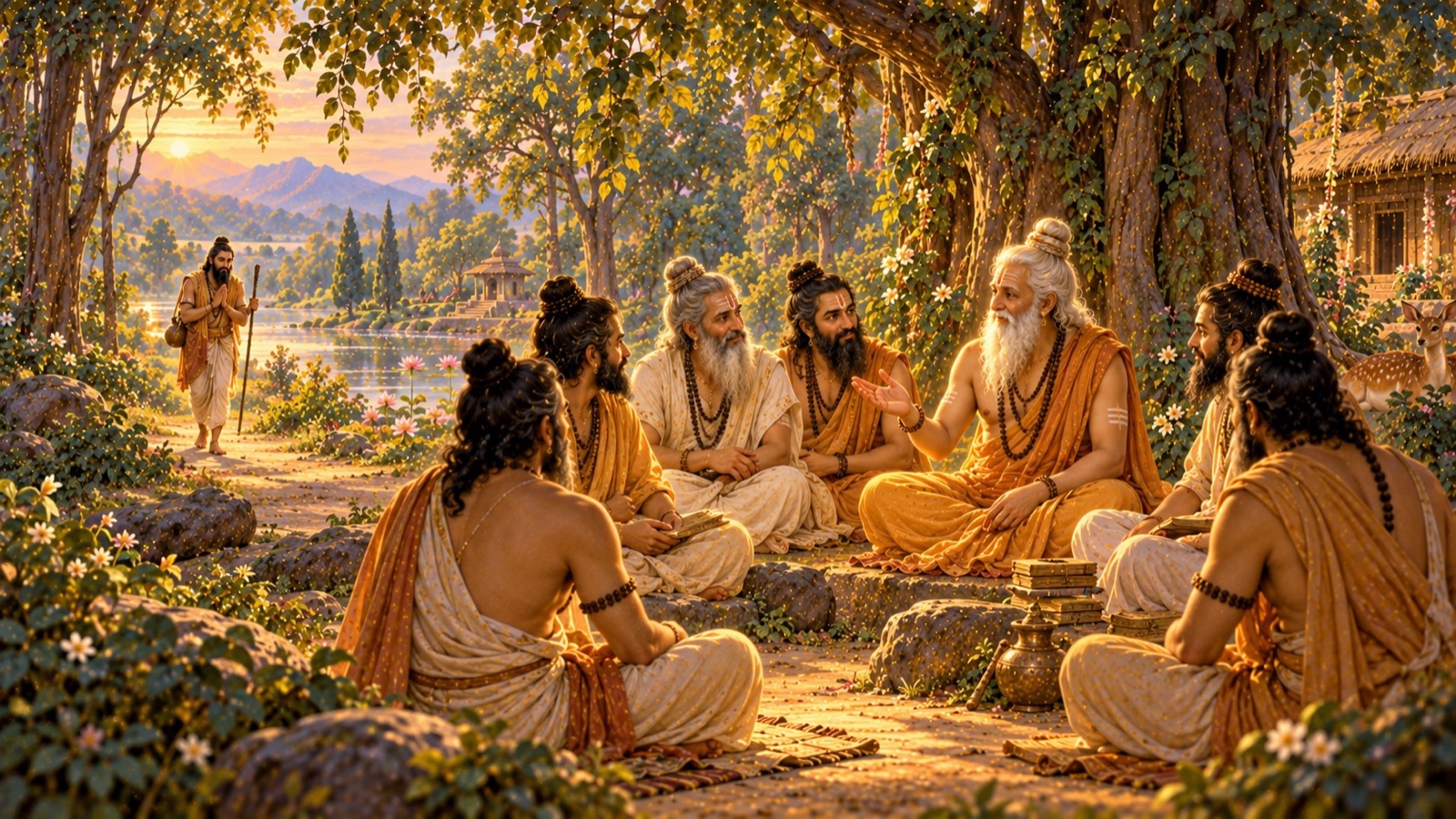
With the outer frame set, Maitreya’s narration returns us to the hermitage on the strand of Bindusarovara, where Kardama has just departed and Kapila alone remains.
Maitreya said: When Kardama (Lord Kapila’s father) had left for the forest, Lord Kapila stayed (in the latter’s hermitage) on the strand of the same Bindusarovara in order to please His mother (Devahuti). (verse 5) (One day) when Kapila (Devahuti’s son), who was capable of showing to her the culmination of the fundamental principles, sat at leisure, Devahuti recalled the words of Brahma (vide verse 18 of the preceding discourse) and spoke to Him (as follows). (verse 6)
It is worth pausing on the phrase “in order to please His mother.” The Lord’s reason for remaining behind is not stated in grand cosmic terms here — it is stated as an act of filial tenderness, a son choosing to stay near his mother rather than depart at once into renunciation as His father has just done. The teaching that follows will be vast in scope, encompassing the whole of Sankhya philosophy and the practice of Yoga and Devotion, and yet its occasion is this simple, intimate fact: a mother, recalling what Brahma once said of her son, finally finds the courage to ask him for what she truly needs.
Devahuti’s Confession
What Devahuti says next is remarkable for its honesty. She does not begin with elaborate praise or philosophical questions; she begins by naming her own spiritual exhaustion in the plainest terms.
Devahuti said: “I am awfully sick of the craving (for enjoyment) of my wicked senses, O Perfect One! It is because of my unremitting efforts to gratify this craving that I have fallen into the deep abyss of ignorance, O Lord. (verse 7) In this present birth, which (I am sure) is going to be the last of a long series, I have now, by Your grace, secured in You an excellent eye to enable me to see through this thick veil of darkness, which is so difficult to penetrate. (verse 8) You are no other than the Lord, the most ancient Person and the Ruler of all embodied souls, who has appeared, like the sun, as an eye to the world blinded by ignorance. (verse 9) Now be pleased, my lord, to dispel my great delusion; for the feeling of I-ness with reference to the body and that of mine-ness in respect of all that is connected with it have been inspired by You. (verse 10) For ascertaining the true nature of Prakrti (Matter) and Purusa (Spirit) I have sought refuge in You, who afford protection to all and are a veritable axe to the tree of metempsychosis in the case of Your devotees. I bow to You, the foremost of those knowing the secret of true religion.” (verse 11)
There is no self-pity in this confession, only clarity. Devahuti names her condition — sick of sense-craving, fallen into ignorance through her own unremitting effort — without excuse, and then, in the very same breath, recognizes that her own son is the very eye by which that darkness can be seen through at all. It is a mother turning to her child not for comfort in the ordinary sense, but for the one thing greater than comfort: the truth that ends all future need of comforting.

The Lord’s Smile, and the Nature of Yoga
Kapila’s response begins not with words but with an expression — a detail Maitreya takes care to preserve.
Maitreya continued: On hearing of His mother’s innocent desire, which was calculated to stimulate in men the longing for liberation, the Lord, who is the goal of noble souls that have subdued their self, mentally approved of it and spoke as follows, His countenance beaming with a gentle smile. (verse 12)
The Lord said: “In my opinion the only means to final beatitude is Yoga in the form of contemplation on the Supreme Spirit, which is characterized by absolute cessation of both joy and sorrow. (verse 13) I shall now explain to you that very Yoga, which is perfect in every limb, and which I taught of yore to sages (like Narada), who were keen to hear of it, O virtuous lady. (verse 14) Mind alone is held responsible for the bondage and emancipation of the soul. Attached to the objects of senses, it leads to bondage; when, however, it develops affinity to the Supreme Person, it brings liberation to the soul. (verse 15) When the mind is purged of its impurities in the form of lust, greed etc. — which have their root in the sense of I-ness and mine-ness — and becomes pure, it grows indifferent to pleasure and pain and gets equipoised. (verse 16) With a mind equipped with true knowledge and dispassion as well as with Devotion, the Jiva (individual soul) then perceives the Self as one (without a second), undifferentiated, self-effulgent, subtle, indivisible, unattached and beyond Prakrti (Matter), and Prakrti as reduced in strength. (verses 17–18) For striving souls there is no blissful road to God-Realization like Devotion directed towards the Lord, who is the Soul of the universe. (verse 19) The wise consider attachment as an unyielding fetter for the soul. The same, however, serves as an open door to liberation, when it is directed towards saints.” (verse 20)
Notice the architecture of the Lord’s opening reply: He begins with Yoga, defined simply as contemplation that transcends joy and sorrow alike; He locates the entire drama of bondage and freedom in the mind itself, not in the world; and then, in a single deft turn at verse 19, He names Devotion — not Yoga in its meditative sense alone — as the most blissful road of all. The chapter’s real subject has already announced itself before Devahuti has even asked her fuller question.
न युज्यमानया भक्त्या भगवत्यखिलात्मनि । सदृशोऽस्ति शिव: पन्था योगिनां ब्रह्मसिद्धये ॥ १९ ॥
na yujyamānayā bhaktyā bhagavaty akhilātmani sadṛśo ‘sti śivaḥ panthā yogināṁ brahma-siddhaye
Meaning: For striving souls, there is no blissful path to God-realization equal to devotion directed toward the Lord, the Soul of the universe. (Canto 3, Chapter 25, verse 19)

The Company of Saints
Having named Devotion as the highest path, the Lord turns immediately to a question that follows naturally: how, in practice, is such devotion cultivated? His answer centers on something deceptively ordinary — the company one keeps.
Saints are forbearing, compassionate and composed; they are friendly to all living beings and inimical to none and follow the injunctions of the Sastras. Their good disposition itself serves as an ornament to them. (verse 21) With an undivided heart they practise unflinching devotion to Me; and for My sake they abandon even their obligatory duties and forsake their kinsmen and relatives. (verse 22) Nay, they listen to and narrate delightful stories relating to Me, their mind ever set on Me. Afflictions of various kinds, therefore, never torment such people. (verse 23) Such are holy men, free from all attachment, O virtuous lady. Attachment to such holy men must be sought for by you; for they counteract the pernicious effects of attachment. (verse 24) Through the fellowship of saints one gets to hear My stories, leading to a correct and full knowledge of My glory and pleasing to the heart as well as to the ear. By hearing such stories one is sure to develop one after another reverence and fondness for and Devotion to the Lord, whose realization is preceded by the cessation of ignorance. (verse 25) Developing distaste for the pleasures of sense, belonging to this world as well as to the next, through Devotion engendered by contemplation on My pastimes connected with the creation, preservation and dissolution of the universe, the man who enjoys the fellowship of saints will diligently and devoutly strive to subdue his mind through easy processes of Yoga (Devotion). (verse 26) Through renunciation of the material objects of sense, through wisdom supplemented by dispassion, through Yoga (concentration of mind) and through Devotion directed towards Me, man attains to Me, the Self of all embodied souls, in that very life. (verse 27)
There is a paradox worth sitting with here: the Lord has just called attachment “an unyielding fetter for the soul” — and yet, in the very next breath, He calls attachment to saints “an open door to liberation.” Attachment, in other words, is not condemned in itself; it is redirected. The same capacity of the heart that binds a person to worldly things, when turned instead toward those whose own hearts are already fixed on the Lord, becomes the very means of freedom. This is why the company of saints occupies seven full verses of the Lord’s teaching — it is not a minor practical tip appended to the philosophy, but one of its central mechanisms.
तितिक्षव: कारुणिका: सुहृद: सर्वदेहिनाम् । अजातशत्रव: शान्ता: साधव: साधुभूषणा: ॥ २१ ॥
titikṣavaḥ kāruṇikāḥ suhṛdaḥ sarva-dehinām ajāta-śatravaḥ śāntāḥ sādhavaḥ sādhu-bhūṣaṇāḥ
Meaning: Saints are forbearing and compassionate, well-wishers of all embodied beings, without enemies, peaceful, and adorned by their own good conduct as by an ornament. (Canto 3, Chapter 25, verse 21)
Devahuti’s Fuller Question
Having heard this much, Devahuti’s response is not satisfaction but a more precise hunger. She wants to know not merely that devotion is the highest path, but exactly what it consists of and how, practically, she herself might walk it.
Devahuti said: “What kind of Devotion is worth developing towards You, and what is the type fit to be practised by me, through which I may easily and immediately attain to Your Being, a synonym for Liberation? (verse 28) What is the character of the Yoga (discipline) referred to by You, O Embodiment of supreme bliss, as a direct means to God-Perception (like an arrow which goes straight to its target) as well as to the realization of Truth; and how many are the processes supplementary to the same? (verse 29) Kindly explain all this to me in such a way that I, a dull-witted woman, O Hari, may understand the difficult process with ease by Your grace.” (verse 30)
Maitreya resumed: Having thus learnt the object of His mother (Devahuti) through whom He had appeared in a human semblance, Lord Kapila was filled with affection for her and expounded the system of philosophy which teaches the fundamental principles (such as Prakrti, Purusa and so on) and which they call Sankhya, as well as the elaborate course of Devotion and Yoga (the process of meditation and the other methods of mind-control). (verse 31)
Devahuti’s self-description as “a dull-witted woman” is, of course, not to be taken as literal fact — this is the same Devahuti who, only a chapter earlier, waited years in disciplined worship for the Lord’s descent, and who has just delivered a philosophically precise confession of her own bondage. It is instead the posture of true humility before the teacher: the willingness to be taught from the very beginning, without pretending to already understand. And it is this posture, more than any argument, that draws from her son not a bare answer but a discourse offered “filled with affection.”
Motiveless Devotion: Superior to Liberation Itself
What follows is the chapter’s philosophical center, and among the most celebrated definitions of Bhakti in the entire Bhagavatam.
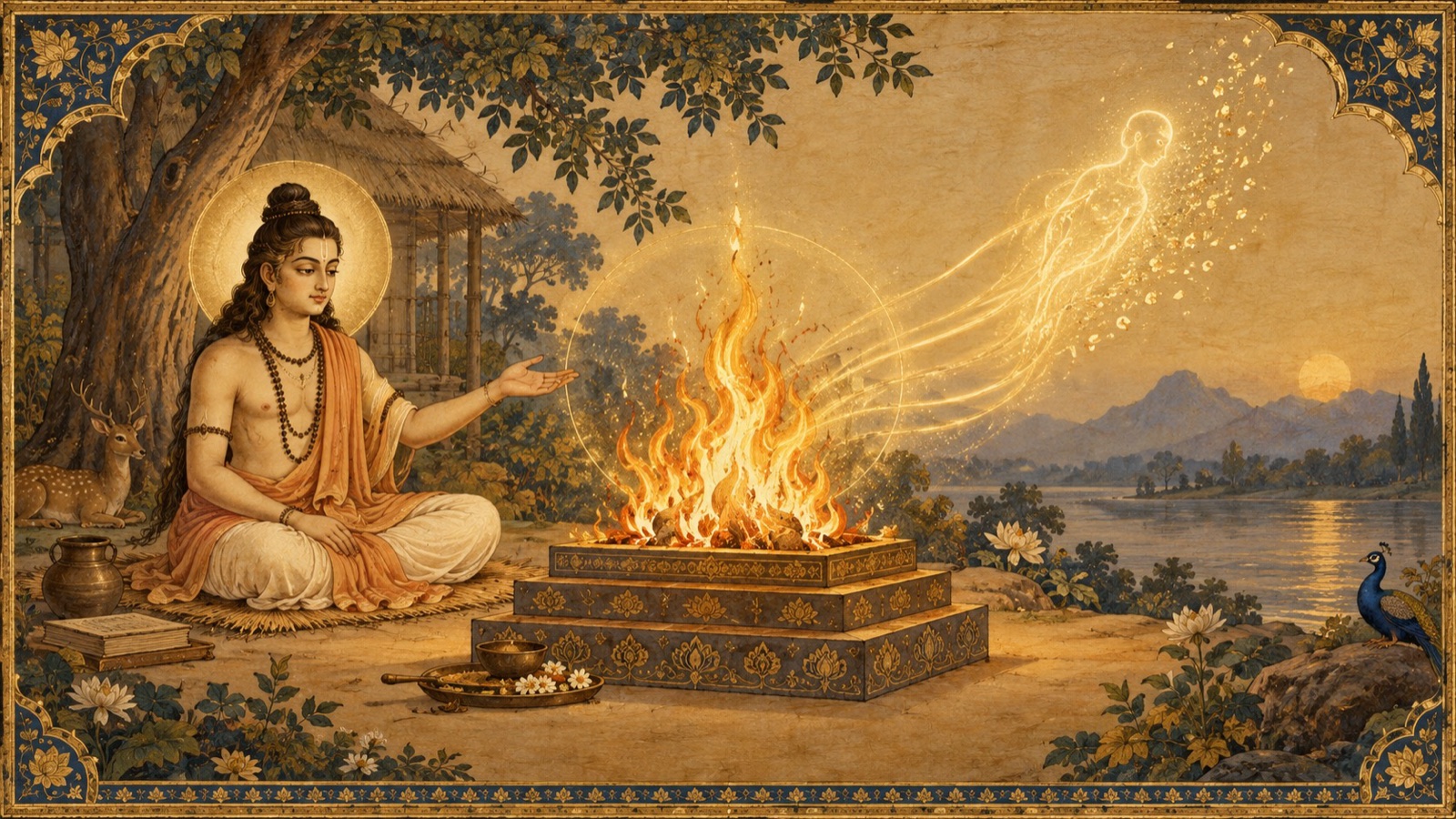
The Lord said: “Motiveless devotion to the Lord may be defined as the natural inclination — towards the Lord, who is an embodiment of Sattva (goodness) — of the senses of a man of undivided mind, which are the only means of perceiving the objects, as well as of his organs of action, which are engaged in activities enjoined by the Vedas. Devotion (as defined above) is superior to final beatitude itself in that it speedily dissolves the subtle body even as the gastric fire digests the food that is devoured.” (verses 32–33)
This is a striking claim, and the chapter does not soften it: devotion is not merely a means to liberation, useful because it leads somewhere else — it is declared superior to liberation itself, because of the thoroughness and ease with which it dissolves the subtle body, the very seat of the soul’s continued wandering through births and deaths, exactly as digestive fire consumes what is placed within it.
देवानां गुणलिङ्गानामानुश्रविककर्मणाम् । सत्त्व एवैकमनसो वृत्ति: स्वाभाविकी तु या । अनिमित्ता भागवती भक्ति: सिद्धेर्गरीयसी ॥ ३२ ॥ जरयत्याशु या कोशं निगीर्णमनलो यथा ॥ ३३ ॥
devānāṁ guṇa-liṅgānām ānuśravika-karmaṇām sattva evaika-manaso vṛttiḥ svābhāvikī tu yā animittā bhāgavatī bhaktiḥ siddher garīyasī jarayaty āśu yā kośaṁ nigīrṇam analo yathā
Meaning: The natural, motiveless inclination of an undivided mind toward the Lord, who is the embodiment of goodness — this devotion is superior even to liberation, for it swiftly dissolves the subtle body just as fire digests what it has consumed. (Canto 3, Chapter 25, verses 32–33)
The Devotees Who Want Nothing, Not Even Union
Having defined devotion, the Lord now describes those rare souls who possess it in its fullest form — and their description culminates in a claim so bold it reframes the entire goal of spiritual life.
Some devotees of the Lord — who ever delight in the service of My feet and are engaged in activities only for My sake, and who lovingly sing to one another of My exploits alone — crave not even for absorption into My Being. (verse 34) The aforesaid saints, O mother, behold My charming and divine forms possessed of a smiling face and ruddy eyes — forms which confer boons on them — and have talks with them, which are the envy even of the greatest sages. (verse 35) Their devotion (to Me) secures to them (a place in) My subtle Abode even though they never seek it, their mind and senses fascinated by those forms with attractive limbs, captivating playful gestures, glances accompanied with a smile and delightful speech. (verse 36) They no longer crave for the wealth and enjoyments of Satyaloka (the highest heaven) and the other spheres falling within My jurisdiction as the Lord of Maya, nor for the eight kinds of supernatural powers that come to them of their own accord as a sequel to Devotion, nor even for the wealth and splendour of the Lord’s own realm (Vaikuntha), which are full in every respect; yet they do enjoy these in that Abode of the Supreme. (verse 37) They who depend on Me, nay, to whom I am the only object of love, nay, the very self, the son, the friend, the preceptor, the kith and kin and the chosen deity, are never deprived of these enjoyments in Vaikuntha (which consists of pure Sattva); nor does My weapon in the shape of Time ever devour them. (verse 38)
The claim in verse 34 is worth reading twice: these devotees “crave not even for absorption into My Being” — that is, they do not even want the merging into the Lord that many traditions treat as the highest possible attainment. What they want instead is relationship: service, conversation, the sight of a smiling face. And precisely because they want nothing for themselves, not even liberation in its most exalted form, everything — the Lord’s own abode, His enjoyments, even freedom from the devouring power of Time itself — comes to them regardless, unsought.
There is a theological claim buried here that is easy to read past. The chapter does not merely rank devotion above liberation as a faster road ranked above a slower one to the same destination; it relocates the very summit of spiritual life. A path that treated merging into the Lord as the final word would have to regard the devotees of verse 34 as somehow unfinished, still short of the goal, since they refuse exactly that merging. This chapter says the opposite: their unwillingness to dissolve into the Lord is not a deficiency but the very mark of their perfection, because it preserves the one thing dissolution cannot offer — a Beloved to serve, to converse with, to behold (verses 33–34). Devotion, in other words, is not presented here as the swiftest technique for reaching an impersonal end; it is presented as disclosing a personal end beyond that horizon altogether, one liberation by itself was never able to reach.

Beyond Death, Beyond Fear
The chapter’s closing movement widens the frame from the qualities of devotees to the cosmic scope of what such devotion ultimately accomplishes — nothing less than deliverance from death itself, and the recognition that fear itself is the very engine of the created order.
I take them once for all to the other side of death (the ocean of birth and death), who worship Me with exclusive devotion in the aforesaid manner, realizing My presence in every quarter and renouncing this world and the next, nay, even their own conditioned self (in the shape of their subtle body), which wanders through both, and all those who are connected with the same here (viz., one’s near and dear ones) as well as (one’s possessions such as) wealth, cattle and houses and everything else. (verses 39–40) The terrible fear of birth and death can never be got rid of by resorting to anyone other than Myself, the almighty Lord, the Ruler of both Prakrti and Purusa (Matter and Spirit), the Self of all living beings. (verse 41) It is through fear of Me that the wind blows; it is through fear of Me that the sun shines; it is through fear of Me that Indra (the god of rain) sends forth showers, fire burns and death goes about (taking its toll). (verse 42) For lasting happiness the Yogis (striving souls) betake themselves through the practice of Devotion, accompanied by spiritual Knowledge and Dispassion, to My feet, which are free from fear (of every kind). (verse 43) A mind fixed on Me through the intense practice of Devotion and steadied thereby — that is the only means for men in this world to attain final beatitude. (verse 44)
Verse 42 is one of the most quoted images in the whole of the Bhagavatam: the wind blows, the sun shines, the rain falls, fire burns, and death itself makes its rounds — all of it “through fear of Me.” It is a vision of a universe held in perfect, orderly motion not by impersonal law alone, but by reverence for its own Source, in which even the most elemental and inevitable forces are, in the end, forms of obedience. And it is precisely because the Lord Himself stands beyond that fear — His own feet described as “free from fear of every kind” — that devotion directed to Him, and only to Him, can carry a soul across it.
एतावानेव लोकेऽस्मिन् पुंसां नि:श्रेयसोदय: । तीव्रेण भक्तियोगेन मनो मय्यर्पितं स्थिरम् ॥ ४४ ॥
etāvān eva loke ‘smin puṁsāṁ niḥśreyasodayaḥ tīvreṇa bhakti-yogena mano mayy arpitaṁ sthiram
Meaning: This alone is the highest good attainable by men in this world — a mind fixed steadily on Me through the intense practice of devotional yoga. (Canto 3, Chapter 25, verse 44)
With this single verse, the “Story of Lord Kapila” arc turns decisively from narrative to teaching. The household drama of Kardama and Devahuti, the descent through fire and kindling, Brahma’s visit, the nine marriages, a father’s renunciation — all of it has been leading here, to this quiet declaration that a mind steadily fixed on the Lord through devotion is, in the end, all that is required.
Principal Teachings of This Chapter
1. No amount of hearing about the Lord is ever truly enough. Saunaka’s confession that his senses remain “not sated” after repeated hearing sets the tone for the entire discourse — devotion is not information to be consumed once, but a relationship to be returned to endlessly (verses 1–2).
2. Honest confession, not polished praise, opens the door to teaching. Devahuti begins not with philosophical questions but with a plain admission of her own weariness and ignorance — and it is this honesty, not eloquence, that draws forth the Lord’s discourse (verses 7–11).
3. The mind alone is the site of both bondage and freedom. The Lord locates the entire drama of the soul’s captivity and release not in circumstances or the external world, but in whether the mind is attached to the objects of sense or turned toward the Supreme Person (verse 15).
4. Attachment is not the enemy — misdirected attachment is. The same capacity of the heart that binds a soul to the world becomes, when redirected toward the company of saints, “an open door to liberation” (verse 20).
5. Devotion is declared superior even to liberation. The Lord’s own definition of motiveless Bhakti places it above final beatitude itself, because of how swiftly and completely it dissolves the subtle body that carries the soul through repeated birth and death (verses 32–33).
6. The highest devotees want relationship, not even merger. Those most dear to the Lord do not seek absorption into His Being — they seek only to serve, converse, and behold His form — and precisely because they desire nothing, they are given everything (verses 34–38).
7. Fear itself is shown to be a form of cosmic order — and the Lord alone stands beyond it. Wind, sun, rain, fire, and death are all described as acting “through fear” of the Lord, while His own feet remain “free from fear of every kind,” making devotion to Him the one path that carries the soul beyond fear altogether (verses 41–43).
A Devotional Reflection
There is something deeply reassuring in the way this chapter begins: not with a mother arriving already wise, already composed, already free of doubt, but with a mother confessing plainly that she is “awfully sick” of her own senses’ cravings and has fallen into ignorance through her own effort. The Lord does not ask her to first become worthy of the teaching. He simply smiles, and begins. This is, perhaps, the chapter’s quietest and most consoling teaching: that the qualification for receiving this knowledge is not perfection but honesty — the willingness to say, without pretense, that one longs for something more than the senses can supply. From that single honest admission flows an entire discourse on Yoga, on the fellowship of saints, and finally on a devotion so complete that it asks nothing for itself, not even the liberation it nonetheless brings.
A Daily Devotional Practice
Today, consider Devahuti’s example rather than searching for a more polished starting point of your own. Bring to mind, honestly and without excuse, whatever craving or attachment currently exhausts you the way sense-gratification exhausted her — and instead of trying to argue yourself out of it through willpower alone, consider the chapter’s actual remedy: seek, even briefly, the company of those whose own hearts are already turned toward the Lord, for it is such company, this chapter tells us, that becomes “an open door to liberation.” Then sit quietly for a few minutes and repeat softly: “Om Namo Bhagavate Vasudevaya.” Let it be an exercise in exactly the motiveless devotion this chapter describes — offered not to gain something for yourself, not even peace of mind, but simply because the natural inclination of an undivided heart, turned toward the Lord, asks for nothing else.
Conclusion
The twenty-fifth discourse of the Third Canto opens the celebrated Kapila-Gita: with Kardama departed into the forest, the Lord Kapila remains at Bindusarovara solely to please His mother, and it is she — confessing her own spiritual exhaustion with disarming honesty — who draws from Him a discourse of extraordinary depth. Beginning with the nature of Yoga as contemplation beyond joy and sorrow, moving through the transforming company of saints, and arriving finally at a definition of motiveless devotion so exalted that it is declared superior to liberation itself, this chapter reframes the entire structure of the spiritual path around a single, luminous claim: that a mind fixed steadily on the Lord through devotion, wanting nothing else, not even absorption into Him, is both the beginning and the whole of the highest good. The chapters that follow will continue this discourse in greater philosophical detail — but its heart, the “glory of Devotion” promised in this chapter’s own title, has already been fully declared.
May the divine wisdom of Srimad Bhagavatam awaken pure devotion within our hearts.
Om Namo Bhagavate Vasudevaya.
Jay Shree Madhav.
References and Attribution
- Primary edition: Gita Press, Śrīmad Bhāgavata Mahāpurāṇa (English, complete), Book Three, Discourse 25, pages 247–251.
- Series: Srimad Bhagavatam Wisdom · Biswa Sanatan Dharma Seva Trust.
- Presented following the spiritual guidance and recommendation of Pandit Dr. Shri Kashinath Mishra.
This is an original, faithful retelling in the writer’s own words, with brief quoted verses shown in Devanāgarī and transliteration and their meanings given as summaries. It is not a reproduction of any single publisher’s continuous translation or commentary. No affiliation with or endorsement by any publisher is implied.
Jay Shree Madhav