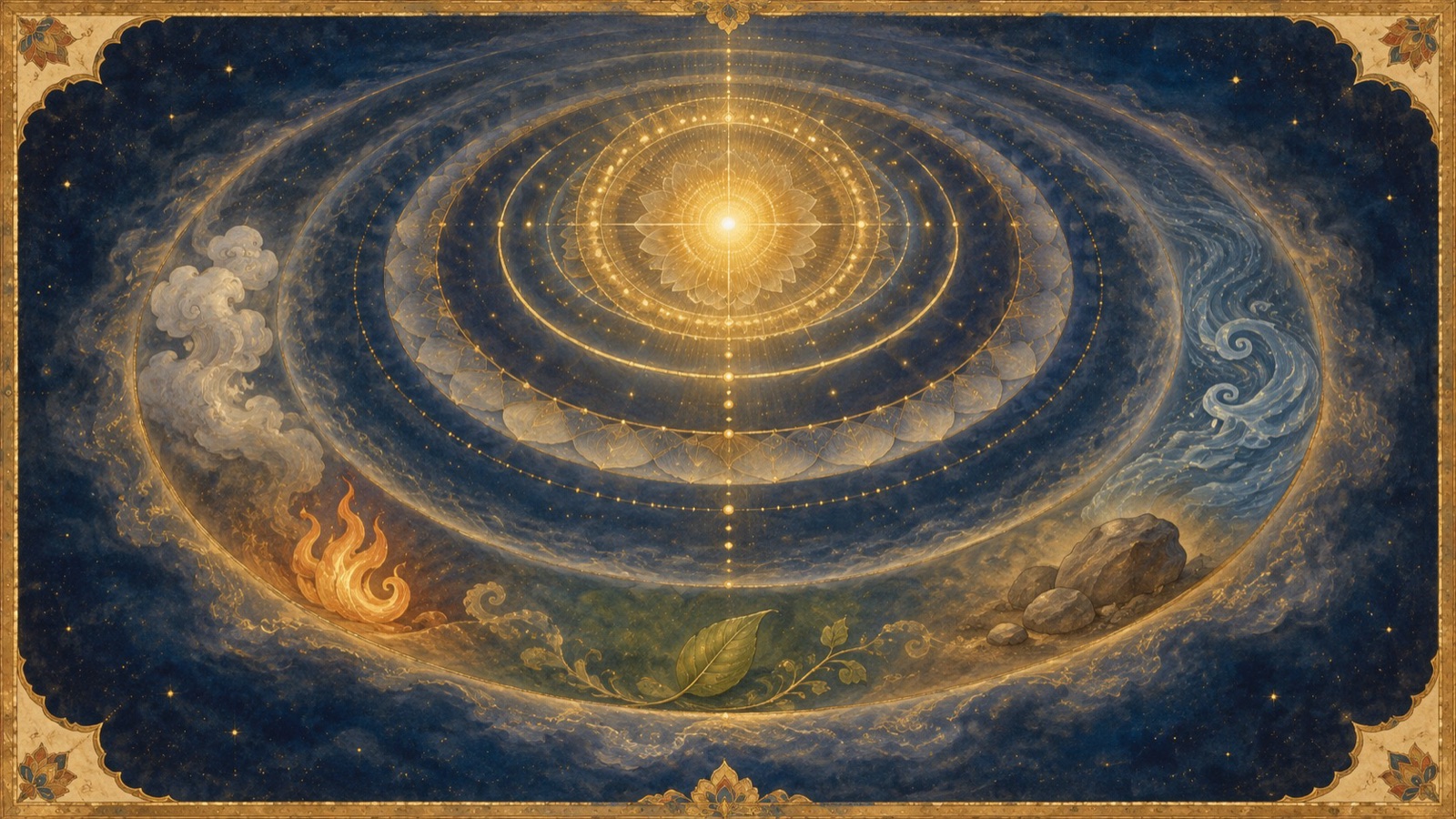
From the union of Purusa and Prakrti springs the Mahat-tattva, luminous and vast — the first principle of cosmic intelligence from which mind, ego, the elements, and every sense unfold in ordered sequence, until at last the Cosmic Being Himself rises from the causal waters.
Om Namo Bhagavate Vasudevaya.
Om Namo Bhagavate Vasudevaya.
Om Namo Bhagavate Vasudevaya.
Welcome to Srimad Bhagavatam Wisdom, a devotional journey through the sacred histories and teachings of the Srimad Bhagavat Mahapurana. Chapter 25 closed with Lord Kapila’s description of the glory of Devotion — the perfected Yogi absorbed in the Lord, and the truth that no refuge exists anywhere except in Him from “the terrible fear of birth and death.” Chapter 26 now turns from that devotional height to something more exacting and, in its own way, no less wonderful: a careful, step-by-step account of how the material universe itself comes into being. Devahuti asks her divine son a single, direct question — what, exactly, are Prakrti and Purusa, the two causes of this universe? — and Kapila’s answer occupies the entire remainder of the chapter. He unfolds, category by category, the whole architecture of Sankhya philosophy: Prakrti’s twenty-four evolutes, the Mahat-tattva born from her disturbed equilibrium, the threefold ego arising from that cosmic intelligence, the five subtle and gross elements streaming forth from the ego in ordered succession, and finally the birth of the cosmic egg and the Cosmic Being (Virat Purusa) Himself — whose limbs, senses, and presiding deities appear one by one, yet who remains motionless and unroused until the one thing capable of waking Him, the Inner Controller seated in the heart, enters last of all. It is a chapter of lists and correspondences, yes — but every list here points toward a single, quietly startling conclusion: that the same Inner Controller who alone could rouse the sleeping universe at its dawn is, this very moment, seated in the heart of the reader as well.
Chapter Information
- Scripture: Śrīmad Bhāgavata Mahāpurāṇa
- Canto: 3 (Book Three)
- Chapter: 26 (Discourse 26)
- Chapter title: The process of evolution of the Mahat-tattva and other fundamental principles
- Principal speaker: Lord Kapila, addressing Devahuti directly (within the outer frame of Maitreya narrating to Vidura, established in earlier chapters)
- Principal listener: Devahuti, who interjects once with a single question (verse 9)
- Main setting: The hermitage of Kardama, continuing the teaching begun in Chapter 24
- Central subject: The Sankhya philosophy’s account of cosmic evolution — Purusa and Prakrti, the twenty-four categories (tattvas) and Time as the twenty-fifth, the birth of Mahat-tattva and the threefold ego (Ahankara), the sequential evolution of the five subtle elements (tanmatras) into the five gross elements and senses, and the formation of the cosmic egg and the Cosmic Being (Virat Purusa), whose organs and deities cannot rouse Him until the Inner Controller alone succeeds
- Principal verse range: Canto 3, Chapter 26, verses 1–72
- Primary edition: Gita Press Śrīmad Bhāgavata Mahāpurāṇa
“The Distinctive Features of the Different Categories”
The chapter opens with Kapila picking up exactly where His teaching on Devotion left off, now promising Devahuti a different, complementary kind of knowledge.
The Lord continued: “Now I shall tell you, one by one, the distinctive features of the different categories, by knowing which a man is freed once for all from the yoke of the modes of Prakrti. I shall also explain to you the nature of Knowledge in the form of Self-Realization, which, by cutting the knot of egotism existing in the heart, leads the Jiva to final beatitude: so declare the wise.” (verses 1–2)
What follows is not devotion in the mode of feeling, but devotion in the mode of understanding — a clear-eyed map of exactly what binds the soul, so that the soul might recognize its own chains and, recognizing them, be free. Kapila begins with the root relationship from which all bondage flows: that between Purusa, the Spirit, and Prakrti, Matter.
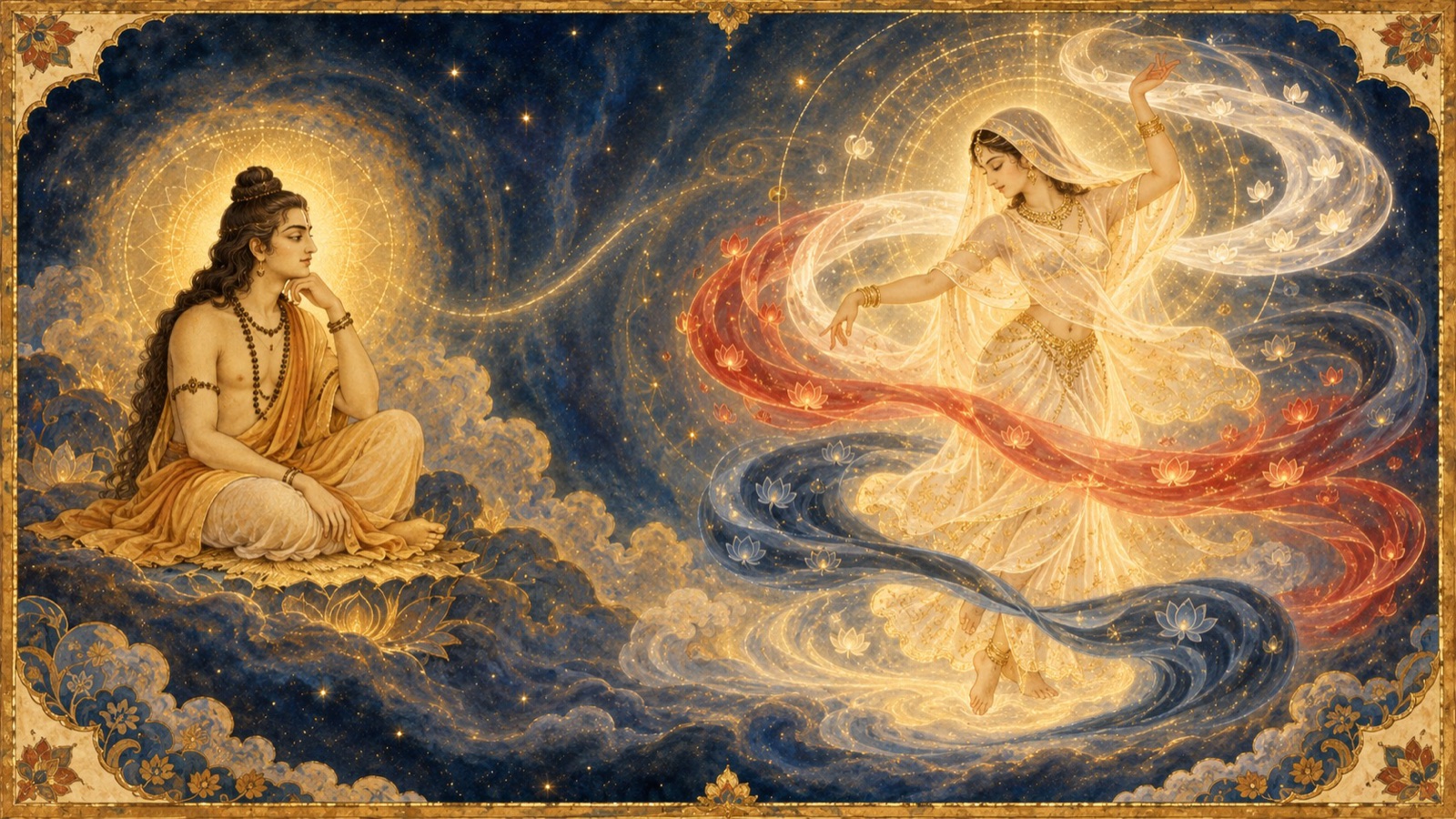
The Purusa is no other than the Spirit, who is beginningless, devoid of attributes, existing beyond Prakrti, revealed in the heart of all beings and self-effulgent — pervaded by whom the universe presents itself to our view. (verse 3) This all-pervading Purusa accepted of his own free will the unmanifest divine Prakrti, consisting of the three Gunas, that sought him in her playful mood. (verse 4) From this point Kapila’s account turns from the Purusa’s own untouched nature to the countless embodied souls who share that same spiritual essence without sharing its freedom: already abiding in Prakrti, such a Purusa falls prey to her charms, that obscure knowledge, and forgets himself the moment he sees her evolving through her Gunas — Sattva, Rajas and Tamas — progeny of various kinds. (verse 5) By identifying himself with Prakrti, who is other than himself, he attributes the doership of actions performed by the Gunas of Prakrti to himself. (verse 6) It is this feeling of doership which binds him to actions, although he is really a mere witness and therefore a non-doer; and it is this bondage through action which makes him helpless, although he is independent in reality, and subjects him to repeated births and deaths even though he is blissful by nature. (verse 7) The knowers of Truth recognize Prakrti as responsible for the identification of the soul with body, senses, and mind; as for the experience of pleasure and pain, they hold this conditioned Purusa — identifying himself with Prakrti — to be responsible, although he is in fact beyond Prakrti. (verse 8)
It is worth sitting with the plainness of this account before moving on, because it is one of the most economical descriptions of bondage found anywhere in scripture: nothing is done to the embodied Purusa. He forgets himself; he mistakes another’s actions for his own; and from that single mistaken identification flows every subsequent experience of pleasure, pain, birth, and death. The remedy, by implication, is not a change of circumstance but a correction of identity.
This distinction — the Purusa’s transcendent freedom in verses 3–4 and the embodied soul’s real bondage from verse 5 onward — carries a theological weight that Kapila will not allow Devahuti to miss. However playfully the two are described as meeting, the meeting itself never touches the Supreme; only the countless souls who forget themselves within Prakrti actually suffer the results. It would be a serious error to conclude, from the single Sanskrit word Purusa naming both, that the Lord’s own transcendental sport and the conditioned soul’s forgetfulness are one and the same experience wearing two faces. They are not. One is freely entered and never binds; the other is unwittingly entered and binds absolutely, unto death and rebirth, until knowledge cuts the knot. The whole force of this chapter’s teaching depends on holding that difference clearly in view.
Devahuti’s Question and the Twenty-Four Categories
Having heard this account of bondage in its bare essentials, Devahuti asks the question that unlocks the rest of the chapter.
Devahuti said: “Kindly also tell me, O Supreme Person, the characteristics of Prakrti and Purusa, the two causes of this universe, which in its gross and subtle forms is nothing but a manifestation of these.” (verse 9)
Kapila’s answer begins with a formal definition and then proceeds, with the patience of a true teacher, to enumerate every single category involved.
The wise speak of Pradhana (Primordial Matter) as Prakrti — consisting of the three Gunas, unmanifest and eternal, existing both as cause and effect, and though undifferentiated in its causal state, the source of distinct categories such as the Mahat-tattva. (verse 10) The aggregate of twenty-four categories — the five gross elements, the five subtle elements, the four internal senses, the five senses of perception, and the five organs of action — is known to be an evolute of the Pradhana. (verse 11) The gross elements are five: earth, water, fire, air, and ether; the subtle elements are likewise five: smell, taste, colour, touch, and sound. (verse 12) The Indriyas are ten: the auditory sense, the tactile sense, the sense of sight, the sense of taste, the olfactory sense, the organ of speech, the hands, the feet, the organ of generation, and the organ of defecation. (verse 13) The internal sense has four aspects — mind, understanding, ego, and reason — distinguished by their functions. (verse 14) This is the full disposition of the conditioned Brahma: twenty-four principles, Time (Kala) being the twenty-fifth. (verse 15)
Kala deserves a moment’s particular attention, because Kapila is careful to say something quite specific about it: some speak of Kala as a destructive potency of the Purusa, which causes fear to the soul that has associated itself with Prakrti and been deluded by egotism (verse 16); but as a matter of fact, the Lord Himself, who activates Prakrti — the equilibrium of the three Gunas which in that state admits of no particular name or form — is Himself designated as Kala. (verse 17) In this way the Lord, by His own Maya, abides unaffected within all living beings as the Purusa, their Inner Controller, and outside them as Kala — the twenty-fifth category. (verse 18) Time, in other words, is not a separate cosmic force operating alongside the Lord; it is one more form the Lord Himself takes in relation to the created world.
To help hold these twenty-five categories in mind as Kapila’s exposition unfolds through the rest of the chapter, they may be summarized as follows:
| # | Category (Sanskrit / English) | Nature |
|---|---|---|
| 1 | Pradhana / Prakrti | Unmanifest primordial matter, the source of all evolutes |
| 2–5 | The four internal senses: mind, understanding (Buddhi), ego (Ahankara), reason (Citta) | The subtle instruments of cognition |
| 6–10 | The five Jnanendriyas (senses of perception): hearing, touch, sight, taste, smell | Instruments of sensory knowledge |
| 11–15 | The five Karmendriyas (organs of action): speech, hands, feet, generation, excretion | Instruments of action |
| 16–20 | The five Tanmatras (subtle elements): sound, touch, colour, taste, smell | Subtle essences underlying the gross elements |
| 21–25 | The five gross elements (Mahabhutas): ether, air, fire, water, earth | Manifest physical elements |
| 25th | Kala (Time) | The Lord’s own potency, the twenty-fifth category, operating both within as Purusa and without as Time |
The Birth of the Mahat-Tattva
With the categories named, Kapila now describes the actual sequence of their emergence — beginning with the very first evolute of Prakrti, the Mahat-tattva, the principle of cosmic intelligence.
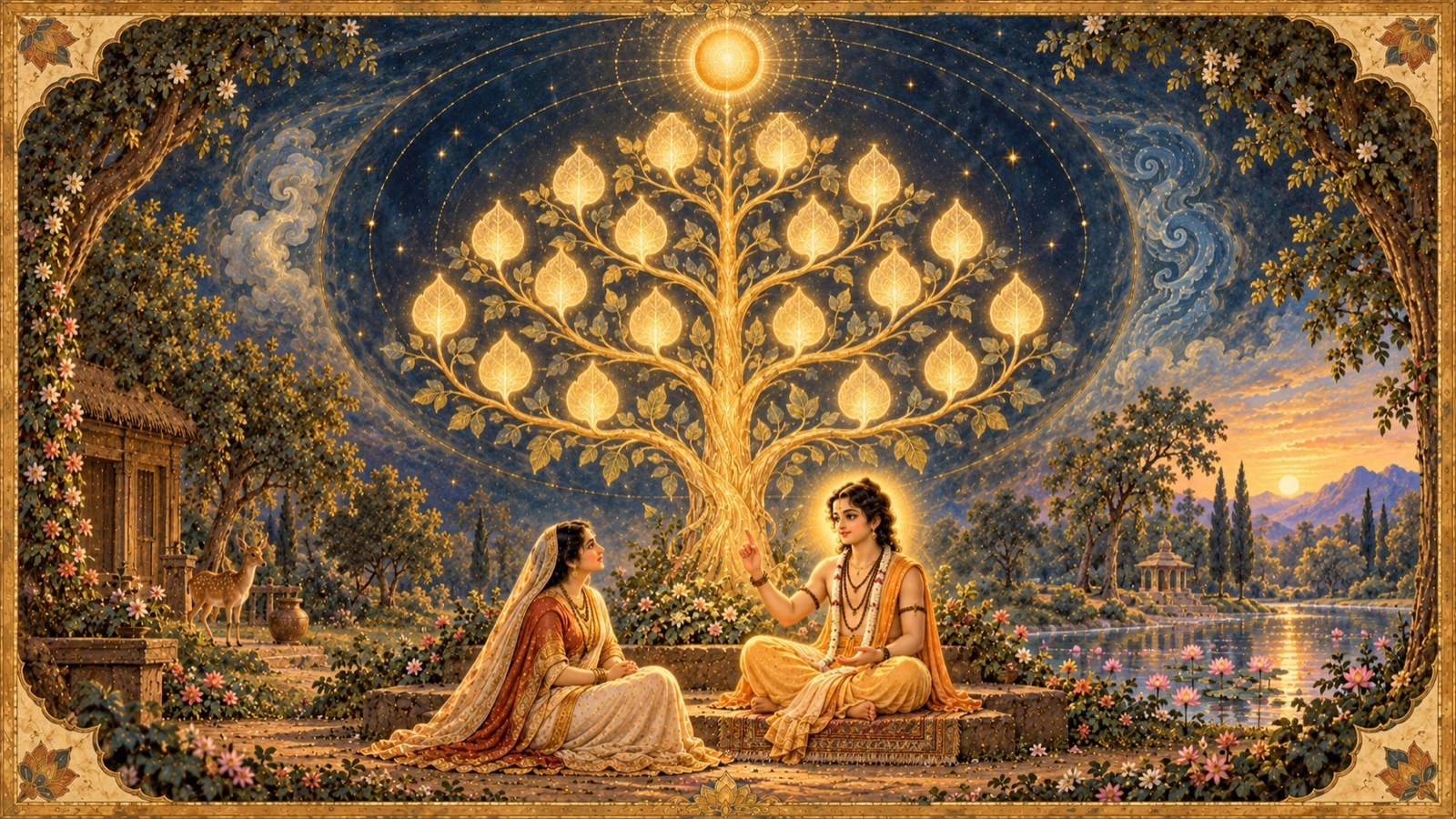
When the Supreme Person placed His energy — Cit-Sakti, the power of intelligence — in His own Maya, the source of all created beings, whose equilibrium of Gunas had been disturbed by the destiny of the various Jivas, the Maya gave birth to the Mahat-tattva, which is full of light. (verse 19) The Mahat-tattva, which knew no languor or distraction, and represented the shoot of the tree of the universe, drank off by its own effulgence the thick gloom that had once swallowed it at the time of universal dissolution — in order to manifest the universe lying subtly within it. (verse 20)
Kapila then identifies the Mahat-tattva not merely as an abstract cosmological principle but as something with a name and a face within the Vaishnava tradition of the Lord’s own forms.
Citta — the faculty of reason, which abounds in Sattva, is pure and free from passion, and is the very place where one can realize God — is spoken of as the Mahat-tattva and is also called by the name Vasudeva, because it is through the cosmic Citta that one worships Vasudeva, the foremost of the Lord’s four forms. (verse 21) Just as water in its natural state, before contact with earth, is clear, sweet, and unruffled, so too transparency, freedom from distraction, and serenity are the characteristic traits of Citta. (verse 22)
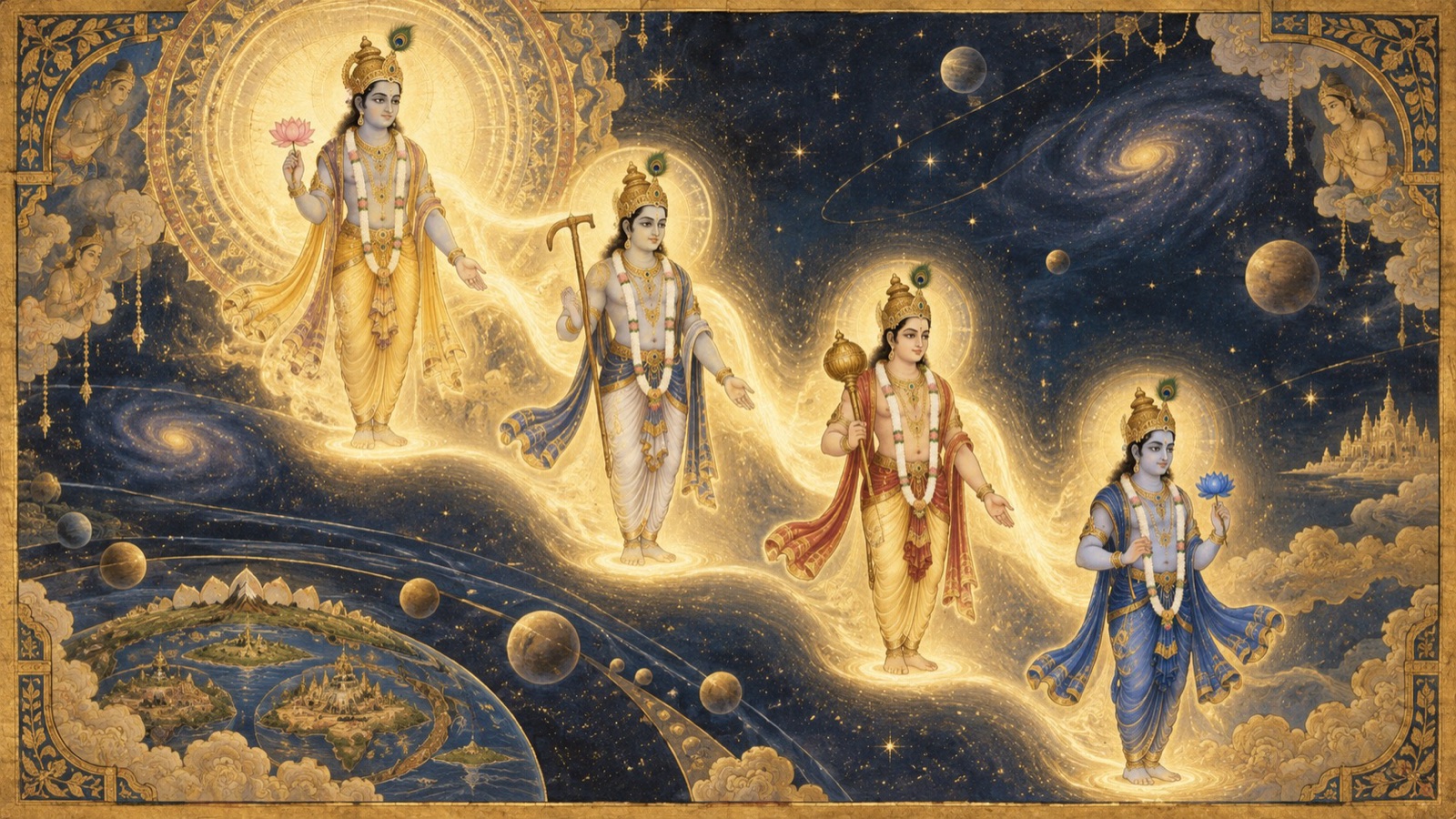
This identification of the Mahat-tattva with Vasudeva is the first appearance, in this chapter, of a pattern that will recur throughout the rest of Kapila’s exposition: each major evolute of Prakrti corresponds to one of the four forms (Vyuhas) of the Lord recognized in the Pancharatra tradition — Vasudeva, Sankarsana, Pradyumna, and Aniruddha — so that the unfolding of matter is never, even at its most technical, separate from the unfolding of the Lord’s own presence within that matter.
The Threefold Ego and Its First Evolutes
From the Mahat-tattva springs the next great principle: Ahankara, the ego, which Kapila describes as threefold from the very moment of its birth.
From the Mahat-tattva, evolved from the Lord’s own Cit-Sakti, as it underwent transformation, sprang up Ahankara, predominantly endowed with active power and of three kinds — Sattvika, Rajasika, and Tamasika. From these three types were severally evolved the mind, the Indriyas, and the gross elements. (verses 23–24) This threefold Ahankara — the source of the gross elements, the Indriyas, and the mind, and hence identical with them as their cause — is the same as the Purusa called Sankarsana, whom the Vaisnavas speak of as Lord Ananta with a thousand heads. (verse 25) The Ahankara is characterized as a doer, an instrument, and an effect, and further as serene, active, or dull according to its Sattvika, Rajasika, or Tamasika nature. (verse 26)
Each of the three types of ego then produces its own distinct line of evolutes. From the Sattvika (Vaikarika) ego comes the mind, whose thoughts and reflections give rise to desire — and this very mind is known by the name of Lord Aniruddha, the supreme Ruler of the Indriyas, dark and beautiful as the blue lotus of autumn, slowly won by the Yogis. (verses 27–28) From the Rajasika ego springs Buddhi, understanding — whose functions are to ascertain the nature of objects and to aid the senses in perceiving them — and this Buddhi is known by the name of Lord Pradyumna, the third of the Lord’s four forms; its characteristics are doubt, misapprehension, correct apprehension, memory, and sleep. (verses 29–30) The senses of perception and the organs of action are likewise both evolutes of the Rajasika (Taijasa) ego, since the power of action belongs to Prana and the power of perception to Buddhi, both themselves evolutes of that same Taijasa ego. (verse 31)
The table below gathers this identification of the four Vyuha-forms with the successive principles of cosmic intelligence, which readers may find useful in following the rest of the chapter’s more technical unfolding:
| Cosmic principle | Guna | Identified Vyuha-form of the Lord | Verses |
|---|---|---|---|
| Mahat-tattva (Citta) | Sattva-dominant | Vasudeva | 21 |
| Ahankara (threefold ego, source of all three lines below) | All three Gunas | Sankarsana | 25 |
| Mind (from Sattvika ego) | Sattva | Aniruddha | 27–28 |
| Buddhi (from Rajasika ego) | Rajas | Pradyumna | 29–30 |
The Five Tanmatras: From Sound to Earth
The chapter’s longest and most methodical passage now begins: the sequential derivation of the five subtle elements (tanmatras) and, from each, its corresponding gross element and sense of perception. The process is set in motion by the Tamasika ego.
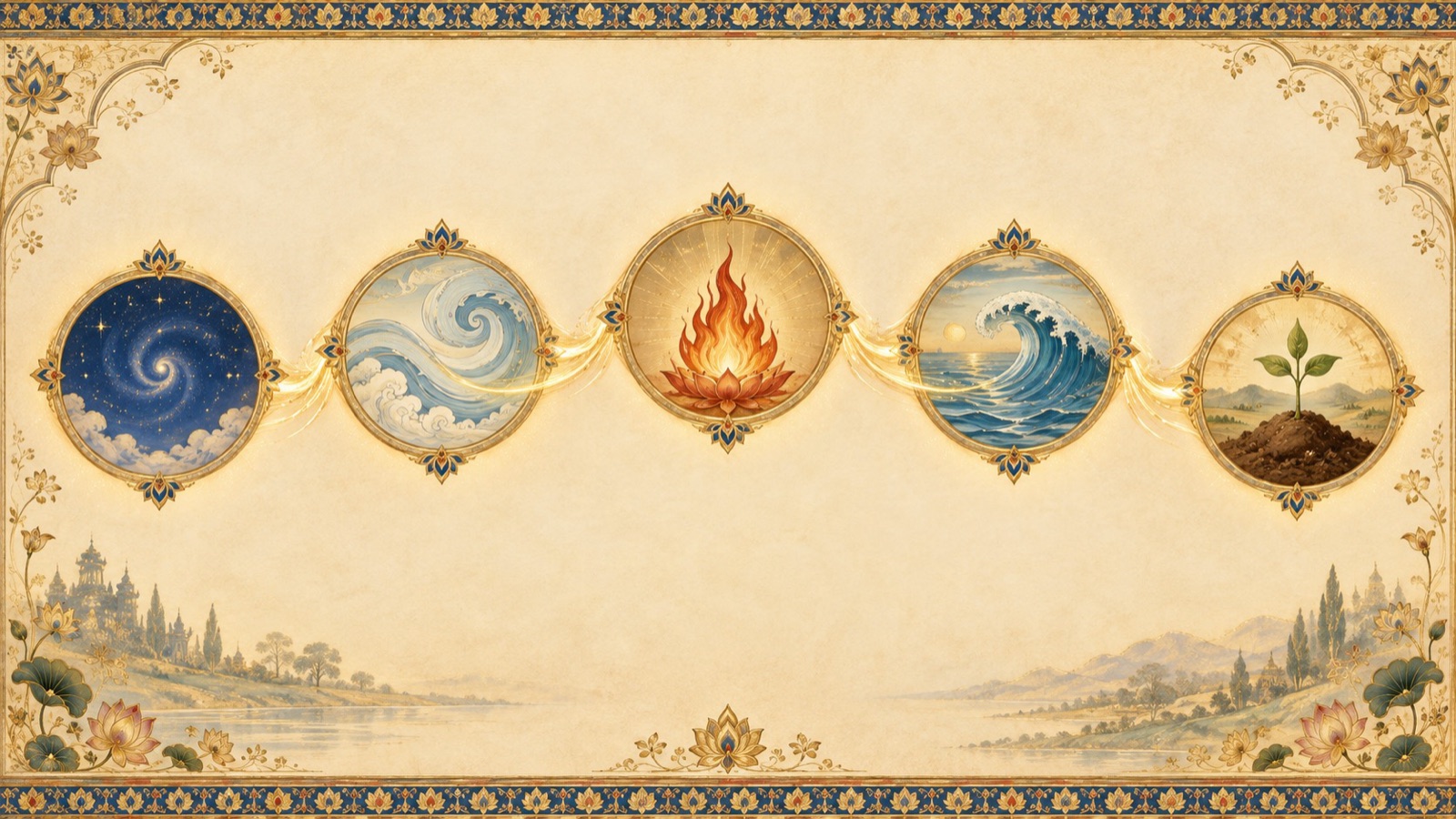
From the Tamasika ego, impelled by the Lord’s own Cit-Sakti, sprang up the principle of sound; and from sound was evolved ether and the auditory sense, which catches sound. (verse 32) Sound is defined as that which conveys the idea of an unseen object, indicates the presence of a speaker screened from view, and constitutes the subtle form of ether; and ether itself is characterized as that which affords room to living beings, gives rise to the notions of inside and outside, and is the abode of Prana, the Indriyas, and the mind. (verses 33–34)
From ether, under the impulse of Time, sprang the principle of touch and, from that, air and the tactile sense. Softness, hardness, cold, and heat are touch’s distinguishing attributes, and it is the subtle form of air; while air itself is characterized by its capacity to shake, to bring together, to reach everywhere, to bear scent and sound to the senses, and to give strength and vitality to all the Indriyas. (verses 35–37)
From air, impelled by the destiny of the various Jivas, proceeded the principle of colour and, from that, fire and the sense of sight. To appear in the same form as the substance it inheres in, to depend on that substance, and to constitute fire’s essential nature — these are colour’s functions; while fire itself gives light, cooks and digests food, destroys cold, dries moisture, and gives rise to hunger and thirst. (verses 38–40)
From fire proceeded the principle of taste and, from that, water and the sense of taste. Taste, though essentially one, becomes manifold — astringent, sweet, bitter, pungent, sour, and salt — through contact with other substances; while water wets, brings cohesion, satisfies, sustains life, refreshes by slaking thirst, and softens things. (verses 41–43)
From water proceeded the principle of smell and, from that, earth and the olfactory sense. Smell too becomes many — mixed, offensive, fragrant, mild, strong, acid — according to the proportion of connected substances; while earth gives form to the concept of the Infinite, holds its position, holds other substances, limits unlimited space, and manifests the very bodies and distinctive qualities of all living beings. (verses 44–46)
Kapila closes this sequence with a summary of how each of the five senses of perception is defined by its corresponding element’s quality — sound for hearing, touch for the tactile sense, colour for sight, taste for the sense of taste, and odour for smell (verses 47–48) — and with a striking closing observation: since a cause exists in its effect as well, the characteristics of each preceding element are found within the one that follows it, which is why the qualities of all the elements are ultimately found present in earth alone. (verse 49) Earth, the last and grossest of the elements, is in this sense also the most complete — carrying within it every quality of sound, touch, colour, taste, and smell that the elements before it introduced one by one.
The full sequence of evolution, tanmatra by tanmatra, may be laid out as follows:
| Tanmatra (subtle element) | Gross element produced | Sense of perception | Verses |
|---|---|---|---|
| Sound (Sabda) | Ether (Akasha) | Hearing (auditory sense) | 32–34 |
| Touch (Sparsha) | Air (Vayu) | Touch (tactile sense) | 35–37 |
| Colour/Form (Rupa) | Fire (Tejas) | Sight | 38–40 |
| Taste (Rasa) | Water (Jala) | Taste | 41–43 |
| Smell (Gandha) | Earth (Prithvi) | Smell (olfactory sense) | 44–46 |
The Cosmic Egg and the Cosmic Being
With the twenty-four categories now fully derived, Kapila turns to how they come together to form the visible universe and the vast cosmic form within it.
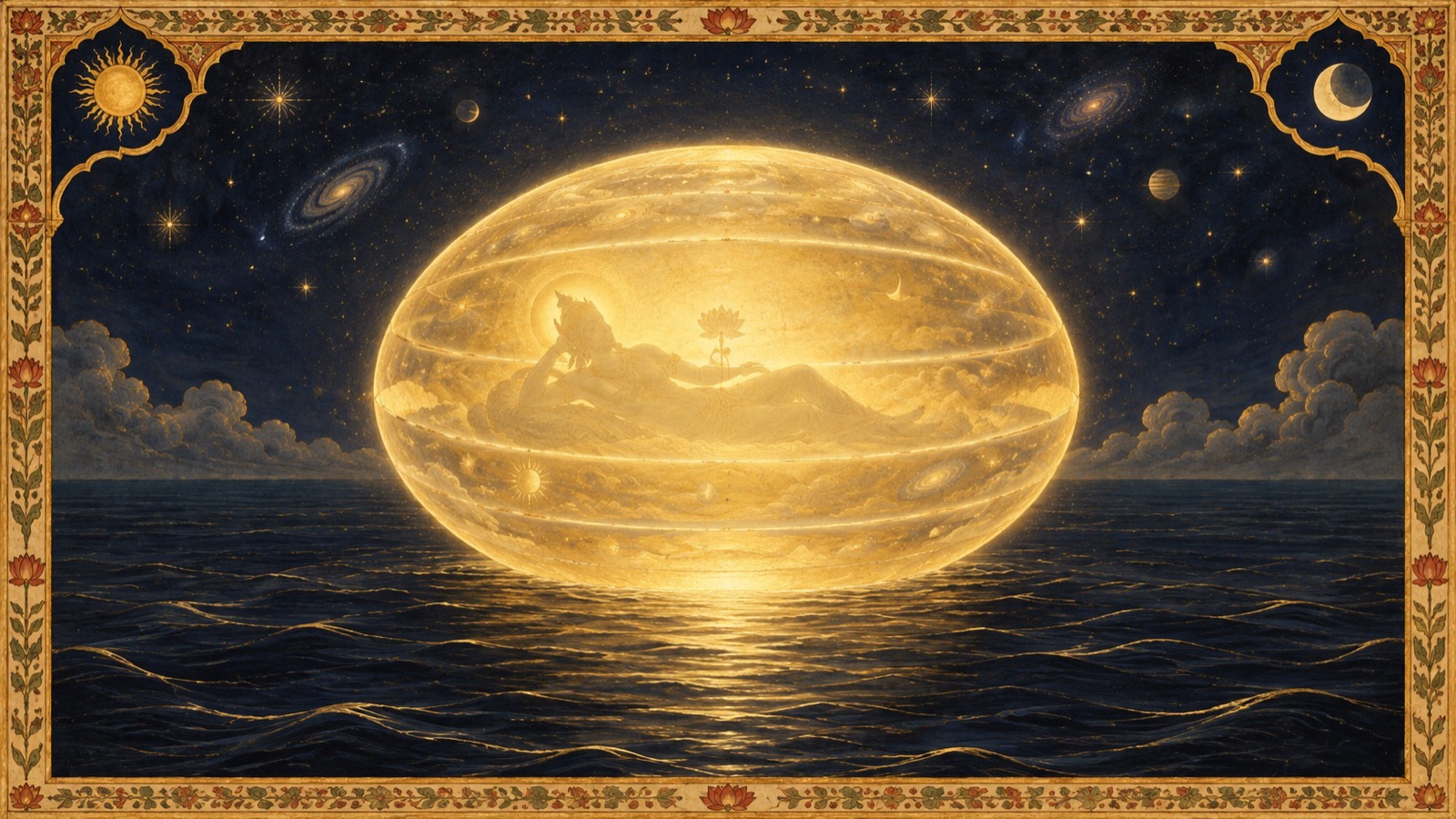
When the Mahat-tattva, the ego, and the five gross elements — these seven — stood disunited, Lord Narayana entered them, taking with Him Time, the destiny of the various Jivas, and the Gunas. (verse 50) From these seven principles, roused into activity and united by the presence of the Lord, arose an unintelligent egg, from which appeared the well-known Cosmic Being. (verse 51) This egg, known as Visesa, is enveloped on all sides by belts of water, fire, air, ether, the ego, and the Mahat-tattva — each ten times larger than what it encloses, all six enveloped in turn by the outermost belt of Pradhana itself. All fourteen worlds, a manifestation of Sri Hari, lie spread within this egg. (verse 52) Shaking off an attitude of indifference toward that shining egg lying upon the causal waters, the Cosmic Being presided over it and manifested from it the seats of the various Indriyas. (verse 53)
What follows is one of the most vivid passages in this entire section of the Bhagavatam: the sequential emergence of the Cosmic Being’s own bodily organs, each accompanied immediately by its presiding deity.
A mouth appeared first, and from it the organ of speech and the god of fire, its presiding deity. Then came a pair of nostrils, with the olfactory sense and Prana; and in their wake, the wind-god. Then came a pair of eyes and the sense of sight, followed by the sun-god; then a pair of ears and the auditory sense, followed by the Digdevatas, the guardian deities of the directions. (verses 54–55) Then came the skin, the hair of the body and head, and a moustache and beard — followed by the herbs and annual plants as presiding deities — and then an organ of generation, in which appeared the faculty of procreation, followed by the god presiding over the waters. (verse 56) Then an anus, and in it the organ of defecation, followed by the fearsome god of death. (verse 57) Then a pair of hands, with the power of grasping, followed by Indra; and a pair of feet, with the power of locomotion, followed by Lord Vishnu Himself as the presiding deity of that power. (verse 58) Then the blood vessels and blood, followed by the rivers as their deities, and then an abdomen. (verse 59) Then hunger and thirst, followed by the ocean; and then a heart, and in the heart, a mind. (verse 60) After the mind came the moon as its deity, and Buddhi, followed by Brahma as Buddhi’s deity; then the ego, followed by Lord Rudra; and last of all, Citta — reason itself — followed by the Kshetrajna, the Inner Controller, as its presiding deity. (verse 61)
For readers who wish to hold the full sequence in view at once, the organs and their presiding deities may be tabulated as follows:
| Organ / faculty of the Cosmic Being | Presiding deity |
|---|---|
| Mouth / organ of speech | Fire (Agni) |
| Nostrils / olfactory sense, Prana | Wind-god (Vayu) |
| Eyes / sense of sight | Sun-god (Surya) |
| Ears / auditory sense | Digdevatas (guardians of the directions) |
| Skin / hair, moustache, beard | Herbs and annual plants |
| Organ of generation / procreation | God of the waters |
| Anus / organ of defecation | God of death (Mrityu) |
| Hands / grasping | Indra |
| Feet / locomotion | Lord Vishnu |
| Blood vessels / blood | The rivers |
| Abdomen / hunger and thirst | The ocean |
| Heart / mind | The moon |
| Buddhi (understanding) | Brahma |
| Ego (Ahankara) | Lord Rudra |
| Citta (reason) | Kshetrajna, the Inner Controller |
Only the Inner Controller Can Wake Him
The chapter’s final movement is also its most quietly dramatic: a parable, told almost as a sequence of failed attempts, about what alone has the power to awaken life.
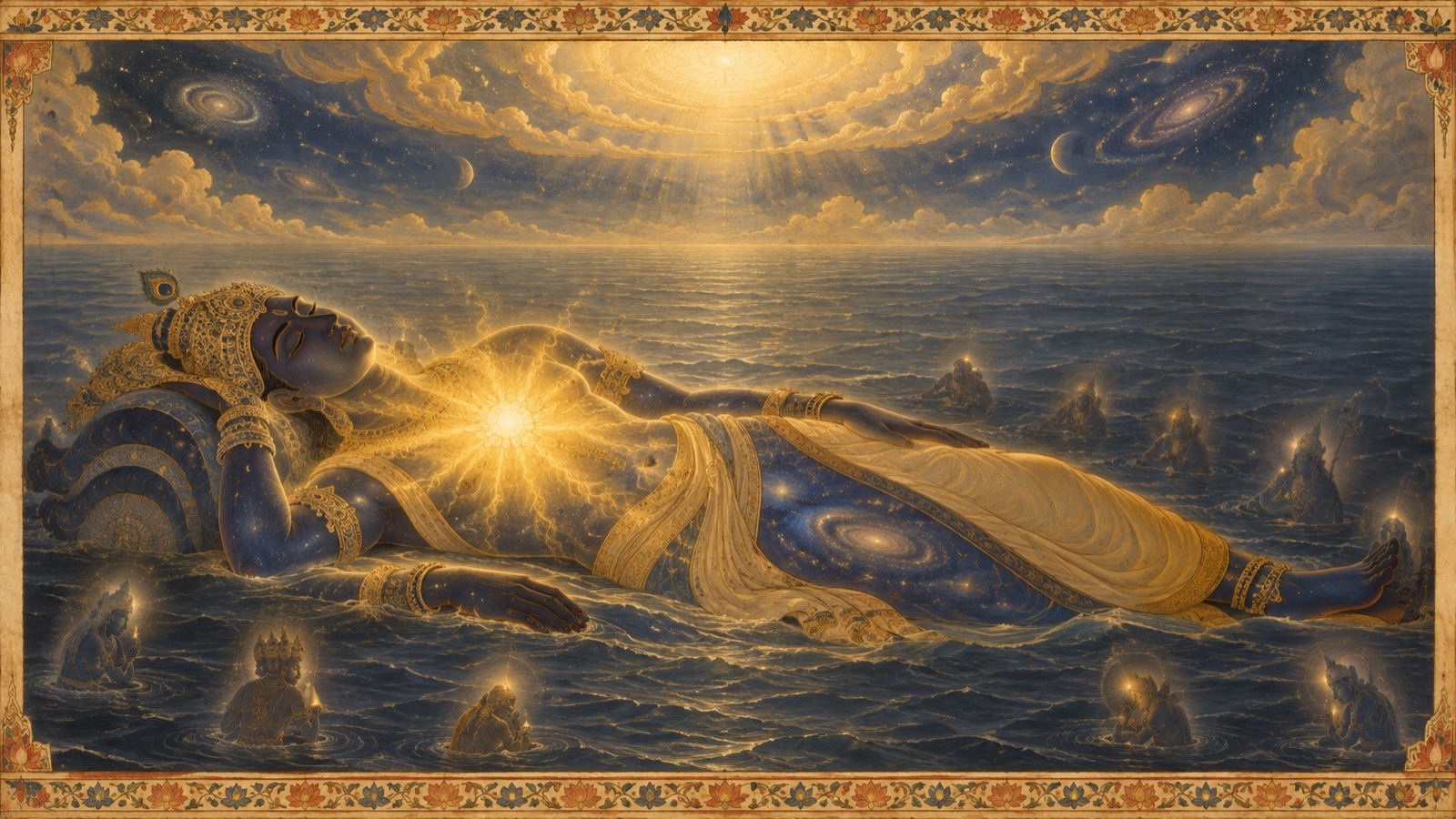
When all the aforesaid deities — with the sole exception of the Inner Controller — though themselves active, were unable to rouse the Cosmic Being into activity, they re-entered each his own seat in order to try to rouse Him one by one. (verse 62) The god of fire entered the mouth with the organ of speech — the Cosmic Being was not roused. The wind-god entered the nostrils with the olfactory sense — He refused to wake. (verse 63) The sun-god entered the eyes with sight — He failed to rise. The Digdevatas entered the ears with hearing — He could not be stirred. (verse 64) The herbs entered the skin with the hair — He would not get up. The water-god entered the organ of generation with procreation — He would not rise. (verse 65) The god of death entered the anus with excretion — He could not be spurred to activity. Indra entered the hands with their grasping power — He would not get up. (verse 66) Lord Vishnu Himself entered the feet with the power of locomotion — He refused to stand. The rivers entered the blood vessels with blood — He could not be made to stir. (verse 67) The ocean entered the abdomen with hunger and thirst — He refused to rise. The moon-god entered the heart with the mind — He was not roused. (verse 68) Brahma entered the heart with Buddhi — still He could not be made to rise. Lord Rudra entered the heart with the ego — still He could not be made to rise. (verse 69)
And then, at last:
चित्तेन हृदयं चैत्यः क्षेत्रज्ञः प्राविशद्यदा । विराट् तदैव पुरुषः सलिलादुदतिष्ठत ॥ ७० ॥
cittena hṛdayaṁ caityaḥ kṣetra-jñaḥ prāviśad yadā virāṭ tadaiva puruṣaḥ salilād udatiṣṭhata
Meaning: Only when the Inner Controller — the deity presiding over Citta, consciousness itself — entered the heart together with reason did the vast Cosmic Being at last rise up from the causal waters. (Canto 3, Chapter 26, verse 70)
It is difficult to overstate how deliberately this sequence is constructed. Every organ receives its faculty; every faculty receives its deity — including, remarkably, Lord Vishnu Himself entering the feet, and Lord Rudra entering the ego. And still nothing stirs. Fire cannot wake Him. The sun cannot wake Him. Even Vishnu, in His form as the deity of locomotion, cannot wake Him. Only when the Kshetrajna — the Inner Controller, the Lord seated in the heart as the witness of the intellect itself — enters, does the vast body finally rise. Kapila draws the lesson out explicitly, so that no reader could mistake this for merely an ancient story about the birth of the universe:
Even as Prana, the Indriyas, the mind, and the understanding are unable to awaken an embodied soul who is fast asleep, by their own power, without the presence of the Inner Controller, similarly they could not do so in the case of the Cosmic Being. (verse 71) Therefore, through Devotion, dispassion, and spiritual wisdom acquired through a concentrated mind, one should contemplate that Inner Controller as present in this very body, though apart from it. (verse 72)
तमस्मिन्प्रत्यगात्मानं धिया योगप्रवृत्तया । भक्त्या विरक्त्या ज्ञानेन विविच्यात्मनि चिन्तयेत् ॥ ७२ ॥
tam asmin pratyag-ātmānaṁ dhiyā yoga-pravṛttayā bhaktyā viraktyā jñānena vivicyātmani cintayet
Meaning: One should contemplate that Inner Controller, discerned as one’s own true Self, present within this very body — through the intellect engaged in Yoga, through Devotion, dispassion, and spiritual Knowledge. (Canto 3, Chapter 26, verse 72)
Why a Chapter of Categories Belongs in a Chapter of Devotion
It may seem, on first encounter, that this chapter’s dense taxonomy of tattvas sits oddly beside the devotional intensity of the chapters that precede and follow it — Kardama’s hymn of surrender in Chapter 24, the glory of Devotion in Chapter 25, and Devahuti’s continuing questions in the chapters ahead. But Kapila Himself gives the reason at the very outset: this knowledge exists to be known, so that a soul, once it has grasped these categories, might finally shake free of Prakrti’s threefold hold (verse 1). The Sankhya enumeration is not offered as an end in itself but as a diagnostic instrument — a way of learning, category by category, exactly what one is not, so that what one actually is can finally come into view. And the chapter’s closing image makes the connection explicit: the same Inner Controller whose entry alone could rouse the vast, motionless Cosmic Being at the dawn of creation is, this chapter insists, seated in exactly the same place — the heart — of every embodied being reading these words today. The cosmology and the devotion are, in the end, describing a single reality from two directions.
Principal Teachings of This Chapter
1. Bondage begins with mistaken identity, not with any actual change in the soul. The Purusa loses nothing of his true nature by “forgetting” himself in Prakrti’s charms — he simply misattributes her actions to himself, and every subsequent experience of pleasure, pain, birth, and death follows from that single error (verses 3–8).
2. Creation follows an intelligible, orderly sequence — it is not chaos. From Prakrti to Mahat-tattva, from Mahat-tattva to the threefold ego, and from the ego through the tanmatras to the gross elements and senses, each principle in this chapter arises from a specific, named predecessor in a fixed order (verses 19–49).
3. Even the most abstract cosmological categories are, at their root, forms of the Lord. The Mahat-tattva is Vasudeva; the Ahankara is Sankarsana; the mind is Aniruddha; Buddhi is Pradyumna — matter’s evolution is never separate from the Lord’s own presence within it (verses 21, 25, 28, 29).
4. Earth, the last and grossest element, paradoxically contains the most, not the least. Because each element inherits the qualities of its cause, earth alone carries within it something of sound, touch, colour, taste, and smell all at once — density is not the same as poverty (verse 49).
5. Every organ can be given, and still nothing stirs, without the one thing that gives it life. Fire, sun, wind, the ocean, even Lord Vishnu in His form presiding over locomotion — none can rouse the Cosmic Being; only the Inner Controller entering the heart succeeds, and the same is true of every sleeping embodied soul (verses 62–71).
6. The whole of this teaching converges on a single, practical instruction. Having unfolded twenty-five categories across seventy-one verses, Kapila’s actual conclusion is simple: contemplate the Inner Controller, present in this very body, through devotion, dispassion, and knowledge (verse 72).
A Devotional Reflection
There is something quietly reassuring in the shape of this chapter, even amid its unfamiliar Sanskrit vocabulary and its long chains of cause and effect. A universe this intricately, deliberately ordered — mind from ego, ego from cosmic intelligence, cosmic intelligence from the Lord’s own energy stirring an otherwise-inert Prakrti — is not a universe governed by accident. And the chapter’s closing parable offers something more personal still: however many faculties a being possesses, however many organs and senses and powers are already active and functioning, none of it amounts to true life without the Inner Controller’s presence. This is not a discouraging thought but a liberating one. It means that whatever feels stalled, unroused, or asleep in one’s own life is not a failure of effort — sun, wind, and fire could not rouse the Cosmic Being either, no matter how faithfully each entered its seat. What was needed was not more effort from the existing faculties, but the presence of the one thing capable of giving them life. The invitation of this chapter is to stop trying to wake oneself up through the senses and the mind alone, and instead to turn attention toward the One already seated, quietly, in the heart.
A Daily Devotional Practice
Today, take a few of the ordinary faculties this chapter names — the ability to see, to hear, to touch, to taste, to smell, to move your hands and feet — and notice, one by one, that each of them is already functioning, already active, without your having built or earned any of them. Then ask, gently and without anxiety, the same question this chapter poses about the Cosmic Being: what is it that actually gives all of this life? Sit quietly for a few minutes, and rather than trying to force a feeling of wakefulness through effort or activity, simply turn attention inward, toward the heart, and repeat softly: “Om Namo Bhagavate Vasudevaya.” Let the practice itself be an act of the “Devotion, dispassion, and knowledge” that verse 72 names as the very means of contemplating the Inner Controller who is, even now, closer than the senses through which this page is being read.
Conclusion
The twenty-sixth discourse of the Third Canto carries the reader from the height of devotional feeling in the preceding chapters into the careful architecture of Sankhya philosophy — and shows, by its very structure, that the two were never really separate. In response to Devahuti’s single question about the nature of Prakrti and Purusa, Lord Kapila unfolds the entire evolutionary sequence of the material creation: the twenty-four categories and Time as the twenty-fifth, the birth of the luminous Mahat-tattva, the threefold ego and its identification with the Lord’s own eternal forms, the ordered succession of the five subtle elements into the five gross elements and senses, and finally the formation of the cosmic egg and the vast Cosmic Being whose every organ receives its own presiding deity and yet who remains motionless until the Inner Controller alone enters the heart. What begins as a lesson in cosmology ends, in its final verse, as a lesson in contemplation — for the very presence that alone could bring the motionless Cosmic Being to life at the dawn of creation is named here as the one reality every embodied soul is invited, through devotion, dispassion, and knowledge, to discover seated within.
May the divine wisdom of Srimad Bhagavatam awaken pure devotion within our hearts.
Om Namo Bhagavate Vasudevaya.
Jay Shree Madhav.
References and Attribution
- Primary edition: Gita Press, Śrīmad Bhāgavata Mahāpurāṇa (English, complete), Book Three, Discourse 26, pages 251/252–258.
- Series: Srimad Bhagavatam Wisdom · Biswa Sanatan Dharma Seva Trust.
- Presented following the spiritual guidance and recommendation of Pandit Dr. Shri Kashinath Mishra.
This is an original, faithful retelling in the writer’s own words, with brief quoted verses shown in Devanāgarī and transliteration and their meanings given as summaries. It is not a reproduction of any single publisher’s continuous translation or commentary. No affiliation with or endorsement by any publisher is implied.
Jay Shree Madhav