
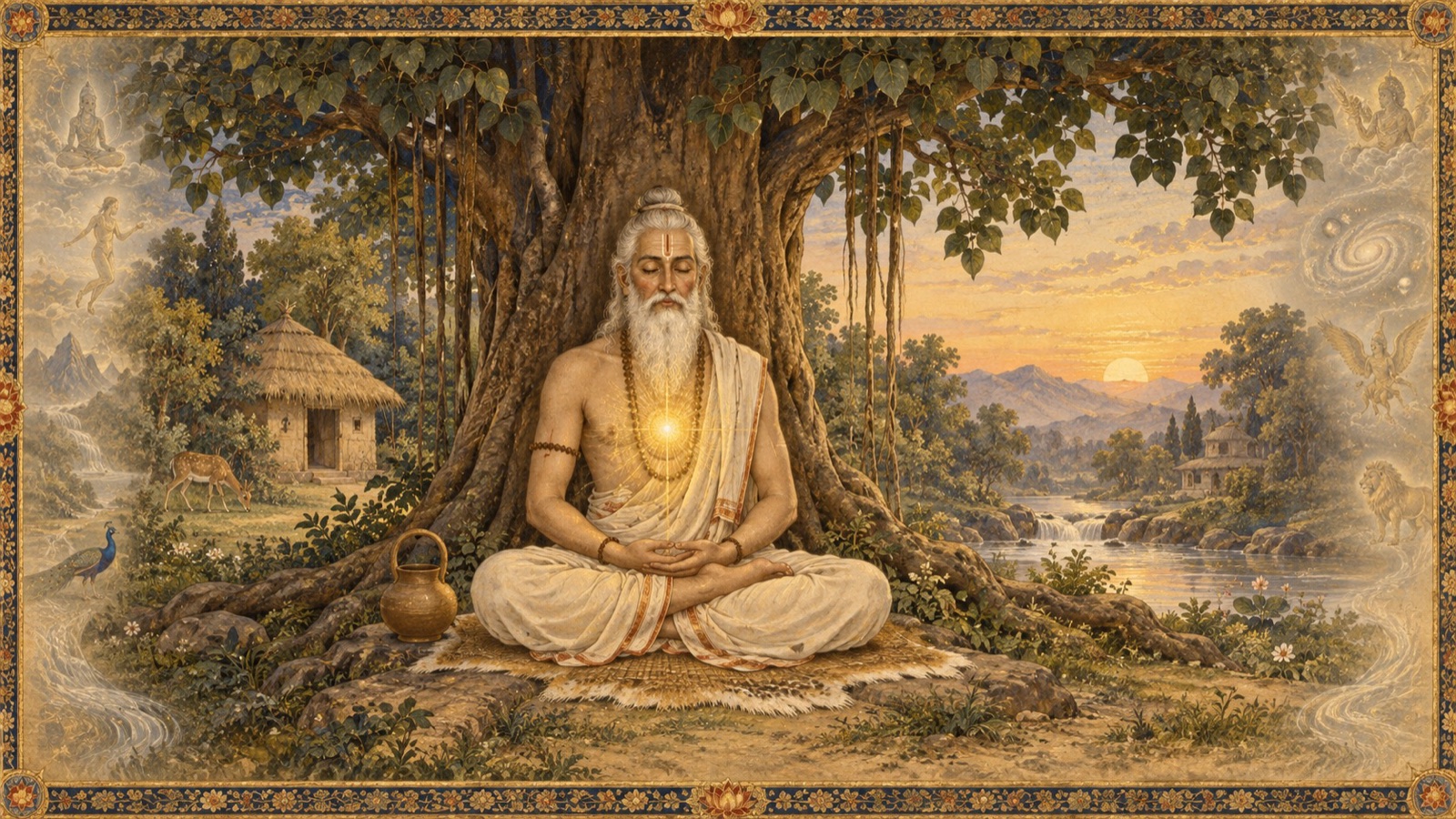
Water may ripple or turn cold, but the sun caught in its reflection is never really touched by either — it only appears to share the water’s condition. In just the same way, the Spirit seated within a suffering, aging body remains, in truth, forever unstained, unchanging, and free.
Om Namo Bhagavate Vasudevaya.
Om Namo Bhagavate Vasudevaya.
Om Namo Bhagavate Vasudevaya.
Welcome to Srimad Bhagavatam Wisdom, a devotional journey through the sacred histories and teachings of the Srimad Bhagavat Mahapurana. We are deep now in the heart of the Kapila-Gita — the teaching Lord Kapila gives to His own mother, Devahuti, in the forest hermitage on the bank of the Sarasvati. The previous chapter laid out, point by point, the twenty-four fundamental principles (tattvas) of manifest existence, ending with the vision of the Cosmic Being (Virat Purusha) rising from the causal waters only when the Inner Controller entered the heart. Chapter 27 turns from that grand cosmic map inward, to the single most practical and most difficult question the whole teaching exists to answer: how does an embodied soul, bound day and night to a body it mistakes for itself, come to see — truly see — that it was never bound at all? Kapila answers first in pure metaphysics: the Spirit is like sunlight reflected in water, touched by nothing it reflects upon. Then Devahuti, in one of the most quietly incisive interruptions in the entire Bhagavatam, presses back with a hard logical objection. And Kapila’s reply to her closes the chapter with the promise every seeker of this teaching is waiting to hear: that bondage, however old, however deeply rehearsed, can be undone — burned away like the kindling-stick consumed by the very fire it produces.
Chapter Information
- Scripture: Śrīmad Bhāgavata Mahāpurāṇa
- Canto: 3 (Book Three)
- Chapter: 27 (Discourse 27)
- Chapter title: How to attain Liberation through the differentiation of Matter and Spirit?
- Principal speaker: Lord Kapila, teaching His mother Devahuti; one direct-speech interruption by Devahuti herself (verses 17–20), to which Kapila’s own words form the chapter’s concluding reply (verses 21–30)
- Principal listener: Devahuti
- Main setting: The hermitage of the sage Kardama on the bank of the river Sarasvati (the same setting as the preceding chapters of the Kapila-Gita)
- Central subject: The Spirit’s essential changelessness compared to the sun reflected in water; the qualities and practices of the God-realized devotee; the ego as a “reflection of a reflection” through which the Self is glimpsed; Devahuti’s objection that Matter and Spirit, being co-eternal, can never truly separate; and Kapila’s reply describing how devotion gradually consumes Prakrti’s hold over the soul, culminating in the warning against attachment to yogic powers on the final approach to liberation
- Principal verse range: Canto 3, Chapter 27, verses 1–30
- Primary edition: Gita Press Śrīmad Bhāgavata Mahāpurāṇa
The Sun in the Water: An Unstained Spirit
Chapter 27 opens with only the barest attribution — “the Personality of Godhead said” — no fresh scene-setting, no “Maitreya said.” Kapila is simply continuing, mid-teaching, from exactly where the previous discourse left off.
श्रीभगवानुवाच । प्रकृतिस्थोऽपि पुरुषो नाज्यते प्राकृतैर्गुणैः । अविकारादकर्तृत्वान्निर्गुणत्वाज्जलार्कवत् ॥ १ ॥
śrī-bhagavān uvāca prakṛti-stho ‘pi puruṣo nājyate prākṛtair guṇaiḥ avikārād akartṛtvān nirguṇatvāj jalārkavat
Meaning: Even while dwelling within a body shaped by Prakrti, the Spirit is never colored by Prakrti’s own qualities — it undergoes no real transformation, performs no action of its own, and carries none of Prakrti’s three modes as its own nature; for that very reason it is exactly like the sun seen reflected in water: present at the scene, yet untouched by it. (SB 3.27.1)
The Lord continued: Just as the sun, though seen reflected in water, remains unaffected by the attributes of water (such as coolness, unsteadiness and so on), so the Spirit, though abiding in a material body, remains unaffected by its pleasurable and painful experiences, being devoid of attributes and doership and, therefore, free from change. (verse 1)
It is worth sitting with this image before moving on, because the entire chapter — indeed much of the Kapila-Gita — rests on it. A pond ripples; the sun’s reflection in it seems to ripple too. The water grows cold; the reflected sun seems, to a careless eye, to share that coldness. But the sun itself, far off in the sky, is touched by neither the ripple nor the cold. It only appears implicated because of where it happens to be seen. This, Kapila says, is exactly the relationship between Purusha (the Spirit, the true Self) and the body it inhabits. The body suffers, ages, hungers, and eventually dies; the Spirit within it, rightly understood, does none of these things. It only appears to suffer because it is being watched through the rippling water of a mind and body it never actually belongs to.
Why, then, does bondage feel so real? Kapila’s next verses trace exactly how the illusion sets in:
When, however, he gets attached to the Gunas (modes) of Prakrti, he begins to look upon himself as a doer, being completely deluded by egotism. (verse 2) Due to this sense of doership he loses his peace of mind through evils attaching to action (in the shape of virtue and sin) and brought about by association with Matter and, helplessly thrown into wombs of good, evil and mixed types, has to undergo repeated births and deaths. (verse 3)
The chain is precise: contact with the Gunas (the three modes of Prakrti — sattva, rajas, tamas) produces the false identification “I am the doer”; that false identification produces karma, both good and evil; and karma produces rebirth into wombs suited to the karma accumulated. None of this touches the Spirit itself — but the Spirit, forgetting its own nature, believes it is happening to it, and so suffers as though it were true. Kapila drives the point home with a second image, the dream:
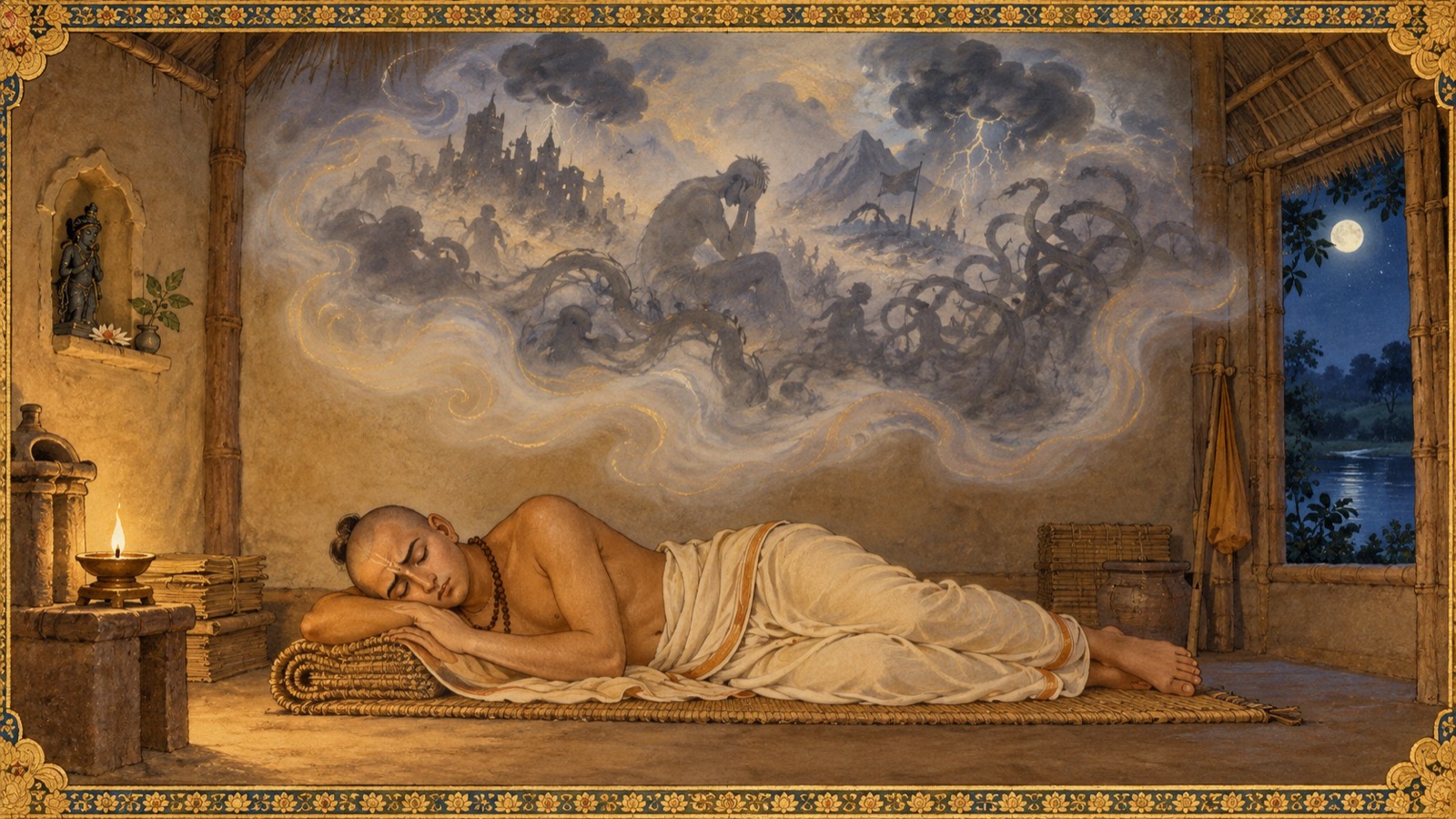
Just as a dreaming man experiences sorrow — even though there is no real cause for it — (because he takes the things seen in the dream to be real), even so for the man who dwells on the objects of senses, the round of births and deaths does not cease, even though those objects do not exist in reality. (verse 4)
A man asleep may dream he is being chased, or drowning, or grieving a loss, and wake genuinely shaken — heart pounding, perhaps even in tears — though nothing in the dream ever actually happened to his waking body. The waking world’s chase after sense-objects, Kapila suggests, is no different in kind, only in scale and duration. The remedy Kapila offers is characteristically direct: “Therefore, through concentrated practice of Devotion as well as through dispassion one should gradually bring under control one’s mind, addicted to the pursuit of sense-objects.” (verse 5) Not suppression by force, but a gradual, disciplined redirection — Bhakti and Vairagya (devotion and dispassion) working together.
Portrait of the God-Realized Devotee
Verses 6 through 11 form one continuous, flowing sentence in the Gita Press English — a single extended portrait, built clause upon clause, of what the life of the liberated devotee actually looks like in practice. It is worth reading slowly, because it is less a list of rules than a description of a particular quality of attention:
Practising concentration of mind through Yama (self-control in the form of non-violence etc.) and other paths of Yoga with reverence, he who has realized the Self (as distinct from Prakrti) by means of sincere devotion to Me, and by listening to My stories, by even-mindedness towards all beings and absence of enmity or attachment to any, by practising continence and observing a vow of silence, and by devotion to one’s own duty in a spirit of dedication to God; who remains contented with whatever is got by chance (as a dispensation of Providence) and takes food in a measured quantity, is ever given to contemplation, lives in seclusion, and is calm and composed, friendly (to all), compassionate and self-possessed; nay, by virtue of wisdom acquired through the perception of reality of both Matter and Spirit, he who ceases to identify himself with his body and to regard those connected with it as his own, who transcends the three states of consciousness (waking, dream and deep sleep), and therefore no longer sees anything else than God — such a man is able to perceive his true Self with his purified intellect even as one sees the sun with his eyes, and (forthwith) attains to that Brahma who is one without a second, who is free from all adjuncts (such as body), who shines as the only reality through the false ego, who is the foundation of Prakrti (the material cause of the universe), nay, who reveals the Mahat-tattva and other evolutes and interpenetrates everything — both cause and effect. (verses 6–11)
Notice how the passage begins with disciplines — self-control, hearing the Lord’s stories, even-mindedness, contentment, measured eating, solitude — and only after laying out this whole way of living does it arrive at the actual moment of realization: “such a man is able to perceive his true Self… even as one sees the sun with his eyes.” The comparison to seeing the sun directly, rather than its reflection, is a deliberate echo of verse 1: the entire discipline described here is nothing other than the slow work of turning attention away from the water’s rippled reflection and toward the sun itself.
The Ego: A Reflection of a Reflection
Having described what realization looks like, Kapila turns to a subtler question — how, exactly, is the Self even glimpsed at all, given that it has no shape, no color, nothing the eye or mind can directly grasp? His answer is another optical image, this one considerably more intricate than the first:
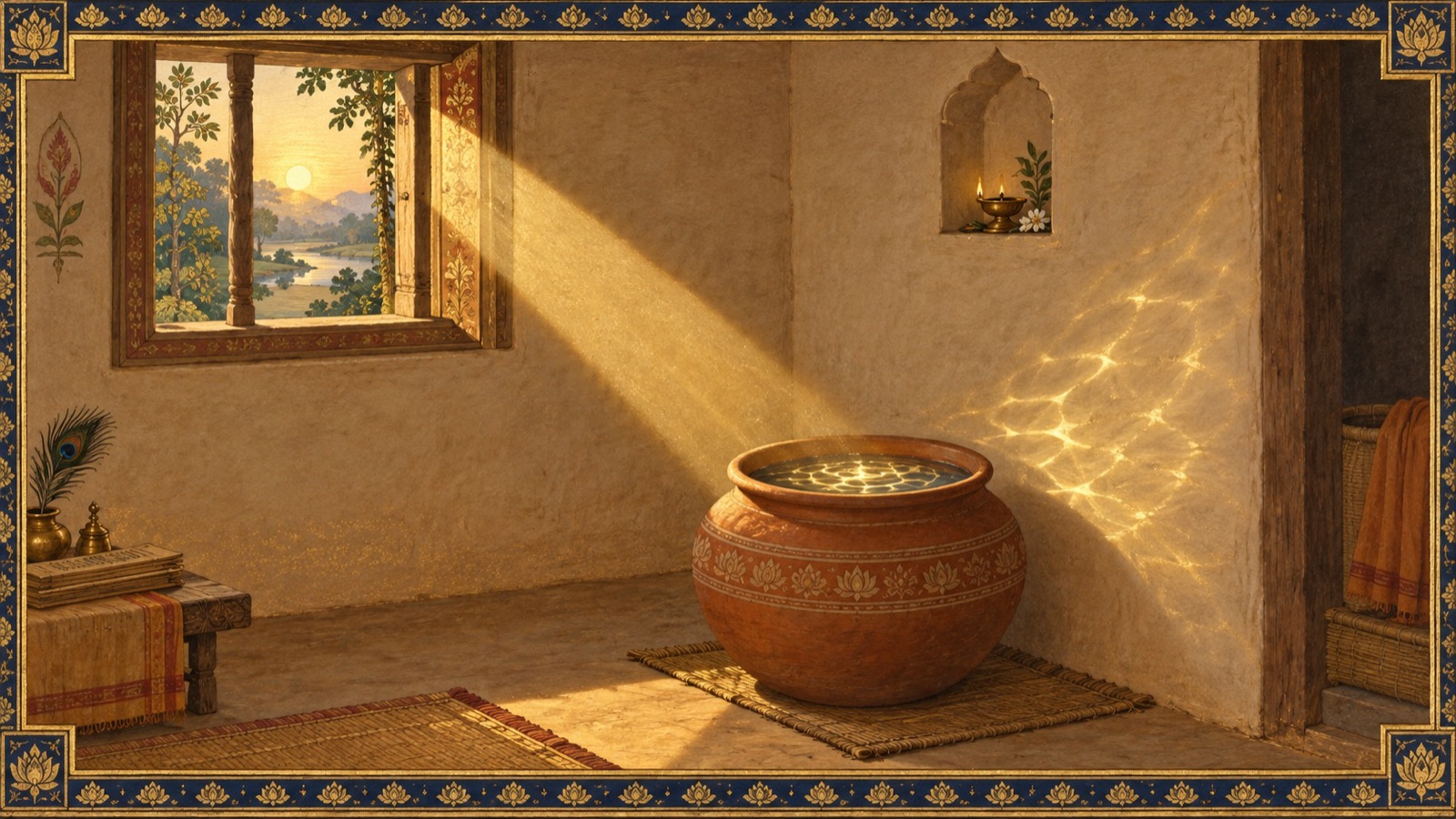
Just as a reflection of the sun in water (existing in a pot in a corner of some house) is discovered (by the inmates of the house) with the help of a reflection of that reflection on a wall of the house, and the sun in the heavens can be seen with the help of its own reflection in water, even so the threefold (Sattvika, Rajasika and Tamasika) ego (which reflects the Spirit) is revealed through its reflections on the body, the Indriyas and the mind; and through the ego, which contains a reflection of the Spirit, is seen God, who is possessed of true wisdom, is absolutely free from egotism and keeps awake even when the subtle elements (in the shape of sound etc.), the Indriyas, the mind and the intellect etc., get merged in the Unmanifest (Primordial Matter) on account of sleep (during the state of deep slumber). (verses 12–14)
This is a genuinely striking piece of imagery: sunlight caught in a pot of water in a dim corner of a room, bounced again onto the wall, so that a person entering the room sees the sun’s reflection of a reflection dancing on the plaster — and by that faint, twice-removed flicker, comes to know that the sun itself exists in the sky outside. Likewise, Kapila says, the ego (ahamkara, in its three modal colorings) is itself a reflection of the Spirit; and the body, senses, and mind, in turn, are reflections cast by the ego. We never see the Spirit directly. We see it only through this layered chain of reflections — yet through that very chain, rightly traced backward, the existence of the Spirit (and behind it, God) can be known with certainty. The chapter adds a further, very human detail: even in deep dreamless sleep, when the ego and mind and senses all dissolve back into Prakrti’s unmanifest state, one thing does not dissolve — the underlying Self, the witness, which “keeps awake” through it all.
Kapila closes this section with what may be the chapter’s most consoling verse for anyone who has ever woken from deep sleep with a strange, momentary sense of not knowing who or where they are:
Although (in waking life) the existence of the Self can be vividly felt as the seer (of objects of perception such as sound etc.), he falsely takes himself as lost, though not lost, because of the disappearance of the ego (which forms its adjunct) during the state of deep sleep, just as a man who has lost his fortune feels distressed and takes himself as lost. (verse 15) Pondering thus, a man of understanding realizes his own Self, who is the substratum and revealer of all fundamental principles including the ego. (verse 16)
The comparison to a man who has lost his fortune is deceptively simple but exact: a bankrupt man does not cease to exist because his wealth is gone — he only feels diminished, as though his very being had shrunk along with his bank balance. In precisely the same way, the Self does not vanish in deep sleep merely because its instrument, the ego, has temporarily gone quiet. The feeling of having “lost oneself” in sleep, or in any moment of confusion, is itself the clue — rightly examined, it points straight back to the very Self that was never actually lost.
Devahuti’s Question: Can Matter and Spirit Ever Truly Part?
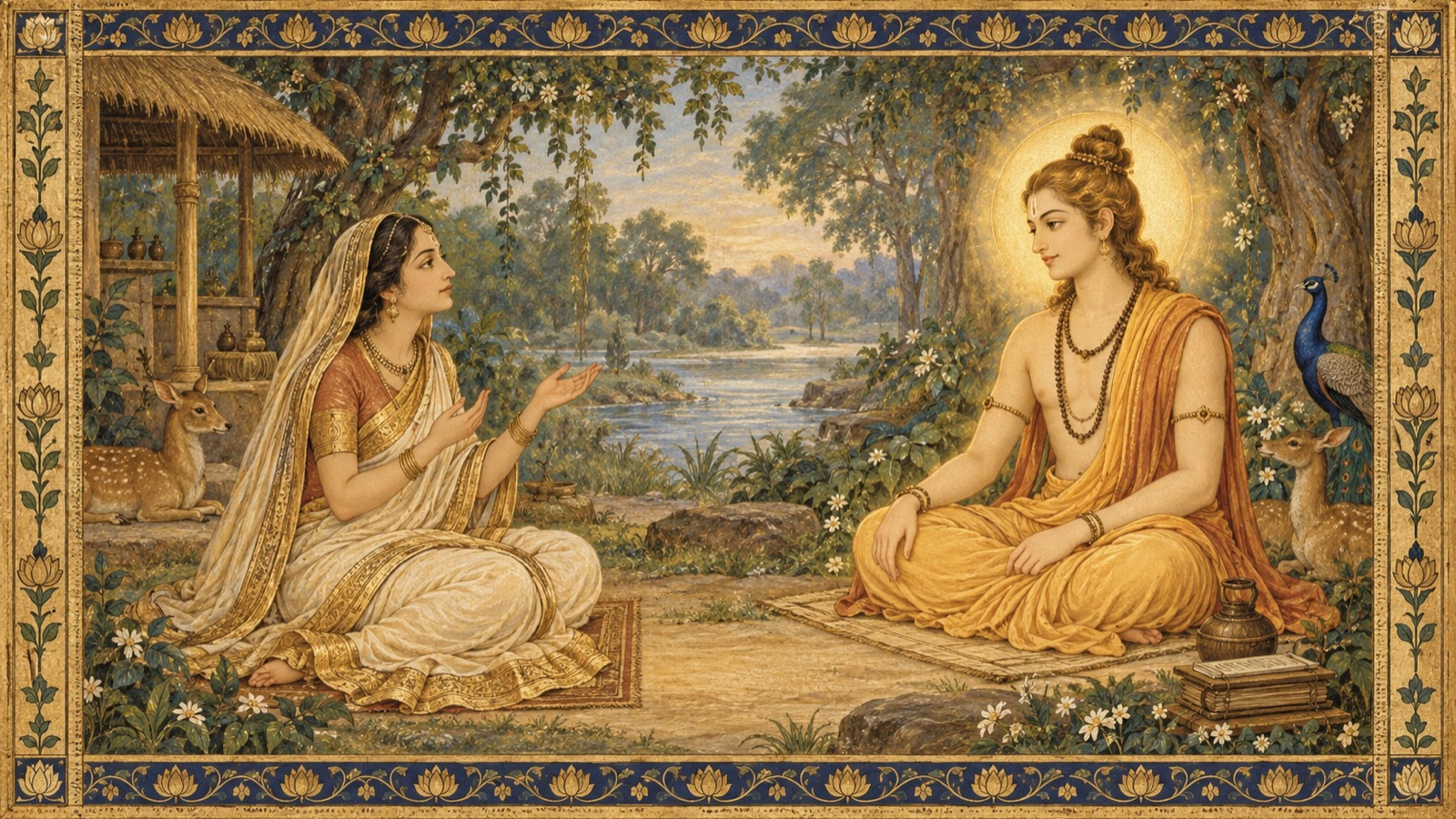
It is here that the chapter takes its most memorable turn. Devahuti, who has been listening to her divine son’s teaching with evident care, does not simply accept the doctrine of the unstained, ever-free Spirit. She raises a real philosophical difficulty — one that any careful student of this teaching is likely to have felt at some point:
Devahuti said: Matter, O divine sage, can never leave the Spirit, the two being interdependent and co-eternal, O Lord. (verse 17) Just as odour and earth and (similarly) taste and water can never exist apart, so can Buddhi (understanding, which is an evolute of Matter) and the Spirit never remain dissociated from each other. (verse 18) Hence how can there be any freedom for the soul so long as the Gunas (modes) of Prakrti continue to exist — Gunas that bind the soul, who is a non-doer, to actions? (verse 19) Even if the great fear of such bondage is averted through an enquiry into (the nature of) the fundamental principles in any particular case, the same may appear again, since the cause of it (in the shape of the aforesaid Gunas) has not ceased. (verse 20)
This is a formidable objection, posed with the precision of someone who has genuinely absorbed the metaphysics just taught. If earth and its odor, or water and its taste, are inseparable qualities of a single substance — never found apart, even in principle — then how, Devahuti asks, can Purusha and Prakrti (Spirit and Matter) ever be pried apart, if scripture itself says they are “co-eternal”? And even granting that a moment of insight might temporarily dissolve the fear of bondage, what stops the Gunas — which have not themselves been destroyed — from simply reasserting their grip later? It is, in effect, the ancient philosophical worry that liberation, if it is real at all, must be permanent and total, not a fragile truce that could break down again. A mother questioning her own son’s teaching, and a devotee questioning the deepest premise of the philosophy she is being given — both are present in these four verses, and it is one of the moments in the Bhagavatam where the reader senses most clearly that this text expects its audience to think, not merely to receive.
Kapila’s Answer: Fire Consuming Its Own Kindling
Kapila’s reply, which closes the chapter, does not dismiss the objection — it answers it directly, and with one of the most memorable images in the entire Kapila-Gita:
श्रीभगवानुवाच । अनिमित्तनिमित्तेन स्वधर्मेणामलात्मना । तीव्रया मयि भक्त्या च श्रुतसम्भृतया चिरम् ॥ २१ ॥
śrī-bhagavān uvāca animitta-nimittena sva-dharmeṇāmalātmanā tīvrayā mayi bhaktyā ca śruta-sambhṛtayā ciram
Meaning: The Lord replied: it is an intense devotion — nourished for a long time by hearing of Me, joined to one’s own prescribed duty carried out with a heart free of impurity and without any motive of self-interest — that alone begins to loosen Prakrti’s hold upon the soul. (SB 3.27.21)
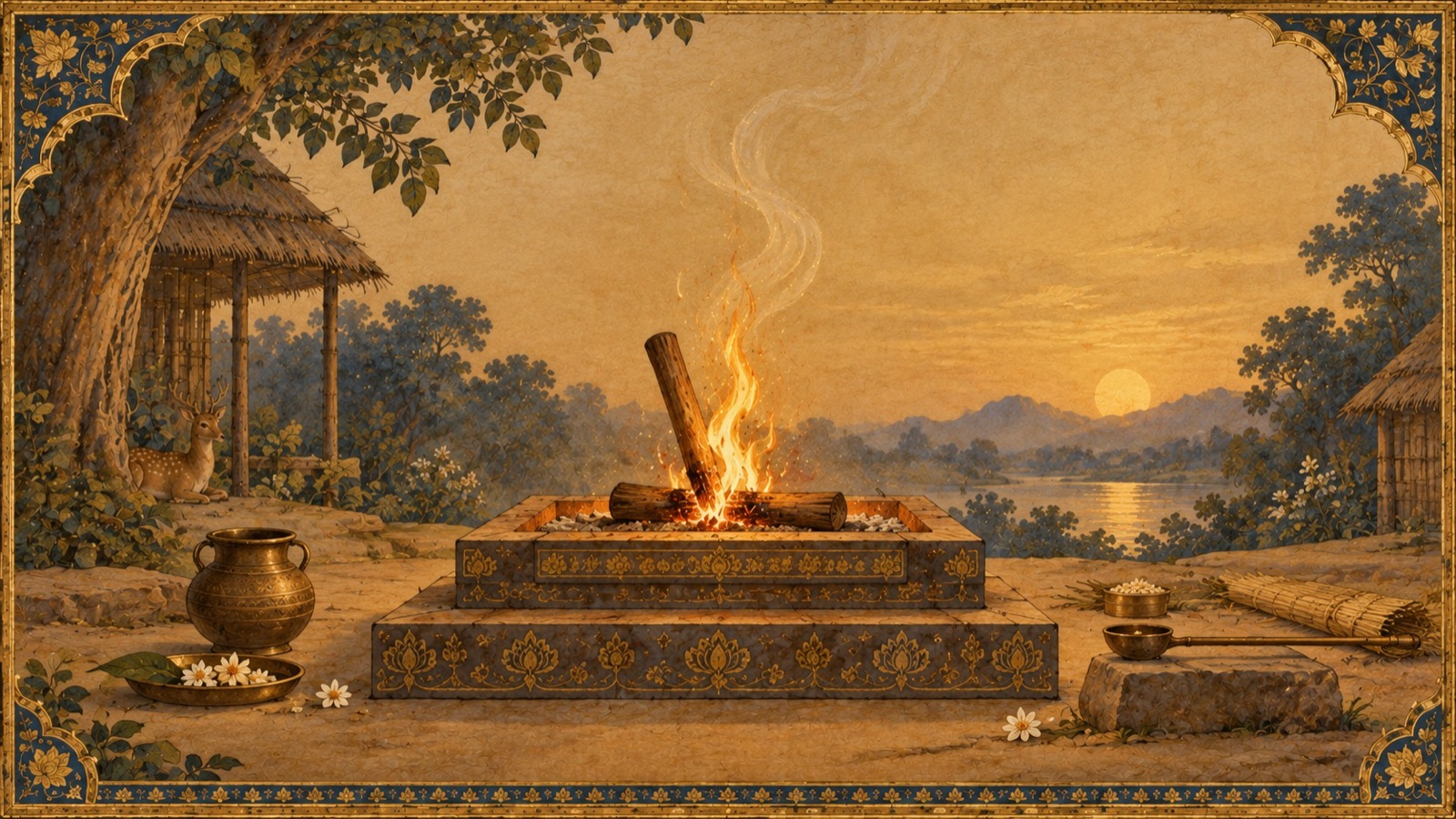
The Lord replied: Assailed day and night by intense devotion to Me — developed by hearing My stories for a long time with a heart purified by doing one’s duties in a disinterested spirit — by spiritual enlightenment which enables one to perceive the truth, by strong dispassion, by practice of meditation accompanied by sacred vows and religious observances, and by thorough concentration of mind, Prakrti, which binds the soul, gradually withdraws, even as the wooden stick used for kindling the sacred fire by attrition is consumed by the very fire it produces. (verses 21–23)
The image answers Devahuti’s objection almost exactly on its own terms. She had asked, in essence: if Matter and Spirit are as inseparable as earth and its smell, how can one ever be freed from the other? Kapila’s answer is that the relationship is not a static, permanent bond like that of earth and odor at all — it is a process, more like fire and the wood that produces it. Two sticks are rubbed together; friction (representing disciplined spiritual practice) produces fire; and that very fire, once kindled, consumes the sticks that made it possible. The sticks are indispensable to the fire’s arising — and yet the fire, once burning, is not dependent on them forever; it burns them away entirely. Prakrti, Kapila is saying, functions the same way in the soul’s evolution: it is the very field in which spiritual practice occurs, and yet sustained practice — devotion, dispassion, meditation, hearing the Lord’s stories — gradually consumes Prakrti’s hold, verse by verse, birth by birth, until nothing of the bondage remains.
There is a reason Kapila answers Devahuti’s metaphysical objection with a devotional process rather than a sharper argument, and it is worth stating plainly. Analysis alone — however precise — cannot dissolve bondage, because analysis does not touch its root cause: the soul’s own desire to lord it over Prakrti, and the still subtler envy that resents the Lord’s exclusive supremacy (verse 20). So Kapila does not hand Devahuti a better proof; he hands her a practice — hearing His stories, duty performed without self-interest, meditation, dispassion — because only sustained devotion actually starves that root desire of the attention it depends on (verses 21–23). And even this, the chapter insists at its very close, unfolds only “by My own abundant grace” (verses 28–29): the soul does not out-argue or out-meditate its own bondage into ending; it is drawn home by the Lord’s mercy, met by its own devotion.
Kapila continues, describing what remains once this process reaches completion:
Ever recognized to be a source of evil and abandoned after enjoyment, she no longer does any harm to the soul, who stands supreme in his glory (blissful nature) and is now absolutely independent. (verse 24) Just as the dream of a sleeping man is fraught with many evils, but the same does not conduce to his infatuation once he is awake, so Prakrti can never do any harm to him who, having realized the truth, ever keeps his mind fixed on Me and who (consequently) delights in his own Self. (verses 25–26)
The dream image returns here, but transformed — no longer describing the soul’s suffering (as in verse 4), but its final immunity. A man who wakes from a nightmare of drowning does not, upon waking, fear water; the dream has lost all power over him because he now knows what it was. In the same way, the liberated soul is not merely free of Prakrti’s bondage in some abstract, future sense — Prakrti simply cannot touch someone who has fully woken up to his own nature.
Final Beatitude and the Warning About Yogic Powers
The chapter’s closing verses trace the last stages of this journey with a rare tenderness — Kapila is, after all, speaking to His own mother about her own path to liberation:
When a man who is given to contemplation remains absorbed (as aforesaid) in (meditation on) the Self for a period extending over many births, he develops a distaste for everything as far as (the enjoyments of) Brahmaloka (the highest heaven, the abode of Brahma). (verse 27) > मद्भक्तः प्रतिबुद्धार्थो मत्प्रसादेन भूयसा ।
निःश्रेयसं स्वसंस्थानं कैवल्याख्यं मदाश्रयम् ॥ २८ ॥ प्राप्नोतीहाञ्जसा धीरः स्वदृशाच्छिन्नसंशयः । यद्गत्वा न निवर्तेत योगी लिङ्गाद्विनिर्गमे ॥ २९ ॥
mad-bhaktaḥ pratibuddhārtho mat-prasādena bhūyasā niḥśreyasaṁ sva-saṁsthānaṁ kaivalyākhyaṁ mad-āśrayam prāpnotīhāñjasā dhīraḥ sva-dṛśā cchinna-saṁśayaḥ yad gatvā na nivarteta yogī liṅgād vinirgame
Meaning: By My own boundless grace My devotee awakens to his true nature and, in this very life, steadily reaches — every doubt cut away by the vision of his own Self — his ultimate destination, the state called kaivalya, sheltered directly in Me; having gone there upon leaving the subtle and gross body, such a devotee never returns. (SB 3.27.28–29)
Having realized the Self by My abundant grace, that strong-minded devotee of Mine has all his doubts resolved by Self-vision and, when freed from his astral body, easily attains in that very life the supremely blissful state known by the name of final beatitude, which is his essential character and rests on Me, and having attained which a Yogi never returns to (the cycle of) birth and death. (verses 28–29)
Two details stand out. First, the timescale is honest rather than promotional: this absorption “extends over many births” — the Bhagavatam does not pretend that liberation is typically a matter of one lifetime’s effort, even as it insists the goal is entirely reachable. Second, the reward described is not merely escape from suffering but a return to one’s “essential character” (svarupa) — liberation restores the soul to what it always, truly was, rather than transporting it somewhere foreign.
The chapter’s final verse offers Kapila’s mother — and every reader after her — a last, practical caution, aimed precisely at the point in spiritual life where success itself becomes the subtlest trap:
यदा न योगोपचितासु चेतो मायासु सिद्धस्य विषज्जतेऽङ्ग । अनन्यहेतुष्वथ मे गतिः स्याद् आत्यन्तिकी यत्र न मृत्युहासः ॥ ३० ॥
yadā na yogopacitāsu ceto māyāsu siddhasya viṣajjate ‘ṅga ananya-hetuṣv atha me gatiḥ syād ātyantikī yatra na mṛtyu-hāsaḥ
Meaning: When the perfected yogi’s mind no longer clings even to the extraordinary powers that Yoga itself produces — powers that are, after all, only products of My illusory energy — his course toward Me becomes unobstructed and absolute, carrying him to a state that death itself has no power to touch. (SB 3.27.30)
If the mind of the accomplished Yogi, O beloved mother, does not get attached to the (eight kinds of) superhuman powers (such as the faculty of reducing one’s body to the size of an atom and so on, which are products of Maya), developed through Yoga, which is the only means of acquiring them, he is sure to attain My immortal state, where death has no power. (verse 30)
The eight classical siddhis of yoga — the power to shrink oneself to the size of an atom, to become immeasurably large, to become weightless, to obtain anything desired, and so on — are real and attainable fruits of advanced practice, Kapila does not deny this. But he singles them out, in the very last word of the chapter, as the one remaining hazard on an otherwise completed path: a practitioner who has come this far and then becomes fascinated by the powers his practice has generated has mistaken the ashes at the edge of the fire for the fire itself. Only the mind that remains unattached even to these — that keeps its eye fixed on the “immortal state, where death has no power” rather than on the marvels along the way — completes the journey the whole chapter has been describing.
The chapter’s colophon closes the discourse: “Thus ends the twenty-seventh discourse, forming part of the ‘Story of Lord Kapila,’ in Book Three of the great and glorious Bhagavata-Purana, otherwise known as the Paramahamsa-Samhita.”
Reflection: A Mother’s Question, and Every Seeker’s
What makes Chapter 27 so quietly powerful is its structure: metaphysics, then a devotee’s honest doubt, then an answer that does not merely restate the metaphysics but deepens it in response to the doubt itself. Devahuti’s objection — that Matter and Spirit, having been bound to one another since beginningless time, might never truly come apart — is not a foolish question a mother might ask out of confusion. It is the question anyone who takes this teaching seriously eventually has to face: if bondage has existed since beginningless time, what guarantee is there that it can end? Kapila’s answer, the image of fire consuming its own kindling, does not offer a logical proof so much as a lived description of what actually happens in sustained spiritual practice — the very process that seems, at first, to require engagement with Matter (through discipline, ritual, devotion, meditation) is precisely the process that exhausts Matter’s hold, the way fire needs wood to begin but does not need wood to keep burning forever. And the chapter’s final word — its caution against attachment even to the miraculous powers that come with advanced practice — is a fitting close: the path Kapila describes asks not for renunciation of the world alone, but for a mind so completely turned toward the sun itself that it is no longer tempted even by the light dancing prettily on the water.
Reference
- Primary source: Śrīmad Bhāgavata Mahāpurāṇa (Bhagavata Purana), Gita Press, Gorakhpur — English Complete edition, Book Three, Discourse XXVII, “How to attain Liberation through the differentiation of Matter and Spirit?”
- Series: Srimad Bhagavatam Wisdom — a chapter-by-chapter devotional journey through the Śrīmad Bhāgavata Mahāpurāṇa
- Presented under the spiritual guidance of: Pandit Dr. Shri Kashinath Mishra
Om Namo Bhagavate Vasudevaya.
Jay Shree Madhav