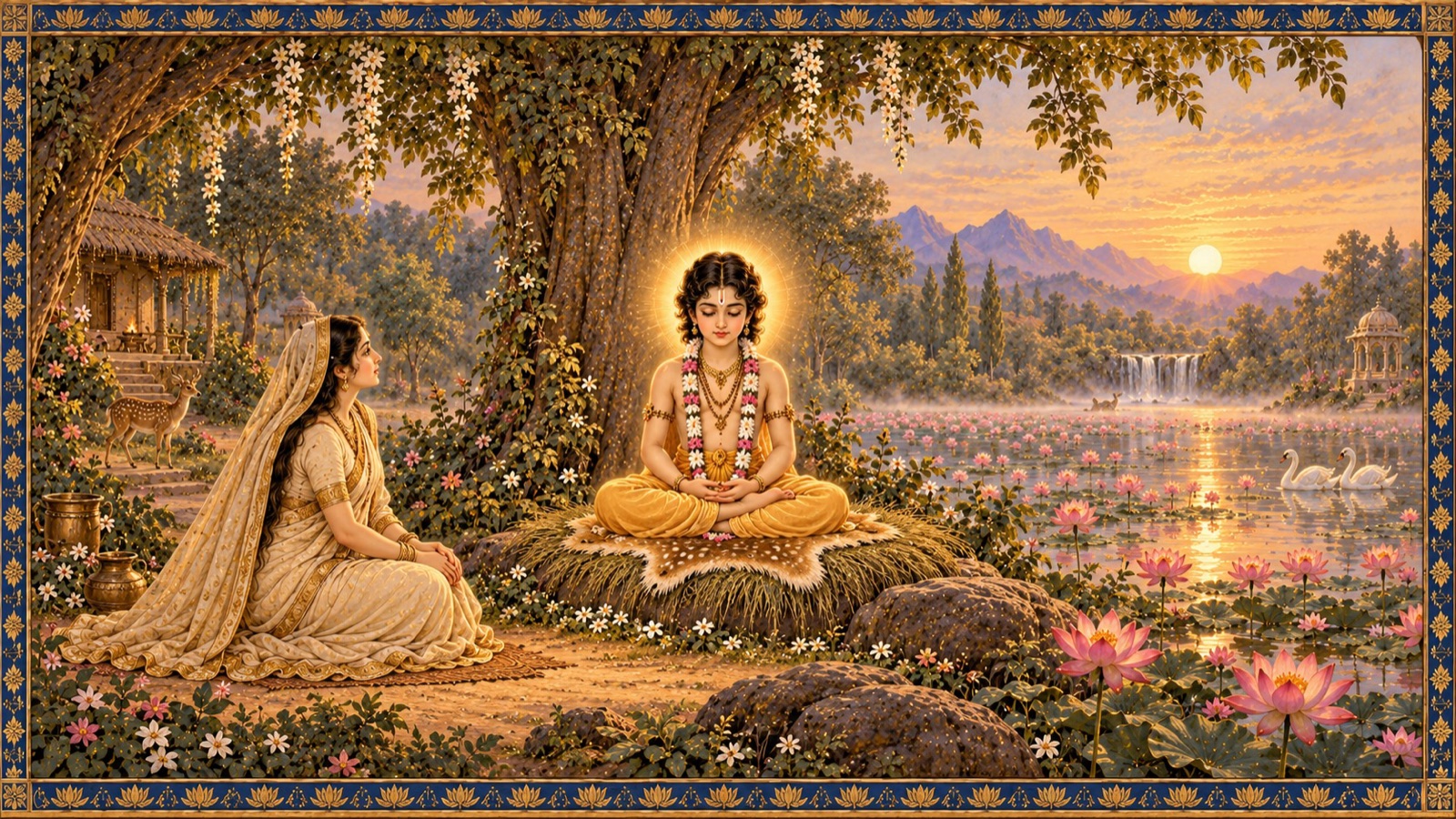
Seated in stillness beside His mother, gaze fixed and unwavering, Lord Kapila begins to unfold the eightfold path of Yoga — a discipline that starts with a controlled breath and a steady seat, and ends with the mind itself dissolving, like a lamp’s flame going out, into the one undivided Self.
Om Namo Bhagavate Vasudevaya.
Om Namo Bhagavate Vasudevaya.
Om Namo Bhagavate Vasudevaya.
Welcome to Srimad Bhagavatam Wisdom, a devotional journey through the sacred histories and teachings of the Srimad Bhagavat Mahapurana. The Kapila-Gita has, by this point in the Third Canto, already established its two great pillars — the philosophy of Sankhya, distinguishing Purusa (Spirit) from Prakrti (Matter), and the incomparable glory of motiveless Bhakti, declared superior even to liberation. Chapter 28 turns from philosophy and devotion to method: it is the chapter in which Lord Kapila, without a single interruption from Devahuti, delivers His most detailed practical instruction of the entire discourse — the “eightfold Yoga” (Ashtanga Yoga) as a graded path of ethical discipline, physical posture, breath control, and, most strikingly, an extraordinarily detailed meditation on the beautiful form of the Lord, limb by limb, from His lotus feet to His smiling face, culminating in a mind so absorbed in love that it dissolves entirely, like an extinguished flame, into the one Absolute. It is, in effect, a manual — the closest thing in the Bhagavatam to a step-by-step guide for the aspiring meditator, and it closes the chapter’s own colophon under a newly shifted arc-label: no longer the “Story of Lord Kapila,” but the “Teachings of Lord Kapila.”
Chapter Information
- Scripture: Śrīmad Bhāgavata Mahāpurāṇa
- Canto: 3 (Book Three)
- Chapter: 28 (Discourse 28)
- Chapter title: The process of the eightfold Yoga (per this PDF’s Table of Contents and chapter heading; the chapter’s own closing colophon titles it “The pursuit of disciplines for God-Realization” — see Verification Notes below)
- Principal speaker: Lord Kapila, continuing His unbroken discourse to His mother Devahuti (there is no interjection from Devahuti anywhere in this chapter)
- Principal listener: Devahuti
- Main setting: The hermitage on the bank of Bindusarovara, continuing directly from the preceding chapters of the Kapila-Gita
- Central subject: The detailed method of Yoga “with an object to rest upon” (sabija) — ethical and preparatory disciplines, posture (asana), breath control (pranayama), sense-withdrawal, and above all a limb-by-limb meditation on the Lord’s divine form, leading through intensifying love to the dissolution of the mind in Samadhi and the striver’s realization of the distinct, undivided Self
- Principal verse range: Canto 3, Chapter 28, verses 1–44
- Primary edition: Gita Press Śrīmad Bhāgavata Mahāpurāṇa
Yoga “With a Seed”: The Path Begins
The chapter opens with the Lord drawing a careful distinction. He does not simply say “I shall now teach you Yoga” — He specifies that He is about to describe Yoga sabija, “with a seed,” meaning meditation that rests upon an object, as opposed to the objectless absorption in the featureless Absolute that has occupied earlier portions of His teaching.
The Lord continued: “(Now) I shall tell you, O princess, the character of Yoga (meditation) with some object to rest upon, by practising which — and in no other way — the mind gets purified and takes to the path of God.” (verse 1)
This single opening line reframes everything that follows. What might otherwise read as a technical manual of postures and breathing exercises is, from its very first sentence, oriented toward a single end: purification of the mind so that it “takes to the path of God.” Method, here, is never separated from devotion; the eightfold Yoga is not presented as an end in itself but as scaffolding for something far more intimate — the vision of the Lord’s own form that will occupy the chapter’s long central section.
श्रीभगवानुवाच योगस्य लक्षणं वक्ष्ये सबीजस्य नृपात्मजे । मनो येनैव विधिना प्रसन्नं याति सत्पथम् ॥ १ ॥
śrī-bhagavān uvāca yogasya lakṣaṇaṁ vakṣye sabījasya nṛpātmaje mano yenaiva vidhinā prasannaṁ yāti sat-patham
Meaning: The Lord said: O princess, I shall now describe the character of Yoga that rests upon an object — the one method by which the mind, once purified, sets out toward the Absolute. (Canto 3, Chapter 28, verse 1)
The Foundation: Duty, Contentment, and Restraint
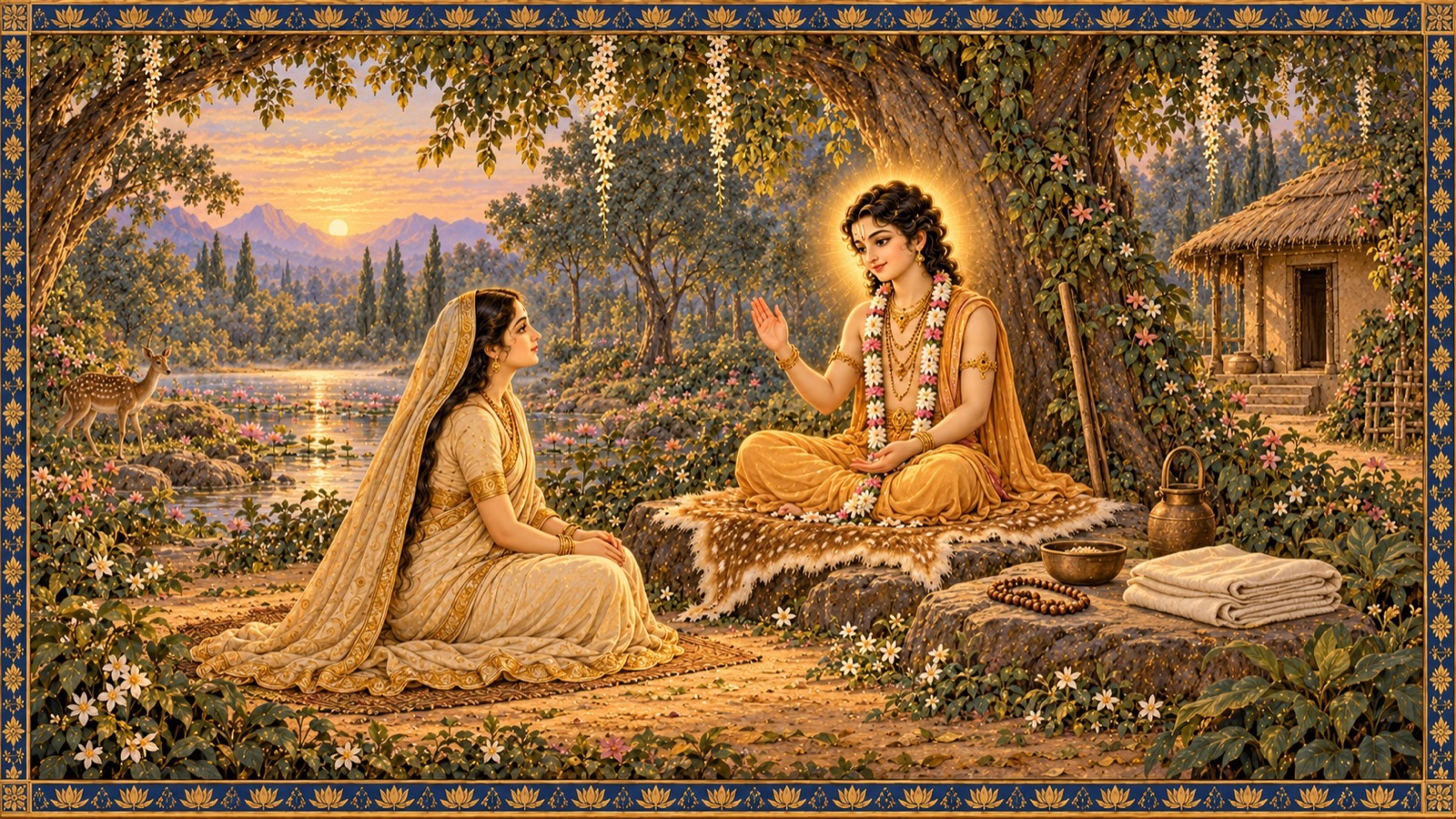
Before any mention of posture or breath, the Lord lays out an extensive foundation of character and conduct — a passage the Gita Press edition itself presents as a single flowing block spanning six verses.
To do one’s allotted duty to the best of one’s ability and to shrink from prohibited acts; to remain contented with whatever is got as a dispensation of Providence; to adore the feet of one who has realized the Self and to cease from duties connected with the pursuit of religious merit, worldly possessions and sensuous enjoyment; even so to take delight in duties tending to final beatitude; to take pure food in a measured quantity; to dwell permanently in a place which is not only secluded but also free from molestation; to practise non-violence in thought, word and deed; to speak the truth, to abstain from thieving, to limit one’s possessions to the extent of one’s barest needs, to abstain from sexual commerce, to practise austere penance, to observe purity of body and mind, to study the Vedas and other sacred texts, to worship the Deity, to observe silence, to acquire steadiness by firmness in the very best postures, to control one’s breath by slow degrees, to withdraw one’s senses from their objects and direct them towards the heart, to fix one’s mind as well as the vital air on any mystical circle in one’s body, and to contemplate without break on the pastimes of Lord Vishnu — by these and other such methods one should diligently control one’s breath and then gradually curb one’s wicked mind, addicted to evil ways, with the help of one’s reason, and apply it to contemplation on God. (verses 2–7)
A footnote attributed to Sridhara Swami, quoted directly in this edition, even specifies the measure of food: “One should fill two quarters of one’s belly with articles of food and one quarter with water. The fourth quarter should be kept empty for the free passage of air.” It is a small, almost domestic detail amid a passage of high philosophy — and it is precisely this blend of the cosmic and the concrete that marks the entire chapter. Before the mind can be taught to see the Lord’s form in meditation, the body and its habits must first be brought into order: what one eats, where one lives, how one speaks, what one refrains from touching. The eightfold Yoga, in other words, does not begin with the mind at all. It begins with a life.
Posture and Breath: Clearing the Passage
With the ethical ground prepared, the Lord turns to the physical technique proper — asana and pranayama, seat and breath.
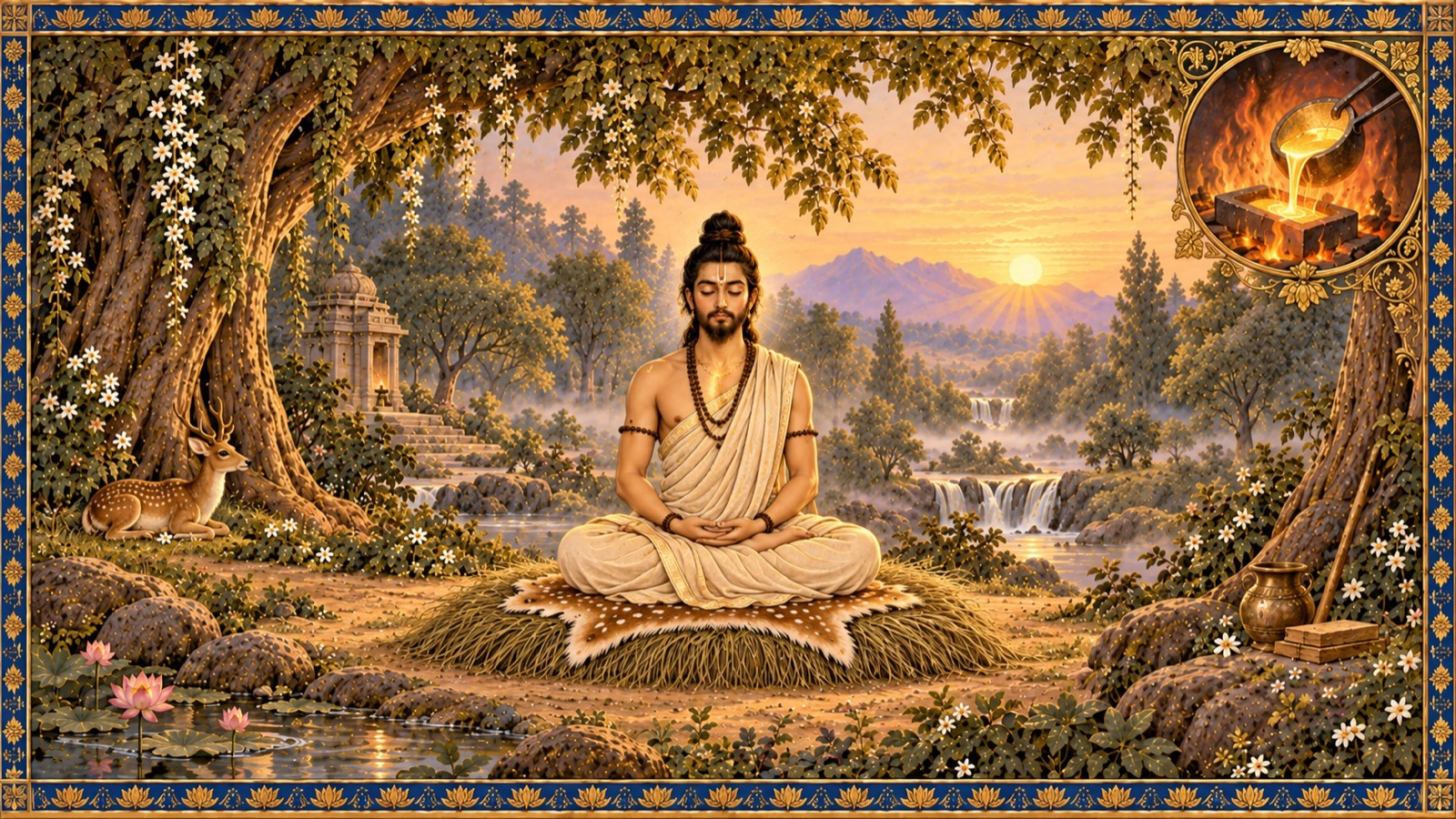
Having controlled one’s posture, one should spread a seat consisting of Kusa grass, deerskin and so on in an undefiled spot. And sitting there in an easy posture, keeping the body erect, one should practise control of breath. (verse 8) At the very outset, the striver should clear the passage of the breath by first inhaling the air to his utmost capacity, then holding the breath and finally exhaling it, or by reversing the process — exhaling first, then holding the breath outside, and finally inhaling — so that the mind may become steady and free from distraction. (verse 9) Even as gold throws off its dross when heated and melted by the force of air and fire, so the mind of the striver who has controlled his breath gets purified before long. (verse 10) A striver should therefore eradicate the disorders of the three humours of the body — wind, bile and phlegm — by these processes of breath-control, his sins by concentrating his mind, his contacts with sense-objects by withdrawing the senses from their objects, and the characteristics contrary to the Lord’s divine nature, such as attachment and aversion, by means of meditation. (verse 11) When his mind gets purified and concentrated by the practice of Yoga, he should meditate on the form of the Lord with his gaze fixed on the tip of his nose. (verse 12)
The image of gold shedding its dross under fire is one of the most memorable in the chapter — not because it is elaborate, but because of its precision. Breath-control is not presented as an exotic power to be acquired for its own sake; it is presented as a purifying fire, applied to the mind exactly as heat is applied to ore, so that what remains, after the dross of distraction and disorder has been driven off, is a mind fit to hold the vision that follows.
प्राणस्य शोधयेन्मार्गं पूरकुम्भकरेचकै: । प्रतिकूलेन वा चित्तं यथा स्थिरमचञ्चलम् ॥ ९ ॥
prāṇasya śodhayen mārgaṁ pūra-kumbhaka-recakaiḥ pratikūlena vā cittaṁ yathā sthiram acañcalam
Meaning: One should clear the passage of the breath through inhalation, retention and exhalation — or the reverse order — so that the mind becomes steady and free from distraction. (Canto 3, Chapter 28, verse 9)
The Lord’s Form: A Meditation From Head to Foot
What follows is the chapter’s longest and most remarkable section — some twenty-one verses (13 through 33) devoted entirely to a graded, limb-by-limb meditation on the beautiful form of the Lord. It begins with an integral view of the whole figure.
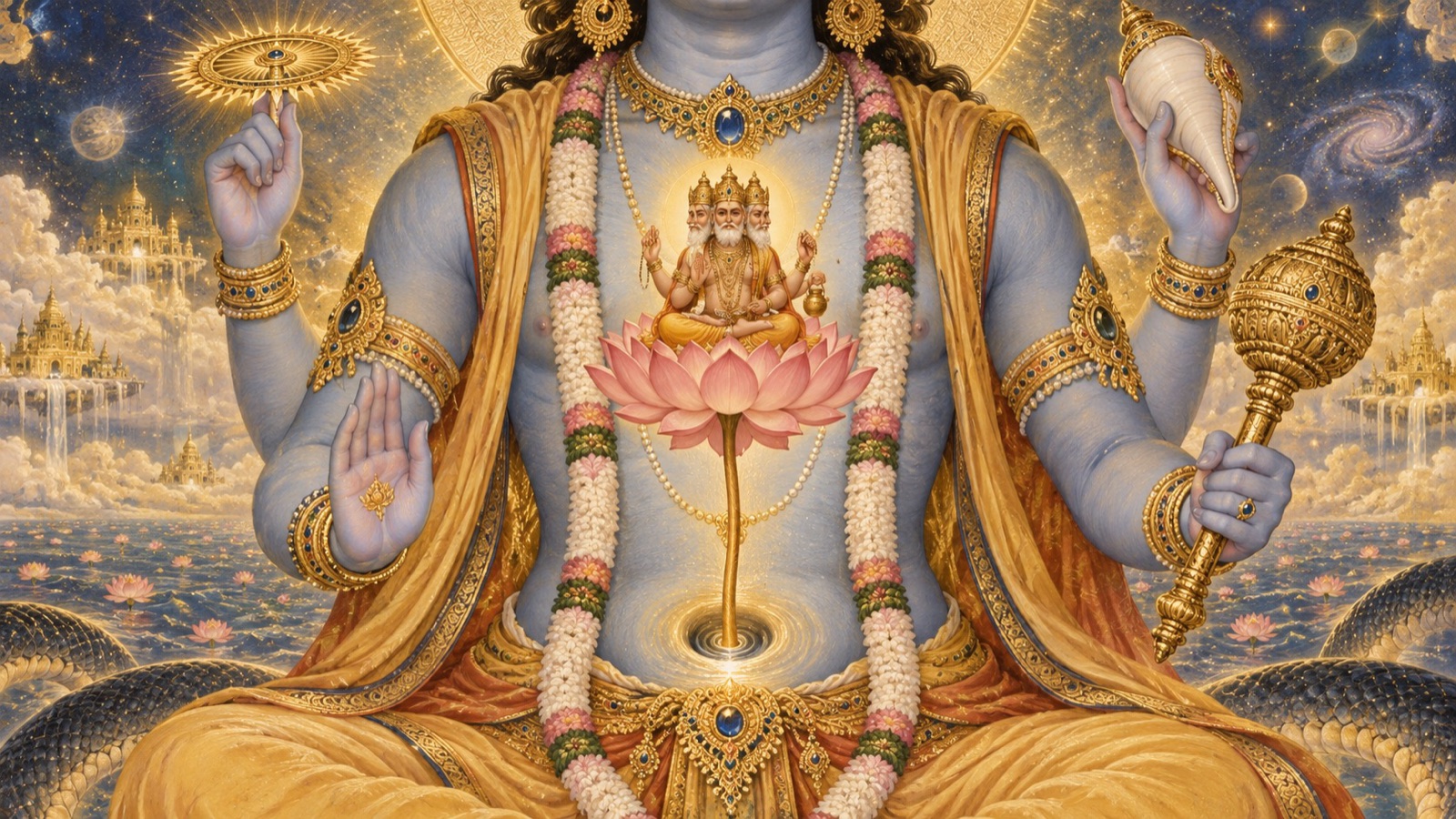
The Lord has a cheerful lotus-like countenance, eyes ruddy like the interior of a lotus, and a body swarthy of complexion like the petals of a blue lotus, bearing a conch, discus and mace in three of His four hands. (verse 13) He has wrapped round His loins a shining piece of silk yellow as the filaments of a lotus, bears the mark of Srivatsa on His bosom, and has the brilliant Kaustubha gem suspended from His neck. (verse 14) He also wears a garland of sylvan flowers that has attracted a swarm of bees drunk with its fragrance, and is further adorned with a pearl necklace, a crown, and armlets, wristlets and anklets, all superb. (verse 15) With His loins and hips graced by a girdle, He stands on the lotus of His devotee’s heart, most charming to look at, gladdening the soul and eyes of those who behold Him. (verse 16) Eternally continuing in the prime of youth, He has a captivating appearance and is impatient to show His grace to His servants. (verse 17) His glory is worth singing and sanctifies all; in this way one should meditate on the integral form of the Lord till the mind does not shake. (verse 18) The pastimes of the Lord are all attractive to the sight; hence with a mind full of sincere devotion one should visualize Him as standing, moving, sitting, lying or dwelling in one’s heart. (verse 19)
Only after this integral vision is firmly held does the Lord instruct the practicant to move to the individual limbs: “Having ascertained that his mind, though fixed on the aforementioned form of the Lord, only takes a collective view of all His limbs, the practicant should fix it on each individual limb of the Lord.” (verse 20) The instruction that follows is exquisitely ordered, moving upward from the feet:
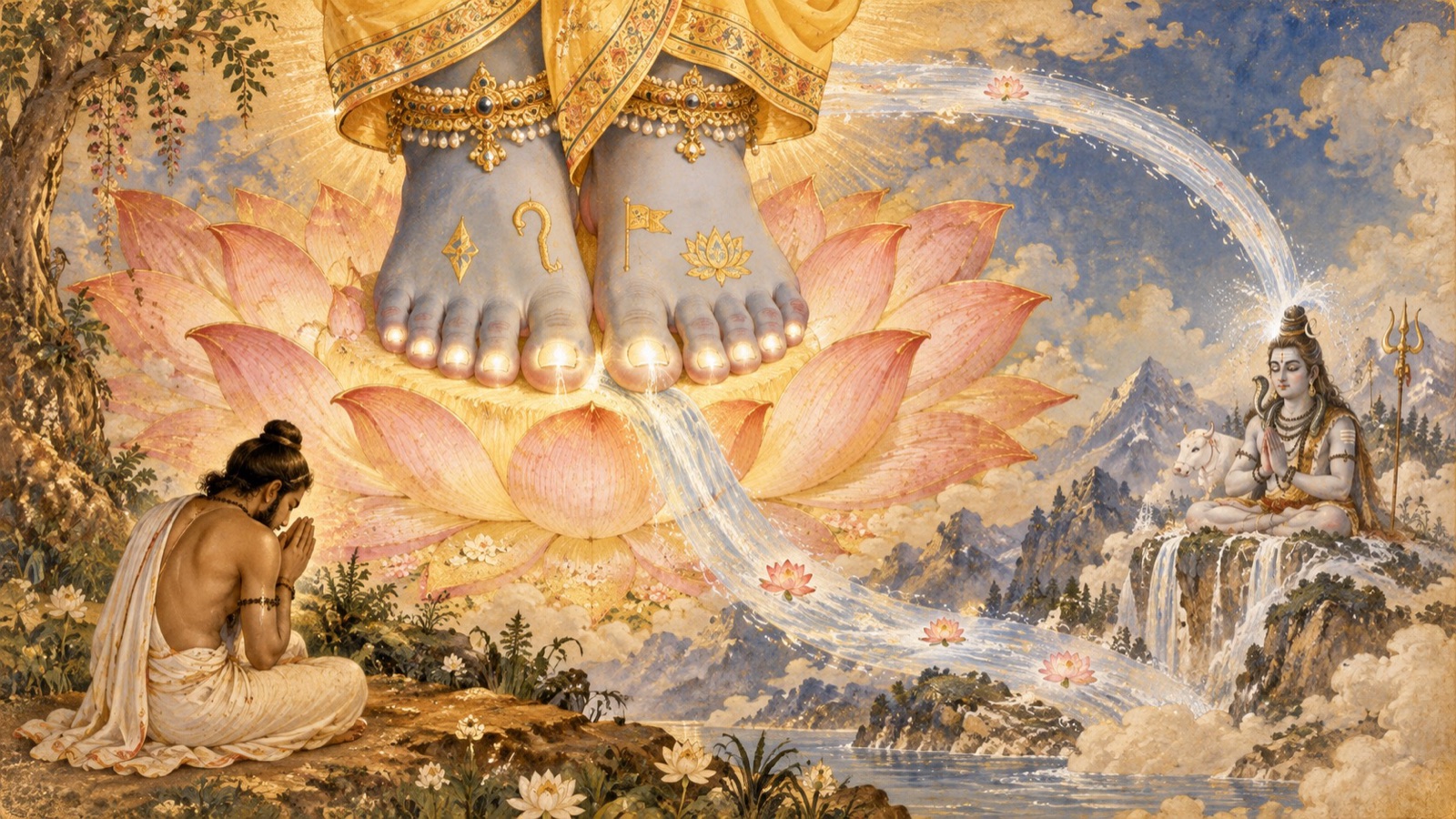
The devotee should first concentrate on the Lord’s lotus-feet, adorned with the marks of a thunderbolt, a goad, a banner and a lotus, the splendour of whose ruddy, moon-like nails dispels the thick gloom of one’s heart. (verse 21) Lord Siva became all the more blessed by bearing on His head the holy waters of the Ganga, which has its source in the water that washed the Lord’s feet; these feet are like a thunderbolt hurled to shatter the mountain of sins in the devotee’s mind. One should meditate on these for a long time. (verse 22) Then the devotee should impress on his heart the knees and shanks of the Lord, fondled by Lakshmi, the lotus-eyed mother of Brahma, with Her shining sprout-like hands, placing them on Her thighs. (verse 23) Next he should fix his mind on the Lord’s thighs, the storehouse of energy, bearing the lustre of the linseed flower, most graceful when borne on the shoulders of Garuda; and on His rounded hips, encircled by a girdle resting on yellow silk extending to His ankles. (verse 24) Now he should meditate on the Lord’s pool-like navel at the centre of His belly, the abode of the entire system of the worlds, from which sprang the lotus forming the home of Brahma; and on His nipples, resembling excellent emeralds whitened by the rays of pearl necklaces. (verse 25) He should fix his mind on the bosom of the Supreme Person, the abode of Goddess Mahalakshmi, and on the neck of the Lord, which enhances the beauty of the Kaustubha gem itself. (verse 26) He should focus on the Lord’s four arms, the abode of the guardians of the various spheres, their ornaments burnished by the revolving of Mount Mandara at the churning of the milk ocean; and on the discus Sudarsana, with its thousand spokes and dazzling lustre, and the conch, resembling a swan in His lotus-like palm. (verse 27) He should then call to mind the beloved mace Kaumodaki, besmeared with the blood of enemy warriors; the garland attended by humming bees; and the Kaustubha gem, representing the pure essential character of the Jivas. (verse 28)
The ascent then reaches the face itself. Next he should rivet his thought on the lotus-like countenance of the Lord, distinguished by a prominent nose and crystalline cheeks irradiated by His glittering, alligator-shaped ear-rings. (verse 29) Adorned with curly tresses and lotus-like eyes, the Lord’s face, further characterized by dancing eyebrows, puts to shame by its elegance a lotus swarming with bees, with a pair of fish throbbing on it. (verse 30) With full devotion he should contemplate for a long time on the glances cast by His eyes to soothe the threefold agony of His devotees — glances accompanied by loving smiles, full of abundant grace. (verse 31) He should meditate on the most benevolent smile of Lord Sri Hari, which dries away the ocean of tears of all who bow to Him, and on His arched eyebrows, manifested to charm the god of love for the good of hermits molested by him. (verse 32) Full of devotion steeped in love, he should finally fix his thought on the laughter of Lord Vishnu, abiding in the cavity of his heart — a laughter so captivating that the rows of His small teeth, like jasmine buds, are rendered rosy by the crimson splendour of His lips. Having devoted his mind exclusively to this, he should desire to see nothing else. (verse 33)
There is something quietly instructive in the sequence itself: feet first, then knees, thighs, navel, chest, arms, and only at the very end, the face and its smile. The devotee does not begin with the most captivating feature — the Lord’s countenance — but earns the vision gradually, verse by verse, the way one might approach a beloved teacher with the humility of touching the feet before ever daring to meet the eyes.
प्रसन्नवदनाम्भोजं पद्मगर्भारुणेक्षणम् । नीलोत्पलदलश्यामं शङ्खचक्रगदाधरम् ॥ १३ ॥
prasanna-vadanāmbhojaṁ padma-garbhāruṇekṣaṇam nīlotpala-dala-śyāmaṁ śaṅkha-cakra-gadā-dharam
Meaning: He has a cheerful lotus-like face, eyes ruddy as the interior of a lotus, a complexion dark as a blue-lotus petal, and He bears the conch, discus and mace. (Canto 3, Chapter 28, verse 13)
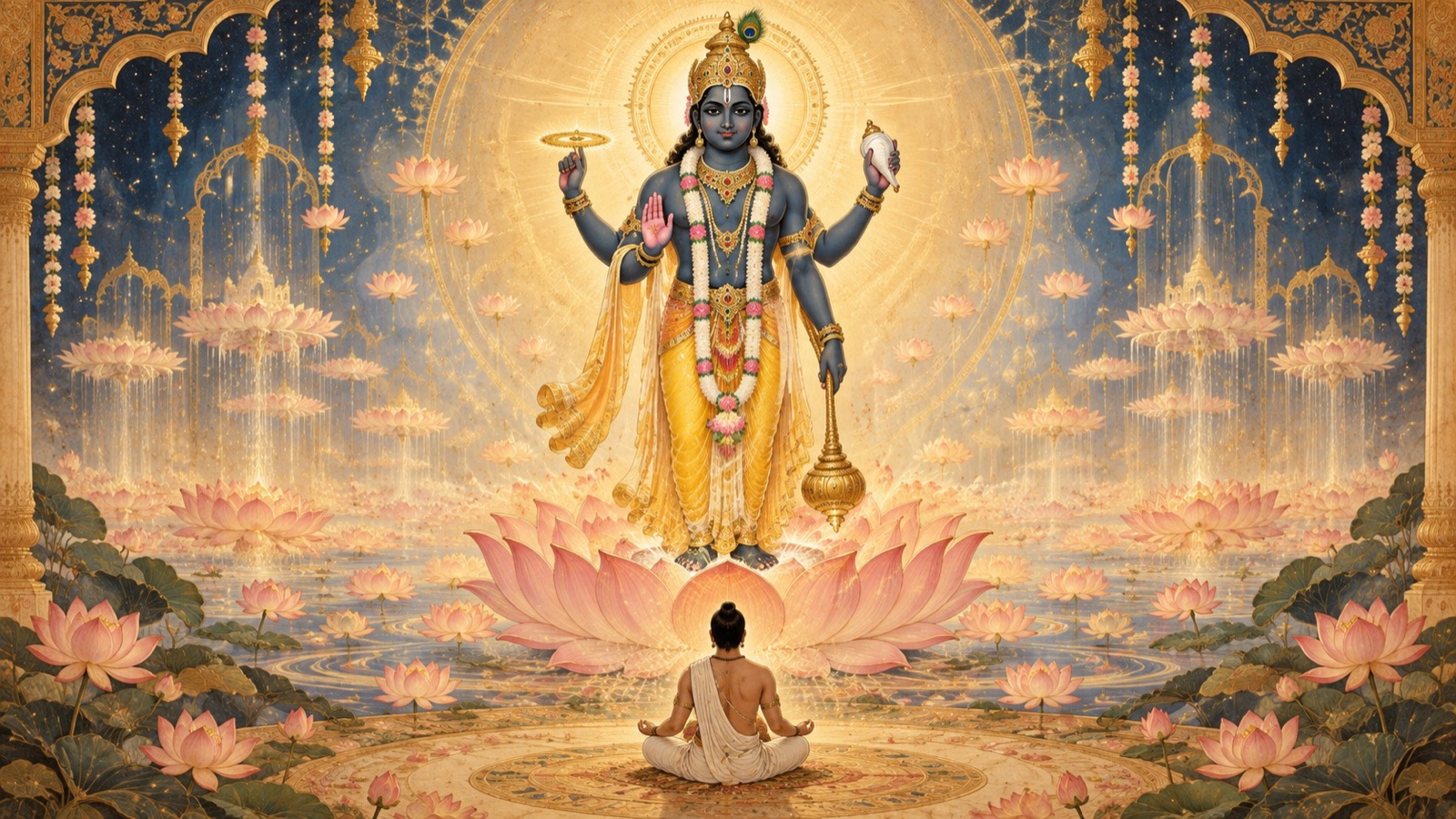
सञ्चिन्तयेद्भगवतश्चरणारविन्दं वज्राङ्कुशध्वजसरोरुहलाञ्छनाढ्यम् । उत्तुङ्गरक्तविलसन्नखचक्रवालज्योत्स्नाभिराहतमहद्धृदयान्धकारम् ॥ २१ ॥
sañcintayed bhagavataś caraṇāravindaṁ vajrāṅkuśa-dhvaja-saroruha-lāñchanāḍhyam uttuṅga-rakta-vilasan-nakha-cakravāla- jyotsnābhir āhata-mahad-dhṛdayāndhakāram
Meaning: One should meditate on the Lord’s lotus feet — marked by an elephant-goad, a banner, a lotus and a thunderbolt — whose tall, red, resplendent toenails shine like moonlight, dispelling the heart’s thickest darkness. (Canto 3, Chapter 28, verse 21)
Love, Tears, and the Dissolving Mind
Having completed the meditation on the Lord’s smiling face and laughter, the chapter turns to describe what actually happens to a devotee who sustains this vision with sincerity — and the description is intensely physical and emotional before it becomes purely metaphysical.
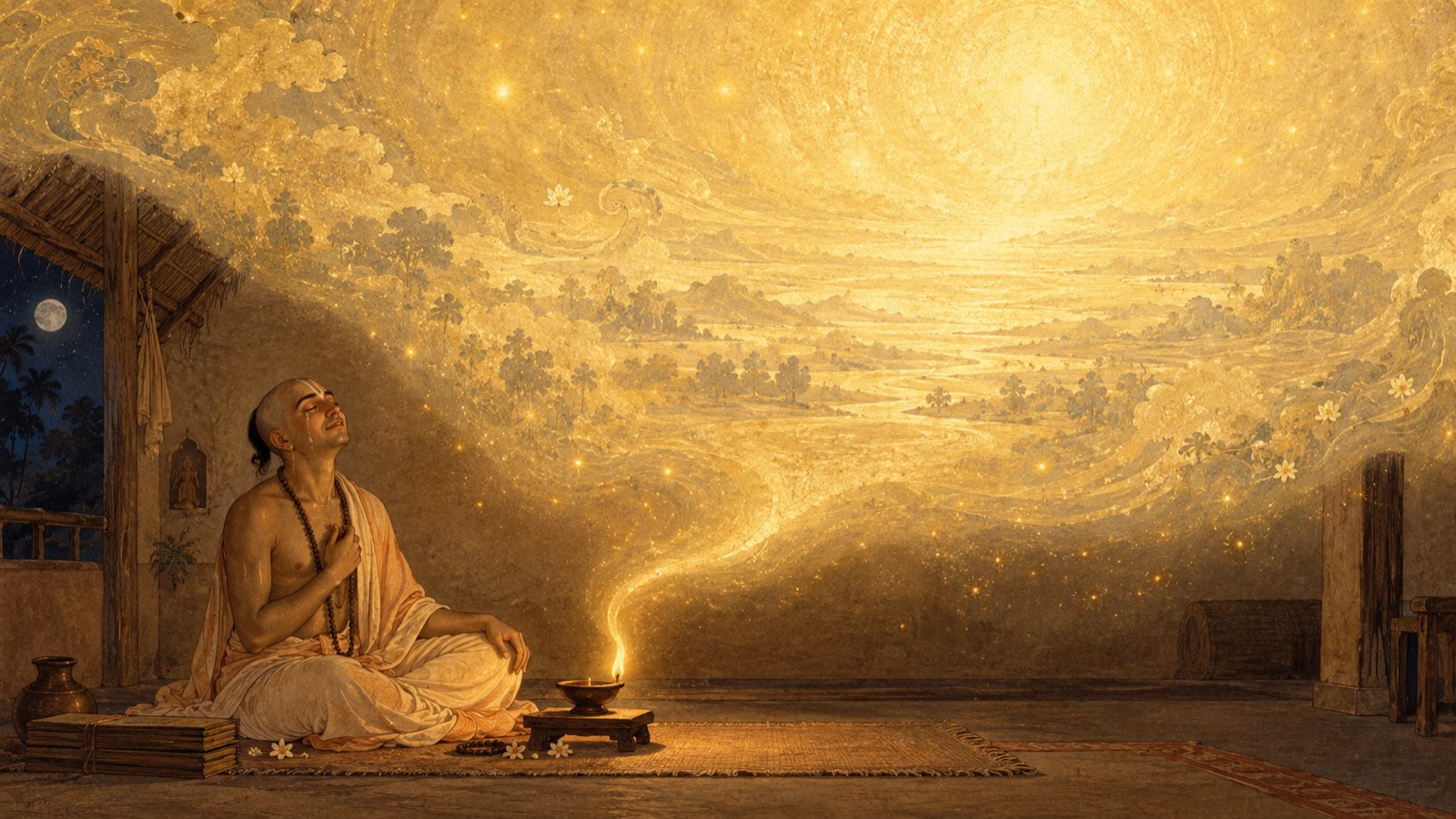
By following the above course of meditation the devotee develops love for Sri Hari: his heart melts through Devotion, the hair on his body stands erect through excessive joy, and he is constantly bathed in a stream of tears occasioned by intense love — so that he now gradually withdraws, from the object of meditation, even the mind itself, which was till now being used by him as a means to attract Sri Hari, just as a hook is used for capturing fish. (verse 34)
The simile of the hook is striking: the elaborate, image-rich meditation on the Lord’s form that has just occupied twenty-one verses is revealed, at this late stage, to have been itself a kind of instrument — a hook cast out to draw the mind toward the Lord, useful precisely until it has done its work, and then, like a hook once the fish is caught, no longer needed. What happens next is the chapter’s philosophical climax.
Even as the flame of a lamp is extinguished — becomes one with its cause, the element of fire — when the oil is burnt and the lamp broken, so the mind gets immediately dissolved, becomes one with Brahma, the moment it is cut off from its moorings in the shape of the soul and, rid of passion, ceases to think of anything. The adjuncts of the soul in the shape of the body, being withdrawn at this stage, the striver sees pervading everywhere the one Absolute, having no distinction of subject, object and so on. (verse 35)
Having established himself in the glory of his own being — which transcends joy and sorrow — through this dissolution of mind, brought about by the practice of Yoga and divorced from ignorance, the striver realizes the truth of the Supreme Self, and discovers that pleasure and pain, and their very experience, which he attributed till now to his own self, are attributable to the ego, a product of ignorance. (verse 36) Even as a man blinded by intoxication caused by liquor sees not whether the cloth wrapped round his loins is still there or has dropped, so the enlightened soul who has attained this final stage no longer discerns whether the body — which they still call his own — is seated or risen, moved or returned; for he has realized his essential character. (verse 37) The body, subject to the will of Providence, survives along with the senses until the destiny that contributed to its existence has been reaped; yet the enlightened soul who has attained the heights of Yoga culminating in Samadhi no longer regards that body, or those connected with it, as his own — even as a man who is awake no longer thinks of the body seen in a dream as his own. (verse 38)
मुक्ताश्रयं यर्हि निर्विषयं विरक्तं निर्वाणमृच्छति मन: सहसा यथार्चि: । आत्मानमत्र पुरुषोऽव्यवधानमेकम् अन्वीक्षते प्रतिनिवृत्तगुणप्रवाह: ॥ ३५ ॥
muktāśrayaṁ yarhi nirviṣayaṁ viraktaṁ nirvāṇam ṛcchati manaḥ sahasā yathārciḥ ātmānam atra puruṣo ‘vyavadhānam ekam anvīkṣate pratinivṛtta-guṇa-pravāhaḥ
Meaning: When the mind, freed of its object and detached, suddenly attains extinction like a flame going out, the person then directly perceives the undivided Self, the flow of the material modes having reversed. (Canto 3, Chapter 28, verse 35)
Fire in the Wood: The Nature of the Distinct Self
The chapter’s closing movement offers three analogies, in quick succession, for the relationship between the individual soul, the body, the universal Self, and the Lord — each one more precise than the last.
Just as a man is realized, on a little thought, as distinct from his son and possessions, which are regarded by common people as their own self on account of excessive fondness, so is the perceiving subject recognized as distinct from the body, senses and other adjuncts, generally identified with one’s own self due to ignorance. (verse 39) Just as fire is distinct from a piece of burning wood, a spark, or the smoke arising from it, and distinct even from a torch which is recognized as identical with it, so the perceiving subject is distinct from the elements, the senses and the internal sense; the all-pervading Self, called Brahma, is distinct even from the perceiving subject, called Jiva, an individual soul; and the Lord, the Supreme Person, is distinct from Prakrti, which is activated by Him. (verses 40–41)
One should see the Self as identical in all living beings and all beings as identical in the Self, even as all four species of living beings — mammals, oviparous animals, sweat-born creatures and those sprouting from the earth — are seen as identical in essence with the gross elements, being products of the same. (verse 42) Just as fire, though one and undifferentiated, appears diversified in the media manifesting it — pieces of wood and so on — due to their diverse characteristics, so the Self, though one, appears different as abiding in various material bodies, due to the diverse characteristics of those bodies. (verse 43)
The chapter then closes on a single, decisive verse. Therefore, conquering — by the grace of the Lord — this divine Prakrti (Maya), which veils the true character and brings about the bondage of the Jiva, a fragment of the Lord, and which appears both as cause and effect and is so difficult to comprehend, a devotee of the Lord realizes his true being. (verse 44)
The fire-in-wood analogy earns its place as the chapter’s final teaching device precisely because of its everyday familiarity: anyone who has watched a fire knows that the flame is not the log, is not the spark it throws off, is not the smoke that rises from it, and yet appears utterly bound up with all three. So too, the chapter insists, with the soul, the mind, the body and their many entanglements — related, but never, at the deepest level, identical.
तस्मादिमां स्वां प्रकृतिं दैवीं सदसदात्मिकाम् । दुर्विभाव्यां पराभाव्य स्वरूपेणावतिष्ठते ॥ ४४ ॥
tasmād imāṁ svāṁ prakṛtiṁ daivīṁ sad-asad-ātmikām durvibhāvyāṁ parābhāvya svarūpeṇāvatiṣṭhate
Meaning: Therefore, having conquered this own divine Prakrti of His — difficult to comprehend, and both cause and effect — one becomes established in one’s own true nature. (Canto 3, Chapter 28, verse 44)

There is a reason Lord Kapila will not let the mind rest, even for a moment, on anything abstract or featureless. From the very first line of the limb-by-limb meditation He gives the mind a face to hold — a lotus countenance, ruddy eyes, a fragrant garland, a girdled waist (verses 13, 15, 16) — and instructs that the whole form be held, complete and unmoving, before it is ever broken into limbs (verses 18, 20). The eightfold Yoga’s real aim, in other words, was never to empty the mind into a void; it was to fill the mind so completely with the Lord’s own beauty that no emptiness remains in it. And when that mind finally dissolves, the closing verse does not describe an impersonal merging but a very particular arrival: by conquering Maya, the striver comes to know his true identity precisely as the Lord’s devotee (verse 44). Liberation here is not the end of the one who loves — it is the beginning of loving without obstruction.
Principal Teachings of This Chapter
1. Method serves devotion, never the reverse. The Lord’s opening verse frames the entire eightfold Yoga as a means to still and cleanse the mind until it sets out toward God — technique is never presented as an end in itself (verse 1).
2. Character comes before posture. Six full verses of ethical and lifestyle discipline — duty, contentment, non-violence, truthfulness, measured food, secluded dwelling — precede any instruction on how to sit or breathe (verses 2–7).
3. Breath-control is described as a purifying fire. The simile of gold shedding its dross under heat gives physical, tangible weight to what breath-control is meant to accomplish in the mind (verse 10).
4. The vision of God is approached in stages, from the feet upward. The devotee does not begin with the Lord’s face but earns the vision progressively — feet, knees, navel, chest, arms, and only then the countenance and its smile (verses 21–33).
5. The very tool of meditation is eventually released. The mind used to fix upon the Lord’s form is likened to a fisherman’s hook — necessary to draw the mind toward God, and then withdrawn once its purpose is served (verse 34).
6. Final absorption is described as a flame going out, not as annihilation. The mind’s dissolution in Samadhi reveals the one undivided Absolute; it is a discovery of what already pervades everywhere, not a loss (verse 35).
7. The soul remains eternally distinct — from body, from ego, and even from the universal Self, and yet identical in essence with all beings. The closing fire-and-wood analogies hold together, without contradiction, both the soul’s absolute distinctness and its underlying oneness with all living beings (verses 39–44).
A Devotional Reflection
There is a tenderness hidden inside this chapter’s technical precision that is easy to miss on a first reading. Lord Kapila does not simply command His mother to concentrate on an abstract point of light or an impersonal principle; He gives her, and through her every future reader, a face to love — a cheerful countenance, ruddy eyes, a gentle smile that dries the ocean of tears. The eightfold Yoga described here is demanding in its discipline, yet its goal, verse after verse, remains startlingly intimate: not power, not extraordinary perception, but simply the sight of a beloved countenance held so long and so completely in the heart that the one holding it and the one held cease, at last, to be experienced as two. And when that mind finally dissolves, the chapter is careful to insist, nothing true is lost — only the dross, gold refined by its own fire, is burned away.
A Daily Devotional Practice
Today, borrow just the chapter’s opening gesture rather than attempting its entire technical sequence. Find a few quiet minutes; sit with your back comfortably straight, in whatever seat is available to you; and simply notice your breath moving in and slowly out, without forcing it, letting it settle the way this chapter describes gold settling as its dross burns away. Then, in that stillness, bring to mind — not an abstract idea, but an actual, warm image — the smiling, compassionate face this chapter describes: eyes full of grace, a smile that dissolves grief. Hold it gently, without strain, the way one holds the memory of someone deeply loved. Close by repeating softly: “Om Namo Bhagavate Vasudevaya.” Let the breath, the seat, and the remembered smile be, for these few minutes, exactly what this chapter calls them — a seed, planted for the mind’s eventual and joyful surrender.
Conclusion
The twenty-eighth discourse of the Third Canto is the Kapila-Gita’s most practical chapter — a graded manual moving from ethical foundation through posture and breath-control to an unprecedented, limb-by-limb meditation on the Lord’s own radiant form, and finally to the dissolution of the very mind that undertook the practice. It is fitting that the chapter’s colophon marks a quiet shift in the Gita Press editor’s own language, from the “Story of Lord Kapila” to the “Teachings of Lord Kapila” — for this chapter, more than any before it in this series, reads not as narrative but as direct instruction, offered by a son to his mother, and through her, to every soul who longs to hold the Lord’s smiling countenance in the heart until the heart itself, purified like gold in fire, needs to hold nothing at all.
May the divine wisdom of Srimad Bhagavatam awaken pure devotion within our hearts.
Om Namo Bhagavate Vasudevaya.
Jay Shree Madhav.
References and Attribution
- Primary edition: Gita Press, Śrīmad Bhāgavata Mahāpurāṇa (English, complete), Book Three, Discourse 28, pages 262–267.
- Series: Srimad Bhagavatam Wisdom · Biswa Sanatan Dharma Seva Trust.
- Presented following the spiritual guidance and recommendation of Pandit Dr. Shri Kashinath Mishra.
This is an original, faithful retelling in the writer’s own words, with brief quoted verses shown in Devanāgarī and transliteration and their meanings given as summaries. It is not a reproduction of any single publisher’s continuous translation or commentary. No affiliation with or endorsement by any publisher is implied.
Jay Shree Madhav