
The uninterrupted stream of a devotee’s love flows toward the Lord as the waters of the Ganga flow toward the ocean — while, beyond that gentle current, the same Lord stands revealed as all-devouring Time, before whom the wind blows, the sun shines, and even Death itself must one day die.
Om Namo Bhagavate Vasudevaya.
Om Namo Bhagavate Vasudevaya.
Om Namo Bhagavate Vasudevaya.
Welcome to Srimad Bhagavatam Wisdom, a devotional journey through the sacred histories and teachings of the Srimad Bhagavat Mahapurana. Chapter 28 closed with Lord Kapila’s description of the eight-limbed path of meditation, culminating in the striver’s dissolution of mind and the realization of the one Self pervading all things. Devahuti, having absorbed that teaching, now turns her son’s instruction in a new and, for many readers, more immediately practical direction: she asks Him to explain devotion itself — not devotion as a vague sentiment, but devotion with its actual, distinguishable characteristics — and, in the same breath, to explain the nature of Time, the force before which even Brahma stands in awe. Chapter 29 is Kapila’s answer to both requests, and it unfolds in two unmistakable movements. First comes a careful, almost clinical anatomy of devotion: the three lower grades of worship shaped by the modes of Prakrti, the definition of the one un-graded, unconditional devotion that transcends them all, the long list of practical limbs by which ordinary worship is purified, and a stern warning that no image-worship, however costly or elaborate, pleases the Lord if it comes at the cost of contempt for the living beings in whom He equally dwells. Then, without transition, Kapila pivots to the second half of His mother’s question and reveals that the same Lord she has been learning to love is also Kala — Time itself — the unseen ruler before whose fear the wind blows, the sun shines, rivers flow, and even the god of Death will one day be devoured. It is, in the end, a single chapter that shows love and awe as two faces of the very same Supreme Person.
Chapter Information
- Scripture: Śrīmad Bhāgavata Mahāpurāṇa
- Canto: 3 (Book Three)
- Chapter: 29 (Discourse 29)
- Chapter title: True meaning of devotion and the glory of Time
- Principal speaker: Lord Kapila, addressing Devahuti directly (within the outer frame of Maitreya narrating to Vidura)
- Principal listener: Devahuti, who opens the chapter with a set of questions (verses 1–5)
- Main setting: The hermitage of Kardama, continuing the teaching begun in Chapter 24
- Central subject: The threefold classification of devotees by the Gunas, the definition of unqualified (nirguna) Bhaktiyoga, the practical limbs of devotional practice, the necessity of seeing the Lord equally present in all beings, and — in the chapter’s second half — the glory of Kala (Time) as an inseparable aspect of the Lord Himself
- Principal verse range: Canto 3, Chapter 29, verses 1–45
- Primary edition: Gita Press Śrīmad Bhāgavata Mahāpurāṇa
- Important source note: Book page 270 of the primary-source PDF is physically missing from the scan, affecting verses 28–34. The gap below is bridged with an independently-worded summary, checked verse by verse against a second published edition.
Devahuti’s Four Questions
The chapter opens not with Kapila but with Devahuti, whose curiosity — awakened by chapter after chapter of Her son’s teaching — now reaches toward the most practical and most fearsome subjects still unaddressed.
Devahuti said: “You have told me, as described in works on the Sankhya system of philosophy, the characteristics of Mahat-tattva, Prakrti, and Purusa — characteristics which reveal their true and distinctive nature; now be pleased to reveal to me at length, O Lord, the path of Bhaktiyoga, which is said to be the end of the above discussion.” (verses 1–2) “Pray, also tell me the various destinies attained by the Jivas, by hearing an account of which man may develop a distaste for everything in this world as well as in the next, O almighty Lord!” (verse 3) “Further let me know the essential character of the all-powerful Time, who is the Ruler even of Brahma and others and identical with You, and for fear of whom people do that which is good.” (verse 4) “You have appeared as a sun to diffuse the light of Yoga for awakening men, who having lost the eye of wisdom, have identified themselves with objects possessing no reality and who, feeling fatigued on account of their mind being attached to action, have long been lying asleep in the bottomless darkness of ignorance.” (verse 5)
It is worth pausing over the shape of these four questions before moving to Kapila’s answer. Devahuti does not ask for comfort; she asks for clarity. She has already been given the map of cosmology in the chapters before this one — now she wants the compass that will actually get her somewhere, and she wants, too, to understand the very thing most people spend their lives trying not to think about: the Time that rules even the rulers of creation. Maitreya, narrating this exchange to Vidura, notes with evident tenderness how Kapila receives it:
Maitreya continued: “The great sage greeted these charming words of His mother and, overwhelmed with compassion and full of delight, O crest-jewel of the Kurus, replied to her as follows.” (verse 6)
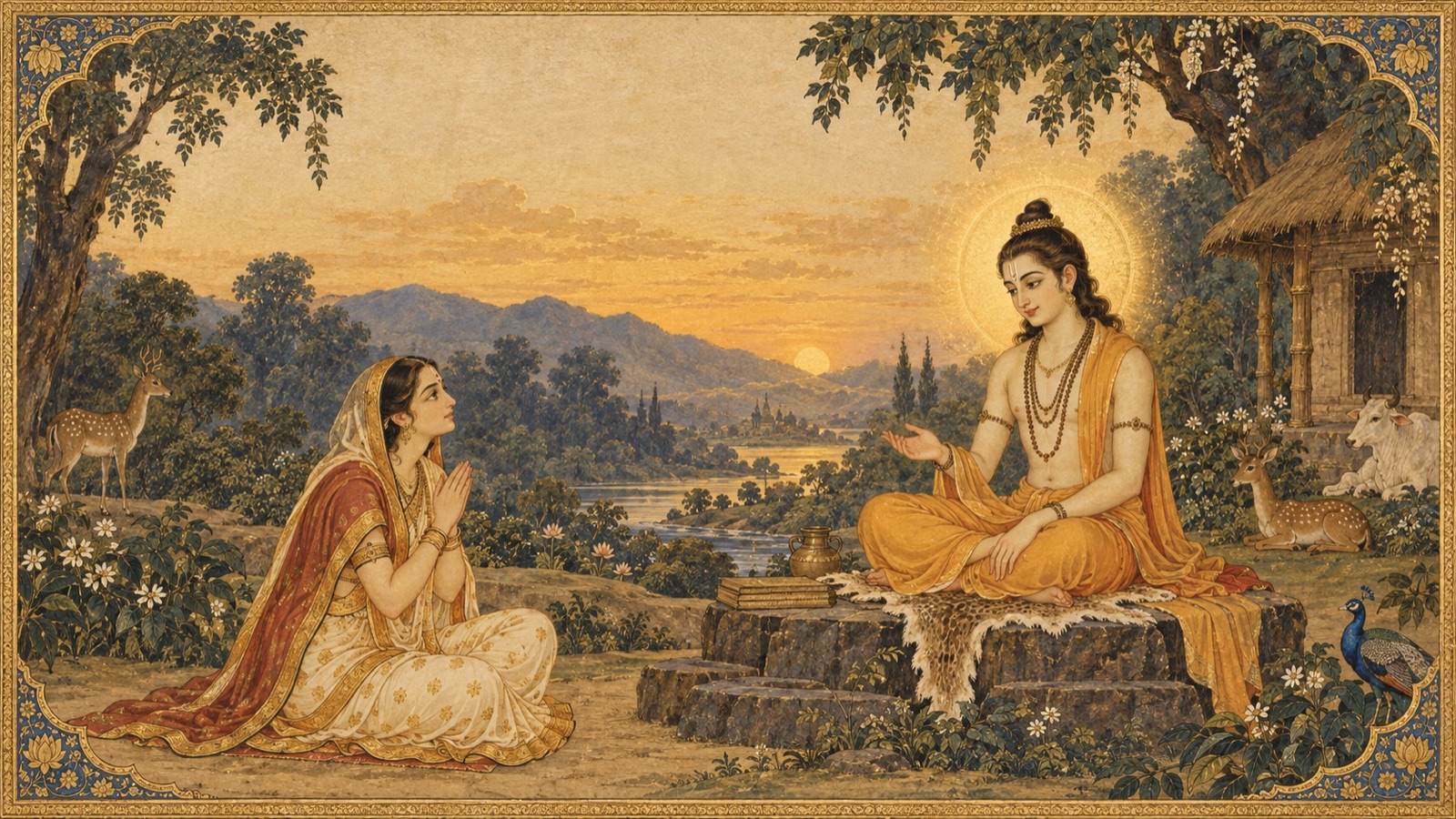
The Three Grades of Devotion
Kapila’s answer begins where all honest teaching on devotion must begin: not with the ideal, but with the ordinary, mixed motives that actually bring most people to worship in the first place.
The Lord said: “The discipline of devotion, O noble lady, is recognized as manifold according to our ways of approach to it; and men’s attitude of mind varies according to the diversity of their natural characteristics.” (verse 7)
Three types follow, each tied to one of the three Gunas of Prakrti that this very Canto has spent several chapters explaining.
A man who is given up to anger and views the Lord as distinct from himself, and who practises devotion with a mind full of violence, hypocrisy and jealousy, is a devotee of the Tamasika type. (verse 8) He who worships through an image, as distinct from himself, with a view to acquiring objects of the senses, fame, or power, is a devotee of the Rajasika type. (verse 9) And he who adores the Lord as distinct from himself, aiming at the eradication of his sins, or with the intention of offering his actions to the Supreme, or again with the simple feeling that it is his duty to worship, is a devotee of the Sattvika type. (verse 10)
None of these three, Kapila makes clear, is the destination — each is still coloured by a Guna, still oriented around the worshipper’s own gain, however refined that gain may have become by the time it reaches the Sattvika stage. The destination lies beyond all three:
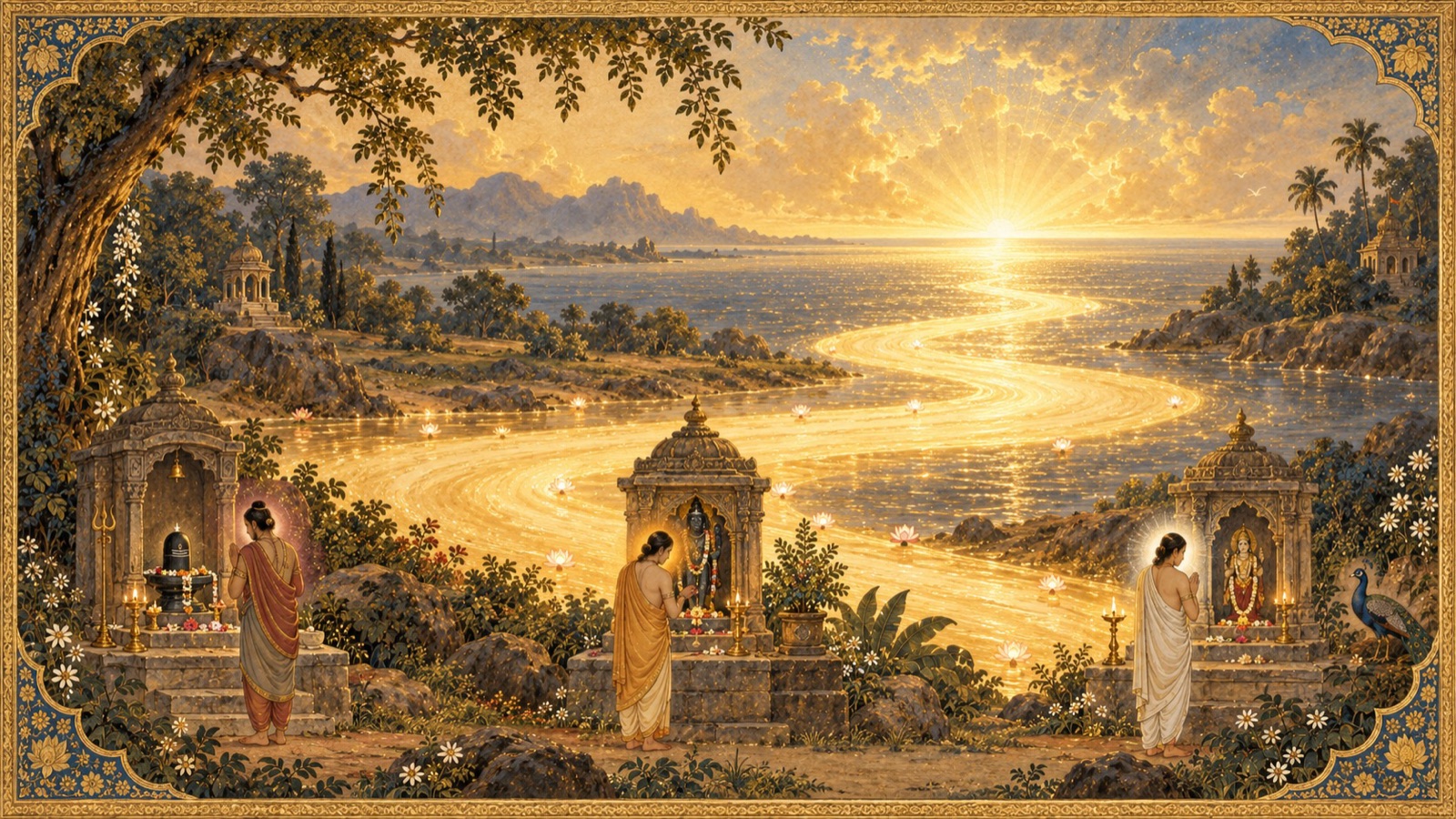
The uninterrupted flow of the mind-stream towards the Lord, dwelling in the heart of all — like that of the waters of the Ganga towards the ocean — at the mere mention of His virtues, combined with motiveless and unremitting love, is spoken of as the distinguishing character of unqualified Bhaktiyoga. (verses 11–12)
मद्गुणश्रुतिमात्रेण मयि सर्वगुहाशये । मनोगतिरविच्छिन्ना यथा गङ्गाम्भसोऽम्बुधौ ॥ ११ ॥ लक्षणं भक्तियोगस्य निर्गुणस्य ह्युदाहृतम् । अहैतुक्यव्यवहिता या भक्ति: पुरुषोत्तमे ॥ १२ ॥
mad-guṇa-śruti-mātreṇa mayi sarva-guhāśaye mano-gatir avicchinnā yathā gaṅgāmbhaso ‘mbudhau lakṣaṇaṁ bhakti-yogasya nirguṇasya hy udāhṛtam ahaituky avyavahitā yā bhaktiḥ puruṣottame
Meaning: The instant the mind hears of the Lord’s own qualities and turns toward Him seated in the cave of every heart, its current becomes as steady and unbroken as the Ganga moving toward the sea — this self-sustaining flow, asking nothing in return, is the very mark of bhakti-yoga untouched by the three Gunas. (Canto 3, Chapter 29, verses 11–12)
The Lord’s devotees accept not, in exchange for His service, any of the five forms of final beatitude — Salokya (residence in His divine realm), Sarsti (enjoying His powers), Samipya (living in His presence), Sarupya (possessing a form similar to His), and Sayujya (absorption into His Being) — even when they are offered. (verse 13) This Bhaktiyoga has been declared the highest goal; for by transcending the realm of the three Gunas, the devotee becomes qualified for the Lord’s own state without any effort. (verse 14)
This is one of the most quietly radical claims in the entire chapter: a devotee practising unqualified Bhaktiyoga would refuse even liberation itself, offered directly by the Lord, if it were offered as a substitute for continued loving service. The image of the Ganga is chosen with evident care — a river does not deliberate about whether to flow to the ocean; it simply flows, drawn by its own nature, without calculation. That, Kapila says, is what real devotion looks like from the inside.
The Practical Limbs of Devotional Life
Having distinguished the destination from the three preliminary stages, Kapila now becomes remarkably concrete about how an ordinary striving soul actually gets there — not through a single dramatic leap, but through a whole way of living.
By devoutly performing one’s duties — both obligatory duties and those arising out of a special occasion — in a disinterested spirit; by following every day a course of worship enjoined by the Pancaratra and other sacred works, involving no destruction of life and actuated by no worldly desire; by beholding, touching, adoring, extolling and bowing to the Lord’s images, and by regarding all living beings as His own manifestations; by resorting to patience and dispassion; by showing great respect to exalted souls, commiserating with the afflicted, and behaving in a friendly manner with one’s equals; by practising the five Yamas — non-violence, truthfulness, non-thieving, abstaining from sexual commerce, and possessing nothing beyond the bare necessaries of life — and the five Niyamas — external and internal purity, contentment, undergoing penance, study of sacred texts, and meditation on God; by hearing spiritual discourses and chanting the divine names; and by unity of mind, speech and body, fellowship with holy men, and absence of egotism — the mind of a person engaged in such activities gets thoroughly purified, and conceives a liking for the Lord without any effort the moment His virtues enter his ears. (verses 15–19)
This is a striking passage to sit with, because nothing in it is exotic or reserved for renunciants. Duty performed without attachment; worship that harms no one; friendliness toward equals; simple ethical restraints; regular study and quiet meditation — Kapila is describing a texture of daily life, not a technique available only to the specially gifted. And the promise attached to it is equally plain: this way of living does not manufacture devotion by force of will. It simply removes the obstructions, so that liking for the Lord “enters his ears” almost the way sound naturally enters an unobstructed ear.
Kapila immediately reinforces the point with an image drawn from the most ordinary of sensory experiences:
Just as odour wafted from its source through the vehicle of a breeze catches the olfactory sense, so an equipoised mind engaged in the pursuit of Yoga embraces the Lord, who is unchanging. (verse 20)
Equal Vision: The Warning Against Selective Worship
Having described what purifies devotion, Kapila now turns to what corrupts it even at an advanced stage — and here the chapter delivers one of its sharpest and most uncomfortable teachings.
“I am ever present in all living beings as their very Self, their Inner Controller. A man who therefore worships Me through an idol, showing disrespect to Me as I abide in all creatures, makes a travesty of worship.” (verse 21) “Ignoring Me, the Supreme Ruler, the Self present in all living beings, he who stupidly resorts to idol-worship alone throws oblations into the ashes.” (verse 22) “The mind of a man who, full of pride, hates Me — abiding in the body of another — views Me as distinct from himself, and bears deep-rooted malice to living creatures, can never find peace.” (verse 23) “I am not pleased, even though adored through an image by means of formal worship carried on with costly or cheap materials, O sinless mother, by a man slighting other creatures.” (verse 24) “Performing his allotted duties, a man should worship Me, the Supreme Ruler, through images and the like, only so long as he does not realize Me as present in his own heart as well as in the heart of other living beings.” (verse 25) “Figuring as Death, I cause great fear to him who makes the least discrimination between himself and another because of his differential outlook.” (verse 26) “Therefore, through charitable gifts and attentions, as well as through friendly behaviour and by viewing all alike, one should propitiate Me, abiding in all creatures as their very Self.” (verse 27)
यो मां सर्वेषु भूतेषु सन्तमात्मानमीश्वरम् । हित्वार्चां भजते मौढ्याद्भस्मन्येव जुहोति स: ॥ २२ ॥
yo māṁ sarveṣu bhūteṣu santam ātmānam īśvaram hitvārcāṁ bhajate mauḍhyād bhasmany eva juhoti saḥ
Meaning: One who turns away from Me, the Self seated equally within every creature, and worships only the temple image while neglecting that living presence, pours his offering nowhere at all — like clarified butter offered into cold ash instead of into fire. (Canto 3, Chapter 29, verse 22)
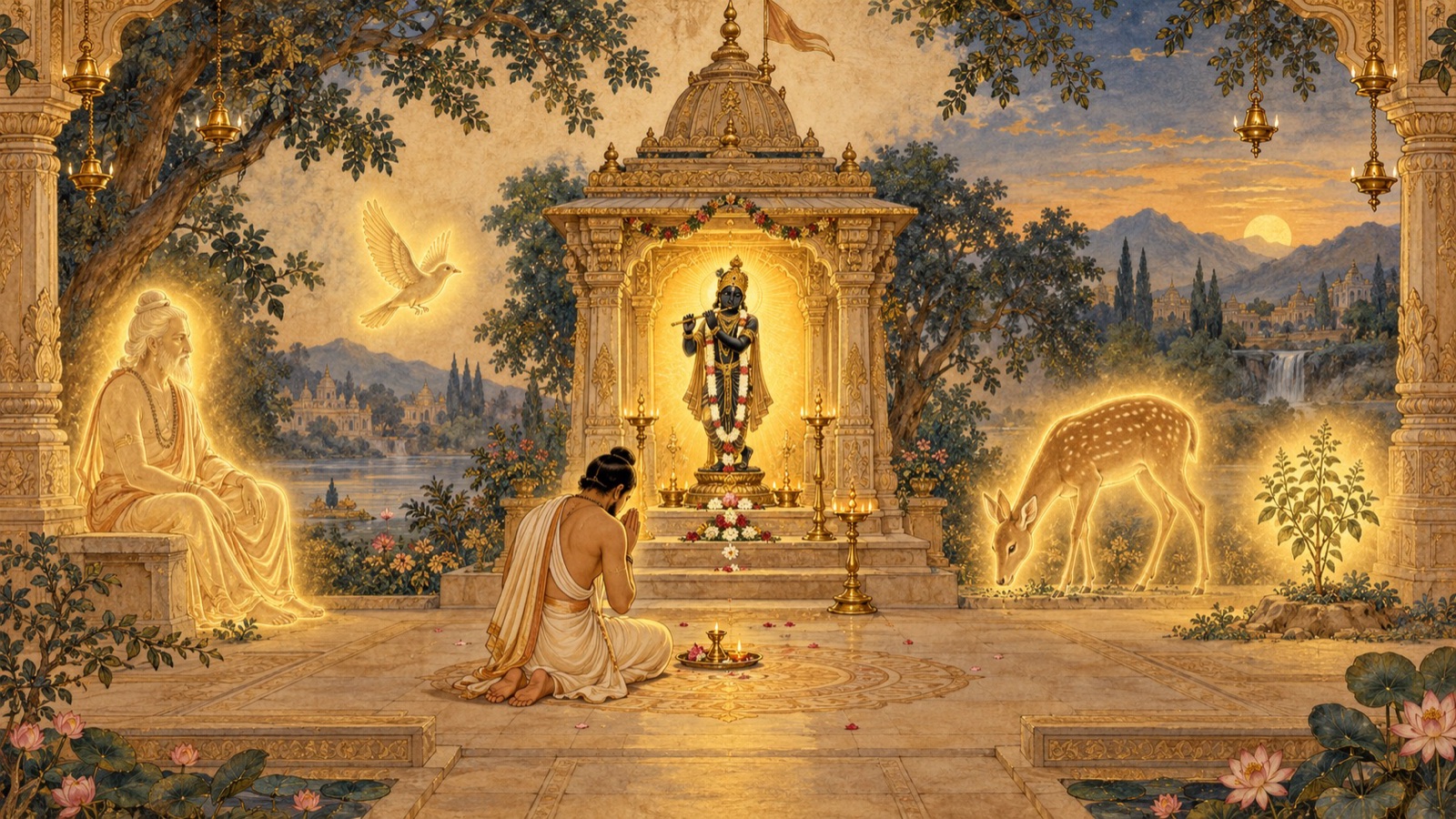
It would be difficult to find a more unambiguous statement, anywhere in scripture, that ritual correctness without ethical vision is not merely incomplete devotion — it is, in Kapila’s own severe phrase, “throwing oblations into the ashes.” The temple image, the daily arati, the careful worship performed “with costly or cheap materials” — none of it substitutes for recognizing the same Lord seated as Inner Controller within the very people one might otherwise ignore, resent, or look down upon. And there is something particularly striking in verse 25: temple worship through images is explicitly sanctioned and even encouraged — but as a stage, a scaffolding, meant to be used “only so long as” the deeper realization has not yet dawned. The image is a means, never a substitute for the reality it points toward.
Why should ritual correctness count for nothing here? Because the Inner Controller seated in the shrine and the same Inner Controller seated in the heart of the person one resents are not two beings who merely resemble each other — they are one undivided Self, wholly present in both places at once. An oblation needs a living fire to carry it upward; the identical butter and mantras poured onto cold ash carry nothing anywhere, however precisely the ritual is performed. In just this way, the warmth withheld from a living being is not a separate lapse sitting beside one’s temple worship — it is the very fire that worship needed, absent at the moment it was needed. This is why Kapila calls selective devotion not a lesser offering but no offering at all (verses 21–24).
A Hierarchy of Life and the Perfect Devotee
At this point in the chapter, the Gita Press primary-source text has a confirmed gap: book page 270 is missing from the scanned PDF, and it corresponds to verses 28 through 34. To keep the chapter’s coverage complete, the paragraph below is an independently-worded summary of these seven verses, checked directly against a second published edition’s Sanskrit and verse numbering for SB 3.29.28–34 — not a copy of any other translation, and clearly marked here as a bridge over a genuine gap in the primary source rather than as a direct quotation from Gita Press.
Continuing naturally from the instruction to “view all alike” in verse 27, Kapila lays out a graded hierarchy of life, meant to deepen — not contradict — that equal vision. Living beings, He explains, are superior to inanimate matter; among living beings, those showing visible signs of life are superior to those without; higher still are beings of developed consciousness, and higher again those with developed sense-perception. (verse 28) Among sense-endowed beings, the scale rises from touch, to taste, to smell, to hearing, each representing a fuller range of capacity. (verse 29) Above these come beings that can distinguish form by sight, then those with a full set of teeth, then many-legged creatures, then four-legged creatures, and finally two-legged human beings. (verse 30) Among humans, society organized by quality and vocation is regarded as best, and within it the brahmana stands foremost; among brahmanas, the knower of the Vedas is superior, and superior still is the one who has grasped the actual purport of the Vedas rather than its letter alone. (verse 31) Above such a knower stands one who can resolve all doubt; above him, one who faithfully performs his own prescribed duty; above him, one entirely free of material attachment; and at the summit of the entire hierarchy, the pure and unmotivated devotee, whose only interest is the Lord’s own interest. (verse 32) Kapila declares that He personally regards no one as greater than such a devotee — one who offers every action, every possession, and life itself to Him without interruption, and who, having relinquished the sense of personal doership, sees with truly equal vision and no longer perceives any being as separate from the Lord. (verse 33) Such a devotee, understanding that the Supreme Person has entered every living being through His partial expansion as the Inner Controller, bows in the mind to all beings with genuine reverence. (verse 34)
Read this way, the “hierarchy” is not a ranking of who deserves more or less respect — that would directly contradict the equal-vision teaching that immediately precedes it. It is, rather, a ranking of capacity: of how much of the Lord’s own nature a given form of life is capable of consciously recognizing and returning. And its logic culminates not in the most powerful being, nor the most learned, but in the devotee who has stopped keeping score altogether — who, precisely because he sees no being as separate from the Lord, ends up bowing, in his own mind, to every single one of them.

The Conclusion of the Devotional Teaching
With the hierarchy completed, Kapila draws the entire first half of the chapter to a close by tying the path of devotion explicitly to the eight-limbed Yoga discussed at length in the preceding chapters.
“The Yoga of Devotion as well as the Yoga with eight limbs have thus been expounded by Me, O daughter of Swayambhuva Manu! By following either of these two Yogas, a man can attain to the Supreme Person.” (verse 35)
The two paths — the devotional and the meditative — are not presented as rivals but as two roads to the identical summit. Having established that, Kapila now turns, without further preamble, to the second of His mother’s original questions.
The Glory of Time
The chapter’s final movement answers Devahuti’s fourth question — about “the essential character of the all-powerful Time” — and it does so by revealing that Time is not a separate cosmic mechanism at all, but another name and another face of the very same Lord whose devotion has just been described.
The aforesaid aspect of the Lord — who is the same as the Absolute of the Vedanti and the Supreme Spirit of the Yogi, who figures both as Prakrti and Purusa and yet lies beyond both — is also known by the name of Providence, who brings into play the activity of Karma, the destiny of the different Jivas in the shape of birth in the various species of life. (verse 36) It also bears the appellation of Kala (Time), which brings about the transformation of things and is possessed of wonderful prowess — a source of constant terror to those who regard themselves as a separate entity and have identified themselves with Mahat-tattva and other products of Matter. (verse 37) Kala, the Ruler of rulers — Brahma and others — who, being the support of all, enters the heart of all living beings as their Inner Controller and devours them through other beings, is no other than the deity presiding over sacrifices, known by the name of Vishnu. (verse 38) Although there is none dear or hateful to Him, nor anyone His kinsman, He is ever on the alert, and attacks and destroys the man who, having forgotten the Lord, wallows in the error of sensuality. (verse 39)
What follows is a sweeping, almost breathless catalogue of the entire visible universe operating in fear of Time — not the anxious fear of the guilty, but the reverent fear that keeps every element of creation faithfully at its post:
For fear of Him blows the wind; for fear of Him the sun shines; for fear of Him the god of rain pours forth showers, and for fear of Him the host of heavenly bodies shed their lustre. (verse 40) Afraid of Him, trees and creepers along with herbs and annual plants put forth blossoms and fructify each in its own season. (verse 41) Afraid of Him, rivers flow and the ocean never overflows; for fear of Him fire burns, and the earth with its mountains sinks not into the waters supporting it. (verse 42) Subject to His control, the yonder sky allows room to living beings, and Mahat-tattva expands its own sprout-like form into this vast universe, enveloped by its seven sheaths. (verse 43) For fear of Him the deities presiding over the three Gunas — Brahma, Vishnu and Shiva, who hold sway over all creation, animate and inanimate — remain engaged in their duties of creating, preserving and destroying it from time to time. (verse 44)
This passage functions almost as a hymn within the discourse: wind, sun, rain, stars, plants, rivers, ocean, fire, earth, sky, and even the three great deities of creation, preservation, and destruction — all of them are shown obeying, without exception, the same unseen Ruler that governs the destiny of every human soul. Nothing in the universe, however vast or however small, stands outside the reach of Time.

Even Death Must One Day Die
The chapter closes with a single verse that gathers the entire teaching on Time into its sharpest possible point.
That imperishable Time-Spirit, who, though beginningless, is the first maker of the universe, and who, though endless, brings about the end of the phenomenal world, carries on the work of creation by bringing into existence one individual through another — a son through a father — and likewise dissolves the universe by destroying even Yama, the lord of death, through Himself. (verse 45)
There is a quiet but total finality in this verse. Every fear that a human life might reasonably hold — including the fear of death itself, personified in the god Yama — is here revealed to be, in the end, subject to something greater still. Death is not the last word; Time is the last word, and Time is nothing other than the Lord. Kapila has just taught His mother that devotion means recognizing the Lord equally present in every living being; this closing revelation now completes that truth: the same Lord who can be approached with tender, unqualified love is also the very ground from which the entire structure of birth, death, and cosmic order proceeds. Love and awe, in this chapter, are shown to be responses to a single, undivided reality.
सोऽनन्तोऽन्तकरः कालोऽनादिरादिकृदव्ययः । जनं जनेन जनयन्मारयन्मृत्युनान्तकम् ॥ ४५ ॥
so ‘nanto ‘nta-karaḥ kālo ‘nādir ādi-kṛd avyayaḥ janaṁ janena janayan mārayan mṛtyunāntakam
Meaning: That endless, imperishable Time, without beginning yet the maker of all beginnings, brings persons into being through other persons and, through death, destroys even the personification of death itself. (Canto 3, Chapter 29, verse 45)
Principal Teachings of This Chapter
1. Devotion has grades, and most worship begins in a mixed, Guna-coloured form. Tamasika devotion is driven by anger and hostility; Rajasika devotion seeks sense-objects, fame, and power through worship; Sattvika devotion seeks the eradication of sin or performs worship as duty — none of these is yet the destination (verses 7–10).
2. True Bhaktiyoga is unconditional and refuses even liberation as a substitute for loving service. The devotee’s mind flows toward the Lord as naturally and unstoppably as the Ganga flows to the ocean, wanting nothing in exchange — not even any of the five classical forms of liberation (verses 11–14).
3. Devotion is built through an entire way of living, not a single technique. Disinterested duty, non-violent worship, ethical restraint (the Yamas and Niyamas), study, chanting, and fellowship with the holy gradually purify the mind until love for the Lord arises without effort (verses 15–20).
4. Worship without equal vision is not devotion at all. However costly or elaborate the ritual, worship offered by someone who discriminates against, hates, or disrespects other living beings is called a “travesty” — because the very Lord being worshipped in the image is equally present as the Inner Controller within everyone else (verses 21–27).
5. Spiritual capacity, not power or status, is the true measure of a being’s rank — and it culminates in selfless devotion. The graded hierarchy of life (verses 28–34) rises not toward the strongest or most learned but toward the devotee who has surrendered all doership and bows, in the mind, to every being.
6. Time is not separate from the Lord — it is one of His own names and forms. Kala, also identified with Vishnu and with Providence, governs the destiny of every Jiva, and the entire visible universe — wind, sun, rivers, fire, even the great deities of creation and destruction — operates in reverent fear of Him (verses 36–44).
7. Even Death is subject to Time, and Time is the Lord. The chapter’s closing verse reveals that the very personification of death, Yama, will himself be destroyed by the same imperishable Time-Spirit that first brought the universe into being (verse 45).
A Devotional Reflection
There is a particular kind of relief available in this chapter for anyone who has ever worried that their own devotion feels imperfect, mixed, or motivated by something less than pure love. Kapila does not begin His teaching by demanding the Ganga’s effortless flow from the very first day. He begins by naming the Tamasika and Rajasika stages honestly, without shame, as real and recognizable starting points on the very same path that leads, through patient practice and purification, to unqualified love. And the chapter’s second half offers a different, equally needed kind of comfort: the same Lord who asks to be recognized with tenderness in the heart of every living being is also the very Time that governs the rise and fall of empires, bodies, and even death itself. Nothing that happens — no loss, no ending, no fear — falls outside His care, because nothing falls outside Him.
A Daily Devotional Practice
Today, bring to mind one person you find genuinely difficult to feel warmth toward — someone whose company grates, or whose faults are easy to dwell on. Without forcing any feeling, simply recall this chapter’s teaching: the same Inner Controller who dwells in your own heart dwells, without exception, in theirs as well. Offer that person, silently, one small act of the “charitable gifts and attentions” verse 27 names — even something as simple as a genuine, unspoken wish for their well-being. Then sit quietly for a few minutes and repeat softly: “Om Namo Bhagavate Vasudevaya,” letting the practice itself become, in this chapter’s own terms, an act of viewing all beings alike.
Conclusion
The twenty-ninth discourse of the Third Canto answers, in a single sweeping arc, both of the questions with which Devahuti opened it. In its first half, Lord Kapila anatomizes devotion itself — distinguishing the three Guna-coloured stages from the one unqualified Bhaktiyoga that flows, unbidden and unconditional, toward the Lord dwelling in every heart, and warning in the sternest terms that no ritual correctness compensates for contempt toward other living beings. In its second half, without so much as a pause, the same Lord is revealed as Kala, all-powerful Time — the unseen Ruler before whom wind, sun, rivers, fire, and even Brahma, Vishnu and Shiva perform their appointed offices, and who will, in the fullness of time, destroy even Death. What begins as an intimate teaching on how to love rightly ends as a cosmic revelation of what, and whom, that love has been directed toward all along.
May the divine wisdom of Srimad Bhagavatam awaken pure devotion within our hearts.
Om Namo Bhagavate Vasudevaya.
Jay Shree Madhav.
References and Attribution
- Primary edition: Gita Press, Śrīmad Bhāgavata Mahāpurāṇa (English, complete), Book Three, Discourse 29, pages 267–271 (page 270 missing from the scanned source).
- Series: Srimad Bhagavatam Wisdom · Biswa Sanatan Dharma Seva Trust.
- Presented following the spiritual guidance and recommendation of Pandit Dr. Shri Kashinath Mishra.
This is an original, faithful retelling in the writer’s own words, with brief quoted verses shown in Devanāgarī and transliteration and their meanings given as summaries. It is not a reproduction of any single publisher’s continuous translation or commentary. No affiliation with or endorsement by any publisher is implied.
Jay Shree Madhav