
A cloud adrift in the sky has no way of sensing the wind’s power over it — and Kapila tells his mother that an embodied soul is no different, swept without pause through birth after birth by a force whose vastness it never once pauses to notice.
Om Namo Bhagavate Vasudevaya.
Om Namo Bhagavate Vasudevaya.
Om Namo Bhagavate Vasudevaya.
Welcome to Srimad Bhagavatam Wisdom, a devotional journey through the sacred histories and teachings of the Srimad Bhagavat Mahapurana. We continue in the heart of the Kapila-Gita — the teaching Lord Kapila gives to His own mother, Devahuti, in the forest hermitage on the bank of the Sarasvati. The previous chapter closed with a majestic hymn to the all-pervading power of the Time-Spirit (Kala), the form of God before whom the wind blows, the sun shines, the rivers flow and the deities of creation themselves stand in awe. Chapter 30 takes that same Time-Spirit and turns it toward the one place most of us never think to look for it: the ordinary, unremarkable life of a person absorbed in maintaining a household. There is no philosophical debate in this chapter, no dazzling cosmic vision — only a patient, almost clinical account of how a soul convinced that body, spouse, children, house and wealth are the whole of reality is carried, step by step, first through the indignities of old age, then through the moment of death, then along a fearsome road to the abode of Yama, and finally through the tortures of hell — until, purged, it is born again as a human being to try once more. Kapila’s own mother is his listener throughout, and it is worth remembering, even in the chapter’s starkest passages, that this is a teaching offered by a son to his mother out of love, meant to warn rather than to frighten for its own sake.
Chapter Information
- Scripture: Śrīmad Bhāgavata Mahāpurāṇa
- Canto: 3 (Book Three)
- Chapter: 30 (Discourse 30)
- Chapter title: Downfall of men attached to their body, house etc.
- Principal speaker: Lord Kapila, continuing His teaching to His mother Devahuti (no direct-speech interruption by Devahuti in this chapter, though Kapila addresses her directly as “O mother” in verse 29)
- Principal listener: Devahuti
- Main setting: The hermitage of the sage Kardama on the bank of the river Sarasvati (the same setting as the preceding chapters of the Kapila-Gita)
- Central subject: The Jiva’s ignorance of the power of Time; the householder’s deepening attachment to body, wife, children, house, animals and wealth; the miseries of old age, disease and neglect; the physical signs of approaching death; the soul’s forced journey along a terrible road to Yama’s abode; the tortures of the various hells; and the eventual rebirth as a human being once the sinner is purged through those tortures and through the lowest animal births
- Principal verse range: Canto 3, Chapter 30, verses 1–34
- Primary edition: Gita Press Śrīmad Bhāgavata Mahāpurāṇa
The Cloud That Does Not Know the Wind
Chapter 30 opens with an image every reader who has ever watched a sky change will recognize instantly:
Lord Kapila continued: Just as a mass of clouds knows not the inordinate strength of the mighty wind-god, though driven (here and there) by the latter, so this Jiva surely does not know the enormous power of the omnipotent Kala though being subjected to repeated births and deaths (by the latter). (verse 1)
A cloud is pushed across the sky, torn apart, reshaped, dissolved — all by a force it has no capacity to perceive, let alone resist. The Jiva (the individual soul, embodied and forgetful of its true nature) is exactly such a cloud, Kapila says, and Kala — Time itself, another name here for the Lord’s own irresistible power — is exactly such a wind. We rarely feel Time as a force at all; we feel it only indirectly, as the plans it wrecks and the losses it inflicts.
कपिल उवाच । तस्यैतस्य जनो नूनं नायं वेदोरुविक्रमम् । काल्यमानोऽपि बलिनो वायोरिव घनावलि: ॥ १ ॥
kapila uvāca tasyaitasya jano nūnaṁ nāyaṁ vedoru-vikramam kālyamāno ‘pi balino vāyor iva ghanāvaliḥ
Meaning: Kapila declared to His mother that this person, ceaselessly carried onward by Time’s tremendous force, has no real awareness that any such power is acting on him at all — no more than a bank of clouds, pushed about by a mighty wind, could ever grasp the wind’s own strength. (Canto 3, Chapter 30, verse 1)
Kapila’s next verse makes this concrete:
The almighty Time-Spirit destroys each and every object the Jiva acquires with great pains for the sake of happiness, and for whose loss he grieves much. (verse 2) That is because the stupid creature foolishly regards as everlasting the house, lands and wealth etc., belonging to one’s transient body and those connected with it (viz., one’s wife, son and so on, who are equally perishable). (verse 3)
The chapter’s entire argument is compressed into these two verses: grief is not a random misfortune that occasionally interrupts an otherwise stable life — it is the guaranteed consequence of mistaking perishable things (a body, a house, relationships built on bodies) for permanent ones. Time does not need to be cruel to produce this grief; it only needs to keep doing what it has always done, which is to end things. The griever’s own error — expecting permanence where none was ever promised — supplies the rest.

The Householder’s Deepening Attachment
Having stated the principle, Kapila spends the next several verses tracing, with unusual narrative patience, exactly how attachment deepens across an ordinary life. The Jiva, he says, “finds delight in whatever species of life he is born into, and never feels aversion for it” (verse 4) — even, startlingly, “in hell,” where “deluded by the Lord’s Maya, the Jiva feels little inclined to cast off his body… taking delight in the infernal enjoyments” (verse 5). This is one of the chapter’s most quietly unsettling observations: attachment is not a rational assessment that a given situation is good; it is a kind of gravitational pull that operates regardless of the situation, binding the soul to whatever body and circumstance it currently occupies, however miserable.
From there Kapila turns to the familiar case — the householder:
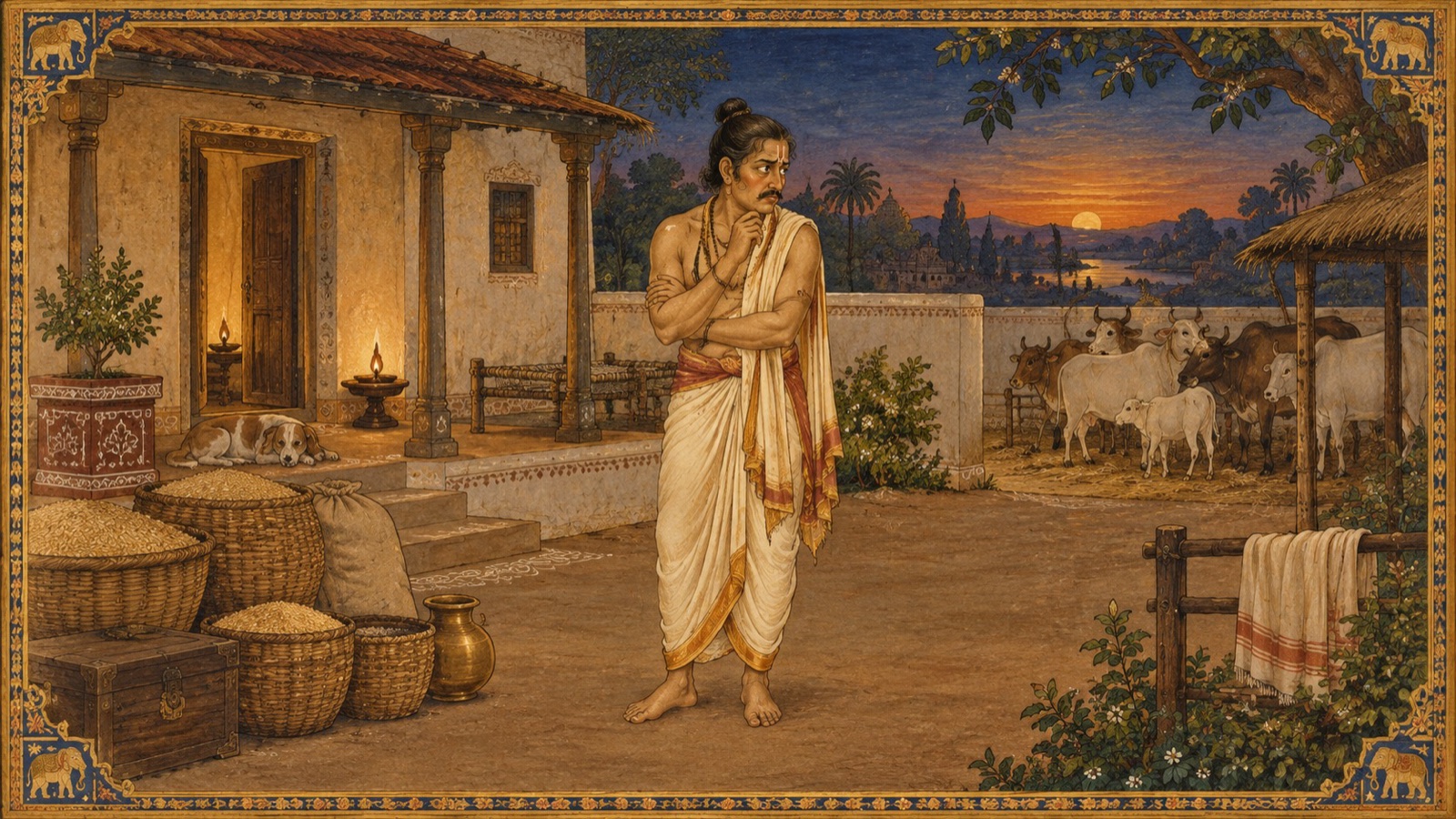
With his heart deeply attached to body, wife, progeny, house, animals, wealth and relations, he deems himself blessed. (verse 6) Burning all over with anxiety to maintain them all, the evil-minded fool incessantly commits sins. (verse 7) Nay, with his mind and senses captivated by the charms wrought on him in the private chamber by lewd women, as well as by the talks of lisping infants, the householder remains attached to his home life, which is mainly full of trouble and the duties of which involve the practice of wiles; and if, while scrupulously performing these duties, he succeeds in averting calamity, he deems himself happy as it were. (verses 8–9)
It is worth noticing the precision of Kapila’s psychology here. He does not say the householder is simply foolish or wicked; he says the householder’s own affections — for a spouse, for a child’s babbling speech, for the small triumph of having kept disaster at bay one more day — are the very mechanism that keeps him bound. Love itself, misdirected entirely toward perishable objects and never toward their source, becomes the engine of continued bondage. The chapter then follows the practical consequences of this bondage without flinching: earning wealth “through moneys procured from here and there by practising great violence” (verse 10) to feed a family that will outlive his ability to provide for it; business ventures repeatedly failing until “he becomes moneyless” and “reduced to a wretched plight” (verses 11–12); and finally, the bitter turn where “his wife and others treat him not with the same respect as before, even as the miserly cultivators do not accord the same treatment to their old and worn-out oxen” (verse 13).
आत्मजायासुतागारपशुद्रविणबन्धुषु । निरूढमूलहृदय आत्मानं बहु मन्यते ॥ ६ ॥
ātma-jāyā-sutāgāra-paśu-draviṇa-bandhuṣu nirūḍha-mūla-hṛdaya ātmānaṁ bahu manyate
Meaning: With the roots of his heart sunk deep into his own body, his wife, his children, his house, his livestock, his wealth and his kinsmen, the householder comes to consider himself thoroughly fortunate. (Canto 3, Chapter 30, verse 6)
Old Age, Neglect, and the Approach of Death
The chapter’s next movement is among the most tender and most sobering in the entire Kapila-Gita, because it describes not villainy but simple, universal human decline. Even treated with diminished respect, Kapila says, the aging man “feels no aversion” for the family he has spent his life serving:
Maintained by those whom he had (once) brought up himself and deformed on account of old age, he falls a prey to diseases like dyspepsia; his diet and activity both diminish and he remains confined to his house, awaiting his death and living like a dog on whatever is thrown despisingly (by his sons and wife). (verses 14–15)
There is no condemnation in this verse, only a plain, almost documentary description of what old age without spiritual preparation can look like — a life’s devotion to a household repaid, at its end, with the same casual indifference one might show an old dog. Kapila does not linger on blame; he moves directly to the body’s own final signs, described with the same unsparing clarity: “his eye-balls are shot out by the action of the life-breath trying to find an exit; his wind-pipe gets choked with phlegm, coughing and breathing cause him exertion and death-rattle is heard from his throat” (verse 16). “Lying (in his bed) surrounded by his sorrowing relations and caught in the noose of Death, he cannot utter a word even when addressed” (verse 17). The man “dies in the midst of his weeping kinsmen, rendered unconscious or thrown out of his wits by excessive agony” (verse 18) — his mind, to the very last moment, still occupied with the family he could never truly protect.
The Road to Yama: A Warning, Not a Spectacle
What follows — the description of the soul’s journey to the abode of Yama, the god of death and cosmic justice, and the sufferings that await it there — is among the most vivid and demanding passages anywhere in the Bhagavatam. It is presented here exactly as the Gita Press text presents it, with the same restraint the whole series maintains toward difficult material: as scripture’s own sober warning against a real spiritual danger, not as a spectacle to dwell on for its own sake.
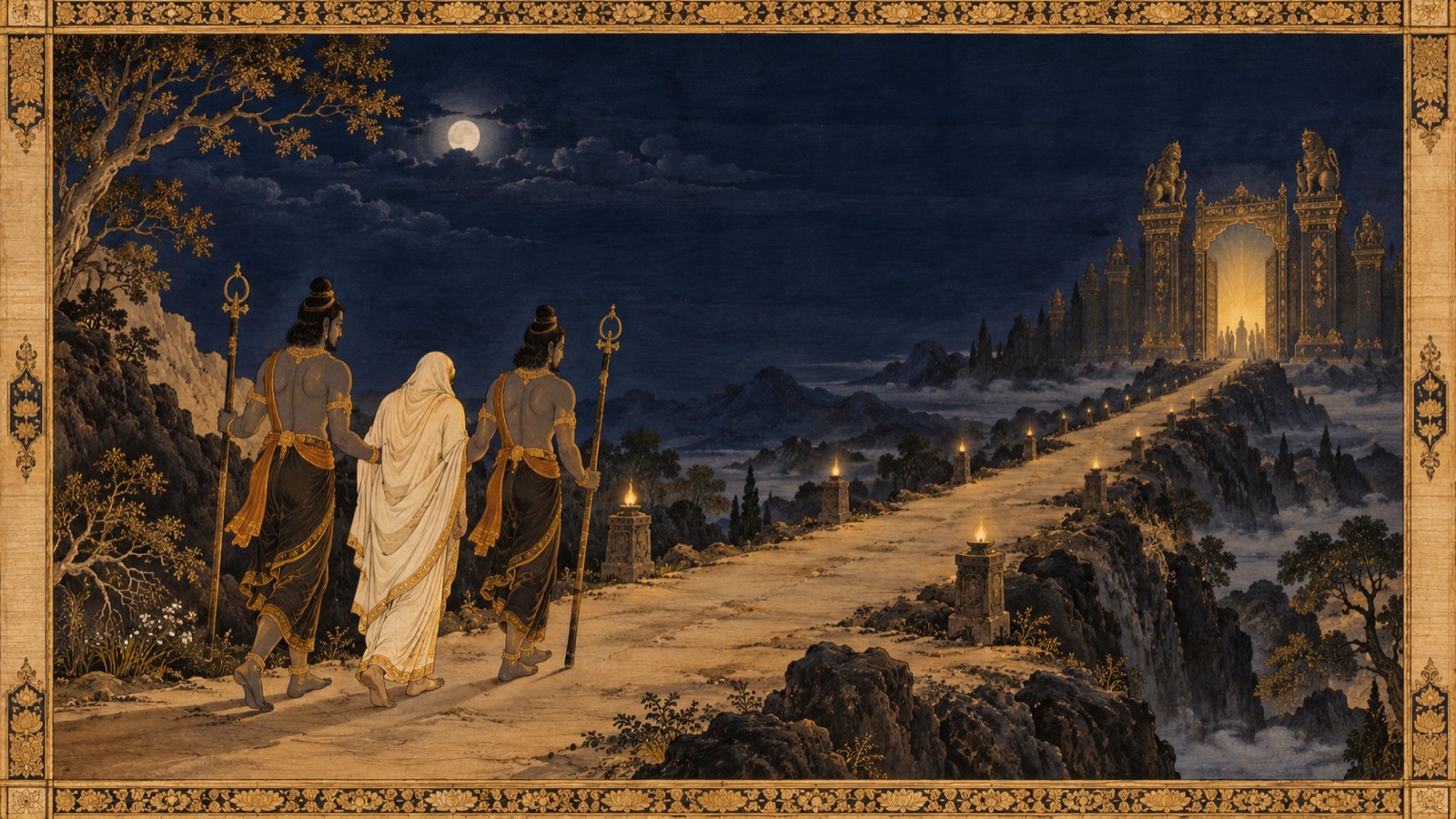
Trembling at heart to see a couple of frightful messengers of Death arrived at the moment, their eyes full of wrath, he passes stool and urine. (verse 19) Clothing his soul in a special (aerial) body fit for undergoing the tortures of hell and binding him with cords about the neck, they forcibly drag him along a long road (to the abode of Yama) even as the constables of a king drag a convict (to gaol). (verse 20)
A traditional gloss on this verse explains a detail that recurs throughout Puranic literature on this subject: “sinners condemned to hell are invested with an aerial body, which, though subjected to tortures in various forms, is wonderfully tenacious and does not perish till the sinner has fully served the sentence.” The point is not gratuitous cruelty but completeness — the consequence must run its full course precisely because it is just, measured exactly to the deeds that produced it. Kapila describes the road itself as “ninety-nine thousand Yojanas (7,92,000 miles) long,” traversed “within two to three hours” (verse 24) — a road with “no shelter or water” and “covered by burning sands” (verse 22), along which the soul is “bitten on the way by dogs” (verse 21) and driven on by hunger, thirst, “forest fire and hot winds” and “flogged on the back with whips” (verse 22), “dropping down now and then and fainting due to exhaustion and rising again” (verse 23).
The tortures of hell itself are catalogued with the same unflinching, scripture-sober directness — limbs “set on fire,” the soul “made to eat his own flesh,” entrails “pulled out by the hounds and vultures of hell,” torment by “serpents, scorpions, gnats,” limbs “lopped off one by one and rent asunder by elephants,” being “hurled down from hill-tops” or “held up either in water or in a cave” (verses 25–27), suffering across the named regions “Tamisra, Andhatamisra, Raurava and so on” (verse 28). This series will not reproduce these images with any embellishment beyond what the primary source itself states, and offers them here — as the Bhagavatam itself intends them — as a solemn call to spiritual seriousness rather than as anything to be dwelt upon for its own sake. It is telling that Kapila’s very next verse steps back from the catalogue to offer his mother a striking reframe:
Some people aver that heaven and hell exist in this very world, O mother; for the tortures which are experienced in hell are seen even here. (verse 29)
This single verse recasts everything that came before it. The elaborate cosmology of hell is not, Kapila suggests, wholly separate from the world we already inhabit — the fear, the physical suffering, the isolation, the loss of dignity that attend a life of unchecked material attachment are themselves a kind of hell, visible to anyone paying attention, right here, without waiting for death to reveal it. The direct address — “O mother” — is a reminder, too, that this entire catalogue has been spoken throughout in love and concern, not detachment.
अत्रैव नरक: स्वर्ग इति मात: प्रचक्षते । या यातना वै नारक्यस्ता इहाप्युपलक्षिता: ॥ २९ ॥
atraiva narakaḥ svarga iti mātaḥ pracakṣate yā yātanā vai nārakyas tā ihāpy upalakṣitāḥ
Meaning: O mother, some wise people say that heaven and hell are both found right here in this very world, since the torments described as hellish are already plainly witnessed among us. (Canto 3, Chapter 30, verse 29)

The Purpose of the Ordeal: Purification, Not Punishment Alone
The chapter’s closing verses make clear that this entire ordeal, terrible as it is, is not the end of the story but a stage within it — a purification that concludes, eventually, in a fresh human birth:
He who supports his family in the aforesaid manner (vide verses 7, 10 and 11 above) or simply nourishes his own body leaves both (his family as well as his body) here and, departing hence, reaps the fruit of his actions as indicated above (in verses 20 to 28). (verse 30) Shuffling off his body, which he nourished by marring the interests of other creatures, he goes down to the dark region of hell alone, carrying a wallet of sins (on his head). (verse 31) Man reaps in hell the evil consequences, inflicted by Providence, of (the sins committed by him in) maintaining his family, and feels distressed like a man who has lost his wealth. (verse 32) The man who is keen to support his family by recourse to purely unrighteous ways goes to the darkest region of hell known by the name of Andhatamisra. (verse 33)
There is a deeper theological point folded into this catalogue of consequence, and it is worth naming directly. Kapila does not present hell as an impersonal ledger that simply balances itself: verse 32 states plainly that these sufferings are “inflicted by Providence” — the very same “omnipotent Kala” introduced back in verse 1 as the Lord’s own irresistible power. What follows, then, is not blind mechanical retribution running unattended, nor cruelty pursued for its own sake; it is a precise, personal arrangement, measured exactly to the deed and sustained only until the soul’s purification is complete (verse 34). Kapila is telling his mother, in effect, that the same Lord who governs Time also governs hell — the way a physician governs a bitter medicine, not the way an enemy governs a punishment.
The phrase “carrying a wallet of sins” is a striking image in its own right — sin here is portrayed not as an abstract moral debt but as a literal burden the soul must physically carry with it, alone, into the next stage of its journey; no family member, however beloved, accompanies it there. And yet the chapter’s very last verse turns, finally, toward hope:
Having gone through in a regular order all the tortures of hell and passed through the lowest forms of animal life preceding human birth (such as that of a dog, swine and so on), and thus purged of his sins, he is reborn as a human being on this earth. (verse 34)
अधस्तान्नरलोकस्य यावतीर्यातनादय: । क्रमश: समनुक्रम्य पुनरत्राव्रजेच्छुचि: ॥ ३४ ॥
adhastān nara-lokasya yāvatīr yātanādayaḥ kramaśaḥ samanukramya punar atrāvrajec chuciḥ
Meaning: Having passed in due order through every torment that lies below the plane of human life, and thereby made clean, the soul comes back once more to take birth as a human being in this world. (Canto 3, Chapter 30, verse 34)
This is the chapter’s essential, and easily missed, final word: the ordeal has an end. It is not eternal damnation but a graded process of purification — tortures in hell, then a passage through lower animal births, and finally, sins purged, a fresh human birth, with all the opportunity for spiritual growth that a human body uniquely offers.

The chapter’s colophon closes the discourse: “Thus ends the thirtieth discourse entitled ‘the fruit of actions pursuing those who commit them through subsequent existences,’ forming part of the ‘Story of Lord Kapila,’ in Book Three of the great and glorious Bhagavata-Purana, otherwise known as the Paramahamsa-Samhita.”
Reflection: A Mother’s Warning, and Every Householder’s Choice
Chapter 30 is deliberately hard to read, and it is meant to be. Unlike the metaphysical chapters that surround it in the Kapila-Gita, it offers no comforting reflection-in-water imagery, no gentle dream-analogy resolved by waking. It simply follows, with scripture’s own sober honesty, the logical consequence of a life organized entirely around body, house and family, treated as if they were the whole of reality rather than a temporary and perishable stewardship. And yet the chapter is not, finally, a counsel of despair. Kapila does not tell his mother that family life or bodily maintenance is itself the sin — earlier chapters of this same Bhagavatam honor householders who fulfill their duties in a spirit of devotion and detachment. The sin, as this chapter defines it precisely, is attachment mistaken for permanence: forgetting that the wife, the child, the house, and the body itself are all, without exception, in the keeping of Time, and building one’s entire sense of blessedness upon things that were never built to last. Read this way, verse 29 — “heaven and hell exist in this very world” — becomes the chapter’s real center of gravity: the choice is not between one distant fate and another, but between two ways of living right now, one that clings and grieves, and one that serves its duties with an open hand. The purification the chapter describes, terrible as its details are, ends every time in the same place — a fresh human birth, and with it, a fresh chance to choose differently.
Reference
- Primary source: Śrīmad Bhāgavata Mahāpurāṇa (Bhagavata Purana), Gita Press, Gorakhpur — English Complete edition, Book Three, Discourse XXX, “Downfall of men attached to their body, house etc.”
- Series: Srimad Bhagavatam Wisdom — a chapter-by-chapter devotional journey through the Śrīmad Bhāgavata Mahāpurāṇa
- Presented under the spiritual guidance of: Pandit Dr. Shri Kashinath Mishra
Om Namo Bhagavate Vasudevaya.
Jay Shree Madhav