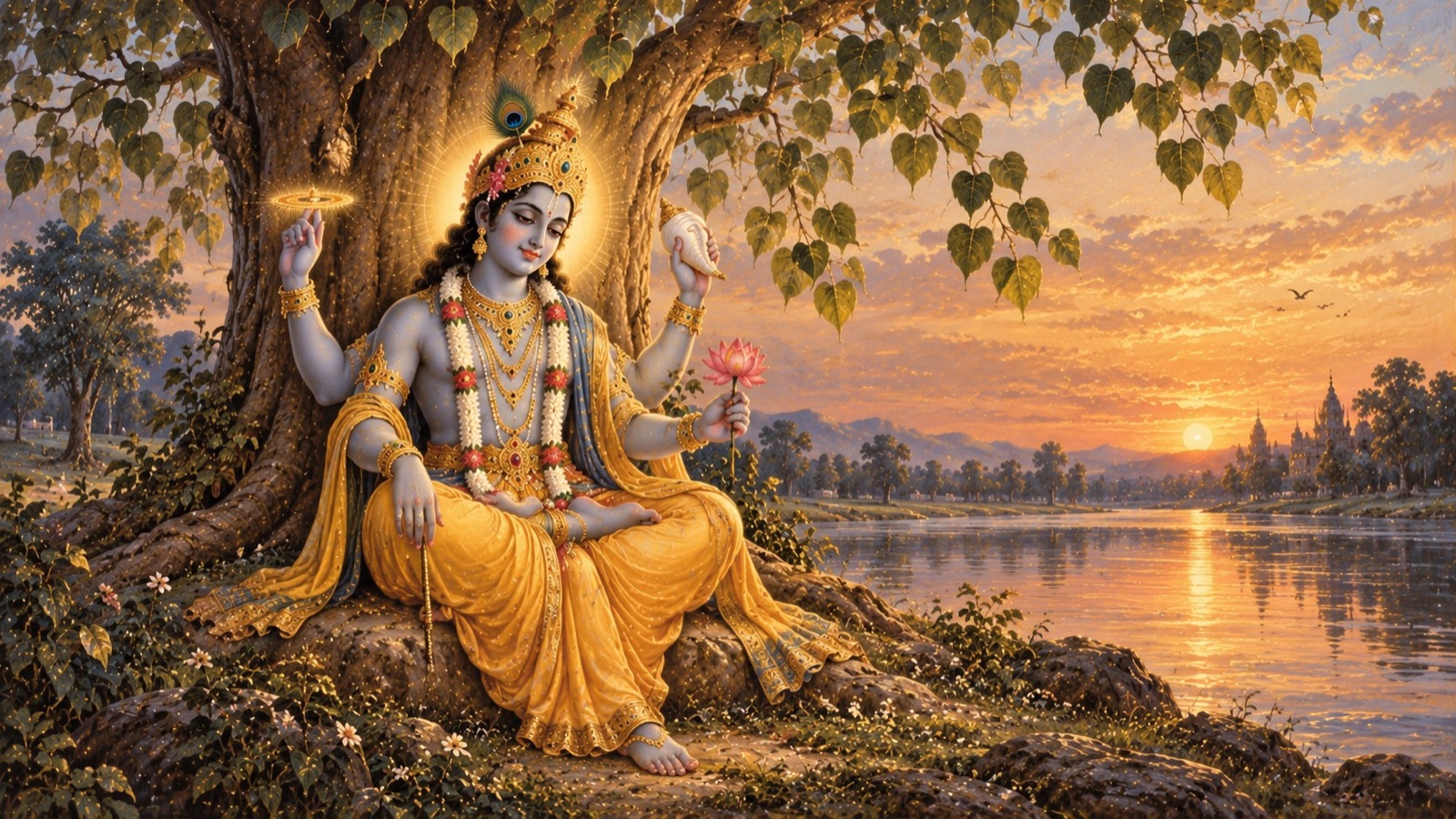
Amid the ashes of His own dynasty, the Lord sits alone beneath a peepul tree on the Saraswati’s bank — and from that stillness a chain of blessing begins: Krishna to Uddhava, Uddhava to Vidura, Vidura to Maitreya, and through Maitreya, at last, to us.
Om Namo Bhagavate Vasudevaya.
Om Namo Bhagavate Vasudevaya.
Om Namo Bhagavate Vasudevaya.
Welcome to Srimad Bhagavatam Wisdom, a devotional journey through the sacred histories and teachings of the Srimad Bhagavat Mahapurana. This chapter continues directly from the conversation begun in Chapter 3, where Uddhava, meeting Vidura on the bank of the Yamuna, had started to describe the terrible end of the Yadu dynasty and his own final, irreplaceable audience with Lord Sri Krishna. Chapter 4 completes that account. Uddhava tells of the Yadus’ drunken self-destruction, of finding the Lord seated alone and radiant beneath a peepul tree on the Saraswati’s bank, of the intimate teaching the Lord gave him there, and of the Lord’s own instruction that he proceed to Badarikasrama. Grief-stricken but composed, Vidura then asks Uddhava for that same wisdom — and Uddhava, in humility, points him instead toward the one who received it directly from the Lord’s own lips: the sage Maitreya. King Parikshit briefly interrupts Sukadeva’s narration to ask a natural question of his own, and the chapter closes with Vidura, alone once more, setting out for the bank of the Ganga to find the sage who will finally answer the very question with which this whole Book began.
Chapter Information
- Scripture: Śrīmad Bhāgavata Mahāpurāṇa
- Canto: 3 (Book Three)
- Chapter: 4 (Discourse 4)
- Chapter title: As directed by Uddhava, Vidura approaches the sage Maitreya
- Principal speakers: Uddhava (continuing his account to Vidura); Sukadeva Gosvami (narrating to King Parikshit); Vidura (briefly, to Uddhava); and King Parikshit (asking one question) — the whole related by Suta Gosvami to the sage Saunaka and the assembly at Naimisharanya
- Principal listener: Vidura (within Uddhava’s speech); King Parikshit (within Sukadeva’s narration); and the sage Saunaka with the assembly at Naimisharanya (hearing it all from Suta)
- Main setting: The bank of the river Saraswati (in Uddhava’s recollection, beneath a peepul tree), the bank of the Yamuna (where Uddhava and Vidura are speaking), and finally the road toward the bank of the Ganga, where Vidura is bound at chapter’s end
- Central subject: The final destruction of the Yadu dynasty, Uddhava’s last teaching from the Lord beneath the peepul tree, the Lord’s instruction to Uddhava to proceed to Badarikasrama, and Uddhava’s direction of the grieving Vidura onward to the sage Maitreya
- Principal verse range: Canto 3, Chapter 4, verses 1–36
- Primary edition: Gita Press Śrīmad Bhāgavata Mahāpurāṇa
The Yadus’ Self-Destruction, Completed
Chapter 4 opens mid-sentence, so to speak, continuing Uddhava’s account from the previous chapter. The Yadu warriors, having eaten their meal with the permission of certain Brahmanas whose curse would soon undo them all, then drank the intoxicating wine called Varuni. Deprived of their wits by drink, they turned on one another with cutting words, and by sunset the quarrel had become a killing — kinsman against kinsman, “like bamboos rubbing against one another” until the friction itself produces fire. It is one of the most sobering images in the entire Bhagavatam: an entire dynasty, protected for a lifetime by the personal presence of God, undone in a single evening by drink and anger.
अथ ते तदनुज्ञाता भुक्त्वा पीत्वा च वारुणीम् । तया विभ्रंशितज्ञाना दुरुक्तैर्मर्म पस्पृशुः ॥ १ ॥
atha te tad-anujñātā bhuktvā pītvā ca vāruṇīm tayā vibhraṁśita-jñānā duruktair marma paspṛśuḥ
Meaning: Uddhava continued: Then, after taking their meals with the permission of those Brahmanas, they drank wine and, having been deprived of their wits by tipsiness, cut one another to the quick by hurling abuses. (Canto 3, Chapter 4, verse 1)
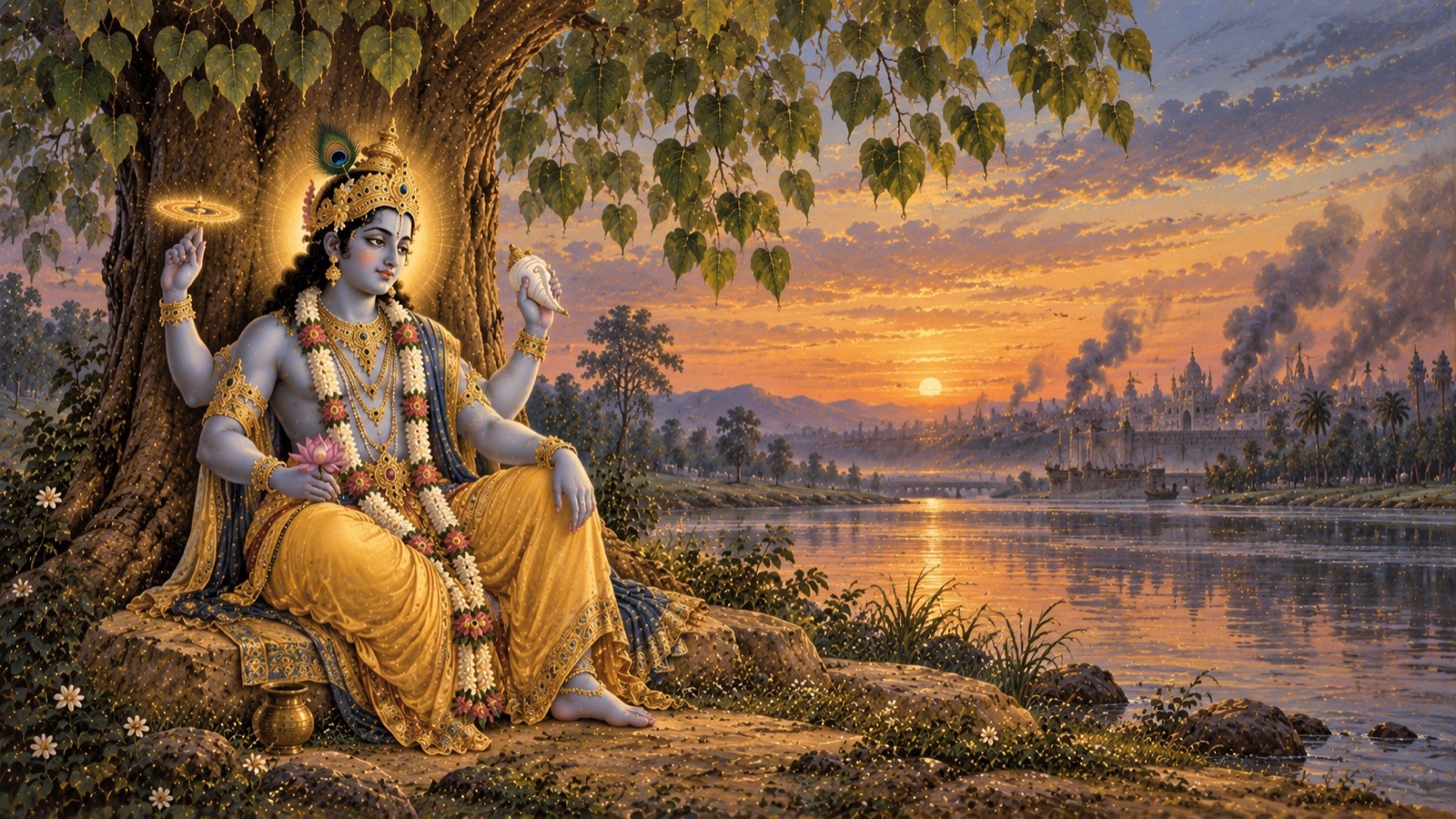
Watching all this unfold, the Lord Himself — who had willed this very end for His own dynasty, to lighten the burden of a world grown too heavy with its “excess” — withdrew quietly from the carnage. He sipped water from the Saraswati and sat down alone at the foot of a peepul tree near its bank, beholding, Uddhava says, “the ways of His own Maya.” Even before this final scene, at Dwaraka, the Lord had already told Uddhava to go on ahead to Badarivana, the forest where the eternal sages Nara and Narayana still practise their penance. But Uddhava, unable to bear separation from the Lord’s feet even for a moment, had followed Him instead.
Finding the Lord Alone Beneath the Peepul Tree
What Uddhava describes next is one of the most tender and visually rich passages in this portion of the Bhagavatam. Searching for his beloved Lord, he found Him seated utterly alone on the bank of the Saraswati — the Lord who is, in truth, the shelter of all beings, yet who here appeared, paradoxically, as one without shelter of His own. His form was a brilliant swarthy hue, entirely Sattvic and free of any trace of passion; His eyes were reddish yet supremely gentle; and He could be recognized at once by His four arms and the yellow silk cloth wrapped about Him. He sat reclining against a young Aswattha tree, His right foot resting lotus-like upon His left thigh, radiating a joy undiminished even though He had, in that hour, renounced every worldly pleasure of sense.
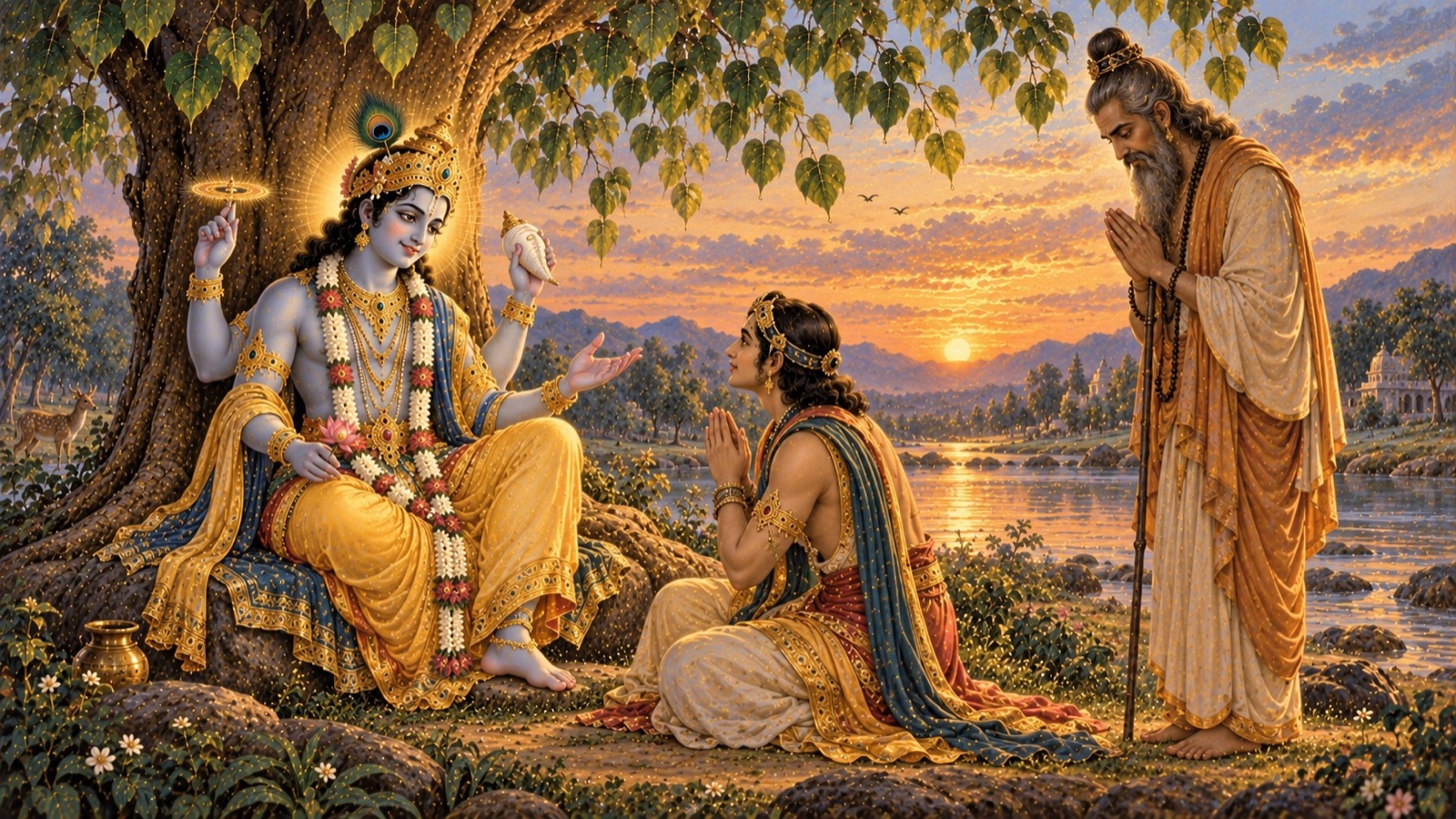
It was at this exact moment, wandering by chance through the various worlds, that the sage Maitreya arrived — described here as a great devotee of the Lord and a beloved friend and fellow-student of the sage Dwaipayana, that is, Vedavyasa himself. Maitreya stood listening with rapt, silent attention, his head bowed low in the ecstasy of the moment, while Lord Sri Krishna — the very Bestower of Liberation — turned to speak to Uddhava, refreshing him with tender, affectionate smiles and glances even in the midst of such sorrow.
The Lord’s Final Teaching to Uddhava
What the Lord says next is the emotional and doctrinal center of this chapter. Dwelling within Uddhava as the Self within every heart, the Lord says He already knows the desire hidden there, and has come to grant what is difficult for others even to approach. He reminds Uddhava of a much earlier life — a life, this Canto’s cosmology will later unfold in greater detail, in which Uddhava had been born among the Vasus and had worshipped the Lord in a sacrifice jointly performed by the Prajapatis and the Vasus, with the single aim of attaining Him. This present life, the Lord says, is certainly Uddhava’s last, for he has now earned the Lord’s own grace; he is fortunate indeed to behold the Lord in this secluded place, through the power of pure, unmixed devotion, at the very hour the Lord is preparing to leave the mortal world and return to His eternal abode.
पुरा मया प्रोक्तमजाय नाभ्ये पद्मे निषण्णाय ममादिसर्गे । ज्ञानं परं मन्महिमावभासं यत्सूरयो भागवतं वदन्ति ॥ १३ ॥
purā mayā proktam ajāya nābhye padme niṣaṇṇāya mamādi-sarge jñānaṁ paraṁ man-mahimāvabhāsaṁ yat sūrayo bhāgavataṁ vadanti
Meaning: [I am going to impart to you] that supreme wisdom, revealing My glory, which the sages call by the name of “Bhagavata” and which I taught to Brahma, seated on the lotus sprung from My navel, in a former cycle at the dawn of creation. (Canto 3, Chapter 4, verse 13)
This single verse quietly does something enormous: it names the very teaching this Canto is about to unfold — the “Bhagavata” wisdom first given to Brahma at creation’s dawn — and identifies its next recipient as Uddhava, here, in this final hour beneath the peepul tree. Every step that follows in Canto Three, down to Maitreya’s own long discourse to Vidura, traces back to this single moment of transmission.
Uddhava’s Trembling Reply
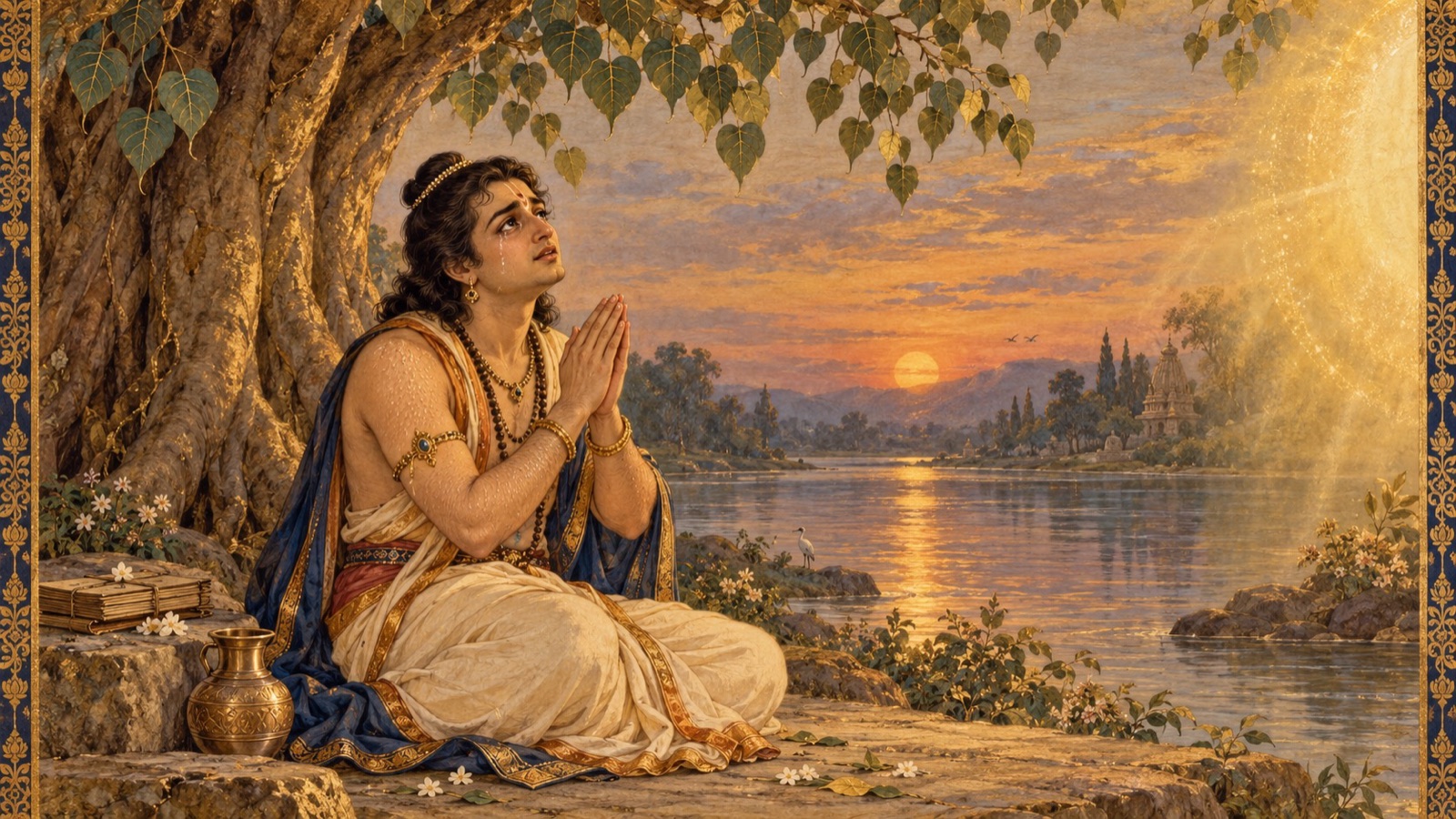
Overwhelmed, Uddhava answers with joined palms, his voice faltering, the hair of his body standing on end with emotion, tears streaming from his eyes. He asks the Lord a question that could only come from a heart already free of worldly craving: of the four classic goals of human life — dharma, artha, kama, and moksha — which one is truly hard to attain for those devoted to the Lord’s lotus feet? And yet, Uddhava says, he craves none of them; his only wish is simply to go on worshipping those same feet. He then voices, with evident wonder rather than doubt, the great paradox of the Lord’s incarnation: that One who is actionless nonetheless acts, who is birthless nonetheless takes birth, who is the Destroyer of all nonetheless flees from enemies and takes shelter in a fortress, who delights only in His own blissful Self yet takes ten thousand wives — all of this, Uddhava says, “puzzles the mind even of the knowing.”
कर्माण्यनीहस्य भवोऽभवस्य ते दुर्गाश्रयोऽथारिभयात्पलायनम् । कालात्मनो यत्प्रमदायुताश्रम: स्वात्मन्रते: खिद्यति धीर्विदामिह ॥ १६ ॥
karmāṇy anīhasya bhavo ‘bhavasya te durgāśrayo ‘thāri-bhayāt palāyanam kālātmano yat pramadā-yutāśramaḥ svātman-rateḥ khidyati dhīr vidām iha
Meaning: Even the wise grow bewildered, O Lord, to see You act though You desire nothing, take birth though You are never born, flee behind a fortress wall in fear of an enemy though You are the master of unconquerable time itself, and keep the company of many wives though You delight only in Your own Self. (Canto 3, Chapter 4, verse 16)
And that this same all-knowing Lord, whose wisdom is never in error, should turn to consult an ordinary devotee like himself as though seeking counsel — this too, Uddhava confesses, perplexes his mind. He begs, finally, to be instructed in that same supreme wisdom once given to Brahma, “in case it is fit to be received by us,” so that the sorrows of worldly existence might at last be overcome.
Having heard this heartfelt petition, the Lord with lotus-like eyes revealed to Uddhava His own transcendent nature directly. Having thus learned, from his worshipful Guru, the one true way of realizing God, Uddhava circumambulated the Lord clockwise in reverence and departed — his heart now heavy with the pain of separation even as it remained lit by what he had just received. Delighted by that final vision yet aching from the parting, Uddhava tells Vidura, he now intends to proceed to Badarikasrama, the Lord’s own favourite retreat, where the eternal sages Nara and Narayana perform their timeless penance for the good of the world.
Vidura’s Grief, and a Question Passed On
Sukadeva now briefly resumes the outer frame of the story: hearing this account of the deaths of his own kinsmen, Vidura’s grief burst forth, but he steadied himself through the very force of the wisdom he had just heard. As Uddhava, chief among the Lord’s servants, prepared to depart for Badarikasrama, Vidura — moved by love — asked him directly for the same supreme wisdom the Lord Himself had taught: the knowledge that unfolds the secret of the Lord’s own essential nature. For, Vidura reasons, the devotees of Lord Vishnu move through this world only in order to fulfil the needs of those who serve Him.
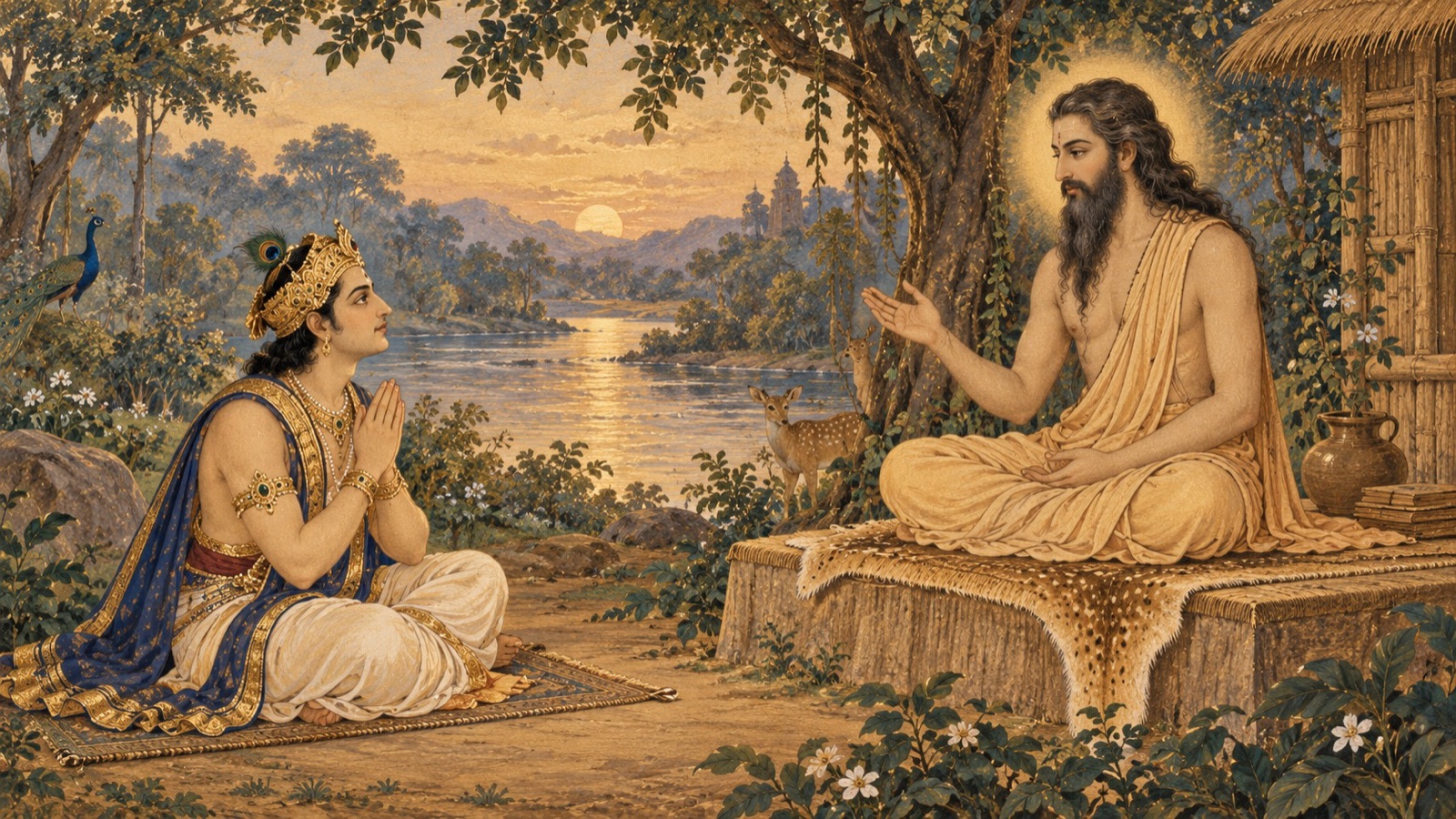
Uddhava’s answer is a study in humility. Though he has just received this very teaching from the Lord’s own lips, he does not claim it as his to give. Instead he directs Vidura onward: for that knowledge, he says, Vidura should wait upon the sage Maitreya, the son of Kusaru — the very sage who stood listening beneath the peepul tree, and who was personally instructed by the Lord Himself in Uddhava’s own presence, at the hour the Lord was preparing to leave this world.
ननु ते तत्त्वसंराध्य ऋषिः कौषारवोऽन्तिके । साक्षाद्भगवतादिष्टो मर्त्यलोकं जिहासता ॥ २६ ॥
nanu te tattva-saṁrādhya ṛṣiḥ kauṣāravo ‘ntike sākṣād bhagavatādiṣṭo martya-lokaṁ jihāsatā
Meaning: Uddhava replied: For the knowledge of that truth you should wait upon the sage Maitreya (son of Kusaru), who was personally instructed in this behalf by the Lord in my presence, while He was about to leave this mortal world. (Canto 3, Chapter 4, verse 26)
This is the hinge on which the rest of Canto Three turns: the reason Vidura will soon sit before Maitreya, and the reason we, as readers, are about to receive the teaching that fills the remainder of this Book. Relieved of much of his sorrow by this very exchange with Vidura on the virtues of Sri Krishna, Uddhava passed that night on the Yamuna’s bank as though it were a single moment, and departed early the next morning for Badarikasrama.
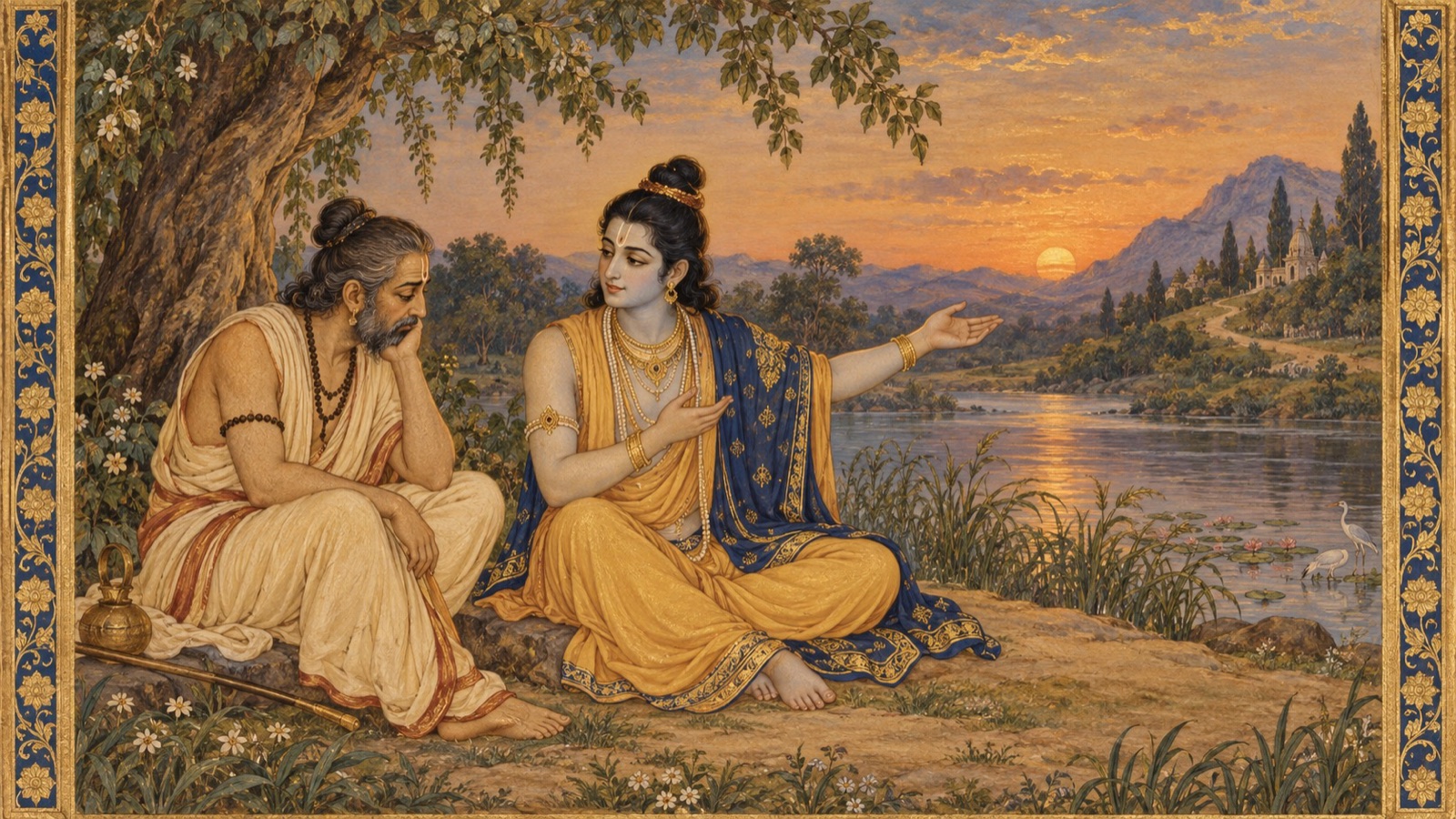
A King’s Question: Why Did Uddhava Alone Survive?
At this point King Parikshit, listening to Sukadeva’s narration, interrupts with a natural question of his own. If even the greatest car-warriors among the Vrishnis and the Bhojas met their end in that catastrophe — and if Sri Hari Himself, the Supreme Ruler even of Brahma, Vishnu and Shiva, chose in the world’s eyes to leave His own body — then how, Parikshit asks, did Uddhava alone, foremost among those generals, survive?
Sukadeva’s reply reaches back into the Lord’s own reflection just before the end. When Sri Krishna, whose will is never thwarted, had brought about the destruction of His own race through the instrument of the Brahmanas’ curse, and was preparing to lay aside His body in the world’s sight, He considered: once He Himself had departed, Uddhava alone — foremost among those who have realized the Self — would be truly fit to hold and carry forward the knowledge concerning Him. Uddhava, the Lord reflected, is in no way inferior to Himself, having mastered his own senses and remaining ever unshaken by the objects of the world; let him, therefore, remain on earth to teach that knowledge to others. Instructed in this way by Sri Krishna, the Preceptor of the three worlds and the very source of the Vedas, Uddhava made his way to Badarikasrama and gave himself over to the Lord’s worship through deep meditation.
Parting in Tears, Vidura Sets Out for the Ganga
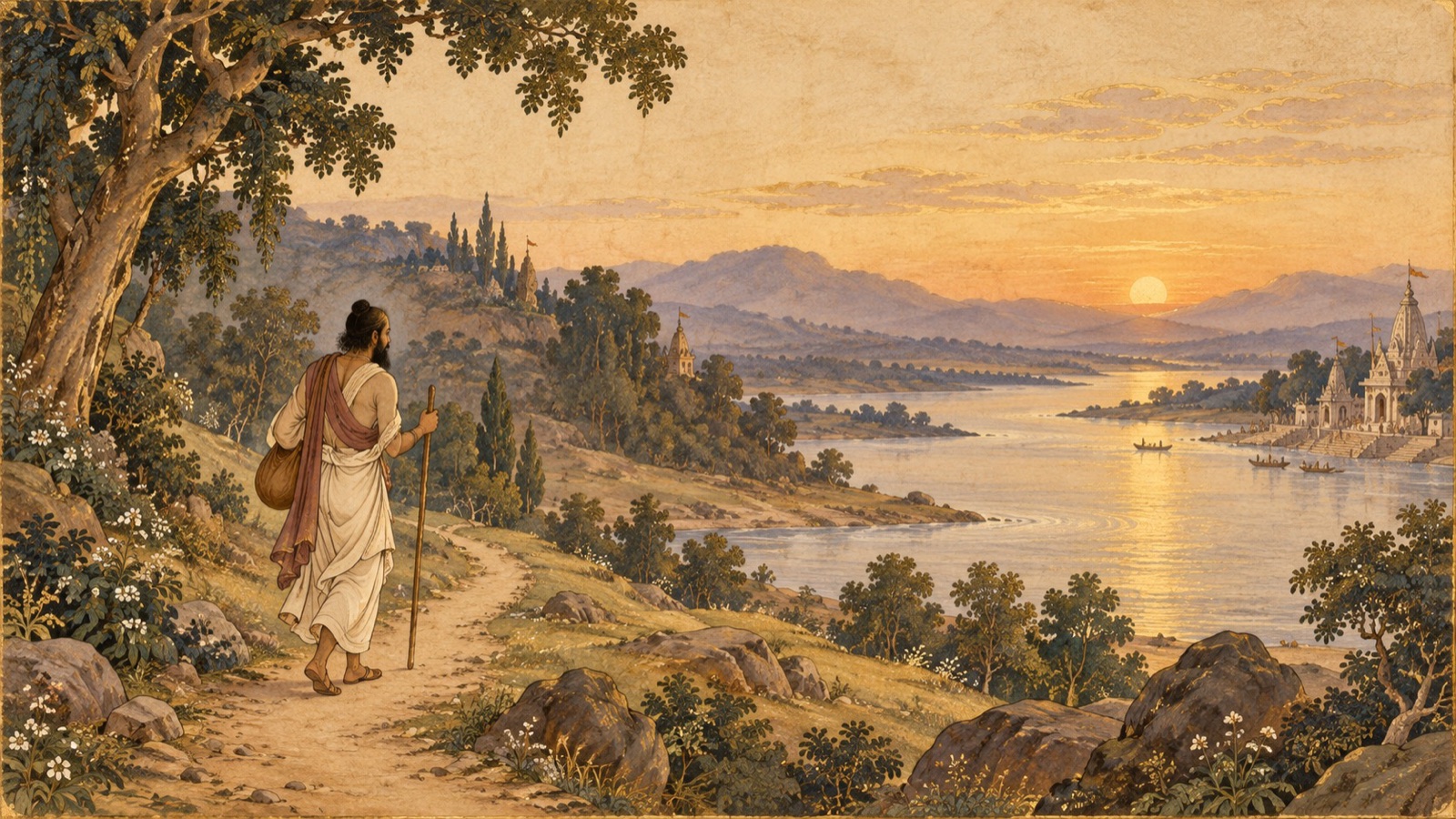
The chapter’s final verses return us to Vidura himself. Hearing from Uddhava this full account of the Lord’s glorious doings — the Lord who had assumed a human form as pure sport, and who had left that form in a manner that would strengthen the resolve of the resolute even as it remained beyond the grasp of the feeble-minded — and remembering, too, that the Lord had thought of him, Vidura, even in that final hour, Vidura was overcome with emotion. He wept as he parted from that great devotee of the Lord. Then, leaving behind the bank of the Kalindi — another name for the Yamuna — the enlightened Vidura journeyed on, and within a few days he arrived at the sacred Ganga’s shore, where Maitreya, the son of Mitra, awaited him.
कालिन्द्याः कतिभिः सिद्ध अहोभिर्भरतर्षभ । प्रापद्यत स्वःसरितं यत्र मित्रासुतो मुनिः ॥ ३६ ॥
kālindyāḥ katibhiḥ siddha ahobhir bharatarṣabha prāpadyata svaḥ-saritaṁ yatra mitrā-suto muniḥ
Meaning: Leaving the bank of the Kalindi (Yamuna), the enlightened Vidura (foremost of the Bharatas) reached in a few days the bank of the heavenly river (Ganga), where the sage Maitreya (the son of Mitra) was. (Canto 3, Chapter 4, verse 36)
With this quiet image — a lone, grieving pilgrim walking on, once again, toward a fresh meeting with a sage — Discourse IV closes, setting the stage for Maitreya’s long-awaited teaching in the chapters ahead.
Principal Teachings of This Chapter
1. The Lord’s own dynasty departs by His own hidden arrangement, not by ordinary misfortune. The Yadus’ drunken self-destruction only looks like an accident of fratricide: Uddhava says plainly that the Lord Himself, foreseeing and willing this very end, quietly withdrew to let it unfold — a reminder that even what looks like tragedy can be the Lord’s own design for concluding His earthly pastimes (verses 1-3).
2. The deepest teachings are given in the deepest solitude, to a heart already surrendered. The Lord does not summon a court or an assembly for His most intimate revelation; He gives it alone, beneath a single tree, at the very hour of His own departure, telling Uddhava first of a devotion carried over past lifetimes and then of the confidential “Bhagavata” wisdom once spoken only to Brahma at creation’s dawn (verses 6-13).
3. True devotion desires nothing but the Lord’s feet themselves. Asked what he wants, Uddhava craves none of the four classic goals of life — only the privilege of continued worship, revealing devotion’s essential nature as an end in itself, not a means to anything else (verses 14-15).
4. Humility passes the gift forward rather than hoarding it. Though Uddhava has just received the Lord’s own teaching directly, he does not present himself as its final custodian; he sends Vidura onward to Maitreya, the one properly appointed to give it (verse 26).
5. Grief and steadiness can coexist in a surrendered heart. Vidura mourns his kinsmen’s deaths and weeps at parting from Uddhava, yet within the same verses he is described as “enlightened,” his sorrow tempered rather than erased by the wisdom he has just received (verses 23, 33-35).
6. Confidential knowledge is given to pure devotion, not merely to nearness or learning. Maitreya — a great sage, a scholar, and Vyasa’s own friend — stands right beside the Lord throughout this scene, yet it is Uddhava the Lord turns to instruct, smiling and glancing at him with particular tenderness. The difference is not proximity or scholarship but the completeness of surrender: Uddhava’s love for the Lord carries no trace of philosophical curiosity or personal ambition, and it is precisely that unmixed devotion — not mere presence at the scene — that qualifies him to receive the Lord’s most confidential teaching (verses 9-10).
A Devotional Reflection
There is something quietly instructive in the shape of this chapter’s transmission of wisdom. The Lord teaches Brahma at the dawn of creation. Ages later, that same teaching passes to Uddhava, in the last hour before the Lord’s own departure. Uddhava, rather than keeping it, sends Vidura onward to Maitreya, who had received it firsthand simply by standing nearby with an open heart. And Maitreya, in the chapters just ahead, will give it in turn to Vidura — who will one day tell it to us, across all the centuries between. Nowhere in this chain does anyone claim the teaching as their private possession. Each recipient becomes, almost immediately, a signpost pointing toward the next true source. This is perhaps the deepest lesson embedded in a chapter that, on its surface, is mostly logistics — who goes where, who asks whom. Wisdom about God is not hoarded; it is handed on, gently, from a full heart to a ready one, exactly as Uddhava hands it to Vidura here, and exactly as this whole series hopes, in its own small way, to hand it on to you.
A Daily Devotional Practice
Today, consider one piece of spiritual understanding that has genuinely helped you — a verse, an insight, a moment of clarity someone once shared with you in a hard time. Rather than keeping it to yourself, look for a quiet, natural way to pass it on to someone else this week, the way Uddhava pointed Vidura toward Maitreya rather than claiming the teaching as his alone. Before you do, sit for a moment in stillness and repeat: “Om Namo Bhagavate Vasudevaya.” Let that remembrance remind you that every true teaching we receive was itself a gift passed down, and is only fully ours once we, too, have let it pass onward.
Conclusion
The fourth discourse of the Third Canto closes a great and sorrowful chapter of the Bhagavatam’s history — the end of the Yadu dynasty — even as it opens the way toward its central teaching. We have watched the Lord withdraw in stillness beneath a peepul tree even as chaos consumed His own kinsmen nearby; watched Him give His most treasured devotee a final, tender teaching before departing this world; and watched grief, humility, and devotion pass like a lit lamp from hand to hand — from the Lord to Uddhava, from Uddhava to Vidura, and now, at chapter’s end, toward Maitreya on the bank of the Ganga. Vidura’s long pilgrimage, begun in Chapter 1 out of exile and loss, has finally brought him to the threshold of the very answer he set out to find. In the chapters ahead, that threshold will open.
May the divine wisdom of Srimad Bhagavatam awaken pure devotion within our hearts.
Om Namo Bhagavate Vasudevaya.
Jay Shree Madhav.
References and Attribution
- Primary edition: Gita Press, Śrīmad Bhāgavata Mahāpurāṇa (English, complete), Book Three, Discourse 4, pages 146–150.
- Series: Srimad Bhagavatam Wisdom · Biswa Sanatan Dharma Seva Trust.
- Presented following the spiritual guidance and recommendation of Pandit Dr. Shri Kashinath Mishra.
This is an original, faithful retelling in the writer’s own words, with brief quoted verses shown in Devanāgarī and transliteration and their meanings given as summaries. It is not a reproduction of any single publisher’s continuous translation or commentary. No affiliation with or endorsement by any publisher is implied.
Jay Shree Madhav