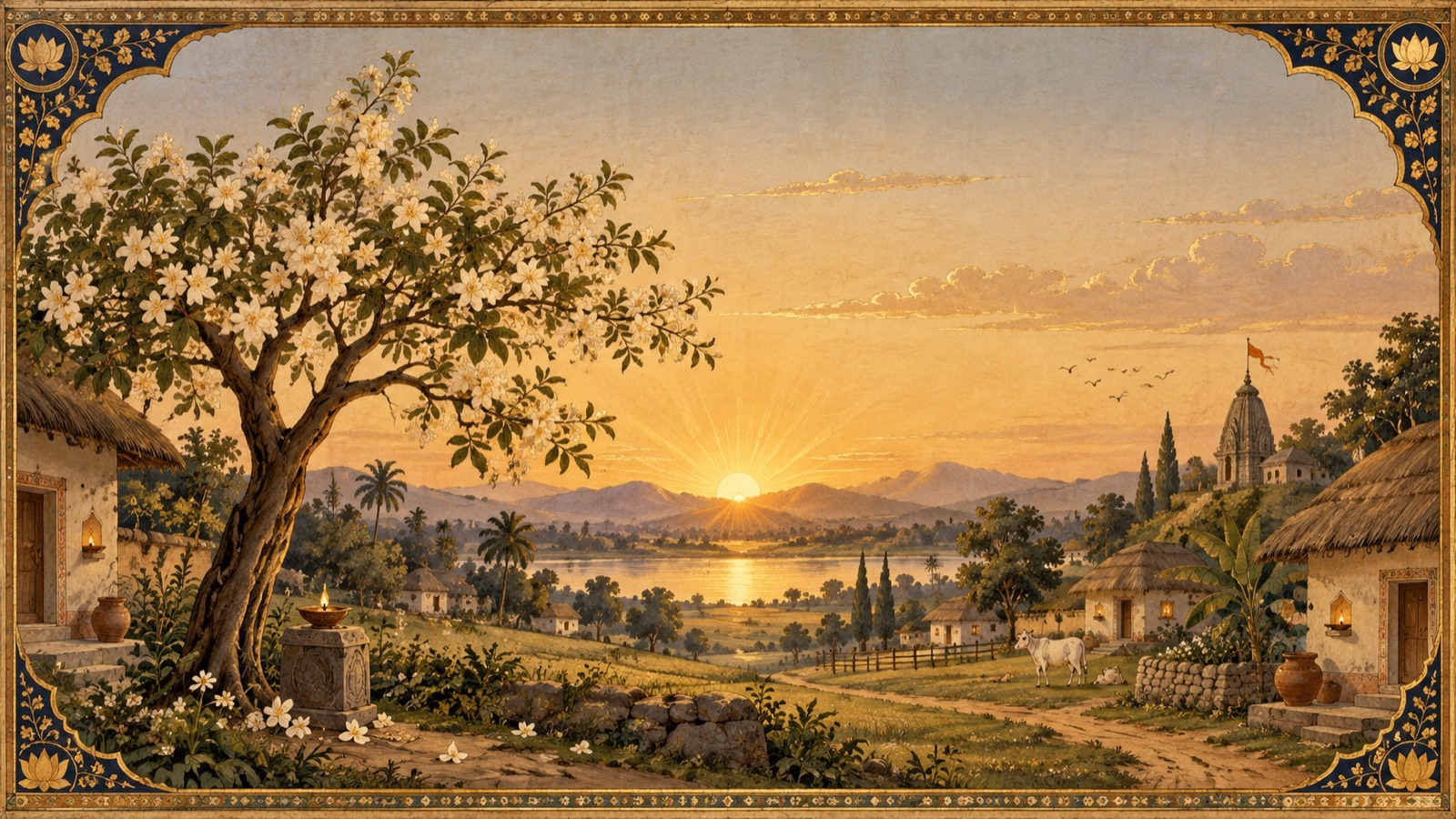
Guided by Providence and shaped by the exact weight of his own past deeds, a soul comes to rest in the seed of a father and is carried into a mother’s womb, there to receive the very body his karma has already earned.
Om Namo Bhagavate Vasudevaya.
Om Namo Bhagavate Vasudevaya.
Om Namo Bhagavate Vasudevaya.
Welcome to Srimad Bhagavatam Wisdom, a devotional journey through the sacred histories and teachings of the Srimad Bhagavat Mahapurana. We continue in the heart of the Kapila-Gita — the teaching Lord Kapila gives to His own mother, Devahuti, in the forest hermitage on the bank of the Sarasvati. The previous chapter ended with a soul, purged of its sins through the tortures of hell and the lowest animal births, arriving once more at a human birth. Chapter 31 now opens that very door and walks through it in full: this is the Bhagavatam’s own account of conception, of the month-by-month growth of the body in the womb, and — at its emotional and spiritual center — the forgotten prayer that the imprisoned soul once knew how to pray, back when memory and suffering had, for a brief span before birth, made it wise. It is one of the most quoted, most tender, and most demanding chapters in the entire Kapila-Gita, and what follows presents it exactly as the Gita Press primary source gives it: as sober, reverent instruction, not as anatomy and not as spectacle.
A note before we begin, in the same spirit the source itself asks of its reader. This chapter describes gestation, birth, infancy and the perils of desire with a directness that a modern reader may not expect from a devotional text. Kapila is not writing a medical treatise; he is diagnosing the condition of every embodied soul, using the womb as the clearest possible mirror of that condition — bound, forgetful, and yet, in its truest depths, capable of turning toward the Divine. The chapter’s most famous passage, the soul’s own prayer from within the womb, deserves to be read slowly and with the gravity that ten months of unbroken memory and helplessness inspire in it.
Chapter Information
- Scripture: Śrīmad Bhāgavata Mahāpurāṇa
- Canto: 3 (Book Three)
- Chapter: 31 (Discourse 31)
- Chapter title: The stages of growth of a human embryo (table of contents); the chapter’s own colophon names it “The Fate of the Jiva”
- Principal speaker: Lord Kapila, continuing His teaching to His mother Devahuti — with an internal narrative shift in which Kapila quotes, as reported first-person speech, the prayer of the soul confined in the womb (verses 12–21)
- Principal listener: Devahuti
- Main setting: The hermitage of the sage Kardama on the bank of the river Sarasvati (the same setting as the preceding chapters of the Kapila-Gita)
- Central subject: The soul’s entry into the womb through the union of male and female generative substances; the month-by-month formation of the embryo’s body; the sufferings of the confined, growing foetus; the awakening of memory of hundreds of past lives and the soul’s own forgotten prayer for release and for knowledge of the Self; the trauma of birth, which erases that hard-won wisdom; the sufferings of infancy, boyhood and youth; the peril of attachment to the opposite sex as the most binding of all attachments; and the chapter’s closing teaching on the true nature of birth and death and the path of dispassionate living
- Principal verse range: Canto 3, Chapter 31, verses 1–48
- Primary edition: Gita Press Śrīmad Bhāgavata Mahāpurāṇa
The Soul’s Entry Into the Womb
Kapila resumes his teaching exactly where Chapter 30 left off — with a soul, purged by its ordeal in the hells and in the lowest animal births, standing once more at the threshold of a human body:
The Lord resumed: By force of Karma (destiny), as directed by Providence, the soul (destined to be born as a man) enters the womb of a woman through the generative fluid of a man for the formation of a body. (verse 1)
श्रीभगवानुवाच । कर्मणा दैवनेत्रेण जन्तुर्देहोपपत्तये । स्त्रिया: प्रविष्ट उदरं पुंसो रेत:कणाश्रय: ॥ १ ॥
śrī-bhagavān uvāca karmaṇā daiva-netreṇa jantur dehopapattaye striyāḥ praviṣṭa udaraṁ puṁso retaḥ-kaṇāśrayaḥ
Meaning: Kapila is answering, at the very root, an unspoken question: what actually determines the body a soul receives? An unseen ledger of past deeds fixes the entry point, and the soul is delivered through a father’s seed into a mother’s womb to take up precisely the body that ledger has already written. (SB 3.31.1)
Nothing here is left to chance or to biology alone, in Kapila’s telling. Karma — the accumulated weight of the soul’s own former actions — is what selects the doorway; Providence directs the passage; the body itself is simply the vessel that karma has earned. This is the chapter’s foundational claim, and everything that follows — every stage of embryonic growth, every stage of suffering, every stage of the soul’s dawning and then forgotten wisdom — unfolds from this single premise: birth is not an accident. It is an appointment kept.

Month by Month: The Growth of the Body
What follows is one of the most detailed physiological passages anywhere in the Puranic literature, and Kapila delivers it with the calm, unhurried precision of someone describing a process that has repeated itself, identically, since the beginning of time:
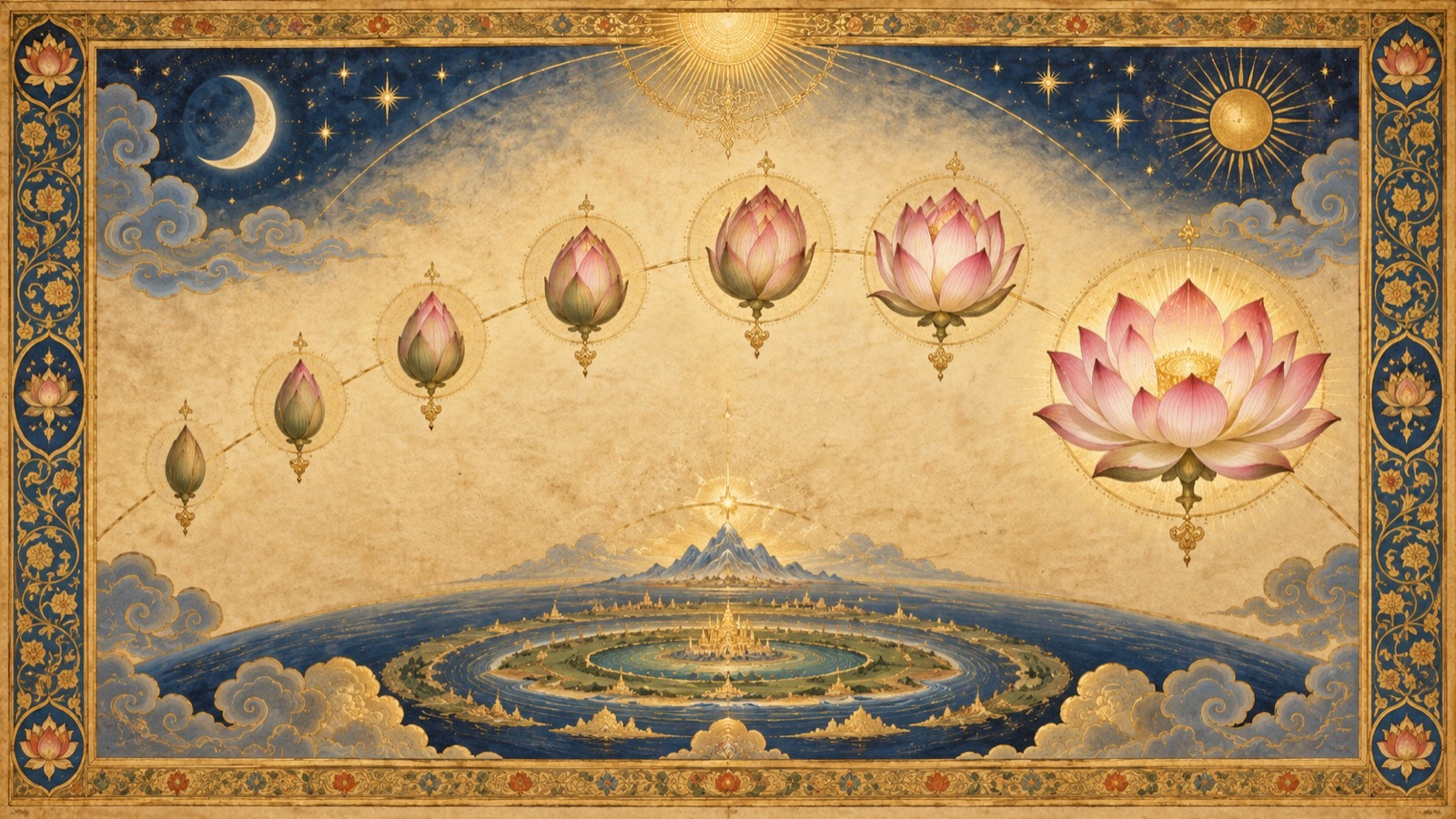
In the course of a night it is integrated by being united with the ovum, and in five nights it is rounded into the shape of a bubble. In a period of ten days it becomes as hard as a plum and later on it develops into the shape of a ball of flesh or an egg (in the case of oviparous creatures). (verse 2) In the course of a month a head is formed and at the end of two months hands, feet and other limbs take shape. By the end of three months the nails, the hair on the body, bones and skin appear, as also the organ of generation and the other apertures in the body (those of eyes, nostrils, ears, mouth and anus). (verse 3) In as many as four months the seven essential ingredients of the body (chyle, blood, flesh, fat, bone, marrow and semen) come into being; while at the end of five months hunger and thirst make themselves felt; in the course of six months the foetus is enclosed by an amnion and begins to move in the right side of the abdomen (or in the left if it is a female). (verse 4)
This progression — bubble, plum, ball of flesh, head, limbs, apertures, the seven bodily ingredients, hunger, movement — is presented not for its own scientific interest but to establish something the rest of the chapter depends on entirely: the body being built here, ingredient by ingredient, is not the self. It is a vessel under construction, assembled the same way for every soul that has ever been born, regardless of who that soul was in any of its countless previous lives. The elaborate architecture of nails and bones and apertures is, in Kapila’s larger argument, precisely the trap that the chapter’s central prayer will beg to see through.
Suffering in the Womb
Having described the body’s formation, Kapila turns, without any softening, to what that formation actually feels like from within:
Deriving its nutrition from the food and drink etc., taken by the mother, the foetus grows and remains in that abominable receptacle of faeces and urine, the breeding-place of worms. (verse 5) Bitten again and again all over the body by the hungry worms in the abdomen itself, the creature suffers terrible agony on account of its tenderness and swoons away moment after moment. (verse 6) Nay, adversely affected by the bitter, pungent, hot, salt, dry, acid and other such irritating substances consumed by its mother, the foetus experiences a painful sensation in every part of its body. (verse 7) Enclosed by the amnion and covered outside by the intestines, it remains lying in one side of the abdomen with its head turned towards the belly and with its back and neck arched (like a bow). (verse 8)
It is worth pausing on how the text treats this material. There is no relish in the description, no lingering for effect — only the same plain, almost clinical honesty this series has noted in earlier difficult chapters of the Kapila-Gita. The point being built here is not “life is disgusting”; it is that the very first experience of embodiment, before any choice has been made, before any sin has been committed in this particular life, is already one of confinement and helplessness. This sets up the chapter’s next and most remarkable turn.
A Bird in a Cage: Memory Awakens
Verse 9 introduces one of the chapter’s most quietly devastating images, and it is the hinge on which the entire prayer that follows depends:
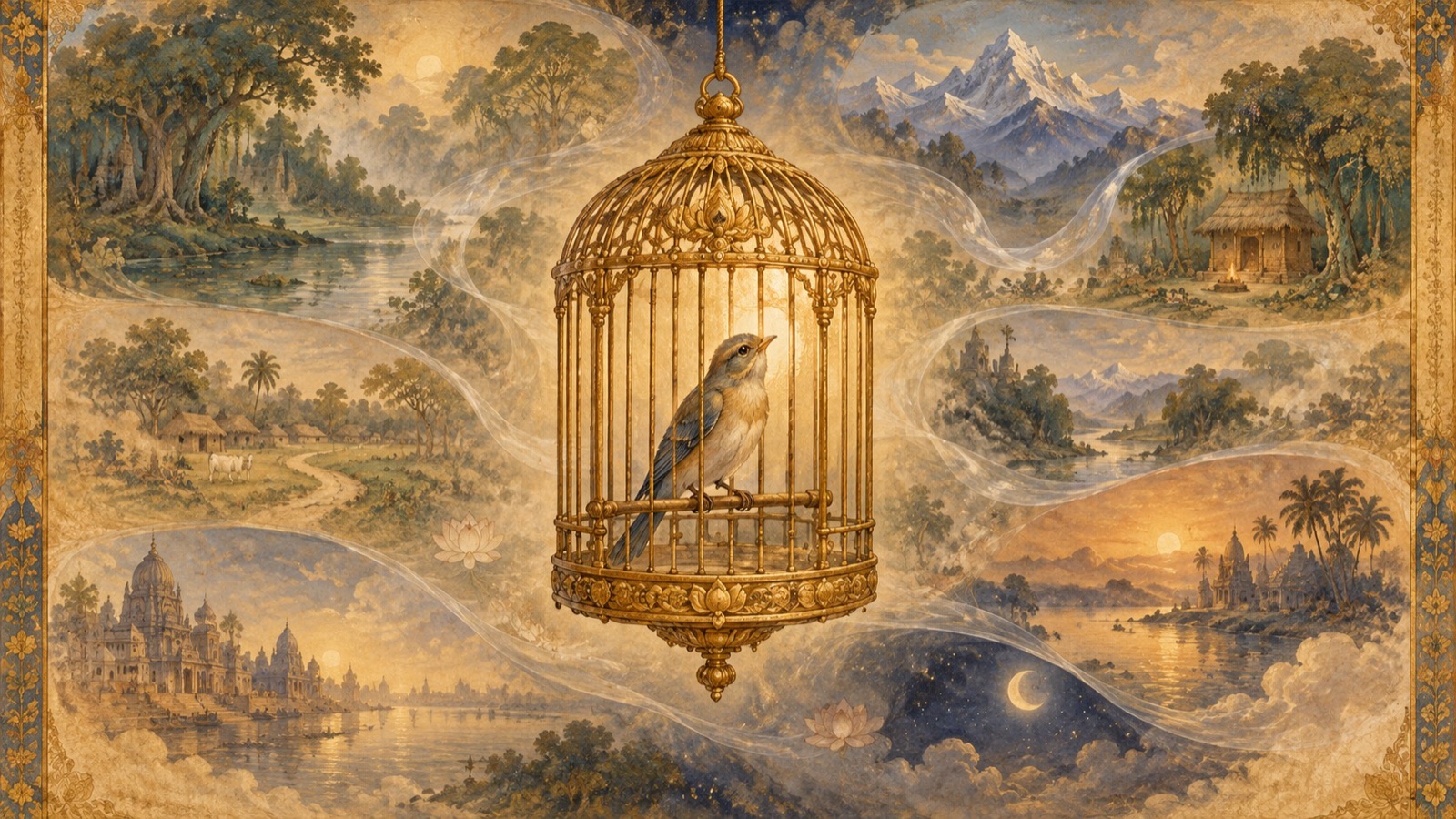
Unable to move its own limbs like a bird which cannot freely move in a cage, the creature in the womb finds its memory awakened by the will of Providence and recollects its doings committed during hundreds of previous lives and feels suffocated for a long time. What peace of mind can it have under such circumstances? (verse 9)
अकल्प: स्वाङ्गचेष्टायां शकुन्त इव पञ्जरे । तत्र लब्धस्मृतिर्दैवात्कर्म जन्मशतोद्भवम् । स्मरन्दीर्घमनुच्छ्वासं शर्म किं नाम विन्दते ॥ ९ ॥
akalpaḥ svāṅga-ceṣṭāyāṁ śakunta iva pañjare tatra labdha-smṛtir daivāt karma janma-śatodbhavam smaran dīrgham anucchvāsaṁ śarma kiṁ nāma vindate
Meaning: Kapila’s image here is deliberately exact: a bird shut inside a cage can still see everything through the bars but move nothing of its own. That, precisely, is the soul’s condition during this one window of clarity — granted by Providence, not earned by effort — when hundreds of forgotten lifetimes suddenly become visible again. (SB 3.31.9)
This is the chapter’s single most important claim about the soul in the womb: for this brief window, before birth erases it again, the soul remembers everything — every life it has lived, every choice it has made, every consequence it has earned. It is, paradoxically, the most spiritually lucid the soul will ever be in an embodied state, and it is lucid precisely because it is utterly powerless, caged like a bird, unable to act on anything it now sees so clearly. Kapila continues:
The foetus, though endowed with consciousness from the seventh month of its conception, is tossed by the winds that press the embryo downwards during the weeks preceding delivery, and cannot remain at one place like the worm born of faeces in the same abdominal cavity. (verse 10) Tied to the physical body, made up of the seven ingredients, which are like so many cords to bind it, the human soul, which regards the body as his own self, is much afraid (of the process of gestation being repeated in other such births), and with joined palms he entreats and extols Him by whom he was cast into the womb, in a tone full of agony. (verse 11)
The Prayer of the Soul in the Womb
What follows — verses 12 through 21 — is among the most beloved and most frequently cited passages in the entire Bhagavatam: the prayer the imprisoned soul offers, in Kapila’s own reported words, from within the darkness of the womb. It deserves to be read here in full and without interruption, the way the source itself presents it.
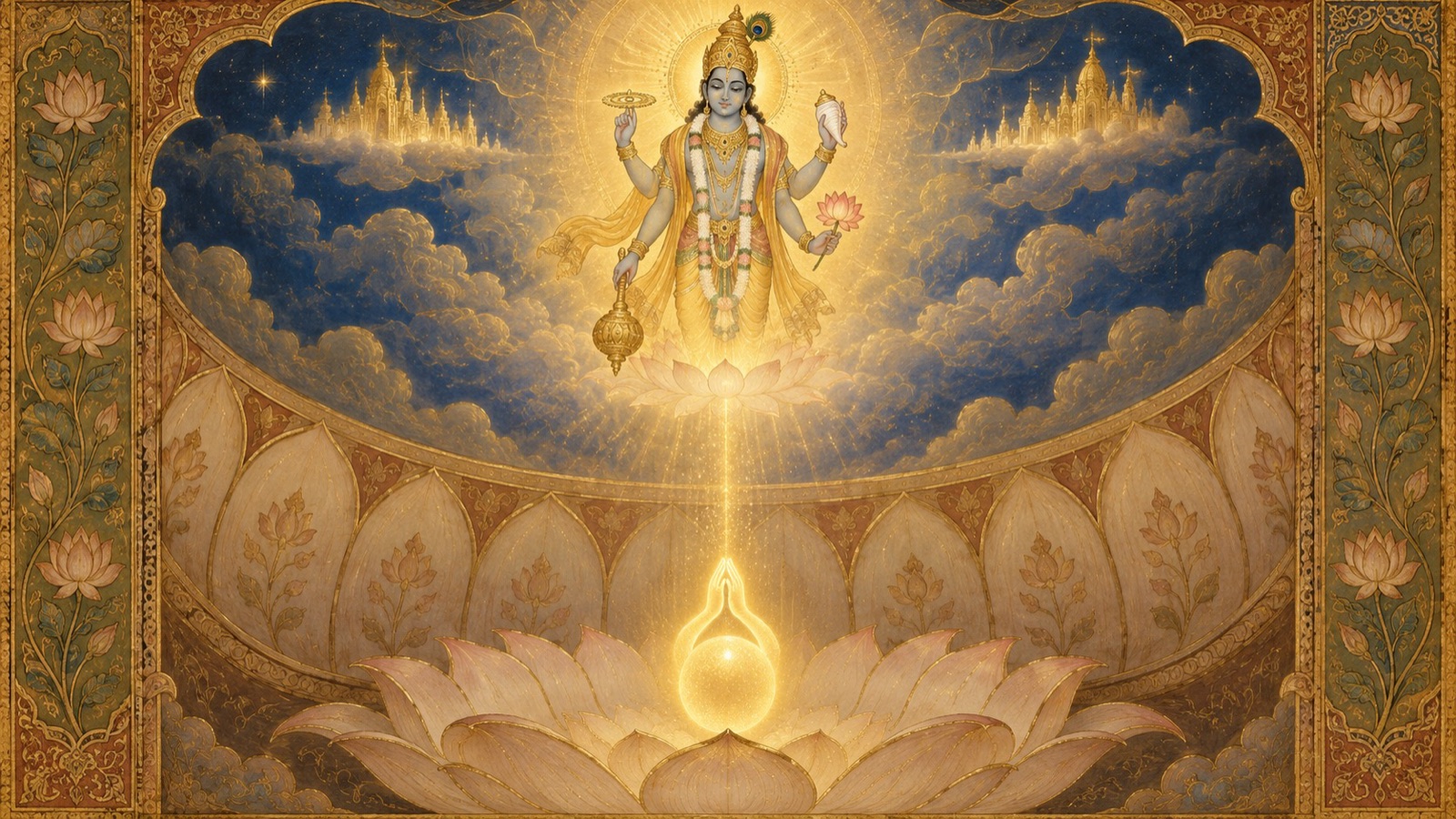
The human soul says: I take shelter in the lotus-feet, which once trod the earth and bring immunity from all fear, of Him who of His own sweet will assumes various forms in order to protect the universe — which has sought His protection (from time to time) — and by whom I have been thrown into such a condition as this, which is quite becoming of my wicked self. (verse 12) I bow to Him who, having embraced Maya in the form of this psychophysical organism in this womb, appears as bound by virtuous and sinful acts, and has His reality screened by Maya, but who flashes on my afflicted heart as absolutely pure (untainted by Maya), immutable and possessed of wisdom which knows no break. (verse 13) Though bodiless (in reality), I appear as clothed in a body made up of the five elements and as consisting of the Indriyas, the Gunas, the objects of senses and the ego. Therefore, I adore the all-knowing Supreme Person, the Controller of both Prakrti (Matter) and Purusa (Spirit), whose glory can never be obscured by such veils. (verse 14) Having forgotten his own self under the influence of the Lord’s Maya, the embodied soul traverses the path of Samsara — strewn with numerous shackles of Karma, having their source in the three Gunas — undergoing hardships of many kinds. By what other expedient, then, than through the grace of that Supreme Being can he expect to realize his true nature? (verse 15)
यन्माययोरुगुणकर्मनिबन्धनेऽस्मिन् सांसारिके पथि चरंस्तदभिश्रमेण । नष्टस्मृति: पुनरयं प्रवृणीत लोकं युक्त्या कया महदनुग्रहमन्तरेण ॥ १५ ॥
yan-māyayoru-guṇa-karma-nibandhane ‘smin sāṁsārike pathi caraṁs tad-abhiśrameṇa naṣṭa-smṛtiḥ punar ayaṁ pravṛṇīta lokaṁ yuktyā kayā mahad-anugraham antareṇa
Meaning: This is the verse the whole prayer turns on. The soul has just admitted that ignorance of its own true identity is what keeps it circling through birth after birth under the sway of the three material qualities — and here it draws the conclusion that follows: no technique and no amount of personal striving can undo that forgetting; only the Lord’s own mercy can restore what ignorance took away. (SB 3.31.15)
Who else than that Lord has bestowed upon me this knowledge of the past, present and future? For it is He who dwells in all animate and inanimate beings as the Inner Controller, who is no other than a part manifestation of the Lord Himself. Therefore, for soothing our threefold agony it is Him that we adore — we who are playing the role of a Jiva as a result of our Karma. (verse 16)
Fallen into a sink of blood, faeces and urine within the abdomen of another body and with his own body scorched by the mother’s gastric fire, this embodied soul is anxious to get out of it, counting his months. Oh, when shall this wretched soul be released, O Lord? (verse 17) Overflowing with compassion, it is Your peerless Self, O Lord, that has imparted to this creature, who is hardly ten months old, such incomparable wisdom. May that Protector of the afflicted be pleased with His own benevolent act; for who can ever repay His obligations except by joining his palms out of gratitude? (verse 18)
The other type of embodied souls — birds, beasts and so on — perceives by instinct only the agreeable and disagreeable sensations in its body. I, however, endowed as I am with a human body capable of practising self-control, behold that most ancient Person, both without and within my heart, by virtue of reason conferred on me by the selfsame Person, who is as manifest as my own self, referred to as “I.” (verse 19) Though living in this womb a life full of numerous troubles, O Lord, I have no desire to get out of it and descend into the pitfall of the outside world; for the Lord’s Maya overtakes the soul who goes there, and in the wake of Maya appear the false notion of “I” (with reference to the body) and the consequent cycle of births and deaths. (verse 20) Therefore, having installed in my heart the feet of Lord Visnu and shaking off all distraction of mind, I shall quickly redeem myself from the ocean of worldly existence with the help of reason, which is my greatest friend, so that this calamity, entailing many rounds of gestation, may not befall me again. (verse 21)
This is a prayer of extraordinary theological maturity coming, in the chapter’s own telling, from an unborn being. It moves from surrender (verse 12), to a subtle understanding of how Maya both binds and, paradoxically, reveals the Lord’s purity to an afflicted heart (verse 13), to a clear grasp of the difference between the eternal Self and the temporary garments of body and ego (verse 14), to the single most important insight in the whole passage — that grace, not effort alone, is what makes liberation possible (verse 15) — and finally to a resolution: having tasted, however briefly, the clarity that suffering and memory together can produce, the soul vows to use its “greatest friend,” reason surrendered to the Lord, to end the cycle for good (verse 21). And then, most poignantly of all, the soul in verse 20 says it does not even wish to be born — it would rather stay in this suffering, lucid state than step out into a world where Maya’s illusion of a separate, embodied “I” will make it forget everything it has just remembered.
There is a further point the chapter makes only by implication, and it is worth drawing out directly. The soul in the womb has already reasoned its way, unaided, to the correct diagnosis: it is bound by the three modes of material nature and by its own forgetfulness (verse 15). Kapila does not let it stop at diagnosis, though. That same verse insists that no method of self-effort — no austerity, no cleverness, no sheer resolve — can substitute for grace; the soul’s own bewilderment is exactly what disqualifies it from rescuing itself. This is why the Lord permits the entire ordeal of gestation in the first place: not as punishment, but as the one guaranteed occasion, however brief, on which a fallen soul is stripped of every distraction and driven to ask for mercy directly. Birth then answers that plea in its own way — not by granting the release requested, but by returning the soul to a world where it may, if it chooses, act on what it once knew.
Birth: The Wisdom Is Lost
Kapila now steps back into his own voice as narrator, and what he describes next is the chapter’s central irony and its deepest sorrow: the very event the soul has spent nine months learning to fear — birth — is also the event that erases everything the ordeal has taught it.
Lord Kapila went on: When the ten-month-old Jiva, who has thus resolved even while in the womb, extols the Lord as aforesaid, the wind that helps parturition propels him forthwith, with his face turned downward, in order that the child may be born. (verse 22) Pushed downwards all of a sudden by the wind, the child issues out of the womb with great trouble, head downward, breathless and deprived of memory out of agony. (verse 23) Fallen on earth in a pool of blood and urine, the new-born babe tosses like a worm sprung from ordure, and having lost its wisdom acquired in the womb and reduced to a state which is just the reverse of wisdom, cries loudly. (verse 24)
The soul that just moments before had prayed with the clarity of a sage now arrives in the world as a helpless, weeping infant with no memory at all of the vow it made. This is, in the Bhagavatam’s own account, why every human being begins life having forgotten the very wisdom the womb itself, through unbearable suffering, once forced into view. The trauma of delivery is not incidental to this forgetting — it is, in Kapila’s telling, the direct mechanical cause of it. Nothing evil intends this; it is simply how a soul crosses from one state to the next, and grief follows again on its own terms.

Infancy, Boyhood, and the Renewed Cycle of Desire
The chapter now moves swiftly through the early stages of a human life, and the tone shifts from the prayer’s intensity to something closer to gentle, sorrowful observation:
Being nourished by people who do not know the mind of another, it is given something which was not intended; and the child is unable to refuse it. (verse 25) Laid on a foul bed infested by sweat-born creatures the creature is incapable even of scratching its limbs, much less of sitting up, standing or moving itself. (verse 26) Just as smaller worms bite a big worm, even so gnats, mosquitoes, bugs and other creatures sting or bite the babe, who is most tender of skin and deprived of its wisdom, cries bitterly. (verse 27)
Infancy, in other words, extends the helplessness of the womb into the open world, minus the one thing the womb still had to offer: memory. From there Kapila moves briskly toward the shape a whole life takes once that forgetting has set in:
Having similarly gone through the painful experiences of infancy and boyhood too, the man, on attaining his youth, flares up due to ignorance when he fails to attain his desired object and is overcome by grief. (verse 28) His pride and anger growing with age, that seeker of sensuous enjoyment enters into hostility with other pleasure-seeking men for his own destruction. (verse 29) Clinging to the unreal, the foolish Jiva of misguided intellect constantly regards the body, made up of the five elements, as his own self or something belonging to him. (verse 30) For the sake of this body — which is a source of constant trouble to him and ever follows him, bound by ties of ignorance and destiny — he performs actions, tied to which he goes through repeated births and deaths. (verse 31) If under the influence of sensually-minded people engaged in the pursuit of sexual enjoyment and the gratification of the palate he delights in their ways again, he goes to hell as before. (verse 32)
The entire arc of Chapter 30 — attachment, sin, death, hell, purification, rebirth — is compressed here into a handful of verses, because the point Kapila is making is not new information but a return: this is the same cycle described in the previous chapter, now shown to begin again from the very moment the soul, forgetting its own womb-prayer, starts once more to mistake the body for the Self.
The Peril of Attachment Between Men and Women
The chapter’s final major movement addresses, with unusual directness, what Kapila identifies as the single most binding of all worldly attachments — desire between men and women — and it does so using the same restrained, instructive tone the whole chapter has maintained toward difficult material:
One should never cultivate the fellowship of those wicked fools, the toys of women, who are ever fidgety, have identified themselves with the body and therefore deserve to be pitied, nay, by whose company truthfulness, purity, compassion, control over the tongue, wisdom, prosperity, modesty, fair name, forbearance, control of mind and the senses and good fortune are blotted out of existence. (verses 33–34) The infatuation and bondage which accrue to a man from attachment to any other object are not so complete as those resulting from attachment to women and from the fellowship of men fond of women. (verse 35)
Kapila then offers a striking illustration from the very beginning of creation:
At the sight of his own daughter (Saraswati) Brahma, the lord of created beings, was bewitched by her charms and shamelessly ran after her in the form of a stag when she took the form of a hind. (verse 36) Among the creatures begotten by Kasyapa and others, then, what male is there, save the divine sage Narayana, whose mind is not distracted by the Lord’s Maya in the form of woman? (verse 37) Behold the might of My Maya in the shape of woman, who by the mere play of her eyebrows treads under foot even the conquerors of the four quarters. (verse 38)
The reference to Brahma is a difficult and startling one, and the Gita Press translation presents it exactly as the source states it, without softening: even the creator of the universe, in a moment of confusion caused by Maya, was not exempt from this force. The point Kapila is making to Devahuti is not a condemnation of any single figure but a demonstration of scale — if even Brahma was not immune, no ordinary soul should imagine itself safe from this particular power of illusion. The chapter continues with equally direct counsel:
He who aspires to reach the culmination of Yoga or who has realized his true nature by adoring Me should never cultivate the fellowship of young women, whom the scriptures declare as a gate to hell for him. (verse 39) Woman is a personification of Maya created by the Lord and slowly entraps man under the pretext of service etc. One should, therefore, regard her as death to oneself, even as a well whose mouth is covered with grass is to an unwary traveller. (verse 40)
And, in a move that gives this teaching its full and necessary symmetry, Kapila immediately turns the same warning around and addresses it, with equal directness, to the soul born as a woman:
Similarly the Jiva who has been endowed with the form of a woman as a result of attachment to a woman in his previous life foolishly looks upon My Maya, figuring as a man, as her husband, the bestower of wealth, progeny, house and so on. (verse 41) A woman should, therefore, know that Maya as veritable death to her — in the form of a husband, progeny and house etc. — preordained by Fate, even as the song of a hunter is to the deer. (verse 42)
Read together, verses 39–42 present a single teaching applied in both directions: it is not women, nor men, who are condemned here, but the mistaking of any person — however dearly loved — for the ultimate source of one’s happiness, security or wealth. That mistake, Kapila says, binds a soul as surely and as tenaciously as any other form of ignorance described earlier in the chapter.
What Birth and Death Truly Are
The chapter’s closing verses lift the entire discussion onto a more purely philosophical plane, offering Devahuti — and every reader since — a precise definition of what birth and death actually consist of:
Moving from one sphere to another with the subtle body, which is falsely recognized as the very self of a Jiva, the human soul goes on reaping the fruit of his actions performed in previous existences and unceasingly at the same time performing fresh actions, thus paving the way for future births. (verse 43) The subtle body and that which accompanies it — the physical body — both these go to make the psycho-physical organism, which is constituted of the gross and subtle elements, the ten Indriyas and the mind. When this organism ceases to function as a whole, it is known as the death of a Jiva; while its beginning to function as a whole is spoken of as his birth. (verse 44)
जीवो ह्यस्यानुगो देहो भूतेन्द्रियमनोमय: । तन्निरोधोऽस्य मरणमाविर्भावस्तु सम्भव: ॥ ४४ ॥
jīvo hy asyānugo deho bhūtendriya-mano-mayaḥ tan-nirodho ‘sya maraṇam āvirbhāvas tu sambhavaḥ
Meaning: Kapila now gives Devahuti a working definition rather than a description: the “living entity” of ordinary experience is really this combination of subtle and gross elements — mind, senses and body — functioning as one unit. What is called death is simply that unit falling silent; what is called birth is simply that same unit starting up again. Neither event touches the soul itself, which is never manufactured and never destroyed. (SB 3.31.44)
Kapila then offers a memorable analogy to make this abstract definition concrete:
Just as when the eyes lose their capacity to see colour etc., the sense of sight also gets deadened that very moment and the Jiva too, the seer of both the eyes as well as the sense of sight, loses its power of sight, similarly when the physical body is rendered incapable of perceiving them, that is known as death; and when one begins to view the physical body as one’s very self, that is called birth. (verses 45–46)
Death, in other words, is not the destruction of the soul — it is simply the moment the instrument (the body) stops functioning, the way blindness is not the destruction of the one who sees but the failure of the eye through which seeing had been happening. Birth, by the same logic, is not the creation of a soul but merely the moment a soul begins, once again, to mistake this temporary instrument for itself. Having established this, the chapter’s very last verses offer their practical conclusion:
Therefore, a man should neither view death with horror nor have recourse to stinginess in life nor give way to infatuation. Realizing the true nature of the Jiva, he should move about in this world free from attachment and steadfast of purpose. (verse 47) Nay, he should relegate his body to this illusory world through his reason endowed with right vision and strengthened by Yoga and dispassion, and move about unconcerned. (verse 48)
The chapter’s colophon closes the discourse: “Thus ends the thirty-first discourse entitled ‘The Fate of the Jiva,’ forming part of the ‘Story of Lord Kapila,’ in Book Three of the great and glorious Bhagavata-Purana, otherwise known as the Paramahamsa-Samhita.”
Reflection: The Wisdom We Are All Born Having Forgotten
Chapter 31 is, in its own quiet way, one of the most hopeful chapters in the entire Kapila-Gita, even though its opening half is also one of its most physically unflinching. Its deepest claim is not that the womb is a place of horror — though it describes the womb’s sufferings without any softening — but that every single human being now walking the earth has, at some point, already prayed this prayer. Every soul reading these words once lay confined, remembering hundreds of lifetimes with perfect clarity, and once resolved, with joined palms, to use the gift of reason to end the cycle of birth and death for good. That resolve was not a fiction; the chapter insists it actually happened, to every one of us, and that it was only the trauma of birth itself — not any failure of will — that caused it to be forgotten. Read this way, Chapter 31 recasts the entire purpose of spiritual practice: it is not the acquisition of some entirely new wisdom, but the slow, patient recovery of a wisdom every soul has already possessed and already, in extremity, already used. The chapter’s closing counsel — neither to fear death nor cling to life nor fall into infatuation, but to move through this Maya-fashioned world with reason, yoga and dispassion — is, in the end, simply Kapila translating the unborn soul’s own forgotten prayer back into instruction a grown human being, still walking about with a body, can actually use.
Reference
- Primary source: Śrīmad Bhāgavata Mahāpurāṇa (Bhagavata Purana), Gita Press, Gorakhpur — English Complete edition, Book Three, Discourse XXXI, “The stages of growth of a human embryo” (colophon title: “The Fate of the Jiva”)
- Series: Srimad Bhagavatam Wisdom — a chapter-by-chapter devotional journey through the Śrīmad Bhāgavata Mahāpurāṇa
- Presented under the spiritual guidance of: Pandit Dr. Shri Kashinath Mishra
Om Namo Bhagavate Vasudevaya.
Jay Shree Madhav