
Every road this chapter describes reaches somewhere real — the moon, the ancestral realm, even Brahmaloka itself — yet only the road of loving devotion arrives at the Lord for good, without the risk of circling back through worlds already left behind.
Om Namo Bhagavate Vasudevaya.
Om Namo Bhagavate Vasudevaya.
Om Namo Bhagavate Vasudevaya.
Welcome to Srimad Bhagavatam Wisdom, a devotional journey through the sacred histories and teachings of the Srimad Bhagavat Mahapurana. We arrive now at the penultimate chapter of the Third Canto — the second-to-last stop in the long, unbroken teaching that Lord Kapila has been giving to His own mother, Devahuti, in the hermitage on the bank of the Sarasvati. The previous chapter followed the fruitive worker’s soul through the terrors of old age, death and hell before its eventual purification and rebirth as a human being. Chapter 32 steps back from that harrowing individual journey and takes up the larger cartography of departure itself: what happens to a soul, of whatever disposition, once it leaves this world? Kapila answers by laying out two roads — the “Bright Path” travelled by those who act without craving, and the “Dark Path” travelled by those who perform good and pious works but remain attached to ritual, family and the world — describing precisely where each road leads and, just as importantly, why neither road, however far it goes, matches the directness of a single alternative: loving devotion to the Lord Himself. This chapter is, in a real sense, the doctrinal summit of the entire Kapila-Gita, the point at which Kapila draws together everything He has taught about Time, Prakrti, Purusa, the constitution of the Jiva and the discipline of Yoga, and hands His mother the conclusion toward which all of it has been building: Bhaktiyoga alone reaches the Lord directly, swiftly and without any risk of return.
Chapter Information
- Scripture: Śrīmad Bhāgavata Mahāpurāṇa
- Canto: 3 (Book Three)
- Chapter: 32 (Discourse 32)
- Chapter title: Destiny of the souls departing from this world by the “Bright Path”, the “Dark Path” and so on, and the superiority of Bhaktiyoga
- Principal speaker: Lord Kapila, concluding His teaching to His mother Devahuti
- Principal listener: Devahuti, addressed directly at several points as “O great lady” (verse 11), “O virtuous lady” (verse 21) and “O mother” (verses 38, 43)
- Main setting: The hermitage of the sage Kardama on the bank of the river Sarasvati (the same setting as the preceding chapters of the Kapila-Gita)
- Central subject: The fate of the ritual-performing householder who returns to the moon-realm and then to earth; the “Bright Path” (Devayana) of the wise, detached soul who reaches the Supreme Person directly; the fate of those who meditate on Brahma and dwell in Satyaloka until Brahma’s own dissolution; the “Dark Path” (Pitryana) of those attached to ritual, home and the manes, who reach the ancestral realm only to fall back to earth once their merit is exhausted; the superiority and swiftness of Bhaktiyoga over all other paths; the underlying identity of Brahman and the Jiva; and, finally, Kapila’s instruction on to whom this teaching may and may not be given
- Principal verse range: Canto 3, Chapter 32, verses 1–43
- Primary edition: Gita Press Śrīmad Bhāgavata Mahāpurāṇa
The Householder Who Returns: Ritual Without Detachment
Chapter 32 opens exactly where a careful reader might expect Kapila to open it — not with the wise or the devoted, but with the ordinary ritualist, the man who performs the sanctioned duties of a householder correctly, but for the wrong reason:
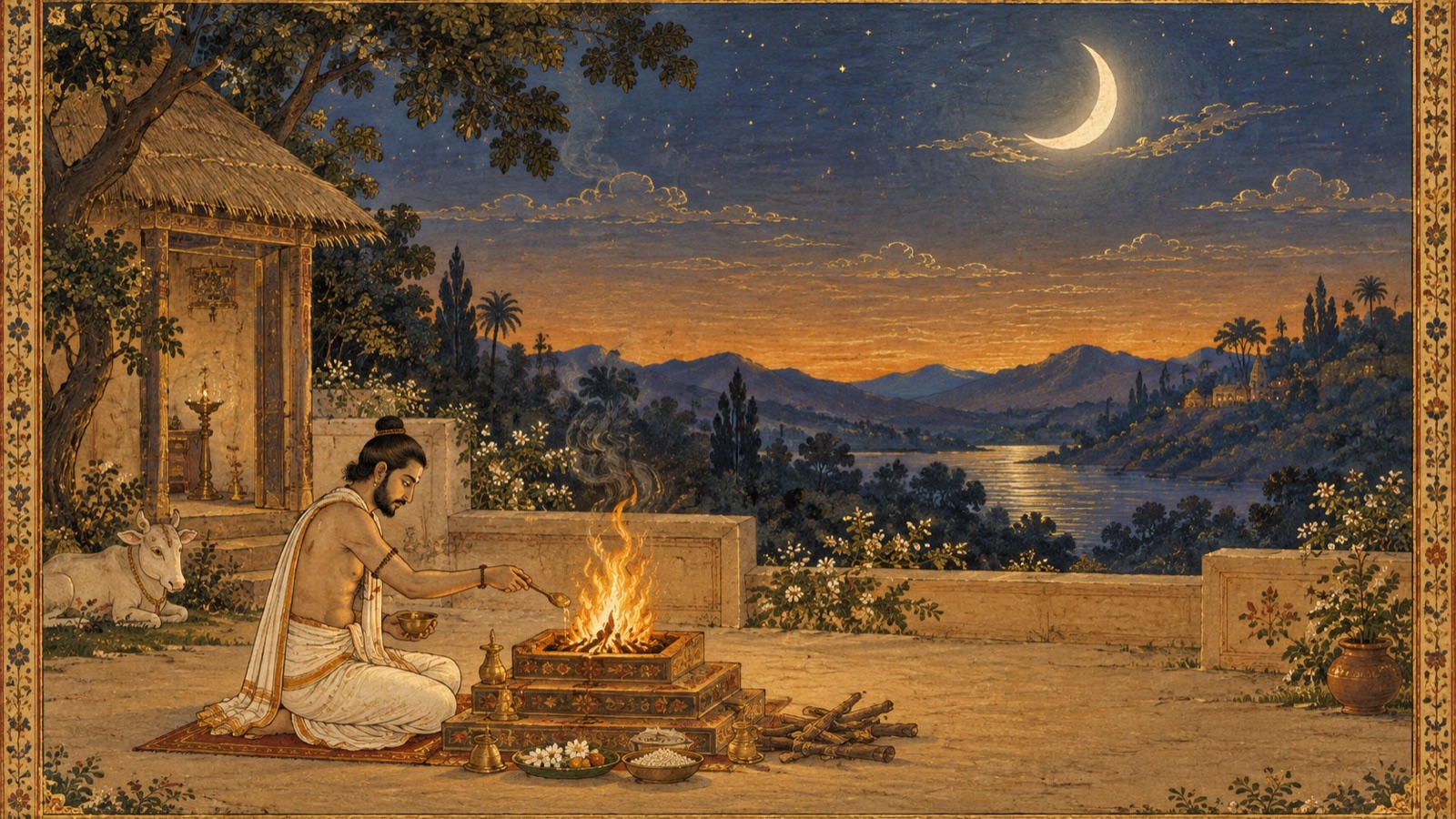
Lord Kapila continued: As for the man who, while continuing at home, performs the duties of a householder and, earning wealth and the pleasures of sense through them resorts to those actions again, he too turns his face away from the Lord, deluded as he is by desire, and worships through sacrificial performances the gods as well as the manes with reverence. (verses 1–2)
It is a subtle and important opening move. This is not a wicked man; he keeps the household duties, performs sacrifices, honors the gods and the ancestors — all of it entirely legitimate religious activity by the letter of scripture. His failing is not irreligion but incompleteness: he performs these acts to “resort to those actions again,” meaning wealth and sense-pleasure remain his actual goal, with the gods and manes serving only as the means to that end. Kapila traces the consequence with characteristic precision:
His mind being swayed by reverence for the aforesaid beings, the man undertakes vows to propitiate the gods and the manes and, having attained (thereby) to the realm of the moon (a part of the heavenly world) drinks (with them) the (inebriating) sap of the Soma plant; but (when the stock of merit that earned him an abode in the aforementioned realm is exhausted) he must return (to this mortal world). (verse 3) When (at the end of a Kalpa) Sri Hari, who has Ananta (the serpent-god Sesa) for His seat, reclines on His couch of Sesa (the lord of the serpents), these worlds, attained to by the householders, get dissolved (enter His body and disappear). (verse 4)
The moon-realm is real, its pleasures are real, and the merit that earns entry to it is real — but merit, unlike devotion, is a currency that can be spent down to zero. What is purchased with finite pious works is, necessarily, a finite stay. Even setting aside the return to earth, Kapila adds a second and more sobering ceiling: at the dissolution of the universe, even the heavenly worlds attained by such merit are themselves absorbed back into the Lord. Ritual without detachment, in other words, buys a temporary lease on a temporary residence within a temporary universe — impressive by any earthly measure, and still, on the scale Kapila is now describing, no kind of permanence at all.
The Bright Path: Where Detached Action Leads
Having described the ritualist who remains attached, Kapila turns immediately to his opposite — the wise man who performs the very same kinds of duty, but without craving, and shows how radically different the destination becomes:
Those wise men, however, who do not perform their duties for the sake of sensuous enjoyment and wealth but offer their actions to Me, nay, who are free from attachment, most serene, pure of mind, devoted to the duties of those who have retired from the world, have no feeling of “I” and “mine” (with regard to the body and everything connected with it) and are endowed with a mind thoroughly cleansed by recourse to Sattva (the quality of goodness) passing by the name of one’s own sacred duty, reach by the “Bright Path” the all-pervading Supreme Person, the Lord of both Prakrti and Purusa (Matter and Spirit), the ultimate Cause (of the universe) and also responsible for the creation, preservation and dissolution of the world. (verses 5–7)
Notice that the outward form of the action need not differ at all from the ritualist of the opening verses — what differs entirely is the inward orientation: action offered to the Lord rather than performed for personal gain, freedom from the sense of “I” and “mine,” a mind purified by Sattva rather than agitated by Rajas. This same inward shift is what Kapila will spend the rest of the chapter insisting makes all the difference between a road that circles back and a road that reaches its destination. The “Bright Path,” traditionally called Devayana in the wider Vedic and Puranic literature, is here described as leading not merely to a heavenly realm among many, but directly to “the all-pervading Supreme Person” — the ultimate Cause of the universe Himself, not merely one of its administrators.
Kapila then describes a further gradation among the detached — those whose meditation stops short of the Supreme Person Himself and settles instead on Brahma, the cosmic architect:
As for those who meditate on Hiranyagarbha (Brahma) as no other than the Supreme, dwell in the realm of Brahma (the highest heaven known by the name of Satyaloka) till the dissolution of Brahma, which takes place at the end of two Parardhas. (verse 8)
Even this — dwelling in Satyaloka, the very highest of the heavenly worlds, for a span so vast it is measured in Parardhas (a unit of cosmic time almost impossible for ordinary imagination to hold) — is still not final. Satyaloka, too, has an end, coinciding with the dissolution of Brahma himself.

Brahmaloka’s Long Twilight, and Why Even Liberated Sages Can Return
The chapter’s next movement is among its most philosophically demanding, and it addresses a question that would occur naturally to any careful listener: if Brahmaloka is dissolved along with Brahma at the end of two Parardhas, what becomes of the great sages and Yogis who have taken up residence there?
Intending to dissolve the universe enclosed by earth, water, fire, air, ether, the mind, the senses and their object and the ego (the source of the elements) and so on, and having finished his regime extending over two Parardhas, when Brahma (the self-born), who is higher than the other gods, identifies himself with Prakrti (consisting of the three Gunas) and enters the Absolute, the Yogis that have controlled their breath and mind and are free from passion enter (the body of) the worshipful Brahma after casting off their body, and along with him get merged into the Supreme Brahma, who is an embodiment of the highest bliss and no other than the most ancient Person, and to whom they did not attain before inasmuch as their egotism had not left them till then. (verses 9–10)
This is, on the face of it, a description of liberation — merger with the Supreme Brahma, an embodiment of the highest bliss. And yet, in one of the chapter’s most striking and easily overlooked turns, Kapila immediately qualifies exactly how provisional even this merger can be:
On the other hand, even Brahma (the repository of the Vedas and) the cause of the mobile and immobile creation, along with the sages (Marici and others), the lords of Yoga like Sanaka and others, and other Siddhas who are the first teachers of Yoga — even after entering (at the time of final dissolution), by virtue of their disinterested action, (the body of) the first Purusa, the foremost of all Purusas, who is no other than Brahma presiding over the three Gunas — is born again as before (if the Lord so desires) at the time of creation — when the equilibrium of the Gunas is disturbed by the Time-Spirit, a manifestation of the Lord Himself — because of his retaining the notion of difference and due to his sense of doership. (verses 12–14) And the sages too — after enjoying the glorious life of the highest heaven, earned by their meritorious acts — (likewise) return (by the will of the Lord as the mind-born sons of Brahma) on the equilibrium of the Gunas being disturbed (at the time of creation). (verse 15)
Even Brahma himself, and the great primordial sages like Sanaka and Marici — figures who stand at the very summit of what disinterested, meritorious spiritual achievement can produce — are born again when a new creation begins, because “the notion of difference” and “the sense of doership” had not yet fully left them. It is worth pausing on this before moving on, because it quietly reframes the whole hierarchy of paths Kapila is describing: not as a ladder that gets you progressively closer to permanent safety the higher you climb, but as a set of distinct destinations, only one of which is actually beyond the reach of the cosmic cycle altogether.
This is the theological hinge on which the whole chapter turns. Every road described so far — ritual, meditation, even disinterested action that reaches the first Purusa incarnation — still carries within it some residue of the worshiper’s own sense of accomplishment, a subtle “I have attained this.” Bhaktiyoga alone works the opposite way: it does not ask the soul to climb toward the Lord by its own effort and only then, at the summit, finally surrender the self; it begins by placing the self in relationship with Him, as servant to master, so that ego dissolves as devotion’s natural by-product rather than as a precondition still to be met. That is exactly why Kapila can promise, within a few verses, that mere loving shelter at His feet accomplishes at once what disinterested striving reaches only after Parardhas of cosmic time (verses 11, 22–23).
Between these two demanding metaphysical passages, Kapila turns to His mother directly with the chapter’s first explicit personal counsel:
Therefore, O great lady, seek refuge with devotion in Him alone who has taken up His abode in the lotus-like heart of all living beings and of whose glory you have (just) heard (from Me). (verse 11)
The placement of this verse is not accidental — sandwiched between two dense passages about the limits of even the highest impersonal or meritorious paths, it functions as Kapila’s own quiet thesis statement, stated once here and then argued for at length in the rest of the chapter.
अथ तं सर्वभूतानां हृत्पद्मेषु कृतालयम् । श्रुतानुभावं शरणं व्रज भावेन भामिनि ॥ ११ ॥
atha taṁ sarva-bhūtānāṁ hṛt-padmeṣu kṛtālayam śrutānubhāvaṁ śaraṇaṁ vraja bhāvena bhāmini
Meaning: Kapila now turns directly to His mother: let her go for shelter, with heartfelt devotion, to that same Lord who has made His abode in the lotus heart of every living being and whose glory she has just heard described. (Canto 3, Chapter 32, verse 11)
The Dark Path: Ritual, the Manes, and the Return to Earth
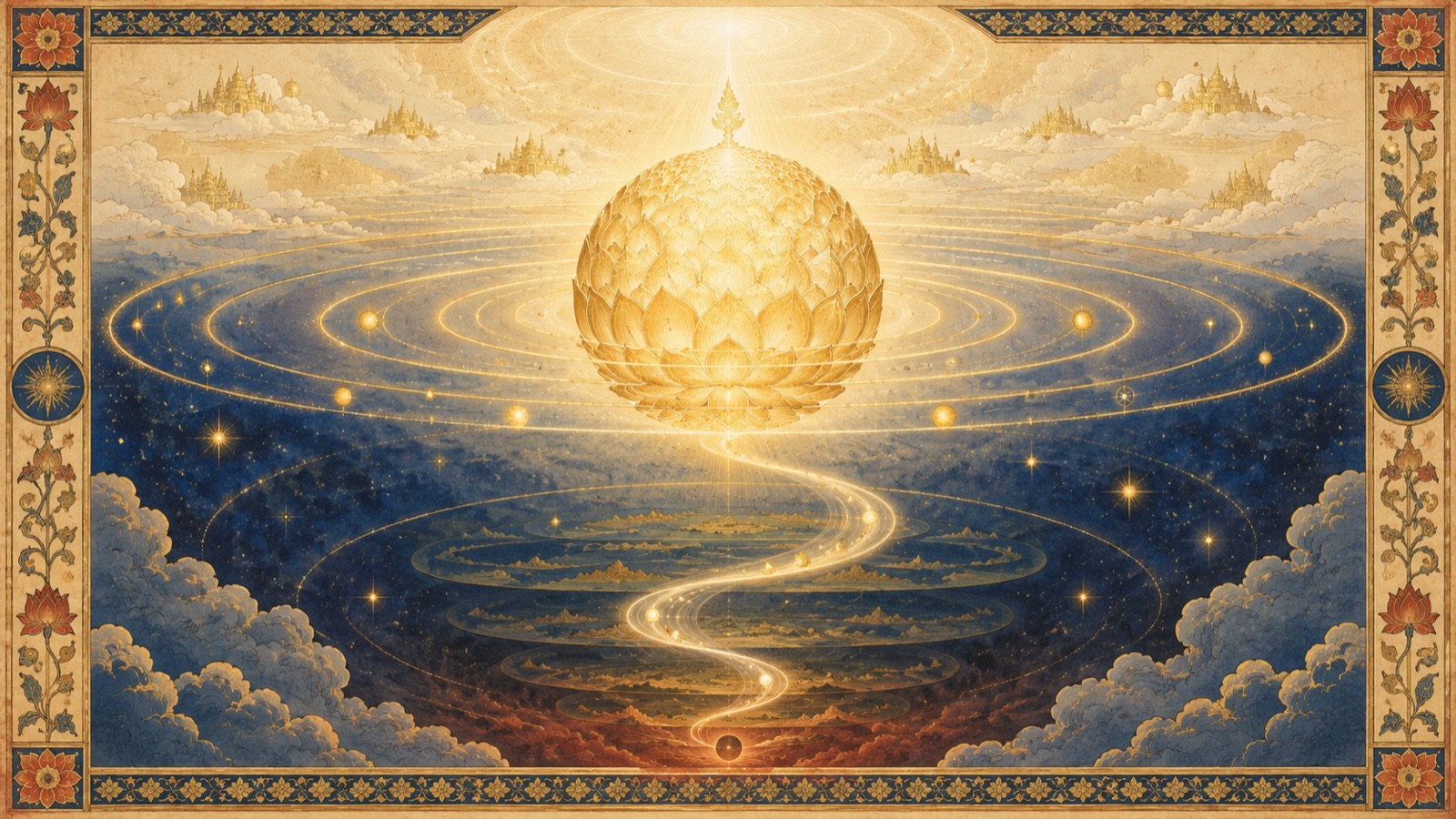
Having described the two destinations available to those free from attachment (the Supreme Person directly, or Brahmaloka’s long but still temporary residence), Kapila now returns to describe, in more detail, what befalls the soul still bound by desire and worldly attachment — the “Dark Path,” or Pitryana:
They, however, whose mind is attached to the world and who are full of reverence for religious rites perform actions that are actuated by desire, though not prohibited by the scriptures, as well as those which are of an obligatory nature, in their entirety. (verse 16) With their understanding clouded by passion, their mind full of desires and their senses uncontrolled, they worship the manes everyday, their heart finding delight in the home alone. (verse 17)
Kapila does not condemn these people as irreligious; their actions are explicitly “not prohibited by the scriptures.” Their fault, once again, is not the form of the action but its motive and its horizon — a heart that “finds delight in the home alone,” rather than in the Lord whose stories, Kapila immediately adds, they have turned away from:
Devoted to the first three objects of human pursuit (viz., religious merit, wealth and sensuous enjoyment) only, these people are averse to the stories of Sri Hari (the Slayer of the demon Madhu), whose knowledge takes away the fear of birth and death and whose innumerable exploits are worth recounting. (verse 18) Abandoning the nectar-like stories of the immortal Lord, they who listen to vile talks (relating to sensual enjoyment) — even as the swine feed on filth — have surely been cheated by fate. (verse 19)
The swine simile is deliberately unsparing, and it is worth reading carefully rather than flinching from: the point is not that ordinary worldly conversation is filthy in some literal sense, but that a mind capable of tasting “nectar-like stories of the immortal Lord” and choosing instead to feed on lesser talk has been, in the most exact sense, cheated — robbed of an available and superior nourishment by its own misdirected appetite. The destination that awaits this attachment is then stated plainly:
Performing religious rites from the ceremony connected with impregnation down to the obsequies, they ascend to the abode of the manes presided over by Aryama (the lord of the manes) by the southern path (also known as the “dark path”) and are (eventually) born in the line of their own progeny. (verse 20) Thereafter, when their merit (that earned them an abode in the realm of the manes) is exhausted, they are forthwith robbed of their glorious state by the gods (in charge of that realm) and helplessly descend once more to this world (of mortals), O virtuous lady. (verse 21)
The structure here precisely mirrors the fate of the ritualist from the chapter’s opening verses, and that repetition is itself the argument: whether the reward is the moon-realm or the abode of the manes, whether the road is called simply “attached ritual” or given the more formal name “Dark Path,” the underlying mechanism is identical — merit is earned, merit is spent, and when it runs out, gravity reasserts itself and the soul falls back to exactly the world it began in. This entire structure — two clearly named paths, one Bright and one Dark, each leading to a real but bounded destination — is what gives the chapter its architecture, and what sets up the force of the alternative Kapila is about to offer.

The Direct Road: Bhaktiyoga’s Superiority
It is at exactly this point — having shown that even the very best outcomes available through the Bright Path (Brahmaloka) and the Dark Path (Pitrloka) both remain, in their different ways, bounded — that Kapila delivers the chapter’s central teaching:
Therefore, do you worship with all your being the supreme Lord — whose lotus-like feet are worth adoring — through devotion evoked by His virtues. (verse 22) A link formed through Devotion with Lord Vasudeva calls forth before long dispassion and spiritual wisdom that reveals the truth of the Absolute. (verse 23)
वासुदेवे भगवति भक्तियोग: प्रयोजित: । जनयत्याशु वैराग्यं ज्ञानं यद्ब्रह्मदर्शनम् ॥ २३ ॥
vāsudeve bhagavati bhakti-yogaḥ prayojitaḥ janayaty āśu vairāgyaṁ jñānaṁ yad brahma-darśanam
Meaning: Once devotion is brought to bear on Lord Vasudeva, that bond itself swiftly gives rise to dispassion and to the very knowledge that discloses the truth of Brahman. (Canto 3, Chapter 32, verse 23)
This is one of the most quietly radical claims in the entire Kapila-Gita, and it is worth stating plainly what it asserts: Bhaktiyoga does not merely stand alongside Jnana (spiritual knowledge) and detached Vedic ritual as one more valid path among several equally slow options. It actively produces dispassion and knowledge as its own natural by-products, “before long” — meaning the fruits that the paths of knowledge and detached ritual labor for over Parardhas of cosmic time, devotion generates organically and swiftly, as a matter of course, simply by forming a living relationship with the Lord. Kapila then explains, in more subtle philosophical terms, exactly what that dispassion and knowledge look like once they arrive:
When the mind of the devotee ceases to perceive, even through the faculty of the senses, any difference, in the shape of agreeability or otherwise, in the objects of senses, which are just the same (as being the manifestations of the same Reality, viz., Brahma), he forthwith realizes by his intellect his own self as the revealer of unity, free from attachment, devoid of merit and demerit (that which is worth accepting or rejecting) and established in its own (glorious) state. (verses 24–25) The Lord is nothing but absolute Consciousness and is the same as the Transcendent Reality (Brahma), the Supreme Spirit, the Ruler of all and the Highest Person. Though One, He appears in diverse forms as the seer, the object seen, the means of sight and so on. (verse 26) Absence of attachment to all — that is the only desired end to be attained through all forms of Yoga practised by a Yogi. (verse 27)
Kapila then spends several verses grounding this insight in the metaphysics He has taught throughout the Kapila-Gita — the relationship between Brahman, the cosmic elements, and the Jiva:
Brahma is absolute Consciousness, one and attributeless; yet, through the senses, which have an outward tendency, it erroneously appears in the form of various objects possessing sound and other attributes. (verse 28) Just as the same supreme Brahma appeared as Mahat-tattva (the principle of cosmic intelligence), the threefold (Sattvika, Rajasika and Tamasika) Ego, the five gross elements and the eleven Indriyas, and the same self-effulgent Being was named as Jiva when endowed with these, even so the body of the Jiva in the form of the universe is no other than Brahma; for it is from Brahma that it has sprung. (verse 29) Of course, he alone can perceive it as such, whose mind has been composed and rid of all attachment through reverence, Devotion, daily practice of Yoga and dispassion. (verse 30)
Having reached this summit, Kapila turns to Devahuti once more, and, in a moment that closes the philosophical circle He opened many chapters earlier, tells her plainly that the teaching is now complete:
I have thus expounded to you, O revered mother, the wisdom which reveals the true nature of the Absolute, and by means of which one can realize the truth about Prakrti (Matter) and Purusa (Spirit). (verse 31) The discipline of Jnana (spiritual knowledge) and the discipline of Devotion — which is free from the influence of the three Gunas — directed towards Me, lead to the same goal, which is signified by the word ‘Bhagavan’. (verse 32)
ज्ञानयोगश्च मन्निष्ठो नैर्गुण्यो भक्तिलक्षण: । द्वयोरप्येक एवार्थो भगवच्छब्दलक्षण: ॥ ३२ ॥
jñāna-yogaś ca man-niṣṭho nairguṇyo bhakti-lakṣaṇaḥ dvayor apy eka evārtho bhagavac-chabda-lakṣaṇaḥ
Meaning: The path of knowledge fixed on Me and the path of devotion untouched by the three modes are not two separate goals — both point to that one reality which the word “Bhagavan” signifies. (Canto 3, Chapter 32, verse 32)
This single verse is the chapter’s philosophical keystone: Jnana and pure, Guna-free Bhakti are not two competing systems arriving at two different prizes, but two roads converging on one and the same destination — the Lord Himself, “signified by the word Bhagavan.” Kapila immediately widens this claim even further, into a striking statement of scriptural pluralism grounded entirely in the nature of the one Reality being sought:
Just as one and the same substance possessed of several attributes (such as colour, taste and so on) is perceived in different ways through the senses, following different courses, even so the Lord, though one, is variously realized through different paths recommended by the scriptures. (verse 33) Through works of public utility (such as the digging of wells and tanks, construction of roads etc.) and sacrifices, charitable gifts and austere penance, study of the Vedas and an enquiry into their meaning, nay, even through the control of the mind and senses (i.e., abstaining from prohibited acts) as well as through the renunciation of action, through Yoga with different limbs (such as Yama, Niyama and so on) and likewise through the discipline of Devotion, through the twofold Dharma, viz., that which is accompanied by worldly activity and that which is characterized by renunciation, and again through the realization of the true nature of the Self and through dispassion do we attain to the same self-effulgent Lord, who is both with attributes and without attributes. (verses 34–36)
It is worth noticing what this list includes: not only meditation and renunciation, but plainly civic service — sinking wells, digging tanks, laying roads for others’ use — an almost startlingly practical, worldly form of activity placed on equal footing with austere penance and Vedic study, so long as it too is directed, ultimately, toward the same self-effulgent Lord. Kapila’s vision of the paths to God, in this verse, is generous rather than narrow — it is Bhaktiyoga’s swiftness and directness that the chapter has singled out for special praise, not an exclusive claim that every other path is worthless.

To Whom This Teaching May Be Given
The chapter closes with a section unlike anything else in the Kapila-Gita so far — Kapila steps back from doctrine entirely and addresses, quite practically, the question of transmission: who is fit to receive this teaching, and who is not?
I have already told you the fourfold character (according as it is predominated by any one of the three Gunas or is absolutely free from their influence) of Bhaktiyoga (the discipline of Devotion) as well as the nature of Kala (the Time-Spirit), whose movement cannot be perceived (through the senses) and who brings about the birth and death etc., of living beings. (verse 37) I have also described the various states of existence of the Jiva — brought about by his actions prompted by Avidya (ignorance) — passing through which, O mother, the soul forgets his true nature. (verse 38)
This is Kapila’s own summary of everything covered across this stretch of the Kapila-Gita — the fourfold Bhaktiyoga, the imperceptible Time-Spirit, and the Jiva’s forgetfulness under Avidya — offered here almost as a table of contents before the discourse’s final word. What follows is a direct, unambiguous restriction on the teaching’s transmission:
One should never teach this gospel of Mine to a wicked person (a source of annoyance to others) nor to him who is wanting in modesty, nor to an arrogant man nor again to a moral rake and in no case to a hypocrite. (verse 39) Nor should one impart it to a man thirsting after pleasures, nor to him who is attached to his home, nor again to him who is not My devotee, nor to those who hate My devotees. (verse 40)
And then, its positive mirror:
It may no doubt be imparted to a man full of reverence, a devotee, a meek soul, an uncavilling man, one who is friendly to living beings, and (likewise) to him who takes delight in service, one who has developed a distaste for external objects, a man who is serene of mind, one who is free from jealousy, one who is pure both within and without and above all to him who holds Me dearer than all. (verses 41–42)
This closing instruction is not incidental to the chapter’s argument — it is, in fact, entirely consistent with everything that has come before it. A teaching that promises to shortcut Parardhas of cosmic cycling through simple, direct devotion is, precisely because of its power, unsuited to a mind still governed by the very attachments — to home, to pleasure, to ego — that the teaching exists to dissolve. Kapila’s final verse then delivers the chapter’s, and this entire section’s, closing promise:
With his mind fixed on Me, O mother, the man who reverently listens to or repeats this (discourse of Mine) but once will surely attain to My state. (verse 43)
य इदं शृणुयादम्ब श्रद्धया पुरुष: सकृत् । यो वाभिधत्ते मच्चित्त: स ह्येति पदवीं च मे ॥ ४३ ॥
ya idaṁ śṛṇuyād amba śraddhayā puruṣaḥ sakṛt yo vābhidhatte mac-cittaḥ sa hy eti padavīṁ ca me
Meaning: O mother, whoever with faith hears this teaching even once, or repeats it with mind fixed on Me, certainly attains that same state which I Myself occupy. (Canto 3, Chapter 32, verse 43)
The chapter’s colophon closes the discourse simply: “Thus ends the thirty-second discourse, forming part of the ‘Story of Lord Kapila’, in Book Three of the great and glorious Bhagavata-Purana, otherwise known as the Paramahamsa-Samhita.”
Reflection: One Destination, Many Roads, One Direct Path
Chapter 32 functions as the great cartographic overview of the entire Kapila-Gita’s teaching on the soul’s departure from this world, and it does something few chapters manage: it holds real intellectual generosity — acknowledging that the Bright Path, the Dark Path, Vedic ritual, public works, Yoga, and the path of knowledge all genuinely lead somewhere, all genuinely connect in the end to the same one Reality — together with a clear-eyed, unsentimental verdict about which of these roads is fastest, safest and most direct. The Dark Path circles back to earth once its merit runs out. Even the Bright Path’s finest destination, Brahmaloka, remains bounded by the dissolution of Brahma, and even liberated sages who reach it can be born again if the subtlest trace of ego persists. Only Bhaktiyoga — a “link formed through Devotion with Lord Vasudeva” — is described as calling forth, swiftly and as a matter of course, the very dispassion and knowledge that every other path pursues through immeasurable spans of disciplined effort. This is, finally, why the chapter closes not with cosmology but with a question of character: to whom should this be taught? Not to the proud, the hypocritical or the home-attached, but to the reverent, the meek, the devoted — because the shortcut Kapila is describing is not a loophole to be exploited by the unprepared, but a gift that only a heart already turned toward the Lord is truly able to receive. Devahuti has listened to this entire, demanding architecture of paths and destinations from her own son; what she — and every listener since — is left with is Kapila’s simplest and final promise: one reverent hearing, with the mind fixed on Him, is enough.
Reference
- Primary source: Śrīmad Bhāgavata Mahāpurāṇa (Bhagavata Purana), Gita Press, Gorakhpur — English Complete edition, Book Three, Discourse XXXII, “Destiny of the souls departing from this world by the ‘Bright Path’, the ‘Dark Path’ and so on, and the superiority of Bhaktiyoga”
- Series: Srimad Bhagavatam Wisdom — a chapter-by-chapter devotional journey through the Śrīmad Bhāgavata Mahāpurāṇa
- Presented under the spiritual guidance of: Pandit Dr. Shri Kashinath Mishra
Om Namo Bhagavate Vasudevaya.
Jay Shree Madhav