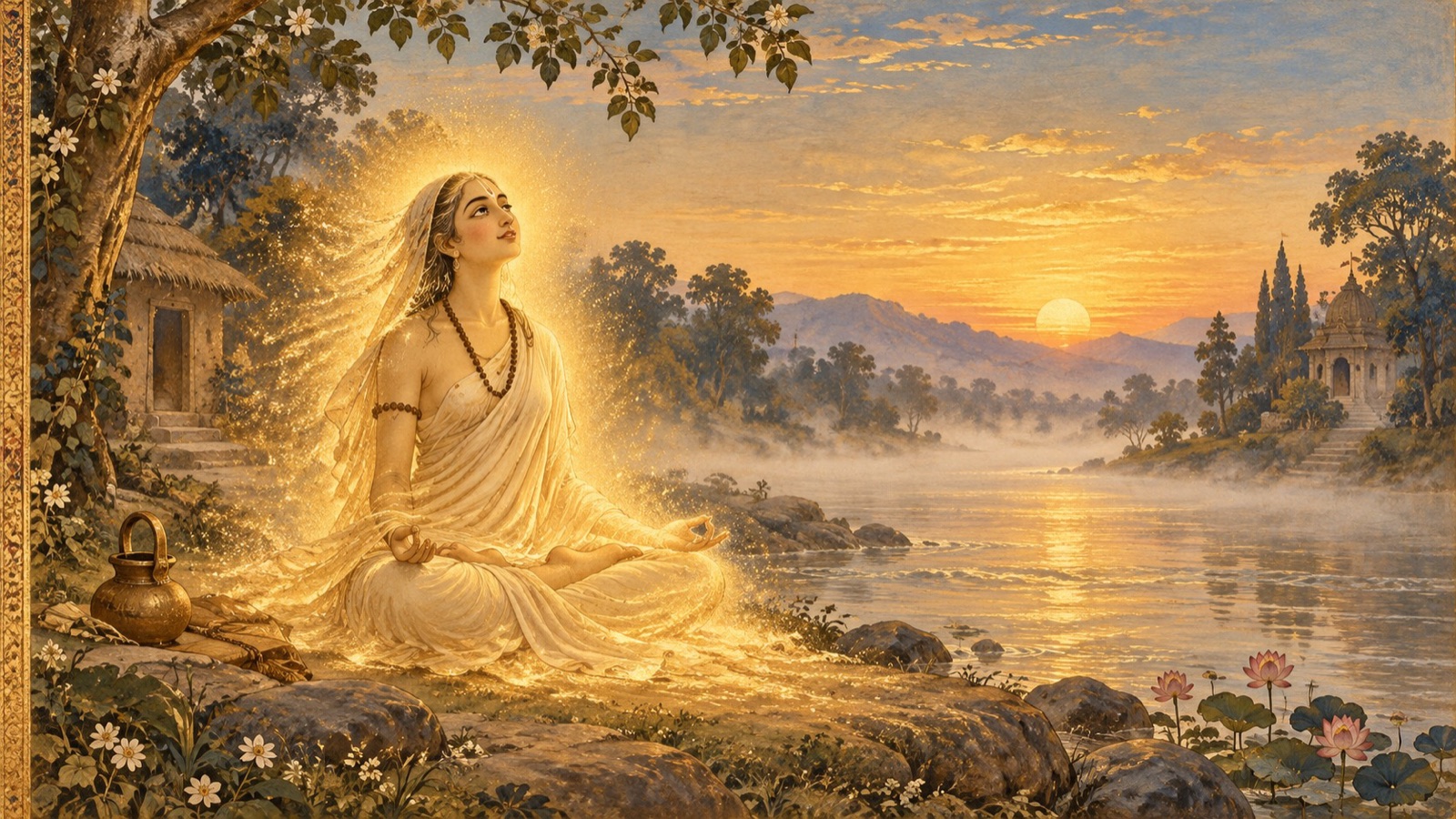
Devahuti’s love for her son deepened into unbroken meditation until the very ground beneath her dissolved into the Lord she contemplated — and the place of her passing has been remembered, across all three worlds, ever since, as ‘Siddhapada,’ the footstep of the perfected.
Om Namo Bhagavate Vasudevaya.
Om Namo Bhagavate Vasudevaya.
Om Namo Bhagavate Vasudevaya.
Welcome to Srimad Bhagavatam Wisdom, a devotional journey through the sacred histories and teachings of the Srimad Bhagavat Mahapurana. We arrive today at the thirty-third and final chapter of the Third Canto — the closing scene of a story that began many chapters ago with the sage Kardama’s austerities, his marriage to Devahuti, and the extraordinary promise that a portion of the Lord Himself would be born as their son. That promise was fulfilled in the birth of Lord Kapila, and for chapter after chapter since, we have sat, in effect, beside Devahuti in the hermitage on the bank of the Sarasvati, listening as her own son unfolded before her the entire architecture of Sankhya philosophy — Prakrti and Purusa, the Gunas, the constitution of the Jiva, the discipline of Yoga, the nature of Time, and finally, in the chapter immediately preceding this one, the two paths of departure and the unmatched swiftness of Bhaktiyoga. Chapter 33 is where all of that teaching bears its fruit. Devahuti does not merely understand what she has heard — she is transfigured by it. She turns to her son not as a student seeking further instruction but as a soul awakening into worship, pours out one of the most moving hymns of praise in the entire Bhagavata, and then, in the quiet second half of the chapter, walks the path she has been shown until she reaches its end: liberation at a place that would come to be called Siddhapada, “the place of perfection.” Kapila, His mission to His mother complete, takes His leave and proceeds to His own abode by the shore of the ocean. And with that, the “Story of Lord Kapila” — and the Third Canto of the Srimad Bhagavatam itself — comes to its close.
Chapter Information
- Scripture: Śrīmad Bhāgavata Mahāpurāṇa
- Canto: 3 (Book Three) — final chapter of the canto
- Chapter: 33 (Discourse 33), 33rd and last chapter of Canto 3
- Chapter title: Devahūti receives the light of wisdom and attains final beatitude
- Principal speakers: The sage Maitreya (narrating to Vidura); Devahuti (verses 2–8, her hymn of praise); Lord Kapila (verses 10–11)
- Principal listener (within the frame story): Vidura, receiving this entire narration from the sage Maitreya
- Main setting: The hermitage of the sage Kardama on the bank of the river Sarasvati, and afterward, the shore of the ocean to the north-east, where Lord Kapila takes up His final abode
- Central subject: Devahuti’s transformation from student to devotee; her hymn of praise to Kapila as the Supreme Person; Kapila’s final instruction and departure; Devahuti’s renunciation of her celestial home; her gradual absorption in meditation on her son as the Lord; her attainment of final beatitude at the sacred spot later known as Siddhapada, and the transformation of her mortal body into a holy river; Kapila’s own retirement to the shore of the ocean; and the concluding statement on the fruit of hearing or reciting this entire dialogue
- Principal verse range: Canto 3, Chapter 33, verses 1–37
- Primary edition: Gita Press Śrīmad Bhāgavata Mahāpurāṇa
- Series note: This chapter closes Canto 3 (Book Three) in its entirety. Canto 4 (Book Four) begins immediately in the source text with the story of the daughters of Swayambhuva Manu.
The Veil Torn Asunder: Devahuti’s Awakening
The chapter opens with a single, quietly momentous line from the sage Maitreya, who has been narrating this entire story to Vidura since Chapter 24. After everything Kapila has taught across the preceding nine chapters — the two paths, the nature of Bhaktiyoga, the identity of Brahman and the Jiva — something finally shifts in Devahuti herself:
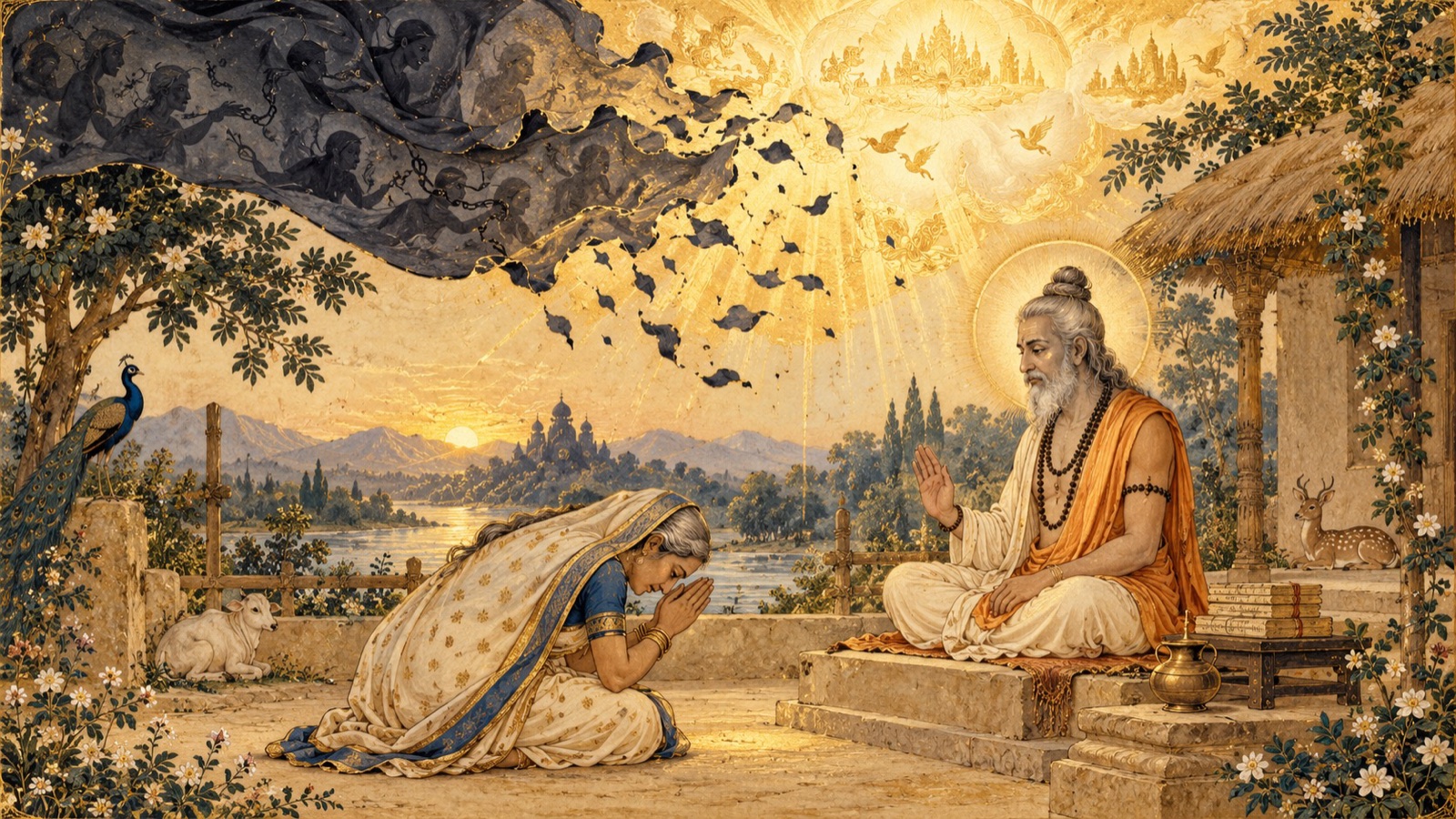
Maitreya resumed: When Devahuti, the beloved spouse of the sage Kardama and mother of Lord Kapila, heard the foregoing discourse of the Lord, the veil of her ignorance was torn asunder. She bowed to Him, the disseminator of the knowledge of Sankhya — which throws light on the fundamental principles — and extolled him thus. (verse 1)
Notice the verb Maitreya chooses: the veil of her ignorance was torn asunder, not gradually lifted or slowly dissolved. This is the language of a decisive, completed event — the culmination of everything the preceding chapters have been building toward, arriving in a single moment of recognition. And her very first response to that recognition is neither a question nor a request for further clarification (as it had been, again and again, across the earlier chapters of this dialogue) but an act of worship. The student has become, in this instant, a devotee.
Devahuti’s Hymn: “You Are Lord Visnu Himself”
What follows is one of the chapter’s — and indeed one of the Third Canto’s — most beautiful passages: Devahuti’s own hymn of praise to the son she raised, now recognized as the Supreme Person Himself. She begins with cosmology, describing how even Brahma, the creator of the universe, could perceive the Lord’s cosmic body only “with his mental eyes”:
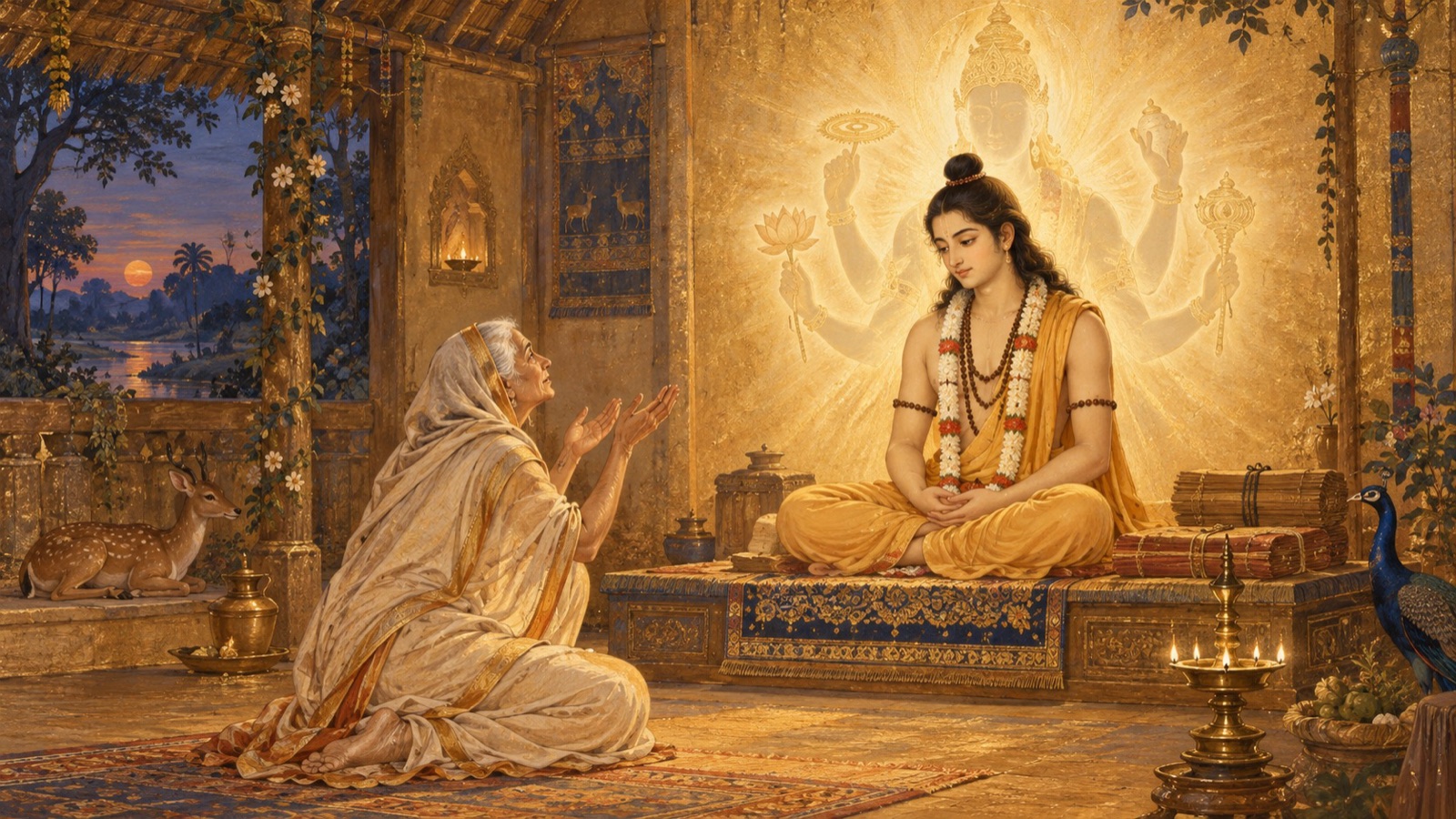
Devahuti said: Brahma (the birthless creator) saw only with his mental eyes Your (Cosmic) Body — pervaded by the (five) gross elements, the (ten) Indriyas, the (five) objects of senses and the mind — from which proceeds the stream of the three Gunas (modes of Prakrti), nay, which is the seed of all and lay manifest on the waters that had submerged the universe at the time of Final Dissolution, and from the lotus of whose navel Brahma himself had sprung. (verse 2) Though actionless, You are of unfailing resolve and possessed of countless inconceivable powers, and the Ruler of all the Jivas. That is why, having partitioned Your energy according to the predominance of the three Gunas, it is You who carry on the creation, preservation and dissolution of the universe. (verse 3)
Having established, in the grandest possible terms, exactly who her son truly is, Devahuti then turns the full force of that recognition back onto the intimate, almost unthinkable fact of her own motherhood:
How, then, could it be that You were borne in my womb — You into whose belly the whole of this universe disappears at the time of universal dissolution and who at the end of a Kalpa rest all alone on a leaf of a banyan tree in the form of an infant possessing inconceivable powers and sucking its great toe? (verse 4)
This is not false modesty. It is the precise emotional register of genuine bhakti as the Bhagavatam repeatedly describes it — awe and intimacy held together without contradiction, wonder at the Lord’s infinite majesty coexisting with the tender, ordinary memory of nursing an infant. Devahuti then explains why the Lord takes such forms at all:
You assume a personality for the extermination of the sinful and the exaltation, O Lord, of those who abide by Your commands. Just as You appear in the semblance of a boar and so on (for various other purposes), even so this descent of Yours is intended for showing (to the world) the path leading to Self-Realization. (verse 5)
By naming the boar incarnation (Varaha, described in an earlier canto) in the same breath as Kapila’s own descent, Devahuti places her son’s teaching mission within the Lord’s larger pattern of Avataras — each one purposeful, each one a gift to a world that needs precisely that form of guidance at precisely that time. She then turns to a theme that will echo throughout the later Cantos of the Bhagavatam: the extraordinary, almost scandalous power of the Lord’s holy name to purify even the most degraded person:
By occasionally hearing and chanting Your names, bowing to You or even remembering You, a pariah (one who feeds on the flesh of dogs) becomes worthy of adoration in this very life as a Brahmana who has performed a Soma-sacrifice (a sacrifice which brings great sanctity and extraordinary religious merit to the sacrificer)! There could be no doubt, then, about one’s attaining the object of life by Your sight. (verse 6) Oh, how wonderful that even a pariah (who cooks the flesh of dogs) becomes highly venerable only because he has Your name on the tip of his tongue! Nay, they who utter Your name have (thereby or in their previous life) practised austere penance, poured oblations into the sacred fire, bathed (in sacred waters), conducted themselves well, and even recited the Vedas. (verse 7)
अहो बत श्वपचोऽतो गरीयान् यज्जिह्वाग्रे वर्तते नाम तुभ्यम् । तेपुस्तपस्ते जुहुवु: सस्नुरार्या ब्रह्मानूचुर्नाम गृणन्ति ये ते ॥ ७ ॥
aho bata śva-paco ’to garīyān yaj-jihvāgre vartate nāma tubhyam tepus tapas te juhuvuḥ sasnur āryā brahmānūcur nāma gṛṇanti ye te
Meaning: A soul born into the most despised caste is lifted, the instant Your name touches his lips, above the station earned by the most rigorous Vedic sacrifice — for that single utterance already carries within it every austerity performed, every oblation poured, every pilgrimage taken, and every scripture studied. (SB 3.33.7)
These two verses deserve to be read slowly. Devahuti is not merely praising her son in the abstract; she is stating, as a matter of settled conviction, that the utterance of His name is sufficient — on its own, without any accompanying ritual apparatus — to elevate even a person occupying the very lowest social station imaginable in the world she inhabited, to a station higher than that earned by the most exacting Vedic sacrifice. It is worth remembering that this declaration is placed here, at the very close of the Kapila-Gita’s long philosophical exposition on Sankhya, ritual, and the two paths — Devahuti has absorbed the entire architecture of that teaching, and what she distills from it, in her own words, is this: the name alone is enough. Her hymn reaches its climax with an unambiguous declaration of her son’s identity:
In the form of Kapila (my son) You are no other than that Supreme Reality, the Highest Person, who could be rightly conceived only in a mind that has been turned inward, and who brings to an end the stream of the three Gunas (in the shape of transmigration) by His own effulgence. You are Lord Visnu Himself, the source of the Vedas. I bow to You. (verse 8)
तं त्वामहं ब्रह्म परं पुमांसं प्रत्यक्स्रोतस्यात्मनि संविभाव्यम् । स्वतेजसा ध्वस्तगुणप्रवाहं वन्दे विष्णुं कपिलं वेदगर्भम् ॥ ८ ॥
taṁ tvām ahaṁ brahma paraṁ pumāṁsaṁ pratyak-srotasy ātmani saṁvibhāvyam sva-tejasā dhvasta-guṇa-pravāhaṁ vande viṣṇuṁ kapilaṁ veda-garbham
Meaning: This is Devahuti’s final identification: the son she nursed is that same unborn Supreme Being who can be known only by a mind withdrawn from the senses and turned within, whose own radiance dissolves the endless current of the three modes — Lord Vishnu Himself, from whom the Vedas themselves originate. (SB 3.33.8)
Kapila’s Final Words and His Departure
Maitreya then records how the Lord responded to His mother’s praise — not with further doctrine, but with a brief, tender, and utterly conclusive promise:
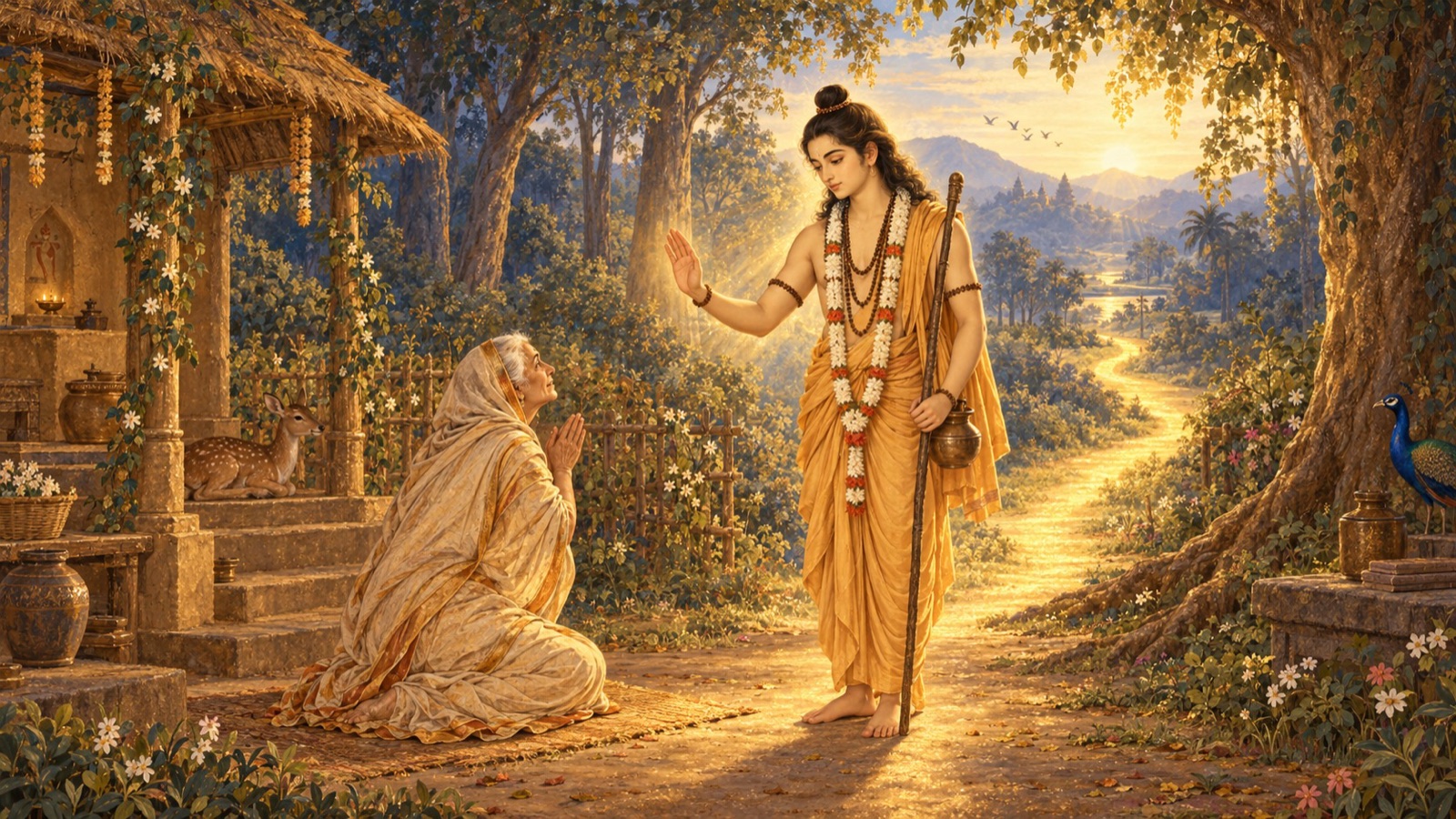
Maitreya went on: Thus praised (by Devahuti), the Supreme Person bearing the name of Lord Kapila, who was full of filial affection, spoke to His mother in unfaltering accents. (verse 9) Lord Kapila said: By following the easy path pointed out by Me, O mother, you will attain before long to the supreme goal (in the shape of final beatitude). (verse 10) Have faith in this doctrine of Mine, which has been followed even by the exponents of Veda, so that you may attain to My birthless state. Those who are ignorant of this go through the process of (birth and) death (again and again). (verse 11)
श्रद्धत्स्वैतन्मतं मह्यं जुष्टं यद्ब्रह्मवादिभि: । येन मामभयं याया मृत्युमृच्छन्त्यतद्विद: ॥ ११ ॥
śraddhatsvaitan mataṁ mahyaṁ juṣṭaṁ yad brahma-vādibhiḥ yena mām abhayaṁ yāyā mṛtyum ṛcchanty atad-vidaḥ
Meaning: Kapila asks for nothing more than trust: place your faith in this teaching — the very path the great expounders of the Vedas themselves have embraced — and you will cross over into My own unborn nature; only those who remain strangers to it are compelled to keep returning through death and birth. (SB 3.33.11)
It is worth pausing on Kapila’s choice of word — “the easy path.” After nine chapters of demanding metaphysics — Prakrti, Purusa, Mahat-tattva, the twenty-four elements, the two paths of departure, Brahmaloka’s dissolution — the Lord’s own summary of everything He has taught His mother is that it constitutes an easy road, provided it is walked with the faith and devotion she has just displayed in her own hymn. This is entirely consistent with the previous chapter’s central claim about the swiftness of Bhaktiyoga; what looked, from the outside, like an intricate philosophical system turns out, from the inside, to be simply a path of trust. With this final assurance given, the mission that brought Kapila to birth is complete:
Maitreya continued: Having thus shown to His mother the noble way to Self-Realization, and permitted by her, who now declared that all was Brahma, Lord Kapila went His way. (verse 12)
Devahuti’s own declaration here — “that all was Brahma” — is her formal acknowledgment that she has received and absorbed the teaching completely; it is only after this acknowledgment, and with her permission, that Kapila departs. The son who was born to teach His mother has finished teaching her, and now, His purpose fulfilled, moves on.
Renouncing a Celestial Home
The chapter’s second half turns entirely to Devahuti, and it opens with one of the most quietly powerful renunciation scenes in the Bhagavatam. Having received Kapila’s teaching, Devahuti takes up serious spiritual practice in earnest:
She too applied herself to the practice of Yoga, according to the process of meditation taught by her son, in that hermitage, which stood like a diadem of flowers on (the head of) the Saraswati, and attained peace of mind. (verse 13) The curly locks she wore on her head turned brown on account of ablutions performed thrice a day, and became matted; while her body, which was clad in rags, grew emaciated as a result of severe penance. (verse 14)
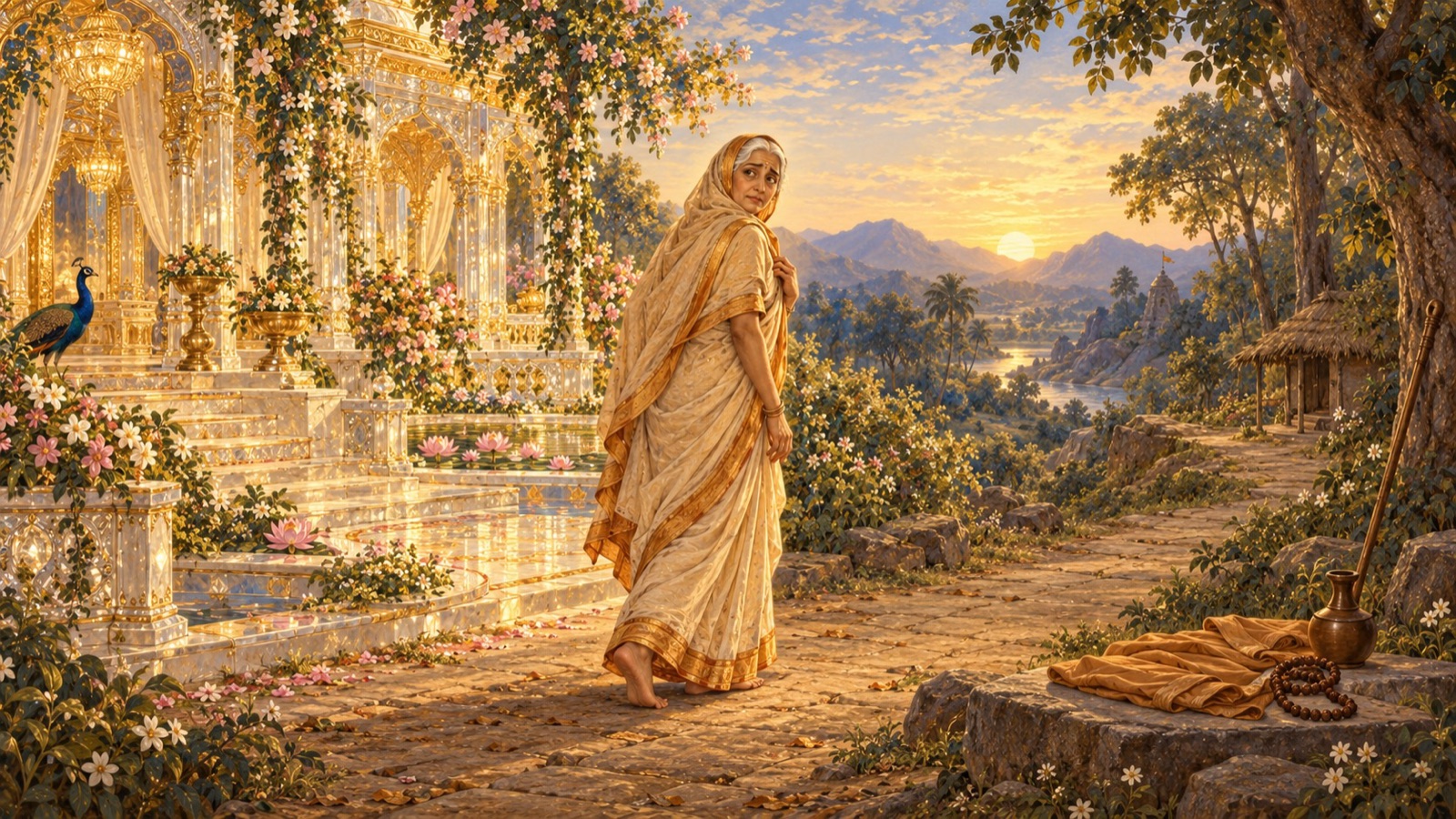
What makes this transformation so striking is what Devahuti is giving up to undertake it. The text pauses to describe, in loving and specific detail, the sheer opulence of the home the sage Kardama had built for her through his own yogic power — a home that, we are told, was coveted even by the celestials:
She renounced her incomparable house, which had been enriched by the austere penance and Yogic power of the sage Kardama, a lord of created beings, and was coveted even by the gods, furnished as it was with beds of ivory, soft and white as the foam of milk and adorned with gold, and seats of gold provided with cushions exceedingly soft to the touch. (verses 15–16) In the walls of that house, which were made of transparent crystal and precious emerald, shone lights of jewels borne by beautiful statues of women. (verse 17) She also deserted the garden attached to her house, charming with its many blossoming celestial trees, cooing pairs of birds and humming bees drunk with honey. (verse 18) When she used to enter the pond in that garden, (the water of) which was scented with the fragrance of lotuses, along with Kardama, who bestowed his loving attention on her, Gandharvas and Kinnaras (the attendants of gods) sang her praises. (verse 19)
The narrative lingers here deliberately. This is not an ascetic renouncing a life of ordinary hardship; it is a woman walking away from a home so extraordinary that even Indra’s own queens are said to have coveted it — sung over by Gandharvas and Kinnaras, its very walls set with luminous jewels. The scale of what is renounced is precisely the point: nothing in the created universe, however celestial, however hard-won by her husband’s own austerities on her behalf, could compete with what her son had shown her. And yet the text is equally careful not to render this renunciation effortless or bloodless:
(Although she felt no compunction) while leaving that garden, which was most eagerly sought after even by the spouses of Indra (the lord of paradise), Devahuti did wear a desolate look on her face, afflicted as she was at the separation from her son. (verse 20)
She feels no regret about the house and garden themselves — but her face is desolate, and the text is explicit about why: not attachment to comfort, but grief at her son’s absence. The chapter refuses to sanitize this into a simple, triumphant renunciation story; Devahuti’s spiritual attainment runs through real maternal grief, not around it.
From Grief to God: The Turning of a Mother’s Love
The next movement of the chapter traces, with remarkable psychological precision, how Devahuti’s grief over her son’s departure is itself transformed into the very medium of her liberation:
(She had somehow consoled herself by the presence of her son) when her husband (the sage Kardama) retired to the forest; but she felt very disconsolate, in spite of her having realized the truth, at the separation from her son (Lord Kapila), even as a cow, who is extremely fond of her calf, is grieved at the loss of the latter. (verse 21)
The simile of the cow grieving for her calf is deliberately chosen for its rawness — this is not abstract philosophical loss but the same instinctive, physical anguish any mother of any species feels at separation from a child. Even a soul who has already grasped the ultimate truth intellectually can still ache in this entirely human way. But Kapila’s teaching does not ask Devahuti to suppress or deny this love; rather, the text shows her love for her son becoming, quite naturally, the very form her meditation takes:
Fixing her thought exclusively on her son, the divine Kapila, who was no other than Sri Hari, she soon grew indifferent, my son, even to such a house (as has been described above). (verse 22) She (now) meditated on the form of the Lord, adorned with a cheerful countenance and spoken of by her son as worth meditating upon, fixing her thought on the same as a whole as well as in parts. (verse 23)
This is a crucial hinge in the chapter’s spiritual logic: Devahuti does not need to manufacture some new, impersonal object of meditation to progress toward liberation. Her existing love for her son is itself devotion to Sri Hari, because her son is Sri Hari — the grief of separation converts, almost seamlessly, into the concentrated remembrance of Yoga. What follows is the description of that meditation deepening into full realization:
With a mind thoroughly depurated by the uninterrupted practice of Devotion, most intense dispassion and spiritual enlightenment leading to Brahmahood (oneness with Brahma) and resulting from a due performance of one’s duties, she then contemplated on her own self as projected everywhere, having set aside by the realization of its true nature the limitations imposed on it by the modes of Prakrti. (verses 24–25)
The three elements Kapila taught throughout the preceding chapters — Devotion, dispassion, and spiritual enlightenment — appear here together, precisely as the chapter’s central teaching promised: devotion generating the other two “before long,” exactly as Kapila had said of Bhaktiyoga generally.
There is a theological point here worth drawing out explicitly, one easy to miss beneath the chapter’s tender narrative surface. Kapila’s entire nine-chapter exposition of Sankhya was, in the end, philosophy — categories, elements, the structure of bondage and release. Yet when the moment comes to describe what actually carries Devahuti across the gulf, the order given in verses 24–25 is deliberate: bhakti comes first, and dispassion and knowledge follow from it, not the reverse. This is arguably the deepest reason Kapila chose to teach His own mother rather than deliver an abstract discourse to the world at large: only within so intimate and devotional a relationship could He demonstrate, through a single living example, that loving surrender — not metaphysical mastery — is what actually dissolves a soul into the Lord.
Final Beatitude: Siddhapada and the Sacred River
The chapter now moves to its central event — the moment of Devahuti’s liberation itself, described with a stillness that matches its subject:
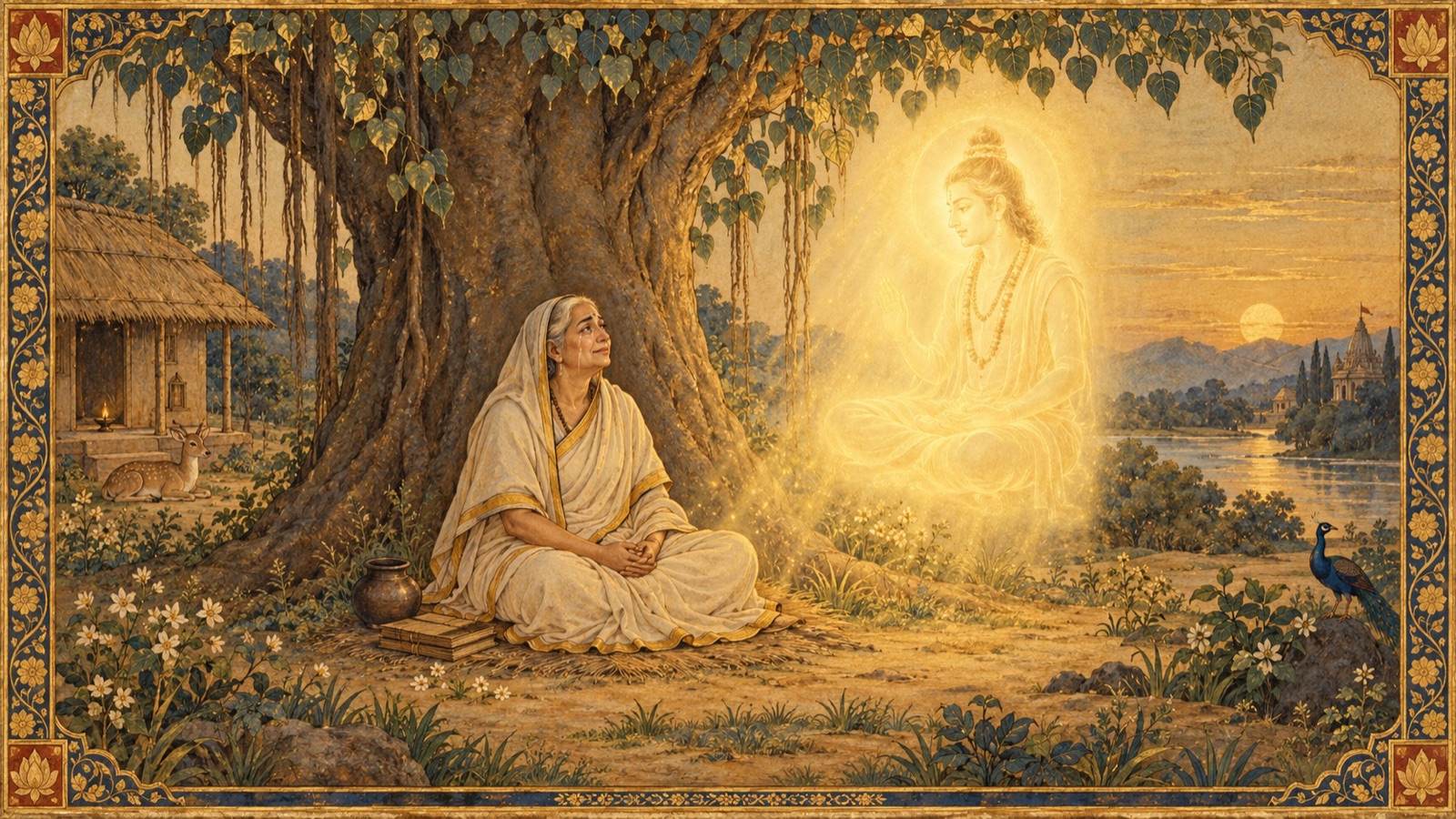
Her mind being now settled in Brahma, the substratum of all the Jivas, who is no other than the Lord, she no more thought of herself as a Jiva, and was accordingly rid of all afflictions and attained final beatitude. (verse 26) Firmly established in perpetual Samadhi (deep meditation), her misapprehension about the reality of the sense-objects now disappeared and she was no more conscious of her body than the man arisen from sleep remembers the body seen in a dream. (verse 27)
The comparison to a man waking from sleep who no longer recalls his dream-body is one of the Bhagavatam’s most precise images for liberation: not a violent destruction of the false self, but simply its natural cessation of relevance once true wakefulness has arrived. The text then describes, almost tenderly, what happened to Devahuti’s physical body during this state:
Her body, though nourished by others (the Vidyadhara damsels summoned and lodged in the hermitage by her husband to look after her), did not grow lean because there was no mental agony. Though covered with layers of dirt, it shone through it like a fire enveloped in (a mass of) smoke. (verse 28) Her mind being fully merged in Lord Vasudeva, she did not perceive her own body — which was completely given up to austerity and Yoga, and was being maintained by Providence — even when her hair got loose and her clothes fell off from her body. (verse 29)
The image of a fire shining through the smoke that covers it — dirt on the outside, radiance underneath — is a striking and economical description of a soul whose outer circumstances (an untended, ascetic body) bear no relationship at all to its inner state (total, radiant absorption in the Lord). The chapter then delivers its central pronouncement:
In this way, by following the path pointed out by Lord Kapila, she attained before long to (the abode of) the Lord, who is eternally free and is no other than the Supreme Spirit or Brahma. (verse 30) The most sacred spot where she attained final beatitude, O valiant Vidura, was known all over the three worlds by the name of ‘Siddhapada.’ (verse 31) Her mortal frame, which had been purged through Yoga of all its dross, was transformed into a river, which ranks foremost among all streams, O gentle Vidura, confers the highest blessings (on those who bathe in it) and is (frequently) resorted to by Siddhas. (verse 32)
This closing image is one of the most striking in the entire Third Canto: Devahuti’s body itself, purified by decades of Yoga, does not simply fall away at death in the ordinary sense — it is transformed into a sacred river, a place of continuing blessing for pilgrims and Siddhas for all the ages since. The site of her liberation, “Siddhapada” — literally, “the place of perfection” or “the footstep of the perfected” — becomes a permanent marker in sacred geography, a physical trace, still spoken of “all over the three worlds,” of what an ordinary human soul’s complete surrender to the teaching of the Lord can accomplish.

Kapila’s Own Abode by the Ocean
Having completed the account of Devahuti’s liberation, Maitreya turns finally to Kapila Himself, describing where the Lord went after leaving His mother and what He continues to do there:
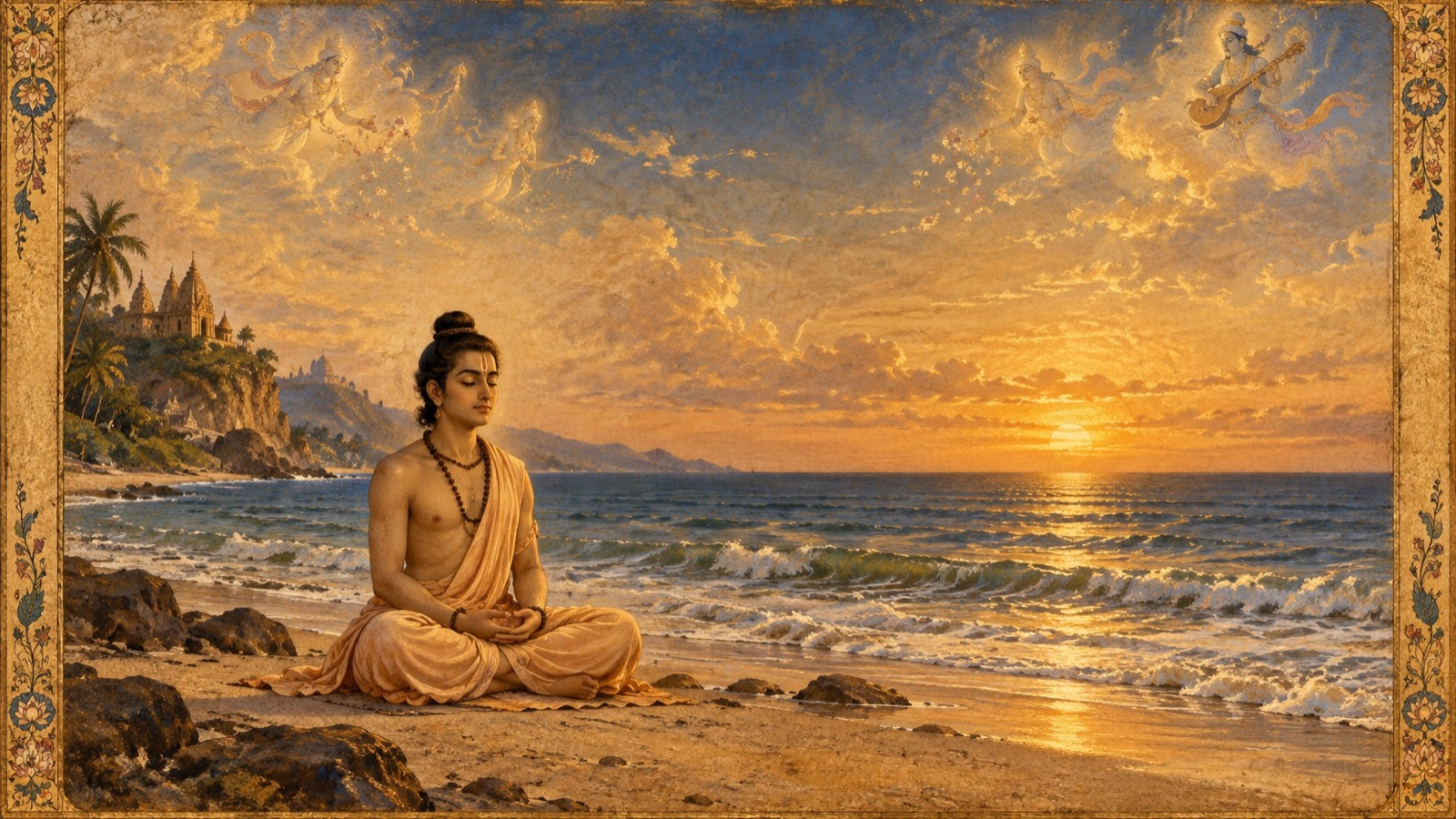
Having taken leave of His mother (Devahuti), Lord Kapila, the great Yogi, proceeded towards the north-east from the hermitage of His father. (verse 33) Duly worshipped and offered an abode by Ocean himself, He continues (there even to this day) in perfect peace of mind, absorbed in deep meditation for the good of all the three worlds, and is (ever) being extolled by Siddhas, Caranas (celestial bards), Gandharvas (celestial musicians) and sages as well as by hosts of Apsaras (celestial nymphs), and praised by the teachers of Sankhya (Asuri and others). (verses 34–35)
This closing image of Kapila is worth sitting with. He does not simply vanish from the narrative once His teaching duty to His mother is discharged; He continues, in an ongoing present tense (“even to this day”), absorbed in meditation “for the good of all the three worlds” — His purpose expanding, quite naturally, from the single soul of His mother to the welfare of the entire creation. The chapter’s account of Kapila’s mission thus closes not with an ending but with a continuation: the Teacher who gave the Sankhya system to His mother remains, in the Bhagavatam’s own telling, still seated in that same meditation, still honored by sages and celestial beings alike.
The Fruit of Hearing This Teaching
The chapter — and with it the entire “Story of Lord Kapila,” spanning ten chapters of the Third Canto — closes with Maitreya turning directly to Vidura, and through him to every reader and listener since, to state plainly what is gained simply by receiving this narration:
I have thus narrated to you, dear and sinless Vidura, what you asked me, viz., the holy dialogue between Lord Kapila and Devahuti (His mother). (verse 36) He who listens to and (similarly) he (too) who expounds this teaching of the (divine) sage Kapila, which is the most secret of all the doctrines teaching the ways and means of God-Realization, is able to fix his mind on Lord Visnu (who bears on His banner an emblem of Garuda, the king of the birds) and attains (proximity) to the Lord’s feet. (verse 37)
This is a fitting close to the entire Kapila-Gita: a teaching that began with a son instructing his mother in the privacy of a forest hermitage ends by declaring that its benefit is not confined to that original audience of one. Whoever hears it, or whoever in turn teaches it to others, participates in the same current of grace that carried Devahuti to Siddhapada — a promise entirely consistent with the very first verses of this chapter, in which Devahuti herself declared that even the name of the Lord, heard or uttered once, purifies completely.
The chapter’s colophon closes the discourse, and the entire canto, with unusual formality: “Thus ends the thirty-third discourse, forming part of the ‘Story of Lord Kapila’, in Book Three of the great and glorious Bhagavata-Purana, otherwise known as the Paramahamsa-Samhita, composed by the sage Vedavyasa and consisting of eighteen thousand Slokas.” Immediately following this colophon, the Gita Press edition prints “END OF BOOK THREE.”
Reflection: A Canto Completes Its Circle
Chapter 33 brings the Third Canto of the Srimad Bhagavatam to a close in a manner that mirrors its own beginning. The canto opened with Vidura, grieving and searching, seeking out Maitreya for instruction; it closes with Devahuti, having received the deepest instruction a mother could ask of a son, transfigured entirely — her grief converted into meditation, her meditation into liberation, her very body into a river of blessing that outlasts her individual life by uncounted ages. Between those two points lies the whole architecture of the Kapila-Gita: the nature of Prakrti and Purusa, the perilous transmigration of the fruitive soul, the two paths of the departed, and finally the declaration that devotion alone reaches the Lord swiftly and directly. What this final chapter demonstrates, more powerfully than any of the philosophical exposition that preceded it, is that the teaching actually works — not merely as doctrine to be understood, but as a path that an ordinary, grieving mother could walk to its very end. Kapila’s own final words to her were not further metaphysics but a simple promise: the easy path. Devahuti believed Him, walked it, and arrived. And Kapila Himself, His mission complete, did not depart from the world altogether but took up a seat by the ocean’s shore, where the Bhagavatam tells us He remains even now, absorbed in meditation for the good of all three worlds — a fitting image with which to close a canto that has, from its very first chapter, been concerned with nothing less than the welfare of the entire creation.
This chapter concludes Canto 3 of the Srimad Bhagavatam in its entirety — thirty-three chapters, from the aftermath of Hiranyaksa’s death and Vidura’s meeting with Maitreya, through the creation account, the story of Kardama and Devahuti, and the complete Kapila-Gita, to Devahuti’s liberation at Siddhapada and Kapila’s retirement to the ocean’s shore. The Srimad Bhagavatam Wisdom series continues from here into Canto 4, which the Gita Press edition opens immediately with the story of the daughters of Swayambhuva Manu. We are grateful to every reader and listener who has walked through the Third Canto with us, and we invite you to continue the journey as the next chapter of this series begins.
Reference
- Primary source: Śrīmad Bhāgavata Mahāpurāṇa (Bhagavata Purana), Gita Press, Gorakhpur — English Complete edition, Book Three, Discourse XXXIII, “Devahūti receives the light of wisdom and attains final beatitude” (final chapter of Book Three)
- Series: Srimad Bhagavatam Wisdom — a chapter-by-chapter devotional journey through the Śrīmad Bhāgavata Mahāpurāṇa
- Presented under the spiritual guidance of: Pandit Dr. Shri Kashinath Mishra
- Series note: This article concludes Canto 3 of the Srimad Bhagavatam. The series continues next with Canto 4, Chapter 1.
Om Namo Bhagavate Vasudevaya.
Jay Shree Madhav