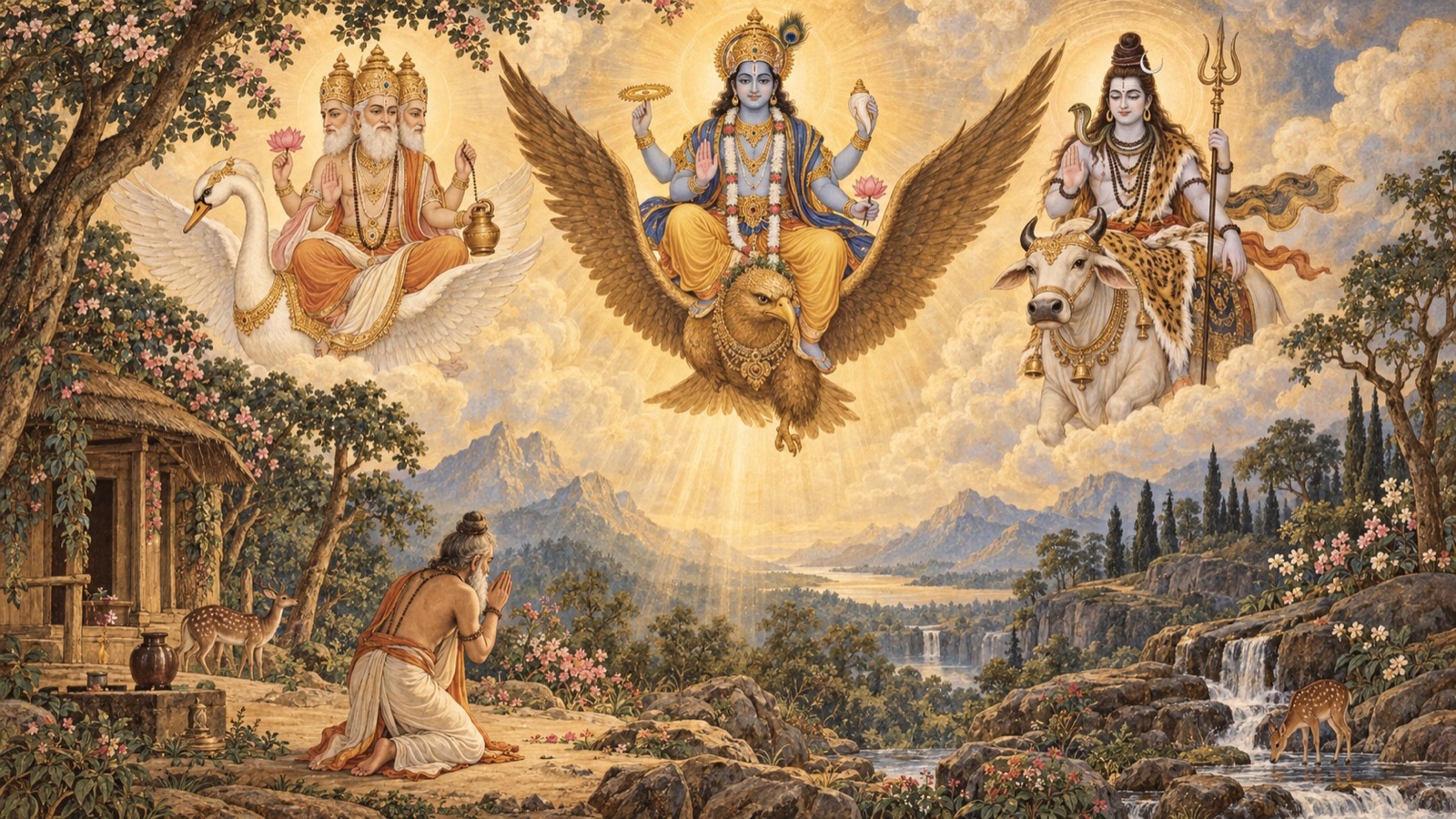
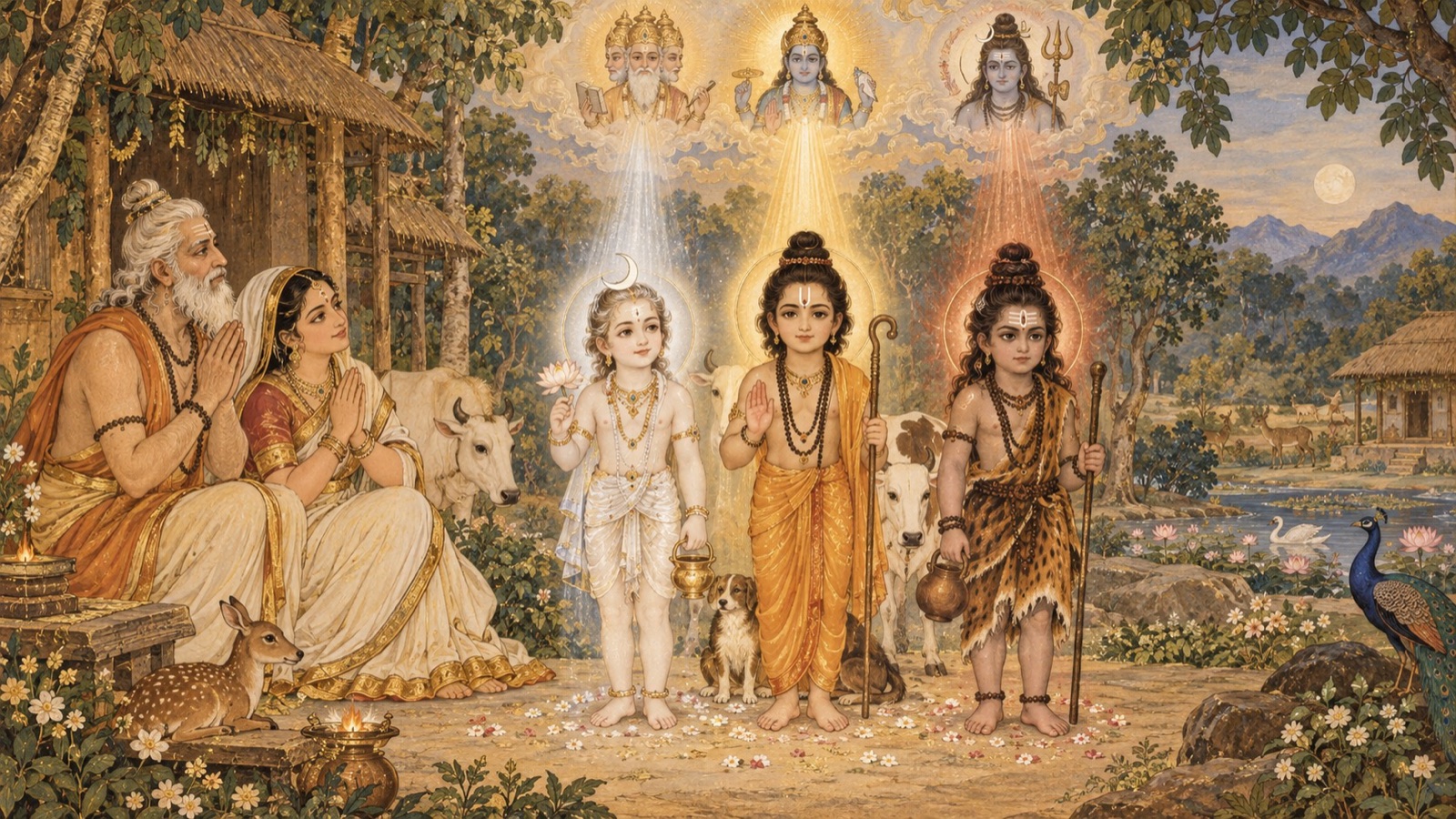
Three streams of divine light converge on a single hermitage: Brahma, Vishnu and Shiva descend together to the forest of sage Atri, and Canto Four opens with the promise of three sons born of the rays of the gods.
Om Namo Bhagavate Vasudevaya.
Om Namo Bhagavate Vasudevaya.
Om Namo Bhagavate Vasudevaya.
Welcome to Srimad Bhagavatam Wisdom, a devotional journey through the sacred histories and teachings of the Srimad Bhagavat Mahapurana. With this chapter we step into Canto Four. Having completed the luminous teaching of Lord Kapila to His mother Devahuti at the close of the Third Canto, the sage Maitreya now turns, at Vidura’s request, to the great river of lineage that flows out from the very first man, Swayambhuva Manu. This opening chapter of Book Four is, on its surface, a genealogy — a careful account of the daughters of Manu and the sages, kings, gods, and demons descended from them. Yet woven through this river of names are moments of pure wonder: the Lord Himself born as the deity of sacrifice, the three great gods descending together to a single forest hermitage, and the appearance on earth of the divine sages Nara and Narayana. Read with a devotee’s eye, this “list of names” becomes a map of how the divine repeatedly enters the world through the households of the pure.
Chapter Information
- Scripture: Śrīmad Bhāgavata Mahāpurāṇa
- Canto: 4 (Book Four)
- Chapter: 1 (Discourse 1)
- Chapter title: The Progeny of Swayambhuva Manu’s Daughters
- Principal speaker: The sage Maitreya, continuing his discourse to Vidura
- Principal listener: Vidura, who interjects with one question about the sage Atri’s household
- Main setting: The hermitage teaching of Maitreya to Vidura, recounting events across the Swayambhuva Manvantara — including the forest of the Riksha mountain, where sage Atri performed penance
- Central subject: The lineages descended from the three daughters of Swayambhuva Manu — Akuti, Devahuti, and Prasuti — including the birth of Lord Yajna, the appearance of the three gods at Atri’s hermitage, and the descent of the divine sages Nara and Narayana
- Principal verse range: Canto 4, Chapter 1, verses 1–66
- Primary edition: Gita Press Śrīmad Bhāgavata Mahāpurāṇa
Three Daughters of the First Man
Maitreya opens Book Four by completing a family picture he had begun earlier. Besides his two mighty sons, Priyavrata and Uttanapada, Swayambhuva Manu also had three daughters through his wife Satarupa. Their names, celebrated in the histories, were Akuti, Devahuti, and Prasuti.
मैत्रेय उवाच मनोस्तु शतरूपायां तिस्र: कन्याश्च जज्ञिरे । आकूतिर्देवहूतिश्च प्रसूतिरिति विश्रुता: ॥ १ ॥
maitreya uvāca manos tu śatarūpāyāṁ tisraḥ kanyāś ca jajñire ākūtir devahūtiś ca prasūtir iti viśrutāḥ
Meaning: Maitreya said: To Manu, through his wife Satarupa, three daughters also were born, well known by the names Akuti, Devahuti, and Prasuti. (Canto 4, Chapter 1, verse 1)
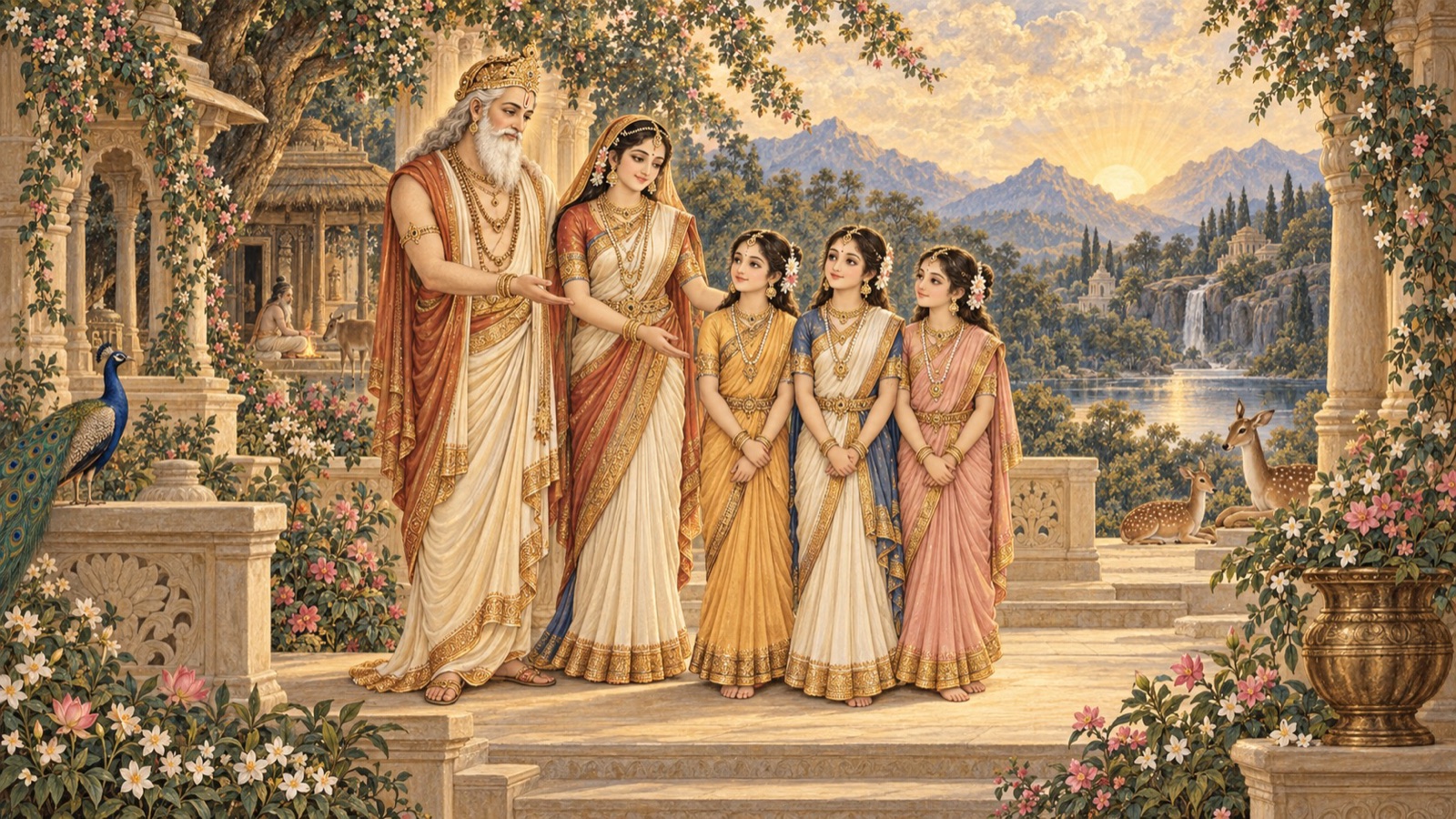
With Satarupa’s agreement, Manu gave his daughter Akuti in marriage to Ruci, one of the lords of created beings — treating her as a putrika, a daughter given on the understanding that her first son would be adopted back by her father, even though Akuti already had two brothers of her own.
The Lord Himself, Born as Sacrifice
What follows is the chapter’s first marvel. The worshipful Ruci, glowing with the spiritual radiance of a true Brahmana, first propitiated the Lord with supreme concentration of mind, and then through Akuti begot a pair of children — a boy and a girl. The boy, Maitreya reveals, was no ordinary child: he was Lord Vishnu Himself, descended in the form of sacrifice and known therefore as Yajna. The girl was Dakshina, a part-manifestation of Lakshmi, the goddess of fortune, inseparable from the Lord. Full of joy, Swayambhuva brought his grandson home as agreed, while Ruci kept Dakshina.
In time Lord Yajna, the very Ruler of all sacrifices, married Dakshina, who longed for Him, and through her He fathered twelve sons — Tosa, Pratosa, Santosa, Bhadra, Santi, Idaspati, Idhma, Kavi, Vibhu, Swahna, Sudeva, and Rocana. These twelve, collectively called the Tushitas, held the office of gods during the reign of Swayambhuva Manu, while the sage Marici and others served as the seven Rishis, and Lord Yajna Himself filled the very seat of Indra. Here already is a quiet teaching: in that first age, God did not merely watch over the world from afar — He personally accepted the burden of ruling it as its Indra.
The Nine Daughters of Kardama and Their Sage Husbands
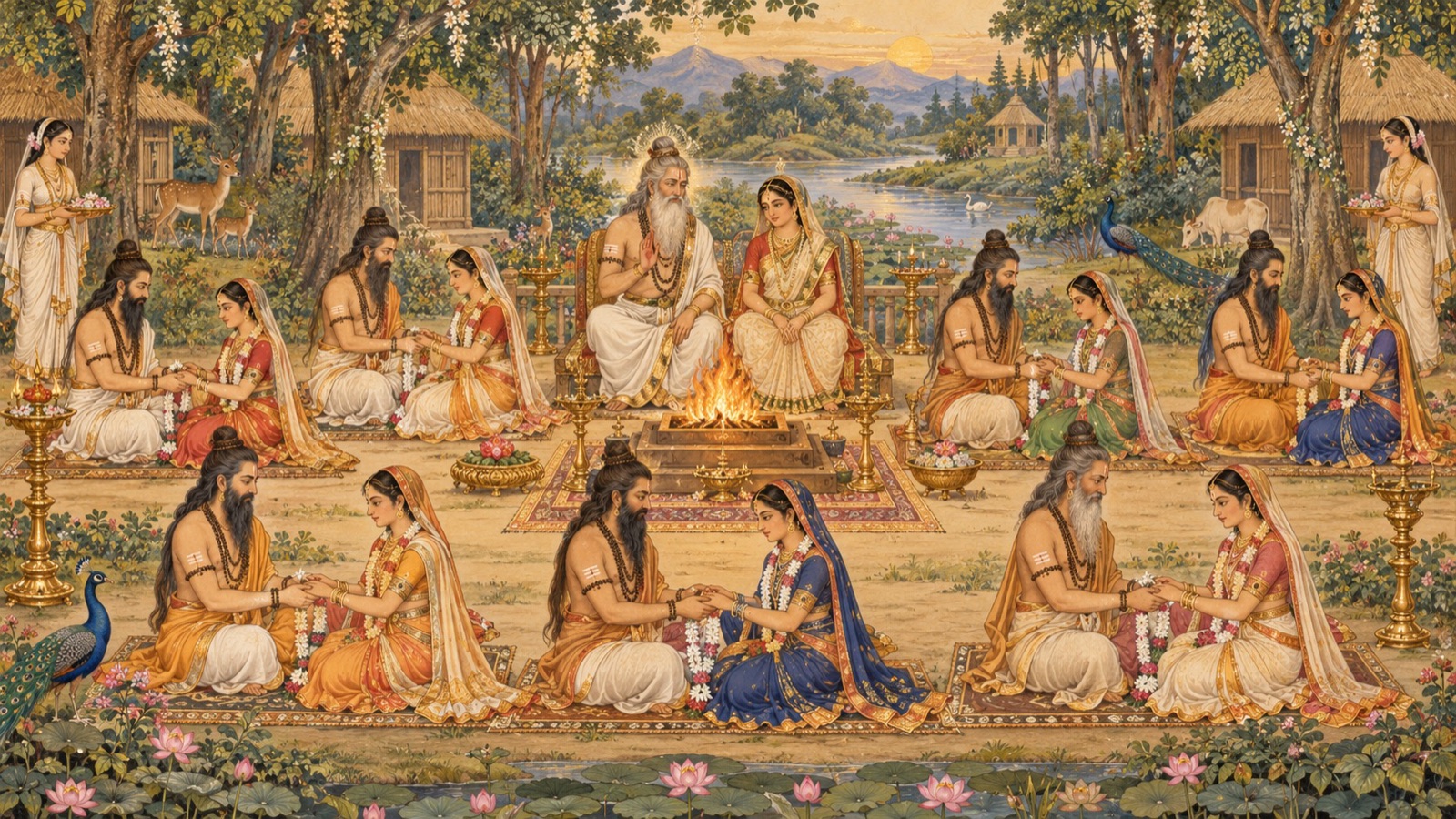
Manu’s second daughter, Devahuti, was given to the sage Kardama — and their story, culminating in the birth of Lord Kapila, had already filled the last chapters of the Third Canto. Here Maitreya simply gestures to it and moves on to the nine daughters born to Kardama and Devahuti, each of whom became the wife of a great Brahmana sage, a mind-born son of Brahma.
Through these nine marriages, whole worlds were peopled. Kardama’s daughter Kala, wife of Marici, bore Kashyapa and Purnima. Anasuya, the wife of the sage Atri, gave birth to three renowned sons — and it is here that Vidura, listening, cannot hold back a question.
अत्रे: पत्न्यनसूया त्रीञ्जज्ञे सुयशस: सुतान् । दत्तं दुर्वाससं सोममात्मेशब्रह्मसम्भवान् ॥ १५ ॥
atreḥ patny anasūyā trīñ jajñe suyaśasaḥ sutān dattaṁ durvāsasaṁ somam ātmeśa-brahma-sambhavān
Meaning: Atri’s wife, Anasuya, gave birth to three famous sons — Datta (Dattatreya), Durvasa, and Soma (the moon-god) — who were born respectively as part-manifestations of Lord Vishnu, Lord Shiva, and Brahma. (Canto 4, Chapter 1, verse 15)
Why the Three Great Gods Came to One Hermitage
Vidura is struck by wonder. How is it, he asks his master, that the three foremost gods — Brahma, Vishnu, and Shiva, who are severally responsible for the creation, preservation, and dissolution of the universe — all appeared together in the house of a single sage?
विदुर उवाच अत्रेर्गृहे सुरश्रेष्ठा: स्थित्युत्पत्त्यन्तहेतव: । किञ्चिच्चिकीर्षवो जाता एतदाख्याहि मे गुरो ॥ १६ ॥
vidura uvāca atrer gṛhe sura-śreṣṭhāḥ sthity-utpatty-anta-hetavaḥ kiñcic cikīrṣavo jātā etad ākhyāhi me guro
Meaning: Vidura said: With what purpose did the foremost of the gods — the causes of the maintenance, creation, and destruction of the universe — take birth in the house of Atri? Explain this to me, O my master. (Canto 4, Chapter 1, verse 16)
Maitreya’s answer is one of the chapter’s most beautiful passages. Urged by Brahma to help populate the creation, the sage Atri retired with his wife to the Riksha mountain, a range clothed in blossoming palasha and ashoka trees and echoing with the sound of the Nirvindhya river falling on the rocks. There he subjugated his mind through breath-control and stood on one foot for a full hundred years, living on air alone, defying cold and heat and every pair of opposites. And throughout that immense austerity a single thought filled his mind: “I take refuge in Him who is the Lord of the whole universe. May He bless me with a son like Himself.”
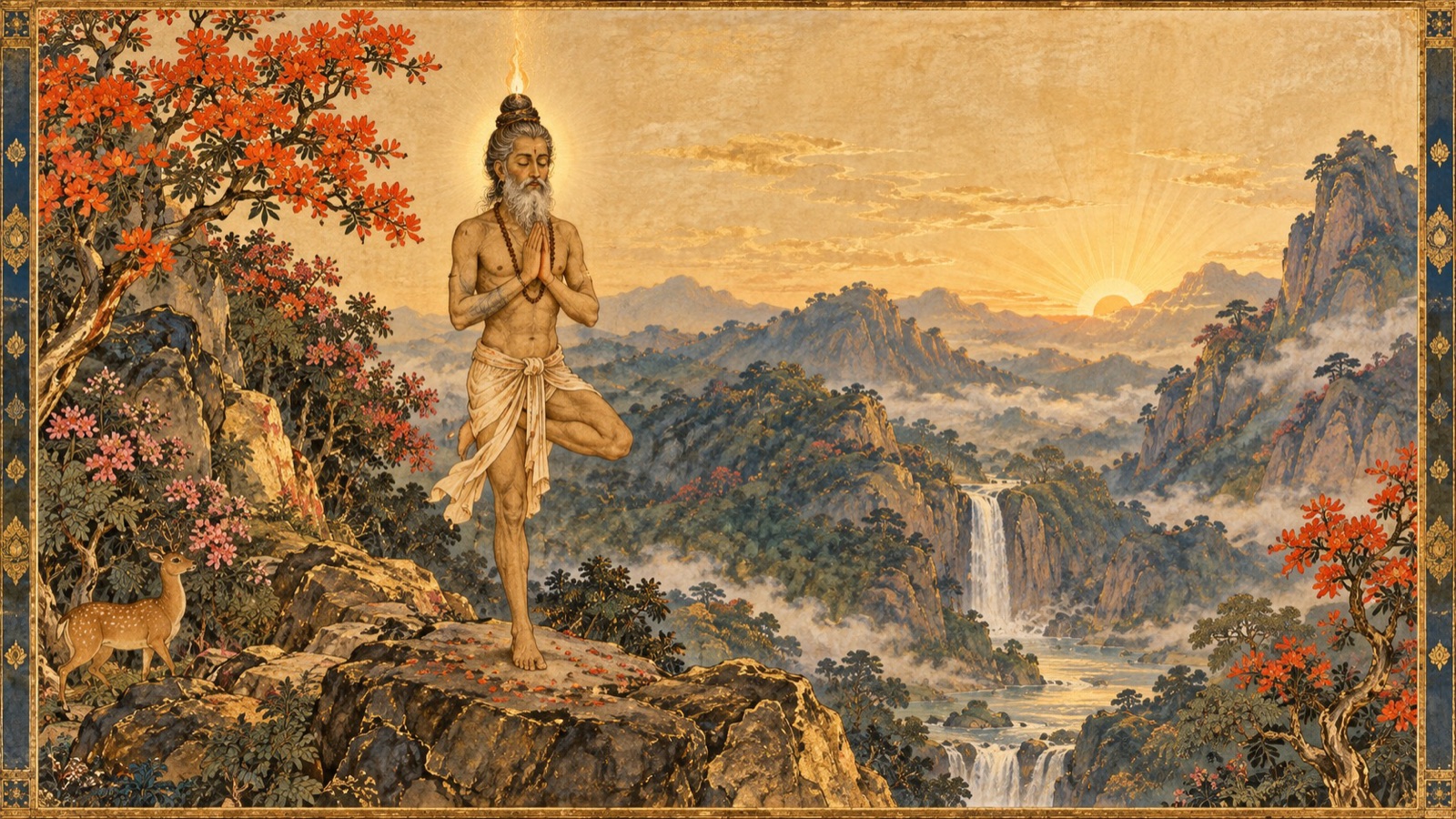
So intense was his penance that the fire of his concentration, rising from the crown of his head, began to torment the three worlds. Seeing this, all three lords — Brahma, Vishnu, and Shiva — came to his hermitage together, their glory sung along the way by celestial nymphs, sages, Gandharvas, and other beings of the higher worlds. His inner darkness flooded with light, Atri saw the three great gods seated upon their carriers — a swan, Garuda, and the bull Nandi — each bearing his own emblem. He fell prostrate, worshipped them with the humble offerings in the hollow of his palms, and, closing his eyes dazzled by their splendour, praised them in sweet and fitting words.
Praised and adored though they were, Atri still did not know which of the three he had actually called, and so, gathering his thoughts, he put his prayer into words.
चेतस्तत्प्रवणं युञ्जन्नस्तावीत्संहताञ्जलि: । श्लक्ष्णया सूक्तया वाचा सर्वलोकगरीयस: ॥ २६ ॥ अत्रिरुवाच विश्वोद्भवस्थितिलयेषु विभज्यमानै- र्मायागुणैरनुयुगं विगृहीतदेहा: । ते ब्रह्मविष्णुगिरिशा: प्रणतोऽस्म्यहं व-स्तेभ्य: क एव भवतां म इहोपहूत: ॥ २७ ॥
cetas tat-pravaṇaṁ yuñjann astāvīt saṁhatāñjaliḥ ślakṣṇayā sūktayā vācā sarva-loka-garīyasaḥ
atrir uvāca
viśvodbhava-sthiti-layeṣu vibhajyamānair māyā-guṇair anuyugaṁ vigṛhīta-dehāḥ te brahma-viṣṇu-giriśāḥ praṇato ‘smy ahaṁ vas tebhyaḥ ka eva bhavatāṁ ma ihopahūtaḥ
Meaning: With his mind now fixed upon them, Atri folded his hands and, in soft and reverent words, praised the three most honoured of all beings: “You have divided yourselves into three forms through the modes of nature, age after age, for the creation, preservation, and dissolution of this universe — Brahma, Vishnu, and Shiva. I bow before all three of you. Yet tell me: of the three of you, which one, exactly, have I called?” (Canto 4, Chapter 1, verses 26–27)
He pressed the question further, for he had prayed to only the one Lord of the universe, desiring a son like Him and thinking of Him alone — yet the Lord is beyond all mental speculation, and now three had answered his single call; in genuine bewilderment, he begged to know why.
Maitreya tells Vidura what happened next: hearing Atri speak this way, the three deities smiled and replied to him in the sweetest of words.
देवा ऊचु: यथा कृतस्ते सङ्कल्पो भाव्यं तेनैव नान्यथा । सत्सङ्कल्पस्य ते ब्रह्मन् यद्वै ध्यायति ते वयम् ॥ ३० ॥
devā ūcuḥ yathā kṛtas te saṅkalpo bhāvyaṁ tenaiva nānyathā sat-saṅkalpasya te brahman yad vai dhyāyati te vayam
Meaning: The gods replied: O Brahmana, exactly as you have resolved, so it shall come to pass, and not otherwise — for your resolve is unfailingly true. We three are none other than that very Being upon whom you have been meditating. (Canto 4, Chapter 1, verse 30)
Look closely at what Atri had actually asked for. He had not prayed for the Lord Himself to come and remain with him — he had prayed only for a son “like” Him (verse 20). By the strict measure of pure devotion, this was still a personal wish, not the desireless surrender of a perfected soul. Yet the three gods did not weigh that wish and find it too small; they answered it exactly, and with an open hand — granting not sons who merely resembled the Lord, but sons carrying the actual rays of Brahma, Vishnu, and Shiva. Here is this chapter’s quiet theology: the Lord measures a prayer not by how spiritually advanced the request is, but by the sincerity and single-pointedness with which it is held. Whatever the heart fixes upon with unwavering resolve, the Lord in His mercy supplies — and supplies it in full.
Three Sons Born of Divine Rays
The gods kept their word. The moon-god Soma was born from a portion of Brahma; Dattatreya, a master of yoga, appeared from a ray of Lord Vishnu; and the sage Durvasa came forth as a portion of Lord Shiva.
सोमोऽभूद्ब्रह्मणोंऽशेन दत्तो विष्णोस्तु योगवित् । दुर्वासा: शङ्करस्यांशो निबोधाङ्गिरस: प्रजा: ॥ ३३ ॥
somo ‘bhūd brahmaṇo ‘ṁśena datto viṣṇos tu yogavit durvāsāḥ śaṅkarasyāṁśo nibodhāṅgirasaḥ prajāḥ
Meaning: Soma was born of a portion of Brahma, Dattatreya the knower of yoga from Lord Vishnu, and Durvasa from a portion of Lord Shankara (Shiva). Now hear of the progeny of the sage Angira. (Canto 4, Chapter 1, verse 33)
A River of Sages, Kings, and Demons
From Atri’s household Maitreya carries Vidura down the widening branches of the family tree. From the sage Angira’s wife Sraddha came four daughters and, in time, the great preceptor of the gods, Brihaspati. From Pulastya descended the sage Agastya and, through his line, both the treasure-lord Kubera and the world-renowned Ravana, Kumbhakarna, and Vibhishana. Pulaha and Kratu fathered saintly sons, and Kratu’s wife alone brought forth the sixty thousand tiny, radiant sages known as the Valakhilyas. Vasishtha had seven pure-hearted Brahmana sons; from Atharva’s line came Dadhichi; and from the illustrious Bhrgu came his sons Dhata and Vidhata, a daughter named Sri devoted to the Lord, and — through his son Kavi — the sage Ushana, better known as Shukracharya, preceptor of the demons. The sage Markandeya, too, springs from this line. Before turning to Manu’s third daughter, Maitreya pauses to give Vidura a direct blessing.
त एते मुनय: क्षत्तर्लोकान्सर्गैरभावयन् । एष कर्दमदौहित्रसन्तान: कथितस्तव ॥ ४६ ॥ शृण्वत: श्रद्दधानस्य सद्य: पापहर: पर: । प्रसूतिं मानवीं दक्ष उपयेमे ह्यजात्मज: ॥ ४७ ॥
ta ete munayaḥ kṣattar lokān sargair abhāvayan eṣa kardama-dauhitra- santānaḥ kathitas tava
śṛṇvataḥ śraddadhānasya sadyaḥ pāpa-haraḥ paraḥ prasūtiṁ mānavīṁ dakṣa upayeme hy ajātmajaḥ
Meaning: O Vidura, all these sages, together with Kardama’s daughters, have filled the three worlds with their offspring — this is the dynasty I have now described for you. Whoever hears it with true faith is at once cleansed of sin. Turn now your attention to what became of Manu’s third daughter. (Canto 4, Chapter 1, verses 46–47)
Prasuti, Daksha, and the Descent of Nara and Narayana
Manu’s youngest daughter, Prasuti, was given to Daksha, another mind-born son of Brahma, and through her he begot sixteen lovely daughters. Thirteen of them Daksha gave to Dharma, the god of piety; one to Agni, the fire-god; one to the assembled Pitris (the manes); and the last, Sati, to Lord Shiva, the cutter of worldly bonds.
Dharma’s thirteen wives bear names that are themselves virtues — Sraddha (faith), Maitri (friendliness), Daya (compassion), Santi (peace), Tushti (contentment), Pushti (nourishment), and others — and their children are further embodiments of goodness, such as well-being, fearlessness, happiness, and peace of mind. But the crown of this lineage is the last: Dharma’s wife Murti, a mine of all virtues, gave birth to the divine sages Nara and Narayana. At their descent the whole world rejoiced; the winds, rivers, and mountains grew calm, celestial instruments played, flowers rained from the sky, and Brahma and all the gods sang the Lord’s praises.
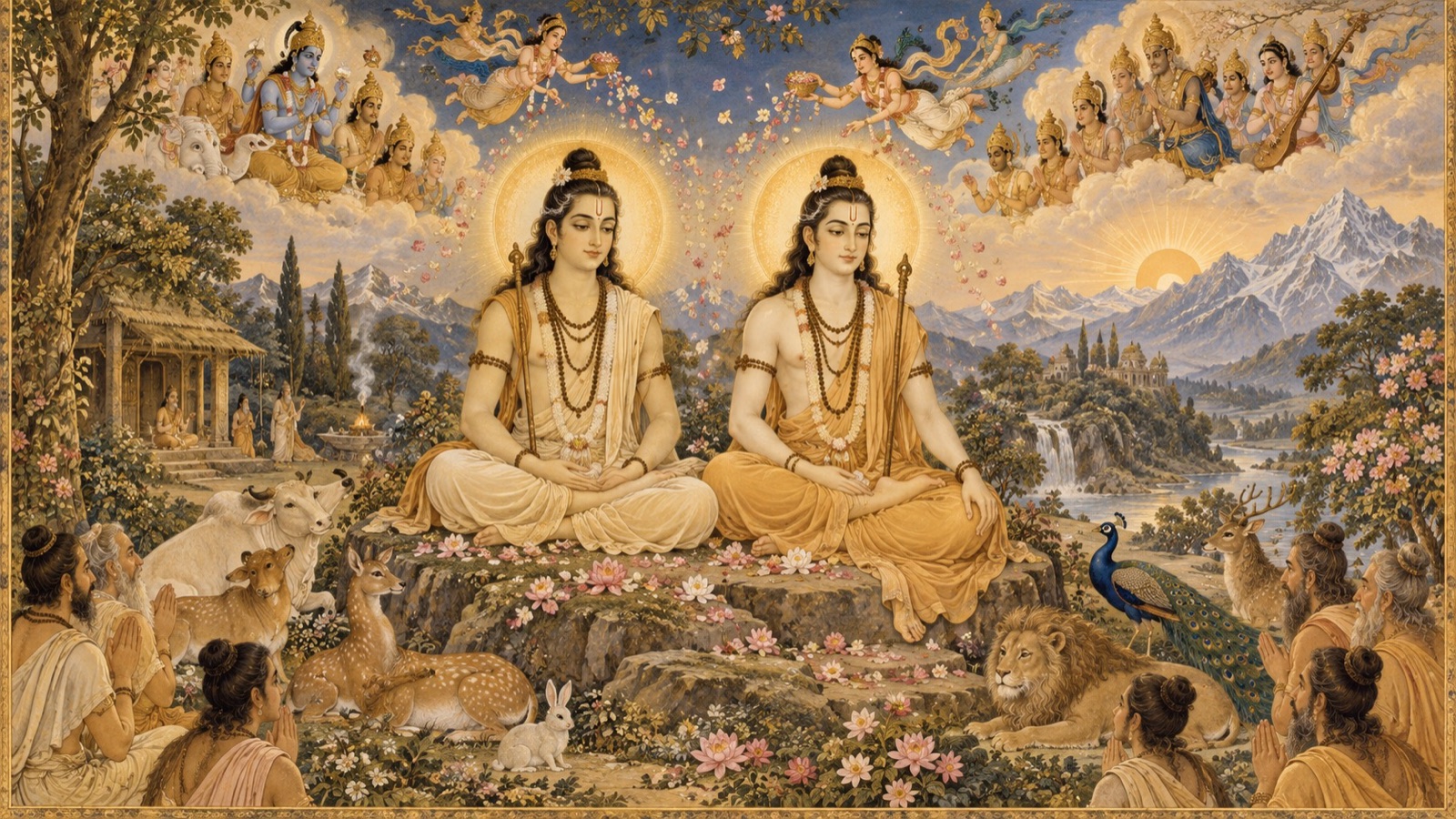
Brahma and the assembled gods then lifted their voices, glorifying the very Person behind this whole display of creation, who now stood before them in the house of Dharma as the two sage-brothers.
देवा ऊचु: यो मायया विरचितं निजयात्मनीदं खे रूपभेदमिव तत्प्रतिचक्षणाय । एतेन धर्मसदने ऋषिमूर्तिनाद्य प्रादुश्चकार पुरुषाय नम: परस्मै ॥ ५६ ॥
devā ūcuḥ yo māyayā viracitaṁ nijayātmanīdaṁ khe rūpa-bhedam iva tat-praticakṣaṇāya etena dharma-sadane ṛṣi-mūrtinādya prāduścakāra puruṣāya namaḥ parasmai
Meaning: The demigods prayed: We bow to that Supreme Person who has fashioned this cosmic manifestation out of His own being — as varied shapes appear and dissolve in the open sky — and who has now, in the house of Dharma, made Himself visible to us in the form of these two sage-brothers. (Canto 4, Chapter 1, verse 56)
They asked for nothing for themselves but His merciful glance — more beautiful, they said, than the spotless lotus that cradles the goddess of fortune — so that the calamities still threatening the newly created world might be turned aside (verse 57). Maitreya tells Vidura that the Lord did indeed bless the gods with such a glance, and then withdrew to Gandhamadana Hill.
These two, Maitreya tells Vidura, are part-manifestations of Sri Hari Himself — and it is they who later appeared in the world, to relieve the earth of its burden, as Sri Krishna, the ornament of the Yadus, and Arjuna, the foremost of the Kurus.
ताविमौ वै भगवतो हरेरंशाविहागतौ । भारव्ययाय च भुव: कृष्णौ यदुकुरूद्वहौ ॥ ५९ ॥
tāv imau vai bhagavato harer aṁśāv ihāgatau bhāra-vyayāya ca bhuvaḥ kṛṣṇau yadu-kurūdvahau
Meaning: These two, indeed, are part-manifestations of the Lord Sri Hari, come into this world to remove the earth’s burden — the two Krishnas, the foremost of the Yadus and the Kurus (Sri Krishna and Arjuna). (Canto 4, Chapter 1, verse 59)
The Fire-Gods, the Manes, and a Shadow of Grief to Come
Maitreya closes the chapter by accounting for two more sacred lineages. Through Swaha, the consort of the fire-god, were born three fire-deities — Pavaka, Pavamana, and Suci — from whom, in turn, sprang forty-five more, so that with their fathers and grandfather they make up the forty-nine sacred fires invoked by name in Vedic sacrifices. And Swadha, given to the Pitris, became the common consort of the four orders of manes.
The chapter ends on a quiet, ominous note that will open the next. Sati, Daksha’s youngest daughter and the beloved consort of Lord Shiva, was wholly devoted to her husband — yet, while still very young, she gave up her own body by the power of yoga, in indignation at her father Daksha’s causeless hostility toward Lord Shiva.
भवस्य पत्नी तु सती भवं देवमनुव्रता । आत्मन: सदृशं पुत्रं न लेभे गुणशीलत: ॥ ६५ ॥
bhavasya patnī tu satī bhavaṁ devam anuvratā ātmanaḥ sadṛśaṁ putraṁ na lebhe guṇa-śīlataḥ
Meaning: Sati, the wife of Bhava (Lord Shiva) and wholly devoted to him, did not obtain a son equal to herself in virtue and character. (Canto 4, Chapter 1, verse 65)
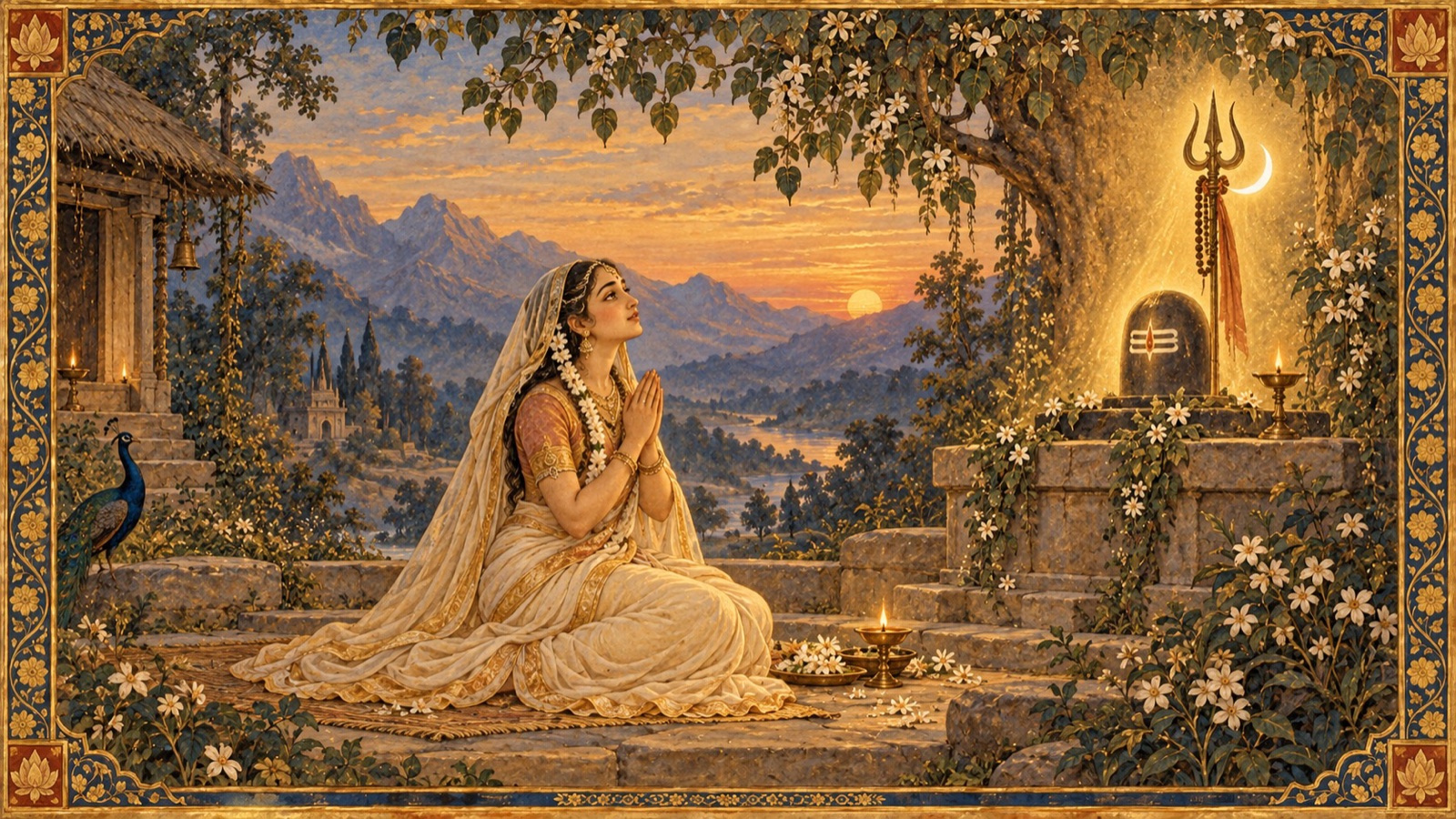
With that shadow of coming grief, the first discourse of Book Four closes — a river of lineage that has carried us from the daughters of the first man all the way to the promise of Krishna Himself, and to the doorstep of the great tragedy of Daksha and Sati.
Principal Teachings of This Chapter
1. The divine enters the world through pure households. Again and again — as Lord Yajna through Akuti, as three great sons through Atri and Anasuya, as Nara and Narayana through Dharma and Murti — the Lord and His powers descend not into palaces of pride but into homes of penance and devotion (verses 3-4, 15, 52-53).
2. Sincere resolve is answered exactly. Atri prayed for a son “like the Lord of the universe,” and the gods told him plainly: “As you willed, so precisely it shall be.” A pure, single-pointed prayer does not go unheard (verses 20, 30).
3. The one Truth wears three faces, and answers exactly what is asked. Atri worshipped one Supreme Lord without knowing His form; all three gods appeared, declaring themselves to be that single Being on whom he had fixed his heart, and promising that his resolve, being true, could not fail to bear fruit. Creation, preservation, and destruction may wear three faces, but behind them stands one undivided Reality (verses 27-30).
4. Even hearing sacred lineage purifies. Maitreya says that listening with reverence to this account of holy descendants is itself a swift means of washing away sin — for to dwell on the lives of the pure is to be drawn toward purity (verse 46).
5. Devotion asks nothing for itself, not even a worthy son. Sati was perfectly devoted to Lord Shiva yet received no son equal to herself, and still her love never wavered — a quiet foreshadowing of the selfless devotion the next chapters will test (verses 65-66).
A Devotional Reflection
It is tempting to skim a chapter of names and move on, as though the “real” scripture begins only when the stories start. But pause over what these names are actually recording. This is the family tree of a world in which God keeps arriving — as the deity of sacrifice in one home, as three sons of divine light in another, as the twin sages who will one day be Krishna and Arjuna in a third. The genealogy is not a dry register; it is testimony that the divine is never far from human households, that it is drawn, like water finding its level, toward wherever there is real devotion. Atri asked for only one thing across a hundred years of standing on a single foot — a child like the Lord — and heaven bent down to a forest hermitage to answer him. When we wonder whether our own small prayers are heard, this chapter answers gently: the same Lord who filled Atri’s darkened eyes with light still listens, and still comes, wherever the heart is turned sincerely toward Him.
A Daily Devotional Practice
Today, follow Atri’s example of single-pointed prayer. Choose one sincere aspiration of the heart — not for possessions, but for something worthy, such as steadiness in devotion, patience with a difficult person, or the well-being of your family. Sit quietly for a few minutes, still your breath, and offer that one prayer to the Lord with full attention, repeating: “Om Namo Bhagavate Vasudevaya.” Let the practice teach you what Atri knew — that a prayer offered with a truthful, undivided heart is already being answered.
Conclusion
The first chapter of the Fourth Canto opens the book not with a battle or a sermon but with a river — the widening current of lineage that flows from Swayambhuva Manu’s three daughters out into all the worlds. Within that current shine the chapter’s true jewels: the Lord Himself born as Yajna to grace a devotee’s home; the three great gods descending together to answer the century-long penance of a single sage; and the appearance of Nara and Narayana, who would one day walk the earth as Krishna and Arjuna. And at its close, in the brief, sorrowful mention of Sati, the chapter quietly lifts the curtain on the drama to come. Maitreya’s message to Vidura, and to us, is unmistakable: the divine is endlessly willing to enter this world, and it does so wherever it finds a household purified by devotion and penance.
May the divine wisdom of Srimad Bhagavatam awaken pure devotion within our hearts.
Om Namo Bhagavate Vasudevaya.
Jay Shree Madhav.
References and Attribution
- Primary edition: Gita Press, Śrīmad Bhāgavata Mahāpurāṇa (English, complete), Book Four, Discourse 1.
- Series: Srimad Bhagavatam Wisdom · Biswa Sanatan Dharma Seva Trust.
- Presented following the spiritual guidance and recommendation of Pandit Dr. Shri Kashinath Mishra.
This is an original, faithful retelling in the writer’s own words, with brief quoted verses shown in Devanāgarī and transliteration and their meanings given as summaries. It is not a reproduction of any single publisher’s continuous translation or commentary. No affiliation with or endorsement by any publisher is implied.
Jay Shree Madhav