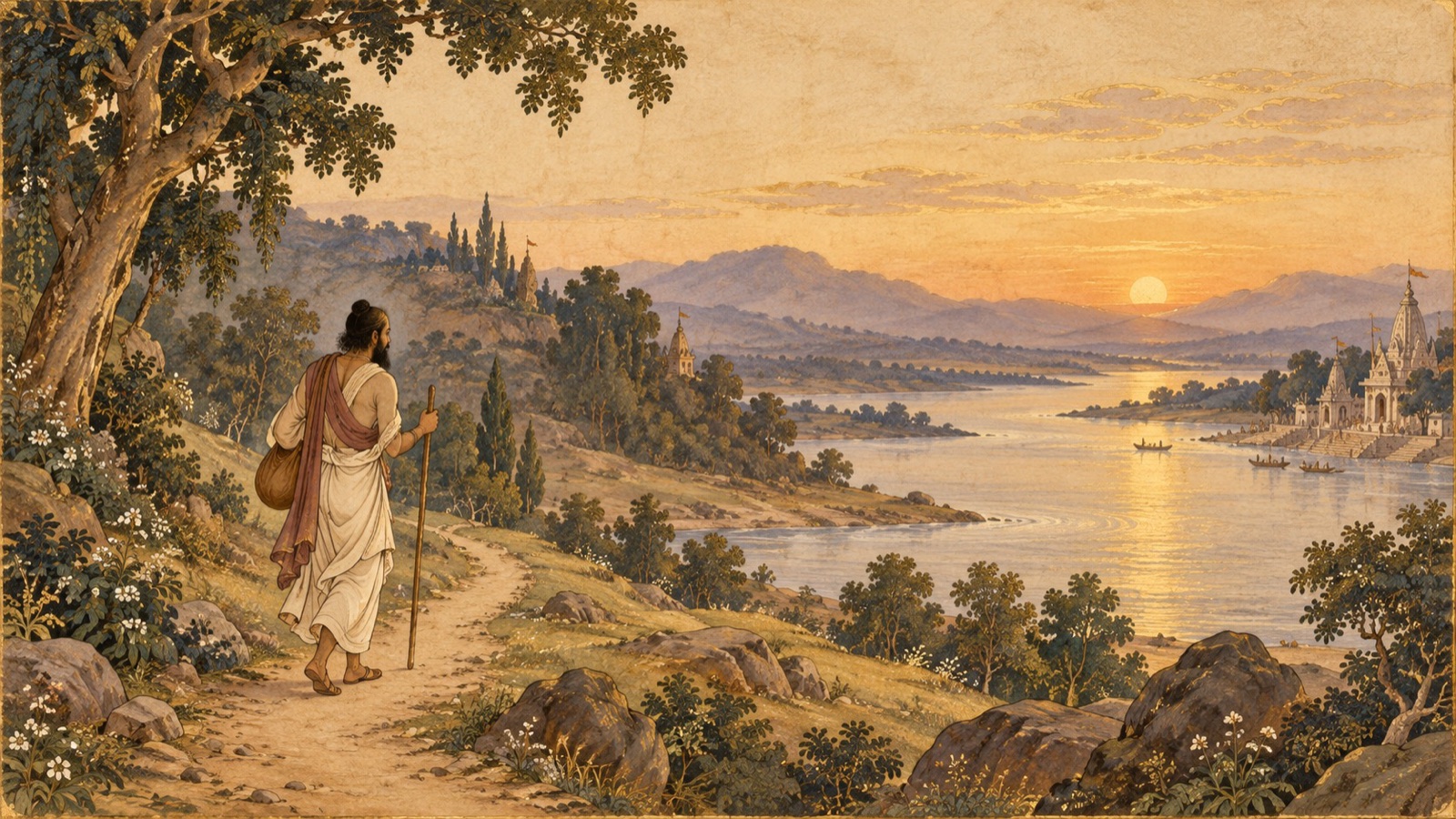
At Haridwara, where the celestial Ganga first touches the plains, a grieving Vidura finally puts his deepest question to the sage Maitreya — and receives, in reply, nothing less than the story of how this entire universe first came to be.
Om Namo Bhagavate Vasudevaya.
Om Namo Bhagavate Vasudevaya.
Om Namo Bhagavate Vasudevaya.
Welcome to Srimad Bhagavatam Wisdom, a devotional journey through the sacred histories and teachings of the Srimad Bhagavat Mahapurana. With this fifth discourse of Book Three, the narration turns a corner. Uddhava’s long account to Vidura — of Krishna’s Vrindavan childhood, of Kamsa’s fall, of the Mahabharata war, of the Yadus’ coming end — has closed. Vidura, still restless, still searching, has traveled onward and now stands before a new teacher: the sage Maitreya, seated at Haridwara where the sacred Ganga descends from heaven into the plains. What follows is one of the most important philosophical turns in the entire Bhagavatam. Vidura does not ask for more stories. He asks, instead, the deepest question a suffering soul can ask — how does one find real and lasting happiness? — and Maitreya’s answer opens, verse by verse, into nothing less than an account of how the entire universe itself came into being: from the Lord alone, existing before anything else, through Maya, the Mahat-tattva, the threefold ego, and the five great elements, all the way to the moment the newly created guardian deities of the universe, unable to complete the work of creation on their own, fold their hands and pray to the Lord for the vision and the power to finish what only He can truly begin.
Chapter Information
- Scripture: Śrīmad Bhāgavata Mahāpurāṇa
- Canto: 3 (Book Three)
- Chapter: 5 (Discourse 5)
- Chapter title: As given in the heading above, following the Gita Press primary edition; the other edition’s title for this chapter differs (see Verification Notes below)
- Principal speakers: Vidura (questioner) and the sage Maitreya (respondent) — the whole conversation related by Sri Suka (Sukadeva Gosvami) to King Parikshit
- Principal listener within the chapter’s frame: Vidura; and, in the outer frame, King Parikshit and, beyond him, the sages of Naimisharanya
- Main setting: Haridwara, the point where the celestial river Ganga descends into the plains of the earth
- Central subject: Vidura’s question about the path to true happiness and about the process by which the Lord creates, maintains and withdraws the universe; Maitreya’s opening reply, describing the pre-creation state of the Lord alone, the appearance of Maya, the Purusa, the Mahat-tattva, the threefold ego, the five gross elements, and the newly created deities’ prayer to the Lord for the power to complete creation
- Principal verse range: Canto 3, Chapter 5, verses 1–50 (Gita Press numbering)
- Primary edition: Gita Press Śrīmad Bhāgavata Mahāpurāṇa
Vidura Arrives at Haridwara
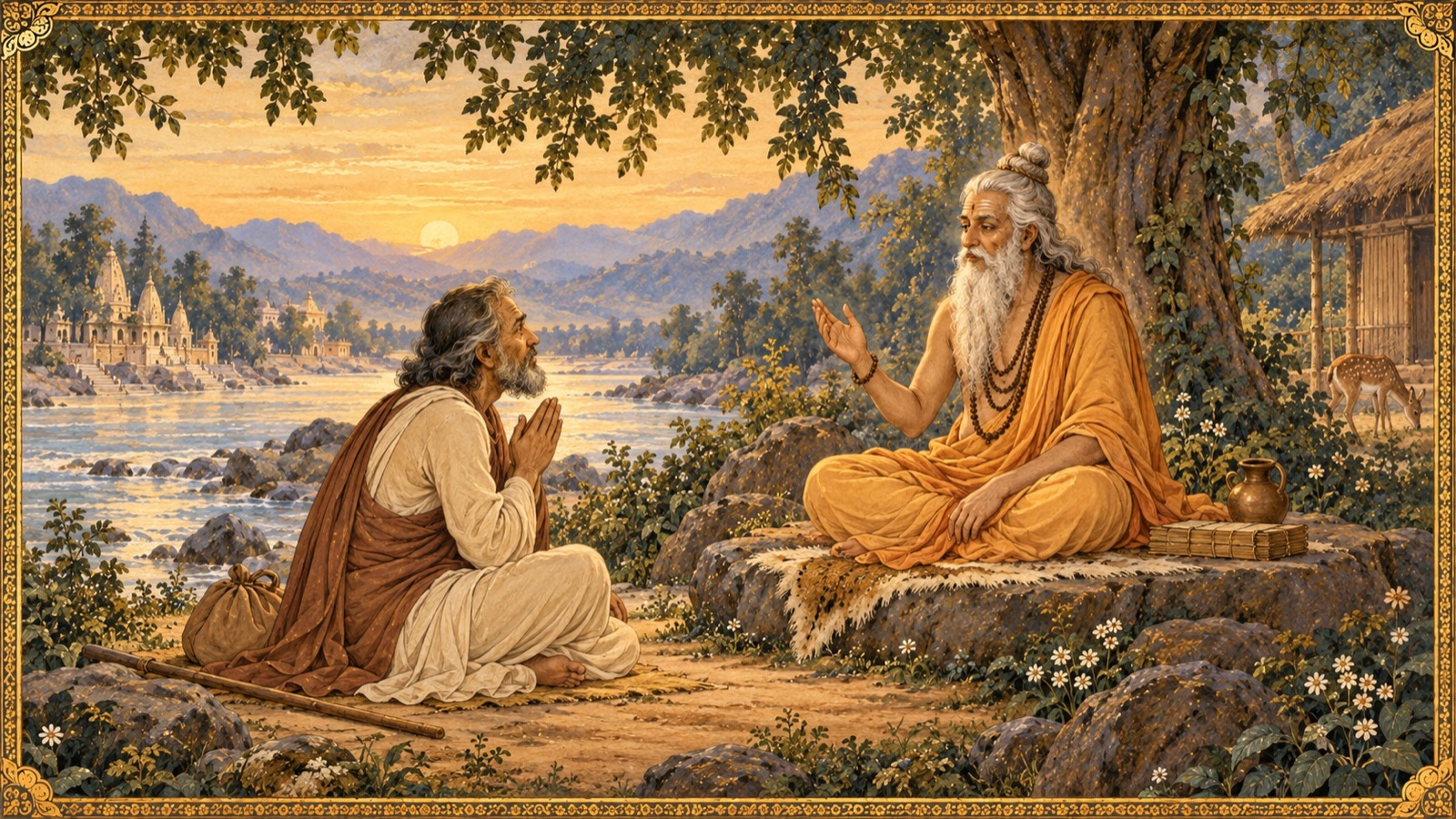
The chapter opens quietly, almost like the turning of a page. Sri Suka tells King Parikshit that Vidura — “the foremost of the Kurus,” his heart long since purified by devotion to the imperishable Lord Sri Krsna — has made his way to Haridwara, the place where the Ganga first descends from the celestial regions into the world of mortals. There he finds Maitreya, a sage of fathomless wisdom, seated in that holy place. Pleased by Vidura’s evident gentleness and virtue, Maitreya receives him, and Vidura puts to him the question that has evidently been forming in his heart through everything narrated in the previous four discourses.
श्री शुक उवाच । द्वारि द्युनद्या ऋषभ: कुरूणां मैत्रेयमासीनमगाधबोधम् । क्षत्तोपसृत्याच्युतभावसिद्ध: पप्रच्छ सौशील्यगुणाभितृप्त: ॥ १ ॥
śrī-śuka uvāca dvāri dyu-nadyā ṛṣabhaḥ kurūṇāṁ maitreyam āsīnam agādha-bodham kṣattopasṛtyācyuta-bhāva-siddhaḥ papraccha sauśīlya-guṇābhitṛptaḥ
Meaning: Sri Suka continued: Vidura, the foremost of the Kurus, whose heart was purified by devotion to the imperishable Lord Sri Krsna, approached the sage Maitreya of fathomless wisdom, who was staying at Haridwara, and, gratified by his good disposition and other virtues, asked him the following question. (Canto 3, Chapter 5, verse 1)
Vidura’s Question: Why Does Ordinary Action Never Bring Peace?
Vidura begins, not with a request for more narrative, but with an honest confession of the world’s condition. People labor for happiness, he observes, yet the labor itself never delivers what it promises — no one, through fruitive action alone, ever attains lasting happiness or brings their sorrow to an end. On the contrary, such action only breeds more suffering, again and again. It is a striking place to begin a chapter that will end in cosmology: Vidura’s spiritual crisis is entirely practical, born from watching the world’s endless, fruitless striving.
He offers Maitreya a reason to hope even in the midst of this bleak observation: the blessed devotees of the Lord Janardana move through the world precisely in order to show mercy to those who, through misfortune, have turned their faces away from Sri Krsna and fallen into unrighteousness and misery. It is, in effect, Vidura’s quiet request that Maitreya be one such devotee for him — that he point out “that blessed path” by which people succeed in propitiating the Lord, so that the Lord Himself may come to dwell, purified by devotion, in the seeker’s own heart and bestow there the most ancient wisdom, the wisdom that brings the realization of Truth.
Vidura’s Larger Question: How Does the Actionless Lord Create?
Having asked for the path of devotion, Vidura widens his question into something far larger. What, he asks, does the Lord — the Ruler of all three worlds, absolutely independent — actually do when He descends into the world of matter? How, though Himself actionless, does He bring forth this entire universe at the dawn of creation? How, having established the universe on a firm footing, does He provide the very means of subsistence for all the beings within it? And then — in a rhythm that will recur throughout the Bhagavatam’s cosmology — how does He, having in due course withdrawn the universe back into the cavity of His own heart, retire into communion with His own Yogamaya, only to create it all over again and enter it once more, this time as the Inner Controller, appearing though one in an endless diversity of forms?
Vidura is not finished. He wants also to hear of the Lord’s Avataras — the exploits performed, seemingly as mere sport, for the well-being of the Brahmanas, the cows, and the gods across His many descents into the world of matter; he confesses that his mind never feels sated, however much he hears of these nectar-like stories. And he presses further still, asking how the suzerain Lord created the different worlds and their guardian deities, along with the dark regions lying beyond the mountain called Lokaloka, and how the self-existent Lord Narayana, the Maker of the universe, endowed every created being with its own distinctive disposition, activity, form and name.
A footnote preserved in the primary edition explains the term Lokaloka: a belt or circle of mountains surrounding the outermost of the seven seas, dividing the visible world from the region of darkness beyond — since the sun’s light falls only within this ring of mountains, one side is illuminated and the other lies in shadow.
“I Am Fed Up With All Other Dharmas”: Vidura’s Confession of Devotion
What follows is one of the most personally revealing passages Vidura speaks in the entire Bhagavatam. He tells Maitreya that he has, in his time, heard a great deal from the lips of the sage Vyasa himself about the duties proper to the higher, twice-born classes of men as well as to the lower classes. And yet, he says plainly, he is now fed up with all of these other Dharmas — conducive though they may be to trivial joys — because he has found his sole delight in the stream of nectar that flows from the stories of Sri Krsna.
He goes further, offering a small but piercing teaching of his own: who, he asks, can ever be sated with the stories of Sri Krsna, whose feet are the abode of all sanctity, sung with praise by seers such as Narada in assemblies like this one? For those stories, entering the cavity of a man’s ears, cut asunder the very bond of attachment to home and household that otherwise throws a soul into the whirlpool of metempsychosis, the endless cycle of birth and death.
It is in this context that Vidura makes a remarkable observation about the Mahabharata itself. It was, he says, with the very intention of recounting the Lord’s virtues that the sage Krsna Dwaipayana — Vedavyasa, Vidura’s own friend — composed that great epic. For even there, while human beings apparently dwell on the pleasures of sense throughout its many stories, their minds are ultimately drawn, again and again, toward the stories of Sri Hari woven through it.
That attraction, Vidura continues, when it grows in a devout heart, creates a natural aversion to lesser things, and it speedily ends all the sorrows of the one who has tasted the joy that flows from constant remembrance of Sri Hari’s feet. By contrast, he says, he deplores those ignorant men who, because of their sin, have developed a dislike for the stories of Sri Hari — men so pitiable that even the pitiable might pity them, since the deity presiding over time cuts short, moment by moment, the allotted span of their lives, spent as they are entirely in idle talk, idle activity and idle thought.
And so Vidura arrives at his central appeal: “Therefore, O Maitreya, son of Kusaru, friend of the afflicted, even as a bee gathers honey from the flowers, so be pleased to extract the essence of all stories in the shape of the stories of Sri Hari, the Bestower of blessedness and the Abode of sacred renown, and relate the same to me for my good.” He closes his opening address by asking, once more, to hear the superhuman feats the Lord performs when He descends into the world of matter, assuming His energy known as Maya for the sake of the creation, preservation and dissolution of the universe.
Maitreya Honors Vidura Before He Answers
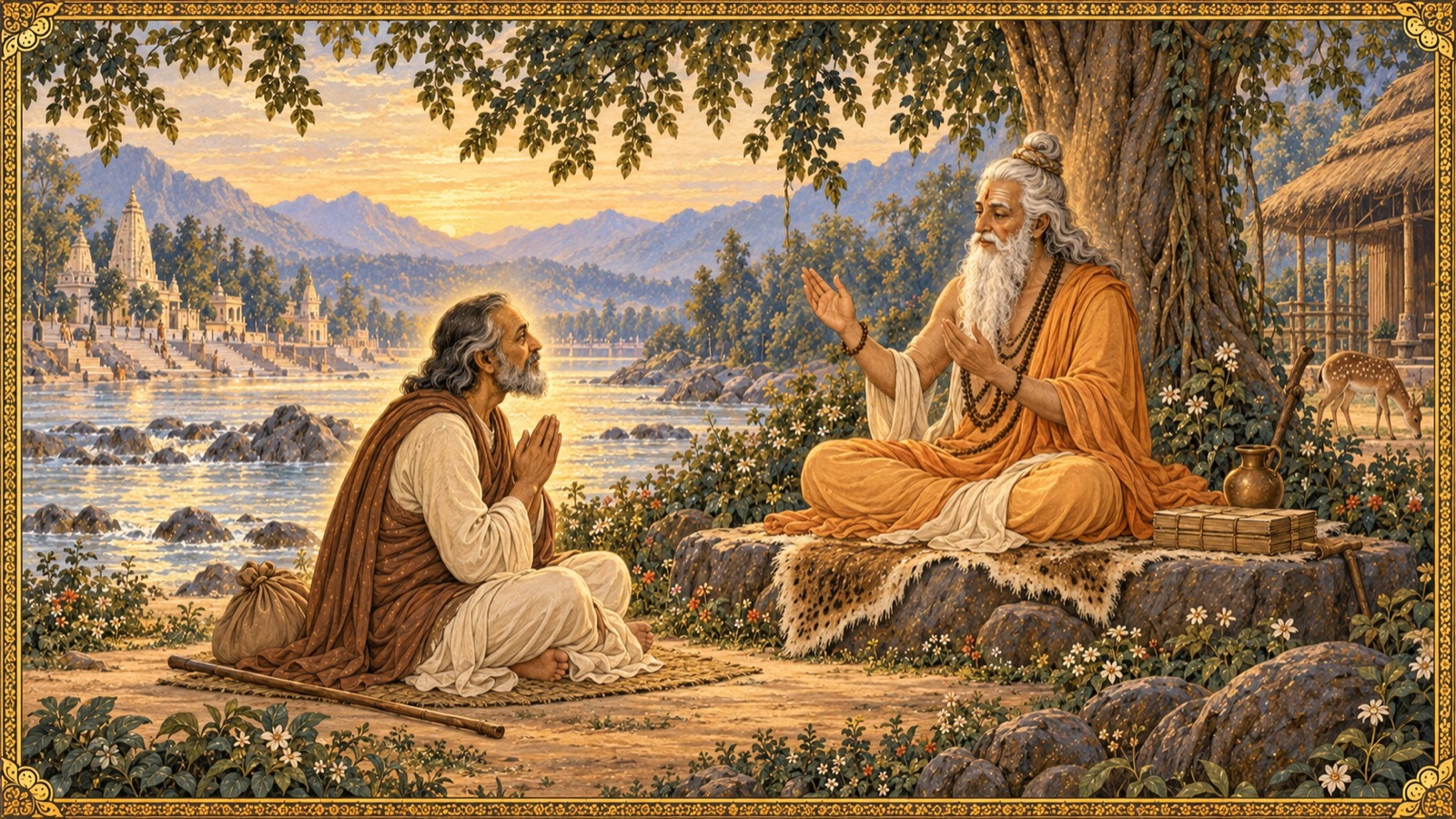
Sri Suka tells Parikshit that Maitreya, questioned in this way by Vidura for the supreme good of all people, addressed him in reply, showing him great honour. What is striking about Maitreya’s opening words is that he does not launch immediately into cosmology. He first turns, warmly and at some length, to Vidura himself.
Maitreya tells him that he has, by asking this excellent question, placed all of mankind under a deep obligation — for his mind is already fixed on the Lord who is beyond ordinary sense-perception, and his own fame will thereby spread far and wide in this world. It is not to be wondered at, Maitreya continues, that Vidura should have so completely captivated Sri Hari, the Lord of the universe, through his exclusive devotion — for he is, after all, no lesser a soul than one begotten by the sage Badarayana, Vedavyasa himself.
Then comes a startling disclosure. Maitreya reveals that Vidura is, in fact, none other than the worshipful Yama, the very deity who presides over death and punishes all creatures according to their deeds — descended into this human birth as a result of the imprecation once pronounced by the sage Mandavya, and begotten by the sage Vyasa, son of Satyavati, through the maid-servant and concubine of Vyasa’s own deceased uterine brother, Vicitravirya, who was likewise born of Satyavati. Vidura, Maitreya says, is moreover ever beloved of the Lord and of His devotees alike — and it was precisely for this reason that, while departing from this world, the Lord Himself had commanded Maitreya to teach Vidura wisdom. Only now, having honoured his student in this way, does Maitreya say he will proceed to recount, in due order, the Lord’s pastimes as unfolded by His Yogamaya for the creation, preservation and destruction of the universe.
Before Creation: The Lord Alone
With this, the chapter turns to its central teaching. Maitreya begins at the very beginning — before there was a beginning at all. Before creation, he says, this universe existed in no other form than the Lord Himself, who is the very Self and Ruler of all the Jivas, the individual souls. The Spirit did not then appear in the form of a many-fold subject and object, for it was the Lord’s own will that He should remain alone.
भगवानेक आसेदमग्र आत्मात्मनां विभु: । आत्मेच्छानुगतावात्मा नानामत्युपलक्षण: ॥ २३ ॥
bhagavān eka āsedam agra ātmātmanāṁ vibhuḥ ātmecchānugatāv ātmā nānā-maty-upalakṣaṇaḥ
Meaning: The Personality of Godhead, the Lord and Ruler of all the Jivas, existed alone before this creation, in His own form; and it was according to His own will that He alone thus remained, before the multiplicity of names and forms had appeared. (Canto 3, Chapter 5, verse 23)
Maitreya adds a strange and beautiful detail: the Lord, in that state, cast His eyes all around, yet failed to perceive any object at all — because He shone there entirely alone. He felt, Maitreya says, almost as though He were non-existent, since all His powers lay dormant at that moment, even though His own consciousness remained fully and perfectly awake. This is, in effect, a description of pure, undifferentiated being, prior even to the first stirring of creative desire — the Lord’s consciousness present in its fullness, yet with none of His potencies yet set into motion.
Why, then, being already whole, does the Lord ever choose to stir at all? This is the question a Vaishnava teacher would press further than the plain narrative does, and it is the real weight beneath this chapter’s cosmology. The Lord’s aloneness before creation is not the aloneness of something missing; it is the fullness of one who, out of compassion rather than compulsion, feels the absence of His countless fragmentary parts — the individual souls who lay folded back into Him, dormant and forgetful, at the close of the previous dissolution. Creation, on this reading, is not the Lord’s need but His mercy: it is undertaken so that these very souls may be given, once again, the field and the opportunity to remember their true relationship with Him and to find their way home. Every element and every deity that follows in this chapter’s account exists, at bottom, for that one compassionate purpose (verses 23–24).
Maya, the Purusa, and the Seed of the Jiva
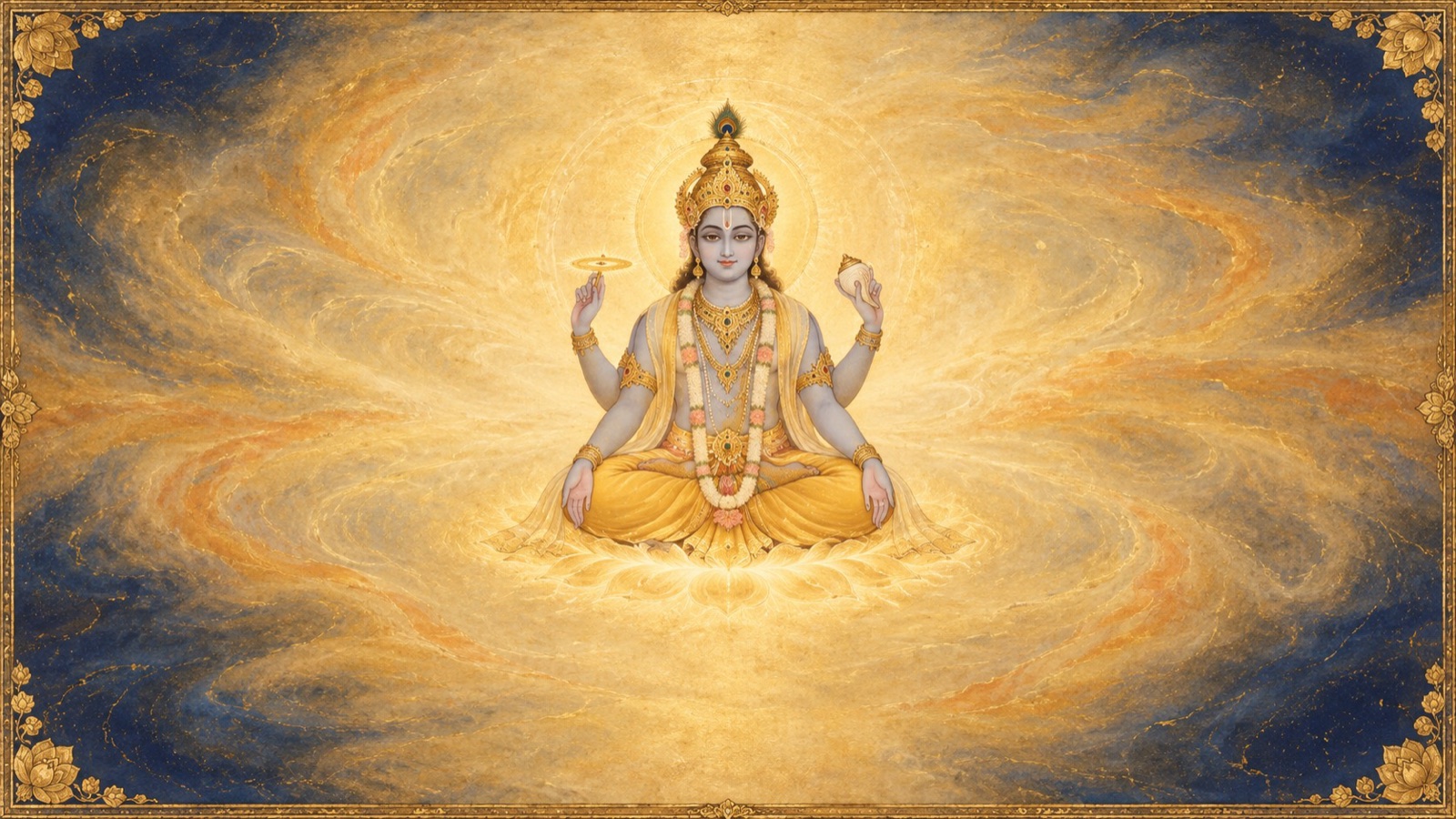
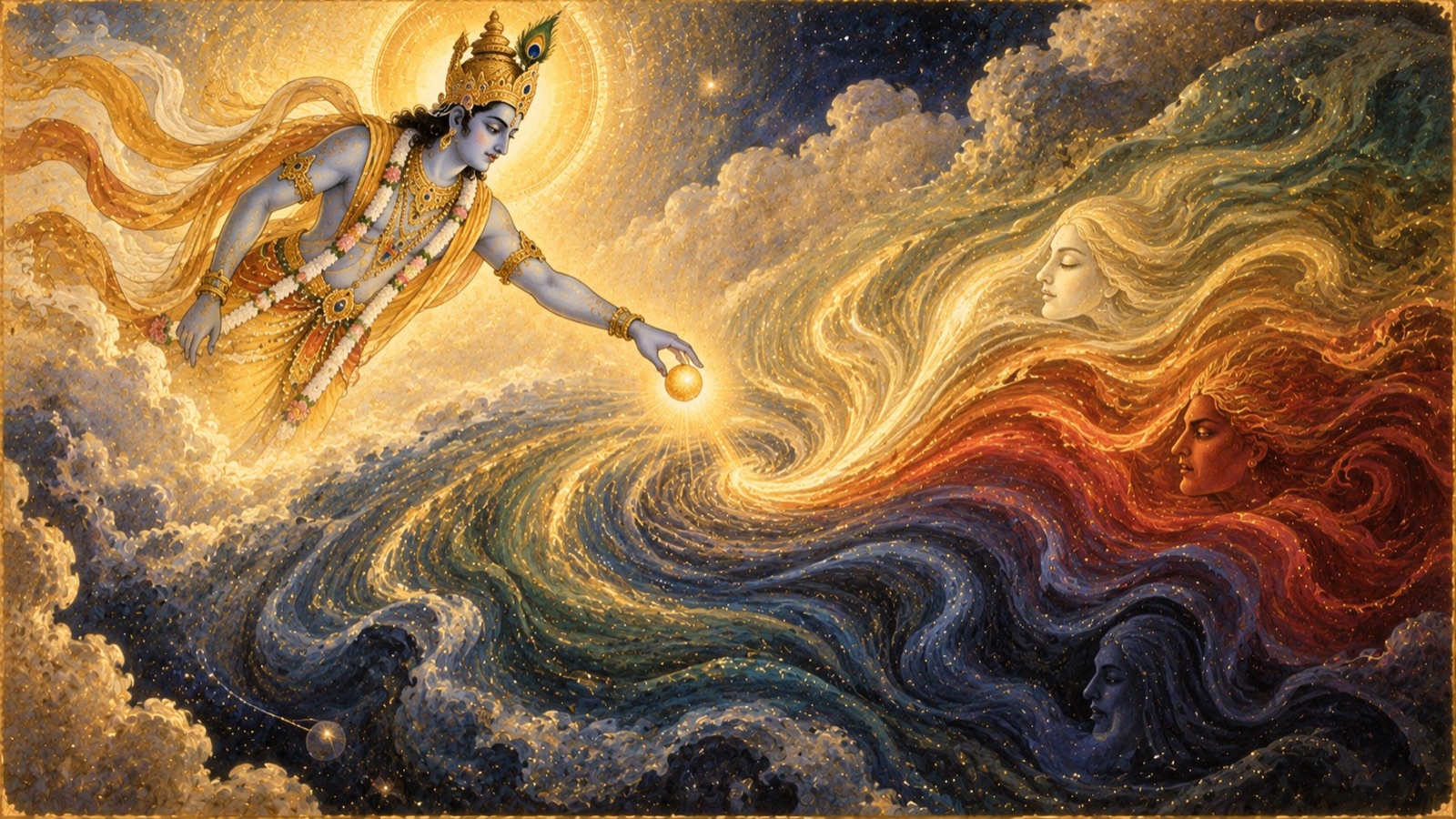
It is this very energy of the all-perceiving Lord — described here as taking the form of a search for an object — that is called Maya, an energy which is, by its very nature, both cause and effect at once. It was with the help of this Maya, Maitreya tells Vidura directly, addressing him by name, that the almighty Lord created this entire universe.
सा वा एतस्य संद्रष्टु: शक्ति: सदसदात्मिका । माया नाम महाभाग ययेदं निर्ममे विभु: ॥ २५ ॥
sā vā etasya saṁdraṣṭuḥ śaktiḥ sad-asad-ātmikā māyā nāma mahā-bhāga yayedaṁ nirmame vibhuḥ
Meaning: That energy of the Lord, the perfect seer, which is of the nature of both cause and effect, is called Maya, O most fortunate Vidura; and it was by means of this very Maya that the Almighty Lord constructed this universe. (Canto 3, Chapter 5, verse 25)
When the equilibrium of the three Gunas that constitute this Maya was disturbed by the force of Time, Maitreya continues, the transcendent Lord — who remains spiritual in His own essence — placed within it, as the Purusa, His own fragment: His seed, in the form of Cidabhasa, the individual Jiva. This is the crucial hinge-point of the whole account: the moment at which the Lord’s own undivided fullness first extends a fragment of Himself into the field of Maya, setting the entire process of material creation into motion.
From the Unmanifest to the Mahat-tattva
From this Unmanifest — Maya, or Prakrti — impelled now by Time, there was evolved the Mahat-tattva, the great principle of cosmic intelligence. Maitreya describes it as the dispeller of darkness, in the sense of dispelling ignorance; it is of the very nature of understanding, and it is capable of manifesting within itself, in subtle form, the entire universe that is yet to unfold.
ततोऽभवन् महत्तत्त्वमव्यक्तात्कालचोदितात् । विज्ञानात्मात्मदेहस्थं विश्वं व्यञ्जंस्तमोनुद: ॥ २७ ॥
tato ‘bhavan mahat-tattvam avyaktāt kāla-coditāt vijñānātmātma-deha-sthaṁ viśvaṁ vyañjaṁs tamo-nudaḥ
Meaning: Thereafter, impelled by Time, the Mahat-tattva — the principle of cosmic intelligence, the dispeller of the darkness of ignorance, of the very nature of understanding — was evolved from this Unmanifest, capable of manifesting within itself, in subtle form, the universe that was to come. (Canto 3, Chapter 5, verse 27)
Subject to the Cidabhasa, the three Gunas, and Time itself, this Mahat, when it fell within the range of the Lord’s own vision, transformed itself with the specific intention of creating the universe. From the Mahat-tattva, as it thus underwent transformation, there evolved the principle of “Aham,” the ego — which, being of the nature of Adhibhuta (relating to the elements), Adhyatma (relating to the self) and Adhidaiva (relating to the presiding deities), becomes the very cause of the five gross elements, the Indriyas (the senses of perception together with the organs of action), and the mind itself.
The Threefold Ego and the Birth of the Senses
Maitreya explains that this Ahankara, the ego, unfolds in three distinct modes: Vaikarika, which is Sattvika; Taijasa, which is Rajasika; and the third, which is Tamasika. From the Sattvika ego, as it underwent its own transformation, there sprang up the mind, together with the deities who preside over the senses — deities who are themselves entirely of a Sattvika nature, and whose function is to reveal the objects of the senses to the perceiving being.
The senses of perception and the organs of action, by contrast, are evolutes of the Rajasika ego alone. And from the Tamasika ego was evolved the source of the other subtle elements — beginning with sound — which is, in turn, the very cause of ether, an element which, by virtue of its all-pervading nature, itself serves as a living illustration of the Spirit, Brahma.
Ether, Air, Fire, Water, Earth: The Unfolding of the Five Elements
What follows is one of the Bhagavatam’s most carefully structured passages, describing the successive evolution of the five gross elements, each arising through the combined action of the previous element with Time, Maya and the Jiva together. When ether came within the range of the Lord’s vision, together with Time, Maya and the Jiva, these combined to produce the sensation of touch — and touch, as it underwent its own transformation, evolved the element of air.
The most powerful air, in turn, as it underwent transformation, combined with ether to produce the sensation of colour, and from colour was evolved fire, the illuminator of the world. Fire, when it came within the range of the Lord’s vision and underwent transformation, combined with air, together with Time, Maya and the Jiva, to produce water, which is an evolute of taste. And water, when it came within the sight of the all-perceiving Brahma and underwent transformation, combined with fire, together again with Time, Maya and the Jiva, to evolve the earth, whose special characteristic is odour.
Maitreya then states a governing principle behind the whole sequence, addressing Vidura directly once more: of the elements beginning with ether — ether, air, fire, water and earth — the later an element appears in this order of evolution, the larger the number of qualities it should be understood to possess; for every effect naturally inherits the characteristics of its own cause, in addition to whatever characteristics belong to it alone.
The Presiding Deities, Unable to Act Alone, Turn to the Lord
With the elements now unfolded, Maitreya turns to the deities who preside over the Mahat-tattva and the other categories of creation. These deities, he explains, share in the characteristics of Time, Maya and the Jiva — namely transformation, distraction and consciousness — and are, in truth, nothing other than rays of Lord Vishnu Himself. And yet, when the moment came for them to complete the work of creating the universe, they found themselves unable to do so, precisely because of their own heterogeneity — their differing natures left them lacking the co-ordination needed to act together. And so, Maitreya tells Vidura, these deities prayed to the almighty Lord, with joined palms.
एते देवा: कला विष्णो: कालमायांशलिङ्गिन: । नानात्वात्स्वक्रियानीशा: प्रोचु: प्राञ्जलयो विभुम् ॥ ३८ ॥
ete devāḥ kalā viṣṇoḥ kāla-māyāṁśa-liṅginaḥ nānātvāt sva-kriyānīśāḥ procuḥ prāñjalayo vibhum
Meaning: These presiding deities of the elements, who are rays of Lord Vishnu Himself, embodied by Time and a portion of Maya, being unable, on account of their own diversity, to perform their own respective functions, addressed the all-pervading Lord with joined palms. (Canto 3, Chapter 5, verse 37 of the Gita Press edition)
The Deities’ Prayer for Creative Vision
What the deities then say to the Lord forms the closing and, in many ways, the most devotional portion of this chapter. They bow, they tell Him, to His lotus-feet — feet that relieve the agony of the suppliant just as an umbrella affords relief from the heat of the sun, and by resorting to whose soles striving men easily drive away the endless woes of earthly existence. Living beings in this world, they say, never enjoy true peace of mind, stricken as they are by the threefold agony of existence; it is for this reason that they resort to the shade of His feet, which is itself the very abode of wisdom.
They describe those same feet as the abode of sanctity, sought out by seers in seclusion through Vedic mantras that are, they say, like birds nesting in the lotus of His mouth — feet that are, moreover, the very source of the Ganga, the foremost of all rivers, whose waters carry the power to wipe away one’s sins. It is by contemplating these lotus-feet in the heart — a heart purified through reverence and devotion expressed in hearing and chanting the divine names and glories — that the Lord’s votaries succeed, they say, in controlling the mind through wisdom strengthened by dispassion.
The deities then turn to the very purpose of their prayer: the Lord, they acknowledge, has descended into the world of matter precisely for the work of creating, preserving and destroying the universe, and they, too, take refuge in His lotus-feet, which, when meditated upon, grant fearlessness to those who worship them. They describe those feet as inaccessible to men bound by a false, deep-rooted identification with their own frail bodies and dwellings, and with the people and possessions connected to them — even though the Lord Himself dwells within their own hearts as the Inner Controller. Those whose minds are led astray by senses forever wandering among unworthy objects, they say, are simply unable to behold the elegance of the Lord’s graceful footsteps as His true devotees do; but those whose hearts have been purified by devotion, intensified through drinking the nectar of His stories, duly attain that spiritual insight whose very essence is dispassion, and thereby ascend, without difficulty, to His eternal abode of Vaikuntha. Even other wise men, they add, who conquer the Lord’s powerful Prakrti through the Yoga of concentrated meditation on the Self, undoubtedly enter the Supreme Spirit at last — though their path is one of great hardship, whereas there is no hardship at all in simply adoring Him.
Finally, the deities come to their actual request. They acknowledge that they themselves have been created by the Lord, one after another, through the three Gunas that constitute their very nature, precisely with the intention that they might help evolve the universe — and yet, being of such a diversified nature, they remain disjoined from one another, independent, and therefore incapable of taking the concerted action needed to complete the task. They ask the Unborn Lord to devise some means by which they may, together, offer Him the completed universe as a fitting stage for His future pastimes, and by which all created beings that are yet to come may also find sustenance and food without hindrance. He alone, they affirm, the immutable Ancient Person, is the true and prime cause of the gods as well as of every other evolute of creation; it was He alone who, of old, placed the seed of the conscious Jiva into the womb of His own energy, Maya. And so, in the chapter’s very last verse, they ask, simply and directly, what they might do for Him, since that alone is the purpose for which they are born — and they beg Him, depending as they do on His grace alone, to confer upon them His own divine vision, together with the creative energy needed to succeed in the great work of creation.
ततो वयं मत्प्रमुखा यदर्थे बभूविमात्मन् करवाम किं ते । त्वं न: स्वचक्षु: परिदेहि शक्त्या देव क्रियार्थे यदनुग्रहाणाम् ॥ ५१ ॥
tato vayaṁ mat-pramukhā yad-arthe babhūvimātman karavāma kiṁ te tvaṁ naḥ sva-cakṣuḥ paridehi śaktyā deva kriyārthe yad-anugrahāṇām
Meaning: Therefore, O Supreme Self, tell us — we who were born for this very purpose — what more we should do for You; graciously bestow upon us, by Your own power, that vision of Yours, O Lord, along with the grace needed for the work of creation. (Canto 3, Chapter 5, verse 50 of the Gita Press edition)
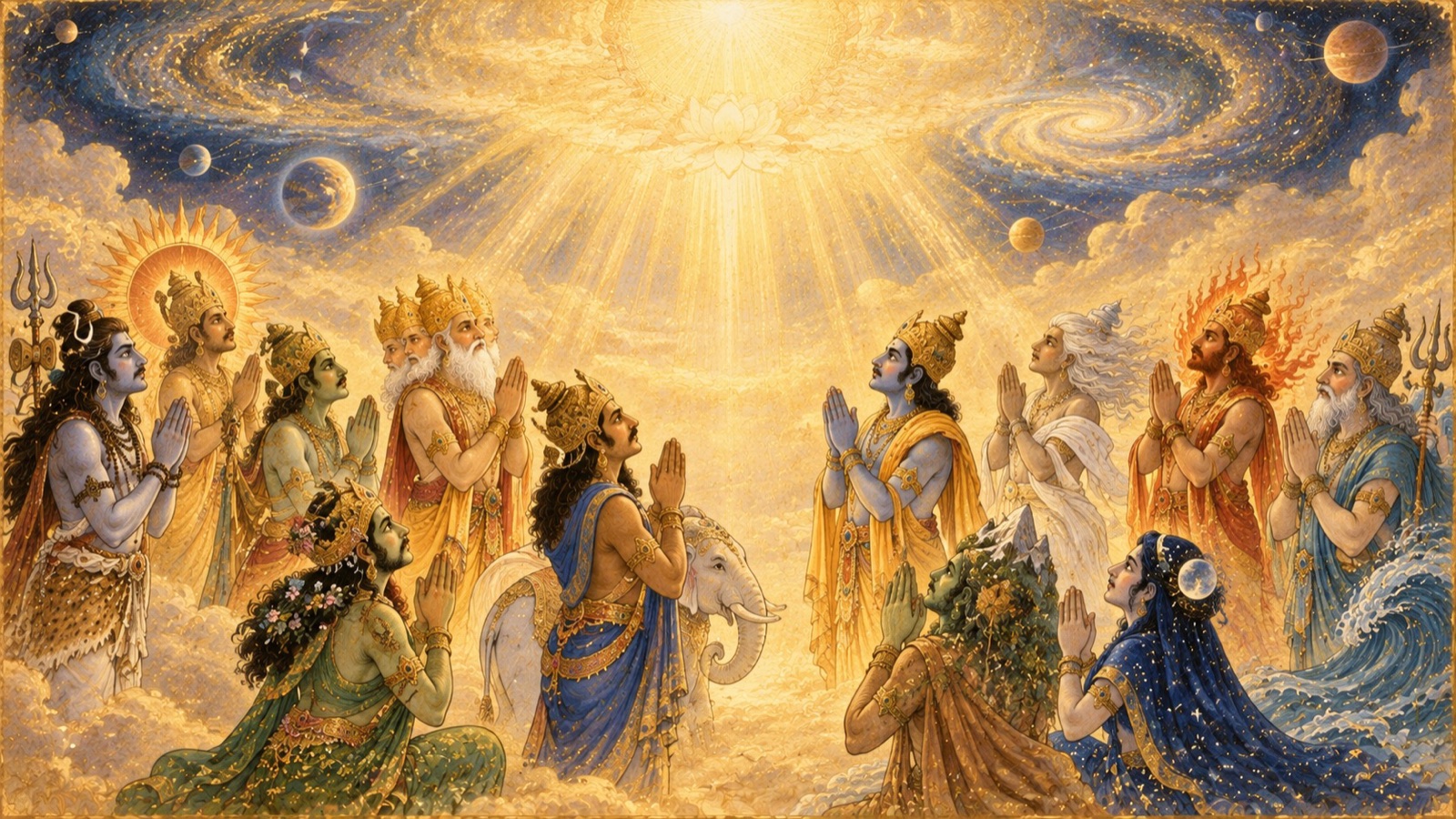
The chapter closes on this note of humble supplication — the newly-formed guardian deities of the universe, unable to complete their own appointed work without the Lord’s direct grace, offering Him nothing but folded hands and a request to be shown how to serve.
Thus ends the fifth discourse in Book Three of the great and glorious Bhagavata-Purana, otherwise known as the Paramahamsa-Samhita.
Principal Teachings of This Chapter
1. The deepest questions arise from the plainest observations. Vidura’s entire inquiry into the nature of creation begins with a simple, honest confession: that ordinary fruitive action never delivers the happiness it promises. The grandest cosmology in this chapter is anchored in an entirely practical, universal human frustration (verse 2).
2. Devotion to the Lord’s stories is its own complete path. Vidura declares himself “fed up with all other Dharmas” — not out of disrespect for duty, but because he has tasted something that renders lesser joys unsatisfying by comparison: the nectar of Sri Krsna’s stories, which alone can cut the bonds of worldly attachment (verses 10-11).
3. The universe begins in the Lord’s aloneness, not in matter. Before any creation, there was only the Lord — full, complete, and consciously awake, though His powers of action lay dormant. Creation is not the appearance of something outside Him; it is the stirring of His own energies within His own being (verses 23-24).
4. Even the guardian deities of the universe cannot act without the Lord’s grace. The presiding deities of the elements, though themselves rays of Lord Vishnu, cannot complete the work of creation through their own combined effort alone — a humbling reminder that no power in the universe, however exalted, functions independently of the Lord’s sanction (verses 37, 47).
5. Prayer, not command, is the deities’ first recourse. Even beings responsible for creating and governing the universe respond to their own limitation not with frustration but with folded-hand supplication — glorifying the Lord’s feet as themselves a place of pilgrimage, a shelter from the threefold miseries of existence, before asking not for independent power but for the creative vision and the grace needed to finish what they cannot complete alone. It models, for every reader, the posture that should meet any point of genuine helplessness (verses 38-50).
A Devotional Reflection
There is something quietly moving in the shape of this chapter. It opens with one soul’s private grief — Vidura, still working through everything he has witnessed and lost, arriving at a holy place to ask a sage the oldest question there is: how does a person actually become happy? And it closes with an entire universe’s worth of newly created gods, powerful beyond ordinary comprehension, admitting that they too cannot finish their own work without turning, in the very same posture of folded hands, to that same one Lord. Between these two moments lies the whole account of creation — the emanation of Maya, the descent of the cosmic Purusa, the awakening of universal intelligence, the branching of ego into three modes, and the five great elements taking shape one after another like notes building into a chord. And yet Maitreya’s real teaching, threaded quietly through all of this intricate cosmology, may be simpler than it first appears: whether you are a grieving man at a riverbank or a god charged with building a universe, the honest response to not-knowing is the same — turn toward the Lord, and ask.
A Daily Devotional Practice
Today, notice a place in your life where you feel, like the deities in this chapter, capable in part but unable to complete the whole task before you — a responsibility you can begin but not finish alone. Rather than forcing the matter through effort alone, follow the example that closes this chapter: fold your hands, in whatever quiet way is available to you, and simply ask for the vision and the strength you lack, trusting that the same grace which set the whole universe in motion is available to you as well. Before returning to your day, pause and repeat quietly: “Om Namo Bhagavate Vasudevaya.” Let that remembrance be, for a moment, your own folded-hand prayer — a small echo of the very posture with which this chapter’s greatest beings turn toward their Lord.
Conclusion
The fifth discourse of Book Three marks a genuine turning point in the Bhagavatam’s unfolding narrative. Vidura’s personal grief and searching, carried across four earlier chapters, now finds its proper teacher in Maitreya — and Maitreya’s answer, rather than offering easy comfort, opens outward into the very architecture of existence itself: the Lord alone before creation, the stirring of Maya, the descent of the Purusa, the birth of cosmic intelligence, the threefold ego, the five elements, and finally the deities’ own humble admission that even they need the Lord’s grace to finish what has been begun. It is a chapter that asks the reader to hold two things together — the intimacy of one man’s spiritual longing, and the vastness of a universe still being built — and to see, in both, the same single truth: nothing is created, sustained, or completed except by the Lord’s own grace, sought always through devotion, and always through prayer.
May the divine wisdom of Srimad Bhagavatam awaken pure devotion within our hearts.
Om Namo Bhagavate Vasudevaya.
Jay Shree Madhav.
References and Attribution
- Primary edition: Gita Press, Śrīmad Bhāgavata Mahāpurāṇa (English, complete), Book Three, Discourse 5, pages 151–156.
- Series: Srimad Bhagavatam Wisdom · Biswa Sanatan Dharma Seva Trust.
- Presented following the spiritual guidance and recommendation of Pandit Dr. Shri Kashinath Mishra.
This is an original, faithful retelling in the writer’s own words, with brief quoted verses shown in Devanagari and transliteration and their meanings given as summaries. It is not a reproduction of any single publisher’s continuous translation or commentary. No affiliation with or endorsement by any publisher is implied.
Jay Shree Madhav