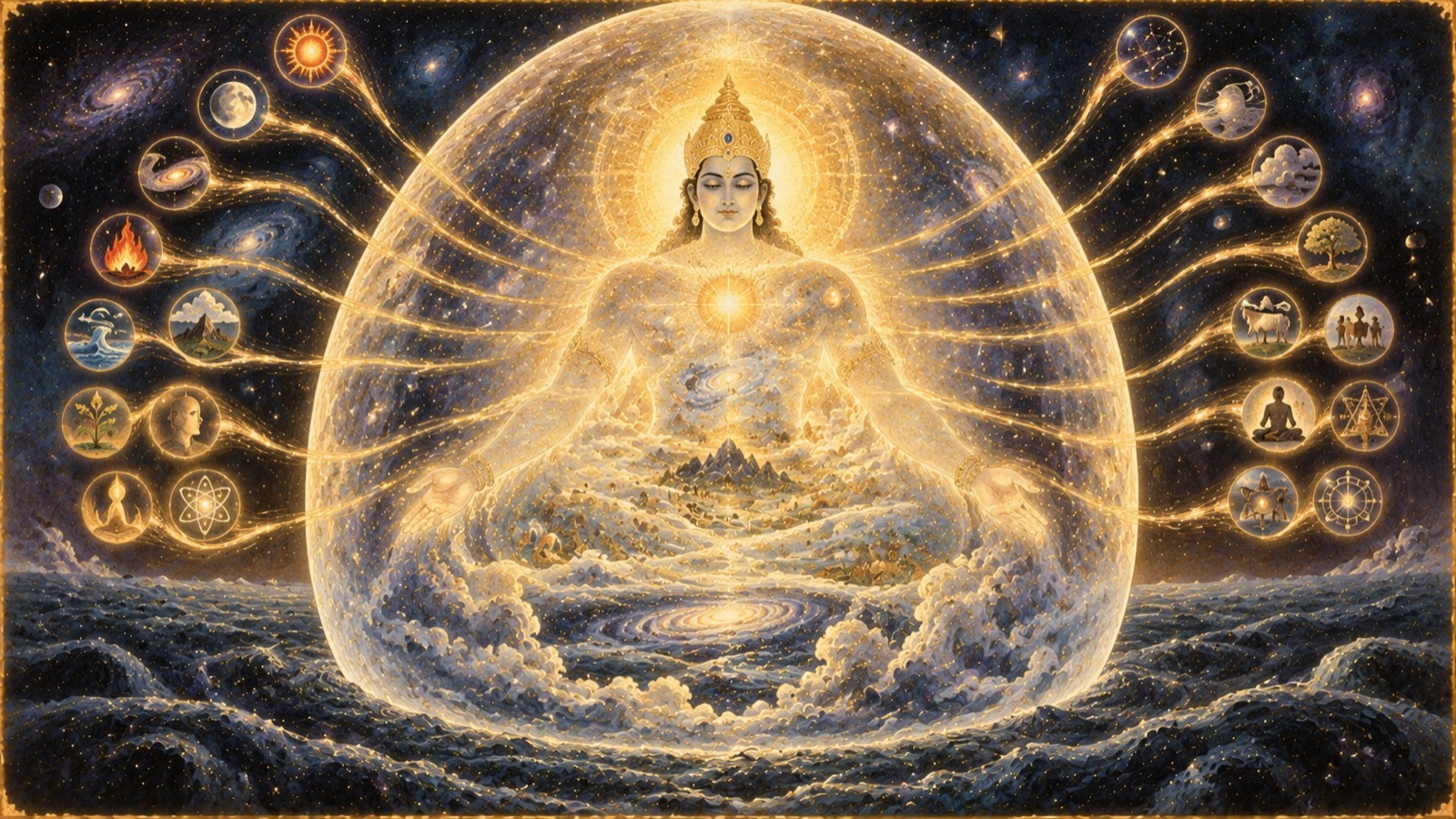
Out of twenty-three disconnected categories that could not, on their own, so much as begin the work of creation, the Lord assumes the potency of Time and — like a single hand closing many separate fingers into a fist — brings forth from them one vast, effulgent Cosmic Body, the very frame from which the senses, the worlds and the four orders of humankind will all, in time, emanate.
Om Namo Bhagavate Vasudevaya.
Om Namo Bhagavate Vasudevaya.
Om Namo Bhagavate Vasudevaya.
Welcome to Srimad Bhagavatam Wisdom, a devotional journey through the sacred histories and teachings of the Srimad Bhagavat Mahapurana. Discourse V closed on the deities’ own confession of helplessness: the presiding powers of the Mahat-tattva and the rest of creation’s raw categories, unable to cooperate, begged the Lord to show them how creation could even begin. Discourse VI answers that prayer directly — and in doing so, gives the Bhagavatam one of its most quietly staggering passages. Maitreya, continuing his narration to Vidura, describes how the Lord assumes His potency of Time, enters the twenty-three disjointed categories of matter, and draws them into a single, effulgent whole: the Cosmic Body, the Virat-rupa, the universal form from which every sense-organ and its presiding deity, every world, and even the fourfold order of human society will spring. It is a chapter of cosmology rendered as devotion — for Maitreya does not describe the Cosmic Body as a scientist would a mechanism; he sings it, admits he cannot fully sing it, and ends by bowing before a glory that even Brahma could not fathom in a thousand celestial years of meditation.
Chapter Information
- Scripture: Śrīmad Bhāgavata Mahāpurāṇa
- Canto: 3 (Book Three)
- Chapter: 6 (Discourse 6)
- Chapter title: Appearance of the Cosmic Body
- Principal speaker: The sage Maitreya, addressing Vidura — the whole related by Sukadeva Gosvami to King Parikshit, and by Suta Gosvami to the sage Saunaka and the assembly at Naimisharanya
- Principal listener: Vidura
- Main setting: Maitreya’s hermitage, continuing his discourse to Vidura on the origin of the universe
- Central subject: The Lord’s assumption of the potency of Time, His entry into the twenty-three categories of creation, and the appearance of the Cosmic Body — the universal form from which the senses, their presiding deities, the three worlds and the four varnas all emanate
- Principal verse range: Canto 3, Chapter 6, verses 1–40
- Primary edition: Gita Press Śrīmad Bhāgavata Mahāpurāṇa
The Lord Assumes the Potency of Time
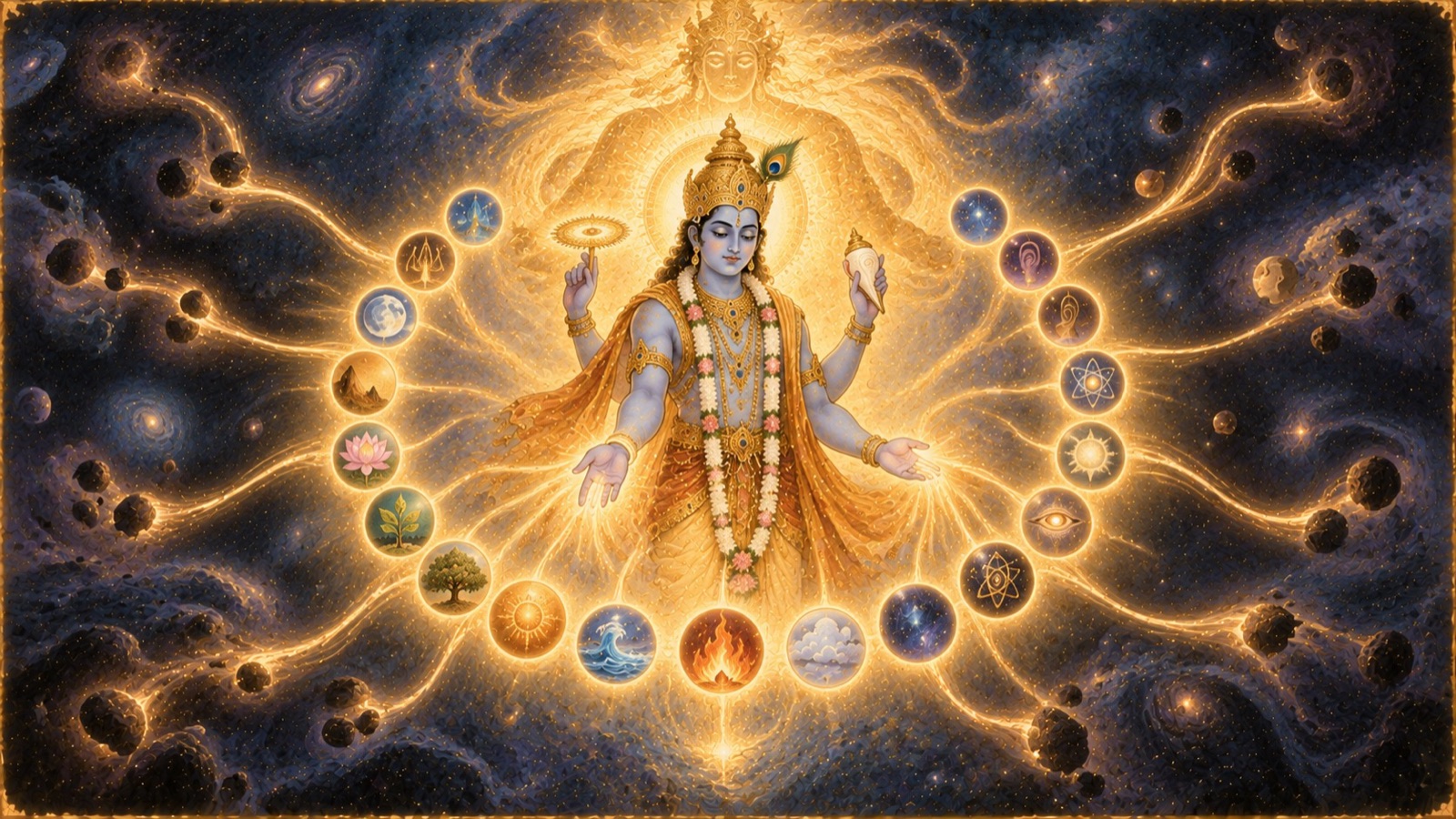
Maitreya opens by resolving the very difficulty the deities had raised at the close of the previous chapter. Their powers — the Mahat-tattva, the ego, the senses, the elements — lay scattered and uncooperative, each a fragment incapable of joint action. Seeing this, the almighty Lord assumed His own divine potency known as Kala, or Time, and simultaneously entered all twenty-three categories of material creation: the Mahat-tattva, the Ego, the five senses of perception, the five organs of action, the mind, the five subtle elements, and the five gross elements.
इति तासां स्वशक्तीनां सतीनामसमेत्य सः । प्रसुप्तलोकतन्त्राणां निशाम्य गतिमीश्वरः ॥ १ ॥ कालसंज्ञां तदा देवीं बिभ्रच्छक्तिमुरुक्रमः । त्रयोविंशतितत्त्वानां गणं युगपदाविशत् ॥ २ ॥
iti tāsāṁ sva-śaktīnāṁ satīnām asametya saḥ prasupta-loka-tantrāṇāṁ niśāmya gatim īśvaraḥ kāla-saṁjñāṁ tadā devīṁ bibhrac chaktim urukramaḥ trayoviṁśati-tattvānāṁ gaṇaṁ yugapad āviśat
Meaning: When the almighty Lord saw that His own powers were unable to start the work of creating the universe, because there was no harmony among them, He assumed His divine potency known by the name of Kala (Time) and simultaneously entered the twenty-three categories. (Canto 3, Chapter 6, verses 1-2)
This is not force applied from outside; it is presence entering from within. Having entered these disconnected categories, the Lord unites them by His own active power, stimulating their dormant energy. Roused thus into activity, the twenty-three categories — impelled by God, not by any capacity of their own — evolve the Cosmic Body out of their own component parts. Maitreya is careful with his wording here: it is not that the Supreme creates the Cosmic Body as a separate object; rather, as He enters them, the group of twenty-three categories, having taken up the task of creation, partially transforms through their own newly possible cooperation — and it is this very transformation that is called the Cosmic Body, the abode of all animate and inanimate creation.
The Cosmic Being Rests Within the Cosmic Egg
That all-effulgent Cosmic Being, together with all the Jivas lying dormant within it in an unmanifest state, dwells for a thousand celestial years — 3,60,000 human years by Maitreya’s reckoning — within a space shaped like the interior of an egg, surrounded on every side by water. Endowed already with knowledge, activity and the capacity for enjoyment, this Cosmic Body manifests of its own accord as one — the heart; as ten — the ten vital airs; and as three — its Adhyatmika, Adhidaivika and Adhibhautika aspects, the personal, divine and elemental dimensions of embodied existence. As the totality of all Jivas, He is the Soul and support of every living being; as an embodied spirit, He is a part manifestation of the Supreme Spirit; and as the very first manifestation of Reality into form, He is the prime Avatara — the mould, Maitreya says, in which the entire living creation takes its shape.
The Senses and Their Presiding Deities Appear
Recalling the deities’ earlier prayer, the Lord — who is Himself beyond sense-perception — illumines the Cosmic Being with His own effulgence, His own consciousness, awakening the dormant potentialities within it. What follows is one of the most remarkable passages in the entire Bhagavatam: verse by verse, Maitreya narrates the appearance, one at a time, of each sense-organ on the Cosmic Body, and the god who enters it as its presiding deity.
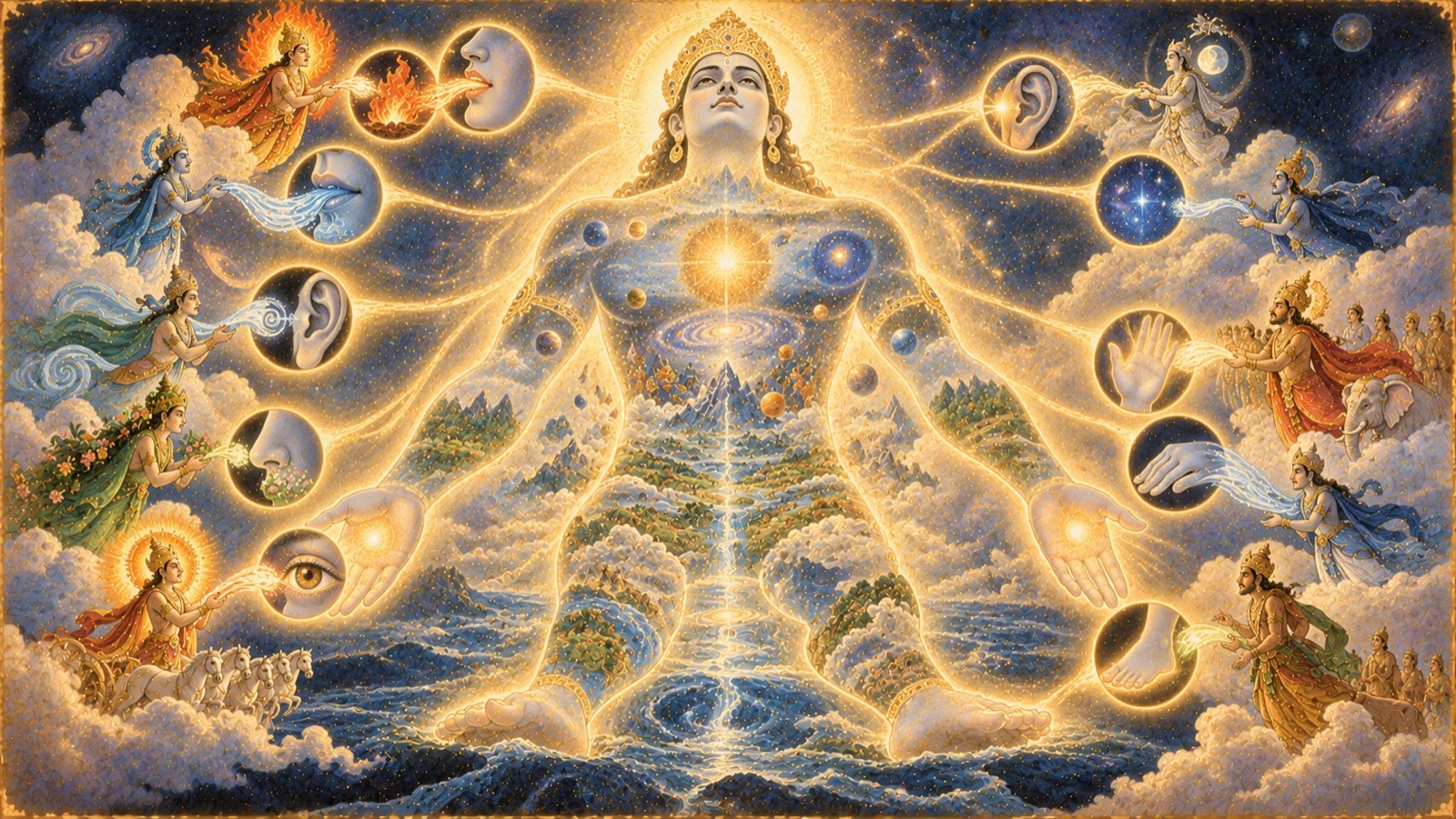
A mouth appears, and the god of fire enters it along with the power of speech. A palate appears, and Varuna, lord of the waters, enters it with the sense of taste. A pair of nostrils appears, and the twin Aswins, the celestial physicians, enter with the power of smell. A pair of eyes appears, and Twasta, the sun-god, enters with the power of sight. The skin appears, seat of the tactile sense, and the wind-god enters with the power of touch. A pair of ears appears, and the Digdevatas — the deities of the cardinal directions — enter with the power of hearing. The skin appears again, this time as the seat of the hair, and the deities presiding over annual herbs enter with it, the source of the itching sensation. A generative organ appears, and Prajapati himself, lord of procreation, enters with the capacity to beget. An organ of evacuation appears, and Mitra enters with the power of excretion. A pair of hands appears, and Indra, lord of paradise, enters with the capacity to grasp and release, by which a Jiva earns its living. A pair of legs appears, and Lord Vishnu Himself enters with the faculty of locomotion, by which a Jiva reaches where it intends to go.
Then come the inner instruments. The intellect appears, and Brahma — lord of Saraswati, goddess of speech — enters with the faculty of understanding. A heart appears, and the moon-god enters with the mind, source of every kind of thought. The ego appears, and Rudra enters with the feeling of “I,” the sense of doership. And finally the Citta, the seat of intellection, appears, and Brahma again — this time as presiding deity of the Mahat-tattva, cosmic intelligence itself — enters with the faculty that discriminates right from wrong.
Heaven, Earth and Sky Are Born of the Cosmic Body
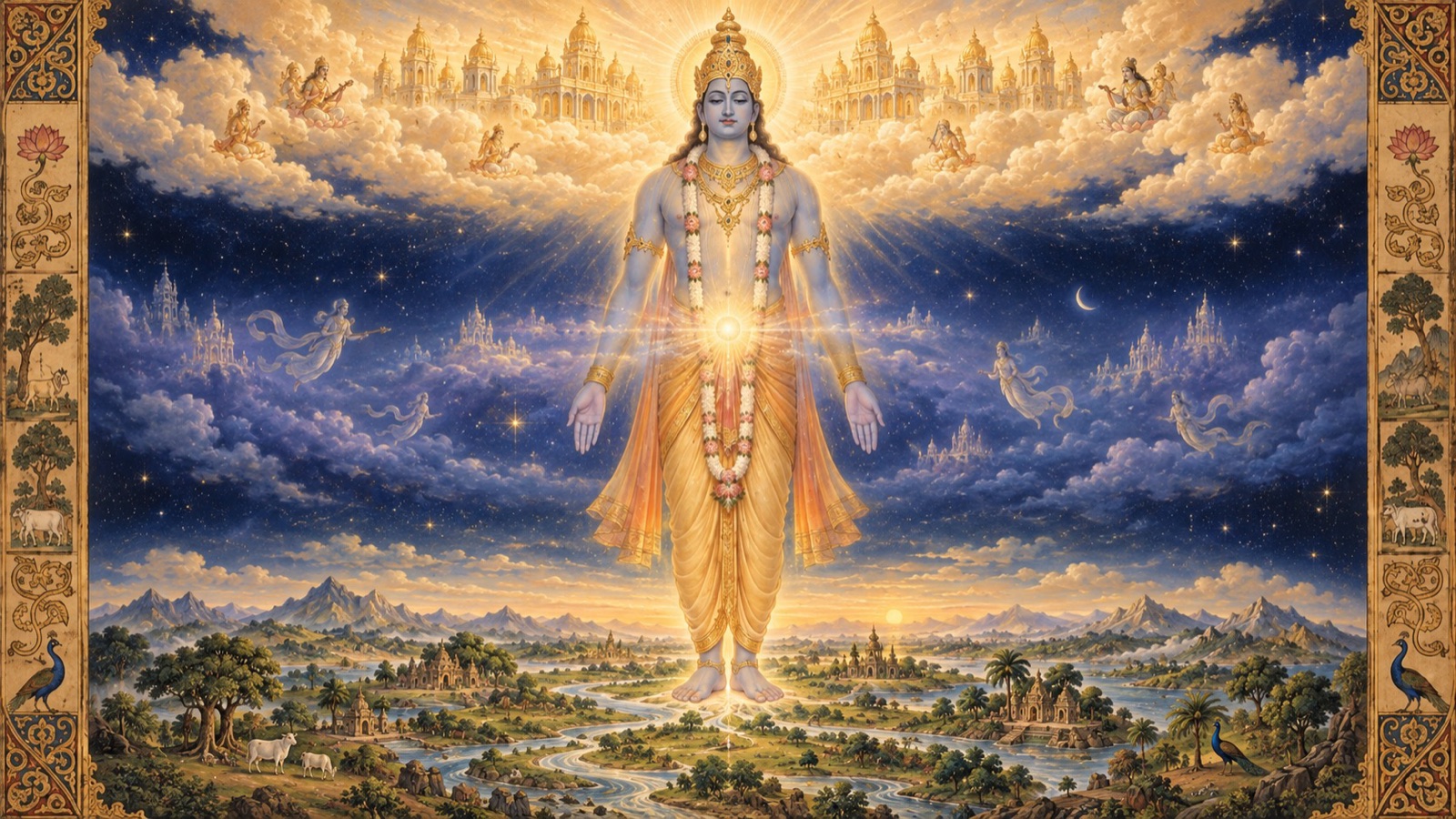
From this fully formed Cosmic Being, the three worlds themselves take shape. From His head emanates the heavenly world; from His feet, the earth; and from His navel, the sky — the intervening space between heaven and earth. Each region houses a different order of being, corresponding to the three Gunas: the gods, evolutes of Sattva, dwell in heaven; human beings and creatures useful to them, evolutes of Rajas, dwell on earth; and the hosts of Rudra’s attendants — spirits and ghosts, evolutes of Tamas — dwell in the sky between the two, precisely at the Cosmic Being’s navel.
शीर्ष्णोऽस्य द्यौर्धरा पद्भ्यां खं नाभेरुदपद्यत । गुणानां वृत्तयो येषु प्रतीयन्ते सुरादयः ॥ २७ ॥
śīrṣṇo ‘sya dyaur dharā padbhyāṁ khaṁ nābher udapadyata guṇānāṁ vṛttayo yeṣu pratīyante surādayaḥ
Meaning: From His head emanated the heavenly world, the earth from His feet, and the sky from His navel. In these regions are found the gods and other beings, the evolutes of Sattva, Rajas and Tamas respectively. (Canto 3, Chapter 6, verse 27)
The Four Varnas Emerge from the Cosmic Body
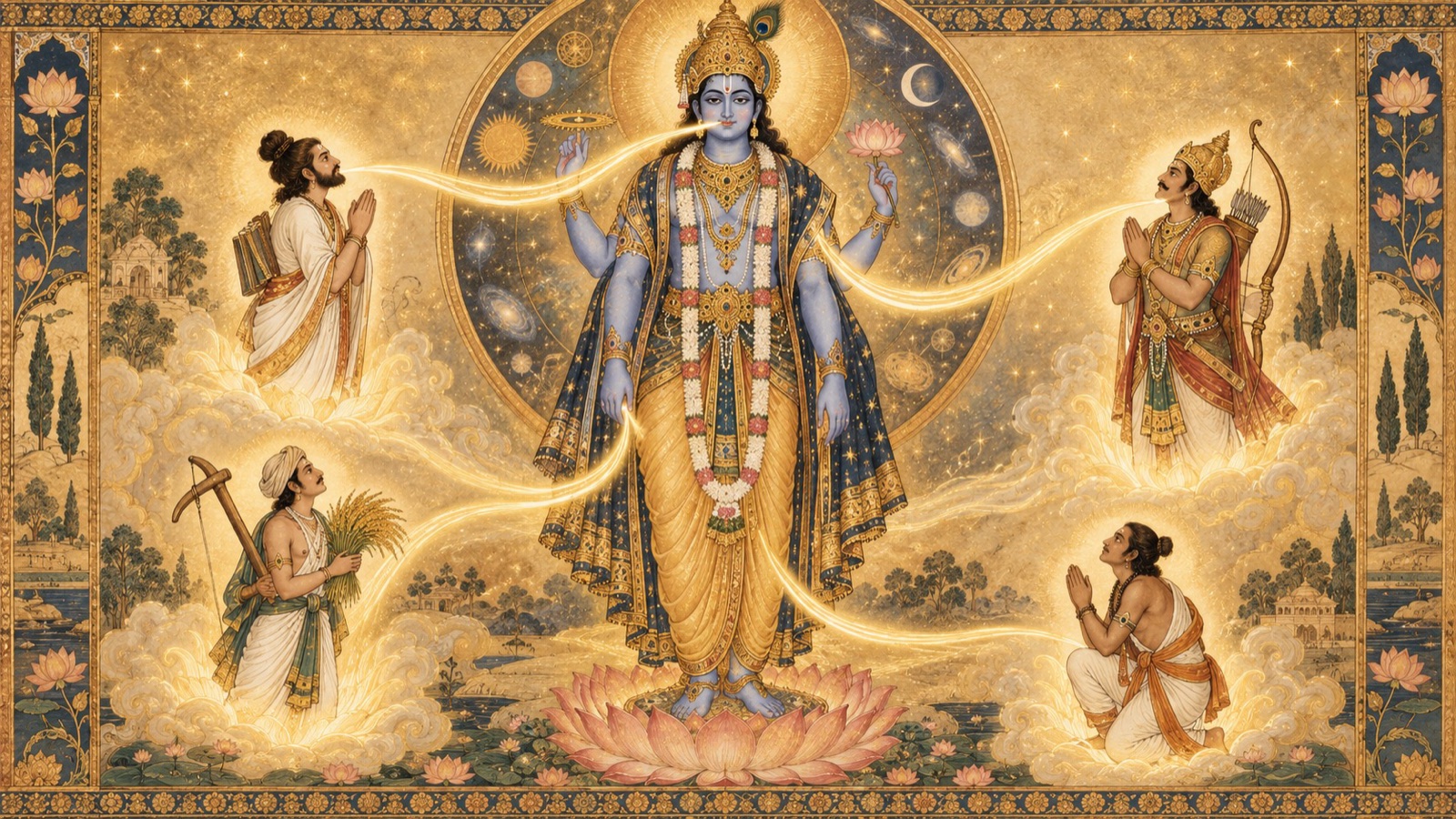
Just as the worlds and the senses emanate from the Cosmic Being, so too does the fourfold order of human society — not as an arbitrary social convention, Maitreya insists, but as a direct emanation of the Lord’s own form. From the mouth of the Cosmic Being emanate the Vedas themselves, together with the Brahmana — seated there, Maitreya makes clear, not by mere birth into the position but by that constitutional inclination toward the mouth’s own Vedic wisdom, which alone qualifies one as the foremost of the Varnas and the natural teacher of the rest. From the arms emanate the vocation of protection and governance, and the Kshatriya who is devoted to it — a ray, Maitreya says, of Lord Vishnu Himself, born to guard the other Varnas from thieves and robbers. From the thighs emanate agriculture and the other occupations that sustain the world’s food supply, and the Vaishya who pursues them, procuring a living for all mankind. And from the feet emanates the calling of service, essential to the discharge of every sacred duty, and the Shudra who was produced for that very pursuit — his occupation, Maitreya notes pointedly, itself securing the Lord’s pleasure.
For the purification of their own hearts, Maitreya says, all four classes reverently worship their common Father, Sri Hari, through the faithful discharge of their own respective duties — the very duties that sprang from His body along with them.
A pointed teaching runs beneath this catalogue of origins, one the tradition insists on directly. Springing symbolically from the Cosmic Being’s mouth, arms, thighs or feet describes a vocation and an inner disposition, not a birthright fixed by family alone. Maitreya is explicit that it is inclination toward Vedic wisdom, not descent from a Brahmana father, that truly seats one at the mouth; likewise it is the actual discharge of protection, provision or service — not the accident of birth — that makes a Kshatriya, Vaishya or Shudra. And the four are not left merely with their separate stations: Maitreya’s closing word on the Varnas is that unconditional life and self-realization come only from worshiping the Lord under the guidance of a genuine spiritual master, the one path of purification common to every occupation and every birth (verses 30-34).
Maitreya’s Hymn of Wonder
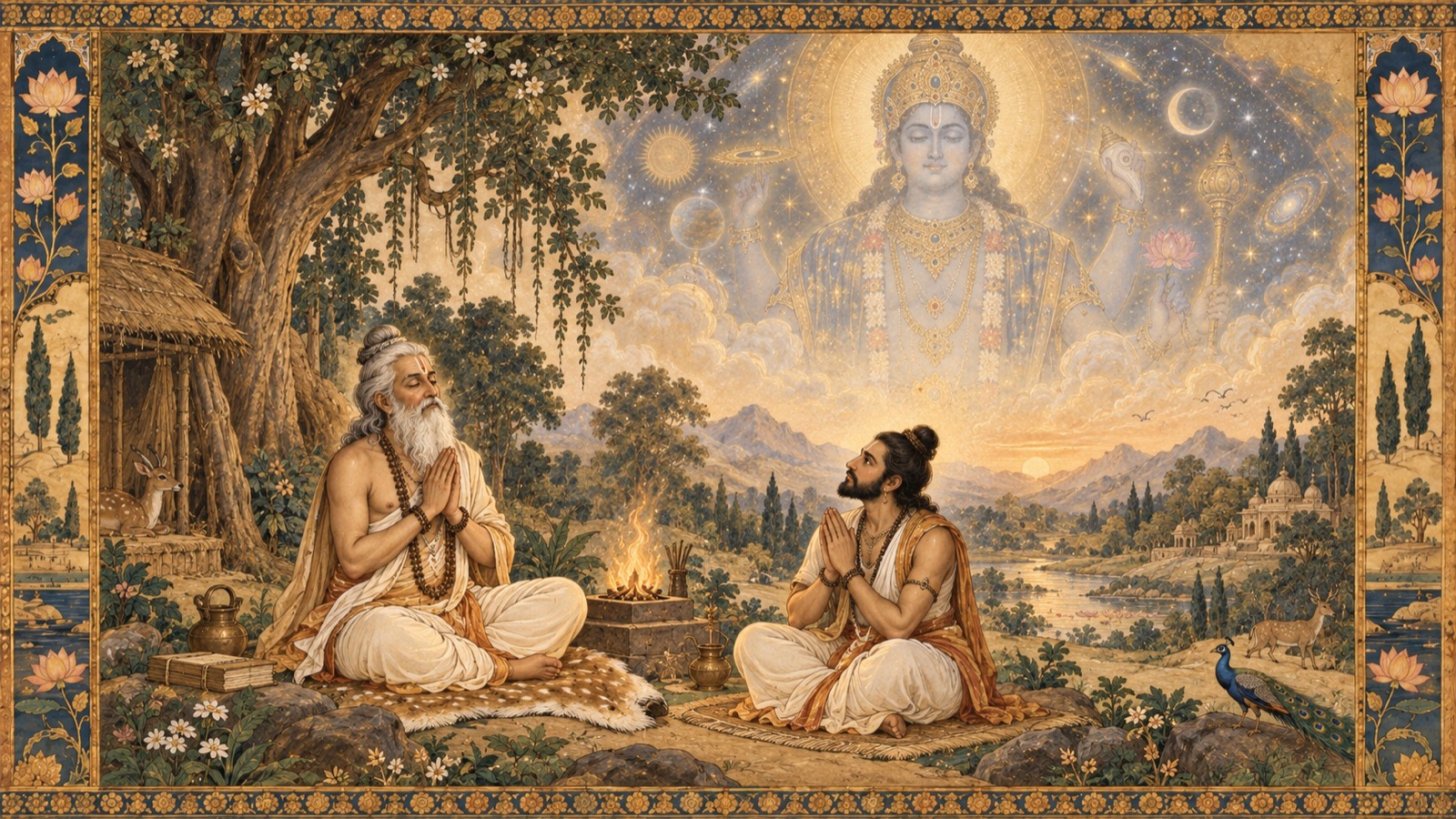
Having completed this extraordinary account, Maitreya turns, in the chapter’s closing verses, from description to confession. Who, he asks Vidura, can dare to describe in full the Cosmic Body of a Lord whose very potencies are Time, Karma and the innate disposition of the Jivas themselves — a body that reveals nothing less than the might of the Lord’s own Yogamaya? And yet, Maitreya says, in order to purify his own speech — rendered foul, he admits with disarming honesty, by other, profane talk — he has proceeded to sing the Lord’s glory as best his own poor lights and the teaching of his preceptor allow him.
The wise, he continues, declare that the sole utility of human speech lies in praising the Lord, and the sole utility of the ears lies in hearing the nectar-like discourses about Him from learned men. Even Brahma, the first of all seers, could not fathom the Lord’s glory after pondering it for a thousand celestial years with an intellect ripened by Yoga. The Lord’s own Maya, Maitreya says, deludes even those most skilled in creating illusion — and if the Lord Himself does not “know” the course of His own Maya in the sense a subject knows an object, how could anyone else hope to fathom it?
यतोऽप्राप्य न्यवर्तन्त वाचश्च मनसा सह । अहं चान्य इमे देवास्तस्मै भगवते नमः ॥ ४० ॥
yato ‘prāpya nyavartanta vācaś ca manasā saha ahaṁ cānya ime devās tasmai bhagavate namaḥ
Meaning: Obeisance to the Lord, from whom not only speech and mind but even Rudra and the other gods return disappointed, unable to reach Him. (Canto 3, Chapter 6, verse 40)
With this hymn of astonished obeisance — offered by a sage who has just spent the entire chapter describing, in extraordinary detail, the very form he now confesses is beyond full description — the sixth discourse of Book Three closes. Discourse VII will pick up immediately, with Vidura, delighted by all he has heard, pressing Maitreya further: how can the unqualified, changeless Lord ever be said to act at all?
Principal Teachings of This Chapter
1. Disconnected power accomplishes nothing; the Lord’s entry alone brings harmony. The twenty-three categories of creation are as old and as available before the Lord enters them as after — the difference is not new material but new cooperation, made possible only by His presence within (verses 1-5).
2. Creation is not manufacture from outside; it is transformation from within. The Cosmic Body is not built by the Lord the way a craftsman builds an object; it is the categories themselves, entered and stimulated by Him, that transform into the universal form — a reminder that the Lord’s creative power works through indwelling, not through external assembly (verses 4-5).
3. Every faculty a living being possesses is, at its root, a portion of divine consciousness lent to it. The senses of perception, the organs of action, even the mind and ego, are described here as places where specific deities have “entered” bearing specific powers — teaching that no capacity we exercise, from sight to speech to thought, is self-generated or self-owned (verses 12-26).
4. Social vocation, rightly understood, is worship, not mere division of labour. Because all four Varnas and their occupations spring from the same Cosmic Body, each is urged to purify the heart through faithful discharge of its own particular duty — every honest vocation, performed with devotion, becomes a way of adoring the common Father from whom it came (verses 30-34).
5. True wisdom about the Lord ends in humility, not mastery. Maitreya, having just delivered forty verses of precise cosmological description, closes not with confidence but with confession — even Brahma could not fathom this glory in a thousand celestial years — modeling for every listener that the right response to sacred knowledge is deeper reverence, not a sense of having “figured God out” (verses 35-40).
A Devotional Reflection
There is something quietly instructive in the shape of this chapter itself. Maitreya spends thirty-four verses describing, with almost scientific precision, exactly how each sense and each world and each social order comes into being from the Cosmic Body — mouth, then palate, then nostrils, then eyes, methodically, deity by deity, power by power. It would be easy to read this as simply an ancient catalogue, a kind of cosmic anatomy lesson. But watch what Maitreya does the moment his catalogue is complete: he does not conclude with a flourish of mastery, as one who has now fully explained the universe. He turns instead to confess that even this careful, verse-by-verse account leaves the deepest truth about the Lord entirely untouched — that Brahma himself, after a thousand celestial years, came no closer to fathoming it. The very sage who has just taught us the most, ends by insisting he knows the least. This is not false modesty; it is the Bhagavatam’s own definition of right knowledge. To understand the mechanism of creation in detail, and still be moved to bow before its Author in wonder rather than in the satisfaction of having explained Him away — that, more than any single verse of cosmology, is the real teaching offered in this chapter.
A Daily Devotional Practice
Today, notice one thing your body or mind does without any conscious effort on your part — a breath drawn, a thought that simply arises, a sound perceived without your willing it. Rather than taking such faculties for granted as simply “yours,” pause and consider, in the spirit of this chapter, that each is itself a gift, a power lent by grace rather than manufactured by your own will. Let that small noticing become an offering. Before you return to your day, pause and repeat quietly: “Om Namo Bhagavate Vasudevaya.” Let that remembrance turn even the most ordinary act of seeing, hearing or thinking into a moment of gratitude toward the One from whom every such power ultimately comes.
Conclusion
The sixth discourse of Book Three answers, in the most sweeping terms imaginable, the very question the deities raised at the close of Discourse V: how does creation actually begin? The answer the Bhagavatam gives is not a mechanism operating on its own, but the Lord’s own indwelling presence, entering scattered and powerless categories and drawing them, through His potency of Time, into the single, effulgent Cosmic Body from which the senses, the worlds, and the very order of human society all take their shape. And yet, having laid out this vast architecture in careful, patient detail, Maitreya closes not in triumph but in awe — reminding Vidura, and every reader since, that the fullest possible description of the Lord’s form is still only an invitation to wonder, never a substitute for it. Sukadeva’s deeper purpose within Maitreya’s narration becomes clear here: to show that true understanding of the Lord’s creation deepens humility rather than replacing it, preparing Vidura — and us — for the very next question the Bhagavatam will ask, in Discourse VII, about how such a Lord can ever be said to act at all.
May the divine wisdom of Srimad Bhagavatam awaken pure devotion within our hearts.
Om Namo Bhagavate Vasudevaya.
Jay Shree Madhav.
References and Attribution
- Primary edition: Gita Press, Śrīmad Bhāgavata Mahāpurāṇa (English, complete), Book Three, Discourse 6, pages 156–160.
- Series: Srimad Bhagavatam Wisdom · Biswa Sanatan Dharma Seva Trust.
- Presented following the spiritual guidance and recommendation of Pandit Dr. Shri Kashinath Mishra.
This is an original, faithful retelling in the writer’s own words, with brief quoted verses shown in Devanāgarī and transliteration and their meanings given as summaries. It is not a reproduction of any single publisher’s continuous translation or commentary. No affiliation with or endorsement by any publisher is implied.
Jay Shree Madhav