Why should the free ever fall into bondage? Why should the changeless One appear to play? In this chapter, Vidura’s doubts become the doorway through which Maitreya opens the whole architecture of creation — and a long, searching list of questions is born that the rest of the Third Canto will spend chapter after chapter answering.
Om Namo Bhagavate Vasudevaya.
Om Namo Bhagavate Vasudevaya.
Om Namo Bhagavate Vasudevaya.
Welcome to Srimad Bhagavatam Wisdom, a devotional journey through the sacred histories and teachings of the Srimad Bhagavat Mahapurana. The previous chapter closed with Maitreya’s majestic description of the Cosmic Being — the Purusha whose mouth gave rise to the Vedas and the Brahmanas, whose arms gave rise to the Kshatriyas, whose thighs gave rise to the Vaishyas, and whose feet gave rise to the Sudras, and before whom even Brahma, after a thousand celestial years of contemplation, could not fathom the Lord’s glory. Vidura has been listening to all of this with a mind sharpened rather than settled. In this seventh discourse, he does something the Bhagavatam rewards again and again: he does not pretend to understand what he does not yet grasp. He asks. And the questions he asks — first a knot of pure philosophy about how a changeless, self-satisfied Absolute could ever seem to suffer or play, and then, once that knot is untied, an extraordinary cascade of forty questions about creation, cosmology, dharma, the four aims of life, and the nature of the soul — become the outline for nearly everything the rest of Canto Three will unfold.
Chapter Information
- Scripture: Śrīmad Bhāgavata Mahāpurāṇa
- Canto: 3 (Book Three)
- Chapter: 7 (Discourse 7)
- Chapter title: Vidura’s questions
- Principal speakers: Vidura and Maitreya, in dialogue — the whole related by Sukadeva Gosvami to King Parikshit, and by Suta Gosvami to the sage Saunaka and the assembly at Naimisharanya
- Principal listener: King Parikshit (within the narrative frame); Vidura (within the dialogue itself)
- Main setting: The hermitage where Vidura, having left the Yamuna’s bank and Uddhava’s company, has come to sit at the feet of the sage Maitreya
- Central subject: Vidura’s philosophical doubt about how the changeless, self-satisfied Lord can appear to be bound by Maya or engaged in play; Maitreya’s resolution of that doubt through the nature of Maya and devotion; and Vidura’s long, systematic list of further questions on creation, cosmology, dharma, and liberation
- Principal verse range: Canto 3, Chapter 7, verses 1–42
- Primary edition: Gita Press Śrīmad Bhāgavata Mahāpurāṇa
A Disciple’s Honest Doubt
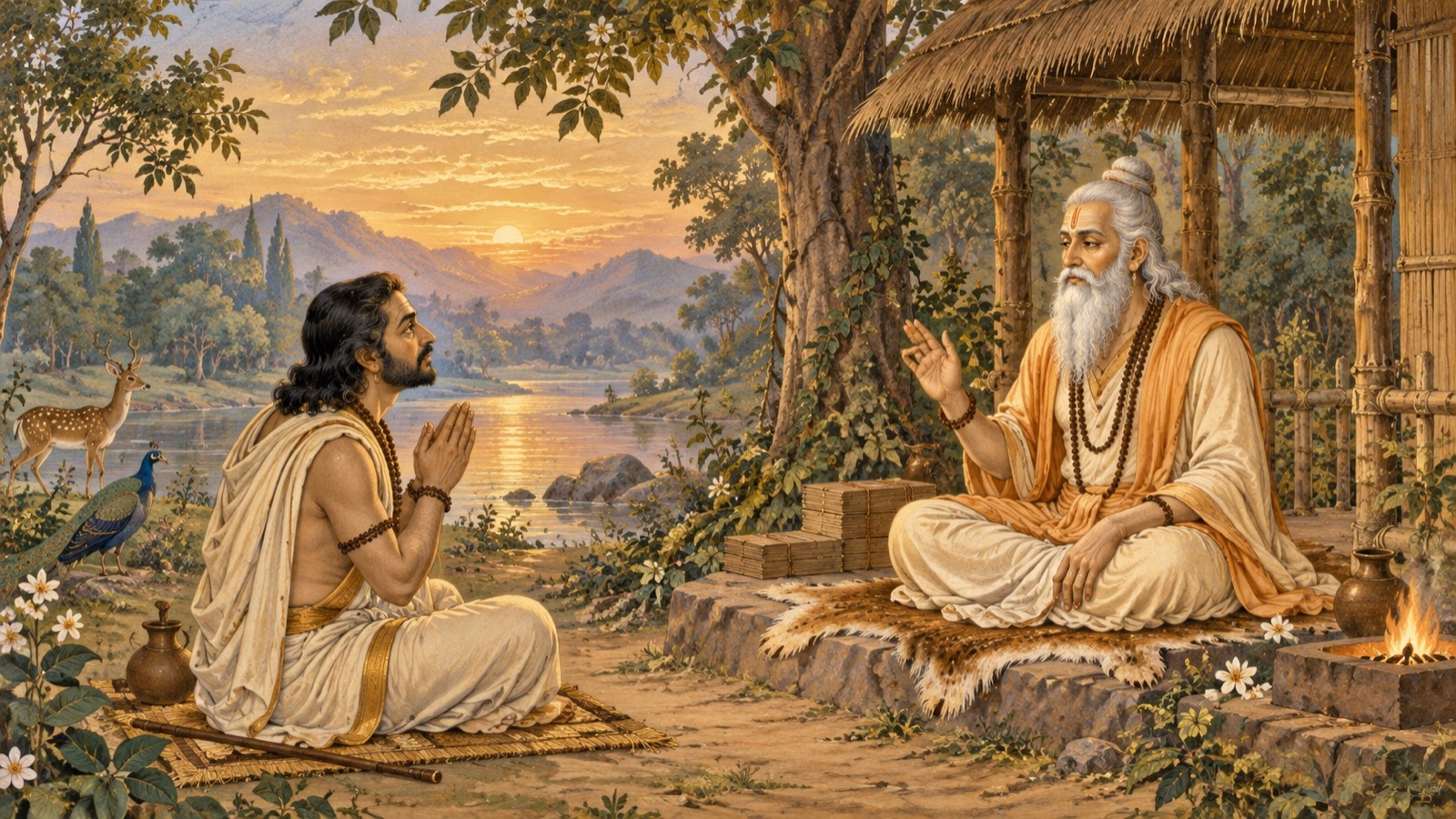
Sukadeva Gosvami sets the scene simply: as Maitreya continued speaking, Vidura — described here as “budhah,” the learned or awakened one — put a question to him, and did so in a manner that pleased the sage rather than offending him. This detail matters more than it first appears. Vidura’s question is, in essence, a challenge to something Maitreya has just said. Yet Vidura asks it with such evident hunger for the truth, and such humility, that Maitreya receives it not as a contradiction but as an invitation.
विदुर उवाच । ब्रह्मन् कथं भगवतश्चिन्मात्रस्याविकारिण: । लीलया चापि युज्येरन्निर्गुणस्य गुणा: क्रिया: ॥ २ ॥
vidura uvāca / brahman kathaṁ bhagavataś cin-mātrasyāvikāriṇaḥ līlayā cāpi yujyeran nirguṇasya guṇāḥ kriyāḥ
Meaning: Vidura asked: O holy sage, how can the Lord, who is pure consciousness, immutable and unqualified (absolute), come to be associated with attributes and activity even in sport? (Canto 3, Chapter 7, verse 2)
Vidura presses the point with an everyday image. A child plays, he observes, because it hankers after pleasure and craves the company of another to play with — a companion, a toy, a game. But the Lord is described everywhere in the scriptures as complete in Himself, ever one without a second, wanting nothing. What need, then, could such a Being have for play at all? Vidura’s questions come quickly after this, each one sharpening the paradox: if it is through the Lord’s own Maya — the interplay of the three Gunas, Sattva, Rajas and Tamas — that the universe is created, sustained, and finally withdrawn, then how can the Lord’s own knowledge, which is never obscured by space, time, or any circumstance, be touched by that same Maya at all? And if the Lord alone truly dwells within every body as its enjoyer, how could there be misfortune for Him, how could He ever suffer the fruits of Karma?
Vidura does not resolve any of this himself. He ends, instead, with a confession that is itself a kind of prayer: his mind, he says, is much distracted, caught in this morass of ignorance, and he asks Maitreya directly to remove the confusion. It is a small but telling moment — a reminder that in this tradition, the sincere admission of not-knowing is itself the doorway through which real teaching becomes possible.
Maitreya’s Answer: The Dream of Bondage
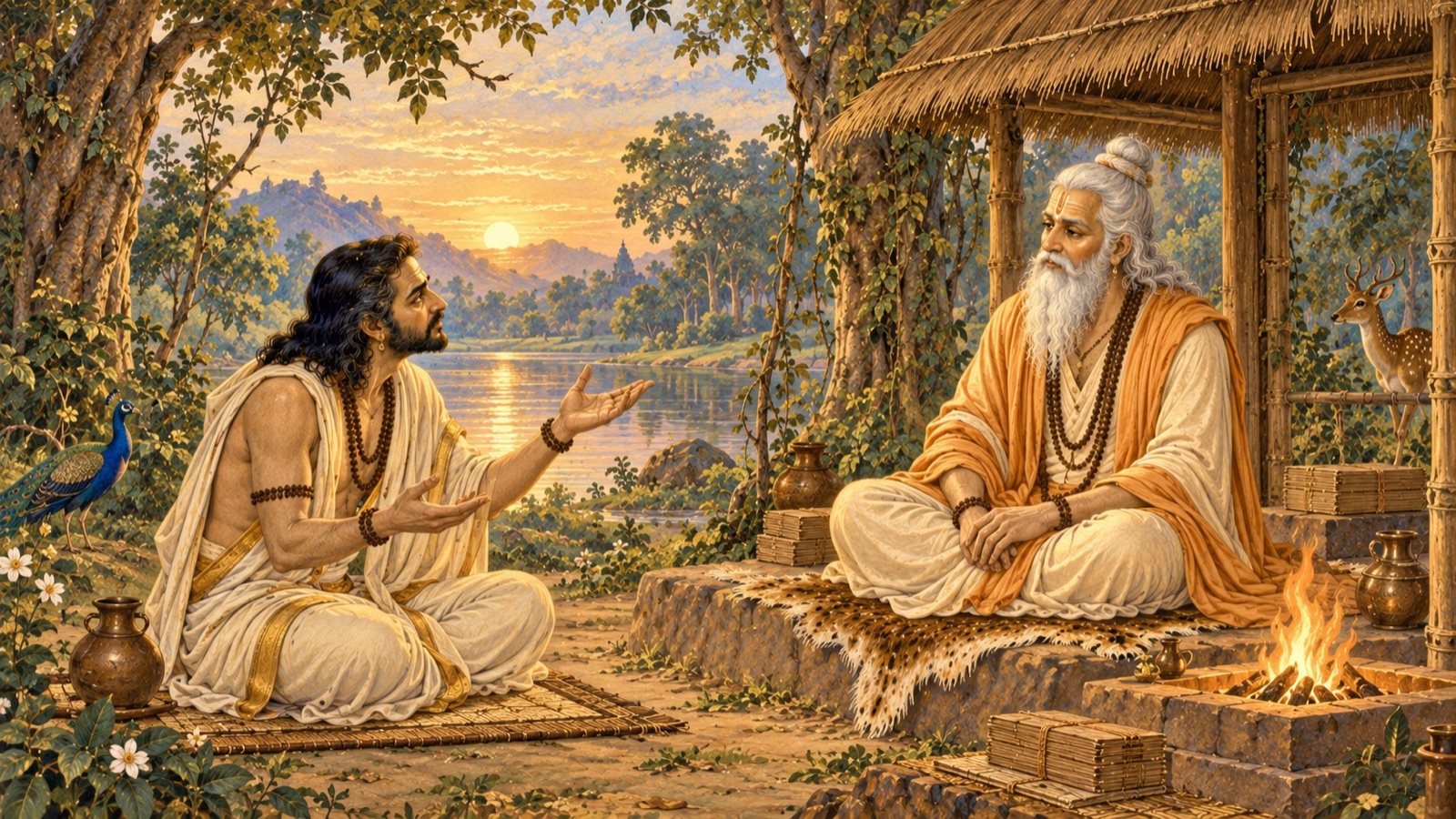
Sukadeva notes, before Maitreya answers, that the sage was “free from all conceit” and replied “as though smiling” — an image of a teacher who takes no offense at being questioned, and who welcomes the chance to speak again of the Lord. Maitreya’s answer begins with a single, startling admission: that the free, sovereign Spirit should ever feel miserable or fall into bondage is, strictly speaking, against all logic. And yet, he says, this is exactly what the Lord’s own Maya accomplishes.
मैत्रेय उवाच । सेयं भगवतो माया यन्नयेन विरुध्यते । ईश्वरस्य विमुक्तस्य कार्पण्यमुत बन्धनम् ॥ ९ ॥
maitreya uvāca / seyaṁ bhagavato māyā yan nayena virudhyate īśvarasya vimuktasya kārpaṇyam uta bandhanam
Meaning: Maitreya said: That the Spirit, who is the ruler (of Prakrti) and ever free, should feel miserable and fall into bondage is against all logic; yet such is the Lord’s Maya (deluding potency). (Canto 3, Chapter 7, verse 9)
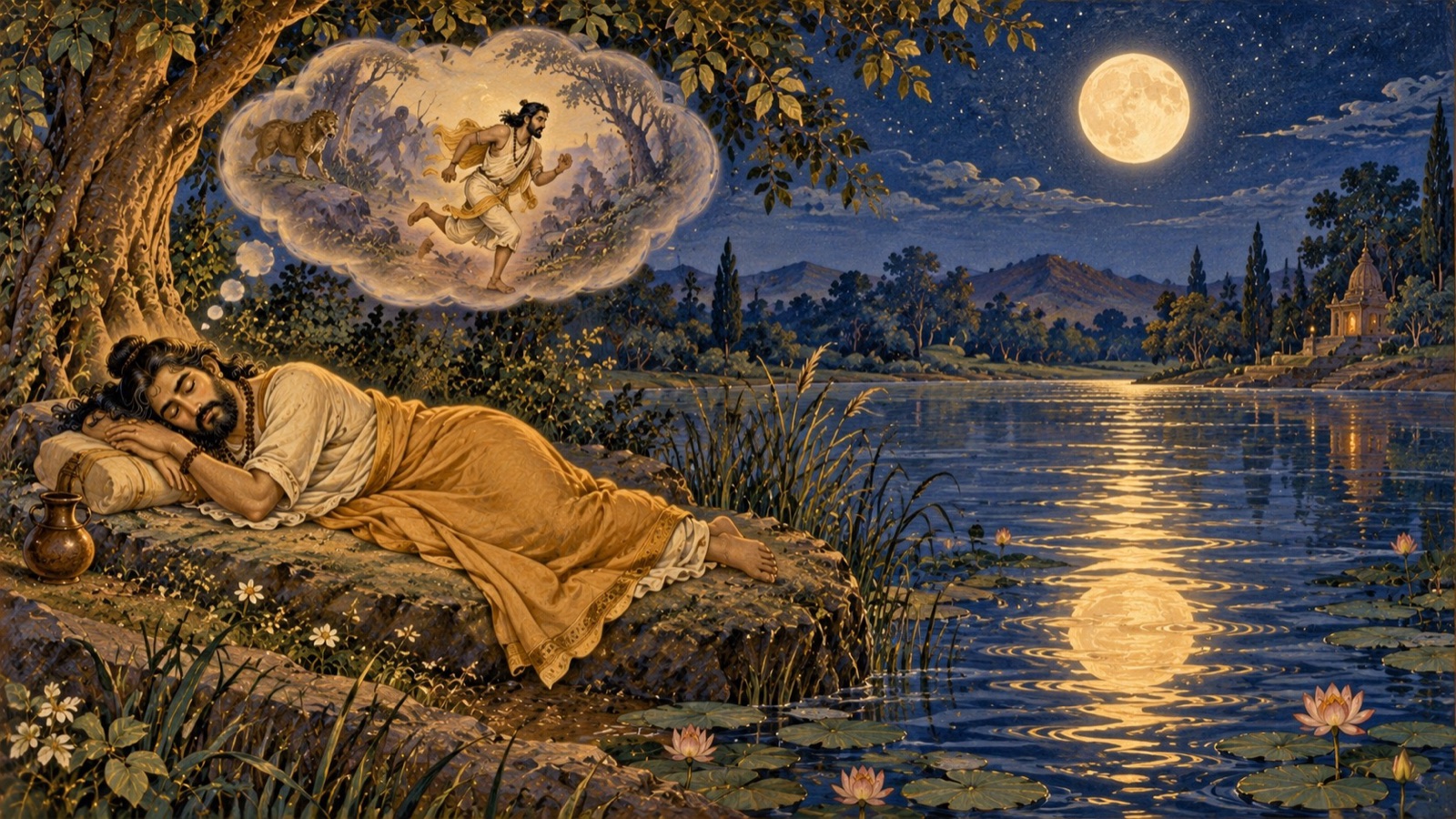
To make the point vivid, Maitreya offers two of the most memorable images in this part of the Bhagavatam. The first is the dream of the severed head: a sleeping man may see, in his dream, that his own head has been cut off — and the terror of that vision feels entirely real to him — even though, in waking fact, his head remains exactly where it always was. The Jiva’s sense of bondage, Maitreya says, is precisely this kind of dream: vivid, distressing, and utterly without foundation in the soul’s actual nature.
The second image is gentler but no less exact. Watch the moon reflected on the surface of a pond when the water trembles in the wind: the moon itself appears to tremble, to ripple, to break apart — yet none of that motion belongs to the moon at all. It belongs entirely to the water. In the same way, Maitreya explains, the characteristics of the body — birth, death, hunger, grief, and all the rest — do not truly belong to the soul, even though the soul, having identified itself with the body, appears to bear them as its own.
यथा जले चन्द्रमस: कम्पादिस्तत्कृतो गुण: । दृश्यतेऽसन्नपि द्रष्टुरात्मनोऽनात्मनो गुण: ॥ ११ ॥
yathā jale candramasaḥ kampādis tat-kṛto guṇaḥ dṛśyate ‘sann api draṣṭur ātmano ‘nātmano guṇaḥ
Meaning: Again, just as trembling and other characteristics, which are attributable to water alone, are seen in the moon as reflected in water, though really non-existent therein, so the attributes of the body, which is not the soul, appear in the soul that has identified itself with a body. (Canto 3, Chapter 7, verse 11)
What, then, dissolves this false identification? Maitreya is direct: it fades only gradually, through devotional service practiced in the mode of renunciation, and that devotion itself is made possible solely by the mercy of Lord Vasudeva — not by philosophical analysis working on its own.
स वै निवृत्तिधर्मेण वासुदेवानुकम्पया । भगवद्भक्तियोगेन तिरोधत्ते शनैरिह ॥ १२ ॥
sa vai nivṛtti-dharmeṇa vāsudevānukampayā bhagavad-bhakti-yogena tirodhatte śanair iha
Meaning: That false identification, Maitreya says, is removed only little by little in this life, through devotional service rendered in the way of renunciation and solely by the mercy of Lord Vasudeva. (Canto 3, Chapter 7, verse 12)
When the senses withdraw from their objects and turn wholly toward Sri Hari, the Supreme Spirit and Seer, the soul’s restless oscillation between attachment and aversion quiets, Maitreya says, exactly as it does in deep, dreamless sleep. Then he makes a still bolder claim about the sufficiency of remembrance itself: merely hearing and chanting the glories of Sri Krishna, the Slayer of the demon Mura, is declared able to end suffering of every kind.
अशेषसंक्लेशशमं विधत्ते गुणानुवादश्रवणं मुरारे: । किं वा पुनस्तच्चरणारविन्दपरागसेवारतिरात्मलब्धा ॥ १४ ॥
aśeṣa-saṅkleśa-śamaṁ vidhatte guṇānuvāda-śravaṇaṁ murāreḥ kiṁ vā punas tac-caraṇāravinda- parāga-sevā-ratir ātma-labdhā
Meaning: Merely hearing and reciting the glories of Sri Krishna, the enemy of the demon Mura, brings an end to unlimited misery of every description — so what need is there even to speak of the fruit that comes to one whose heart has itself grown fond of serving the fragrant dust of His lotus feet? (Canto 3, Chapter 7, verse 14)
This is the quiet turning point of Maitreya’s whole reply, and it carries a lesson that reaches beyond the immediate puzzle of Maya. Vidura had asked a philosopher’s question — how could the changeless Absolute ever be touched by activity? — and Maitreya could have answered it with metaphysics alone, tracing the logic of Prakriti and the three Gunas indefinitely. Instead he turns that very inquiry toward remembrance and service: the knot is untied not chiefly by more reasoning but by the practice of bhakti, and its simplest possible form — merely speaking and hearing of the Lord’s glories — is declared sufficient to end boundless suffering. The point easy to miss beneath this chapter’s dense philosophy is that Sri Krishna arranges even a disciple’s hardest doubts to end at His own lotus feet: in the Bhagavatam’s own reckoning, understanding is never complete until it ripens into devotion.
Vidura’s Relief, and a Deeper Longing
The effect on Vidura is immediate and complete. He tells Maitreya that his doubts have been “eradicated by the sword” of the sage’s reasoned exposition — a striking image of teaching as a blade that cuts cleanly through confusion rather than merely soothing it. Both halves of the paradox now sit clearly in his mind at once: the Lord’s own unbroken freedom, and the Jiva’s merely apparent bondage, a bondage with no more real foundation than the universe itself has apart from the Lord’s Maya.
From this clarity Vidura draws a further, quietly profound observation about the shape of ordinary human life: the person who is utterly, unreflectively ignorant, and the person who has fully realized God and gone beyond the reach of the mind, both live at ease in this world. It is the person caught in between — aware enough to doubt, but not yet awake enough to know — who suffers.
यश्च मूढतमो लोके यश्च बुद्धे: परं गत: । तावुभौ सुखमेधेते क्लिश्यत्यन्तरितो जन: ॥ १७ ॥
yaś ca mūḍhatamo loke yaś ca buddheḥ paraṁ gataḥ tāv ubhau sukham edhete kliśyaty antarito janaḥ
Meaning: He who is the most ignorant and he who has realized God, who is beyond the reach of mind, both these lead a care-free life in this world; while he who stands between the two lives in misery. (Canto 3, Chapter 7, verse 17)
Having now understood that the material world, though it appears real, is not ultimately so, Vidura declares his intention: to dissolve even that last, subtle illusion through service at Maitreya’s own feet. That service, he says, opens onto the true feast — intense devotion to the immutable Lord, the Slayer of Madhu, a devotion that alone ends the agony of repeated birth and death. And he adds a further, humbling observation: the company and service of the Lord’s own devotees, those living approaches to Vishnu Himself, in whose fellowship the praises of Janardana are ceaselessly sung, is not something easily secured by men of only modest penance.
दुरापा ह्यल्पतपस: सेवा वैकुण्ठवर्त्मसु । यत्रोपगीयते नित्यं देवदेवो जनार्दन: ॥ २० ॥
durāpā hy alpa-tapasaḥ sevā vaikuṇṭha-vartmasu yatropagīyate nityaṁ deva-devo janārdanaḥ
Meaning: The service of the Lord’s devotees, who are living approaches to Lord Visnu, and in whose company are ever sung the praises of Lord Janardana, who is adored even by gods, cannot be easily secured by men of little penance. (Canto 3, Chapter 7, verse 20)
A Question for Every Chapter Still to Come
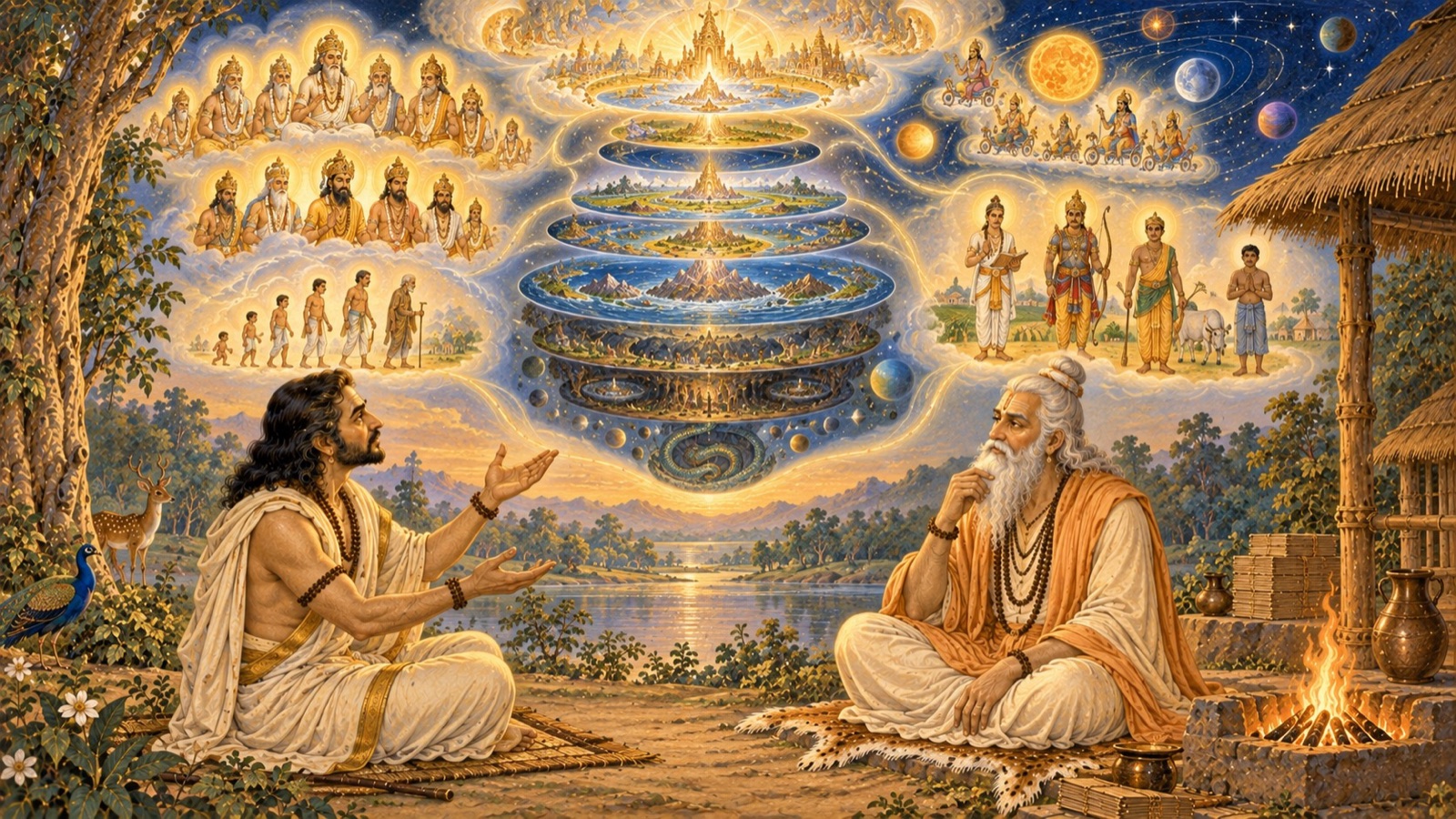
It is at this point that the chapter changes character entirely. Having received his answer, Vidura does not simply thank Maitreya and move on. Instead, drawing on what Maitreya has already told him about the Cosmic Being at the close of the previous discourse — the Purusha of a thousand feet and arms and thighs, from whose body the four Varnas and all created worlds proceeded — Vidura begins to ask, in unbroken succession, for the full unfolding of the Bhagavatam’s cosmology and dharma. The pace and scope of this list is itself remarkable: in barely twenty verses, Vidura names nearly every major subject the remainder of the Third Canto, and indeed much of the Bhagavatam beyond it, will go on to answer one by one.
He first asks about the manifestations of that Cosmic Being — the Prajapatis evolved by Brahma, the categories and subdivisions of created beings, the sequence in which the fourteen Manus, beginning with Svayambhuva, arose to preside each over a full Manvantara, and the lines of descent and deeds of their many offspring. He asks after the relative position and dimensions of the worlds above and below the earth, and the terrestrial region itself, together with the detailed process by which every kind of living being — those born from a womb, from an egg, from sweat, and those sprouting directly from the soil — comes into existence. He asks, too, for the glorious exploits connected with creation, preservation, and dissolution of the Lord who embodies Himself as Brahma, Vishnu, and Shiva according to the three Gunas of Prakriti.
पुरुषस्य च संस्थानं स्वरूपं वा परस्य च । ज्ञानं च नैगमं यत्तद्गुरुशिष्यप्रयोजनम् ॥ ३८ ॥
puruṣasya ca saṁsthānaṁ svarūpaṁ vā parasya ca jñānaṁ ca naigamaṁ yat tad guru-śiṣya-prayojanam
Meaning: What is the true nature of the Jiva (embodied soul) and the essential character of the Supreme? What is the wisdom taught by the Upanisads and what, again, is the use a teacher has for his pupil and vice versa? (Canto 3, Chapter 7, verse 38)
From cosmology Vidura moves to society and its structure: the grouping of humanity into the four Varnas and four Asramas by outward mark, conduct, and temperament; the births and deeds of the great Rishis; the divisions of the Vedas; the extensive details of sacrifice; the paths of disinterested action, renunciation, and discriminative knowledge between Matter and Spirit; the Vaishnava Pancharatra teaching the Lord gave to the sage Narada; the confusion caused by the spread of heretical doctrines; and even the puzzling case of children descended from a mother of higher caste than the father. He asks, in the same breath, about the means proper to religious merit, worldly wealth, sensuous enjoyment, and final liberation — the four traditional Purusharthas — without one undermining another; about agriculture, trade, the administration of justice, and Vedic study; about the rites of Sraddha performed for departed ancestors and the nature of the Pitrs themselves; about the positions of the planets, lunar mansions, and stars that govern the divisions of time; and about the rewards of charitable gifts, austerity, sacrifice, and works of public benefit such as wells, roads, temples, and gardens — closing this stretch of questions with a practical concern for the duties of a person living abroad, or one fallen upon hard times.
The Question Beneath All the Questions
Vidura’s list, for all its extraordinary range, keeps circling back toward a single center. He asks by what means Lord Sri Krishna — Janardana, the very source of piety — can be pleased, and what kind of person is able to win His favor, adding a gentle appeal to Maitreya’s own compassion: kind teachers, he says, tell their devoted pupils and sons even what they have not thought to ask.
येन वा भगवांस्तुष्येद्धर्मयोनिर्जनार्दन: । सम्प्रसीदति वा येषामेतदाख्याहि मेऽनघ ॥ ३५ ॥
yena vā bhagavāṁs tuṣyed dharma-yonir janārdanaḥ samprasīdati vā yeṣām etad ākhyāhi me ‘nagha
Meaning: Also tell me, O sinless Maitreya, the means by which Lord Sri Krsna (who is invoked by His devotees), the source of piety, can be propitiated, and what type of men are able to win His pleasure. (Canto 3, Chapter 7, verse 35)
He asks how the material elements, at the dissolution of the universe, return to their source in Primordial Matter, and who continues to serve the Lord even through a Pralaya, or while He rests in Yoganidra. He asks, in verses that gather up everything that has come before, for the true nature of the Jiva and the essential character of the Supreme, the wisdom the Upanishads teach, and the very purpose of the bond between teacher and pupil — and then, having asked for so much knowledge, he asks the still more practical question of how such wisdom is actually to be attained, since, he notes, neither spiritual enlightenment, nor devotion, nor renunciation can be had in isolation from the others.
Vidura closes this long inquiry with a statement of his own motive and, remarkably, with a judgment about what matters most of all. He asks all of this, he says, purely to acquaint himself with the exploits of Sri Hari, confessing himself ignorant and still blinded by Maya. And then he offers a conviction that will echo through the rest of the Bhagavatam: the study of all the Vedas, the performance of sacrifice, austerity, and charitable giving, put together, cannot equal even a fraction of the merit earned by freeing a single soul from the fear of birth and death through true instruction in God.
सर्वे वेदाश्च यज्ञाश्च तपो दानानि चानघ । जीवाभयप्रदानस्य न कुर्वीरन् कलामपि ॥ ४१ ॥
sarve vedāś ca yajñāś ca tapo dānāni cānagha jīvābhaya-pradānasya na kurvīran kalām api
Meaning: (The study of) all the Vedas, sacrificial acts and austere penance and charitable gifts, O holy one, cannot equal even a fraction of the merit that one acquires by rendering a Jiva immune from the fear of birth and death through instruction in the truth about God. (Canto 3, Chapter 7, verse 41)
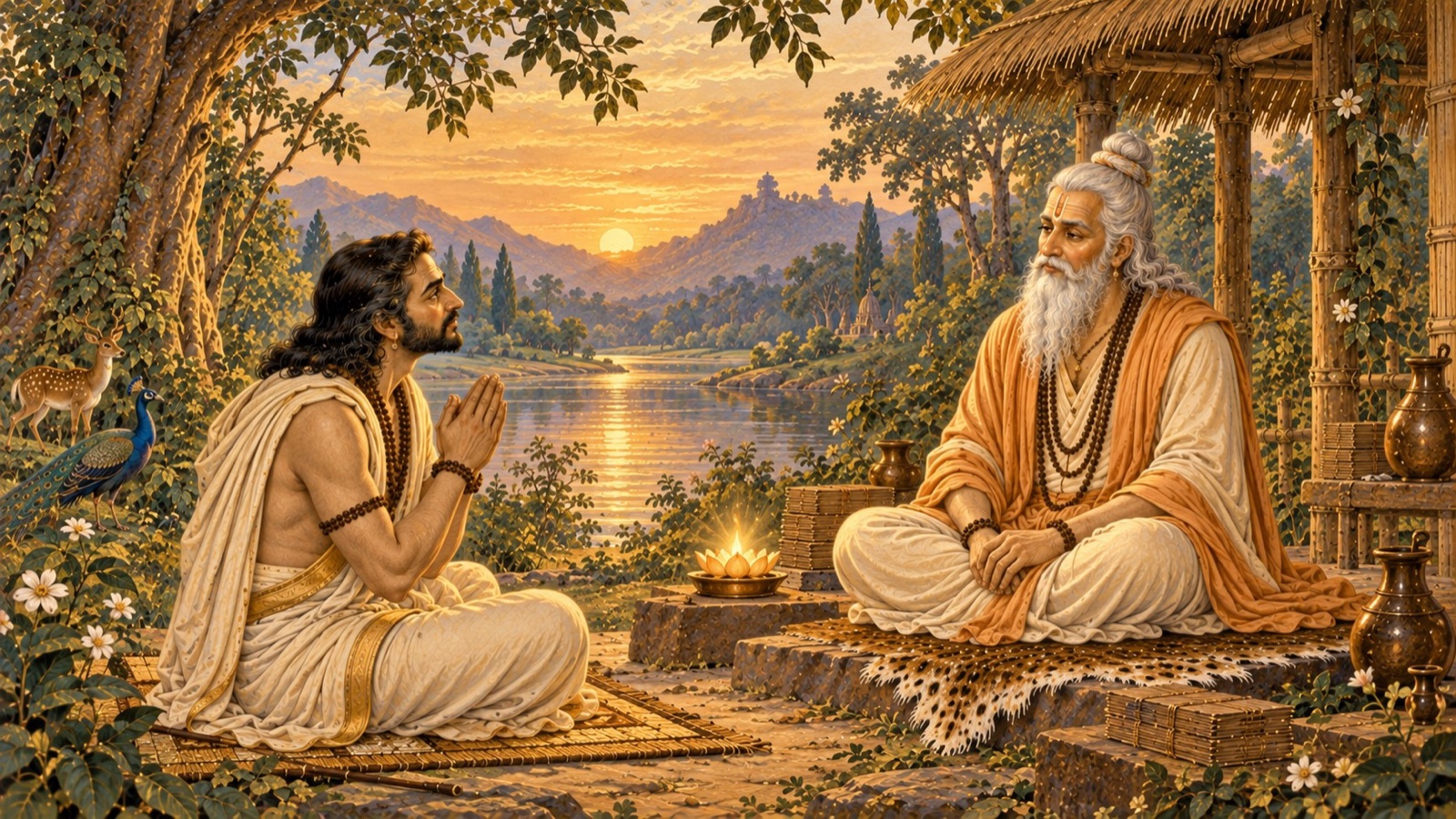
Maitreya’s Delight
The chapter’s final verse belongs, once more, to Sukadeva Gosvami’s narration. Having been asked so much — questions touching the entire span of the Puranic tradition — Maitreya, described here as the foremost among sages, does not grow weary or overwhelmed. Instead, Sukadeva says, his joy only deepens the more he is urged to speak of the Lord’s stories; and so, smiling, he begins his reply.
श्रीशुक उवाच । स इत्थमापृष्टपुराणकल्प: कुरुप्रधानेन मुनिप्रधान: । प्रवृद्धहर्षो भगवत्कथायां सञ्चोदितस्तं प्रहसन्निवाह ॥ ४२ ॥
śrī-śuka uvāca / sa ittham āpṛṣṭa-purāṇa-kalpaḥ kuru-pradhānena muni-pradhānaḥ pravṛddha-harṣo bhagavat-kathāyāṁ sañcoditas taṁ prahasann ivāha
Meaning: Sri Suka continued: When Vidura, the foremost of the Kurus, asked Maitreya, the chief of the sages, questions bearing on the theme of the Puranas, the latter was immensely delighted at being urged to narrate the stories of the Lord, and smilingly spoke as follows. (Canto 3, Chapter 7, verse 42)
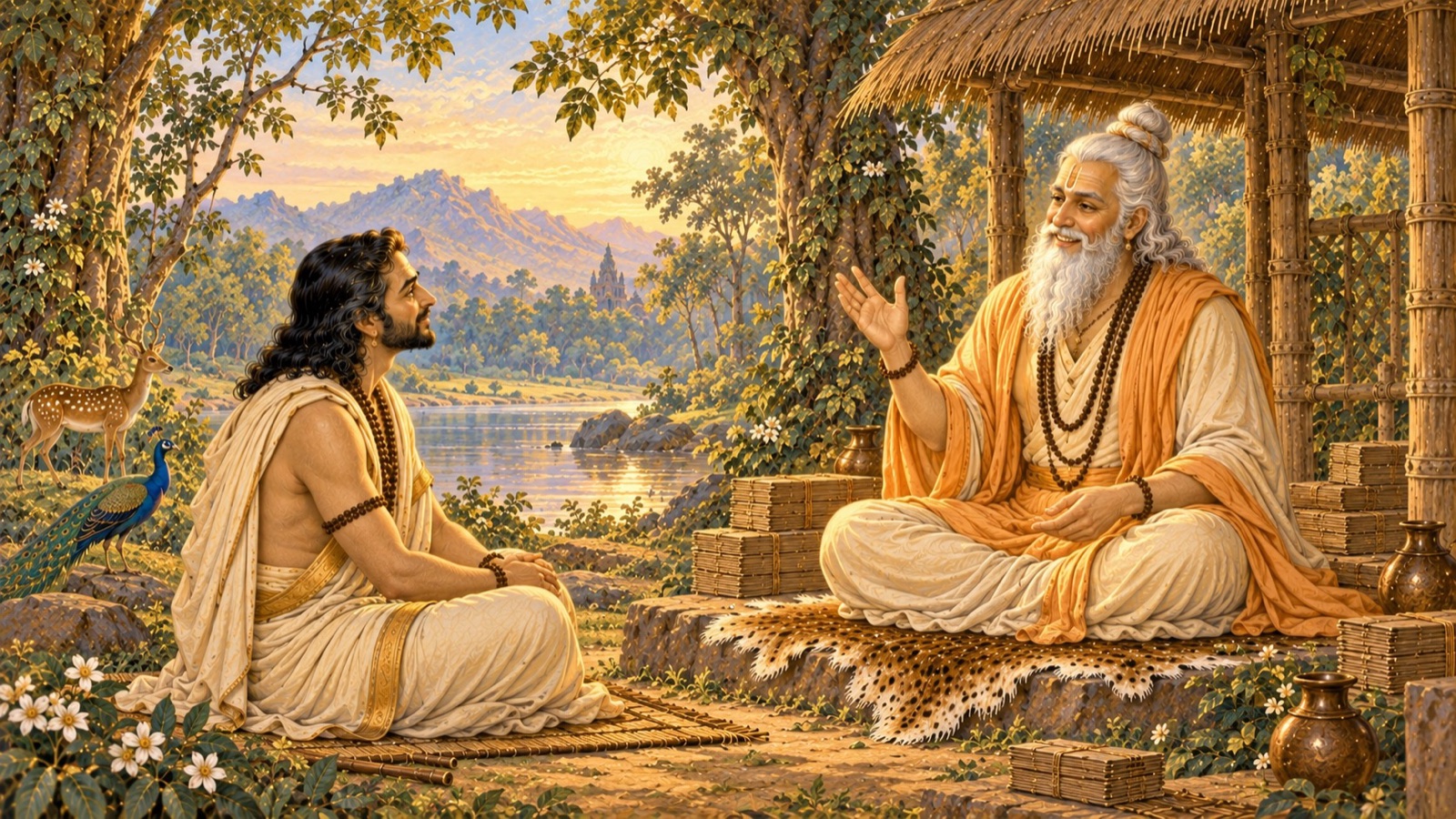
With this single line — delight rather than fatigue, welcome rather than reluctance — Discourse VII of Book Three comes to its close. Every question Vidura has asked here still hangs in the air, unanswered in this chapter itself; Maitreya’s actual reply, beginning with Brahma’s manifestation from the Lord’s own navel-lotus, is the subject of the discourse that follows immediately after.
Principal Teachings of This Chapter
1. Honest doubt, offered with humility, is not a failure of faith but an opening for deeper understanding. Vidura challenges what he has just been taught, yet does so in a way that delights rather than offends his teacher — a model for how sincere questioning belongs inside, not outside, a life of devotion (verses 2-7).
2. The soul’s bondage is real in experience but has no foundation in truth. The dream of a severed head and the trembling moon reflected in disturbed water both teach the same lesson: suffering that feels utterly convincing can still be, at its root, an identification with something the soul is not (verses 9-11).
3. Devotion, not analysis alone, dissolves the illusion of bondage. Maitreya is precise that the false identification of soul with body fades only through devotion made possible by the Lord’s own grace — and that even the simplest form of that devotion, merely hearing and chanting His glories, is declared sufficient to end unlimited suffering (verses 12-14).
4. The person in between is the one who suffers most. Neither total ignorance nor full God-realization brings misery; it is the state of partial awareness — awake enough to doubt, not yet awake enough to know — that is genuinely difficult (verse 17).
5. A single, well-placed question can outline an entire scripture. Vidura’s forty questions in this chapter — on creation, the Manus, the Varnas and Asramas, the four aims of life, the nature of the soul, and the means to please the Lord — become, in effect, the table of contents for much of what the Bhagavatam will go on to teach (verses 21-41).
A Devotional Reflection
There is something quietly instructive in the order of this chapter. Vidura does not begin with the sweeping cosmological questions that dominate its second half; he begins with a single, personal doubt about how the Lord he worships could ever seem touched by suffering or need. Only after that doubt is resolved — only after his own confusion about bondage and freedom has been cut through “as though by a sword” — does he feel free to ask about everything else: the Manus, the planets, the Varnas, the purpose of a teacher, the meaning of the Upanishads. This is not accidental. The Bhagavatam seems to be teaching, through the very shape of this dialogue, that the deepest metaphysical and cosmological knowledge only becomes truly useful once the heart’s own confusion about the Lord’s nature has first been settled. Vidura could have asked about the Manus and the Prajapatis at any point; he waits until he has understood, in his own case, that his bondage was a dream and the Lord’s freedom was never in question. Only then does the wider universe become something worth inquiring into — not as an escape from devotion, but as its natural extension.
A Daily Devotional Practice
Today, notice a place in your own understanding where a small, personal doubt has been quietly blocking a larger question you would otherwise want to ask — about your purpose, your relationships, or your own suffering. Rather than reaching first for the larger question, follow Vidura’s example: bring the smaller, more honest doubt into the light, even if it feels embarrassingly simple, and sit with it until some clarity comes. Before you return to your day, pause and repeat quietly: “Om Namo Bhagavate Vasudevaya.” Let that remembrance loosen the knot of confusion the way Maitreya’s smiling patience loosened Vidura’s, so that the questions still waiting beneath it can, in their own time, be asked and answered.
Conclusion
The seventh discourse of Book Three is, on its surface, a chapter almost entirely made of questions — first Vidura’s single anguished doubt about a changeless Lord’s apparent bondage and play, then, once that doubt dissolves under Maitreya’s gentle reasoning, an extraordinary flood of forty further questions covering nearly the whole architecture of existence. And yet nothing in this chapter feels aimless. Each question Vidura asks is itself an act of devotion — the desire to know more fully the Lord whose glory Maitreya has already begun to reveal. Behind the philosophy of Maya and the dream of the severed head, behind the long list of Manus and Prajapatis and Varnas still to come, lies the same quiet current that runs through every discourse of the Bhagavatam: a disciple’s hunger to understand, met by a teacher’s undiminished joy in answering. Maitreya’s delight at the chapter’s close is itself the promise of everything that follows — that no question asked in true humility, however vast, will ever exhaust a teacher whose only real subject is the Lord Himself.
May the divine wisdom of Srimad Bhagavatam awaken pure devotion within our hearts.
Om Namo Bhagavate Vasudevaya.
Jay Shree Madhav.
References and Attribution
- Primary edition: Gita Press, Śrīmad Bhāgavata Mahāpurāṇa (English, complete), Book Three, Discourse 7, pages 160–164.
- Series: Srimad Bhagavatam Wisdom · Biswa Sanatan Dharma Seva Trust.
- Presented following the spiritual guidance and recommendation of Pandit Dr. Shri Kashinath Mishra.
This is an original, faithful retelling in the writer’s own words, with brief quoted verses shown in Devanāgarī and transliteration and their meanings given as summaries. It is not a reproduction of any single publisher’s continuous translation or commentary. No affiliation with or endorsement by any publisher is implied.
Jay Shree Madhav