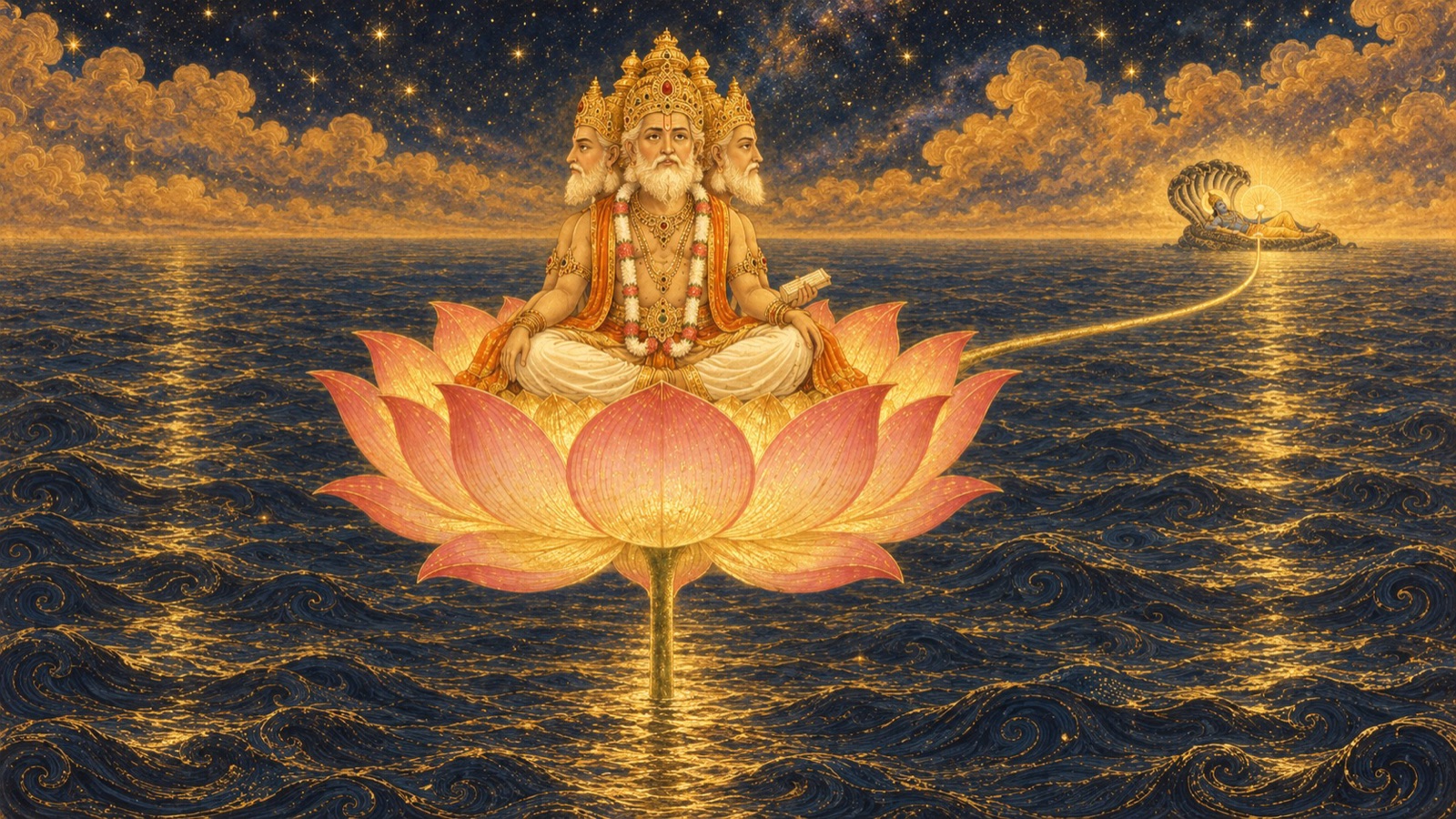
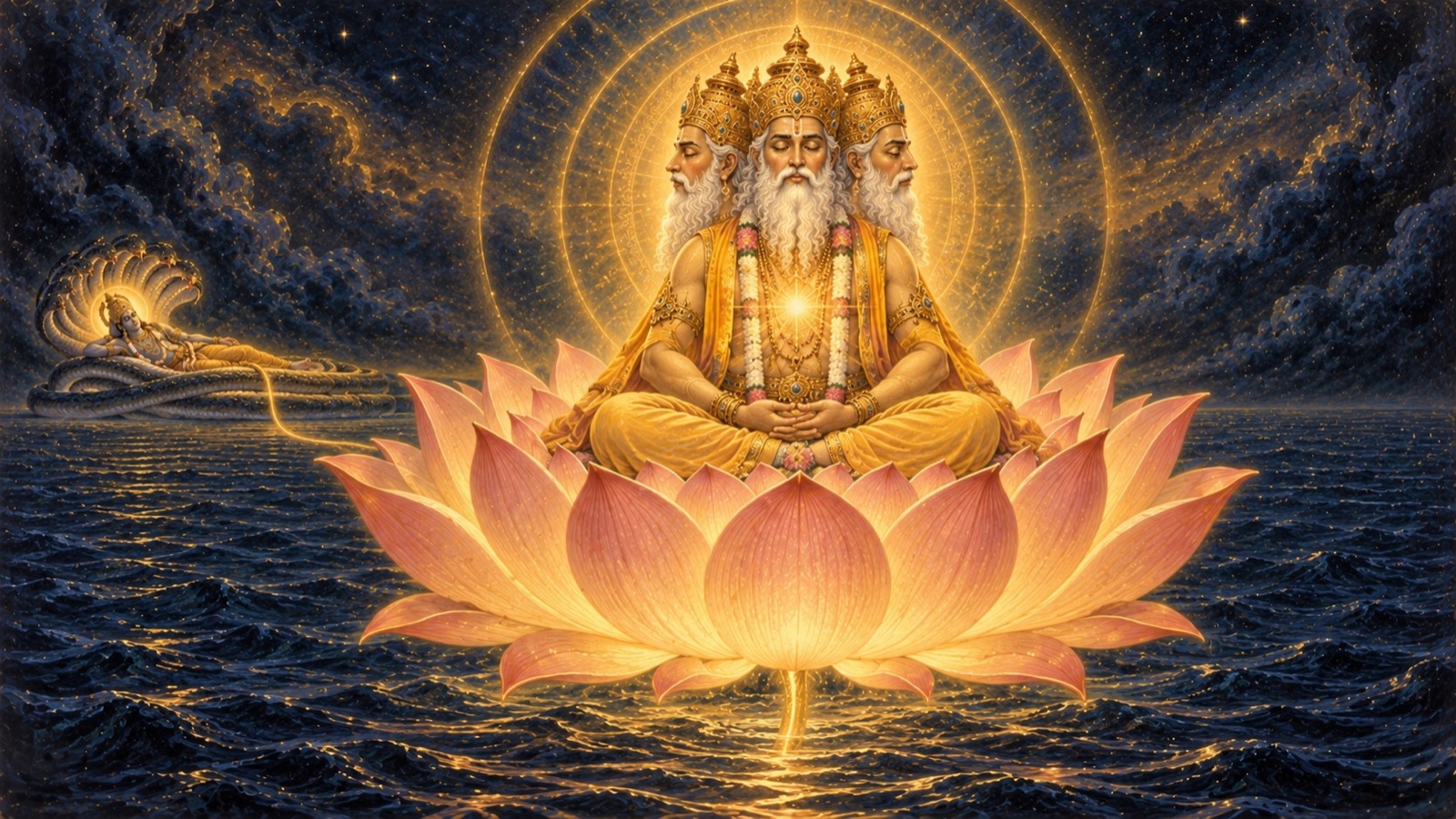
From the navel of the sleeping Lord, upon the shoreless waters of dissolution, a single lotus unfolds — and seated within it, gazing in every direction at once, the self-born Brahma opens his eyes on a universe he cannot yet see.
Om Namo Bhagavate Vasudevaya.
Om Namo Bhagavate Vasudevaya.
Om Namo Bhagavate Vasudevaya.
Welcome to Srimad Bhagavatam Wisdom, a devotional journey through the sacred histories and teachings of the Srimad Bhagavat Mahapurana. Vidura’s long pilgrimage — begun in exile, carried through grief at the Yadu dynasty’s destruction, and guided step by step toward the one sage who could finally answer his questions — reaches its destination in this chapter. Having found Maitreya on the bank of the Ganga, Vidura now receives the very teaching that Lord Sankarsana first gave to the sage-boy Sanatkumara, and that has passed, master to disciple, all the way down to Maitreya himself. Chapter 8 is where that teaching truly begins: not with abstract philosophy, but with the very first event of creation — the appearance, from the navel of the sleeping Supreme Lord, of a single cosmic lotus, and from that lotus, the birth of Brahma, the self-born architect of the coming worlds. Brahma opens his eyes onto nothing he can recognize, searches in vain for the root of his own existence, and finally, through a hundred years of unbroken meditation, is shown in his heart the resplendent form of the Lord he had been seeking all along.
Chapter Information
- Scripture: Śrīmad Bhāgavata Mahāpurāṇa
- Canto: 3 (Book Three)
- Chapter: 8 (Discourse 8)
- Chapter title: Brahma’s Manifestation
- Principal speaker: Maitreya (beginning his discourse to Vidura), narrating in turn the earlier questioning of Lord Sankarsana by Sanatkumara and the other sages — the whole related by Suta Gosvami to the sage Saunaka and the assembly at Naimisharanya
- Principal listener: Vidura (receiving Maitreya’s teaching directly); the sage Saunaka with the assembly at Naimisharanya (hearing it all from Suta)
- Main setting: The bank of the river Ganga, where Maitreya and Vidura are seated; within Maitreya’s narration, the subterranean region of Patala (where Sankarsana resides) and the shoreless causal waters on which Lord Narayana reclines
- Central subject: Maitreya’s opening praise of Vidura and account of the parampara through which the Bhagavata teaching reached him; the cosmic sleep of Lord Narayana; the emergence of the navel-lotus and the birth of the self-born Brahma; Brahma’s failed search for the lotus’s root; and Brahma’s hundred years of meditation, culminating in his vision of the Lord reclining on Sesa
- Principal verse range: Canto 3, Chapter 8, verses 1–33
- Primary edition: Gita Press Śrīmad Bhāgavata Mahāpurāṇa
Maitreya Begins: Praise for Vidura and the Chain of Teachers
Maitreya opens not with cosmology but with warmth. He tells Vidura that the entire dynasty of Puru has become worthy of reverence simply because Vidura was born into it — and, in a striking aside, identifies Vidura as none other than the god Yama, so devoted is he to the Lord, and so is he, through his very questions, forever lending “fresher and newer charm… to the garland of Sri Hari’s glories.” It is a beautiful way to begin a discourse: not by asserting authority, but by honoring the sincerity of the one who has come to receive it.
मैत्रेय उवाच सत्सेवनीयो बत पूरुवंशो यल्लोकपालो भगवत्प्रधान: । बभूविथेहाजितकीर्तिमालां पदे पदे नूतनयस्यभीक्ष्णम् ॥ १ ॥
maitreya uvāca sat-sevanīyo bata pūru-vaṁśo yal loka-pālo bhagavat-pradhānaḥ babhūvithehājita-kīrti-mālāṁ pade pade nūtanayasy abhīkṣṇam
Meaning: Maitreya said: Oh! the race of Puru has become worthy of adoration even by noble men ever since you were born into it — you, who are no other than the god Yama, so devoted to the Lord; and you lend fresher and newer charm at every step to the garland of Sri Hari’s glories. (Canto 3, Chapter 8, verse 1)
Maitreya then explains what he is about to teach, and why: “in order to relieve the great woe of men who fall into it in their search for trivial delights of sense,” he will now recount the Bhagavata-Purana — the very teaching Lord Sankarsana himself once taught to the sage-boy Sanaka and his brothers. He recalls how Sanatkumara and the other sages, eager to know the truth of the Lord who stands even higher than Sankarsana, once approached Sankarsana in the subterranean region of Patala, where he sat in mental worship of his own source, Lord Vasudeva, his lotus-bud eyes only half opened out of tenderness for his visitors. The sages touched, with their Ganga-drenched matted locks, the lotus feet that even the serpent-chiefs’ daughters worshipped in hope of a worthy match, and extolled Sankarsana’s glories in voices trembling with devotion, while his thousand serpent-hoods shone with the light of gems set in his thousand crowns.
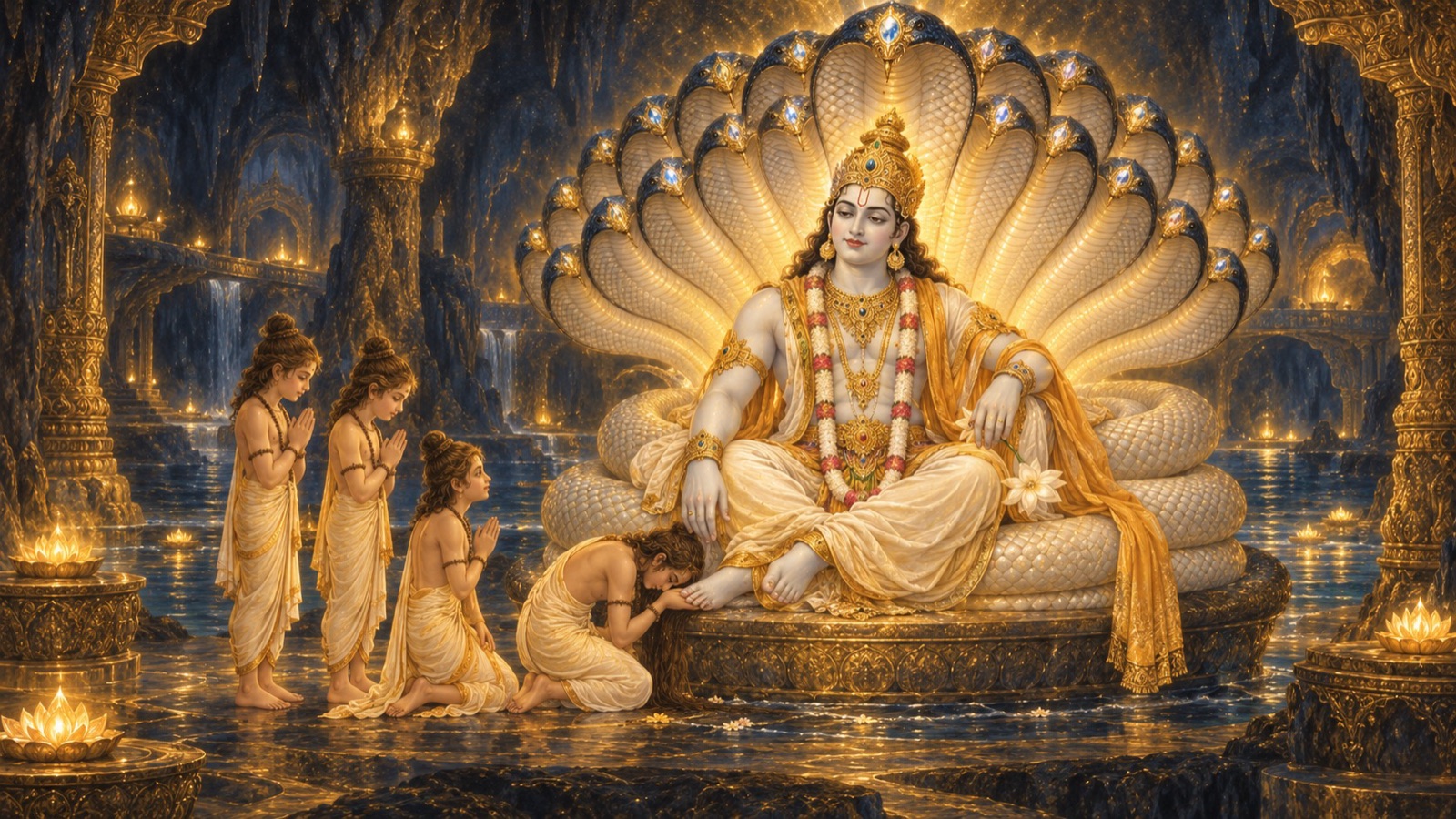
Maitreya then traces the lineage by which this teaching reached him: Sankarsana taught it to Sanatkumara, devoted to renunciation; Sanatkumara taught it to the celibate sage Sankhyayana; Sankhyayana, eager to recount the Lord’s glories, taught it to his own disciple and Maitreya’s preceptor, Parasara, and also to the sage Brihaspati; and Parasara, urged on by his father Pulastya, taught the great Purana to Maitreya himself. “And I now proceed to teach the same to you,” Maitreya tells Vidura, “dear child, who are so reverent and ever devoted to me.” In these nine opening verses, an entire unbroken chain of transmission — sage to sage, heart to heart — arrives, at last, at the moment of speaking to Vidura, and through him, to every reader who takes up this teaching after.
The Cosmic Sleep of Lord Narayana
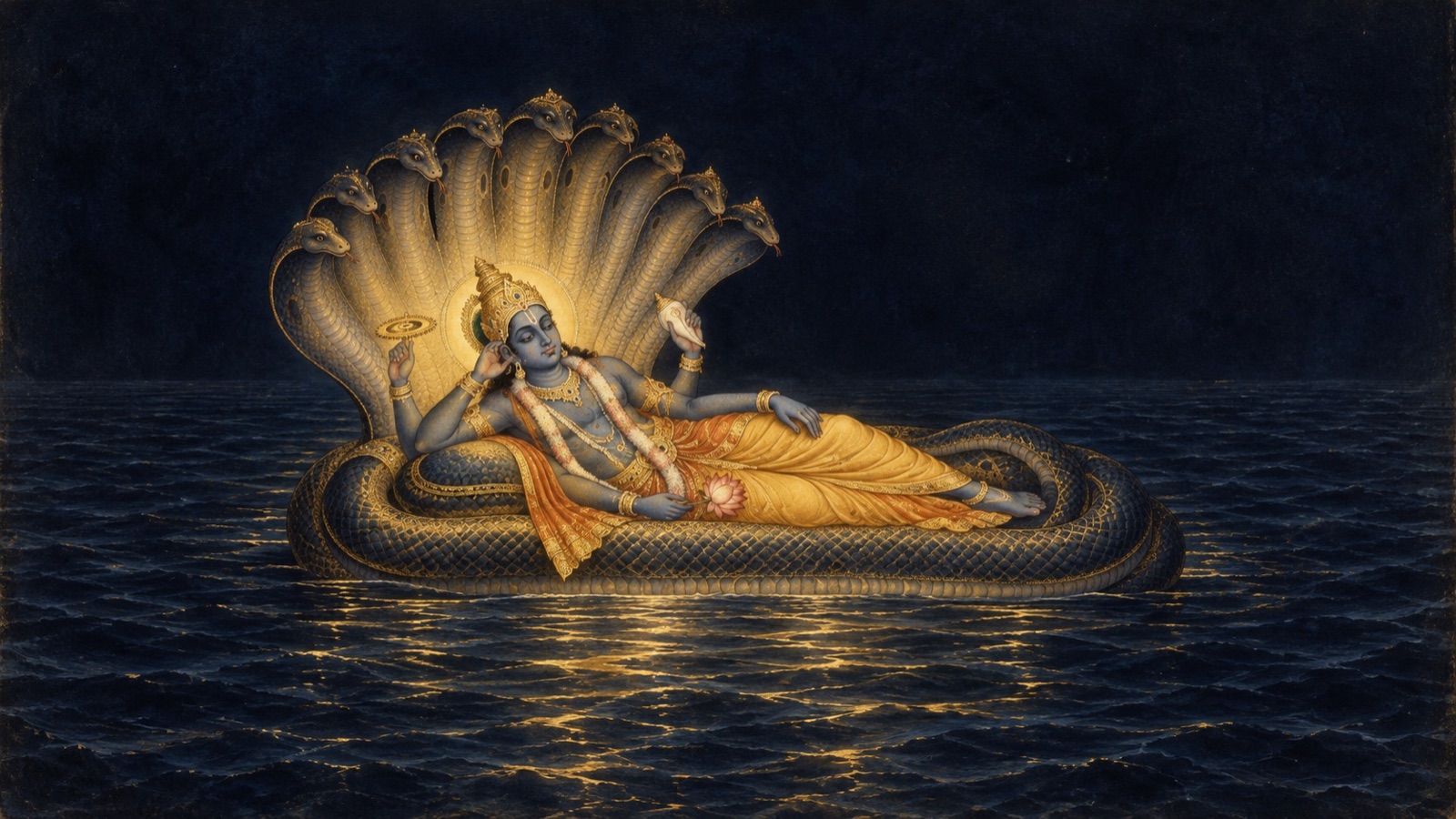
With verse 10, Maitreya begins the narrative proper — and it opens not with light, but with an image of vast, silent waiting. Before creation, he says, the whole universe lay submerged in water, and the only being in existence was Lord Narayana Himself, reclining upon His serpent-couch of Sesa. His eyes were shut, as though in sleep, yet His consciousness remained fully awake even in that repose — a mystic slumber, not an ordinary one — and He had ceased entirely from the threefold activity of creating, preserving, and dissolving the universe, resting instead in the bliss of His own Self.
Within His own body, Maitreya explains, the Lord had gathered the subtle bodies of every embodied soul, keeping them there as fire lies hidden and latent within wood — present, yet unmanifest — while only His potency in the form of Time remained quietly active, waiting to rouse Him again when the hour of creation returned. For a period equal to a thousand rounds of the four Yugas, the Lord slept thus upon the waters, His own consciousness His only companion, until Time itself, acting according to the accumulated Karma of all the Jivas, showed Him — in an instant — the countless worlds still merged, unmanifest, within His own being.
The Navel-Lotus and the Birth of Brahma
It is at this moment — when the Lord’s eye falls upon the subtle matter deposited within His own body, now stirred into activity by the quality of Rajas, the principle of activity that Time itself impels — that the great unfolding begins. That subtle matter issues forth from His navel in order to evolve the grosser forms of the coming universe, and, driven by Time’s force acting upon the residue of all Karma, it springs forth all at once in the shape of a lotus bud — a bud whose splendour illuminates the whole vast expanse of water like a second sun.
तल्लोकपद्मं स उ एव विष्णु: प्रावीविशत्सर्वगुणावभासम् । तस्मिन् स्वयं वेदमयो विधाता स्वयम्भुवं यं स्म वदन्ति सोऽभूत् ॥ १५ ॥
tal loka-padmaṁ sa u eva viṣṇuḥ prāvīviśat sarva-guṇāvabhāsam tasmin svayaṁ vedamayo vidhātā svayambhuvaṁ yaṁ sma vadanti so ‘bhūt
Meaning: The all-pervading Lord Vishnu Himself entered as the inner controller that lotus representing all the worlds. There appeared from it the Creator (Brahma), who is no other than Veda personified and whom they call “Self-born,” because his Progenitor was not to be seen. (Canto 3, Chapter 8, verse 15)
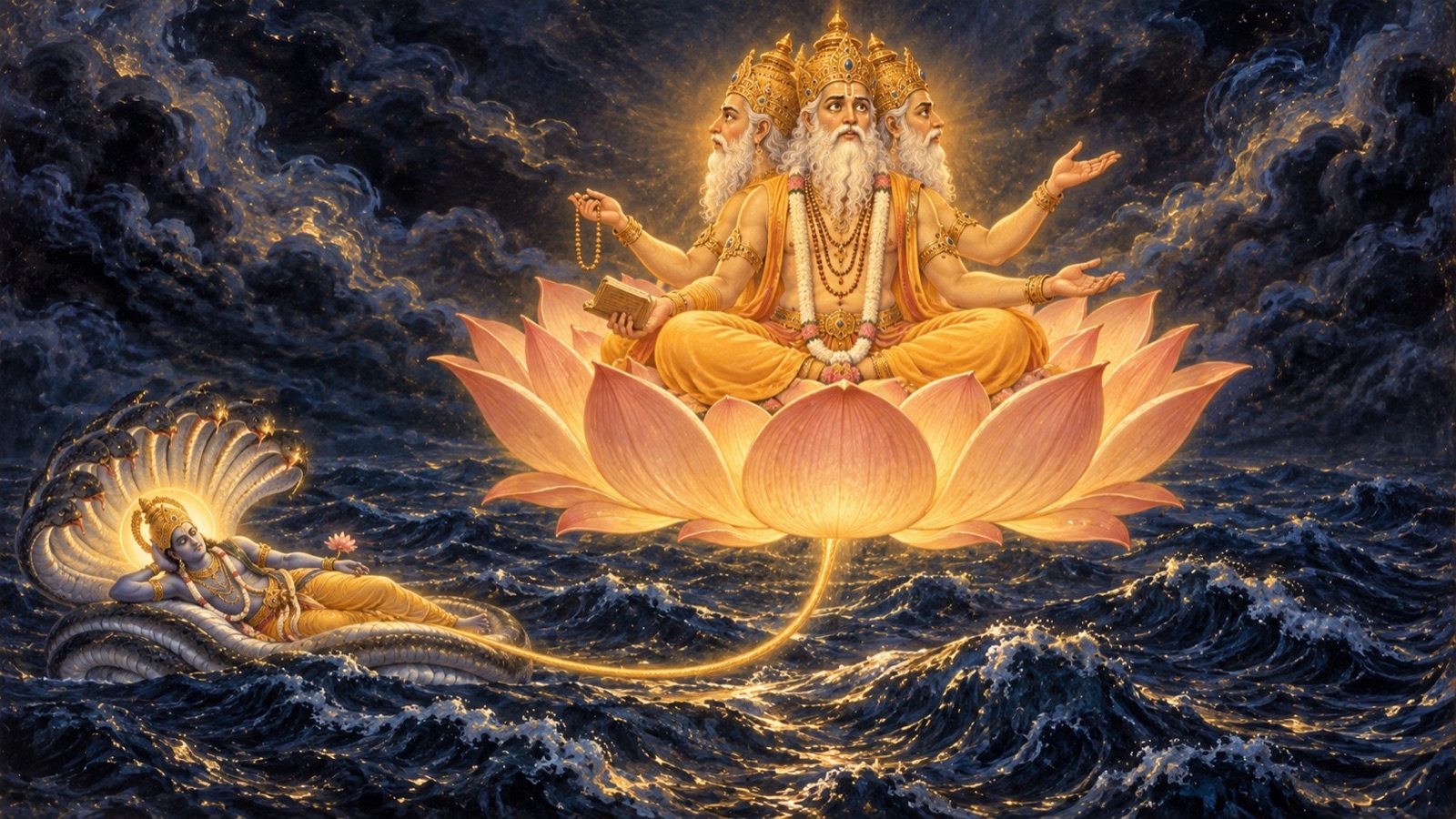
Lord Vishnu Himself, Maitreya tells Vidura, entered that navel-lotus as its indwelling controller — the lotus that represented, in seed form, all fourteen worlds and every object of future sensuous enjoyment. And from within it, there appeared the Creator: Brahma, who is Veda personified, called “Self-born” because no visible parent could be seen to account for his birth. But Brahma, perched upon the pericarp of that vast lotus, could perceive no world at all. Turning his neck about in every direction to search the empty sky with wide, wondering eyes, he found himself, in that very instant, endowed with four faces — one looking each way — so that he might see all around him at once. And still, resting on a lotus tossed by the furious winds of universal destruction that still lingered on the waters, Brahma the first god could make out neither the reality of the lotus that supported him, nor even the reality of his own self.
Brahma’s Search for the Root, and a Hundred Years in Samadhi
Bewildered, Brahma reasons within himself: “I am seated on the pericarp of this lotus — but whence has this lotus arisen? Surely it cannot simply stand in the void, unsupported. There must be something beneath the water on which this very stalk rests.” Resolving to find that hidden support, he dives down through the pores of the lotus stalk into the causal waters, following the stem downward in search of its root. But however hard he strives, however close he seems to come, Brahma the unborn cannot find the base of the stalk. Groping through that impenetrable darkness for his own origin, he loses all sense of how long he has searched — for the time that passes there, Maitreya says, is nothing other than the Lord’s own discus, Sudarsana, silently cutting short the allotted span of every living creature even as it turns.
At last, without ever finding what he sought, Brahma abandons the search and returns to his seat upon the lotus. There he does something altogether different: he steadies his breath, withdraws his mind completely from every outward object, and settles into unbroken Samadhi — deep meditation fixed wholly upon the Lord. He remains thus, in perfect stillness, for a hundred full years — the entire span of a healthy human life — until, at the end of that immense discipline, the light of wisdom dawns within him of its own accord, and he beholds, spontaneously revealed in his own heart, the very thing his frantic search through the waters could never show him.
There is a deeper teaching beneath this failure and this success. Brahma does not fail to find the lotus’s root for want of strength or persistence — he is, after all, the very deva who will soon fashion the universe. He fails because the Lord can never be reached by anyone’s own personal endeavor, whether it is the body’s labor groping through the causal waters or the mind’s labor turned toward speculation. Only when Brahma abandons every effort of his own and offers his mind in complete surrender is the vision he sought finally granted to him — not seized by his striving, but given, by the Lord’s mercy alone (verses 19, 21–22). This is the arrangement behind every soul’s search for God: it is surrender, not achievement, that invites the grace which alone reveals Him.
Brahma’s Vision of the Lord on the Serpent-Couch
What Brahma sees, when wisdom finally dawns, is described in some of the most lavish and loving verses in this entire portion of the Bhagavatam. Upon the waters that had submerged the whole universe, he beholds the one Supreme Person — Lord Narayana — reclining upon the vast body of Sesa, white as a lotus fibre, which serves Him as a bed. The serpent-god’s ten thousand hoods spread above the Lord like so many umbrellas, and the gems set in his myriad crowns scatter the surrounding darkness with their own brilliance.
मृणालगौरायतशेषभोग- पर्यङ्क एकं पुरुषं शयानम् । फणातपत्रायुतमूर्धरत्न- द्युभिर्हतध्वान्तयुगान्ततोये ॥ २३ ॥
mṛṇāla-gaurāyata-śeṣa-bhoga- paryaṅka ekaṁ puruṣaṁ śayānam phaṇātapatrāyuta-mūrdha-ratna- dyubhir hata-dhvānta-yugānta-toye
Meaning: On the waters that had submerged the whole universe during the period of universal destruction, Brahma beheld the one Supreme Person lying on the huge body of Sesa, white as a lotus fibre, which served as a bed for Him — the ten thousand hoods of the serpent-god serving as so many umbrellas, their crown-jewels dispelling the darkness all around with their brilliance. (Canto 3, Chapter 8, verse 23)
Maitreya lingers over this vision at length, reaching for image after image to convey its splendour. The Lord’s dark, swarthy effulgence outshines a mountain of emerald; His yellow silk garment eclipses bright evening clouds hanging about such a mountain’s sides; His jewelled crown surpasses its many golden peaks; His forest garland outshines the gems, rills, and flowering herbs upon its breast; His shapely arms surpass the bamboo groves that might resemble a mountain’s limbs; His beautiful legs put its very roots to shame. His form, containing all three worlds within itself, has no equal in either length or breadth — so vast that even His own celestial ornaments, however wonderful, seem to borrow their beauty from Him rather than lend Him theirs. He shows His wish-fulfilling lotus feet openly to the devotees who worship Him through faultless means, their toe-petals visible through the moonlight of their own nails; and He greets all who behold Him with a face of gentle brows and a smile bright enough to relieve the sorrow of the entire world, His ears bright with earrings, His lips ruddy as a ripe Bimba fruit. A golden streak marks His broad chest, along with His priceless, ever-favourite necklace and the diamond Kaustubha, gleaming like a gem born from the very heart of a mountain; His waist is wrapped in yellow silk the colour of Kadamba filaments, bound by a jewelled girdle.
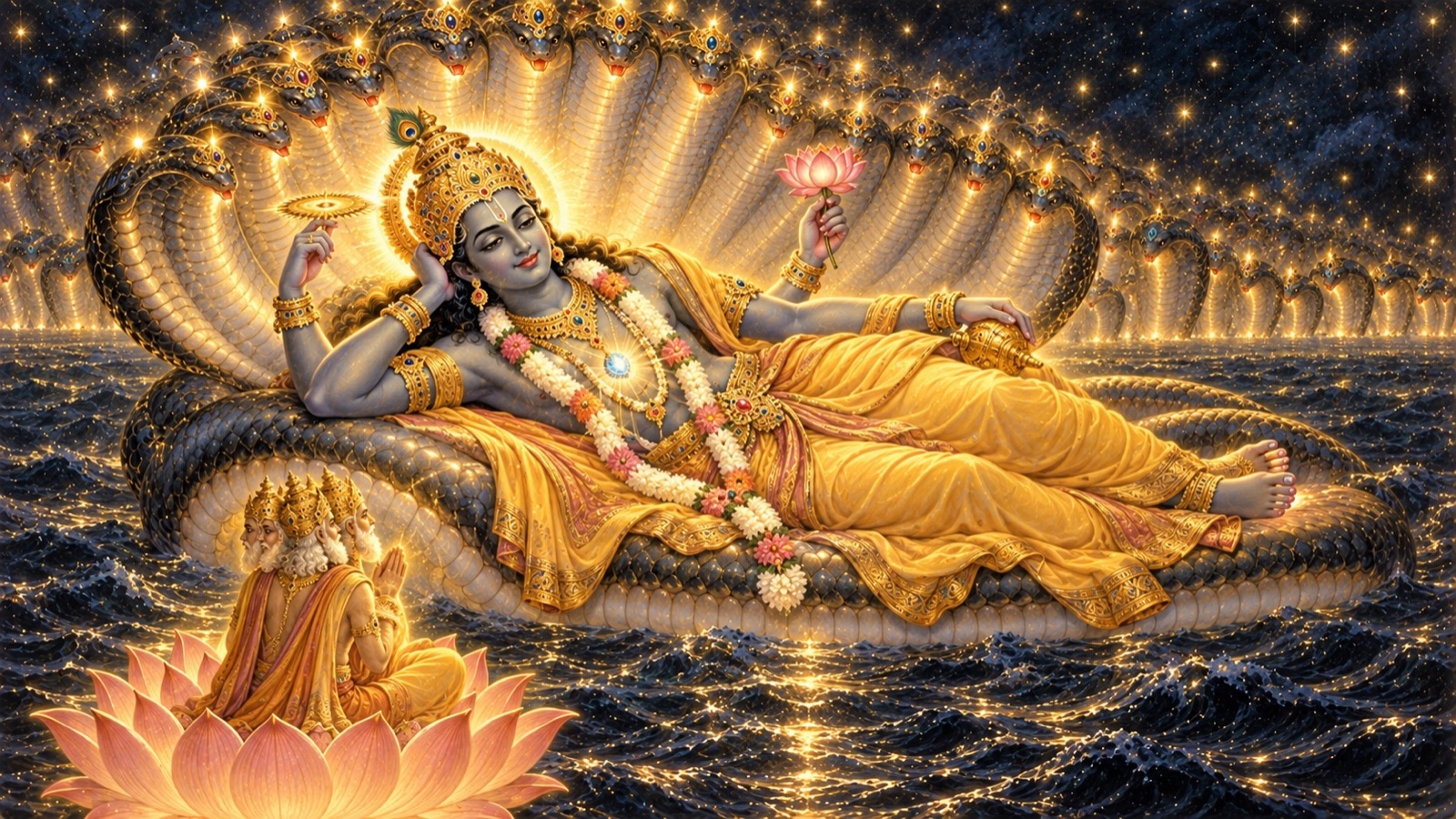
In His fourteen worlds of form, Maitreya says, the Lord resembles the sandal tree, king of all trees — His two stout arms its innumerable jewelled boughs, His trunk rooted in nothing but Himself, with the coiled hoods of Sesa wrapped about its base like a serpent about a great tree’s roots. Lying amid the ocean, He is like a mountain surrounded by water: a mountain shelters every creature, animate and inanimate, just as the Lord is the resting-place of all creation; a mountain is a friend to the great serpents that dwell upon it, just as the Lord is Sesa’s own beloved friend; and the countless diadems crowning Sesa’s hoods rise like so many golden peaks around Him, while the Kaustubha jewel on His breast gleams like a gem drawn from a mountain’s very heart. Around His neck hangs a garland of forest flowers, glory made visible, alive with the humming of the Vedas themselves, who circle it in the form of bees singing His praise. He is inaccessible even to the sun, moon, wind, and fire, guarded on every side by His own personified weapons — Sudarsana and the rest, forms of truth, consciousness, and bliss themselves — who eternally patrol about Him.
Brahma Fixes His Mind and Begins to Praise
Beholding all of this in a single moment — the Lord Himself, the navel-lotus that had brought him into being, the waters, the winds, the sky above, and his own self seated upon the lotus, and nothing beyond these — Brahma, the would-be architect of the universe, finds himself with everything and nothing at once. Dominated as he is by the quality of Rajas, he is eager to begin the great work of creation; but surveying all that lies before him, he realizes this is the entirety of his material — no more, no less. And so, rather than acting rashly upon so little, Brahma fixes his mind wholly upon the one Lord whose ways are unknown to any being, and, intent though he still is on the coming work of creation, begins instead to extol Him who alone is worthy of all praise.
स कर्मबीजं रजसोपरक्त: प्रजा: सिसृक्षन्नियदेव दृष्ट्वा । अस्तौद्विसर्गाभिमुखस्तमीड्य- मव्यक्तवर्त्मन्यभिवेशितात्मा ॥ ३३ ॥
sa karma-bījaṁ rajasoparaktaḥ prajāḥ sisṛkṣann iyad eva dṛṣṭvā astaud visargābhimukhas tam īḍyam avyakta-vartmany abhiveśitātmā
Meaning: Dominated by the quality of Rajas, and desiring to undertake the work of creation, Brahma, on seeing only this much material for the same, fixed his mind on the Lord, whose ways are unknown to anyone, and, intent as he was on creation, began to extol Him who alone is worthy of praise. (Canto 3, Chapter 8, verse 33)
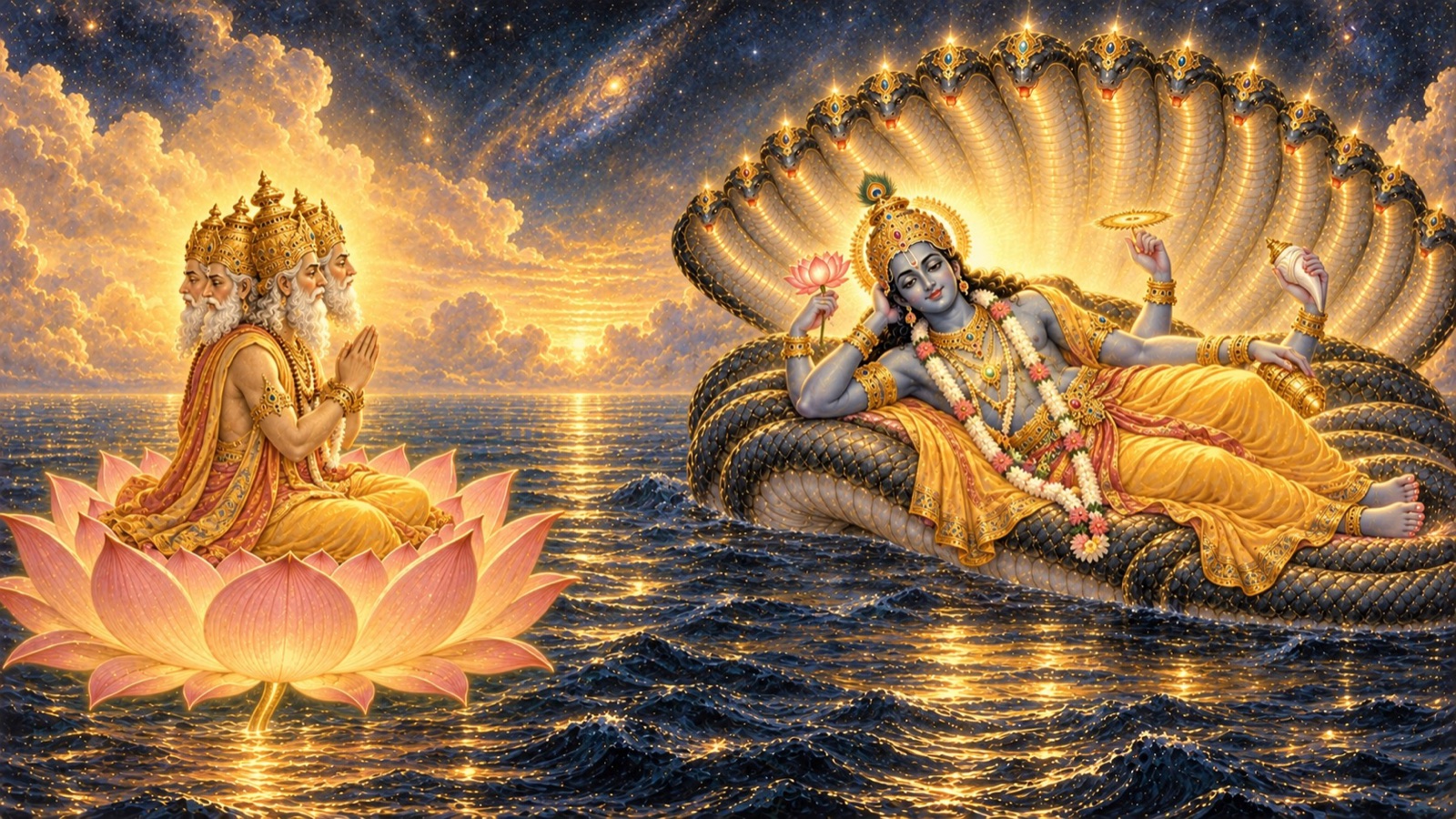
With this single act of turning inward, before a single world has yet been made, Discourse VIII closes — and the hymn that Brahma is now about to offer, the very words with which the first-born being addresses his own Source, awaits us in the chapter ahead.
Principal Teachings of This Chapter
1. Reverence for the teacher begins with reverence for the sincere seeker. Maitreya opens not with doctrine but with praise for Vidura’s own devotion, honoring the questioner before answering the question (verse 1).
2. Sacred knowledge survives only by being handed on, unbroken, from heart to heart. The Bhagavata teaching reaches Vidura only because five teachers before Maitreya — Sankarsana, Sanatkumara, Sankhyayana, Parasara, and now Maitreya himself — each passed it faithfully onward (verses 7-9).
3. Even the Supreme Lord’s rest is not inactivity but a different order of activity altogether. Narayana’s cosmic sleep is described as fully conscious repose, His self-awareness never lapsing even while all outward creation lies dormant within Him (verses 10-12).
4. Creation begins not with a plan, but with a single point of light emerging from stillness. The entire manifest universe unfolds from one lotus issuing from the Lord’s navel — vast complexity growing, quite literally, from a single point (verses 13-15).
5. The search for our origin cannot be completed by outward effort alone. Brahma dives desperately through the causal waters seeking the root of his own existence and fails; only a hundred years of inward stillness in Samadhi reveals what frantic searching could not (verses 18-22).
6. True vision of the divine arrives as a revelation from within, not a discovery from without. Brahma’s vision of the Lord on Sesa comes to him unbidden, in his own heart, by the Lord’s mercy rather than his own effort, only after he has stopped searching outside himself (verse 22).
7. Even the Creator, faced with the work of creation, turns first to praise rather than to action. Confronted with the immense task ahead and only the barest material to work with, Brahma’s first act is not to build, but to extol the Lord — placing devotion before doing (verse 33).
A Devotional Reflection
There is something quietly humbling in watching Brahma — the very architect of the universe, the “self-born” first being of all creation — fail so completely at the one thing he sets out first to do. He dives, he searches, he strains for a hundred lifetimes’ worth of effort compressed into a single desperate plunge, and finds nothing. It is only when he stops searching outward and turns his attention fully inward, sustaining that inward gaze not for a moment but for a hundred years, that the very thing he sought reveals itself, gently, from within his own heart. There is a lesson here that no amount of restless effort can substitute for stillness rightly sustained — and a further lesson in what Brahma does the instant that vision arrives: rather than seizing at once upon the power to create, he pauses to praise. Before the first world is spoken into being, the first being teaches us, wordlessly, that praise must come before action, and that even a task as vast as creating a universe can wait a moment longer for gratitude to be offered first.
A Daily Devotional Practice
Today, notice one thing in your life that you have been trying to solve, understand, or fix through sheer outward effort — searching, striving, pushing — without pausing to look within. Set aside even five quiet minutes to simply sit still, breathe evenly, and turn your attention inward rather than outward, the way Brahma finally did after his search through the waters failed. Before you begin, and again when you finish, repeat softly: “Om Namo Bhagavate Vasudevaya.” Let that remembrance remind you that some answers are not found by searching harder, but by becoming still enough to receive them.
Conclusion
The eighth discourse of the Third Canto is where Vidura’s long journey finally bears its fruit: Maitreya begins to teach, and what he teaches first is nothing less than the story of how the universe itself began — a story that turns out to be, at its heart, a story about a single being’s search for his own origin. We have watched the Lord rest in conscious slumber upon the causal waters; watched a lotus, and then a four-faced Creator, spring from His navel; watched that Creator search in vain through the depths for the root of his own existence; and watched him, at last, through a hundred years of stillness, behold in his own heart the full and radiant splendour of the very Lord who had given him birth. Before a single world is yet created, Brahma has already learned the lesson every devotee must eventually learn: that praise comes before action, and that stillness reveals what searching cannot. In the chapter ahead, we will hear the hymn Brahma now begins to offer.
May the divine wisdom of Srimad Bhagavatam awaken pure devotion within our hearts.
Om Namo Bhagavate Vasudevaya.
Jay Shree Madhav.
References and Attribution
- Primary edition: Gita Press, Śrīmad Bhāgavata Mahāpurāṇa (English, complete), Book Three, Discourse 8, pages 165–170.
- Series: Srimad Bhagavatam Wisdom · Biswa Sanatan Dharma Seva Trust.
- Presented following the spiritual guidance and recommendation of Pandit Dr. Shri Kashinath Mishra.
This is an original, faithful retelling in the writer’s own words, with brief quoted verses shown in Devanāgarī and transliteration and their meanings given as summaries. It is not a reproduction of any single publisher’s continuous translation or commentary. No affiliation with or endorsement by any publisher is implied.
Jay Shree Madhav