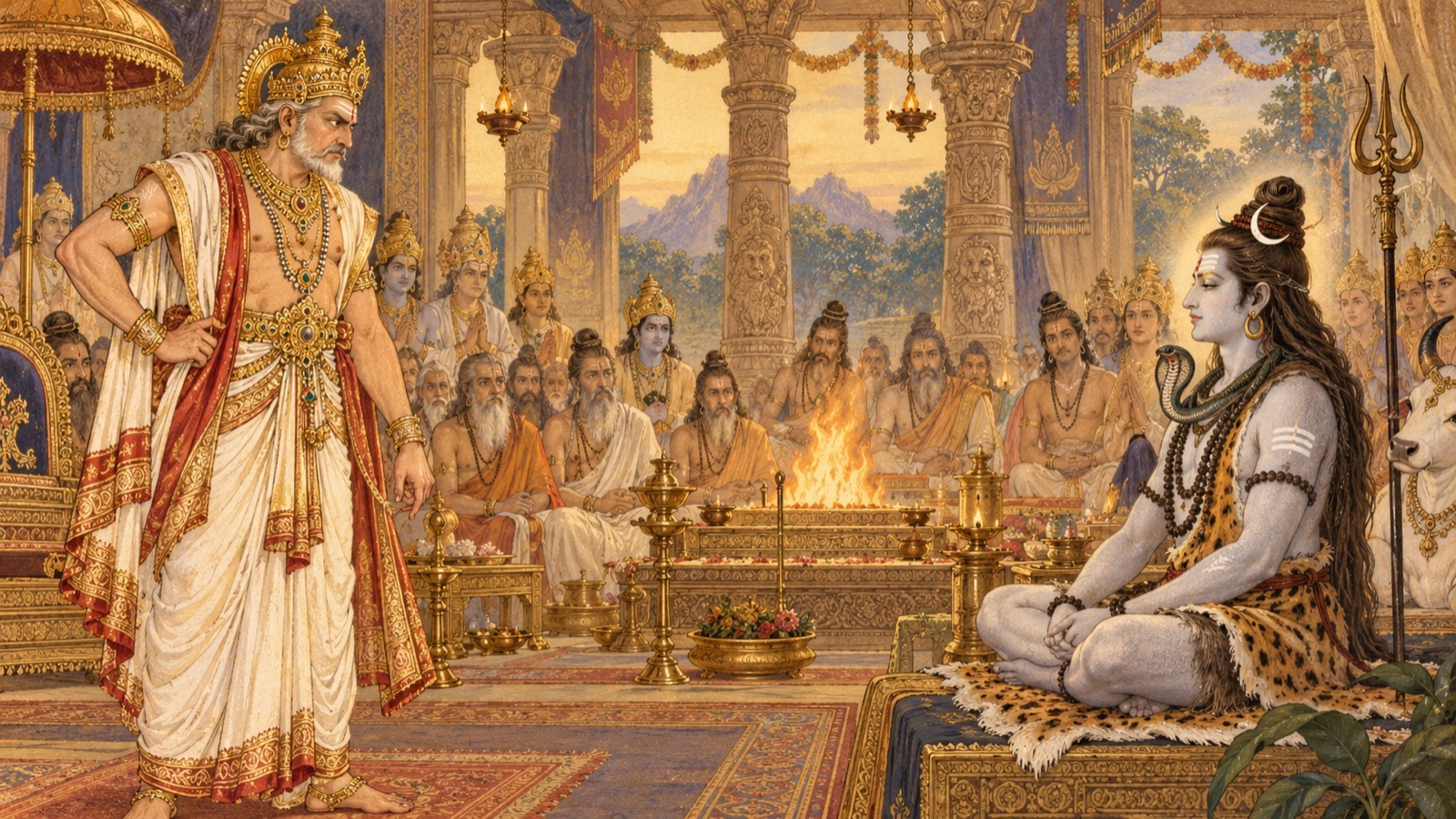
In a great assembly of sages and gods, one heart curdles with wounded pride: Daksha fixes his son-in-law Lord Shiva with a burning glare — and a quarrel begins that will cost his daughter her life.
Om Namo Bhagavate Vasudevaya.
Om Namo Bhagavate Vasudevaya.
Om Namo Bhagavate Vasudevaya.
Welcome to Srimad Bhagavatam Wisdom, a devotional journey through the sacred histories and teachings of the Srimad Bhagavat Mahapurana. The first chapter of Book Four ended on a shadow: the brief, sorrowful note that Sati, the youngest daughter of Daksha and the devoted consort of Lord Shiva, gave up her body in indignation at her father’s hostility toward her husband. This second chapter answers the question that shadow raised. Vidura cannot understand it — how could Daksha, so fond of his daughters, come to hate the gentlest and most auspicious of all beings? Maitreya’s reply is one of the great cautionary tales of the scriptures: a story of wounded pride, a curse spoken in anger, a chain of counter-curses, and the tragic estrangement between a father-in-law and a son-in-law who happened to be Lord Shiva himself. It is a chapter about the terrible cost of taking offense.
Chapter Information
- Scripture: Śrīmad Bhāgavata Mahāpurāṇa
- Canto: 4 (Book Four)
- Chapter: 2 (Discourse 2)
- Chapter title: Daksha’s Imprecation
- Principal speaker: The sage Maitreya, continuing his discourse to Vidura
- Principal listener: Vidura, who opens the chapter with a question about Daksha’s enmity
- Main setting: A great sacrificial assembly of the Prajapatis, attended by sages, gods, and the fire-deities
- Central subject: How Daksha, insulted that Lord Shiva did not rise to honour him, reviled and cursed Shiva; the counter-curses of Nandishvara and the sage Bhrgu; and Shiva’s silent departure
- Principal verse range: Canto 4, Chapter 2, verses 1–35
- Primary edition: Gita Press Śrīmad Bhāgavata Mahāpurāṇa
Vidura’s Wonder: How Could Anyone Hate Shiva?
Vidura begins with genuine bewilderment. How, he asks Maitreya, did Daksha — a man so loving toward his own daughters — come to bear ill-will toward Lord Bhava, the most amiable of beings, and to disregard his own daughter Sati in the process? More than that, Vidura marvels at the very idea of anyone hating Shiva at all.
कस्तं चराचरगुरुं निर्वैरं शान्तविग्रहम् । आत्मारामं कथं द्वेष्टि जगतो दैवतं महत् ॥ २ ॥
kas taṁ carācara-guruṁ nirvairaṁ śānta-vigraham ātmārāmaṁ kathaṁ dveṣṭi jagato daivataṁ mahat
Meaning: Who could hate him — the teacher of all moving and unmoving beings, who is free from enmity, tranquil in nature, satisfied within himself, and the great object of worship for the whole universe? (Canto 4, Chapter 2, verse 2)
Tell me, Vidura presses, what caused such bitterness between the son-in-law and the father-in-law that it drove Sati to give up her very life.
An Assembly of the Gods, and a Slight
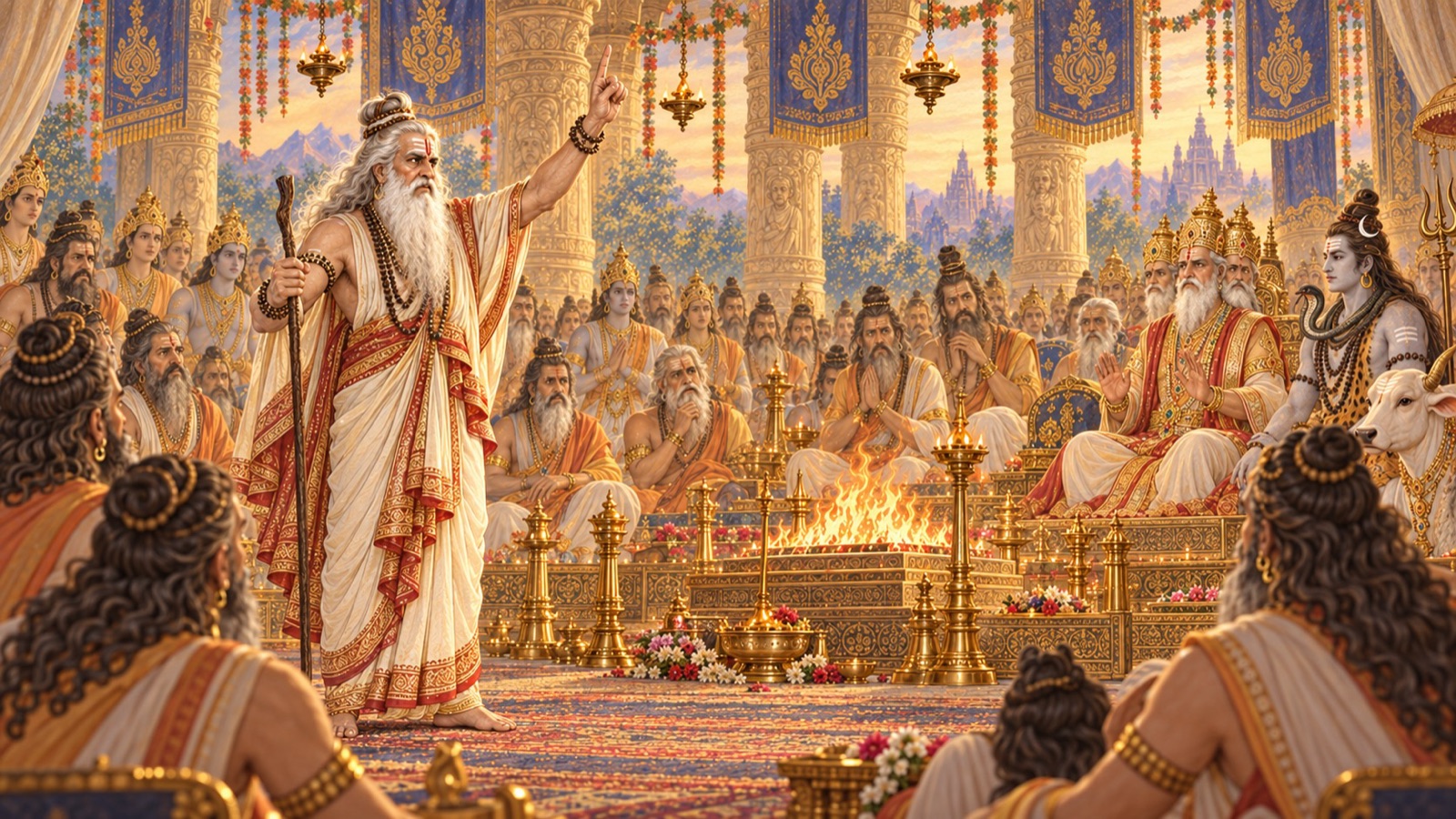
Maitreya answers by taking Vidura back to a grand occasion. Long ago, all the foremost seers, sages, and hosts of divinities — including the deities presiding over the sacred fires — gathered with their attendants at a great sacrificial session held by the Prajapatis. Into this assembly came Daksha, radiant as the sun, and his splendour so overwhelmed the gathering that everyone present rose from their seats to honour him — everyone, that is, except two: Brahma, his own father, and Lord Shiva.
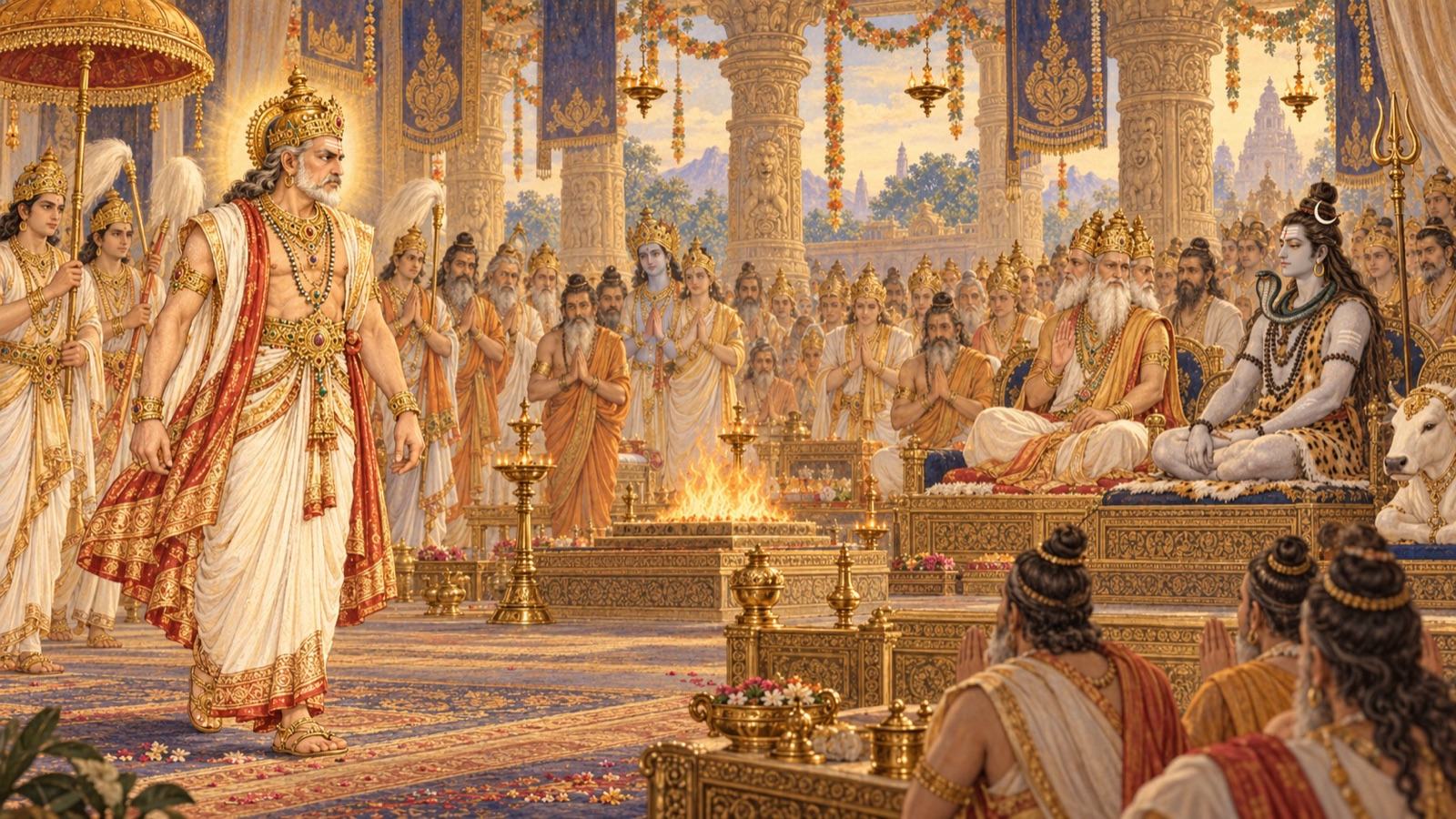
Daksha bowed to Brahma, received his permission, and took his seat. But when he saw Lord Shiva already seated and receiving him with no special show of deference, something in Daksha broke. He could not bear it. Unable to contain his indignation, he fixed Shiva with a glare so full of anger that it seemed he would burn him where he sat.
प्राङ्निषण्णं मृडं दृष्ट्वा नामृष्यत्तदनादृत: । उवाच वामं चक्षुर्भ्यामभिवीक्ष्य दहन्निव ॥ ८ ॥
prāṅ-niṣaṇṇaṁ mṛḍaṁ dṛṣṭvā nāmṛṣyat tad-anādṛtaḥ uvāca vāmaṁ cakṣurbhyām abhivīkṣya dahann iva
Meaning: Seeing Shiva (Mrida, the gracious one) already seated and receiving no honour from him, Daksha could not tolerate it; glaring at him with his eyes as if to burn him, he spoke. (Canto 4, Chapter 2, verse 8)
The Reviling of the Auspicious One
What followed was a long and bitter denunciation. Claiming to speak neither from ignorance nor from spite but as a defender of virtue, Daksha called Shiva shameless, arrogant, a violator of the path of the virtuous. He recalled, with rising resentment, how he had given his fawn-eyed daughter to this “monkey-eyed fellow,” who had not so much as risen or spoken a word of courtesy to him. He mocked everything about Shiva’s way of life: that he roams the frightful crematories surrounded by ghosts and goblins, his hair matted, now laughing and now weeping like a madman; that he bathes in the ashes of funeral pyres, wears a garland of skulls and ornaments of human bone; that though he is called Shiva, “the all-auspicious,” he is (in Daksha’s furious telling) inauspicious, the lord of wicked spirits. Bitterly, Daksha declared that it was only at Brahma’s urging that he had ever given his virtuous girl to such a one.
The tragedy of the scene is that every insult falls upon a being who, as Vidura himself had just said, bears enmity toward no one and remains perfectly tranquil. Shiva does not answer a single word.
The Curse
Having reviled Shiva, who sat unmoved without the least show of resistance, Daksha sipped a little water — the formal prelude to a solemn imprecation — and pronounced his curse.
अयं तु देवयजन इन्द्रोपेन्द्रादिभिर्भव: । सह भागं न लभतां देवैर्देवगणाधम: ॥ १८ ॥
ayaṁ tu deva-yajana indropendrādibhir bhavaḥ saha bhāgaṁ na labhatāṁ devair deva-gaṇādhamaḥ
Meaning: Let this Bhava (Shiva), lowest of the gods, no longer receive a share in the sacrificial offerings along with the other gods, such as Indra and Upendra. (Canto 4, Chapter 2, verse 18)
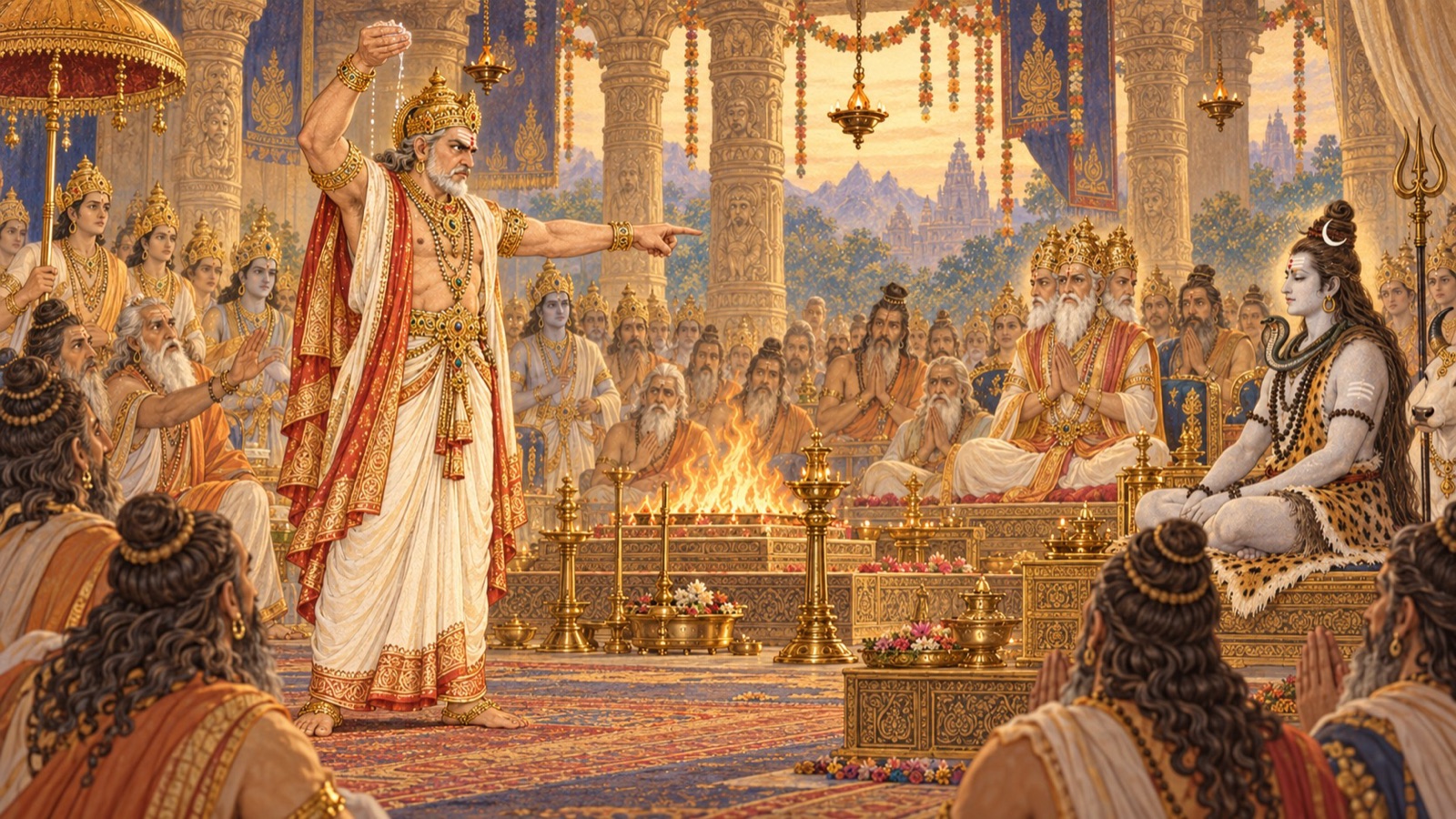
Though the leading members of the assembly warned him against such a course, Daksha, still burning with rage, rose and left, returning to his own home.
There is a deeper lesson folded inside this curse than its cruelty alone. Daksha’s intention was to strip Shiva of standing — to deny him a share in the very oblations that mark a god’s place in the cosmic order (verses 17-18). But a devotee whose contentment is not sourced in outward honour cannot be diminished by its withdrawal; Shiva remains “satisfied within himself,” precisely as Vidura described him at the chapter’s opening (verse 2). The curse could take away a portion of ritual fire; it could not touch what it was never resting on. When the sacrifice later closes with its oblations offered to Sri Hari alone (verses 34-35), the Bhagavatam quietly confirms the point: true worship was never about who sits where or who receives what share — it was always about the Lord who is pleased by devotion itself.
Nandishvara’s Counter-Curse
Now the quarrel widened. Nandishvara, the foremost of Lord Shiva’s attendants, learned of the curse and grew wild with grief and anger. He turned upon Daksha — and upon those brahmanas in the assembly who had silently countenanced the blasphemy — and pronounced a terrible curse of his own. This fool, he declared, who makes so much of his perishable body and hates the guileless Shiva, mistaking the body for the self, shall have his face turned forever away from the truth. Attached to home and ritual and the pursuit of pleasure, deluded by the alluring promises of ritual texts, Daksha has forgotten the true nature of the self and become no better than a brute; therefore, said Nandi, let him be excessively fond of women, and let his head soon be turned into that of a goat.
बुद्ध्या पराभिध्यायिन्या विस्मृतात्मगति: पशु: । स्त्रीकाम: सोऽस्त्वतितरां दक्षो बस्तमुखोऽचिरात् ॥ २३ ॥
buddhyā parābhidhyāyinyā vismṛtātma-gatiḥ paśuḥ strī-kāmaḥ so ‘stv atitarāṁ dakṣo basta-mukho ‘cirāt
Meaning: With his understanding fixed on externals, having forgotten the true nature of the self, this brute Daksha shall become excessively fond of women, and shall soon have the head of a goat. (Canto 4, Chapter 2, verse 23)
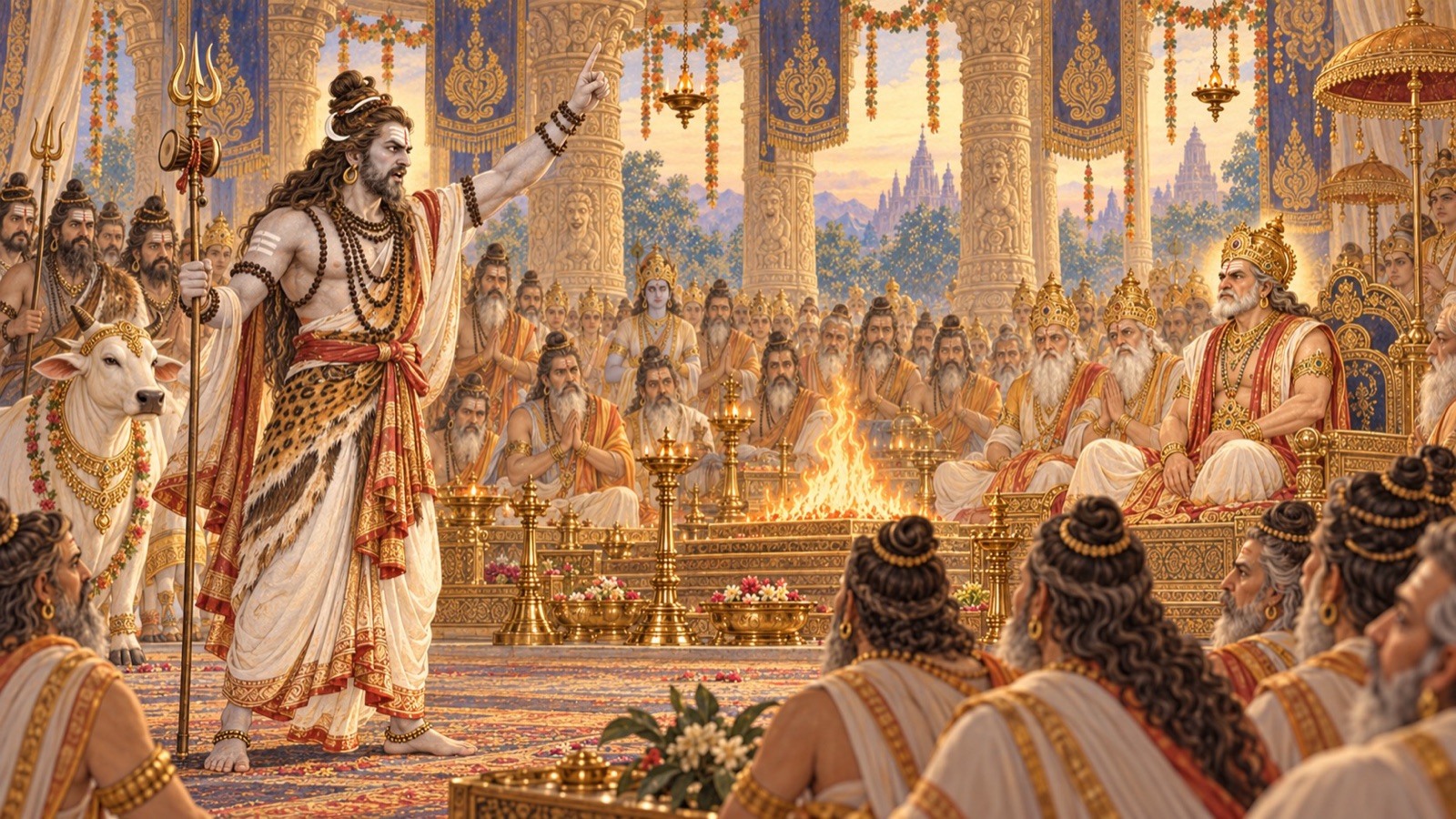
Nandi went further, declaring that those who cling to ignorance in the form of ritual as though it were wisdom, and slight Lord Shiva, would be reborn again and again, their minds bewildered by the sweet, profuse promises of the flowery texts — and that such brahmanas would wander the world as beggars, valuing only wealth, comfort, and the gratification of the senses.
Bhrgu’s Counter-Curse
The escalation did not stop. Hearing Nandi curse the brahmana class, the sage Bhrgu answered with a counter-curse of his own, hard to revoke. Those who observe vows sacred to Bhava and follow such practices, he said, shall become opposed to the true scriptures; only those who have cast aside purity, wearing matted locks, ashes, and bones and honouring intoxicants, shall be drawn to that path. Because you (the followers of Shiva) decry the Vedas and the brahmanas who preserve them, Bhrgu declared, you have embraced the way of heretics — turning from the eternal, blessed path laid down by the Vedas and sanctioned by the authority of Lord Vishnu (Janardana) himself.
Here the Bhagavatam lays bare a painful truth: even among the great, wounded pride can spread from heart to heart like fire through dry grass, until an entire assembly of the wise is trading curse for curse.
Shiva Departs in Silence
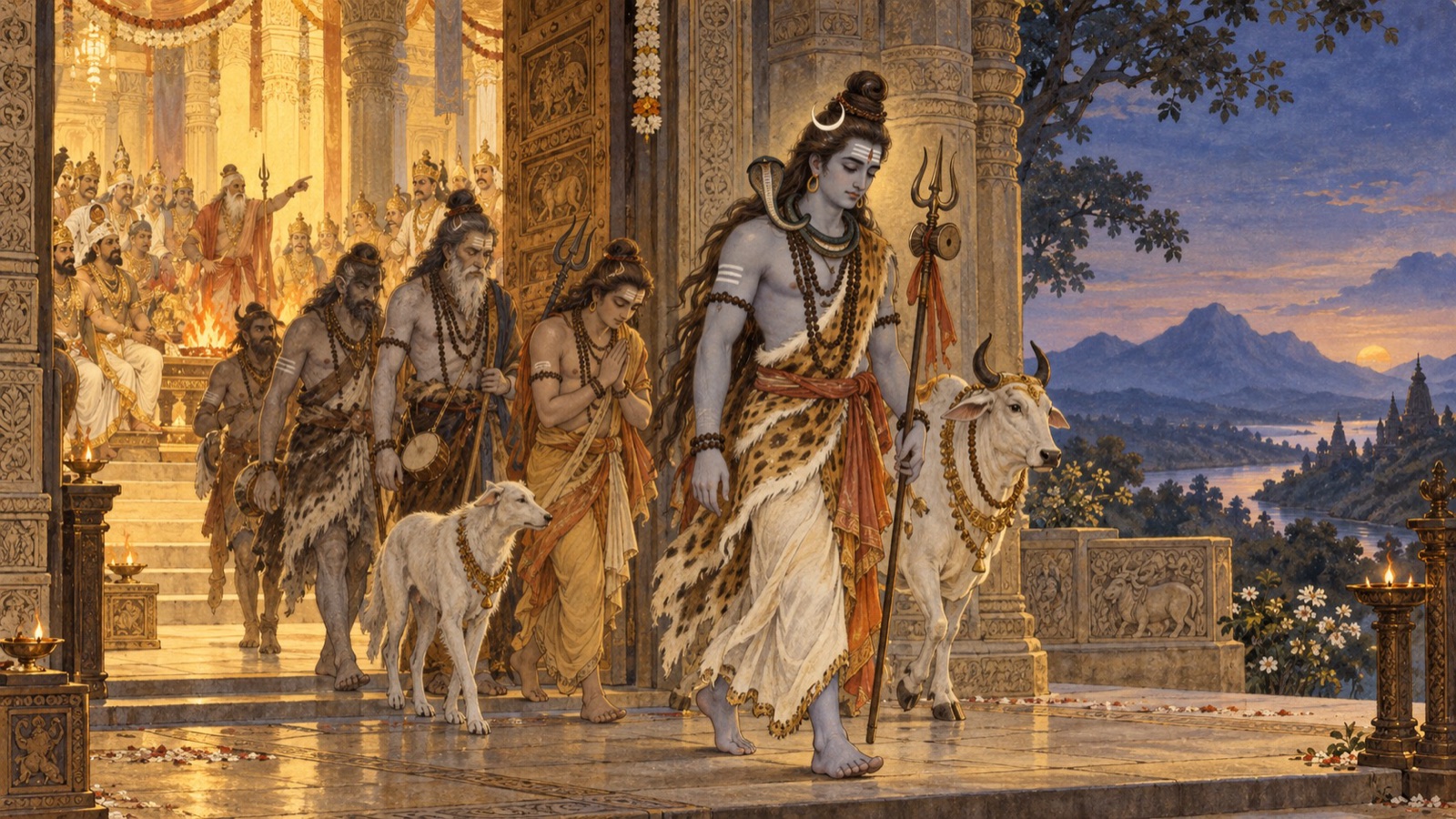
Through all of this — the reviling, the curse, the answering curses — Lord Shiva himself has said nothing. And now, as Bhrgu’s imprecation still hangs in the air, Shiva quietly rises and leaves the assembly with his retinue, a little disconsolate at heart, but without a word of retaliation.
मैत्रेय उवाच तस्यैवं वदत: शापं भृगो: स भगवान् भव: । निश्चक्राम तत: किञ्चिद्विमना इव सानुग: ॥ ३३ ॥
maitreya uvāca tasyaivaṁ vadataḥ śāpaṁ bhṛgoḥ sa bhagavān bhavaḥ niścakrāma tataḥ kiñcid vimanā iva sānugaḥ
Meaning: Maitreya said: While Bhrgu was thus pronouncing his curse, the worshipful Lord Bhava (Shiva), a little disconsolate at heart, departed from that place along with his followers. (Canto 4, Chapter 2, verse 33)
The chapter closes on a note of ritual continuation that only deepens the irony. The lords of created beings duly carried on the sacrifice for a thousand years — a sacrifice in which Sri Hari, the Supreme Being, was the deity worshipped — and at its conclusion they bathed where the Ganga meets the Yamuna and returned, cleansed, each to his own home. The great ceremony went on; but the seed of a far greater catastrophe had been planted, and it would ripen, chapters later, into the destruction of Daksha’s own sacrifice.
Principal Teachings of This Chapter
1. Pride turns honour into poison. Daksha entered an assembly that rose in his honour, yet fixed on the one seat that did not rise. When the ego hunts for slights, it will always find one — and it will let a single perceived insult undo a lifetime of merit (verses 6-8).
2. The truly great do not retaliate. Reviled, cursed, and slandered before all the gods, Lord Shiva does not answer with a single word; he simply departs. His silence, not Daksha’s fury, is the real strength in the room (verses 8, 17, 33).
3. Anger is contagious. A single curse spoken in wrath provokes a counter-curse, which provokes another, until even sages are ensnared. The chapter is a sober warning that taking offense rarely stays contained to the one who first took it (verses 18, 20-32).
4. Ritual without reverence is hollow. Daksha was a master of sacrifice, yet his heart had no room to honour the Lord of yogis seated before him. Outer performance divorced from inner humility is, the story shows, a house built on sand (verses 12-16).
5. Reverence is due to the auspicious, however unconventional his form. The scripture frames Shiva as tranquil, self-satisfied, and free from all enmity, and treats Daksha’s contempt for his unconventional ways as the failing — a reminder not to judge holiness by outward appearances (verses 2, 14-15).
A Devotional Reflection
There is something almost unbearably human about Daksha’s fall. He is not a demon or a villain by nature; he is a respected father, a great performer of sacrifices, a man honoured by an entire assembly of gods. And all of that dissolves in an instant because one being — the gentlest of all — did not stand up for him. How small the trigger, how vast the ruin. We know this movement of the heart intimately: the gathering where we counted every greeting and fixed only on the one that was withheld, the slight we replayed until it hardened into a grievance. The Bhagavatam does not spare Daksha, but it does not spare us either; it holds up his wounded pride as a mirror. And beside that mirror it places Shiva’s silence — the response of a heart so full and so free that an insult simply finds nothing in it to catch on. The question the chapter quietly asks is which of the two we will choose to resemble the next time we feel slighted.
A Daily Devotional Practice
Today, practise the discipline of Shiva’s silence. Recall one small slight you have been carrying — a word left unsaid to you, a courtesy withheld, a recognition that never came. Instead of rehearsing it once more, consciously set it down. Sit quietly, breathe, and offer the grievance to the Lord, repeating: “Om Namo Bhagavate Vasudevaya.” Resolve that for this one day you will not defend your wounded pride, but will let the insult pass through you as it passed through Shiva — finding nothing to burn.
Conclusion
“Daksha’s Imprecation” is, on its surface, the story of a family quarrel among the gods. But beneath the curses and counter-curses it is a searching study of what pride does to a good man. Daksha had everything — lineage, learning, an assembly that honoured him, a daughter married to the Lord of yogis himself — and he threw it all into the fire over a single unreturned greeting. Lord Shiva, insulted past all bearing, answered only with silence and a quiet departure, embodying the very tranquillity that Vidura had marvelled at in his opening question. The sacrifice went on for a thousand years, but the true offering demanded by this story is subtler: the surrender of our own hunger to be honoured. As the next chapters will show, the curse Daksha spoke that day would return to consume his own great sacrifice — proof that no ritual, however grand, can outrun the consequences of a heart ruled by pride.
May the divine wisdom of Srimad Bhagavatam awaken pure devotion within our hearts.
Om Namo Bhagavate Vasudevaya.
Jay Shree Madhav.
References and Attribution
- Primary edition: Gita Press, Śrīmad Bhāgavata Mahāpurāṇa (English, complete), Book Four, Discourse 2.
- Series: Srimad Bhagavatam Wisdom · Biswa Sanatan Dharma Seva Trust.
- Presented following the spiritual guidance and recommendation of Pandit Dr. Shri Kashinath Mishra.
This is an original, faithful retelling in the writer’s own words, with brief quoted verses shown in Devanāgarī and transliteration and their meanings given as summaries. It is not a reproduction of any single publisher’s continuous translation or commentary. No affiliation with or endorsement by any publisher is implied.
Jay Shree Madhav