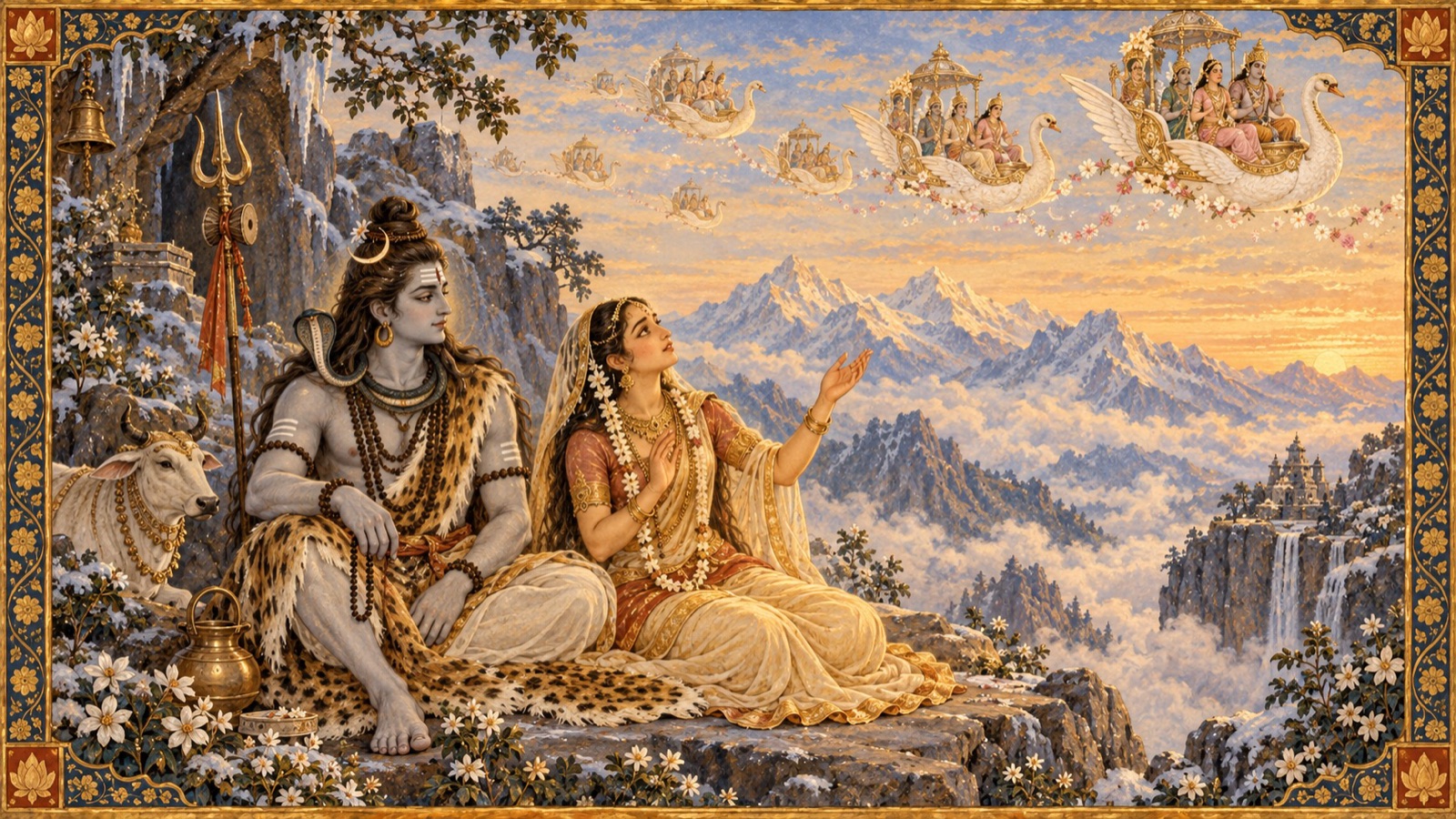
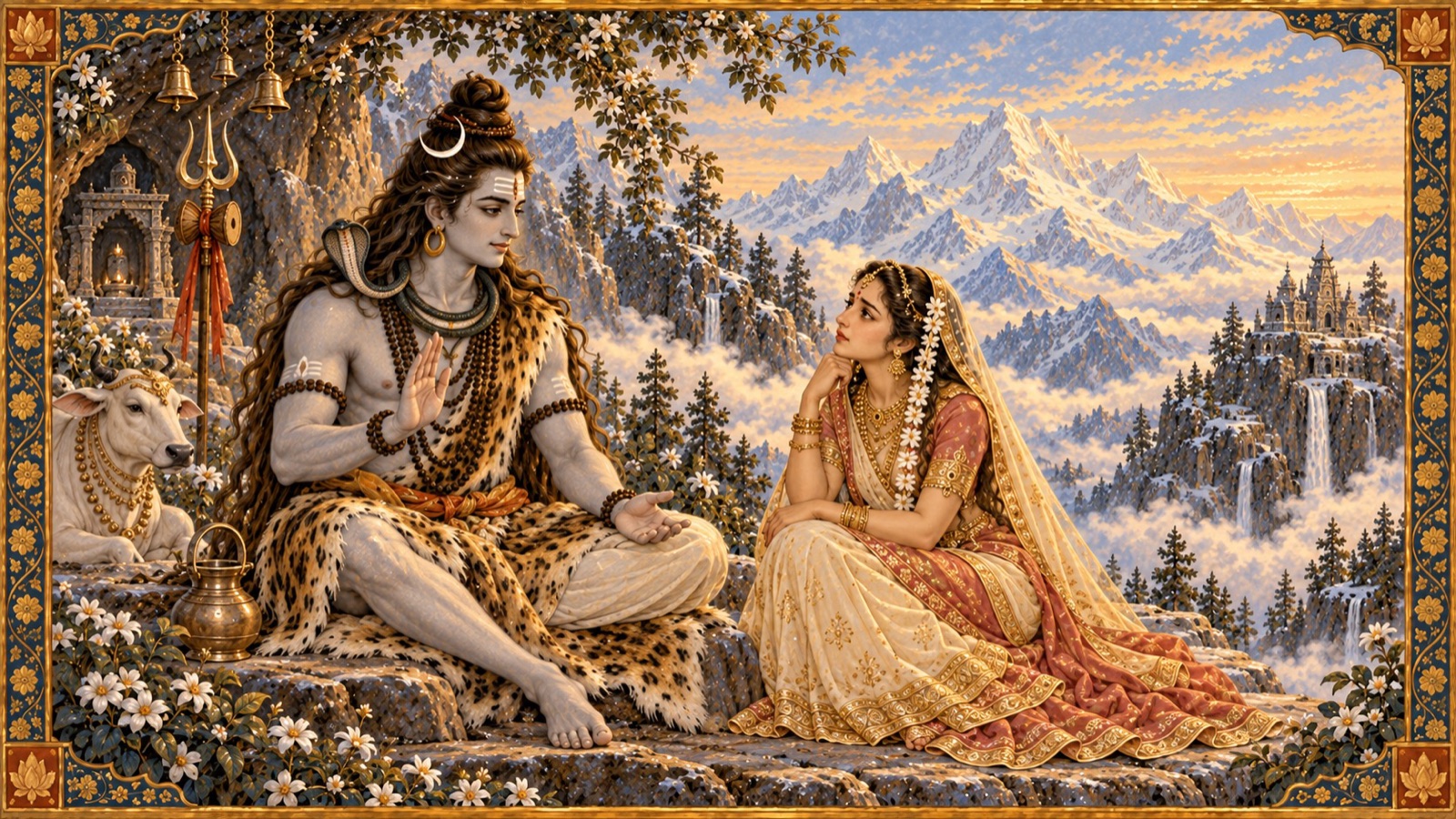
From the heights of Kailasa, Sati watches the goddesses of heaven stream past in swan-white aerial cars toward her father’s great sacrifice — and, her heart aching to be among her own people, turns to plead with Lord Shiva.
Om Namo Bhagavate Vasudevaya.
Om Namo Bhagavate Vasudevaya.
Om Namo Bhagavate Vasudevaya.
Welcome to Srimad Bhagavatam Wisdom, a devotional journey through the sacred histories and teachings of the Srimad Bhagavat Mahapurana. In the previous chapter, wounded pride turned Daksha against his gentle son-in-law, Lord Shiva, and the assembly of the gods dissolved into a storm of curses and counter-curses. This third chapter opens the human heart of that quarrel. The enmity has smouldered for a very long time when Daksha, now the proud head of all the Prajapatis, commences a magnificent sacrifice — and word of it reaches Kailasa. Sati, Daksha’s daughter and Shiva’s devoted consort, sees the wives of the gods flying past to the festival and is seized by a longing to visit her childhood home. What follows is one of the most tender and searching dialogues in the scriptures: a wife’s yearning for her family set against a husband’s clear-eyed warning about the wound that a relative’s contempt can inflict.
Chapter Information
- Scripture: Śrīmad Bhāgavata Mahāpurāṇa
- Canto: 4 (Book Four)
- Chapter: 3 (Discourse 3)
- Chapter title: The Dialogue of Lord Shiva and Sati
- Principal speaker: The sage Maitreya, continuing his discourse to Vidura, who narrates the dialogue of Sati and Lord Shiva
- Principal listener: Vidura
- Main setting: The abode of Lord Shiva (Kailasa), from where Sati beholds the gods journeying to Daksha’s sacrifice
- Central subject: Sati’s longing to attend her father Daksha’s great sacrifice, and Lord Shiva’s gentle but firm counsel warning her against going
- Principal verse range: Canto 4, Chapter 3, verses 1–25
- Primary edition: Gita Press Śrīmad Bhāgavata Mahāpurāṇa
Context from the Previous Chapter
In Chapter 2, Daksha took offense when Lord Shiva did not rise to honour him in the great assembly of the Prajapatis. He reviled and cursed Shiva; Shiva’s attendant Nandishvara and the sage Bhrgu answered with counter-curses; and Lord Shiva, bearing every insult in silence, quietly left the assembly with his followers. That estrangement between father-in-law and son-in-law is the wound from which this chapter’s sorrow now grows.
Years of Smouldering Enmity
Maitreya resumes his account by marking the passage of time. While Lord Shiva and Daksha continued to bear this lasting enmity toward one another, a very long time elapsed.
मैत्रेय उवाच सदा विद्विषतोरेवं कालो वै ध्रियमाणयो: । जामातु: श्वशुरस्यापि सुमहानतिचक्रमे ॥ १ ॥
maitreya uvāca sadā vidviṣator evaṁ kālo vai dhriyamāṇayoḥ jāmātuḥ śvaśurasyāpi sumahān aticakrame
Meaning: Maitreya said: While the son-in-law (Lord Shiva) and the father-in-law (Daksha) continued in this way to nurse enmity toward each other, a very long time elapsed. (Canto 4, Chapter 3, verse 1)
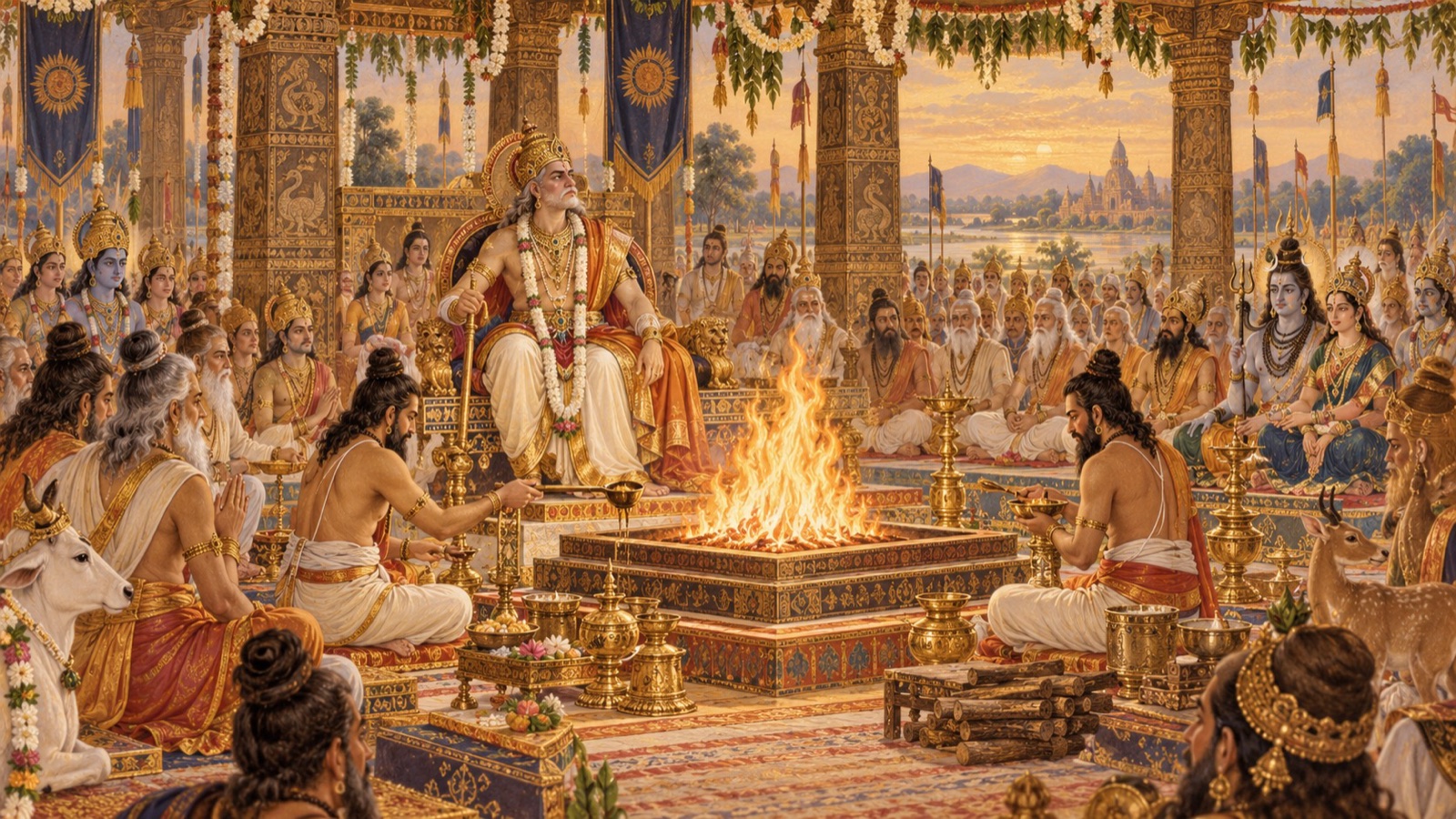
In the meantime, Daksha had been installed by Brahma, the highest of the gods, as the chief of all the lords of created beings. The honour swelled his pride. Having performed a Vajapeya sacrifice, and having slighted by his overbearing manner even those most skilled in sacred knowledge, he now commenced the greatest of all sacrifices, known as the Brhaspati-sava.
The Great Sacrifice of Daksha
To this grand rite gathered the whole company of the sacred: the Brahmana seers, the celestial sages, the manes, and the gods, all adorned with every kind of jewel — and their wives too, arrayed beside their husbands. It was a festival of the entire heavenly world, and its splendour would soon carry all the way to the gates of Kailasa.
Sati Sees the Gods Fly Past
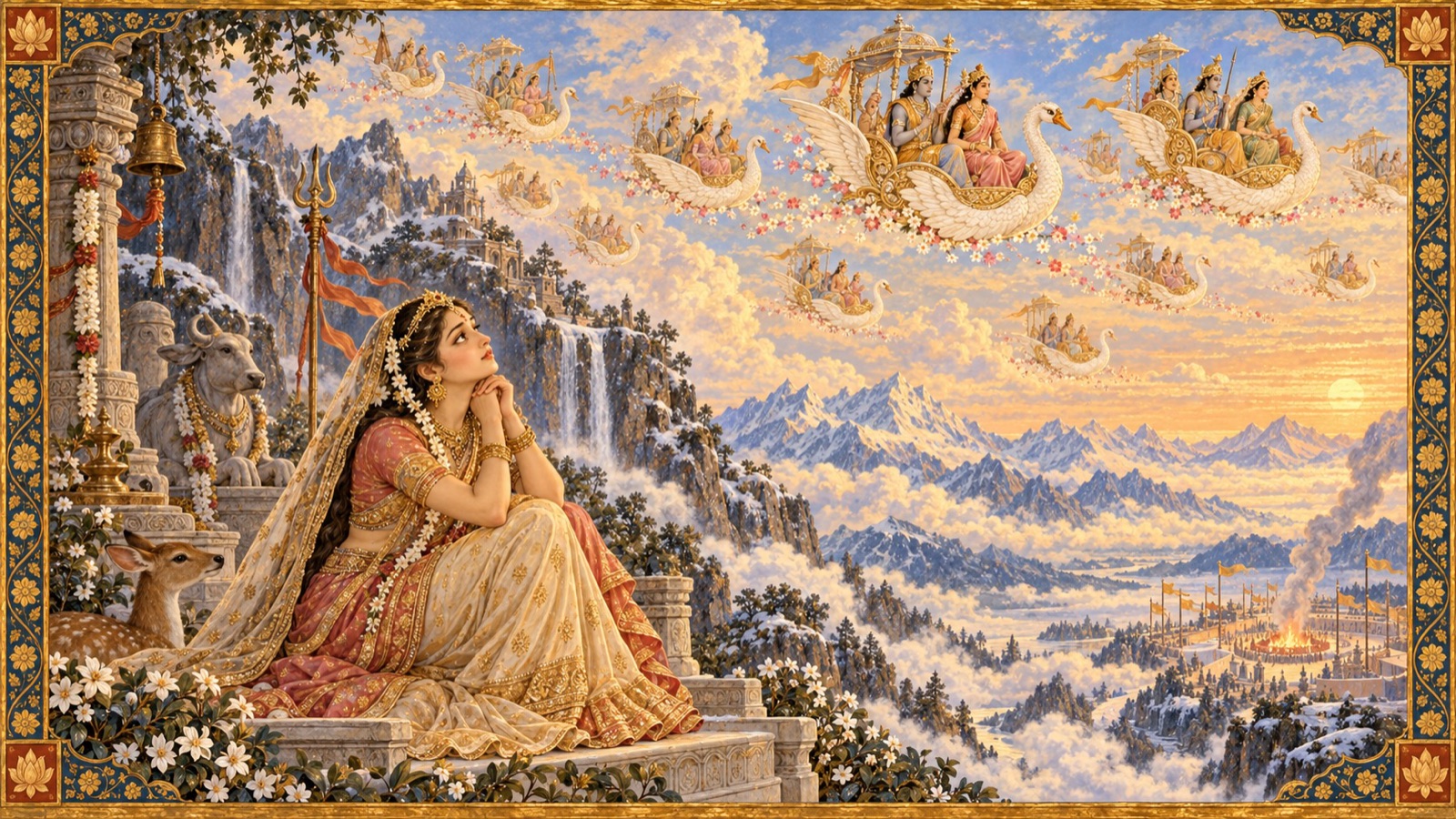
Word of the festival reached Sati not through invitation but on the wind. She overheard heavenly beings passing overhead through the sky, talking loudly of the great sacrificial festival at her father’s house. Then she saw them with her own eyes — the lovely wives of the demigods, with rolling eyes and polished ear-rings, dressed in fine costumes and wearing gold ornaments about their necks, flying in their aerial cars from every direction, past her own abode, toward her father’s home. Filled with eagerness to join them, she turned to her Consort, Lord Shiva, the lord of created beings, and began to speak.
Sati’s Plea
Sati’s appeal is all tenderness and longing. A grand sacrificial festival, she tells Shiva, has been set on foot at the residence of his father-in-law; if he so desires, let them also go, for all these heavenly beings are already on their way.
सत्युवाच प्रजापतेस्ते श्वशुरस्य साम्प्रतं निर्यापितो यज्ञमहोत्सव: किल । वयं च तत्राभिसराम वाम ते यद्यर्थितामी विबुधा व्रजन्ति हि ॥ ८ ॥
saty uvāca prajāpates te śvaśurasya sāmprataṁ niryāpito yajña-mahotsavaḥ kila vayaṁ ca tatrābhisarāma vāma te yady arthitāmī vibudhā vrajanti hi
Meaning: Sati said: A grand sacrificial festival has now been set on foot at the residence of your father-in-law, the lord of created beings. Let us also go there, O Vamadeva, if you so desire, for all these gods are going. (Canto 4, Chapter 3, verse 8)
Her sisters, she says, will surely be there with their husbands, eager to see their kinsfolk; she too longs to be among them and to receive the gifts her parents will bestow. She yearns to see her sisters, her mother’s sisters, and above all her own mother, whose heart is so full of affection for her — dear ones for whom her own heart has ached for a long time. And she longs, too, to behold the great sacrifice being performed by eminent seers.
Yet even as she pleads, Sati confesses something more searching than mere homesickness.
त्वय्येतदाश्चर्यमजात्ममायया विनिर्मितं भाति गुणत्रयात्मकम् । तथाप्यहं योषिदतत्त्वविच्च ते दीना दिदृक्षे भव मे भवक्षितिम् ॥ ११ ॥
tvayy etad āścaryam ajātma-māyayā vinirmitaṁ bhāti guṇa-trayātmakam tathāpy ahaṁ yoṣid atattva-vic ca te dīnā didṛkṣe bhava me bhava-kṣitim
Meaning: This whole astonishing universe, woven from the three modes of material nature, has its very being in you, O unborn one, who stand forever untouched by its play. But I am only a woman, without your transcendent grasp of the truth; therefore, O Bhava, this land of my birth still holds me, and I long to see it once more. (Canto 4, Chapter 3, verse 11)
It is a startling admission: the consort of Shiva does not claim to stand above the pull of illusion; she names it honestly as her own limitation, even while glimpsing that her husband stands beyond it. Vaishnava teachers read this exchange as a gentle lesson in humility — attachment to one’s birthplace and kin is not itself a fault, but it is unmistakably the working of maya, and only a soul as fully surrendered as Shiva stands free of its grip. Sati’s honesty here, more than any argument, is what makes Shiva’s coming counsel tender rather than severe.
Then, pointing to the flocks of swan-white aerial cars still streaming across the heavens, she gives voice to the truest thing in her heart.
कथं सुताया: पितृगेहकौतुकं निशम्य देह: सुरवर्य नेङ्गते । अनाहुता अप्यभियन्ति सौहृदं भर्तुर्गुरोर्देहकृतश्च केतनम् ॥ १३ ॥
kathaṁ sutāyāḥ pitṛ-geha-kautukaṁ niśamya dehaḥ sura-varya neṅgate anāhutā apy abhiyanti sauhṛdaṁ bhartur guror deha-kṛtaś ca ketanam
Meaning: How, O chief of the gods, can the body of a daughter remain unmoved on hearing of a joyful festivity at her parents’ home? Out of affection, people go even uninvited to the house of a husband, a preceptor, or a father. (Canto 4, Chapter 3, verse 13)
Therefore, she pleads, let him in his compassion grant her this one desire. Has he not placed her in the left half of his own person, accepting the very form of Ardhanarishwara? Then let him do this favour for the one he has made half of himself.
Lord Shiva’s Gentle Reply
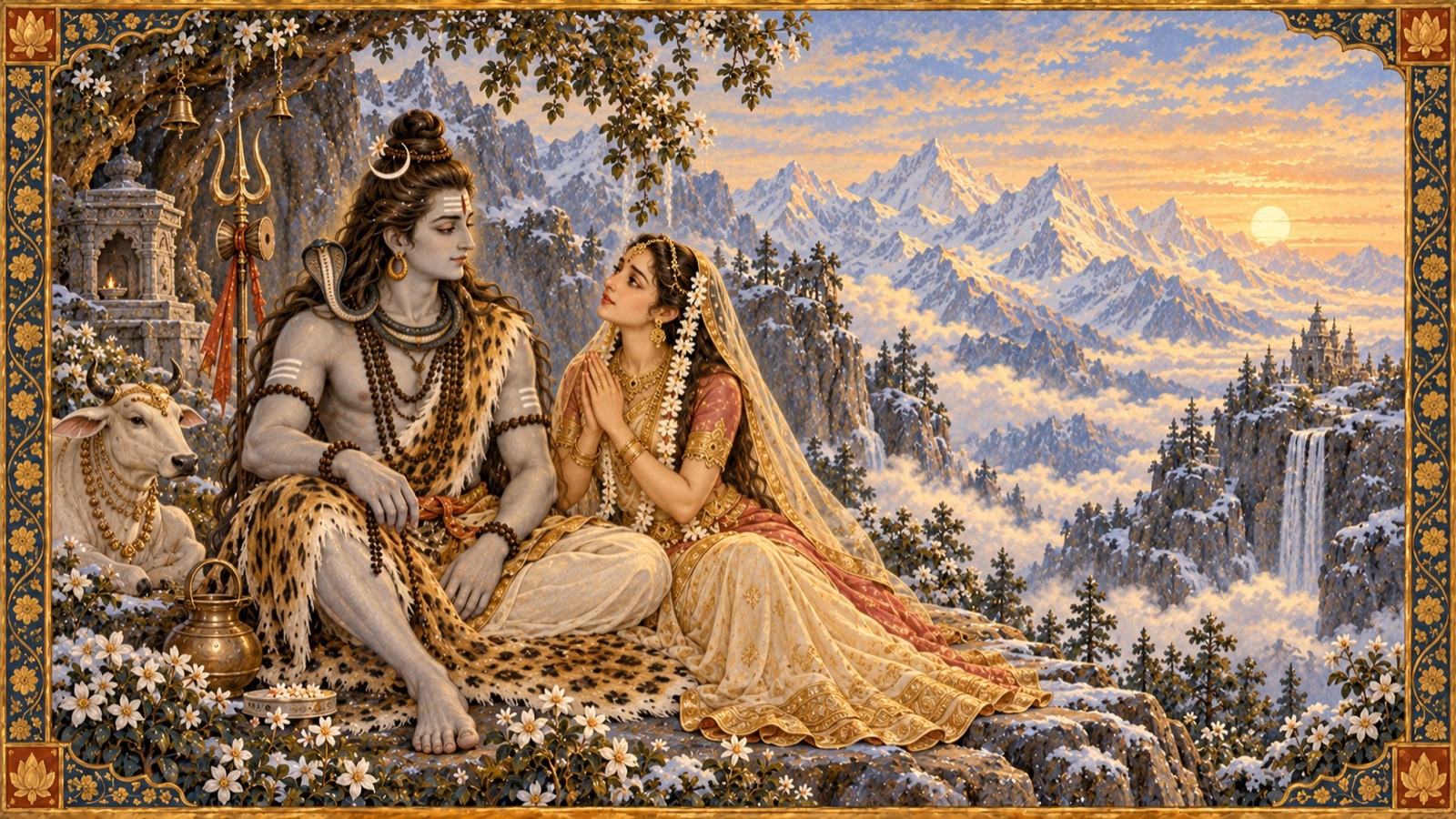
Thus importuned by his beloved, Shiva — so loving to his relations — was reminded of the shaft-like words of reproach that Daksha had once hurled at him in the presence of the other lords of created beings, words that had cut him to the quick. He laughed softly and gave his reply.
His answer begins by conceding her point, then turning it. What she has said is beautifully true, he agrees: people do go even uninvited to the homes of their kin. But this holds only when the relative’s mind is not tainted with malice born of arrogance and the false identification of the self with the body.
श्रीभगवानुवाच त्वयोदितं शोभनमेव शोभने अनाहुता अप्यभियन्ति बन्धुषु । ते यद्यनुत्पादितदोषदृष्टयो बलीयसानात्म्यमदेन मन्युना ॥ १६ ॥
śrī-bhagavān uvāca tvayoditaṁ śobhanam eva śobhane anāhutā apy abhiyanti bandhuṣu te yady anutpādita-doṣa-dṛṣṭayo balīyasānātmya-madena manyunā
Meaning: The Lord said: What you have said is indeed good, O gracious lady — that people go even uninvited to their relations. But this is so only when those relations do not, out of overpowering pride born of bodily self-identification and anger, look upon the visitor as a wrongdoer. (Canto 4, Chapter 3, verse 16)
The six embellishments of life — learning, austerity, wealth, beauty, youth, and noble birth — are an ornament to the noble, Shiva explains, but a curse to the wicked, in whom they only inflame pride and pervert the judgment until such men can no longer perceive the glory of the truly exalted. One should never, thinking of them as one’s own kin, visit the house of such men of unsteady judgment, who receive their guests with suspicious, angry, frowning eyes. And then he names the deepest of all hurts.
तथारिभिर्न व्यथते शिलीमुखै: शेतेऽर्दिताङ्गो हृदयेन दूयता । स्वानां यथा वक्रधियां दुरुक्तिभि- र्दिवानिशं तप्यति मर्मताडित: ॥ १९ ॥
tathāribhir na vyathate śilīmukhaiḥ śete ’rditāṅgo hṛdayena dūyatā svānāṁ yathā vakra-dhiyāṁ duruktibhir divā-niśaṁ tapyati marma-tāḍitaḥ
Meaning: A man whose body has been pierced by an enemy’s arrows does not suffer so much; wounded, he can still lie down and sleep. But one who has been struck to the very heart by the cruel words of his own crooked-minded people burns with that pain day and night. (Canto 4, Chapter 3, verse 19)
The Wound Beneath the Quarrel
Shiva now lays bare the root of Daksha’s hostility. Sati is the most beloved and esteemed of all Daksha’s daughters, he tells her — yet precisely because of her connection with him, she will not receive her father’s regard, for that connection is itself a source of torment to Daksha. The man whose heart burns with jealousy at the sight of exalted souls, who feels troubled that such beings stand as witnesses even to the mind of every embodied soul, can never rise to the supreme heights they have attained; he merely hates them, as the demons hate Sri Hari.
As for the courtesies of rising to greet, of advancing to meet a guest, of bowing in salutation — these, Shiva says, are rightly offered by the wise not to the body but, in the mind, to the Supreme Person who dwells within every heart. It is that absolutely pure state of consciousness, in which the Supreme is realized in His unveiled glory, that is called Vasudeva.
सत्त्वं विशुद्धं वसुदेवशब्दितं यदीयते तत्र पुमानपावृत: । सत्त्वे च तस्मिन्भगवान्वासुदेवो ह्यधोक्षजो मे नमसा विधीयते ॥ २३ ॥
sattvaṁ viśuddhaṁ vasudeva-śabditaṁ yad īyate tatra pumān apāvṛtaḥ sattve ca tasmin bhagavān vāsudevo hy adhokṣajo me namasā vidhīyate
Meaning: The state of absolutely pure consciousness, in which the Supreme Person is beheld unveiled, is called Vasudeva; and it is within that pure consciousness that I offer my obeisance to Lord Vasudeva, who is beyond the reach of the senses. (Canto 4, Chapter 3, verse 23)
He who takes the body for the self, and honours only the body, has no share in this vision — and Daksha, in his pride, is such a man.
Shiva’s Warning, and a Shadow of Grief
Having made his heart plain, Shiva gives Sati his counsel outright. She should not, he tells her, so much as look upon the face of Daksha — even though he is her father, her very procreator — nor upon those who are devoted to him; for Daksha bears ill-will toward Shiva and insulted him with abusive words before the assembled lords of creation, though Shiva had done him no wrong. And then he speaks the words that fall across the rest of the story like a shadow.
यदि व्रजिष्यस्यतिहाय मद्वचो भद्रं भवत्या न ततो भविष्यति । सम्भावितस्य स्वजनात्पराभवो यदा स सद्यो मरणाय कल्पते ॥ २५ ॥
yadi vrajiṣyasy atihāya mad-vaco bhadraṁ bhavatyā na tato bhaviṣyati sambhāvitasya sva-janāt parābhavo yadā sa sadyo maraṇāya kalpate
Meaning: If you disregard my words and go there, no good will come to you from it. For when one who is held in high honour suffers humiliation at the hands of a kinsman, that affront at once becomes a cause of death. (Canto 4, Chapter 3, verse 25)
With those words the dialogue closes. Shiva has spoken with perfect clarity and perfect love; Sati has heard a warning she cannot yet bring herself to heed. The chapter ends poised on the edge of the great sorrow to come, when a daughter’s longing for her father’s house will meet a father’s contempt.
Principal Teachings of This Chapter
1. Not every longing should be followed. Sati’s wish to see her mother and sisters is natural and pure, yet Shiva counsels her against acting on it, because the household she longs to enter is poisoned by pride. Love for our kin does not oblige us to walk into hostility (verses 13-14, 24).
2. Cruel words wound deeper than any weapon. Shiva’s teaching that an enemy’s arrows hurt less than the abuse of one’s own crooked-minded people is one of the scripture’s most piercing insights into the human heart — and a caution against ever being the one who inflicts such a wound (verse 19).
3. Gifts of fortune can bless or curse, depending on the heart. Learning, austerity, wealth, beauty, youth, and noble birth adorn the humble but corrupt the proud, blinding them to the glory of the exalted. The same blessing becomes a curse in a heart ruled by ego (verse 17).
4. True honour is offered inwardly, to the Lord in every heart. The wise salute not the body but the Supreme Person dwelling within all beings; real reverence rises from that pure consciousness called Vasudeva, not from mere outward formality (verses 22-23).
5. Pride estranges us from the holy. Daksha cannot bear the glory of the pure, and so he hates Shiva “as the demons hate Sri Hari.” Envy of the exalted keeps a soul forever from the heights it might have climbed (verse 21).
6. Naming one’s own illusion is a step toward truth. Sati openly admits that she, unlike her unborn husband, still feels the pull of birth and kinship; the scripture treats this honesty not as a flaw but as the beginning of self-knowledge (verse 11).
A Devotional Reflection
This chapter turns on a quiet, difficult truth: love and wisdom do not always point the same way. Sati loves her family, and there is nothing impure in her wish to see her mother’s face again. Yet Shiva, who loves her more than she knows, must tell her that this particular door opens onto a house of pride, and that to walk through it will cost her dearly. How often our own hearts pull us toward reconciliations that are not yet possible, toward people who receive our affection with suspicion and scorn. Shiva does not shame Sati for her longing; he honours it, calls her wish “good,” and only then, gently, shows her the wound waiting on the other side. There is a lesson here in how to counsel those we love — first to acknowledge the goodness in their desire, and only then to speak the harder truth. And there is a lesson in learning to hear such counsel ourselves, before longing outruns wisdom.
A Daily Devotional Practice
Today, guard the door of your speech. Lord Shiva taught that the cruel words of one’s own people burn deeper than any arrow. Resolve, for this one day, to speak no harsh or belittling word to anyone in your family or close circle — no matter the provocation. Before you respond in a difficult moment, pause and silently offer the name of the Lord, “Om Namo Bhagavate Vasudevaya,” and let that remembrance soften your reply. In protecting others from the wound of your words, you honour the Supreme Person who, as Shiva reminds us, dwells within every heart.
Conclusion
The third discourse of Book Four is a chamber piece — two figures, one conversation — yet within it beats the whole tragedy that is about to unfold. Sati hears of her father’s magnificent sacrifice and is swept by a daughter’s longing to go home; Lord Shiva, remembering the abuse Daksha once heaped upon him, counsels her with love and clarity to stay away, teaching along the way that pride blinds, that a relative’s contempt is the deepest of wounds, and that true reverence is offered inwardly to the Lord in every heart. He ends with a warning that hangs in the air like distant thunder: if she goes, no good will come of it. Maitreya leaves us at that threshold, where a pure heart’s yearning stands poised against a wise heart’s warning — and where, we sense, love is about to be tested past bearing.
May the divine wisdom of Srimad Bhagavatam awaken pure devotion within our hearts.
Om Namo Bhagavate Vasudevaya.
Jay Shree Madhav.
References and Attribution
- Primary edition: Gita Press, Śrīmad Bhāgavata Mahāpurāṇa (English, complete), Book Four, Discourse 3, pp. 361–364.
- Series: Srimad Bhagavatam Wisdom · Biswa Sanatan Dharma Seva Trust.
- Presented following the spiritual guidance and recommendation of Pandit Dr. Shri Kashinath Mishra.
This is an original, faithful retelling in the writer’s own words, with brief quoted verses shown in Devanāgarī and transliteration and their meanings given as summaries. It is not a reproduction of any single publisher’s continuous translation or commentary. No affiliation with or endorsement by any publisher is implied.
Jay Shree Madhav