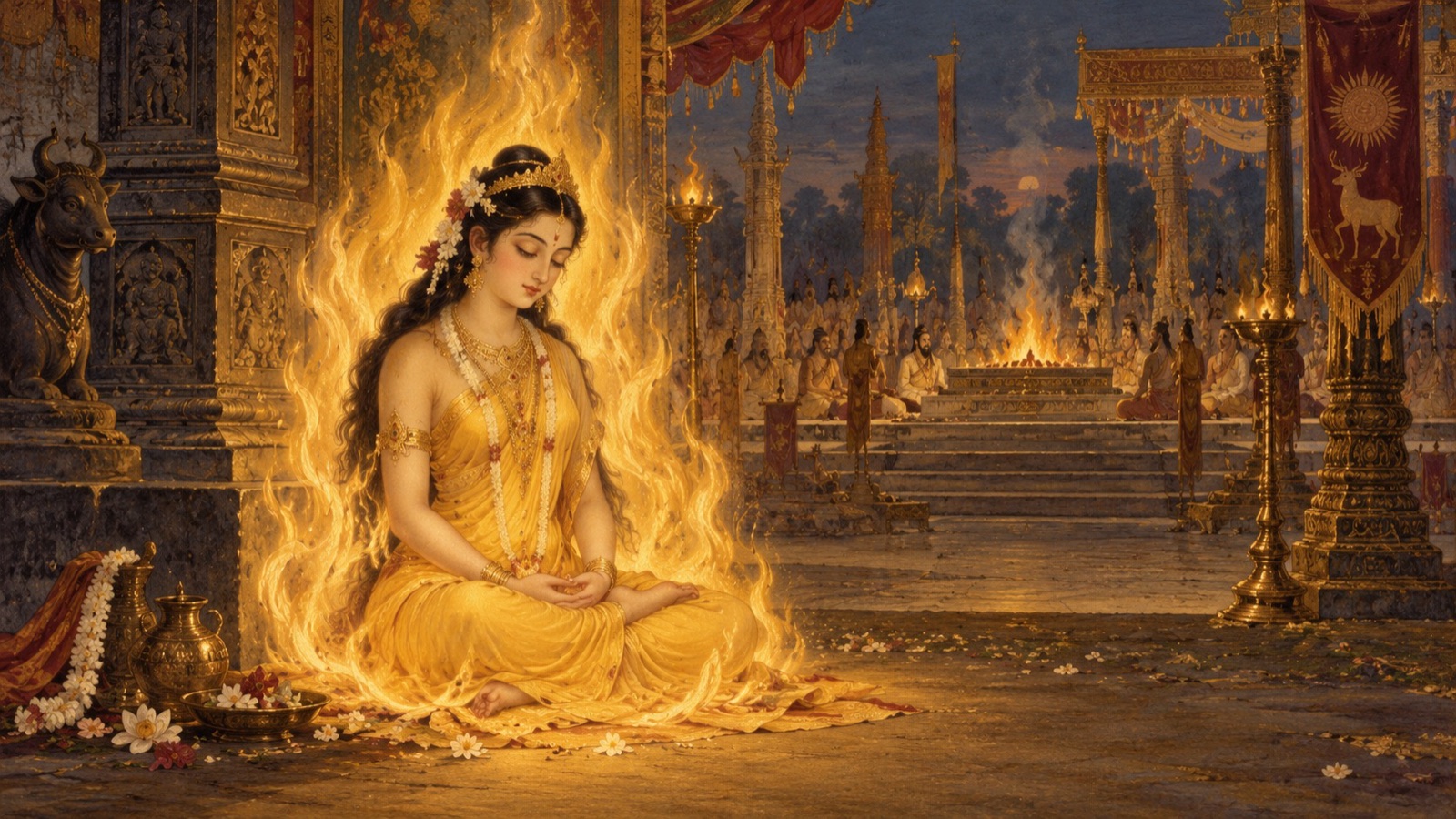
Absorbed wholly in the lotus-feet of her lord, Sati withdraws her life-breath through the discipline of yoga, and her purified body blazes up in a sacred inner fire — a soul returning to the Divine rather than dwell in a house that scorned Him.
Om Namo Bhagavate Vasudevaya.
Om Namo Bhagavate Vasudevaya.
Om Namo Bhagavate Vasudevaya.
Welcome to Srimad Bhagavatam Wisdom, a devotional journey through the sacred histories and teachings of the Srimad Bhagavat Mahapurana. In the previous chapter, Lord Shiva lovingly warned his consort Sati not to attend her father Daksha’s great sacrifice, for Daksha’s heart was poisoned with contempt for him. This fourth chapter tells what came of that warning. Torn between love for her family and grief at her father’s hatred of her husband, Sati sets out for the sacrifice against Shiva’s counsel — and there receives the very wound Shiva had foretold. What follows is one of the most solemn and moving episodes in all the scriptures: Sati’s fearless rebuke of her father before the assembled world, and her decision to give up the body born of a man who reviled the Lord she adored. It is a chapter about the intolerable pain of hearing the holy blasphemed, and the purity of a devotion that would rather leave the body than live estranged from the Divine.
Chapter Information
- Scripture: Śrīmad Bhāgavata Mahāpurāṇa
- Canto: 4 (Book Four)
- Chapter: 4 (Discourse 4)
- Chapter title: Sati Gives Up Her Body
- Principal speaker: The sage Maitreya, continuing his discourse to Vidura
- Principal listener: Vidura
- Main setting: The great sacrificial grounds of Daksha, to which Sati travels from Kailasa
- Central subject: Sati’s journey to her father’s sacrifice against Shiva’s warning, her rebuke of Daksha for his contempt of Lord Shiva, and her giving up of her body through the fire of yoga
- Principal verse range: Canto 4, Chapter 4, verses 1–34
- Primary edition: Gita Press Śrīmad Bhāgavata Mahāpurāṇa
Context from the Previous Chapter
In Chapter 3, Sati longed to attend the grand sacrifice at her father Daksha’s house and see her mother and sisters again. Lord Shiva, remembering the abuse Daksha had heaped upon him, counselled her with love and clarity to stay away, warning that a kinsman’s contempt is the deepest of wounds and that no good could come of going. The dialogue closed with Sati unable, in her heart, to heed that warning.
Sati Sets Out Against the Warning
When Shiva fell silent, Sati stood torn, swinging like a pendulum between her longing to go and her fear of disobeying her lord. At last, sighing deeply, her judgment clouded by grief and anger, she left him and set out for her parents’ home — leaving behind the very Lord who, out of love, had given her half of his own body.
ततो विनि:श्वस्य सती विहाय तं शोकेन रोषेण च दूयता हृदा । पित्रोरगात्स्त्रैणविमूढधीर्गृहान् प्रेम्णात्मनो योऽर्धमदात्सतां प्रिय: ॥ ३ ॥
tato viniḥśvasya satī vihāya taṁ śokena roṣeṇa ca dūyatā hṛdā pitror agāt straiṇa-vimūḍha-dhīr gṛhān premṇātmano yo ’rdham adāt satāṁ priyaḥ
Meaning: Then, sighing deeply, with a heart aching from grief and anger, and her judgment overcome by womanly feeling, Sati departed for her father’s house, forsaking that beloved of the saints who had, in his affection, granted her half of his own being. (Canto 4, Chapter 4, verse 3)
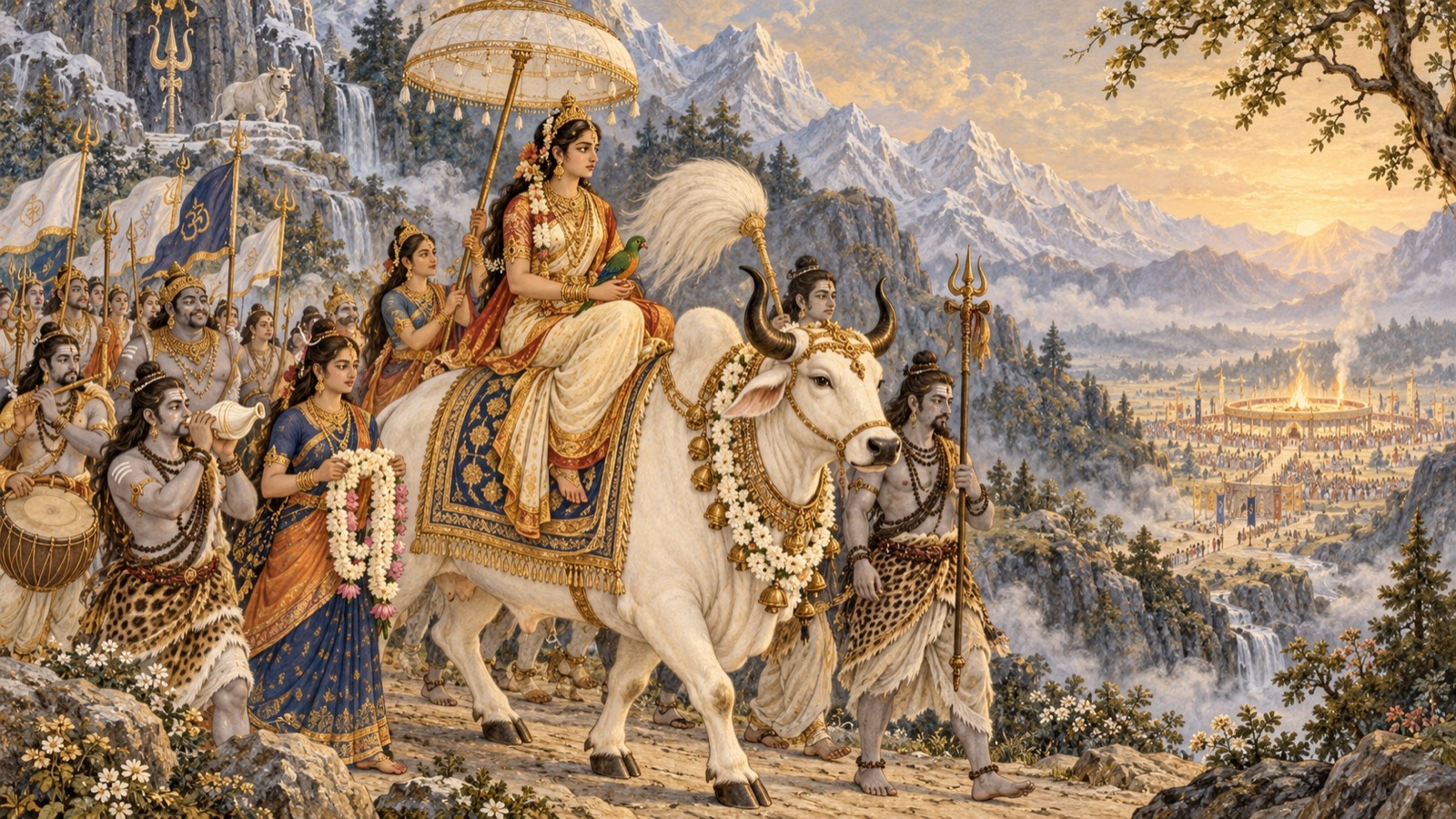
Seeing her go, Shiva’s devoted attendants — Maniman, Mada, and others, together with the Yakshas — would not let her travel alone. Placing Nandishvara, the chief of the bulls, at their head, they set her upon the great bull, equipped with her pet Sarika bird, a white umbrella, a chowrie, and the emblems of royalty, and escorted her toward Daksha’s sacrifice to the sound of conchs, flutes, and kettledrums.
A Cold Welcome
Sati reached the sacrificial grounds, where Vedic hymns rang out on every side and the arena was thronged with Brahmana seers and divinities. But afraid of Daksha, who had shown Shiva such disrespect, no one there dared to greet her — no one except her own sisters and her mother, who embraced her, their throats choked with tears of love. Not addressed kindly by her father, Sati would not accept the presents or the seat of honour her mother and sisters lovingly offered, nor even return their gentle enquiries about her welfare. Her father’s silence had told her everything.
Sati’s Rebuke of Her Father
Then Sati saw the thing that pierced her deepest: among all the shares of the sacrificial offerings, not one had been set aside for Rudra, her lord. Seeing this deliberate slight to the omniscient Lord, and her father’s open contempt, she blazed with a righteous anger that seemed as if it would burn the worlds. Restraining by her command the hosts of ghosts who had sprung forward to strike Daksha, she turned upon that enemy of Lord Shiva and reproached him, in a voice faltering with grief and anger, within the hearing of the whole assembly.
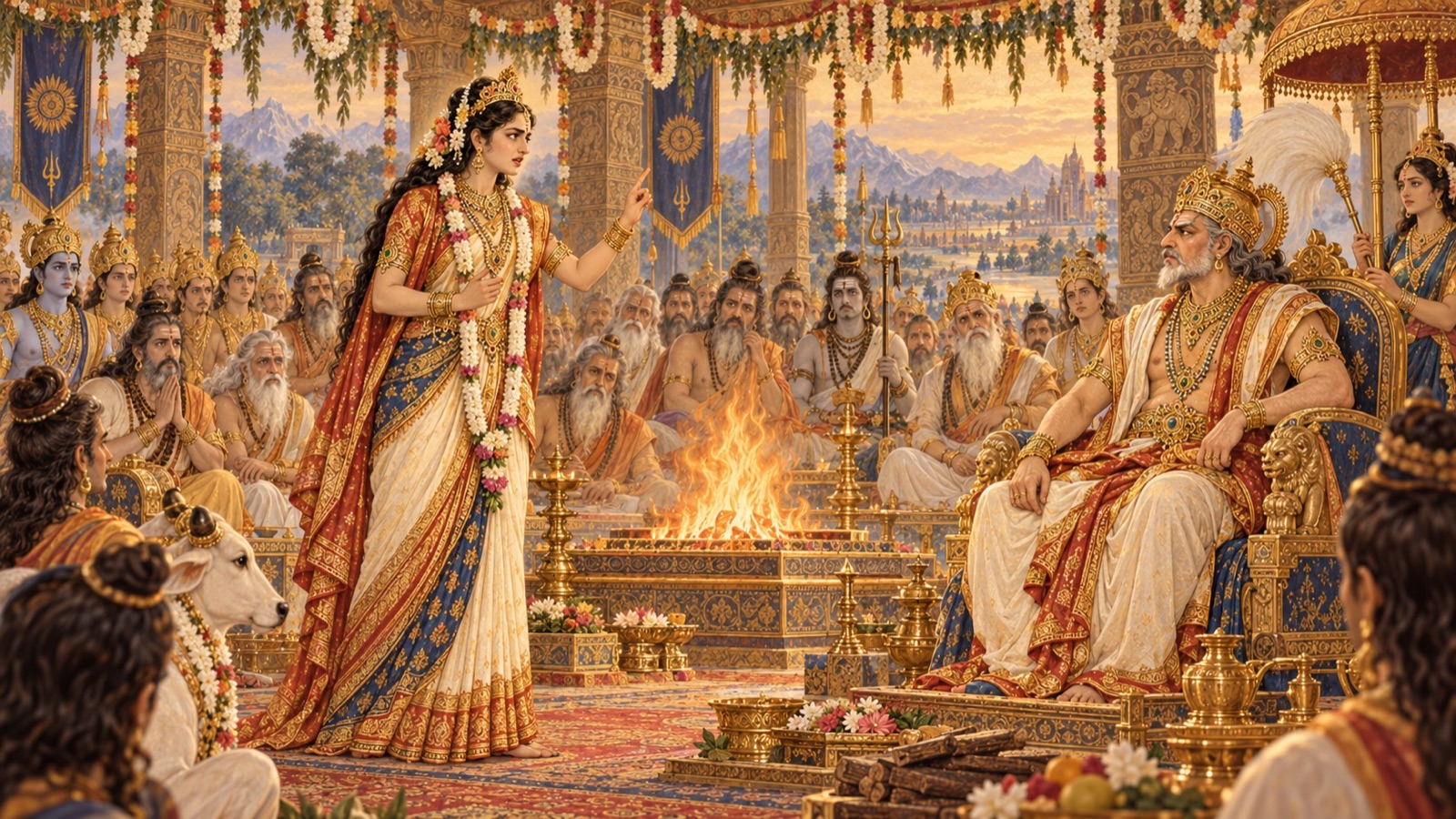
None but you, she declared, would bear enmity toward Lord Shiva — he who is dear beyond all to every embodied being, who is the very Self of all, and free from the least enmity toward anyone.
देव्युवाच न यस्य लोकेऽस्त्यतिशायन: प्रिय- स्तथाप्रियो देहभृतां प्रियात्मन: । तस्मिन्समस्तात्मनि मुक्तवैरके ऋते भवन्तं कतम: प्रतीपयेत् ॥ ११ ॥
devy uvāca na yasya loke ’sty atiśāyanaḥ priyas tathāpriyo deha-bhṛtāṁ priyātmanaḥ tasmin samastātmani mukta-vairake ṛte bhavantaṁ katamaḥ pratīpayet
Meaning: The goddess said: Toward him who has no one dearer and no one more hateful — the beloved Self of all embodied beings, in whom there is no enmity at all — who but you would ever act with hostility? (Canto 4, Chapter 4, verse 11)
Ordinary people, she said, magnify even the small virtues of others, while pettier souls find fault; but Daksha had found fault even with those free of all fault. It was no wonder that ignoble men who take the body for the self should revile exalted souls — but for Daksha to hate Lord Shiva of sacred renown, whose very name is a means of grace, was a thing beyond excuse.
यद्वयक्षरं नाम गिरेरितं नृणां सकृत्प्रसङ्गादघमाशु हन्ति तत् । पवित्रकीर्तिं तमलङ्घ्यशासनं भवानहो द्वेष्टि शिवं शिवेतर: ॥ १४ ॥
yad dvy-akṣaraṁ nāma gireritaṁ nṛṇāṁ sakṛt prasaṅgād agham āśu hanti tat pavitra-kīrtiṁ tam alaṅghya-śāsanaṁ bhavān aho dveṣṭi śivaṁ śivetaraḥ
Meaning: His two-syllabled name, “Śiva,” uttered by men but once, even casually, at once destroys their sin. Yet you — inauspicious as you are — hate that Shiva of pure renown, whose command none can transgress! (Canto 4, Chapter 4, verse 14)
The Vow to Cast Off Her Body
When a master is being vilified, Sati continued, one who has no power to stop it should at least shut his ears and leave; and one who has the power should silence the blasphemer, even at the cost of his own life. As for herself, she would no longer keep the body she had received from a man who reviled Lord Shiva — for the wise say that one is purified only by casting off what has been wrongly taken in. She was ashamed, she said, of her very kinship with such a man; and whenever her lord, in play, addressed her as “Dakshayani” — the daughter of Daksha — she was cut to the heart. That link she would now sever forever.
Here Sati is not merely giving way to grief; she is applying to herself the very law she has just proclaimed. Her own teaching holds that one who hears the protector of religion blasphemed, and lacks the standing to silence the offender himself, must either withdraw from his presence or, failing that, give up the very body that heard the offense unavenged. Daksha was her father — she would not raise a hand against him as one might against a stranger. So she turns the penalty she has prescribed for blasphemers upon her own body, born of his, rather than upon him. Her death is thus neither despair nor rebellion; it is the deliberate, considered fulfillment of the principle she had just declared before the whole assembly (verses 17-18).
गोत्रं त्वदीयं भगवान्वृषध्वजो दाक्षायणीत्याह यदा सुदुर्मना: । व्यपेतनर्मस्मितमाशु तदाऽहं व्युत्स्रक्ष्य एतत्कुणपं त्वदङ्गजम् ॥ २३ ॥
gotraṁ tvadīyaṁ bhagavān vṛṣadhvajo dākṣāyaṇīty āha yadā sudurmanāḥ vyapeta-narma-smitam āśu tadā ’haṁ vyutsrakṣya etat kuṇapaṁ tvad-aṅgajam
Meaning: Whenever the glorious Lord who bears the bull on His banner addresses me, even in jest, as “Dakshayani,” born of your lineage, I lose all mirth and am plunged in sorrow. Therefore I shall at once cast off this corpse-like body born of your body. (Canto 4, Chapter 4, verse 23)
The Fire of Yoga
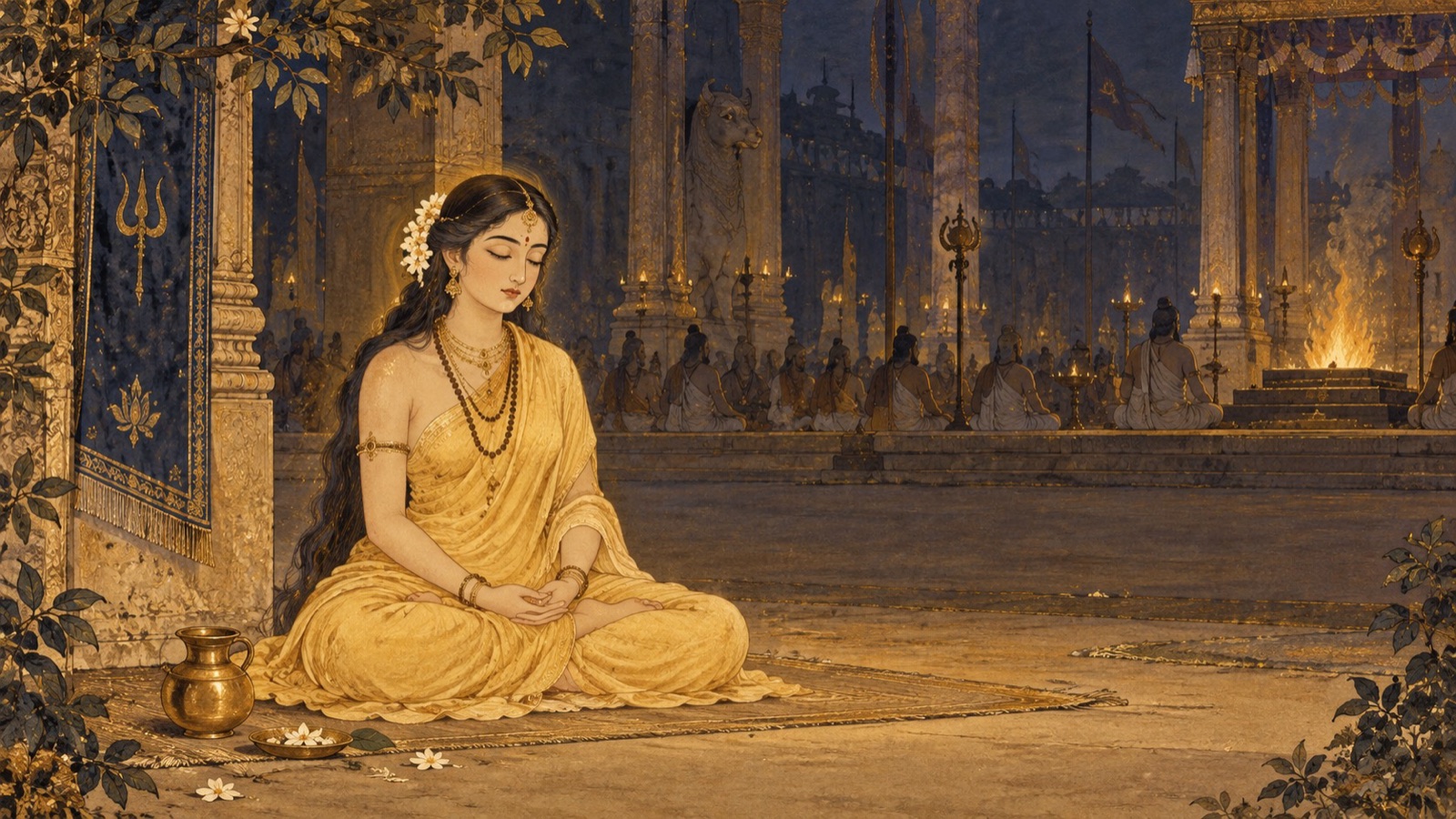
Having spoken thus to Daksha in the midst of the sacrifice, Sati sat down upon the ground, silent, facing north. She sipped water in purification, wrapped herself in a yellow cloth, closed her eyes, and turned to the yogic art of shedding the body. Steadying herself, she joined the Prana and Apana airs at the navel, and drew the Udana air upward, through the heart, to the space between her eyebrows. Then, longing to give up the body that her lord had so often drawn lovingly onto his lap — now offered up in displeasure against her father — she summoned, by deep concentration, the inner fire and air. Absorbed utterly in the honey of her lord’s lotus-feet, perceiving nothing else, her body, cleansed of every impurity, blazed up in the fire born of her meditation.
तत: स्वभर्तुश्चरणाम्बुजासवं जगद्गुरोश्चिन्तयती न चापरम् । ददर्श देहो हतकल्मष: सती सद्य: प्रजज्वाल समाधिजाग्निना ॥ २७ ॥
tataḥ sva-bhartuś caraṇāmbujāsavaṁ jagad-guroś cintayatī na cāparam dadarśa deho hata-kalmaṣaḥ satī sadyaḥ prajajvāla samādhijāgninā
Meaning: Then, meditating only on the nectar of the lotus-feet of her husband, the preceptor of the universe, and on nothing else, Sati — her body freed of all impurity — was at once ablaze with the fire born of her deep meditation. (Canto 4, Chapter 4, verse 27)
Uproar in Heaven and on Earth
At that wonder a tremendous cry of grief arose, in the sky and upon the earth alike: “Alas! Sati, the beloved consort of the most worshipful of the gods, has given up her life — provoked to what wrath, and by whom?”
तत्पश्यतां खे भुवि चाद्भुतं महद् हाहेति वाद: सुमहानजायत । हन्त प्रिया दैवतमस्य देवी जहावसून् केन सती प्रकोपिता ॥ २८ ॥
tat paśyatāṁ khe bhuvi cādbhutaṁ mahad hā heti vādaḥ sumahān ajāyata hanta priyā daivatamasya devī jahāv asūn kena satī prakopitā
Meaning: As all beheld that great marvel, a mighty cry of “Alas! Alas!” arose in the sky and on the earth: “The beloved consort of the most worshipful Lord, the goddess Sati, has given up her life! By whom was she so provoked?” (Canto 4, Chapter 4, verse 28)
The world looked with horror upon Daksha, the father of all creatures, by whose contempt his own high-souled daughter had cast away the life she never deserved to lose. He would reap lasting infamy, they said — this hater of Shiva who had not even forbidden his own child when she prepared to die.
The Attendants Rise, and the Sacrifice Grows Dark
Seeing their mistress dead, Sati’s attendants sprang up with uplifted weapons to strike down Daksha. But the sage Bhrgu, officiating at the rite, poured oblations into the southern fire with a Yajurveda incantation that has the power to destroy those who would wreck a sacrifice — and at once thousands of heavenly beings called the Rbhus, whose great power is drawn from Soma, the moon, rose blazing from the sacrificial pit. Armed with firebrands and resplendent with brahminical power, they drove Shiva’s attendants and the Yakshas fleeing in every direction.
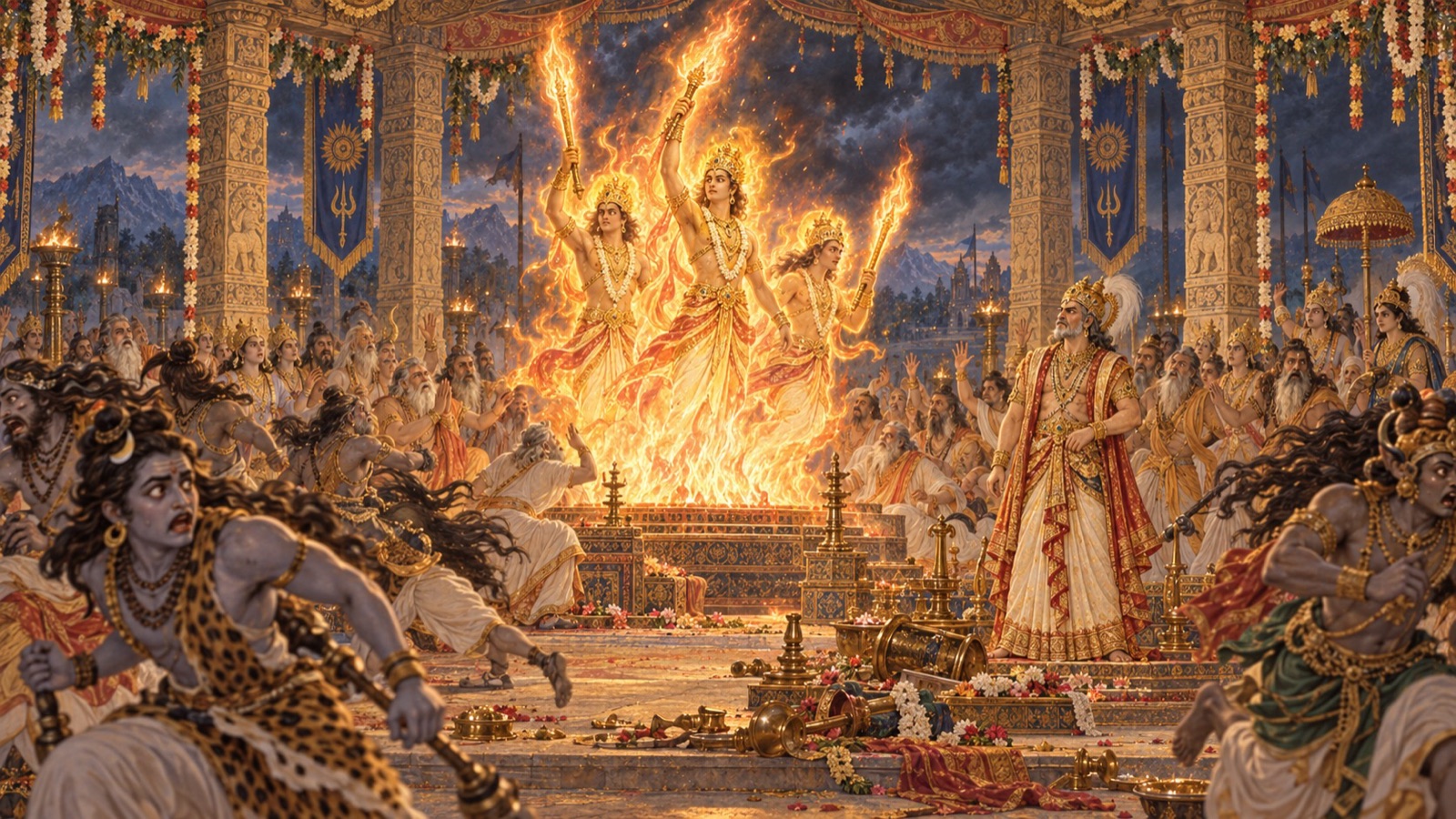
With that, the fourth discourse closes — but the grief it has kindled will not be contained. Word of Sati’s death is already speeding toward Kailasa, where Lord Shiva waits, and the next chapter will bring the storm.
Principal Teachings of This Chapter
1. The blasphemy of the holy is unbearable to a pure heart. What Sati cannot endure is not a personal slight but the contempt shown to Lord Shiva, who bears enmity toward no one and is dear to every embodied being. Where ordinary people delight in magnifying even the smallest virtue in another, Daksha went out of his way to find fault in one universally free of it — proof, Sati says, of how far envy can blind a man even to what the whole world reveres. Her whole being recoils from a household that dishonours the Divine, a measure of how completely her heart belonged to her lord (verses 11-14).
2. The Lord’s name is itself a purifier. Sati declares that the two-syllabled name “Śiva,” spoken even once and even casually, destroys sin. The scripture again and again exalts the holy name as a grace available to all (verse 14).
3. Devotion may require costly separation from what dishonours God. Sati’s giving up of the body born of a Shiva-hater is an extreme and singular act, not a model to imitate literally; its spiritual meaning is her refusal to remain identified with anything that reviles the Lord (verses 18, 23).
4. Pride that hates the holy brings its own ruin. Daksha’s contempt for Shiva does not exalt him; it earns him the horror of heaven and earth and sets in motion the undoing of his own grand sacrifice. Enmity toward the devotees of God is self-destructive (verses 29-30).
5. The mind absorbed in the Lord’s feet is freed of all impurity. In her final moment Sati thinks of nothing but the nectar of her lord’s lotus-feet, and her body is described as “freed of all impurity.” A mind wholly fixed on the Divine is itself the highest purification (verse 27).
A Devotional Reflection
This is a hard and holy chapter, and it asks to be read with reverence rather than imitation. Sati’s act is not offered to us as a lesson in how to grieve or how to leave the world; it is the singular deed of a goddess whose identity was so wholly merged in her lord that she could not bear to wear a name, a body, or a kinship that dishonoured him. What speaks to us across the distance is the completeness of her love. Most of us divide our hearts — a little for God, much for the world, and a careful silence when the holy is mocked in our presence. Sati kept nothing back. She teaches us, gently and terribly, what it might mean to love the Divine without reservation, and to feel the dishonouring of God as a wound in our own flesh. We need not follow her into the fire; but we might ask whether we, too, could refuse to sit comfortably where the Lord and His devotees are held in contempt, and whether our own devotion has anything of her wholeness in it.
A Daily Devotional Practice
Today, honour the power of the holy name that Sati exalted. Set aside a few quiet minutes, sit with a still breath, and slowly repeat the name of the Lord — “Om Namo Bhagavate Vasudevaya” — letting each utterance settle deeper than the last. And resolve that today, should you hear the Divine or the devotees of God spoken of with mockery or contempt, you will not join in and will not sit as though it were nothing; instead, quietly turn your own mind to the Lord’s name. In treasuring the name and refusing to countenance its dishonour, you keep faith, in a small way, with the wholeness of Sati’s devotion.
Conclusion
The fourth discourse of Book Four is the tragic heart of the story of Daksha and Sati. Against her lord’s loving warning, Sati goes to her father’s sacrifice, only to find the very contempt Shiva had foretold — and, worst of all, no share of the offering set aside for her lord. Before the whole assembled world she rebukes her father for hating the most auspicious of beings, declares that his two-syllabled name alone can purify the sinful, and refuses to keep any longer the body born of a Shiva-hater. Fixing her mind entirely on the lotus-feet of her lord, she gives up that body in the fire of yoga, and a great cry of grief goes up through heaven and earth. Daksha’s proud sacrifice, begun in vanity, now stands under the shadow of infamy and turmoil — and the news races toward Kailasa. Maitreya leaves us here, at the threshold of Lord Shiva’s grief, and of the reckoning to come.
May the divine wisdom of Srimad Bhagavatam awaken pure devotion within our hearts.
Om Namo Bhagavate Vasudevaya.
Jay Shree Madhav.
References and Attribution
- Primary edition: Gita Press, Śrīmad Bhāgavata Mahāpurāṇa (English, complete), Book Four, Discourse 4, pp. 364–369.
- Series: Srimad Bhagavatam Wisdom · Biswa Sanatan Dharma Seva Trust.
- Presented following the spiritual guidance and recommendation of Pandit Dr. Shri Kashinath Mishra.
This is an original, faithful retelling in the writer’s own words, with brief quoted verses shown in Devanāgarī and transliteration and their meanings given as summaries. It is not a reproduction of any single publisher’s continuous translation or commentary. No affiliation with or endorsement by any publisher is implied.
Jay Shree Madhav