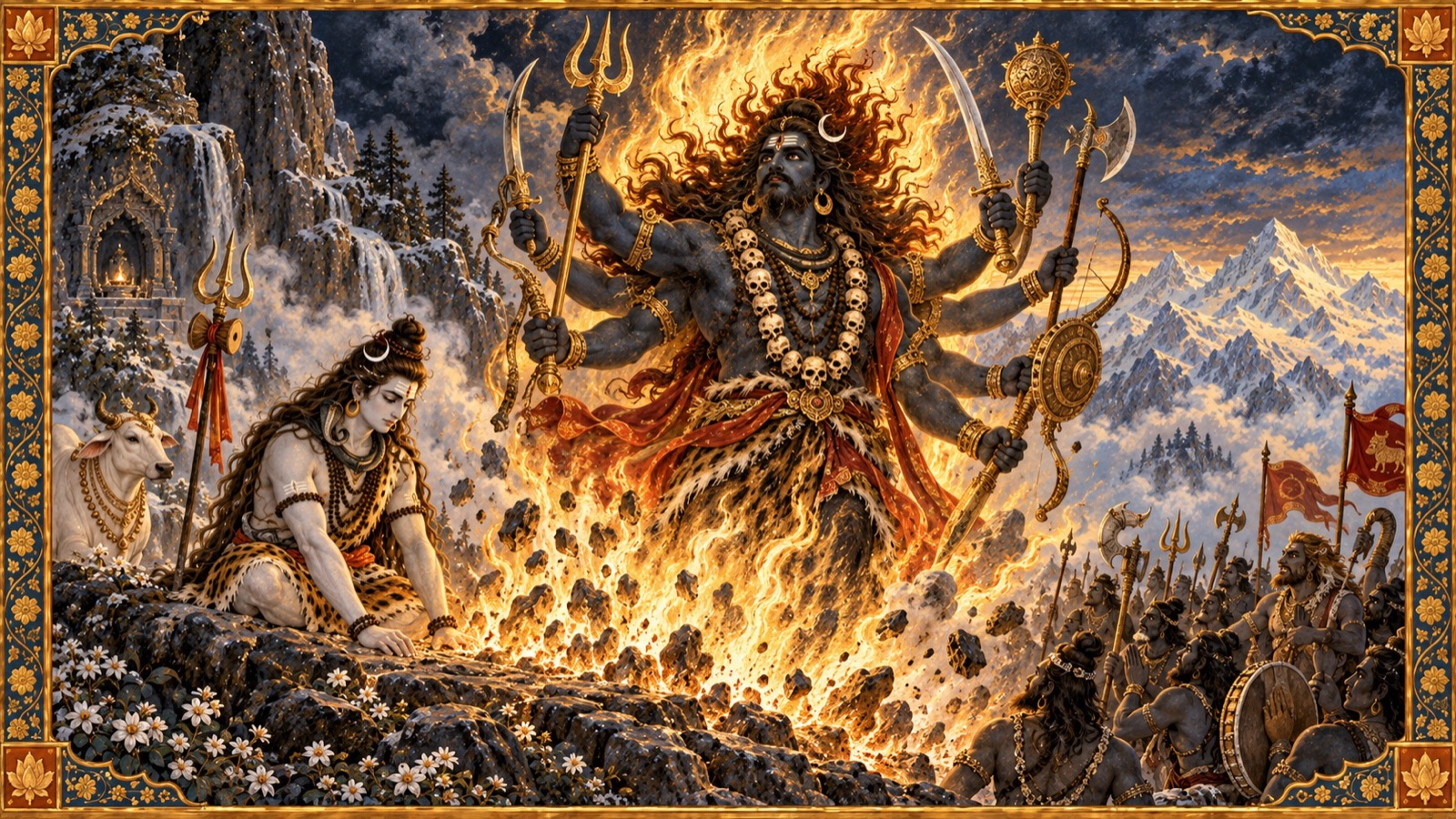
From a single lock of Lord Shiva’s matted hair, dashed against the ground in the fury of grief, springs the towering warrior Virabhadra — a storm gathering to undo the sacrifice that scorned the Lord.
Om Namo Bhagavate Vasudevaya.
Om Namo Bhagavate Vasudevaya.
Om Namo Bhagavate Vasudevaya.
Welcome to Srimad Bhagavatam Wisdom, a devotional journey through the sacred histories and teachings of the Srimad Bhagavat Mahapurana. In the previous chapter, Sati gave up her body in the fire of yoga rather than keep the form of a daughter whose father reviled her lord, and a great cry of grief rose through heaven and earth. This fifth chapter tells how that grief reached Lord Shiva on Kailasa, and what his sorrow, turned to wrath, brought forth. From a single lock of his hair springs the mighty Virabhadra, who leads the hosts of Rudra against Daksha’s proud sacrifice. It is a solemn chapter about the reckoning that overtakes contempt for the Divine — and, read rightly, about the terrible seriousness with which the scriptures regard the dishonouring of God and His devotees.
Chapter Information
- Scripture: Śrīmad Bhāgavata Mahāpurāṇa
- Canto: 4 (Book Four)
- Chapter: 5 (Discourse 5)
- Chapter title: The Destruction of Daksha’s Sacrifice
- Principal speaker: The sage Maitreya, continuing his discourse to Vidura
- Principal listener: Vidura
- Main setting: Mount Kailasa, the abode of Lord Shiva, and the great sacrificial grounds of Daksha
- Central subject: Lord Shiva’s grief and wrath at Sati’s death, the birth of Virabhadra, and the wrecking of Daksha’s sacrifice
- Principal verse range: Canto 4, Chapter 5, verses 1–26
- Primary edition: Gita Press Śrīmad Bhāgavata Mahāpurāṇa
Context from the Previous Chapter
In Chapter 4, Sati travelled to her father Daksha’s sacrifice against Lord Shiva’s warning, found no offering set aside for her lord, and rebuked her father before the whole assembly for his contempt of the most auspicious Lord. Then, unwilling to keep the body born of a Shiva-hater, she absorbed her mind in her lord’s lotus-feet and gave it up in the fire of yoga. Her attendants rose to strike Daksha but were driven off by fiery beings summoned from the sacrificial fire. As this chapter opens, the news is racing toward Kailasa.
The Wrath of Shiva
The sage Narada carried the news to Kailasa: that Sati had given up her life on being slighted by Daksha, and that the host of Shiva’s own attendants had been driven away by the Rbhus who sprang from the sacrifice. Learning this, Lord Shiva was seized by a wrath beyond all measure.
मैत्रेय उवाच भवो भवान्या निधनं प्रजापते- रसत्कृताया अवगम्य नारदात् । स्वपार्षदसैन्यं च तदध्वरर्भुभि- र्विद्रावितं क्रोधमपारमादधे ॥ १ ॥
maitreya uvāca bhavo bhavānyā nidhanaṁ prajāpater asat-kṛtāyā avagamya nāradāt sva-pārṣada-sainyaṁ ca tad-adhvararbhubhir vidrāvitaṁ krodham apāram ādadhe
Meaning: Maitreya said: When Lord Shiva learnt from Narada that his consort Sati had met her death on being dishonoured by the lord of created beings, Daksha, and that the host of his own attendants had been driven off by the Rbhus who had appeared from that sacrifice, he was seized with boundless wrath. (Canto 4, Chapter 5, verse 1)
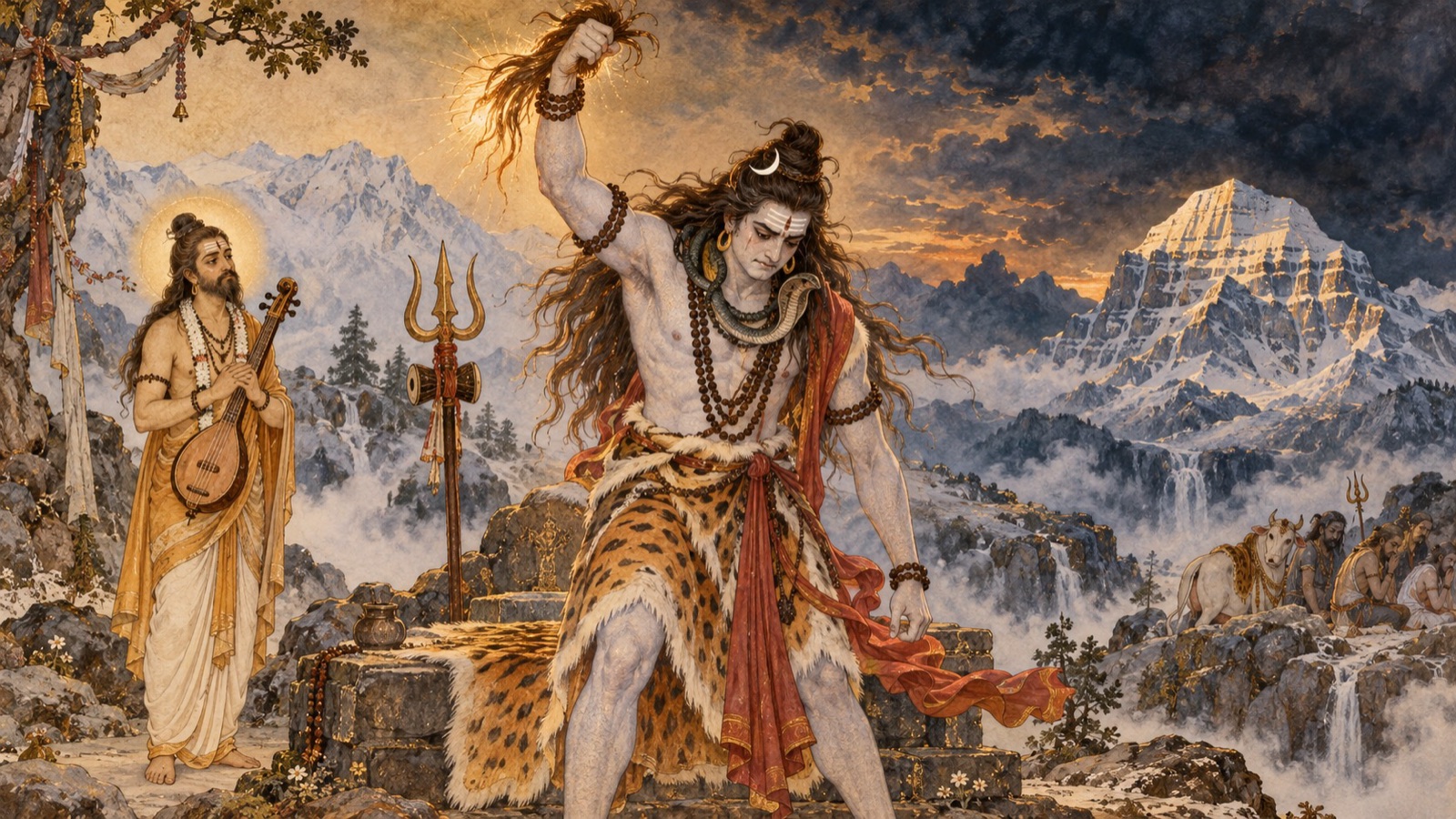
Biting his lips in rage, Shiva tore a single clotted lock from his matted hair — a lock that blazed like lightning and like a flame of fire — sprang to his feet, laughed with a deep and terrible roar, and dashed it against the ground.
क्रुद्ध: सुदष्टौष्ठपुट: स धूर्जटि- र्जटां तडिद्वह्निसटोग्ररोचिषम् । उत्कृत्य रुद्र: सहसोत्थितो हसन् गम्भीरनादो विससर्ज तां भुवि ॥ २ ॥
kruddhaḥ sudaṣṭauṣṭha-puṭaḥ sa dhūr-jaṭir jaṭāṁ taḍid-vahni-saṭogra-rociṣam utkṛtya rudraḥ sahasotthito hasan gambhīra-nādo visasarja tāṁ bhuvi
Meaning: Enraged, biting his lips, Lord Shiva, who bears a heavy burden of matted locks, tore off one such lock — blazing terribly like lightning and fire — and, springing up all at once, laughed with a deep roar and dashed it to the ground. (Canto 4, Chapter 5, verse 2)
The Birth of Virabhadra
From that lock there sprang a colossal being — Virabhadra — whose towering figure touched the skies. He had a thousand arms; his body was dark as a cloud; he had three eyes bright as suns, fierce teeth, and hair blazing like fire; he wore a garland of skulls and bore many uplifted weapons.
ततोऽतिकायस्तनुवा स्पृशन्दिवं सहस्रबाहुर्घनरुक् त्रिसूर्यदृक् । करालदंष्ट्रो ज्वलदग्निमूर्धज: कपालमाली विविधोद्यतायुध: ॥ ३ ॥
tato ’tikāyas tanuvā spṛśan divaṁ sahasra-bāhur ghana-ruk tri-sūrya-dṛk karāla-daṁṣṭro jvalad-agni-mūrdhajaḥ kapāla-mālī vividhodyatāyudhaḥ
Meaning: From that lock sprang a being of colossal stature, whose figure touched the heavens; possessed of a thousand arms, dark as a cloud, with three eyes bright as suns, fearful teeth, and hair blazing like fire, wearing a garland of skulls and armed with many uplifted weapons. (Canto 4, Chapter 5, verse 3)
Joining his palms, the mighty being asked what he should do. Lord Shiva, the lord of all spirits, replied: “You are born of my own being, O valiant Rudra. Lead my hosts, and destroy Daksha together with his sacrifice.”
तं किं करोमीति गृणन्तमाह बद्धाञ्जलिं भगवान् भूतनाथ: । दक्षं सयज्ञं जहि मद्भटानां त्वमग्रणी रुद्र भटांशको मे ॥ ४ ॥
taṁ kiṁ karomīti gṛṇantam āha baddhāñjaliṁ bhagavān bhūta-nāthaḥ dakṣaṁ sa-yajñaṁ jahi mad-bhaṭānāṁ tvam agraṇī rudra bhaṭāṁśako me
Meaning: To that being, who stood with joined palms asking, “What shall I do?”, the Lord of all spirits said: “Being a part of my own self, O valiant Rudra, lead the vanguard of my hosts and destroy Daksha along with his sacrifice.” (Canto 4, Chapter 5, verse 4)
The March Upon the Sacrifice
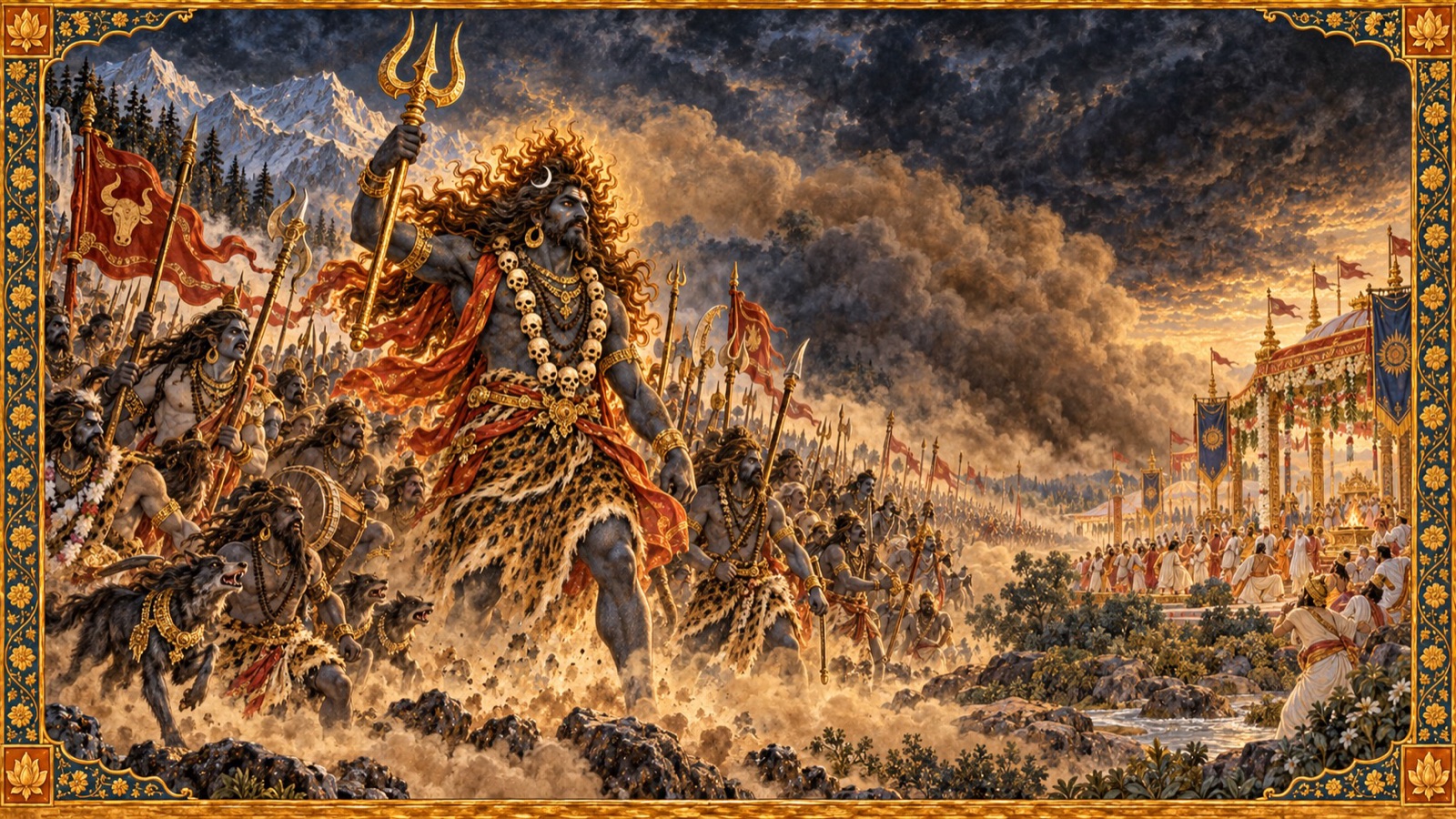
Reverently circumambulating Lord Shiva, Virabhadra set out, thundering terribly and lifting a trident capable of destroying even Death, followed by the roaring hosts of Rudra. At the sacrifice, the priests, Daksha, the assembled guests and the Brahmanas and their wives saw a strange darkness and a cloud of dust rising in the northern quarter, and wondered fearfully what it could be — for no wind blew and no robbers could account for it. Troubled, Daksha’s wife Prasuti and the other women understood: this was the fruit of the wrong Daksha had done, slighting his innocent daughter before the eyes of her sisters, and of the offence given to Lord Rudra. As they spoke, ill-omens of the worst kind appeared again and again in the heavens and on the earth, striking fear even into the stout-hearted Daksha.
The Wrecking of the Sacrifice
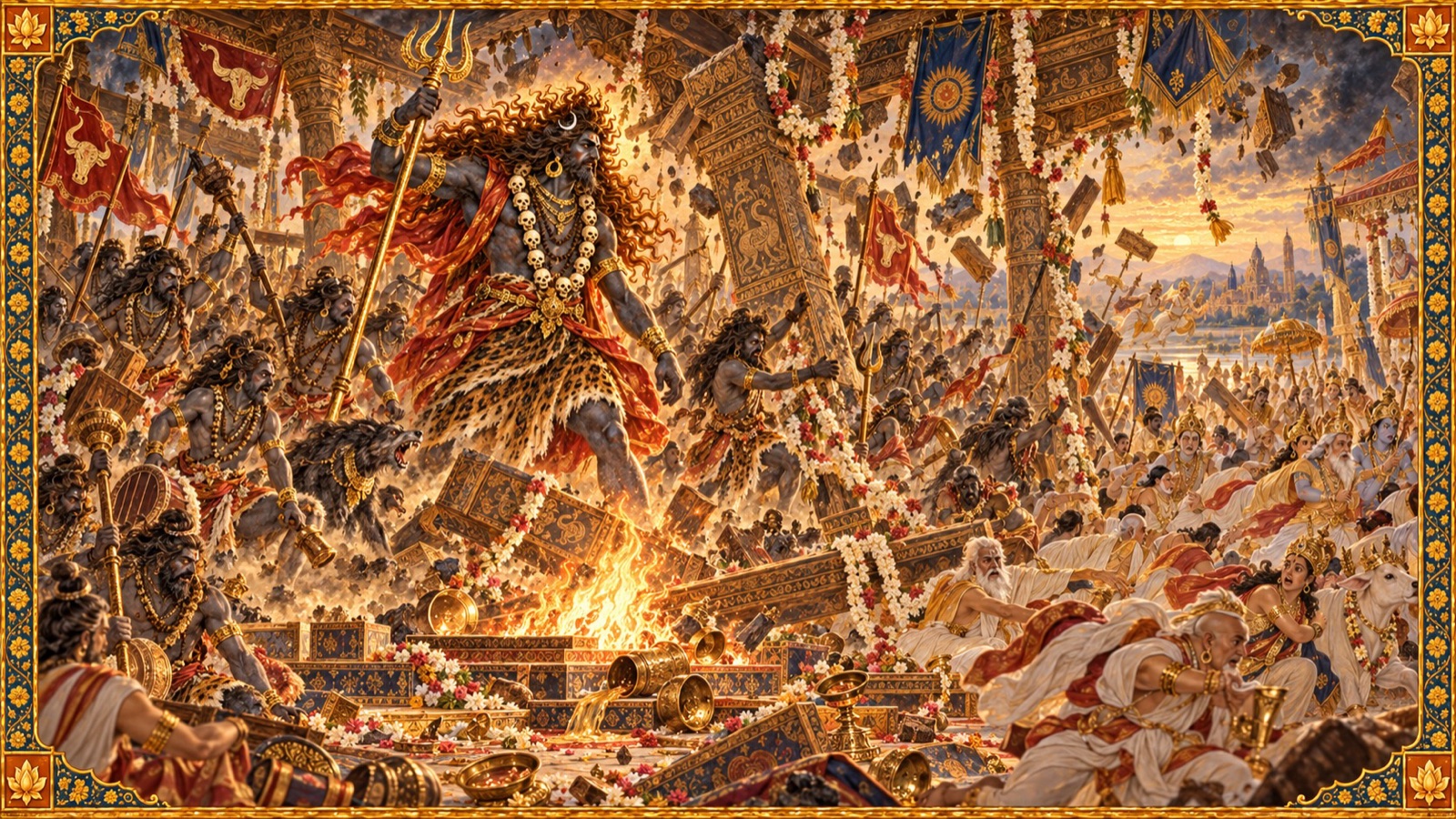
Then the followers of Rudra — armed with uplifted weapons, of fearsome and varied form — rushed in from every side and surrounded the spacious sacrificial ground. Some broke the pillars and beams of the sacrificial hall; some destroyed the apartments of the wives, the assembly-hall, the store-cottage, and the kitchen; some smashed the sacred vessels and put out the sacrificial fires; some scattered and defiled the sacred enclosures. Others seized the fleeing gods. Maniman bound the sage Bhrgu; Virabhadra himself seized Daksha; Chandisa seized the god Pusha, and Nandishvara laid hold of Bhaga. Seeing the outrage and pelted with stones, the priests, guests, and heavenly beings fled in every direction.
Virabhadra dealt with those who had abetted Daksha’s contempt as their deeds deserved: he tore out the moustache of Bhrgu — the very priest who had cursed Lord Shiva and now stood offering oblations into the sacrificial fire with his own hands; he knocked down Bhaga and put out his eyes, for Bhaga had signalled his approval, moving his eyebrows, while Bhrgu pronounced that curse; and he dashed out the teeth of Daksha, who had bared them while himself cursing Lord Shiva, and of Pusha, who had laughed, showing his teeth, while Shiva was being reviled.
The Beheading of Daksha
Setting his foot on Daksha’s breast, the three-eyed Virabhadra tried to sever his head with a sharp weapon, but could not cut it. Wondering greatly that no weapon could so much as pierce Daksha’s skin, he reflected for a long while. Then, observing the method by which sacrificial animals were slain in the rite, Virabhadra severed Daksha’s head from his body in that same way — treating the sacrificer himself as the animal to be offered.
दृष्ट्वा संज्ञपनं योगं पशूनां स पतिर्मखे । यजमानपशो: कस्य कायात्तेनाहरच्छिर: ॥ २४ ॥
dṛṣṭvā saṁjñapanaṁ yogaṁ paśūnāṁ sa patir makhe yajamāna-paśoḥ kasya kāyāt tenāharac chiraḥ
Meaning: Observing at the sacrifice the method by which the sacrificial animals were killed, that lord of Shiva’s hosts severed the head of Daksha — the sacrificer, now become the animal to be offered — from his body by that same means. (Canto 4, Chapter 5, verse 24)
A shout of applause rose from the ghosts and spirits who extolled the deed, while Daksha’s own party cried out against it. Full of anger, Virabhadra cast Daksha’s head as an oblation into the southern sacrificial fire, set the whole sacrificial edifice ablaze, and departed for Mount Kailasa.
जुहावैतच्छिरस्तस्मिन्दक्षिणाग्नावमर्षित: । तद्देवयजनं दग्ध्वा प्रातिष्ठद् गुह्यकालयम् ॥ २६ ॥
juhāvaitac chiras tasmin dakṣiṇāgnāv amarṣitaḥ tad-deva-yajanaṁ dagdhvā prātiṣṭhad guhyakālayam
Meaning: Filled with indignation, Virabhadra offered Daksha’s head as an oblation into the southern fire, and, having burnt down that place of sacrifice, set out for the abode of the Guhyakas (Mount Kailasa). (Canto 4, Chapter 5, verse 26)
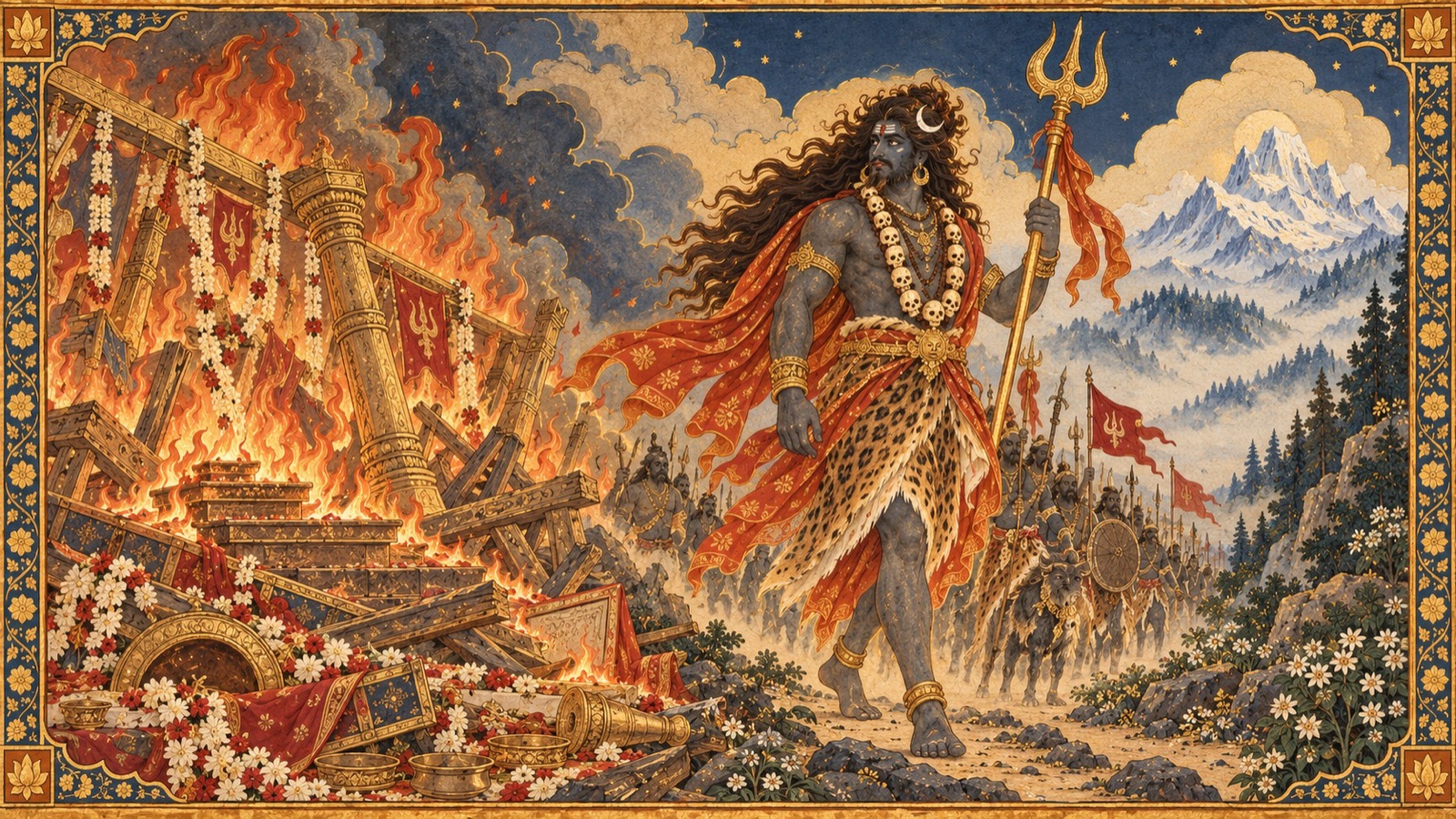
With that, the fifth discourse closes. Daksha’s grand sacrifice, begun in pride and stained by contempt for the Lord, lies in ashes — and the gods, worsted and afraid, will soon seek the only remedy that remains: to go to Kailasa and beg the forgiveness of the one they wronged.
Principal Teachings of This Chapter
1. Contempt for the Divine sets its own ruin in motion. Daksha’s magnificent sacrifice is undone not by chance but as the direct fruit of his hatred of Lord Shiva and his cruelty to Sati. The scripture shows, starkly, that enmity toward God and His devotees carries its own undoing (verses 9-11).
2. The Lord’s wrath is the shadow of His love — and even that wrath answers to a higher authority. Shiva’s fury is not petty temper but the grief of love wounded past bearing. Even Virabhadra, its fierce embodiment, springs from the Lord and acts only at his word — a reminder that the Divine remains sovereign even in the terrible (verses 1-4). Maitreya makes this sovereignty explicit: the towering being born of that wrath is called nothing less than the personified anger of the Supreme Personality of Godhead, entirely bound to carry out Lord Shiva’s command (verse 5). Even so fearsome a manifestation is not an independent or lawless force; it is an instrument of divine justice, not divine caprice — proof that the immense powers wielded by great personalities such as Shiva remain, at every moment, subordinate to and expressive of the will of the one Supreme Lord who ultimately directs them all.
3. Those who abet cruelty share in its reckoning. Bhrgu, Bhaga, and Pusha are singled out not at random but because each had laughed at, or countenanced, the insult to Shiva. To take pleasure in the mockery of the holy is itself an offence (verses 19-21).
4. Pride blinds even the wise — and true greatness is not what it seems. Daksha, a lord of created beings and master of sacrifice, is brought low by his own arrogance. Notably, the very account that condemns him still calls him steadfast even as Sati was preparing to give up her life — yet the scripture will not let outward steadiness pass for real greatness of soul: greatness, it insists, is proven by a heart surrendered to the Divine, not by rank, learning, or nerve (verse 12). By that measure, Daksha’s high position and ritual expertise were no protection at all, for the one thing that mattered was missing precisely when the reckoning came — and it is that same hollow pride that Virabhadra strips from him, along with his head, at the sacrifice’s climax (verse 24).
5. Ill-omens and dread precede the fruit of wrongdoing. The strange darkness, the rising dust, and the omens repeated in earth and sky all warn the assembly before the blow falls. Prasuti herself, watching, likens what is coming to Lord Rudra’s own dance of cosmic dissolution — his hair flying loose, his trident piercing the guardians of the four quarters, his laughter rolling like thunder — and warns that once such wrath is roused, not even the creator himself could escape it unscathed. The world itself recoils when the Divine is dishonoured (verses 7-12).
A Devotional Reflection
This is a chapter of thunder, and it asks to be read with sober reverence. It is easy to be startled by its violence and to miss its meaning: the scriptures are showing us, in the strongest terms they possess, how gravely they regard contempt for God and for those devoted to Him. Daksha is not an evil man in any ordinary sense — he is learned, powerful, a master of sacred rites. His ruin comes from a single fatal flaw: he despised the Lord and could not bear to honour him. The chapter is not an invitation to imagine God as vengeful, but a mirror held up to our own smaller contempts — the mockery we tolerate, the honour we withhold, the pride that will not bow. Virabhadra’s storm is, in the end, the outward form of an inward truth: what refuses to bend before the Divine will one day be broken by it, while the heart that bows is kept safe. The mercy of this hard chapter is that even here, at the very moment of destruction, the door to reconciliation is already opening, and the next chapter will carry the gods through it.
A Daily Devotional Practice
Today, guard your heart against the subtle contempt that ruined Daksha. When you sit for a few quiet minutes of remembrance, begin by letting go of any pride or grievance you are carrying toward another, and offer it inwardly at the Lord’s feet with the words “Om Namo Bhagavate Vasudevaya.” Then resolve that today you will honour the Divine wherever you meet it — in worship, in the scriptures, and in the devotees and elders around you — and that you will not join in, or sit easy amid, the mockery of holy things. In choosing reverence over pride, you keep faith with the very lesson this chapter teaches through fire.
Conclusion
The fifth discourse of Book Four is the reckoning that follows Sati’s death. When Narada brings word to Kailasa, Lord Shiva’s grief turns to boundless wrath; he tears a lock from his matted hair and dashes it to the ground, and from it springs the towering Virabhadra, whom he commands to destroy Daksha and his sacrifice. Virabhadra marches upon the rite at the head of Rudra’s hosts, and amid darkness and dread they wreck the sacrificial ground, punish those who had abetted the insult to Shiva, and at last behead Daksha, casting his head into the fire and burning the whole edifice before returning to Kailasa. Daksha’s proud sacrifice lies in ruins, and the worsted gods must now seek the mercy of the Lord they wronged. Maitreya leaves us here, at the threshold of that appeal — and of the compassion that will answer it.
May the divine wisdom of Srimad Bhagavatam awaken pure devotion within our hearts.
Om Namo Bhagavate Vasudevaya.
Jay Shree Madhav.
References and Attribution
- Primary edition: Gita Press, Śrīmad Bhāgavata Mahāpurāṇa (English, complete), Book Four, Discourse 5, pp. 306–309 (PDF pp. 369–372).
- Series: Srimad Bhagavatam Wisdom · Biswa Sanatan Dharma Seva Trust.
- Presented following the spiritual guidance and recommendation of Pandit Dr. Shri Kashinath Mishra.
This is an original, faithful retelling in the writer’s own words, with brief quoted verses shown in Devanāgarī and transliteration and their meanings given as summaries. It is not a reproduction of any single publisher’s continuous translation or commentary. No affiliation with or endorsement by any publisher is implied.
Jay Shree Madhav