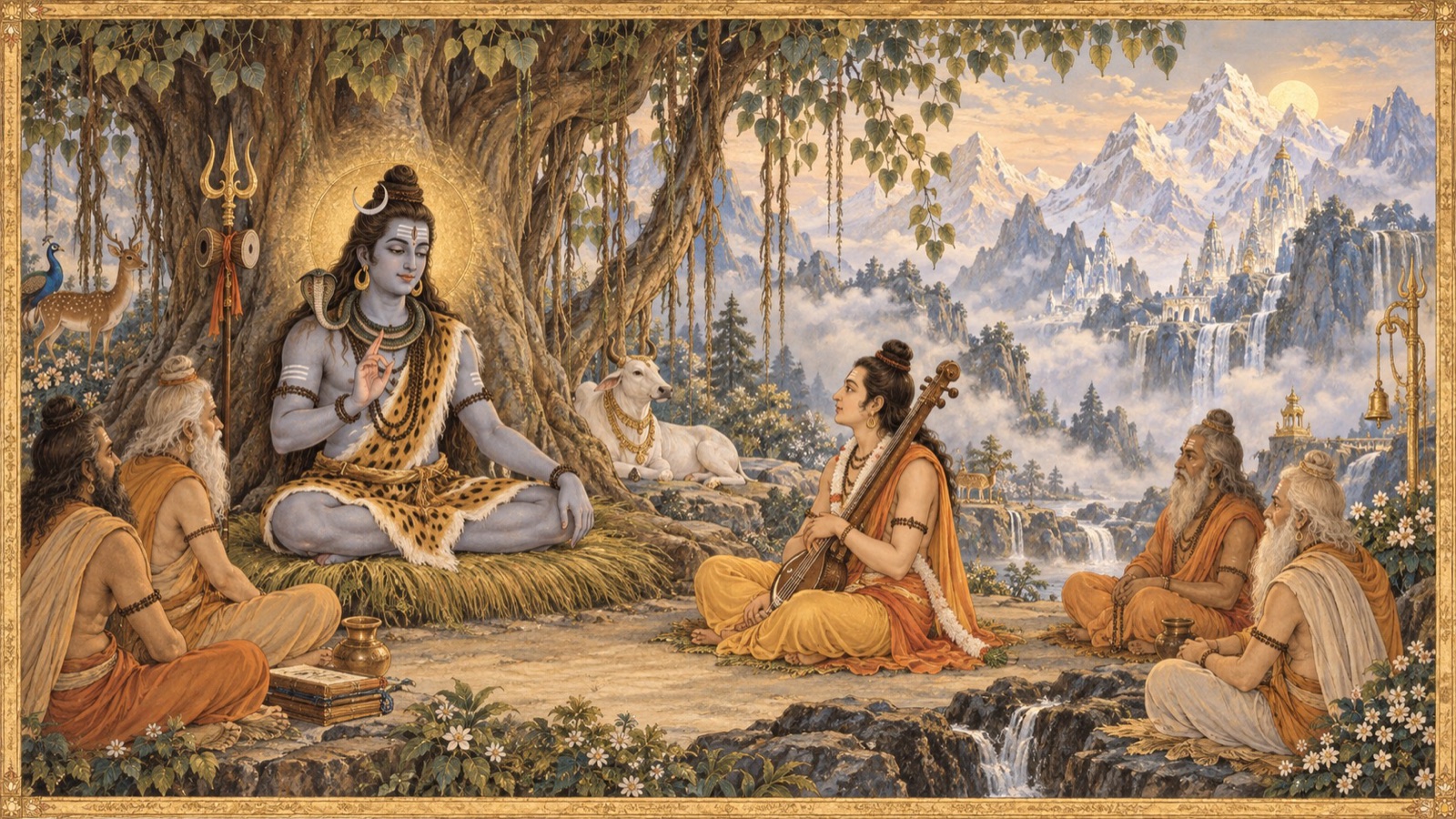
Beneath a vast banyan on Mount Kailasa the gods behold Lord Shiva seated in perfect tranquillity — free of anger, absorbed in the bliss of the Absolute, teaching the eternal truth to the sage Narada.
Om Namo Bhagavate Vasudevaya.
Om Namo Bhagavate Vasudevaya.
Om Namo Bhagavate Vasudevaya.
Welcome to Srimad Bhagavatam Wisdom, a devotional journey through the sacred histories and teachings of the Srimad Bhagavat Mahapurana. In the previous chapter, Lord Shiva’s grief at Sati’s death gave birth to the mighty Virabhadra, who wrecked Daksha’s proud sacrifice and left it in ashes. This sixth chapter tells what came after the storm. The worsted gods and priests turn to Brahma, who leads them to Mount Kailasa to seek the forgiveness of the very Lord they had wronged. There, amid the loveliness of Shiva’s mountain, they find him seated in serene composure, teaching the eternal truth; and Brahma, with folded hands, offers one of the most beautiful prayers in the scriptures — a prayer that recognises Shiva’s true greatness, pleads for the erring, and asks that the ruined sacrifice be restored. It is a chapter of reconciliation, and of the mercy that answers a humble appeal.
Chapter Information
- Scripture: Śrīmad Bhāgavata Mahāpurāṇa
- Canto: 4 (Book Four)
- Chapter: 6 (Discourse 6)
- Chapter title: The Appeasement of Lord Shiva
- Principal speaker: The sage Maitreya, continuing his discourse to Vidura (with the prayer of Brahma quoted within)
- Principal listener: Vidura
- Main setting: The realm of Brahma, and Mount Kailasa, the abode of Lord Shiva
- Central subject: Brahma leads the gods to Kailasa to appease Lord Shiva and to seek the revival of Daksha’s wrecked sacrifice
- Principal verse range: Canto 4, Chapter 6, verses 1–53
- Primary edition: Gita Press Śrīmad Bhāgavata Mahāpurāṇa
Context from the Previous Chapter
In Chapter 5, the news of Sati’s death reached Lord Shiva on Kailasa, and his grief turned to boundless wrath. From a lock of his hair sprang the towering Virabhadra, who led the hosts of Rudra against Daksha’s sacrifice, wrecked the sacred ground, punished those who had abetted the insult to Shiva, and at last beheaded Daksha and burned the whole edifice. The gods, worsted and afraid, were left to seek some remedy — and this chapter opens with that search.
The Gods Turn to Brahma
Beaten by the forces of Rudra and stricken with fear, their limbs mangled by tridents and clubs, the hosts of gods and the priests of the sacrifice made their way to Brahma and told him all that had happened. But Brahma, the lotus-born creator, and Lord Narayana, the Soul of the universe, had foreseen the whole calamity and had not attended Daksha’s sacrifice at all.
उपलभ्य पुरैवैतद्भगवानब्जसम्भव: । नारायणश्च विश्वात्मा न कस्याध्वरमीयतु: ॥ ३ ॥
upalabhya puraivaitad bhagavān abja-sambhavaḥ nārāyaṇaś ca viśvātmā na kasyādhvaram īyatuḥ
Meaning: Having foreseen all this beforehand, the glorious lotus-born Brahma and Lord Narayana, the Soul of the universe, did not attend the sacrifice of Daksha. (Canto 4, Chapter 6, verse 3)
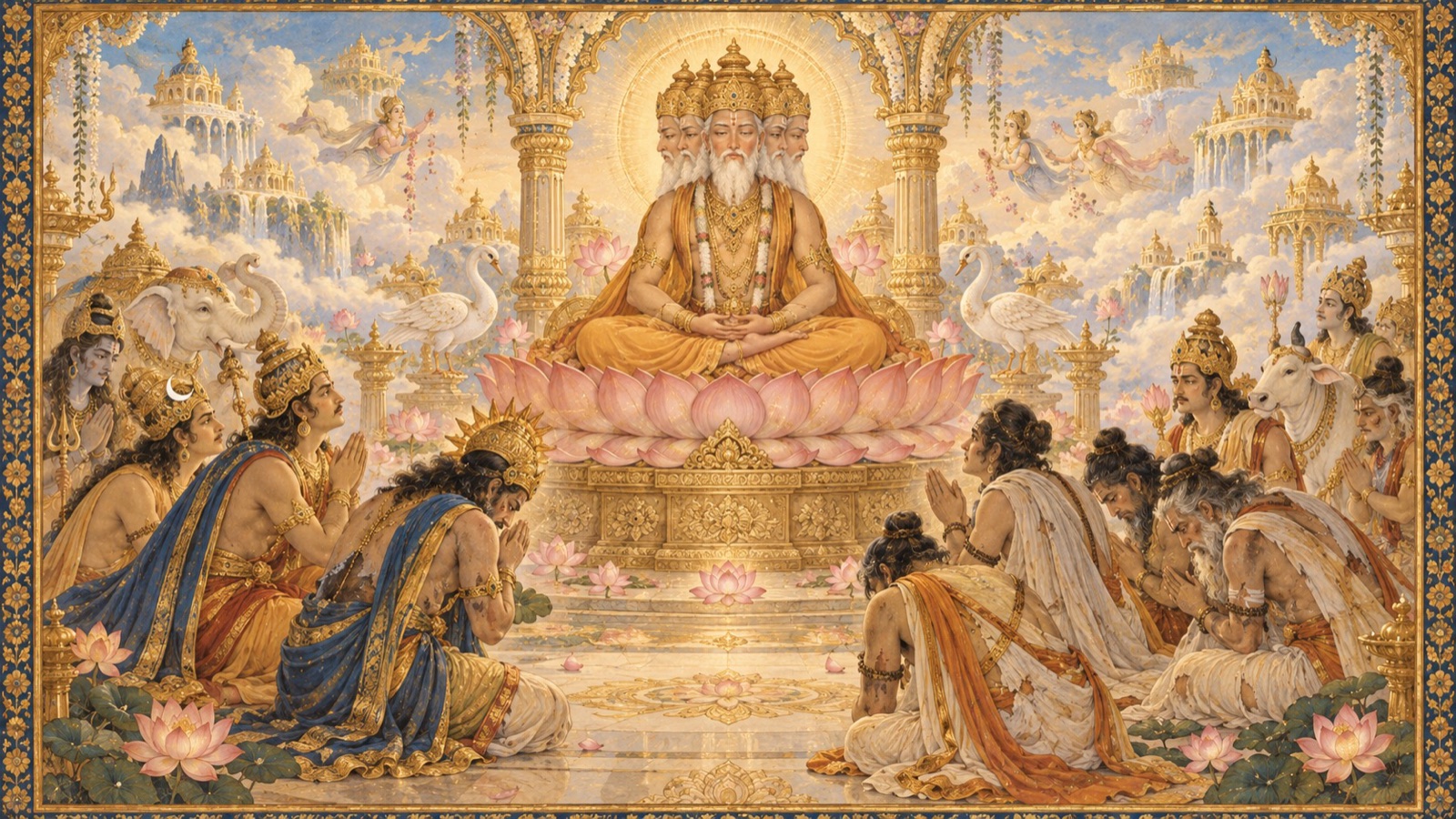
Hearing their account, Brahma did not excuse them. Those who seek to get even with one far more powerful, he told them, whom they have themselves wronged, rarely fare well. Their real fault, he said, lay in depriving Lord Shiva of the share of the sacrifice that was rightly his. The remedy was not defiance but humility: they must go and clasp Shiva’s feet with a guileless heart and beg his forgiveness, for he is quickly propitiated — and the world with its guardians could not stand if his anger continued. Neither Brahma himself, nor the presiding deity of sacrifice, nor the gods, nor even the sages, he admitted, truly knew the full extent of Shiva’s nature and power; there was no means to placate the wholly independent Lord except to fall at his feet.
The Journey to Mount Kailasa
Having thus counselled the gods, Brahma set out with them, and with the manes and the lords of created beings, from his own realm to Mount Kailasa, the beloved abode of Lord Shiva. The mountain they beheld was a marvel: peaks of jewels and many-coloured minerals, clothed in every kind of tree and creeper, alive with peacocks and cuckoos and humming bees, graced with celestial trees and lotus-filled ponds, and hallowed above all by the river Nanda, whose waters had been sanctified by the touch of Sati when she once bathed there. The gods felt wonder at the beauty of Shiva’s mountain.
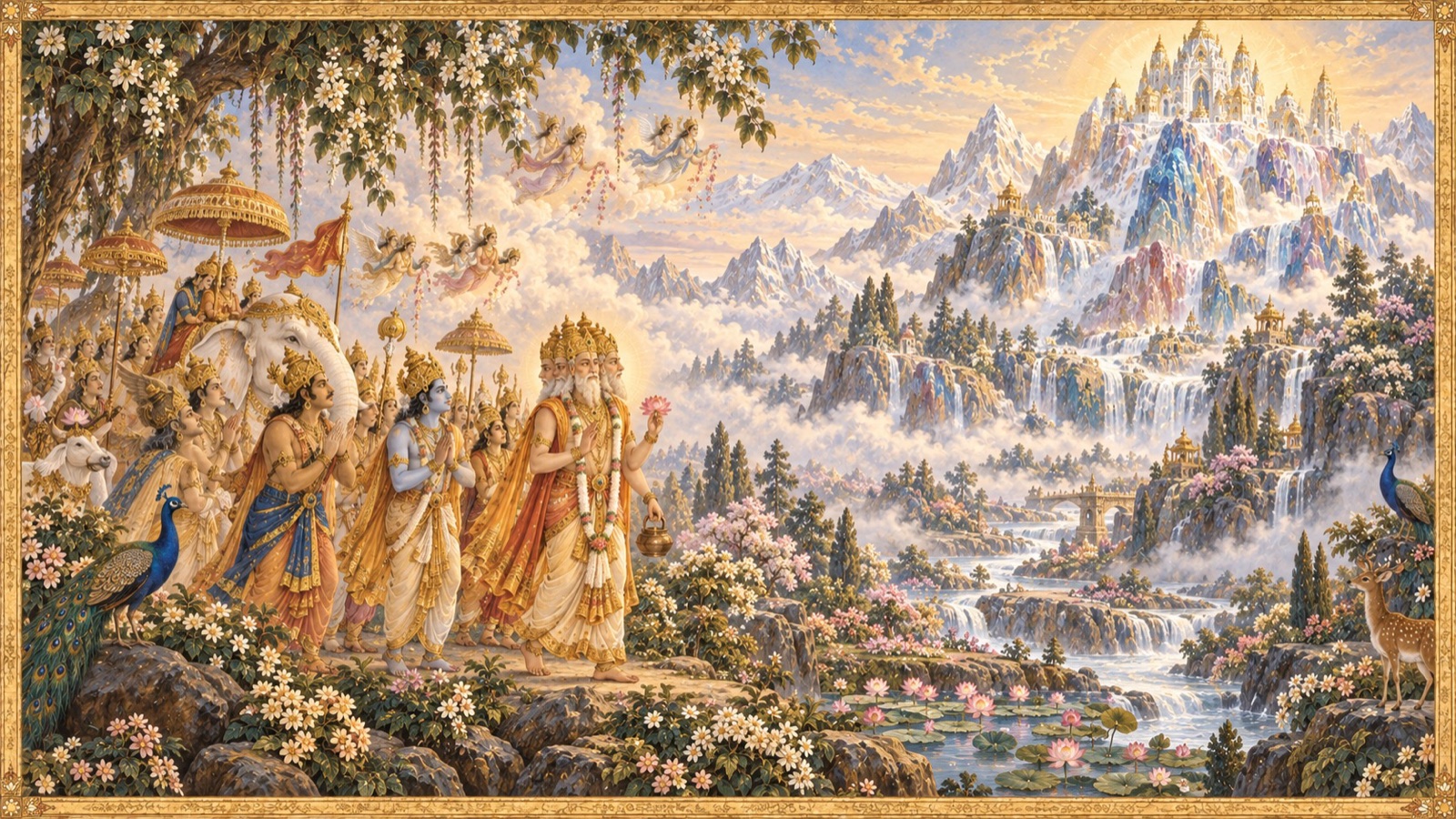
Passing the celebrated city of Alaka and the fragrant garden of Saugandhika, and the two holy rivers Nanda and Alakananda whose waters are hallowed by the dust of Lord Vishnu’s feet, they came at last to a great banyan tree — a hundred yojanas high, casting a cool and permanent shade, yet bearing no nest — beneath which those seeking liberation gathered in deep meditation.
The Vision of Lord Shiva
There, beneath that tree, the gods beheld Lord Shiva seated like Death itself — but Death with all its anger set aside — in perfect tranquillity, the refuge of those who seek liberation.
तस्मिन्महायोगमये मुमुक्षुशरणे सुरा: । ददृशु: शिवमासीनं त्यक्तामर्षमिवान्तकम् ॥ ३३ ॥
tasmin mahā-yogamaye mumukṣu-śaraṇe surāḥ dadṛśuḥ śivam āsīnaṁ tyaktāmarṣam ivāntakam
Meaning: There, at that seat of the highest yoga and refuge of those seeking liberation, the gods beheld Lord Shiva seated — like Death itself, but with all wrath laid aside. (Canto 4, Chapter 6, verse 33)
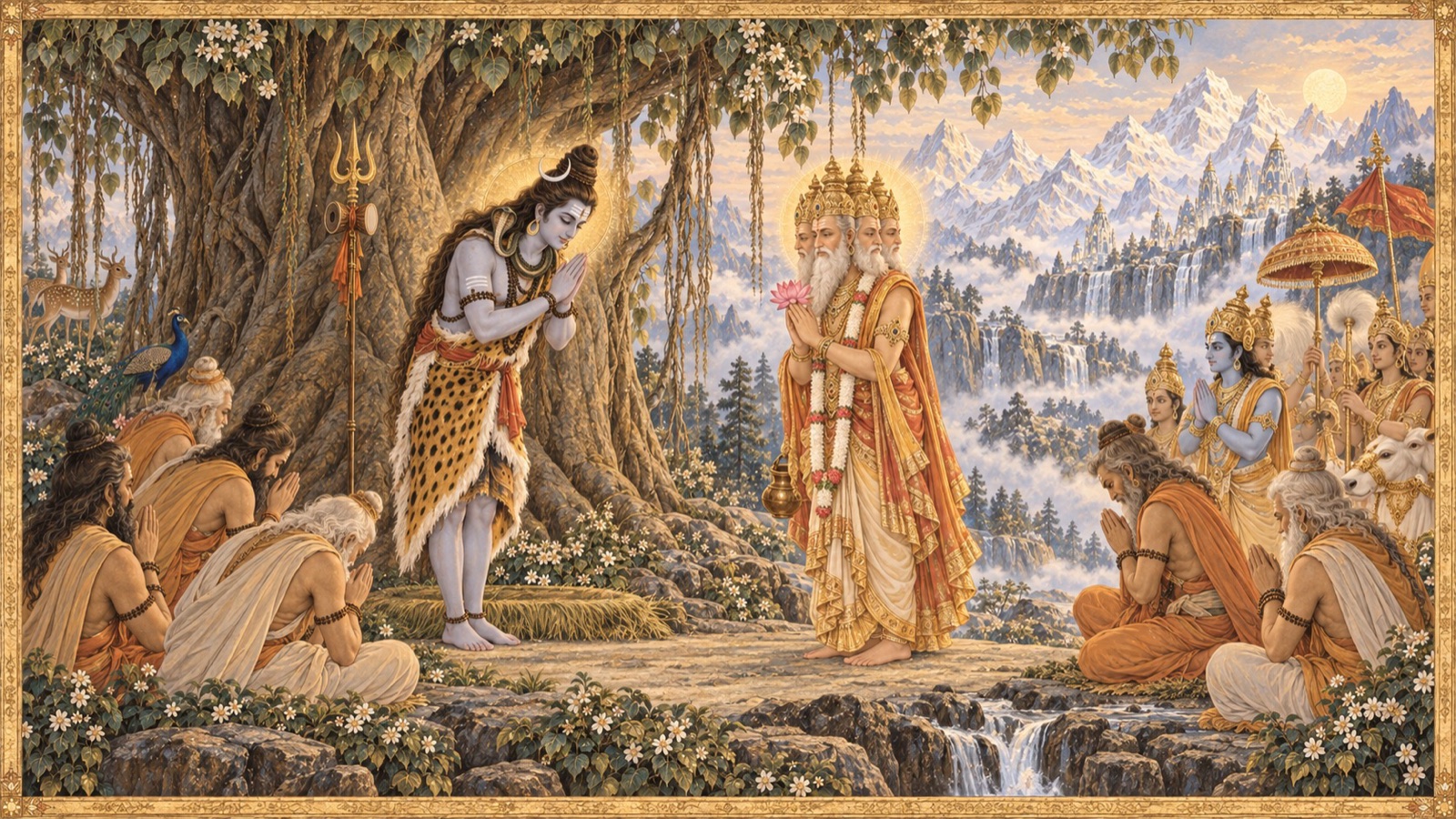
He was waited upon by realised and peaceful souls, Sanandana and others, and by his friend Kubera. Serene of person, his body the hue of an evening cloud, he wore the marks dear to ascetics — ashes, matted locks, deerskin, and the crescent moon. Seated on a mat of kusha grass, his hand formed in the gesture of teaching, he was expounding the truth of the eternal Brahma to the sage Narada, while other worthy ones listened. Seeing Brahma arrive, Lord Shiva rose and greeted him with a bow of the head, and the Siddhas and sages around him bowed as well.
Brahma’s Prayer
Then Brahma, smiling, addressed Lord Shiva, who was still bowing to him. He began by acknowledging Shiva’s true greatness: that he is the Ruler of the universe, none other than the undifferentiated Brahma, the source at once of Shakti — the divine energy that is the womb of creation — and of Shiva, the spirit that is its seed.
ब्रह्मोवाच जाने त्वामीशं विश्वस्य जगतो योनिबीजयो: । शक्ते: शिवस्य च परं यत्तद्ब्रह्म निरन्तरम् ॥ ४२ ॥
brahmovāca jāne tvām īśaṁ viśvasya jagato yoni-bījayoḥ śakteḥ śivasya ca paraṁ yat tad brahma nirantaram
Meaning: Brahma said: I know you to be the Lord of the universe, the supreme, undivided Brahma, who are the source of both Shakti and Shiva — the womb and the seed of all creation. (Canto 4, Chapter 6, verse 42)
Carrying on his play through Shakti and Shiva, who are essentially one, Brahma continued, it is the Lord alone who creates, preserves, and withdraws the universe, as a spider spins its web, keeps it, and draws it back into itself. It was the Lord who had established the very institution of sacrifice through Daksha for the protection of the Vedas, and who had fixed the bounds of right conduct. Brahma pleaded gently for the erring: anger, he said, does not overpower the noble souls who behold the Lord in all beings; and those whose minds are bewildered by Maya, fixed on ritual and diversity, deserve the compassion of the great rather than their power, for they act as their own adverse fate compels. Shiva’s own judgment, being omniscient, was untouched by that Maya — and so Brahma begged him to shower grace upon Daksha and the others whose understanding had been clouded.
Here lies the deeper point of Brahma’s prayer, one every devotee returns to for guidance in the face of another’s fault. He does not merely ask Shiva to spare the guilty; he explains why an exalted soul refrains from punishing them at all. Those consumed by envy, harsh of tongue toward another’s good fortune, are already undone by their own resentment — providence itself has already dealt with them, and nothing is gained by striking them again. A being of true stature, Brahma says, restrains his hand not from weakness but from compassion, seeing that the offender’s own bewilderment is affliction enough. This is why Shiva, unclouded by Maya himself, is asked to extend mercy rather than justice to Daksha and the priests (verses 46-49).
The Appeal to Revive the Sacrifice
Brahma then made his specific appeal. Let the Lord, he prayed, revive the sacrifice that had been wrecked and left unfinished — unfinished because the unwise priests had denied Shiva his rightful share, though it is by him that a sacrifice yields its fruit. Let Daksha come to life again; let Bhaga recover his eyes, the sage Bhrgu his beard, the god Pusha his teeth; let the gods and priests whose limbs were broken be made whole. And let whatever remained of the offerings become Shiva’s own share, so that the sacrifice might at last be completed with his portion restored.
एष ते रुद्र भागोऽस्तु यदुच्छिष्टोऽध्वरस्य वै । यज्ञस्ते रुद्रभागेन कल्पतामद्य यज्ञहन् ॥ ५३ ॥
eṣa te rudra bhāgo ’stu yad-ucchiṣṭo ’dhvarasya vai yajñas te rudra bhāgena kalpatām adya yajña-han
Meaning: O Rudra, let this that remains of the sacrifice be your share; and let the sacrifice, O destroyer of the sacrifice, now be duly completed today with your portion restored to you. (Canto 4, Chapter 6, verse 53)
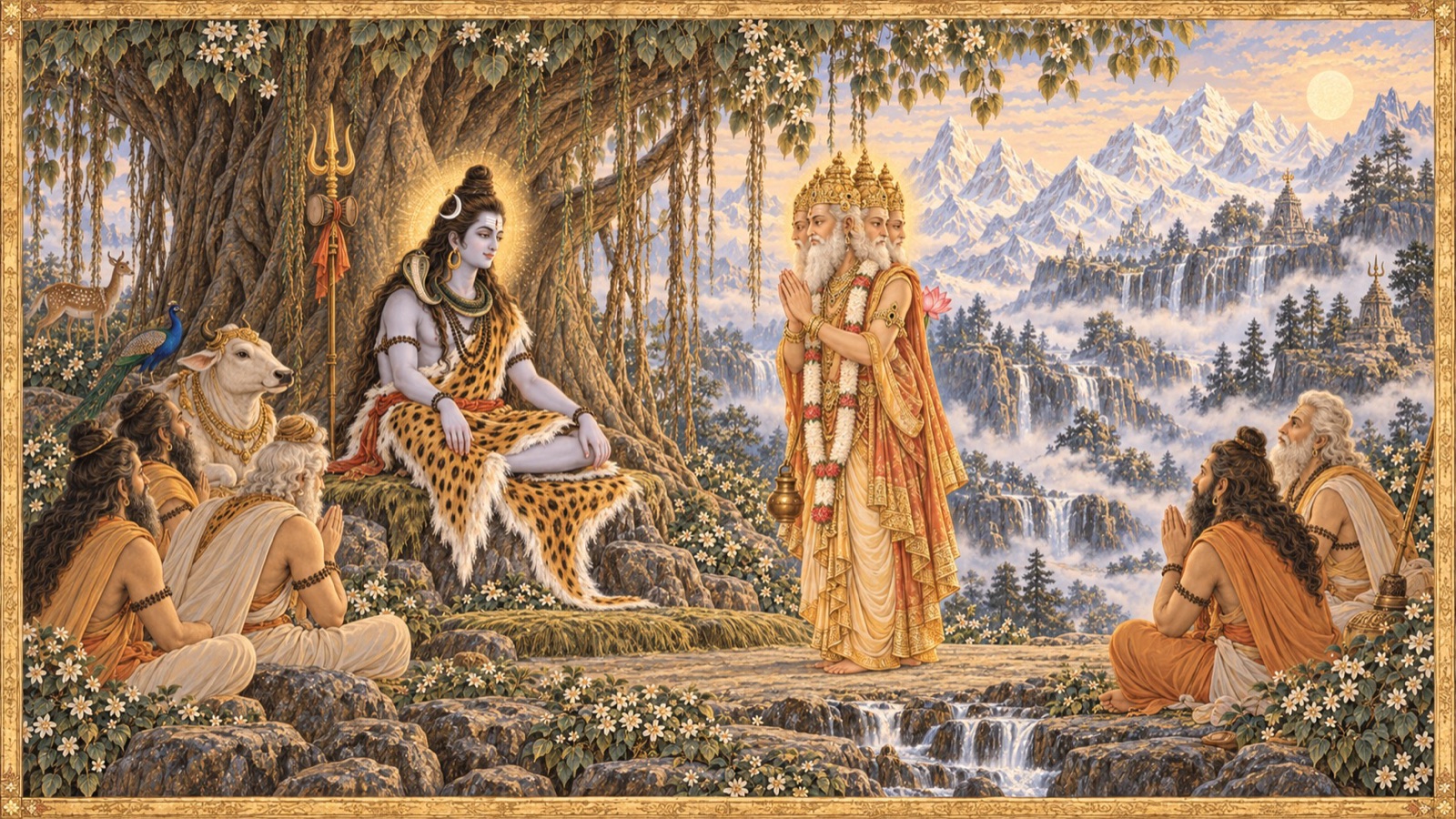
With Brahma’s appeal, the sixth discourse closes. The storm of wrath has spent itself; humility has replaced defiance; and the door stands open for the Lord’s mercy. What Shiva will answer, and how the sacrifice will be restored and Daksha given a new life, the next chapter will tell.
Principal Teachings of This Chapter
1. Reconciliation begins with humility, not defiance. Brahma does not counsel the gods to muster a counter-force but to fall at Shiva’s feet with a guileless heart. The way back from wrongdoing is honest repentance and the seeking of forgiveness (verses 5-7).
2. Wrongdoing must be owned before it can be healed. Brahma names the real fault plainly — the gods deprived Shiva of his rightful share. Grace is asked for, but only after the offence is acknowledged (verse 5).
3. The Lord is beyond the full grasp of even the great. Brahma admits that neither he nor the sages truly know the extent of Shiva’s nature and power. Genuine reverence includes the humility to know that God exceeds our understanding (verse 7).
4. The compassion of the great is shown to the erring. Brahma pleads that those bewildered by Maya, fixed on ritual and diversity, deserve grace rather than punishment — for one whose own resentment already condemns him needs no further blow. The truly exalted restrain their power out of compassion, not weakness, and use it to uplift rather than crush (verses 46-49).
5. Anger yields to the peace of the Absolute. The gods find Shiva not raging but seated in tranquillity, “like Death with all wrath laid aside,” absorbed in the bliss of Brahman and teaching the eternal truth. The Lord’s stillness after the storm is itself a teaching (verse 33).
A Devotional Reflection
After the fire and thunder of the previous chapter, this one comes like cool shade beneath a great tree. Its heart is the moment when the gods, who had wronged the Lord and then been humbled, come at last to seek his forgiveness — and find him not vengeful but serene, seated in peace and teaching the truth. There is deep comfort here. We are all, at times, in the position of these gods: we have withheld honour where it was due, taken pleasure in the wrong, and then met the consequences. The chapter shows us the way home. It is not to justify ourselves, nor to fear that the Divine will not receive us, but to come humbly, to own our fault, and to fall at the Lord’s feet — for he is, as Brahma says, quickly propitiated. And Brahma’s prayer teaches us how to pray for others too, even for those whose blindness has caused harm: not with condemnation, but pleading for grace upon minds bewildered by illusion. The mercy that answers such a prayer is the quiet promise beneath this whole chapter.
A Daily Devotional Practice
Today, learn from Brahma the humility that heals. If there is someone you have wronged, or some honour to the Divine you have withheld, take a few quiet minutes to acknowledge it plainly before the Lord — without excuse — and offer it with the words “Om Namo Bhagavate Vasudevaya.” Then, in the spirit of Brahma’s prayer, ask for grace not only for yourself but for anyone whose confusion or pride has caused pain, including those who may have wronged you. In choosing humble repentance and compassion over defiance and blame, you walk the very path of reconciliation this chapter lays open.
Conclusion
The sixth discourse of Book Four is the turning from wrath to reconciliation. The worsted gods and priests come to Brahma, who tells them plainly that their fault was to deny Lord Shiva his rightful share, and that the only remedy is to seek his forgiveness with humble hearts. Brahma leads them across the beauty of Mount Kailasa to the great banyan where Shiva sits in serene tranquillity, free of anger and teaching the eternal truth to Narada. Rising to greet Brahma, Shiva receives his prayer — a prayer that acknowledges his supreme greatness, pleads for the erring bewildered by Maya, and begs that Daksha be restored to life, the injured gods made whole, and the wrecked sacrifice completed with Shiva’s share restored. The chapter ends with that appeal, and with the door of mercy standing open. Maitreya leaves us here, awaiting the Lord’s compassionate reply.
May the divine wisdom of Srimad Bhagavatam awaken pure devotion within our hearts.
Om Namo Bhagavate Vasudevaya.
Jay Shree Madhav.
References and Attribution
- Primary edition: Gita Press, Śrīmad Bhāgavata Mahāpurāṇa (English, complete), Book Four, Discourse 6, pp. 309–315 (PDF pp. 372–377).
- Series: Srimad Bhagavatam Wisdom · Biswa Sanatan Dharma Seva Trust.
- Presented following the spiritual guidance and recommendation of Pandit Dr. Shri Kashinath Mishra.
This is an original, faithful retelling in the writer’s own words, with brief quoted verses shown in Devanāgarī and transliteration and their meanings given as summaries. It is not a reproduction of any single publisher’s continuous translation or commentary. No affiliation with or endorsement by any publisher is implied.
Jay Shree Madhav