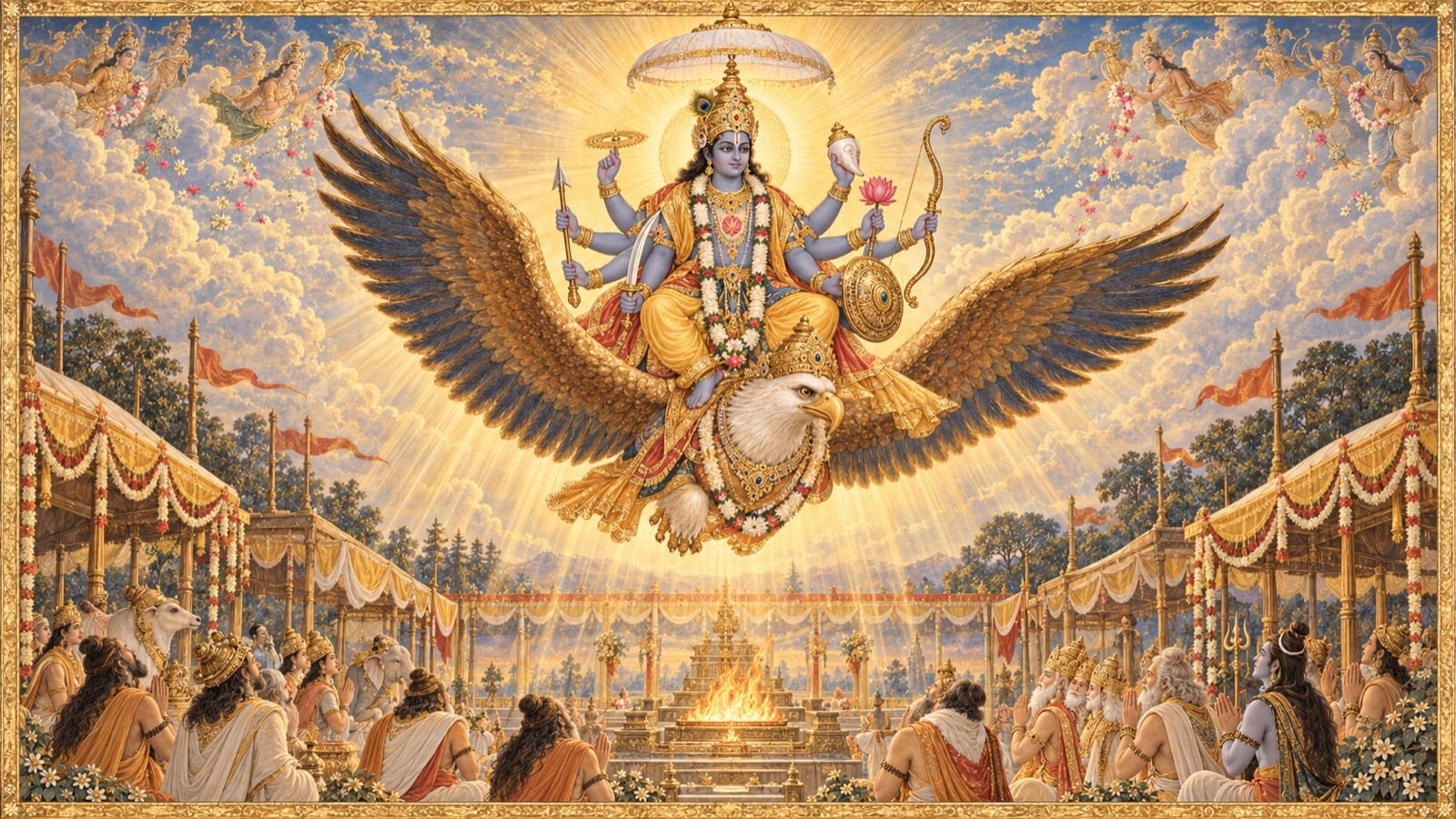
As Daksha meditates with a purified heart, the Supreme Lord Sri Hari appears in person at the sacrifice, borne upon Garuda, radiant beyond the sun — and the whole assembly rises and bows in awe.
Om Namo Bhagavate Vasudevaya.
Om Namo Bhagavate Vasudevaya.
Om Namo Bhagavate Vasudevaya.
Welcome to Srimad Bhagavatam Wisdom, a devotional journey through the sacred histories and teachings of the Srimad Bhagavat Mahapurana. In the previous chapter, Brahma led the gods to Kailasa and appealed to Lord Shiva to forgive Daksha and restore the wrecked sacrifice. This seventh chapter is the chapter of grace and completion. Pleased by Brahma’s prayer, Lord Shiva laughs away the offence and restores what was lost — Daksha to life, the injured gods to wholeness. The sacrifice begins again, and this time it reaches its true fruit: the Supreme Lord Sri Hari himself appears in person before the assembly, and one after another the gods and sages glorify him. Daksha, his heart at last washed clean of malice, offers his own prayer of gratitude. It is a chapter about the boundless mercy of the Lord, the healing of an old enmity, and the completion of a sacrifice that had begun in pride but ends in devotion — closing with the tender news that Sati would be born again to rejoin her lord.
Chapter Information
- Scripture: Śrīmad Bhāgavata Mahāpurāṇa
- Canto: 4 (Book Four)
- Chapter: 7 (Discourse 7)
- Chapter title: The Completion of Daksha’s Sacrifice
- Principal speaker: The sage Maitreya, continuing his discourse to Vidura (with the words of Shiva, Daksha, and the assembled gods quoted within)
- Principal listener: Vidura
- Main setting: The sacrificial grounds of Daksha, restored
- Central subject: Lord Shiva’s grace, the revival of Daksha and the gods, the appearance of Sri Hari, and the completion of the sacrifice
- Principal verse range: Canto 4, Chapter 7, verses 1–61
- Primary edition: Gita Press Śrīmad Bhāgavata Mahāpurāṇa
Context from the Previous Chapter
In Chapter 6, the worsted gods came to Brahma, who told them their fault was to deny Lord Shiva his rightful share, and led them to Mount Kailasa to seek his forgiveness. There they found Shiva serene and free of anger, and Brahma offered a beautiful prayer, acknowledging Shiva’s supreme greatness and begging that Daksha be restored to life, the injured gods made whole, and the wrecked sacrifice completed with Shiva’s share restored. This chapter opens with Shiva’s gracious reply.
The Grace of Lord Shiva
Pleased by Brahma’s supplication, Lord Shiva laughed heartily and spoke without a trace of resentment. He said that he did not brood over or even recall the misdeeds of those deluded by the Lord’s Maya; the punishment he had meted out was only to teach a lesson. Then he restored what had been lost: let Daksha, whose head was burnt, receive the head of the sacrificial goat; let Bhaga see his share through the eyes of Mitra; let Pusha chew with the teeth of the sacrificer; let the priests who had lost their arms use the arms of the Ashvins, and Bhrgu wear the beard of the goat. When the gods and sages heard these gracious words, every creature present cried out, “Well said!” with a gladdened heart.
They joined the goat’s head to Daksha’s trunk, and, receiving Rudra’s kindly glance, Daksha at once rose as if from sleep and beheld Lord Shiva before him. In that moment the malice that had poisoned his heart against Shiva dissolved away.
तदा वृषध्वजद्वेषकलिलात्मा प्रजापति: । शिवावलोकादभवच्छरद्ध्रद इवामल: ॥ १० ॥
tadā vṛṣadhvaja-dveṣa- kalilātmā prajāpatiḥ śivāvalokād abhavac charad-dhrada ivāmalaḥ
Meaning: Then Daksha, the lord of created beings, whose heart had been fouled by hatred of Lord Shiva, became purified by Shiva’s gracious glance — clear as a lake in autumn. (Canto 4, Chapter 7, verse 10)
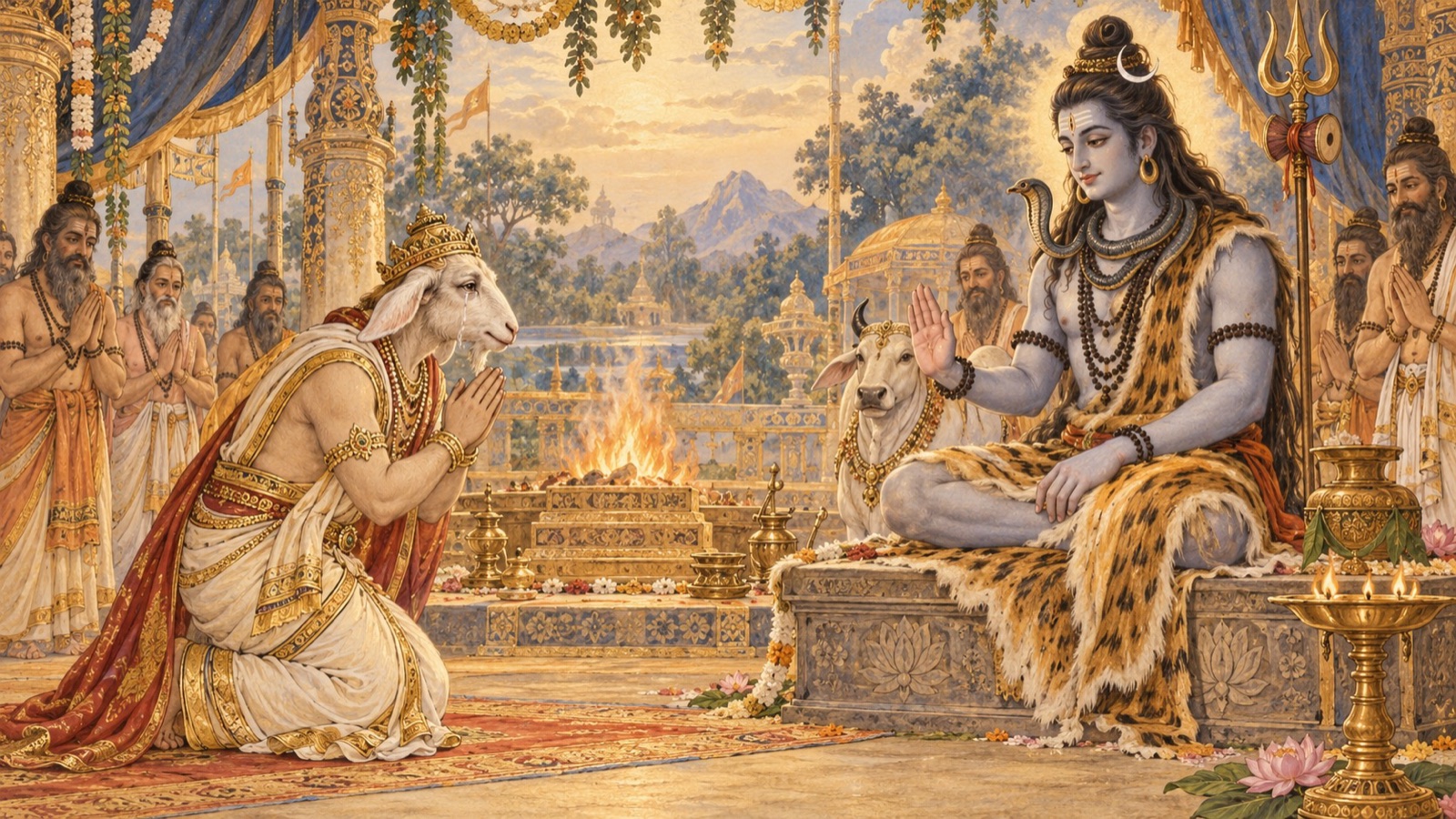
Daksha longed to praise Lord Shiva, but affection and grief overcame him as he remembered his dead daughter, and his throat choked with tears. Mastering himself with difficulty, he extolled the Lord with sincere devotion, marvelling that Shiva and Sri Hari show no disregard even for the fallen, and had corrected him as a herdsman guides his cattle — punishing only to save.
The Sacrifice Begins Again
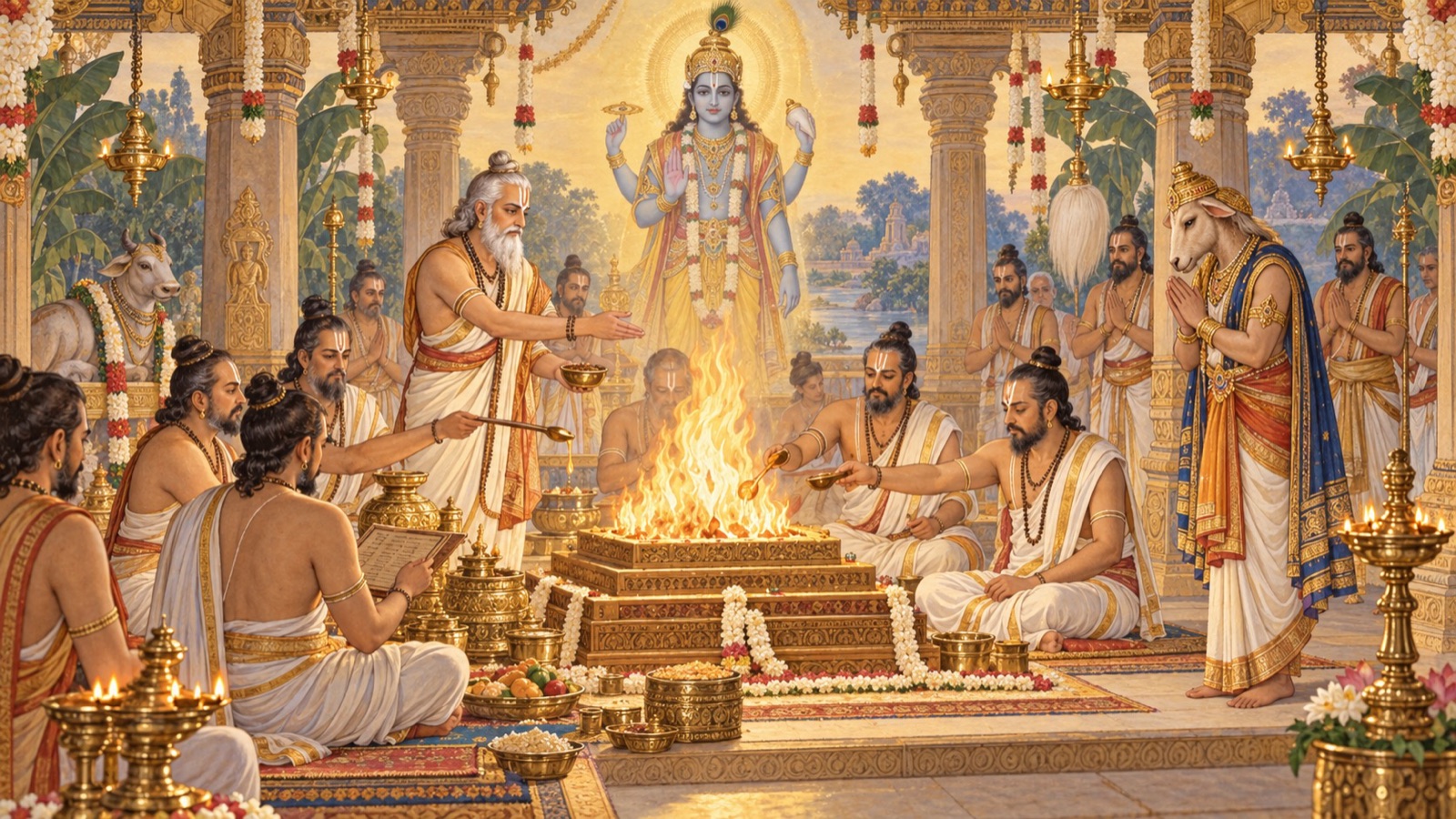
Having sought Shiva’s forgiveness and taken leave of Brahma, Daksha had the ritual recommenced by the preceptor and priests. To remove any impurity and restore the sacrifice’s continuity, the Brahmanas offered the oblation called Purodasa, intended for Lord Vishnu.
The Appearance of Sri Hari
Then, as Daksha and the officiating priest contemplated the Lord with guileless, purified minds, the Supreme Lord Sri Hari appeared in person before them.
अध्वर्युणात्तहविषा यजमानो विशाम्पते । धिया विशुद्धया दध्यौ तथा प्रादुरभूद्धरि: ॥ १८ ॥
adhvaryuṇātta-haviṣā yajamāno viśāmpate dhiyā viśuddhayā dadhyau tathā prādurabhūd dhariḥ
Meaning: As the sacrificer, Daksha, meditated with a purified mind together with the officiating priest who held the oblation, O ruler of men, the Lord, Sri Hari, appeared in person. (Canto 4, Chapter 7, verse 18)
Eclipsing the splendour of all present with a brilliance that lit the ten quarters, the Lord was borne upon Garuda. Swarthy of hue, girdled with gold, crowned like the sun, his face graced with dark locks and ear-rings, he bore in his eight arms the conch, lotus, discus, arrow, bow, mace, sword, and shield; Goddess Lakshmi rested upon his bosom, and a moon-white umbrella shone above his head. Beholding him, Brahma, Indra, Lord Shiva, and all the hosts of gods rose at once and bowed low; and, their own splendour dimmed by his, they stood in awe with joined palms and began, to the best of their ability, to glorify him.
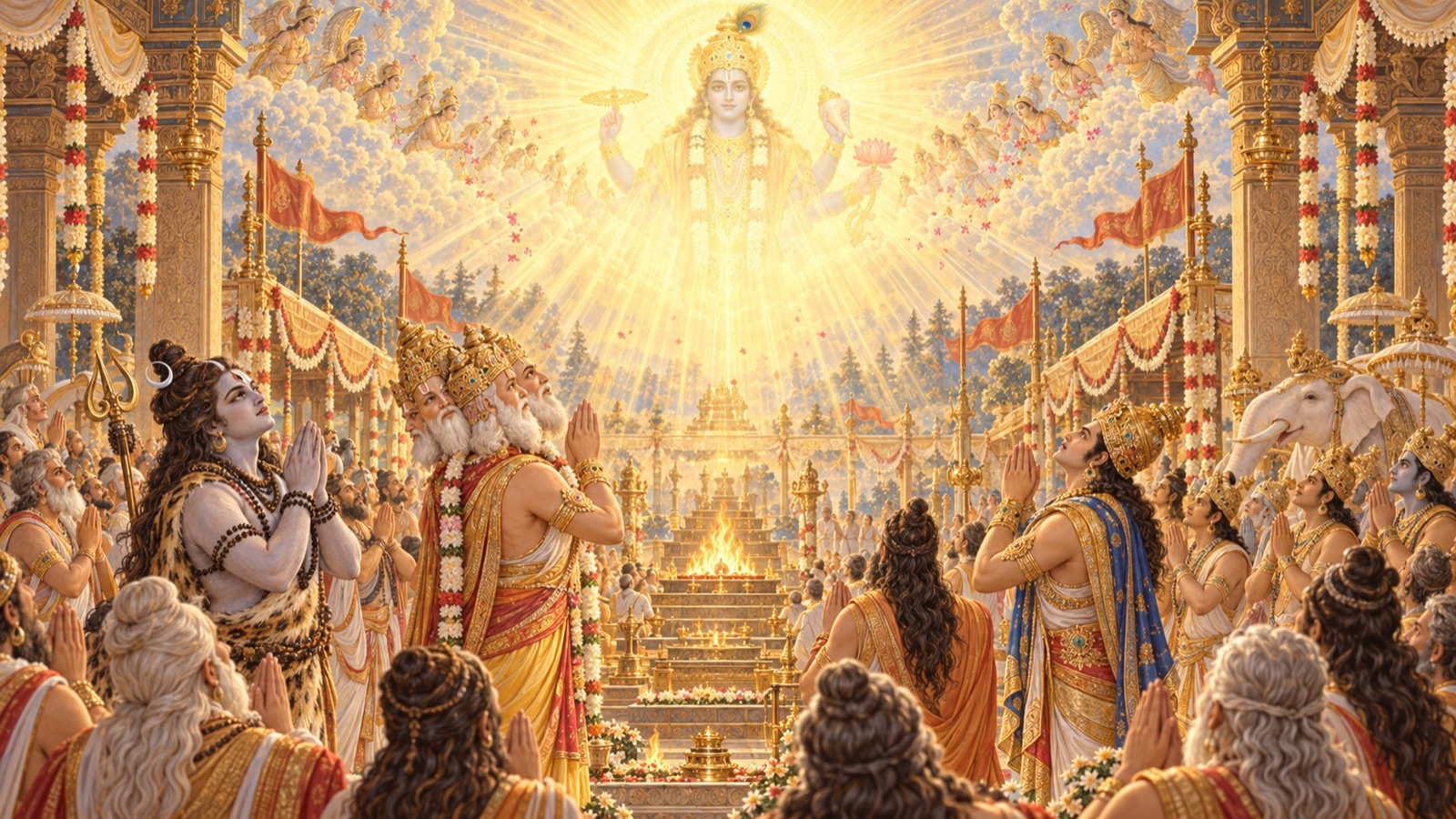
One after another — Daksha, the priests, the sages, Rudra, Bhrgu, Brahma, Indra, the wives of the sacrificers, the Rbhus and the Sadhyas, and the guardians of the world — each glorified the Lord according to his own vision: as the witness within all hearts, as the goal of all sacrifice, as the one Reality beyond the play of Maya, whose grace alone frees the soul (verses 25-49).
Then the Lord himself spoke, for it was Daksha’s own contempt for Shiva that had shattered the sacrifice in the beginning, and that wound needed more than a restored head to heal. Addressing Daksha directly, Sri Hari declared that he himself, Brahma and Shiva together are the highest cause of the universe, and that as the one Self seated within every being there is, in truth, no difference between the three of them. Acting through his own energy alone, he said, he takes the different names of creator, preserver and destroyer according to the work each performs; only one lacking real understanding imagines that Brahma or Shiva, or any living being, stands independent of him. Just as no man treats his own head or hand as something foreign to himself, his true devotee never regards him as separate from any other being. And whoever ceases to see Brahma, Vishnu and Shiva as three divided persons, the Lord said, at last attains real peace (verses 50-54).
त्रयाणामेकभावानां यो न पश्यति वै भिदाम् । सर्वभूतात्मनां ब्रह्मन् स शान्तिमधिगच्छति ॥ ५४ ॥
trayāṇām eka-bhāvānāṁ yo na paśyati vai bhidām sarva-bhūtātmanāṁ brahman sa śāntim adhigacchati
Meaning: Whoever no longer sees Brahma, Vishnu and Shiva as three separate beings, O brahmana, but knows them as the one Self dwelling within every creature, truly attains peace. (Canto 4, Chapter 7, verse 54)
Having heard this teaching, Daksha worshipped Sri Hari through the sacrifice sacred to him, and honoured Lord Rudra with his rightful share and the other gods with theirs, until the sacrifice was duly completed with the sacred ablutions that crown a great rite. Blessed by the gods with devotion to righteousness, the assembly departed in peace, and the gods ascended to heaven (verses 55-57).
The Return of Sati
Maitreya closed the story with a tender word of hope. Having cast off the body born of Daksha, Sati was reborn — this time as the daughter of Mena, the wife of Himavan, lord of the Himalaya.
एवं दाक्षायणी हित्वा सती पूर्वकलेवरम् । जज्ञे हिमवत: क्षेत्रे मेनायामिति शुश्रुम ॥ ५८ ॥
evaṁ dākṣāyaṇī hitvā satī pūrva-kalevaram jajñe himavataḥ kṣetre menāyām iti śuśruma
Meaning: Thus, having given up her former body, Sati, the daughter of Daksha, was born again — so we have heard — in the land of Himavan, as the daughter of Mena. (Canto 4, Chapter 7, verse 58)
As the divine energy, dormant through the dissolution, embraces the Lord again at the dawn of creation, so Ambika — reborn Sati — sought union once more with her beloved lord Shiva, her only refuge, to whom she was ever devoted. Maitreya added that he had heard this sacred story of Lord Shiva, who wrecked and then let be restored Daksha’s sacrifice, from Uddhava, the great devotee and disciple of Brihaspati. And he closed with a promise for all who hear it.
इदं पवित्रं परमीशचेष्टितं यशस्यमायुष्यमघौघमर्षणम् । यो नित्यदाकर्ण्य नरोऽनुकीर्तयेद् धुनोत्यघं कौरव भक्तिभावत: ॥ ६१ ॥
idaṁ pavitraṁ param īśa-ceṣṭitaṁ yaśasyam āyuṣyam aghaugha-marṣaṇam yo nityadākarṇya naro ’nukīrtayed dhunoty aghaṁ kaurava bhakti-bhāvataḥ
Meaning: This supremely purifying account of the Lord’s doings — which confers renown and long life and washes away a host of sins — whoever daily hears and recounts it with devotion, O descendant of Kuru, shakes off all sin. (Canto 4, Chapter 7, verse 61)
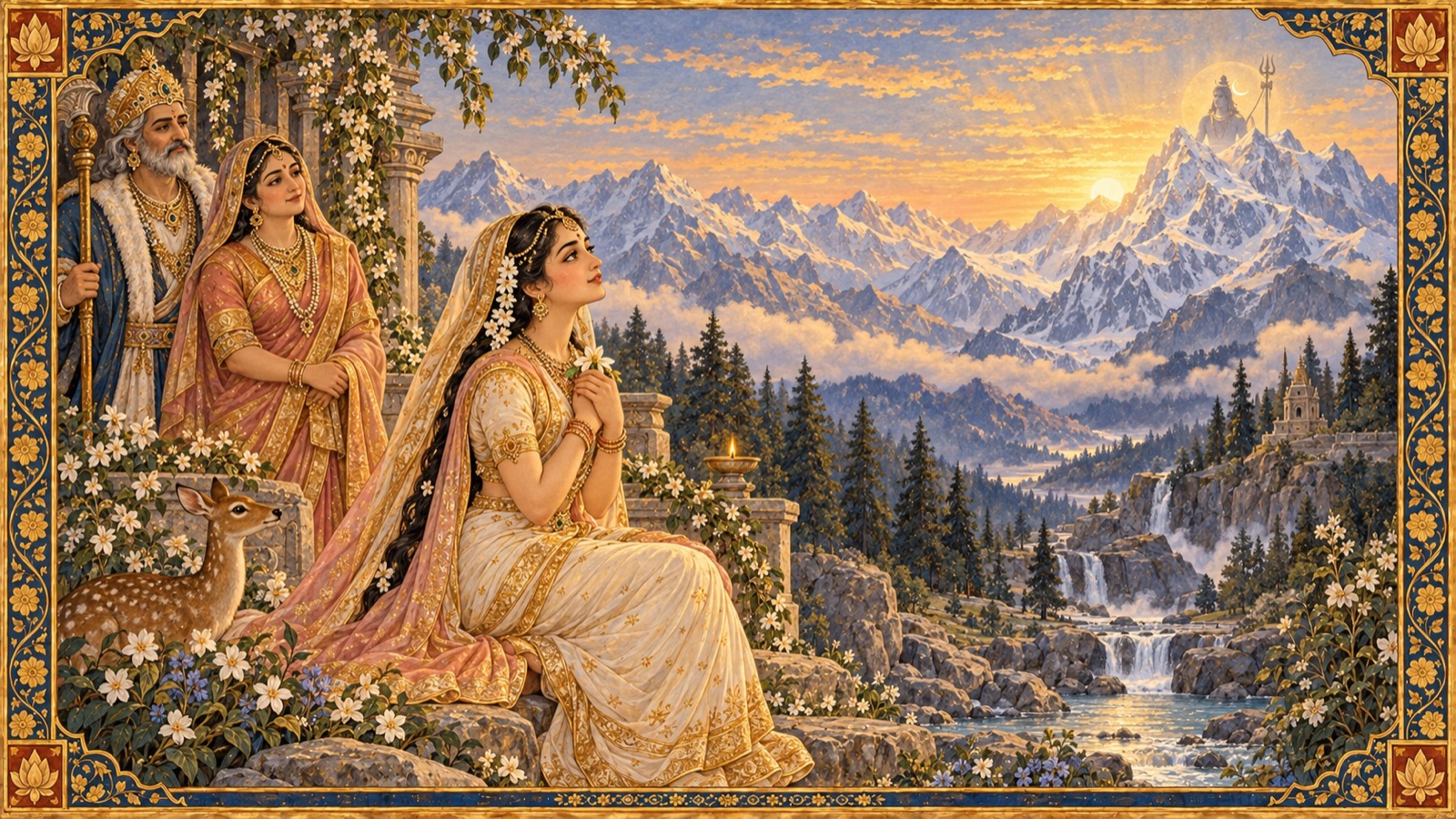
With that gracious word the seventh discourse closes, and with it the whole history of Daksha and Sati — a story that began in pride and insult, passed through grief and fire, and ends in forgiveness, reunion, and the appearance of the Lord himself.
Principal Teachings of This Chapter
1. The Lord’s grace outweighs His wrath. Shiva’s first words after being appeased are that he does not even recall the offence of the deluded, for his punishments were never a conqueror’s revenge but a father’s correction. He restores at once what discipline had cost — Daksha given a new head, Bhaga’s sight, Pusha’s power to chew, the priests’ severed arms, Bhrgu’s beard — the moment the lesson has been learned, so completely that the healing outpaces the original wound (verses 2-5).
2. A gracious glance can wash the heart clean. Daksha’s malice, long fixed against Shiva, dissolves in a single kindly look, “clear as a lake in autumn.” The touch of the Divine purifies what our own efforts cannot (verse 10).
3. The Lord appears to the purified heart. Sri Hari manifests only when Daksha and the priest contemplate him “with purified minds.” Sincere, guileless devotion is what draws the Lord’s presence (verse 18).
4. Right worship excludes no one. Once Daksha has heard the Lord’s own teaching, he completes the sacrifice by giving Rudra and every other deity his rightful share — the very failure that had wrecked the rite in the first place is undone by an act of inclusive worship (verses 55-57).
5. All names point back to the One. Confronted with the very quarrel that had wrecked his sacrifice, the Lord himself declares that he, Brahma and Shiva are one Self appearing under different names, and that whoever stops seeing them as divided attains true peace (verse 54).
6. Devotion is never lost, and separation is not the end. Sati, wholly devoted to Shiva, is reborn to rejoin him. The chapter promises that love fixed on the Divine finds its way back, across even death itself (verses 58-59).
A Devotional Reflection
If the fifth chapter was thunder and the sixth was cool shade, this seventh chapter is sunrise. Everything broken is mended; everything hostile is reconciled; and at the centre stands the appearance of the Lord himself, drawn not by the grandeur of the rite but by the purified hearts of those who longed for him. There is a whole spiritual life mapped in this arc. We, too, begin in some pride or estrangement; we, too, meet the humbling consequences; and we, too, are offered not condemnation but restoration the moment we turn back. What moves the heart most is that gracious glance of Shiva that clears Daksha’s malice “like a lake in autumn” — for it tells us that the change we cannot manage by our own striving can be worked in an instant by the mercy of the Divine, if only we will stand in its light. And the closing note, that Sati is reborn to seek her lord again, leaves us with the quiet assurance at the heart of all devotion: love offered to God is never wasted, and never truly parted from its object.
A Daily Devotional Practice
Today, receive and pass on the grace this chapter celebrates. As Maitreya promises that whoever hears and recounts this story with devotion is freed of sin, take a few minutes to read or recall one part of this history aloud — the mercy of Shiva, the appearance of Sri Hari, or the return of Sati — and let it settle in your heart with the words “Om Namo Bhagavate Vasudevaya.” Then, in the spirit of Daksha’s cleansed heart, let go of one grudge you have been holding, offering it to the Lord and asking that your own heart be made “clear as a lake in autumn.” In hearing, retelling, and forgiving, you take your small part in the reconciliation this chapter reveals.
Conclusion
The seventh discourse of Book Four is the chapter of grace and completion. Pleased by Brahma’s prayer, Lord Shiva sets aside all resentment and restores Daksha to life with the head of a goat, heals the injured gods, and lets the sacrifice begin again. Daksha, his malice washed away by Shiva’s kindly glance, offers a prayer of gratitude; and as he and the priests meditate with purified hearts, the Supreme Lord Sri Hari appears in person, borne on Garuda, radiant beyond the sun. The whole assembly bows and glorifies him, the sacrifice is completed with every deity given his due share, and the gods depart in peace. Maitreya closes with the tender news that Sati has been reborn as the daughter of Himavan to rejoin her lord, and with the promise that whoever hears this holy story with devotion is freed of sin. So the long history of Daksha and Sati, begun in pride, ends in forgiveness, reunion, and the vision of the Lord.
May the divine wisdom of Srimad Bhagavatam awaken pure devotion within our hearts.
Om Namo Bhagavate Vasudevaya.
Jay Shree Madhav.
References and Attribution
- Primary edition: Gita Press, Śrīmad Bhāgavata Mahāpurāṇa (English, complete), Book Four, Discourse 7, pp. 316–324 (PDF pp. 378–386).
- Series: Srimad Bhagavatam Wisdom · Biswa Sanatan Dharma Seva Trust.
- Presented following the spiritual guidance and recommendation of Pandit Dr. Shri Kashinath Mishra.
This is an original, faithful retelling in the writer’s own words, with brief quoted verses shown in Devanāgarī and transliteration and their meanings given as summaries. It is not a reproduction of any single publisher’s continuous translation or commentary. No affiliation with or endorsement by any publisher is implied.
Jay Shree Madhav