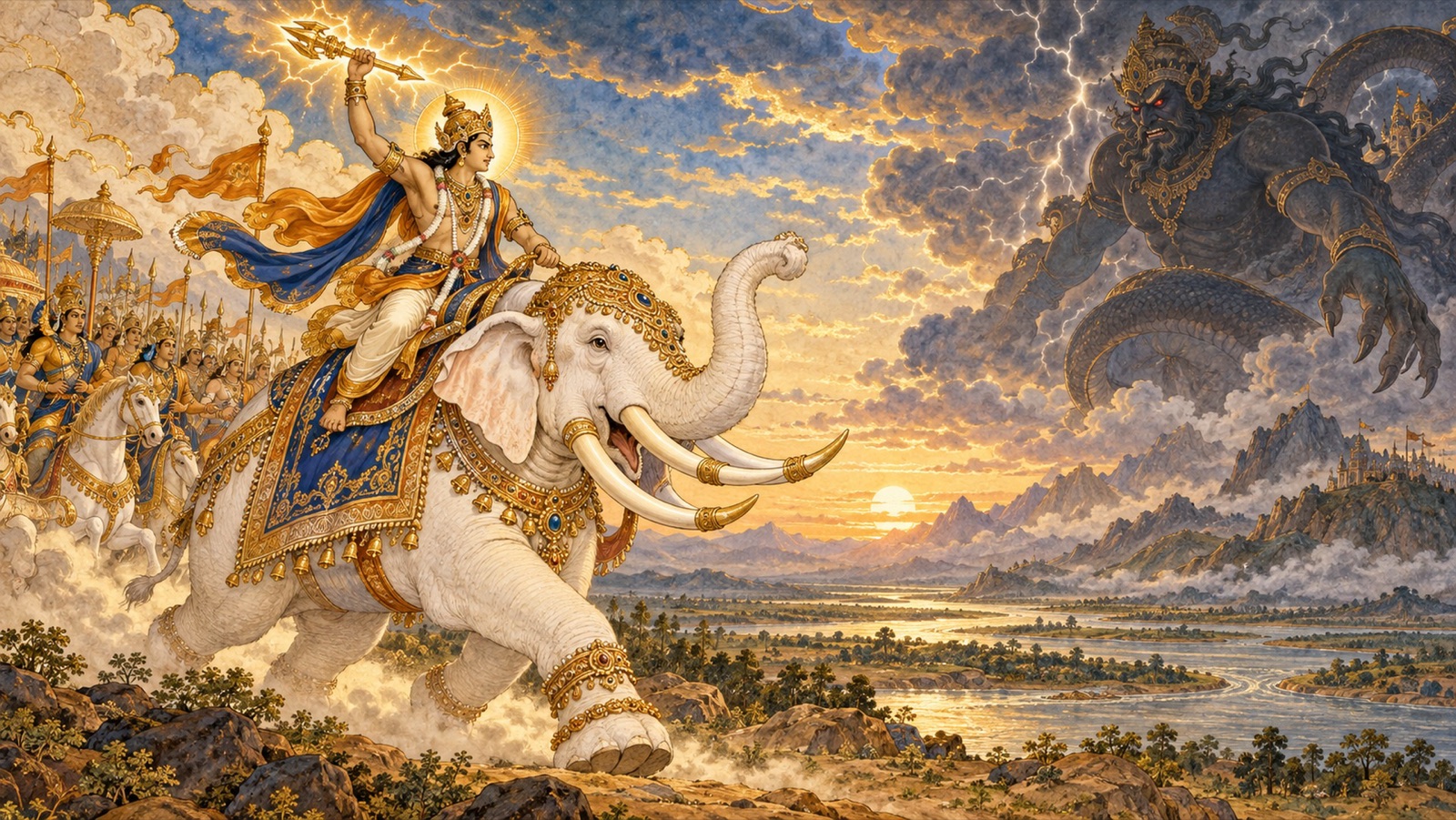
Armed with the thunderbolt forged from a saint’s willingly surrendered bones and charged with the Lord’s own power, Indra rides forth upon Airavata against the mountainous demon Vritra, while heaven and earth tremble at the opening of their war.
Om Namo Bhagavate Vasudevaya.
Om Namo Bhagavate Vasudevaya.
Om Namo Bhagavate Vasudevaya.
Welcome to Srimad Bhagavatam Wisdom, a devotional journey through the sacred histories and teachings of the Srimad Bhagavat Mahapurana. Having been told by Lord Hari that only a thunderbolt fashioned from the bones of the sage Dadhici could overcome Vritra, Indra now goes to beg that gift of the great seer. What follows is first a quiet miracle of charity — a saint who gives away his very body for the good of others — and then the thunder of the first great clash between the gods and the demon host on the bank of the holy Narmada.
Chapter Information
- Scripture: Śrīmad Bhāgavata Mahāpurāṇa
- Canto: 6 (Book Six)
- Chapter: 10 (Discourse 10)
- Chapter title: The Battle Between the Gods and Vritrasura
- Principal speaker: Sukadeva Gosvami, narrating to King Parikshit
- Principal listener: King Parikshit; the sages of Naimisharanya at the outer frame
- Main setting: The hermitage of the sage Dadhici, and the battlefield on the bank of the river Narmada
- Central subject: Dadhici’s self-sacrifice, the forging of the thunderbolt, and the opening of the war with Vritra
- Principal verse range: Canto 6, Chapter 10, verses 1–33
- Primary edition: Gita Press Śrīmad Bhāgavata Mahāpurāṇa
The Request Made to Dadhici
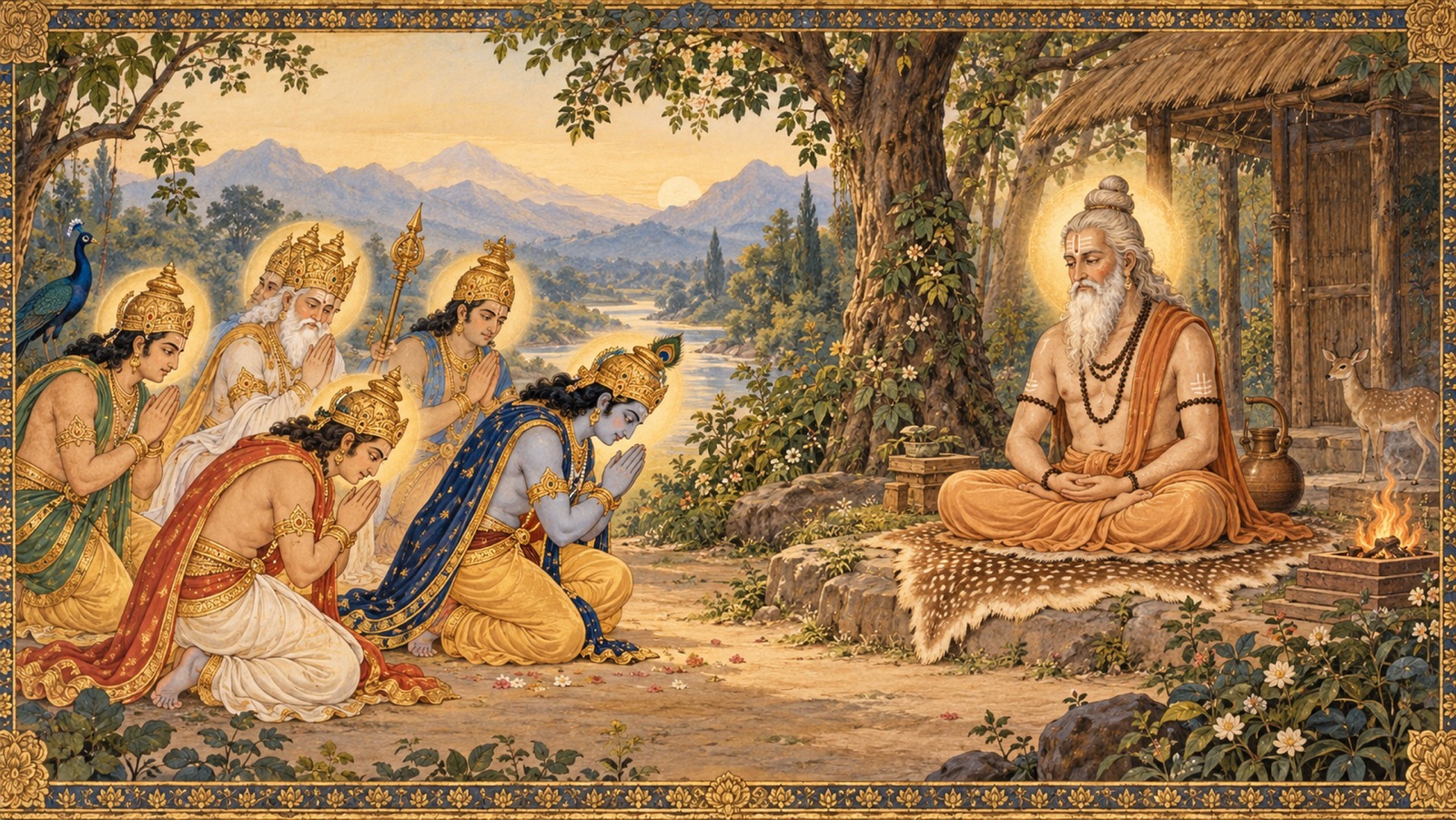
When Lord Sri Hari, the protector of the universe, had finished instructing Indra, He vanished from that very spot while the unwinking gods looked on. Then the deities, exactly as the Lord had counselled, approached the magnanimous sage Dadhici, the son of Atharva, and made their appeal. Rejoicing, yet speaking as if in gentle jest, the sage put a searching question to them: had they any idea, he asked, of the agony that death brings to embodied beings, a pain so overwhelming that it robs them even of consciousness? The body, he reminded them, is the dearest of all possessions to one who longs to live — who, then, would have the courage to surrender it even to Lord Vishnu Himself, should He ask for it? (verses 1-4)
The gods answered that for great souls like him — compassionate to every living being, their deeds praised by the holy — nothing at all is too difficult to give. Selfish people, they said, never pause to weigh the cost a giver bears; did they understand it, they would never ask; and a generous soul, able to grant a request, would never answer “No.” (verses 5-6)
The Sage Gives His Body
Then the sage revealed his heart. He had spoken as he did, he said, only that he might hear from them the truth of Dharma; and here and now he would cast off the body they coveted — a body that was, in any case, destined to leave him one day. The one who fails to earn, through his fleeting frame, either spiritual merit or the fame born of kindness to others, is a person to be pitied even by the trees and the plants (verses 7-8).
योऽध्रुवेणात्मना नाथा न धर्मं न यश: पुमान् । ईहेत भूतदयया स शोच्य: स्थावरैरपि ॥ ८ ॥
yo ‘dhruveṇātmanā nāthā na dharmaṁ na yaśaḥ pumān īheta bhūta-dayayā sa śocyaḥ sthāvarair api
Meaning: A person who, with this impermanent body, strives neither for righteousness nor for lasting renown through compassion to living beings deserves to be pitied even by the immobile creatures — the very trees and plants. (Canto 6, Chapter 10, verse 8)
The abiding virtue of the saintly, Dadhici continued, lies simply in this: that a person grieves and rejoices in sympathy with the sorrows and joys of his fellow beings. What a pity it is that a mortal will not serve others with his wealth, his kinsmen, and his body — things that are transient by nature and in truth belong to others anyway (verses 9-10). Having thus made up his mind, the sage merged his individual self in the Lord, the Supreme Reality. Controlling his senses, breath, mind and intellect, his gaze fixed upon the Absolute and every bond of virtue and sin dissolved, he established himself in supreme Yoga — so completely that he did not even know the moment his body fell (verses 11-12).
The Thunderbolt and the March to War
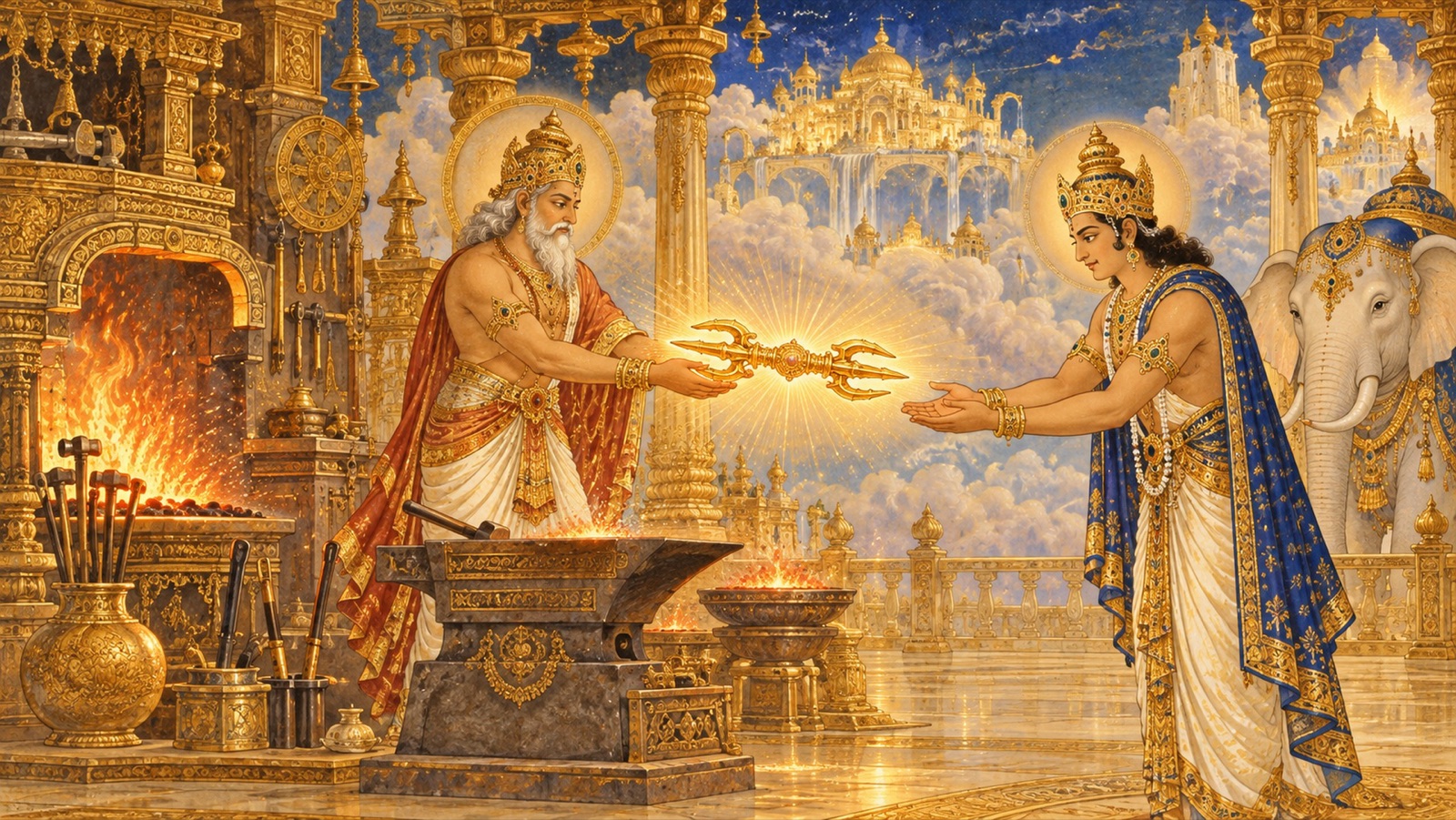
From the bones of that self-given saint, Vishvakarma, the heavenly artisan, forged the thunderbolt, and into it passed the energy of the Lord. Taking up that weapon, Indra felt mighty beyond measure. Surrounded by the hosts of the gods and extolled by crowds of sages, he shone upon the back of Airavata, the king of elephants, as if he were the very delight of the three worlds. To cut down Vritra, who stood ringed by the generals of the demon cohorts, he rushed forward full of wrath — as Rudra rushes against Death at the dissolution of the world (verses 13-15).
There, upon the bank of the holy river Narmada, at the beginning of the age of Treta in the very first round of the four Yugas of the present Manvantara, ensued a most fierce encounter of the gods with the demons. Indra stood resplendent in his native glory, attended by the Rudras, the Vasus, the Adityas, the two Asvini-kumaras, the Maruts and many hosts of heaven. The demons — Namuci, Sambara, Vipracitti, Puloma, Vrisaparva and thousands more, adorned with gold — could not bear the sight of him, and rained upon the celestial vanguard a storm of maces, clubs, arrows, barbed darts, lances, pikes, axes and swords (verses 16-23).
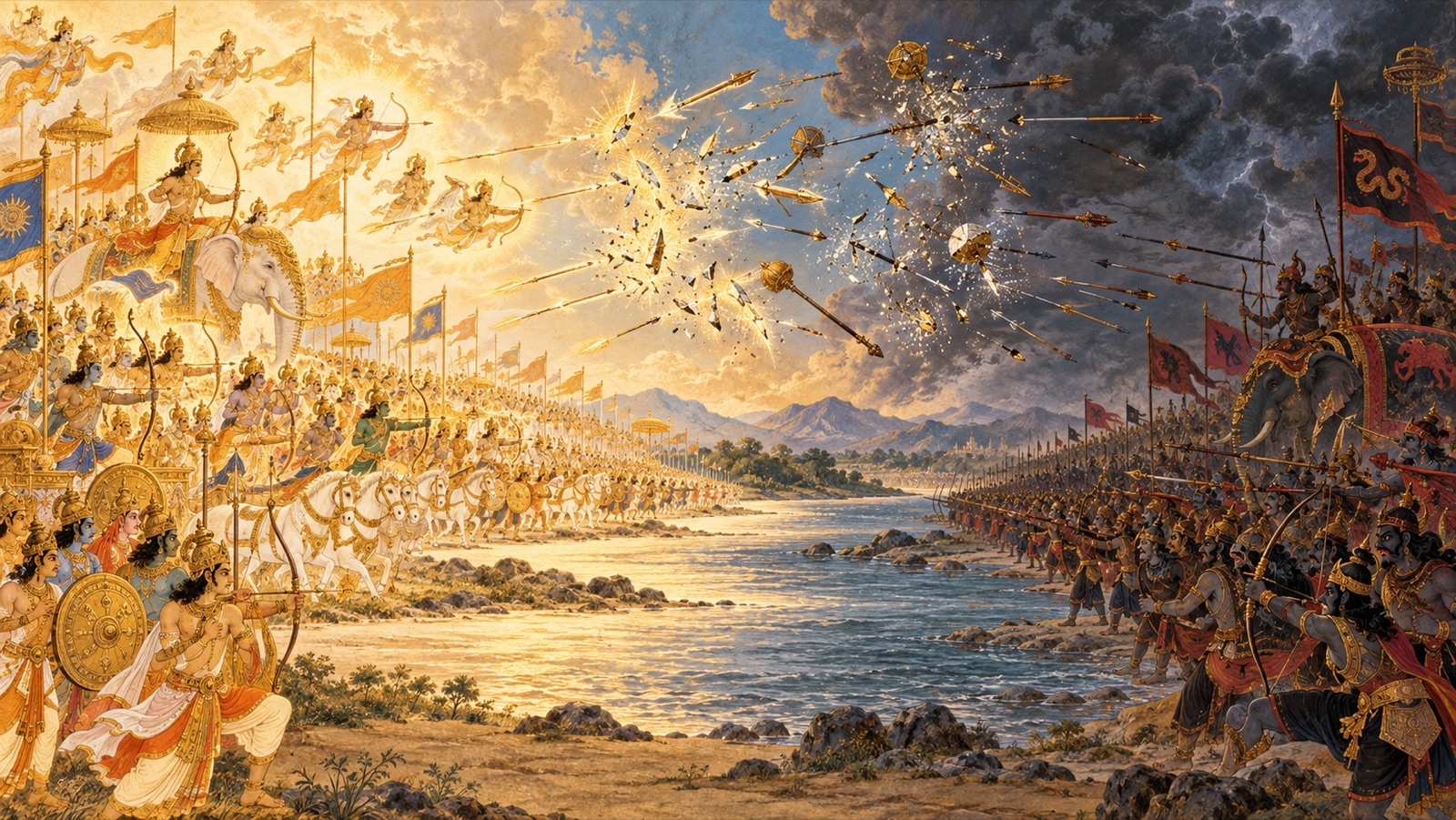
Yet the gods were skilled archers. Torn to a thousand pieces in the air, the whole deluge of missiles never so much as touched the celestial troops. When the demons then hurled down mountain peaks, trees and boulders, the gods split those as before. Finding Indra’s warriors unhurt by every weapon and unscathed even by the mountains they flung, the demons led by Vritra were filled with dismay. All their repeated efforts against the gods — to whom the all-blissful Lord was favourably disposed — proved utterly fruitless, just as the harsh and spiteful words of the wicked fail to provoke exalted souls (verses 24-28).
The Courage of Vritra
Seeing the futility of it, the demons — who cherished no devotion to Sri Hari and whose pride had been crushed — turned and fled, abandoning their own leader in the opening stages of the fight. But when Vritra saw his followers scattering in terror, that valiant and self-possessed hero only laughed, and spoke words appropriate to the moment and thrilling to the brave. “Hullo, Vipracitti, Namuci, Puloma, Maya, Anarva, Sambara — listen to me,” he called. This death that you so dread, he told them, is certain to befall everyone who is born, wherever he may be; the creator has devised no means of escaping it. If, then, heaven and lasting fame could be won from it, who would not gladly court so desirable a death? (verses 29-32)
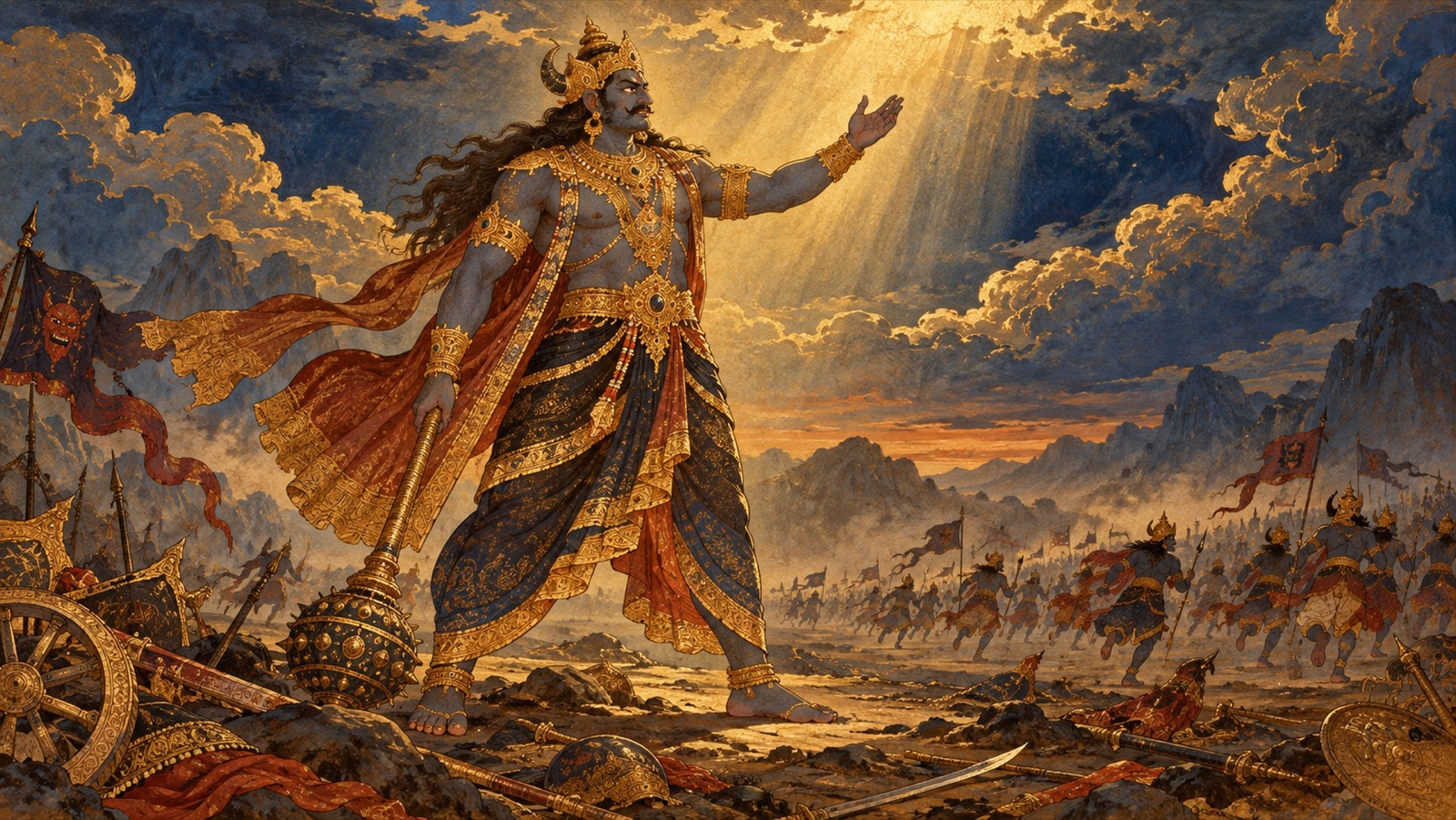
He then named the two deaths that the scriptures approve, and that rarely fall to one’s lot: the death of the yogi who, having mastered his vital airs and senses, lays down the body through deep absorption in Brahma; and the death of the warrior who falls at the forefront of battle, taking care never to turn his back upon the foe (verse 33).
द्वौ सम्मताविह मृत्यू दुरापौ यद् ब्रह्मसन्धारणया जितासु: । कलेवरं योगरतो विजह्याद् यदग्रणीर्वीरशयेऽनिवृत्त: ॥ ३३ ॥
dvau sammatāv iha mṛtyū durāpau yad brahma-sandhāraṇayā jitāsuḥ kalevaraṁ yoga-rato vijahyād yad agraṇīr vīra-śaye ‘nivṛttaḥ
Meaning: Two kinds of death are approved in the scriptures and are hard to obtain: that of the yogi who, having conquered his breath, casts off the body while absorbed in Brahma, and that of the warrior who falls at the front of battle and never turns his back upon the enemy. (Canto 6, Chapter 10, verse 33)
Principal Teachings of This Chapter
1. A true saint gives even his body for others. Dadhici does not merely lend his aid; he lays down his very life so that the gods may be delivered, showing that the highest charity is the gift of oneself (verses 11-12).
2. A fleeting body is meant for merit and mercy. The sage teaches that a frame which is bound to perish gains worth only when spent in righteousness and in compassion for living beings (verses 8-10).
3. The heart of holiness is fellow-feeling. To grieve and rejoice with the sorrows and joys of others is named by Dadhici as the eternal virtue of the pure (verse 9).
4. The Lord’s protection makes effort against His own futile. Every weapon of the demons fails against the gods whom the Lord favours, as spite fails to disturb the serene (verse 28).
5. Death, rightly met, is a doorway, not a terror. Vritra faces the certainty of death without fear, counting a death won in dharma or in valour as a thing to be welcomed (verses 32-33).
A Devotional Reflection
There are two kinds of greatness side by side in this chapter, and both are quietly instructive. First there is the sage who, when asked for the one thing a living being clings to most, hands it over with a smile — not because his body means nothing to him, but because he has learned that a perishable thing kept for oneself is wasted, while the same thing given away for others becomes imperishable merit. Dadhici turns the moment of death into an act of worship, folding his whole being into the Lord before the body even falls. Then there is Vritra, a demon by birth, who nevertheless meets the collapse of his army and the nearness of his own end with a composure that shames the brave gods who fled. He does not grasp at life; he welcomes a worthy death. The Bhagavata sets these two before us so that we might measure our own grip on the little we possess — our time, our strength, our very selves — and ask whether we are hoarding what was only ever lent to us, or spending it, as the saint did, in love and in service of others.
A Daily Devotional Practice
Today, choose one thing you tend to hold back — your time, your attention, a skill, a portion of what you own — and give it freely for someone else’s good, without expecting thanks or return. As you do so, remember the sage Dadhici, who offered his very bones so that heaven might be saved, and quietly offer your small act at the feet of the Lord with His holy name upon your lips. Let the body and the day you have been given be spent, even a little, in righteousness and in mercy.
Conclusion
The tenth chapter of the Sixth Canto turns upon a single, luminous act of surrender: a saint who gives his body so that a weapon of deliverance may be forged, and a Lord whose power alone makes that weapon invincible. From Dadhici’s hermitage the scene moves to the thunder of the Narmada battlefield, where the demons’ every missile falls harmless before the gods whom the Lord protects, and where even the demon Vritra teaches his comrades not to fear a worthy death. As the Canto moves toward Vritra’s own instruction of Indra, we carry with us the chapter’s steady lesson: that what we clutch for ourselves is lost, and what we offer to God and to others endures.
May the divine wisdom of Srimad Bhagavatam awaken pure devotion within our hearts.
Om Namo Bhagavate Vasudevaya.
Jay Shree Madhav.
References and Attribution
- Primary edition: Gita Press, Śrīmad Bhāgavata Mahāpurāṇa (English, complete), Book Six, Discourse 10.
- Series: Srimad Bhagavatam Wisdom · Biswa Sanatan Dharma Seva Trust.
- Presented following the spiritual guidance and recommendation of Pandit Dr. Shri Kashinath Mishra.
This is an original, faithful retelling in the writer’s own words, with brief quoted verses shown in Devanāgarī and transliteration and their meanings given as summaries. It is not a reproduction of any single publisher’s continuous translation or commentary. No affiliation with or endorsement by any publisher is implied.
Jay Shree Madhav