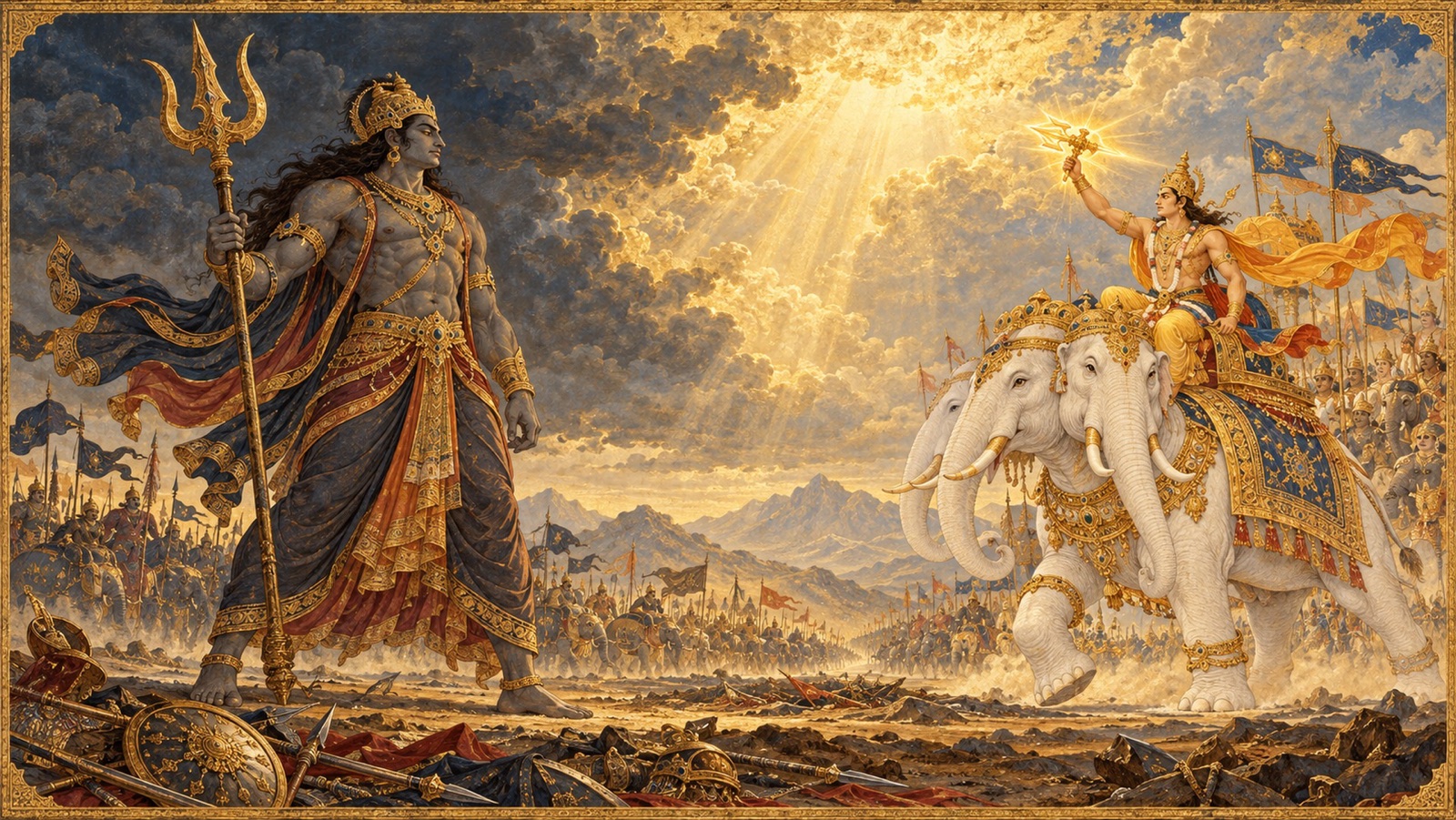
Towering alone upon the battlefield, the demon Vritra lifts his trident against the thunderbolt of Indra — yet his heart is turned wholly to the Lord, and from his lips flows not a curse but one of the purest prayers of surrender in all the Bhagavata.
Om Namo Bhagavate Vasudevaya.
Om Namo Bhagavate Vasudevaya.
Om Namo Bhagavate Vasudevaya.
Welcome to Srimad Bhagavatam Wisdom, a devotional journey through the sacred histories and teachings of the Srimad Bhagavat Mahapurana. The eleventh chapter of the Sixth Canto reveals an astonishing secret: that beneath the terrible form of the demon Vritra beat the heart of a great devotee of the Lord. Deserted by his fleeing army, Vritra rebukes the cowardice of the gods, overpowers them in combat, and then — facing the thunderbolt of Indra — pours out a prayer that asks for nothing of this world, only for the endless privilege of serving Lord Narayana birth after birth.
Chapter Information
- Scripture: Śrīmad Bhāgavata Mahāpurāṇa
- Canto: 6 (Book Six)
- Chapter: 11 (Discourse 11)
- Chapter title: The Transcendental Glory of Vritrasura
- Principal speaker: Sukadeva Gosvami, narrating to King Parikshit; the demon Vritra within the account
- Principal listener: King Parikshit; the sages of Naimisharanya at the outer frame
- Main setting: The battlefield on the bank of the river Narmada
- Central subject: Vritra’s valour, his instruction to the gods, and his prayer of pure devotion
- Principal verse range: Canto 6, Chapter 11, verses 1–27
- Primary edition: Gita Press Śrīmad Bhāgavata Mahāpurāṇa
Vritra Rebukes the Gods
Frantic with fear and intent only on flight, the demons paid no heed to the counsel of their chief, who had been preaching to them the wisdom of a fearless death. Roused to anger at the sight of his host being scattered, Vritra warded the gods off by his own might, and, scolding them, spoke: “What will you gain by striking from behind these fugitives who are no better than their mother’s refuse? The slaughter of the terror-stricken is neither praiseworthy nor a path to heaven for those who account themselves brave. If you are keen to fight, and if there is any courage in your hearts, O vile ones, then stand but for a moment before me.” (verses 1-5)
The Combat
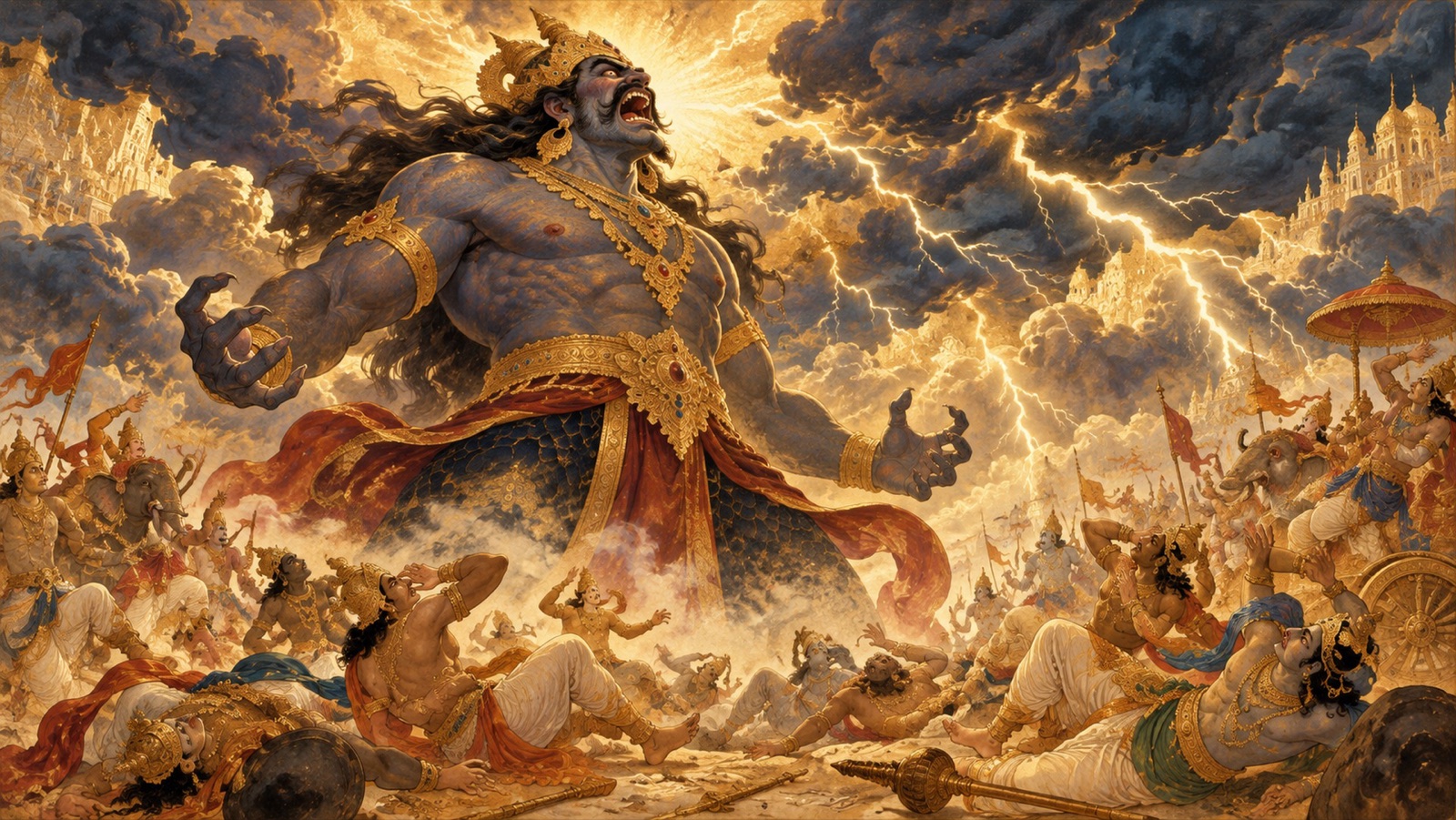
Thus challenging the host of the gods, and full of rage, Vritra roared so terribly that people fainted at the sound; struck as if by lightning, the gods dropped to the ground. Taking up his spear and shaking the earth, the demon trod the unconscious troops beneath his feet, as a lordly elephant tramples a bed of lotuses. Indra, seized with indignation, hurled a huge mace at the demon, who sportfully caught that most formidable weapon in his left hand and with it smote Airavata upon the head. Smitten like a mountain struck by lightning, the celestial elephant reeled back twenty-eight cubits, carrying Indra, and vomited blood (verses 6-11).
Yet that noble soul Vritra did not strike a second time at the dejected Indra. By the nectar-shedding touch of his hand Indra healed his wounded elephant and stood once more before his foe. Seeing Indra — the slayer of his brother Visvarupa — armed with the thunderbolt and seeking single combat, Vritra was filled with grief as he recalled that cruel deed, and, laughing, began to speak (verses 12-13).
Vritra’s Fearless Words
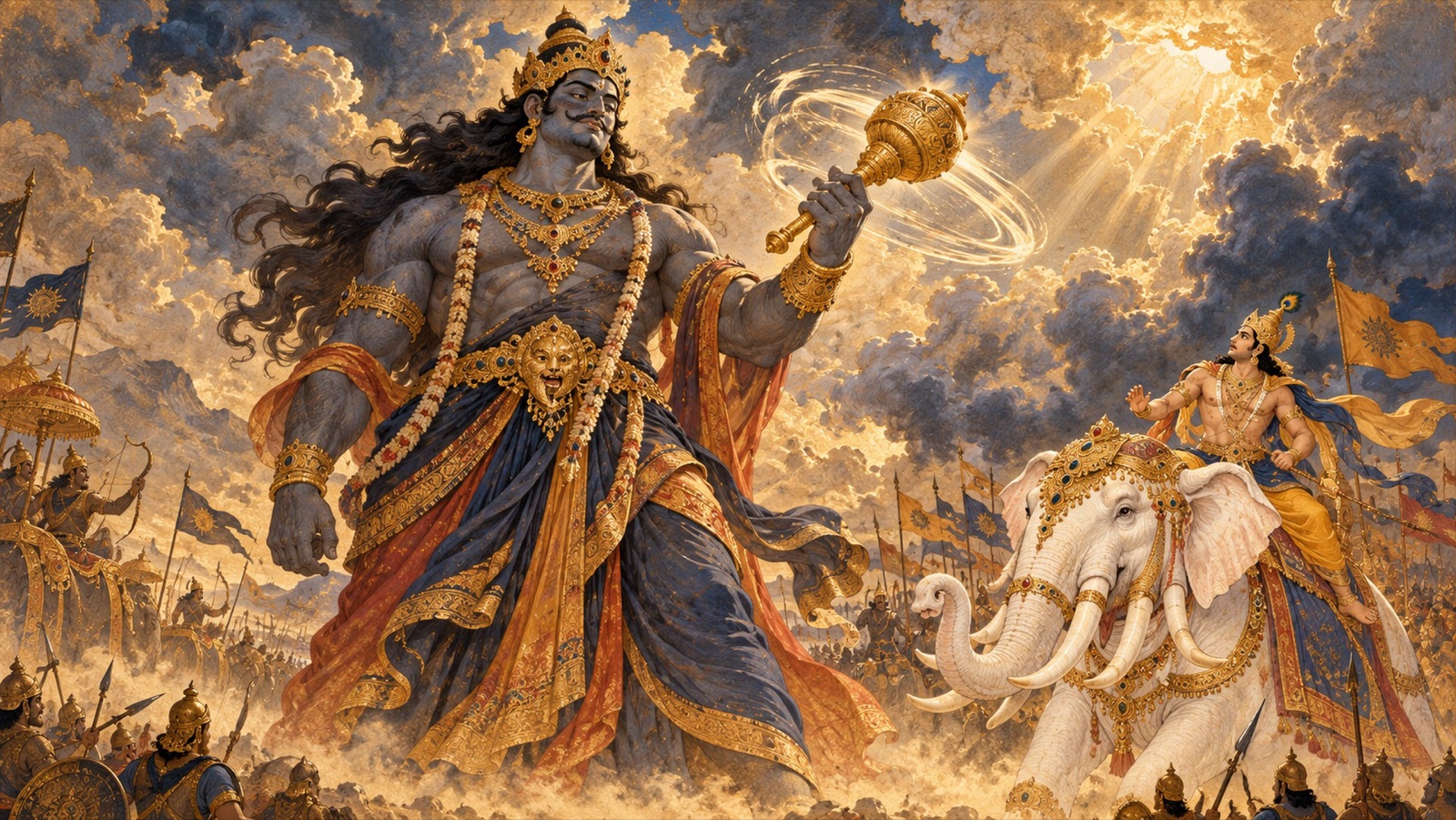
“Luckily for me,” Vritra said, “you who slew a Brahmana — your own preceptor, and my brother — have stood firm before me as my adversary. Today, when my trident has pierced your stone-like heart, I shall have discharged my debt to my brother.” He reminded Indra of the ruthless beheading of the innocent Visvarupa, who had been engaged in sacrifice on Indra’s own behalf, and declared that if instead his own head should be severed by the thunderbolt, he would gladly offer his body to the birds and beasts and, freed from every debt of karma, attain the dust of the feet of enlightened souls (verses 14-18).
Then came words that no ordinary demon could speak. “O ruler of the gods, why do you not hurl your unfailing thunderbolt at me, stationed before you? Do not doubt it: this thunderbolt, whetted by the energy of Sri Hari and the asceticism of the sage Dadhici, will never prove ineffectual, for victory, fortune and every virtue lean to that side alone on which Sri Hari stands. Fixing my mind, as He has instructed me, upon the lotus-feet of Lord Sankarshana, and with the cords of my attachment to the senses cut asunder by your thunderbolt, I shall cast off this body and attain the destiny of a sage absorbed in contemplation.” (verses 19-21)
The Prayer of a Pure Devotee
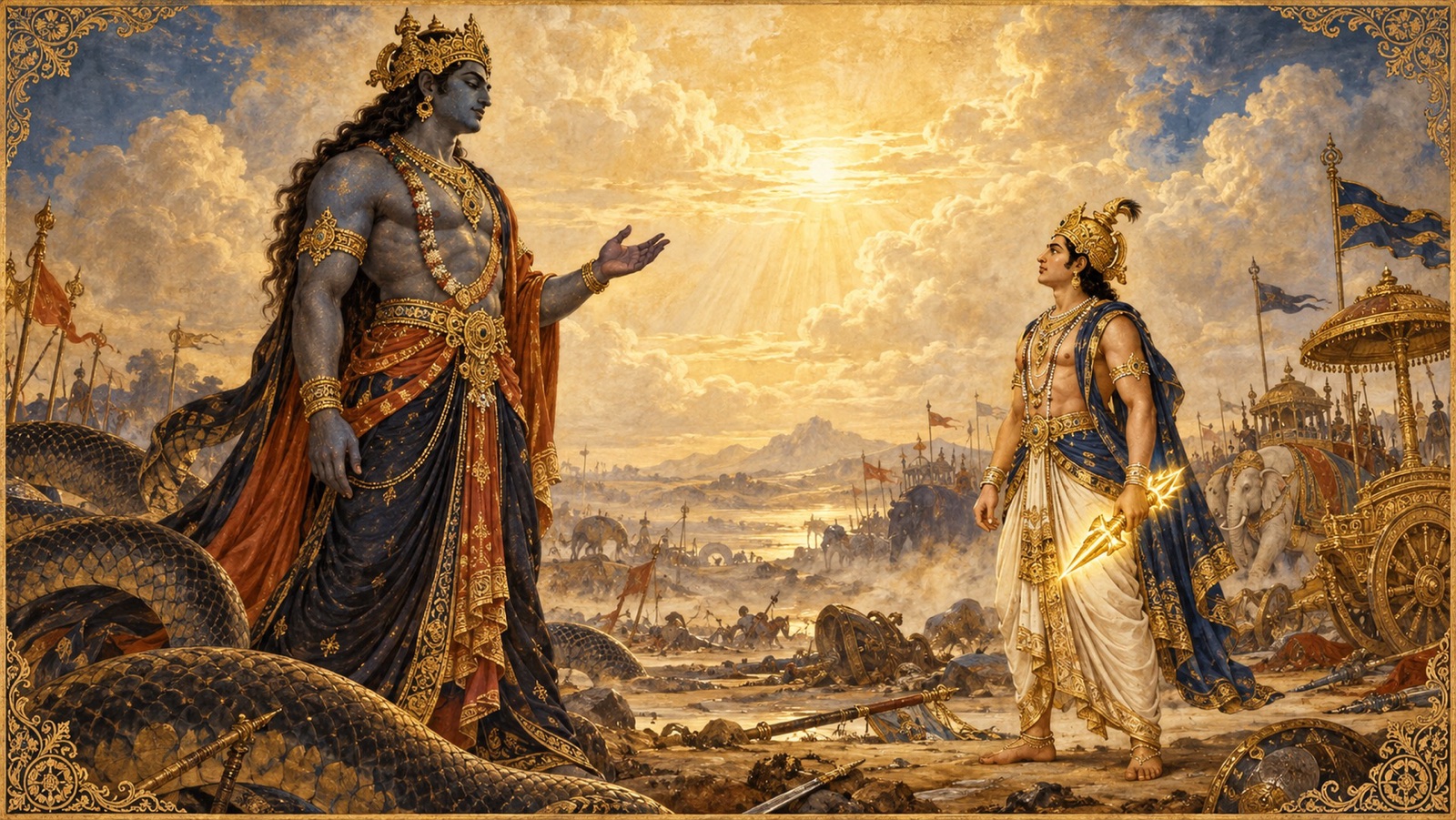
Here the chapter opens into its true heart. The Lord, Vritra declared, does not bestow upon His own exclusive devotees the riches of heaven, earth or the subterranean worlds — for from such wealth follow hatred, fear, anguish, arrogance, discord, suffering and toil. Indeed, the Master lovingly frustrates His servant’s striving after religious merit, wealth and enjoyment; and from that very frustration one may infer the grace of the Lord, a grace reserved for those who have nothing of their own to call theirs and hard for others to obtain (verses 22-23).
Then Vritra prayed. “May I be born again, O Hari, as a servant of those devotees who have taken sole refuge at Your lotus-feet. Let my mind dwell upon Your excellences, my tongue celebrate them, and my body do only Your service.” And he asked for nothing beyond the Lord Himself (verses 24-25).
न नाकपृष्ठं न च पारमेष्ठ्यं न सार्वभौमं न रसाधिपत्यम् । न योगसिद्धीरपुनर्भवं वा समञ्जस त्वा विरहय्य काङ्क्षे ॥ २५ ॥
na nāka-pṛṣṭhaṁ na ca pārameṣṭhyaṁ na sārva-bhaumaṁ na rasādhipatyam na yoga-siddhīr apunar-bhavaṁ vā samañjasa tvā virahayya kāṅkṣe
Meaning: O perfectly complete Lord, I do not desire, if it means being parted from You, the abode of Dhruva, nor the realm of Brahma, nor sovereignty over the earth, nor dominion over the lower worlds, nor the perfections of yoga, nor even freedom from rebirth. (Canto 6, Chapter 11, verse 25)
As unfledged birds long to see the mother that feeds them, as hungry calves yearn for the cow’s milk, as a lonely wife longs for her absent husband, so, he said, did his mind long to behold the lotus-eyed Lord (verse 26). His one request was for holy company — the friendship of the Lord’s devotees — and his one fear was the company of the worldly.
ममोत्तमश्लोकजनेषु सख्यं संसारचक्रे भ्रमत: स्वकर्मभि: । त्वन्माययात्मात्मजदारगेहे- ष्वासक्तचित्तस्य न नाथ भूयात् ॥ २७ ॥
mamottamaśloka-janeṣu sakhyaṁ saṁsāra-cakre bhramataḥ sva-karmabhiḥ tvan-māyayātmātmaja-dāra-geheṣv āsakta-cittasya na nātha bhūyāt
Meaning: As I wander in the wheel of birth and death by my own deeds, let my friendship be only with those devoted to You of excellent renown; and let me never, O Lord, befriend one whose mind is bound by Your Maya to body, children, wife and home. (Canto 6, Chapter 11, verse 27)
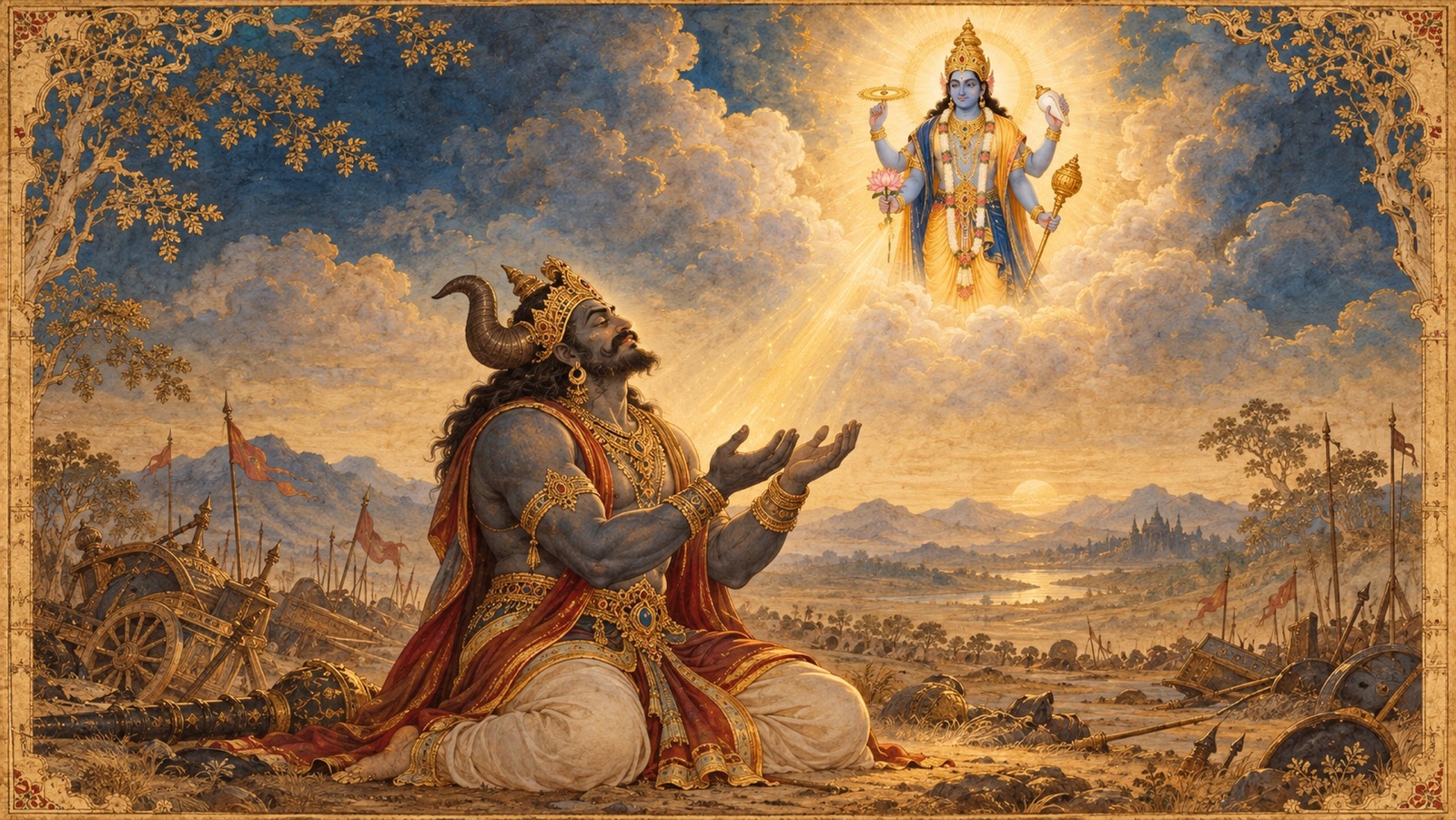
Such was the heart of the demon who stood armed against heaven: a heart already at the feet of the Lord, longing only for the shelter of His devotees and the sweetness of His service.
Principal Teachings of This Chapter
1. Devotion can shine in the most unlikely heart. Vritra, a demon by birth and ferocious in battle, reveals a purity of love for the Lord that puts the gods to shame (verse 14).
2. The true devotee desires nothing but the Lord. Vritra refuses heaven, sovereignty, yogic powers and even liberation, asking only to serve the Lord birth after birth (verse 25).
3. The Lord’s grace may look like loss. When the Lord withholds worldly success from His servant, it is not neglect but mercy, sparing him the pride and bondage that wealth breeds (verses 22-23).
4. Longing is the language of love. Vritra likens his yearning for the Lord to the helpless longing of a chick, a calf and a lonely wife — a love that cannot be satisfied by anything less than its object (verse 26).
5. Holy company is the one thing worth asking. His single prayer is for the friendship of devotees and freedom from attachment to the worldly-minded (verse 27).
A Devotional Reflection
It is easy to divide the world into heroes and villains, gods and demons, and to assume that goodness wears only the faces we expect. This chapter quietly shatters that assumption. The gods, for all their brightness, flee from the battlefield; and it is the demon who turns to rebuke them, who fights without cruelty, who spares his dazed enemy a second blow, and who, with death a breath away, lifts his heart to Lord Narayana in a prayer of flawless surrender. Vritra does not bargain. He does not ask to win, or to live, or even to be freed from rebirth. He asks only that, wherever his deeds may carry him, his mind might dwell on the Lord, his tongue sing the Lord’s glories, and his body serve the Lord’s devotees. Here is the measure of real devotion: not the absence of hardship, but a heart so fixed on God that it treasures even the stroke of the thunderbolt as the hand that will cut its last attachment. The Bhagavata holds Vritra before us so that we may stop measuring souls by their outward station and begin to recognise devotion wherever it truly lives.
A Daily Devotional Practice
Today, examine the shape of your prayers. We so often ask the Lord for safety, success, relief, or the removal of some trouble. Following the example of Vritra, offer at least one prayer that asks for nothing of this world at all — only for the grace to remember the Lord, to speak His name, and to serve those who love Him. If a difficulty will not lift, consider that its very weight may be the Lord’s mercy, loosening your grip on what cannot last, and quietly thank Him for it.
Conclusion
The eleventh chapter of the Sixth Canto is one of the Bhagavata’s great surprises: the unveiling of a saint within a demon. Vritra fights with courage and without malice, overpowers the gods, spares his fallen foe, and then, with the thunderbolt poised against him, prays only to love and serve the Lord through every birth to come, refusing heaven and liberation alike for the sake of that love. As the Canto moves on to the final combat and Vritra’s glorious passing, we carry with us his unforgettable lesson: that the purest prayer asks for nothing but God Himself, and that His deepest grace is to draw the soul away from everything that is not Him.
May the divine wisdom of Srimad Bhagavatam awaken pure devotion within our hearts.
Om Namo Bhagavate Vasudevaya.
Jay Shree Madhav.
References and Attribution
- Primary edition: Gita Press, Śrīmad Bhāgavata Mahāpurāṇa (English, complete), Book Six, Discourse 11.
- Series: Srimad Bhagavatam Wisdom · Biswa Sanatan Dharma Seva Trust.
- Presented following the spiritual guidance and recommendation of Pandit Dr. Shri Kashinath Mishra.
This is an original, faithful retelling in the writer’s own words, with brief quoted verses shown in Devanāgarī and transliteration and their meanings given as summaries. It is not a reproduction of any single publisher’s continuous translation or commentary. No affiliation with or endorsement by any publisher is implied.
Jay Shree Madhav