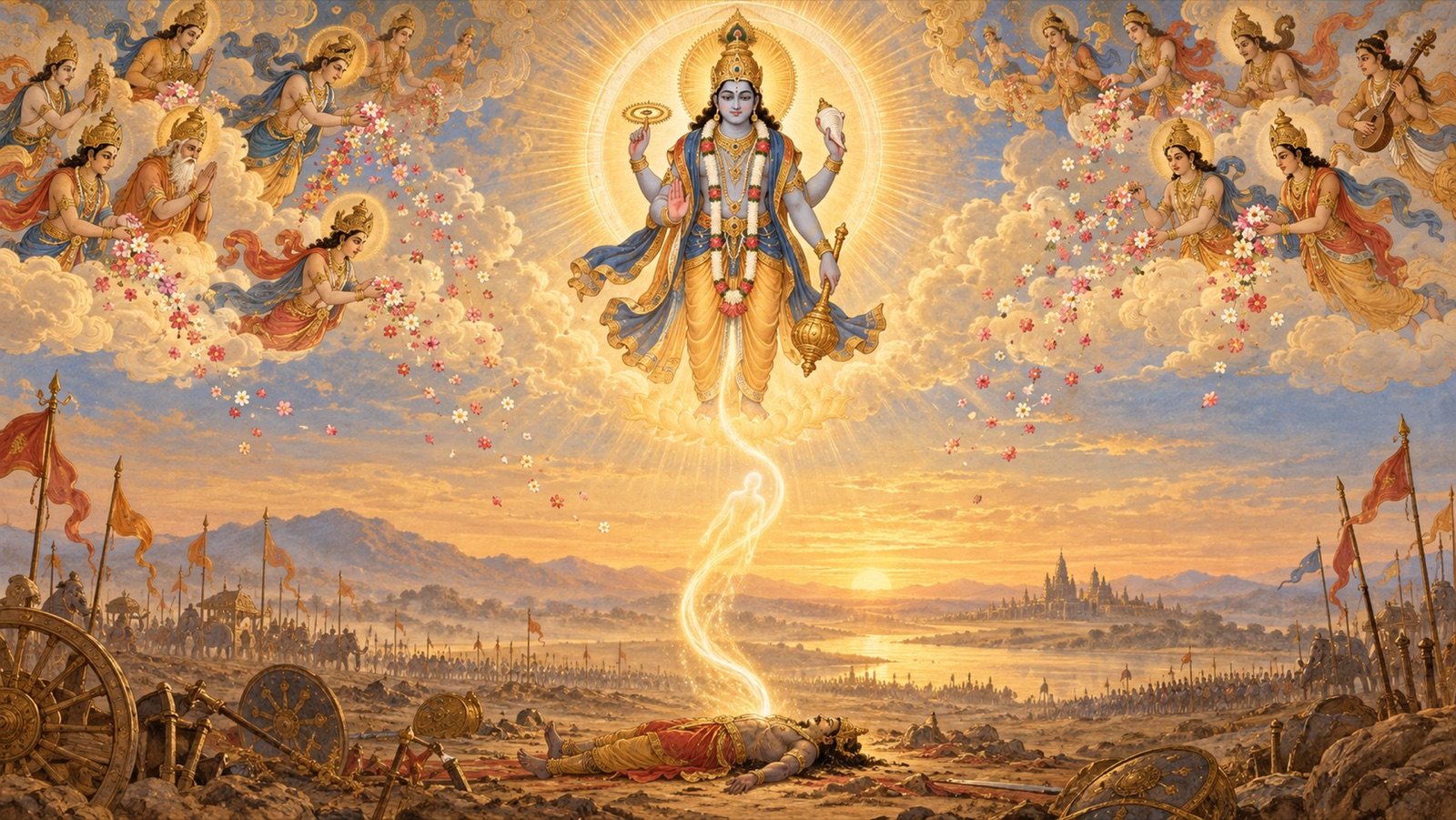
When at last the thunderbolt severs the head of the mighty Vritra, his soul rises from the fallen body as a stream of light and merges into Lord Narayana, while the gods, the sages and the perfected beings look on in wonder and rain down flowers.
Om Namo Bhagavate Vasudevaya.
Om Namo Bhagavate Vasudevaya.
Om Namo Bhagavate Vasudevaya.
Welcome to Srimad Bhagavatam Wisdom, a devotional journey through the sacred histories and teachings of the Srimad Bhagavat Mahapurana. The twelfth chapter of the Sixth Canto brings the long battle to its close — yet it is less a tale of defeat than of liberation. Vritra fights on even after losing his arms, and in the midst of combat teaches Indra that the Lord alone, as Time, decides victory and defeat. When the thunderbolt finally falls, the demon’s soul does not perish but merges, luminous, into the Lord — the glorious death of a devotee who had never truly left His feet.
Chapter Information
- Scripture: Śrīmad Bhāgavata Mahāpurāṇa
- Canto: 6 (Book Six)
- Chapter: 12 (Discourse 12)
- Chapter title: The Glorious Death of Vritrasura
- Principal speaker: Sukadeva Gosvami, narrating to King Parikshit; Vritra and Indra within the account
- Principal listener: King Parikshit; the sages of Naimisharanya at the outer frame
- Main setting: The battlefield on the bank of the river Narmada
- Central subject: Vritra’s final combat, his teaching on the Lord as Time, and the merging of his soul into the Lord
- Principal verse range: Canto 6, Chapter 12, verses 1–35
- Primary edition: Gita Press Śrīmad Bhāgavata Mahāpurāṇa
The Trident Hurled
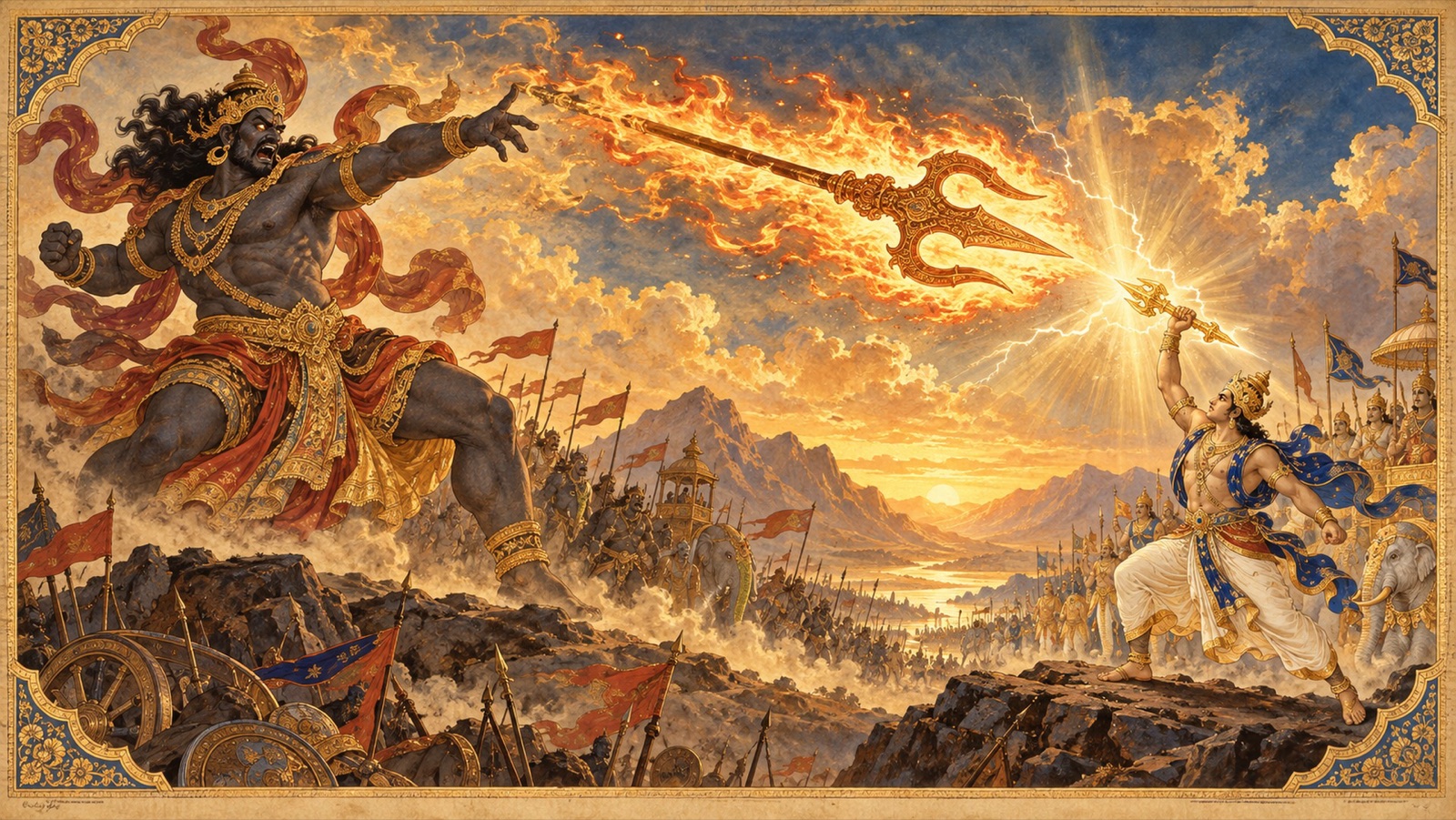
Longing now to lay down his body on the field, and counting death more desirable than victory, Vritra seized his trident and rushed at Indra as the demon Kaitabha once rushed at Lord Vishnu upon the waters of dissolution. Whirling the trident, whose prongs blazed like the fire that breaks forth at the end of the world, he hurled it with all his force and roared, “You are slain, O wicked one!” But Indra, unperturbed, cut down with his hundred-jointed thunderbolt both the darting trident and the demon’s arm, round and thick as the body of Vasuki, the king of serpents (verses 1-3).
With one arm severed and full of fury, Vritra drew near and struck Indra and Airavata upon the jaws with his iron club — and the thunderbolt slipped from Indra’s hand. Gods and demons, Charanas and Siddhas alike marvelled at the feat, crying “Alas! Alas!” to see Indra’s plight. Ashamed, Indra would not pick up the weapon in the presence of his foe. And then the demon spoke words that no enemy would expect: “Take up your thunderbolt once more, O Indra, and slay your enemy. This is no time for despondency.” (verses 4-6)
Vritra’s Teaching on the Lord as Time
What followed was not the taunt of a warrior but the wisdom of a devotee. Victory, Vritra said, does not always woo those who bear arms; all beings are subject to their destiny, save the Lord alone — the all-knowing Cause, the one Controller of creation, preservation and dissolution. It is that Lord, in the form of Time, who ordains victory and defeat, while the worlds and their guardian deities act helplessly, like birds caught in a net. One who does not recognise Him as the true cause looks instead to the gross body for the source of his strength. Just as a wooden puppet moves only at the will of the showman, so every living being is subject to God (verses 7-10).
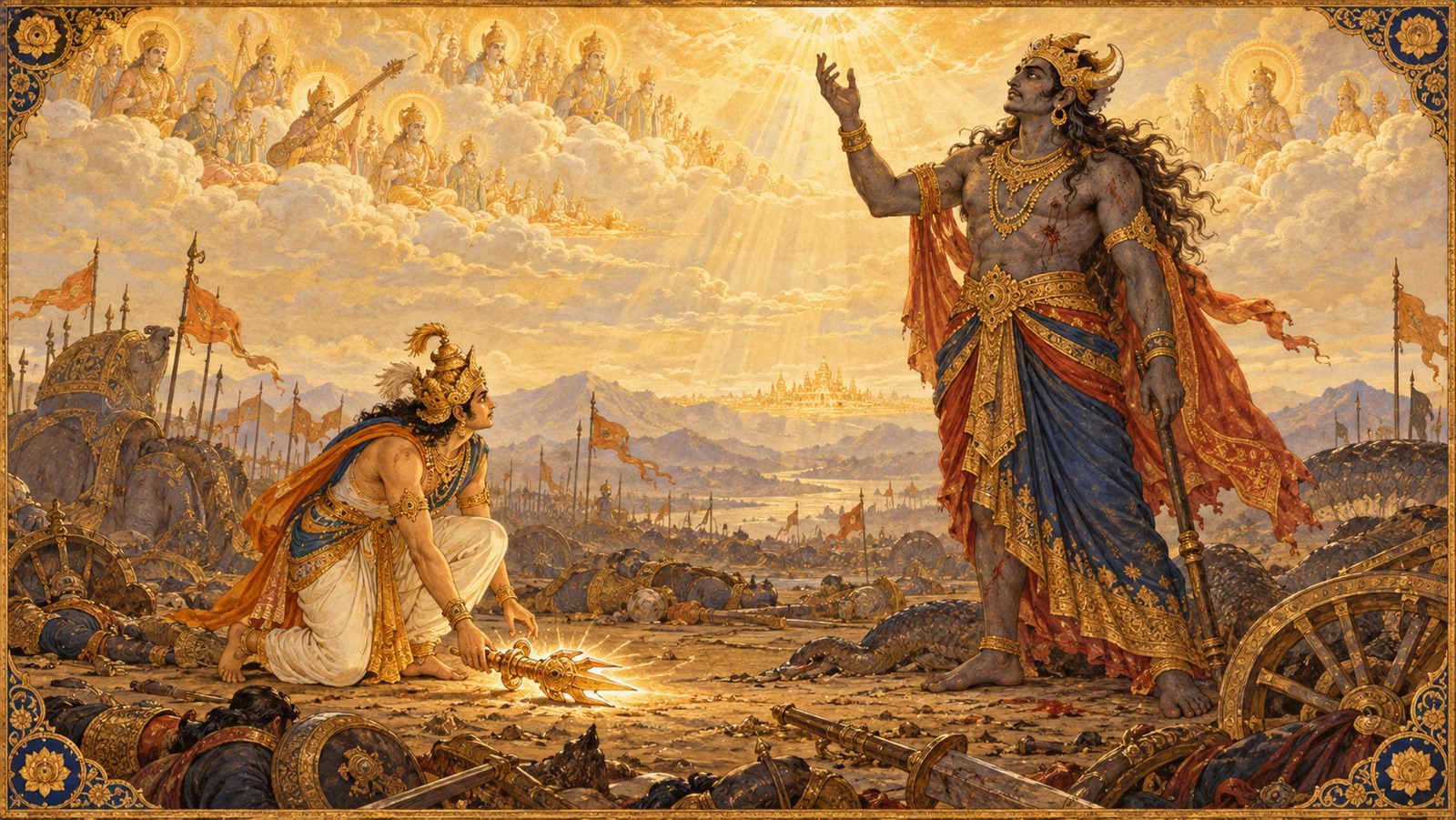
Whatever a person covets — long life, wealth, fame or power — comes to him at the appointed time, as surely as do their opposites, even against his will. Therefore, Vritra taught, one should remain balanced in joy and sorrow, in honour and disgrace, in victory and defeat, and in life and death alike. The three modes — goodness, passion and ignorance — belong to material nature, not to the Self; and whoever knows the Self to be only their witness is not bound by them (verses 11-15).
सत्त्वं रजस्तम इति प्रकृतेर्नात्मनो गुणा: । तत्र साक्षिणमात्मानं यो वेद स न बध्यते ॥ १५ ॥
sattvaṁ rajas tama iti prakṛter nātmano guṇāḥ tatra sākṣiṇam ātmānaṁ yo veda sa na badhyate
Meaning: Goodness, passion and ignorance are the qualities of material nature, not of the Self; one who knows the Self to be the mere witness of these is never bound by them. (Canto 6, Chapter 12, verse 15)
“Look at me,” he said, “striving with all my power to take your life, though already vanquished and with my weapon and arm cut away. This warfare is but a game of chance, in which life itself is staked and the arrows are the dice — and none can know, until the end, whose is the victory and whose the defeat” (verses 16-17). Hearing this guileless speech, Indra welcomed it, took up the thunderbolt, and laughing, replied.
Indra Honours His Foe
“You have truly achieved your object, O demon,” said Indra, “blessed as you are with such a mind even now, and devoted with your whole being to the Lord, who is your very Self and Friend. You have crossed beyond the Maya of Lord Vishnu that deludes the world; having shed the demoniac nature, you have risen to the level of an exalted soul. It is a great wonder that, though born of passion, you have conceived such unswerving devotion to Lord Vasudeva. What use has he for a shallow ditch of water who sports in an ocean of nectar — the nectar of devotion to Sri Hari?” (verses 18-22)
The Glorious Death
Then the two fought on. Vritra hurled his iron bludgeon with his remaining left hand, and Indra cut down both the weapon and that arm with his thunderbolt. With both arms severed at the root and streaming blood, the demon shone like a great mountain. Of gigantic form, he stretched his lower jaw to the earth and his upper jaw to the heavens, and, as though to devour the three worlds, swallowed Indra together with Airavata, even as a python swallows an elephant. Seeing Indra devoured, the gods, the lords of creation and the eminent sages were seized with despair (verses 23-30).
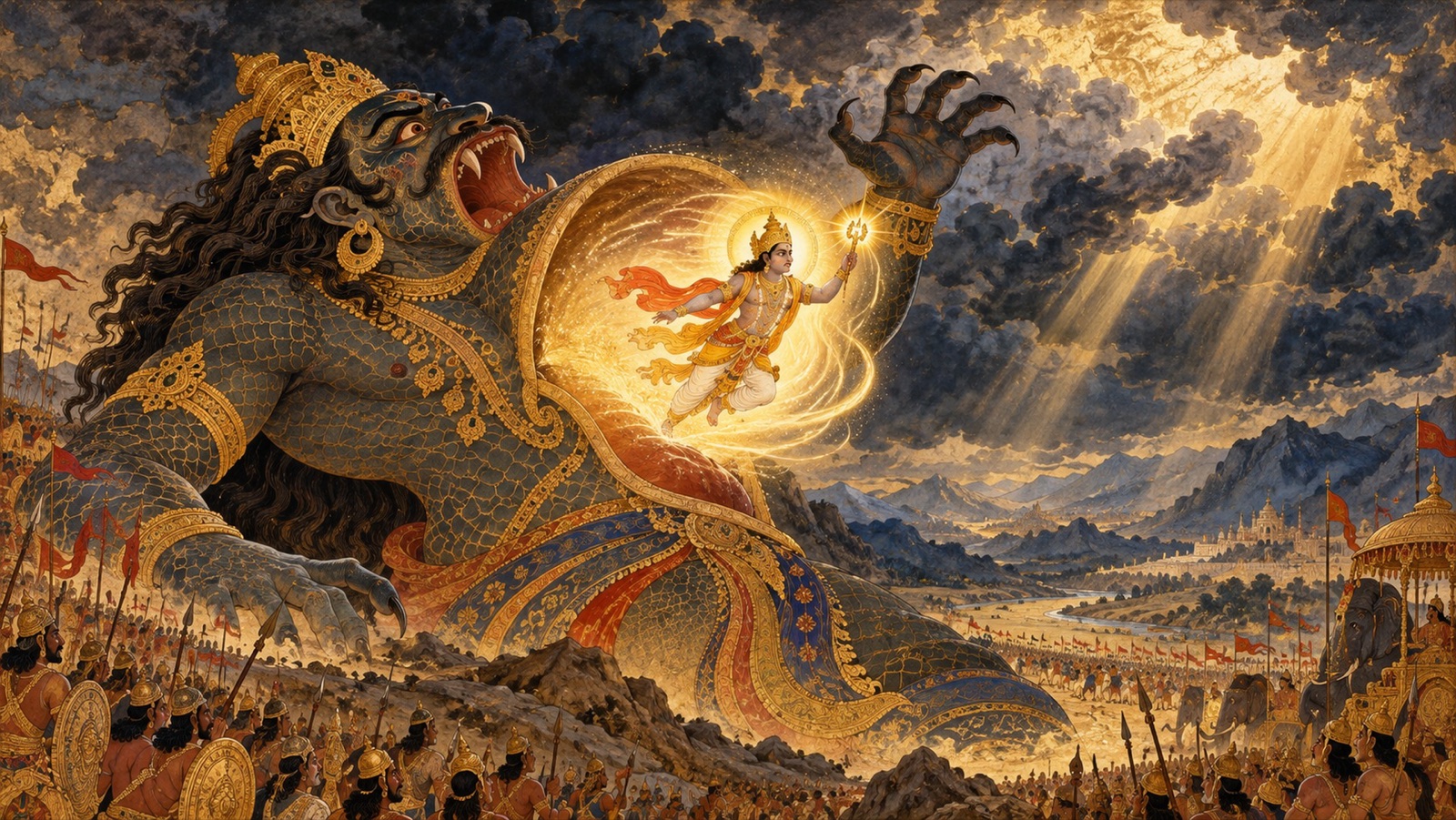
Yet, protected by Lord Narayana through the armour-like Narayana-kavaca and by mystic power, Indra did not perish within the demon’s belly. Ripping it open with his thunderbolt and emerging, he struck off the enemy’s head like the peak of a mountain. Though whirling swiftly and cutting on every side, the thunderbolt took as many days to sever that neck as the sun takes in its northward and southward courses — for the appointed hour of the demon’s death had come. Drums sounded, and the Gandharvas and Siddhas with the sages joyfully rained down flowers, glorifying the slayer of Vritra (verses 31-34).
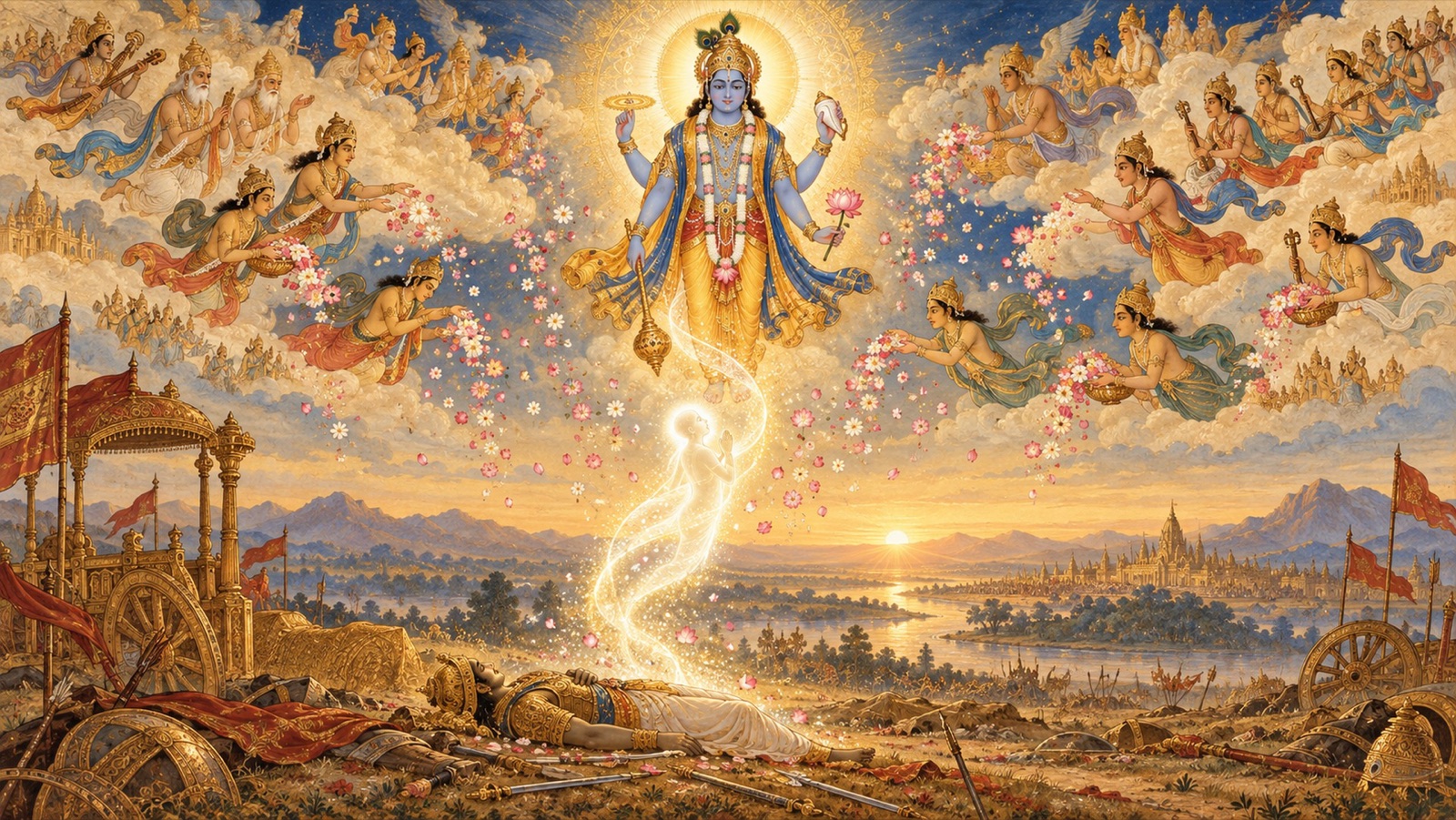
Then came the moment the whole long war had been moving toward. Issuing forth from Vritra’s body as a radiance, the soul of the demon entered and merged into the Lord — the Lord who lies beyond all the material worlds — while all those present looked on in wonder (verse 35).
वृत्रस्य देहान्निष्क्रान्तमात्मज्योतिररिन्दम । पश्यतां सर्वदेवानामलोकं समपद्यत ॥ ३५ ॥
vṛtrasya dehān niṣkrāntam ātma-jyotir arindama paśyatāṁ sarva-devānām alokaṁ samapadyata
Meaning: O subduer of foes, the self-effulgent soul of Vritra, issuing from his body, merged into the transcendental Lord while all the gods looked on. (Canto 6, Chapter 12, verse 35)
Principal Teachings of This Chapter
1. The Lord alone, as Time, grants victory and defeat. Vritra teaches that no warrior’s strength decides the outcome; all beings move at the Lord’s will, like birds within a net (verses 7-10).
2. Equanimity is the fruit of this knowledge. Since gain and loss come at their appointed hour, the wise remain balanced in honour and disgrace, victory and defeat, life and death (verse 14).
3. The Self is the witness, not the doer of the modes. Goodness, passion and ignorance belong to nature; one who knows the Self as their silent witness is freed from bondage (verse 15).
4. Devotion outshines every lesser prize. Indra marvels that one who delights in the ocean of devotion to the Lord has no wish for the ditch-water of worldly gain (verse 22).
5. The death of a devotee is his liberation. Vritra’s soul does not perish but merges into the Lord — the glorious end of one whose heart had never left His feet (verse 35).
A Devotional Reflection
A battlefield is the last place we would expect to find a teacher of equanimity, and a dying demon the last mouth from which we would expect to hear it. Yet here is Vritra, arms severed and life draining away, urging his enemy to pick up the fallen weapon and pointing him, through every blow, to the one truth that steadies a soul: that victory and defeat are not ours to seize but the Lord’s to grant, and that the Self within us is only the witness of nature’s restless play, never its prisoner. He fights with all his strength and loses without bitterness, because he has already placed the outcome where it belongs. And when the end comes, it is not an ending at all. The light that was always within him returns to its source; his soul merges into the Lord before the eyes of heaven. The Bhagavata lets us watch this so that we might loosen our own frantic grip on winning and losing, and learn to act with all our heart while leaving the result in the hands of God — trusting that for the devotee, even death is only a homecoming.
A Daily Devotional Practice
Today, choose one effort — a task, a difficulty, a contest of some kind — and give it your whole strength while silently surrendering its outcome to the Lord. Before you begin, offer it at His feet; when it is done, whether it brought success or disappointment, receive the result as His gift and remain even-minded. Through the day, remember that you are not the body that wins or loses but the witnessing soul within, and let the holy name rest quietly on your tongue as you work.
Conclusion
The twelfth chapter of the Sixth Canto turns a scene of carnage into one of the Bhagavata’s most luminous lessons. Vritra, even as he dies, teaches that the Lord alone decides all victory and defeat, that the wise remain equipoised, and that the Self is the untouched witness of nature’s modes. Indra honours the devotion of his foe, and when the thunderbolt at last falls, the demon’s soul merges into the Lord in full view of heaven. As the Canto turns next to Indra’s own burden of sin for this slaying, we carry with us the chapter’s radiant close: that for one whose heart rests in the Lord, the hour of death is the hour of return.
May the divine wisdom of Srimad Bhagavatam awaken pure devotion within our hearts.
Om Namo Bhagavate Vasudevaya.
Jay Shree Madhav.
References and Attribution
- Primary edition: Gita Press, Śrīmad Bhāgavata Mahāpurāṇa (English, complete), Book Six, Discourse 12.
- Series: Srimad Bhagavatam Wisdom · Biswa Sanatan Dharma Seva Trust.
- Presented following the spiritual guidance and recommendation of Pandit Dr. Shri Kashinath Mishra.
This is an original, faithful retelling in the writer’s own words, with brief quoted verses shown in Devanāgarī and transliteration and their meanings given as summaries. It is not a reproduction of any single publisher’s continuous translation or commentary. No affiliation with or endorsement by any publisher is implied.
Jay Shree Madhav